
ASEAN
From Reset to Readiness: Southeast Asia’s Capital Markets in 2026

Southeast Asia capital markets 2026 are poised for growth after a reset year. Explore IPO trends, foreign inflows, AI opportunities, and investment strategies across ASEAN.
The trading floor in Jakarta’s financial district hums with a different energy these days. Where 2024 brought hesitation and volatility, early 2026 carries something more tangible: anticipation. On screens across the room, green tickers outnumber red ones. Foreign investors, absent for much of the previous two years, are tentatively returning. The Indonesian rupiah, once under relentless pressure, has found footing. A senior equity analyst leans back in her chair, reviewing the latest IPO filings. “We’re not celebrating yet,” she says, “but we’re ready.”
This moment—cautious, data-driven, forward-looking—captures the inflection point facing Southeast Asia’s capital markets in 2026. After a turbulent 2024 marked by aggressive Federal Reserve tightening, dollar strength, and capital flight, 2025 became what many now call the “reset year.” Interest rates peaked and began their descent. The dollar’s relentless climb reversed. Initial public offerings, moribund across much of ASEAN for two years, began showing signs of life in Hong Kong and India, stabilizing sentiment regionally. Institutional investors who had written off emerging Asia started circling back.
Now, as Southeast Asia capital markets 2026 take shape, the fundamental question isn’t whether conditions have improved—they demonstrably have. It’s whether this region of 680 million people, growing at roughly 4.5–5% annually, can translate macro stabilization into durable capital market momentum. The answer matters enormously: to pension funds reallocating toward emerging markets, to tech startups eyeing public listings, to infrastructure developers requiring patient capital, and to the millions of Southeast Asians whose prosperity depends on efficient capital allocation.
This article examines that question through multiple lenses—monetary policy shifts, returning foreign capital, country-by-country dynamics, sectoral opportunities, and looming risks—to provide investors, policymakers, and market participants with a comprehensive roadmap for navigating Southeast Asia’s capital markets in the year ahead.
The 2025 Reset – What Changed and Why It Matters
Understanding 2026 requires grasping what made 2025 pivotal. Three structural shifts occurred, each reversing painful trends from the previous two years.
Interest Rate Reversal and Its Ripple Effects
The Federal Reserve’s pivot from hawkish tightening to cautious easing fundamentally altered capital flows. After holding rates at 5.25–5.50% through much of 2024, the Fed began cutting in late 2024 and continued through 2025, bringing rates down to approximately 4.25% by year-end. This wasn’t merely technical—it represented a regime change. Emerging market bonds, yielding 6–8% in local currencies, suddenly looked attractive again relative to risk-free Treasuries. Indonesian 10-year bonds rallied. Thai government debt found buyers. The cost of capital across ASEAN declined measurably.
Regional central banks responded asymmetrically. Bank Indonesia cut rates 75 basis points over six months, supporting rupiah stability while stimulating domestic credit. The Monetary Authority of Singapore maintained its gradual appreciation stance but signaled comfort with slower tightening. Vietnam’s State Bank navigated between supporting the dong and preventing overheating, ultimately finding equilibrium around 5% policy rates. The result: borrowing costs for corporations fell, IPO windows opened, and refinancing risk for leveraged companies diminished.

Dollar Weakness and Currency Stabilization
Perhaps nothing mattered more for Southeast Asia investment trends 2026 than the dollar’s retreat. After appreciating nearly 20% against a basket of ASEAN currencies between 2022 and early 2024, the greenback gave back approximately half those gains through 2025. The rupiah strengthened from 16,000 to roughly 15,200 per dollar. The Thai baht recovered from 36 to 33. Vietnamese dong volatility subsided.
This wasn’t just about exchange rates—it was about confidence. Corporate treasurers with dollar debt breathed easier. Exporters regained competitiveness. Most critically, foreign portfolio investors who had suffered devastating currency losses in 2023–2024 saw hedging costs decline and return profiles improve. December 2025 data showed foreign inflows returning to Southeast Asian equities for the first time in nearly two years, with approximately $337 million entering regional markets—modest in absolute terms but symbolically significant.
IPO Market Thawing
Initial public offerings serve as both capital-raising mechanism and sentiment barometer. By this measure, 2024 was catastrophic: IPO volumes across Southeast Asia fell roughly 60% year-over-year as volatility, valuation compression, and risk aversion shuttered primary markets. Companies postponed listings. Venture capital-backed startups extended runway. Private equity firms held assets longer than planned.
The 2025 thaw began not in ASEAN but nearby—Hong Kong and India. Hong Kong’s IPO pipeline rebuilt through mid-2025 as Chinese companies sought international capital and valuations stabilized. Indian listings, particularly in technology and consumer sectors, attracted robust demand. This mattered for Southeast Asia: institutional investors who had sworn off emerging market IPOs began participating again. Underwriting syndicates reformed. Pricing mechanisms functioned. By late 2025, Indonesian and Singaporean issuers were testing investor appetite with small-to-medium offerings, often receiving adequate subscriptions.
Critically, the IPO revival emphasized quality over quantity. Unlike the 2020–2021 SPAC-fueled bubble, 2025’s offerings featured profitable or near-profitable companies with clear business models. This profitability focus would define Southeast Asia IPO outlook 2026.
Key Signals Emerging Across the Region
Beneath macro stabilization, several micro-level signals suggest Southeast Asia capital markets 2026 possess genuine momentum rather than mere mean reversion.
Artificial Intelligence Adoption and Supply Chain Integration
Southeast Asia’s relationship with artificial intelligence operates on two levels: adoption and infrastructure. On adoption, companies across sectors—from Indonesian banks deploying AI credit scoring to Vietnamese manufacturers implementing predictive maintenance—are integrating these technologies faster than many predicted. This creates investable opportunities in AI services, software, and consulting firms serving regional enterprises.
More significantly, Southeast Asia increasingly anchors AI’s physical supply chain. Malaysia and Singapore have emerged as preferred locations for semiconductor packaging and testing, benefiting from China-US technology decoupling. Thailand attracts data center investment thanks to cooling costs and connectivity. Vietnam manufactures electronics components feeding AI hardware. As global tech firms diversify manufacturing beyond China—Apple, Microsoft, and Nvidia have all expanded regional footprints—Southeast Asian suppliers gain revenue visibility and valuation multiples.
This isn’t without competition or risk. India pursues similar positioning. China’s overcapacity in green tech and legacy semiconductors pressures margins. But for patient capital, the intersection of AI demand and Southeast Asian supply chain advantages represents a multi-year theme.
Corporate Governance Improvements
Emerging markets perennially battle governance skepticism—justified by decades of related-party transactions, opaque disclosures, and minority shareholder dilution. Southeast Asia’s progress, while uneven, merits acknowledgment. Singapore maintains world-class standards; the question was whether others would follow.
Indonesia provides the clearest example of evolution. After high-profile corporate scandals in 2019–2020, regulators tightened disclosure requirements and strengthened independent director mandates. The Indonesian Stock Exchange implemented automated surveillance for unusual trading. Family-controlled conglomerates, traditionally resistant to external oversight, increasingly appoint professional CEOs and separate governance from ownership, responding to institutional investor pressure.
Vietnam’s journey proves rockier—state-owned enterprise reform lags, and Communist Party influence complicates board independence—but even here, companies seeking international capital recognize governance as a competitive differentiator. The ASEAN Corporate Governance Scorecard, while imperfect, shows measurable year-over-year improvements across most metrics.
For foreign investors burned by governance failures, these improvements matter enormously. Pension funds and sovereign wealth funds can justify allocations only when governance risk is bounded. The 2025–2026 period marks a tentative recalibration.
Liquidity and Market Depth
Trading volumes tell stories. Through 2023–2024, ASEAN stock markets often felt thin—large block trades moved prices materially, bid-ask spreads widened, and institutional investors struggled to deploy capital without signaling. This illiquidity stemmed from retail investor dominance, limited market-making, and foreign exodus.
The 2025 recovery in volumes, while incomplete, restored basic market function. Indonesian daily equity turnover rose from $400 million in early 2024 to approximately $650 million by late 2025. Thai markets saw similar patterns. More importantly, derivatives markets—often the first to die and last to recover—began functioning again. Index futures found counterparties. Options on major stocks traded with tighter spreads.
Liquidity begets liquidity: as foreign institutions return, they provide the size and sophistication that deepens markets, which attracts more institutions. This virtuous cycle, fragile in early 2026, represents critical infrastructure for sustained capital market development.
Country-by-Country Outlook for 2026
Southeast Asia’s diversity defies generalization. Each market faces distinct opportunities and constraints shaped by politics, policy, and position in global supply chains.
Indonesia: Cautious Optimism Amid Political Transition
Indonesia enters 2026 with contradictory signals. President Prabowo Subianto’s administration, now several months old, pursues ambitious economic targets—8% growth, massive infrastructure investment—while grappling with fiscal constraints and bureaucratic inertia. The rupiah’s stabilization supports confidence, but inflation risks lurk if commodity prices spike or currency weakness returns.
For capital markets, Indonesia’s scale matters most. With 280 million people and a rapidly expanding middle class, consumer-oriented companies—retail, digital payments, food and beverage—offer growth uncorrelated with global cycles. The Jakarta Composite Index, after grinding sideways through 2024, posted modest gains in 2025 and begins 2026 near 7,500, still below 2021 peaks but establishing a base.
IPO activity should accelerate modestly. Several Indonesian unicorns—including logistics and e-commerce platforms—delayed listings through the downturn but now face investor pressure to monetize. These offerings will test whether public markets assign valuations justifying the wait. Early indicators suggest pricing discipline: investors demand profitability paths, not just growth narratives.
Risks center on policy unpredictability. Resource nationalism—proposals to restrict mineral exports or mandate local processing—could deter mining investment. Fiscal slippage might spook bond markets. But Indonesia’s demographic tailwinds and domestic consumption story remain fundamentally intact.
Singapore: Regional Hub Navigating Geopolitical Crosscurrents
Singapore’s role as Southeast Asia’s financial center ensures that ASEAN stock markets 2026 dynamics flow through Singaporean institutions, even when underlying activity occurs elsewhere. The Straits Times Index reflects this intermediary position—movements often correlate more with regional sentiment than domestic fundamentals.
Singapore’s 2026 narrative emphasizes three themes. First, wealth management inflows: high-net-worth individuals from China, India, and Southeast Asia continue parking assets in Singapore amid geopolitical uncertainty, supporting private banking and asset management fees. Second, fintech and digital asset regulation: Singapore’s pragmatic approach to cryptocurrency and blockchain—neither banning nor embracing uncritically—positions it as Asia’s preferred digital finance hub as clearer global frameworks emerge. Third, real estate stabilization: after painful corrections in 2023–2024, residential and commercial property markets find equilibrium, reducing banking sector stress.
For investors, Singapore offers liquidity and governance at premium valuations. The challenge lies in finding growth: GDP expansion hovers around 2–3%, limiting domestic opportunities. Instead, Singapore-listed regional plays—companies headquartered there but operating across ASEAN—provide leveraged exposure to faster-growing neighbors.
Vietnam: Growth Engine with Execution Risks
Vietnam’s economic dynamism—GDP growth consistently near 6–7%—makes it Southeast Asia’s most compelling growth story. Foreign direct investment, particularly in manufacturing, continues flowing as multinationals diversify supply chains away from China. Samsung, Apple suppliers, and textile manufacturers operate vast Vietnamese facilities.
Capital markets, however, lag fundamentals. The Ho Chi Minh Stock Exchange suffers from limited foreign participation (capped at 49% ownership in many sectors), state-owned enterprise dominance, and regulatory opacity. The VN-Index spent 2024–2025 range-bound despite strong economic growth, frustrating investors.
The 2026 question: can Vietnam’s capital markets mature to reflect its economy? Optimists point to incremental reforms—loosening foreign ownership limits, improving settlement infrastructure, enhancing disclosure. The government recognizes that deeper capital markets could reduce reliance on bank lending and foreign debt. Pessimists note slow implementation and vested interests resisting change.
For emerging markets Southeast Asia 2026 allocations, Vietnam represents a frontier within a frontier—high growth potential paired with high execution risk. Investors typically access Vietnam through funds rather than direct stock picking, given information asymmetries and liquidity constraints.
Thailand: Structural Headwinds Meeting Tactical Opportunities
Thailand enters 2026 confronting longer-term challenges: aging demographics, middle-income trap dynamics, and political instability that periodically disrupts policy continuity. The Thai baht’s strength, while stabilizing capital flows, pressures exporters. Tourism recovery from pandemic lows is largely complete, removing a growth tailwind.
Yet tactical opportunities exist. Thai real estate investment trusts, after severe 2022–2024 drawdowns, offer yields near 7–8% with occupancy recovering in Bangkok’s office and retail sectors. The Stock Exchange of Thailand, while lacking dynamic tech champions, hosts solid consumer staples and infrastructure companies trading at discounted valuations relative to regional peers.
The automotive sector merits attention: Thailand serves as ASEAN’s Detroit, producing roughly 2 million vehicles annually. The transition to electric vehicles creates both disruption and opportunity. Legacy automakers and suppliers face obsolescence risk; EV component manufacturers and battery suppliers could thrive. Navigating this transition requires selectivity.
Malaysia and the Philippines: Divergent Trajectories
Malaysia combines competent technocratic management with political fragmentation. Prime Minister Anwar Ibrahim’s coalition government pursues market-friendly reforms—subsidy rationalization, fiscal consolidation—but implementation proceeds slowly given coalition dynamics. The ringgit’s recovery through 2025 helps, as does Malaysia’s positioning in semiconductor supply chains.
Malaysian markets offer value—the KLCI trades at roughly 14x earnings, below historical averages and regional peers—but growth remains elusive. Institutional investors typically underweight Malaysia, viewing it as stable but uninspiring. This creates contrarian opportunities for patient capital willing to accept low-single-digit returns in exchange for stability.
The Philippines presents greater volatility. Infrastructure investment under the Marcos administration supports construction and materials sectors. Overseas Filipino remittances provide consumption stability. But fiscal deficits, infrastructure bottlenecks, and governance concerns constrain upside. The Philippine Stock Exchange Index recovered modestly in 2025 but remains well off peaks, reflecting cautious sentiment.
Sector Opportunities and Risks Across ASEAN
Beyond country-specific dynamics, sectoral themes shape Southeast Asia capital markets 2026.
Initial Public Offerings: Quality Over Quantity
The Southeast Asia IPO outlook 2026 emphasizes profitability and sustainable business models—a marked shift from the growth-at-any-cost mentality of previous cycles. Prospective issuers include:
- Profitable tech platforms: E-commerce, digital payments, and logistics companies that survived the 2022–2024 downturn by achieving unit economics discipline. These firms, often backed by Softbank, Sequoia, or Temasek, face investor pressure to exit via IPO.
- Infrastructure and renewables: Toll roads, power generation, and renewable energy projects offer predictable cash flows attractive in volatile markets. Governments across ASEAN encourage private capital participation in infrastructure through public listings.
- Consumer brands: Regional food and beverage, retail, and healthcare companies targeting ASEAN’s expanding middle class. These businesses typically generate steady profits and offer domestic growth uncorrelated with exports.
Pricing discipline will define success. Investors burned by overvalued 2021 listings demand reasonable entry points. Companies accepting lower valuations in exchange for successful flotations will fare better than those holding out for peak prices.
Private Equity: Patient Capital Finds Opportunities
Southeast Asia private equity 2026 benefits from dislocated valuations and motivated sellers. Private equity firms raised substantial capital in 2020–2021 but struggled to deploy given high public market valuations. The 2022–2024 correction created entry points.
Key trends include corporate carve-outs (multinationals divesting non-core regional assets), family business succession (next generation seeking institutional partners), and growth equity in mid-market companies (profitable firms needing capital for expansion). Holding periods will likely extend given IPO market uncertainty, but ultimate returns could prove attractive for funds buying well.
Technology and Fintech: Navigating the AI Opportunity
Technology sector opportunities span consumer-facing platforms and enterprise solutions. Consumer internet companies—ride-hailing, e-commerce, food delivery—consolidate after a bruising shakeout, leaving fewer, stronger players. These survivors often possess network effects and improving margins.
Enterprise software targeting ASEAN businesses represents an emerging opportunity. As companies digitize operations, demand grows for locally-relevant solutions in accounting, HR, inventory management, and customer relationship management. These businesses typically generate recurring revenue and scale capital-efficiently.
Fintech evolution continues. After regulatory crackdowns on aggressive lending practices, digital banks and payment platforms focus on sustainable growth. Indonesia and the Philippines, with large unbanked populations, offer greenfield opportunities. Singapore’s progressive regulation supports innovation in areas like tokenized securities and programmable money.
Real Estate and REITs: Selective Recovery
Real estate investment trusts across Southeast Asia suffered brutal 2022–2024 downturns as rising rates compressed valuations and occupancy concerns emerged. The sector enters 2026 healing but unevenly.
Logistics and industrial REITs benefit from e-commerce growth and supply chain diversification. Grade-A office properties in prime locations (Singapore CBD, Jakarta’s Golden Triangle) see stable demand from multinationals and financial services. Retail REITs struggle with e-commerce competition but best-in-class malls maintain traffic.
Residential property markets vary dramatically: Singapore stabilizes after government cooling measures; Vietnam’s high-end segment faces oversupply; Indonesian middle-class housing shows resilience. For equity investors, REITs offer yield and simplicity over direct property ownership.
Where Disciplined Capital is Heading
Understanding capital flows—who’s investing, in what, and why—reveals Southeast Asia capital markets 2026 dynamics.
Foreign Institutional Return: Cautious and Selective
The $337 million in foreign inflows during December 2025 represented just a trickle compared to the billions that exited in prior years. But direction matters more than magnitude. Institutional investors—pension funds, sovereign wealth funds, endowments—are revisiting ASEAN allocations after multi-year underweights.
This return emphasizes quality and liquidity. Investors favor Singapore and Indonesian blue-chips over frontier exposures. They demand governance standards, analyst coverage, and trading volumes supporting large positions. Small-cap and mid-cap opportunities exist but require specialized managers and longer time horizons.
Thematic investments attract attention: AI supply chain beneficiaries, energy transition plays, financial inclusion stories. Broad index exposure generates less enthusiasm given weak historical returns and corporate governance concerns.
Domestic Institutional Growth
An underappreciated Southeast Asia investment trends 2026 story involves domestic institutional capital—pension funds, insurance companies, sovereign funds—gaining scale and sophistication. Indonesia’s pension assets exceed $40 billion and grow annually. Malaysia’s Employees Provident Fund ranks among Asia’s largest pension systems. Singapore’s GIC and Temasak operate globally but maintain regional focus.
As these institutions mature, they provide capital market stability—long-term investors absorbing volatility rather than amplifying it. They also demand governance improvements and professional management, raising standards for listed companies.
Private Wealth Allocation
Southeast Asia’s wealth creation—from entrepreneurs, professionals, and intergenerational wealth transfer—increasingly seeks local investment opportunities rather than automatically flowing to developed markets. This “capital repatriation” supports regional markets, though wealthy individuals typically favor private equity, real estate, and private credit over public equities.
Risks on the Horizon: What Could Derail the Recovery
Prudent analysis requires examining downside scenarios that could undermine Southeast Asia capital markets 2026 momentum.
U.S. Tariff Risks and Trade War Escalation
Despite President Trump’s January 2025 inauguration, specific tariff implementations remain unclear as of mid-January 2026. However, campaign rhetoric suggested potential tariffs on Chinese goods (60%+) and broader emerging market imports (10–20%). Should such policies materialize, Southeast Asia faces complex dynamics.
Direct effects likely prove modest—ASEAN exports to the U.S. constitute roughly 10–15% of total trade, and countries like Vietnam already faced anti-circumvention scrutiny. Indirect effects matter more: Chinese overcapacity dumped into Southeast Asian markets, supply chain disruptions, and reduced global trade volumes. Past trade wars showed ASEAN often benefits from diversion effects, but escalation could overwhelm these gains.
Investors should monitor quarterly trade data and currency volatility. Countries with diversified export markets (Indonesia, Philippines with domestic consumption focus) face less risk than export-dependent economies (Vietnam, Malaysia).
China Economic Spillovers
China’s economic trajectory—property market struggles, deflationary pressures, demographic decline—shapes Southeast Asia through multiple channels. Chinese tourist spending, investment flows, and commodity demand all influence ASEAN economies. A hard landing in China would reverberate regionally.
Current indicators show Chinese economic stabilization rather than acceleration—GDP growth near 4–5%, stimulus targeted rather than flood-like. But risks include shadow banking system stress, local government debt crises, or geopolitical shocks (Taiwan tensions) that could trigger capital flight affecting all emerging markets.
Valuation and Bubble Concerns
After significant 2024–2025 compression, Southeast Asian equity valuations look reasonable—forward P/E ratios around 12–15x, broadly in line with historical averages and below developed markets. But pockets of exuberance exist, particularly in AI-related stocks and some consumer tech platforms.
The risk isn’t generalized overvaluation but selective bubbles fueled by narrative momentum rather than fundamentals. Investors chasing “the next Nvidia” or “Southeast Asian AI play” may overpay for businesses with tenuous connections to genuine AI opportunities. Discipline and fundamental analysis matter more than ever.
Inflation Rebound and Policy Errors
The benign inflation environment enabling rate cuts could reverse. Commodity price spikes—oil, food, industrial metals—would pressure central banks to tighten prematurely, aborting the nascent recovery. Geopolitical shocks (Middle East conflict escalation, Russia-Ukraine developments) could trigger such spikes.
Regional central banks must navigate between supporting growth and controlling inflation. Policy errors—cutting too aggressively and allowing inflation to re-accelerate, or maintaining tight policy despite growth weakness—could destabilize markets. Indonesia and the Philippines, with higher inflation sensitivities, face greater risk.
Conclusion: Readiness for the Next Phase
Southeast Asia capital markets enter 2026 neither celebrating unbridled optimism nor mired in crisis pessimism. Instead, they occupy a pragmatic middle ground: cautiously ready. The 2025 reset—falling rates, dollar stabilization, IPO market thawing—established preconditions for recovery. But converting preconditions into durable momentum requires execution: companies delivering profits, governments implementing reforms, investors exercising discipline.
The region’s fundamental attractions remain intact. Demographics favor consumption growth across Indonesia, the Philippines, and Vietnam. Supply chain diversification continues benefiting manufacturing hubs. Digital transformation creates investable opportunities in fintech, e-commerce, and enterprise software. Infrastructure needs guarantee project pipelines for patient capital.
Yet challenges persist. Governance improvements, while real, remain incomplete. Geopolitical risks—U.S.-China tensions, tariff threats—could disrupt carefully laid plans. Valuations, while reasonable in aggregate, require selectivity given wide dispersion across countries and sectors.
For investors, Southeast Asia capital markets 2026 demand active engagement rather than passive allocation. Country selection matters: Indonesia and Singapore offer different risk-return profiles than Vietnam or the Philippines. Sector selection matters: AI supply chain beneficiaries face different trajectories than consumer staples. Timing matters: entry points will vary as markets digest economic data and policy developments.
The traders in Jakarta, Singapore, Bangkok, and Ho Chi Minh City understand this nuanced reality. They’ve weathered the storm of 2022–2024, absorbed the lessons of the 2025 reset, and now position for 2026’s opportunities with eyes wide open. Their caution isn’t pessimism—it’s professionalism. Their readiness isn’t complacency—it’s preparation grounded in experience.
In this balance between caution and readiness lies Southeast Asia’s capital market opportunity. The region won’t deliver spectacular returns overnight. But for disciplined investors with multi-year horizons, willing to navigate complexity and embrace volatility, the ASEAN economic outlook 2026 offers compelling risk-adjusted returns in a world where such opportunities grow increasingly scarce. The reset is complete. The readiness phase begins now.
Discover more from The Economy
Subscribe to get the latest posts sent to your email.


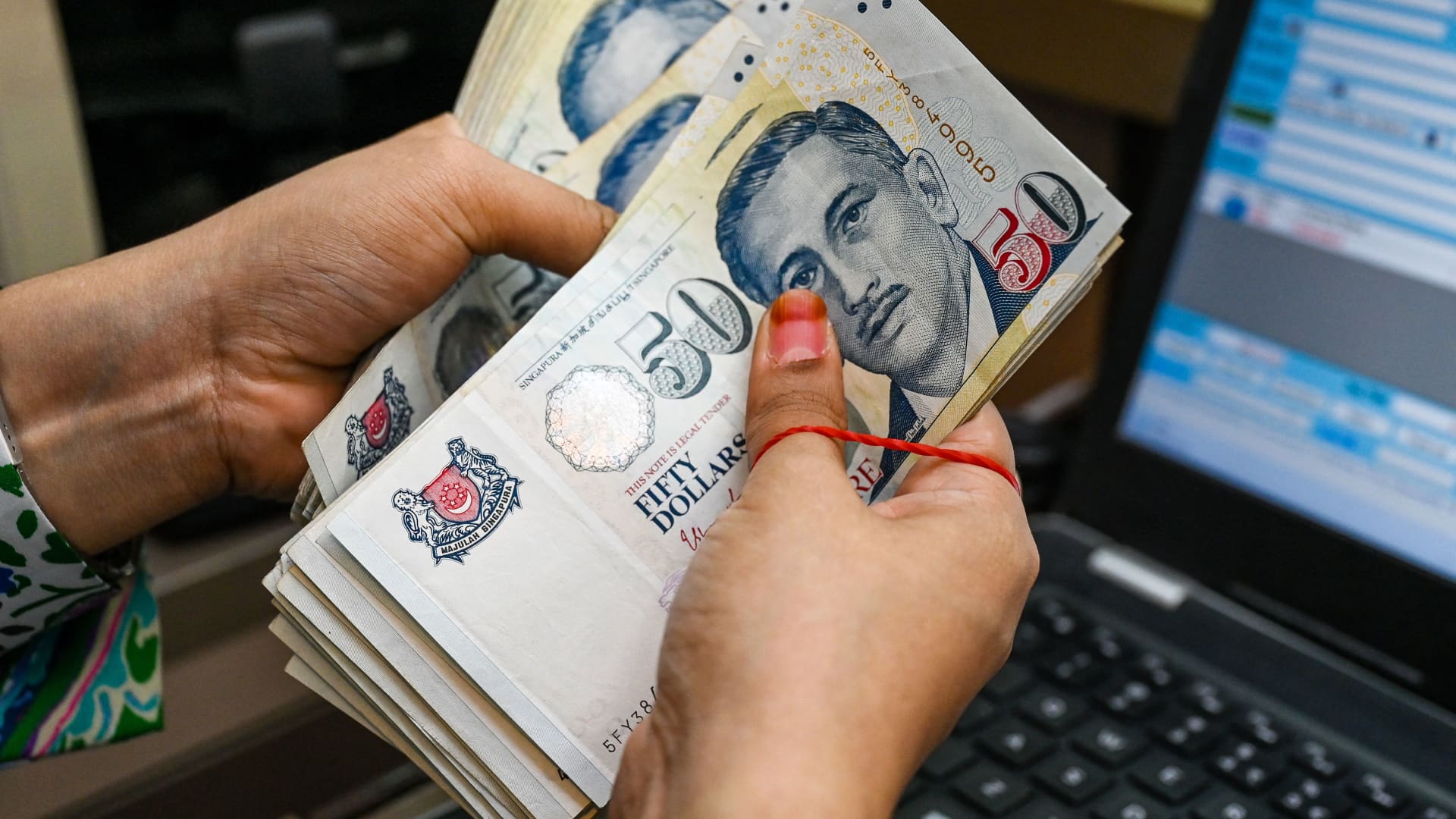
As US and Israeli strikes reshape the Middle East’s energy map, the SGD retreats — but Singapore’s fundamentals offer more ballast than the headlines suggest
The Singapore dollar has shed more than a full percentage point against the US dollar in five trading sessions, the steepest weekly decline the currency has seen in months — but the real story is not the number on the screen. It is the cascade of events that produced it: coordinated American and Israeli airstrikes on Iran that killed Supreme Leader Ayatollah Ali Khamenei over the weekend of 28 February, a de facto closure of the Strait of Hormuz, Brent crude surging past $84 a barrel, and a stampede of global capital into the one refuge that never seems to go out of fashion — the US dollar.
On Wednesday morning in Singapore, SGD/USD was quoted at approximately 0.7824, meaning one Singapore dollar buys just over 78 US cents. Flipped into the more commonly traded convention, USD/SGD stood at 1.278, its highest point since late 2025. The move places the pair at the centre of a broader emerging-market rout: an MSCI gauge of developing-nation currencies logged its worst single session since November 2024 on Monday, as central banks in Indonesia, Turkey and India were forced to intervene. Singapore, by contrast, did neither — a quiet signal of relative confidence.
Market Snapshot: Key Data as of 4 March 2026
| Asset | Level | 5-Day Change |
|---|---|---|
| SGD/USD | 0.7824 | −1.1% |
| USD/SGD | 1.278 | +1.1% |
| DXY (US Dollar Index) | ~99.7 → 99.16 | +~1.0% (WTD) |
| Brent Crude | $82.76/bbl | +13.5% (WTD) |
| WTI Crude | $75.48/bbl | +12.0% (WTD) |
| Straits Times Index (STI) | ~4,800 est. | −1.6% (WTD) |
| Fed Rate Cut (first fully priced) | September 2026 | Pushed back from July |
Sources: Bloomberg, CNBC, TradingEconomics, Wise FX
The Geopolitical Trigger: When “Operation Epic Fury” Hit the FX Markets
The catalyst arrived without warning on the weekend of 28 February, when US and Israeli forces launched what President Donald Trump dubbed “Operation Epic Fury” — a massive wave of coordinated strikes against Iranian nuclear and military infrastructure. Tehran responded with missile salvos targeting Gulf energy facilities, and within hours the commander of Iran’s Revolutionary Guard declared the Strait of Hormuz closed, threatening to “set any ship on fire” that attempted passage.
The consequences for energy markets were immediate and severe. Brent crude, which had closed near $73 per barrel on the Friday before the strikes, surged as high as $85 at one point on Tuesday — a level last seen in early 2024 — before settling into a still-elevated range around $82–84 by Wednesday. WTI rose above $75. The Strait of Hormuz typically channels roughly 20 per cent of the world’s seaborne oil and vast volumes of Qatari liquefied natural gas; QatarEnergy halted LNG production after attacks on its Ras Laffan export site, sending European natural gas futures rocketing more than 40 per cent in a single session.
For foreign-exchange markets, the transmission mechanism was swift and familiar: energy shock → inflation risk → narrowing Fed rate-cut expectations → dollar strength. The US dollar index gained nearly 1 per cent on Monday alone, erasing its losses for 2026 and trading at a five-week high. By Wednesday, DXY hovered near 99.7 before easing slightly to 99.16, approaching but not yet piercing the psychologically important 100 level. Meanwhile, former Treasury Secretary Janet Yellen summed up the Fed’s dilemma bluntly: “The recent Iran situation puts the Fed even more on hold, more reluctant to cut rates than they were before this happened.”
The market agrees. Rate futures now push the first fully priced Fed cut to September, two months later than the July consensus that prevailed before the weekend — a shift with direct implications for dollar-denominated carry trades and Asian currency valuations alike.
Singapore: Risk-Off, but Relatively Contained
Against that backdrop, the Singapore dollar’s 1.1 per cent weekly retreat looks, in context, almost orderly. Senior economists Chua Han Teng and Radhika Rao at DBS Group Research offered the most measured institutional read on the situation, noting that “Singapore’s financial markets saw risk-off but contained movements,” with the benchmark equity index — the Straits Times Index — declining approximately 1.6 per cent, and the SGD weakening by around 1 per cent. Their conclusion: “The economy [is] confronting uncertainty from a relatively strong position, amid solid growth momentum buoyed by global artificial intelligence-related tailwinds and still-low inflation at the start of 2026.”
That framing is important. Singapore entered this crisis with considerably more macro cushion than many of its emerging-market peers. In January 2026, the government upgraded the full-year GDP growth forecast to a range of 2 to 4 per cent, lifted higher in part by the sustained global boom in artificial intelligence infrastructure investment — a wave that has turbocharged Singapore’s data-centre sector, financial services exports and semiconductor-adjacent supply chains. Core inflation, meanwhile, was running well within the Monetary Authority of Singapore’s 1–2 per cent target band heading into the conflict.
The MAS moved quickly to reassure markets. In a statement issued on 2 March, the central bank confirmed that it is “closely monitoring developments arising from the ongoing situation in the Middle East, and is assessing the impact on the domestic economy and financial system.” Critically, it confirmed that “Singapore’s foreign exchange and money markets continue to function normally,” and that the Singapore dollar nominal effective exchange rate — the S$NEER — “remains within its appreciating policy band, which will continue to dampen imported inflationary pressures.” Translation: the MAS is not panicking, and the exchange-rate framework is doing exactly what it was designed to do.
Deputy Prime Minister Gan Kim Yong told Parliament on 2 March that a prolonged conflict could push up prices and weigh on growth, and that the government stands ready to revise GDP and inflation forecasts if conditions warrant. He also pointed to Budget 2026 measures designed to build precisely this kind of economic resilience.
Singapore’s Structural Vulnerabilities and Compensating Strengths
The city-state is not, however, immune. As a small, highly open economy with no domestic energy production, Singapore is structurally exposed to Persian Gulf disruptions through multiple channels simultaneously. More than 14 million barrels of crude oil per day typically pass through the Strait of Hormuz, with roughly three-quarters destined for China, India, Japan and South Korea — the same economies to which Singapore’s trading, logistics and financial infrastructure is intimately connected. A sustained Hormuz disruption ripples outward through shipping costs, LNG prices and ultimately consumer price indices.
Maybank economist Dr Chua Hak Bin had flagged in advance that inflation was an underappreciated risk in 2026, citing rising semiconductor prices and the unwinding of Chinese export deflation — a deflationary cushion that had kept manufactured goods prices suppressed for several years. A Gulf supply shock superimposes an energy cost surge on top of those pre-existing pressures. If the conflict persists beyond four to six weeks, Singapore’s core inflation could break above the MAS’s 1–2 per cent forecast band, creating pressure on the central bank to shift its exchange-rate policy.
On the currency’s specific bilateral move, three forces are at work. First, broad dollar strength driven by safe-haven demand and reduced Fed easing expectations. Second, a modest compression of Singapore’s yield advantage as global risk premia widen. Third, the direct trade exposure: Singapore’s port and re-export economy is a node through which Middle East energy flows toward the rest of Asia — a role that, if interrupted, shrinks the near-term growth outlook priced into SGD. The relative outperformance of SGD versus, say, the Indonesian rupiah or the Thai baht reflects the first factor (safe-haven properties of a highly creditworthy small open economy) partially offsetting the second and third.
Global Macro: The Fed Between Two Fires
For the Federal Reserve, the Iran conflict has arrived at the most uncomfortable possible moment. US inflation stood at 2.4 per cent in January 2026, already above the 2 per cent target. JPMorgan Chase CEO Jamie Dimon put the conundrum plainly: “This right now will increase gas prices a little bit, and again, if it’s not prolonged it’s not going to be a major inflationary hit. If it went on for a long time, that would be different.”
Markets are currently pricing in two 25-basis-point cuts by year-end — but with the first fully expected cut pushed to September and genuine uncertainty about supply-side inflation, even that modest easing path is far from guaranteed. Nomura economists have flagged the dilemma facing Asian central banks as a binary: tolerate higher inflation, or absorb the fiscal cost of consumer subsidies. “So which ‘negative’ do you want to have: higher inflation or worse fiscal?” asked Rob Subbaraman, Nomura’s head of global macro research.
Barclays analysts have flagged a scenario where Brent reaches $100 per barrel if Hormuz remains blocked, with UBS seeing potential for $120 in an extreme-disruption case. Even BMI, which maintained its full-year Brent forecast at $67 per barrel, acknowledged that its core view rests on a “brief spike in March, followed by rapid retracement” — an assumption that requires a relatively swift de-escalation. President Trump, who has said the conflict “could become a prolonged battle,” has offered no such assurance.
What It Means for Investors — and for Travellers
For Singapore-based investors, the near-term calculus involves navigating a market that is simultaneously buffeted by geopolitical risk and buoyed by structural AI-driven growth. DBS’s equity strategy team identified defence, oil-and-gas, and shipbuilding names — including ST Engineering, Seatrium and Nam Cheong — as likely near-term beneficiaries, while flagging headwinds for aviation, transport and interest-rate-sensitive REITs. At the same time, the STI’s historical tendency to recover geopolitical drawdowns within 60 days — an average of 6 to 7 per cent decline over that window — provides a baseline for calibrating exposure.
For the millions of travellers who use Singapore as a hub or who hold SGD-denominated accounts, the currency move has a practical dimension. A weaker Singapore dollar means purchasing power against USD-denominated goods and services — American hotel rates, US flight tickets, dollar-priced tours across Southeast Asia — has declined. At 0.7824, a Singapore traveller exchanging S$5,000 receives around US$3,912, compared with roughly US$3,963 before the conflict. That is not a catastrophic shift, but it underscores the direct household relevance of geopolitical shocks that often appear abstract. Conversely, travellers to Singapore from the United States will find the city-state modestly more affordable — a silver lining for inbound tourism that Singapore’s hotel and hospitality sector will welcome.
Forward Outlook: A Corridor of Uncertainty
The range of plausible outcomes from here is unusually wide. At one end: a swift diplomatic resolution, Hormuz reopens, oil retraces toward $70, the Fed resumes its cutting cycle in July, and the SGD recovers toward the 0.79–0.80 range versus the dollar that prevailed in early 2026. At the other: a conflict lasting weeks or months, Brent sustaining above $90 or beyond, core inflation breaking above MAS targets, and USD/SGD testing 1.30 or higher.
What keeps Singapore closer to the optimistic scenario than most of its peers is precisely what DBS’s economists identified: the economy is not entering this shock from a position of vulnerability. The AI investment supercycle, export resilience, low pre-crisis inflation, and MAS’s exchange-rate-based policy framework — which can tighten by allowing a faster SGD appreciation when inflation threatens — all represent buffers unavailable to less structurally sound emerging markets.
The MAS’s managed float system, in which the S$NEER is guided within a policy band that prioritises inflation control over short-term exchange-rate stability, is arguably the most sophisticated monetary transmission mechanism in Asia. The current episode is not testing its limits — not yet.
One number to watch above all others: Brent crude. If it holds below $90 and Hormuz traffic resumes within weeks, Singapore’s financial markets are likely to absorb this shock with the composure they have shown so far. If it approaches $100 and the geopolitical calendar darkens further, the MAS will face choices it would prefer not to make.
The Conclusion
The Singapore dollar’s retreat is real, but it is not a verdict. Markets price fear before they price facts, and the facts of Singapore’s economic position in early 2026 — strong growth momentum, low inflation, a credible central bank, and an economy wired into the AI-powered future — are considerably more durable than the fear that moved the currency by a percentage point this week. In the fog of geopolitical war, that is worth remembering.
A weaker SGD is a symptom of global anxiety. Singapore’s fundamentals are the cure — and they remain intact.
Discover more from The Economy
Subscribe to get the latest posts sent to your email.
How Asian investors can navigate the geopolitical impact on Asian markets without falling into the twin traps of complacency and panic — and why pricing geopolitical risk in 2026 demands a fundamentally different toolkit
The Fire Horse Meets the Year of Geopolitics
In the Chinese zodiac, 2026 belongs to the Fire Horse — a symbol of restless, combustible energy. Driven, brilliant, and unpredictably volatile, the Fire Horse is considered one of the most dramatic animals in the Chinese astrological cycle. In certain East Asian traditions, years bearing its mark are ones in which conventional wisdom gets upended and fortune favors those who move decisively rather than hesitantly.
For investors operating across Asian markets this year, that ancient metaphor has collided head-on with a grimmer, more modern label: the Year of Geopolitics.
It is a label earned in full. Consider the dizzying catalogue of risk events that greeted markets before the calendar had even turned to February. On January 3rd, US forces captured Venezuelan President Nicolás Maduro — barely three days into the new year — in an intervention that Lombard Odier’s strategists immediately flagged as a return of sphere of influence logic to geopolitics, with the operation mirroring the US intervention in Panama in 1989 and the arrest of Manuel Noriega. MarketPulse Within weeks, President Trump announced 10% tariffs on eight NATO allies, ostensibly tied to US demands over Greenland — a move that, according to Lombard Odier’s analysis, drove geopolitical risk premia higher, led by gold, though broader impacts were expected to stay contained unless tensions intensified. J.P. Morgan
Meanwhile, US military assets have been repositioned in the Gulf, pressuring Iran toward nuclear negotiations, with Lombard Odier warning that oil markets are a key transmission channel for geopolitical risks, and any Iranian action in the Strait of Hormuz would be a high-risk, high-cost option — but one that cannot be ruled out. Allianz Global Investors And as if a crowded geopolitical stage needed more actors, the independence of the US Federal Reserve has come into question, with Jerome Powell’s term ending in May and President Trump’s preference for a loyalist replacement threatening what markets once considered an institutional certainty.

Layering all of this is the ongoing shadow of Trump’s trade tariffs — tools whose legal foundations remain contested in the Supreme Court — and a tech decoupling between Washington and Beijing that has moved from rhetorical sparring to operational architecture.
The central question for Asian investors is not whether these risks are real. They are, spectacularly so. The question is: how should you price geopolitical risk in a world where economic growth remains remarkably resilient? Do you sell? Discount? Simply watch the headlines and hold firm? As we will argue, the answer is none of the above in isolation. What this moment demands — particularly for investors with Asian portfolio exposure — is analytical nuance, not instinct.
Loud Headlines, Quiet Markets — and Why That Pattern Can Deceive
There is a seductive and well-documented pattern in modern financial history: geopolitical events tend to produce sharp, short-lived volatility spikes, followed by recoveries that leave investors wondering what all the fuss was about. Geopolitical events tend to have only a temporary impact on markets as long as they have no lasting effect on oil prices or permanently disrupt global supply chains. BlackRock
This has been the dominant experience of the past several years. From Middle Eastern flare-ups to the initial phases of the Russia-Ukraine war, from North Korean missile tests to US-China semiconductor skirmishes, markets have repeatedly absorbed the shock, processed the information, and moved on — often within days. The global economy has shown surprising resilience. Despite the tax burdens and protectionist policies of the Trump administration, markets have grown accustomed to the rhythm of confrontation and compromise — particularly in the ongoing dynamic between President Trump and his global counterparts. Asia House
The clearest stress-test of this pattern came in April 2025 with “Liberation Day” — the Trump administration’s sweeping tariff announcement. Volatility spiked violently, and supply-chain-exposed stocks across Taiwan, South Korea, Vietnam, and Malaysia sold off hard. After Liberation Day, markets panicked. The dollar fell as volatility spiked — the opposite of its usual safe-haven behavior. Reserve managers sharply shifted allocations away from dollars; the greenback’s share of global reserves hit its lowest in two decades. Pundits rushed to declare American exceptionalism dead. Lombard Odier And yet, by the year’s end, a partial trade détente had been negotiated, and foreign investors had bought more US assets than in the prior year.
Despite fading market shocks, ongoing geopolitical tensions and elevated gold volatility signal that concerns about global risks may linger in 2026, as State Street’s Head of Macro Policy Research Elliot Hentov noted. Trade continues to grow despite trade wars — but deals are being closed only gradually, and uncertainty has not fully dissipated. BlackRock
The danger for investors lies in a subtle but crucial category error: confusing market recovery with market immunity. Geopolitical risks are often priced heuristically. Their uncertain duration, scope, and low frequency make them difficult to quantify in advance. In the meantime, their tail-risk nature — as relatively rare but potentially extreme occurrences — means they are underpriced until they materialise. J.P. Morgan Private Bank Put differently: the fact that a crisis passed without lasting damage does not mean the next one will. And for Asian investors, the structural transmission channels are uniquely numerous and direct.

BlackRock’s Geopolitical Risk Dashboard tracks a “market movement score” for each risk — measuring the degree to which asset prices have moved similarly to risk scenarios. The current environment reflects the US resetting of trade deals and alliances, intensifying US-China competition with AI at its core, and continued volatility from conflicts in Ukraine, Gaza, and the Caribbean. Allianz Global Investors The dashboard makes plain that market attention and market movement are two different things — and that the gap between them is where complacency breeds.
Asia’s Unique Position — Why Nuance Is Not Optional
Asia is not a spectator in the Year of Geopolitics. It is one of its primary stages. The region encompasses the world’s most consequential bilateral rivalry (US-China), the most contested maritime geography (the Taiwan Strait and South China Sea), the most trade-exposed economies in the developed world, and the most energy-import-dependent major markets on the planet. For Asian investors, the transmission channels for geopolitical shocks are not theoretical — they flow directly into earnings, currencies, bond yields, and capital flows.
The bilateral relationship between Washington and Beijing remains the most important indicator of geopolitical tensions to gauge in 2026 and for years to come. Long-term strategic decoupling is highly likely to continue amid growing great-power competition, especially in emerging technologies and defense. While there may be increased stability prior to an anticipated summit between Xi Jinping and Donald Trump, the underlying dynamic of technology and supply-chain competition is structural rather than episodic. SpecialEurasia
Several specific vulnerability channels demand attention:
Export dependency. South Korea, Taiwan, Malaysia, Singapore, and Vietnam are among the world’s most trade-reliant economies. Any durable deterioration in global trade flows hits their corporate earnings faster and harder than in more domestically insulated markets. China’s export machine continues to defy geopolitical headwinds, showing robust growth even as protectionist policies proliferate globally — yet the structural supply-demand imbalance will require years to resolve, and more time is needed for recent anti-involution policy measures to have a meaningful impact on the real economy. Pinebridge
Energy import vulnerability. Around one-third of the world’s seaborne crude oil flows through the Strait of Hormuz, which is also key for transporting liquefied natural gas, fertilisers, copper, and aluminium. Allianz Global Investors Japan and South Korea, as near-total energy importers, face the most direct exposure to any supply disruption emanating from Middle Eastern conflict.
Technology decoupling. Despite a trade detente with China, the military posture in Asia hasn’t softened. Washington sent Taipei its largest-ever arms sale package, and Beijing continues to assert its Taiwan position. Lombard Odier Meanwhile, China’s ambition to triple domestic semiconductor production by 2026 is reshaping investment flows across the electronics supply chain from Penang to Shenzhen.
Currency fragility. The Chinese yuan’s relative stability — maintained deliberately to preserve export competitiveness — acts as an anchor that constrains appreciation across the broader Asian currency complex. Dollar-yen is expected to breach 160 in 2026, with yen risks remaining key to the downside. Hartford Funds
Water and resource security. An often-overlooked vector of geopolitical risk in Asia is resource competition. The Indus Waters Treaty has been suspended. South Asian nuclear-armed rivals are turning rivers into leverage. The governance vacuum around shared water resources is deepening — and when the next shock comes, water will make it worse. Lombard Odier
Given these interlocking vulnerabilities, it should be clear why the standard market wisdom — “geopolitics rarely moves markets” — is an incomplete guide for Asian portfolios. Despite optimism about Asian equities in 2026, some challenges cannot be overlooked, including uncertain global demand, trade dynamics, and a volatile macro environment, all creating headwinds to medium-term potential growth. J.P. Morgan
The correct response, however, is not to flee risk entirely. Asia enters 2026 with genuine resilience and structural opportunity, driven by AI infrastructure investment, advanced manufacturing, and the green energy transition. The message for investors is clear: stay nimble, diversify beyond technology, and hedge strategically. Eurasia Group
The Lombard Odier Framework: How the Intelligent Allocator Approaches Geopolitical Risk
In managing clients’ money through successive geopolitical shocks over more than two centuries, Lombard Odier has developed what it calls the “Intelligent Allocator” framework — a discipline for separating analytical signal from emotional noise in volatile environments. Its core insight is worth absorbing in full.
The investor’s edge does not come from predicting events, but from understanding which outcomes are unaffordable. Rather than trying to anticipate geopolitical shocks, the goal is to build portfolios that can endure them through a robust strategic asset allocation. The idea is to understand the objectives of major economic actors, and more importantly the material constraints that limit those objectives — the hard physical, economic, and resource limits that bind policymakers regardless of ideology. J.P. Morgan Private Bank
This “material constraints” framework, developed by geopolitical strategist Marko Papic, is particularly illuminating in the context of US-China relations. At the February 2026 Lombard Odier “Rethink Perspectives” event in Paris, the firm’s chief strategists laid out the logic explicitly. The Americans possess what China needs — computing power — but China equally holds what the Americans require — rare earths. This symmetry is central to risk management. It sustains geopolitical tension, yet also reduces the probability of full decoupling, as the economic cost of a “pure” separation would be prohibitive. For markets, this translates into recurring cycles of political announcements, targeted restrictions, and industrial adaptation — in other words, volatility that is structural rather than episodic. Pinebridge
This insight directly challenges two equally mistaken responses: the first is to dismiss US-China tech tensions as noise that markets will look through; the second is to treat them as an existential rupture requiring wholesale portfolio defensiveness. The correct position is somewhere harder to hold: acknowledging the structural nature of the competition while maintaining exposure to the growth it generates.
On portfolio construction in this environment, Lombard Odier has been consistently clear since the start of the year. The key lesson from 2025 is to remain invested through the noise. Economies are still expanding, corporate growth is solid, policy offsets are in place, and the private sector is strong. While growth should slow through the year, stronger end-2025 momentum provides a higher buffer. Diversification is essential, with a preference for emerging markets, which offer higher earnings growth at a more reasonable price. Hartford Funds
On the Venezuela intervention specifically, Lombard Odier’s January analysis provided a useful template for how the framework operates in real time. The firm expected further spread compression in emerging bonds, precious metals outperforming due to a rise in the geopolitical risk premium, and a neutral view on the global energy sector — given both upside and downside risks to oil prices in the short term. MarketPulse This is the Intelligent Allocator in action: calibrated rather than reactive, nuanced rather than binary.
Real-Time Geopolitical Fault Lines: What Is Priced In and What Isn’t
Against this analytical backdrop, several specific 2026 geopolitical fault lines warrant close attention from Asian investors — both for the risks they present and, often, the opportunities embedded within them.
The US Political Revolution. According to the Eurasia Group’s Top Risks 2026 report, the United States is attempting to dismantle checks on presidential power and capture the machinery of government — making it the principal source of global risk in 2026. Lombard Odier As Eurasia Group founder Ian Bremmer put it: “The United States is itself unwinding its own global order. The world’s most powerful country is in the throes of a political revolution.” Lombard Odier For Asian markets, the implications ripple through trade policy, Federal Reserve independence, and the durability of US security commitments in the Indo-Pacific.
The Federal Reserve question is especially consequential. With Jerome Powell’s term ending in May 2026, the nomination process will be a market-moving spectacle. If a presidential loyalist is nominated, markets could price in a politicized, dovish Fed — producing a sharp equity rally and a sell-off in the dollar, with Senate confirmation hearings becoming the key volatility event of the spring. Societegenerale
The Electrons vs. Molecules Competition. China is betting on electrons — AI, advanced manufacturing, drones, batteries, and solar — while the United States is betting on molecules: energy, fossil fuels, critical minerals. 2026 will begin to reveal which bet is paying off. Lombard Odier The answer has significant implications for Asian supply chains. China tightens its grip on drones, battery storage, robots, and manufacturing, even as deflation clouds its domestic outlook with a quarter of all listed Chinese firms now unprofitable — the highest level in 25 years. Lombard Odier
The Supreme Court Tariff Ruling. Legal challenges to the administration’s reciprocal tariff executive orders are heading to the Supreme Court, with a ruling expected by June. If the Court strikes down the president’s authority to unilaterally set broad tariffs, the result could be a massive deflationary unwind and a rally in global trade proxies — shipping, emerging markets, and Asian export-oriented economies. Societegenerale The reverse scenario — Court upholding the tariffs — would entrench the current landscape of elevated trade friction.
Iran and Energy Risk. Lombard Odier’s February assessment concluded that the base case remains a negotiated outcome on US-Iran tensions, consistent with financial markets’ relative calmness. The VIX remained just below its long-term average, with no sign that risk premia were adjusting in anticipation of escalation. Allianz Global Investors But the tail risk remains real: a Strait of Hormuz disruption would function as a direct economic shock to virtually every energy-importing Asian economy.
Gray Zone Warfare Around Taiwan. Intelligence suggests China may be moving its timeline for “reunification readiness” forward. 2026 could see an increase in gray zone warfare — cyberattacks, blockades, and airspace incursions — that could trigger major repricing in risk assets and the US dollar. Any kinetic escalation around Taiwan would make 2025’s volatility look like a warm-up. Societegenerale Wellington Management’s geopolitical framework places this among the highest-consequence monitoring priorities for Asia-tilted portfolios.
China’s Deflation Trap. China enters 2026 with ten consecutive quarters of worsening deflation, personal consumption at just 39% of GDP — half the US share — and disposable income stalled at US$5,800 per person. Lombard Odier China’s export machine continues to defy geopolitical headwinds, showing robust growth. However, resolving the structural supply-demand imbalance will be a multi-year process. Pinebridge The irony is that Beijing’s response — accelerating exports — compounds competitive pressure on Asian neighbors even as it stabilizes Chinese growth.
Structural Beneficiaries: Vietnam, Malaysia, Indonesia. Not all of Asia’s geopolitical geography is risk. Vietnam has increasingly functioned as a “connector economy,” facilitating trade flows between the US and China. As corporates diversify production away from China, Vietnam has absorbed manufacturing activity tied to US end-demand while continuing to source intermediate inputs from China. Pinebridge Indonesia’s critical minerals position — particularly nickel for batteries and semiconductors — aligns directly with the AI-driven digital economy. These are genuine structural opportunities embedded within the geopolitical disruption.
Investment Strategies: Pricing Risk Without Being Paralyzed by It
What does a genuinely nuanced approach look like in practice? The following principles synthesize insights from across the major institutional frameworks operating in this environment.
Stay invested — but with eyes open. Despite its stellar performance in 2025, gold remains the most attractive portfolio hedge against market and geopolitical risks, with momentum from private inflows and central bank diversification expected to remain strong. As for the US dollar, renewed Fed easing and US policy uncertainty argue for sustained weakness and lower exposures. Hartford Funds The base case across major institutional investors entering 2026 is moderately pro-risk — not risk-off.
Use gold as a systematic hedge, not an emotional response. Adding gold in a sell-off makes sense given the multiple roles it can play as a hedge against geopolitical risk, stagflation, and US-dollar concerns. Stimson Center Lombard Odier advocates a gold allocation “of the order of 3–5%” as a line of portfolio defence when faced with extreme shocks — a structural position rather than a tactical reaction. Wellington Management The critical distinction is between owning gold before a crisis, when it is cheapest, versus scrambling to buy it after a spike.
Distinguish geopolitical categories. Geopolitical cycles are long — historically, they last between 80 and 100 years. Structural changes like those we’re witnessing now only come around once per century and tend to be disruptive. While market risk is structurally higher in this new regime, 2026 will afford ongoing and novel opportunities to seek portfolio winners and losers across defense technology, energy transition, and advanced manufacturing themes. SpecialEurasia
Diversify within Asia, not just out of it. Lombard Odier expects Swiss, Japanese, and emerging market equities to outperform. Within EM equities, more domestic-led markets such as China and India are expected to outperform more US-exposed markets such as Taiwan and Korea, which are more vulnerable to profit-taking when tariff tensions flare. J.P. Morgan
Watch sovereign bond dynamics for structural signals. Geopolitical shifts are reshaping global demand for government debt. As central banks diversify into gold, sovereign bonds may see higher domestic ownership and depend more on domestic demand — a structural shift that changes the diversification calculus for Asian fixed-income investors. State Street
Position for AI as a geopolitical theme, not merely a technology theme. A genuine transformation is underway, with the logic of efficiency and interdependence giving way to the logic of security. Security is replacing efficiency as the guiding principle of economic policy, prompting massive investment in energy, infrastructure, and industrial capacity — a shift that creates both risks and long-term opportunities for investors. Pinebridge In Asia, this means AI hardware infrastructure, semiconductor equipment makers, and advanced manufacturing platforms are not simply growth stocks — they are geopolitical position plays.
The comparison below illustrates how geopolitical risk transmission differs across key Asian markets:
| Market | Primary Risk Channel | Key Vulnerability | Structural Opportunity |
|---|---|---|---|
| Taiwan | Tech decoupling, Taiwan Strait | Semiconductor export controls | TSMC global supply chain dominance |
| South Korea | Trade tariffs, China slowdown | US-Korea trade tension | Defense tech, battery manufacturing |
| Japan | Yen weakness, energy costs | BoJ normalization pace | Governance reforms, fiscal stimulus |
| India | Tariff exposure (36% effective rate) | Energy import costs | Domestic demand, rate cutting cycle |
| Vietnam | China +1 beneficiary dynamics | US scrutiny of trade flows | Manufacturing connector economy |
| Indonesia | Critical minerals demand | Commodity price volatility | Nickel, AI infrastructure materials |
| China | Deflation trap, tech restrictions | Export overcapacity, property sector | Semiconductor self-sufficiency drive |
| Singapore | Financial hub volatility | Capital flow sensitivity | Digital economy, wealth management |
The Case for Active Management Over Passive Conviction
One underappreciated implication of the geopolitical environment is its structural favorability for active over passive investment management. This environment is naturally conducive to active management, which can seek to avoid increased market risks and capitalize on differentiation more nimbly than a passive approach. There may be alpha opportunities for long/short and other alternatives strategies that simply do not exist in a regime of smooth, globally coordinated growth. SpecialEurasia
Passive indices — particularly those heavily weighted toward Chinese or tech-dominant Asian benchmarks — embed specific geopolitical assumptions that may not reflect the rapidly evolving risk landscape. A passive Asia ex-Japan ETF, for example, carries significant Taiwan semiconductor and South Korean battery exposure, and limited hedging against the tail scenarios that both Wellington and Lombard Odier have flagged. Active management allows for the kind of within-region, within-sector rotation that a nuanced geopolitical view demands.
Geopolitical fragmentation does not lead to a generalised market retreat, but instead imposes a more detailed and refined hierarchy of risks, broken down by region and sector. It demands particular attention to sovereign balance sheets and microeconomic fundamentals. Wellington Management This is a world that rewards research depth and penalizes index-hugging.
The Intelligent Allocator’s Conclusion: Nuance Is the Strategy
The Fire Horse year demands that investors move: those who stand still, paralyzed by the sheer volume of geopolitical noise, risk being trampled by the opportunities passing them. Those who panic-sell risk exiting at precisely the moments when fundamentals argue for holding course. And those who are complacent — who assume that because markets have recovered from previous shocks, they will always recover quickly from the next — are building portfolios on a foundation that the Year of Geopolitics may not spare.
The geopolitical environment remains fraught with uncertainty. But markets have grown accustomed to the rhythm of confrontation and compromise. The balance of power, especially in trade and strategic resources like rare earths, has shifted. And yet, despite the tax burdens and protectionist policies of the Trump administration, the global economy has shown surprising resilience. Asia House
A moderate pace of economic growth, more accommodative monetary conditions, and a weaker dollar create fertile ground for risk assets, even as the fixed income outlook remains constrained. By seeking value opportunities, embracing emerging markets, and diversifying further through real assets, investors can position portfolios for resilience amid inevitable risks and potential shocks. Societegenerale
The analytical discipline that this moment demands is not exotic. It is, at its core, a commitment to asking a more precise question than either “should I be scared?” or “should I be calm?” The better question is: which specific outcomes are unaffordable for my portfolio, which geopolitical risks have economic transmission channels that could materialize those outcomes, and am I appropriately positioned to endure them while remaining exposed to the genuine growth that Asia’s structural story continues to offer?
That question, asked with rigor and answered with evidence rather than instinct, is the whole of the nuanced response. In the Year of Geopolitics, it may also be the difference between a good year and a great one.
Discover more from The Economy
Subscribe to get the latest posts sent to your email.
Analysis
How Singapore’s Global Investor Programme Attracted 450 High-Net-Worth Investors and S$930 Million from 2015–2025
Imagine you are a founder who has spent two decades building a logistics technology company across Southeast Asia. Your business is profitable, your networks span a dozen countries, and you are quietly contemplating where to plant your family’s permanent roots. Hong Kong’s political climate gives you pause. Dubai is compelling but feels transactional. Then Singapore enters the conversation — not as a tax haven or a geographical convenience, but as a node where capital, talent, and institutional stability converge with remarkable precision. Within eighteen months, you have secured permanent residency through the Global Investor Programme, your holding company is registered in one-north, and you are attending Economic Development Board (EDB) roundtables alongside engineers, venture capitalists, and government ministers who actually return emails.
This is not a hypothetical unique to one entrepreneur. It is a pattern that has played out, in varying forms, roughly 450 times over the past decade.
The Numbers Behind Singapore’s Quiet Wealth Migration
As disclosed in Parliament on February 27, 2026, Minister of State for Trade and Industry Gan Siow Huang confirmed that approximately 450 high-net-worth investors were granted permanent residency under Singapore’s Global Investor Programme (GIP) between 2015 and 2025. Their combined capital deployment reached S$930 million — S$500 million invested directly into Singapore-based businesses, and another S$430 million channelled through GIP-select funds targeting local companies.
The disclosure came in response to a parliamentary question from Workers’ Party MP Fadli Fawzi, and while the numbers may appear modest against Singapore’s trillion-dollar financial ecosystem, their sectoral concentration tells a more consequential story. More than half of the direct investments flowed into professional services, info-communications, and financial services — precisely the knowledge-intensive sectors Singapore has prioritised in its successive economic restructuring blueprints.
The Straits Times noted the EDB’s broader framing: GIP investors contribute not merely capital, but market networks and operational know-how — the connective tissue that formal investment metrics rarely capture.
The Economic Ripple Effects of GIP Investments
The headline figure that warrants the most scrutiny is jobs. According to Minister Gan, GIP investors created over 30,000 positions in Singapore between 2010 and 2025, concentrated in engineering, research, and consulting roles within the same high-value sub-sectors that absorbed most direct investment.
Thirty thousand jobs across fifteen years averages to 2,000 annually — a figure that sounds incremental until one considers the quality dimension. These are not warehouse or hospitality roles. They are the kind of positions that anchor Singapore’s ambition to remain a centre of gravity for Asia-Pacific’s knowledge economy. For a city-state of 5.9 million, the multiplier effects of high-density, skills-intensive employment are disproportionate.
Business Times contextualised this within Singapore’s broader effort to attract substantive business activity rather than passive wealth parking — a distinction that has sharpened considerably in the programme’s post-2023 iteration.
Breaking Down the GIP Qualification Paths
The GIP is not a single instrument. It offers three distinct pathways, each calibrated to attract a different profile of investor:
- Direct Business Investment: Invest at least S$10 million into a new or existing Singapore-incorporated company.
- GIP-Select Fund: Place at least S$25 million in an approved fund that invests in Singapore-based businesses.
- Single Family Office: Establish a family office with a minimum of S$200 million in assets under management, with at least S$50 million deployed in EDB-specified investment categories.
The family office route deserves particular attention. Singapore now hosts over 1,100 single family offices — a number that has grown dramatically since 2020 — and the GIP’s S$200 million AUM threshold positions the programme squarely at the intersection of wealth management and productive investment. The S$50 million deployment requirement is the mechanism by which Singapore ensures these structures generate genuine economic activity rather than functioning as sophisticated tax minimisation vehicles.
Forbes Business Council has described Singapore’s framework as among the most rigorously structured investor residency pathways in Asia, noting that the combination of institutional transparency, rule of law, and targeted sector focus differentiates it meaningfully from competing regional programmes.
Singapore vs. the Global Field: How Does GIP Compare?
Investor residency programmes have proliferated globally, yet few have managed the balance between capital attraction and economic substance with Singapore’s consistency.
The United States EB-5 programme — the best-known benchmark — has been plagued by backlogs, fraud controversies, and legislative reforms that stretch processing times to a decade or more for certain nationalities. The minimum investment threshold sits at US$1.05 million for targeted employment areas, lower than Singapore’s equivalent entry points, but the programme’s structural dysfunctions have eroded its comparative advantage for Asian applicants.
Portugal’s Golden Visa, once a European favourite, effectively closed its real estate route in 2023 under pressure from housing affordability concerns. The UK’s Tier 1 Investor Visa was scrapped entirely in 2022 amid national security reviews. Hong Kong’s Capital Investment Entrant Scheme was relaunched in 2024 with a HK$30 million threshold, but the city’s shifting institutional landscape continues to weigh on its appeal to investors seeking long-term stability.
Singapore, by contrast, has raised its thresholds rather than retreating. The 2023 GIP revisions significantly increased investment minimums and tightened eligibility criteria — a counterintuitive move that has, if anything, reinforced the programme’s premium positioning. As one regional economist observed privately: “Singapore is not competing for volume. It is competing for the top decile of the top decile.”
IMI Daily noted that while 450 approvals over a decade appears selective compared to programmes in the Middle East or Caribbean that process thousands annually, Singapore’s preference for depth over breadth reflects a deliberate policy philosophy — one that prioritises integration into the productive economy over residency-as-a-service.
The Challenges: Selectivity, Scrutiny, and the S$3 Billion Shadow
Singapore’s GIP operates in the long shadow of the 2023 money laundering scandal, in which S$3 billion in assets were seized from a network of foreign nationals — some of whom had obtained residency through investment pathways. The episode prompted a sweeping review of anti-money laundering frameworks across the financial sector and accelerated due diligence requirements for investor residency applications.
The EDB has been emphatic that GIP applicants undergo rigorous background checks and that the programme’s business track record requirement — investors must demonstrate an established entrepreneurial history, not merely liquid wealth — provides a structural filter absent in many competing schemes. Nevertheless, the reputational dimension lingers, and Singapore’s authorities have had to balance openness to global capital with heightened vigilance about its provenance.
The revised 2023 criteria, which raised thresholds and introduced stricter sector requirements, can be read partly as a response to these concerns. Fewer approvals, higher quality, greater scrutiny: the architecture of a programme recalibrating its risk-reward calculus in real time.
Looking Forward: GIP’s Role in Singapore’s 2026 Economic Landscape
The geopolitical environment of 2026 is, in many respects, the ideal backdrop for Singapore’s value proposition. US-China technological decoupling has intensified corporate restructuring across Asia, with multinationals seeking neutral jurisdictions for regional headquarters, intellectual property holding structures, and treasury functions. The ASEAN economic corridor is attracting renewed attention from European and American firms diversifying supply chains. Singapore sits at the intersection of all these flows.
Channel NewsAsia’s coverage of Minister Gan’s parliamentary statement emphasised the forward-looking framing: GIP is not simply a residency programme but a mechanism for curating a cohort of investors whose businesses and networks actively deepen Singapore’s economic connective tissue.
The data supports cautious optimism. S$930 million in a decade is not a transformative sum for an economy of Singapore’s scale, but its concentration in strategic sectors — and the 30,000 jobs that accompanied it — suggests that the programme’s design is functioning broadly as intended. The question for the next decade is whether Singapore can sustain this selectivity while remaining genuinely competitive as rivals sharpen their own offerings and as ultra-high-net-worth individuals become increasingly sophisticated in comparing jurisdictions.
A Hub Built on More Than Tax Efficiency
What Singapore has constructed through the GIP is not merely an investor residency programme. It is a carefully engineered signal to the global wealth community: that permanent residency here is earned through substantive economic contribution, confers genuine institutional stability, and places the recipient inside one of the world’s most effective small-state economic ecosystems.
For the logistics entrepreneur who arrived eighteen months ago, the value is not the red passport booklet. It is the EDB roundtable, the talent pipeline from NUS and NTU, the contract enforceability, and the quiet confidence that the rules will not change arbitrarily by Tuesday morning.
That proposition — boring in the best possible way — may prove to be Singapore’s most durable competitive advantage in a world where predictability has become the scarcest luxury of all.
Discover more from The Economy
Subscribe to get the latest posts sent to your email.
-

 Markets & Finance2 months ago
Top 15 Stocks for Investment in 2026 in PSX: Your Complete Guide to Pakistan’s Best Investment Opportunities
-

 Analysis4 weeks ago
Brazil’s Rare Earth Race: US, EU, and China Compete for Critical Minerals as Tensions Rise
-

 Investment2 months ago
Top 10 Mutual Fund Managers in Pakistan for Investment in 2026: A Comprehensive Guide for Optimal Returns
-

 Banks2 months ago
Best Investments in Pakistan 2026: Top 10 Low-Price Shares and Long-Term Picks for the PSX
-

 Asia2 months ago
China’s 50% Domestic Equipment Rule: The Semiconductor Mandate Reshaping Global Tech
-

 Global Economy2 months ago
What the U.S. Attack on Venezuela Could Mean for Oil and Canadian Crude Exports: The Economic Impact
-

 Global Economy2 months ago
Pakistan’s Export Goldmine: 10 Game-Changing Markets Where Pakistani Businesses Are Winning Big in 2025
-

 Global Economy2 months ago
15 Most Lucrative Sectors for Investment in Pakistan: A 2025 Data-Driven Analysis