
China Economy
10 Ways Academia and Research Are Driving China’s Economic Growth

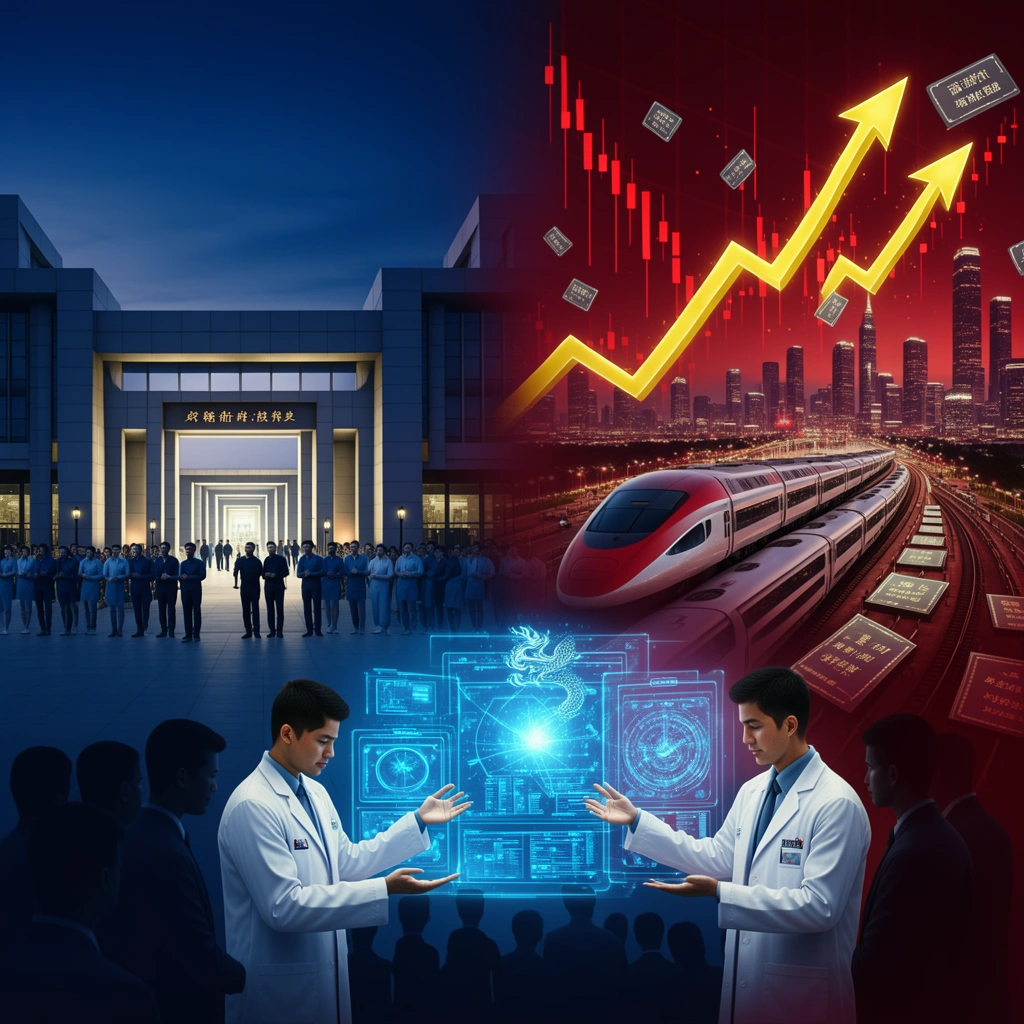
In a sleek laboratory at the University of Science and Technology of China in Hefei, researchers huddle around the Jiuzhang photonic quantum computer, a machine that can complete certain computational tasks in 200 seconds that would take classical supercomputers an estimated half-billion years. Just down the corridor, graduate students test components for next-generation electric vehicle batteries, their work funded by partnerships with BYD and Contemporary Amperex Technology. This scene, replicated across dozens of Chinese research institutions, captures a profound transformation: China’s evolution from the world’s factory floor to an innovation powerhouse where academic research increasingly determines economic competitiveness.
The numbers tell a remarkable story. In 2025, China’s research and development spending reached 2.8 percent of GDP, surpassing the average level of OECD countries for the first time, according to the National Bureau of Statistics. This milestone represents more than statistical achievement—it signals a fundamental reorientation of the world’s second-largest economy toward knowledge-intensive growth. With R&D expenditure rising 8.9 percent year-on-year to exceed 3.6 trillion yuan in 2024, China now stands as the world’s second-largest R&D investor, trailing only the United States but gaining ground rapidly.
Yet China’s research-driven transformation extends far beyond headline spending figures. The country has systematically built an innovation ecosystem where universities, research institutes, and industry collaborate with unprecedented intensity. The results manifest across multiple dimensions: Chinese institutions now dominate the Nature Index rankings, with nine of the world’s top ten academic institutions coming from China, while patent applications reached 1.8 million in 2024, accounting for nearly half of the global total. In strategic sectors from artificial intelligence to quantum computing, electric vehicles to biotechnology, academic research increasingly provides the foundation for commercial breakthroughs that reshape global markets.
This article examines ten distinct ways that China’s academic and research institutions fuel economic expansion. Drawing on the latest data from 2025-2026, it analyzes how university-industry partnerships, talent pipelines, patent commercialization, and regional innovation clusters collectively drive China’s transition toward innovation-led growth. The analysis also acknowledges persistent challenges—inefficiencies in spending allocation, geopolitical tensions constraining international collaboration, and questions about research quality versus quantity—that complicate assessments of China’s research performance. Understanding these dynamics matters not only for evaluating China’s economic trajectory but for anticipating shifts in global technological leadership and competitive advantage.
1. Building a World-Class Talent Pipeline Through Elite Universities
China’s research-driven economic growth begins with human capital cultivation at elite universities that have rapidly ascended global rankings. Tsinghua University and Peking University, China’s flagship institutions, consistently rank among the world’s top 20 universities and produce thousands of STEM graduates annually who populate both domestic industries and international research labs. The University of Science and Technology of China now ranks as the top university in China and second globally in the Nature Index with a total paper count of 2,585, demonstrating research output that rivals Harvard.
This talent pipeline operates at unprecedented scale. China produces more than four million STEM graduates annually, creating the world’s largest pool of technically trained workers. These graduates don’t merely fill existing positions—they drive innovation across emerging sectors. At Zhejiang University, dubbed the “mother of little dragons” because so many founders of top startups, including DeepSeek and Unitree, came from its programs, students transition seamlessly from academic research to entrepreneurship, often with university support providing subsidized infrastructure, mentorship, and capital.
The quality of this talent pool has improved alongside its expansion. Chinese universities have invested heavily in attracting top faculty, including returnee scholars from Western institutions and international researchers. The “Thousand Talents Program” and similar initiatives, despite generating geopolitical controversy, successfully recruited experienced researchers who elevated China’s academic capabilities. These faculty members not only conduct research but train the next generation, creating multiplier effects that compound over time.
Beyond individual institutions, China has developed tiered excellence through initiatives like Project 985 and the Double First-Class Construction project, which concentrate resources at top universities while raising standards across the system. This hierarchical approach allows specialization: while Tsinghua excels in engineering, Peking University leads in humanities and social sciences, and USTC dominates in physics and quantum research. Such specialization enables Chinese universities to compete globally across multiple disciplines simultaneously, rather than concentrating strengths in limited areas.
2. Dominating Global Patent Filings and Intellectual Property Creation
China’s intellectual property generation has reached extraordinary levels, fundamentally altering global innovation dynamics. The country’s patent filing surge reflects not merely bureaucratic productivity but increasingly sophisticated research capabilities that translate into commercial applications. In 2024, China maintained its position as the global leader with 1.8 million patent applications, a figure that dwarfs the 501,831 applications filed in the United States and represents nearly half the global total.
These patents span critical technological domains. Computer technology, electrical machinery, and digital communications lead filing activity, sectors where China seeks competitive advantage and where patents can protect lucrative markets. Huawei Technologies alone filed 6,600 Patent Cooperation Treaty applications in 2024, making it the world’s most prolific corporate filer and demonstrating how Chinese firms use IP strategy to secure market position. Contemporary Amperex Technology, the battery manufacturer, ranked fifth globally with nearly 2,000 applications, illustrating patent activity in sectors like electric vehicles where China has already achieved market dominance.
The quality question surrounding Chinese patents deserves nuanced assessment. Critics correctly note that quantity doesn’t equal quality, and that some Chinese patent filings have historically aimed to meet bureaucratic targets rather than protect genuine innovations. The Chinese government has acknowledged this concern, reducing subsidies that encouraged low-quality filings and implementing stricter quality checks, meaning that while the total number is still impressive, there is a clear focus on ensuring patents are meaningful. Recent data suggests improvement: Chinese patent citations have increased, foreign filings (an indicator of commercial value) have grown, and Chinese-origin patents increasingly appear in high-value litigation globally.
Patent commercialization presents another dimension of economic impact. Chinese universities and research institutes have established technology transfer offices that actively license patents to industry. Tsinghua University operates dedicated tech transfer infrastructure designed to ensure that research outcomes result in products and services that benefit the public, transforming innovations from concept to real-world application. This commercialization creates direct economic value through licensing revenues while generating spillover effects as patented technologies diffuse through supply chains.
3. Forging Deep University-Industry Partnerships and Tech Transfer Hubs
The integration of academic research with industrial application has become a hallmark of China’s innovation system, creating feedback loops where industry funding supports university research that generates commercially relevant findings. This model differs from Western arms-length relationships, instead featuring close collaboration that accelerates technology transfer. Major tech firms maintain extensive research partnerships with leading universities, jointly funding labs, co-supervising graduate students, and sharing research facilities.
The Tsinghua Berkeley Shenzhen Institute exemplifies this model, bringing together U.S. expertise and technological capabilities developed by U.S. professors with Chinese commercialization infrastructure. While such partnerships have generated security concerns in Washington, they demonstrate how Chinese institutions leverage global knowledge networks while building domestic capabilities. Similar institutes linking Chinese universities with international partners have proliferated, particularly in fields like artificial intelligence, semiconductor design, and renewable energy.
Regional tech transfer hubs amplify these partnerships. The China International Technology Transfer Center, established by the Ministry of Science and Technology, promotes technology transfer between universities, research centers, and industry while facilitating international collaboration. These platforms reduce transaction costs associated with moving research from lab to market, providing matchmaking services, incubation support, and commercialization expertise that individual universities might lack.
Financial mechanisms support this ecosystem. Universities increasingly participate as limited partners in venture funds, with Tsinghua University, Peking University, Fudan University, and others establishing science and technology funds that invest directly in startups commercializing university research. In 2024, Sichuan Province partnered with Tsinghua to establish a 10 billion yuan University Science and Technology Achievement Transformation Fund, providing patient capital for translating research into commercial products. Such funds align university incentives with commercialization outcomes while providing startup capital for ventures emerging from academic research.
The economic impact extends beyond individual transactions. Systematic university-industry collaboration creates knowledge spillovers as researchers gain practical problem-solving experience while industry partners access cutting-edge findings. Graduate students exposed to industry challenges produce more relevant research, while companies gain early access to emerging technologies before competitors. These advantages compound across sectors, from pharmaceuticals where university labs conduct drug discovery research funded by biotech firms, to semiconductors where university-designed architectures inform commercial chip development.
4. Achieving Dominance in Strategic High-Tech Sectors
China’s research excellence increasingly concentrates in sectors deemed strategically critical, where academic breakthroughs directly enhance national competitiveness and economic performance. This focused approach reflects deliberate policy choices that channel research funding toward areas with commercial and security significance, creating clusters of excellence that drive sectoral leadership.
Artificial intelligence represents perhaps the clearest example. Chinese institutions have rapidly advanced AI capabilities, with applications ranging from facial recognition and natural language processing to autonomous systems. The release of DeepSeek-R1 in early 2025, developed by researchers with ties to Chinese universities, demonstrated that Chinese AI development could achieve competitive performance while requiring far less computational power than Western models—a crucial advantage given semiconductor access constraints. Universities provide the talent pipeline, with institutions like Tsinghua embedding AI throughout curricula and research programs while companies like Alibaba, Tencent, and Baidu recruit graduates and fund academic research.
Quantum computing showcases similar dynamics. Chinese researchers have achieved multiple breakthroughs, including the Jiuzhang photonic quantum computer that performed a boson-sampling task in 200 seconds that would have taken a classical supercomputer an estimated half-billion years. Pan Jianwei, a quantum physicist and Chinese Academy of Sciences academician, has built a formidable research group at USTC that leads globally in quantum communications and ranks among the world’s best in quantum computing. China’s quantum program spans computing, communications, and sensing, with quantum computing firms increasing from 93 in 2023 to 153 in 2024, a rise of nearly 40 percent.
Electric vehicle and battery technology illustrates how academic research translates into market dominance. Chinese universities conduct extensive research on battery chemistry, power electronics, and electric drivetrain design, often in partnership with firms like BYD and CATL. These collaborations have helped China achieve commanding market positions: the country produced over 16 million new energy vehicles in 2025, accounting for more than half of domestic car sales and roughly two-thirds of global electric vehicle production. University research in materials science enabled improvements in battery energy density, charging speed, and cost that made this scale possible.
Biotechnology and pharmaceuticals represent an emerging area of strength. While China historically lagged in drug development, academic research has accelerated. Universities conduct basic research in genetics, protein folding, and disease mechanisms that inform drug discovery, while pharmaceutical firms increasingly partner with academic labs. The pandemic accelerated vaccine and therapeutic development, with Chinese academic institutions contributing to multiple COVID-19 vaccines. Looking forward, quantum computing applications in drug discovery could compound these advantages, as Chinese startups explore using quantum algorithms for molecular modeling and compound screening.
5. Advancing the Made in China 2025 Initiative Through Research
The Made in China 2025 initiative, launched in 2015 to transform China into a high-tech manufacturing powerhouse, has fundamentally relied on academic and research contributions to achieve its ambitious goals. While the program officially disappeared from public discourse in 2018 amid international criticism, its core objectives have persisted under alternative frameworks, with universities playing central roles in developing technologies across target sectors.
Assessment of Made in China 2025’s success yields mixed but generally positive results. A 2024 analysis found that 86 percent of the over 260 goals proposed under the plan have been achieved, with targets in sectors such as electric vehicles and renewable energy far surpassed. Academic research contributed significantly to sectors where China exceeded targets: renewable energy benefited from university research in solar cell efficiency and wind turbine design, while electric vehicles drew on battery and power electronics research conducted at universities nationwide.
Achievements vary substantially across sectors. In robotics, Chinese universities conduct extensive research in control systems, machine vision, and human-robot interaction that supports the country’s industrial automation. By 2025, China accounted for approximately 54% of all new industrial robot installations, driven partly by domestic suppliers whose technologies often originate in university labs. Agricultural machinery and biopharmaceuticals achieved all stated goals, with university contributions in precision agriculture technology and biological manufacturing proving crucial.
However, significant gaps remain in advanced semiconductors and commercial aircraft—precisely the areas where academic research faces greatest challenges. Despite massive investment, China continues relying on foreign lithography equipment and chip design software, constraints that limit progress despite strong university research programs. The semiconductor challenge illustrates limits of academic research alone: while Chinese universities produce excellent research in chip architecture and materials science, translating findings into manufacturing capabilities requires equipment, processes, and tacit knowledge that prove harder to acquire.
The program’s university-industry collaboration mechanisms have driven technology diffusion. Government guidance funds, many managed through university-affiliated entities, channel capital toward commercializing research. The third iteration of the China Integrated Circuit Industry Investment Fund, at $47.5 billion, and a new $8.2 billion government guidance fund for AI investments in January 2025 both aim to commercialize university research at scale. These funds explicitly prioritize transforming academic findings into industrial capabilities, creating financial incentives that align research agendas with national strategic goals.
6. Attracting Global Talent and Leveraging Diaspora Knowledge Networks
China’s research ascent has been significantly enhanced by talent attraction programs that bring international expertise into Chinese institutions while leveraging overseas Chinese researchers’ knowledge and networks. These initiatives address a historical challenge—brain drain to Western universities and companies—by creating incentives for talented researchers to work in China, either permanently or through collaborative arrangements.
The Thousand Talents Program, despite becoming controversial and largely discontinued amid U.S. security concerns, successfully recruited experienced researchers from abroad. While exact numbers remain unclear, estimates suggest thousands of scientists and engineers returned to China, bringing expertise gained at top Western institutions. Many established research groups at Chinese universities that rapidly achieved international recognition, accelerating China’s research capabilities in fields from materials science to artificial intelligence.
Successor programs continue talent recruitment through different mechanisms. Many Chinese universities offer competitive salaries, research funding, and laboratory facilities that rival Western institutions, particularly for mid-career researchers who might struggle to secure major grants or tenure in the United States or Europe. The appeal extends beyond compensation: Chinese researchers often access larger research teams, more willing industry partners, and faster paths from research to application given China’s manufacturing capabilities and less restrictive regulatory environment in some domains.
Chinese diaspora scientists and engineers, even when remaining abroad, contribute to China’s research ecosystem through collaborations, conferences, and knowledge exchange. Universities maintain extensive international partnerships that facilitate researcher exchanges, joint publications, and shared facilities. While geopolitical tensions have constrained some collaborations, particularly in sensitive technologies, broad networks persist across fields from climate science to mathematics.
These talent flows create economic value through multiple channels. Experienced researchers accelerate capability development, shortening learning curves and avoiding dead ends that junior researchers might pursue. Their international networks provide access to global knowledge while their presence signals institutional quality that attracts additional talent. Returnees often maintain connections abroad that facilitate technology licensing, equipment acquisition, and recruitment of additional researchers, creating network effects that compound advantages.
National talent recruitment complements institutional efforts. Research by China’s national talent recruitment programs shows measurable impact, with “talent hats” improving performance and encouraging collaboration, particularly benefiting experimental and applied research that feeds into commercial innovation. This structured support helps recruited talent navigate China’s academic system, access funding, and build research teams quickly.
7. Cultivating Regional Innovation Clusters and Science Parks
China’s geography of innovation features concentrated regional clusters where universities, research institutes, and industry collocate, generating agglomeration effects that enhance productivity and accelerate knowledge diffusion. These innovation clusters operate at city and sub-city scales, creating dense networks where ideas flow rapidly from research to application.
Beijing’s Zhongguancun district exemplifies this model, functioning as China’s Silicon Valley with concentrations of universities including Tsinghua and Peking, Chinese Academy of Sciences institutes, and thousands of technology companies ranging from startups to giants like ByteDance and Baidu. The proximity enables researchers to consult for companies, graduate students to intern at tech firms, and entrepreneurs to recruit talent directly from university labs. Zhongguancun firms collectively hold hundreds of thousands of patents, many originating from university research, while venture capital flows abundantly given the density of investors and deal flow.
Shenzhen demonstrates how cities without prestigious traditional universities can build innovation clusters through different mechanisms. The city hosts research institutes affiliated with leading universities, including Tsinghua Berkeley Shenzhen Institute and Chinese University of Hong Kong Shenzhen, while its manufacturing ecosystem provides unparalleled resources for hardware innovation. The combination of research capabilities and manufacturing prowess enables rapid prototyping and iteration, advantages that hardware startups globally struggle to replicate. Companies like BYD, Huawei, and DJI have grown into global leaders while maintaining deep ties to research institutions.
Shanghai, Hangzhou, and Guangzhou each cultivate distinct cluster characteristics. Shanghai excels in life sciences and semiconductors, leveraging Fudan University and Shanghai Jiao Tong University alongside pharmaceutical and chip firms. Hangzhou benefits from Zhejiang University’s research strength and Alibaba’s presence, creating a digital economy cluster. Guangzhou’s proximity to Hong Kong and manufacturing base in Guangdong supports hardware and automotive innovation.
Provincial governments actively support cluster development through subsidies, infrastructure investment, and preferential policies. Multiple provinces have established university science and technology funds and transformation funds that commercialize local university research. Beijing invested 327.84 billion yuan in R&D, representing 6.58 percent of its GDP, while Shanghai reached 4.35 percent, both far exceeding the national average. These investments support research universities, technology parks, and innovation districts that anchor regional clusters.
The economic impacts of these clusters extend beyond direct participants. Supplier networks develop around anchor firms, creating ecosystems where specialized services—from IP law to equipment calibration—flourish. Knowledge spillovers occur as employees move between firms or start new ventures, taking expertise developed elsewhere. The density of technical talent creates labor markets thick enough to support specialized skills, reducing costs for firms seeking particular capabilities.
8. Leading in Basic Research and Scientific Publications
China’s basic research capabilities have advanced dramatically, moving from marginal participant to global leader in high-quality scientific output across multiple disciplines. This transformation in fundamental research creates knowledge foundations that support applied research and commercial innovation, while demonstrating research maturity beyond merely scaling up existing approaches.
The Nature Index, which tracks contributions to research articles in elite scientific journals, illustrates China’s ascent. The Chinese Academy of Sciences maintains first position globally with a 2024 Share of 2,776.90, extending its lead over second-place Harvard University. More remarkably, Chinese institutions increased from having 31 institutions in the Nature Index top 100 in 2022 to 43 in 2024, demonstrating breadth alongside excellence at the very top.
China’s strength concentrates particularly in physical sciences and chemistry. In the Nature Index physical sciences rankings, China holds eight of the top ten positions globally, with institutions including CAS, USTC, Tsinghua, and Peking University dominating. In earth and environmental sciences, similar patterns emerge. These subject areas represent traditional Chinese strengths but also fields with enormous economic significance—materials science informs semiconductor and battery development, while earth science research supports renewable energy siting and climate adaptation.
Basic research output has practical economic significance beyond prestige. Fundamental discoveries in quantum physics enable quantum computing development, while advances in materials science inform battery chemistry improvements. Chinese researchers’ work on catalysis and chemical processes contributes to pharmaceutical manufacturing and industrial chemistry. The lag between basic research and commercial application varies by field, but systematic investment in fundamental science creates option value—the possibility that today’s esoteric research enables tomorrow’s breakthrough products.
China’s basic research investment has grown substantially, with spending on basic research, applied research, and experimental development growing by 10.7 percent, 17.6 percent, and 7.6 percent respectively in 2024. This reflects government recognition that leadership requires discovery, not merely development. While critics note that China’s basic research still lags the United States in some metrics—Nobel Prize recognition, citations of most influential papers—the trajectory shows rapid improvement.
Institutional structures support basic research excellence. The Chinese Academy of Sciences operates as a massive research organization with over 100 institutes conducting fundamental research across disciplines. Universities emphasize publication in top-tier international journals, creating incentives for high-quality basic research. State Key Laboratories provide sustained funding for long-term research programs, insulating researchers from short-term commercial pressures that might discourage fundamental inquiry.
9. Incubating Startups and Fostering Entrepreneurial Ecosystems
Chinese universities have evolved into startup incubators, systematically commercializing research through new venture creation while cultivating entrepreneurial mindsets among students and faculty. This transformation reflects both institutional evolution and policy support, creating pathways from academic research to market impact that generate economic growth and employment.
China hosts 158 unicorns—privately held companies valued above $1 billion—in 2025, with collective market capitalization exceeding $500 billion. Many trace origins to university research or were founded by recent graduates. DeepSeek, the AI startup that shocked Western observers with its efficient large language model, emerged from research at Chinese universities. Unitree, which produces advanced quadruped and humanoid robots, similarly benefited from Zhejiang University’s ecosystem. These unicorns don’t merely represent paper wealth—they employ thousands of workers, generate tax revenue, and drive innovation in strategic sectors.
University-affiliated venture funds increasingly invest in student and faculty startups. Fudan University established a science and technology innovation mother fund with initial scale of 1 billion yuan in 2023, expanded to national and overseas funds by 2025. These funds provide patient capital while leveraging university expertise to evaluate technical viability. Beyond capital, universities offer incubation services including subsidized laboratory space, business mentorship, and IP licensing on favorable terms.
The startup ecosystem extends beyond individual unicorns to encompass thousands of small technology companies. Beijing alone hosts over 1.6 million micro, small, and medium enterprises, many technology-focused, which contribute more than 30% of the city’s tax revenue, more than 40% of its revenue, more than 50% of its patents for technological inventions and more than 60% of its jobs. Universities feed this ecosystem with talent, technology, and entrepreneurial energy.
Funding dynamics have shifted recently, with government-affiliated investors replacing some foreign venture capital following U.S.-China tensions. In Q1 2025, government-affiliated investment companies took part in roughly 16% of funding rounds, up from less than 5% a decade earlier. This substitution maintains capital availability for university spin-offs while aligning investment with national priorities in areas like semiconductors, AI, and advanced manufacturing.
Cultural shifts complement structural support. Entrepreneurship has gained social prestige in China, with successful founders achieving celebrity status and “mass entrepreneurship and innovation” becoming a government slogan. Universities cultivate entrepreneurial mindsets through courses, competitions, and exposure to startup ecosystems. This cultural change matters economically because it increases the supply of potential entrepreneurs willing to leave secure academic or corporate positions to commercialize research findings.
10. Generating Productivity Spillovers and Export Competitiveness
The cumulative impact of China’s research ecosystem manifests in productivity improvements and export performance across the broader economy, as knowledge generated in universities and research institutes diffuses through supply chains, labor mobility, and technology adoption. These spillover effects represent perhaps the most important but least visible way that research drives economic growth.
Total factor productivity growth—the portion of economic expansion not explained by capital and labor inputs—depends fundamentally on technological progress and efficiency improvements. China experienced TFP stagnation in recent years amid challenges including resource misallocation and debt accumulation. However, research-intensive sectors show different patterns, with productivity gains concentrated in industries where academic research contributes to process improvements and product innovation.
Manufacturing competitiveness increasingly depends on research capabilities. Chinese manufacturers in sectors from electric vehicles to consumer electronics benefit from domestic research that generates intellectual property, reduces dependence on foreign technology licensing, and enables rapid product iterations. When BYD develops new battery chemistries in partnership with university researchers, it gains cost and performance advantages over competitors using licensed technology. Similar dynamics play across industries, from pharmaceutical manufacturing to telecommunications equipment.
Export performance reflects these advantages. China’s exports of high-tech products have grown dramatically, with the country now leading globally in electric vehicle exports and dominating solar panel production. These export successes rest on research capabilities that enable Chinese firms to compete not merely on price but on technical sophistication. Research also supports export competitiveness indirectly by training engineers who staff export-oriented manufacturers and generate process innovations that improve quality while reducing costs.
Knowledge diffusion mechanisms amplify research impacts. Personnel mobility transfers knowledge as researchers move between universities and companies, or as university-trained engineers join manufacturers. Supplier relationships spread knowledge when technology firms work with component suppliers, sharing technical requirements and problem-solving approaches. Industry-university conferences, training programs, and consulting relationships create additional diffusion channels.
Measurement challenges complicate quantification of these spillovers. Standard economic statistics struggle to capture knowledge flows, making spillover effects difficult to measure precisely. However, sectoral patterns provide suggestive evidence: industries with stronger university linkages generally show higher productivity growth, while regions with denser research ecosystems tend toward faster economic expansion. China’s rise in the Global Innovation Index, entering the top ten for the first time in 2025, reflects accumulated spillover effects as research capabilities translate into broader innovative capacity.
Looking Forward: Challenges and Sustainability
China’s research-driven economic growth faces significant challenges alongside its impressive achievements. Understanding these limitations matters for realistic assessment of the model’s sustainability and likely evolution.
Efficiency concerns deserve serious attention. China’s rapid R&D spending growth doesn’t automatically translate into proportional innovation output. Some investment goes toward duplicative projects as local governments compete for prestige, while other spending supports research of questionable commercial relevance. The government has acknowledged these inefficiencies, adjusting policies to emphasize quality over quantity, but fundamental tensions remain between bureaucratic incentive systems and innovative discovery’s unpredictable nature.
Geopolitical tensions increasingly constrain China’s research ecosystem. U.S. export controls limit access to advanced semiconductor manufacturing equipment and high-end AI chips, handicapping research in affected areas. International collaborations have contracted in sensitive technologies, reducing knowledge flows that previously accelerated Chinese capabilities. Talent recruitment programs face scrutiny and restrictions, complicating efforts to attract overseas researchers. These constraints particularly impact fields where China lags technically and would most benefit from international cooperation.
Quality versus quantity remains an ongoing question in Chinese research. While metrics like patent filings and publication counts show impressive growth, citation impact and breakthrough discoveries represent different challenges. China has produced incremental advances across many fields but fewer paradigm-shifting discoveries that redefine technological possibilities. Whether this reflects measurement timing—with current investment ultimately yielding breakthrough discoveries—or more fundamental limitations remains contested among observers.
The transition from catch-up growth to frontier innovation presents challenges. When developing countries can license, reverse-engineer, or recruit talent from technological leaders, innovation becomes primarily a deployment challenge. At the frontier, innovation requires original discovery with higher uncertainty and failure rates. China’s research system, optimized for rapid scaling and directed toward specific goals, may struggle with frontier research’s inherent unpredictability and longer time horizons.
Sustainability questions also arise regarding the heavy state role in directing research agendas. While state coordination enables focused efforts in strategic technologies, it risks missing opportunities in areas that appear less important to planners but might prove transformative. The balance between directed research and investigator-initiated exploration remains under constant negotiation in China’s system, with economic implications depending on achieving appropriate balance.
Despite these challenges, China’s research ecosystem has demonstrated remarkable capabilities and resilience. The country’s research spending continues growing faster than GDP, indicating sustained commitment despite economic headwinds. Universities continue ascending global rankings, patent quality improves alongside quantity, and commercialization mechanisms mature. The combination of scale, focus, and institutional learning suggests that China’s research contributions to economic growth will persist and likely expand, even if the path forward presents more challenges than the catch-up phase.
The global implications extend beyond China itself. As Chinese research capabilities rise, they create both opportunities and tensions for the broader international research community. Collaboration with Chinese institutions offers access to unique capabilities and resources, while competition intensifies in many technology domains. The resulting dynamic—part collaboration, part competition—will shape innovation trajectories globally in coming decades, with economic consequences extending far beyond China’s borders as research-driven competitive advantages shift and new technological possibilities emerge from the world’s largest scientific enterprise.
Discover more from The Economy
Subscribe to get the latest posts sent to your email.


China Economy
China’s Growth Slips to a Four-Year Low: Why Beijing Still Won’t Pull the Stimulus Trigger
Introduction
China’s economy expanded just 4.3% in the second quarter of 2026, the weakest quarterly pace since late 2022, missing economists’ 4.5% consensus forecast and slowing sharply from 5% growth in the first quarter (CNBC). The reading came in below Beijing’s own full-year target range of 4.5% to 5% — already the least ambitious growth goal China has set in decades — and has intensified calls for fresh stimulus even as policymakers show little appetite for aggressive intervention (CNBC).
What’s Actually Slowing
The slowdown is being driven by an accelerating slide in investment and stubbornly subdued consumption, even as exports have remained comparatively resilient — helped, paradoxically, by a global oil shock that boosted demand for Chinese goods in some categories even as it squeezed household budgets in others (WHBL/Reuters). Reuters’ polling of analysts projects growth will edge up slightly to 4.6% in the third quarter before easing to 4.5% in the fourth, putting full-year 2026 growth at roughly 4.6%, down from 5.0% in 2025 and expected to slow further to 4.4% in 2027 (WHBL/Reuters).
Notably, one bright spot within the investment slump is technology: surging tech-related imports point to a deepening domestic AI infrastructure buildout, with autos and consumer electronics adding further momentum even as broader fixed-asset investment weakens (CNBC).
The Deflation Problem Beijing Can’t Shake
Underlying the growth numbers is a more persistent structural issue: China’s producer prices have now fallen for roughly three years running, undercutting corporate profitability and discouraging the kind of household spending that would normally pull the economy out of a slowdown (FXStreet). When prices fail to rise, consumers have less incentive to spend “today,” a dynamic that suppresses GDP and forces the central bank to actively target positive inflation rather than simply react to it (FXStreet). Analysts at FxPro describe China as a continued “net exporter of deflation” to the rest of the world — as its own overcapacity pushes discounted goods into global markets, applying disinflationary pressure well beyond its borders (FXStreet).
Why Beijing Is Holding Back on Stimulus
Despite the weak headline numbers, most analysts expect no aggressive stimulus action from the late-July Politburo meeting unless growth deteriorates more sharply. The reasoning is twofold: exports have remained resilient, and policymakers remain more focused on curbing excess factory capacity to fight deflation than on further juicing demand, which risks worsening the overcapacity problem that is driving deflation in the first place (WHBL/Reuters).
That said, fiscal policy is expected to accelerate through the second half of the year. Beijing has set a budget deficit of around 4% of GDP for 2026 and lined up heavy government bond issuance specifically to shore up growth after early-year support was front-loaded and then faded (WHBL/Reuters). Capital Economics expects growth to pick up over the second half as this fiscal support ramps up, while cautioning that domestic overcapacity will remain entrenched — meaning China’s economy stays structurally reliant on exports for growth rather than a genuine consumption rebound (WHBL/Reuters). Analysts polled by Reuters expect the People’s Bank of China to hold its key seven-day reverse repo rate unchanged for the remainder of 2026, signaling that Beijing sees this as a fiscal problem rather than a purely monetary one (WHBL/Reuters).
The Trade War Backdrop
The slowdown is unfolding against continued tensions with trade partners, including the United States, which have weighed on export growth even as it has held up better than domestic demand (CNBC). U.S. tariffs specifically are cited as a factor exacerbating China’s domestic deflationary trend by reducing demand for Chinese goods abroad, compounding the overcapacity problem at home (FXStreet). Analysts note that a meaningful reversal of China’s deflationary spiral would likely require either a Federal Reserve rate cut that eases global financial conditions, or a easing of the tariff regime directly — neither of which is fully within Beijing’s control (FXStreet).
What to Watch Next
- The late-July Politburo meeting: the clearest near-term signal of whether Beijing shifts from measured fiscal support to a more aggressive stimulus posture.
- Producer price index trends: continued multi-year declines would reinforce the deflation narrative and pressure corporate margins further.
- Bond issuance pace: heavy issuance against a 4%-of-GDP deficit target will be a key gauge of how quickly fiscal support actually reaches the real economy.
- U.S.-China trade signals: any easing of tariffs would provide more relief to Chinese exporters than domestic policy alone is currently offering.
Key Takeaways
- China’s Q2 2026 GDP growth of 4.3% was its weakest since late 2022, missing forecasts and falling below Beijing’s own full-year target range.
- Producer prices have declined for roughly three years, cementing China’s role as a net exporter of global deflation.
- Beijing is prioritizing capacity reduction over demand-side stimulus, betting that fiscal spending — not rate cuts — will carry the second-half recovery.
- Full-year 2026 growth is forecast at around 4.6%, cooling further to 4.4% in 2027 as structural export-reliance persists.
- A genuine reversal of China’s deflation trend likely depends on external factors — Fed policy or US tariff relief — as much as domestic stimulus.
Sources: CNBC, WHBL/Reuters, FXStreet
Discover more from The Economy
Subscribe to get the latest posts sent to your email.
China’s economy has just delivered its weakest quarterly result since the depths of the pandemic recovery, and the number that matters most isn’t the headline growth figure — it’s what Beijing does, or doesn’t do, about it.
The Numbers Behind the Miss
Gross domestic product expanded 4.3 percent in the April-to-June period, according to the National Bureau of Statistics, missing economists’ forecast of 4.5 percent and slowing sharply from 5 percent in the first quarter. Crucially, that print came in below Beijing’s own full-year target range of 4.5 to 5 percent — described by CNN as the least ambitious goal Beijing has set in decades — and represents a rare public admission of economic weakness for a government that has long leaned on infrastructure investment and exports to mask domestic softness.
An accelerating slide in fixed investment, alongside subdued consumption, is doing most of the damage. Reuters polling ahead of the release had already flagged that weak domestic demand was offsetting the boost from resilient exports during the global oil shock triggered by the Iran conflict.
The Export Paradox
Here is the twist most coverage has undersold: China’s exports haven’t collapsed — in some categories they’ve been the standout performer. Higher energy costs stemming from the war in Iran have actually helped pull China out of one of its longest deflationary stretches on record, as global buyers seeking to reduce fossil-fuel exposure have turned to Chinese batteries, electric vehicles and clean-energy technology.
Macquarie analysts found that chips, computer parts and power equipment accounted for roughly half of China’s export growth in the first half of 2026, underscoring how intertwined China’s growth engine has become with global AI infrastructure spending — even as its domestic property and consumption engines continue to sputter.
Will Beijing Blink on Stimulus?
All eyes now turn to the Politburo’s expected late-July meeting. The consensus among analysts is caution rather than a bazooka. Capital Economics expects growth to pick up in the second half as fiscal support ramps up, but warns that entrenched domestic overcapacity means China’s economy will remain structurally reliant on exports rather than consumption for growth. UOB economist Woei Chen Ho told CNN that a large-scale stimulus package appears unlikely, with selective, targeted measures instead more probable to stabilise investment and consumption.
Beijing has already set a budget deficit of roughly 4 percent of GDP for 2026 and lined up heavy bond issuance, with GDP growth forecast to edge up modestly to 4.6 percent in the third quarter before easing again in the fourth, according to Reuters’ economist poll.
Deflation Still the Deeper Problem
Even with the export-led relief, China’s deflationary pressure has not disappeared. Producer prices have now fallen for well over two years running, with July’s year-on-year decline running at roughly 3.6 percent even as consumer inflation hovers near zero. Analysts note this dynamic effectively exports deflation to trading partners already grappling with tariff-driven cost pressures — complicating monetary policy from Washington to Jakarta.
Why It Matters for Southeast Asia and the Gulf
China remains the dominant trading partner for much of Southeast Asia and a major source of imports for Pakistan. A structurally slower, export-dependent China means continued downward pressure on regional manufacturing prices, but also sustained demand for the commodities and components that feed its clean-energy export machine — a dynamic ASEAN economies from Malaysia to Indonesia are positioning to capture, as detailed in our companion coverage of the region’s investment inflows.
Discover more from The Economy
Subscribe to get the latest posts sent to your email.

China’s National Bureau of Statistics reported second-quarter GDP growth of 4.3%, missing analyst forecasts of 4.5% and falling below Beijing’s own 4.5–5% annual target — the lowest target range the country has set since it began publishing such figures in 1991 (CNN; NPR). It is the weakest quarterly print since the pandemic-disrupted final quarter of 2022, and it lands at the mid-point of a year already reshaped by the Iran war’s oil shock.
Two Economies, One Government
Economists including Natixis’s Alicia Garcia-Herrero describe an increasingly pronounced “two-track economy”: a thriving export engine — car exports topped one million units for the first time in June and semiconductor and computer-part shipments surged — running alongside a domestic consumption base still weighed down by a property slump and cautious households (CNN). Retail sales rose just 1% year-over-year in June, while fixed asset and property investment continued to contract, with property investment down roughly 18% (Reuters via WTAQ).
The Uncovered Angle: A Widening Surplus Meets a Fragile World
China’s trade surplus widened to $125.6 billion in June even as crude oil imports fell to near decade lows — evidence that Beijing is managing the Hormuz-driven energy shock better than most importers, while simultaneously exporting the industrial overcapacity problem to trading partners. That widening surplus is already straining relations with the European Union, and it has direct implications for manufacturing competitors across Southeast Asia and South Asia, including Pakistan’s textile and Malaysia’s electronics sectors, which now compete more directly with subsidised Chinese EV, battery and solar exports flooding third markets (CNN; IndexBox).
What Happens Next: The Politburo’s July Decision
Convera’s APAC strategist Shier Lee Lim frames the miss as strengthening the case for additional stimulus at the July Politburo meeting, potentially through faster special local government bond issuance or new policy financing tools rather than a formal budget revision (WTAQ). The IMF has already nudged its 2026 China growth forecast up slightly to 4.6%, while projecting a further slowdown to 4.1% in 2027 as the AI and robotics-led export boom fails to translate into broad-based job creation (IndexBox).
Why Cross-Border Investors Should Care
For Pakistan, whose CPEC-linked trade and infrastructure financing remains closely tied to Chinese capital flows, and for Malaysia and Singapore, whose electronics and semiconductor sectors sit downstream of Chinese supply chains, the composition of any Beijing stimulus matters more than the headline growth number. A consumption-focused package would support Southeast Asian consumer and tourism exports; an infrastructure-heavy package would deepen the commodity and industrial-goods relationship that already dominates trade with Indonesia and Malaysia.
The Bottom Line
China’s growth model is becoming structurally unbalanced in a way that a single quarter of stimulus cannot fix. Cornell economist Eswar Prasad’s assessment — that heavy state and private investment in frontier technology is running well ahead of job-creating sectors — points to a slow-burn risk for global trade partners that goes well beyond this quarter’s data print (IndexBox).
Discover more from The Economy
Subscribe to get the latest posts sent to your email.

Pakistan Gulf Investment Outflows 2026: Peace Deal Stakes Explained

Canada Trade Diversification 2026: China, Indonesia, UAE Deals Explained

US Forced-Labour Tariffs on 60 Countries: The Hidden Trade Shock of 2026

Global Central Banks 2026: Fed, BoE and BoJ Decisions Could Reshape Markets

Gulf Capital Retreat From Pakistan 2026: UAE Loan Freeze & What It Means

Pakistan’s Most Reliable Export Is Its People: Remittances Hit $41.6 Billion, Overtaking Total Exports

Indonesia’s Confidence Problem: Record Investment, a Sinking Rupiah, and a Widening Credibility Gap

Down But Not Out: Inside the Slow Sinking of Russia’s War Economy

China’s Growth Slips to a Four-Year Low: Why Beijing Still Won’t Pull the Stimulus Trigger

The Johor-Singapore Corridor: How Malaysia Became Southeast Asia’s AI Infrastructure Powerhouse

Canada’s Economy ‘On Pause’: Inside the CUSMA Deadline That Passed Without a Deal

Dubai’s Millionaire Magnet: How the UAE Turned Middle East Turmoil Into a Capital Safe-Haven Boom

Britain’s Sixth Prime Minister in a Decade: What Starmer’s Exit Means for Gilts, Sterling and Your Portfolio

Anthropic Offers Up to $600,000 Salary for Critical IPO Role as AI Giant Prepares for Wall Street Debut

Carry Trade Unwind 2026: How the Yen’s Snapback Triggered a Global Margin Call

AI Bubble Warning 2026: Why BIS, IMF and Bank of England Fear a Market Crash

BRICS De‑Dollarization Strategy Takes Shape with $15 Billion Local‑Currency Push

The AI Super Bubble Is Ready to Burst

Russia Bans Diesel Exports 2026: Global Fuel Market Impact Explained

Strait of Hormuz Blockade 2026: Oil Prices Surge 9% as US-Iran Conflict Reignites

Private Credit Warning: Most BDCs Turn Unprofitable in 2026, Reuters Finds

Bitcoin $150k Milestone Achieved as US Sovereign Crypto Pivot Looms

IMF Cuts Pakistan Growth Forecast, Raises Inflation to 8.4%
Gulf Capital Retreat From Pakistan 2026: UAE Loan Freeze & What It Means

India Economic Rise 2026: How the Subcontinent Toppled Japan

Strait of Hormuz 2026: Why Markets Still Don’t Trust It’s Open

China Housing Market Turnaround: White‑List Model Stabilises Prices

Chipmakers Just Lost 6.7% in Two Days: Inside the Great AI Trade Rotation
-

 Markets & Finance7 months ago
Top 15 Stocks for Investment in 2026 in PSX: Your Complete Guide to Pakistan’s Best Investment Opportunities
-

 Analysis5 months ago
Johor’s Investment Boom: The Hidden Costs Behind Malaysia’s Most Ambitious Economic Surge
-

 Analysis5 months ago
Top 10 Stocks for Investment in PSX for Quick Returns in 2026
-

 Analysis6 months ago
Brazil’s Rare Earth Race: US, EU, and China Compete for Critical Minerals as Tensions Rise
-

 Banks6 months ago
Best Investments in Pakistan 2026: Top 10 Low-Price Shares and Long-Term Picks for the PSX
-

 Investment7 months ago
Top 10 Mutual Fund Managers in Pakistan for Investment in 2026: A Comprehensive Guide for Optimal Returns
-

 Global Economy7 months ago
15 Most Lucrative Sectors for Investment in Pakistan: A 2025 Data-Driven Analysis
-

 Global Economy7 months ago
Pakistan’s Export Goldmine: 10 Game-Changing Markets Where Pakistani Businesses Are Winning Big in 2025