
Investment
Pakistan Stock Surge: KSE-100 Hits Record 188,000+ on Rate Cut Bets


KSE-100 index soars past 188,621 points amid Pakistan stock market rally fueled by SBP rate cut expectations. Analysis of drivers, risks, and global emerging market context for January 2026.
A Frontier Market’s Unexpected Ascent
The trading floor at the Pakistan Stock Exchange opened Tuesday morning with the nervous energy that has become characteristic of frontier markets in early 2026. By midday, the benchmark KSE-100 index had tumbled to an intraday low of 187,192 points, triggering familiar anxieties among investors who remember Pakistan’s volatility all too well. Yet what followed was a dramatic reversal that encapsulates the peculiar momentum gripping this South Asian economy.
The KSE-100 surged 860 points to close at a record 188,621.78, marking not just another milestone but a continuation of what has become one of the most compelling—and confounding—bull runs in emerging markets. For investors watching from afar, Pakistan’s bourse suddenly looks less like a frontier gamble and more like an opportunity that demands serious consideration.
The rally extends a remarkable streak. Over the past month alone, the index has climbed 10.20 percent, and stands up 63.99 percent compared to the same period last year, according to data from Trading Economics. This isn’t the ephemeral bounce of speculative fervor; it’s a sustained ascent driven by fundamentals that are quietly reshaping Pakistan’s investment narrative.
The January 20 Session: Volatility Gives Way to Conviction
Tuesday’s trading session offered a microcosm of Pakistan’s current market dynamics. The index swung between an intraday high of 188,958.38 and its morning low of 187,192.02, a range reflecting both persistent uncertainty and growing confidence. The volatility wasn’t surprising—frontier markets rarely move in straight lines—but the decisive close above 188,600 points signaled something more substantial than mere momentum.

Volume remained robust, with market participants noting sustained buying interest across heavyweight sectors. According to analysis from KTrade Securities, all-share traded volumes rose 2.3 percent day-over-day to 1,226 million shares, suggesting broad participation rather than narrow speculation. The breadth of the rally—spanning energy, financials, and fertilizers—indicates institutional conviction rather than retail exuberance.
Heavy stocks drove the gains. Engro Holdings, Pakistan Petroleum, Sazgar Engineering, Oil and Gas Development Company, and Pakistan State Oil collectively added 661 points to the index, underscoring how Pakistan’s largest companies are benefiting from improving macroeconomic conditions and sector-specific tailwinds.
The Rate Cut Catalyst: Monetary Easing in Focus
At the heart of Tuesday’s rally—and indeed, much of the recent bullishness—lies a simple calculation: investors are betting heavily that the State Bank of Pakistan will announce a rate cut at its Monetary Policy Committee meeting scheduled for January 26. The conviction behind this bet is remarkably strong.
Survey data indicates that approximately 80 percent of market participants expect the SBP to reduce interest rates, with 56 percent predicting a 50 basis point cut and 15 percent foreseeing a full percentage point reduction. These aren’t idle expectations. They’re grounded in a macroeconomic reality that has shifted dramatically over the past several months.
The central bank surprised markets in December by cutting rates 50 basis points to 10.5 percent, even as many analysts had forecast rates would remain on hold. The move followed the IMF’s approval of a $1.2 billion disbursement, which bolstered foreign exchange reserves to over $15.8 billion, according to Trading Economics data. That cut signaled the SBP’s confidence that inflation was being durably tamed without requiring the punishingly high real interest rates that had characterized much of 2024 and early 2025.
Market pricing now reflects expectations of further easing. Looking ahead, nearly 49 percent of survey participants believe the policy rate will remain at 10 percent until June 2026, while 46 percent expect it to fall below 10 percent. If realized, such cuts would represent a remarkable pivot from the 22 percent peak reached during Pakistan’s acute inflation crisis.
The broader context matters enormously. Pakistan’s real interest rate—the policy rate minus inflation—currently stands at approximately 450 basis points, well above the historical average of 200-300 basis points for the country. This substantial buffer provides the SBP meaningful room to ease without risking inflation expectations becoming unanchored.
Inflation’s Cooling Trajectory
The foundation for monetary easing rests on Pakistan’s remarkable inflation performance. After experiencing devastating price pressures that saw annual inflation surge above 30 percent in 2023, the country has achieved a disinflation that would have seemed implausible just 18 months ago.
Pakistan’s annual inflation eased to 5.6 percent in December 2025 from 6.1 percent in November, marking the lowest reading since August. More critically, this deceleration appears broad-based rather than driven by volatile components. Food and non-alcoholic beverage inflation decelerated significantly to 3.2 percent from 5.5 percent in November, with perishable food prices declining 17.8 percent, according to Trading Economics.
For a country where food comprises a substantial portion of household consumption baskets, this moderation provides genuine relief to ordinary Pakistanis while simultaneously creating space for the central bank to support growth through lower rates. The combination of falling inflation and a still-elevated policy rate creates what economists term “real policy easing”—even if nominal rates are unchanged, declining inflation makes monetary conditions more accommodative.
The inflation trajectory looks sustainable. Core inflation, which strips out volatile food and energy prices, has also moderated, though it remains somewhat sticky. The central bank’s target range of 5-7 percent appears achievable for the foreseeable future, barring external shocks.
The IMF Anchor: Credibility Through Commitment
Pakistan’s relationship with the International Monetary Fund has been tumultuous over decades—a pattern of crisis lending, temporary stabilization, and eventual backsliding that eroded investor confidence. The current program, however, appears different in execution if not always in rhetoric.
The successful completion of recent IMF reviews and the subsequent $1.2 billion disbursement represents more than just liquidity provision. It signals external validation of Pakistan’s fiscal and monetary policy trajectory, providing a credibility anchor that domestic institutions often struggle to establish independently.
The Monetary Policy Committee noted that despite sizable ongoing debt repayments, SBP’s foreign exchange reserves continued to increase, reaching above $15.8 billion, according to the December policy statement. Moreover, with the realization of planned official inflows, SBP’s reserves are projected to strengthen to $17.8 billion by June 2026.
These aren’t trivial numbers for Pakistan. Reserve adequacy has historically been a vulnerability—periods when reserves dipped below three months of import cover triggered currency crises and capital flight. The current trajectory, if sustained, would represent the strongest reserve position in recent memory, providing a crucial buffer against external shocks.
The fiscal side shows improvement as well, though challenges persist. Led by sizable SBP profit transfer, the overall and primary fiscal balances recorded surpluses during the first quarter of fiscal year 2026. However, tax collection remains a persistent weakness, with revenue growth lagging targets and necessitating potentially painful adjustments in coming months.
Economic Activity: Green Shoots Amid Caution
Beyond monetary and fiscal metrics, Pakistan’s real economy is showing signs of life that contrast with the torpor of recent years. High-frequency indicators point to continued momentum in industry and agriculture, with large-scale manufacturing up 4.1 percent year-over-year in the first quarter of fiscal year 2026, according to central bank data.
This manufacturing recovery is particularly notable given the sector’s struggles during the acute phase of Pakistan’s economic crisis. Industries ranging from textiles to automobiles are benefiting from improved power supply reliability, moderating input costs, and gradually recovering domestic demand.
The remittance story remains crucial. Worker remittances rose 17 percent year-over-year to $3.6 billion in December 2025, taking cumulative inflows in the first half of fiscal year 2026 to $19.7 billion, up 11 percent year-over-year. For an economy chronically short of foreign exchange, these inflows provide vital breathing room, supporting both the balance of payments and domestic consumption through transfers to households.
Yet headwinds persist. The State Bank reported a current account deficit of $244 million in December 2025, compared with surpluses of $454 million in December 2024 and $98 million in November 2025. While the deficit remains manageable within the projected 0-1 percent of GDP range, its reemergence after months of surplus warrants monitoring.
Sector Leadership: Banks, Energy, and Discovery
The composition of Pakistan’s equity rally reveals where investors see the most compelling opportunities. Banking stocks have been consistent leaders, benefiting from the prospect of lower funding costs, improving asset quality as the economy stabilizes, and the potential for credit growth resumption after years of contraction.
The energy sector, particularly oil and gas exploration companies, received a boost from recent discoveries. Hydrocarbon reserves were discovered in the TAL block, with expected production of 1.37 million cubic feet per day of gas. While not transformative in scale, such discoveries provide psychological lift to a sector that has long underperformed due to pricing disputes and regulatory uncertainty.
Pakistan Petroleum (PPL), Oil and Gas Development Company (OGDC), and Pakistan State Oil (PSO) have all participated in the rally, though for differing reasons. Exploration companies benefit from discovery potential and improving cash flows, while marketing companies like PSO gain from normalizing economic activity and reduced circular debt accumulation.
The fertilizer sector represents another area of strength, supported by government efforts to support agricultural production and moderating input costs, particularly natural gas pricing. Given agriculture’s central role in Pakistan’s economy and food security, policy support for this sector tends to be bipartisan and sustained.
The Historical Context: Unprecedented Territory
To fully appreciate the current rally’s magnitude, consider the historical perspective. The KSE-100 has previously reached all-time highs, with the index touching 170,719 points in earlier sessions. The current level of 188,621 represents a substantial advance beyond those previous peaks, taking the index into genuinely unprecedented territory.
The year-to-date performance is particularly striking. From January 5 to 9, the KSE-100 surged from 179,035 to 184,410, adding 5,375 points in a single week, according to Arif Habib Limited analysis. Such concentrated gains reflect both improving fundamentals and technical factors, including short-covering and momentum-based buying.
What distinguishes this rally from previous episodes is its foundation. Past bull markets in Pakistan often rested on fragile bases—temporary commodity windfalls, unsustainable fiscal expansions, or purely speculative fervor. The current advance, while certainly benefiting from momentum, appears anchored in more durable improvements: disinflation, external sector stability, and the resumption of economic activity after a brutal contraction.
Global Comparison: Pakistan’s Place in the Emerging Market Constellation
Pakistan’s equity performance becomes even more remarkable when viewed against the broader emerging market landscape. The year 2025 has been exceptional for emerging markets generally, with the MSCI Emerging Markets Index posting strong gains and outperforming developed markets.
The MSCI Emerging Markets Index has surged around 30 percent since the beginning of the year, outperforming all three major Wall Street averages. Within this cohort, certain markets have excelled. Greece’s Athens Composite has surged nearly 44 percent over the year and will be upgraded to developed market status in September 2026, while Chile and the Czech Republic’s benchmark indexes are both up around 50.8 percent year-to-date.
Pakistan’s 64 percent annual gain positions it among the top performers globally, though its frontier market classification and smaller free float mean it attracts less attention than larger emerging markets like India or Vietnam.
India, the regional giant, presents an interesting comparison. After a multi-year period of outperformance, Indian equities diverged from broader emerging market trends in 2025, entering a phase of consolidation. The Indian market’s valuation premium to other emerging markets had become stretched, prompting profit-taking even as the economic fundamentals remained solid.
Vietnam tells a different story. FTSE Russell announced in October 2025 that Vietnam will be upgraded from Frontier to Secondary Emerging Market status from September 21, 2026. The VN-Index rose from 1,100 points in April 2025 to nearly 1,700 points by October 2025, a 50 percent jump and a 33 percent year-to-date gain, making Vietnam the best-performing market in Southeast Asia.
Pakistan’s challenge is securing a similar reclassification. While its market has performed admirably, concerns about liquidity, governance, and regulatory predictability continue to keep it in the frontier category. Progress on these structural issues could unlock substantial passive inflows should international index providers upgrade Pakistan’s status.
The Dollar Dynamic: Currency as Catalyst
A crucial but often overlooked driver of emerging market performance in 2025-2026 has been the weakening U.S. dollar. One of the key catalysts for the continued strengthening of emerging market currencies and assets—U.S. dollar weakness—appears set to persist into the new year, according to VIG Asset Management analysis.
For Pakistan specifically, the Pakistani rupee strengthened slightly against the U.S. dollar, closing at 280.02 per dollar, up 0.03 percent week-over-week. While the magnitude of appreciation has been modest compared to some peers, the stabilization itself represents progress after years of serial devaluations that eroded purchasing power and investor confidence.
Currency stability creates multiple benefits for equity investors. It reduces the hedging costs for foreign investors, improves the predictability of earnings for companies with dollar-denominated debt, and signals macroeconomic competence to international audiences. For a country that has experienced repeated balance-of-payments crises, even modest currency strength carries outsize psychological weight.
Risks on the Horizon: What Could Derail the Rally
Prudent analysis demands acknowledging risks, and Pakistan’s rally faces several potential headwinds. The most immediate concerns fiscal slippage. Federal Board of Revenue collection slowed considerably to 10.2 percent year-over-year during July-November fiscal year 2026, implying significant acceleration required to achieve the budgeted tax collection target in the remaining seven months.
Tax revenue shortfalls create a familiar dilemma for Pakistani policymakers: either slash expenditures, potentially derailing growth, or accept higher deficits that risk triggering IMF concerns and currency pressure. The government’s ability to square this circle will be tested in coming months.
Foreign direct investment tells a sobering story. Net FDI stood at $808 million in the first six months of fiscal year 2025-26, down 43 percent year-over-year compared to $1,425 million in the same period last year. The country’s net FDI in December 2025 reported outflows of $135 million, with the largest outflow from Norway of $376 million in the IT sector due to Telenor’s exit from Pakistan following the sale of its assets to PTCL.
The FDI weakness reflects deeper structural issues: regulatory uncertainty, governance concerns, and the exit of multinational corporations that have concluded Pakistan’s market doesn’t justify the operational complexity. While portfolio inflows into equities have been strong, the absence of greenfield FDI limits Pakistan’s long-term growth potential and technological upgrading.
Geopolitical risks remain ever-present. Regional tensions, domestic political instability, and the perennial risk of security incidents all pose threats to investor confidence. Pakistan’s location in a volatile neighborhood means external shocks—from conflict escalation to border closures—can materialize with little warning.
Global factors matter as well. The global environment remains challenging, particularly for exports, which may have some implications for the macroeconomic outlook, the SBP noted. A global slowdown, particularly in key markets like China and the Gulf countries that absorb Pakistani exports, could undermine the current account trajectory.
The Valuation Question: Expensive or Just Getting Started?
For equity investors, the perennial question becomes whether Pakistan’s rally has run ahead of fundamentals or represents genuine value recognition. The KSE-100 currently trades at a price-to-earnings ratio of 9.2 times and offers a dividend yield of approximately 5.4 percent, according to analyst estimates.
These multiples appear modest relative to regional peers and global emerging markets, particularly given the earnings growth prospects. Yet valuations alone don’t determine market direction—sentiment, liquidity, and momentum frequently dominate in the short term.
The composition of buyers matters. Buying from local mutual funds, as reflected in recent flow data, played a key role in supporting the market’s upward trend. Domestic institutional participation provides a more stable foundation than purely retail-driven rallies, though it also means foreign investor participation remains limited relative to Pakistan’s market size.
For international investors, Pakistan presents a classic frontier market trade-off: exceptional returns potential balanced against liquidity constraints, governance uncertainty, and episodic volatility. The country lacks the institutional infrastructure and market depth of larger emerging markets, meaning position sizing must remain modest and exit liquidity cannot be taken for granted.
Forward Outlook: Momentum Versus Mean Reversion
As the January 26 Monetary Policy Committee meeting approaches, market attention will focus intensely on the magnitude of any rate cut and the accompanying forward guidance. A 50 basis point reduction is largely priced in; anything less could trigger profit-taking, while a larger cut might fuel further gains.
Beyond the immediate catalyst, Pakistan’s market trajectory depends on execution across multiple dimensions. Can the government close its fiscal gap without derailing growth? Will the current account remain manageable as imports recover? Can political stability be maintained through an election cycle? These questions will determine whether 2026 proves to be a continuation of 2025’s success or a return to familiar volatility.
The international context provides some tailwinds. Emerging market equities are positioned for robust performance in 2026, boosted by lower local interest rates, higher earnings growth, attractive valuations, ongoing improvements in corporate governance, healthier fiscal balance sheets and resilient global growth, according to J.P. Morgan Global Research.
For Pakistan to capture its share of emerging market flows, however, it must continue demonstrating policy credibility. The IMF program provides a framework, but sustained implementation matters more than announced intentions. Investors have heard promising narratives from Pakistani policymakers before; what distinguishes this cycle is the actual delivery on inflation reduction, reserve accumulation, and fiscal discipline.
Implications for Investors and Policymakers
For portfolio managers evaluating Pakistan, the opportunity set has clearly improved relative to the acute crisis years. The risk-reward proposition, while still tilted toward higher risk than established emerging markets, no longer appears as asymmetrically unfavorable as it did when reserves were perilously low and inflation was raging.
Tactical traders will focus on near-term catalysts: the January 26 rate decision, upcoming corporate earnings, and technical chart levels. Strategic investors might view Pakistan as a potential multi-year recovery play, betting that continued policy discipline could unlock a re-rating toward regional peer valuations.
For policymakers, the market’s strength creates both opportunities and responsibilities. Strong equity markets improve sentiment, facilitate capital raising for corporations, and can support wealth effects that boost consumption. Yet they also risk complacency—allowing market euphoria to substitute for the hard structural reforms that Pakistan desperately needs.
The agenda remains daunting: tax base expansion, energy sector reform, privatization of loss-making state enterprises, governance improvements in institutions ranging from power distribution to ports. These challenges won’t be solved by monetary easing or IMF programs alone. They require sustained political will, technical capacity, and societal consensus that have often proven elusive.
Conclusion: A Rally Grounded in Reality, Shadowed by Risks
Pakistan’s stock market surge past 188,600 points represents more than statistical milestone. It reflects a fundamental shift in the country’s macroeconomic trajectory—from crisis management to tentative normalization. The confluence of moderating inflation, improving reserves, and the prospect of further monetary easing has created conditions for equity appreciation that would have seemed implausible during the darkest days of 2023-2024.
Yet as Tuesday’s intraday volatility demonstrated, this remains a market where conviction and anxiety coexist. The path from frontier gamble to reliable emerging market investment requires more than favorable momentum—it demands institutional development, governance improvements, and sustained policy credibility that take years to build.
For now, Pakistan’s bourse continues to defy skeptics, posting returns that place it among the world’s top-performing markets. Whether this represents a durable re-rating or an ephemeral rally will be determined by execution on the structural challenges that have constrained Pakistan’s potential for decades. The central bank’s January 26 decision will provide the next chapter in this unfolding story.
Sources :
- Pakistan Stock Exchange Market Summary – Official PSX data and statistics
- KSE-100 Index Bloomberg Quote – Real-time index tracking
- State Bank of Pakistan Official Site – Monetary policy statements and economic data
- Trading Economics Pakistan Indicators – Comprehensive economic metrics
- MSCI Emerging Markets Analysis – Global EM context and comparisons
Discover more from The Economy
Subscribe to get the latest posts sent to your email.


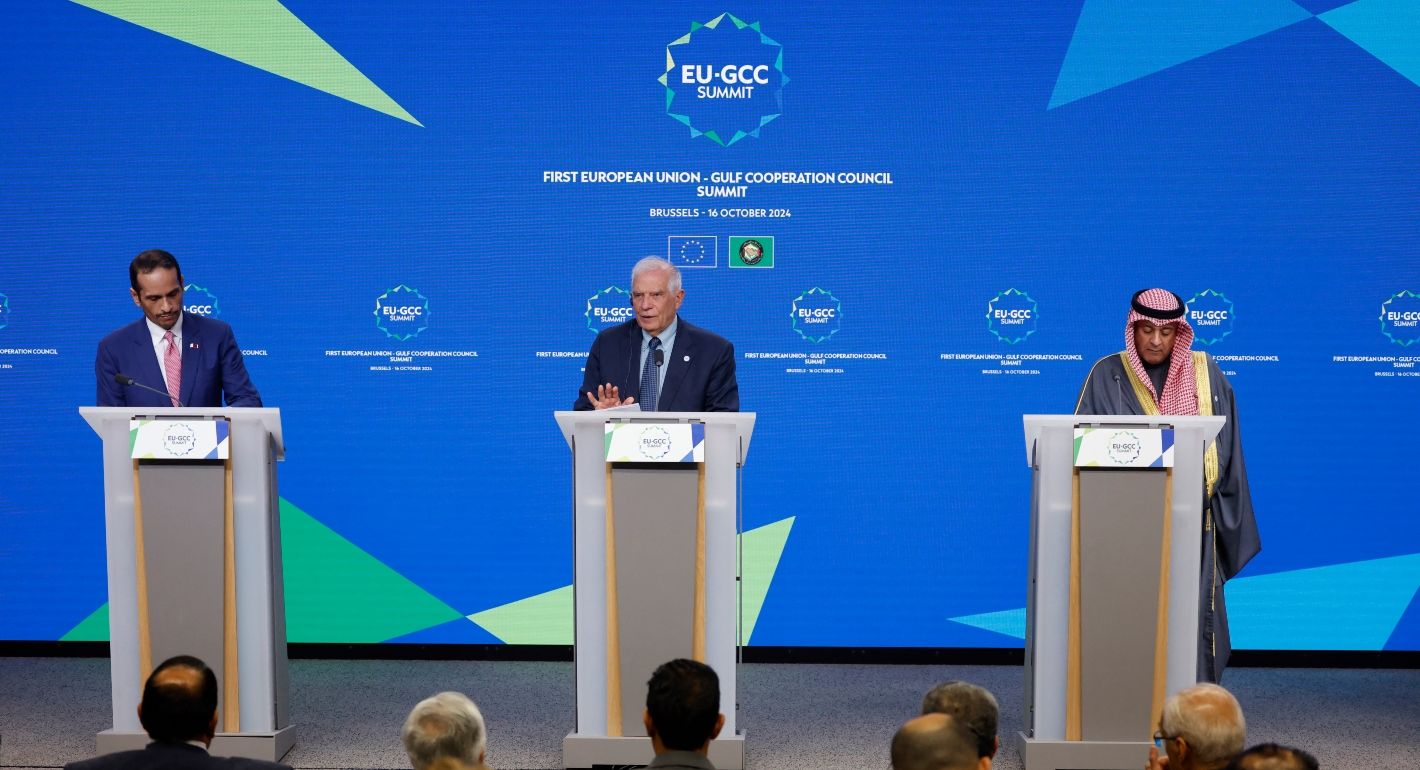
Gulf investors pulled over $1 billion from Pakistan’s bonds and equities in FY26. Here’s why the Gulf peace deal matters more than headlines suggest.
Pakistan’s economic commentary this year has largely stayed domestic — inflation, IMF reviews, remittances. The more revealing story sits in the balance-of-payments data: Gulf capital, historically one of Pakistan’s most reliable sources of portfolio investment, has gone into reverse at precisely the moment Islamabad is leaning on its Gulf relationships diplomatically.
The numbers
State Bank of Pakistan data show that from July 1, 2025 to June 19, 2026, equity market inflows totalled just $308 million while outflows exceeded $1 billion. Foreign direct investment declined by 28% over the first 11 months of FY26, domestic bonds saw a net outflow of $550 million, and total bond outflows for the year topped $2 billion. Pakistan’s external financing needs are steep: the country must pay over $26 billion in 2026–27, against an $35 billion trade deficit in the first 11 months of FY26.
Between July 2025 and June 2026, foreign outflows from Pakistan’s domestic bonds exceeded $2 billion, while equity market outflows topped $1 billion against just $308 million in inflows. Gulf states have been net sellers, with Bahrain withdrawing $30 million from Pakistani bonds in early FY27 alone, as the US-Israeli war with Iran raised regional risk premiums.
The pattern has continued into the new fiscal year. In the first ten days of FY27, Bahrain withdrew $30 million from Pakistan’s domestic bonds — $21 million from treasury bills and $9 million from Pakistan Investment Bonds — with no Gulf country recording any inflow during the period. Luxembourg was the only recorded foreign buyer, investing $4 million.
Why the peace deal matters disproportionately to Pakistan
Analysts quoted in Pakistani financial press note that Pakistan is not a party to the Gulf war but is now part of the peace framework, which raises the stakes for Islamabad if the deal collapses. Remittances from Gulf countries have so far held up, but bankers warn a prolonged conflict could eventually disrupt what remains the country’s largest source of foreign exchange, alongside stagnant exports and growth capped below 4%.
This sits against a wider regional backdrop: a new UNCTAD World Investment Report finds Gulf outbound investment grew through 2025, but warns that a prolonged conflict could redirect Gulf capital toward domestic reconstruction and strategic infrastructure, reducing the pool available for developing economies in Asia and Africa that increasingly depend on GCC financing — a dynamic that directly implicates Pakistan’s financing model.
The underserved angle
Most Pakistani business coverage frames this as an IMF-and-remittances story. The more precise framing is a capital-substitution risk: Pakistan has structurally relied on Gulf sovereign and institutional capital to plug its external financing gap, and that capital source is now competing for the same money regional reconstruction and Gulf domestic strategic infrastructure would need in a prolonged-conflict scenario. There is a live, underreported counter-current too — SBP data show net FDI actually rose from $54.46 million in April 2026 to $214.29 million in May, suggesting the bond-market flight and the FDI picture are not moving in lockstep.
Discover more from The Economy
Subscribe to get the latest posts sent to your email.
Markets & Finance
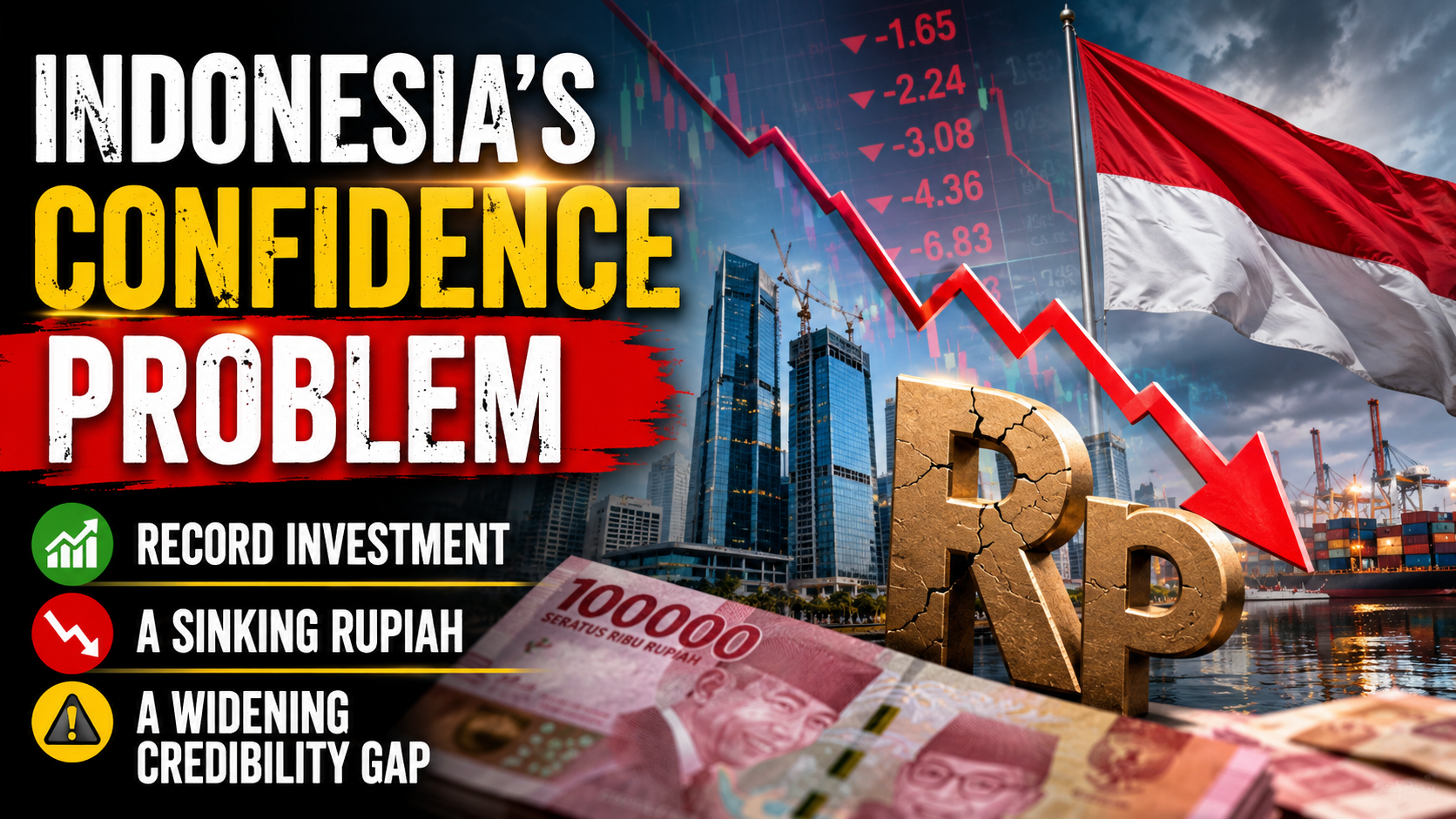
Indonesia’s Confidence Problem: Record Investment, a Sinking Rupiah, and a Widening Credibility Gap
Introduction
Indonesia’s economic story in mid-2026 is one of genuine contradiction. On one hand, the government posted a record Rp1,010.6 trillion ($56.1 billion) in realized investment for the first half of the year, up 7.2% from a year earlier and on pace to hit its full-year target (Antara News). On the other, the rupiah has been sliding toward Rp18,000 per US dollar, the state budget deficit has widened, and a growing chorus of domestic commentators is warning that Indonesia risks permanently losing what one Jakarta Post analysis called “the vital game of investor confidence” (The Jakarta Post).
The Investment Numbers Look Genuinely Strong
Indonesia’s Investment and Downstreaming Minister Rosan Roeslani reported that first-half 2026 investment realization reached 49.5% of the government’s full-year target of Rp2,041.3 trillion, creating 1.44 million jobs — a 15% increase in job creation compared to the first half of 2025 (Antara News). Domestic and foreign investment remained almost perfectly balanced, with foreign direct investment reaching Rp507.6 trillion (50.2% of the total) against Rp502.9 trillion in domestic investment (Antara News). Notably, investment outside the country’s most populous island, Java, exceeded inflows into Java itself for the first time in this dataset — Rp507.8 trillion versus Rp502.8 trillion — supporting the government’s long-standing goal of more balanced regional development (Antara News).
Singapore remained by far Indonesia’s largest source of foreign capital at $8.8 billion, followed by Hong Kong ($7.6 billion), China ($3.9 billion), Japan ($1.9 billion) and the United States ($1.7 billion) — together accounting for roughly 77.8% of all foreign direct investment into the country (Antara News). Second-quarter investment specifically rose 7.1% year-on-year to Rp511.8 trillion, with Minister Roeslani noting that investor commitment to Indonesia has held up despite significant “geopolitical and geoeconomic challenges” globally (The Jakarta Post).
But the Pace Is Slowing, and the Currency Is Under Pressure
Despite the record absolute figures, the Jakarta Post notes that investment growth in 2026 has been running at a distinctly slower pace than the country achieved in recent prior years, even as it remains on track to hit the annual target (The Jakarta Post). Meanwhile Bank Indonesia has had to actively respond to renewed rupiah weakness, attributing the currency’s slide toward Rp18,000 per dollar to hawkish signals from Federal Reserve officials and broader movements in the US dollar index (Samuel Sekuritas Daily Economic Insights). The state budget deficit reached Rp196.5 trillion in the first half of 2026, equivalent to 0.76% of GDP (Samuel Sekuritas Daily Economic Insights).
There has been some relief more recently: a 27.4% surge in second-quarter foreign direct investment helped strengthen the rupiah, with USD/IDR trading around 17,990 in mid-July as softer US inflation data reduced the odds of a near-term Fed hike (TMGM). Even so, the US dollar has retained broad support from escalating Middle East geopolitical tensions, keeping the rupiah’s recovery fragile rather than decisive (TMGM).
Why Growth Forecasts Keep Getting Trimmed
International lenders have grown more cautious about Indonesia’s growth trajectory for 2026. The OECD has held its outlook at 4.7% year-on-year — a clear deterioration from 2025’s realized 5.1% growth — with most major lending institutions clustering around the 5.0% threshold, implying a loss of momentum after Indonesia posted 5.61% growth in the first quarter of 2026 alone (Indonesia Investments). The deceleration is attributed to a softening labor market, weakening consumer confidence, and contracting retail sales in the second quarter (Indonesia Investments). High global oil prices are compounding the pressure on the government’s fiscal balance, since Indonesia continues to subsidize a significant portion of domestically sold fuel — a policy that transmits global energy volatility directly into the state budget rather than shielding consumers from it entirely (Indonesia Investments).
The Deeper Warning: A Confidence Problem, Not Just a Cyclical One
The most pointed recent critique comes from domestic commentary rather than foreign analysts. A Jakarta Post opinion piece published July 20, 2026 argues Indonesia must halt what it describes as erratic policymaking and institutional erosion before the country permanently damages its standing in the “vital game of investor confidence,” framing the rupiah’s weakness and shifting global market conditions as symptoms of a deeper credibility issue rather than purely external shocks (The Jakarta Post). That framing matters for how the strong headline investment numbers should be read: capital is still arriving, but the terms on which it arrives, and the confidence with which it stays, are visibly more fragile than the raw totals suggest.
Strategic Bright Spots
Not every recent development points toward strain. India secured access to Indonesian critical minerals through several major agreements signed during Prime Minister Narendra Modi’s visit to Jakarta, part of a broader push by Indonesia to leverage its resource base for deeper strategic partnerships (Samuel Sekuritas Daily Economic Insights). Indonesia is also pursuing energy independence through B50 biodiesel and compressed natural gas development, aimed explicitly at reducing reliance on imported LPG — a structural move that, if successful, would reduce exactly the kind of imported-energy vulnerability now straining the budget (Samuel Sekuritas Daily Economic Insights).
Key Takeaways
- Indonesia posted a record Rp1,010.6 trillion ($56.1 billion) in H1 2026 investment, up 7.2% year-on-year, with foreign and domestic capital nearly evenly split.
- The rupiah has weakened toward Rp18,000 per dollar on hawkish Fed signals, though a Q2 FDI surge has since provided partial relief.
- International lenders have trimmed Indonesia’s 2026 growth outlook to around 4.7–5.0%, down from 5.1% realized growth in 2025.
- The H1 2026 budget deficit reached 0.76% of GDP, pressured by continued fuel subsidies amid high global oil prices.
- Domestic commentary increasingly frames Indonesia’s challenge as a credibility and policymaking issue, not merely a cyclical external shock.
Sources: Antara News, The Jakarta Post — Investment Growth, The Jakarta Post — Confidence Game, Samuel Sekuritas Daily Economic Insights, Indonesia Investments, TMGM
Discover more from The Economy
Subscribe to get the latest posts sent to your email.
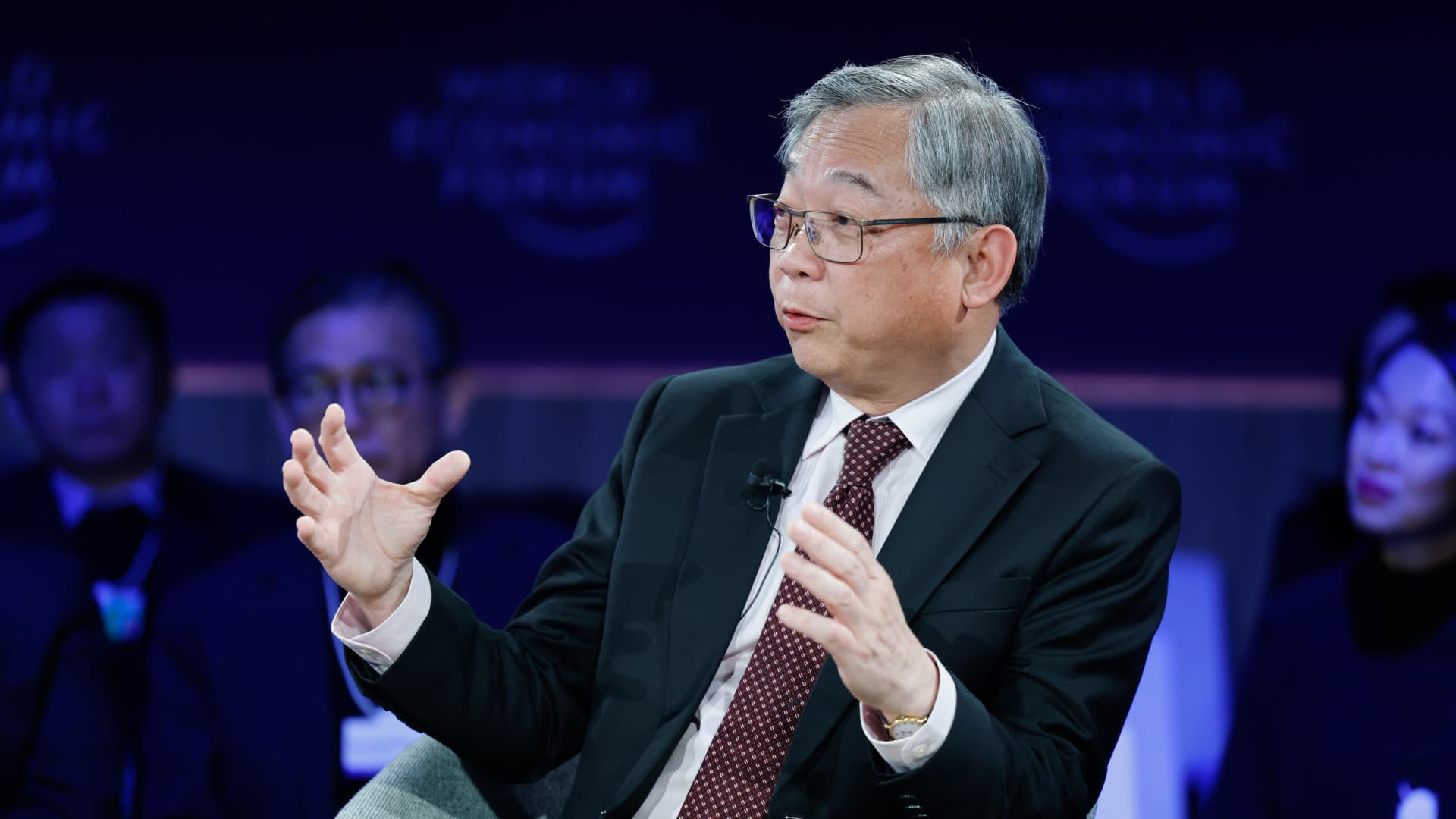
The 13th Invest ASEAN conference in Singapore brought together 200 institutional investors managing a combined US$23 trillion in assets and 54 listed companies worth US$553 billion. The concentration reflects a broader recalibration of global capital toward Southeast Asia as energy transition, supply-chain reconfiguration, and AI-led digital transformation converge — with Singapore positioning itself as the region’s financial gateway for that capital.
The number that got buried in the GDP headline
Most coverage of Singapore’s economy this month led with the topline figure: Q1 2026 GDP growth came in at a robust 6.0% year-on-year, well above flash estimates of 4.6% and the strongest reading since Q3 2024 (Joey Choy Newsletter). That’s a genuinely strong number. But it obscures a more consequential story happening in parallel: the sheer scale of capital now treating Singapore as Southeast Asia’s default financial hub for AI-era investment.

At this year’s Invest ASEAN conference, Maybank Investment Banking Group reported that 200 institutional investors managing US$23 trillion in combined assets attended alongside 54 companies with a combined market capitalization of US$553 billion, spanning Malaysia, Singapore, Thailand, Indonesia, the Philippines, Vietnam and India (BigGo Finance). Maybank IBG’s CEO Michael Oh-Lau said attendance exceeded expectations, underscoring sustained interest from both global and local investors in the region’s resilience amid worldwide uncertainty.
Why now — the three-part thesis driving the capital shift
The conference’s dominant themes weren’t accidental. Three forces are converging simultaneously:
- Energy transition — as global supply chains reroute away from Middle East chokepoints exposed by the Strait of Hormuz conflict, Southeast Asia’s manufacturing base becomes comparatively more attractive.
- Supply chain reconfiguration — companies diversifying out of single-country manufacturing dependence increasingly view ASEAN as a structural beneficiary, not just a cyclical one.
- AI-led digital transformation — the region is capturing meaningful downstream value from the AI capex boom, not just as a manufacturing base for chips but as a testing, R&D and deployment hub.
Maybank IBG simultaneously upgraded its Asean-6 growth forecast to 4.7% from 4.5%, citing easing global oil prices, a recovering flow of tanker traffic through the Strait of Hormuz, and robust regional activity (BigGo Finance) — a dynamic explored further in our Malaysia GDP upgrade analysis.
Singapore’s policy backdrop: stability as the product
Singapore’s Ministry of Trade and Industry has kept its full-year 2026 GDP growth forecast at 2.0–4.0%, flagging geopolitical developments — not domestic weakness — as the primary downside risk to monitor (Joey Choy Newsletter). Inflation remains contained within a 1–2% range, which has allowed the Monetary Authority of Singapore to hold its policy stance steady rather than react defensively. In a year when most major central banks are navigating volatility, that steadiness is itself the competitive advantage drawing capital in.
What this means beyond Singapore
The capital concentration isn’t purely a Singapore story — it’s a bet on the entire ASEAN growth thesis, with Singapore serving as the transaction and custody layer. For businesses and investors, the practical signal is that Southeast Asia is increasingly being treated by global allocators as a coherent investment bloc rather than nine separate frontier markets, with Singapore’s regulatory stability functioning as the anchor that makes exposure to higher-growth, higher-volatility neighbors (Indonesia, Vietnam, the Philippines) palatable to large institutional funds.
Discover more from The Economy
Subscribe to get the latest posts sent to your email.

Pakistan’s 2026 Monsoon Floods Threaten Fragile Economic Recovery as Inflation Nears 9%

Pakistan Gulf Investment Outflows 2026: Peace Deal Stakes Explained

Canada Trade Diversification 2026: China, Indonesia, UAE Deals Explained

US Forced-Labour Tariffs on 60 Countries: The Hidden Trade Shock of 2026

Global Central Banks 2026: Fed, BoE and BoJ Decisions Could Reshape Markets

Gulf Capital Retreat From Pakistan 2026: UAE Loan Freeze & What It Means

Pakistan’s Most Reliable Export Is Its People: Remittances Hit $41.6 Billion, Overtaking Total Exports

Indonesia’s Confidence Problem: Record Investment, a Sinking Rupiah, and a Widening Credibility Gap

Down But Not Out: Inside the Slow Sinking of Russia’s War Economy

China’s Growth Slips to a Four-Year Low: Why Beijing Still Won’t Pull the Stimulus Trigger

The Johor-Singapore Corridor: How Malaysia Became Southeast Asia’s AI Infrastructure Powerhouse

Canada’s Economy ‘On Pause’: Inside the CUSMA Deadline That Passed Without a Deal

Dubai’s Millionaire Magnet: How the UAE Turned Middle East Turmoil Into a Capital Safe-Haven Boom

Britain’s Sixth Prime Minister in a Decade: What Starmer’s Exit Means for Gilts, Sterling and Your Portfolio

Carry Trade Unwind 2026: How the Yen’s Snapback Triggered a Global Margin Call

AI Bubble Warning 2026: Why BIS, IMF and Bank of England Fear a Market Crash

BRICS De‑Dollarization Strategy Takes Shape with $15 Billion Local‑Currency Push

The AI Super Bubble Is Ready to Burst

Russia Bans Diesel Exports 2026: Global Fuel Market Impact Explained

Strait of Hormuz Blockade 2026: Oil Prices Surge 9% as US-Iran Conflict Reignites

Private Credit Warning: Most BDCs Turn Unprofitable in 2026, Reuters Finds

Bitcoin $150k Milestone Achieved as US Sovereign Crypto Pivot Looms

IMF Cuts Pakistan Growth Forecast, Raises Inflation to 8.4%
Gulf Capital Retreat From Pakistan 2026: UAE Loan Freeze & What It Means

India Economic Rise 2026: How the Subcontinent Toppled Japan

Strait of Hormuz 2026: Why Markets Still Don’t Trust It’s Open

China Housing Market Turnaround: White‑List Model Stabilises Prices

Chipmakers Just Lost 6.7% in Two Days: Inside the Great AI Trade Rotation
-

 Markets & Finance7 months ago
Top 15 Stocks for Investment in 2026 in PSX: Your Complete Guide to Pakistan’s Best Investment Opportunities
-

 Analysis5 months ago
Johor’s Investment Boom: The Hidden Costs Behind Malaysia’s Most Ambitious Economic Surge
-

 Analysis5 months ago
Top 10 Stocks for Investment in PSX for Quick Returns in 2026
-

 Analysis6 months ago
Brazil’s Rare Earth Race: US, EU, and China Compete for Critical Minerals as Tensions Rise
-

 Banks6 months ago
Best Investments in Pakistan 2026: Top 10 Low-Price Shares and Long-Term Picks for the PSX
-

 Investment7 months ago
Top 10 Mutual Fund Managers in Pakistan for Investment in 2026: A Comprehensive Guide for Optimal Returns
-

 Global Economy7 months ago
15 Most Lucrative Sectors for Investment in Pakistan: A 2025 Data-Driven Analysis
-

 Global Economy7 months ago
Pakistan’s Export Goldmine: 10 Game-Changing Markets Where Pakistani Businesses Are Winning Big in 2025