Connect with us

Analysis

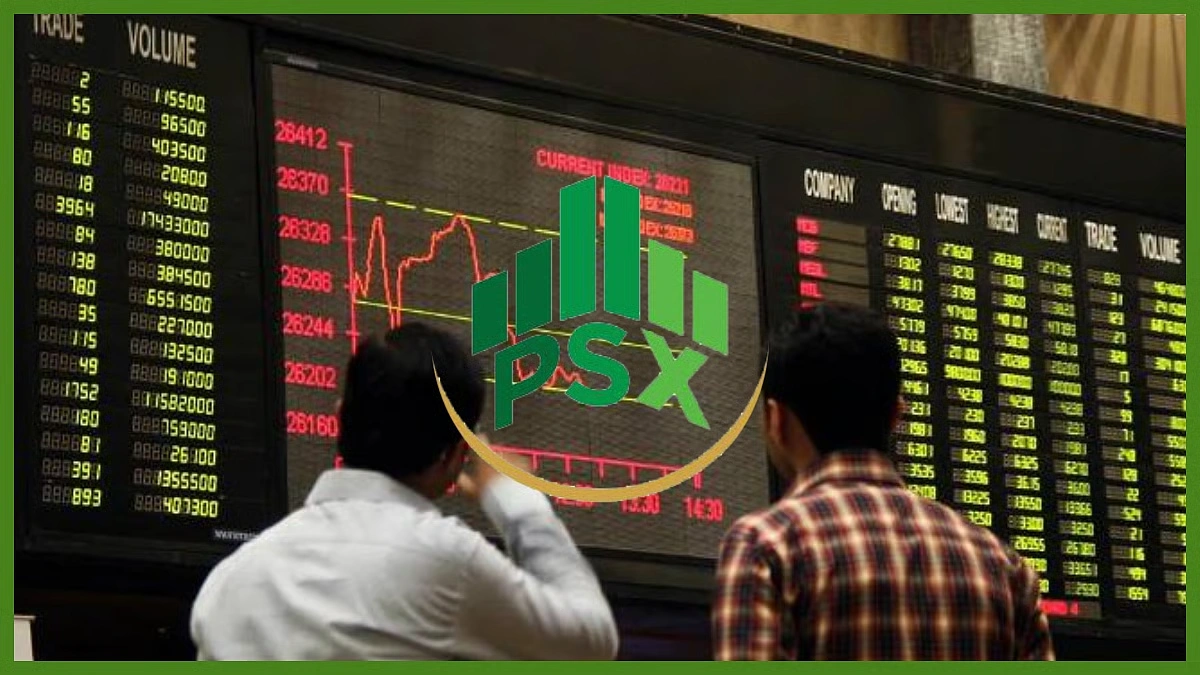
PSX Bloodbath: KSE-100 Plunges 16,089 Points in Historic Single-Day Crash

Published

on

The KSE-100 index collapsed 9.57% on March 2, 2026 — its worst-ever single-day absolute loss — as US-Israel strikes on Iran triggered a PSX bloodbath, oil shock, and global market panic. Here’s the full breakdown.

Key Facts at a Glance

MetricValue
KSE-100 Closing Value (Mar 2, 2026)151,972.99
Points Lost (Single Day)16,089.17
Percentage Decline9.57%
Intraday Low151,747.96
Circuit Breaker Triggered9:22 AM PKT
Brent Crude (Day’s High)~$82.00/barrel
Gold$5,327/oz (+1%)
Previous Close (Feb 28)168,062.17
Drawdown from Jan 2026 Peak~19%

It began not with the opening bell, but with silence — the particular, loaded silence of traders staring at screens as the world they priced for had, overnight, become a different one entirely. By 9:22 on a Monday morning in Karachi, the Pakistan Stock Exchange had effectively declared an emergency, triggering a mandatory trading halt after the benchmark KSE-100 index plummeted 15,071 points — nearly 9% — in less than half an hour of trading. When markets finally closed, the KSE-100 had shed 16,089 points to settle at 151,972.99, a decline of 9.57% that constitutes the worst absolute single-day loss in the exchange’s history.

This was no ordinary correction. This was the market’s verdict on a new and dangerous world.

The Trigger: When Washington and Tel Aviv Changed the Calculus

The proximate cause was a seismic geopolitical event that investors had feared but hoped would remain theoretical. Over the weekend of February 28–March 1, 2026, the United States and Israel launched what the White House described as “major combat operations” in Iran, reportedly killing Supreme Leader Ayatollah Ali Khamenei in the opening strikes. Tehran’s response was swift and broad: retaliatory missile barrages targeting US military installations across the Gulf, with blasts reported in the UAE, Qatar, Bahrain, Kuwait, Jordan, and Saudi Arabia.

Dubai International Airport was briefly engulfed in chaos, with footage showing people fleeing a smoke-filled passageway as Iran’s missile salvos — mostly intercepted — sent shockwaves through Gulf infrastructure. President Trump, characteristically blunt, suggested the campaign could last another four weeks.

For energy markets, the threat to the Strait of Hormuz was the true horror. Roughly 15 million barrels of crude oil per day — approximately 20% of the world’s total oil supply — transit the Strait daily, making it the planet’s most consequential energy chokepoint. Marine tracking sites showed tankers piling up on either side, unable to obtain insurance for the voyage. Brent crude surged 9% to $79.41 a barrel in early Monday trading, while West Texas Intermediate climbed 8.6% to $72.79 — the steepest single-day energy price spike since the brief Israel-Iran war of 2025.

The PSX Collapse: Anatomy of a Historic KSE-100 Plunge

Pakistan, as a major net oil importer and a nation whose western border already simmers with Afghan tensions, sits at an especially exposed node in this crisis network. The market did not wait for analysis.

The benchmark index closed at 151,972.99, plunging 16,089.17 points or 9.57% in a single session. It traded within a wild intraday range of 7,580 points, recording a high of 159,328.59 and a low of 151,747.96, reflecting extreme volatility throughout the session. Total trading volume surged to 479.70 million shares.

Monday’s decline marks the KSE-100’s highest-ever single-day fall in absolute terms. Historically, the largest percentage decline was on June 1, 1998 at 12.4%, but due to the lower base of the index at that time, it does not rank in the top ten for absolute point drops. Today’s crash, in sheer numerical magnitude, stands alone.

The circuit breaker fired at 9:22 AM after the KSE-30 fell 5% from its previous close. Following the resumption of trading around 10:22 AM, strong recovery momentum briefly emerged, pushing the index more than 6,000 points higher from its intraday floor — before selling pressure re-emerged and erased those gains.

Market breadth told a brutal story: of the 100 index companies, only one closed higher, 98 declined, and one remained unchanged. The heaviest individual drags were Fauji Fertilizer Company (-1,595 pts), UBL (-1,301 pts), Engro Holdings (-886 pts), Hub Power (-718 pts), and Meezan Bank (-681 pts).

Sector Damage (Index Points Lost):

SectorPoints Eroded
Commercial Banks5,031.81
Fertilizer2,192.22
Oil & Gas Exploration1,715.57
Cement1,428.11
Investment Companies/Securities982.42

Pakistan’s Particular Vulnerability

Why did Karachi suffer so much more than London, Frankfurt, or New York? The answer is structural, not merely psychological.

Pakistan imports the vast majority of its energy needs. Every $10 rise in the per-barrel price of crude translates to roughly $2.5 billion in additional annual import costs — a meaningful sum for an economy currently navigating IMF-supervised stabilisation. Analysts were quick to connect the dots: “Elevated oil prices are highly detrimental to Pakistan’s external account, and persistently high commodity prices are likely to trigger a new wave of inflation,” said Waqas Ghani, Head of Research at JS Global.

The country was already navigating a dual-front stress test. Pakistan’s Defence Minister had described the situation with Afghanistan as tantamount to “open war,” and the KSE-100 has now fallen nearly 19% from its record high of 189,166.83 set in January 2026, edging dangerously close to the 20% threshold commonly associated with a formal bear market.

In the week before Monday’s collapse, the index had already shed 5,107 points — a 2.9% weekly decline. The PSX crash of March 2 was therefore not a surprise attack on a healthy market, but a breaking point on an already-fractured one.

The Global Picture: A Coordinated Rout

Pakistan’s pain was severe, but it was not isolated. Global markets opened the week sharply lower after the US-Israel strikes on Iran rattled investors across every time zone. In the US, S&P 500 futures were down 1.1%, Nasdaq 100 futures fell 1.5%, and the Dow Jones futures slid 1.1%. In Europe, the pan-European Stoxx 600 fell nearly 1.8% during Monday’s session.

Asian markets joined the rout: India’s Sensex fell 1.3%, Taiwan’s benchmark lost 0.9%, and Singapore’s dropped 2.3%. Bangkok’s SET fell 4%, while the UAE and Kuwait temporarily closed their own stock markets entirely, citing “exceptional circumstances.”

Gold surged to $5,408.10 per ounce — a 3.1% single-day gain — as the classic safe-haven flight took hold. The US dollar strengthened against most emerging-market currencies, adding a secondary pressure on Pakistan’s rupee and its debt-servicing capacity.

Standard Chartered’s Global Head of Research Eric Robertsen noted that investors had already been underpricing geopolitical risk, pointing to commodity-linked currencies outperforming as markets began pricing exposure to scarce resources and terms-of-trade winners.

What Analysts and Economists Are Saying

The bull case for containment: Quantum Strategy’s David Roche argued that the market impact depends almost entirely on duration. If the conflict remains short and contained, he noted, the risk-off move and oil spike could be brief — referencing the June 2025 pattern, when Israel struck Iranian nuclear sites and equities sold off sharply at the open before recovering once it became clear the Strait of Hormuz was not disrupted.

The bear case for escalation: Goldman Sachs estimated that oil prices could blow past $100 a barrel if there is an extended disruption to Strait of Hormuz flows — a scenario with severe implications for Pakistan’s current account and inflation trajectory.

The structural concern: Arif Habib Limited (AHL), in its latest note, highlighted that despite the near-term pressure, the tail-end of March typically marks the beginning of a seasonally bullish period for the KSE-100, and that following an almost 15% drawdown, the index appears poised for a rebound towards the 175,000 level, with sustained support above 165,000 likely to underpin such a move.

Recovery Scenarios: Three Possible Paths Forward

Scenario 1 — Swift De-escalation (30–45 days) If the US-Iran conflict remains largely aerial and does not close the Strait of Hormuz, global oil markets could retrace sharply. Pakistan would benefit from falling crude prices, a stabilizing rupee, and renewed risk appetite for frontier markets. KSE-100 recovery to 165,000–170,000 is plausible by April.

Scenario 2 — Prolonged Campaign (60–90 days) A sustained conflict, particularly one that throttles Strait of Hormuz traffic, would push Brent above $90–100, forcing Pakistan to burn through foreign exchange reserves at an accelerated pace and potentially triggering an emergency IMF review. The KSE-100 could test support at 140,000.

Scenario 3 — Regime Change and Uncertainty The death of Ayatollah Khamenei opens a power vacuum scenario in Iran that few analysts have priced. Ben Emons of FedWatch Advisors argued that leadership strikes in Tehran raise regime-change tail risks and leave an uncertain endgame — potentially the most destabilizing medium-term outcome for all regional markets, including PSX.

Actionable Insights for Investors

This is not a moment for panic, but it is a moment for precision. Here is what the data suggests:

1. Energy-linked plays carry double risk. Pakistani oil marketing companies and refineries face margin compression from higher crude costs even as revenues appear to rise in PKR terms. The sector’s net impact is negative for most listed names.

2. Banks face a credit cycle test. Commercial banks, which bore the largest index-point losses today, face rising non-performing loan risk if a fresh inflation cycle materializes. However, their healthy net interest margins — built during the high-rate era — provide a buffer. Selectively accumulating quality names on dips remains a viable strategy.

3. Fertilizer stocks are caught in a vice. Higher natural gas costs (linked to LNG imports) and falling farm-gate prices from commodity pressure could squeeze margins. Fauji Fertilizer’s 1,595-point drag on the index today reflects this anxiety.

4. Technicals matter now. AHL’s observation that the KSE-100 remains 7% above its 200-day moving average is significant — it represents a long-term structural support that institutional investors will defend. Breach of 145,000 would mark genuine capitulation territory.

5. Watch the Strait, not just the headlines. The single most important variable for Pakistan’s macro outlook over the next 30–60 days is not battlefield developments, but whether marine traffic through the Strait of Hormuz normalizes. A functional strait = manageable oil shock. A blocked strait = crisis conditions.

The Bigger Picture

Pakistan’s PSX bloodbath today is, in one sense, a microcosm of a broader truth about the global economy in 2026: the world has underpriced geopolitical risk for years, and it is now receiving the bill. From Karachi to Frankfurt, from the Gulf tanker lanes to Wall Street’s futures desks, the US-Israel strikes on Iran have created a risk-repricing event of genuine historical significance.

The Pakistan Stock Exchange, with its volatile frontier-market character, tends to price these shocks faster and harder than more liquid peers. That same characteristic means it tends to recover faster when clarity returns. The question Pakistani investors — and the government — must answer urgently is: what decisions, made today, preserve the most options for that recovery?


Discover more from The Economy

Subscribe to get the latest posts sent to your email.

Analysis

Asia Oil Buyers Have Exhausted Their Hormuz Alternatives

Published

on

Supply shocks, collapsing buffers, and the geopolitical reckoning Asia can no longer defer

Picture a tanker called the MV Rich Starry — flying a Malawian flag, which is an intriguing choice for a landlocked country — spoofing its AIS position for eleven days, loaded with methanol officially declared as originating from a UAE port. When the US naval blockade of Iranian waters took effect in April 2026, the vessel turned back once, then slipped through the Strait of Hormuz on a second attempt. That single ship, as investigated by the Jerusalem Post, tells the story of Asia’s energy crisis more honestly than any ministerial communiqué: the workarounds still exist, but they are getting thinner, costlier, and more dangerous by the day.

For the past four years, China and India ran a sophisticated arbitrage against Western sanctions and Middle Eastern volatility. They bought Russian crude at steep discounts, warehoused Iranian barrels through opaque intermediaries, and leaned on floating storage to buffer supply disruptions. That system is now under terminal stress. Since the US-Israeli strikes on Iran on February 28, 2026 triggered the effective closure of the Strait of Hormuz, Asian buyers have discovered that their carefully assembled safety net has very few knots left to hold.

The IEA’s April 2026 Oil Market Report describes this as ‘the largest disruption in the history of the global oil market.’

The consequences are no longer theoretical. The International Energy Agency’s April 2026 Oil Market Report describes this as the largest disruption in the history of the global oil market — a designation that should concentrate minds in every capital from New Delhi to Beijing to Washington.

What Asia Did to Avoid a Supply Shock

The story of Asia’s Hormuz workarounds begins, predictably, with Russia’s invasion of Ukraine in February 2022. When Western sanctions stranded Russian crude, China and India positioned themselves as buyers of last resort. By late January 2026, China was receiving nearly 1.7 million barrels per day of Russian crude at Chinese ports — a record — while India had overtaken Europe as Moscow’s top client. The discounts were generous enough that Beijing’s state and private refiners alike suspended their usual commercial caution.

China’s strategy was more elaborate than simple opportunism. A House Select Committee report published in early 2026 documented how Beijing assembled a strategic petroleum reserve of approximately 1.2 billion barrels by early 2026 — equivalent to 109 days of seaborne import cover — built largely from sanctioned crude purchased through a shadow fleet of roughly 138 tankers. Iran, Russia, and Venezuela supplied roughly one-fifth of China’s total oil imports through this system, each barrel arriving at a discount of $8–$12 below Brent.

India took a more pragmatic, less organised approach. New Delhi redirected refinery procurement toward discounted Urals, expanded its bilateral energy dialogue with Moscow, and quietly tolerated shadow-fleet vessels on its import routes. It also struck long-term LPG supply agreements with the United States, securing around 2–2.2 million tonnes annually from 2026. Diversification was underway — but it was partial, slow, and critically dependent on Hormuz remaining open for the bulk of its imports.

Why Those Buffers Are Shrinking Now

China’s Teapot Refineries: A Clever Hedge That Is Running Hot

The architecture of China’s hedge is holding — barely. Beijing’s roughly 1.2 billion barrel reserve did what it was designed to do: buy time. But the country has already responded by banning refined fuel exports, cutting Sinopec refinery runs, and imposing its largest domestic retail price hike since 2022. These are not the actions of a country with comfortable headroom. They are triage.

The shadow fleet itself is under pressure. Between December 2025 and February 2026, US authorities interdicted nine shadow fleet tankers across the Caribbean, Atlantic, and Indian Ocean in Operation Southern Spear. Meanwhile, Kpler data shows that China’s Iranian crude discharges fell to 1.138 million barrels per day in February 2026, down from 1.4 million bpd the previous month, as buyers grew wary ahead of military escalation. Russia rapidly filled part of that gap — Chinese customs records showed Russian crude shipments rising 40.9 percent in the first two months of 2026 — but at rising cost and logistical complexity.

Most critically, the IEA’s April report reveals that global observed oil inventories fell by 85 million barrels in March 2026, with stocks outside the Middle East Gulf drawn down by a devastating 205 million barrels — 6.6 million barrels per day — as Hormuz flows were choked off. The Middle East’s landlocked floating storage swelled by 100 million barrels of crude that cannot move. The buffer is not being replenished; it is being consumed at an accelerating rate.

India’s LPG Crisis: The Political Bomb Beneath the Gas Cylinder

India’s vulnerability is more acute and more politically dangerous. Data from the Petroleum Planning and Analysis Cell shows that LPG production in January 2026 stood at 1.158 million tonnes while imports reached 2.192 million tonnes. More than 90 percent of those imports transited the Strait of Hormuz. India’s total LPG storage capacity is approximately 1.9 million tonnes, or roughly 22 days of supply according to S&P Global Commodity Insights — dangerously thin for a nation whose clean-cooking programme spans 300 million households.

The results have been immediate: restaurants limiting operations, panic buying of cylinders, and queues at gas agencies in Jharkhand and other states. Bloomberg reported in mid-March that two state-owned LPG tankers required diplomatic clearance for safe passage — a measure of how desperate the situation had become when individual cargo movements needed ministerial-level intervention.

Market and Price Implications: When the Discounts Disappear

The market mathematics of Asia’s predicament are brutal. In early April 2026, loadings through the Strait averaged just 3.8 million barrels per day, compared to more than 20 million bpd in February. Alternative export routes — Saudi Arabia’s Red Sea terminals, the UAE’s Fujairah port, Iraq’s Ceyhan pipeline — had scaled to 7.2 million bpd from under 4 million bpd, but that still leaves a gap of nearly 10 million bpd the global market cannot fill.

Brent crude, which traded around $71 a barrel before the conflict, surged above $100 by early March and reached approximately $130 per barrel by the time of the IEA’s April report — some $60 above pre-conflict levels. Physical crude reached near $150/bbl at points, with the physical-futures disconnect becoming increasingly acute as refiners scrambled for spot cargoes.

The era of discounted Russian and Iranian crude — which underpinned Asia’s refining economics for three years — is effectively over for the duration of this crisis.

China’s independent Shandong refineries, which processed 90 percent of Iranian crude, now face replacement barrel costs of $10–12 more per barrel. Asian refiners have cut runs by around 6 million barrels per day — a contraction now feeding through into jet fuel and diesel shortages from Thailand to Pakistan.

The Federal Reserve Bank of Dallas estimates that a full closure removing 20 percent of global oil supplies for one quarter could raise WTI prices to $98/bbl and reduce global real GDP growth by 2.9 percentage points annualised. These were conservative assumptions relative to what has unfolded.

Geopolitical and Policy Fallout: India’s Vulnerability, China’s Calculated Gamble

The divergence between India and China’s positions is instructive. China entered this crisis with a 109-day reserve and a shadow fleet purpose-built for sanctions evasion. It has responded by restricting domestic fuel exports — prioritising its own economy — and calibrating its Iran relationship to maximise leverage. Beijing’s calculation is whether to pressure Tehran toward a deal using its status as Iran’s sole meaningful customer, or to continue running the shadow fleet and absorb US secondary sanctions risk.

India had no such cushion. With around 2.5–2.7 million barrels per day arriving through Hormuz — nearly half its import requirement — New Delhi faces a structural vulnerability it cannot resolve through diplomacy alone. In April 2026, the Modi government signed a deal to import sanctioned Russian LNG, a move that risks straining relations with Washington even as India courts US energy partnerships.

Regional contagion is accelerating. Malaysia ordered civil servants to work from home to conserve fuel. Japan and South Korea, sourcing roughly 95 percent and 70 percent of their crude from the Middle East respectively, are measuring remaining supply in weeks. The World Economic Forum’s April 2026 analysis warns the disruption extends beyond oil: a third of global seaborne methanol trade, nearly half of global sulfur exports, and 46 percent of global urea trade all pass through the strait — compounding food security and industrial supply risks across Asia’s agricultural economies.

The IEA has coordinated the largest emergency reserve draw in history — 400 million barrels — but that covers roughly four days of what the market has lost.

What Comes Next: Policy Prescriptions Before the Next Shock

The immediate priority is diplomacy, not logistics. Resuming flows through the Strait of Hormuz remains, as the IEA bluntly states, “the single most important variable in easing the pressure.” The April 2026 ceasefire provided temporary respite, but Iran’s initial statement that the strait was “completely open” was almost immediately contradicted by Revolutionary Guard conditions for transit.

For the medium term, three structural reforms should be non-negotiable for any Asian government serious about energy security.

First, strategic stockpile expansion. India’s 22-day LPG reserve is dangerously inadequate for a 1.4 billion-person democracy. New Delhi should target 60 days of LPG cover — financed through a transparent cess on cylinder sales — comparable to its strategic crude oil reserve.

Second, genuine route diversification. The Eastern Maritime Corridor from Vladivostok to Chennai is operational for crude, but requires stress-testing for LPG and refined products. India and Japan should jointly finance infrastructure at Oman’s deep-water ports at Duqm and Salalah — both of which sustained drone damage in March 2026, underscoring that even bypass routes require protection frameworks.

Third, accelerated energy transition investment — not as idealism but as hard security infrastructure. Every gigawatt of renewables installed in South and East Asia reduces the volume of crude that must transit a waterway controlled by an adversarial power. The IEA has noted that this crisis may accelerate the clean energy shift — but only if Asian governments treat it as such, rather than racing to replace barrels with barrels.

The lesson of the past eight weeks is not that Asia’s energy planners were naive — they were rational. The error was in believing the workarounds would last indefinitely.

The error was in believing they would last indefinitely. The arithmetic of dependency has now been written in crude oil prices above $130 a barrel, queues at gas agencies in Jharkhand, and a single Malawian-flagged tanker deciding whether to run a naval blockade.

Asia’s energy policymakers have one useful gift from this crisis: clarity. The alternatives to Hormuz are not gone, but they are exhausted as a primary strategy. What comes next must be built on sturdier foundations — and built now, before the next closure.

BIBLIOGRAPHY

1. IEA (April 2026). Oil Market Report — April 2026

2. House Select Committee on China (2026). Crude Intentions: How China Became the Clearing Market for Sanctioned Oil

3. Business Standard / S&P Global (March 2026). Why India faces LPG shortage amid ongoing West Asia war

4. Bloomberg (March 14, 2026). Two LPG Ships Sail Through Hormuz to Shortage-Hit India

5. Federal Reserve Bank of Dallas (March 20, 2026). What the closure of the Strait of Hormuz means for the global economy

6. World Economic Forum (April 2026). Beyond oil: 9 commodities impacted by the Strait of Hormuz crisis

7. Al Jazeera (April 3, 2026). How China’s ‘teapot’ refineries are cushioning it from Iran war oil crisis

8. Iran International / Kpler, Vortexa (February 25, 2026). China refiners turn to Russian oil as Iran faces rising uncertainty

9. Jerusalem Post (April 2026). China may survive Trump’s Hormuz blockade, but time is no longer on its side

10. Bloomberg (2026). Iran War: How High Could Oil Prices Get with Strait of Hormuz Closure?

11. Observer Research Foundation / RT (April 3, 2026). How Russia fits into India’s plan to secure LPG supplies from Hormuz

12. UNCTAD (March 10, 2026). Strait of Hormuz disruptions: Implications for global trade and development


Discover more from The Economy

Subscribe to get the latest posts sent to your email.

Continue Reading

Analysis

Poland Gold Reserves Sale to Fund Defense Is a Dangerous Mirage, Minister Warns

Published

on

Warsaw’s plan to monetize 550 tonnes of bullion for military spending rests on shaky legal ground, pits president against prime minister, and risks dismantling the sovereign hedge Poland spent a decade building.

Poland has spent the better part of a decade accumulating gold with the intensity of a nation preparing for something it hopes never comes. It now holds 550 tonnes of the metal — worth roughly $89 billion at end-January 2026 prices — making the National Bank of Poland (NBP) the 11th-largest central bank gold holder on Earth, surpassing even the European Central Bank. That achievement, engineered by NBP Governor Adam Glapiński, was celebrated in Warsaw as a statement of financial sovereignty. Then, in a single week in early March, Glapiński proposed turning the crown jewels into cannon fodder. Finance Minister Andrzej Domański’s response was swift and withering: the scheme, he said, was nothing more than “fairy tales” that “finances nothing.” He is right — and the political theatre surrounding this Poland gold reserves sale proposal reveals far deeper fractures in Warsaw’s strategic architecture than the headlines suggest.

The Glapiński Proposal: Gold as a Defense Instrument

On March 4, 2026, President Karol Nawrocki stood before cameras alongside Glapiński to announce what they branded “Polish SAFE 0%”: a sovereign, interest-free alternative to the European Union’s €150 billion Security Action for Europe (SAFE) rearmament loan programme. The central bank chief had presented to Nawrocki a proposal to generate up to 48 billion zloty — approximately $13 billion — by selling down a portion of Poland’s gold reserves and then buying them back at a later date, according to people familiar with the discussions who spoke to Bloomberg on condition of anonymity.

The political backdrop is important. Nawrocki and his allies in the opposition Law and Justice (PiS) party have long attacked the EU’s SAFE programme as an infringement on Polish sovereignty, objecting particularly to the rule that at least 65 percent of procurement contracts must go to European suppliers — a constraint that would limit Warsaw’s ability to buy American F-35 fighters and South Korean artillery systems. The president described SAFE as “costly” and warned it would “jeopardize ties with Washington,” a position that aligns conveniently with the Trump administration’s own derision of the programme.

The optics of “paying for weapons with gold” carry undeniable nationalist appeal. The substance is considerably less solid.

Why the Legal Architecture Is Broken

“We cannot use any part of the reserves in the sense that part of the reserves will be transferred, because it is against the law.” — Adam Glapiński, NBP Governor, March 5, 2026

The NBP’s own governor, in the same breath as pitching the plan, acknowledged its primary legal obstacle: the central bank is prohibited by Polish law from directly financing the government. The bank is, however, required to transfer almost its entire annual net income to the state budget — a mechanism that theoretically could be leveraged if legislative conditions were changed. Glapiński confirmed he is “working on a plan” and that the NBP could transfer “several dozens of billions of zloty in profits a year” if new legislation were passed, subject to consultations with the ECB.

That is a very large “if.” Finance Minister Andrzej Domański dismissed the Nawrocki-Glapiński scheme as “fairy tales” that “finances nothing,” pointing out that the NBP has run at a net loss for several consecutive years — meaning the profit-transfer mechanism is, at present, generating no revenue at all. The bank’s paper gains on gold are real — unrealised profits from gold price appreciation amount to approximately 197 billion zloty, or roughly $54 billion — but converting those book gains into actual defence procurement requires legislative engineering that would, at minimum, need ECB sign-off and likely trigger a constitutional challenge in Poland’s already-paralysed court system.

The plan to sell gold and buy it back later is equally fraught. At current prices — gold briefly surpassed $4,400 per troy ounce in early 2026 before pulling back — there is no guarantee that repurchase prices will be lower. Poland would be selling at a market peak and betting on a future correction to reconstitute reserves. That is speculation, not strategy.

The Political Rupture: A President Against His Own Government

The gold gambit cannot be understood apart from Poland’s increasingly dangerous constitutional deadlock. Nawrocki vetoed the SAFE Financial Instrument Act on March 12, 2026, blocking Warsaw’s access to €43.7 billion — the largest allocation any EU member secured under the programme. Prime Minister Donald Tusk’s reaction was unsparing: “Poland is in shock,” he said. Foreign Minister Radosław Sikorski called the veto “national treason.”

What is remarkable is that Poland stands alone on NATO’s eastern flank as the only country where SAFE has become a political battlefield rather than a shared strategic asset. Lithuania, Estonia, Latvia, and Romania all moved swiftly to access the programme. Warsaw, the neighbour of Ukraine and the country spending the highest share of GDP on defence in NATO — an estimated 4.5 percent in 2025, alongside Lithuania — is now mired in a domestic dispute that could slow the very military buildup it claims to prioritise.

Tusk has vowed to access the SAFE funds regardless of the veto, though doing so without the implementing legislation means less flexibility: border guard modernisation, police upgrades, and infrastructure improvements would be ineligible. The government argues it can proceed through existing legal frameworks; the opposition has threatened prosecution before the State Tribunal.

Into this vacuum, the gold proposal has been inserted — less as a serious financing mechanism and more as a political instrument designed to give Nawrocki cover for blocking €44 billion in EU loans.

Poland’s Gold Strategy: A Decade-Long Achievement at Risk

To understand why the gold sale plan has rattled observers, it is necessary to appreciate the scale of Poland’s accumulation strategy. In 2018, the NBP held just 103 tonnes of gold. By January 2026, that figure had reached 550 tonnes — a more than fivefold increase. In the first quarter of 2025 alone, Poland purchased 48.6 tonnes, maintaining its position as the world’s top central bank gold buyer, acquiring nearly half its full-year 2024 total in a single quarter. Glapiński had announced in January 2026 plans to purchase a further 150 tonnes — bringing the target to 700 tonnes, which would cement Poland among the world’s ten largest central bank gold holders.

The rationale was explicitly defensive: gold provides a hedge against credit risk, currency devaluation, and geopolitical shock. As recently as May 2025, Glapiński himself declared that selling gold was “absolutely out of the question,” describing it as “a strategic asset for the state’s security.” Gold now constitutes 28.22 percent of Poland’s total foreign exchange reserves — up from 16.86 percent in 2024 — one of the fastest structural shifts in any central bank’s reserve composition worldwide.

To now contemplate selling that buffer — even temporarily — at a moment of peak geopolitical risk, and to do so in order to circumvent a proven multilateral financing mechanism, is not sovereignty. It is circular logic: dismantling the strategic shield to pay for the swords that were supposed to replace it.

The Comparative Evidence: When Central Banks Sell Gold, It Rarely Goes Well

History is instructive here. The United Kingdom’s decision to sell roughly half its gold reserves between 1999 and 2002 — near the bottom of a two-decade bear market — became notorious as “Brown’s Bottom,” named for then-Chancellor Gordon Brown. The sales, totalling 395 tonnes, were executed at prices between $256 and $296 per troy ounce. At 2026 prices above $4,000 per ounce, the cost of that decision exceeds $50 billion in forgone reserves.

Poland would be making the mirror-image error: selling at or near a cyclical peak, locking in revenue that assumes gold prices either stay elevated for repurchase or — implausibly — decline after the sale. Gold erased much of its 2026 gains in a single session in March, falling from above $4,400 to near $4,400 per ounce, partially on the very rumour of Polish sales. That price sensitivity should give Warsaw pause: a nation holding 550 tonnes cannot sell without affecting the price it receives.

More broadly, the trend among central banks in spring 2026 has moved decisively toward selling. Turkey’s central bank sold approximately 131 tonnes in March alone — its largest divestment in seven years — to defend the lira against currency pressure. Russia has been liquidating reserves to fund its war in Ukraine. These are distressed sellers. Poland is not in distress. It would be manufacturing the conditions for a strategic own goal.

The Right Path: SAFE, Sovereignty, and Strategic Coherence

The policy prescription here is straightforward, even if the politics are not. Poland should sign the SAFE implementing legislation — or, given the presidential veto, should press ahead with Plan B access through existing legal frameworks, accepting the reduced flexibility that entails. The €43.7 billion available is real, structured, and purpose-built for exactly the kind of military modernisation Warsaw requires: air defence, cyber operations, heavy artillery, and the industrial base to sustain them.

Defence Minister Władysław Kosiniak-Kamysz put the case better than any analyst could: “SAFE is a project written not in Brussels, but in Warsaw. The European Commission adopted the proposal at Poland’s request and at our dictation.” That authorship matters. This is not Brussels imposing conditions on Poland; it is Poland’s own generals’ procurement priorities, funded at zero percent interest over a five-year window.

The NBP’s gold, meanwhile, should stay exactly where it is — in vaults, as a genuine reserve asset, growing toward the 700-tonne target that would rank Poland among the world’s top sovereign bullion holders. Glapiński was right in May 2025 when he said selling was “absolutely out of the question.” He should return to that position.

Poland has built something rare: genuine financial sovereignty underwritten by hard assets. The mirage is not EU dependency. The mirage is the idea that the fastest path to security runs through the vaults of the central bank, in the wrong direction.

The most powerful weapon in any nation’s arsenal is not one it can buy with gold — it is the institutional coherence that allows it to make rational decisions under pressure.


Discover more from The Economy

Subscribe to get the latest posts sent to your email.

Continue Reading

Analysis

MSCI Boots Indonesian Tycoon-Owned Stocks from Indices: A $15 Trillion Rupiah Reckoning

Published

on

In a landmark investability review, MSCI has moved to boot tycoon-owned Indonesian stocks — most prominently PT Barito Renewables Energy (BREN) and PT Dian Swastatika Sentosa (DSSA) — from its global indices ahead of its May 2026 rebalancing, citing opaque shareholding structures and concerns over coordinated trading that undermines price formation. The Jakarta Composite Index (JCI) has already shed approximately $80 billion in market value since MSCI first raised alarm in January, and passive fund outflows from BREN and DSSA alone are estimated at IDR 15 trillion. This article argues that the MSCI intervention is not merely a technical reweighting exercise — it is a structural forcing function that exposes the incompatibility of Indonesia’s oligarchic ownership model with the standards demanded by global capital markets.

When MSCI announced in January 2026 that it would freeze all index additions for Indonesian securities and place the country’s emerging-market status under formal review, the reaction in Jakarta was instantaneous and brutal. The benchmark Jakarta Composite Index plunged 7.4% in a single session — the steepest one-day drop in nine months — triggering a 30-minute market halt. The following day, the index fell a further 10%, cascading to 7,482 and forcing three trading halts across two sessions. Roughly $80 billion in market capitalisation was erased in the span of 48 hours.

The trigger was a four-page statement from the New York-headquartered index compiler that used the driest possible regulatory language to say something explosive: Indonesia’s largest listed companies were too tightly controlled by their founders to be reliably investable. MSCI boots Indonesian tycoon-owned stocks from indices not merely as a routine methodological housekeeping — but as a verdict on decades of governance neglect that global institutional investors can no longer afford to overlook.

Background: How Indonesia Built a Market on Billionaire Foundations

The Jakarta Stock Exchange has long been dominated by family-owned conglomerates whose listed subsidiaries span mining, banking, tobacco, petrochemicals and renewable energy. According to data compiled by PT Trimegah Sekuritas, the top 20 tycoon-linked companies account for nearly 43% of the Jakarta Composite Index’s total weighting. This concentration was not accidental — it was the architecture of post-Suharto capitalism, where business licences and political proximity created dynasties that listed subsidiaries on the exchange without meaningfully surrendering control.

The concept of Indonesia’s so-called “deep-fried stocks” — a term that gained international currency after reporting by the Financial Times — captures the essential problem. These are tightly held shares, often with fewer than 5% of outstanding stock available for public trading, whose price can be engineered to spike dramatically in the hands of a controlling shareholder, lifting their owners into the upper echelons of Asia’s richest overnight. The very illiquidity that enables such manoeuvres is what makes these stocks structurally unfit for inclusion in a globally benchmarked index that passive fund managers must faithfully replicate.

MSCI’s own consultation paper on Indonesian free-float methodology — released in September 2025 and seeking responses by January 2026 — proposed using the Monthly Holding Composition Report from KSEI (PT Kustodian Sentral Efek Indonesia) as an additional data source to estimate true free float. The findings were damning. Many Indonesian companies disclose only shareholders owning 5% or more of total shares, leaving a vast opacity below that threshold. The KSEI report, while providing some additional granularity by investor category, could not identify individual shareholders — meaning the true beneficial ownership remained obscured behind opaque corporate and nominee structures.

“Opacity in shareholding structure and concerns about possible co-ordinated trading behaviour that undermines proper price formation.”

MSCI Official Statement, January 2026


The Decision and the Immediate Market Rout

By early April 2026, the Indonesia Stock Exchange (IDX) published a public list of nine companies where more than 95% of shares are held by a concentrated group of investors. Two names dominated the conversation: PT Barito Renewables Energy Tbk (BREN), controlled by Prajogo Pangestu — Indonesia’s richest man with an estimated net worth of $35.2 billion — and PT Dian Swastatika Sentosa Tbk (DSSA), affiliated with the Widjaja family’s Sinar Mas Group. Both are constituents of the MSCI Global Standard Index since 2025. Both fell more than 7% on the day of the IDX announcement.

Affected Tycoon-Linked Indonesian Stocks — MSCI Exclusion Risk Tracker (April 2026)

TickerCompanyConglomerate / TycoonEst. Free FloatPrice Move (Apr)Est. Passive OutflowMSCI Risk
BREN.JKPT Barito Renewables EnergyPrajogo Pangestu / Barito Group<5%−9.17%~IDR 6T🔴 Removal Likely
DSSA.JKPT Dian Swastatika SentosaWidjaja Family / Sinar Mas<5%−9.34%~IDR 9T🔴 Removal Likely
ABLI.JKPT Abadi Lestari IndonesiaUndisclosed consortium<5%−3.20%~IDR 1.2T🟡 Under Review
AGII.JKPT Samator Indo GasRachmat Handoyo family~7%−2.80%~IDR 0.9T🟡 Under Review

Sources: Bloomberg; IDNFinancials / Maybank Sekuritas; IDX filings April 2026. Passive outflow estimates are indicative.

The anticipated passive fund outflows from BREN and DSSA combined are estimated at approximately IDR 15 trillion if both are removed at the May 2026 rebalancing, according to analysts at Maybank Sekuritas Indonesia. That figure represents forced selling by index-tracking funds that have no discretion over whether to hold or sell once a stock is excised from a benchmark. In a market already suffering from 13.96 trillion rupiah ($834 million) in foreign outflows across all of 2025 — the worst annual figure since 2020 — mechanical passive selling on top of discretionary exits could prove destabilising.

“Stocks included in the high-concentration category are highly likely to be removed from MSCI. That is almost certain, and they will not be eligible for re-entry within the next 12 months.”

Fath Aliansyah Budiman, Head of Investment Specialist, Maybank Sekuritas Indonesia


Governance and Ownership: A Forensic View

The Structural Problem No Regulator Would Solve

For years, institutional investors pressed Indonesian regulators to address the market’s chronic free-float problem. The minimum public shareholding requirement stood at just 7.5% — a threshold so low it was effectively an invitation for controlling shareholders to list subsidiaries as stock market proxies without surrendering meaningful economic or voting control. International fund managers operating under fiduciary mandates found it increasingly difficult to enter and exit positions at scale without moving the market, inflating trading costs and compressing risk-adjusted returns.

Governance Scorecard — Key Tycoon-Linked MSCI Constituents

Company / TickerFree FloatDisclosure TransparencyMSCI Governance Risk
BREN.JK — Barito Renewables🔴 Critical (<5%)🔴 LowExclusion Imminent
DSSA.JK — Dian Swastatika🔴 Critical (<5%)🔴 LowExclusion Imminent
BBCA.JK — Bank Central Asia🟡 Moderate (~15%)🟡 PartialWatch — 15% Transition
BYAN.JK — Bayan Resources🟡 ~12%🟢 ImprovingMonitoring Period

Assessments based on IDX filings, MSCI consultation findings, and Maybank/BCA Sekuritas research. Not investment advice.

What makes the BREN and DSSA cases particularly instructive is that their problems were visible well in advance. Analysts at Maybank Sekuritas noted that MSCI had been monitoring high ownership concentration in both stocks since August 2025 — months before the January 2026 public warning. The regulator’s failure to act pre-emptively, and the tycoons’ unwillingness to dilute their stakes voluntarily, transformed what should have been a managed governance upgrade into a systemic market crisis.

The resignations of Mahendra Siregar, chair of Indonesia’s Financial Services Authority (OJK), and Iman Rachman, president-director of the IDX — along with three other senior OJK officials — were extraordinary acknowledgments that the regulatory apparatus had failed. Siregar’s statement described his departure as a “form of moral responsibility.” In practice, it was a recognition that years of regulatory capture by conglomerate interests had made Indonesia’s capital markets structurally unfit for the global index ecosystem they claimed membership of.

“The swift reaction to MSCI’s downgrade threat underscores the influence of index providers.”

Alex Matturri, Former Head of S&P Global’s Indexing Business


Macro and Policy Implications: Reforms Under Fire

The Indonesian government’s policy response has been swift — but its adequacy remains in serious question. The OJK and IDX have committed to raising the minimum free-float requirement from 7.5% to 15%, with a phase-in period of up to three years for non-compliant companies. Future IPOs will be required to offer between 15% and 25% of shares, up from the previous 10%–20% range. These are meaningful structural reforms — but the transition timelines may be too generous to satisfy an MSCI deadline measured in weeks, not years.

As of April 20, 2026, MSCI announced it would delay its high-stakes review pending further assessment of the scope, consistency and effectiveness of the new transparency measures — effectively keeping Indonesia in what one analyst described as “a holding pattern.” The delay provides temporary relief but sends a chilling signal: MSCI is unconvinced that the reforms go far enough. The index compiler has now pushed its formal verdict to June 2026, extending market uncertainty and suppressing any incremental passive inflows in the interim.

Indonesia’s macro backdrop amplifies the stakes. The rupiah has weakened materially against the dollar, the fiscal deficit has widened, and concerns about central bank autonomy have added to sovereign risk perceptions. Overseas investors sold a net $834 million worth of Indonesian equities in 2025, the worst outflow year since the pandemic. A formal downgrade to frontier-market status — still a non-trivial tail risk — would force systematic selling by funds benchmarked to the MSCI Emerging Markets Index, potentially triggering a capital account shock that the rupiah would struggle to absorb.

Investor Takeaways

Tactical Guidance for Institutional & Retail Investors

  • Reduce or hedge BREN and DSSA exposure immediately. Exclusion from the MSCI Global Standard Index at the May or June review appears highly probable. Stocks removed from the index are ineligible for re-entry for at least 12 months, creating a sustained valuation discount.
  • Watch the free-float transition list closely. The nine companies named by IDX for concentrated ownership are on a de facto probation list. Any that fail to dilute stakes within the phase-in period face further exclusion risk at subsequent reviews.
  • Underweight Indonesia relative to MSCI EM peers while the June review outcome remains uncertain. The holding pattern means no incremental passive inflows — a structural negative for momentum.
  • Monitor the rupiah and sovereign spreads as leading indicators of capital account pressure. A sustained breach of 16,500 IDR/USD would signal heightened systemic risk.
  • Selective re-entry opportunities may emerge in quality Indonesian names — particularly those with genuine free floats above 15% and transparent ownership structures — once the MSCI review resolves. Bank Central Asia (BBCA) and Telkom Indonesia (TLKM) are among the names analysts flag as structurally better-positioned.
  • Track Prajogo Pangestu’s stake-dilution timeline in Barito and Petrindo. The South China Morning Post has reported he is already moving to loosen his grip — if sufficient dilution occurs before the June review, BREN’s exclusion is not fully certain.

Conclusion and Outlook: The Long Road from “Deep-Fried” to Investable

The MSCI intervention in Indonesia is best understood not as a punishment but as a market-design correction that was overdue by at least a decade. Indonesia’s capital markets developed in the shadow of oligarchic conglomerates whose power was political as much as economic. The index provider’s leverage — derived from the trillions of dollars benchmarked to its emerging markets classifications — has done in weeks what years of investor pressure failed to achieve: it forced the Indonesian state to confront the incompatibility of its ownership culture with the standards of global investability.

The reforms now underway — doubling the free-float minimum, publishing transparency disclosures modelled on Hong Kong’s 2016 precedent, and reforming IPO requirements — represent genuine structural progress. But reforms on paper are not reforms in practice. The three-year phase-in period for existing companies means that the underlying concentration problem will persist well into 2029, even in a best-case scenario. And persuading Indonesia’s most powerful tycoons to genuinely relinquish controlling stakes — as opposed to engineering cosmetic compliance — remains the critical unresolved political economy challenge.

Three scenarios define the near-term outlook:

ScenarioConditionsMarket Outcome
🟢 Bull CaseTycoons dilute stakes before June; MSCI confirms EM statusReduced weighting; foreign confidence stabilises
🟡 Base CaseBREN/DSSA excluded at May–June rebalancing; EM status retainedLower EM weighting; subdued inflows through 2027
🔴 Bear CaseReform stalls; MSCI downgrades Indonesia to Frontier by year-endSustained capital outflow cycle; rupiah/fiscal stress

Monitor these three signal variables: MSCI’s June statement; IDX free-float compliance filings; rupiah volatility vs. 16,500 IDR/USD.

Citations & Sources

  1. MSCI Indonesia Index — MSCI Official
  2. MSCI Free Float Consultation Paper (Sept 2025)
  3. Bloomberg — Indonesia Flags Tightly Held Companies (Apr 3, 2026)
  4. Bloomberg — Indonesia Stocks Plunge 7% After MSCI Warning (Jan 28, 2026)
  5. Bloomberg — MSCI Delays High-Stakes Indonesia Review (Apr 20, 2026)
  6. Jakarta Globe — Indonesia to Raise Minimum Free Float to 15%
  7. Bangkok Post — Indonesian Stocks Plunge on Downgrade Warning (Jan 28, 2026)
  8. IDNFinancials — BREN, DSSA Face MSCI Exit Risk
  9. South China Morning Post — Indonesia’s Richest Man Loosens Grip on Barito
  10. ETF Stream — MSCI Action in Indonesia Proves Growing Power of Index Providers


Discover more from The Economy

Subscribe to get the latest posts sent to your email.

Continue Reading

Trending

Copyright © 2025 The Economy, Inc . All rights reserved .

Discover more from The Economy

Subscribe now to keep reading and get access to the full archive.

Continue reading