
Geopolitics
The Economics of Regime Change: Historical Lessons for Post-Maduro Venezuela and Protest-Riven Iran

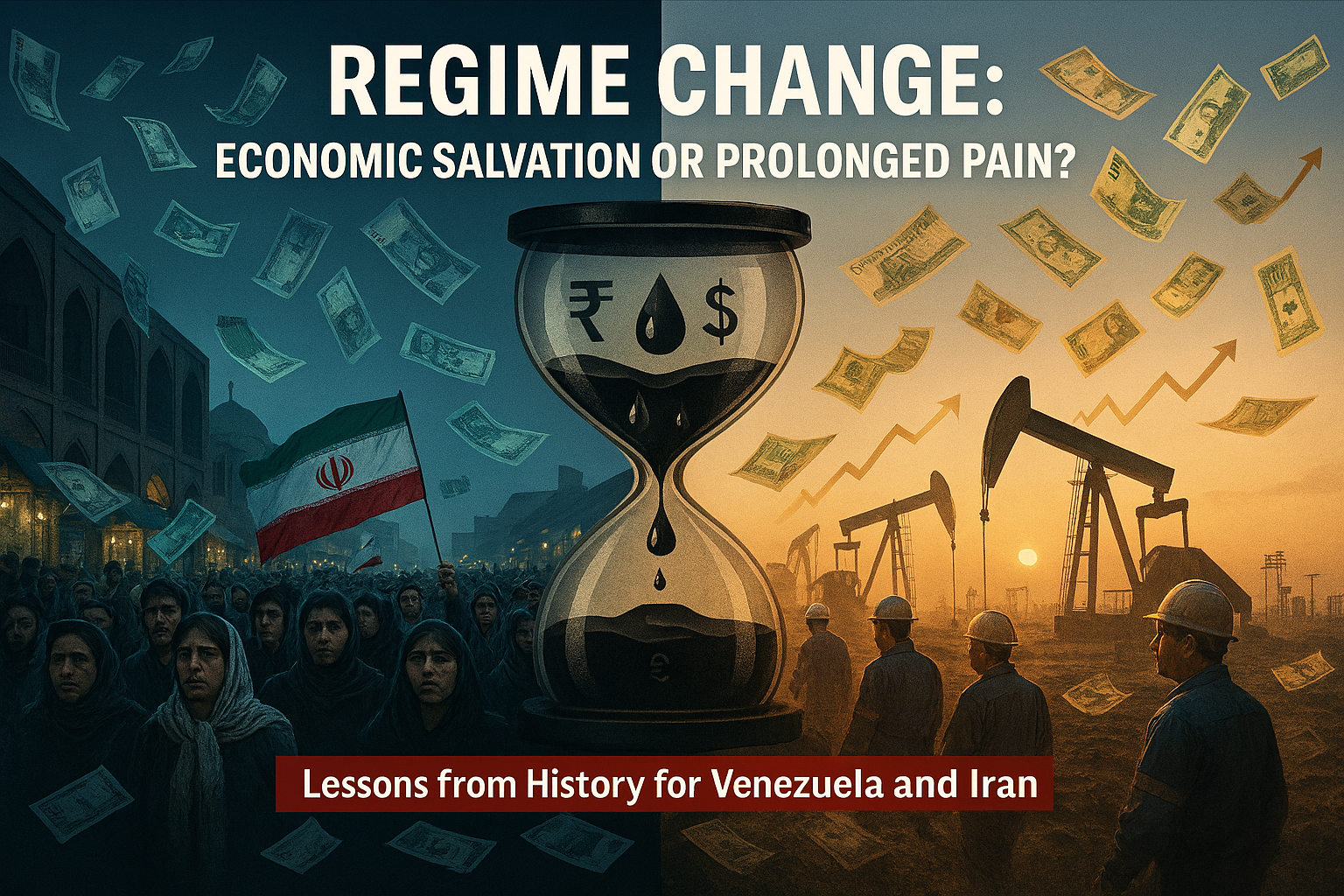
In the sweltering heat of Caracas this January, street vendors who once bartered eggs for devalued bolivars now speak cautiously of hope. Nicolás Maduro’s departure from Venezuela’s presidency—confirmed through a negotiated transition involving regional powers and domestic opposition—has unleashed a torrent of speculation about economic renewal. Opinion polls conducted in the capital’s barrios suggest more than 70% of Venezuelans expect their purchasing power to improve within two years, a striking reversal from the fatalism that pervaded the nation during its decade-long economic collapse.
Meanwhile, 2,500 kilometers northeast across the Atlantic, a different drama unfolds in Tehran’s ancient bazaars. Merchants shuttered their shops throughout late 2025 and early 2026, not in religious observance but in protest against a government whose economic mismanagement has rendered the rial nearly worthless and pushed inflation past 50%. What began as scattered demonstrations over bread prices has metastasized into the most serious challenge to Iran’s clerical establishment since the Green Movement.
These parallel crises illuminate one of political economy’s most consequential questions: does regime change deliver the economic renewal that catalyzes it, or does it merely exchange one form of hardship for another? The economics of regime change—the material consequences when one governing structure displaces another through revolution, coup, or negotiated transition—remains poorly understood despite its obvious importance. Citizens topple autocrats expecting prosperity; what they often receive is prolonged stagnation punctuated by false starts.
The scholarly consensus tilts pessimistic. Decades of research document how political upheaval disrupts investment, erodes property rights, and triggers capital flight that takes years to reverse. Iraq’s post-2003 descent into sectarian chaos, Libya’s fragmentation after Muammar Gaddafi’s fall, and Egypt’s economic stagnation following the Arab Spring all confirm this grim pattern. Yet outliers exist—South Korea’s democratic transition preceded its elevation to developed-nation status, Indonesia navigated Suharto’s 1998 ouster without prolonged collapse, and Poland’s post-communist shock therapy became a model others studied. Understanding what separates success from failure has never mattered more. Venezuela stands at a crossroads between rehabilitation and further decay, while Iran’s rulers calculate whether economic concessions might forestall the fate that befell their Venezuelan counterparts.
This analysis examines the economic impact of regime change through comparative historical analysis, extracting lessons for nations experiencing or approaching political rupture. It argues that while regime change creates necessary preconditions for reform, economic recovery depends crucially on institutional quality, external support, and the speed with which new governments establish credible commitments to property rights and macroeconomic stability. The contrast between post-regime change economic recovery in successful transitions and failures offers practical guidance for policymakers navigating Venezuela’s uncertain future and contemplating Iran’s potential transformation.
The Pessimistic Historical Consensus: Why Regime Change Usually Disappoints
The dominant finding in political economy research is unambiguous: regime change typically harms economic performance in the short to medium term. Alberto Alesina and Roberto Perotti’s landmark 1996 study demonstrated that political instability reduces investment rates by approximately 0.8 percentage points for each standard deviation increase in instability measures. This might seem modest until compounded over years. A nation experiencing severe upheaval—multiple coup attempts, revolutionary transitions, or prolonged civil conflict—can see investment collapse by 5-7% of GDP annually, directly translating into forgone growth.
The mechanisms are well-established. Political uncertainty raises discount rates as investors demand higher returns for increased risk. Property rights become ambiguous when governments change hands violently; the new regime may repudiate contracts signed by its predecessor, nationalize industries, or impose retroactive taxation. Capital flight accelerates as those with movable assets—financial wealth, human capital, portable businesses—relocate to more stable jurisdictions. World Bank research on political transitions shows unemployment typically rises 1-1.5 percentage points immediately following regime change, even in relatively peaceful transitions.
Iraq exemplifies these dynamics at their most destructive. The 2003 invasion removed Saddam Hussein’s Ba’athist regime but created a power vacuum that sectarian militias and insurgents rushed to fill. The decision to disband the Iraqi army and pursue aggressive de-Ba’athification destroyed institutional capacity overnight. GDP per capita, which stood at approximately $3,600 in 2002, plummeted to $2,100 by 2005, and Iraq burned through decades of developmental progress. Oil production—the economy’s backbone—collapsed from 2.5 million barrels daily pre-invasion to barely 1 million by late 2003. Even massive American reconstruction spending, exceeding $60 billion in the first five years, couldn’t prevent economic catastrophe when basic security and functioning institutions disappeared simultaneously.
Libya’s trajectory after 2011 followed a similar pattern, though NATO intervention prevented the scale of foreign occupation that characterized Iraq. Muammar Gaddafi’s overthrow unleashed regional militias that the weak central government in Tripoli could never fully control. Oil production, which reached 1.65 million barrels daily in 2010, fell to barely 200,000 barrels at its nadir during the civil conflict. The IMF documented that Libya’s GDP contracted by 62% in 2011 alone, a peacetime economic collapse matched only by the Great Depression in severity. A decade later, Libya remains partitioned between competing governments, its economic potential squandered by political fragmentation that regime change enabled.
Egypt’s experience proved that even relatively peaceful transitions disappoint economically. The 2011 uprising removed Hosni Mubarak with far less violence than Iraq or Libya experienced, and the military maintained basic order throughout. Yet economic performance remained dismal. Tourism—Egypt’s crucial foreign exchange earner—collapsed as visitors avoided perceived instability. Foreign direct investment dried up as businesses waited for political clarity that never fully arrived. GDP growth, which averaged 5-6% in the decade before 2011, barely exceeded 2% annually through 2013. Unemployment rose from 9% in 2010 to nearly 13% by 2013, particularly devastating for the educated youth who had led protests against Mubarak.
The pattern transcends individual cases. A comprehensive analysis by the Brookings Institution examining Arab Spring outcomes across Tunisia, Egypt, Libya, Yemen, and Syria found that citizens in all five nations reported worse economic conditions five years post-uprising than before. This wasn’t merely perception—real wages declined, unemployment rose, and fiscal positions deteriorated as new governments struggled with legitimacy crises and inherited debts. Historical regime change economic outcomes suggested a cruel irony: the economic grievances that motivated regime change often worsened precisely because the change occurred.
The economic impact of regime change operates through multiple channels simultaneously. Infrastructure deteriorates when governments focus on political survival rather than maintenance. Brain drain accelerates as skilled professionals emigrate. International sanctions often remain in place during transitional periods, as new governments struggle to establish credibility with global financial institutions. Domestic factions compete for control of state resources, prioritizing redistribution to supporters over efficiency. The combatants in Iraq’s sectarian militias sought control of government ministries not to deliver services but to channel patronage to their ethnic constituencies—a pattern that corroded institutional quality for years.
Moreover, economic reform typically requires unpopular measures that fragile post-transition governments lack the political capital to implement. Subsidy removal, currency devaluation, state-owned enterprise privatization, and civil service restructuring all create losers who can mobilize against governments already vulnerable to accusations of betraying revolutionary ideals. Research published in the Journal of Economic Growth demonstrates that democracies emerging from autocracy postpone necessary macroeconomic stabilization on average 2-3 years longer than established democracies facing similar crises, precisely because new governments fear the political consequences of austerity.
This pessimistic consensus, while empirically grounded, risks becoming self-fulfilling. International financial institutions and bilateral donors often withhold support from transitional governments, citing instability and uncertain reform trajectories. This caution paradoxically worsens the instability it purports to avoid by denying resources needed for early stabilization. Citizens lose faith when immediate improvements fail to materialize, creating political space for authoritarians promising order. The economics of regime change thus creates a negative feedback loop: economic deterioration following political transition undermines the new regime’s legitimacy, inviting further instability that deepens economic crisis.
Success Stories and Conditions for Recovery: When Political Upheaval Enables Growth
Yet the historical record contains enough counterexamples to prove that economic disaster following regime change isn’t inevitable. Several nations navigated political transitions without prolonged economic collapse, and some even accelerated development afterward. Understanding what distinguished these successes from failures offers crucial lessons for contemporary cases.
South Korea’s 1987 democratic transition stands as perhaps the most impressive example of political upheaval enabling rather than disrupting economic dynamism. The authoritarian developmental state constructed under Park Chung-hee and sustained by Chun Doo-hwan delivered rapid industrialization but at considerable cost to civil liberties. When massive street protests forced democratic reforms in 1987, many observers feared economic disruption. Foreign Affairs analysis from that era worried that labor militancy freed from authoritarian constraints would erode the export competitiveness that underpinned Korean growth.
Instead, South Korea’s GDP growth accelerated to over 10% annually in 1987-1988, driven partly by democratic legitimacy enhancing international economic relationships and partly by unleashed entrepreneurial energy no longer constrained by political favoritism. Real wages rose substantially as newly empowered unions bargained effectively, yet productivity gains kept pace, preventing competitiveness losses. The chaebol—Korea’s family-controlled conglomerates—adapted to greater political accountability without losing efficiency. By the mid-1990s, South Korea had joined the OECD, cementing its developed-nation status. The 1997 Asian Financial Crisis temporarily interrupted this trajectory, but Korea’s recovery proved more robust than authoritarian neighbors like Indonesia precisely because democratic accountability forced painful but necessary restructuring of the banking sector.
Indonesia itself provides another instructive case. Suharto’s 1998 resignation amid economic crisis and street protests created conditions for catastrophic state failure—ethnic tensions simmered across the archipelago, the military’s political role remained unclear, and GDP had already contracted 13% from the Asian Financial Crisis. Yet Indonesia navigated the transition with surprising resilience. The IMF’s program, though initially poorly designed, eventually stabilized the rupiah. Decentralization reforms transferred power from Jakarta to provinces and districts, relieving pressure on the central government while allowing local adaptation. Crucially, the military accepted a diminished political role without staging a coup, and elections in 1999 produced a legitimate government that could implement reforms.
Indonesia’s post-regime change economic recovery wasn’t immediate—GDP growth remained below 5% until 2000—but the trajectory was positive and sustained. By 2004, growth exceeded 5% annually and continued at that pace through the commodities boom of the 2000s. Democratic institutions deepened rather than collapsed under pressure. The contrast with Iraq and Libya is striking: Indonesia faced comparable challenges—ethnic fragmentation, uncertain democratic traditions, economic crisis—yet avoided their fate primarily through rapid establishment of credible institutions and inclusive political processes that gave diverse groups stakes in the new system.
Eastern Europe after 1989 offers perhaps the richest laboratory for understanding variation in post-regime change economic outcomes. Poland’s “shock therapy”—the rapid implementation of macroeconomic stabilization, price liberalization, and privatization beginning January 1990—remains controversial but broadly successful. Analysis by The Economist documented that Poland’s GDP per capita, which stood at barely 30% of Western European levels in 1990, reached 70% by 2019. The initial pain was severe: inflation hit 585% in 1990, industrial production fell 25%, unemployment rose from effectively zero to 16% by 1993. Yet credible commitments to property rights, rapid integration with Western European markets, and eventually EU accession created conditions for sustained growth averaging 4-5% annually over three decades.
Not all post-communist transitions succeeded similarly. Russia’s chaotic privatization enriched oligarchs while impoverishing ordinary citizens, creating a crisis of legitimacy that eventually enabled Vladimir Putin’s authoritarian restoration. Romania and Bulgaria lagged Poland economically throughout the 1990s, victims of slower reform and greater corruption. The variation illustrates that regime change creates opportunities but doesn’t guarantee outcomes—institutional quality and policy choices matter enormously.
Several factors distinguish successful from failed transitions. First, successful cases established credible property rights rapidly. Poland’s shock therapy, whatever its other faults, created clear legal frameworks for private ownership within months. South Korea’s democratic transition didn’t disrupt existing property arrangements, and Indonesia’s decentralization actually strengthened local property rights. In contrast, Iraq’s Coalition Provisional Authority made property rights ambiguous through poorly designed de-Ba’athification, while Libya never established functioning courts capable of adjudicating disputes.
Second, successful transitions typically involved significant external support—financial, technical, and political. Poland received debt relief and preferential access to European markets. South Korea benefited from existing American security guarantees and trade relationships. Indonesia obtained IMF financing that, despite program flaws, prevented complete currency collapse. The Marshall Plan’s role in Western Europe’s post-1945 reconstruction remains the template: external resources provide breathing room for painful reforms while demonstrating that the international community supports the transition.
Third, commodity-dependent economies face particular challenges requiring specific policy responses. Indonesia’s success partly reflected deliberate efforts to avoid “Dutch disease”—the phenomenon where resource booms appreciate currencies and hollow out manufacturing. Research from the World Bank demonstrates that resource-dependent nations experiencing regime change need especially strong institutions to manage commodity revenues transparently. Norway’s sovereign wealth fund model represents the gold standard, but even less sophisticated mechanisms like Indonesia’s revenue-sharing arrangements between central and local governments can prevent the worst outcomes.
Fourth, inclusive political settlements that give diverse factions stakes in the new system prevent the zero-sum competitions that plagued Iraq and Libya. Poland’s Roundtable Talks created negotiated transition rather than winner-take-all. Indonesia’s decentralization accommodated regional diversity. South Korea’s democratic institutions channeled labor-management conflict into bargaining rather than violence. Exclusionary transitions—where victors monopolize power—invite resistance that undermines economic recovery by forcing governments to prioritize security over development.
The conditions for post-regime change economic recovery thus extend beyond technocratic economic management to encompass political settlements, institutional design, and international support. Political upheaval and economic growth can coexist, but only when deliberate policy choices mitigate the inherent uncertainties that regime change creates.
Venezuela’s Post-Maduro Crossroads: Pathways to Recovery and Risks of Relapse
Venezuela’s January 2026 transition—negotiated through regional mediation involving Colombia, Brazil, and the United States, with Maduro accepting exile in exchange for immunity—creates the most significant opportunity for economic recovery in a generation. The optimism is palpable and, in many respects, justified. Oil production, which collapsed from 3.2 million barrels daily in 1998 to barely 400,000 by 2024, could theoretically return to 2 million barrels daily within three years if investment flows and technical expertise returns. The lifting of American and European sanctions removes a major barrier to financial normalization. Venezuela’s opposition coalition, fractious during resistance, now faces the sobering responsibility of governing a shattered economy.
Yet cautious observers note troubling parallels with previous failed transitions. The Venezuela economy after Maduro faces challenges that dwarf most historical cases. Hyperinflation—which peaked at an estimated 130,000% annually in 2018 before dollarization partially stabilized prices—destroyed domestic currency credibility and created habits of speculation over production. Capital stock deteriorated catastrophically during two decades of underinvestment and maintenance neglect; Petróleos de Venezuela (PDVSA), once Latin America’s premier oil company, resembles a hollow shell, its equipment corroded, its reservoirs damaged by poor extraction practices, its expertise scattered across continents as engineers fled. The Financial Times reported that restoring PDVSA to even 60% of previous capacity requires $150-200 billion in investment over a decade—capital that won’t materialize without credible political stability.
The new government’s early actions will determine whether Venezuela follows Poland’s recovery path or Libya’s fragmentation. Several policy priorities stand out. First, macroeconomic stabilization remains incomplete despite dollarization. The transitional government must establish a credible central bank, address public debt (estimated at $150 billion, much of it in default), and create budgetary discipline after years of fiscal chaos. Bringing the IMF into a monitoring role—politically sensitive given nationalist opposition—would signal commitment to orthodox management while unlocking multilateral financing.
Second, property rights require urgent clarification. Chavismo’s nationalizations and expropriations left ownership disputes affecting billions in assets. A credible arbitration mechanism that balances restitution for victims of expropriation against need for social stability could unlock frozen capital. Chile’s post-Pinochet model offers guidance: the democratic governments that followed military rule didn’t reverse privatizations entirely but created social safety nets that legitimized market economics among previously skeptical constituencies.
Third, oil sector restructuring must avoid both extremes of complete nationalization and wholesale privatization. The Norwegian model—maintaining state ownership while professionalizing management and creating transparent revenue distribution—suits Venezuela’s political culture better than selling PDVSA outright. Analysis from the Brookings Institution suggests mixed ownership, with international oil companies taking minority stakes in joint ventures while the state retains majority control, could attract necessary capital without triggering nationalist backlash. Critically, oil revenues must fund broader economic diversification rather than simply enriching new elites—the “resource curse” that plagued Venezuela under both Chavismo and its predecessors.
Fourth, institutional reconstruction must proceed rapidly. Venezuela’s judiciary, legislature, and bureaucracy suffered systematic politicization under Chavismo. Rebuilding credible institutions requires purging the most compromised officials while retaining enough continuity to maintain basic state functions—a delicate balance Iraq failed catastrophically. Technical assistance from Chile, Colombia, and Spain could accelerate this process while demonstrating regional commitment to Venezuela’s recovery.
The political economy challenges are equally daunting. Chavista remnants retain support among perhaps 20-30% of Venezuelans, concentrated in certain regions and sectors. Exclusionary policies that strip Chavistas of political voice invite resistance that could turn violent. Yet accountability for corruption and human rights abuses can’t be entirely sacrificed to reconciliation. Truth and reconciliation mechanisms—South Africa’s post-apartheid model—might thread this needle, though Venezuela’s polarization exceeds even South Africa’s during transition.
External support will prove crucial. The United States has indicated willingness to provide $5 billion in reconstruction assistance if Venezuela meets governance benchmarks. The European Union and multilateral development banks could contribute similar amounts. China, Venezuela’s largest creditor with perhaps $60 billion in outstanding loans, seeks repayment but might accept debt restructuring if Venezuela’s new government maintains oil shipments. Regional powers like Colombia and Brazil have strong interests in Venezuelan stability given migration pressures—over 7 million Venezuelans fled during the Maduro years, creating humanitarian and political challenges for neighbors.
Yet historical regime change economic outcomes suggest tempering optimism. Even under favorable scenarios, Venezuela’s recovery requires a decade of sustained effort. GDP growth might reach 5-7% annually if conditions align, but from such a depleted base that per-capita income won’t return to 2013 levels until the mid-2030s. Unemployment, currently estimated at 40% including underemployment, won’t normalize without years of investment in productive capacity. The professional class that fled—doctors, engineers, teachers, managers—won’t return immediately, creating human capital constraints that slow recovery.
The first 18-24 months prove critical for any transition. If Venezuela’s new government can stabilize prices, restore basic services, and demonstrate inclusive governance, a virtuous cycle becomes possible: returning confidence encourages investment, investment creates employment, employment reduces desperation that fuels extremism. Conversely, if early missteps—hyperinflation resurgence, political score-settling, corruption scandals—discredit reformers, cynicism and polarization deepen, inviting either chaos or authoritarian restoration. The economics of regime change places Venezuela at a crossroads where every policy choice resonates far beyond its immediate impact.
Iran’s Simmering Crisis and Regime Fragility: Economic Drivers and Uncertain Futures
While Venezuela navigates post-transition challenges, Iran’s regime confronts mounting pressures that could eventually produce similar upheaval. The Iran protests economic causes that erupted in late 2025 and accelerated into early 2026 reflect deep structural problems that episodic repression cannot resolve indefinitely. The rial, which traded at approximately 32,000 to the dollar in 2015, collapsed past 600,000 to the dollar by December 2025—a currency crisis that vaporized savings and made imported necessities unaffordable for ordinary Iranians. Inflation, officially reported at 52% annually but likely higher in practice, reflects both monetary mismanagement and economic sanctions that constrict trade.
Iran’s economic crisis stems from multiple failures compounding over decades. American sanctions reimposed in 2018 after Washington withdrew from the nuclear agreement devastated oil exports, Iran’s primary foreign exchange earner. Oil shipments, which exceeded 2.5 million barrels daily in 2017, fell to perhaps 500,000-800,000 daily by 2024, much of it sold surreptitiously to China at discounts. Analysis published in Foreign Affairs documented that sanctions reduced Iranian GDP by approximately 12% between 2017 and 2020, a peacetime economic contraction matched only by Venezuela’s collapse. Unemployment, particularly among educated youth, exceeds 25%, creating a frustrated demographic that fills protest movements.
Yet sanctions alone don’t explain Iran’s dysfunction. Systemic corruption, with the Islamic Revolutionary Guard Corps controlling perhaps 40% of the economy through opaque networks, stifles entrepreneurship and diverts resources from productive investment. Subsidies consuming nearly 15% of GDP prevent budgetary rationalization while enriching smugglers who exploit price differences. Water scarcity, exacerbated by misguided agricultural policies, threatens livelihoods across rural provinces. The regime’s response to economic crisis—alternating between brutal repression and tactical concessions that never address root causes—has exhausted its legitimacy among large segments of Iranian society.
The bazaar shutdowns that began in November 2025 carry particular significance. The Washington Post reported that merchants historically provided the regime with crucial social support, funding revolutionary causes in 1979 and tolerating economic difficulties in exchange for Islamic governance. Their defection signals crisis comparable to the Shah’s final years, when economic mismanagement and corruption alienated even conservative religious constituencies. When traditional supporters join opposition movements, regimes lose their social foundations.
What happens economically if Iran’s regime falls remains deeply uncertain. The optimistic scenario draws on Indonesia’s experience: a negotiated transition that preserves state continuity while opening political space for reform. Iran possesses considerable human capital—high literacy rates, substantial technical expertise, entrepreneurial traditions dating centuries. Sanctions relief following regime change could unleash pent-up economic potential, particularly if a new government credibly committed to property rights and market economics. Oil production could increase to 4 million barrels daily within two years if investment flowed freely. GDP growth might reach 8-10% annually in early recovery as capacity utilization normalized.
Yet pessimistic scenarios draw on Iraq and Libya. Iran’s ethnic diversity—Persians, Azeris, Kurds, Arabs, Baloch—creates centrifugal pressures that weakened central authority might not contain. The Revolutionary Guard commands substantial military force with interests in preserving its economic privileges regardless of civilian government preferences. Regional powers—Saudi Arabia, Israel, Turkey—have conflicting interests in Iranian stability that could manifest through proxy support for favored factions. American policymakers debate whether supporting regime change risks creating another failed state on a larger, more strategic scale than Libya.
The economic impact of regime change in Iran would likely dwarf Venezuela’s transition given Iran’s larger population (85 million versus 28 million) and more complex economy. Brain drain could accelerate dramatically—millions of educated Iranians already live abroad, and political chaos would trigger further exodus. Supply chains dependent on Revolutionary Guard networks might collapse without replacement mechanisms. Agriculture, already stressed by water scarcity, could fail without state intervention that new governments might lack capacity to provide.
International support structures for Iranian transition would differ significantly from Venezuela. The United States would likely provide assistance, but regional complications and domestic political constraints might limit scale. European nations have economic interests in Iran but limited budgets for reconstruction. China and Russia, traditional partners with the current regime, would approach any successor government cautiously. Unlike Venezuela, where regional consensus supports transition, Iranian regime change would occur amid great power competition that complicates economic recovery.
The most likely scenario involves neither smooth transition nor complete collapse but extended crisis—periodic protests met with repression, incremental reforms that prove insufficient, deepening economic dysfunction that radicalizes opposition while strengthening hardliners. This “muddling through” prevents both regime change and genuine economic reform, leaving Iranians trapped in declining living standards without clear pathways to improvement. Historical regime change economic outcomes suggest this intermediate state—stable enough to resist collapse, dysfunctional enough to prevent growth—might persist for years.
Conclusion: Necessary But Insufficient—The Political Economy of Transitions
The economics of regime change reveals a paradox that policymakers and citizens must confront honestly: political transformation is often necessary for economic revival in failing states, yet transformation alone guarantees nothing. Economic recovery requires deliberate choices that mitigate the inherent uncertainties political upheaval creates. The contrast between successful transitions—South Korea, Poland, Indonesia—and failures like Iraq and Libya illustrates that institutional quality, policy competence, external support, and inclusive political settlements determine whether regime change enables growth or prolongs suffering.
Venezuela’s transition and Iran’s potential upheaval pose distinct challenges that historical experience can inform but not determine. For Venezuela, the immediate priorities are macroeconomic stabilization, property rights clarification, oil sector reconstruction, and inclusive governance that prevents exclusionary impulses from triggering civil conflict. The resources for recovery exist—educated diaspora, oil reserves, regional support—but must be mobilized through credible institutions that inspire confidence. The first 24 months will establish trajectories that persist for decades.
For Iran, assuming regime change eventually occurs, the challenges multiply given greater complexity, regional complications, and ethnic fragmentation. International support—financial and technical—will prove crucial, yet geopolitical rivalries complicate coordination. The Indonesian model of inclusive transition preserving state continuity while opening political space offers the best template, but Iran’s Revolutionary Guard poses institutional obstacles Indonesia’s military never presented. Planning for potential transition now, rather than reacting to crisis, could mitigate worst outcomes.
Several policy prescriptions emerge from comparative analysis. First, international financial institutions should prepare contingency frameworks for transitions rather than waiting until crisis deepens. Early disbursement of reconstruction funds contingent on governance benchmarks—not delayed years while new governments prove themselves—can stabilize situations before they deteriorate irreversibly. The Marshall Plan succeeded partly through rapid deployment when credibility mattered most.
Second, technical assistance in institutional reconstruction deserves equal priority with financial support. Venezuela’s new government needs experienced bureaucrats, judges, and regulators to rebuild state capacity. International secondment programs, drawing on successful Latin American democracies like Chile and Uruguay, could transfer expertise rapidly. Similarly, Iran’s potential transition would require extensive technical assistance in areas from central banking to local governance.
Third, realistic timelines must temper public expectations. Post-regime change economic recovery unfolds over decades, not months. Public diplomacy that honestly acknowledges difficulties while maintaining commitment to long-term support can prevent premature disillusionment. Overselling transition prospects—as occurred in Iraq and Libya—creates backlash when immediate improvements fail to materialize.
Fourth, political settlements must prioritize inclusivity over efficiency. Excluding groups from political processes invites resistance that undermines economic stability regardless of policy competence. Venezuela’s treatment of residual Chavista constituencies and Iran’s hypothetical management of Revolutionary Guard elements will substantially determine whether transitions consolidate or fragment.
The economic impact of regime change ultimately depends less on the change itself than on what follows. Political upheaval and economic growth can coexist when governments establish credible institutions rapidly, implement painful reforms with social safety nets that maintain legitimacy, attract external support through demonstrated commitment to inclusion and accountability, and manage commodity revenues transparently when applicable. These conditions are demanding and rarely achieved completely, explaining why successful transitions remain exceptional rather than normal.
Yet the alternative—indefinite toleration of failed regimes—imposes its own costs that compound over time. Venezuela’s economic collapse under Maduro destroyed two decades of development and displaced millions. Iran’s dysfunction under clerical rule squanders the potential of 85 million people while fueling regional instability. Regime change, whatever its risks, creates possibilities for renewal that stagnant autocracy forecloses.
The citizens celebrating in Caracas and protesting in Tehran deserve honest assessments rather than false promises. Regime change is necessary but insufficient for prosperity. The economics adjust slowly, institutions reconstruct painfully, and recovery requires sustained effort that exhausts nations already depleted by years of misrule. Yet history demonstrates that success, while difficult, remains achievable when deliberate policy choices address the specific challenges political transition creates. The lessons from South Korea, Poland, and Indonesia offer roadmaps; whether Venezuela and potentially Iran follow them depends on choices being made now, as old orders collapse and uncertain futures unfold.
Discover more from The Economy
Subscribe to get the latest posts sent to your email.


Key Takeaways
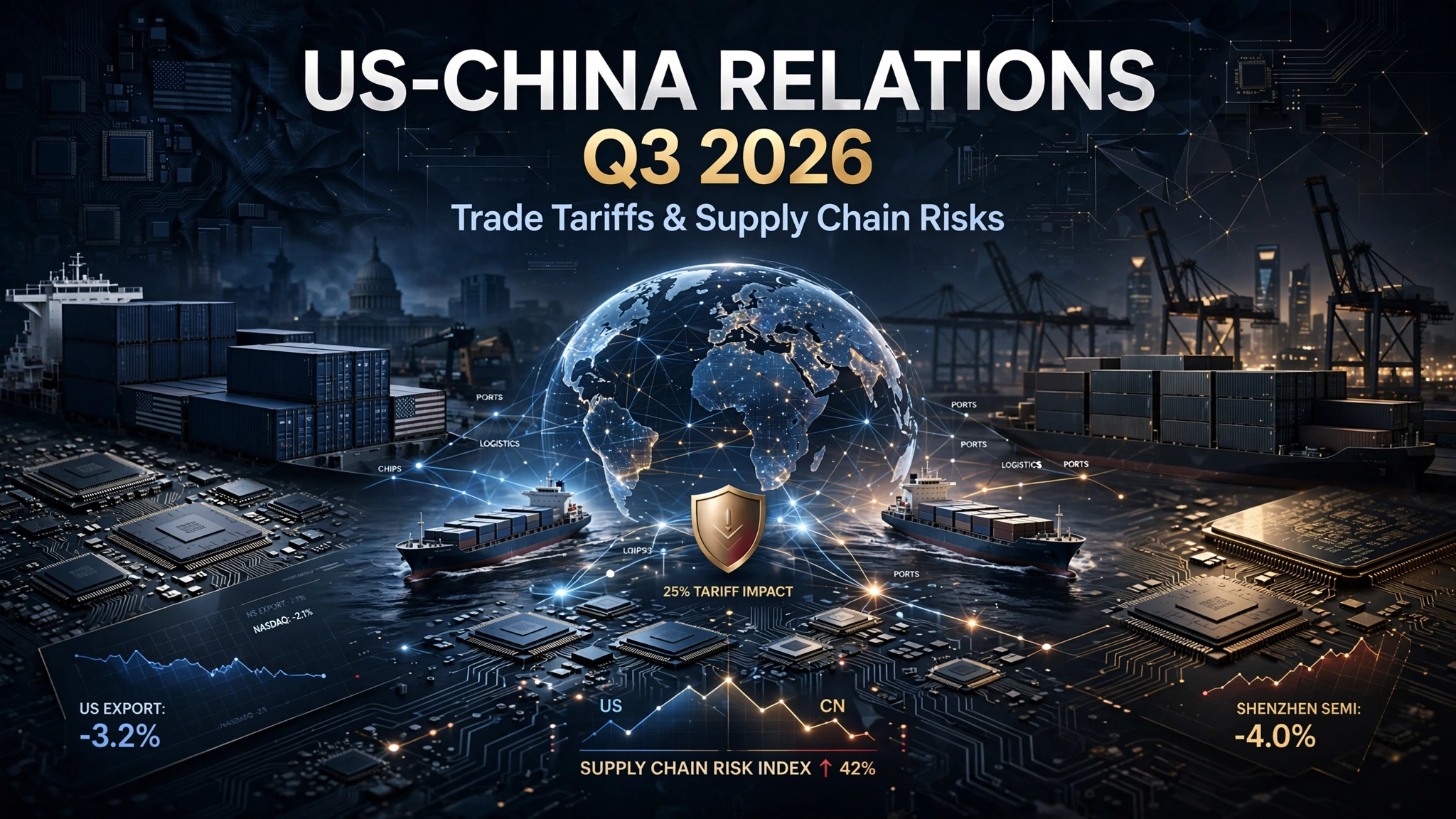
- The US-China relationship in Q3 2026 is best described as a “tactical truce” — managed friction with both sides avoiding total decoupling, rather than a resolved trade relationship.
- The blended effective US tariff on Chinese imports stood around 33% as of May 2026, stacked across four separate legal layers, with some product categories (EVs, batteries, solar) clearing 145%.
- A Supreme Court ruling on February 20, 2026 found the President cannot use IEEPA to impose tariffs, forcing a pivot to Section 122 and Section 301 authorities — a significant legal constraint reshaping the tariff toolkit.
- Washington’s focus has shifted from tariff escalation toward structural supply chain revamps, including critical-minerals diplomacy with dozens of allied countries.
- US imports from China have fallen to near-2001 levels — the year China joined the WTO — reflecting one of the most significant trade reallocations in a generation.
From Escalation to “Managed Competition”
Q3 2026 finds the US-China relationship in a distinctly different posture than the tariff-escalation cycles of 2025. As of mid-2026, the US-China trade relationship is best described as a “tactical truce” — a state of managed friction where both nations maintain aggressive competitive postures while avoiding total economic decoupling. Unlike the optimistic expectations surrounding the 2020 Phase One agreement, today’s reality reflects a fundamental shift toward “de-risking” and “friend-shoring” strategies reshaping global logistics patterns.
That truce has institutional grounding. President Trump and President Xi Jinping appear to have maintained a fragile truce in the trade war following their May 2026 summit in Beijing, though experts say complete decoupling of the world’s two biggest economies remains unlikely, with high tariffs, rare earth restrictions, and tech export controls remaining major sticking points. The two leaders shared a vision of building “a constructive relationship of strategic stability” to bring enhanced certainty and predictability to the global economy — with the agreed approach to restore stability being “managed trade” through a board of trade to manage bilateral trade in non-sensitive goods, reduced tariff and non-tariff barriers in selective sectors, and Chinese commitments to purchase US aircraft and address US concerns about critical mineral supplies.
The Tariff Stack: Complex, Layered, and Legally Contested
Understanding the actual tariff burden on US-China trade in Q3 2026 requires unpacking a genuinely complex, multi-layered structure. The blended effective US tariff on Chinese imports stood around 33% in May 2026, stacked across four layers: MFN (~3.4%), Section 301 (7.5-25%), IEEPA fentanyl (20%), and the reciprocal tariff (currently 10% during a truce extension) — though some HS codes covering EVs, batteries, and solar clear 145%.
That legal architecture was upended mid-year by the judiciary. On February 20, 2026, the Supreme Court ruled that the President cannot use IEEPA to impose tariffs. President Trump subsequently lifted such tariffs and imposed a 10% global tariff for 150 days under Section 122 of the Trade Act instead. This ruling forced a structural pivot in how the administration constructs its China tariff policy — shifting weight toward Section 301 and Section 122 authorities, which carry different procedural and duration constraints than the IEEPA framework the administration had relied on.
The November 2025 Truce Framework Still Shapes Q3 2026
Under the trade agreement, the US halved the 20% fentanyl-related tariff to 10% and extended Section 301 tariff exclusions through November 2026, while China pledged to suspend retaliatory tariffs on US agricultural and food products. The US also agreed to suspend implementation of the new BIS “Affiliates Rule” for one year until November 9, 2026, and China agreed to “take appropriate measures” to resume semiconductor manufacturing and exports of legacy chips, suspending for one year its October 2025 export control measures on rare earth materials — though the status of its earlier April 2025 controls remains ambiguous.
That November 10, 2026 expiration date is the single most important near-term calendar event for anyone tracking US-China trade risk through Q3 and into Q4 2026 — nearly every major concession in the current truce is time-limited to that date.
The Structural Shift: From Tariffs to Supply Chain Architecture
The most consequential Q3 2026 development is not a new tariff announcement but a change in strategic focus. Washington has been steadily moving to revamp supply chains away from China — after taking US levies on China up past 100% at their peak, the administration’s efforts to reset the economic relationship have lately focused on a different set of tools. In early 2026, the United States convened dozens of countries and hosted two separate ministerial meetings on critical minerals, signalling that the policy centre of gravity has moved from bilateral tariff brinkmanship toward multilateral supply chain realignment.
The scale of the underlying reallocation is historically significant. The recalibration of supply chains has been so profound that US imports from China have returned to near-2001 levels — the year China entered the World Trade Organization — with research showing companies were already positioned to adjust to tariff levels well before the most recent escalations.
Comparative Table: US-China Trade Relationship, Late 2025 vs. Q3 2026
| Dimension | Late 2025 | Q3 2026 |
|---|---|---|
| Overall posture | Active tariff escalation | “Tactical truce” / managed competition |
| Primary tariff legal basis | IEEPA (executive emergency powers) | Section 122 / Section 301 (post-Supreme Court ruling) |
| Blended effective tariff rate | Higher, more volatile | ~33% (as of May 2026), layered across four mechanisms |
| Policy focus | Tariff rate negotiation | Critical-minerals diplomacy, supply chain diversification |
| US imports from China | Declining | Near 2001 (pre-WTO-accession-era) levels |
| Key expiration date to watch | N/A | November 9-10, 2026 (multiple truce provisions expire) |
Why It Matters: Sector-Specific Supply Chain Exposure
The blended tariff figures conceal enormous sector variation, and that variation is where the real corporate risk-management work lies. The technology sector has been hit hardest, with tariffs on components forcing abrupt sourcing shifts and catalysing a wave of investment in domestic fabrication, though dependence on Asian supply chains remains a persistent challenge. Automakers have been compelled to redesign supply routes, absorbing some extra costs via price adjustments while facing longer lead times and increased inventory holding that strain margins. Retailers in consumer goods and apparel have explored new sourcing from Bangladesh, India, and Central America, but price volatility and inconsistent quality control remain problematic.
For investors and supply chain planners, the practical takeaway is that “US-China trade risk” is no longer a single macro variable — it is a sector-specific, product-code-specific exposure that requires granular mapping rather than a single blended-tariff assumption.
What to Do Next
- Calendar the November 9-10, 2026 expiration dates explicitly — the Affiliates Rule suspension, Section 301 exclusions, and reciprocal tariff terms are all time-limited to this window, making it the highest-probability point for renewed volatility.
- Map exposure at the HS-code level, not the country level — with some categories facing 145% effective rates while the blended average sits near 33%, country-level tariff assumptions materially understate risk for EV, battery, and solar-linked supply chains.
- Track critical-minerals diplomacy as a leading indicator of the next phase of US trade strategy — the shift from tariff brinkmanship to allied-country mineral-supply coordination signals a more durable structural approach than tariff negotiation alone.
- Monitor the Supreme Court’s IEEPA ruling’s downstream effects on the administration’s remaining tariff toolkit, since Section 301 and Section 122 authorities carry different procedural constraints than the now-invalidated IEEPA approach.
- Treat “near-2001 levels” of US-China import volume as a durable baseline, not a cyclical dip — the scale of supply chain reallocation documented by Harvard Business School research suggests this is structural rather than temporary.
FAQ
What is the current effective tariff rate on Chinese imports to the US?
The blended effective US tariff on Chinese imports stood around 33% as of May 2026, stacked across four layers — MFN, Section 301, the IEEPA fentanyl tariff, and the reciprocal tariff — though specific categories like EVs, batteries, and solar can face rates as high as 145%.
Did the Supreme Court block Trump’s China tariffs?
Partially. On February 20, 2026, the Supreme Court ruled that the President cannot use the International Emergency Economic Powers Act to impose tariffs, prompting a shift to a 10% global tariff under Section 122 of the Trade Act instead. Section 301 tariffs, which rest on separate legal authority, remain largely intact.
When does the current US-China trade truce expire?
Multiple key provisions expire around the same date. The suspension of the BIS “Affiliates Rule” runs until November 9, 2026, and the suspension of heightened tariffs on Chinese imports is set to run until November 10, 2026 — making that window the most significant near-term risk point for the relationship.
Discover more from The Economy
Subscribe to get the latest posts sent to your email.
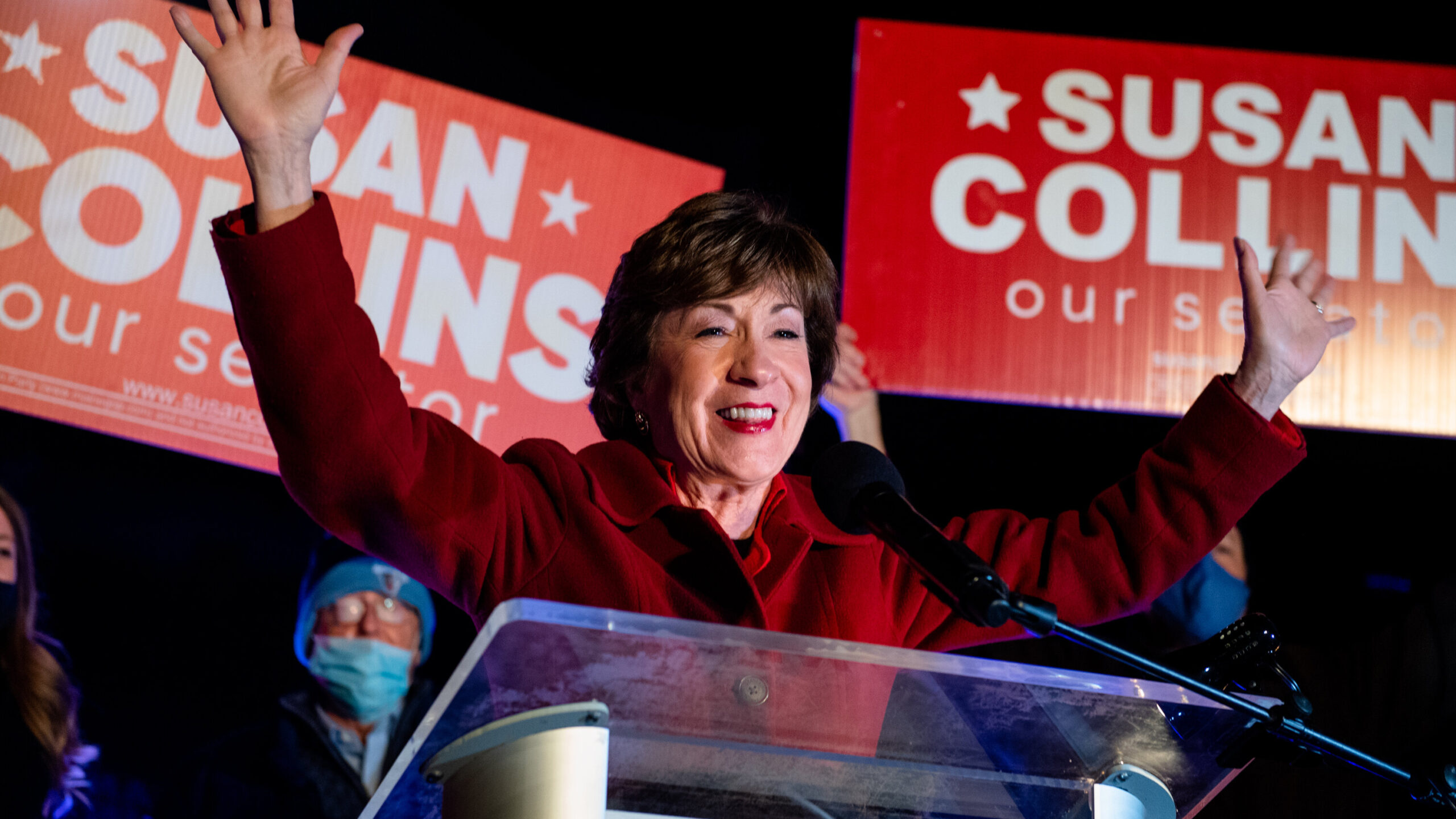
Susan Collins faces her toughest reelection yet against Troy Jackson after a chaotic Democratic candidate swap. Here’s why Maine is a genuine Senate toss-up.
Republican Sen. Susan Collins faces Democrat Troy Jackson, a former Maine Senate president, in a toss-up 2026 general election after Democrats’ original nominee, Graham Platner, was replaced through a special party nomination process. Recent polling shows Jackson with a slight edge.
For a senator who has survived six consecutive campaigns and just cast her 10,000th consecutive Senate vote, Susan Collins now faces what independent analysts are calling a genuine toss-up race — one of the clearest tests of whether Republicans can hold their Senate majority in November.
A Late, Chaotic Democratic Swap
The road to Collins’ current opponent was unusually turbulent. Maine’s Democratic field originally centered on a three-way primary between Gov. Janet Mills, oyster farmer and combat veteran Graham Platner, and former Maryland government official David Costello. Mills dropped out in April, leaving Platner as the grassroots-backed front-runner heading into the June 9 primary — a candidate whose anti-establishment profile and matched fundraising against Collins had national Democrats excited about their odds.
But Platner’s candidacy collapsed amid revelations that included past social media posts and a tattoo resembling a Nazi symbol. With the general election bearing down, the Maine Democratic Party activated an emergency special nomination process — built around county-level delegate meetings rather than a snap primary — to replace him. On July 25, that process produced Troy Jackson, a former Maine Senate president, as the party’s new standard-bearer with roughly 100 days left until Election Day.
Why the Race Is Genuinely Competitive
Despite the compressed timeline, early data suggests Jackson is not merely a placeholder candidate. A Pine Tree Poll conducted by the University of New Hampshire Survey Center showed Jackson with a three-point edge over Collins among likely general-election voters, and Fox News’ inaugural 2026 Power Rankings classify the race as a toss-up — one of roughly a dozen Senate contests that will determine which party controls the chamber.
Collins’ vulnerabilities are structural as much as political. Maine backed the Democratic presidential ticket by seven points in 2024, meaning Collins has long relied on ticket-splitting voters to survive in a state that leans against her party nationally. Democrats are also targeting her more directly than in past cycles, criticizing her comment that she doesn’t regret her 2018 vote to confirm Justice Brett Kavanaugh despite his later vote to overturn Roe v. Wade, and her continued support for Immigration and Customs Enforcement funding following a fatal shooting in Maine involving ICE agents earlier this month.
Collins, who chairs the powerful Senate Appropriations Committee, is leaning on 28 years of relationship-building with industries dependent on federal spending, along with a substantial outside-money advantage. In her campaign launch, Collins argued that “my experience, seniority and independence matter,” while Democrats have countered that “seniority without a backbone is just tenure.”
What It Means for Senate Control
Maine is one of two Senate seats Democrats are defending — or, in Collins’ case, one Republicans are defending — in a state won by the opposing party’s presidential nominee in 2024, making it a marquee Senate battleground alongside Georgia, North Carolina, and Alaska. Democrats need to net four seats nationally to reclaim the majority, and unseating Collins is widely viewed as central to that math given how few genuinely competitive Republican-held seats exist on the 2026 map.
The compressed Jackson campaign timeline is itself a variable worth watching: Collins has now defeated multiple well-funded Democratic challengers over her career, and whether Jackson can build statewide name recognition and a comparable small-dollar fundraising operation in roughly 14 weeks will likely determine whether Maine actually flips or simply stays close.
Discover more from The Economy
Subscribe to get the latest posts sent to your email.
Most headlines on Russia’s economy in July 2026 focus on the latest sanctions package or oil price cap negotiation. The more important story is structural: the model Russia has used to fund its war for four years is showing real signs of running out of road.
The core finding
A research brief from the Center for Strategic and International Studies (CSIS) argues Putin is pushing Russia toward an “economic, political, and military abyss,” according to Fortune. While Russia’s economy remains large — roughly $2.6 trillion — growth is slowing and shrinking on a quarterly basis, with 2026 growth projected at just 0.4%, worse than 2025’s 1% growth, which itself narrowly avoided recession.
Analysts describe Russia’s approach as a form of “military Keynesianism” — the state investing heavily in militarizing the economy while extending financial support to households affected by the war. But per Fortune’s reporting, “after more than four years of war, that well is running dry.” Russia’s fiscal reserves are dwindling, and 71% of the country’s gold reserves have been liquidated to sustain spending.
The number that matters most: oil and gas budget share
The most underreported data point here: the share of oil and gas receipts in Russia’s federal budget revenue fell to just 23% in 2025 — the lowest share in two decades — according to the Oxford Institute for Energy Studies, cited by Fortune. To compensate, Russia has turned to expansive taxation, including raising VAT from 20% to 22% — a move that has proven unpopular domestically.
This matters because Russia’s economy has historically been described, correctly, as fossil-fuel dependent — with oil and gas taxation making up 44% of federal revenues in the decade before the Ukraine invasion, and still around 24.5% over the first three quarters of 2025, according to a Brookings Institution analysis. A further slide to 23% signals the sanctions and diversification pressure are compounding, even as Russia continues finding workarounds through its “shadow fleet.”
The Iran-war reprieve was temporary — and it’s over
The Iran war offered Russia a brief lifeline: Brent crude surged more than 55% at its peak, nearing $120 a barrel, after President Trump eased some sanctions on Russian oil, per Fortune. But that chaos also undermined Russia’s own long-term energy and infrastructure projects in the Middle East — two Russian-linked power plants in Iran were put on hold, along with oil and gas exploration and plans to link Russia to India via Iran through new transit routes. Since then, oil prices have normalized as demand softened and the Strait of Hormuz reopened, removing that temporary cushion.
The sanctions escalation now in motion
The pressure is intensifying on multiple fronts simultaneously. US senators unveiled a sweeping bipartisan Russia sanctions bill in mid-July, which would impose mandatory sanctions on Russian political and military leaders including President Putin, and up to a 100% tariff on the top five countries — including China and India — that purchase Russian crude oil and natural gas, according to CNN. Separately, the EU has been racing to avoid an automatic upward revision of its Russian oil price cap, which would otherwise jump from $44.10 to roughly $58 per barrel if a new sanctions package wasn’t agreed by July 15, per Euronews.
Analysis from the Center for European Policy Analysis notes the outcome depends heavily on whether India and China accept the risk of secondary sanctions: “If China stands firm, Moscow’s dependence on Beijing deepens,” per CEPA. If Russian seaborne oil exports were to fall to near-zero, the budget would lose roughly a quarter of its revenue — an extreme but non-trivial scenario given the pace of legislative and diplomatic pressure building in July 2026.
Why this matters beyond Russia
For countries positioned between Western sanctions regimes and continued Russian energy purchases — including India, and by extension trade partners like Pakistan whose remittance and trade flows intersect with Gulf and South Asian energy markets — the trajectory of Russia’s budget dependency and the secondary-sanctions risk attached to its buyers is a live variable, not a settled one. A further deterioration in Russia’s oil-and-gas revenue share would likely accelerate Moscow’s reliance on China specifically, reshaping regional energy-trade alignments well beyond the Russia-Ukraine conflict itself.
FAQ
What percentage of Russia’s federal budget comes from oil and gas? 23% in 2025 — the lowest share in two decades, according to the Oxford Institute for Energy Studies.
What is Russia’s projected GDP growth for 2026? 0.4%, according to CSIS research cited by Fortune — down from 1% growth in 2025.
What is “military Keynesianism” in the context of Russia’s economy? A term analysts use to describe Russia’s strategy of heavy state investment in militarizing the economy alongside financial support for war-affected households, functioning as a form of stimulus that is now showing signs of fiscal strain.
Discover more from The Economy
Subscribe to get the latest posts sent to your email.

Middle East War Economics 2026: Oil Prices & Energy Markets

PSX Forecast 2026: KSE-100, IMF Reviews & Geopolitics

Asian Markets Outlook 2026: China, Japan & Singapore Stocks

Global Economy 2026: IMF Growth, Inflation & Private Credit

Current Account Deficit (CAD) : Causes and Impact

Balance of Payments (BOP)

The Falkland Islands Dispute: Sovereign Wealth, Offshore Drilling, and Market Impacts

Gross Domestic Product (GDP): Nominal vs. Real

What is Inflation and the Consumer Price Index (CPI)?

US-China Trade Competition 2026: Supply Chain Relocation Guide

Oil Prices Break $100 in 2026: Middle East Conflict & Energy Markets

South-South Trade Expansion: Digital Integration and Emerging Market Growth

$166B Tariff Refund Tapering Fast: Is Your Business Missing Out?

Stock Market Today: Dow Climbs 500 Points as Markets Shake Off Inflation Jitters

State Farm’s $5B Dividend 2026: Who Qualifies & Payout Dates

US-China Relations in Q3 2026: Trade Tariffs and Supply Chain Risks

Gold’s Wild 2026: From a Record $5,600 Peak to a 24% Crash and Back Toward $4,500

Oil Surges as Strait of Hormuz Traffic Collapses Again

The Rocket That Won’t Quit: Inside SpaceX’s Falcon 9 Launch Machine

Bank of England Set to Hold Rates Through Year-End, Reuters Poll Shows

SpaceX Starship Flight 14: First Orbital Attempt & Starlink V3 Launch Explained

The 2026 Crypto Regulatory Shift: What It Means for Institutional Investors

AI Chip Stocks 2026: The Best Semiconductor Investments Beyond Marvell

Retail Earnings Week: What Home Depot, Target & Walmart Reveal

AI-Powered Training: The Next Multi-Billion Dollar Ecosystem in Fitness

Russia’s Black Sea Oil Exports Fall for a Fifth Straight Week

Top 30 Stocks for Investment in PSX for Massive ROI in 2026

Tween Back-to-School Trends 2026: What’s Driving the $85B Season
-

 Markets & Finance8 months ago
Top 15 Stocks for Investment in 2026 in PSX: Your Complete Guide to Pakistan’s Best Investment Opportunities
-

 Analysis7 months ago
Johor’s Investment Boom: The Hidden Costs Behind Malaysia’s Most Ambitious Economic Surge
-

 Analysis7 months ago
Top 10 Stocks for Investment in PSX for Quick Returns in 2026
-

 Analysis7 months ago
Brazil’s Rare Earth Race: US, EU, and China Compete for Critical Minerals as Tensions Rise
-

 Banks8 months ago
Best Investments in Pakistan 2026: Top 10 Low-Price Shares and Long-Term Picks for the PSX
-

 Investment8 months ago
Top 10 Mutual Fund Managers in Pakistan for Investment in 2026: A Comprehensive Guide for Optimal Returns
-

 Global Economy9 months ago
15 Most Lucrative Sectors for Investment in Pakistan: A 2025 Data-Driven Analysis
-

 Global Economy9 months ago
Pakistan’s Export Goldmine: 10 Game-Changing Markets Where Pakistani Businesses Are Winning Big in 2025