
ASEAN
Can Improving Corporate Governance Help Asian Markets Finally Challenge US Stock Market Exceptionalism in 2026?


The narrative looked unassailable twelve months ago. As 2025 dawned, the mantra of “US stock market exceptionalism” echoed through trading floors from Manhattan to Mayfair—superior returns underpinned by legal clarity, shareholder empowerment, deep liquid markets, and the innovation juggernaut of Silicon Valley. Yet as the calendar now flips to 2026, that certainty has fractured. The S&P 500 delivered a respectable 17.9% total return in 2025, impressive by historical standards but thoroughly eclipsed by emerging markets. The MSCI Emerging Markets Asia Index surged 32.11%, while international markets delivered a 29.2% gain that left American indices in the dust.
The question vexing asset allocators globally is whether this represents a temporary aberration or the early tremors of a tectonic shift—one powered not by macroeconomic tailwinds alone, but by something more structural: a quiet revolution in Asian corporate governance that is narrowing the longstanding institutional advantage of US markets.
The Crumbling Foundations of American Exceptionalism
For decades, US stock market exceptionalism rested on several bedrock principles: corporate transparency enforced by the SEC, robust minority shareholder protections, liquid capital markets that could absorb shocks, and a legal framework that treated property rights as sacrosanct. These advantages translated into a persistent valuation premium—the S&P 500 trades at a forward earnings yield of around 4.5%, compared to over 6.5% for Europe and 7.5% for emerging markets.
Yet the events of 2025 exposed vulnerabilities. President Trump’s April tariff announcement triggered the biggest one-day decline since the COVID-19 pandemic, shedding approximately $3.1 trillion in market value. While markets rebounded as tariffs were suspended and renegotiated, the volatility signaled something deeper: the weaponization of trade policy had introduced an unpredictable variable into what was supposedly the world’s most stable investment destination.

State Street Global Advisors identified several forces undermining American outperformance: fading fiscal stimulus, the conclusion of ultra-low interest rates, “America First” policies eroding trust in the US as a reliable global partner, and rising competition in innovation from China and Europe. Louis-Vincent Gave of Gavekal Research went further, declaring bluntly that 2025 marked the year the US-China trade war effectively ended—with China, having successfully de-Westernized its supply chains, emerging as the victor.
The dollar’s trajectory confirmed the sentiment shift. The US dollar index fell approximately 9.4% in 2025, its worst year since 2017, and analysts project a further decline in 2026 driven by expectations of lower interest rates and a broader shift away from the dollar’s role as an invincible reserve currency.
Asia’s Governance Renaissance: From Form to Substance
While US advantages atrophied, Asian markets embarked on an accelerating governance transformation that moved beyond box-ticking compliance toward genuine structural reform. The shift is most pronounced in the region’s three largest markets: Japan, South Korea, and India.
Japan: From Deflation to Shareholder Value
Japan’s corporate governance journey represents perhaps the most dramatic reversal. Long derided for cross-shareholdings, entrenched management, and capital inefficiency, Japanese companies have undergone a metamorphosis driven by regulatory pressure and investor activism.
The Financial Services Agency’s revised Stewardship Code (Version 3.0), released in June 2025, marked a philosophical pivot from prescriptive rules to principles-based frameworks that prioritize substance over form. The code emphasizes moving beyond “box-ticking” approaches, promoting collective engagement between institutional investors and companies, and improving transparency around beneficial ownership.
The Tokyo Stock Exchange’s March 2023 directive urging companies to implement “Management that is Conscious of Cost of Capital and Stock Price” has yielded tangible results. J.P. Morgan Asset Management reported a significant increase in share buybacks in 2024, with some companies officially committing to reduce balance sheet cash and return excess capital to shareholders. Japan’s three largest insurance companies pledged to entirely unwind their cross-shareholdings.
The results speak volumes. South Korea’s Kospi index soared almost 76% in 2025, posting its best year since 1999, while shareholder activism in Asia reached record highs, with 108 campaigns advanced in Japan alone—a 74% increase from 2018.
South Korea: Legislative Momentum and Minority Rights
South Korea demonstrated that political will can accelerate governance reform dramatically. In August 2025, the National Assembly passed amendments mandating cumulative voting for large listed companies with assets exceeding KRW 2 trillion and expanding audit committee independence requirements. These amendments, effective September 2026, override exclusion clauses that previously allowed companies to opt out of cumulative voting.
The reforms empower minority shareholders by allowing those holding at least 1% of voting shares to request cumulative voting six weeks before shareholder meetings without first amending articles of incorporation. Combined with earlier July 2025 legislation ending single-gender boards and requiring pre-AGM annual report disclosures, Korea has constructed a robust framework for minority shareholder protection that rivals developed markets.
Challenges remain. Asian Corporate Governance Association analysts note that implementation obstacles—including board size caps, shareholder meetings called on short notice, and defensive practices by some managements—may constrain practical impact. Yet the directional momentum is unmistakable, particularly when amplified by 78 public activist campaigns in 2024, a stark increase from just eight in 2019.
India: Judicial Evolution and Activism
India’s governance story combines legislative foundations with evolving judicial interpretation. The Companies Act 2013 established comprehensive frameworks for minority shareholder protection, including sections 241 and 244 addressing oppression and mismanagement. What has changed dramatically is enforcement and interpretation.
The National Company Law Appellate Tribunal (NCLAT) has expanded remedies available to minority shareholders, with recent rulings establishing structured buy-out mechanisms to resolve shareholder deadlocks. The landmark Escientia Life Sciences case in March 2025 demonstrated the tribunal’s willingness to propose definitive solutions rather than simply issuing directives for parties to negotiate.
Shareholder activism has surged, with minority shareholders defeating resolutions on executive remuneration hikes, related party transactions, and director reappointments at companies including KRBL Limited, Max Financial, and Sobha Realty. In September 2023, shareholders of Godfrey Phillips India rejected a related party transaction worth up to INR 1,000 crore.
India’s evolving governance framework now mandates that the top 500 listed companies have at least two female directors, promotes independent director oversight of audit and risk management, and strengthens disclosure requirements around related party transactions. The Securities and Exchange Board of India (SEBI) has imposed significant penalties for governance failures, including heavy fines and director disqualifications for related-party transaction manipulation at companies like E-Tech Solutions.
Valuation Gaps Create Compelling Entry Points
The divergence in valuations between US and Asian markets has widened to levels that make a purely quantitative case for reallocation. The S&P 500’s forward price-to-earnings multiple stands at approximately 24x, while the MSCI Emerging Markets Asia Index trades at 15.39x forward earnings. Measured against ten-year averages, J.P. Morgan research indicates that India’s relative P/E ratio versus the S&P 500 sits one standard deviation below its long-term mean.
Goldman Sachs Research predicts earnings from emerging market companies to grow 9% in 2025 and accelerate to 14% in 2026, compared with S&P 500 earnings growth forecasts of approximately 13-14% for 2026. The combination of lower valuations and comparable growth trajectories presents a risk-reward calculus increasingly favorable to Asian equities.
Currency dynamics amplify the attractiveness. With the US dollar projected to continue weakening amid Federal Reserve rate cuts and narrowing yield advantages, dollar-denominated returns from Asian markets should benefit from both local currency appreciation and equity gains. As Goldman Sachs strategists note, the dollar has recently behaved more like a cyclical currency—appreciating with economic growth and declining during slowdowns—rather than maintaining its traditional safe-haven status.
Persistent Challenges: The Governance Gap Remains Real
Acknowledging progress should not obscure enduring structural disadvantages that continue to favor US markets. The depth and liquidity of American capital markets remain unmatched. When volatility strikes, investors can enter and exit positions at scale with minimal price impact—a critical consideration for large institutional allocators constrained by daily redemption requirements.
Legal recourse in the United States, while imperfect, operates with greater predictability and speed than in most Asian jurisdictions. The class action mechanism, despite its flaws, provides a credible deterrent to management malfeasance. By contrast, the NCLAT in India faces backlogs, and enforcement remains inconsistent across different tribunal benches.
Family ownership and controlling shareholders—ubiquitous across Asian markets—create principal-principal agency conflicts that differ fundamentally from the principal-agent problems addressed by US governance frameworks. In markets where promoters control board composition and related party transactions remain common, minority shareholders face structural disadvantages that regulatory reform can only partially address.
Geopolitical risks, particularly around Taiwan and the South China Sea, introduce binary outcomes that have no parallel in developed markets. China’s economic slowdown and its implications for regional supply chains represent a systemic risk that governance reform cannot ameliorate. J.P. Morgan’s 2026 Asia Outlook notes that while Chinese earnings estimates have stabilized, domestic demand remains weak, with industrial overcapacity extending beyond traditional heavy industries into higher-end sectors.
2026 Outlook: Broadening Beyond Big Tech
Looking ahead, the investment case for Asian markets in 2026 rests on three pillars: earnings momentum, policy support, and the diffusion of AI-related capital expenditure beyond a narrow cohort of hyperscalers.
J.P. Morgan Private Bank forecasts Asian earnings growth to reaccelerate to 13-14% in both 2026 and 2027, compared with approximately 11% in 2025. The September 2025 earnings season witnessed 13% year-over-year earnings growth, 4% better than expectations at the reporting period’s outset. This fundamental improvement, combined with valuations at reasonable levels, supports a constructive outlook.
Monetary policy provides a tailwind as Asian central banks near the conclusion of their easing cycles, having implemented steady rate cuts throughout 2025. With interest rate cuts largely priced in, fiscal policy will play an increasingly important role in supporting growth. Taiwan’s semiconductor sector, Malaysia’s data center buildout, and Singapore’s position as a regional AI hub should benefit from continued global technology investment.
The democratization of AI returns represents perhaps the most significant medium-term catalyst. While 2025 witnessed remarkable concentration—with seven stocks accounting for 52% of the S&P 500’s total return—the diffusion of AI capabilities across sectors creates opportunities for companies outside the Magnificent Seven. Asian industrial companies, logistics providers, healthcare systems, and financial services firms implementing AI-driven efficiency gains should see margin expansion and earnings growth that current valuations fail to reflect.
Investment Implications: The Case for Deliberate Diversification
The question confronting investors is not whether to maintain US equity exposure—the innovation ecosystem, rule of law, and depth of capital markets ensure America’s continued relevance in global portfolios. Rather, the question is whether the traditional overweight to US equities (often 60-70% of global equity allocations) remains justified when Asian markets offer comparable earnings growth at substantially lower valuations, supported by accelerating governance reform.
Goldman Sachs Research forecasts global equities to return 11% over the next 12 months, with diversification across regions, styles, and sectors potentially boosting risk-adjusted returns. For the first time in years, investors who diversified across geographies in 2025 were rewarded, and strategists anticipate this trend continuing in 2026.
Tactical positioning could emphasize:
Quality over momentum: Focus on Asian companies demonstrating concrete governance improvements—independent directors, transparent capital allocation, minority shareholder engagement—rather than chasing market beta. Japan’s corporate transformations at companies reducing cross-shareholdings and Korea’s firms implementing cumulative voting deserve premiums.
Secular themes over cyclical bets: The AI infrastructure buildout, data center proliferation, and semiconductor supply chain realignment represent multi-year themes with clear Asian beneficiaries. Taiwan Semiconductor Manufacturing Company, Korean memory manufacturers, and Malaysian data center developers align with these irreversible technological shifts.
Active over passive: The dispersion within Asian markets—between reformers and laggards, between sectors benefiting from AI and those facing disruption—creates alpha opportunities that passive index strategies cannot capture. With stock correlations having fallen and governance quality diverging, manager selection matters more than market allocation.
The Verdict: Evolution, Not Revolution
US stock market exceptionalism is not ending in 2026; it is evolving. The American advantages of innovation capacity, entrepreneurial culture, and institutional depth remain formidable. Yet the gap has narrowed meaningfully, driven by governance reform in Asia that addresses long-standing concerns about shareholder rights, board independence, and capital allocation discipline.
The outperformance of Asian markets in 2025—with the MSCI Emerging Markets Asia Index surging 32% versus the S&P 500’s 18%—reflects both cyclical factors (dollar weakness, AI-related export demand, fiscal stimulus) and structural improvements (cumulative voting in Korea, stewardship code revisions in Japan, activist-driven change in India). Whether this performance persists depends on three variables: the continuation of governance reform momentum, the stability of the global macroeconomic backdrop, and the avoidance of geopolitical shocks that could derail investor confidence.
For 2026, the probability-weighted case favors selective increased allocation to Asian equities within diversified global portfolios. The valuation discount, governance tailwinds, and earnings growth trajectory create asymmetric risk-reward. American exceptionalism is not dead—but it now faces legitimate competition from markets that have spent two decades addressing their institutional shortcomings while the United States grapples with its own vulnerabilities around trade policy uncertainty, fiscal sustainability, and political polarization.
The investment world is moving toward a multipolar equilibrium where no single market enjoys uncontested superiority. That transition, accelerated by governance reform across Asia, represents the defining portfolio construction challenge of the decade ahead.
Suggested Meta Description (150 chars): Asian corporate governance reforms in Japan, Korea, and India challenge US stock market exceptionalism. 2026 outlook favors selective diversification.
Target Keywords:
- Primary: US stock market exceptionalism, American exceptionalism markets, US exceptionalism 2026
- Secondary: Asian corporate governance improvements, emerging markets challenging US dominance 2026, Asian stocks vs US stocks 2026 outlook, end of US market exceptionalism, Japan corporate governance reforms, Korea shareholder rights, India minority shareholders, MSCI Asia performance 2025
Sources Cited:
- First Trust Advisors – S&P 500 2025 Recap
- MSCI – Emerging Markets Asia Index
- CNN Business – International Markets 2025
- MoneyWeek – US Stock Market Exceptionalism
- ABC News – Stock Market 2025 Performance
- State Street Global Advisors – US Exceptionalism Analysis
- Gavekal Research via The Market NZZ – End of US Exceptionalism
- ACGA – Japan Stewardship Code 2025
- J.P. Morgan Asset Management – Japan Corporate Governance
- BusinessWire – Asian Shareholder Activism
- ACGA – Korea Governance Reforms
- ICLG – India Corporate Governance
- STA Law Firm – India Governance Trends 2025
- J.P. Morgan Private Bank – 2026 Asia Outlook
- Goldman Sachs Research – EM Stocks Forecast
- Goldman Sachs – S&P 500 2026 Outlook
- RBC Wealth Management – US Equity Returns 2025
- Goldman Sachs Research – Global Stocks 2026
Discover more from The Economy
Subscribe to get the latest posts sent to your email.



A quiet automotive arbitrage is reshaping the weekend habits of Singapore’s affluent — and spawning an entirely new service economy across the Causeway.
On weekday mornings, Iylia Kwan looks like any other 36-year-old Singaporean navigating the commute from Yishun in a sensible Toyota Corolla Altis. But on Friday evenings, something shifts. He drives across the Woodlands Checkpoint, walks into a modern, air-conditioned facility in Skudai, and slides into the cream leather seat of a secondhand Porsche Cayenne — a 2009 model he bought for a price that would barely cover one month’s parking in Orchard Road: RM50,000, or roughly S$15,000. He recently added a Mercedes-Benz E-Class, personalised number plate included, as what he described to The Straits Times as “a fated birthday gift to himself.”
Kwan is not an outlier. He is a data point in a trend accelerating with the inexorability of a turbocharged flat-six on an open Malaysian highway.
Across Singapore, a growing cohort of car enthusiasts — ranging from engineers and entrepreneurs to finance professionals and serial hobbyists — have found an elegant loophole in one of the world’s most expensive automotive regimes: buy your dream car in Malaysia, store it just across the border, and drive it whenever you please on roads that don’t end at a customs checkpoint.
The economics are, frankly, staggering.
The COE Wall: Singapore’s Structural Barrier to Automotive Joy
To understand the Malaysian arbitrage, one must first appreciate the full, almost theatrical expensiveness of car ownership in Singapore. The Certificate of Entitlement (COE), administered by the Land Transport Authority, is a quota-based bidding system designed to control the number of vehicles on the island’s finite road network. It is, in essence, a government-issued permission slip to own a car — and it expires after ten years.
In the first bidding exercise of March 2026, Category B COEs — covering cars above 1,600cc or 97kW, the bracket that ensnares virtually every performance or luxury vehicle — closed at S$114,002, up nearly nine percent from the previous round. Category A, for smaller cars, sat at S$108,220. Category E, the open category used as a benchmark, cleared S$114,890.
To put those numbers in human terms: before a buyer in Singapore spends a single dollar on the car itself, they have already paid more than S$114,000 for the temporary right to own it. That right dissolves in a decade.
A new Porsche Macan — Porsche’s entry-level SUV — retails in Singapore at approximately S$430,000 with COE included. The same vehicle sits on showroom floors in Malaysia at RM433,154, or roughly S$130,000 at current exchange rates. A 2025 Porsche 911 starts at RM1.43 million in Malaysia — not inexpensive by any regional standard, but compared to the Singapore equivalent, where the same car commands upward of S$600,000 with COE, it represents a discount that approaches the philosophical.
The Toyota GR Yaris — the turbocharged hot hatch that has become the talisman of a generation of track-day enthusiasts — illustrates the gap with particular clarity. In Malaysia, the GR Yaris is available at around RM254,000 new, or under S$78,000. In Singapore, the same car requires a Category A COE of over S$108,000 on top of the base vehicle price, pushing the all-in cost above S$175,000. For buyers who want to drive hard on weekends without the anxiety of watching a six-figure certificate depreciate, Malaysia offers a rational alternative.
Comparative Price Snapshot (March 2026)
Model Malaysia Price (RM) ≈ SGD Equiv. Singapore Price (incl. COE) Savings Porsche Cayenne (used, 2009) RM 50,000 ~S$15,000 S$150,000–200,000 ~90% Porsche Macan (new) RM 433,000 ~S$130,000 ~S$430,000 ~70% Porsche 911 (base, new) RM 1,430,000 ~S$430,000 ~S$600,000+ ~25–30% Toyota GR Yaris (new) RM 254,000 ~S$77,000 ~S$175,000+ ~56% BMW 3 Series (new) RM 270,000 ~S$82,000 ~S$250,000+ ~67%
Exchange rate approximate at SGD 1 = MYR 3.30. All prices indicative; subject to optional extras, taxes, and market conditions.
An Inconvenient Legal Clarity
The arrangement is entirely legal — with one firm caveat. Under current regulations, Singapore’s Land Transport Authority prohibits citizens, permanent residents, and long-term pass holders from driving foreign-registered vehicles within Singapore. Malaysia’s Road Transport Department (JPJ) permits foreigners, including Singaporeans, to register vehicles under their own name as long as those vehicles remain in Malaysia. Registration requires a passport and thumbprint verification at any JPJ counter; for used vehicles, a mandatory roadworthiness inspection precedes the transfer of ownership.
The result is a legal structure that neatly bifurcates the automotive life of its participants: a practical, quotidian car for Singapore, and a fantasy machine for the weekend, stored and maintained across the Causeway.
“In Singapore, you don’t actually permanently own a car,” observed Heeraj Sharma, co-founder of Carlogy Malaysia, in an interview with Malay Mail. “All registered vehicles come with a COE that ends after the usual ten-year tenure expires. In Malaysia, registered cars offer owners permanent ownership of the vehicle — there’s no expiry date here.”
The Business of Cross-Border Motoring
Where demand concentrates, enterprise follows. The most visible new player in the cross-border automotive ecosystem is Carlogy Malaysia Sdn Bhd, a 24,000 square-foot vehicle storage and lifestyle hub established in Skudai, Johor Baru — positioned, with deliberate geographic logic, at the midpoint between the Woodlands Checkpoint and the Tuas Second Link.
Co-founded by Sharma and fellow Singaporean Regis Tia, Carlogy offers a service proposition that would feel at home in a premium Swiss watch vault: air-conditioned storage at RM1,000 per month, standard covered storage at RM700 monthly, 24/7 security, remote CCTV monitoring accessible from the owner’s phone, weekly engine warming to prevent battery degradation, monthly washes, detailing, paint protection film, performance tuning, and a concierge service to deliver vehicles within Johor Baru — all wrapped in an industrial-chic space adjacent to a specialty café that has become a weekend gathering point for the region’s car community.
By mid-2025, Carlogy had already accumulated over 80 clients, the majority of them Singaporean.
“We want to show our customers that car ownership, especially luxury and performance marques, can still be affordable,” Sharma told Malay Mail. The facility also offers sourcing concierge services — helping clients identify and acquire specific models including Porsche, BMW, and reconditioned sports cars through Malaysia’s well-established parallel import and used car ecosystem, where decades of collector activity have produced a depth of inventory unavailable in Singapore’s constricted market.
Carlogy is not alone in sensing the opportunity. Across Johor Baru, informal networks of condominium parking spaces — rented for RM200 to RM400 per month — have long served as the budget tier of this ecosystem. Friends’ driveways, trusted dealers with storage arrangements, and specialist workshops offering seasonal car-sitting packages have all responded to the same fundamental demand signal: Singaporeans who want to own cars they cannot, or simply will not, afford at home.
Three Archetypes of the Cross-Border Car Enthusiast
The phenomenon aggregates a surprisingly diverse range of motivations and life circumstances. Three broad archetypes capture most of the market.
The Weekend Track Devotee. Motoring enthusiasts like Kelvin Kok and Afeeq Anwar, cited in reporting by The Straits Times, use their Malaysian-registered vehicles primarily for motorsport events — track days at Sepang International Circuit, spirited runs along the coastal roads of Johor, hill climbs in the Cameron Highlands. For these buyers, the Malaysian car is a dedicated performance tool, never intended for the traffic-calmed streets of Singapore, and the COE arbitrage is simply a prerequisite for participation in the sport they love. Some within this community have maintained Malaysian performance cars for nearly two decades.
The Aspirational Collector. This archetype is less about performance than possession. The Singapore car market’s structural constraints — 10-year COE cycles, spiralling depreciation, scarcity of rare variants that bypassed parallel import channels — mean that certain models are simply unavailable or economically irrational to own locally. A low-mileage Japanese domestic market special, a lightly used European estate wagon from a pre-facelift generation, a specific AMG Black Series: these are cars that exist in Malaysian classifieds and don’t in Singapore’s, or exist at prices that make the math absurd. Collectors who would otherwise be priced out of their obsession find Malaysia a reasonable solution.
The Early-FIRE Professional. A third cohort consists of Singaporeans who have achieved financial independence relatively young, spend extended time working or living across the Causeway under arrangements enabled by the Johor-Singapore Special Economic Zone, and have effectively merged their automotive lives with their professional geography. For these individuals, the Malaysian car is not an exotic weekend indulgence but a sensible component of a life being lived partly outside Singapore’s cost architecture. Kwan himself exemplifies this: he rents a semi-detached house in Pasir Gudang, maintains a practical vehicle in Singapore for family obligations, and treats his Porsche and Mercedes as the natural perquisites of a bicultural lifestyle.
The Macroeconomic Tailwind: The JS-SEZ Factor
The timing of this automotive trend is not incidental to a much larger structural shift reshaping the southern Malaysian-Singaporean corridor. The Johor-Singapore Special Economic Zone (JS-SEZ), formally established on January 8, 2025, has catalysed what analysts describe as the most significant bilateral economic integration effort in the history of the two countries.
Spanning 3,288 square kilometres across nine flagship zones — roughly five times the landmass of Singapore — the JS-SEZ targets eleven priority sectors and has attracted staggering early investment momentum. Johor emerged as the top Malaysian state for approved investment in the first nine months of 2025, garnering RM91.1 billion, with the JS-SEZ accounting for 74.6 percent of that total at RM68 billion. Singapore was the largest investor at RM28.5 billion.
The Johor Bahru–Singapore Rapid Transit System (RTS) Link, slated to move 10,000 passengers per hour, is expected to commence commercial service in late 2026, cutting the crossing to a five-minute train journey and dramatically reducing friction for the growing number of Singaporeans maintaining professional and personal lives on both sides.
For the automotive arbitrage community, the JS-SEZ matters beyond symbolism. As more Singaporeans establish genuine residential or professional presences in Johor — whether through the zone’s favourable 15 percent knowledge-worker income tax rate, its accelerated manufacturing licences, or simply the widening availability of quality housing and infrastructure — the question of maintaining a performance car locally resolves itself without the need for weekend pilgrimages. The car doesn’t need to be a weekend hobby when the weekend and the workweek share the same geography.
Malaysia’s ringgit, meanwhile, has remained competitive against the Singapore dollar across the post-pandemic period, reinforcing the purchasing-power advantage that makes Malaysian car prices so compelling to Singapore-based buyers. A strengthening ringgit would erode the arbitrage; the current macroeconomic environment has, if anything, sustained it.
The Risks: What the Glossy Stories Leave Out
Platinum journalism requires honesty about the rough edges. The cross-border car ownership model carries genuine risks that deserve articulation beyond the weekend-drive romance.
Insurance complexity. Comprehensive insurance for a Malaysian-registered vehicle driven by a Singaporean resident demands careful navigation. Standard Malaysian motor policies may contain clauses that affect coverage when the named driver’s primary residence is across the border, or that create ambiguity in the event of an accident on Malaysian roads. Buyers are advised to work with insurance brokers familiar with cross-border ownership structures and to read policy wordings carefully — a recommendation that applies with special force for high-value exotics.
Maintenance and depreciation. Luxury and performance vehicles require regular use to maintain mechanical health. A Porsche 911 left dormant for two or three weeks in a humid climate risks battery discharge, tyre flat-spotting, brake disc corrosion, and deterioration of rubber seals. Facilities like Carlogy have emerged partly to address this reality, but owners who rely on informal storage arrangements bear full responsibility for maintaining vehicles that will decline faster than their Singapore counterparts might expect.
Regulatory uncertainty. Singapore’s rules on foreign-registered vehicle usage are clear and enforced. But both LTA’s and JPJ’s policies are subject to revision. A future regulatory change that restricted Singaporean ownership of Malaysian vehicles, or that tightened cross-border ownership documentation requirements, could strand a cohort of owners with illiquid assets. The model is built on regulatory arbitrage; regulatory convergence is its existential risk.
Resale liquidity. The Malaysian market for premium and exotic cars is thinner than Singapore’s was at comparable price points. Selling a high-value Malaysian-registered vehicle quickly and at fair value can be challenging, particularly for models that were imported through reconditioned channels and whose provenance documentation may be incomplete.
Looking Forward: A Market at Inflection
The businesses serving cross-border car enthusiasts are, for now, operating in a niche that the mainstream automotive and financial industries have not yet fully addressed. Car financing for Malaysian vehicles purchased by Singaporean buyers remains awkward; insurance products are underserved; and the secondary market infrastructure — valuations, certified inspections, warranty programmes — lags years behind Singapore’s mature ecosystem.
That gap represents opportunity. As the JS-SEZ deepens cross-border integration and the RTS Link reduces friction to the level of a short MRT ride, the number of Singaporeans with genuine dual-geography lives will grow. The automotive implications are significant: a Singaporean who spends three days a week in Johor Baru is not the same creature as one who crosses over on Sunday mornings for dim sum and a drive. The former has a car problem to solve. The latter has a lifestyle.
Carlogy’s founders are betting that their timing is right. “With the Johor-Singapore Special Economic Zone in the works,” reads their pitch to potential clients, “Carlogy’s timing is impeccable.”
The data does not obviously contradict them. When COE Category B premiums have spent the better part of two years oscillating between S$110,000 and S$141,000, and when a 2009 Porsche Cayenne can be purchased in Johor for the price of a Singapore kitchen renovation, the economics do a considerable amount of the marketing work on their own.
For a certain kind of Singaporean — success achieved, weekends reclaimed, the Causeway no longer a border but a commute — the arrangement offers something the COE system structurally cannot: a car you actually own. Permanently. In perpetuity. Without an expiry date, without a renewal auction, without the grinding arithmetic of depreciation accelerated by bureaucratic design.
There is, in that, a small and precise kind of freedom. And freedom, it turns out, smells remarkably like a Porsche flat-six warming up on a Saturday morning in Skudai.
Frequently Asked Questions
Can Singaporeans legally own cars in Malaysia? Yes. Under JPJ regulations, foreigners including Singaporeans may register and own Malaysian vehicles. The sole restriction is that such vehicles may not be driven into Singapore by Singapore citizens, permanent residents, or long-term pass holders under LTA rules.
How do Singaporeans register a car in Malaysia? Buyers visit any JPJ counter in Malaysia with their passport and complete a thumbprint verification. For used vehicles, a mandatory inspection (known locally as a “puspakom” check) must be completed before ownership is transferred.
What does car storage in Johor Baru cost? Rates vary by provider. Carlogy Malaysia charges RM700/month for standard covered storage and RM1,000/month for air-conditioned parking. Informal condominium parking spaces range from RM200–400/month.
Does the price advantage apply to new or used cars? Both, but the savings are proportionally larger for used vehicles. A secondhand 2009 Porsche Cayenne can be sourced in Malaysia for RM50,000–80,000; an equivalent vehicle in Singapore would carry COE costs alone exceeding S$100,000. For new cars, the gap is significant but narrower in percentage terms.
What are the main risks of cross-border car ownership? Insurance coverage complexity, mechanical maintenance requirements for infrequently driven luxury vehicles, regulatory risk from potential policy changes in either country, and reduced resale liquidity compared to the Singapore market.
How does the Johor-Singapore SEZ affect this trend? The JS-SEZ is deepening the economic integration of the corridor and encouraging more Singaporeans to live and work partly in Johor. As cross-border lives become more common, so does the logic of maintaining a vehicle on the Malaysian side. The RTS Link, expected to open in late 2026, will further reduce the friction of crossing.
Discover more from The Economy
Subscribe to get the latest posts sent to your email.
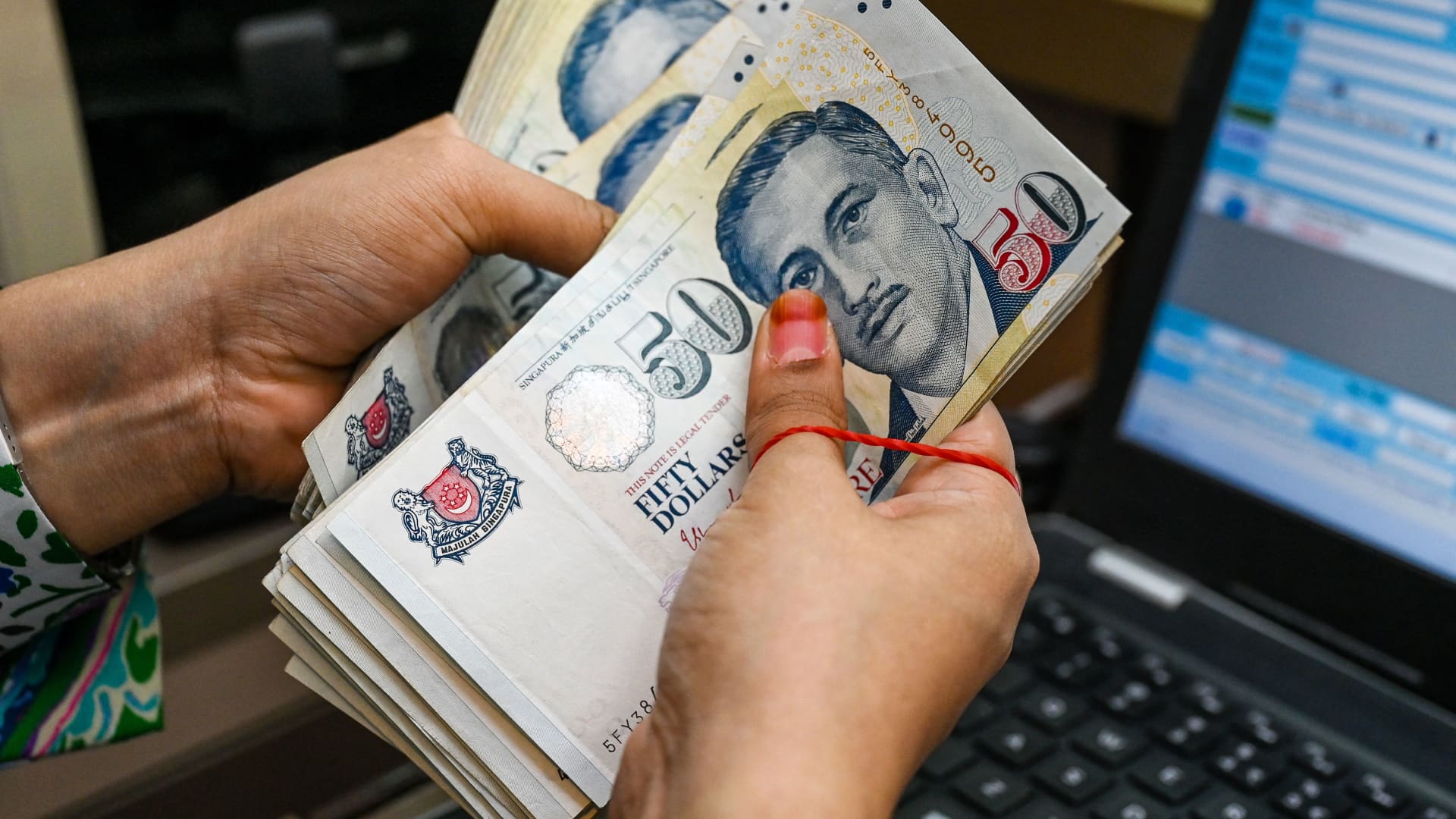
As US and Israeli strikes reshape the Middle East’s energy map, the SGD retreats — but Singapore’s fundamentals offer more ballast than the headlines suggest
The Singapore dollar has shed more than a full percentage point against the US dollar in five trading sessions, the steepest weekly decline the currency has seen in months — but the real story is not the number on the screen. It is the cascade of events that produced it: coordinated American and Israeli airstrikes on Iran that killed Supreme Leader Ayatollah Ali Khamenei over the weekend of 28 February, a de facto closure of the Strait of Hormuz, Brent crude surging past $84 a barrel, and a stampede of global capital into the one refuge that never seems to go out of fashion — the US dollar.
On Wednesday morning in Singapore, SGD/USD was quoted at approximately 0.7824, meaning one Singapore dollar buys just over 78 US cents. Flipped into the more commonly traded convention, USD/SGD stood at 1.278, its highest point since late 2025. The move places the pair at the centre of a broader emerging-market rout: an MSCI gauge of developing-nation currencies logged its worst single session since November 2024 on Monday, as central banks in Indonesia, Turkey and India were forced to intervene. Singapore, by contrast, did neither — a quiet signal of relative confidence.
Market Snapshot: Key Data as of 4 March 2026
| Asset | Level | 5-Day Change |
|---|---|---|
| SGD/USD | 0.7824 | −1.1% |
| USD/SGD | 1.278 | +1.1% |
| DXY (US Dollar Index) | ~99.7 → 99.16 | +~1.0% (WTD) |
| Brent Crude | $82.76/bbl | +13.5% (WTD) |
| WTI Crude | $75.48/bbl | +12.0% (WTD) |
| Straits Times Index (STI) | ~4,800 est. | −1.6% (WTD) |
| Fed Rate Cut (first fully priced) | September 2026 | Pushed back from July |
Sources: Bloomberg, CNBC, TradingEconomics, Wise FX
The Geopolitical Trigger: When “Operation Epic Fury” Hit the FX Markets
The catalyst arrived without warning on the weekend of 28 February, when US and Israeli forces launched what President Donald Trump dubbed “Operation Epic Fury” — a massive wave of coordinated strikes against Iranian nuclear and military infrastructure. Tehran responded with missile salvos targeting Gulf energy facilities, and within hours the commander of Iran’s Revolutionary Guard declared the Strait of Hormuz closed, threatening to “set any ship on fire” that attempted passage.
The consequences for energy markets were immediate and severe. Brent crude, which had closed near $73 per barrel on the Friday before the strikes, surged as high as $85 at one point on Tuesday — a level last seen in early 2024 — before settling into a still-elevated range around $82–84 by Wednesday. WTI rose above $75. The Strait of Hormuz typically channels roughly 20 per cent of the world’s seaborne oil and vast volumes of Qatari liquefied natural gas; QatarEnergy halted LNG production after attacks on its Ras Laffan export site, sending European natural gas futures rocketing more than 40 per cent in a single session.
For foreign-exchange markets, the transmission mechanism was swift and familiar: energy shock → inflation risk → narrowing Fed rate-cut expectations → dollar strength. The US dollar index gained nearly 1 per cent on Monday alone, erasing its losses for 2026 and trading at a five-week high. By Wednesday, DXY hovered near 99.7 before easing slightly to 99.16, approaching but not yet piercing the psychologically important 100 level. Meanwhile, former Treasury Secretary Janet Yellen summed up the Fed’s dilemma bluntly: “The recent Iran situation puts the Fed even more on hold, more reluctant to cut rates than they were before this happened.”
The market agrees. Rate futures now push the first fully priced Fed cut to September, two months later than the July consensus that prevailed before the weekend — a shift with direct implications for dollar-denominated carry trades and Asian currency valuations alike.
Singapore: Risk-Off, but Relatively Contained
Against that backdrop, the Singapore dollar’s 1.1 per cent weekly retreat looks, in context, almost orderly. Senior economists Chua Han Teng and Radhika Rao at DBS Group Research offered the most measured institutional read on the situation, noting that “Singapore’s financial markets saw risk-off but contained movements,” with the benchmark equity index — the Straits Times Index — declining approximately 1.6 per cent, and the SGD weakening by around 1 per cent. Their conclusion: “The economy [is] confronting uncertainty from a relatively strong position, amid solid growth momentum buoyed by global artificial intelligence-related tailwinds and still-low inflation at the start of 2026.”
That framing is important. Singapore entered this crisis with considerably more macro cushion than many of its emerging-market peers. In January 2026, the government upgraded the full-year GDP growth forecast to a range of 2 to 4 per cent, lifted higher in part by the sustained global boom in artificial intelligence infrastructure investment — a wave that has turbocharged Singapore’s data-centre sector, financial services exports and semiconductor-adjacent supply chains. Core inflation, meanwhile, was running well within the Monetary Authority of Singapore’s 1–2 per cent target band heading into the conflict.
The MAS moved quickly to reassure markets. In a statement issued on 2 March, the central bank confirmed that it is “closely monitoring developments arising from the ongoing situation in the Middle East, and is assessing the impact on the domestic economy and financial system.” Critically, it confirmed that “Singapore’s foreign exchange and money markets continue to function normally,” and that the Singapore dollar nominal effective exchange rate — the S$NEER — “remains within its appreciating policy band, which will continue to dampen imported inflationary pressures.” Translation: the MAS is not panicking, and the exchange-rate framework is doing exactly what it was designed to do.
Deputy Prime Minister Gan Kim Yong told Parliament on 2 March that a prolonged conflict could push up prices and weigh on growth, and that the government stands ready to revise GDP and inflation forecasts if conditions warrant. He also pointed to Budget 2026 measures designed to build precisely this kind of economic resilience.
Singapore’s Structural Vulnerabilities and Compensating Strengths
The city-state is not, however, immune. As a small, highly open economy with no domestic energy production, Singapore is structurally exposed to Persian Gulf disruptions through multiple channels simultaneously. More than 14 million barrels of crude oil per day typically pass through the Strait of Hormuz, with roughly three-quarters destined for China, India, Japan and South Korea — the same economies to which Singapore’s trading, logistics and financial infrastructure is intimately connected. A sustained Hormuz disruption ripples outward through shipping costs, LNG prices and ultimately consumer price indices.
Maybank economist Dr Chua Hak Bin had flagged in advance that inflation was an underappreciated risk in 2026, citing rising semiconductor prices and the unwinding of Chinese export deflation — a deflationary cushion that had kept manufactured goods prices suppressed for several years. A Gulf supply shock superimposes an energy cost surge on top of those pre-existing pressures. If the conflict persists beyond four to six weeks, Singapore’s core inflation could break above the MAS’s 1–2 per cent forecast band, creating pressure on the central bank to shift its exchange-rate policy.
On the currency’s specific bilateral move, three forces are at work. First, broad dollar strength driven by safe-haven demand and reduced Fed easing expectations. Second, a modest compression of Singapore’s yield advantage as global risk premia widen. Third, the direct trade exposure: Singapore’s port and re-export economy is a node through which Middle East energy flows toward the rest of Asia — a role that, if interrupted, shrinks the near-term growth outlook priced into SGD. The relative outperformance of SGD versus, say, the Indonesian rupiah or the Thai baht reflects the first factor (safe-haven properties of a highly creditworthy small open economy) partially offsetting the second and third.
Global Macro: The Fed Between Two Fires
For the Federal Reserve, the Iran conflict has arrived at the most uncomfortable possible moment. US inflation stood at 2.4 per cent in January 2026, already above the 2 per cent target. JPMorgan Chase CEO Jamie Dimon put the conundrum plainly: “This right now will increase gas prices a little bit, and again, if it’s not prolonged it’s not going to be a major inflationary hit. If it went on for a long time, that would be different.”
Markets are currently pricing in two 25-basis-point cuts by year-end — but with the first fully expected cut pushed to September and genuine uncertainty about supply-side inflation, even that modest easing path is far from guaranteed. Nomura economists have flagged the dilemma facing Asian central banks as a binary: tolerate higher inflation, or absorb the fiscal cost of consumer subsidies. “So which ‘negative’ do you want to have: higher inflation or worse fiscal?” asked Rob Subbaraman, Nomura’s head of global macro research.
Barclays analysts have flagged a scenario where Brent reaches $100 per barrel if Hormuz remains blocked, with UBS seeing potential for $120 in an extreme-disruption case. Even BMI, which maintained its full-year Brent forecast at $67 per barrel, acknowledged that its core view rests on a “brief spike in March, followed by rapid retracement” — an assumption that requires a relatively swift de-escalation. President Trump, who has said the conflict “could become a prolonged battle,” has offered no such assurance.
What It Means for Investors — and for Travellers
For Singapore-based investors, the near-term calculus involves navigating a market that is simultaneously buffeted by geopolitical risk and buoyed by structural AI-driven growth. DBS’s equity strategy team identified defence, oil-and-gas, and shipbuilding names — including ST Engineering, Seatrium and Nam Cheong — as likely near-term beneficiaries, while flagging headwinds for aviation, transport and interest-rate-sensitive REITs. At the same time, the STI’s historical tendency to recover geopolitical drawdowns within 60 days — an average of 6 to 7 per cent decline over that window — provides a baseline for calibrating exposure.
For the millions of travellers who use Singapore as a hub or who hold SGD-denominated accounts, the currency move has a practical dimension. A weaker Singapore dollar means purchasing power against USD-denominated goods and services — American hotel rates, US flight tickets, dollar-priced tours across Southeast Asia — has declined. At 0.7824, a Singapore traveller exchanging S$5,000 receives around US$3,912, compared with roughly US$3,963 before the conflict. That is not a catastrophic shift, but it underscores the direct household relevance of geopolitical shocks that often appear abstract. Conversely, travellers to Singapore from the United States will find the city-state modestly more affordable — a silver lining for inbound tourism that Singapore’s hotel and hospitality sector will welcome.
Forward Outlook: A Corridor of Uncertainty
The range of plausible outcomes from here is unusually wide. At one end: a swift diplomatic resolution, Hormuz reopens, oil retraces toward $70, the Fed resumes its cutting cycle in July, and the SGD recovers toward the 0.79–0.80 range versus the dollar that prevailed in early 2026. At the other: a conflict lasting weeks or months, Brent sustaining above $90 or beyond, core inflation breaking above MAS targets, and USD/SGD testing 1.30 or higher.
What keeps Singapore closer to the optimistic scenario than most of its peers is precisely what DBS’s economists identified: the economy is not entering this shock from a position of vulnerability. The AI investment supercycle, export resilience, low pre-crisis inflation, and MAS’s exchange-rate-based policy framework — which can tighten by allowing a faster SGD appreciation when inflation threatens — all represent buffers unavailable to less structurally sound emerging markets.
The MAS’s managed float system, in which the S$NEER is guided within a policy band that prioritises inflation control over short-term exchange-rate stability, is arguably the most sophisticated monetary transmission mechanism in Asia. The current episode is not testing its limits — not yet.
One number to watch above all others: Brent crude. If it holds below $90 and Hormuz traffic resumes within weeks, Singapore’s financial markets are likely to absorb this shock with the composure they have shown so far. If it approaches $100 and the geopolitical calendar darkens further, the MAS will face choices it would prefer not to make.
The Conclusion
The Singapore dollar’s retreat is real, but it is not a verdict. Markets price fear before they price facts, and the facts of Singapore’s economic position in early 2026 — strong growth momentum, low inflation, a credible central bank, and an economy wired into the AI-powered future — are considerably more durable than the fear that moved the currency by a percentage point this week. In the fog of geopolitical war, that is worth remembering.
A weaker SGD is a symptom of global anxiety. Singapore’s fundamentals are the cure — and they remain intact.
Discover more from The Economy
Subscribe to get the latest posts sent to your email.
How Asian investors can navigate the geopolitical impact on Asian markets without falling into the twin traps of complacency and panic — and why pricing geopolitical risk in 2026 demands a fundamentally different toolkit
The Fire Horse Meets the Year of Geopolitics
In the Chinese zodiac, 2026 belongs to the Fire Horse — a symbol of restless, combustible energy. Driven, brilliant, and unpredictably volatile, the Fire Horse is considered one of the most dramatic animals in the Chinese astrological cycle. In certain East Asian traditions, years bearing its mark are ones in which conventional wisdom gets upended and fortune favors those who move decisively rather than hesitantly.
For investors operating across Asian markets this year, that ancient metaphor has collided head-on with a grimmer, more modern label: the Year of Geopolitics.
It is a label earned in full. Consider the dizzying catalogue of risk events that greeted markets before the calendar had even turned to February. On January 3rd, US forces captured Venezuelan President Nicolás Maduro — barely three days into the new year — in an intervention that Lombard Odier’s strategists immediately flagged as a return of sphere of influence logic to geopolitics, with the operation mirroring the US intervention in Panama in 1989 and the arrest of Manuel Noriega. MarketPulse Within weeks, President Trump announced 10% tariffs on eight NATO allies, ostensibly tied to US demands over Greenland — a move that, according to Lombard Odier’s analysis, drove geopolitical risk premia higher, led by gold, though broader impacts were expected to stay contained unless tensions intensified. J.P. Morgan
Meanwhile, US military assets have been repositioned in the Gulf, pressuring Iran toward nuclear negotiations, with Lombard Odier warning that oil markets are a key transmission channel for geopolitical risks, and any Iranian action in the Strait of Hormuz would be a high-risk, high-cost option — but one that cannot be ruled out. Allianz Global Investors And as if a crowded geopolitical stage needed more actors, the independence of the US Federal Reserve has come into question, with Jerome Powell’s term ending in May and President Trump’s preference for a loyalist replacement threatening what markets once considered an institutional certainty.

Layering all of this is the ongoing shadow of Trump’s trade tariffs — tools whose legal foundations remain contested in the Supreme Court — and a tech decoupling between Washington and Beijing that has moved from rhetorical sparring to operational architecture.
The central question for Asian investors is not whether these risks are real. They are, spectacularly so. The question is: how should you price geopolitical risk in a world where economic growth remains remarkably resilient? Do you sell? Discount? Simply watch the headlines and hold firm? As we will argue, the answer is none of the above in isolation. What this moment demands — particularly for investors with Asian portfolio exposure — is analytical nuance, not instinct.
Loud Headlines, Quiet Markets — and Why That Pattern Can Deceive
There is a seductive and well-documented pattern in modern financial history: geopolitical events tend to produce sharp, short-lived volatility spikes, followed by recoveries that leave investors wondering what all the fuss was about. Geopolitical events tend to have only a temporary impact on markets as long as they have no lasting effect on oil prices or permanently disrupt global supply chains. BlackRock
This has been the dominant experience of the past several years. From Middle Eastern flare-ups to the initial phases of the Russia-Ukraine war, from North Korean missile tests to US-China semiconductor skirmishes, markets have repeatedly absorbed the shock, processed the information, and moved on — often within days. The global economy has shown surprising resilience. Despite the tax burdens and protectionist policies of the Trump administration, markets have grown accustomed to the rhythm of confrontation and compromise — particularly in the ongoing dynamic between President Trump and his global counterparts. Asia House
The clearest stress-test of this pattern came in April 2025 with “Liberation Day” — the Trump administration’s sweeping tariff announcement. Volatility spiked violently, and supply-chain-exposed stocks across Taiwan, South Korea, Vietnam, and Malaysia sold off hard. After Liberation Day, markets panicked. The dollar fell as volatility spiked — the opposite of its usual safe-haven behavior. Reserve managers sharply shifted allocations away from dollars; the greenback’s share of global reserves hit its lowest in two decades. Pundits rushed to declare American exceptionalism dead. Lombard Odier And yet, by the year’s end, a partial trade détente had been negotiated, and foreign investors had bought more US assets than in the prior year.
Despite fading market shocks, ongoing geopolitical tensions and elevated gold volatility signal that concerns about global risks may linger in 2026, as State Street’s Head of Macro Policy Research Elliot Hentov noted. Trade continues to grow despite trade wars — but deals are being closed only gradually, and uncertainty has not fully dissipated. BlackRock
The danger for investors lies in a subtle but crucial category error: confusing market recovery with market immunity. Geopolitical risks are often priced heuristically. Their uncertain duration, scope, and low frequency make them difficult to quantify in advance. In the meantime, their tail-risk nature — as relatively rare but potentially extreme occurrences — means they are underpriced until they materialise. J.P. Morgan Private Bank Put differently: the fact that a crisis passed without lasting damage does not mean the next one will. And for Asian investors, the structural transmission channels are uniquely numerous and direct.

BlackRock’s Geopolitical Risk Dashboard tracks a “market movement score” for each risk — measuring the degree to which asset prices have moved similarly to risk scenarios. The current environment reflects the US resetting of trade deals and alliances, intensifying US-China competition with AI at its core, and continued volatility from conflicts in Ukraine, Gaza, and the Caribbean. Allianz Global Investors The dashboard makes plain that market attention and market movement are two different things — and that the gap between them is where complacency breeds.
Asia’s Unique Position — Why Nuance Is Not Optional
Asia is not a spectator in the Year of Geopolitics. It is one of its primary stages. The region encompasses the world’s most consequential bilateral rivalry (US-China), the most contested maritime geography (the Taiwan Strait and South China Sea), the most trade-exposed economies in the developed world, and the most energy-import-dependent major markets on the planet. For Asian investors, the transmission channels for geopolitical shocks are not theoretical — they flow directly into earnings, currencies, bond yields, and capital flows.
The bilateral relationship between Washington and Beijing remains the most important indicator of geopolitical tensions to gauge in 2026 and for years to come. Long-term strategic decoupling is highly likely to continue amid growing great-power competition, especially in emerging technologies and defense. While there may be increased stability prior to an anticipated summit between Xi Jinping and Donald Trump, the underlying dynamic of technology and supply-chain competition is structural rather than episodic. SpecialEurasia
Several specific vulnerability channels demand attention:
Export dependency. South Korea, Taiwan, Malaysia, Singapore, and Vietnam are among the world’s most trade-reliant economies. Any durable deterioration in global trade flows hits their corporate earnings faster and harder than in more domestically insulated markets. China’s export machine continues to defy geopolitical headwinds, showing robust growth even as protectionist policies proliferate globally — yet the structural supply-demand imbalance will require years to resolve, and more time is needed for recent anti-involution policy measures to have a meaningful impact on the real economy. Pinebridge
Energy import vulnerability. Around one-third of the world’s seaborne crude oil flows through the Strait of Hormuz, which is also key for transporting liquefied natural gas, fertilisers, copper, and aluminium. Allianz Global Investors Japan and South Korea, as near-total energy importers, face the most direct exposure to any supply disruption emanating from Middle Eastern conflict.
Technology decoupling. Despite a trade detente with China, the military posture in Asia hasn’t softened. Washington sent Taipei its largest-ever arms sale package, and Beijing continues to assert its Taiwan position. Lombard Odier Meanwhile, China’s ambition to triple domestic semiconductor production by 2026 is reshaping investment flows across the electronics supply chain from Penang to Shenzhen.
Currency fragility. The Chinese yuan’s relative stability — maintained deliberately to preserve export competitiveness — acts as an anchor that constrains appreciation across the broader Asian currency complex. Dollar-yen is expected to breach 160 in 2026, with yen risks remaining key to the downside. Hartford Funds
Water and resource security. An often-overlooked vector of geopolitical risk in Asia is resource competition. The Indus Waters Treaty has been suspended. South Asian nuclear-armed rivals are turning rivers into leverage. The governance vacuum around shared water resources is deepening — and when the next shock comes, water will make it worse. Lombard Odier
Given these interlocking vulnerabilities, it should be clear why the standard market wisdom — “geopolitics rarely moves markets” — is an incomplete guide for Asian portfolios. Despite optimism about Asian equities in 2026, some challenges cannot be overlooked, including uncertain global demand, trade dynamics, and a volatile macro environment, all creating headwinds to medium-term potential growth. J.P. Morgan
The correct response, however, is not to flee risk entirely. Asia enters 2026 with genuine resilience and structural opportunity, driven by AI infrastructure investment, advanced manufacturing, and the green energy transition. The message for investors is clear: stay nimble, diversify beyond technology, and hedge strategically. Eurasia Group
The Lombard Odier Framework: How the Intelligent Allocator Approaches Geopolitical Risk
In managing clients’ money through successive geopolitical shocks over more than two centuries, Lombard Odier has developed what it calls the “Intelligent Allocator” framework — a discipline for separating analytical signal from emotional noise in volatile environments. Its core insight is worth absorbing in full.
The investor’s edge does not come from predicting events, but from understanding which outcomes are unaffordable. Rather than trying to anticipate geopolitical shocks, the goal is to build portfolios that can endure them through a robust strategic asset allocation. The idea is to understand the objectives of major economic actors, and more importantly the material constraints that limit those objectives — the hard physical, economic, and resource limits that bind policymakers regardless of ideology. J.P. Morgan Private Bank
This “material constraints” framework, developed by geopolitical strategist Marko Papic, is particularly illuminating in the context of US-China relations. At the February 2026 Lombard Odier “Rethink Perspectives” event in Paris, the firm’s chief strategists laid out the logic explicitly. The Americans possess what China needs — computing power — but China equally holds what the Americans require — rare earths. This symmetry is central to risk management. It sustains geopolitical tension, yet also reduces the probability of full decoupling, as the economic cost of a “pure” separation would be prohibitive. For markets, this translates into recurring cycles of political announcements, targeted restrictions, and industrial adaptation — in other words, volatility that is structural rather than episodic. Pinebridge
This insight directly challenges two equally mistaken responses: the first is to dismiss US-China tech tensions as noise that markets will look through; the second is to treat them as an existential rupture requiring wholesale portfolio defensiveness. The correct position is somewhere harder to hold: acknowledging the structural nature of the competition while maintaining exposure to the growth it generates.
On portfolio construction in this environment, Lombard Odier has been consistently clear since the start of the year. The key lesson from 2025 is to remain invested through the noise. Economies are still expanding, corporate growth is solid, policy offsets are in place, and the private sector is strong. While growth should slow through the year, stronger end-2025 momentum provides a higher buffer. Diversification is essential, with a preference for emerging markets, which offer higher earnings growth at a more reasonable price. Hartford Funds
On the Venezuela intervention specifically, Lombard Odier’s January analysis provided a useful template for how the framework operates in real time. The firm expected further spread compression in emerging bonds, precious metals outperforming due to a rise in the geopolitical risk premium, and a neutral view on the global energy sector — given both upside and downside risks to oil prices in the short term. MarketPulse This is the Intelligent Allocator in action: calibrated rather than reactive, nuanced rather than binary.
Real-Time Geopolitical Fault Lines: What Is Priced In and What Isn’t
Against this analytical backdrop, several specific 2026 geopolitical fault lines warrant close attention from Asian investors — both for the risks they present and, often, the opportunities embedded within them.
The US Political Revolution. According to the Eurasia Group’s Top Risks 2026 report, the United States is attempting to dismantle checks on presidential power and capture the machinery of government — making it the principal source of global risk in 2026. Lombard Odier As Eurasia Group founder Ian Bremmer put it: “The United States is itself unwinding its own global order. The world’s most powerful country is in the throes of a political revolution.” Lombard Odier For Asian markets, the implications ripple through trade policy, Federal Reserve independence, and the durability of US security commitments in the Indo-Pacific.
The Federal Reserve question is especially consequential. With Jerome Powell’s term ending in May 2026, the nomination process will be a market-moving spectacle. If a presidential loyalist is nominated, markets could price in a politicized, dovish Fed — producing a sharp equity rally and a sell-off in the dollar, with Senate confirmation hearings becoming the key volatility event of the spring. Societegenerale
The Electrons vs. Molecules Competition. China is betting on electrons — AI, advanced manufacturing, drones, batteries, and solar — while the United States is betting on molecules: energy, fossil fuels, critical minerals. 2026 will begin to reveal which bet is paying off. Lombard Odier The answer has significant implications for Asian supply chains. China tightens its grip on drones, battery storage, robots, and manufacturing, even as deflation clouds its domestic outlook with a quarter of all listed Chinese firms now unprofitable — the highest level in 25 years. Lombard Odier
The Supreme Court Tariff Ruling. Legal challenges to the administration’s reciprocal tariff executive orders are heading to the Supreme Court, with a ruling expected by June. If the Court strikes down the president’s authority to unilaterally set broad tariffs, the result could be a massive deflationary unwind and a rally in global trade proxies — shipping, emerging markets, and Asian export-oriented economies. Societegenerale The reverse scenario — Court upholding the tariffs — would entrench the current landscape of elevated trade friction.
Iran and Energy Risk. Lombard Odier’s February assessment concluded that the base case remains a negotiated outcome on US-Iran tensions, consistent with financial markets’ relative calmness. The VIX remained just below its long-term average, with no sign that risk premia were adjusting in anticipation of escalation. Allianz Global Investors But the tail risk remains real: a Strait of Hormuz disruption would function as a direct economic shock to virtually every energy-importing Asian economy.
Gray Zone Warfare Around Taiwan. Intelligence suggests China may be moving its timeline for “reunification readiness” forward. 2026 could see an increase in gray zone warfare — cyberattacks, blockades, and airspace incursions — that could trigger major repricing in risk assets and the US dollar. Any kinetic escalation around Taiwan would make 2025’s volatility look like a warm-up. Societegenerale Wellington Management’s geopolitical framework places this among the highest-consequence monitoring priorities for Asia-tilted portfolios.
China’s Deflation Trap. China enters 2026 with ten consecutive quarters of worsening deflation, personal consumption at just 39% of GDP — half the US share — and disposable income stalled at US$5,800 per person. Lombard Odier China’s export machine continues to defy geopolitical headwinds, showing robust growth. However, resolving the structural supply-demand imbalance will be a multi-year process. Pinebridge The irony is that Beijing’s response — accelerating exports — compounds competitive pressure on Asian neighbors even as it stabilizes Chinese growth.
Structural Beneficiaries: Vietnam, Malaysia, Indonesia. Not all of Asia’s geopolitical geography is risk. Vietnam has increasingly functioned as a “connector economy,” facilitating trade flows between the US and China. As corporates diversify production away from China, Vietnam has absorbed manufacturing activity tied to US end-demand while continuing to source intermediate inputs from China. Pinebridge Indonesia’s critical minerals position — particularly nickel for batteries and semiconductors — aligns directly with the AI-driven digital economy. These are genuine structural opportunities embedded within the geopolitical disruption.
Investment Strategies: Pricing Risk Without Being Paralyzed by It
What does a genuinely nuanced approach look like in practice? The following principles synthesize insights from across the major institutional frameworks operating in this environment.
Stay invested — but with eyes open. Despite its stellar performance in 2025, gold remains the most attractive portfolio hedge against market and geopolitical risks, with momentum from private inflows and central bank diversification expected to remain strong. As for the US dollar, renewed Fed easing and US policy uncertainty argue for sustained weakness and lower exposures. Hartford Funds The base case across major institutional investors entering 2026 is moderately pro-risk — not risk-off.
Use gold as a systematic hedge, not an emotional response. Adding gold in a sell-off makes sense given the multiple roles it can play as a hedge against geopolitical risk, stagflation, and US-dollar concerns. Stimson Center Lombard Odier advocates a gold allocation “of the order of 3–5%” as a line of portfolio defence when faced with extreme shocks — a structural position rather than a tactical reaction. Wellington Management The critical distinction is between owning gold before a crisis, when it is cheapest, versus scrambling to buy it after a spike.
Distinguish geopolitical categories. Geopolitical cycles are long — historically, they last between 80 and 100 years. Structural changes like those we’re witnessing now only come around once per century and tend to be disruptive. While market risk is structurally higher in this new regime, 2026 will afford ongoing and novel opportunities to seek portfolio winners and losers across defense technology, energy transition, and advanced manufacturing themes. SpecialEurasia
Diversify within Asia, not just out of it. Lombard Odier expects Swiss, Japanese, and emerging market equities to outperform. Within EM equities, more domestic-led markets such as China and India are expected to outperform more US-exposed markets such as Taiwan and Korea, which are more vulnerable to profit-taking when tariff tensions flare. J.P. Morgan
Watch sovereign bond dynamics for structural signals. Geopolitical shifts are reshaping global demand for government debt. As central banks diversify into gold, sovereign bonds may see higher domestic ownership and depend more on domestic demand — a structural shift that changes the diversification calculus for Asian fixed-income investors. State Street
Position for AI as a geopolitical theme, not merely a technology theme. A genuine transformation is underway, with the logic of efficiency and interdependence giving way to the logic of security. Security is replacing efficiency as the guiding principle of economic policy, prompting massive investment in energy, infrastructure, and industrial capacity — a shift that creates both risks and long-term opportunities for investors. Pinebridge In Asia, this means AI hardware infrastructure, semiconductor equipment makers, and advanced manufacturing platforms are not simply growth stocks — they are geopolitical position plays.
The comparison below illustrates how geopolitical risk transmission differs across key Asian markets:
| Market | Primary Risk Channel | Key Vulnerability | Structural Opportunity |
|---|---|---|---|
| Taiwan | Tech decoupling, Taiwan Strait | Semiconductor export controls | TSMC global supply chain dominance |
| South Korea | Trade tariffs, China slowdown | US-Korea trade tension | Defense tech, battery manufacturing |
| Japan | Yen weakness, energy costs | BoJ normalization pace | Governance reforms, fiscal stimulus |
| India | Tariff exposure (36% effective rate) | Energy import costs | Domestic demand, rate cutting cycle |
| Vietnam | China +1 beneficiary dynamics | US scrutiny of trade flows | Manufacturing connector economy |
| Indonesia | Critical minerals demand | Commodity price volatility | Nickel, AI infrastructure materials |
| China | Deflation trap, tech restrictions | Export overcapacity, property sector | Semiconductor self-sufficiency drive |
| Singapore | Financial hub volatility | Capital flow sensitivity | Digital economy, wealth management |
The Case for Active Management Over Passive Conviction
One underappreciated implication of the geopolitical environment is its structural favorability for active over passive investment management. This environment is naturally conducive to active management, which can seek to avoid increased market risks and capitalize on differentiation more nimbly than a passive approach. There may be alpha opportunities for long/short and other alternatives strategies that simply do not exist in a regime of smooth, globally coordinated growth. SpecialEurasia
Passive indices — particularly those heavily weighted toward Chinese or tech-dominant Asian benchmarks — embed specific geopolitical assumptions that may not reflect the rapidly evolving risk landscape. A passive Asia ex-Japan ETF, for example, carries significant Taiwan semiconductor and South Korean battery exposure, and limited hedging against the tail scenarios that both Wellington and Lombard Odier have flagged. Active management allows for the kind of within-region, within-sector rotation that a nuanced geopolitical view demands.
Geopolitical fragmentation does not lead to a generalised market retreat, but instead imposes a more detailed and refined hierarchy of risks, broken down by region and sector. It demands particular attention to sovereign balance sheets and microeconomic fundamentals. Wellington Management This is a world that rewards research depth and penalizes index-hugging.
The Intelligent Allocator’s Conclusion: Nuance Is the Strategy
The Fire Horse year demands that investors move: those who stand still, paralyzed by the sheer volume of geopolitical noise, risk being trampled by the opportunities passing them. Those who panic-sell risk exiting at precisely the moments when fundamentals argue for holding course. And those who are complacent — who assume that because markets have recovered from previous shocks, they will always recover quickly from the next — are building portfolios on a foundation that the Year of Geopolitics may not spare.
The geopolitical environment remains fraught with uncertainty. But markets have grown accustomed to the rhythm of confrontation and compromise. The balance of power, especially in trade and strategic resources like rare earths, has shifted. And yet, despite the tax burdens and protectionist policies of the Trump administration, the global economy has shown surprising resilience. Asia House
A moderate pace of economic growth, more accommodative monetary conditions, and a weaker dollar create fertile ground for risk assets, even as the fixed income outlook remains constrained. By seeking value opportunities, embracing emerging markets, and diversifying further through real assets, investors can position portfolios for resilience amid inevitable risks and potential shocks. Societegenerale
The analytical discipline that this moment demands is not exotic. It is, at its core, a commitment to asking a more precise question than either “should I be scared?” or “should I be calm?” The better question is: which specific outcomes are unaffordable for my portfolio, which geopolitical risks have economic transmission channels that could materialize those outcomes, and am I appropriately positioned to endure them while remaining exposed to the genuine growth that Asia’s structural story continues to offer?
That question, asked with rigor and answered with evidence rather than instinct, is the whole of the nuanced response. In the Year of Geopolitics, it may also be the difference between a good year and a great one.
Discover more from The Economy
Subscribe to get the latest posts sent to your email.
-

 Markets & Finance2 months ago
Top 15 Stocks for Investment in 2026 in PSX: Your Complete Guide to Pakistan’s Best Investment Opportunities
-

 Analysis4 weeks ago
Brazil’s Rare Earth Race: US, EU, and China Compete for Critical Minerals as Tensions Rise
-

 Banks2 months ago
Best Investments in Pakistan 2026: Top 10 Low-Price Shares and Long-Term Picks for the PSX
-

 Investment2 months ago
Top 10 Mutual Fund Managers in Pakistan for Investment in 2026: A Comprehensive Guide for Optimal Returns
-

 Asia2 months ago
China’s 50% Domestic Equipment Rule: The Semiconductor Mandate Reshaping Global Tech
-

 Global Economy2 months ago
Pakistan’s Export Goldmine: 10 Game-Changing Markets Where Pakistani Businesses Are Winning Big in 2025
-

 Global Economy2 months ago
What the U.S. Attack on Venezuela Could Mean for Oil and Canadian Crude Exports: The Economic Impact
-

 Global Economy2 months ago
15 Most Lucrative Sectors for Investment in Pakistan: A 2025 Data-Driven Analysis