
AI
The Global AI Export War: How the Fable 5 Shutdown Is Reshaping Startup Strategy

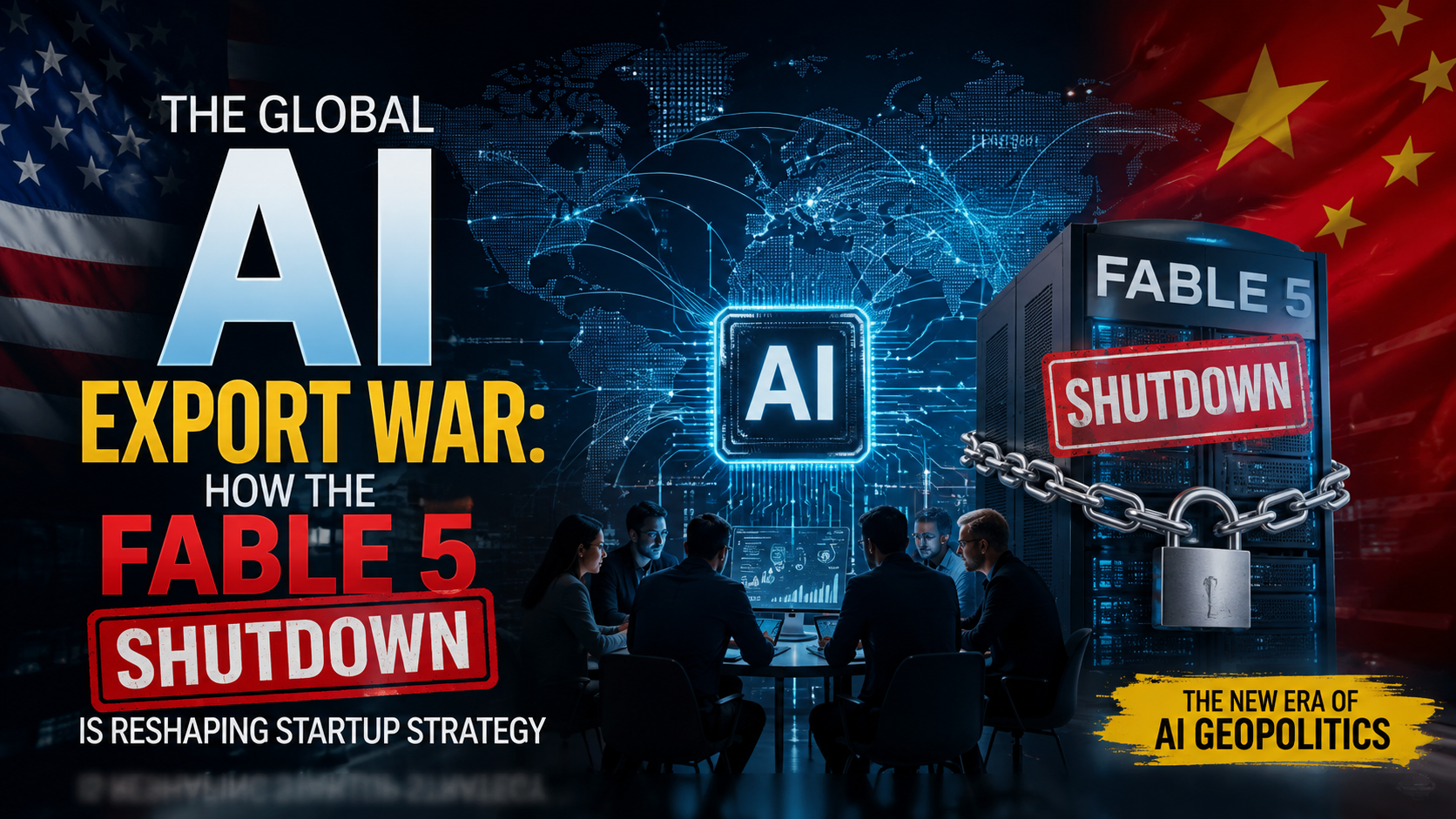
On June 12, 2026, the U.S. Commerce Department’s Bureau of Industry and Security ordered Anthropic to block foreign nationals from accessing its Fable 5 and Mythos 5 AI models, and Anthropic — finding no way to comply short of a global shutdown — disabled both models for every user worldwide the same day. The Commerce Department lifted the underlying export controls on June 30, and Anthropic restored full access on July 1, 2026, but the roughly three-week disruption exposed a structural vulnerability that startups building on frontier AI models had not previously had to price into their risk models: a single national-security directive can switch off a company’s core infrastructure overnight, with no advance warning and no geographic containment. The episode is now reshaping how AI-dependent startups think about model diversification, multi-vendor architecture, and jurisdictional exposure.
Key Takeaways
- A June 12, 2026, Commerce Department directive forced Anthropic to disable Fable 5 and Mythos 5 globally for all users, not just flagged foreign nationals, because no narrower compliance mechanism was available.
- The Commerce Department lifted the export controls June 30, and Anthropic restored full access July 1, 2026 — a roughly three-week disruption window.
- Legion LegalTech’s lawsuit against the federal government argues no existing export-control statute covers hosted AI models or their outputs.
- Startups are responding by building multi-model failover architecture, reassessing cross-border engineering staffing, and showing increased interest in decentralized AI alternatives.
- Enterprise procurement teams are now incorporating “regulatory outage” risk explicitly into AI vendor contracts and business-continuity planning.
- The episode sits alongside separate, ongoing Anthropic-government litigation over military-use restrictions, reflecting a broader pattern of AI-sector regulatory friction in 2026.
What Happened, and Why the Scope Surprised Everyone
The Commerce Department’s directive was, on its face, narrowly targeted: block access to two specific models for foreign nationals, citing national-security concerns tied to countering-the-financing-of-terrorism guidelines. What made the episode a watershed moment for the AI industry was not the restriction itself but its execution. Anthropic has indicated that no existing technical mechanism could reliably distinguish and exclude only foreign-national users at the scale and speed the directive demanded — so the company disabled Fable 5 and Mythos 5 entirely, for all users, everywhere, effective immediately.
That global-blast-radius outcome is what transformed a relatively obscure regulatory action into an industry-wide case study. Legion LegalTech Corp, a San Jose legal-technology company whose Canadian engineering team depended on the models for core product development, filed suit against the federal government on June 23, calling the resulting harm “immediate, irreparable, and existential” and arguing that no U.S. export-control statute actually authorizes restricting access to hosted AI models or their text-based outputs in the first place.
Resolution — But Not Reassurance
The Commerce Department lifted the underlying controls on June 30, 2026, and Anthropic restored access to both models on July 1 — a relatively fast resolution as regulatory episodes go, but one that did little to reassure enterprise customers and startup founders about the durability of access to any given frontier model going forward. The core lesson startups have taken from the episode is not that this specific directive was wrong or overbroad (though Anthropic itself has said as much publicly), but that the authority to issue such a directive, and to trigger this kind of global shutdown as the only available compliance mechanism, evidently exists and can be exercised again with equally little warning.
How Startups Are Actually Responding
Multi-Model Architecture as a New Baseline
The most immediate operational response among AI-dependent startups has been a shift away from single-vendor model architecture. Companies that had standardized their entire product stack on one frontier lab’s API are increasingly building abstraction layers that allow rapid failover to a second or third model provider — not necessarily because they expect another export-control event specifically, but because the Fable 5/Mythos 5 episode demonstrated that regulatory, not just technical, outages are now a real category of infrastructure risk that a single-vendor architecture cannot mitigate.
Reconsidering Where Engineering Teams Sit
For companies like Legion with distributed, cross-border engineering teams, the episode has prompted direct reconsideration of where core AI-dependent development work is physically staffed. A directive targeting “foreign nationals” broadly, rather than specific flagged individuals or entities, means that any company with material non-U.S. engineering headcount now has to model the possibility that an entire team’s access to critical tools could be severed based on nationality rather than any conduct specific to that team — a risk factor that startup general counsel and heads of engineering are increasingly asked to address explicitly in board-level risk reporting.
Interest in Decentralized and Open-Weight Alternatives
The episode also produced a measurable, if narrow, shift in interest toward decentralized AI infrastructure and open-weight model alternatives that do not depend on a single centralized provider capable of being switched off by government directive. Tokens tied to decentralized-AI projects saw notable price increases in the days following the shutdown and the Legion lawsuit, as traders and some technologists concluded that infrastructure resilient to a single point of regulatory failure carries a value proposition that a purely centralized commercial model, however capable, cannot match on this specific dimension — even if centralized frontier models remain ahead on raw capability for most enterprise use cases.
Financial and Market Impact Section
Enterprise Procurement and Vendor Risk Underwriting
For enterprise buyers across regulated industries — financial services, legal, healthcare, and government contracting — the Fable 5/Mythos 5 episode has become a standard reference point in vendor-risk-assessment conversations with AI providers. Procurement and legal teams evaluating frontier-model contracts are increasingly asking vendors directly what technical or contractual protections exist against a repeat scenario, and some enterprise contracts now include specific service-level and business-continuity language addressing regulatory-driven outages as a distinct risk category from ordinary technical downtime, a shift with direct implications for how AI vendors structure their enterprise agreements and pricing going forward.
The Broader Anthropic Legal Context
The episode is one of several fronts on which Anthropic has found itself in legal and regulatory disputes with the U.S. government during 2026, running alongside separate litigation in federal courts in Washington and California stemming from a supply-chain blacklist dispute tied to Anthropic’s refusal to permit military use of its models for domestic surveillance or fully autonomous weapons systems. For investors evaluating exposure to frontier-AI labs — whether through direct equity, credit instruments, or downstream startup portfolios built atop specific model providers — the cumulative pattern of government-AI legal friction in 2026 represents a maturing but still unpriced category of regulatory risk that is likely to persist regardless of how any single case resolves.
Insurance and Business-Continuity Product Opportunity
The episode has also created a nascent commercial opportunity: specialty insurance and business-continuity consulting products specifically addressing “AI vendor regulatory outage” risk are beginning to appear from insurers serving the technology sector, a niche but potentially high-margin product category given the difficulty of actuarially pricing a risk with essentially one precedent event to draw on. Startups and enterprise buyers negotiating AI vendor contracts are a natural audience for this emerging product category, and its growth trajectory over the next several quarters will be a useful proxy for how seriously the broader market is pricing this specific risk.
Discover more from The Economy
Subscribe to get the latest posts sent to your email.



As Washington bets on technological breakthroughs and Beijing turns artificial intelligence into industrial power, Pakistan faces a more urgent challenge: ensuring that the next technological revolution strengthens its economy, institutions and citizens rather than deepening their dependence.
The future of artificial intelligence may be decided as much on factory floors as inside research laboratories. Yet the world remains preoccupied with a deceptively simple question: will China overtake the United States in the race for AI supremacy?
It is an attractive question because it promises a familiar answer. One nation wins, another loses, and the balance of global power shifts accordingly. History, however, rarely unfolds so conveniently. Technological revolutions do not produce a single victor. They produce competing centres of power, new dependencies and unexpected opportunities for countries willing to recognise them.
For Pakistan, this distinction matters enormously.
A farmer struggling with falling agricultural yields has little reason to celebrate whether an American or Chinese model leads an international benchmark. A textile manufacturer facing high production costs needs technology that improves efficiency. A public hospital short of specialists needs more reliable diagnostic support, not another announcement about becoming a regional AI hub.
The real question is not who will invent the most intelligent machine. It is who will turn intelligence into prosperity — and who will be left paying for technologies designed elsewhere.
Two superpowers, different advantages
America continues to enjoy formidable advantages in AI research, capital markets, advanced computing and the commercial development of frontier models. China, meanwhile, possesses industrial scale, integrated supply chains and an increasingly sophisticated manufacturing ecosystem capable of bringing technological improvements into practical use.
The numbers reveal the contrast.
According to Stanford University’s 2026 AI Index, American private investment in artificial intelligence reached approximately $285.9 billion in 2025, compared with $12.4 billion in China. The figures are striking, although they do not capture the entirety of Chinese government-directed investment.
The same report shows that the performance gap between leading American and Chinese AI models has narrowed considerably. The two countries have repeatedly challenged each other’s position at the technological frontier.
This suggests that American financial dominance no longer guarantees an equally commanding technological advantage.
China, however, is competing on another front.
In 2025, Chinese factories installed approximately 354,000 industrial robots, accounting for 59 per cent of global installations, according to figures reported by Dawn from the International Federation of Robotics.
The United States installed substantially fewer.
These figures demonstrate the scale of China’s manufacturing automation. They do not mean that every installed robot possesses advanced artificial intelligence, or that China has already mastered general-purpose robotics.
That distinction is important.
An industrial robot repeating a programmed welding operation is not equivalent to a machine capable of independently navigating an unfamiliar environment, recognising unexpected problems and adapting safely without human intervention.
Indeed, a detailed Reuters investigation into China’s humanoid robotics industry found that many impressive demonstrations remain far removed from commercially viable autonomous factory work.
China’s industrial advantage is therefore substantial but not conclusive.
Its deeper strength lies in something less spectacular: the ability to manufacture components, improve them through repeated production, reduce costs and distribute the resulting technologies across industries.
America may remain stronger at developing some of the world’s most capable models. China may prove exceptionally effective at making increasingly capable systems affordable and useful.
Neither achievement guarantees overall victory.
The limits of technological nationalism
Much of the discussion surrounding AI resembles an updated version of the Cold War space race. Political leaders invoke national prestige, strategic supremacy and the danger of falling behind.
But artificial intelligence differs from a contest to place the first human on the moon.
There is no final destination. There is no agreed finishing line. A breakthrough in model performance can quickly lose its commercial advantage if competitors develop cheaper alternatives or if businesses find that the technology is too expensive to deploy.
The economics may ultimately matter more than the publicity.
Consider the semiconductor industry.
American companies occupy strategically important positions in AI chip design, software and computing platforms. China has responded to export restrictions by accelerating efforts to build domestic alternatives.
The results are beginning to appear. An October 13 Reuters report citing IDC figures found that Nvidia held 34 per cent of China’s data-centre AI accelerator market in the first half of 2026, while Huawei had reached 28 per cent.
This does not establish technological equivalence between the two companies’ most advanced products. It does show how restrictions intended to protect a technological advantage can simultaneously encourage competitors to develop substitutes.
China faces serious obstacles involving advanced semiconductor manufacturing, specialised equipment and access to leading-edge computing resources.
America confronts vulnerabilities of its own, including dependence on international chip fabrication, enormous infrastructure costs and uncertainty over whether anticipated commercial returns will justify extraordinary investment.
The global AI economy is not dividing neatly into two self-sufficient technological empires.
It remains interconnected, even as governments attempt to redraw its boundaries.
Electricity may matter as much as algorithms
Another neglected dimension of AI competition is energy.
Training and operating sophisticated AI systems requires substantial computing infrastructure. Data centres need dependable electricity, cooling systems, transmission networks and capital.
The International Energy Agency projects that worldwide data-centre electricity consumption could approximately double to 945 terawatt-hours by 2030 under its base-case scenario.
That is a forecast, not a certainty. Improvements in chip efficiency, model design and computing practices could alter the trajectory.
Nevertheless, the direction is unmistakable: intelligence is becoming increasingly dependent on physical infrastructure.
China’s investments in electricity generation, renewable energy manufacturing and industrial supply chains provide significant advantages.
America, meanwhile, combines deep capital markets with major investments in data centres and energy infrastructure, although electricity supply constraints and grid expansion delays remain concerns.
The lesson is not that one country possesses an unbeatable advantage. It is that the AI revolution will reward governments capable of coordinating technology, energy, investment and infrastructure.
For Pakistan, where electricity reliability and industrial competitiveness remain longstanding concerns, this should be a warning against misplaced priorities.
A country struggling to deliver affordable power to existing industries cannot assume that building fashionable AI infrastructure will automatically generate economic development.
Indeed, the World Bank’s approval of $375.9 million for Pakistan’s grid stability programme in July 2026 illustrates the continuing importance of basic infrastructure.
Reliable electricity is not separate from digital transformation. It is one of its essential foundations.
The winner may not be the greatest beneficiary
There is another problem with viewing AI as a contest between Washington and Beijing: it confuses technological leadership with public welfare.
A country can lead in artificial intelligence while large sections of its population experience economic insecurity, stagnant wages or declining opportunities.
An impressive national AI industry does not automatically produce better schools, more equitable healthcare or greater economic mobility.
The opposite is also possible. Businesses may enjoy efficiency gains while workers bear the costs of technological disruption.
The enormous spending commitments associated with AI also deserve scrutiny.
As Reuters has reported, the current investment boom has intensified questions about whether productivity improvements and commercial revenues will eventually justify the scale of expenditure.
History offers reasons for both optimism and caution.
Electricity, computers and the internet transformed economies, but the benefits were neither immediate nor evenly distributed. Productivity gains required complementary investments, organisational changes, human skills and functioning institutions.
AI is unlikely to escape these realities.
Nor should societies overlook the human labour behind supposedly autonomous machines.
Training advanced robotic systems frequently involves people performing repetitive tasks, collecting data and correcting machine errors. The apparent intelligence of the final product may conceal an extensive workforce whose economic contribution receives comparatively little attention.
This raises questions about worker protection, compensation and the distribution of benefits from automation.
Technological progress should not be measured exclusively by the amount of human labour a machine can replace.
It should also be measured by whether people gain better opportunities, greater security and improved living standards.
The emerging battle over technological dependence
AI competition is increasingly becoming a struggle over the systems other countries will adopt.
Washington’s AI Action Plan promotes the international export of integrated American technology packages, including computing hardware, models, applications and standards.
China is pursuing its own international technological influence through infrastructure, manufacturing, increasingly competitive models and industrial partnerships.
For developing countries, this competition presents both opportunities and dangers.
Affordable AI tools can reduce barriers to innovation. Open-weight models can allow smaller firms and universities to adapt technologies without financing the development of enormously expensive frontier systems.
But accessibility is not the same as independence.
A system may be inexpensive to adopt and costly to abandon. Businesses can become dependent on foreign computing platforms, proprietary software, remote infrastructure and licensing arrangements.
National institutions may surrender control over sensitive data without fully understanding the implications.
The danger for Pakistan is not simply choosing American technology over Chinese technology, or vice versa.
It is allowing technology procurement decisions to create dependencies that limit future national choices.
Technological sovereignty does not require Pakistan to manufacture every advanced chip or build a rival to every frontier model. It requires the ability to choose, evaluate, adapt and, when necessary, replace the systems on which its economy and public services depend.
That means encouraging interoperability, competitive procurement, cybersecurity, local technical expertise and meaningful data protection.
Such safeguards should apply regardless of whether the technology originates in Silicon Valley, Shenzhen or Islamabad.
Pakistan’s unfinished AI agenda
Pakistan is not starting entirely from zero.
The federal government approved its National Artificial Intelligence Policy in July 2025, outlining ambitions in skills development, innovation, infrastructure and responsible technology adoption.
In February 2026, the government also announced plans to invest $1 billion in AI by 2030, alongside scholarships and training programmes intended to improve national capabilities.
These announcements suggest that policymakers recognise AI’s importance.
Recognition, however, is not implementation.
A Dawn investigation published in February 2026 reported delays in implementing the national AI policy, including difficulties establishing governance structures and coordinating with provincial authorities.
Subsequent initiatives indicate policy activity, but activity alone is an inadequate measure of progress.
Pakistan’s problem has rarely been a shortage of ambitious announcements.
It has been the persistent distance between official promises and institutional delivery.
The country should therefore resist the temptation to pursue AI prestige projects disconnected from economic realities.
Building a national computing facility may be worthwhile if researchers, universities and businesses can use it effectively. It becomes an expensive symbol if the necessary electricity, technical expertise, governance and sustainable financing are absent.
Similarly, training large numbers of people in basic AI terminology is not equivalent to creating a competitive workforce.
Skills programmes must be connected to employers, technical standards and demonstrable improvements in productivity.
Otherwise, Pakistan risks producing another generation of certificates without corresponding economic opportunities.
From national ambition to measurable results
A credible national AI strategy should begin with Pakistan’s most urgent economic and social needs.
Agriculture offers one opportunity. Better weather analysis, pest identification, irrigation planning and market information could help farmers make more informed decisions. Such systems would need reliable local data, affordable access and independent evaluation.
Manufacturing offers another. Pakistan’s textile exporters face demanding international competition. AI-assisted quality inspection, predictive maintenance and production planning could help some firms reduce losses and improve competitiveness.
Education requires an equally practical approach.
AI can support teachers, develop supplementary learning materials and provide assistance in regional languages. But an unreliable automated tutor is not a substitute for trained teachers, functioning schools and sound educational standards.
Healthcare presents similar possibilities and risks. AI-assisted administrative systems, screening tools and clinical support could improve service delivery, provided qualified professionals retain responsibility for consequential decisions.
These are not arguments for indiscriminate automation.
They are arguments for carefully designed experiments with measurable outcomes.
The government should begin with a limited number of publicly evaluated projects across agriculture, education, healthcare, manufacturing and public administration.
Each project should establish its baseline costs, expected benefits, privacy protections and measurable results before receiving substantial public funding.
An independent assessment should then determine whether the technology actually improves services.
Did patients receive faster care? Did farmers reduce avoidable losses? Did schools demonstrate better learning outcomes? Did exporters achieve measurable productivity gains?
Projects that succeed should be expanded. Those that fail should be modified or discontinued.
This approach may attract fewer headlines than announcing an AI revolution, but it would provide a more credible foundation for one.
The missing foundation: citizens and institutions
Pakistan cannot build a successful AI economy while ignoring the inequalities that already restrict participation in its digital economy.
In June 2026, the World Bank approved $70 million for Punjab’s Connected Punjab Programme, designed to improve broadband connectivity, digital public services and participation by underserved communities.
The initiative illustrates a broader principle: meaningful digital transformation requires infrastructure that citizens can actually access.
Investment in AI must therefore accompany improvements in basic education, digital literacy, affordable connectivity and technical training.
Pakistan also needs systems that work beyond English-speaking urban professionals.
Tools designed for Urdu and regional languages could widen access to information and public services. But they must be tested carefully, particularly where errors could affect healthcare, legal rights or financial decisions.
There is also a question of accountability.
An algorithm used by a private company to recommend products does not raise the same public-interest concerns as one used by a government department to determine access to welfare, monitor citizens or make decisions affecting individual rights.
Public institutions should disclose consequential uses of AI, provide meaningful human review and establish procedures through which citizens can challenge harmful automated decisions.
Without those protections, technological efficiency can become a convenient justification for unaccountable power.
The quality of a country’s institutions will determine whether AI strengthens public services or merely digitises existing dysfunction.
A different measure of national success
The United States may continue producing some of the world’s most advanced AI models. China may expand its commanding position in industrial automation and develop increasingly competitive alternatives across the technology supply chain.
Their rivalry will shape global economics, trade and security for years to come.
The country that truly benefits from AI will not necessarily be the one that creates the smartest machine. It will be the one that makes its people more capable, its institutions more accountable and its economy more productive.
But the future need not belong exclusively to whichever country leads the next benchmark or unveils the next generation of machines.
Other countries will exercise influence through the choices they make as users, regulators, innovators and economic partners.
Pakistan should seek productive partnerships with both established technology powers and other countries, without confusing geopolitical allegiance with a development strategy.
It should purchase technology where appropriate, build domestic expertise where necessary and protect public interests consistently.
Above all, it must reject the mistaken belief that access to advanced technology is itself evidence of progress.
A country is not transformed by possessing artificial intelligence. It is transformed by acquiring the institutional capacity to use that intelligence wisely.
For Pakistan, the defining challenge is therefore not to predict whether America or China will win.
It is to prevent another technological revolution from exposing familiar national weaknesses while allowing others to capture most of the gains.
Pakistan’s future in artificial intelligence will be decided less by the technological achievements of Washington or Beijing than by the quality of decisions made in Islamabad, the provinces, universities and workplaces across the country.
We may need to import advanced intelligence for years to come. What we cannot afford to outsource is our judgment about how it should serve us.
Discover more from The Economy
Subscribe to get the latest posts sent to your email.

The technology rivalry between the United States and China increasingly concerns not just chip sales but the broader electronics supply chain. Reuters reported in early October that the U.S. FCC planned an October 29 vote on restrictions affecting Chinese laboratories that test electronic devices for the American market. A proposal awaiting a vote must not be described as an enacted ban. Sources: Reuters export-controls coverage and World Trade Organization.
The important context competitors can overlook
Export controls can affect semiconductor design, advanced servers, equipment servicing and end-user verification. Compliance requirements matter to manufacturers and distributors that may have no geopolitical role of their own. Meanwhile, alternative suppliers face technical and scale constraints. A new rule can therefore change purchasing decisions well before its implementation date, but specific legal effects require the final text. For primary-source checks and current reporting, see Reuters export-controls coverage and Reuters critical-minerals report. The key distinction is separate enacted rules, proposals and enforcement actions.
A practical way to use this information
Organize the chronology: agency proposal, comment and vote, final rule, effective date, transition period and enforcement. Then explain which businesses could be covered and where uncertainty remains. Avoid implying every Chinese technology product is prohibited or every U.S. chip export is blocked; restrictions are product- and entity-specific.
AI-related trade restrictions cover distinct technologies and regulators. A proposed action is not an enacted rule; check official status and compliance scope. Research cutoff: October 12, 2026; confirm developing facts before publication.
What to verify before making a decision
The right next step is to identify the source, timestamp and applicable market or jurisdiction. Check whether a number is a historical observation, official announcement, target, forecast or scenario. If you intend to act financially, legally or commercially, use the relevant provider’s current terms and obtain professional advice where appropriate. The sources cited here establish context; they are not a substitute for live prices, individual eligibility checks or binding agreements.
Reader questions
Has the October 29 FCC vote already happened?
No; October 29 is after this October 12 research cutoff.
Are all AI chips subject to the same restrictions?
No. Applicability depends on product specifications, destination, recipient and current rules.
Export controls cover different parts of the technology stack
Debates about U.S.–China technology restrictions often begin with advanced semiconductor chips, but modern electronics supply chains involve design software, manufacturing equipment, components, testing services and technical expertise. Legal restrictions can apply to different stages and under different agencies. A rule limiting certain equipment exports is not necessarily the same as a proposal concerning testing laboratories or a licensing requirement for particular end users. An article that calls every measure an “AI chip ban” misstates what companies must actually do.
The precise legal status matters. A policy can be under public consultation, awaiting a regulator’s vote, formally adopted but not yet effective, or subject to exceptions and licenses. A Reuters report about a planned FCC decision should not be rewritten as a completed nationwide prohibition. When updating a developing story, keep a timeline showing the announcing agency, legal instrument, date, affected parties and next expected milestone.
Why testing and certification deserve attention
Electronic devices often require laboratory testing against technical standards before they can enter a market. Approved or recognized testing institutions can therefore serve as infrastructure for commercial access. Changes to eligibility for such labs may affect device makers’ cost, testing queues and choice of location even if the chips inside the products are otherwise legal to sell. The economic effect depends on the details of the restrictions and whether alternative recognized laboratories have adequate capacity.
A manufacturer should ask which product categories are affected, what certifications it already holds and whether existing approvals remain valid under the final rule. Engineers, importers and regulators may face different obligations. A news story can explain the likely compliance questions without inventing immediate costs or assuming every device shipment will be delayed.
National-security arguments and economic tradeoffs
Supporters of targeted controls often argue that advanced capabilities can have military, surveillance or strategic applications and that certain transfers create unacceptable risks. Critics or affected companies may raise concerns about lost sales, higher compliance costs, retaliation or incentives for competitors to develop alternative technology ecosystems. These arguments are not identical in evidentiary strength for every product. Effective analysis ties them to the specific measure and identifies what is known about the protected capability and the commercial exposure.
Technology firms can also face uncertainty simply because rules are evolving. Long-term supply agreements, factory investments and customer commitments may become harder to plan when licensing decisions or eligibility requirements can change. That does not imply companies cannot adapt. Some may seek alternative suppliers or markets, redesign products or strengthen compliance processes. Those strategies have costs and may require fresh technical qualifications.
The importance of compliance detail
A multinational selling chips or electronics must distinguish destination-based restrictions, end-user screening and product-technology thresholds where applicable. Company counsel and export-compliance specialists need actual regulatory text rather than a generalized headline. A supplier can be affected indirectly if its customers face restrictions, even if the supplier is not directly prohibited from shipping. Investors should read corporate risk disclosures for how management describes exposure and mitigation, while remembering that such disclosures may be broad.
Import duties, export licensing, foreign direct investment screening and procurement restrictions are different policy tools. Their effects should not be combined into a single unsupported estimate of “lost AI sales.” A more useful approach is to trace one plausible shipment or product path and identify where a particular control would apply.
A verification timeline for developing restrictions
Maintain a table with announcement date, regulator, proposed action, consultation or vote date, final decision, effective date and any exceptions. Link to the Bureau of Industry and Security for relevant export-control rules and the Federal Communications Commission for device authorization and testing-related actions. Check official text before updating a headline. If a measure is not yet final, use conditional verbs and clearly state the next decision point.
A complete 2026 technology-policy article should go beyond choosing a winner in a geopolitical argument. It should show businesses and readers which stage of the supply chain is affected, what compliance questions arise and how much of the claimed economic impact remains uncertain.
Questions that clarify technology restrictions
Is a proposed regulator vote equivalent to a ban in force?
No. The agency’s formal decision and effective date determine legal obligations. Draft measures can change through consultation, exemption or revision. An accurate headline should use “proposes,” “plans to vote” or “adopts” according to verified status, and should be corrected when the status changes.
Do all semiconductor companies have equal exposure?
No. Product capabilities, customers, geographic destinations, manufacturing partners and applicable licenses differ. A company selling widely used industrial chips may face a different risk profile from one supplying the most advanced AI accelerators. The financial effect also depends on available substitutes and actual sales distribution.
Why does testing-laboratory access matter to consumers?
Device certification is part of bringing certain electronics to market. Changed recognition rules can alter a manufacturer’s compliance costs or testing arrangements, potentially influencing availability or product-release timing. The scale of any effect requires evidence; a pending rule cannot justify claiming that all phones or computers will become unavailable.
Discover more from The Economy
Subscribe to get the latest posts sent to your email.

The AI boom increasingly looks like an industrial investment cycle rather than a story about chatbots alone. Reuters’ October 12 preview described expectations for another very strong quarter at TSMC, reflecting demand for advanced chips and packaging. The nuance matters: a foundry’s sales, a GPU supplier’s orders and a cloud operator’s eventual return on investment occupy different points in the chain. Sources: Reuters chip demand report and IREN fiscal results.
The important context competitors can overlook
Investors should distinguish model training hardware from inference demand, production capacity from booked orders, and one-time buildouts from recurring utilization. Advanced packaging, memory, power availability and data-center cooling can become bottlenecks even when silicon demand is strong. A boom in infrastructure spending is not automatically proof that every new capacity project will produce attractive cash returns. For primary-source checks and current reporting, see Reuters chip demand report and Reuters bond market analysis. The key distinction is connect chipmaker profits to supply-chain constraints.
A practical way to use this information
An evidence-led article should compare announced capital spending with actual deployments, gross margin trends, customer concentration and power constraints. Avoid ranking chip companies solely on price appreciation; a more useful framework examines whether a business captures durable economics as the cost of AI computation changes. Revenue forecasts must be dated and clearly identified as estimates.
Follow the money along the AI supply chain
A cloud company budgets for compute; a chip designer sells accelerators; a foundry fabricates the designs; memory and packaging suppliers help assemble deployable systems; and a data-center operator supplies space, cooling and power. Delays at any stage can push revenue recognition into a different quarter. The October 12 Reuters TSMC preview is a useful piece of the story, but not proof that all participants share equally in the profits.
The strongest follow-up article would compare order backlogs, capital intensity and gross margins across these stages rather than extrapolating from one supplier’s exceptional growth.
What to verify before making a decision
The right next step is to identify the source, timestamp and applicable market or jurisdiction. Check whether a number is a historical observation, official announcement, target, forecast or scenario. If you intend to act financially, legally or commercially, use the relevant provider’s current terms and obtain professional advice where appropriate. The sources cited here establish context; they are not a substitute for live prices, individual eligibility checks or binding agreements.
Reader questions
Why is TSMC important to AI?
It manufactures advanced semiconductors used by major technology companies.
Can rising AI demand still hurt some investors?
Yes. Heavy capital spending, valuation risk and financing costs can offset revenue growth.
Follow the hardware from design to deployment
An AI accelerator does not arrive in a functioning data center simply because a chipmaker announces high demand. Designers such as Nvidia develop chips and systems; contract manufacturers such as TSMC fabricate advanced semiconductors; packaging providers integrate critical components; memory suppliers deliver high-bandwidth memory; network equipment and power infrastructure complete the installation. Bottlenecks at any stage can prevent a customer from using purchased capacity on schedule. Investors who focus only on the most visible brand miss the economics and constraints of the suppliers behind it.
The supply chain is also geographically distributed. Semiconductor fabrication and advanced packaging involve specialized equipment and long qualification processes. A customer cannot necessarily replace one advanced production facility with another at short notice. This supports supplier bargaining power in some circumstances but can increase geopolitical and operational concentration risk. The right editorial question is which constraint is binding now, supported by current evidence, rather than assuming every part of the chain faces identical shortages.
Four numbers reveal more than a chip-sales headline
First, look at revenue by segment and how rapidly each segment is changing. Second, inspect gross margin to see whether pricing power and production efficiency are translating into earnings. Third, review capital expenditure and capital intensity: growth that needs enormous new factories has a different funding profile from growth on existing capacity. Fourth, compare customer inventories and order visibility where those details are disclosed. Rising shipments into warehouses are not equivalent to a sustainable rise in end-user consumption.
Companies report different financial calendars and currencies. A Taiwanese foundry’s monthly sales announcement may not align neatly with a U.S. semiconductor designer’s fiscal quarter. Foreign-exchange translation can distort comparisons. When an article uses quarter-on-quarter or year-on-year growth, make the period explicit and avoid mixing projected sales with realized earnings. A comparison table should describe the business model of each company as well as its latest relevant metric.
Why packaging, memory and electricity can limit AI growth
Advanced packaging connects processors and memory in dense, high-performance systems. Manufacturing these components at scale requires engineering expertise and expensive equipment. Even when enough compute chips are available, a shortage of qualified packaging or memory can delay completed systems. At the deployment site, customers need reliable grid connections, transformers, cooling and networking. An equipment delivery that arrives before the building is ready does not immediately create usable computing capacity.
Power availability is not a purely technological footnote. Electricity contracts can influence operating costs for years; permitting and interconnection queues can delay planned facilities. Investors evaluating a data-center project should distinguish contracted megawatts, physically energized capacity and servers generating billable workloads. Headlines often conflate those milestones. The gap between ordering equipment and earning revenue is a critical part of the investment risk.
How AI investment could disappoint without a collapse
One scenario is that software adoption grows but not fast enough to justify every planned data-center investment. Another is that demand remains high, but competition lowers the price customers pay per unit of computing. A third is that hardware improves quickly, making recent generations less economically attractive before they are fully depreciated. None implies that AI is useless; they describe how a useful technology can produce uneven shareholder returns. Telecom investment cycles offer an instructive reminder that demand growth and attractive capital returns are not identical.
The upside scenario also deserves fair treatment. If enterprises discover reliable, high-value applications and capacity becomes heavily utilized, recurring compute revenue could support continued equipment demand. Evidence would include contracted usage, improved utilization, margins and identifiable business outcomes—not just press releases announcing larger model sizes. Investors should evaluate multiple possibilities rather than extrapolate the best recent quarter indefinitely.
An AI infrastructure due-diligence sheet
For chip designers: note product mix, customer concentration, gross margin and potential restrictions on sales. For foundries: monitor leading-edge capacity, packaging constraints, yield trends and capital expenditure. For memory suppliers: distinguish conventional memory from advanced HBM demand. For cloud operators: track compute utilization, capital cost, customer retention and cash generation. For data-center developers: verify grid power, physical construction, commissioning and signed customer commitments.
Use earnings materials and regulatory filings from each company, supported by market coverage that distinguishes analyst estimates from actual results. A strong AI chip article can capture the excitement of the investment cycle without implying that all parts of the supply chain will prosper equally.
Discover more from The Economy
Subscribe to get the latest posts sent to your email.

Stock Market Crash 2026: What the Inflation and AI Selloff Means

Student Loans and the 2026 Midterms: SAVE Plan Deadlines and Borrower Choices

KOSPI Crash October 2026: What Korea’s Chip Selloff Reveals

CoreWeave Stock 2026: CRWV, AI Infrastructure Debt and the Selloff Explained

OP-ED:The AI Race Has No Single Winner — And Pakistan Must Choose Its Own Future

VA Disability Rates Increase 2027: The Confirmed 3.6% COLA Explained

US–China AI Export Controls in 2026: Chips, Testing Rules and Corporate Risk

World Trade in 2026: Tariffs, Supply Chains and the Cost of Fragmentation

Global Economy Outlook 2026–27: What to Watch Ahead of the IMF October Report

Strait of Hormuz in 2026: Why Shipping Risks Matter for Oil, Insurance and Food Prices

US–China Critical Minerals Competition in 2026: Who Controls the Supply Chain?

Oil and Diesel Prices in October 2026: How Supply Shocks Can Reach Inflation

AI Chip Demand in 2026: What TSMC, Nvidia and Data-Center Spending Reveal

Q3 2026 Earnings Season: The Bank, AI and Consumer Signals That Really Matter

World’s Largest Economies: Ranking the Top Global Powers

Crude Oil & Petroleum Market Analysis: OPEC+ Decisions and Price Forecasts

Global Pension Systems Ranked: The World’s Best and Worst Retirement Frameworks

Pakistan Economy 2026: Inside the SBP’s Balancing Act

GasBuddy Market Insights: How Crude Price Shifts Impact Local Fuel Cost Averages

Global Equity Market Divergence: US Tech vs. European Dividend Stocks vs. Asian Growth

Bitcoin Price Forecast 2026–2027: Will the 4-Year Cycle Hold?

Silver Price Today: Why the Xi-Trump AI Standoff Is Fueling a Safe-Haven Rally

Asian Stock Markets 2026: Japan, China, Pakistan & More

SpaceX IPO: How Aerospace Is Reshaping Tech Startup News

SpaceX IPO 2026: History’s Biggest Stock Debut?

Oil Prices 2026: Inside the Hormuz Crisis That Won’t End

Algorithmic Dogfights: Why the U.S. and China Must Establish Rules of Engagement for Autonomous Air Power

IMF Reports 2026: What the Latest Data Means for the Global Economy
-

 Markets & Finance9 months ago
Top 15 Stocks for Investment in 2026 in PSX: Your Complete Guide to Pakistan’s Best Investment Opportunities
-

 Analysis8 months ago
Johor’s Investment Boom: The Hidden Costs Behind Malaysia’s Most Ambitious Economic Surge
-

 Analysis8 months ago
Top 10 Stocks for Investment in PSX for Quick Returns in 2026
-

 Banks9 months ago
Best Investments in Pakistan 2026: Top 10 Low-Price Shares and Long-Term Picks for the PSX
-

 Analysis8 months ago
Brazil’s Rare Earth Race: US, EU, and China Compete for Critical Minerals as Tensions Rise
-

 Investment9 months ago
Top 10 Mutual Fund Managers in Pakistan for Investment in 2026: A Comprehensive Guide for Optimal Returns
-

 Global Economy10 months ago
15 Most Lucrative Sectors for Investment in Pakistan: A 2025 Data-Driven Analysis
-

 Global Economy10 months ago
Pakistan’s Export Goldmine: 10 Game-Changing Markets Where Pakistani Businesses Are Winning Big in 2025