
AI
OP-ED:The AI Race Has No Single Winner — And Pakistan Must Choose Its Own Future


As Washington bets on technological breakthroughs and Beijing turns artificial intelligence into industrial power, Pakistan faces a more urgent challenge: ensuring that the next technological revolution strengthens its economy, institutions and citizens rather than deepening their dependence.
The future of artificial intelligence may be decided as much on factory floors as inside research laboratories. Yet the world remains preoccupied with a deceptively simple question: will China overtake the United States in the race for AI supremacy?
It is an attractive question because it promises a familiar answer. One nation wins, another loses, and the balance of global power shifts accordingly. History, however, rarely unfolds so conveniently. Technological revolutions do not produce a single victor. They produce competing centres of power, new dependencies and unexpected opportunities for countries willing to recognise them.
For Pakistan, this distinction matters enormously.
A farmer struggling with falling agricultural yields has little reason to celebrate whether an American or Chinese model leads an international benchmark. A textile manufacturer facing high production costs needs technology that improves efficiency. A public hospital short of specialists needs more reliable diagnostic support, not another announcement about becoming a regional AI hub.
The real question is not who will invent the most intelligent machine. It is who will turn intelligence into prosperity — and who will be left paying for technologies designed elsewhere.
Two superpowers, different advantages
America continues to enjoy formidable advantages in AI research, capital markets, advanced computing and the commercial development of frontier models. China, meanwhile, possesses industrial scale, integrated supply chains and an increasingly sophisticated manufacturing ecosystem capable of bringing technological improvements into practical use.
The numbers reveal the contrast.
According to Stanford University’s 2026 AI Index, American private investment in artificial intelligence reached approximately $285.9 billion in 2025, compared with $12.4 billion in China. The figures are striking, although they do not capture the entirety of Chinese government-directed investment.
The same report shows that the performance gap between leading American and Chinese AI models has narrowed considerably. The two countries have repeatedly challenged each other’s position at the technological frontier.
This suggests that American financial dominance no longer guarantees an equally commanding technological advantage.
China, however, is competing on another front.
In 2025, Chinese factories installed approximately 354,000 industrial robots, accounting for 59 per cent of global installations, according to figures reported by Dawn from the International Federation of Robotics.
The United States installed substantially fewer.
These figures demonstrate the scale of China’s manufacturing automation. They do not mean that every installed robot possesses advanced artificial intelligence, or that China has already mastered general-purpose robotics.
That distinction is important.
An industrial robot repeating a programmed welding operation is not equivalent to a machine capable of independently navigating an unfamiliar environment, recognising unexpected problems and adapting safely without human intervention.
Indeed, a detailed Reuters investigation into China’s humanoid robotics industry found that many impressive demonstrations remain far removed from commercially viable autonomous factory work.
China’s industrial advantage is therefore substantial but not conclusive.
Its deeper strength lies in something less spectacular: the ability to manufacture components, improve them through repeated production, reduce costs and distribute the resulting technologies across industries.
America may remain stronger at developing some of the world’s most capable models. China may prove exceptionally effective at making increasingly capable systems affordable and useful.
Neither achievement guarantees overall victory.
The limits of technological nationalism
Much of the discussion surrounding AI resembles an updated version of the Cold War space race. Political leaders invoke national prestige, strategic supremacy and the danger of falling behind.
But artificial intelligence differs from a contest to place the first human on the moon.
There is no final destination. There is no agreed finishing line. A breakthrough in model performance can quickly lose its commercial advantage if competitors develop cheaper alternatives or if businesses find that the technology is too expensive to deploy.
The economics may ultimately matter more than the publicity.
Consider the semiconductor industry.
American companies occupy strategically important positions in AI chip design, software and computing platforms. China has responded to export restrictions by accelerating efforts to build domestic alternatives.
The results are beginning to appear. An October 13 Reuters report citing IDC figures found that Nvidia held 34 per cent of China’s data-centre AI accelerator market in the first half of 2026, while Huawei had reached 28 per cent.
This does not establish technological equivalence between the two companies’ most advanced products. It does show how restrictions intended to protect a technological advantage can simultaneously encourage competitors to develop substitutes.
China faces serious obstacles involving advanced semiconductor manufacturing, specialised equipment and access to leading-edge computing resources.
America confronts vulnerabilities of its own, including dependence on international chip fabrication, enormous infrastructure costs and uncertainty over whether anticipated commercial returns will justify extraordinary investment.
The global AI economy is not dividing neatly into two self-sufficient technological empires.
It remains interconnected, even as governments attempt to redraw its boundaries.
Electricity may matter as much as algorithms
Another neglected dimension of AI competition is energy.
Training and operating sophisticated AI systems requires substantial computing infrastructure. Data centres need dependable electricity, cooling systems, transmission networks and capital.
The International Energy Agency projects that worldwide data-centre electricity consumption could approximately double to 945 terawatt-hours by 2030 under its base-case scenario.
That is a forecast, not a certainty. Improvements in chip efficiency, model design and computing practices could alter the trajectory.
Nevertheless, the direction is unmistakable: intelligence is becoming increasingly dependent on physical infrastructure.
China’s investments in electricity generation, renewable energy manufacturing and industrial supply chains provide significant advantages.
America, meanwhile, combines deep capital markets with major investments in data centres and energy infrastructure, although electricity supply constraints and grid expansion delays remain concerns.
The lesson is not that one country possesses an unbeatable advantage. It is that the AI revolution will reward governments capable of coordinating technology, energy, investment and infrastructure.
For Pakistan, where electricity reliability and industrial competitiveness remain longstanding concerns, this should be a warning against misplaced priorities.
A country struggling to deliver affordable power to existing industries cannot assume that building fashionable AI infrastructure will automatically generate economic development.
Indeed, the World Bank’s approval of $375.9 million for Pakistan’s grid stability programme in July 2026 illustrates the continuing importance of basic infrastructure.
Reliable electricity is not separate from digital transformation. It is one of its essential foundations.
The winner may not be the greatest beneficiary
There is another problem with viewing AI as a contest between Washington and Beijing: it confuses technological leadership with public welfare.
A country can lead in artificial intelligence while large sections of its population experience economic insecurity, stagnant wages or declining opportunities.
An impressive national AI industry does not automatically produce better schools, more equitable healthcare or greater economic mobility.
The opposite is also possible. Businesses may enjoy efficiency gains while workers bear the costs of technological disruption.
The enormous spending commitments associated with AI also deserve scrutiny.
As Reuters has reported, the current investment boom has intensified questions about whether productivity improvements and commercial revenues will eventually justify the scale of expenditure.
History offers reasons for both optimism and caution.
Electricity, computers and the internet transformed economies, but the benefits were neither immediate nor evenly distributed. Productivity gains required complementary investments, organisational changes, human skills and functioning institutions.
AI is unlikely to escape these realities.
Nor should societies overlook the human labour behind supposedly autonomous machines.
Training advanced robotic systems frequently involves people performing repetitive tasks, collecting data and correcting machine errors. The apparent intelligence of the final product may conceal an extensive workforce whose economic contribution receives comparatively little attention.
This raises questions about worker protection, compensation and the distribution of benefits from automation.
Technological progress should not be measured exclusively by the amount of human labour a machine can replace.
It should also be measured by whether people gain better opportunities, greater security and improved living standards.
The emerging battle over technological dependence
AI competition is increasingly becoming a struggle over the systems other countries will adopt.
Washington’s AI Action Plan promotes the international export of integrated American technology packages, including computing hardware, models, applications and standards.
China is pursuing its own international technological influence through infrastructure, manufacturing, increasingly competitive models and industrial partnerships.
For developing countries, this competition presents both opportunities and dangers.
Affordable AI tools can reduce barriers to innovation. Open-weight models can allow smaller firms and universities to adapt technologies without financing the development of enormously expensive frontier systems.
But accessibility is not the same as independence.
A system may be inexpensive to adopt and costly to abandon. Businesses can become dependent on foreign computing platforms, proprietary software, remote infrastructure and licensing arrangements.
National institutions may surrender control over sensitive data without fully understanding the implications.
The danger for Pakistan is not simply choosing American technology over Chinese technology, or vice versa.
It is allowing technology procurement decisions to create dependencies that limit future national choices.
Technological sovereignty does not require Pakistan to manufacture every advanced chip or build a rival to every frontier model. It requires the ability to choose, evaluate, adapt and, when necessary, replace the systems on which its economy and public services depend.
That means encouraging interoperability, competitive procurement, cybersecurity, local technical expertise and meaningful data protection.
Such safeguards should apply regardless of whether the technology originates in Silicon Valley, Shenzhen or Islamabad.
Pakistan’s unfinished AI agenda
Pakistan is not starting entirely from zero.
The federal government approved its National Artificial Intelligence Policy in July 2025, outlining ambitions in skills development, innovation, infrastructure and responsible technology adoption.
In February 2026, the government also announced plans to invest $1 billion in AI by 2030, alongside scholarships and training programmes intended to improve national capabilities.
These announcements suggest that policymakers recognise AI’s importance.
Recognition, however, is not implementation.
A Dawn investigation published in February 2026 reported delays in implementing the national AI policy, including difficulties establishing governance structures and coordinating with provincial authorities.
Subsequent initiatives indicate policy activity, but activity alone is an inadequate measure of progress.
Pakistan’s problem has rarely been a shortage of ambitious announcements.
It has been the persistent distance between official promises and institutional delivery.
The country should therefore resist the temptation to pursue AI prestige projects disconnected from economic realities.
Building a national computing facility may be worthwhile if researchers, universities and businesses can use it effectively. It becomes an expensive symbol if the necessary electricity, technical expertise, governance and sustainable financing are absent.
Similarly, training large numbers of people in basic AI terminology is not equivalent to creating a competitive workforce.
Skills programmes must be connected to employers, technical standards and demonstrable improvements in productivity.
Otherwise, Pakistan risks producing another generation of certificates without corresponding economic opportunities.
From national ambition to measurable results
A credible national AI strategy should begin with Pakistan’s most urgent economic and social needs.
Agriculture offers one opportunity. Better weather analysis, pest identification, irrigation planning and market information could help farmers make more informed decisions. Such systems would need reliable local data, affordable access and independent evaluation.
Manufacturing offers another. Pakistan’s textile exporters face demanding international competition. AI-assisted quality inspection, predictive maintenance and production planning could help some firms reduce losses and improve competitiveness.
Education requires an equally practical approach.
AI can support teachers, develop supplementary learning materials and provide assistance in regional languages. But an unreliable automated tutor is not a substitute for trained teachers, functioning schools and sound educational standards.
Healthcare presents similar possibilities and risks. AI-assisted administrative systems, screening tools and clinical support could improve service delivery, provided qualified professionals retain responsibility for consequential decisions.
These are not arguments for indiscriminate automation.
They are arguments for carefully designed experiments with measurable outcomes.
The government should begin with a limited number of publicly evaluated projects across agriculture, education, healthcare, manufacturing and public administration.
Each project should establish its baseline costs, expected benefits, privacy protections and measurable results before receiving substantial public funding.
An independent assessment should then determine whether the technology actually improves services.
Did patients receive faster care? Did farmers reduce avoidable losses? Did schools demonstrate better learning outcomes? Did exporters achieve measurable productivity gains?
Projects that succeed should be expanded. Those that fail should be modified or discontinued.
This approach may attract fewer headlines than announcing an AI revolution, but it would provide a more credible foundation for one.
The missing foundation: citizens and institutions
Pakistan cannot build a successful AI economy while ignoring the inequalities that already restrict participation in its digital economy.
In June 2026, the World Bank approved $70 million for Punjab’s Connected Punjab Programme, designed to improve broadband connectivity, digital public services and participation by underserved communities.
The initiative illustrates a broader principle: meaningful digital transformation requires infrastructure that citizens can actually access.
Investment in AI must therefore accompany improvements in basic education, digital literacy, affordable connectivity and technical training.
Pakistan also needs systems that work beyond English-speaking urban professionals.
Tools designed for Urdu and regional languages could widen access to information and public services. But they must be tested carefully, particularly where errors could affect healthcare, legal rights or financial decisions.
There is also a question of accountability.
An algorithm used by a private company to recommend products does not raise the same public-interest concerns as one used by a government department to determine access to welfare, monitor citizens or make decisions affecting individual rights.
Public institutions should disclose consequential uses of AI, provide meaningful human review and establish procedures through which citizens can challenge harmful automated decisions.
Without those protections, technological efficiency can become a convenient justification for unaccountable power.
The quality of a country’s institutions will determine whether AI strengthens public services or merely digitises existing dysfunction.
A different measure of national success
The United States may continue producing some of the world’s most advanced AI models. China may expand its commanding position in industrial automation and develop increasingly competitive alternatives across the technology supply chain.
Their rivalry will shape global economics, trade and security for years to come.
The country that truly benefits from AI will not necessarily be the one that creates the smartest machine. It will be the one that makes its people more capable, its institutions more accountable and its economy more productive.
But the future need not belong exclusively to whichever country leads the next benchmark or unveils the next generation of machines.
Other countries will exercise influence through the choices they make as users, regulators, innovators and economic partners.
Pakistan should seek productive partnerships with both established technology powers and other countries, without confusing geopolitical allegiance with a development strategy.
It should purchase technology where appropriate, build domestic expertise where necessary and protect public interests consistently.
Above all, it must reject the mistaken belief that access to advanced technology is itself evidence of progress.
A country is not transformed by possessing artificial intelligence. It is transformed by acquiring the institutional capacity to use that intelligence wisely.
For Pakistan, the defining challenge is therefore not to predict whether America or China will win.
It is to prevent another technological revolution from exposing familiar national weaknesses while allowing others to capture most of the gains.
Pakistan’s future in artificial intelligence will be decided less by the technological achievements of Washington or Beijing than by the quality of decisions made in Islamabad, the provinces, universities and workplaces across the country.
We may need to import advanced intelligence for years to come. What we cannot afford to outsource is our judgment about how it should serve us.
Discover more from The Economy
Subscribe to get the latest posts sent to your email.



Nvidia’s stock has fallen sharply in November 2026, driven by governance reports involving CEO Jensen Huang, concern about slower U.S. data center construction, and doubts about whether hyperscaler AI spending can keep rising. The company reports fiscal third-quarter results on November 17, and options markets were pricing an unusually large move of about 10.6% in either direction. Investors now need to separate the business, which remains strong on reported guidance, from the sentiment and governance risks that drove the selloff.
Key Takeaways
- Nvidia shares fell about 9.3% on November 5, 2026, their largest one-day drop in a year, according to Trefis.
- On November 9, shares fell 4.3%, wiping out roughly $190 billion in market value, after reports of an investigation into whether an alleged Chinese intelligence operation targeted Huang, per MarketPulse.
- Nvidia’s board announced an independent investigation on November 8 while expressing confidence in Huang, according to InvestingLive.
- Nvidia’s revenue guidance for the quarter was about $108 billion, plus or minus 2%.
- Options markets priced a move of about ±10.6% around earnings, above the stock’s 10-year average earnings-day move of ±7.8%.
What Happened in November
The selloff came in stages. Nvidia fell 4.22% on October 30, then about 7% over the five sessions ending November 4, according to Crypto Briefing. The 9.3% drop on November 5 was the largest in a year.
Three drivers overlapped:
- AI spending doubts. Investors questioned whether hyperscaler capex, which has been Nvidia’s main demand driver, can keep growing as cash flow tightens. (See our article on AI infrastructure sustainability for detail.)
- Data center constraints. Local moratoriums and ballot measures against data centers threaten to slow construction, and construction timing drives chip orders. (See our article on data center backlash.)
- Governance headlines. Reports about the investigation and about the board’s deliberations over Huang’s leadership added a company-specific risk premium.
Reports have said that Nvidia’s board was preparing to consider changes in leadership, according to a Wall Street Journal report summarized by InvestingLive. That report is unconfirmed by the company as of this writing, and editors should verify the latest board statements before publication.
The Business Picture Has Not Broken
Nvidia’s operating results remain strong by most measures. Analysts expect revenue and earnings per share to rise roughly 90% year over year for the quarter, and guidance points to continued growth. The stock’s forward price-to-earnings ratio has also been described as near a five-year low, which some investors see as a sign that expectations have reset.
Still, guidance quality matters more than the headline. Investors will focus on three items.
Data center revenue and hyperscaler orders. Growth in sales to large cloud customers is the clearest signal of whether AI infrastructure spending is sustaining.
Gross margin. Analysts have flagged rising memory prices as a pressure on gross margin, which some estimates place in the 71% to 72% range. A margin decline would matter as much as a revenue miss.
China exposure. Nvidia’s guidance has excluded most China data center sales, according to coverage from TIKR. Any update on export restrictions or China demand could move the stock.
What to Watch on November 17
Earnings are scheduled for about 4:20 p.m. Eastern Time, with a conference call at 5 p.m. Eastern. Focus on the following:
- Actual revenue versus the roughly $108 billion guide, and the size of the next-quarter guide
- Commentary on customer demand, particularly from hyperscalers and enterprises
- Data center timing and power constraints, which determine when orders convert to revenue
- Any update on the governance investigation, including statements about leadership
- Capital allocation, including buybacks and any change in investment plans
Expect volatility. The options-implied move of about 10.6% means a double-digit change is plausible in either direction.
Valuation: Why Some Analysts See Value
Valuation is the main debate. Bulls argue that the stock trades near its cheapest forward earnings multiple in five years while earnings have roughly doubled. Bears argue that the multiple is cheap only if earnings keep growing, which depends on AI spending that is now under scrutiny.
Two points keep this debate balanced. First, a lower multiple can reflect legitimate concerns rather than a bargain. Second, a strong quarterly report does not resolve longer-term questions about demand durability and competition. Nvidia has faced competitors such as AMD and Broadcom, and some investors rotated toward those names during the selloff.
Risks to Keep in View
- Concentration. Nvidia is one of the largest companies in the market, so its moves affect index funds and retirement accounts.
- Governance uncertainty. An unresolved investigation or leadership change could cause further volatility regardless of operating results.
- Customer concentration. A large share of revenue comes from a small number of hyperscalers, whose spending plans can shift.
- Policy risk. Export controls, data center moratoriums, and AI regulation could slow demand.
Frequently Asked Questions
Why did Nvidia stock fall in November 2026? Several factors combined: a sharp drop on November 5 tied to AI spending doubts, reports about an investigation involving CEO Jensen Huang, and concern that data center construction could slow due to local opposition.
When does Nvidia report earnings? Nvidia is scheduled to release fiscal third-quarter 2027 results on November 17, 2026, at about 4:20 p.m. Eastern Time, with a call at 5 p.m. Eastern.
What is Nvidia’s revenue guidance? Coverage cites guidance of about $108 billion, plus or minus 2%, for the quarter. Check the company’s official release for the exact figure.
Is Jensen Huang leaving Nvidia? Nvidia’s board announced an independent investigation and expressed confidence in Huang on November 8. A Wall Street Journal report said the board was preparing to consider leadership changes. No change had been confirmed by the company as of this writing.
Is Nvidia stock cheap now? Analysts disagree. Some point to a forward multiple near a five-year low. Others argue the multiple reflects risks to growth. This article does not offer investment advice.
What should I watch besides the headline earnings number? Gross margin, data center revenue, guidance for the next quarter, and any update on the governance investigation.
Conclusion: The Report Will Not End the Debate
Nvidia’s November 17 report is important, but no single quarter will settle whether the AI investment cycle is durable. Investors should look for evidence of continued demand, margin stability, and clarity on governance. Expect volatility around the report, and avoid making large decisions based on a single day’s price action.
Discover more from The Economy
Subscribe to get the latest posts sent to your email.

Big Tech is spending at a historic pace on AI infrastructure. Estimates for 2026 hyperscaler capital spending range from about $700 billion to $830 billion, depending on which companies and definitions are included. The question investors are now asking is whether that spending can produce enough revenue and cash flow to justify its cost. The honest answer in November 2026 is that it may be sustainable for the largest players, but the margin for error is shrinking, and financing is becoming a bigger part of the story.
Key Takeaways
- Estimates of 2026 AI-related capital expenditure range from roughly $700 billion to about $830 billion, depending on the company set and definitions used.
- Fortune’s tally puts combined 2026 spending for Amazon, Alphabet, Microsoft, Meta, and SpaceX (including xAI) at up to $828 billion.
- Five major technology companies recorded more capex than operating cash flow in the first nine months of 2026, according to one market analysis.
- Hyperscaler bond issuance has surged, reaching an estimated $194 billion in the first half of 2026 alone, per Funds Society’s analysis.
- AI-related services revenue in 2025 was far smaller than infrastructure spending, which is the core of the bear case.
How Big Is the Spending?
The scale is hard to overstate. Goldman Sachs projects total hyperscaler capital expenditure from 2025 through 2027 at about $1.15 trillion, more than double the roughly $477 billion spent from 2022 through 2024. Company guidance for 2026 suggests the pace will continue or accelerate.
Individual figures vary by source. Fortune’s tally cited Amazon at about $220 billion, Alphabet at up to $205 billion, and Microsoft at about $170 billion for 2026. Other estimates place the combined total closer to $700 billion, because they exclude some companies or count only AI-specific infrastructure rather than all capital spending.
That definitional gap matters. Some outlets combine total capex with AI-specific spending; others isolate the AI portion. Editors should specify which measure they cite.
The Cash Flow Problem
The most important shift in 2026 is that spending is outpacing cash generation at some companies. According to one market analysis of the first nine months of 2026, five major technology firms recorded about $557 billion in capital expenditure against roughly $543 billion in operating cash flow. Free cash flow, which subtracts capex from operating cash, is therefore thin or negative for several players.
Tech Insider’s review of company-level data reported that Amazon had negative free cash flow of about $42 billion over the trailing twelve months, and that only one of the five largest spenders could show positive free cash flow in the latest period. Those company figures should be checked against each firm’s quarterly filings before publication.
This matters because free cash flow is what funds dividends, buybacks, and new projects without external capital. When it turns negative, companies must borrow or issue equity, which changes the risk profile of the investment.
The Financing Shift
Borrowing is now a central part of the AI build-out. Funds Society’s analysis reports hyperscaler bond issuance rising from about $17 billion in 2024 to $109 billion in 2025, and then to about $194 billion in the first half of 2026. Full-year 2026 issuance could reach roughly $279 billion if the pace holds.
Large private financing deals have also appeared. Reuters reporting, as summarized in early November coverage, described Blackstone and major banks agreeing to provide $63 billion in financing for AI chips and networking equipment associated with Anthropic. Such arrangements spread risk beyond the largest balance sheets, but they also create debt obligations that depend on future revenue.
Financing matters most when interest rates are high. Several analysts have noted that the rise in Treasury yields during 2026 raises the cost of this debt, which narrows the gap between investment returns and borrowing costs.
The Revenue Gap
The central bear argument is simple: infrastructure is being built faster than customers are paying for it. Moody’s, as cited in one 2026 analysis, warned that the capex surge is eroding historically strong free cash flow. That analysis reported that AI-related services generated only about $25 billion in revenue in 2025, roughly 10% of that year’s infrastructure spending.
That comparison deserves scrutiny. Infrastructure built today supports revenue that arrives over many years, and cloud and AI revenue is growing quickly. Still, the ratio shows how much monetization must rise to justify current build rates.
The gap is also visible in utilization. Data centers that sit underused still incur depreciation, electricity, and financing costs. If customer demand grows more slowly than capacity, returns fall even if AI adoption continues.
Where the Bull Case Holds Up
The optimistic case has real support. Demand for compute from enterprises and AI developers remains strong, and the largest cloud providers report accelerating revenue growth in AI-linked services. Infrastructure built for one workload can often be redirected to others, which lowers the risk of stranded assets.
Second-order beneficiaries are also growing. Power delivery, cooling, networking, and advanced packaging scale with compute deployments and may enjoy longer demand cycles than individual chips or models.
Scale provides another advantage. The largest companies have cash reserves and credit access that smaller competitors cannot match, which may allow them to absorb losses while the market matures.
Market Signals Turned Negative in November
Investor sentiment shifted quickly in early November. Business Standard’s editorial on November 1 noted that investors were now weighing the cost of capital against the return on capital employed for the first time since ChatGPT’s launch in late 2022. Reuters, as reported in early November coverage, said about $2.5 trillion was erased from Nasdaq market value during a selloff, though political developments and regulatory uncertainty contributed alongside AI concerns.
That attribution is important. Not all of the decline reflected AI spending alone, and readers should avoid treating the selloff as a clean verdict on the technology.
Anthropic’s initial public offering prospectus, reported in the same week, added another focus point. Public disclosure of a major AI company’s finances gives investors a clearer view of unit economics than private funding rounds did.
What to Watch Next
- Free cash flow trends in quarterly filings, particularly whether spending growth slows relative to operating cash flow.
- Debt issuance and credit spreads for hyperscalers, which will show whether lenders remain comfortable.
- Cloud revenue growth and disclosed AI revenue, to measure monetization against spending.
- Capex guidance for 2027. Analysts expect spending could rise toward $1.2 trillion in 2027 in some estimates, though that projection is not consensus.
- Power and permitting constraints, including local opposition to data centers, which can delay projects regardless of demand.
Frequently Asked Questions
How much are Big Tech companies spending on AI in 2026?
Estimates range from about $700 billion to $830 billion, depending on the companies included and whether total or AI-specific capex is measured.
Is AI infrastructure spending a bubble?
Analysts disagree. Bulls point to strong demand and redeployable assets. Bears point to thin free cash flow, rising debt, and modest AI revenue relative to spending. The outcome depends on whether revenue catches up with capacity.
Why does free cash flow matter for AI spending?
Free cash flow shows whether a company can fund investment from its own operations. When it turns negative, companies must borrow or issue equity, which adds risk.
How is the AI boom being financed?
Largely through bond issuance and large private financing arrangements. Hyperscaler bond issuance has risen sharply since 2024.
What would signal that AI spending is slowing?
Declining capex guidance, widening credit spreads for major borrowers, weak cloud growth, or rising data center vacancy rates would all be warning signs.
Does higher interest rate pressure affect AI companies?
Yes. Higher Treasury yields raise the cost of borrowing for data center projects, which narrows the margin between investment returns and financing costs.
Should individual investors avoid AI stocks?
This article does not offer investment advice. Investors should consider diversification, their time horizon, and their risk tolerance, and consult a licensed adviser before making decisions.
Conclusion: Sustainable for Some, Stretched for Others
The AI infrastructure boom is not obviously unsustainable, but it is no longer assumed to be. The largest companies have the balance sheets to keep building, while smaller or more leveraged participants face tougher financing conditions. The key test for 2027 is whether revenue growth can keep pace with capital spending. Track free cash flow, debt issuance, and AI revenue disclosures to judge whether the boom is maturing into a durable investment cycle.
Discover more from The Economy
Subscribe to get the latest posts sent to your email.
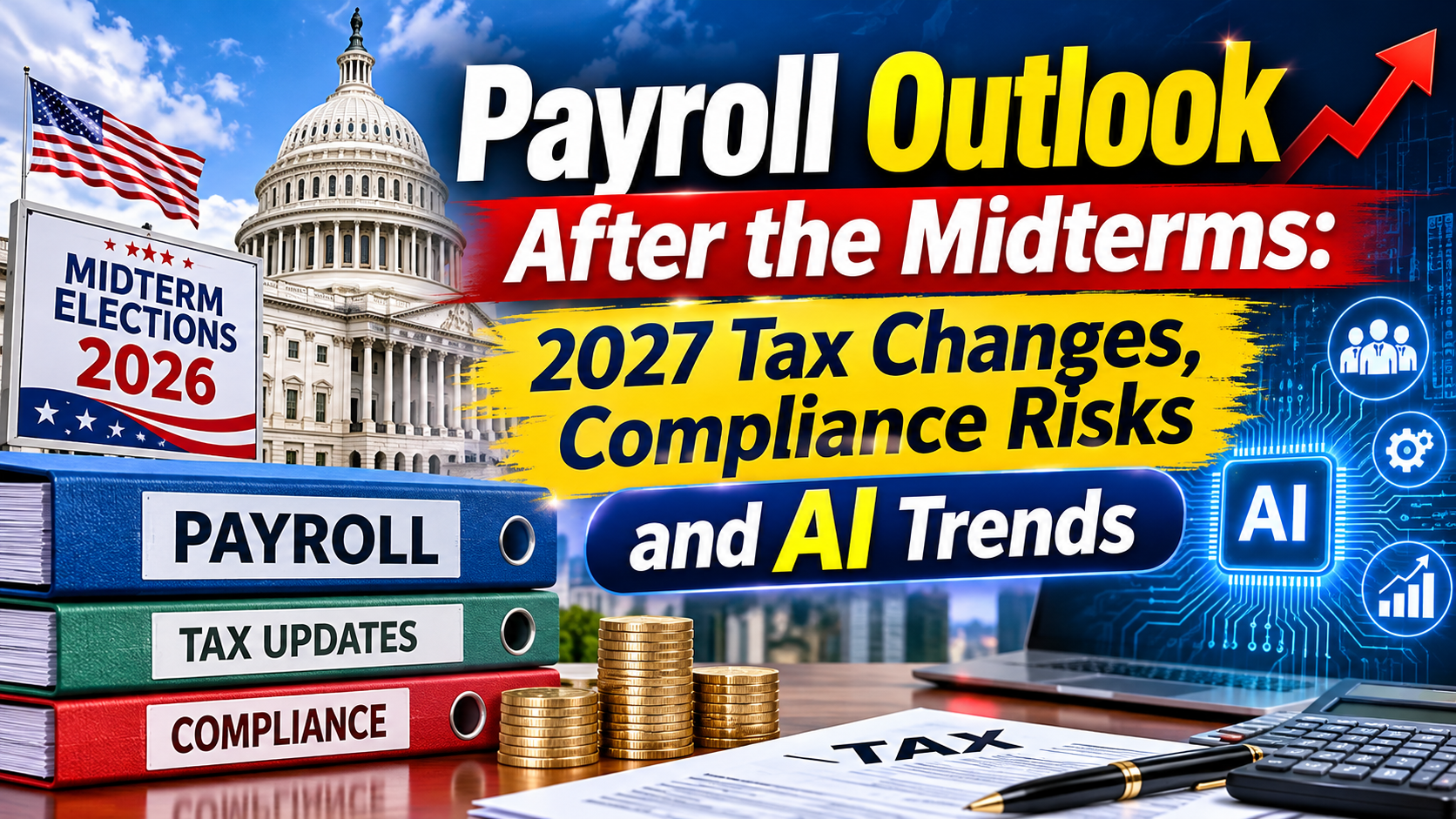
With the 2026 US midterm elections concluded, payroll departments are turning their attention to year-end processing and the possibility of late legislative changes that could alter 2027 withholding or reporting requirements. The IRS has already released inflation-adjusted figures for tax year 2027, but any lame-duck bill enacted with a 1 January effective date would compress the implementation window. Thomson Reuters Checkpoint
At the same time, industry surveys show continued acceleration in adopting AI and automation for payroll calculations, employee self-service, and compliance monitoring, along with growing interest in faster pay cycles such as weekly payroll.
Table of Contents
- What Are the Immediate Post-Election Priorities for Payroll Teams?
- Which 2027 Tax Adjustments Are Already Confirmed?
- Why Does Legislative Timing Create Implementation Risk?
- How Is Artificial Intelligence Changing Payroll Operations?
- What Is Happening with Faster Pay Cycles and Weekly Payroll?
- What Practical Steps Should Employers Take Now?
- How Should Organizations Prepare for Multi-State and Local Changes?
- Key Takeaways
- Frequently Asked Questions
What Are the Immediate Post-Election Priorities for Payroll Teams?
Monitor any tax legislation that emerges in the lame-duck session, finalise 2026 year-end reporting, load confirmed 2027 withholding tables, and prepare employee communications. Practitioners note that “timing is almost as important as the substance of the law” when changes arrive late in the calendar year. Thomson Reuters
Which 2027 Tax Adjustments Are Already Confirmed?
The IRS announced inflation adjustments for nearly 70 provisions. Illustrative standard-deduction amounts for 2027 include $33,200 for married couples filing jointly, $16,600 for single filers and $24,925 for heads of household. These figures flow directly into withholding calculations and Form W-4 processing and must be implemented for the first payroll of 2027. Thomson Reuters
Why Does Legislative Timing Create Implementation Risk?
Payroll systems, tax engines and year-beginning employee notices must be updated before the first 2027 pay date. A bill passed in December with a 1 January effective date leaves little room for testing and training, raising the probability of under- or over-withholding and subsequent corrections.
How Is Artificial Intelligence Changing Payroll Operations?
Industry research indicates that organisations are deploying AI for anomaly detection, predictive compliance, employee query handling and report generation. The technology is viewed both as a productivity tool and as a means of improving accuracy in multi-jurisdictional environments. Adoption continues to accelerate through 2026.
What Is Happening with Faster Pay Cycles and Weekly Payroll?
Search interest and employer adoption of weekly payroll and on-demand pay options continue to rise. Workers increasingly expect more frequent access to earned wages. Payroll teams must ensure that faster cycles remain compliant with tax-deposit schedules and reporting rules.
What Practical Steps Should Employers Take Now?
- Load the published 2027 IRS inflation adjustments into payroll systems.
- Establish a rapid-response protocol for any lame-duck legislation.
- Review state and local withholding changes effective 1 January.
- Audit AI and automation tools for accuracy and audit-trail capability.
- Communicate any material withholding changes to employees before the first 2027 payroll.
How Should Organizations Prepare for Multi-State and Local Changes?
Maintain updated tables for every jurisdiction in which employees work or reside, confirm reciprocity agreements, and test year-beginning payroll runs well before the first pay date of 2027.
2027 Standard Deduction Examples (IRS)
| Filing Status | 2027 Standard Deduction |
|---|---|
| Married filing jointly | $33,200 |
| Single | $16,600 |
| Head of household | $24,925 |
Key Takeaways
- Post-midterm focus shifts to 2027 implementation and year-end close.
- IRS inflation adjustments for 2027 are already published and must be loaded.
- Lame-duck legislation with short effective dates is the largest near-term risk.
- AI and automation adoption in payroll continues to accelerate.
- Weekly and faster-pay models are gaining traction.
- Proactive system updates and employee communication reduce compliance exposure.
Frequently Asked Questions
Do the midterm results immediately change federal payroll rules?
No. Existing law remains in force until new legislation is enacted and becomes effective.
When must the 2027 IRS adjustments be implemented?
In time for the first payroll of tax year 2027.
What is the biggest compliance danger right now?
Last-minute federal changes that alter withholding or reporting with a 1 January start date.
Is AI already handling core payroll calculations at most companies?
Adoption is growing rapidly but varies; many organisations still use AI mainly for ancillary tasks and exception handling.
Should employers delay updates until Congress adjourns?
No. Implement the known inflation adjustments now and retain flexibility for possible late changes.
Are weekly payroll cycles compliant with federal deposit rules?
Yes, provided deposit schedules and reporting are handled correctly by the payroll system.
Conclusion
Payroll professionals face a familiar but heightened post-election workload: absorb the already-published 2027 inflation adjustments while remaining ready for any surprise lame-duck provisions. For finance, HR and compliance audiences, the combination of legislative uncertainty and accelerating AI adoption makes disciplined change-management and testing essential. Organisations that prepare both their systems and their employee communications in advance will navigate the transition to 2027 with the least disruption.
Discover more from The Economy
Subscribe to get the latest posts sent to your email.

Open Banking Trends 2026: What Consumers Should Know

Nvidia After the Selloff: What to Watch Before Earnings

Black Friday 2026 Early Deals: A Data-Driven Shopping Guide

Fed Policy Path 2027: Rate Expectations After the Hold

Asia’s Economic Resilience in 2026: The Strategic Blueprint for Sustaining the Global Growth Engine

Credit Scoring Changes 2026: What Mortgage Buyers Need to Know

10-Year Treasury Yield Outlook for 2027 After the Democratic Sweep

Is the AI Infrastructure Boom Sustainable? A Reality Check

Disability Insurance Demand in 2026: Who’s Buying and Why

What the 2026 Midterms Mean for Treasury Yields and Bond Markets

Payroll Outlook After the Midterms: 2027 Tax Changes, Compliance Risks and AI Trends

Lisa Su: AMD Is Now a “Data Center First Company” – 2027 Outlook

Reasons for Falling US Gas Prices in November 2026: A Seasonal Shift

SoftBank’s $3.7 Billion Turbine Loss: What the AI Power Bet Reveals

Dow Jones Today: Dow Slips 237 Points After the Worst Day Since April 2025

US–Iran Conflict in October 2026: Hormuz, Oil Prices and Diplomacy

Pakistan IMF Programme 2026: Why Bailouts Keep Returning

SSI November 2026 Payment: Why Benefits Arrive October 30

Singapore Stock Market Outlook 2027: The STI’s Bank-and-Yield Test

2027 Federal Tax Brackets: New IRS Rates and Standard Deductions Explained

IMF Global Outlook 2027: The Recovery Is Real, but the Divide Is Growing

World Bank Debt Report 2026: The $9.4 Trillion Burden Behind the Recovery

Stock Market Crash 2026? What the November Rout Actually Tells Us

KSE-100 Index 2026: Is Pakistan’s Stock-Market Recovery Sustainable?

Germany–France ‘Made in Europe’ Deal Could Reshape China’s EV Ambitions

Global Markets Today: The AI Sell-Off Has Become a Test of Liquidity

Zhuhai Airshow 2026: How China’s Stealth Jets, Drones and Missiles Are Redrawing Global Air Power

Singapore’s Bank Sell-Off Is Really a Test of What Stability Is Worth
-

 Markets & Finance10 months ago
Top 15 Stocks for Investment in 2026 in PSX: Your Complete Guide to Pakistan’s Best Investment Opportunities
-

 Analysis9 months ago
Johor’s Investment Boom: The Hidden Costs Behind Malaysia’s Most Ambitious Economic Surge
-

 Analysis9 months ago
Top 10 Stocks for Investment in PSX for Quick Returns in 2026
-

 Banks10 months ago
Best Investments in Pakistan 2026: Top 10 Low-Price Shares and Long-Term Picks for the PSX
-

 Analysis9 months ago
Brazil’s Rare Earth Race: US, EU, and China Compete for Critical Minerals as Tensions Rise
-

 Investment10 months ago
Top 10 Mutual Fund Managers in Pakistan for Investment in 2026: A Comprehensive Guide for Optimal Returns
-

 Global Economy11 months ago
15 Most Lucrative Sectors for Investment in Pakistan: A 2025 Data-Driven Analysis
-

 Global Economy11 months ago
Pakistan’s Export Goldmine: 10 Game-Changing Markets Where Pakistani Businesses Are Winning Big in 2025