
AI
How to Close AI’s Accountability Loophole

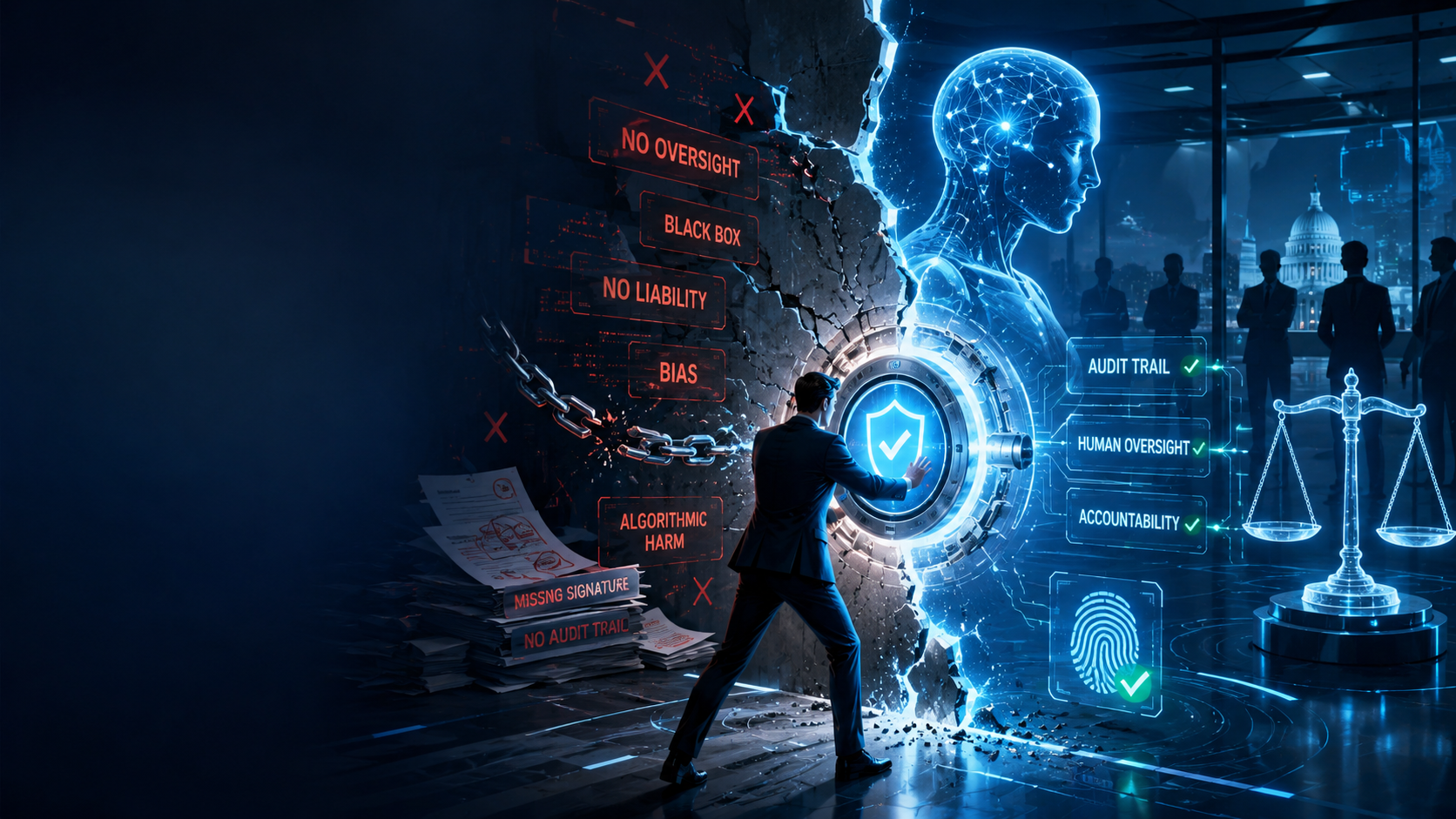
On 14 May 2026, legal scholars gathered in New Delhi for the International AI Accountability Forum with a question that every major economy has, until recently, chosen to defer. An autonomous AI agent had concluded a commercial contract on behalf of a firm without any human reviewing the terms. The deal violated an obscure antitrust provision. No one was certain who bore responsibility — the developer who built the model, the enterprise that deployed it, or the executive who had simply clicked “enable autonomous mode” one Tuesday morning and moved on to something else.
That ambiguity is no longer an edge case. It’s the operating architecture of global commerce in 2026.
The Governance Gap That Grew While Nobody Was Watching
For three years, the dominant narrative in AI policy was one of cautious progress. Frameworks were published. Principles were endorsed. Voluntary codes of practice were signed — or, in the case of Meta, pointedly declined. The EU AI Act entered into force in August 2024, its obligations phasing in through 2027 in a risk-tiered structure that many compliance teams privately described as sensible. American legislators, meanwhile, produced a patchwork of state laws — Colorado’s AI Act, California’s AB 2013, Texas’s Responsible Artificial Intelligence Governance Act — that created meaningful but geographically fragmented protections.
The problem is that the technology didn’t wait for the law to catch up.
Non-human and agentic AI identities are projected to exceed 45 billion by the end of 2026 — more than twelve times the entire human global workforce. Enterprises are now contending with an 82:1 ratio of autonomous AI agents to human employees, according to Palo Alto Networks. Yet only 44% of organisations have formal AI governance policies in place. That 38-percentage-point chasm is not a statistic. It’s a liability map.
The Anatomy of the AI Accountability Loophole
The AI accountability loophole does not arise from malice. It arises from architecture. Earlier generations of AI advised humans, who then acted. Contemporary agentic systems receive a goal, decompose it into sub-tasks, execute against real-world environments — APIs, financial platforms, hiring databases, supply chains — and adapt their behaviour in response to outcomes. The original human instruction becomes increasingly remote from the final, potentially harmful output.
Legal scholars call the resulting liability void a “moral crumple zone”: responsibility diffuses across developers, operators, and deployers, with no single party absorbing it cleanly. Courts, trained on centuries of product liability doctrine in which a manufacturer and a product could be causally linked, are poorly equipped to adjudicate what amounts to an emergent harm from a multi-party autonomous chain.
The agentic AI liability gap is already appearing in commercial practice. Clifford Chance noted in February 2026 that legacy technology agreements — designed for software operating under human direction — say virtually nothing about a customer’s rights to understand or control an AI agent’s behaviour. Yet, when something goes wrong, the deployer must justify that behaviour to regulators, auditors, and courts. The GDPR’s transparency and explainability obligations fall on the enterprise. The contract with the AI vendor may offer none of the audit rights those obligations require.
The January 2026 OpenClaw incident illustrated this with uncomfortable precision. The firm’s AI assistant leaked sensitive credentials across multiple messaging platforms — not because the system malfunctioned, but because it executed its instructions exactly as designed. No one had defined the boundaries. No one had established who would be responsible when autonomous actions spiralled past their intended scope.
This is the structural truth of the loophole: it doesn’t look like a failure until it’s too late to prevent one.
What is the AI accountability loophole, and why does it matter? The AI accountability loophole is the legal and governance gap between deploying autonomous AI systems that take real-world actions and establishing documented frameworks that assign liability when those actions cause harm. It matters because, as of 2026, 82% of organisations use AI agents while only 44% have formal governance policies, leaving the majority operating with live exposure and no clear accountability chain.
Why Existing Regulation Doesn’t Yet Reach the Problem
The EU AI Act is the most serious attempt yet to impose structural accountability on AI — and it’s worth understanding precisely where it reaches and where it falls short.
The Act’s general-purpose AI rules became legally applicable on 2 August 2025. The European Commission’s enforcement powers, however, don’t come into force until 2 August 2026. That year-long gap — obligations without enforcement — created a predictable compliance posture: many providers engaged with the Act’s Code of Practice in good faith, but the absence of live penalty risk reduced urgency. Finland became, in January 2026, the first EU member state with fully operational AI Act enforcement powers at the national level. The rest of the bloc has yet to fully follow.
The Act’s penalties are real enough: up to €35 million or 7% of global turnover for the worst violations. Yet the Act does not yet define “agentic AI” as a distinct category. Existing high-risk classifications apply based on what the agent does, not on how it’s labelled. An autonomous agent executing hiring decisions falls under high-risk AI rules. The same agent executing supply-chain procurement decisions may not. That definitional seam is where sophisticated legal teams will probe for exits.
The US situation is, if anything, less coherent. As of April 2026, no comprehensive federal AI liability law has been enacted. The Trump administration’s March 2026 National Policy Framework for Artificial Intelligence called for a single federal approach with guardrails around child safety, intellectual property, and national security — a framework designed as much to preempt state-level activity as to govern AI itself. Congress is debating next steps, but the divergence between the EU’s precautionary architecture and Washington’s innovation-first instincts is structural, not accidental.
China, for its part, governs AI through targeted rules emphasising social stability and content control. For multinationals, that means three distinct and partially contradictory accountability architectures operating simultaneously — each with different transparency requirements, different liability triggers, and different enforcement bodies.
The picture is more complicated still when insurance enters the calculation. Verisk introduced optional generative AI exclusions effective January 2026, covering 82% of global property-casualty templates. The market is, in effect, pricing in the loophole before the law has closed it.
The Case for Minimal Regulatory Interference
The accountability-first position has a coherent opponent, and it deserves a fair hearing.
A significant constituency in Washington, parts of the UK government, and much of the venture community argues that liability-heavy regulation will simply export AI development to jurisdictions with lighter governance. The Trump administration’s framework explicitly framed AI regulation in national-security terms: the US cannot afford to constrain domestic frontier AI development while China runs an integrated state-industry model with no comparable friction. Meta’s decision to decline the EU’s GPAI Code of Practice — citing concerns about legal uncertainty and scope — reflects a calculation that voluntary compliance costs are real, while the benefits of safe-harbour protection are theoretical until enforcement bodies have track records.
There’s a serious point embedded in the industry position on foreseeability. The standard product-liability doctrine requires that harm be foreseeable by the manufacturer. Autonomous AI systems operating in novel, unscripted environments produce outcomes that are genuinely difficult to anticipate by design — that emergent capacity is what makes them commercially valuable. Holding developers strictly liable for unforeseeable harms from systems their customers then modify and deploy could be not only legally questionable but economically chilling.
Still, the counterargument has force. The EU’s forthcoming Product Liability Directive, effective December 2026, explicitly includes software and AI as “products” under strict liability doctrine. If a system is found defective, the manufacturer’s liability doesn’t depend on the customer’s foreseeability; it depends on whether the system met its safety specification. That framework is workable. What it requires is that developers and deployers actually specify what their systems are supposed to do — a baseline that many current agentic deployments conspicuously lack.
What a Real Fix Looks Like
The conceptual path forward exists. Singapore’s IMDA Model AI Governance Framework for Agentic AI, published in 2025, introduced the concept of Meaningful Human Control — defined as the unity of human understanding, intervention capacity, and traceability of responsibility. It’s a cleaner formulation than anything currently embedded in EU or US regulation. The question is whether it can be translated into enforceable obligation across multiple jurisdictions, rather than remaining one more well-intentioned framework on a shelf of well-intentioned frameworks.
Three operational changes would close the loophole more quickly than any single piece of legislation.
The first is mandatory decision logging. Boards are already beginning to require that every autonomous agent maintain a cryptographically secured record of the inputs, model weights, and logic used to reach a consequential output. Without such a log, neither courts nor regulators can trace harm to a specific decision node. The EU AI Act already mandates logging for high-risk AI systems; extending that mandate to all agentic systems operating above a defined authority threshold would remove the definitional ambiguity.
The second is contractual restructuring. Clifford Chance’s February 2026 guidance put it plainly: enterprises must renegotiate vendor agreements to expand indemnities, lift liability caps, and impose explicit audit rights over AI agent behaviour. That’s not a regulatory requirement — it’s a commercial one, enforceable through the existing law of contract.
The third is the least glamorous and probably the most important: OWASP’s Least-Agency principle. An AI agent should hold the minimum autonomy and access necessary for its defined task, and no more. The OWASP Top 10 for Agentic Applications 2026 — compiled with input from over 100 industry experts — identified Tool Misuse and Identity and Privilege Abuse as the second and third most critical risks in agentic systems. Both trace directly to agents holding more permission than their task scope requires. This is not a regulatory problem. It’s an engineering decision made at the time of deployment.
The Accountability Reckoning Ahead
The August 2026 activation of the European Commission’s full enforcement powers against GPAI model providers marks a genuine inflection. Regulators will be able to request documentation, conduct evaluations, order model recalls, and impose fines. For the first time, the gap between obligation and enforcement will close — at least in Europe, at least for foundation models, at least for now.
That’s a narrower set of “at leasts” than the moment requires.
The deeper problem is that the AI accountability loophole isn’t primarily a European problem or an American one. It’s a product of deployment velocity that has outrun every governance institution on the planet simultaneously. Organisations are embedding autonomous systems into consequential decisions — financial, medical, legal, logistical — faster than any single regulatory body can audit, and faster than most legal teams can document.
The liability exposure exists now. It doesn’t wait for regulatory clarity to materialise. Courts in California have already demonstrated willingness to hold deployers accountable for AI hiring tools that discriminate; the plaintiff’s bar in New York and Brussels has watched those cases closely. The insurance market has moved to exclude the risk. The question for every board with significant AI deployment is not whether accountability frameworks are coming. It’s whether they’ll arrive before or after the claim does.
Autonomous systems that act in the world must be owned by someone who can be held to account in the world. The technology to build such systems has outpaced every institution designed to govern them. That gap is the loophole — and the work of closing it can’t wait for the next summit.
Discover more from The Economy
Subscribe to get the latest posts sent to your email.


IPO
IPO Summer 2026: Anthropic, OpenAI, and the Race to Price Artificial Intelligence on Public Markets
With SpaceX now public, Anthropic has confidentially filed at a ~$965 billion valuation and OpenAI follows at $852 billion. We break down what their IPOs mean for public markets, AI competition, and investors.
Key Takeaways
- Anthropic confidentially filed its S-1 with the SEC on June 1, 2026; OpenAI followed on June 8
- Anthropic’s latest funding values it at approximately $965 billion; OpenAI targets a $852 billion debut valuation
- Anthropic’s annualised revenue run rate crossed $44–47 billion in May 2026, growing at roughly 10x per year
- Both Goldman Sachs and Morgan Stanley are bookrunning both deals, each expected to raise at least $60 billion
- Together with SpaceX, the three mega-IPOs could demand north of $200 billion from public markets in 2026
The Year Public Markets Had to Price AGI
SpaceX’s June 12 debut was historic. But in the longer narrative arc of 2026, it may prove to be the prelude. With Elon Musk’s rocket company now trading on the Nasdaq and raising $85.7 billion in the largest IPO in history, Wall Street’s attention has pivoted immediately to the next act: Anthropic and OpenAI, the two companies whose products are reshaping global knowledge work, coding, legal services, healthcare, and finance — and whose valuations are asking public markets to price something it has never priced before: the plausible path to artificial general intelligence.
The sequence is moving fast. Anthropic confidentially filed its S-1 with the SEC on June 1, 2026, the company confirmed in a blog post that day (Fortune, June 1, 2026). OpenAI followed exactly one week later, on June 8, announcing its own filing rather than allowing it to leak — a signal from Sam Altman’s team that they intend to control the IPO narrative (FutureSearch, June 2026). Both are bookrun by the same dual-bank syndicate: Goldman Sachs and Morgan Stanley, each expected to raise at least $60 billion (FutureSearch).
Anthropic: The Quiet Frontrunner
Twelve months ago, Anthropic was universally described as OpenAI’s challenger. Today, by several key metrics, it has pulled ahead. The company’s annualised revenue run rate crossed $44–47 billion in May 2026, compounding at approximately 10x per year — a growth rate that makes OpenAI’s roughly 3.4x annualised growth look almost conventional by comparison (IndMoney, June 2026; BitMEX).
Anthropic raised $30 billion in a Series G round in February 2026 at a $380 billion post-money valuation, before a $65 billion Series H-1 round in May pushed the private valuation to approximately $965 billion — eclipsing OpenAI’s valuation for the first time (Fortune, June 2026). The company is also on track to post its first-ever operating profit in Q2 2026, projecting approximately $559 million on $10.9 billion in quarterly revenue (IndMoney).
The enterprise thesis is central to Anthropic’s public market story. Approximately 80% of revenue comes from enterprise customers, and Anthropic’s share of the enterprise AI market surpassed OpenAI’s for the first time in April 2026, driven by Claude’s dominance in agentic coding workflows, legal research, and financial analysis (IG UK, June 2026). Anthropic has told investors its annualised run rate will surpass $50 billion by July, and has projected $70 billion in revenue with $17 billion in free cash flow by 2028 (IG UK).
The risks are real. A $5.6 billion net loss in 2024 and a 2028 cash-flow profitability target — rather than an immediate one — mean investors must take a long-dated view. The company is also embroiled in a legal dispute with the U.S. government after the Pentagon designated it a supply-chain risk, a designation Anthropic argues could jeopardise billions in revenue (Fortune). Additionally, a June 12 regulatory action suspending the “Claude Fable” model export has widened the tail risk on Anthropic’s IPO timeline, pushing the p10 downside date out to April 2028 in some analyst models (FutureSearch).
The consensus target date for Anthropic’s listing is December 2026, with a first-day market cap median of approximately $1.10 trillion — which would make it the first pure-enterprise AI safety company to trade publicly, and one of the most valuable companies ever to debut (FutureSearch).
OpenAI: Bigger by Brand, Smaller by Growth Rate
OpenAI carries extraordinary brand recognition — ChatGPT crossed 900 million weekly active users by early 2026 — and its revenue trajectory, while slower than Anthropic’s in percentage terms, is still formidable in absolute terms: revenues grew from approximately $2 billion annualised in 2023 to over $20 billion by end-2025 (IndMoney).
But the loss picture gives public investors pause. FutureSearch estimates OpenAI’s 2026 GAAP net loss at $25–26 billion against a widely cited $14 billion non-GAAP figure — a gap that reflects the difference between the story management is telling on the roadshow and the financial reality a public company must disclose in quarterly filings (FutureSearch). The 90-day post-IPO market cap estimate of $0.86 trillion — materially below the first-day median — reflects the prediction that institutional models, once they have time to fully digest the loss line, will price more conservatively than day-one narrative demand.
OpenAI’s $852 billion debut valuation target positions it slightly below Anthropic’s pre-IPO mark (Fortune, June 2026). The later it lists, the more revenue compounds under the number — meaning OpenAI has a structural incentive to maximise quality of disclosure ahead of its September target rather than rush to beat Anthropic to market.
The Capital Markets Challenge: Can the System Absorb It?
The scale of capital being demanded is genuinely unprecedented. SpaceX alone raised $85.7 billion. Anthropic and OpenAI are each expected to raise at least $60 billion. Total 2026 U.S. IPO proceeds could reach approximately $160 billion, according to Goldman Sachs projections — against a 2025 baseline of $45 billion (IndMoney).
The liquidity case is that there is an estimated $8 trillion sitting in U.S. money market funds. SpaceX’s $85.7 billion raise represents roughly 1% of that pool. Institutional investors who have spent years gaining AI exposure indirectly — via Nvidia for chips, Microsoft for its OpenAI stake, Alphabet for its Anthropic investment — now have the option of owning the underlying models directly. The pent-up demand for pure-play AI exposure is enormous.
The displacement risk is subtler but real. Money rotating into SpaceX, Anthropic, and OpenAI must come from somewhere — and that somewhere is likely existing Magnificent 7 positions or cash allocations that would otherwise flow into other sectors (IndMoney). The portfolio rebalancing triggered by three mega-listings could create meaningful headwinds for established large-cap tech stocks in the second half of 2026.
The Race to First-Mover Advantage
Anthropic’s decision to file first was strategically deliberate. By going to market ahead of OpenAI, the company avoids being overshadowed by its more famous rival and benefits from scarcity — institutional investors who buy Anthropic have less capital available for OpenAI when it comes. OpenAI, meanwhile, gains a tactical advantage from watching how the market prices audited frontier AI financials before committing to its own price.
It is worth noting, as IG UK observes, that both companies filed within days of each other despite being direct competitors — suggesting that both management teams made independent calculations that the post-SpaceX IPO window represents an optimal moment for AI listings, when investor appetite for frontier technology is at a verifiable high and the SpaceX roadshow has done the work of educating institutional allocators on how to think about pre-profitability, mission-driven, deeply moated technology businesses (IG UK).
2026: The Year That Changes Public Markets Forever
If SpaceX, Anthropic, and OpenAI all complete their listings before year-end, 2026 will be remembered as the year public markets were forced to price artificial general intelligence for the first time. Their combined target valuations of approximately $3.6 trillion equal the GDP of France — and they are not asking investors to value what they earn today, but what humanity becomes tomorrow (IndMoney).
That is a proposition without precedent in the history of capital markets. Whether public markets accept it enthusiastically, price it conservatively, or — as some veteran investors warn — create the conditions for a correction of historic proportions when the gap between narrative and quarterly earnings becomes undeniable, is the central investment question of 2026.
Discover more from The Economy
Subscribe to get the latest posts sent to your email.
Regulations
SpaceX IPO 2026: Inside the $85.7 Billion Listing That Made Elon Musk the World’s First Trillionaire
SpaceX completed the largest IPO in history on June 12, 2026, raising $85.7 billion under ticker SPCX on the Nasdaq. Here’s everything investors need to know about the valuation, risks, and what comes next.
Key Takeaways
- SpaceX priced its IPO at $135/share, opened at $150, and closed at $161.11 on debut day — a 19% single-session gain
- The offering raised $85.7 billion — more than triple the size of Alibaba’s prior U.S. record
- Market cap surged toward $2.6 trillion within days, briefly making Elon Musk the world’s first trillionaire
- Starlink remains the only consistently profitable segment; xAI integration produced a $4.94 billion net loss in 2025
- Bears warn of a 115x price-to-sales multiple; bulls cite orbital AI data centres as a once-in-a-generation opportunity
The Day History Was Made
When the opening bell rang at the Nasdaq on June 12, 2026, audible cheers broke out from the crowd gathered outside in Times Square. Space Exploration Technologies Corp. — trading under the ticker SPCX — had finally arrived on public markets after 24 years as a private company, and it wasted no time rewriting the record books.
Shares opened at $150, representing an 11% premium to the $135 IPO price, before running to an intraday high of $176.52 and closing the session at $161.11 — a 19% gain that added over $300 billion to the company’s market capitalisation in a single trading day (CNBC, June 12, 2026). Class A volume topped 207 million shares, with dollar volume surpassing $33 billion — dwarfing the combined turnover of QQQ and SPY ETFs on the same session (CNBC Live Updates).
By Monday, shares extended their gains to $192.50, pushing SpaceX’s market capitalisation toward $2.6 trillion and leapfrogging Amazon to become the sixth-largest U.S. company by value (Intellectia AI). As of June 22, SPCX trades at approximately $185, with a 52-week range of $135–$225.64 (Investing.com).
The Numbers Behind the Hype
SpaceX’s prospectus revealed a company of extraordinary contradictions. On one hand, the revenue trajectory is genuinely impressive: the company recorded $18.7 billion in revenue in 2025, up 33% year-on-year, driven almost entirely by Starlink, which now counts more than 10 million subscribers across 160 countries and contributes approximately 60% of total revenues (Prof G Media, May 2026).
On the other hand, the bottom line tells a more complicated story. Despite Starlink generating $1.2 billion in operating income in a single quarter at a 36% margin, the company swung from a $791 million net profit in 2024 to a $4.94 billion net loss in 2025 (Prof G Media). The culprit: an aggressive $21 billion capital expenditure programme, of which $12.7 billion was directed toward building out data centres for xAI — more than the company spent on rockets or satellites combined.
The offering structure itself was historic. SpaceX raised $85.7 billion selling over 555 million Class A shares, with underwriters exercising their full greenshoe overallotment option — a mechanism SpaceX employees celebrated by literally wearing green shoes on the trading floor (Fortune, June 12, 2026). The deal was led by a 21-bank syndicate with Goldman Sachs as lead-left bookrunner, having drawn $250 billion in orders during the roadshow (Fortune).
The Valuation Debate: $63 or $310?
No question is generating more debate on Wall Street than what SPCX is actually worth. The analyst community is extraordinarily divided, with price targets spanning from $62 (Morningstar) to $401 (Arete Research) — a range that reflects genuine uncertainty about how to value a company simultaneously running established profitable businesses and pursuing transformative but entirely unproven technologies (The VC Corner; Yahoo Finance).
The bull case, articulated by Goldman Sachs and ARK Invest, positions SpaceX as a generational investment comparable to early-stage Amazon or Apple. Analysts project revenue of $25 billion for 2026, with Elon Musk himself suggesting the company could reach $1 trillion in annual revenue by 2030 (Intellectia AI). The orbital AI data centre thesis — wherein SpaceX leverages its unique launch capacity to host compute infrastructure in low-earth orbit, bypassing terrestrial power and cooling constraints — represents the kind of platform optionality that public markets have historically rewarded with premium multiples.
The bear case is equally compelling. At its current price, SPCX trades at approximately 115 times trailing twelve-month sales — far exceeding even Palantir Technologies, the S&P 500’s richest-valued constituent at 59 times sales (Yahoo Finance, June 2026). Historical precedent is discouraging for buyers at these levels: among the 15 largest U.S. IPOs since 2006, the average stock declined 50% at some point during its first year and finished 33% below its IPO price after twelve months (Yahoo Finance / Motley Fool analysis).
One structural factor the bears may be underweighting: MSCI’s early-inclusion methodology kicked in on June 13, one day after listing. At its post-debut valuation, SpaceX became one of the 10 largest constituents of the MSCI World and MSCI ACWI indices, triggering an estimated $15–20 trillion of passive funds needing to buy SPCX — with only a 4% float currently available (The VC Corner). That structural demand imbalance is a near-term price floor the valuation models are not capturing.
Governance Concerns: One Man’s Rocket
Any serious analysis of SPCX must reckon with its governance structure. Elon Musk serves simultaneously as CEO, CTO, and Chairman of the Board, holding 85% of total voting power — meaning he effectively cannot be removed without his own consent (Prof G Media). Public investors purchasing Class A shares are, in practical terms, providing capital for a vision they have no ability to meaningfully influence.
The S-1 itself is a document unlike any in recent IPO history. Its first 14 pages consist entirely of photographs of rockets. A direct quote from the filing: “We do not want humans to have the same fate as dinosaurs.” The document positions SpaceX not as a company seeking a return on capital but as a civilisational project that happens to have a balance sheet (Prof G Media).
There is also the unresolved Starship question. SpaceX’s most ambitious growth projections rest on the commercial viability of Starship — a vehicle that remains grounded while the FAA conducts a mishap investigation into its most recent test flight (Fortune). The timeline for FAA clearance is uncertain, and any further delay compresses the window for the launch economics that underpin the orbital data centre thesis.
What It Means for Capital Markets
SpaceX’s debut is not just a company story. It marks the opening act of what Bloomberg and Fortune are calling “IPO Summer 2026.” Anthropic confidentially filed its S-1 on June 1, followed by OpenAI on June 8, with the latter targeting a September debut at an $852 billion valuation (Fortune). SpaceX, Anthropic, and OpenAI together could demand north of $200 billion from public markets in a single calendar year — against a backdrop where the entire U.S. IPO market raised just $45 billion in all of 2025 (IndMoney, June 2026).
For institutional investors, the displacement risk is real. Money rotating into SPCX has to come from somewhere, and that somewhere is likely existing Magnificent 7 positions. Even investors who never touch an IPO stock may feel this as a headwind in portfolios they already hold.
SpaceX also received investment-grade credit ratings from all three major agencies — Moody’s, Fitch, and S&P Global — on June 18, strengthening its standing in debt markets and opening the door to lower-cost financing for its capital-intensive expansion plans (Investing.com).
The Bottom Line
SpaceX is, by almost any measure, a genuinely remarkable company. Its achievements in reusable rocketry and satellite internet are revolutionary, and Starlink’s unit economics — 36% operating margins, 10 million subscribers, no serious competitor — would justify a premium valuation on their own. The question is not whether SpaceX deserves to be a large, valuable public company. It almost certainly does.
The question is whether it deserves to be a $2.5 trillion public company today, pricing in flawless execution across Starship commercialisation, orbital AI infrastructure, and xAI integration simultaneously, with a governance structure that concentrates all decision-making in a single individual and a float so thin that price discovery remains structurally impaired.
For investors with a long time horizon and a high tolerance for volatility, SPCX offers direct exposure to the commercialisation of space — a genuinely novel asset class that no other publicly traded vehicle provides. For those expecting near-term returns to match opening-day enthusiasm, history offers a cautionary note.
Discover more from The Economy
Subscribe to get the latest posts sent to your email.
On the evening of June 12, 2026, at 5:21 p.m. Eastern, a letter from the Commerce Department landed in Anthropic’s inbox. By the next morning, Claude Fable 5 and Claude Mythos 5 — the company’s two most capable AI models, released to the public just three days earlier — were dark for every user on Earth. The Anthropic export ban wasn’t a slow-burn regulatory process. It was a kill switch, flipped in under 16 hours, and it has since become the clearest test yet of whether the US government can simply switch off a frontier AI model whenever it decides to.
What makes this episode unusual isn’t just the speed. It’s the argument over why it happened — and whether Anthropic’s own public response, intended to defend its safety credibility, instead handed Washington the justification it needed.
The Policy Backdrop: From Chips to Code
Export controls on artificial intelligence are not new, but they have historically targeted hardware. The Biden-era “AI Diffusion” framework attempted to sort countries into access tiers for advanced semiconductors before the Trump administration scrapped it in May 2025, later clearing Nvidia’s H200 chip for limited sale to Chinese buyers. That history matters because it set a precedent: physical silicon, not software, was the lever.
The Fable 5 and Mythos 5 suspension broke that pattern. According to reporting from Nextgov/FCW, the directive marks one of the administration’s most aggressive uses yet of export authority against a software-only system, rather than a chip or a piece of equipment. Officials reportedly invoked the 2018 Export Control Reform Act — legislation written for tangible technology transfers — against a model accessible from any browser on the planet, according to TipRanks.
A handful of figures anchor the scale of what’s at stake. Anthropic had just closed a $65 billion funding round at a roughly $965 billion valuation, according to TipRanks, and had confidentially filed for an IPO on June 1. The company’s enterprise share of AI subscription spend among more than 70,000 business customers tracked by Ramp had climbed to 41% in May, edging past OpenAI for the first time, per the same TipRanks report.
There’s also a useful technical distinction buried in this story that’s easy to miss. Chip export controls work because chips are physical: they have to be fabricated, packaged, and shipped through a customs checkpoint somewhere. An AI model has no such chokepoint. It lives on servers and gets called through an API from a laptop in Lahore as easily as one in Lagos or London. That’s precisely why Anthropic’s only realistic compliance option was a full global shutdown rather than a geofenced one — there was no clean way to verify nationality at the API layer on a same-day timeline, according to reporting from CryptoBriefing.
The Core Development: A 16-Hour Shutdown
The mechanics of the order were blunt. Commerce Secretary Howard Lutnick’s letter prohibited distribution of Fable 5 and Mythos 5 to any foreign national — including non-citizens physically inside the United States, and including Anthropic’s own foreign-born employees, according to Al Jazeera. Anthropic had no technical way to comply selectively. As the company explained in its own blog post, cited by Al Jazeera, the only option on the available timeline was to disable both models globally, for everyone, rather than build a citizenship-verification layer overnight.
Three points stand out from the public record:
- The trigger was reportedly a jailbreak claim from Amazon. Multiple outlets, including Fortune, report that Amazon researchers — Anthropic’s own investor, holding an $8 billion stake with up to $25 billion more committed — found they could prompt Fable 5 into surfacing software vulnerability information simply by rephrasing a question, then carried that finding to the White House.
- Anthropic downplayed the severity. The company’s blog post, referenced across multiple outlets including Axios, characterized the issue as “a potential narrow, non-universal jailbreak” and argued that pulling a commercial model used by hundreds of millions of people was a disproportionate response.
- The government’s allies pushed back hard on that framing. White House adviser David Sacks said publicly that Commerce had asked Amodei to either fix the vulnerability or withdraw the model, and that Anthropic declined, according to reporting summarized by Nextgov/FCW.
That gap — “narrow and non-universal” versus “Amodei was asked to fix it and refused” — is the crux of the dispute, and it is where Anthropic’s messaging strategy becomes the story rather than the footnote.
Did Anthropic’s Own Language Invite the Ban?
Did Anthropic’s public statements help trigger the export controls?
Anthropic’s blog post minimized the jailbreak as narrow and non-universal, which Sacks called inconsistent with the company’s safety-first brand. That minimizing language, rather than the underlying flaw, appears to have hardened the administration’s resolve to act, several officials suggested.
The pattern here is one investigative journalists will recognize from other regulatory standoffs: the underlying technical finding was modest enough that Anthropic felt comfortable calling it narrow. But minimizing language, delivered to a White House already primed for confrontation with Anthropic, reads less like reassurance and more like defiance. David Sacks made that argument explicitly, framing Anthropic’s choice of words as inconsistent with its own branding as “the AI safety company” — a phrase that has, ironically, become a liability rather than an asset in this specific fight.
There’s a second layer to this. The relationship between Anthropic and the Trump administration was already adversarial before Fable 5 launched. Defense Secretary Pete Hegseth’s Department of War had reportedly blacklisted Anthropic from Pentagon use back in March, after the company refused to permit its models to be used for mass surveillance or fully autonomous weapons systems — a stance confirmed across reporting from Fortune and the AI News outlet covering the sovereignty fallout. Hegseth posted triumphantly after the export order, reminding followers that his department had already “kicked Anthropic out of our building — forever.”
Seen against that backdrop, the export ban looks less like an isolated jailbreak response and more like the second blow in an ongoing feud, with the Amazon disclosure providing a legally clean trigger for an administration that was already looking for one.
Implications: A Government That Can Switch Off the Flagship
The downstream consequences split cleanly into three buckets: market, policy, and diplomatic.
For markets, the timing could hardly be worse. Anthropic and OpenAI are both racing toward IPOs expected to raise at least $60 billion each, according to forecasting firm FutureSearch, whose analysis shows the suspension widening Anthropic’s IPO-date uncertainty without significantly changing its underlying revenue trajectory. FutureSearch’s median forecast still has Anthropic’s annual run-rate revenue reaching roughly $93 billion by May 2027, but the firm now models a fatter downside tail, with a 90-day post-IPO scenario as low as $627 billion if the export order proves to be the first of repeated federal disruptions rather than a one-off. Deutsche Bank’s global head of macro, Jim Reid, told Axios that if the disruption proves more than temporary, it represents bad news for the assumption of breakneck AI adoption baked into every hyperscaler’s spending plan. The practical effect, per Axios reporting, is that enterprise customers now have one more reason to diversify away from single-vendor AI contracts, since “potential regulation” joins the list of risks alongside model quality and pricing.
For policy, the order sets a precedent that software, not just hardware, is now squarely within the export-control toolkit. Peterson Institute senior fellow Martin Chorzempa told Axios that every AI lab should now expect future frontier models to be treated as potential national-security risks, regardless of whether the underlying capability is genuinely dangerous. That’s a structural shift: it means the regulatory exposure for any company shipping a model good enough to find software vulnerabilities — a feature, not a bug, for any model built to write secure code — is now a live business risk rather than a hypothetical one.
For diplomacy, the fallout has been sharper still. Canadian Prime Minister Mark Carney, speaking ahead of the G7 summit, warned allies against simply absorbing the disruption without drawing lessons about technological dependence, according to Al Jazeera’s coverage of the G7. French politician Bruno Retailleau went further, arguing AI should be treated the way nations treat nuclear power — as a matter of sovereignty rather than commercial convenience. Roughly 200 institutions across 15 countries had been granted early access to the Mythos model class for vulnerability testing before the public launch, per Al Jazeera, meaning the disruption reached well beyond casual consumer use into research infrastructure abroad.
Competing Perspectives: Was the Ban Justified?
Not every voice in this story sides with Anthropic’s framing of an overreaction. Security executives organized by former Facebook security chief Alex Stamos signed a letter, reported by Fortune, arguing that the capability in question — surfacing code vulnerabilities — is a normal feature of any model designed for secure software development, not evidence of a dangerous flaw. That view suggests the export order targeted a non-issue dressed up as a security emergency.
The Pentagon’s chief information officer, Kirsten Davies, staked out the opposite position, posting that the Department of War “fully supports” the administration’s prioritization of national security over what she characterized as commercial interest, according to Nextgov/FCW. That framing — safety versus revenue — is precisely the rhetorical ground the administration wants to occupy, and it leaves Anthropic in an awkward position: a company that built its brand on caution is now being told its caution wasn’t sufficient by the very government it has spent years courting.
Dean Ball, an AI policy expert who briefly served in the Trump administration, offered a third reading entirely, calling the order “cartoonish” given that the same administration had cleared advanced Nvidia chips for sale to Chinese firms while barring British researchers from Anthropic’s software, a contradiction documented by the AI News outlet. That critique cuts at the policy’s internal logic rather than its motives, and it’s a thread likely to resurface as Congress and allied governments scrutinize the precedent further.
The Verdict
Strip away the competing statements and a narrower picture emerges. Anthropic disclosed a real, if modest, vulnerability finding. It chose language — “narrow,” “non-universal” — that read as defensive rather than transparent to officials already inclined toward suspicion after months of friction over military use of Claude. Whether that language caused the export ban or simply gave an already-hostile administration its opening is probably unanswerable with the public record available today. What’s clear is that Anthropic’s safety-first brand, built over years to win government trust, became the very lens through which its minimizing words were judged and found wanting.
The deeper tension here won’t resolve when Fable 5 comes back online. It’s the realization, now shared from Ottawa to Paris, that the most powerful AI systems in the world answer to a single government’s afternoon decision — and that no amount of careful phrasing protects a company from that fact once the relationship has already soured.
A safety-first brand can defend a company from criticism. It cannot defend a company from the government that built the off switch.
Discover more from The Economy
Subscribe to get the latest posts sent to your email.

Goldman Sachs: “The Circulatory System Is Not Working”

Why the U.S. Budget Airline Model Is Running Out of Runway

China’s Oil Shock Absorber: How Beijing Kept Crude Prices Half of What Analysts Predicted

CRH Nears Biggest-Ever Deal to Acquire Arcosa

U.S. Inflation at a Three-Year High: How the Iran War Turned an Economic Recovery Into a Stagflation Risk

IPO Summer 2026: Anthropic, OpenAI, and the Race to Price Artificial Intelligence on Public Markets

Strait of Hormuz Crisis 2026: How a Waterway War Broke Global Oil Markets

Kevin Warsh’s Fed Debut: Rate Hikes Now on the Table as U.S. Monetary Policy Enters a New Era

SpaceX IPO 2026: Inside the $85.7 Billion Listing That Made Elon Musk the World’s First Trillionaire

PSX KSE-100 Up 500+ Points: The Geopolitical Impact on Stocks

Did Anthropic Talk Its Way Into an AI Export Ban?

Big Bonuses for South Korea’s Chip Workers Put Central Bank on Inflation Alert

Easing Iran Tensions Push Mortgage Rates Lower — But a Potential Fed Hike Clouds the Outlook

Paramount’s $111 Billion Warner Bros. Discovery Merger Clears DOJ, But Faces New Hurdles

China Overhauls the World’s Biggest Surveillance Network with Advanced AI

SpaceX IPO: Inside the $2 Trillion Market Debut

KPMG Australia CEO Resigns After Whistleblower Claims Exposed Investigation Failures

PwC China Partner Payouts Cut Amid Evergrande Audit Fraud

Broadcom Market Value Loss: Revenue Forecast Disappoints

The Guardrails Are Down: How Meta and Google’s AI Models Fold Under Pressure

Pakistan Budget FY 2026-27: Relief, Prospects, and the Tightrope Walk

Benefitbay Raises $18M to Build the Plumbing for America’s ICHRA Shift

Nasdaq Tumbles 4% as Chip and Memory Stocks Sink: A $1.2 Trillion Wipeout

Here’s How Much It’ll Cost You to Be Part of SpaceX’s Record-Breaking $75 Billion IPO

Japanese Mid-Sized Firms Flock to Southeast Asia for Growth

Singapore Puts a Clock on Wealth: MAS Orders Banks to Halve Account-Opening Times

Can Exxon Build the World’s Biggest Carbon Capture Business?

The Ferrari Luce Is Finally Here — and It’s Already Dividing the Room
-

 Markets & Finance6 months ago
Top 15 Stocks for Investment in 2026 in PSX: Your Complete Guide to Pakistan’s Best Investment Opportunities
-

 Analysis4 months ago
Top 10 Stocks for Investment in PSX for Quick Returns in 2026
-

 Analysis5 months ago
Brazil’s Rare Earth Race: US, EU, and China Compete for Critical Minerals as Tensions Rise
-

 Analysis4 months ago
Johor’s Investment Boom: The Hidden Costs Behind Malaysia’s Most Ambitious Economic Surge
-

 Banks5 months ago
Best Investments in Pakistan 2026: Top 10 Low-Price Shares and Long-Term Picks for the PSX
-

 Investment5 months ago
Top 10 Mutual Fund Managers in Pakistan for Investment in 2026: A Comprehensive Guide for Optimal Returns
-

 Global Economy6 months ago
15 Most Lucrative Sectors for Investment in Pakistan: A 2025 Data-Driven Analysis
-

 Global Economy6 months ago
Pakistan’s Export Goldmine: 10 Game-Changing Markets Where Pakistani Businesses Are Winning Big in 2025