Analysis
Why War Can’t Sink Global Growth – or the STI – for Long | Iran War Economic Impact 2026
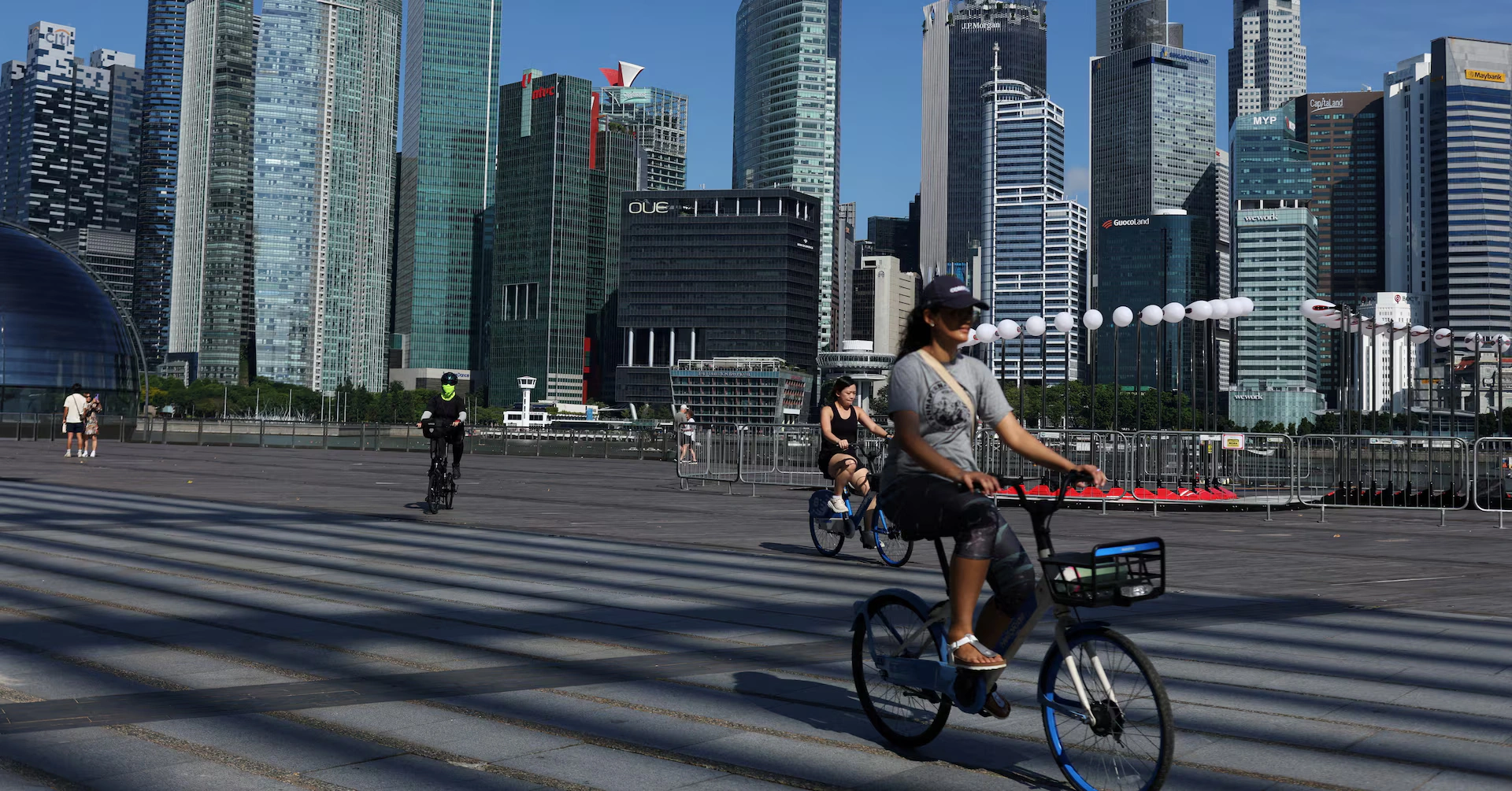
Despite the tragedy and turbulence of the Iran conflict, history offers a bracing truth: markets are ruthlessly efficient at discounting temporary shocks. The Straits Times Index, and Asian equities broadly, are built for this moment.
| Indicator | Value | Change |
|---|---|---|
| IMF Global Growth Forecast 2026 | 3.1% | ↓ from 3.3% |
| Brent Crude Peak | $91/bbl | ↑ 18% since tensions |
| STI Level (May 2026) | ~4,850 | Near multi-year highs |
| STI Bull Target (UOB) | 6,500 | 12-month horizon |
Let us begin with the human cost, because market commentary that skips straight to price targets is a form of moral amnesia. The Iran conflict has brought suffering to real people — displacement, economic disruption across the Persian Gulf, elevated anxiety from Oman to Osaka. Any serious analysis must hold that truth in one hand, even while the other reaches for data. The two are not incompatible. Cold-eyed economic realism is not indifference; it is the discipline that separates good policy from panic.
With that said, here is what the historical record tells us with remarkable consistency: wars in the Middle East — even catastrophic ones — do not derail global economic expansions for long. They create violent, temporary dislocations. They reset risk premiums. They punish the complacent. And then, almost invariably, the world adapts, energy markets recalibrate, and equities resume their march upward. The investors who understand this mechanism — and hold their nerve — tend to capture the recovery that the frightened leave on the table.
For Singapore’s Straits Times Index, currently trading near multi-year highs in the 4,700–4,900 range and targeted as high as 6,500 by several institutional desks, the question is not whether this conflict will cause pain. It already has. The question is whether that pain is structural or episodic. History votes decisively for the latter.
The Anatomy of a Market Shock: Three Phases That Always Repeat
Students of geopolitical market history — and I would argue every serious investor should be one — will recognise a recurring three-act structure to how financial markets process armed conflict. It is not a perfect template, but it rhymes with enough consistency to be operationally useful.
Phase 1 — Saber-Rattling Volatility
Diplomatic breakdown, troop movements, and sanctions announcements drive risk-off positioning. Oil spikes on supply-risk premiums. Equities sell off on worst-case headline risks. VIX elevates. This phase is driven by fear of what might happen, not what is happening.
Phase 2 — Worst-Case Pricing
Initial fighting breaks out. Markets price catastrophic scenarios — Strait of Hormuz closure, regional conflagration, supply chain collapse. Sentiment bottoms. This is typically the moment of maximum pessimism, and paradoxically, often the best entry point for investors with long enough horizons to wait out the noise.
Phase 3 — Scope Realisation & Rally
As the conflict’s actual scope becomes clear — limited, contained, manageable — markets rapidly unwind worst-case scenarios. Oil recedes. Equities rally sharply. Underlying growth fundamentals reassert dominance. Recoveries often overshoot the initial drop in the opposite direction.
We are currently navigating the seam between Phase 2 and Phase 3. And that is precisely why the strategic conversation matters most right now.
History’s Unambiguous Verdict on Wars and Markets
The Iraq War of 2003 is the most instructive modern parallel. The Financial Times documented extensively how Brent crude surged through $35 per barrel on invasion fears — a level that felt alarming at the time — only to retreat as coalition forces achieved rapid initial objectives. The S&P 500, which had fallen into correction territory in the weeks before the invasion, bottomed almost precisely on the day ground operations began. Within six months, it had recovered all losses and continued rallying into 2004.
Gulf War I — 1990–91
Iraq’s Kuwait invasion sent Brent to $46/bbl. The S&P 500 fell 20%. Within six months of conflict resolution, U.S. equities had fully recovered and were posting new highs.
9/11 — 2001
NYSE closed for four sessions — the longest halt since 1933. On reopening, the Dow fell 7.1% in a single session. Full recovery came within 31 trading days. Long-run effects were structural and security-related, not cyclical.
Iraq War — 2003
The S&P 500 bottomed on invasion day, March 20. Global equities rose 35%+ over the following twelve months despite the conflict’s protracted nature.
Israel–Gaza Escalation — October 2023
Initial shock sent oil up 9% and regional indices down 4–6%. Within three weeks, most indices had fully retraced. Global growth continued at 3.2% for 2023 per IMF final estimates.
The pattern is not coincidence. It reflects a structural truth about modern globalised economies: they are vastly more diversified, adaptive, and shock-absorbent than any single geopolitical event. As The Economist noted in its landmark analysis of conflict economics, the elasticity of global supply chains — forged through decades of just-in-time logistics and now hardened by post-pandemic diversification — means that the transmission mechanism between Middle East conflict and global recession is far weaker than public discourse assumes.
The Iran Conflict in 2026: Real Disruption, Manageable Scope
The current Iran conflict has, as conflicts do, produced genuine economic dislocation. The IMF’s April 2026 World Economic Outlook revised global growth down to approximately 3.1% from an earlier projection of 3.3% — a meaningful but far from catastrophic reduction. The Fund cited elevated energy prices and heightened uncertainty as the primary transmission channels, with Gulf Cooperation Council economies bearing a disproportionate share of direct impact.
Brent crude touched $91 per barrel at the conflict’s early peak, driven primarily by risk premiums around Strait of Hormuz transit rather than actual supply disruption. The Strait carries approximately 21 million barrels per day — roughly 21% of global petroleum liquids — making it the world’s most critical maritime chokepoint. Partial disruptions, even temporary ones, command an immediate price response. But the market’s pricing of full closure proved, as it almost always does, to be excessive.
“The oil price shock is real. The permanent impairment of global growth is not. These two statements are compatible, and confusing one for the other is the most expensive mistake an investor can make in a crisis.”
Several structural factors limit the long-term damage. First, the International Energy Agency has confirmed that OECD Strategic Petroleum Reserves hold sufficient capacity to offset meaningful supply disruptions for extended periods — the U.S. SPR alone represents roughly 350 million barrels. Second, alternative transit routes via Saudi Arabia’s East-West Pipeline and Oman’s Habshan–Fujairah link, while costlier, remain operational. Third, and critically, the conflict has not — as of this writing — disrupted Iranian crude exports to the degree that many worst-case scenarios projected, partly because key buyers in Asia have maintained pragmatic purchase arrangements through intermediary channels.
For the broader global economy, the energy shock functions like a tax on consumption — painful, regressive, and inflationary at the margin, but not the kind of systemic demand destruction that precipitates recession. World Bank commodity market data suggests that for every $10/bbl sustained increase in crude, global GDP loses approximately 0.15–0.2 percentage points over 12 months. Even at current elevated levels, the arithmetic does not add up to a global contraction.
Why the Straits Times Index Is Built for This Moment
Singapore occupies a peculiar position in the global energy economy — one that makes it both more exposed to energy disruptions and, paradoxically, more resilient to them than almost any other major financial hub. The city-state is the world’s third-largest oil trading centre, home to refining capacity across Jurong Island, and a critical node in Asian LNG distribution. One might expect this to make Singapore equities particularly vulnerable to energy shocks.
In practice, the opposite is often true. Singapore’s banks — DBS, OCBC, and UOB, which collectively dominate STI weighting — earn substantial trade finance revenues from precisely the kinds of commodity flows that intensify during supply disruptions. Higher oil prices, sustained even temporarily, boost the margins on letters of credit, commodity-backed lending, and treasury operations that form the backbone of Singapore banking profitability. Bloomberg Intelligence estimates that for every 10% sustained increase in oil and commodity prices, Singapore bank earnings face a net positive effect of approximately 2–3% through trade finance and treasury channels, more than offsetting any credit quality deterioration in exposed sectors.
STI 2026 — Institutional Price Targets
| Scenario | Target |
|---|---|
| Current Level (May 2026) | ~4,850 |
| Base Case | 5,000 |
| Bull Case | 5,500 |
| UOB Extended Target | 6,500 |
The STI’s composition also offers a natural hedge against the specific risk profile of this conflict. Financial services represent over 40% of index weight; real estate investment trusts a further 12–15%. These sectors are driven primarily by interest rate cycles, domestic economic activity, and regional capital flows — not oil prices. The technology and industrial components, while not immune to global growth headwinds, are tied to the secular AI infrastructure build-out across Southeast Asia, a demand driver that operates on a five-to-ten year horizon, not a quarterly one.
JPMorgan’s Asia equity strategy team and UOB’s research division have both maintained constructive 12-month targets for the STI in the 5,000–6,500 range, citing earnings momentum at Singapore’s major banks — DBS posted record profits in its most recent quarterly result — alongside an attractive valuation discount to regional peers at roughly 11–12x forward earnings. The Straits Times has reported sustained foreign institutional inflows into Singapore equities even as the conflict-driven risk-off move briefly pushed indices lower, suggesting that sophisticated international capital is already separating signal from noise.
Asia’s Structural Resilience: The Longer Arc
Zoom out from the daily price moves, and the picture for Asian equities in 2026 looks structurally compelling in ways that no single geopolitical event can easily undo. The region is mid-cycle in one of the most significant economic transitions of the past generation: the shift from export-led manufacturing dependency toward domestic consumption, services-led growth, and technological capability.
India’s economy, as Reuters reported drawing on IMF data, is tracking approximately 6.5% real GDP growth for 2026 — a pace that makes it the world’s fastest-growing major economy and increasingly a gravitational centre for regional capital flows. ASEAN collectively is forecast by the World Bank East Asia Pacific team to grow at 4.7–5.0%, anchored by Indonesia’s domestic consumption story and Vietnam’s continued manufacturing ascendancy. These are not small-ticket geographies; together they represent a consumer market of over two billion people at various stages of an income transition that wars in distant theatres do not easily interrupt.
The AI infrastructure wave deserves particular attention, because it represents something genuinely new in the global growth calculus. Hyperscaler capital expenditure — from Microsoft, Google, Amazon, and their Asian equivalents in Alibaba, SoftBank, and a resurgent Samsung — is flowing into regional data centres, semiconductor supply chains, and connectivity infrastructure at a pace that structural economists haven’t seen since the original internet buildout of the late 1990s. Singapore is a primary beneficiary of this investment cycle, capturing hyperscaler facility investments that generate construction activity, utility demand, and high-value employment. This is not cyclical demand. It doesn’t care about oil prices in the Persian Gulf.
Energy Diversification: Asia’s Long-Term Hedge
Perhaps the most underappreciated structural shift limiting the long-term damage of Middle East conflicts to Asian growth is the region’s accelerating energy diversification. IEA World Energy Outlook data shows that Asia-Pacific renewable energy capacity additions in 2025 exceeded fossil fuel additions for the first time in history. China added more solar capacity in a single year than the entire installed base of the United Kingdom. India’s renewable auction pipeline runs through 2030 with government-backed certainty.
This is not to suggest that Asian economies have weaned themselves off Persian Gulf oil — they have not, and won’t for years. But the marginal sensitivity of Asian growth to oil supply disruptions is measurably declining with each passing year. The elasticity that made the 1973 OPEC embargo or the 1979 Iranian Revolution so economically devastating — when oil represented a far larger share of industrial cost structures — is simply not present in the same magnitude today. Electric vehicles, efficiency improvements, and fuel substitution mean that a $91 barrel in 2026 carries roughly 60–65% of the economic punch that the same real-price level carried in 1990.
The Bull Case, Stated Plainly
Let me be direct about what the evidence suggests, shorn of false modesty or performative hedging. The Iran conflict has created a temporary and likely partially reversible oil shock. It has shaved perhaps 0.2 percentage points from 2026 global growth — meaningful at the margin, not transformative in its consequence. It has caused equity markets, including Singapore’s, to experience exactly the kind of short-term volatility that long-horizon investors should view as opportunity rather than threat.
The STI, sitting near 4,850 with institutional targets ranging from 5,000 to 6,500, is backed by earnings momentum in its largest constituents, attractive relative valuations, sustained foreign inflows, and Singapore’s structural position as the premier financial and trade hub of Southeast Asia — a region that is, by any credible measure, the most dynamic growth theatre in the global economy over the next decade.
The three-phase market reaction framework has, historically, resolved in Phase 3 rallies that often exceed the initial Phase 1–2 drawdowns. The Gulf War I resolution produced a 25% S&P rally within six months. The Iraq War produced 35% global equity gains over twelve months. The Israel-Gaza shock of October 2023 reversed within three weeks. Each instance differed in its specifics; all of them rhymed in their resolution. There is no obvious reason why 2026 should be the exception to a pattern that reflects deep structural truths about how modern market economies process and absorb geopolitical shocks.
The Caveats That Honest Analysis Demands
None of this is to suggest complacency. Several scenarios could meaningfully extend the disruption beyond what history’s template predicts. A full Strait of Hormuz closure sustained beyond six weeks would test SPR capacity and force genuine demand destruction. Iranian missile strikes on Saudi Arabian production infrastructure — as occurred briefly in the Abqaiq attack of 2019 — would be a different order of shock altogether. A broadening of the conflict to involve Hezbollah on a full-war footing, with implications for Israeli and Lebanese economic activity, would expand the affected geography significantly.
Investors in Singapore and Asia more broadly should maintain scenario discipline: size positions to weather a Phase 2 extension, hedge energy exposures where cost-effective, and resist the temptation to over-extrapolate short-term commodity moves into long-duration equity valuations. The VIX is not a perpetual state. Neither is a $91 oil price, which implies market expectations of sustained supply tightness that historical precedent suggests are almost always too pessimistic.
Central bank policy adds another layer of complexity. The U.S. Federal Reserve, already navigating a delicate path between residual inflation and softening labour markets, faces renewed upward pressure from energy costs. Fed communications in recent weeks have carefully preserved optionality on rate cuts, which means the anticipated monetary tailwind for risk assets may arrive later than pre-conflict pricing implied. This is a headwind, not a structural impediment.
Conclusion: Resilience Is Not Optimism, It Is History
There is a tendency, in moments of geopolitical stress, to mistake the intensity of news flow for the magnitude of economic consequence. These are not the same thing. The Iran conflict is, by any human measure, a serious and tragic event. By the measure of global economic history, it is an episodic shock to a system that has repeatedly demonstrated its capacity to absorb, adapt, and resume growth.
The Straits Times Index, rooted in the earnings power of world-class financial institutions and the structural growth of Southeast Asia’s most important commercial hub, does not need geopolitical calm to compound value over time. It needs the structural tailwinds — regional growth, AI investment, trade finance expansion, tourism recovery — to continue. They are continuing.
History does not repeat. But it rhymes with sufficient regularity that investors who study it carefully tend to act at precisely the moments when others are paralysed by fear. Phase 3 is coming. It always does. The only question worth asking, right now, is whether you intend to be positioned for it.
Discover more from The Economy
Subscribe to get the latest posts sent to your email.
AI
Blackstone, Goldman Sachs Back $1.5bn Anthropic JV to Supercharge Private Equity with Claude AI
A landmark joint venture announced today signals that Wall Street is no longer merely watching the AI revolution—it is financing and building the infrastructure to own it.
Sometime in the next eighteen months, the CFO of a mid-size logistics company owned by a buyout firm will open her laptop to find that her quarterly close process—historically a grueling, weeks-long exercise in spreadsheet archaeology—has been compressed into three days by a team of applied AI engineers running Anthropic’s Claude. She won’t have found these engineers through a consultancy pitch or a software procurement process. They will have arrived via a $1.5 billion joint venture that is, as of today, one of the most consequential infrastructure plays in the history of enterprise technology.
On Monday, May 4, 2026, Anthropic formally announced its partnership with Blackstone, Hellman & Friedman, and Goldman Sachs to launch a new AI-native enterprise services company—a venture structured to embed Claude models and applied AI engineers directly into the core operations of private equity portfolio companies and mid-size enterprises worldwide. The deal, which has been confirmed by Reuters, the Wall Street Journal, and Fortune, represents more than a funding event. It is a declaration of strategic intent: that the most safety-focused AI laboratory in the world is now, unmistakably, in the enterprise services business.
The Deal: Structure, Investors, and Capital Commitments
The Anthropic Blackstone joint venture—which has yet to receive its official brand name—is anchored by three co-equal founding partners, each committing approximately $300 million: Anthropic itself, Blackstone (the world’s largest alternative asset manager with over $1 trillion in assets under management), and Hellman & Friedman, the San Francisco-based buyout firm known for deep specialization in software and technology services businesses.
Goldman Sachs, acting in its capacity as a strategic financial investor, is committing roughly $150 million as a founding participant. Rounding out the investor table are General Atlantic, Leonard Green & Partners, Apollo Global Management, Singapore’s sovereign wealth fund GIC, and Sequoia Capital—a coalition that, taken together, spans every major category of institutional capital: growth equity, buyout, sovereign, and venture.
The total committed capital across all participants is expected to reach approximately $1.5 billion.
The structural logic of the venture is straightforward, even if its implications are not. Rather than approaching individual portfolio companies one by one—a slow, expensive, and operationally complex process—the JV creates a centralized, AI-native services layer that Blackstone, Hellman & Friedman, and the other private equity firms can deploy across their portfolios at scale. Think less “enterprise software license,” and more “AI transformation partner with skin in the game.”
The new entity will act as a consulting arm for Anthropic, helping businesses—including the private equity firms’ portfolio companies—integrate AI into their operations.
Why Now? Anthropic’s Explosive Growth Sets the Stage
To understand why this JV is happening now—rather than two years earlier or two years later—you have to understand the velocity of Anthropic’s commercial trajectory.
Anthropic hit approximately $30 billion in annualized revenue in March 2026, up roughly 1,400% year-over-year and up from $9 billion at the end of 2025. Enterprise and startup API calls continue to drive the majority of revenue through pay-per-token pricing.
This is not a normal growth curve. No enterprise technology company in recorded history has compounded at this rate at this scale—not Slack, not Zoom, not Snowflake. The engine behind it is the Claude model family—now spanning Claude Opus 4.6 for high-complexity reasoning and Claude Sonnet 4.6 for faster, cheaper code and agentic workflows—and, critically, Claude Code, Anthropic’s agentic coding platform that has driven viral developer adoption.
Over 500 customers now spend over $1 million annually on Claude, up from a dozen two years ago. Eight of the Fortune 10 are now Claude customers.
The company’s financial backing is commensurately staggering. Anthropic closed a $30 billion Series G funding round on February 12, 2026, at a $380 billion post-money valuation, led by GIC and Coatue and co-led by D.E. Shaw Ventures, Dragoneer, Founders Fund, ICONIQ, and MGX. Amazon’s $8 billion investment is now worth more than $70 billion on its books. And investor demand has pushed discussions around a potential $50 billion funding round at a valuation approaching $900 billion—a figure that would make Anthropic one of the most valuable private companies in history.
Today’s JV is not Anthropic’s response to a capital need. It is Anthropic’s response to a distribution opportunity.
The Palantir Playbook, Upgraded for the AI Era
Industry observers have been quick to reach for the Palantir comparison, and it is largely apt. The operational model is a direct copy of Palantir’s playbook: rather than just shipping software, the venture will embed teams of AI engineers directly inside client organizations. But where Palantir targeted defense and intelligence agencies with bespoke, high-touch implementations, Anthropic’s JV is targeting a far broader and faster-growing market: the tens of thousands of companies that sit within the portfolios of global private equity firms.
For the AI companies themselves, this is about pushing deeper into the enterprise—where the checks are bigger and the revenue is usually recurring. It is a whole lot faster for Anthropic to partner with PE firms than to approach each of their portfolio companies independently, and these efforts could be a test ground for non-PE enterprise clients.
The use cases the JV will prioritize reflect where AI is generating measurable ROI today: coding automation, financial due diligence, data analysis and reporting, research acceleration, workflow orchestration, and operational process transformation. These are not speculative applications. They are live deployments being tested across Anthropic’s existing enterprise customers—and the JV is designed to industrialize and scale what has already been proven.
Blackstone’s portfolio alone includes more than 230 companies across sectors including logistics, healthcare, real estate, media, and financial services. Hellman & Friedman’s holdings are concentrated in high-value software and insurance businesses. The addressable market within these two firms’ portfolios represents a formidable launching pad—before a single external enterprise client is onboarded.
Goldman Sachs and the Financial Infrastructure Angle
Goldman Sachs’s participation deserves particular scrutiny. At $150 million, Goldman’s commitment is proportionally smaller than the anchor investors, but its strategic value exceeds its check size considerably.
Goldman brings three things the JV needs: corporate relationships that span virtually every major mid-cap and large-cap company globally, expertise in financial engineering that will be essential as the JV structures its commercial offerings, and credibility with the CFOs, boards, and institutional investors who will ultimately decide whether to bring the venture into their organizations.
In 2026, enterprise AI procurement decisions are increasingly shaped by concerns about consistent outputs, audit-ready governance, and enterprise-grade control. Goldman’s presence on the cap table sends a clear signal to risk-averse buyers: this is not a speculative AI experiment. It is an institutional-grade transformation program.
There is also a subtler dimension. Goldman has been preparing for a potential Anthropic IPO—Anthropic is in early discussions with Goldman Sachs, JPMorgan, and Morgan Stanley about a potential public offering that could value the Claude maker at more than $60 billion on revenue terms. A founding role in the JV positions Goldman advantageously when that process accelerates.
The Competitive Landscape: Anthropic vs. OpenAI’s “DeployCo” Gambit
Today’s announcement does not occur in a vacuum. OpenAI and Anthropic are each in talks with different PE groups to create something akin to enterprise AI consulting arms.
OpenAI’s equivalent initiative—internally referred to as DeployCo—has been structured differently and more aggressively on investor economics. OpenAI is offering private equity firms a guaranteed minimum return of 17.5%, significantly higher than typical preferred instruments, as it seeks to enlist investors including TPG, Bain Capital, Advent International, and Brookfield Asset Management.
DeployCo is structured as a $10 billion Delaware LLC, with OpenAI committing up to $1.5 billion of its own capital upfront, while the PE investors are putting in roughly $4 billion over five years.
The contrast between the two ventures is instructive. OpenAI is offering higher financial returns to attract PE partners. Anthropic is offering something subtler but arguably more durable: a co-ownership model in which the PE firms are not merely customers or financial investors, but genuine strategic co-founders of the enterprise services vehicle. Both companies are competing to partner with buyout firms to roll out AI tools across hundreds of private companies, boosting adoption and creating long-term customer stickiness.
The effort is reminiscent of Avanade—a joint venture formed in 2000 between Microsoft and Accenture to implement Windows and Microsoft enterprise solutions into large corporations. Not apples-to-apples, but similar enough in strategic logic.
Strategic Implications: What This Means for Enterprise AI Adoption
A New Distribution Model for AI Infrastructure
The JV solves a problem that has quietly plagued enterprise AI adoption for three years: the implementation gap. Companies sign AI contracts, attend demos, and run pilots—then struggle to translate prototype performance into production-scale value. McKinsey’s research has consistently found that fewer than 30% of enterprise AI initiatives achieve their intended ROI targets within two years of launch.
The Anthropic JV is structurally designed to close this gap. By embedding applied AI engineers within client organizations—rather than handing off software licenses—the venture assumes responsibility for outcomes, not just outputs. This shift from software vendor to transformation partner is the core commercial innovation.
Claude AI for Portfolio Companies: The Compounding Advantage
Private equity’s portfolio model creates a structural advantage for AI adoption that is easy to underestimate. When a single PE firm owns 30 to 50 operating companies, and an AI services provider can deploy a standardized transformation playbook across that portfolio, the economics of AI implementation improve with every successive deployment.
Configuration knowledge, integration templates, industry-specific prompt libraries, and change management frameworks developed for the first portfolio company become assets that accelerate the tenth, the twentieth, the fiftieth. This compounding dynamic—AI playbooks getting better as they scale—is precisely what makes the Palantir comparison feel apt, and what makes Blackstone’s network effect so valuable to Anthropic.
Implications for Traditional Consulting Firms
The JV puts Anthropic in direct competition with the world’s largest consulting firms for the lucrative business of corporate AI transformation. McKinsey, Bain, BCG, Deloitte, and Accenture have all built significant AI practices over the past three years—but those practices remain fundamentally model-agnostic. They advise clients on AI strategy without owning the underlying technology.
Anthropic’s JV collapses the distance between model and implementation. This is not consulting. It is vertical integration at the application layer—and traditional consultancies will need to decide whether to compete, partner, or cede this segment of the market.
Risks and Challenges: The Road Ahead Is Not Smooth
Implementation Complexity at Scale
The vision of deploying AI engineers across hundreds of portfolio companies simultaneously is operationally demanding. Anthropic, for all its model excellence, does not yet have the implementation infrastructure of an Accenture or an IBM Global Services. Building that capability—recruiting, training, deploying, and retaining applied AI engineers at scale—will be the JV’s most immediate and most difficult challenge.
Job Displacement and Workforce Tensions
The JV’s stated focus on workflow automation and operational transformation is a euphemism for process compression—and process compression, in human terms, often means fewer roles. CFOs who reduce quarterly close cycles from weeks to days with AI assistance do not typically add headcount. Private equity’s ownership model, with its emphasis on operational efficiency and EBITDA expansion, creates additional pressure on workforce outcomes. The JV should expect mounting scrutiny from regulators, labor organizations, and ESG-focused institutional investors.
Concentration of AI Power
The investor lineup—Blackstone, Goldman, Apollo, GIC, Sequoia, General Atlantic, Leonard Green—reads like a who’s who of global institutional capital. Their collective network spans thousands of companies and hundreds of billions of dollars in enterprise value. Critics will argue, with some justification, that concentrating access to Anthropic’s most capable AI models through this particular coalition creates structural advantages for PE-backed businesses over their independently owned competitors.
Anthropic’s Pentagon Problem
A complicating backdrop: the U.S. Department of Defense has designated Anthropic a supply-chain risk, requiring defense contractors to cut ties with the company by June 30, 2026—a designation stemming from Anthropic’s usage-policy restrictions that cost it a $200 million defense contract. While the JV targets commercial enterprise clients rather than government contractors, the Pentagon designation creates regulatory uncertainty that sophisticated enterprise buyers will not ignore.
What Comes Next: The AI Private Equity Land Grab
Today’s announcement is best understood not as a singular deal, but as the opening move in a multi-year AI private equity land grab—a race among the world’s most capable AI laboratories to lock in the distribution channels and implementation relationships that will determine enterprise market share for the better part of a decade.
The structural analogy to the cloud transition of the 2010s is imperfect but instructive. When Amazon Web Services, Microsoft Azure, and Google Cloud competed for enterprise cloud adoption, the winners were not necessarily those with the best underlying technology—they were those who built the deepest integrations, the largest partner ecosystems, and the most dependable migration pathways. AI enterprise adoption will follow a similar logic.
A large portion of Anthropic’s current revenue growth is driven by AI coding capabilities, specifically through Claude Code and the Cowork platform—and many investors believe the company is only scratching the surface of its potential, given the massive opportunity to expand into finance, life sciences, and healthcare.
The JV accelerates that expansion substantially. With Blackstone’s operational network, Goldman’s corporate relationships, and Hellman & Friedman’s software sector expertise serving as distribution infrastructure, Anthropic’s applied AI engineers will have access to a client pipeline that would take a conventional enterprise software company a decade to cultivate independently.
For mid-size companies watching from the sidelines—particularly those not yet owned by any of the JV’s PE participants—the message is sobering: the premium tier of enterprise AI implementation is consolidating, and the window to access it on equal terms is narrowing.
FAQ: Anthropic Blackstone JV — Your Questions Answered
What is the Anthropic Blackstone joint venture? It is a newly announced, $1.5 billion AI-native enterprise services company co-founded by Anthropic, Blackstone, and Hellman & Friedman (each contributing ~$300 million), with Goldman Sachs as a founding investor (~$150 million) alongside General Atlantic, Leonard Green, Apollo Global Management, GIC, and Sequoia Capital. The JV will embed Anthropic’s Claude models and applied AI engineers into private equity portfolio companies and mid-size enterprises.
What will the JV actually do? The venture functions as a hybrid software-plus-consulting firm, deploying Claude-powered AI workflows across enterprise operations including financial reporting, due diligence, coding automation, data analysis, research, and process transformation—drawing on a model similar to Palantir’s forward-deployed engineering approach.
Why is Goldman Sachs involved in an AI venture? Goldman brings corporate relationships, financial credibility, and IPO advisory positioning. As Anthropic prepares for a potential public offering, Goldman’s founding role in the JV deepens the firm’s commercial and financial relationship with one of the world’s most valuable private companies.
How does this compare to OpenAI’s DeployCo initiative? OpenAI’s competing venture offers PE investors a guaranteed 17.5% return and is structured as a majority-owned OpenAI subsidiary. Anthropic’s JV uses a co-ownership model without guaranteed returns, emphasizing strategic alignment over financial engineering. Both target the same market: accelerating AI adoption across private equity portfolio companies.
What are the risks for enterprise clients considering the JV? Implementation complexity, workforce displacement, vendor concentration, and—specific to Anthropic—the company’s ongoing regulatory tensions with the Pentagon. Enterprise buyers should conduct thorough due diligence on data governance terms, implementation guarantees, and workforce transition planning before committing.
Is an Anthropic IPO coming? Multiple reports indicate Anthropic is in early IPO discussions with Goldman Sachs, JPMorgan, and Morgan Stanley. A public offering could come as soon as late 2026 or 2027. Today’s JV, and the revenue visibility it creates, strengthens the IPO narrative considerably.
Discover more from The Economy
Subscribe to get the latest posts sent to your email.
Analysis
The Law Firm Wall Street Influence Can’t Escape: How Sullivan & Cromwell Wrote the Rules of Modern Finance
Corporate law influence rarely announces itself. It arrives in footnotes, closing conditions, and regulatory comment letters written in careful, deliberate prose.
There is a building at 125 Broad Street in Lower Manhattan that most New Yorkers walk past without a second glance. It is handsome, institutional, unsentimental—the kind of architecture that suggests permanence rather than power. Inside, Sullivan & Cromwell LLP has, for nearly a century and a half, quietly drafted the legal frameworks that govern how capital moves, how corporations die and are reborn, and how governments decide which financial risks are tolerable and which are not. To understand the law firm Wall Street influence depends upon most, you must begin here. And you must begin with the uncomfortable truth that the legal architecture of finance was not designed by legislators or central bankers—it was designed, to a remarkable degree, by lawyers billing by the hour.
Sullivan & Cromwell was founded in 1879 by Algernon Sullivan and William Nelson Cromwell, at a moment when American capitalism was shedding its agrarian skin and growing something altogether harder. Cromwell, in particular, arrived as a legal mercenary of unusual audacity. He restructured the Erie Railroad’s debt, saved the Northern Pacific from receivership, and—most consequentially—lobbied the United States Congress to abandon the Nicaragua route for an inter-oceanic canal, steering the project toward Panama. A 1977 Foreign Affairs essay on American empire in Latin America noted that Cromwell’s role in securing Panama’s secession from Colombia in 1903 remained, at the time of writing, one of the least-examined legal interventions in diplomatic history. The fees his firm collected from the French canal company exceeded $800,000—equivalent to roughly $28 million today—making it, at the time, one of the largest legal payouts in American history.
The Cravath System Is Famous. The Sullivan System Is More Powerful.
Legal historians tend to celebrate the “Cravath System”—the pyramid model of associate recruitment, training, and partnership that Paul Cravath formalized in the early twentieth century—as the defining organizational innovation of elite American law. Harvard Law Review has examined this model extensively, tracing how it professionalized corporate legal practice and concentrated talent in a small number of New York firms. But while Cravath systematized the firm, Sullivan & Cromwell systematized something subtler and more durable: the relationship between the law firm and its clients that persists across regulatory epochs, market cycles, and even national borders.
John Foster Dulles, who served as the firm’s senior partner from the 1920s through 1949, exemplifies this dynamic with almost uncomfortable clarity. Dulles represented German industrial conglomerates before and after the First World War, advised on the reparations framework created by the Treaty of Versailles, and then—as Secretary of State under Eisenhower—shaped the Cold War foreign policy environment in which his former clients operated. The revolving door between Sullivan & Cromwell and the American foreign policy establishment is not a metaphor. It is, in many cases, a documented biographical fact.
“The most powerful legal institution in the world is not the Supreme Court. It is the law firm that advises the institution the Supreme Court is asked to review.”
This is not a sentence any senior partner at Sullivan & Cromwell would utter in public. It represents a judgment that serious scholars of institutional power—including Luigi Zingales at the University of Chicago Booth School of Business, whose work on financial sector capture merits wider attention among policy audiences—have approached from different angles and reached, in softer language, similar conclusions.
Structuring the Crisis: From Glass-Steagall to the Derivatives Revolution
The firm’s most consequential modern chapters are written not in the language of empire but in the language of financial engineering. When Glass-Steagall began its slow political death in the 1980s and 1990s—the Gramm-Leach-Bliley Act finally repealed its core provisions in 1999—Sullivan & Cromwell’s attorneys were central to advising the banks and financial conglomerates that stood to gain. The firm represented Travelers Group in its 1998 merger with Citicorp, a transaction that was technically illegal under then-existing law but predicated on the—correct—assumption that the law would change before the Federal Reserve’s regulatory grace period expired. It did.
This is not illegal. It is not even unusual. But it describes something worth naming clearly: elite law firms do not simply interpret the law. They help to determine which laws will exist, when they will be enforced, and how their language will be structured so as to favor—or at least not disfavor—the clients who pay to have them written. The Financial Crisis Inquiry Commission, in its 2011 report, stopped short of indicting any specific law firm for the legal structures that enabled the 2008 collapse. But its index contains the names of firms, transactions, and regulatory opinions that reward careful reading.
The Derivatives Question No One Wanted to Ask
Brooksley Born, as chair of the Commodity Futures Trading Commission in the late 1990s, attempted to regulate over-the-counter derivatives before they metastasized into the instruments that nearly destroyed the global financial system. She was overruled—by the Treasury, the Fed, and the SEC—after a sustained campaign by financial institutions and their legal counsel arguing that regulation would “disrupt” an efficient market. The legal memoranda supporting that position were not written by legislators. They were written by the Wall Street law firms whose clients stood to lose billions in compliance costs and margin requirements. As the Washington Post documented in a 2009 investigation, the legal and lobbying apparatus arrayed against Born’s proposal represented one of the most coordinated exercises of private legal influence over public policy in the post-war period.
Sullivan & Cromwell was not alone in this landscape. Davis Polk, Skadden Arps, Simpson Thacher—the roster of firms that shaped the legal architecture of finance is longer than any single profile can contain. But Sullivan & Cromwell has a particular claim to primacy: it has advised Goldman Sachs on virtually every significant transaction and regulatory matter since the 1970s, a relationship that grants it an almost unparalleled window into the mechanics of how markets are made and, occasionally, gamed.
“Sullivan & Cromwell does not merely advise Goldman Sachs. In any meaningful structural sense, Sullivan & Cromwell helped to invent Goldman Sachs as a public company.”
That is less hyperbole than it sounds. The firm managed Goldman’s 1999 IPO, one of the most closely watched offerings of the dot-com era, structuring a partnership-to-corporation transition that preserved the firm’s culture while accessing public capital markets. The legal documents that governed that transaction—the partnership agreement modifications, the governance frameworks, the lockup structures—were instruments of institutional design as much as legal compliance.
The International Dimension: Exporting the Legal Architecture of American Finance
Sullivan & Cromwell’s reach is not confined to lower Manhattan or Washington regulatory corridors. The firm has served as lead counsel on sovereign debt restructurings, cross-border mergers, and privatization transactions across Latin America, Europe, and Asia. When Argentina restructured its debt in the aftermath of its 2001 default—the largest sovereign default in history at the time—American law firms, applying New York law principles to Argentine obligations, played a decisive role in determining which creditors recovered what, and on what timeline.
This is the often-overlooked international dimension of elite law firm influence: the fact that New York law governs a disproportionate share of global financial contracts means that New York law firms effectively set the terms of financial relationships between parties who may never set foot in the United States. The International Monetary Fund has noted in successive reports on sovereign debt restructuring that the reliance on New York-law documentation in international bond markets creates systemic asymmetries—between creditors and debtors, between sophisticated institutional investors and sovereign governments with limited legal resources—that have profound implications for financial stability.
A London Footnote That Illuminates the Architecture
The 2012 restructuring of Greek sovereign debt offers a revealing case study. The so-called Private Sector Involvement (PSI), which imposed haircuts on private creditors, was structured under English and New York law with heavy involvement from the major Anglo-American law firms. The legal engineering required to activate collective action clauses, manage holdout creditors, and satisfy the requirements of multiple legal systems simultaneously was, in effect, a demonstration of legal architecture at global scale. The creditors who recovered most were those whose bonds had been issued under legal frameworks that their lawyers had helped design.
The FTX Reckoning: When the Architecture Failed
No treatment of elite law firm influence is complete without confronting its limits. The collapse of FTX in November 2022 revealed something that the legal community found uncomfortable: that the most sophisticated legal structures are no protection against outright fraud. Sullivan & Cromwell had represented FTX as outside counsel and then, controversially, was appointed as lead restructuring counsel following the firm’s bankruptcy—a dual role that drew sustained criticism from the bankruptcy trustee and members of the U.S. Senate Judiciary Committee who questioned whether the firm’s prior relationship created irreconcilable conflicts of interest.
The firm denied any impropriety. But the episode illustrated something important: the legal architecture of finance is only as robust as the honesty of the people operating within it. And it raised a question that the profession has not yet satisfactorily answered—when a law firm’s institutional interests become entwined with its clients’ interests over decades of exclusive representation, who watches the watchmen?
Conclusion: Power Without Accountability, and the Reckoning Still Pending
Sullivan & Cromwell will not appear in most histories of Wall Street. Its name does not trend on financial media platforms. Its senior partners do not write memoirs or give TED talks. This opacity is, in a meaningful sense, the firm’s most powerful product: the ability to shape outcomes without ever becoming the visible agent of change.
I find this troubling—not because legal expertise is illegitimate, but because the concentration of that expertise in a handful of firms representing a handful of institutions creates something that does not appear in any regulatory framework: a private legal infrastructure that operates at global scale with minimal public accountability. The Administrative Conference of the United States has examined revolving-door dynamics in regulatory agencies; it has examined notice-and-comment rulemaking. It has not, to my knowledge, examined the systematic influence of relationship-based legal counsel on the shape of financial regulation.
That examination is overdue. As artificial intelligence reshapes the economics of legal services, as regulatory fragmentation accelerates across jurisdictions, and as financial crises continue to expose the gap between the law as written and the law as practiced by the people who draft it, the question of who designs the legal architecture of finance—and in whose interest—is no longer academic. It is the central governance question of the next century of global capitalism. Sullivan & Cromwell, and the small cohort of firms that sit beside it at the apex of the corporate legal hierarchy, have been answering that question, quietly, for 145 years. The rest of us are only just beginning to notice.
Discover more from The Economy
Subscribe to get the latest posts sent to your email.
Analysis
The Resilient Periphery: What the Singapore-New Zealand Supply Pact Means for Global Trade
In the grand theater of global geopolitics, it is easy to fixate exclusively on the tectonic friction between superpowers. We monitor the escalating US-China tech rivalries, parse the rhetoric of calibrated economic coercion, and watch with bated breath as vital maritime arteries choke under geopolitical strain. The ongoing maritime disruptions in the Strait of Hormuz, which have sent cascading shockwaves through global energy routes and downstream petrochemical derivatives, are a stark reminder of our collective fragility.
Yet, while the world’s heavyweights engage in a costly zero-sum game of tariffs and technological containment, a far quieter, vastly more pragmatic revolution is taking place on the periphery. On May 4, 2026, within the air-conditioned calm of a Singapore leadership forum, Singapore Prime Minister Lawrence Wong and New Zealand Prime Minister Christopher Luxon signed a document that, in my view, represents the future of global commerce.
The Agreement on Trade in Essential Supplies (AOTES) is the world’s first legally binding bilateral supply chain resilience pact. In an era defined by weaponized interdependence—where countries routinely hoard vaccines, ban semiconductor exports, and weaponize grain shipments—this agreement is a radical act of mutual trust. It offers a blueprint for how open, trade-dependent economies can pivot from the vulnerabilities of “just-in-time” supply chains to the security of trusted, “just-in-case” networks.
The Anatomy of the AOTES: Institutionalizing Trust
To appreciate the gravity of the AOTES, we must first understand the default reflex of the modern nation-state during a crisis: protectionism. When global supply chains buckle, the immediate political impulse is to shutter borders and halt exports to satisfy domestic anxieties. We saw this during the darkest days of the COVID-19 pandemic, and we are witnessing it again as global food and fuel prices oscillate wildly due to Middle Eastern conflicts.
The AOTES essentially outlaws this panic-induced protectionism between Singapore and New Zealand. As detailed by Singapore’s Ministry of Trade and Industry (MTI), both governments have legally committed not to impose unnecessary export restrictions on a predefined list of critical goods. This is not a vague memorandum of understanding; it is a binding framework integrated into their existing Closer Economic Partnership (ANZSCEP). The list of protected goods is comprehensive, encompassing food, fuel, healthcare products, chemicals, and construction materials.
“We will keep essential goods flowing… We will not shut each other out,” Prime Minister Wong stated with characteristic pragmatism during the signing. “In difficult times, every country will be tempted to look inward. But when that happens, supply chains break down and everyone ends up worse off.”
It takes profound confidence to codify such a promise. If a severe global fuel shortage occurs, Singapore’s domestic populace will undoubtedly demand that local refineries prioritize local pumps. By signing the AOTES, Singapore is tying its own hands to ensure New Zealand is not left stranded. Conversely, New Zealand is guaranteeing that, should a regional crisis sever international food networks, its agricultural bounty will continue to sustain Singaporeans. This is not mere diplomacy; it is the institutionalization of survival.
The Beautiful Symmetry of Food and Fuel
The Singapore-New Zealand relationship is uniquely positioned for this kind of pact because of a striking macroeconomic symmetry. They are two highly developed, profoundly open economies situated at opposite ends of the Indo-Pacific, each possessing exactly what the other lacks.
Consider the energy-agriculture nexus. As Prime Minister Luxon highlighted during the inaugural Annual Leaders’ Meeting, roughly one-third of New Zealand’s fuel is refined in Singapore. The diesel that flows from the refineries of Jurong Island directly underpins the vast farming and freight logistics networks across the New Zealand archipelago. Without Singaporean fuel, New Zealand’s agricultural engine grinds to a halt.
Conversely, Singapore imports over 90 percent of its nutritional needs. The city-state is a financial and technological powerhouse but remains existentially vulnerable to global food shocks. New Zealand, a global heavyweight in agricultural exports, serves as a vital guarantor of Singapore’s food security. Under AOTES, the New Zealand food that Singapore requires to feed its population is harvested and transported using the very diesel Singapore refined and shipped southward.
This reciprocal machinery is the antithesis of the broad, vulnerable, multi-node supply chains that defined globalization in the 2010s. It signals a shift away from efficiency at all costs, moving toward dedicated bilateral corridors that prioritize resilience. If the closure of the Strait of Hormuz limits flows to the broader region, as Prime Minister Wong starkly warned, this Singapore-New Zealand artery is designed to bypass the global arterial blockage.
Small States, Big Ideas: Navigating Geopolitical Fragmentation
The broader significance of the May 4 signing cannot be understood without looking at the Comprehensive Strategic Partnership (CSP) elevated between the two nations in October 2025. The CSP upgraded ties across six pillars, including defense, climate change, and science and technology, essentially aligning the strategic posture of two middle powers operating in an increasingly multipolar and fractured Indo-Pacific.
Both nations are acutely aware of the dangers posed by superpower decoupling. For Washington and Beijing, the restructuring of global trade is viewed through the lens of national security and strategic dominance. For Wellington and Singapore, maintaining open trade lines is quite literally a matter of economic life and death. They do not have the luxury of vast domestic markets or endless natural resources to fall back on if the global trading system collapses into fragmented, protectionist blocs.
Therefore, they have historically punched above their weight in setting global trade rules. It is worth recalling that New Zealand and Singapore, along with Chile and Brunei, were the original architects of the P4 agreement in 2005. That small, seemingly niche pact eventually snowballed into the Trans-Pacific Partnership, and ultimately the CPTPP—one of the world’s most significant trade blocs.
Similarly, they pioneered the Digital Economy Partnership Agreement (DEPA) alongside Chile, setting early global rules for digital trade, cross-border data flows, and AI governance. With the AOTES, they are running the same playbook. They are establishing a high-standard, proof-of-concept framework for supply chain resilience with the explicit hope that it will attract like-minded nations.
As PM Luxon noted in his remarks, they are open to inviting other countries that can “meet the standard” and are prepared to “have each other’s backs.” In a global economy desperate for stability, this plurilateral potential is immensely valuable. It offers a blueprint for middle powers—from Canada to South Korea to Australia—to build an overlapping web of resilient trade corridors that are immune to superpower whims or regional conflicts.
The Next Frontier: AI Deployment and the Green Transition
While the AOTES addresses the immediate, physical requirements of national survival—calories and kilowatts—the deepening Singapore-New Zealand partnership is equally focused on the defining economic transformations of our era: artificial intelligence and the green economy.
In the realm of AI, both nations wisely recognize their structural limitations. Neither Singapore nor New Zealand will win the capital-intensive arms race to build the next trillion-parameter foundational model; that arena is firmly dominated by the US-China tech rivalries and Silicon Valley monoliths. However, the true economic value of the next decade will not solely reside in creating the models, but in the speed and ingenuity of their deployment.
At the Singapore-New Zealand Leadership Forum, PM Wong emphasized synergies for deploying AI in practical, economy-boosting sectors. By establishing joint frameworks for AI governance, healthcare diagnostics, advanced manufacturing, and maritime logistics, these two nations can serve as agile regulatory sandboxes. They can attract capital from global enterprises seeking stable, forward-looking jurisdictions to test and scale AI applications without the regulatory whiplash seen in larger blocs.
Parallel to this digital collaboration is an urgent push toward the green economy. Both nations face distinct challenges in achieving net-zero emissions. Singapore is land-scarce and alternative-energy disadvantaged, relying heavily on imported natural gas. New Zealand, while blessed with renewable hydropower and geothermal energy, grapples with massive agricultural emissions.
Through the elevated CSP, the two are pooling intellectual and financial capital to address these hurdles. There is significant potential for cross-pollination between their sovereign wealth funds and institutional investors—such as Temasek Holdings and the NZ Super Fund—to scale sustainable finance, develop robust carbon markets, and accelerate the commercialization of green hydrogen and sustainable aviation fuels (SAF). It is no coincidence that the CEOs of Singapore Airlines and Air New Zealand are fostering closer ties; decarbonizing long-haul aviation is an existential requirement for both geographically isolated nations.
The Realist’s Caveat: Testing the Ties
Despite the undeniable strategic elegance of the AOTES and the broader partnership, a rigorous analysis must acknowledge the implementation risks. Treaties, no matter how ironclad the legal vernacular, are only as strong as the political will sustaining them during a true crisis.
What happens if a severe geopolitical shock fundamentally severs maritime routes through the South China Sea or the Strait of Malacca, rather than just the Middle East? While the political commitment to supply one another remains, the physical logistics of moving diesel from Jurong Island to Auckland, or dairy from Waikato to Pasir Panjang, could become prohibitively dangerous or expensive. The AOTES establishes a framework for consultations and information sharing during disruptions, but it cannot magically conjure cargo ships out of thin air or guarantee their safe passage through contested waters.
Furthermore, defining what constitutes an “unnecessary” export restriction leaves a sliver of ambiguity that could be exploited under intense domestic political pressure. If domestic fuel reserves in Singapore drop to critical, emergency-service-only levels, political leaders will face an excruciating choice between international legal commitments and domestic stability.
Scaling the AOTES to include other nations also presents a diplomatic hurdle. Bilateral trust between two deeply aligned, non-threatening, complementary economies is relatively easy to foster. Expanding this to a plurilateral agreement involving larger economies with competing domestic industries will require navigating fierce lobbying and protectionist instincts.
A Blueprint for Resilient Globalization
Despite these caveats, the signing of the Agreement on Trade in Essential Supplies on May 4 is a milestone worth celebrating. It is a necessary rebuke to the prevailing narrative of global decoupling.
For the past five years, the global economic discourse has been dominated by fear: fear of dependency, fear of technological espionage, fear of supply shocks. The default policy response from major capitals has been to build higher walls, subsidize domestic industries, and retreat into economic nationalism.
Singapore and New Zealand are offering an alternative. They are proving that the antidote to fragile globalization is not isolationism, but resilient globalization. By codifying mutual reliance, integrating their technological and green ambitions, and refusing to succumb to the sirens of protectionism, they have charted a course through the geopolitical storm.
In an era where large powers are increasingly defining themselves by who they choose to exclude, this partnership between two forward-looking middle powers reminds us of the enduring, stabilizing power of choosing to include. It is a small-state masterclass with profoundly big implications, and the rest of the world would do well to take notes.
Discover more from The Economy
Subscribe to get the latest posts sent to your email.
-
Markets & Finance4 months agoTop 15 Stocks for Investment in 2026 in PSX: Your Complete Guide to Pakistan’s Best Investment Opportunities
-
Analysis3 months agoBrazil’s Rare Earth Race: US, EU, and China Compete for Critical Minerals as Tensions Rise
-
Analysis2 months agoTop 10 Stocks for Investment in PSX for Quick Returns in 2026
-
Banks4 months agoBest Investments in Pakistan 2026: Top 10 Low-Price Shares and Long-Term Picks for the PSX
-
Investment4 months agoTop 10 Mutual Fund Managers in Pakistan for Investment in 2026: A Comprehensive Guide for Optimal Returns
-
Global Economy4 months agoPakistan’s Export Goldmine: 10 Game-Changing Markets Where Pakistani Businesses Are Winning Big in 2025
-
Global Economy4 months ago15 Most Lucrative Sectors for Investment in Pakistan: A 2025 Data-Driven Analysis
-
Asia4 months agoChina’s 50% Domestic Equipment Rule: The Semiconductor Mandate Reshaping Global Tech