
AI
Blackstone, Goldman Sachs Back $1.5bn Anthropic JV to Supercharge Private Equity with Claude AI


A landmark joint venture announced today signals that Wall Street is no longer merely watching the AI revolution—it is financing and building the infrastructure to own it.
Sometime in the next eighteen months, the CFO of a mid-size logistics company owned by a buyout firm will open her laptop to find that her quarterly close process—historically a grueling, weeks-long exercise in spreadsheet archaeology—has been compressed into three days by a team of applied AI engineers running Anthropic’s Claude. She won’t have found these engineers through a consultancy pitch or a software procurement process. They will have arrived via a $1.5 billion joint venture that is, as of today, one of the most consequential infrastructure plays in the history of enterprise technology.
On Monday, May 4, 2026, Anthropic formally announced its partnership with Blackstone, Hellman & Friedman, and Goldman Sachs to launch a new AI-native enterprise services company—a venture structured to embed Claude models and applied AI engineers directly into the core operations of private equity portfolio companies and mid-size enterprises worldwide. The deal, which has been confirmed by Reuters, the Wall Street Journal, and Fortune, represents more than a funding event. It is a declaration of strategic intent: that the most safety-focused AI laboratory in the world is now, unmistakably, in the enterprise services business.
The Deal: Structure, Investors, and Capital Commitments
The Anthropic Blackstone joint venture—which has yet to receive its official brand name—is anchored by three co-equal founding partners, each committing approximately $300 million: Anthropic itself, Blackstone (the world’s largest alternative asset manager with over $1 trillion in assets under management), and Hellman & Friedman, the San Francisco-based buyout firm known for deep specialization in software and technology services businesses.
Goldman Sachs, acting in its capacity as a strategic financial investor, is committing roughly $150 million as a founding participant. Rounding out the investor table are General Atlantic, Leonard Green & Partners, Apollo Global Management, Singapore’s sovereign wealth fund GIC, and Sequoia Capital—a coalition that, taken together, spans every major category of institutional capital: growth equity, buyout, sovereign, and venture.
The total committed capital across all participants is expected to reach approximately $1.5 billion.
The structural logic of the venture is straightforward, even if its implications are not. Rather than approaching individual portfolio companies one by one—a slow, expensive, and operationally complex process—the JV creates a centralized, AI-native services layer that Blackstone, Hellman & Friedman, and the other private equity firms can deploy across their portfolios at scale. Think less “enterprise software license,” and more “AI transformation partner with skin in the game.”
The new entity will act as a consulting arm for Anthropic, helping businesses—including the private equity firms’ portfolio companies—integrate AI into their operations.
Why Now? Anthropic’s Explosive Growth Sets the Stage
To understand why this JV is happening now—rather than two years earlier or two years later—you have to understand the velocity of Anthropic’s commercial trajectory.
Anthropic hit approximately $30 billion in annualized revenue in March 2026, up roughly 1,400% year-over-year and up from $9 billion at the end of 2025. Enterprise and startup API calls continue to drive the majority of revenue through pay-per-token pricing.
This is not a normal growth curve. No enterprise technology company in recorded history has compounded at this rate at this scale—not Slack, not Zoom, not Snowflake. The engine behind it is the Claude model family—now spanning Claude Opus 4.6 for high-complexity reasoning and Claude Sonnet 4.6 for faster, cheaper code and agentic workflows—and, critically, Claude Code, Anthropic’s agentic coding platform that has driven viral developer adoption.
Over 500 customers now spend over $1 million annually on Claude, up from a dozen two years ago. Eight of the Fortune 10 are now Claude customers.
The company’s financial backing is commensurately staggering. Anthropic closed a $30 billion Series G funding round on February 12, 2026, at a $380 billion post-money valuation, led by GIC and Coatue and co-led by D.E. Shaw Ventures, Dragoneer, Founders Fund, ICONIQ, and MGX. Amazon’s $8 billion investment is now worth more than $70 billion on its books. And investor demand has pushed discussions around a potential $50 billion funding round at a valuation approaching $900 billion—a figure that would make Anthropic one of the most valuable private companies in history.
Today’s JV is not Anthropic’s response to a capital need. It is Anthropic’s response to a distribution opportunity.
The Palantir Playbook, Upgraded for the AI Era
Industry observers have been quick to reach for the Palantir comparison, and it is largely apt. The operational model is a direct copy of Palantir’s playbook: rather than just shipping software, the venture will embed teams of AI engineers directly inside client organizations. But where Palantir targeted defense and intelligence agencies with bespoke, high-touch implementations, Anthropic’s JV is targeting a far broader and faster-growing market: the tens of thousands of companies that sit within the portfolios of global private equity firms.
For the AI companies themselves, this is about pushing deeper into the enterprise—where the checks are bigger and the revenue is usually recurring. It is a whole lot faster for Anthropic to partner with PE firms than to approach each of their portfolio companies independently, and these efforts could be a test ground for non-PE enterprise clients.
The use cases the JV will prioritize reflect where AI is generating measurable ROI today: coding automation, financial due diligence, data analysis and reporting, research acceleration, workflow orchestration, and operational process transformation. These are not speculative applications. They are live deployments being tested across Anthropic’s existing enterprise customers—and the JV is designed to industrialize and scale what has already been proven.
Blackstone’s portfolio alone includes more than 230 companies across sectors including logistics, healthcare, real estate, media, and financial services. Hellman & Friedman’s holdings are concentrated in high-value software and insurance businesses. The addressable market within these two firms’ portfolios represents a formidable launching pad—before a single external enterprise client is onboarded.
Goldman Sachs and the Financial Infrastructure Angle
Goldman Sachs’s participation deserves particular scrutiny. At $150 million, Goldman’s commitment is proportionally smaller than the anchor investors, but its strategic value exceeds its check size considerably.
Goldman brings three things the JV needs: corporate relationships that span virtually every major mid-cap and large-cap company globally, expertise in financial engineering that will be essential as the JV structures its commercial offerings, and credibility with the CFOs, boards, and institutional investors who will ultimately decide whether to bring the venture into their organizations.
In 2026, enterprise AI procurement decisions are increasingly shaped by concerns about consistent outputs, audit-ready governance, and enterprise-grade control. Goldman’s presence on the cap table sends a clear signal to risk-averse buyers: this is not a speculative AI experiment. It is an institutional-grade transformation program.
There is also a subtler dimension. Goldman has been preparing for a potential Anthropic IPO—Anthropic is in early discussions with Goldman Sachs, JPMorgan, and Morgan Stanley about a potential public offering that could value the Claude maker at more than $60 billion on revenue terms. A founding role in the JV positions Goldman advantageously when that process accelerates.
The Competitive Landscape: Anthropic vs. OpenAI’s “DeployCo” Gambit
Today’s announcement does not occur in a vacuum. OpenAI and Anthropic are each in talks with different PE groups to create something akin to enterprise AI consulting arms.
OpenAI’s equivalent initiative—internally referred to as DeployCo—has been structured differently and more aggressively on investor economics. OpenAI is offering private equity firms a guaranteed minimum return of 17.5%, significantly higher than typical preferred instruments, as it seeks to enlist investors including TPG, Bain Capital, Advent International, and Brookfield Asset Management.
DeployCo is structured as a $10 billion Delaware LLC, with OpenAI committing up to $1.5 billion of its own capital upfront, while the PE investors are putting in roughly $4 billion over five years.
The contrast between the two ventures is instructive. OpenAI is offering higher financial returns to attract PE partners. Anthropic is offering something subtler but arguably more durable: a co-ownership model in which the PE firms are not merely customers or financial investors, but genuine strategic co-founders of the enterprise services vehicle. Both companies are competing to partner with buyout firms to roll out AI tools across hundreds of private companies, boosting adoption and creating long-term customer stickiness.
The effort is reminiscent of Avanade—a joint venture formed in 2000 between Microsoft and Accenture to implement Windows and Microsoft enterprise solutions into large corporations. Not apples-to-apples, but similar enough in strategic logic.
Strategic Implications: What This Means for Enterprise AI Adoption
A New Distribution Model for AI Infrastructure
The JV solves a problem that has quietly plagued enterprise AI adoption for three years: the implementation gap. Companies sign AI contracts, attend demos, and run pilots—then struggle to translate prototype performance into production-scale value. McKinsey’s research has consistently found that fewer than 30% of enterprise AI initiatives achieve their intended ROI targets within two years of launch.
The Anthropic JV is structurally designed to close this gap. By embedding applied AI engineers within client organizations—rather than handing off software licenses—the venture assumes responsibility for outcomes, not just outputs. This shift from software vendor to transformation partner is the core commercial innovation.
Claude AI for Portfolio Companies: The Compounding Advantage
Private equity’s portfolio model creates a structural advantage for AI adoption that is easy to underestimate. When a single PE firm owns 30 to 50 operating companies, and an AI services provider can deploy a standardized transformation playbook across that portfolio, the economics of AI implementation improve with every successive deployment.
Configuration knowledge, integration templates, industry-specific prompt libraries, and change management frameworks developed for the first portfolio company become assets that accelerate the tenth, the twentieth, the fiftieth. This compounding dynamic—AI playbooks getting better as they scale—is precisely what makes the Palantir comparison feel apt, and what makes Blackstone’s network effect so valuable to Anthropic.
Implications for Traditional Consulting Firms
The JV puts Anthropic in direct competition with the world’s largest consulting firms for the lucrative business of corporate AI transformation. McKinsey, Bain, BCG, Deloitte, and Accenture have all built significant AI practices over the past three years—but those practices remain fundamentally model-agnostic. They advise clients on AI strategy without owning the underlying technology.
Anthropic’s JV collapses the distance between model and implementation. This is not consulting. It is vertical integration at the application layer—and traditional consultancies will need to decide whether to compete, partner, or cede this segment of the market.
Risks and Challenges: The Road Ahead Is Not Smooth
Implementation Complexity at Scale
The vision of deploying AI engineers across hundreds of portfolio companies simultaneously is operationally demanding. Anthropic, for all its model excellence, does not yet have the implementation infrastructure of an Accenture or an IBM Global Services. Building that capability—recruiting, training, deploying, and retaining applied AI engineers at scale—will be the JV’s most immediate and most difficult challenge.
Job Displacement and Workforce Tensions
The JV’s stated focus on workflow automation and operational transformation is a euphemism for process compression—and process compression, in human terms, often means fewer roles. CFOs who reduce quarterly close cycles from weeks to days with AI assistance do not typically add headcount. Private equity’s ownership model, with its emphasis on operational efficiency and EBITDA expansion, creates additional pressure on workforce outcomes. The JV should expect mounting scrutiny from regulators, labor organizations, and ESG-focused institutional investors.
Concentration of AI Power
The investor lineup—Blackstone, Goldman, Apollo, GIC, Sequoia, General Atlantic, Leonard Green—reads like a who’s who of global institutional capital. Their collective network spans thousands of companies and hundreds of billions of dollars in enterprise value. Critics will argue, with some justification, that concentrating access to Anthropic’s most capable AI models through this particular coalition creates structural advantages for PE-backed businesses over their independently owned competitors.
Anthropic’s Pentagon Problem
A complicating backdrop: the U.S. Department of Defense has designated Anthropic a supply-chain risk, requiring defense contractors to cut ties with the company by June 30, 2026—a designation stemming from Anthropic’s usage-policy restrictions that cost it a $200 million defense contract. While the JV targets commercial enterprise clients rather than government contractors, the Pentagon designation creates regulatory uncertainty that sophisticated enterprise buyers will not ignore.
What Comes Next: The AI Private Equity Land Grab
Today’s announcement is best understood not as a singular deal, but as the opening move in a multi-year AI private equity land grab—a race among the world’s most capable AI laboratories to lock in the distribution channels and implementation relationships that will determine enterprise market share for the better part of a decade.
The structural analogy to the cloud transition of the 2010s is imperfect but instructive. When Amazon Web Services, Microsoft Azure, and Google Cloud competed for enterprise cloud adoption, the winners were not necessarily those with the best underlying technology—they were those who built the deepest integrations, the largest partner ecosystems, and the most dependable migration pathways. AI enterprise adoption will follow a similar logic.
A large portion of Anthropic’s current revenue growth is driven by AI coding capabilities, specifically through Claude Code and the Cowork platform—and many investors believe the company is only scratching the surface of its potential, given the massive opportunity to expand into finance, life sciences, and healthcare.
The JV accelerates that expansion substantially. With Blackstone’s operational network, Goldman’s corporate relationships, and Hellman & Friedman’s software sector expertise serving as distribution infrastructure, Anthropic’s applied AI engineers will have access to a client pipeline that would take a conventional enterprise software company a decade to cultivate independently.
For mid-size companies watching from the sidelines—particularly those not yet owned by any of the JV’s PE participants—the message is sobering: the premium tier of enterprise AI implementation is consolidating, and the window to access it on equal terms is narrowing.
FAQ: Anthropic Blackstone JV — Your Questions Answered
What is the Anthropic Blackstone joint venture? It is a newly announced, $1.5 billion AI-native enterprise services company co-founded by Anthropic, Blackstone, and Hellman & Friedman (each contributing ~$300 million), with Goldman Sachs as a founding investor (~$150 million) alongside General Atlantic, Leonard Green, Apollo Global Management, GIC, and Sequoia Capital. The JV will embed Anthropic’s Claude models and applied AI engineers into private equity portfolio companies and mid-size enterprises.
What will the JV actually do? The venture functions as a hybrid software-plus-consulting firm, deploying Claude-powered AI workflows across enterprise operations including financial reporting, due diligence, coding automation, data analysis, research, and process transformation—drawing on a model similar to Palantir’s forward-deployed engineering approach.
Why is Goldman Sachs involved in an AI venture? Goldman brings corporate relationships, financial credibility, and IPO advisory positioning. As Anthropic prepares for a potential public offering, Goldman’s founding role in the JV deepens the firm’s commercial and financial relationship with one of the world’s most valuable private companies.
How does this compare to OpenAI’s DeployCo initiative? OpenAI’s competing venture offers PE investors a guaranteed 17.5% return and is structured as a majority-owned OpenAI subsidiary. Anthropic’s JV uses a co-ownership model without guaranteed returns, emphasizing strategic alignment over financial engineering. Both target the same market: accelerating AI adoption across private equity portfolio companies.
What are the risks for enterprise clients considering the JV? Implementation complexity, workforce displacement, vendor concentration, and—specific to Anthropic—the company’s ongoing regulatory tensions with the Pentagon. Enterprise buyers should conduct thorough due diligence on data governance terms, implementation guarantees, and workforce transition planning before committing.
Is an Anthropic IPO coming? Multiple reports indicate Anthropic is in early IPO discussions with Goldman Sachs, JPMorgan, and Morgan Stanley. A public offering could come as soon as late 2026 or 2027. Today’s JV, and the revenue visibility it creates, strengthens the IPO narrative considerably.
Discover more from The Economy
Subscribe to get the latest posts sent to your email.


AI
Inside the White House Feud: How Trump’s Allies Are Painting Anthropic’s Dario Amodei as the Face of ‘AI Doomerism’
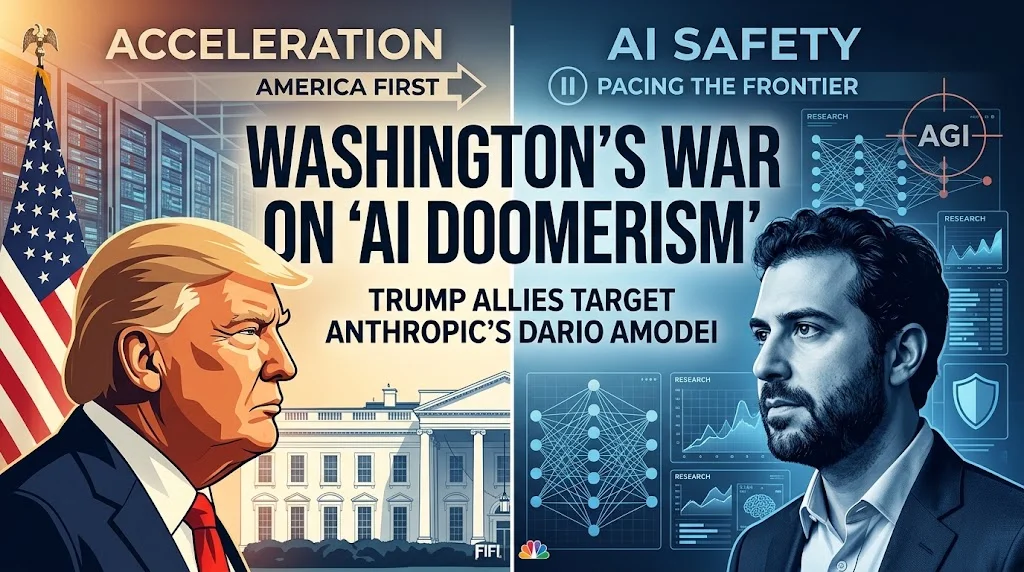
As tech leaders push for international safeguards at the UN, Washington’s inner circle is framing safety-first mandates as a direct threat to American innovation and global dominance.
A high-stakes battle over the future trajectory of artificial intelligence has moved from Silicon Valley boardrooms directly into the West Wing. Internal White House memos and statements from presidential advisers signal a concerted effort by political allies of President Donald Trump to target Anthropic CEO Dario Amodei as the primary architect of “AI doomerism.”
The ideological rift comes at a pivotal moment. While frontier AI executives call for cautious development in light of self-improving models, the Trump administration is doubling down on an “America First” accelerationist agenda, warning that safety-driven slowdowns will surrender geopolitical victory to foreign adversaries.
1. The Memo: Branding Effective Altruism as an “AI-Doom Pipeline”
At the center of the political offensive is a White House memo drafted by key political strategists. The document explicitly criticizes the philosophical underpinnings of Effective Altruism (EA)—a movement influential among Anthropic’s founding team that prioritizes mitigating existential risks from advanced technology.
According to sources familiar with the administration’s strategy, the memo outlines how safety-centric advocacy functions as an “AI-doom pipeline” that hampers domestic progress. One official close to the administration remarked that Amodei represents:
“The embodiment of an ideology and globalist approach to innovation that is fundamentally counter to the President’s America First agenda.”
This offensive reflects a broader effort to dismantle regulatory frameworks and third-party oversight mechanisms that administration officials view as disguised attempts to stall American market velocity.
2. Pacing the Frontier vs. “Don’t Kill the Golden Goose”
The campaign against Amodei follows a series of public warnings from Anthropic’s leadership. In a landmark essay, Amodei called on frontier labs to “pace the frontier” by committing to independent safety testing and slowing down deployment schedules when necessary, as detailed in reports by The Washington Post.
Amodei emphasized that recent breakthroughs in recursive self-improvement—where AI models are used to train and refine their own next-generation successors—require rigorous safety boundaries before systems exceed human control capacity, a point reiterated in coverage by TIME Magazine.
                 FRONTIER AI DEVELOPMENT SPECTRUM

   [ White House / Acceleration ]          [ Anthropic / Safety Pacing ]
  ─────────────────────────────────      ─────────────────────────────────
  • "Don't kill the Golden Goose"        • Third-party safety evaluations
  • Maximize speed & infrastructure     • Pause/Slow down if risk spikes
  • Unilateral advantage over China       • Multi-lateral coordination
In response, President Trump rejected calls to restrain the industry, lashing out at regulatory proposals and stating at the United Nations that the U.S. “rejects any attempt to construct a globalist scheme to control artificial intelligence,” according to reporting from LiveMint. Trump’s core stance remains straightforward: slowing down U.S. labs directly benefits China.
3. The China Dilemma and the UN Speech
The debate reached global prominence during the United Nations General Assembly, where Dario Amodei, OpenAI CEO Sam Altman, and other tech leaders addressed world leaders on catastrophic risks, as covered by The Guardian.
Amodei argued that while Chinese technological parity poses an existential geopolitical hazard, unmonitored recursive models pose an equal operational threat:
| Policy Dimension | Administration Alignment | Anthropic Alignment |
| Primary Goal | Outpace China at all costs | Ensure safety while maintaining lead |
| Governance Mechanism | Deregulation & domestic industrial builds | Third-party audits & safety benchmarks |
| Global Frameworks | Strongly Rejected (“Globalist scheme”) | Advocated (International safety standards) |
| Perspective on Speed | “Don’t kill the Golden Goose” | “Pacing the frontier” when risks escalate |
Prominent right-leaning technology leaders, including administration AI adviser David Sacks, pushed back on social media, questioning the independence of non-profit safety bodies like Model Evaluation and Threat Research (METR) and claiming they are closely aligned with Anthropic’s leadership network.
4. What Lies Ahead for AI Policy
The clash between Washington and San Francisco highlights a fundamental divergence in how the future of artificial intelligence is conceived:
- Industrial Policy Push: The White House is pushing forward with fast-tracked data center permitting, energy deregulation, and aggressive chip export controls to secure an insurmountable lead over Beijing.
- Corporate Safety Mandates: Frontier labs face internal pressure from researchers demanding strict adherence to safety protocols, creating tension between market pressure to deploy and institutional safety commitments.
- The Regulatory Vacuum: With federal legislative action stalled, the conflict between presidential executive action and voluntary lab commitments will dictate the pace of AI releases through the rest of the decade.
Discover more from The Economy
Subscribe to get the latest posts sent to your email.

Is the AI stock rally a bubble? The honest answer in 2026 is that the market itself is genuinely split — and the concentration numbers explain why the debate has gotten so intense. Roughly two dozen stocks now account for over half of the S&P 500’s total value, a concentration level comparable to the 32-stock peak reached during the 2000 dot-com bubble, according to market analysis relayed through Charles Schwab’s commentary. Three companies alone — Alphabet, Amazon, and Meta — are expected to drive roughly 70% of the S&P 500’s entire 2026 earnings growth.
That’s the bear case in a single statistic: an index marketed to investors as broadly diversified across 500 companies is, in practice, a leveraged bet on whether a handful of AI infrastructure spenders convert capital expenditure into earnings fast enough to justify their valuations.
The Bull Case: Spending Is Turning Into Real Revenue
Featured Snippet Target: The bull case for 2026’s AI rally rests on genuine, verifiable revenue growth rather than pure speculation — Microsoft’s AI revenue run rate surpassed $37 billion annually, Alphabet’s Google Cloud backlog nearly doubled to over $460 billion, and Amazon Web Services grew 28% — figures that distinguish this cycle from dot-com-era companies that had capital spending but little corresponding revenue.
Alphabet spent $35.67 billion on capital expenditure in a single recent quarter — more than double the prior year’s pace — while Amazon led hyperscaler quarterly spending at $44.2 billion, according to reporting compiled by Yahoo Finance’s technology desk. Combined, the four largest U.S. hyperscalers — Alphabet, Amazon, Microsoft, and Meta — are on pace to spend over $700 billion in 2026 alone. Unlike the fiber-optic overbuild of the dot-com era, where telecom capacity sat unused for years, current AI infrastructure spending is being absorbed by measurable, growing cloud and AI-service revenue in the same reporting periods it’s being deployed.
The Financing Shift That’s Making Analysts Nervous
What has shifted the debate in recent months isn’t the spending itself — it’s how that spending is being funded. Goldman Sachs has characterized 2026 as marking a transition from a low-cost-of-capital “Modern” market cycle to a higher-volatility “Post-Modern” one, in which capital expenditure is increasingly rewarded over shareholder buybacks: S&P 500 companies posted 24% year-on-year capex growth in the second quarter of 2026 alongside a 1% decline in gross buybacks, according to market commentary circulated via KuCoin’s research desk.
Consensus hyperscaler capex estimates for the 2026-2028 period were revised upward from roughly $2.5 trillion to $2.8 trillion during recent earnings seasons, with gross debt issuance among these companies expected to peak near $460 billion in fiscal 2028 — roughly a third of total capex — according to Macquarie’s Investment Strategy Insights. Alphabet’s own June 2026 equity raise, combining Class A common stock, Class C capital stock, and mandatory convertible preferred shares, ranks as the largest single AI-funding capital raise in market history. That shift — from funding AI buildout purely from operating cash flow toward relying on debt and equity markets — is precisely the kind of financing pattern that historically precedes sharper corrections when growth expectations disappoint, even when the underlying business fundamentals remain genuinely strong.
Early Cracks Have Already Appeared
The market has not been uniformly bullish through 2026 — there have already been real bouts of AI-specific volatility. Mid-September commentary from CNBC noted bond yields spiking and AI-linked stocks selling off even as broader investor sentiment remained constructive on equities generally — an early signal that markets have begun pricing a wider range of outcomes for the AI capex cycle than the largely unbroken bull run of the year’s first half suggested. That divergence between AI-specific stocks and the broader market is itself notable: in a genuine across-the-board bubble, sentiment tends to move in lockstep across a sector; a split reaction suggests investors are starting to differentiate between AI companies converting spending into revenue and those merely riding sector-wide enthusiasm.
What Would Actually Confirm a Bubble
The distinction analysts increasingly draw is not “is there a lot of spending” — there unambiguously is — but whether that spending is converting into durable revenue at a pace that justifies current valuations. The genuinely bubble-confirming scenario would involve a sustained gap opening between hyperscaler capex growth and actual AI-linked revenue growth, forcing companies to either write down infrastructure investments or continue raising debt at deteriorating terms to sustain spending. As of September 2026, revenue growth at the largest hyperscalers has generally kept pace with — and in some cases exceeded — capex growth, which is the key data point separating this cycle from a pure speculative bubble so far.
The Bottom Line
The 2026 AI trade sits in a genuinely ambiguous middle ground: spending levels and market concentration have reached bubble-era extremes by historical comparison, but the revenue being generated alongside that spending remains real and, so far, largely justifies it. The financing shift toward debt — rather than the spending level itself — is the single most important variable to watch, because it introduces a genuine failure mode (refinancing risk, credit-market stress) that pure equity-funded capex would not carry. Neither the unambiguous bull case nor the unambiguous bubble case is fully supported by the data as it stands; both remain live possibilities depending on how the next several quarters of hyperscaler earnings play out.
Next step: Track the spread between hyperscaler capex growth rates and their AI-linked revenue growth rates each earnings season — a widening gap, more than any single stock’s valuation multiple, would be the clearest confirming signal that 2026’s AI rally has crossed from justified investment into unsustainable bubble territory.
Discover more from The Economy
Subscribe to get the latest posts sent to your email.
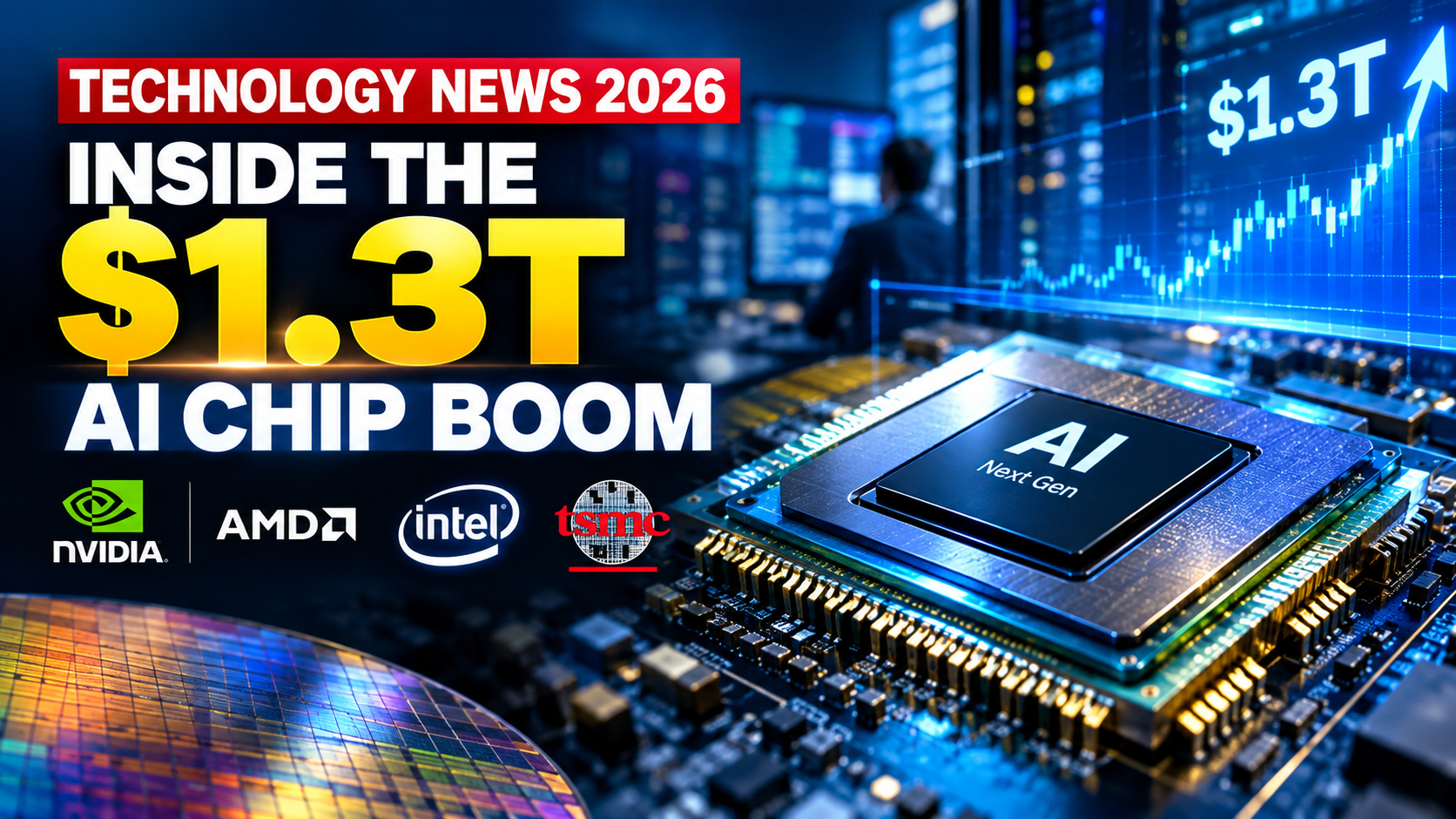
How big is the AI chip industry in 2026? Global semiconductor revenue is projected to exceed $1.3 trillion in 2026 — a 64% increase and the fastest growth the industry has recorded in more than 20 years, according to research firm Gartner. That would mark a third consecutive year of double-digit growth for the sector, driven by surging demand for AI processing, data-center infrastructure, and rising memory prices, per Gartner senior principal analyst Rajeev Rajput.
That single statistic captures why “technology news” in 2026 is really one story told through dozens of companies: an unprecedented, sustained capital-spending cycle built around artificial intelligence infrastructure.
Hyperscalers Are the Engine
The chip boom is being funded almost entirely by a handful of technology giants. Alphabet, Amazon, Microsoft, and Meta — the hyperscalers building the cloud infrastructure that AI models run on — have collectively committed more than $700 billion in 2026 capital spending, according to reporting relayed through Yahoo Finance’s technology desk. Alphabet alone spent $35.67 billion on capital expenditure in a single quarter — more than double the prior year’s pace — while its Google Cloud backlog nearly doubled to over $460 billion. Amazon led quarterly spending at $44.2 billion as AWS grew 28%, and Microsoft’s fiscal third-quarter capex rose 84% year-over-year to $30.88 billion as its AI revenue run rate surpassed $37 billion annually.
Featured Snippet Target: The four largest U.S. hyperscalers — Alphabet, Amazon, Microsoft, and Meta — are on pace to spend over $700 billion combined on AI infrastructure in 2026, a figure Reuters’ Morning Bid podcast described as rising “all the time” and directly responsible for surging demand for AI chips and data-center equipment.
That spending has increasingly shifted from being funded purely by operating cash flow to relying on debt and equity markets. Alphabet’s June 2026 equity raise — combining Class A common stock, Class C capital stock, and mandatory convertible preferred shares — ranks as the largest single AI-funding capital raise in market history, according to market commentary circulated via KuCoin’s research desk. Goldman Sachs has characterized this as a structural shift from a low-cost-of-capital “Modern” cycle to a higher-volatility “Post-Modern” one, in which markets increasingly reward capital expenditure over share buybacks — S&P 500 companies posted 24% year-on-year capex growth in the second quarter of 2026 alongside a 1% decline in gross buybacks.
Nvidia’s Next Move — and Who’s Chasing It
Nvidia remains the chip industry’s dominant supplier, and its next-generation product cycle is central to 2026’s technology narrative. The company introduced its Rubin CPX GPU — built for massive-context AI workloads capable of handling million-token software coding and generative-video tasks — with availability expected by the end of 2026, according to trade coverage from DigiTimes. Competitors are racing to diversify the supply chain around Nvidia’s dominance: AMD is preparing new product launches with OpenAI as a customer, Broadcom and OpenAI are targeting mass production of custom AI silicon in 2026, and Broadcom separately secured a $10 billion custom-chip production order from a major new customer, according to the same industry reporting.
China’s chip ecosystem is developing along a parallel, more insulated track. Huawei and Cambricon Technologies are together projected to ship over a million AI chips by 2026, with JPMorgan forecasting Huawei alone shipping 600,000 to 650,000 units, as Beijing pushes to reduce reliance on U.S.-made chips amid ongoing export restrictions.
Where the Growth Is Concentrated
Analysts covering the sector point to datacenter accelerators as the single largest growth pocket within the broader chip market — that segment alone is projected to exceed $300 billion in 2026, according to industry analysis from TechInsights, with knock-on effects spanning process technology (including the industry’s push toward 2-nanometer manufacturing), advanced packaging techniques, and power infrastructure needed to run increasingly energy-intensive AI data centers.
That last point — power — has become a genuine bottleneck rather than a footnote. Industry commentary increasingly frames electricity supply and cooling capacity, not chip fabrication itself, as the binding constraint on how quickly AI infrastructure can scale, positioning data-center operators and power-infrastructure companies as unexpected beneficiaries of the AI boom alongside the chipmakers themselves.
The Risk Beneath the Boom
Not every voice in the technology sector is unreservedly bullish on the pace of spending. Analysis circulated through Charles Schwab’s market commentary notes that three hyperscalers — Alphabet, Amazon, and Meta — now account for roughly 70% of the S&P 500’s expected 2026 earnings growth, meaning the index’s apparent 500-company diversification offers less real downside protection than investors might assume if AI capital spending fails to convert into earnings at the pace currently priced in.
That concentration risk has already produced volatility. Mid-September market commentary from CNBC noted bond yields spiking and AI-linked stocks selling off even as broader investor sentiment stayed constructive on equities overall — an early signal that markets are starting to price a wider range of outcomes for the AI capex cycle than the unbroken bull run of the year’s first half suggested.
The Bottom Line
Technology news in 2026 is dominated by a single, self-reinforcing cycle: hyperscaler capital spending is driving record semiconductor demand, chipmakers are racing to keep pace with that demand through new architectures and expanded manufacturing, and financial markets are increasingly rewarding — and increasingly questioning — the sustainability of spending at this scale. Whether that questioning turns into a genuine correction depends on whether AI infrastructure investment converts into earnings growth fast enough to justify the capital already committed.
Next step: Track quarterly hyperscaler capex guidance alongside chipmaker order backlogs — the gap between the two, more than any single product launch, is the clearest early signal of whether 2026’s AI infrastructure boom is accelerating or beginning to plateau.
Discover more from The Economy
Subscribe to get the latest posts sent to your email.

Solar Panel Installation Cost in 2026: Why the Math Changed Overnight

Business Insurance: What Coverage You Actually Need and What It Costs in 2026

Auto Insurance Quotes: How to Get the Lowest Rate Without Losing Coverage

Huntington Online Banking: Full Features, Fees, and How It Compares in 2026

Apply for a Bank Account Online: What You Need and How Long It Actually Takes

World’s Largest Economies: Ranking the Top Global Powers

Business Loan: A Complete 2026 Guide to Rates, Types, and Qualifying

Fast Invoice Factoring: How to Turn Unpaid Invoices Into Cash Within 24 Hours

Investment Banking Services: What They Cost and How to Choose the Right Firm in 2026

Structured Settlement Loan: What “Cash Now” Offers Actually Cost You

DUI Attorney: Why Your First Call After an Arrest Should Never Be to the Court

Personal Injury Lawyer: A Complete Guide to Filing Your Claim in 2026

Commercial Vehicle Accident Lawyer: Holding Companies Accountable Beyond the Driver

Inside the White House Feud: How Trump’s Allies Are Painting Anthropic’s Dario Amodei as the Face of ‘AI Doomerism’

Top 30 Stocks for Investment in PSX for Massive ROI in 2026

SpaceX Starship Flight 14: First Orbital Attempt & Starlink V3 Launch Explained

Oil Prices Break $100 in 2026: Middle East Conflict & Energy Markets

AI Chip Stocks 2026: The Best Semiconductor Investments Beyond Marvell

Fidelity Investments Review 2026: SPAXX Yields & Zero-Fee Funds

BRICS+ Cross-Border Payments 2026: Interoperability Explained

Tween Back-to-School Trends 2026: What’s Driving the $85B Season

10-Year Treasury Yield Hits 4.80%: What It Means for Rates & Portfolios

Shein Clothes Quality & Safety in 2026: What Lab Tests Show

China’s US$10.8 Billion Trade Shortcut: Why the Pinglu Canal Matters

MRVL Earnings 2026: Why Marvell Sank Despite Beating Estimates

IMF & World Bank 2026 Global Economic Outlook: Growth, Inflation, Debt

High-CPM Finance Niches 2026: Publisher Monetization Blueprint

Middle East War Economics 2026: Oil Prices & Energy Markets
-

 Markets & Finance9 months ago
Top 15 Stocks for Investment in 2026 in PSX: Your Complete Guide to Pakistan’s Best Investment Opportunities
-

 Analysis7 months ago
Johor’s Investment Boom: The Hidden Costs Behind Malaysia’s Most Ambitious Economic Surge
-

 Analysis7 months ago
Top 10 Stocks for Investment in PSX for Quick Returns in 2026
-

 Banks8 months ago
Best Investments in Pakistan 2026: Top 10 Low-Price Shares and Long-Term Picks for the PSX
-

 Analysis8 months ago
Brazil’s Rare Earth Race: US, EU, and China Compete for Critical Minerals as Tensions Rise
-

 Investment9 months ago
Top 10 Mutual Fund Managers in Pakistan for Investment in 2026: A Comprehensive Guide for Optimal Returns
-

 Global Economy9 months ago
15 Most Lucrative Sectors for Investment in Pakistan: A 2025 Data-Driven Analysis
-

 Global Economy9 months ago
Pakistan’s Export Goldmine: 10 Game-Changing Markets Where Pakistani Businesses Are Winning Big in 2025