Analysis
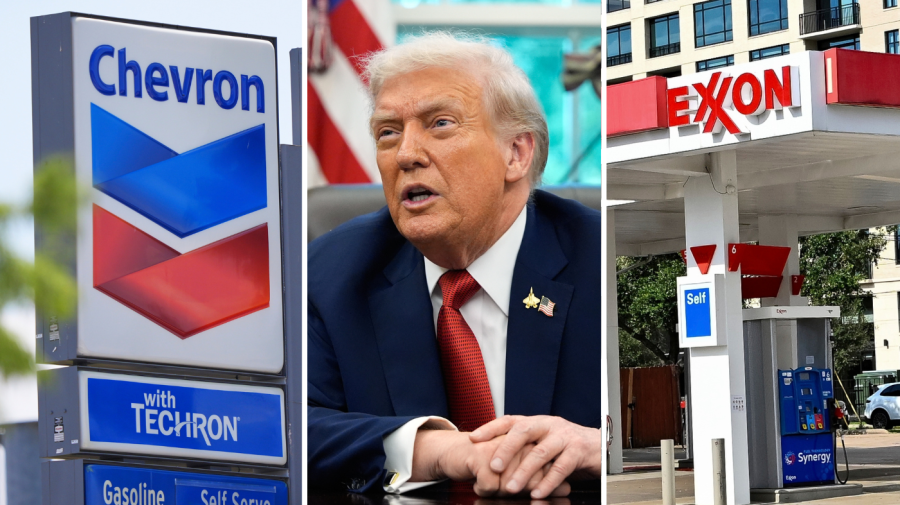
Exxon and Chevron Defy Trump Pressure to Boost Oil Production
When the White House calls and Wall Street watches, America’s oil giants have chosen an uncomfortable answer—and they may be right to do so.
| Indicator | Figure |
|---|---|
| Brent crude peak (April 30, 2026) | $126/barrel |
| US average gasoline price (AAA) | $4.30/gallon |
| Global oil supply through Hormuz | ~20% |
| ExxonMobil shareholder returns, 2025 | $37.2 billion |
| Brent surge since Iran war began | 55%+ |
At a videoconference convened on April 16, Interior Secretary Doug Burgum and Energy Secretary Chris Wright delivered what amounted to a national security appeal to roughly a dozen of America’s most powerful oil executives: produce more crude, now, and help us contain the political catastrophe unfolding at the pump. Representatives of ExxonMobil, Chevron and Continental Resources were among those on the call. The message from Washington was as urgent as it was blunt.
The supermajors listened politely. Then they went back to their spreadsheets.
With Brent crude briefly touching $126 a barrel on April 30—its highest level in four years, driven by the de facto closure of the Strait of Hormuz following the US-Iran war—and the national average gasoline price hitting $4.30 a gallon according to the latest AAA reading, the temptation to cast America’s oil giants as unpatriotic rent-seekers is understandable and already bipartisan. But this reading is wrong, and dangerously so. What ExxonMobil and Chevron are practising is not dereliction. It is discipline—a hard-won corporate virtue that took two decades of boom-bust disasters to instil, and one that would take far less time to destroy.
The Geopolitical Backdrop: A Supply Shock Unlike Any Other
The scale of the current disruption demands context. Since the conflict with Iran began in late February, daily tanker transits through the Strait of Hormuz—ordinarily a conduit for around 20 percent of the world’s seaborne oil and liquefied natural gas—have plunged to single digits. The International Energy Agency, not an institution given to hyperbole, has characterised this as the “largest supply disruption in the history of the global oil market.” Brent crude surged more than 55 percent from its pre-war level of roughly $72 a barrel to a peak approaching $120, with March 2026 marking one of the largest one-month oil price surges on record.
Even after a fragile ceasefire was announced on April 8, traffic through the strait remained far below pre-conflict norms. Iran re-imposed tighter controls within hours of a brief reopening; the US Navy seized an Iranian-flagged vessel in the Gulf of Oman. Analysts at Commodity Context estimate that any genuine reopening of the strait would trigger an immediate $10-to-$20 drop in crude prices from speculative unwinding, but warn that supply chain bottlenecks and infrastructure damage would keep Brent anchored in the $80-to-$90 range thereafter—well above the pre-war equilibrium.
For American motorists, the arithmetic has been brutal. Gasoline prices briefly exceeded $4 a gallon in late March and have continued to climb; in Los Angeles, prices exceeding $8 a gallon were photographed at Chevron stations. Economists warn that if the disruption extends into the second half of the year, it risks triggering a global recession. The political stakes for the Trump administration ahead of November’s midterm elections could hardly be higher.
“The crux of the issue is that even if the government is willing, companies may not be able to respond promptly. The oil industry is inherently capital-intensive and long-cycle.”
— TradingKey Energy Analysis, April 2026
Why Supermajors Are Not Drilling Their Way Out of a Geopolitical Crisis
Here is the problem that Washington’s energy team appears unwilling to fully confront: every stage of oil production—from permitting to drilling to first oil—takes time. Even in the technically mature shale basins of West Texas and New Mexico, where infrastructure is relatively well-developed and regulatory friction has been substantially reduced under the Trump administration’s executive orders, bringing meaningful new production online typically takes six months at minimum. The Strait of Hormuz crisis, by contrast, is being priced in real-time. No volume of incremental Permian output can substitute for twenty percent of global seaborne supply on a quarterly timeframe.
This is not a technocratic caveat. It is the central flaw in the White House’s production-acceleration thesis. The administration is, in effect, asking ExxonMobil and Chevron to commit multi-year capital at politically-induced price peaks in order to address a geopolitical disruption that may partially or fully resolve itself—as ceasefire negotiations in Islamabad suggest is possible—within months. If that resolution comes, and crude falls precipitously, those capital commitments become stranded liabilities borne by shareholders, not taxpayers.
The Lessons of the Shale Cycle
The supermajors have been through this before, and they did not emerge from the experience unscathed. During the shale boom of 2011–2014, under sustained triple-digit oil prices, the US industry drilled aggressively, accumulated debt, and in many cases destroyed substantial value. When OPEC flooded the market in 2014 and Brent collapsed from $115 to $27, hundreds of smaller operators went bankrupt and even the majors were forced into painful restructurings. A second cycle followed in 2021–2022, as pandemic-era shutdowns gave way to a post-Covid demand surge and then the Russia-Ukraine war price spike—which ultimately corrected sharply as OPEC+ discipline frayed and demand growth disappointed.
The institutional memory of those cycles is now encoded in the financial frameworks that govern ExxonMobil and Chevron. Both companies have explicitly committed to spending and production decisions based on long-run price assumptions—typically in the $60-to-$70 per barrel range—rather than spot market euphoria. This is not timidity. It is the discipline that preserved their balance sheets through multiple downturns and enabled the shareholder distributions that fund American pension funds, endowments, and retail investors alike.
The Numbers Behind the Discipline
The financial data from both companies’ most recent reporting periods illustrates the point with unusual clarity. ExxonMobil’s full-year 2025 results, released in January, showed the company achieving its highest upstream production in more than four decades—while simultaneously distributing $37.2 billion to shareholders, including $17.2 billion in dividends (the second-largest dividend payment among S&P 500 companies) and $20 billion in share repurchases. The company has committed to continuing $20 billion in repurchases through 2026 and has grown its annual dividend per share for 43 consecutive years.
Chevron, meanwhile, reported record worldwide production of 3,723 thousand barrels of oil equivalent per day in 2025, driven by the integration of its $48 billion acquisition of Hess Corporation, new output from the Tengiz field in Kazakhstan, and expanding volumes from Guyana. The company returned $27.1 billion to shareholders during the year. For Q1 2026, Chevron raised its quarterly dividend payout by 4 percent to $1.78 per share, marking 39 consecutive years of annual dividend increases.
Why Supermajors Are Holding the Line: Five Strategic Rationales
- Cycle-disciplined capital allocation. Both companies use long-run price decks far below current spot prices. Committing capital at $120 Brent for projects that require $70 to be viable is a path to destruction tested twice in the last decade.
- Shareholder primacy and fiduciary duty. ExxonMobil and Chevron collectively returned over $64 billion to shareholders in 2025. Destabilising that commitment with politically motivated capex would trigger a shareholder revolt and potentially activist pressure.
- Portfolio optionality abroad. Both companies are expanding through international assets—Guyana (Exxon’s Stabroek block), Kazakhstan (Chevron’s Tengiz), and potential Venezuelan re-entry—that offer better long-term returns than marginal US shale at inflated capital costs.
- Permian growth already underway, on their own terms. Neither company has stopped growing Permian production. They simply refuse to accelerate beyond what their own engineers and economists determine is capital-efficient.
- Geopolitical uncertainty cuts both ways. A diplomatic resolution to the Hormuz crisis—which ceasefire negotiations suggest is possible—would crash prices within weeks. Drilling commitments made today would mature into an oversupplied market.
The Permian Basin Is Not a Spigot
One of the more persistent misconceptions in Washington’s energy discourse is that the Permian Basin—the prolific shale formation spanning west Texas and southeast New Mexico—can be turned up or down like a tap in response to political need. The reality is considerably more textured. Chevron has guided 2026 capital expenditure at the low end of its long-term range, at $18–$19 billion—a deliberate signal that the company is optimising for cash flow durability rather than volume maximisation. Exxon, with its $29 billion capex in 2025, has been more ambitious but equally clear that growth must earn returns above its cost of capital across cycles.
The operational constraints are equally real. Drilling and completion crews cannot be conjured instantly; supply chains for steel, proppant, and specialised equipment take months to scale; and the sweet spots of the Permian’s core acreage are, by definition, finite. The shale wells that would deliver meaningful incremental production in a compressed timeframe are increasingly in the inventory’s lower tiers—more expensive, faster-declining, and more sensitive to the capital cost environment that has risen sharply as the Fed has maintained restrictive monetary policy.
The International Chessboard: Where the Real Growth Lies
While the political debate fixates on American soil, both ExxonMobil and Chevron have been quietly executing a more sophisticated international strategy that may ultimately contribute more to global supply stability than any domestic drilling surge. Both companies are expanding production in nations tied to OPEC, including geopolitically complex environments where Trump’s assertive foreign policy has helped open previously closed doors.
Exxon’s Stabroek block in Guyana—a deepwater asset that has become one of the highest-return upstream developments in the industry—continues to ramp up output. Chevron’s $48 billion absorption of Hess brought with it a significant Stabroek stake as well as expanded production from Kazakhstan’s Tengiz field, one of the world’s largest. The company expects further production growth this year, primarily from Guyana and the Eastern Mediterranean. These are not hypothetical prospects; they are operating assets delivering first oil or expanding existing production trains.
The Venezuelan dimension adds another layer. Major US drillers face growing pressure to assist in the Trump administration’s aspiration to revive the Venezuelan oil sector following the ouster of Nicolás Maduro. If that materialises, it would represent a more durable supply increment than any shale acceleration—and one that contributes to OPEC-adjacent production balances rather than simply shifting market share within the non-OPEC universe.
The Political Economy of “Drill, Baby, Drill”
There is something almost theatrical about the Trump administration’s production appeal. The phrase “drill, baby, drill” has served as a reliable piece of campaign rhetoric since the 2008 election cycle—a confident invocation of American resource abundance as the solution to whatever energy problem the moment presents. But corporate chief executives are not voters, and they are certainly not campaigners. They answer to boards, investors, and—ultimately—long-run economics.
The uncomfortable truth is that the oil price spike of 2026 is, in structural terms, not primarily a supply story. It is a transit story: the physical inability to move roughly twenty percent of global crude and LNG exports through a narrow maritime chokepoint. No volume of new Permian output can substitute for Hormuz tanker access. The crude must still be shipped, refined, and distributed—and if the strait remains effectively closed, the downstream infrastructure to convert incremental US barrels into pump-price relief simply does not exist at the scale required.
What the administration is really seeking is a political signal: proof that it is doing something in the face of $4.30 gasoline. The supermajors, to their credit, have declined to be props in that performance. Some smaller executives on the April 16 call indicated they were responding to price signals—as one would expect rational producers to do—but the strategic discipline of the largest players has held.
“Chevron’s upstream breakeven remains below $50 per barrel, reinforcing its ability to remain cash-flow positive across cycles—a key advantage in any volatile environment.”
— Yahoo Finance / Nasdaq Analysis, December 2025
Capital Discipline as Energy Security
It is worth stepping back to consider what “energy security” actually requires in a world of persistent geopolitical volatility. The conventional answer—produce more, build more, drill more—contains an important partial truth. US domestic production has been a genuine buffer against OPEC pricing power for fifteen years, and it will remain one. But energy security also requires solvent producers: companies with strong balance sheets, diversified portfolios, and the financial resilience to sustain investment through the inevitable downturns that follow every spike.
A supermajor that drills recklessly at $120 Brent, overleverages its balance sheet, and then faces collapse when prices normalise is not a contribution to energy security. It is a liability. The boom-bust cycles of 2014 and 2020 temporarily crippled US production capacity precisely because operators had not maintained the financial discipline to survive the downturns. ExxonMobil’s industry-leading debt-to-capital ratio of 14 percent and its uninterrupted 43-year dividend growth record exist because the company has, in prior moments of political enthusiasm, refused to subordinate financial logic to short-term optics.
The supermajors’ discipline, in other words, is not a failure of patriotism. It is the accumulated institutional wisdom of companies that have learned—at considerable cost—that the market always gets the last word. In the meantime, as negotiations between Washington and Tehran continue in Islamabad, the surest path to lower gasoline prices runs through a reopened strait, not a new well pad in the Delaware Basin. The White House would do well to direct its urgency accordingly.
Discover more from The Economy
Subscribe to get the latest posts sent to your email.
Analysis
America’s AI Engine Meets the China Fault Line: Can Growth Outrun Geopolitics in 2026?
US GDP rebounded to 2.0% in Q1 2026 on AI investment, while jobless claims hit a 57-year low. But can America’s AI-driven growth outlast the fragile US-China trade truce and global uncertainty?
On the same Thursday morning that the Bureau of Economic Analysis confirmed America’s economic rebound, the Labor Department delivered a figure that made analysts double-check their screens: 189,000 initial jobless claims for the week ending April 25 — the lowest reading since September 1969, when Neil Armstrong’s moonwalk was still fresh in the national memory. Set against a backdrop of an active conflict with Iran, persistent inflation, and some of the most contentious trade diplomacy since the Cold War, the US economy’s resilience borders on the paradoxical.
The headline GDP number — a 2.0% annualized growth rate in Q1 2026, according to the BEA’s advance estimate — was slightly below the 2.2-2.3% consensus, and skeptics rightly note the mechanical lift from post-shutdown federal payroll normalization. But the number that deserves greater analytical weight is hidden deeper in the national accounts: business investment in equipment, particularly computers and AI-related infrastructure, surged to become the economy’s single most dynamic engine of demand. According to the Federal Reserve Bank of St. Louis, AI-related investment in software, specialized processing equipment, and data center buildout accounted for roughly 39% of the marginal growth in US GDP over the last four quarters — a contribution that exceeds even the tech sector’s peak impact during the dot-com boom of 2000.
That is an extraordinary fact. It is also a strategically dangerous one.
The AI Boost Behind US GDP Resilience
The private-sector numbers are staggering in their ambition. Microsoft has earmarked approximately $190 billion in capital expenditure for 2026. Alphabet is targeting $180–190 billion. Amazon is maintaining a near-$200 billion capex envelope. Meta projects $125–145 billion. At the midpoint, these four hyperscalers alone represent capital deployment equivalent to roughly 2.2% of annualized US nominal GDP — before a single smaller competitor, startup, or government AI initiative is counted.
The real-economy effects are tangible. Data center-related spending alone added approximately 100 basis points to US real GDP growth, according to Morgan Stanley’s chief investment officer. In Gallatin, Tennessee, Meta’s $1.5 billion hyperscale data center revitalized a local economy that had previously depended on declining manufacturing. In Washington, D.C., AI infrastructure investment materially buffered the regional economy during the federal government shutdown that dragged Q4 2025 GDP to a near-stall of 0.5%. The BEA’s own Q1 2026 data confirms that investment led the recovery, driven by equipment — computers and peripherals — and intellectual property products including software.
Oxford Economics chief US economist Michael Pearce summed it up with characteristic precision: “The core of the economy remained solid in Q1, driven by the AI buildout and the tax cuts beginning to feed through.” Cornell economist Eswar Prasad, Wells Fargo’s Shannon Grein, and Brookings’ Mark Muro have reached similar conclusions, though Muro’s framing is more pointed: “This AI gold rush is generating all the excitement and papering over a drift in the rest of the economy.”
That is the first tension embedded in America’s resilience story. The growth is real. Its distribution is not.
A Labor Market Defying Gravity — For Now
The jobless claims figure deserves its own moment of pause. Initial claims fell by 26,000 to 189,000 in the week ended April 25, according to Labor Department data — well below the 212,000 median forecast from Bloomberg’s economist survey. Continuing claims simultaneously dropped to 1.79 million, a two-year low. High Frequency Economics’ chief economist Carl Weinberg called it a clean report. “There is nothing to worry about in this report. YET!,” he wrote to clients, with the emphasis and punctuation entirely deliberate.
That caveat matters. The job market’s tightness reflects AI-driven demand for power engineers, data center technicians, and specialized researchers — occupational categories experiencing wage inflation that lifts aggregate statistics while leaving large swaths of traditional workers in wage stagnation. A “two-track economy,” as Brookings put it, rarely remains politically stable. And with the PCE price index — the Federal Reserve’s preferred inflation gauge — jumping to a 4.5% annualized rate in Q1 2026, real purchasing power erosion is biting even as employment remains robust. The Fed, under pressure not to cut rates into an inflationary surge, is boxed in.
This is the macroeconomic paradox of 2026: an economy generating headline strength through concentrated private investment and a historically tight labor market, while consumers decelerate, inflation accelerates, and geopolitical shocks keep piling up at the margins.
Navigating US-China Trade Diplomacy in Volatile Times
Against this domestic backdrop, the diplomatic chessboard between Washington and Beijing has been moving rapidly — and not always in predictable directions.
The arc of the past eighteen months reads like a crisis management manual. In April 2025, the Trump administration’s “Liberation Day” tariff regime ignited a full escalation, with mutual tariffs between the US and China ultimately exceeding 100% before a Geneva truce in May 2025 brought temporary de-escalation. That truce frayed quickly. By October 2025, Washington imposed additional 100% duties on Chinese goods alongside expanded export controls on critical software. Beijing countered with non-tariff measures — canceling orders, restricting rare earth exports, and tightening end-use disclosure requirements for American firms dependent on Chinese inputs.
Then came the Busan inflection point. At their summit in South Korea in late October 2025, Trump and Xi agreed to a new trade truce that suspended US escalatory tariffs through November 2026 and delivered Chinese commitments on fentanyl, rare earth pauses, and soybean purchases. The deal was described by analysts as tactical rather than structural — a détente without a doctrine. Persistent friction in technology, semiconductors, and strategic manufacturing was pointedly left unresolved.
In February 2026, the dynamics shifted again when the US Supreme Court ruled that the executive branch could not use the International Emergency Economic Powers Act (IEEPA) to impose tariffs, obligating the government to refund affected businesses and forcing the administration to shift to a 10% global tariff under Section 122 of the Trade Act of 1974. It was a legal earthquake that simultaneously constrained White House trade leverage and injected fresh legal uncertainty into bilateral negotiations.
Senior trade officials from both countries have since engaged in multiple rounds of talks — Paris in February, with both sides describing the discussions as “constructive,” a diplomatic adjective that in this context carries approximately the same information content as “ongoing.” President Trump’s planned visit to China in 2026 — his first trip in eight years — represents the highest-stakes diplomatic moment in the relationship since the first-term Phase One deal, and arguably since the 2001 WTO accession itself.
De-Risking, Decoupling, and the Silicon Chessboard
The language in this debate matters enormously. “Decoupling” — the full bifurcation of US and Chinese economic systems — is a fantasy embraced primarily by those who have not priced its consequences. The US imported over $400 billion in goods from China in 2024, from consumer electronics to pharmaceutical precursors to the very servers and peripherals that are now driving American GDP growth. The BEA noted that the Q1 2026 surge in goods imports was led by computers, peripherals, and parts — meaning that America’s AI boom is, in part, being assembled with Asian supply chains that run through Taiwan, South Korea, and yes, mainland China.
This is the central irony of US-China relations in 2026: the technology sector powering America’s economic resilience is also the sector most exposed to geopolitical disruption. Advanced semiconductors, rare earth magnets essential for defense and clean energy systems, and the specialized capital equipment for AI training clusters — all exist at the intersection of national security and economic interdependence.
The USTR’s 2026 Trade Policy Agenda explicitly frames the goal as “managing trade with China for reciprocity and balance” — a formulation that signals the administration understands full decoupling is neither achievable nor desirable, even as it maintains sweeping Section 301 tariffs inherited from the first Trump term and pursues new Section 301 investigations into Chinese semiconductor practices. The more honest strategic concept is “de-risking”: maintaining commercial engagement while systematically reducing dependencies in sectors where a supply shock could compromise national security or economic function.
That is, in principle, the correct instinct. The difficulty is execution. Export controls on advanced AI chips — the Nvidia H200 episode, where the administration allowed sales to China while collecting 25% of proceeds, drew fierce bipartisan criticism for precisely the reason that critics of managed trade always articulate: when economic and security concessions become transactional, you erode the credibility of both. Former senior US officials, quoted in Congressional Research Service analysis, noted that the decision “contradicts past US practice” of separating national security decisions from trade negotiations.
Risks and Opportunities in Bilateral Economic Ties
The structural risks are not hypothetical. They are identifiable, measurable, and — for policymakers willing to look — actionable.
On the American side, the AI buildout has created three distinct vulnerabilities. First, energy infrastructure: data centers are projected to require upwards of 25 gigawatts of new grid capacity by decade’s end, already driving electricity prices up 5.4% in 2025. A supply chain in which compute capacity races ahead of grid investment is a supply chain that will eventually encounter a hard ceiling. Second, talent concentration: the AI economy has generated insatiable demand for a narrow band of specialists — power engineers, ML researchers, data center architects — while leaving broader labor markets structurally unchanged. This is not a foundation for durable political economy. Third, import exposure: as Oxford Economics’ Pearce noted, the AI boom is partly self-limiting because US firms send substantial money abroad to import chips and components from South Korea and Taiwan — a geographic concentration that creates fragility precisely where resilience is most needed.
On the diplomatic side, the fragility of the current truce is not in dispute. The November 2026 deadline on the Busan commitments will arrive fast, and the structural issues — Chinese overcapacity in electric vehicles, solar, and steel; American restrictions on semiconductor exports and connected vehicle technology; Beijing’s tightening of rare earth export controls — will not have resolved themselves in the interim. A Trump-Xi meeting in May 2026 offers the possibility of extending the détente, perhaps structuring a more durable “managed trade” framework. But managed trade, when both parties define “management” differently, has a well-documented tendency to collapse at precisely the moment it is most needed.
The Iran war — now in its ninth week, with crude oil trading near $104 per barrel — adds a layer of global volatility that is already showing up in energy prices and consumer sentiment, and will appear in Q2 data. The Conference Board has warned that higher energy costs and supply chain disruptions are likely to weigh on GDP growth and keep the Fed on hold, further tightening the policy space available to manage whatever comes next.
The Path Forward: Smart Diplomacy or Missed Opportunity?
The case for measured optimism is real but requires specificity to be credible. The US holds asymmetric advantages in this competition: the frontier AI research ecosystem, the dollar’s reserve currency status, the depth of its capital markets, and the extraordinary private-sector energy now channeled into technological infrastructure. These are genuine strengths. They confer strategic leverage. They also, if mismanaged, create complacency — the assumption that technological lead translates automatically into diplomatic leverage, or that economic dynamism renders geopolitical risk management optional.
It does not. The Reagan-era trade disputes with Japan, the Clinton-era engagement with China, and the first-term Trump tariff campaigns all demonstrate that economic power and diplomatic sophistication must operate in tandem. The current moment calls for exactly that combination: a framework that protects semiconductor supply chains and critical technology leadership without sacrificing the commercial relationships that make the AI buildout itself possible. “Friend-shoring” — the deliberate diversification of supply chains toward allied democracies — is a genuine and necessary strategy, but it takes a decade to build what markets created over forty years.
The diplomats who navigate this most successfully will be those who resist the binary of engagement versus confrontation, and instead build durable, enforceable rules in the specific sectors where rivalry is sharpest: advanced chips, rare earths, AI governance, and data security. The USTR’s ambitious Reciprocal Trade Agreement program, which seeks binding market access commitments from partners across Asia and Europe, points in roughly the right direction — provided it does not inadvertently impose costs that undermine the private investment driving the very GDP growth policymakers are celebrating today.
America’s AI-driven resilience is real, and this week’s data — a 2.0% rebound from near-stall, jobless claims at a 57-year low — deserves genuine recognition. But economies, like tectonic plates, can appear stable right up to the moment they are not. The fault line running beneath the current recovery is not primarily technological. It is geopolitical. Managing it demands the same ambition and precision that the private sector is currently bringing to the AI buildout. There is, in 2026, no reason to believe it cannot be done. There is also no reason to assume it will be done automatically.
That, ultimately, is the work.
FAQ: US-China Relations, GDP Growth, and the AI Economy in 2026
Q: What drove US GDP growth in Q1 2026? The BEA’s advance estimate showed 2.0% annualized growth, driven by surging business investment in AI equipment, computers, and software, alongside a rebound in government spending following the end of the Q4 2025 federal government shutdown. Consumer spending and exports also contributed, while elevated imports — largely computers and AI-related parts — partially offset those gains.
Q: Why did US initial jobless claims fall to 189,000 in April 2026? The week ending April 25 saw claims fall by 26,000 to 189,000, the lowest since September 1969. The drop reflects a tight labor market in which layoff announcements — from companies like Meta and Nike — have not yet translated into actual terminations. AI-driven sectors are generating strong demand for specialized workers, keeping aggregate layoff rates historically low despite broader economic uncertainty.
Q: What is the current state of US-China trade relations in 2026? Relations are in a fragile détente. The Trump-Xi Busan summit in late 2025 produced a truce suspending escalatory US tariffs until November 2026 in exchange for Chinese commitments on fentanyl, rare earths, and agricultural purchases. However, structural disputes over semiconductors, technology export controls, Chinese industrial overcapacity, and rare earth access remain unresolved. A Trump visit to China in 2026 may seek to extend or deepen this framework.
Q: What does “de-risking” versus “decoupling” mean in the US-China context? Decoupling refers to a full economic separation — ending significant trade and investment ties between the two countries. De-risking is the more pragmatic approach: maintaining commercial engagement while systematically reducing dependencies in sectors critical to national security, such as advanced semiconductors, rare earth materials, and connected technology. The current US administration’s policy formally targets the latter, though execution remains contested.
Q: How much of US GDP growth is driven by AI investment? The Federal Reserve Bank of St. Louis estimates that AI-related investment in software, specialized equipment, and data centers accounted for approximately 39% of marginal US GDP growth over the four quarters through Q3 2025 — surpassing the tech sector’s contribution at the peak of the dot-com boom. Major tech companies have collectively planned over $700 billion in capital expenditure for 2026, much of it AI-related.
Q: What are the key risks to US economic resilience in 2026? The main risks include: elevated inflation (PCE at 4.5% annualized in Q1 2026) constraining consumer spending and Federal Reserve flexibility; the Iran war driving energy prices higher; AI investment’s over-concentration in a single sector; grid capacity failing to keep pace with data center energy demand; and the potential collapse of the US-China trade truce ahead of its November 2026 deadline.
Q: What is the outlook for a Trump-Xi summit in 2026? President Trump’s planned visit to China — his first in eight years — is expected in 2026 and would represent the most significant bilateral diplomatic moment since the Phase One trade deal. Analysts broadly expect any summit outcome to be tactical rather than structural: a potential extension of the tariff truce, some progress on fentanyl and agricultural trade, but no resolution of deeper disputes over technology, Taiwan, or the strategic competition in advanced manufacturing.
Discover more from The Economy
Subscribe to get the latest posts sent to your email.
Analysis
The Fed’s Leadership Reckoning: Powell’s Shadow Lingers as Warsh Steps Into the Storm
There is a particular kind of institutional vertigo that sets in when the most powerful monetary authority on earth changes hands in the middle of a geopolitical fire. On April 29, the Federal Reserve held its benchmark interest rate steady at 3.5%–3.75% for a third consecutive meeting — a decision that, in ordinary times, would have warranted a three-paragraph wire dispatch and a muted market shrug. These are not ordinary times.
Jerome Powell, conducting what was in all likelihood his final press conference as Fed Chair, arrived burdened by something rarer than any policy dilemma: the weight of an unfinished exit. Four members of the Federal Open Market Committee cast dissenting votes, producing an 8-4 split that CNBC’s reporting confirms was the most fractious FOMC decision since October 1992. At the same moment, the Senate Banking Committee advanced Kevin Warsh’s nomination as the next Fed Chair on a 13-11 party-line vote. And Powell announced he would remain on the Board of Governors — for reasons that are simultaneously principled, political, and deeply personal.
Welcome to the most consequential monetary leadership transition in a generation.
Why the Fed Held Rates Steady Amid Energy Shocks
The rate freeze itself was, paradoxically, the least surprising element of a deeply surprising day. Markets had priced a 100% probability of no change heading into the meeting, according to CME FedWatch data. The logic was austere: with the Consumer Price Index at 3.3% on an annual basis as of March — its highest reading since May 2024, well above the Fed’s 2% target — and the ongoing Iran conflict having sent crude oil above $100 per barrel, there was simply no defensible case for easing.
The FOMC statement was clinical in its diagnosis: “Inflation is elevated, in part reflecting the recent increase in global energy prices. Developments in the Middle East are contributing to a high level of uncertainty about the economic outlook.” That single sentence conceals enormous complexity. Energy price shocks are, in the Fed’s traditional framework, transitory — the kind of supply-side disruption that monetary policy cannot and arguably should not try to extinguish. Raise rates aggressively to fight oil-driven inflation, and you risk crushing employment. Ease to protect growth, and you risk allowing energy pass-throughs to embed in wage expectations and core prices. The Fed chose the third path: wait, and watch.
That patience has a cost. Personal Consumption Expenditures inflation — the Fed’s preferred gauge — has been running above 3% for the better part of two years, as CBS News noted in its pre-meeting analysis. What was once characterized as a transitory post-pandemic overshoot has calcified into something more stubborn: a structural plateau, driven now by energy geopolitics as much as domestic demand. The Fed’s dual mandate — maximum employment and price stability — is being tested not by a simple trade-off but by a chaotic collision of global forces that no interest rate committee in Washington can fully govern.
The Fracture Lines: Reading the 8-4 Vote
The four dissents tell four different stories, and Warsh would do well to read each carefully before his first FOMC meeting.
Governor Stephen Miran voted for a quarter-point cut, consistent with his dovish position since joining the Board in September 2025. His dissent reflects a genuine concern about growth: tariff headwinds, a cooling labor market, and the risk that excessive caution at the Fed tips a resilient but slowing economy into contraction. Miran is not alone in that fear — but he may be alone in his willingness to act on it.
The other three dissenters — Cleveland’s Beth Hammack, Minneapolis’s Neel Kashkari, and Dallas’s Lorie Logan — moved in the opposite direction. They did not object to holding rates; they objected to the statement’s retention of language implying future cuts remain in the cards. Their message, as Axios’s analysis captured, was unambiguous: with inflation in its sixth year above the 2% target and growth remaining solid, the FOMC should not be telegraphing easing at all. Remove the bias. Acknowledge the upside risks. Stop pretending the next move is obviously down.
This is the committee Warsh inherits. As KKM Financial’s Jeff Kilburg put it on CNBC, three of those four dissenters were “letting him know, we’re not going to let you lead us here.” That is a pointed welcome gift. It signals that any attempt by Warsh to deliver the aggressive rate cuts President Trump has publicly demanded will face substantial internal resistance — absent a genuine and measurable turn in the data.
Powell’s Exit Strategy: The Two-Popes Problem
No element of Wednesday’s drama was more unusual — or more carefully calculated — than Powell’s decision to remain as a member of the Board of Governors after his chairmanship expires on May 15.
Formally, Powell cited the ongoing investigation into Federal Reserve headquarters renovations. The Justice Department had handed the probe to the Fed’s Inspector General, and Powell stated he wished to see the matter reach “transparency and finality” before fully stepping back. His Board term runs through January 2028, and he signaled he would remain for “an undetermined period” while keeping a deliberately low profile.
The institutional calculus here is significant. Powell’s continued presence on the Board preserves a 4-3 majority of Biden-appointed governors — counting Powell himself, who was originally appointed by Trump before reappointment under Biden — against Trump-aligned nominees. It denies the White House an immediate vacancy to fill with someone more politically amenable on monetary policy. And it preserves a quiet counterweight, however restrained, against undue executive pressure on the institution’s independence.
Powell has been careful to frame none of this in adversarial terms. He is not positioning himself as a dissident. He congratulated Warsh publicly at the press conference. He pledged deference. But his very presence is a structural check, and all parties understand that. The “two Popes” dynamic — the emeritus and the reigning figure occupying the same institution — carries obvious risks of ambiguity and undermined authority. Powell, to his credit, appears aware of that tension, which is precisely why he has gone to lengths to minimize his visible footprint going forward.
His legacy, however, demands a fuller accounting. The Powell era — from February 2018 through May 2026 — spanned the Trump tariff wars 1.0, a global pandemic, the most severe inflation shock since the 1980s, the most aggressive rate-hiking cycle in four decades, and a partial easing cycle interrupted by Middle Eastern conflict. He made consequential errors: the 2021 “transitory” inflation miscall cost the Fed credibility it is still, in some measure, rebuilding. But his defense of institutional independence — against repeated and explicit presidential pressure — stands as a genuine achievement. The Fed did not become a political instrument on his watch. Whether that record holds under his successor is the central question of the next chapter.
Kevin Warsh and the Incoming Era: What His Stewardship May Look Like
Kevin Warsh is a man arriving at the Federal Reserve with a complicated relationship to his own reputation. His first stint as Fed Governor, from 2006 to 2011, produced a record that puzzled many economists: inexplicably hawkish in the aftermath of the Global Financial Crisis, he was seen as arguing for premature tightening at a moment when the economy desperately needed accommodation. That record has followed him.
Yet his Senate confirmation hearing testimony, as Invesco’s post-hearing analysis detailed, revealed a notably more nuanced posture. Warsh struck a broadly dovish, pragmatic tone — acknowledging the complexity of inflation in an era shaped by AI-driven productivity gains, tariff-induced supply disruptions, and energy shocks. He expressed openness to alternative inflation metrics like median CPI and trimmed mean inflation, which strip out extreme observations and may paint a less alarming picture of underlying price pressures than headline figures suggest.
On balance sheet policy, the picture is more hawkish. Warsh has been a persistent critic of the Fed’s $6.7 trillion portfolio — nearly eight times its pre-2008 size — and signaled interest in accelerating the drawdown. But he was careful to note, as Motley Fool’s analysis of his testimony observed, that meaningful balance sheet reduction is a deliberate, collective process requiring FOMC consensus and measured over years, not months.
On the critical question of independence, Warsh offered a formulation that was politically deft but left room for interpretation: “Monetary policy independence is essential,” he said in prepared remarks, adding that he was “committed to working with the administration and Congress on non-monetary matters.” The qualifier is load-bearing. Markets noticed. According to the latest CNBC Fed Survey, only 50% of economists and market strategists believe Warsh will conduct monetary policy mostly or very independently — a slim majority, and a 13-point improvement from the prior month’s survey, suggesting his confirmation hearing partially, but not fully, allayed credibility concerns.
The deeper tension is structural. Trump has been unambiguous in wanting lower rates, arguing that elevated borrowing costs disadvantage the U.S. competitively. Warsh is a creature of Wall Street and Washington, instinctively sensitive to the political environment he inhabits. But as Axios’s reporting highlighted, the hawkish bloc he inherits from this fractured FOMC will make delivering rate cuts — absent clear data justification — genuinely difficult. “Warsh will be hard pressed to get a majority of the FOMC to vote for rate cuts when core and headline PCE are running above 3% and GDP growth is holding firm at 2%,” observed Stephen Coltman of 21shares. That assessment is hard to dispute.
The Geopolitical Dimension: Energy, Tariffs, and the World Beyond the Eccles Building
What makes this Fed transition genuinely singular is the external environment it is occurring within. The Iran conflict has introduced a persistent energy price shock that sits awkwardly within traditional monetary frameworks. The Fed cannot bomb its way to lower oil prices, nor can it meaningfully incentivize domestic production through rate adjustments. What it can do — and what policymakers privately fear — is validate an inflationary expectation cycle if it eases while energy costs remain elevated. The signal matters as much as the substance.
Trump’s tariff agenda compounds the problem geometrically. Tariffs are, at their mechanical core, inflationary: they raise the price of imported goods, compress real consumer purchasing power, and trigger retaliatory measures that further distort trade flows. Their combination with an energy shock creates a dual supply-side squeeze that monetary policy is structurally ill-equipped to resolve. The Fed finds itself holding the economy steady not because it has solved the inflation problem, but because every available alternative carries greater downside risk.
For emerging markets, this posture carries its own collateral damage. Elevated U.S. rates sustain dollar strength, pressuring commodity importers and countries with dollar-denominated debt. Central banks in Southeast Asia, Latin America, and Sub-Saharan Africa have been forced into defensive postures — keeping rates higher than domestic conditions warrant, to prevent capital outflows. The Fed’s decisions ripple outward with a force proportional to dollar hegemony, and that hegemony has not diminished.
What Comes Next: Scenarios for June and Beyond
Warsh’s first FOMC meeting as Chair — likely in June — will be watched with an intensity normally reserved for geopolitical summits. The question is not whether he will cut in June; the data almost certainly will not support it. The question is how he frames the committee’s forward guidance, how aggressively he pursues communication reform (he has historically favored a more rules-based, transparent policy framework), and whether he moves quickly on balance sheet changes.
Three plausible scenarios frame the second half of 2026:
Scenario A — Cautious Continuity. Warsh adopts a deliberately conservative opening posture, holding rates steady through summer and focusing early energy on internal process reforms — communication, balance sheet review, and FOMC cohesion. This earns credibility at the cost of early growth-boosting moves.
Scenario B — Data-Dependent Easing. A genuine deceleration in energy prices — perhaps through a Middle East ceasefire or supply normalization — gives Warsh cover to cut once by year-end. This is the market’s mild base case and politically convenient, but risks appearing reactive to external factors rather than anchored in principle.
Scenario C — Hawkish Surprise. Persistent PCE above 3% and continued energy volatility push Warsh to endorse the hawkish bloc’s framing, removing the easing bias from Fed communications and signaling a rates-on-hold posture well into 2027. Markets would reprice, long-duration bonds would sell off, and the mortgage market — already strained — would tighten further.
The probability weighting, given what Warsh said in his confirmation hearing, likely favors Scenario A shading toward B. But the FOMC he has inherited is not easily managed, and the external environment could force his hand in either direction.
The Institutional Question That Outlasts Both Men
Beneath the tactical questions of rate paths and balance sheet trajectories lies a more fundamental issue that neither Powell’s cautious exit nor Warsh’s ambitious arrival fully resolves: the long-run independence of the Federal Reserve in an era of intensifying executive pressure.
The 1951 Treasury-Fed Accord — which separated debt management from monetary policy and established the central bank’s operational independence — represents one of the great institutional achievements of postwar American economic governance. As John Donaldson of Haverford Trust noted in the CNBC survey commentary, the degree to which Warsh and Treasury Secretary Bessent might seek to remake that accord is among the most consequential unknowns of the new era. Donaldson considers a breach unlikely. History suggests that unlikely does not mean impossible.
Powell’s decision to linger — quiet, unobtrusive, constitutionally present — may be the most meaningful gesture of institutional defense available to him within the constraints of his situation. It is an imperfect check. But imperfect checks, properly deployed, have a long record of mattering.
Warsh, for his part, enters the chairmanship with genuine qualifications: crisis experience, market fluency, and an apparent willingness to adapt his intellectual priors to new evidence. Whether those qualities prove sufficient to navigate the triple challenge of sticky inflation, tariff-distorted supply chains, and a politically charged White House — while maintaining the FOMC’s internal cohesion — is a question that will not be answered in June, or even by year-end.
What we can say with confidence is this: the Federal Reserve’s leadership reckoning has arrived at the worst possible moment — and that, in itself, is a test of whether American institutions are as durable as their architects intended.
Discover more from The Economy
Subscribe to get the latest posts sent to your email.
Analysis
Apple iPhone 17: Most Popular Lineup Drives Record $57B Quarter
Apple’s iPhone 17 family powered a record $57B March quarter and 17% revenue growth to $111.2B. What the boom reveals about China, AI memory costs, and Apple’s future under John Ternus.
There is a category of corporate achievement that barely registers as remarkable anymore — Apple posting record revenue. The company has done it so often, across so many geographies and product lines, that any given quarter’s superlatives slide past with the effortlessness of a well-rehearsed chorus. But strip away the habituation, and Apple’s fiscal second quarter of 2026 demands genuine attention. Not merely because of the numbers — though $111.2 billion in revenue, growing at 17% year-on-year, is extraordinary for a company of this scale — but because of what those numbers disclose about where premium consumer technology is heading, and under whose stewardship Apple will navigate the journey.
The headline driver was the iPhone 17 lineup, which Tim Cook — in the characteristically understated fashion of a man who has presided over the most profitable consumer electronics run in history — called simply “the most popular lineup in our history.” Cook and CFO Kevan Parekh had cause for satisfaction: iPhone revenue climbed 22% year-on-year to $57 billion, a March-quarter record. The broader question is whether this represents a cyclical high-water mark or a structural inflection point in how consumers — particularly the world’s billion-odd iPhone faithful — think about upgrading.
The Numbers Behind the Boom
| Metric | Q2 FY2026 | Change |
|---|---|---|
| Total Revenue | $111.2B | +17% YoY · Best March Quarter Ever |
| iPhone Revenue | $57.0B | +22% YoY · March-Quarter Record |
| Greater China Revenue | $20.5B | +28% YoY |
| Services Revenue | $30.98B | +16% YoY · All-Time High |
| Net Income | $29.6B | +19% YoY |
| Diluted EPS | $2.01 | vs. $1.65 year prior |
| Gross Margin | 49.3% | Up from 46.6% year prior |
| R&D Expenditure | $11.4B | +33% YoY |
To understand the iPhone 17 effect, consider the full architecture of Apple’s Q2 performance. Net income rose to $29.6 billion, or $2.01 per diluted share — up from $1.65 a year earlier — while gross margin expanded to a formidable 49.3%, a figure most mature hardware companies would regard as science fiction. Every geographic segment posted double-digit growth. Analysts had expected a solid quarter; they received an exceptional one.
Importantly, Cook acknowledged that revenue beat the company’s own guidance “despite supply constraints.” The A19 and A19 Pro chips powering the iPhone 17 family are manufactured by TSMC on its 3-nanometre process — the same advanced node that the semiconductor industry is straining to direct toward AI accelerators. Had Apple been able to fulfil all demand, the numbers would have been larger still. That is not a complaint one often hears from technology executives with genuine credibility. In this case, the underlying data supports it.
“The iPhone 17 family is now the most popular lineup in our history… we believe we gained market share during the quarter.”
— Kevan Parekh, Apple CFO · Q2 FY2026 Earnings Call, April 30, 2026
What Makes the iPhone 17 “Most Popular” in History
The question worth pressing is not whether Apple sold a lot of iPhones — it manifestly did — but why this particular generation broke historic records. The answer is layered. At one level, the iPhone 17 lineup benefited from a broadened family: the addition of the iPhone 17e, a competitively priced entry point, expanded the addressable market meaningfully without compromising the margins that investors have come to expect. Apple has long understood that the most durable moat in consumer technology is the one that admits new entrants at the low end while extracting extraordinary value at the high end.
At another level, the upgrade cycle dynamics were unusually favorable. A significant cohort of iPhone 12 and iPhone 13 users — devices released in 2020–21 — had accumulated four or five years of deferred replacement decisions. The iPhone 17 Pro Max, with its refined camera system, enhanced AI processing capabilities baked into the A19 Pro chip, and display improvements at 120Hz ProMotion across the entire lineup, gave those users a compelling reason to finally act. Cook noted strong demand from both upgraders and customers choosing iPhone for the first time — a dual engine that is relatively rare in mature markets.
The AI Premium Paradox
Here is the productive tension at the heart of Apple’s current moment: the iPhone 17’s outperformance is occurring in a period when Apple Intelligence — the company’s suite of on-device AI features — remains, by most honest assessments, behind the headline capabilities of Google’s Gemini and OpenAI’s GPT family. And yet consumers are buying in record numbers. This tells us something important: the primary driver of iPhone purchases in 2026 remains quality, ecosystem integration, and trust — not raw AI benchmarks.
Apple’s strategic gamble, which involves processing AI computationally on-device rather than surrendering data to cloud inference, appears to resonate with a privacy-conscious consumer base more than many observers anticipated. The recently announced partnership with Google to integrate Gemini capabilities into Siri is a pragmatic acknowledgment that Apple need not build everything — it need only assemble the best experience.
China’s Surprising Comeback
If the iPhone 17’s domestic momentum was expected, the performance in Greater China was genuinely striking. Greater China revenue jumped 28% year-on-year to $20.5 billion — a region that, as recently as 2023, appeared to be entering structural decline for Apple amid Huawei’s resurgence, rising nationalist consumption preferences, and Beijing’s directives encouraging domestic technology procurement in government and state enterprise settings.
What changed? Counterpoint Research data from the first nine weeks of 2026 shows iPhone sales in China surging approximately 23% year-on-year, in a broader smartphone market that contracted by roughly 4%. The divergence is significant. Three forces appear to be operating simultaneously:
- Government subsidies. China’s consumer electronics subsidy programme positioned the iPhone 17 within eligible price bands, stimulating upgrade demand among middle-class consumers sitting on older handsets.
- Supply chain foresight. Apple’s reportedly pre-secured, long-term memory supply agreements with partners like Samsung allowed it to avoid price increases that burdened rival manufacturers.
- Huawei’s ceiling. Despite the technical accomplishment of its Kirin-powered Mate series, Huawei remains constrained in its ability to scale the most advanced silicon domestically.
None of this is a guarantee of durability. The geopolitical environment remains brittle; US–China technology relations have an almost gravitational tendency toward periodic deterioration. Apple’s dependence on China — both as a manufacturing base and as a market representing roughly 18% of revenue — remains the company’s most structurally exposed position. Cook has acknowledged this privately for years; the earnings numbers do not eliminate the risk, they merely defer its salience.
Supply Constraints in the Age of AI: A New Structural Headwind
For most of the past decade, Apple’s primary supply-side challenge was assembling enough final units to meet launch-week demand — a problem of logistics, not components. The current era introduces a categorically different constraint. Cook was explicit on the earnings call: “We expect significantly higher memory costs” in Q3, with the impact of memory inflation likely to “drive an increasing impact on our business” beyond that. The culprit is the global artificial intelligence buildout — the insatiable appetite of data centre operators for high-bandwidth memory has cascaded through the supply chain, creating tightness in the DRAM and NAND markets that consumer device makers now compete within.
This represents a fascinating structural irony. Apple’s devices increasingly market themselves on AI capability — Apple Intelligence, on-device processing, the neural engine improvements in successive chip generations. But the very AI enthusiasm driving those marketing narratives is simultaneously inflating the cost of the memory those devices require. R&D expenditure grew 33% to $11.4 billion in Q2 alone, reflecting accelerating investment in AI infrastructure. Apple is both victim and beneficiary of the AI supercycle.
CFO Parekh noted that Apple faces supply constraints on iPhones and Macs simultaneously, with the MacBook Neo — an apparent instant hit — selling out entirely. Supply constraints on the Mac Mini and Mac Studio may extend “for several months,” Cook said. For investors accustomed to Apple executing flawlessly on supply chains, this is worth monitoring — not because the situation is critical, but because it signals that the company is entering a period where input costs are partially beyond its direct control.
The Services Flywheel Keeps Spinning
Amid the iPhone drama, Apple’s Services division quietly posted yet another all-time revenue record: $30.98 billion, up 16.3%, comfortably beating analyst expectations of $30.4 billion. The significance of this figure compounds annually. Services — Apple TV+, iCloud, the App Store, Apple Pay, Apple Music, and the expanding family of subscription offerings — generates margins that dwarf those of hardware. Every iPhone sold is a gateway into this ecosystem; every year a user remains converts into recurring, high-margin revenue that is largely insulated from component cost volatility.
This is the part of Apple’s business that its most sophisticated investors have spent the past half-decade learning to appreciate. The installed base of active Apple devices now exceeds two billion globally — a captive audience for services monetisation that no competitor can easily replicate. Samsung makes excellent hardware; no one pays monthly for the Samsung ecosystem. This asymmetry is durable, and it explains why Apple’s valuation multiple has proved surprisingly resilient through periods of hardware stress.
The Post-Cook Era: Discipline, AI, and What John Ternus Inherits
This earnings call carried unusual historical weight. It was the first time Apple faced Wall Street since announcing that Tim Cook would step down as CEO, with John Ternus — currently SVP of Hardware Engineering — set to assume the role on September 1, 2026. Ternus is not a household name outside Apple’s own circles, which is, arguably, a point in his favour. He is a product engineer by formation, not a supply chain operator or a financier — the sensibility he brings is that of someone who cares, with genuine depth, about how the things Apple makes actually work.
Cook’s fifteen-year tenure transformed Apple from a premium hardware maker with exceptional margins into a platform business with hardware as its on-ramp. Ternus inherits an extraordinarily strong hand — the most popular iPhone lineup in history, a services business printing cash, a gross margin at near-record levels, and a $100 billion share repurchase authorization freshly renewed by the board. What he also inherits is a set of genuinely difficult problems:
- The AI capability gap relative to pure-software competitors
- The memory cost headwind expected to worsen through 2026
- The China geopolitical exposure that no earnings quarter can fully immunise
- The question of what the next major product platform beyond the iPhone will be
The company that Ternus inherits is not merely the most profitable consumer technology business ever assembled — it is one facing a genuine inflection point in how intelligence, rather than silicon, defines a device’s value.
The signals from the earnings call were instructive. Ternus, in his brief public remarks, struck a note of what might be called calibrated ambition — emphasising the strength of the product roadmap without overclaiming. That restraint is appropriate. Apple has lost credibility in the AI narrative by making promises that Siri has not reliably kept. The Gemini integration partnership — pragmatic, slightly humbling for a company that has historically insisted on vertical integration — suggests that Ternus’s Apple will prioritise experience over ideology. That is the right instinct.
The Broader Premium Smartphone Market: Apple as Gravity Well
Zoom out from Apple’s specific results, and the picture for the broader premium smartphone market is one of continued stratification. Samsung’s Galaxy S25 series performed credibly but could not match iPhone 17’s upgrade momentum. Chinese manufacturers — Xiaomi, OPPO, Vivo — continue to produce technically impressive devices at aggressive price points but remain largely constrained outside their home markets by geopolitical friction and brand trust deficits. Huawei’s recovery narrative remains compelling in China but is circumscribed everywhere else by the consequences of US export controls.
The result is an increasingly bifurcated global smartphone market: Apple dominant above $800, a contested middle ground, and Chinese manufacturers competing intensely in emerging markets. This structure suits Apple well — the premium segment is where the margin lives, and Apple’s ability to raise effective selling prices through a mix of pro-tier innovation and financing options has proved remarkably durable across economic cycles. The iPhone 17 cycle did not merely sustain this position; it deepened it.
Cyclical Win or Structural Dominance? A Measured Verdict
The honest answer is: both, with caveats. The iPhone 17 benefited from a favourable alignment of pent-up upgrade demand, a genuinely compelling product iteration, a broadly stable global consumer environment, and a China market experiencing government-stimulated electronics consumption. Some of those tailwinds will fade. The deferred-upgrade cohort will be substantially exhausted by year-end. Chinese subsidy programmes have defined timeframes. Memory costs will pressure margins in ways that quarters of record iPhone revenue cannot entirely absorb.
And yet the structural case for Apple remains among the most robust in global technology. The ecosystem lock-in is real and deepening. The services revenue base is compounding. The brand carries a form of cultural gravity — particularly among younger consumers — that is extraordinarily difficult to build and stubbornly resistant to erosion. The iPhone 17 being the most popular lineup in history is not an accident: it is the outcome of a decades-long, systematically executed strategy of making the device that people trust most with the most intimate moments of their lives.
Whether John Ternus can sustain that trust while navigating the AI transition — the genuine next frontier of what a smartphone does and means — is the question that will define the next chapter of the company’s history. The Q2 FY2026 earnings are a resounding vindication of what Tim Cook built. They are also the most consequential set of results that Ternus will never have to personally explain. From September, the story is his to write.
Discover more from The Economy
Subscribe to get the latest posts sent to your email.
-
Markets & Finance4 months agoTop 15 Stocks for Investment in 2026 in PSX: Your Complete Guide to Pakistan’s Best Investment Opportunities
-
Analysis3 months agoBrazil’s Rare Earth Race: US, EU, and China Compete for Critical Minerals as Tensions Rise
-
Analysis2 months agoTop 10 Stocks for Investment in PSX for Quick Returns in 2026
-
Banks3 months agoBest Investments in Pakistan 2026: Top 10 Low-Price Shares and Long-Term Picks for the PSX
-
Investment4 months agoTop 10 Mutual Fund Managers in Pakistan for Investment in 2026: A Comprehensive Guide for Optimal Returns
-
Global Economy4 months agoPakistan’s Export Goldmine: 10 Game-Changing Markets Where Pakistani Businesses Are Winning Big in 2025
-
Global Economy4 months ago15 Most Lucrative Sectors for Investment in Pakistan: A 2025 Data-Driven Analysis
-
Asia4 months agoChina’s 50% Domestic Equipment Rule: The Semiconductor Mandate Reshaping Global Tech