
Banks
Top 5 Best Performing Islamic Banks in Pakistan


By March 2026, the architecture of domestic capital in South Asia has fundamentally shifted. Shariah-compliant deposits now capture over 26.5% of the total banking industry, an acceleration that has entirely rewritten the institutional hierarchy. For sovereign debt managers and equity analysts alike, identifying Pakistan’s best performing Islamic banks in 2026 is no longer a niche exercise in religious finance—it is the baseline for understanding domestic liquidity. The institutions dominating this sector are not merely capturing unbanked populations; they are actively stripping premium corporate clientele and high-net-worth capital away from conventional legacy lenders.
The transition from parallel financial system to systemic heavyweight has been engineered through aggressive digital acquisition and superior asset quality. While conventional competitors struggle with shrinking net interest margins in a cooling policy rate environment, the top tier of Islamic finance has successfully decoupled its profitability from traditional macroeconomic headwinds.
The Macroeconomic Reality Dictating the Shift
The domestic financial landscape in the first half of 2026 is defined by a distinct monetary pivot. The central bank policy rate, which averaged 12.3% in March 2025, has compressed to 10.5% by the first quarter of 2026 [1]. In a traditional banking model, this 180-basis-point drop would trigger a severe contraction in banking sector profitability. Yet, the leading Islamic financial institutions have neutralised this rate decline through sheer volume growth.
According to official central bank data, total assets within the Islamic banking sector expanded to PKR 12.68 trillion late last year, driven by intense consumer demand [2]. This capital migration is supported by an expanding physical footprint, with the industry network surpassing 6,770 branches. More critically, the return on equity (ROE) for these institutions has climbed above 45%, a metric that places them among the most profitable financial entities in emerging markets [3].
The State Bank of Pakistan’s regulatory framework has actively facilitated this, but the growth is fundamentally market-led. Corporate treasurers are increasingly moving operational accounts to Shariah-compliant windows to satisfy evolving board-level governance mandates, while retail depositors are drawn to aggressively priced digital savings products.
The Core Development: The Five Dominant Institutions
The hierarchy of the sector is now clearly defined by five institutions that have weaponised their balance sheets and technology stacks to secure market share. These banks have moved beyond basic asset growth, focusing heavily on trade finance, complex Sukuk structuring, and paperless transaction banking.
1. Meezan Bank As the undisputed apex predator of the sector, Meezan Bank commands a balance sheet that rivals the largest conventional lenders. In the quarter ending March 31, 2026, the institution reported a profit after tax of PKR 23.4 billion, reflecting a 6% year-on-year increase despite the lower policy rate environment [4]. Total assets sit at a commanding PKR 4.79 trillion. What separates Meezan from its peers is its unyielding asset quality; it maintains a non-performing financing ratio of just 2.0%, outperforming the industry average significantly, backed by a 151% coverage ratio [5]. Its Current and Savings Account (CASA) deposits constitute an extraordinary 93% of its portfolio, granting it the cheapest cost of funds in the country.
2. BankIslami Recently awarded the Euromoney title for Best Islamic Bank in Pakistan, BankIslami has executed a flawless turnaround and expansion strategy [6]. Under the operational direction of CEO Rizwan Ata, the bank grew its deposits by 7% through severe market fluctuations in late 2024 and 2025, reporting stellar fiscal health [7]. By deploying over 500 branches across 210 cities, BankIslami captured the lucrative SME financing market and retail savings space. Their ability to merge ethical banking mandates with aggressive commercial acquisition has made them the most compelling growth story of 2026.
3. Faysal Bank The completion of Faysal Bank’s transition from a conventional lender to a fully Shariah-compliant institution remains the largest successful conversion of its kind in global financial history. In 2026, the bank is reaping the structural rewards of this pivot. By offering highly competitive profit-sharing ratios on products like their Prestige and Platinum saving accounts—yielding up to 13% for high-yield clients—Faysal has retained its legacy corporate base while capturing billions in new Islamic deposits [8]. Their transition eliminated the operational drag of running dual systems, allowing them to underprice competitors on corporate lending.
4. Bank Alfalah Islamic Operating as the most lethal transaction bank in the Islamic space, Bank Alfalah Islamic has targeted the arteries of domestic commerce: trade finance and supply chain liquidity. Within a 12-month period, the institution aggressively expanded its trade client base from 359 to 541 corporate entities [9]. By expanding its supply chain finance network across critical industrial anchors, Alfalah has locked in the transaction flows of the country’s largest manufacturing conglomerates, ensuring a steady stream of low-cost, non-remunerative deposits.
5. Allied Aitebar Islamic Banking While legacy banks fight for physical deposits, Allied Aitebar has dominated the digital frontier. Recognised for its Shariah-compliant digital transformation, the bank has pioneered paperless trade, mobile banking vans for remote acquisition, and seamless business internet banking [10]. Their strategy deliberately targets the demographic dividend—young, tech-native professionals who demand mobile-first financial services but strictly prefer Islamic compliance.
The Analytical Layer: Structural Interpretation
The momentum behind these top five top Islamic financial institutions in Pakistan is not a temporary cyclical anomaly. It is the result of a structural repricing of risk and capital in the domestic market. Conventional banks are increasingly viewed as utility providers, whereas Islamic banks are operating as high-growth technology platforms with banking licenses.
Which are the best performing Islamic banks in Pakistan in 2026?
The best performing Islamic banks in Pakistan in 2026 are Meezan Bank, BankIslami, Faysal Bank, Bank Alfalah Islamic, and Allied Aitebar. These institutions lead the financial sector through superior asset quality, aggressive digital acquisition, high corporate trade volumes, and highly efficient Current and Savings Account (CASA) deposit ratios.
The operational efficiency of these institutions is staggering. The cost-to-income ratio for industry leaders like Meezan dropped to 32% by early 2026 [11]. This efficiency allows them to absorb macroeconomic shocks that would fracture the balance sheets of smaller conventional banks. Furthermore, fee and commission income—driven by debit card usage, trade-related activities, and home remittance flows—is growing at 36% year-on-year for the top tier [12]. They are no longer heavily reliant on government securities for yield; they are generating massive revenue from actual economic activity and consumer transactions.
The downstream consequences of this concentration of capital are profound for policymakers and equity markets. As these five institutions swallow domestic liquidity, the State Bank of Pakistan is forced to rapidly evolve its open market operations and liquidity management frameworks to accommodate Shariah-compliant instruments.
The immediate second-order effect is a fierce acceleration in the digital banking space. The dominance of physical Islamic branches has forced the regulator to license digital-only Shariah-compliant challengers. Entities like Raqami Islamic Digital Bank and the Islamic window of Mashreq Bank Pakistan, which commenced pilot operations in late 2025, saw their assets explode by 109% quarter-on-quarter to PKR 6.90 billion [13]. These digital entrants will force the top five to spend heavily on user interface and cloud infrastructure throughout the remainder of 2026 to defend their retail deposit bases.
For the SME sector, the implications are highly favourable. As these banks compete for yield outside of sovereign debt, they are pushing aggressively into middle-market lending. Corporate borrowers now have significant leverage to negotiate financing terms, as Islamic syndication desks, particularly those led by institutions like HBL Islamic—which dominated the Sukuk market with $349 million in recent deals—compete fiercely to deploy surplus liquidity [14].
Still, the narrative of invincible, uninterrupted growth requires rigorous scrutiny. Credit rating analysts and risk managers privately warn that the breakneck expansion of the Islamic financing portfolio—growing at nearly 2% quarter-on-quarter in a largely stagnant broader economy—carries latent risks.
The dissenting view argues that the current profitability of these institutions is temporarily inflated by a lack of alternative investment avenues for religious depositors, effectively giving these banks a captive audience and artificially cheap funding. If inflation spikes unexpectedly later in 2026, forcing a rapid reversal in the central bank’s policy rate, the heavily concentrated nature of Islamic banking assets could trigger sudden liquidity imbalances.
Furthermore, some structural economists point out that a significant portion of Islamic banking profitability is still tied to low-risk sovereign Sukuks and heavily collateralised corporate financing. They argue that until these top five institutions begin taking genuine equity-like risks in venture capital or uncollateralised micro-lending—the true theoretical intent of Mudarabah and Musharakah—their business models remain functionally identical to conventional banking, merely cloaked in different legal documentation. If the regulator begins to strictly enforce genuine risk-sharing capital requirements, the 45% ROE figures could compress violently.
The trajectory of domestic finance is no longer a debate between conventional and Shariah-compliant models. The capital has voted. The top five Islamic banks have engineered a permanent realignment of market power, transforming ethical compliance from a niche retail product into a ruthless corporate advantage.
They have insulated their balance sheets from policy rate compressions, digitized their acquisition funnels, and captured the transaction flows of the country’s largest industries. The defining financial narrative of the decade is not just that Islamic banks are competing with legacy institutions, but that they have fundamentally rendered them obsolete.
Discover more from The Economy
Subscribe to get the latest posts sent to your email.


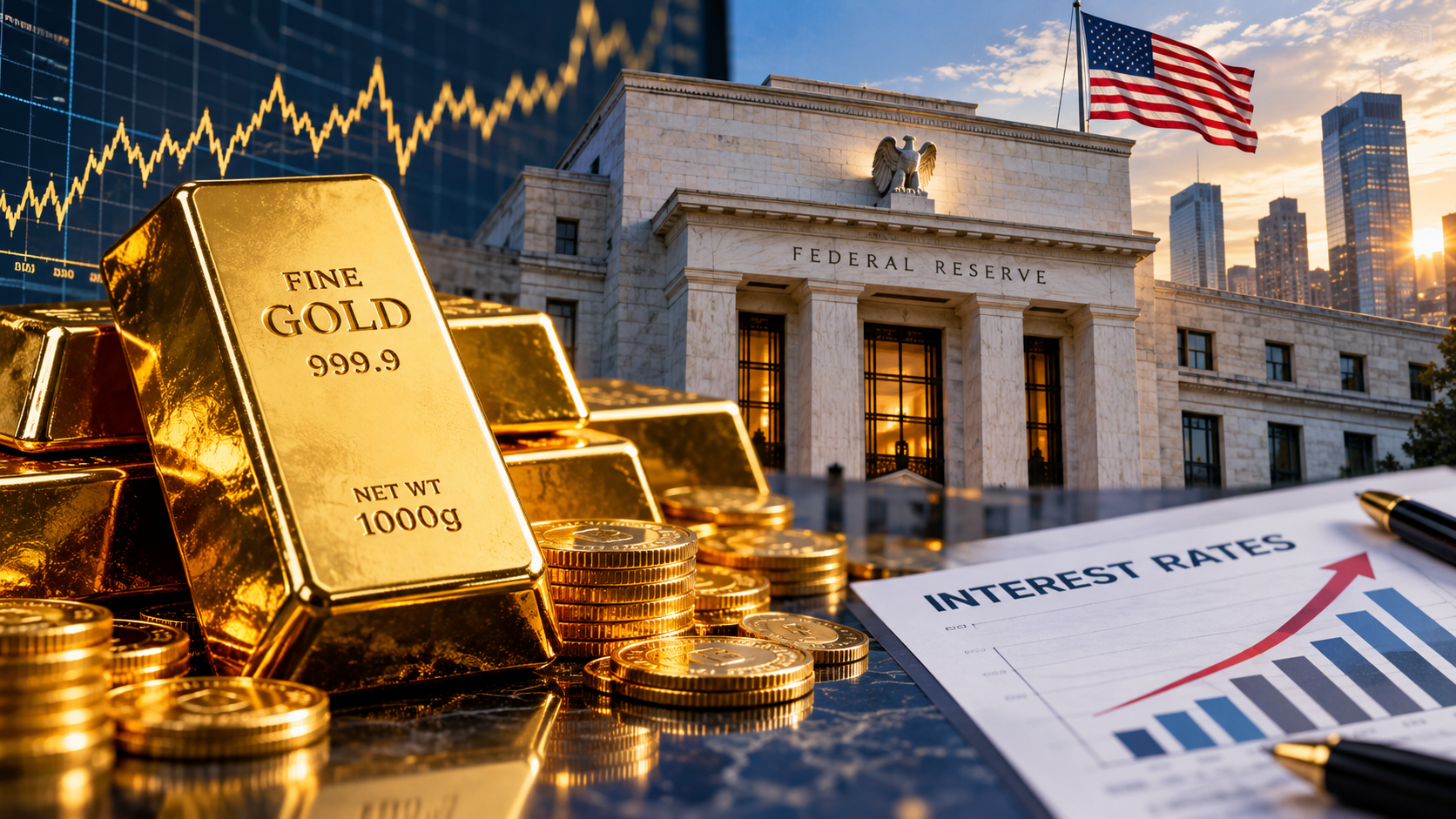
Spot gold traded around $4,020 to $4,035 an ounce on Thursday 29 October, down roughly 1% on the day, and moved briefly close to $3,983 later, according to Kitco’s live quote. Reuters reported bullion on track for a second straight monthly decline. The metal remains roughly 27-28% below its 2026 record of about $5,600, set in late January.
In Pakistan, one local market report put gold at about Rs423,436 per tola on 26 October. Tola prices also depend on the dollar-rupee rate and local premiums, so check the day’s rate.
Why Gold Is Under Pressure
A hawkish Fed hold. The Fed held rates at 3.75%-4.00% on 28 October, but Governor Lisa Cook and Cleveland Fed President Beth Hammack voted for a hike. On Thursday, Reuters reported markets pricing about a 90% chance of a December hike on the CME FedWatch tool.
Strong US data. Q3 GDP grew 3.4% and core PCE inflation rose to 2.5%, per Kitco, reinforcing the case for restrictive policy. The 10-year yield stayed near 5%.
Why this matters for gold. Gold pays no interest, so higher yields raise the opportunity cost of holding it, and a firmer dollar makes it costlier for non-US buyers. TDS strategist Bart Melek called the Fed’s stance a hawkish pause and expects gold to stay vulnerable in a $3,900-$4,250 range; Sucden Financial warned of a possible fall to $3,900.
Spot gold fell to about $4,020-4,035 an ounce on 29 October 2026 as strong US growth (3.4% in Q3) and higher core inflation kept a December Fed rate hike in play. Higher rates raise the opportunity cost of holding gold, which pays no interest.
What Could Push Gold Back Up
- A softer Fed: TDS expects the Fed to eventually turn toward its employment mandate, which could lift gold, though not immediately.
- Geopolitical shocks: Reuters quoted an analyst noting markets are wary of another spike in tensions after the 3 November US midterms.
- Oil, a double-edged factor: an oil spike raises inflation fears and hawkish expectations, which hurts gold in the short run. The same analyst said gold could post a fresh yearly low if oil revisits $120 and above.
Technical Levels Traders Watch
Kitco’s technical commentary points to $4,000 as a pivot, with downside objectives near $4,024 on a break lower and $3,986 beyond, and resistance in the $4,084-$4,146 zone. Treat these as trader reference points, not predictions.
What It Means for Pakistani Buyers
- Dollar-rupee matters as much as the gold price. If the rupee weakens, local gold can stay firm even when dollar gold falls.
- Time horizon. Analysts quoted expect volatility in a range over the coming weeks; long-term holders and short-term traders face different risks.
- Compare with alternatives. With the SBP policy rate at 12%, yield-bearing assets compete with gold for savings.
- Mind premiums and purity. Jewellery carries making charges; bars and coins track the spot price more closely.
Gold is stuck between a hawkish Fed and geopolitical risk. The $4,000 level has become the focus, and the next US inflation data and Iran’s response on the Qatari deal are the nearest catalysts.
Discover more from The Economy
Subscribe to get the latest posts sent to your email.

The Federal Open Market Committee left its target range unchanged at 3.75%-4.00% on Wednesday 28 October, according to Admiral Markets’ FOMC summary. The vote was 10-2. The two dissenters, Governor Lisa Cook and Cleveland Fed President Beth Hammack, wanted to raise rates by 25 basis points. A committee that is split towards tightening rather than easing is a notable shift in tone.
The statement pointed to strong economic growth and elevated inflation. Chair Kevin Warsh said the committee held to gather more information, and he floated cutting the number of rate decisions from eight to six a year, per Trading Economics.
Why the Dissents Matter More Than the Hold
A hold was expected. The significance is the direction of dissent. Two voters wanting a hike signals that part of the committee sees inflation risks, aggravated by energy prices from the Middle East conflict, as large enough to justify tightening now. FXStreet and MUFG Research both framed the outcome as a hold with a hawkish edge, with the committee not explicitly committing to further hikes but not ruling them out.
MUFG’s read is that a December hike remains live, with more of another move priced by March. On Thursday, Reuters reported the CME FedWatch tool showing roughly a 90% chance of a December hike. That pricing, rather than the unchanged rate, is what moved currencies and precious metals around the decision.
The Inflation Problem Is an Energy Problem
The Fed’s challenge is that the inflation pressure is not purely domestic demand. Brent oil has climbed to around $115, a six-month high, as attacks on tankers and Saudi infrastructure keep supply worries alive, and Iran is weighing a Qatari draft deal that could ease or inflame the market depending on the answer. Central banks cannot lower oil prices with interest rates, but they can stop an energy shock from becoming embedded in wages and expectations, which is the argument the hawkish dissenters appear to be making.
Market Reaction
Crude oil barely moved on the decision, according to FXStreet, as traders waited on Iran’s response to the Qatari proposal. Gold slid toward $4,000 an ounce on Thursday after US Q3 growth printed at 3.4% and core PCE at 2.5%, per Kitco, with the 10-year yield near 5%.
What It Means Beyond the US
- Emerging markets: a Fed leaning hawkish tightens global financial conditions and raises the bar for easing elsewhere. Pakistan’s central bank raised its policy rate to 12% two days before the Fed meeting for domestic inflation reasons, but a firmer dollar adds pressure to the rupee.
- Gulf central banks: several Gulf central banks held rates after the decision, since their currencies are pegged to the dollar.
- Asia-Pacific: officials such as RBNZ’s governor have said another hike is plausible if inflation does not ease.
What to Watch Before December
- Inflation data: the next PCE and CPI prints will decide whether the dissenters gain allies.
- Oil: Iran’s reply on the Qatari draft, due by the end of the week, is the biggest swing factor. A deal would remove part of the hawks’ case; a breakdown would strengthen it.
- Chair Warsh’s messaging: his comments on the balance between AI-driven productivity and inflation risk.
- Labour market data ahead of the December meeting.
The Fed held, but the committee is no longer debating how fast to cut. It is debating whether to hike. Unless oil retreats, the December meeting is genuinely open.
Discover more from The Economy
Subscribe to get the latest posts sent to your email.
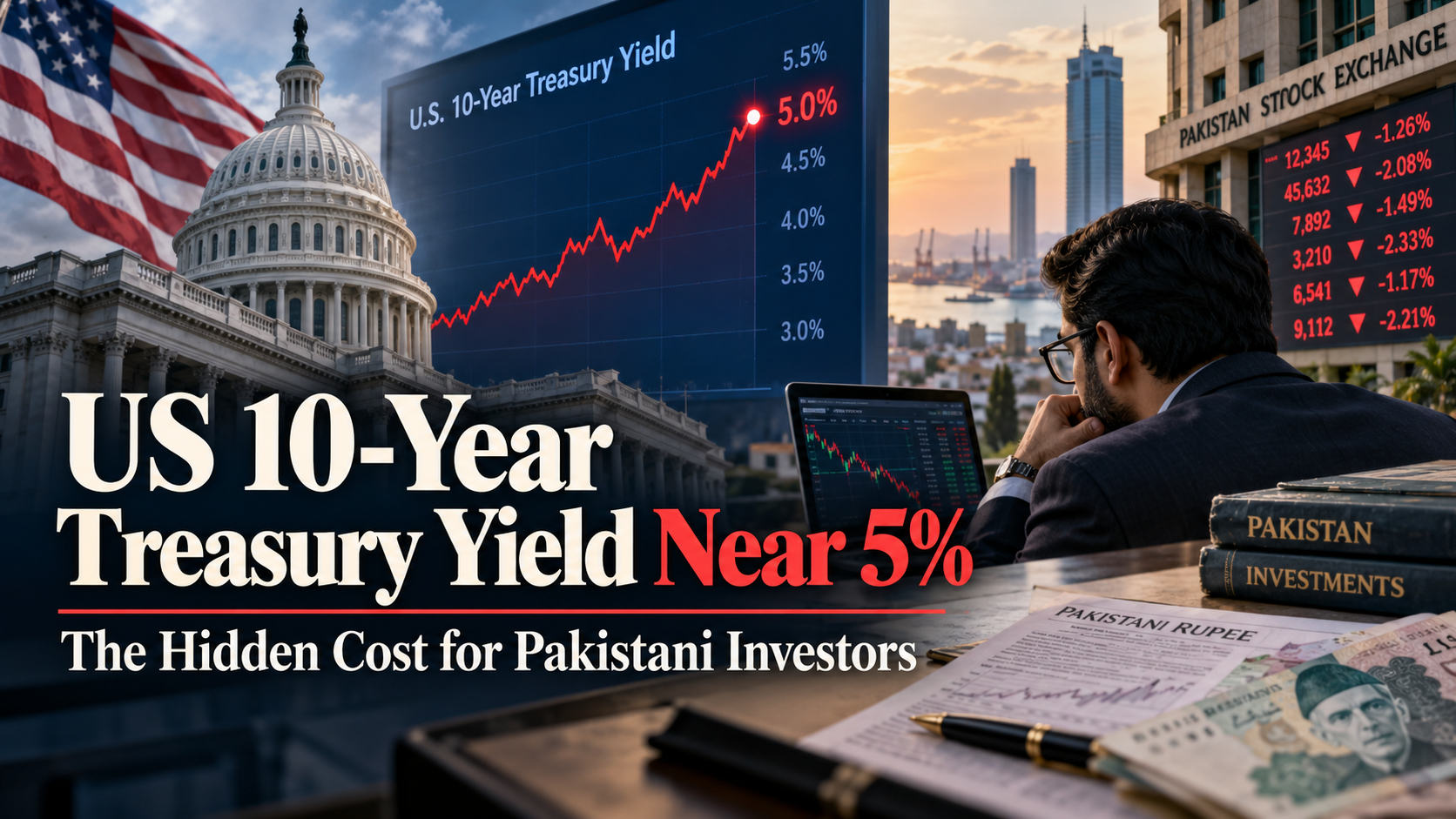
A US government bond can change the required return on a Pakistani investment without a single dollar physically crossing the border. The link runs through a basic idea: when a benchmark asset yields more, investors demand a stronger reason to take additional currency, liquidity and credit risks elsewhere.
The yield on the US 10-year Treasury stood near 5.00% on October 23, 2026, after reaching about 5.24% on October 9, according to historical Treasury-yield data. The user-friendly phrase above 5% should therefore be treated as a description of much of October, not a guaranteed quote for every moment of the latest trading day.
A bond yield is not a savings-account rate
A government-bond yield is the return implied by its market price and promised cash flows, assuming the relevant payment and holding assumptions. When investors sell an existing fixed-coupon bond and its price falls, its yield typically rises. That inverse relationship is central to interpreting the US Treasury market.
The 10-year yield reflects a mixture of expected short-term policy rates, expected inflation and a term premium for holding longer-dated debt. It can fall even while central-bank inflation concerns persist, for example if growth fears rise or investor demand for safe securities strengthens. Reading any single yield move as a pure Fed forecast is a mistake.
Four ways it reaches Pakistan
1. Dollar funding becomes a tougher benchmark. Investors weighing dollar-denominated assets may compare emerging-market returns with those available in US government debt. Pakistani external bonds must compensate for additional sovereign and market risk, although observed spreads change independently of benchmark yields.
2. Currency calculations shift. A domestic bond offering a high rupee yield can still disappoint a foreign investor if depreciation erodes converted returns. For Pakistani investors with future dollar obligations, currency exposure is similarly relevant.
3. Valuations face a higher discount rate. Equity valuations are sensitive to the interest rate used to discount expected future earnings. Companies promising distant profits may be more exposed than businesses generating cash immediately, but there is no perfect sector rule.
4. Sovereign refinancing risk draws scrutiny. Global debt investors assess not only current yields but also how costly it will be for governments to refinance existing obligations. Local T-bills and PIBs are nevertheless priced mainly by Pakistan-specific inflation, liquidity, central-bank policy and credit conditions; US yields do not mechanically set auction cutoffs.
The price-risk example
Imagine a fixed-coupon bond with a duration of seven years. A one-percentage-point increase in yields would imply an approximate 7% price decline, all else equal, using the basic duration approximation. That is not a prediction and not an exact valuation; convexity, yield-curve changes and cash-flow structure matter. It illustrates why holding a bond fund is different from locking in a bank deposit.
Duration risk also works in reverse: bond prices can rise when market yields fall. An investor buying only because the quoted coupon looks attractive may discover later that the resale price has moved against them.
What the latest global backdrop adds
The Federal Reserve raised its policy range to 3.75%–4.00% in September, amid persistent inflation concerns. At the same time, oil-market instability has made imported inflation a more acute concern for Pakistan. The IMF’s October World Economic Outlook forecasts 3.1% world growth for 2026 and highlights downside risks from conflict and financing strains.
This combination means bond yields may be high for reasons that are not benign. A superficially attractive yield could reflect inflation anxiety, fiscal uncertainty or a global risk premium. Investors need to ask why the yield is high, not just how high it is.
A useful comparison table
| Asset | Return quoted in | Main extra risk to examine |
|---|---|---|
| US 10-year Treasury | USD | Duration, inflation, reinvestment |
| Pakistan T-bill | PKR | Domestic rate/inflation, reinvestment |
| Pakistan Investment Bond | PKR | Duration, inflation, liquidity |
| Pakistan dollar bond | USD | Sovereign credit spread, liquidity, duration |
| PSX equity | PKR | Earnings, valuation, currency and market risk |
Currency hedging is not a free lunch
A Pakistani saver comparing foreign-currency investments with domestic government paper must think about more than headline yield. Converting rupees to dollars and back can involve spreads, banking charges, legal requirements and foreign-exchange movement. A hedging instrument, where available and suitable, usually embeds a cost related to interest-rate differences and market conditions. It cannot simply erase currency risk without consequence.
Tax treatment also matters. A quoted yield before withholding tax, custody expense or fund fees is not comparable with an after-tax return from another product. Similarly, a dollar asset can generate a positive dollar return but a different return in rupees. The investor should calculate both if future expenses are split between currencies.
For institutional portfolios, bond duration and liquidity become central. A long-maturity bond may have an attractive yield to maturity but be unsuitable for liabilities due next month. For individuals, the ability to meet an emergency expense without selling at a loss may be worth more than an extra percentage point of advertised return.
The sound comparison is liability-matched, not headline-driven: decide when the money is needed, in what currency and how much market-price movement is tolerable before selecting an asset.
Does a 5% US yield mean Pakistan must offer 5% plus a fixed margin?
No. Each instrument differs in currency, maturity, credit, liquidity and taxation; spreads vary with markets and policy.
Are US Treasuries risk-free?
They are commonly treated as a benchmark for dollar credit risk, but their market prices are not risk-free. Inflation and interest-rate changes can erode purchasing power and resale value.
What should a Pakistani retail investor do first?
List liabilities by currency and timing, then compare instruments on an after-tax, after-inflation and liquidity-adjusted basis. Seek licensed guidance where suitable.
The takeaway: a 5% US benchmark changes the world’s price of patience. Pakistani investors should respond by measuring real cash flows and risks, not by chasing whichever country advertises the biggest nominal yield.
Discover more from The Economy
Subscribe to get the latest posts sent to your email.

Brian Kemp’s Georgia Legacy: Economic Growth, Elections and the Costs of His Policy Choices

Dow Futures vs Dow Jones: What E-mini Contracts Really Tell You Before Wall Street Opens

China Tape Maker Stock Debut: Crown New Materials Soared 787%

Apple’s Earnings Beat Had a Catch: Look Past the Tariff Refund

Social Security Payments in November 2026: The Full Calendar and Two Important Changes

Johor–Singapore SEZ’s $21.8 Billion Bet: The Hard Part Starts Now

China’s 175 Trillion AI Tokens Reveal a Bigger Shift: The AI Boom

The Philippines’ Stagflation Trap: Higher Interest Rates

Alphabet’s $500 Billion Reckoning: Wall Street Is Losing Patience With the AI Boom

4 Reasons Why China’s Trade Concessions to Europe Will Not Solve the Crisis

The AI Revolution Needs Atomic Power. Southeast Asia Is Ready to Build It.

Zhuhai Airshow 2026: How China’s Stealth Jets, Drones and Missiles Are Redrawing Global Air Power

The $8 Billion Runway: China’s Strategic Bet on Guangzhou and the Future of Aviation

The Sandbox Imperium: Why Beijing’s Digital Yuan Needs Hong Kong

Crude Oil & Petroleum Market Analysis: OPEC+ Decisions and Price Forecasts

Top US Convenience Store Chains: Store Counts, EV Charging, and Sales Trends

Social Security Extra $90 Deposit: Who Qualifies for the October 2026 Medicare Rebate?

Gold Price Outlook 2026: The Forces Behind the Forecasts—and What Could Reverse Them

Algorithmic Dogfights: Why the U.S. and China Must Establish Rules of Engagement for Autonomous Air Power

Global Economic Outlook 2026: 7 Forces Reshaping Markets, Trade and Business

Corporate America Faces a New Debt Test as US Borrowing Costs Surge

Stock Market Crash in 2026? Warning Signs, Scenarios and a Calm Investor Checklist

US–Iran Conflict in October 2026: Hormuz, Oil Prices and Diplomacy

Stock Market Today: Dow, S&P 500, and Nasdaq Retreat as Treasury Yields

Geopolitics and Your Portfolio: How International Affairs Move Global Markets

Anthropic Bans Sustained Abuse of Claude AI Under New Usage Policy Effective November 12, 2026

US–China Critical Minerals Competition: Why a Trade Deal Cannot Fix Every Supply Risk

Why Did I Get $90 From Social Security? 8 Reasons Behind an Unexpected SSA Payment
-

 Markets & Finance10 months ago
Top 15 Stocks for Investment in 2026 in PSX: Your Complete Guide to Pakistan’s Best Investment Opportunities
-

 Analysis9 months ago
Johor’s Investment Boom: The Hidden Costs Behind Malaysia’s Most Ambitious Economic Surge
-

 Analysis9 months ago
Top 10 Stocks for Investment in PSX for Quick Returns in 2026
-

 Banks10 months ago
Best Investments in Pakistan 2026: Top 10 Low-Price Shares and Long-Term Picks for the PSX
-

 Analysis9 months ago
Brazil’s Rare Earth Race: US, EU, and China Compete for Critical Minerals as Tensions Rise
-

 Investment10 months ago
Top 10 Mutual Fund Managers in Pakistan for Investment in 2026: A Comprehensive Guide for Optimal Returns
-

 Global Economy10 months ago
15 Most Lucrative Sectors for Investment in Pakistan: A 2025 Data-Driven Analysis
-

 Global Economy10 months ago
Pakistan’s Export Goldmine: 10 Game-Changing Markets Where Pakistani Businesses Are Winning Big in 2025