Business
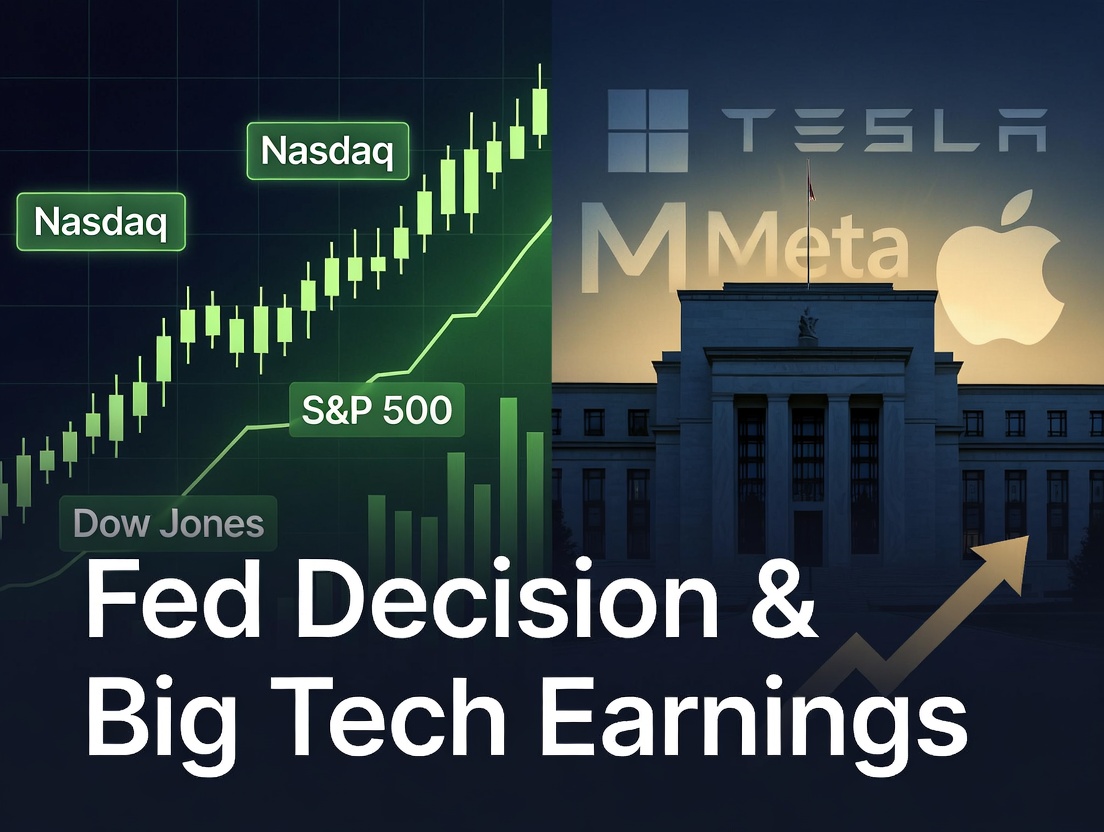
Stock Market Today: Wall Street Rallies Ahead of Fed Decision as Big Tech Earnings Loom
Wall Street opened Wednesday with cautious optimism, as investors positioned for a consequential convergence of monetary policy and corporate earnings that could define the market’s trajectory for months to come. Nasdaq 100 futures rose about 0.5% Yahoo Finance, leading the advance, while S&P 500 futures inched up 0.2% Yahoo Finance. The technology-heavy surge offered a counterpoint to Dow futures, which struggled near the flatline amid sector-specific pressures.
The stock market today reflects a delicate balancing act. The S&P 500 notched a record close on Tuesday of 6,978 Yahoo Finance, placing the benchmark index tantalizingly close to the psychological 7,000 threshold. Yet beneath this surface strength lies a web of uncertainties that few earnings seasons have had to navigate simultaneously: a Federal Reserve caught between political pressure and institutional independence, trillion-dollar questions about artificial intelligence returns, and the specter of policy upheaval at the world’s most powerful central bank.
The Fed Decision: Politics Meets Monetary Policy
Wednesday afternoon’s Federal Reserve announcement marks the central bank’s first rate decision of 2026, and the stakes extend well beyond the expected outcome. CME Group’s Fedwatch tool indicates a 97.2% probability that the Fed will maintain interest rates at the current 3.5% to 3.75% range Stocktwits, effectively pausing the easing cycle that delivered three consecutive quarter-point cuts in the final months of 2025.
The pause itself is unremarkable. What transforms this meeting into a pivotal moment is the extraordinary political backdrop. Earlier this month, the Justice Department served the Fed with subpoenas over testimony Powell made before Congress related to the $2.5bn renovation of the central bank’s headquarters Al Jazeera. In a rare video statement, Powell characterized these moves as pretexts designed to undermine the Fed’s independence, declaring that the threat of criminal charges stemmed from the central bank setting rates based on economic assessment rather than presidential preferences.
The tension between the White House and the Fed has been simmering for months. President Trump has repeatedly called for lower interest rates, even as inflation remains elevated above the Fed’s two percent target. Markets currently expect the Fed to cut once or twice this year — most likely in June and December, according to futures market pricing CNBC. That measured approach stands in sharp contrast to the administration’s more aggressive stance, creating what some economists describe as the most fraught period for central bank independence in modern American history.
According to CNBC, Chair Powell’s press conference will likely become a referendum on Fed autonomy as much as a policy briefing. The question hanging over Wednesday afternoon is whether Powell can navigate this political minefield while maintaining the institutional credibility that underpins effective monetary policy.
Big Tech Earnings: The AI Reckoning Begins
While the Fed commands immediate attention, the real test for equity markets arrives after the closing bell. Microsoft, Meta Platforms, and Tesla report fourth-quarter results Wednesday evening, followed by Apple on Thursday. Collectively, these technology behemoths will provide the first comprehensive read on whether the extraordinary capital expenditures flowing toward artificial intelligence infrastructure are beginning to generate commensurate returns.
The numbers tell a sobering tale of investor expectations. For Microsoft, the expectation is of $3.88 per share in earnings on $80.2 billion in revenues, representing year-over-year growth rates of +20.1% and +15.2% Yahoo Finance. Yet the stock has underperformed recently, pressured by concerns about margin compression as AI-related spending accelerates. Analysts polled by FactSet expect capex to rise to $99 billion this fiscal year CNBC, up substantially from prior periods.
Meta faces perhaps the most acute scrutiny. Analysts expect $8.15 per share in earnings on $58.4 billion in revenues, representing year-over-year growth rates of +1.6% and +20.7% Yahoo Finance. The modest earnings growth belies massive investments in AI and the metaverse. When Meta last reported in October, the stock tumbled despite solid fundamentals, a reaction driven entirely by elevated spending guidance. Investors want clarity on when these investments translate into bottom-line results.
Tesla’s position is equally precarious. The electric vehicle maker faces headwinds from increased competition and margin pressure in its core automotive business, even as it advances autonomous vehicle technology. Apple, meanwhile, must demonstrate that its iPhone supercycle thesis remains intact while addressing questions about its own AI strategy and capital allocation.
Bloomberg reports that the four hyperscalers — Microsoft, Meta, Alphabet, and Amazon — are expected to boost capital expenditures to over $470 billion in 2026 from approximately $350 billion in 2025. That represents an investment surge of historic proportions, predicated on the assumption that artificial intelligence will fundamentally reshape the technology landscape. Whether that thesis proves correct may hinge on the guidance these companies provide this week.
Market Breadth and Underlying Dynamics
The divergence in Wednesday’s pre-market action speaks to broader market tensions. While technology shares lifted Nasdaq futures, the Dow struggled under the weight of sector-specific disappointments. UnitedHealth’s shares tumbled over 15% Yahoo Finance after the Trump administration announced it would keep Medicare payment rates steady, triggering a broader retreat across healthcare insurers.
This uneven performance reflects a market grappling with rotating leadership and uncertain catalysts. The S&P 500’s record close Tuesday marked impressive resilience, yet that strength remains concentrated in a narrow cohort of stocks. The Magnificent Seven technology giants, which once powered market gains with seemingly effortless momentum, have lagged the broader market over the trailing twelve months. Their collective performance through this earnings season will likely determine whether market breadth finally expands or concentration intensifies.
The Path Forward: Scenarios and Implications
As Wednesday’s events unfold, three distinct scenarios emerge. In the first, Powell delivers a dovish hold, signaling patience on rates while emphasizing the Fed’s data-dependent approach. Big Tech earnings meet or exceed expectations, with management teams providing credible paths to AI monetization. Markets rally on reduced uncertainty, and the S&P 500 pushes decisively above 7,000.
The second scenario is less benign. Powell’s press conference devolves into repeated questions about political pressure, undermining confidence in Fed independence. Tech earnings disappoint, or worse, guidance points to continued spending without clear revenue visibility. Volatility spikes as investors reassess both policy support and growth assumptions.
The third possibility splits the difference: The Fed maintains its cautious stance successfully, but tech earnings prove mixed, with some companies demonstrating AI progress while others struggle. Markets digest the results without dramatic moves, entering a period of consolidation as investors await more data.
What seems increasingly clear is that 2026 will test market resilience in ways that 2025’s concentrated leadership never fully addressed. The stock market today stands at an inflection point, caught between political uncertainty, technological transformation, and the timeless challenge of valuation. How these forces resolve may well determine whether this year’s market narrative proves triumphant or cautionary.
Discover more from The Economy
Subscribe to get the latest posts sent to your email.
Analysis
US Economy Sheds 92,000 Jobs in February in Sharp Slide
The February 2026 jobs report delivered the starkest labor market warning in months: nonfarm payrolls fell by 92,000 — far worse than any forecast — as federal workforce cuts, a major healthcare strike, and mounting AI-driven layoffs converged into a single, bruising data point.
The American jobs machine didn’t just stall in February. It reversed. The U.S. Bureau of Labor Statistics reported Friday that nonfarm payrolls dropped by 92,000 last month — a miss so severe it nearly doubled the worst estimates on Wall Street, which had penciled in a modest gain of 50,000 to 59,000. The unemployment rate climbed to 4.4%, up from 4.3% in January, marking the highest reading since late 2024.
The February 2026 jobs report doesn’t arrive in a vacuum. It lands at a moment of compounding economic pressures: a Federal Reserve frozen in a “wait-and-see” posture, geopolitical oil shocks from a new Middle East conflict, tariff uncertainty reshaping corporate hiring plans, and a relentless wave of AI-driven workforce restructuring. The convergence of all these forces — punctuated by what one economist called “a perfect storm of temporary drags” — produced a headline number that markets could not dismiss.
Equity futures reacted with immediate alarm. The S&P 500 fell 0.8% and the Nasdaq dropped 1.0% in the minutes after the 8:30 a.m. ET release. The 10-year Treasury yield retreated four basis points to 4.11% as investors rushed into safe-haven bonds, while gold rose 1% and silver 2%. WTI crude oil surged 6.2% to $86 per barrel, adding another layer of stagflationary pressure that complicates the Fed’s already knotted path.
What the February 2026 Nonfarm Payrolls Data Actually Shows
The headline figure — a loss of 92,000 jobs — is striking enough. But the full picture from the BLS Employment Situation report is considerably darker once the revisions are accounted for.
December 2025 was revised downward by a stunning 65,000 jobs, swinging from a reported gain of 48,000 to a loss of 17,000 — the first outright contraction in months. January 2026 was nudged down by 4,000, from 130,000 to 126,000. In total, the two-month revision erased 69,000 jobs from prior estimates. The three-month average payroll gain now stands at approximately 6,000 — essentially statistical noise. The six-month average has turned negative for the fourth time in five months.
“After lackluster job gains in 2025, the labor market is coming to a standstill,” said Jeffrey Roach, chief economist at LPL Financial. “I don’t expect the Fed to act sooner than June, but if the labor market deteriorates faster than expected, officials could cut rates on April 29.”
Sector Breakdown: Where the Jobs Disappeared
| Sector | February Change | Context |
|---|---|---|
| Health Care | –28,000 | Kaiser Permanente strike (31,000+ workers) |
| Manufacturing | –12,000 | Missed estimate of +3,000 |
| Information | –11,000 | AI-driven restructuring, 12-month trend |
| Transportation & Warehousing | –11,000 | Demand softening |
| Federal Government | –10,000 | Down 330,000 (–11%) since Oct. 2024 peak |
| Local Government | –1,000 | Partially offset by state gains |
| Social Assistance | +9,000 | Individual and family services (+12,000) |
The health care sector’s reversal is perhaps the most analytically significant. For much of 2025 and early 2026, health care was the single pillar keeping the headline payroll numbers out of outright contraction territory. In January it added 77,000 jobs. In February it shed 28,000 — a 105,000-job swing — primarily because a strike at Kaiser Permanente kept more than 30,000 nurses and healthcare professionals in California and Hawaii off the payroll during the BLS survey reference week. The labor action ended February 23, meaning the jobs will likely reappear in the March data, but the strike’s timing could not have been worse for February’s optics.
Federal government employment, meanwhile, continues its historic contraction. Federal government employment is down 330,000 jobs, or 11%, from its October 2024 peak Fox Business, a decline driven by the Trump administration’s aggressive reduction-in-force campaign. President Trump’s efforts to pare federal payrolls has seen a slide of 330,000 jobs since October 2024, a few months before Trump took office. CNBC
Manufacturing’s 12,000-job loss underscores the squeeze that elevated borrowing costs and trade-policy uncertainty are placing on goods-producing industries. Transportation and warehousing losses of 11,000 suggest logistics networks are already adjusting to softer demand expectations. The information sector’s 11,000-job decline continues a 12-month trend in which the sector has averaged losses of 5,000 per month — a structural signal, not a cyclical one, as artificial intelligence reshapes the contours of knowledge-work employment.
The Wage Paradox: Hot Pay, Cold Hiring
In an economy where the headline is undeniably weak, one data point stands out as paradoxically stubborn: wages.
Average hourly earnings increased 0.4% for the month and 3.8% from a year ago, both 0.1 percentage point above forecast. CNBC That combination — deteriorating employment alongside above-expectation wage growth — is precisely the stagflationary profile that gives the Federal Reserve its greatest headache. The Fed cannot simply cut rates to rescue the labor market if doing so risks reigniting the price pressures it has spent three years fighting.
The wage story is also deeply unequal. While higher-income wage growth rose to 4.2% year-over-year in February, lower- and middle-income wage growth slowed to 0.6% and 1.2% respectively — the largest gap since the beginning of available data. Bank of America Institute An economy where the well-paid are getting paid more while everyone else sees real-wage stagnation is not a healthy one, regardless of what the aggregate number says.
The household survey — which provides the unemployment rate and tends to be more sensitive to true labor-market stress — painted an even grimmer portrait. That portion of the report indicated a drop of 185,000 in those reporting at work and a rise of 203,000 in the unemployment level. CNBC The broader U-6 measure of underemployment, which includes discouraged workers and those involuntarily working part-time, came in at 7.9%, down 0.2 percentage points from January — a modest offset to the headline deterioration.
The Federal Reserve’s Dilemma
What the Jobs Report Means for Rate Cuts
Following the payrolls report, traders pulled forward expectations for the next cut to July and priced in a greater chance of two cuts before the end of the year, according to the CME Group’s FedWatch gauge of futures market pricing. CNBC
The Federal Reserve has been navigating a uniquely treacherous policy landscape. After cutting the federal funds rate to its current range of 3.50%–3.75%, it paused its easing cycle in early 2026 as inflation remained sticky above the 2% target and layoffs — despite slowing hiring — failed to produce the labor-market slack needed to justify further accommodation.
Fed Governor Christopher Waller said earlier in the morning that a weak jobs report could impact policy. “If we get a bad number, January’s revised down to some really low number… the question is, why are you just sitting on your hands?” Waller said on Bloomberg News. CNBC Waller has been among the minority of FOMC members pressing for near-term cuts. Friday’s data gave him considerably more ammunition.
San Francisco Fed President Mary Daly offered a characteristic note of caution. “I think it just tells us that the hopes that the labor market was steadying, maybe that was too much,” Daly told CNBC. “We also have inflation printing above target and oil prices rising. How long they last, we don’t know, but both of our goals are in our risks now.” CNBC
That dual-mandate tension — maximum employment under pressure, price stability still elusive — defines the central bank’s predicament heading into its next meeting.
Atlanta Fed GDPNow: A Warning Already Flashing
The jobs report doesn’t arrive as a surprise to those tracking the Atlanta Fed’s real-time growth model. The GDPNow model estimate for real GDP growth in the first quarter of 2026 was 3.0% on March 2 Federal Reserve Bank of Atlanta — a figure that already reflected softening in personal consumption and private investment. Critically, that pre-report estimate has not yet incorporated February’s job losses; Friday’s data will almost certainly pull the Q1 nowcast lower.
GDPNow had recently dropped to as low as –2.8% earlier in the current tracking period before recovering Charles Schwab, suggesting the model’s directional trajectory was already pointing toward deceleration even before the payroll shock. Whether the updated estimate breaks below zero again will be closely watched as a leading indicator of recession risk.
Is This a Recession Signal? A Closer Look
Temporary Shocks vs. Structural Deterioration
The intellectual debate emerging from Friday’s report centers on one critical distinction: how much of the 92,000-job loss is temporary, and how much is the economy genuinely breaking down?
The case for temporary distortion is real. Jefferies economist Thomas Simons called the result “a perfect storm of temporary drags coming together following an above-trend print in January.” CNBC The Kaiser Permanente strike alone subtracted roughly 28,000 to 31,000 jobs from the headline. Severe winter weather further depressed activity in construction and outdoor industries during the survey week. Both factors should partially reverse in March.
But the case for structural concern is equally compelling. “Looking through the weather-impacted sectors and the strike, which ended on February 23, this is still a poor jobs number,” Simons added. CNBC Strip out the healthcare strike and winter-weather effects and the underlying number is still deeply soft. Manufacturing lost 12,000 jobs without a weather excuse. Federal employment continues its unprecedented contraction. And the information sector’s ongoing slide reflects not a seasonal disruption but a multi-year rearchitecting of how corporations use labor in an age of generative AI.
“Still, the pace of job gains over the last few months is still dramatically slower than it was in 2024 and much of 2025 — this is going to make it harder for the Fed to sell the labor market stabilization narrative that’s been used to justify patience on further rate cuts. Add higher oil prices given conflict in the Middle East and renewed tariff uncertainty to the convoluted jobs market story, and you have a tricky, stagflationary mix of risks in the backdrop for the Fed,” Fox Business said one Ausenbaugh of J.P. Morgan.
What Happens Next: A Scenario Framework
Scenario A — Temporary Bounce-Back (Base Case): The Kaiser strike’s resolution and a weather reversal produce a March payroll rebound of 100,000–150,000. The Fed stays on hold through June, inflation data cools, and markets stabilize. Probability: ~45%.
Scenario B — Protracted Weakness (Risk Case): Federal workforce contraction deepens, manufacturing continues shedding jobs, and the three-month average payroll trend falls below zero outright. The Fed cuts rates in June or earlier. Recession risk climbs above 35%. Probability: ~35%.
Scenario C — Stagflationary Spiral (Tail Risk): Wage growth remains above 3.5%, oil sustains above $85, and tariff escalation drives goods-price inflation back above 3%. The Fed is paralyzed, unable to cut despite labor market deterioration. Dollar strengthens. Equity markets re-price earnings estimates lower. Probability: ~20%.
Global Ripple Effects
How the February 2026 US Jobs Report Moves the World
A weakening US labor market is not a domestic story. It travels — through capital flows, trade volumes, currency markets, and commodity demand — to every corner of the global economy.
Europe: The euro-area economy, which has been cautiously recovering from the energy crisis of 2023–2024, now faces the prospect of a softer US import demand picture just as its own manufacturing sector had begun to stabilize. The European Central Bank, which has already cut rates further than the Fed, finds its policy divergence potentially narrowing. A weaker dollar would provide some export-competitiveness relief to European firms, but it would also reduce the purchasing power of European consumers of dollar-denominated commodities like oil — of which Friday’s $86 WTI price is already a concern.
China and Emerging Markets: Beijing, which has been engineering its own modest stimulus program to stabilize growth at around 4.5%, will watch the US labor deterioration with some ambivalence. A slowing American consumer is a headwind for Chinese export sectors, particularly electronics, consumer goods, and industrial equipment. For dollar-denominated debt holders in emerging markets, however, any shift toward a weaker dollar — if the Fed is eventually forced to cut — would provide meaningful relief on debt-servicing costs.
Travel and Hospitality: The leisure and hospitality sector saw no notable job gains in February, continuing a pattern of stagnation in an industry still recalibrating from post-pandemic normalization. Expedia Group and other travel industry bellwethers will be monitoring whether consumer spending resilience — which has so far been concentrated among upper-income earners — can sustain international travel demand even as lower- and middle-income households face real-wage erosion. The risk is a bifurcated travel economy: business-class cabins full while economy-seat bookings slow.
The Bigger Picture: A Labor Market in Structural Transition
Zoom out far enough and February’s number is less a sudden rupture than the clearest confirmation yet of a trend that has been building for 18 months. Total nonfarm employment growth for 2025 was revised down to +181,000 from +584,000, implying average monthly job gains of just 15,000 — well below the previously reported 49,000. TRADING ECONOMICS An economy adding 15,000 jobs per month on average is not expanding its workforce in any meaningful sense; it is essentially flatlining.
Three structural forces are doing the work that cyclical headwinds once did:
Federal workforce reduction is real, large, and accelerating. A loss of 330,000 federal jobs since October 2024 is not a rounding error — it is a deliberate political restructuring of the size of the American state, with multiplier effects on contractors, lobbyists, lawyers, consultants, and the entire ecosystem of the Washington metropolitan area and beyond.
AI-driven labor displacement is moving from theoretical to measurable. The information sector’s 12-month average loss of 5,000 jobs per month reflects an industry actively substituting machine intelligence for human workers. Jack Dorsey’s announcement that Block would cut 40% of its payroll due to AI — cited in pre-report previews — was emblematic of a boardroom trend spreading well beyond Silicon Valley.
Healthcare dependency has masked the underlying weakness for too long. “One of the things that is very interesting-slash-potentially problematic is that we have almost all the growth happening in this health care and social assistance sector,” CNBC said Laura Ullrich of the Federal Reserve Bank of Richmond. When the single sector sustaining your jobs headline goes on strike, the vulnerability of the entire superstructure is suddenly visible.
Key Data Summary
| Indicator | February 2026 | January 2026 | Consensus Estimate |
|---|---|---|---|
| Nonfarm Payrolls | –92,000 | +126,000 (rev.) | +50,000–59,000 |
| Unemployment Rate | 4.4% | 4.3% | 4.3% |
| Avg. Hourly Earnings (MoM) | +0.4% | +0.4% | +0.3% |
| Avg. Hourly Earnings (YoY) | +3.8% | +3.7% | +3.7% |
| U-6 Underemployment | 7.9% | 8.1% | — |
| Dec. 2025 Revision | –17,000 | Prior: +48,000 | — |
| 10-Year Treasury Yield | 4.11% | ~4.15% | — |
| S&P 500 Futures | –0.8% | — | — |
The Bottom Line
February’s employment report is not a definitive verdict on the American economy. One month of data — distorted by a strike and abnormal weather — does not make a recession. But it does something arguably more important: it forces a serious reckoning with the possibility that the “stable but slow” labor market narrative that policymakers have been selling since mid-2025 was always more fragile than it appeared.
The Federal Reserve is now caught in a policy bind that will define the next six months of market psychology. Cut too soon and you risk re-igniting inflation in an economy where wages are still growing at 3.8%. Cut too late and you risk allowing a soft landing to become a hard one. The Fed’s March meeting was always going to be consequential. After Friday morning, it is indispensable.
The March jobs report — due April 3 — will be the next critical data point. If the healthcare bounce-back materializes and weather-related distortions reverse, the February number may be remembered as a noisy outlier. If it doesn’t, the conversation shifts from “when does the Fed cut?” to “can the Fed cut fast enough?”
For the full BLS Employment Situation data tables, visit bls.gov. For Atlanta Fed GDPNow real-time Q1 2026 tracking, see atlantafed.org.
Discover more from The Economy
Subscribe to get the latest posts sent to your email.
Analysis
How the Iran Conflict Has Rattled Global Energy Markets: Tehran’s Grip on the Strait of Hormuz Fuels Worldwide Disruptions
Explore how the 2026 Iran conflict and Strait of Hormuz disruptions are shaking global energy markets, with real-time price surges, supply chain breakdowns, and what comes next for oil, LNG, and the global economy.
For decades, energy analysts have marked the Strait of Hormuz in red on their risk maps — a narrow, 21-mile-wide corridor threading between Iran and Oman through which roughly one-fifth of the world’s oil flows every single day. The scenario they feared most has now arrived. In the span of four days, the Iran conflict global energy markets have been dreading has become a full-blown reality: a waterway that underpins the price of everything from gasoline in Ohio to heating bills in Hamburg to factory output in Guangdong has effectively gone dark.
The catalyst was swift and seismic. A coordinated US-Israeli air campaign launched in late February struck Iranian military and governmental targets with precision, killing Supreme Leader Ali Khamenei. Tehran’s response — retaliatory strikes, naval mobilization, and the threat of asymmetric warfare — has choked off one of the most critical chokepoints in the global trading system. As of March 3, 2026, the Strait of Hormuz blockade effects on oil supply are being felt from Houston to Hanoi. The question now is not whether this hurts — it manifestly does — but how long the pain lasts, and whether the world’s energy architecture can absorb a shock of this magnitude.
The Strategic Chokepoint: Strait of Hormuz Under Siege
To understand why markets have responded with such alarm, consider the geometry. The Strait of Hormuz — barely navigable by supertankers at its narrowest — is not just another shipping lane. It is the jugular vein of global petroleum trade. Approximately 20 million barrels of crude oil pass through it daily, alongside roughly 20% of the world’s liquefied natural gas exports, primarily from Qatar’s colossal North Field operations.
When Iranian naval and missile assets make that corridor too dangerous to traverse, the downstream consequences are near-instantaneous. Tanker insurance premiums — already elevated heading into the crisis — have spiked by multiples. Several major shipping operators have suspended transits entirely. Qatar’s LNG export terminals, operating under threat posture, have curtailed loading. Iraqi oil flowing south through Basra faces disruption. Even Saudi Arabia’s eastern oil fields and their Red Sea-bound pipelines are operating under emergency protocols.
Bloomberg reported that this threatens to be the worst disruption in global gas markets since Russia’s 2022 invasion of Ukraine — a benchmark that, in energy policy circles, carried nearly apocalyptic connotations. That comparison is sobering: the 2022 shock rewired European energy infrastructure, sent utilities to the brink, and triggered a continent-wide scramble for alternative supply that lasted years.
This time, the geographic scope may be even wider.
Surging Prices and Supply Shocks: The Numbers Don’t Lie
Markets have reacted with textbook crisis reflexes, but the scale is striking. As CNBC’s coverage of Strait of Hormuz global oil and gas trade disruptions documented, Brent crude — the global benchmark — surged between 7% and 13% in the first 72 hours of the closure, settling in a range of $80–$83 per barrel as of this writing. That represents a significant re-pricing of risk, though it still sits below the $100-plus levels that analysts warn could materialize if the disruption extends beyond a week.
The downstream effects are already visible at the consumer level:
| Energy Metric | Pre-Conflict Level | Current Level (Mar 3, 2026) | Change |
|---|---|---|---|
| Brent Crude ($/barrel) | ~$72–$74 | $80–$83 | +7–13% |
| US Regular Gasoline ($/gallon) | ~$2.78 | Above $3.00 | +8–10% |
| European TTF Natural Gas (€/MWh) | ~€38 | €46–€49 | +20–30% |
| LNG Spot Prices ($/MMBtu) | ~$11–$12 | ~$14–$16 | +25–35% |
| Global Dry Bulk Shipping Index | Elevated | All-time high | Record |
Sources: Reuters, Bloomberg, CNBC, BBC Energy Desk, March 2026
For American motorists, the gasoline price crossing the psychologically and politically significant $3-per-gallon threshold is an unwelcome reminder that Middle East instability has never been truly distant from the US domestic economy — whatever the strategic independence afforded by shale production. The US Strategic Petroleum Reserve (SPR), partially restocked after the 2022 drawdowns, offers some buffer, but its release would be a political decision as much as an economic one, carrying its own messaging risks amid an ongoing military operation.
European natural gas futures have borne perhaps the sharpest repricing. The continent entered 2026 with storage levels modestly above seasonal averages, but that cushion looks thinner now. Qatar’s LNG — which Europe came to depend on heavily post-Ukraine — has seen loading disruptions, and the timing, still technically late winter, is painfully inconvenient.
Geopolitical Ripples Across Asia and Europe
If the financial mathematics are stark, the geopolitical algebra is even more complex. The Iran conflict global energy market disruption does not affect all nations equally, and the asymmetries matter enormously for diplomatic positioning.
Asia: Maximum Pain, Minimum Leverage
Asia, bluntly, is where this crisis hits hardest. Japan, South Korea, India, and China collectively import a staggering share of their crude oil through the Strait of Hormuz. For Japan and South Korea — both US security allies with negligible domestic production — there is almost no realistic near-term alternative. Their refineries are calibrated for Gulf crude grades; switching supply origin is neither fast nor cheap.
China’s position is particularly nuanced. Beijing imports approximately 40–45% of its crude through Hormuz, and it has long maintained energy relationships with Tehran as a hedge against Western-dominated supply chains. The death of Khamenei and the subsequent power vacuum in Tehran create genuine uncertainty for Chinese planners who valued predictable, if troubled, Iranian partnerships. Xi Jinping faces a situation where condemning the US-Israeli operation risks straining Washington relations at a sensitive moment in trade negotiations, while staying silent signals acquiescence to an action that directly threatens Chinese energy security. Expect Beijing’s diplomatic communications to be measured, multilateral in framing, and ultimately self-interested.
India, for its part, has in recent years secured significant discounts on Russian oil routed around Western sanctions. But the Hormuz disruption is a different problem — it affects the physical movement of tankers, not just pricing arrangements. New Delhi’s government will be watching carefully, managing both inflation risks and the political optics of being seen as dependent on a conflict-ridden supply corridor.
Europe: Higher Bills and Harder Choices
BBC coverage of the crisis noted that gas and oil prices have surged while shares tumble as the crucial shipping lane faces closure — a headline that captures the dual squeeze European governments are navigating. Higher energy costs feed directly into headline inflation, complicating the European Central Bank’s already delicate balancing act between growth support and price stability.
For European consumers, the how Iran war rattles energy supply chains dynamic is not abstract. It means higher heating bills, elevated transport costs, and broader inflationary pressure across supply chains still recovering from the 2022–2024 energy shock cycle. Industrial users — particularly energy-intensive sectors like chemicals, glass, and aluminum smelting — face margin compression that could accelerate the ongoing debate about European industrial competitiveness.
On the geopolitical dimension, European governments that have been cautious about the Iran military operation will now face domestic pressure to publicly distance themselves from a conflict that is directly raising their citizens’ energy costs. This creates awkward dynamics within NATO and the broader Western alliance.
Tehran’s Influence: More Than Just Oil
It would be reductive to frame the Tehran influence on Strait of Hormuz shipping disruptions as purely a petroleum story. The closure — or even the credible threat of closure — of the strait weaponizes Iran’s geographic position in ways that outlast any individual political leadership. Khamenei may be gone, but the Revolutionary Guard’s naval assets, the Houthi proxy networks in Yemen, and the broader architecture of Iranian asymmetric capability remain operational.
The Guardian’s analysis highlighted what disrupting the strait could mean for global cost-of-living pressures — and the answer is: considerably more than just expensive gasoline. Shipping rate spikes propagate through entire supply chains. When it costs dramatically more to move a supertanker from Ras Tanura to Yokohama, those costs eventually appear in manufacturing inputs, finished goods, and ultimately consumer prices across dozens of economies.
There is also the LNG dimension. Global LNG shortages from the Iran crisis represent a newer and in some ways more structurally significant threat than the oil disruption. The 2026 global LNG market is tighter than in previous years, with demand growth from Asia consistently outpacing new supply project completions. A sustained Qatari export curtailment — even partial — would stress-test every LNG supply contract and spot market simultaneously.
Market Forecasts and Mitigation Strategies
What happens next depends on variables that analysts model but cannot predict: the duration of the closure, the trajectory of Iranian political succession, US military objectives, and the diplomatic space available to regional actors like Saudi Arabia, the UAE, and Oman.
The Bull Case for Oil Prices
If the Strait of Hormuz remains effectively closed for two weeks or more, the consensus emerging from energy desks at major banks and trading houses is that $100-per-barrel oil becomes a base case, not a tail risk. Some models, incorporating production halt cascades from Iraq and Kuwait (whose eastern export routes are also affected), project spikes toward $110–$120 under sustained disruption. At those levels, the global economy faces a stagflationary headwind not seen since 2008: energy-driven inflation colliding with weakening consumer sentiment and tightening financial conditions.
Mitigation Levers
The strategic response toolkit is familiar if imperfect. The International Energy Agency (IEA) member countries collectively hold strategic reserves designed for exactly this contingency; a coordinated release announcement would likely exert immediate downward pressure on futures prices, even if physical supply relief takes weeks to materialize. The US has already signaled readiness to tap the SPR; whether European nations coordinate through IEA mechanisms will be a test of multilateral energy governance.
OPEC+ nations with spare capacity — primarily Saudi Arabia and the UAE, whose production is already disrupted but whose political calculus may favor market stabilization — face an unusual situation: production increases that would typically benefit them financially are constrained by the same conflict that is creating the price opportunity. Saudi Aramco’s Ras Tanura complex, facing regional threat postures, cannot easily increase output it cannot export.
Meanwhile, US LNG exporters have received a windfall in the form of soaring spot prices, and American shale producers are accelerating permitting and rig deployments. But the timelines for meaningful new supply are measured in months, not days.
The Long View: Energy Transition in a Conflict World
There is a bitter irony embedded in the current crisis that energy economists are already noting. The global energy transition — the multi-decade shift toward renewables, battery storage, and electrification — has been partly justified on energy security grounds: reducing dependence on volatile petrostates and conflict-prone regions. Yet in 2026, most of the world’s major economies remain profoundly exposed to exactly the kind of Hormuz disruption that renewables advocates have long cited as justification for faster transition.
The crisis will almost certainly accelerate certain policy decisions. European governments will fast-track offshore wind permitting and battery storage investment, citing Hormuz as a national security imperative. Asian economies will revisit nuclear energy timelines. The US will likely see renewed political support for both domestic production and clean energy infrastructure — an unusual alignment of typically opposing interests.
But transitions take decades. In the meantime, the world runs on oil and gas, and a 21-mile strait still holds the global economy partly hostage to the decisions of actors thousands of miles from the financial capitals that price that risk.
Conclusion: The Price of Dependence
Four days into the Strait of Hormuz closure, the full economic damage remains incomplete and still accumulating. What is already clear is that the Iran conflict’s global energy market impact is neither a blip nor a manageable disruption — it is a structural stress test exposing vulnerabilities that years of relative stability had obscured.
Brent crude at $80+ may feel manageable compared to historical peaks. But the trajectory matters more than the current level. If Iranian political succession proves chaotic, if proxy forces escalate in Yemen or Iraq, if the strait closure extends into weeks rather than days, the $100 threshold is not a worst-case scenario — it is a median one.
For policymakers, the coming weeks demand both tactical crisis management and strategic honesty. SPR releases buy time; they do not buy energy independence. The world has known for decades that its dependence on a 21-mile waterway was a systemic risk. The 2026 Iran crisis is not a surprise. It is a reckoning.
Sources:
- Reuters: Global energy prices soar as Iran crisis disrupts shipping
- Bloomberg: Iran Crisis Threatens Worst Gas Market Disruption Since 2022
- CNBC: Strait of Hormuz Global Oil, Gas Trade Disrupted Amid Iran War
- BBC: Gas and oil prices soar and shares tumble as crucial shipping lane threatened
- The Guardian: What disrupting the Strait of Hormuz could mean for global cost-of-living pressures
Discover more from The Economy
Subscribe to get the latest posts sent to your email.
Analysis
PSX Bloodbath: KSE-100 Plunges 16,089 Points in Historic Single-Day Crash
The KSE-100 index collapsed 9.57% on March 2, 2026 — its worst-ever single-day absolute loss — as US-Israel strikes on Iran triggered a PSX bloodbath, oil shock, and global market panic. Here’s the full breakdown.
Key Facts at a Glance
| Metric | Value |
|---|---|
| KSE-100 Closing Value (Mar 2, 2026) | 151,972.99 |
| Points Lost (Single Day) | 16,089.17 |
| Percentage Decline | 9.57% |
| Intraday Low | 151,747.96 |
| Circuit Breaker Triggered | 9:22 AM PKT |
| Brent Crude (Day’s High) | ~$82.00/barrel |
| Gold | $5,327/oz (+1%) |
| Previous Close (Feb 28) | 168,062.17 |
| Drawdown from Jan 2026 Peak | ~19% |
It began not with the opening bell, but with silence — the particular, loaded silence of traders staring at screens as the world they priced for had, overnight, become a different one entirely. By 9:22 on a Monday morning in Karachi, the Pakistan Stock Exchange had effectively declared an emergency, triggering a mandatory trading halt after the benchmark KSE-100 index plummeted 15,071 points — nearly 9% — in less than half an hour of trading. When markets finally closed, the KSE-100 had shed 16,089 points to settle at 151,972.99, a decline of 9.57% that constitutes the worst absolute single-day loss in the exchange’s history.
This was no ordinary correction. This was the market’s verdict on a new and dangerous world.
The Trigger: When Washington and Tel Aviv Changed the Calculus
The proximate cause was a seismic geopolitical event that investors had feared but hoped would remain theoretical. Over the weekend of February 28–March 1, 2026, the United States and Israel launched what the White House described as “major combat operations” in Iran, reportedly killing Supreme Leader Ayatollah Ali Khamenei in the opening strikes. Tehran’s response was swift and broad: retaliatory missile barrages targeting US military installations across the Gulf, with blasts reported in the UAE, Qatar, Bahrain, Kuwait, Jordan, and Saudi Arabia.
Dubai International Airport was briefly engulfed in chaos, with footage showing people fleeing a smoke-filled passageway as Iran’s missile salvos — mostly intercepted — sent shockwaves through Gulf infrastructure. President Trump, characteristically blunt, suggested the campaign could last another four weeks.

For energy markets, the threat to the Strait of Hormuz was the true horror. Roughly 15 million barrels of crude oil per day — approximately 20% of the world’s total oil supply — transit the Strait daily, making it the planet’s most consequential energy chokepoint. Marine tracking sites showed tankers piling up on either side, unable to obtain insurance for the voyage. Brent crude surged 9% to $79.41 a barrel in early Monday trading, while West Texas Intermediate climbed 8.6% to $72.79 — the steepest single-day energy price spike since the brief Israel-Iran war of 2025.
The PSX Collapse: Anatomy of a Historic KSE-100 Plunge
Pakistan, as a major net oil importer and a nation whose western border already simmers with Afghan tensions, sits at an especially exposed node in this crisis network. The market did not wait for analysis.
The benchmark index closed at 151,972.99, plunging 16,089.17 points or 9.57% in a single session. It traded within a wild intraday range of 7,580 points, recording a high of 159,328.59 and a low of 151,747.96, reflecting extreme volatility throughout the session. Total trading volume surged to 479.70 million shares.
Monday’s decline marks the KSE-100’s highest-ever single-day fall in absolute terms. Historically, the largest percentage decline was on June 1, 1998 at 12.4%, but due to the lower base of the index at that time, it does not rank in the top ten for absolute point drops. Today’s crash, in sheer numerical magnitude, stands alone.
The circuit breaker fired at 9:22 AM after the KSE-30 fell 5% from its previous close. Following the resumption of trading around 10:22 AM, strong recovery momentum briefly emerged, pushing the index more than 6,000 points higher from its intraday floor — before selling pressure re-emerged and erased those gains.
Market breadth told a brutal story: of the 100 index companies, only one closed higher, 98 declined, and one remained unchanged. The heaviest individual drags were Fauji Fertilizer Company (-1,595 pts), UBL (-1,301 pts), Engro Holdings (-886 pts), Hub Power (-718 pts), and Meezan Bank (-681 pts).
Sector Damage (Index Points Lost):
| Sector | Points Eroded |
|---|---|
| Commercial Banks | 5,031.81 |
| Fertilizer | 2,192.22 |
| Oil & Gas Exploration | 1,715.57 |
| Cement | 1,428.11 |
| Investment Companies/Securities | 982.42 |
Pakistan’s Particular Vulnerability
Why did Karachi suffer so much more than London, Frankfurt, or New York? The answer is structural, not merely psychological.
Pakistan imports the vast majority of its energy needs. Every $10 rise in the per-barrel price of crude translates to roughly $2.5 billion in additional annual import costs — a meaningful sum for an economy currently navigating IMF-supervised stabilisation. Analysts were quick to connect the dots: “Elevated oil prices are highly detrimental to Pakistan’s external account, and persistently high commodity prices are likely to trigger a new wave of inflation,” said Waqas Ghani, Head of Research at JS Global.
The country was already navigating a dual-front stress test. Pakistan’s Defence Minister had described the situation with Afghanistan as tantamount to “open war,” and the KSE-100 has now fallen nearly 19% from its record high of 189,166.83 set in January 2026, edging dangerously close to the 20% threshold commonly associated with a formal bear market.
In the week before Monday’s collapse, the index had already shed 5,107 points — a 2.9% weekly decline. The PSX crash of March 2 was therefore not a surprise attack on a healthy market, but a breaking point on an already-fractured one.
The Global Picture: A Coordinated Rout
Pakistan’s pain was severe, but it was not isolated. Global markets opened the week sharply lower after the US-Israel strikes on Iran rattled investors across every time zone. In the US, S&P 500 futures were down 1.1%, Nasdaq 100 futures fell 1.5%, and the Dow Jones futures slid 1.1%. In Europe, the pan-European Stoxx 600 fell nearly 1.8% during Monday’s session.
Asian markets joined the rout: India’s Sensex fell 1.3%, Taiwan’s benchmark lost 0.9%, and Singapore’s dropped 2.3%. Bangkok’s SET fell 4%, while the UAE and Kuwait temporarily closed their own stock markets entirely, citing “exceptional circumstances.”
Gold surged to $5,408.10 per ounce — a 3.1% single-day gain — as the classic safe-haven flight took hold. The US dollar strengthened against most emerging-market currencies, adding a secondary pressure on Pakistan’s rupee and its debt-servicing capacity.
Standard Chartered’s Global Head of Research Eric Robertsen noted that investors had already been underpricing geopolitical risk, pointing to commodity-linked currencies outperforming as markets began pricing exposure to scarce resources and terms-of-trade winners.
What Analysts and Economists Are Saying
The bull case for containment: Quantum Strategy’s David Roche argued that the market impact depends almost entirely on duration. If the conflict remains short and contained, he noted, the risk-off move and oil spike could be brief — referencing the June 2025 pattern, when Israel struck Iranian nuclear sites and equities sold off sharply at the open before recovering once it became clear the Strait of Hormuz was not disrupted.
The bear case for escalation: Goldman Sachs estimated that oil prices could blow past $100 a barrel if there is an extended disruption to Strait of Hormuz flows — a scenario with severe implications for Pakistan’s current account and inflation trajectory.
The structural concern: Arif Habib Limited (AHL), in its latest note, highlighted that despite the near-term pressure, the tail-end of March typically marks the beginning of a seasonally bullish period for the KSE-100, and that following an almost 15% drawdown, the index appears poised for a rebound towards the 175,000 level, with sustained support above 165,000 likely to underpin such a move.
Recovery Scenarios: Three Possible Paths Forward
Scenario 1 — Swift De-escalation (30–45 days) If the US-Iran conflict remains largely aerial and does not close the Strait of Hormuz, global oil markets could retrace sharply. Pakistan would benefit from falling crude prices, a stabilizing rupee, and renewed risk appetite for frontier markets. KSE-100 recovery to 165,000–170,000 is plausible by April.
Scenario 2 — Prolonged Campaign (60–90 days) A sustained conflict, particularly one that throttles Strait of Hormuz traffic, would push Brent above $90–100, forcing Pakistan to burn through foreign exchange reserves at an accelerated pace and potentially triggering an emergency IMF review. The KSE-100 could test support at 140,000.
Scenario 3 — Regime Change and Uncertainty The death of Ayatollah Khamenei opens a power vacuum scenario in Iran that few analysts have priced. Ben Emons of FedWatch Advisors argued that leadership strikes in Tehran raise regime-change tail risks and leave an uncertain endgame — potentially the most destabilizing medium-term outcome for all regional markets, including PSX.
Actionable Insights for Investors
This is not a moment for panic, but it is a moment for precision. Here is what the data suggests:
1. Energy-linked plays carry double risk. Pakistani oil marketing companies and refineries face margin compression from higher crude costs even as revenues appear to rise in PKR terms. The sector’s net impact is negative for most listed names.
2. Banks face a credit cycle test. Commercial banks, which bore the largest index-point losses today, face rising non-performing loan risk if a fresh inflation cycle materializes. However, their healthy net interest margins — built during the high-rate era — provide a buffer. Selectively accumulating quality names on dips remains a viable strategy.
3. Fertilizer stocks are caught in a vice. Higher natural gas costs (linked to LNG imports) and falling farm-gate prices from commodity pressure could squeeze margins. Fauji Fertilizer’s 1,595-point drag on the index today reflects this anxiety.
4. Technicals matter now. AHL’s observation that the KSE-100 remains 7% above its 200-day moving average is significant — it represents a long-term structural support that institutional investors will defend. Breach of 145,000 would mark genuine capitulation territory.
5. Watch the Strait, not just the headlines. The single most important variable for Pakistan’s macro outlook over the next 30–60 days is not battlefield developments, but whether marine traffic through the Strait of Hormuz normalizes. A functional strait = manageable oil shock. A blocked strait = crisis conditions.
The Bigger Picture
Pakistan’s PSX bloodbath today is, in one sense, a microcosm of a broader truth about the global economy in 2026: the world has underpriced geopolitical risk for years, and it is now receiving the bill. From Karachi to Frankfurt, from the Gulf tanker lanes to Wall Street’s futures desks, the US-Israel strikes on Iran have created a risk-repricing event of genuine historical significance.
The Pakistan Stock Exchange, with its volatile frontier-market character, tends to price these shocks faster and harder than more liquid peers. That same characteristic means it tends to recover faster when clarity returns. The question Pakistani investors — and the government — must answer urgently is: what decisions, made today, preserve the most options for that recovery?
Discover more from The Economy
Subscribe to get the latest posts sent to your email.
-
Markets & Finance2 months agoTop 15 Stocks for Investment in 2026 in PSX: Your Complete Guide to Pakistan’s Best Investment Opportunities
-
Analysis4 weeks agoBrazil’s Rare Earth Race: US, EU, and China Compete for Critical Minerals as Tensions Rise
-
Banks2 months agoBest Investments in Pakistan 2026: Top 10 Low-Price Shares and Long-Term Picks for the PSX
-
Investment2 months agoTop 10 Mutual Fund Managers in Pakistan for Investment in 2026: A Comprehensive Guide for Optimal Returns
-
Asia2 months agoChina’s 50% Domestic Equipment Rule: The Semiconductor Mandate Reshaping Global Tech
-
Global Economy2 months agoPakistan’s Export Goldmine: 10 Game-Changing Markets Where Pakistani Businesses Are Winning Big in 2025
-
Global Economy2 months agoWhat the U.S. Attack on Venezuela Could Mean for Oil and Canadian Crude Exports: The Economic Impact
-
Global Economy2 months ago15 Most Lucrative Sectors for Investment in Pakistan: A 2025 Data-Driven Analysis