Business
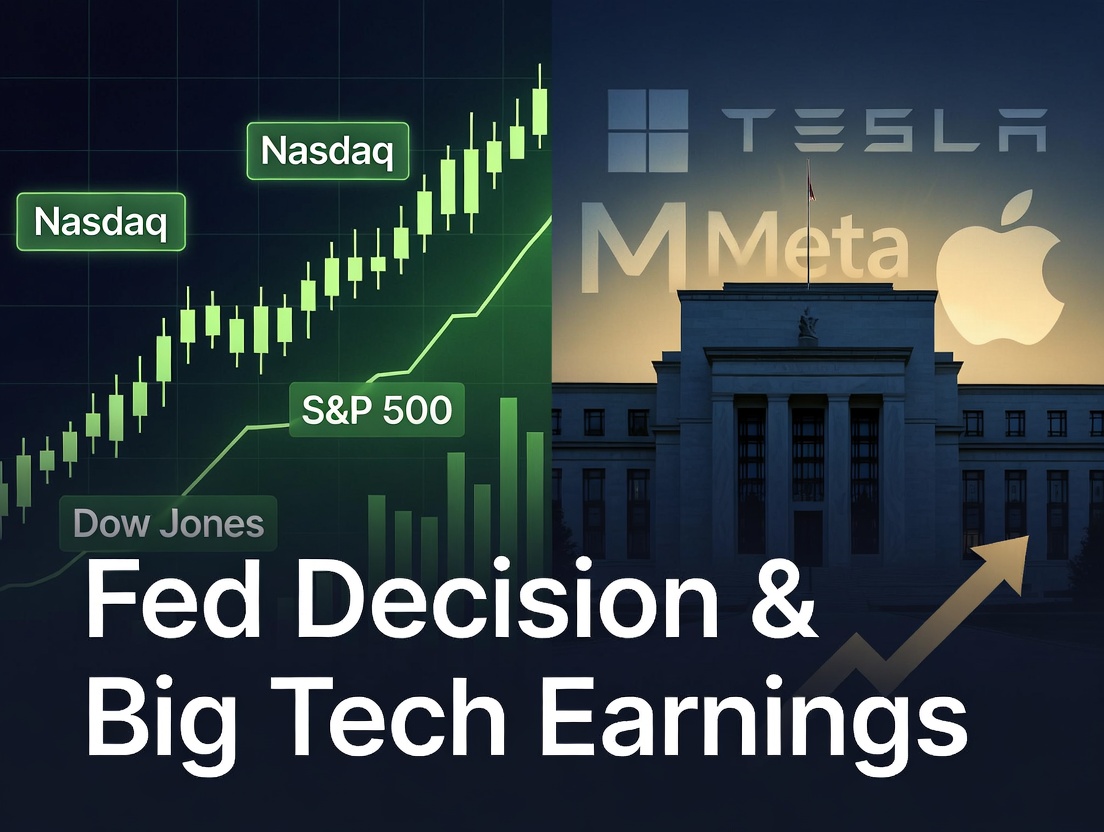
Stock Market Today: Wall Street Rallies Ahead of Fed Decision as Big Tech Earnings Loom
Wall Street opened Wednesday with cautious optimism, as investors positioned for a consequential convergence of monetary policy and corporate earnings that could define the market’s trajectory for months to come. Nasdaq 100 futures rose about 0.5% Yahoo Finance, leading the advance, while S&P 500 futures inched up 0.2% Yahoo Finance. The technology-heavy surge offered a counterpoint to Dow futures, which struggled near the flatline amid sector-specific pressures.
The stock market today reflects a delicate balancing act. The S&P 500 notched a record close on Tuesday of 6,978 Yahoo Finance, placing the benchmark index tantalizingly close to the psychological 7,000 threshold. Yet beneath this surface strength lies a web of uncertainties that few earnings seasons have had to navigate simultaneously: a Federal Reserve caught between political pressure and institutional independence, trillion-dollar questions about artificial intelligence returns, and the specter of policy upheaval at the world’s most powerful central bank.
The Fed Decision: Politics Meets Monetary Policy
Wednesday afternoon’s Federal Reserve announcement marks the central bank’s first rate decision of 2026, and the stakes extend well beyond the expected outcome. CME Group’s Fedwatch tool indicates a 97.2% probability that the Fed will maintain interest rates at the current 3.5% to 3.75% range Stocktwits, effectively pausing the easing cycle that delivered three consecutive quarter-point cuts in the final months of 2025.
The pause itself is unremarkable. What transforms this meeting into a pivotal moment is the extraordinary political backdrop. Earlier this month, the Justice Department served the Fed with subpoenas over testimony Powell made before Congress related to the $2.5bn renovation of the central bank’s headquarters Al Jazeera. In a rare video statement, Powell characterized these moves as pretexts designed to undermine the Fed’s independence, declaring that the threat of criminal charges stemmed from the central bank setting rates based on economic assessment rather than presidential preferences.
The tension between the White House and the Fed has been simmering for months. President Trump has repeatedly called for lower interest rates, even as inflation remains elevated above the Fed’s two percent target. Markets currently expect the Fed to cut once or twice this year — most likely in June and December, according to futures market pricing CNBC. That measured approach stands in sharp contrast to the administration’s more aggressive stance, creating what some economists describe as the most fraught period for central bank independence in modern American history.
According to CNBC, Chair Powell’s press conference will likely become a referendum on Fed autonomy as much as a policy briefing. The question hanging over Wednesday afternoon is whether Powell can navigate this political minefield while maintaining the institutional credibility that underpins effective monetary policy.
Big Tech Earnings: The AI Reckoning Begins
While the Fed commands immediate attention, the real test for equity markets arrives after the closing bell. Microsoft, Meta Platforms, and Tesla report fourth-quarter results Wednesday evening, followed by Apple on Thursday. Collectively, these technology behemoths will provide the first comprehensive read on whether the extraordinary capital expenditures flowing toward artificial intelligence infrastructure are beginning to generate commensurate returns.
The numbers tell a sobering tale of investor expectations. For Microsoft, the expectation is of $3.88 per share in earnings on $80.2 billion in revenues, representing year-over-year growth rates of +20.1% and +15.2% Yahoo Finance. Yet the stock has underperformed recently, pressured by concerns about margin compression as AI-related spending accelerates. Analysts polled by FactSet expect capex to rise to $99 billion this fiscal year CNBC, up substantially from prior periods.
Meta faces perhaps the most acute scrutiny. Analysts expect $8.15 per share in earnings on $58.4 billion in revenues, representing year-over-year growth rates of +1.6% and +20.7% Yahoo Finance. The modest earnings growth belies massive investments in AI and the metaverse. When Meta last reported in October, the stock tumbled despite solid fundamentals, a reaction driven entirely by elevated spending guidance. Investors want clarity on when these investments translate into bottom-line results.
Tesla’s position is equally precarious. The electric vehicle maker faces headwinds from increased competition and margin pressure in its core automotive business, even as it advances autonomous vehicle technology. Apple, meanwhile, must demonstrate that its iPhone supercycle thesis remains intact while addressing questions about its own AI strategy and capital allocation.
Bloomberg reports that the four hyperscalers — Microsoft, Meta, Alphabet, and Amazon — are expected to boost capital expenditures to over $470 billion in 2026 from approximately $350 billion in 2025. That represents an investment surge of historic proportions, predicated on the assumption that artificial intelligence will fundamentally reshape the technology landscape. Whether that thesis proves correct may hinge on the guidance these companies provide this week.
Market Breadth and Underlying Dynamics
The divergence in Wednesday’s pre-market action speaks to broader market tensions. While technology shares lifted Nasdaq futures, the Dow struggled under the weight of sector-specific disappointments. UnitedHealth’s shares tumbled over 15% Yahoo Finance after the Trump administration announced it would keep Medicare payment rates steady, triggering a broader retreat across healthcare insurers.
This uneven performance reflects a market grappling with rotating leadership and uncertain catalysts. The S&P 500’s record close Tuesday marked impressive resilience, yet that strength remains concentrated in a narrow cohort of stocks. The Magnificent Seven technology giants, which once powered market gains with seemingly effortless momentum, have lagged the broader market over the trailing twelve months. Their collective performance through this earnings season will likely determine whether market breadth finally expands or concentration intensifies.
The Path Forward: Scenarios and Implications
As Wednesday’s events unfold, three distinct scenarios emerge. In the first, Powell delivers a dovish hold, signaling patience on rates while emphasizing the Fed’s data-dependent approach. Big Tech earnings meet or exceed expectations, with management teams providing credible paths to AI monetization. Markets rally on reduced uncertainty, and the S&P 500 pushes decisively above 7,000.
The second scenario is less benign. Powell’s press conference devolves into repeated questions about political pressure, undermining confidence in Fed independence. Tech earnings disappoint, or worse, guidance points to continued spending without clear revenue visibility. Volatility spikes as investors reassess both policy support and growth assumptions.
The third possibility splits the difference: The Fed maintains its cautious stance successfully, but tech earnings prove mixed, with some companies demonstrating AI progress while others struggle. Markets digest the results without dramatic moves, entering a period of consolidation as investors await more data.
What seems increasingly clear is that 2026 will test market resilience in ways that 2025’s concentrated leadership never fully addressed. The stock market today stands at an inflection point, caught between political uncertainty, technological transformation, and the timeless challenge of valuation. How these forces resolve may well determine whether this year’s market narrative proves triumphant or cautionary.
Discover more from The Economy
Subscribe to get the latest posts sent to your email.
Analysis
US Hotels Slash Summer Room Rates as World Cup Demand Falls Short
A $30 billion economic dream collides with the sobering arithmetic of inflation, geopolitics, and over-optimism.
In the final weeks of March, Ed Grose, the president of the Greater Philadelphia Hotel Association, delivered a piece of news that should have landed as a footnote but instead became a canary in the coal mine. FIFA, the global football governing body, had cancelled approximately 2,000 of its 10,000 reserved hotel rooms in Philadelphia—a 20% haircut with no explanation offered. “While we were not excited about that, it’s not the end of the world either,” Grose told ABC 6, in the kind of measured understatement that hotel executives deploy when they are privately recalibrating their summer budgets.
But Philadelphia was not an isolated data point. It was a signal.
By mid-April, the hospitality industry’s quiet unease had become impossible to ignore. Hotels across US host cities began slashing summer room rates. Match-day prices in Atlanta, Dallas, Miami, Philadelphia and San Francisco dropped roughly one-third from their peaks earlier this year, according to data from Lighthouse Intelligence. In Vancouver, FIFA released approximately 15,000 nightly room bookings—a volume that local hoteliers described as “higher than typically expected”. In Toronto, the cancellations reached 80%.
The message is unmistakable: the much-hyped 2026 FIFA World Cup is not going to deliver the economic bonanza that FIFA, the Trump administration, and countless hotel owners had promised themselves. And the reasons—ticket prices, inflation fears, a Trump-driven slump in international arrivals, and the geopolitical fallout from the Iran war—point to something deeper than a temporary demand shortfall. They point to the structural limits of the mega-event economic model itself.
The numbers tell a story of sharp reversal
Let us begin with the arithmetic, because the arithmetic is unforgiving. In February, CoStar and Tourism Economics projected that the World Cup would lift US hotel revenue per available room (RevPAR) by 1.7% during June and July—already a modest figure, roughly one-quarter of the 6.9% RevPAR lift the United States enjoyed during the 1994 World Cup. By April, even that muted forecast had been downgraded: CoStar now expects RevPAR to rise just 1.2% in June and 1.5% in July.
Isaac Collazo, STR’s senior director of analytics, put it bluntly in February: the overall impact to the United States would be “negligible due to the underlying weakness expected elsewhere”. That underlying weakness has only deepened since. For the full year 2026, the World Cup is now expected to contribute just 0.4 percentage points to US RevPAR growth, down from 0.6%.
The correction in pricing has been swift. Hoteliers who had locked in eye-watering rate increases—some exceeding 300% during match weeks—are now in full retreat. Scott Yesner, founder of Philadelphia-based short-term rental and boutique hotel management company Bespoke Stay, told the Financial Times: “I’m seeing a lot of people start to panic and lower their rates”.
This is not merely a story of greedy hoteliers getting their comeuppance. It is a story of structural miscalculation—one in which every stakeholder, from FIFA to city tourism bureaus to individual property owners, built their projections on a foundation of wishful thinking.
Why the fans aren’t coming
The collapse in demand is overdetermined, which makes it all the more revealing. Four factors are converging, each sufficient on its own to chill international travel, and together they form a perfect storm.
First, ticket prices. A Guardian analysis found that tickets for the 2026 final shot up in price by up to nine times compared with the 2022 edition, adjusted for inflation. For the average European fan—already facing a transatlantic flight, a weak euro, and domestic cost-of-living pressures—the math simply does not work. Many fans are instead choosing to watch from home.
Second, inflation fears. While US inflation has moderated from its 2022 peaks, the memory of double-digit price increases lingers, and hotel rates that briefly soared into four-figure territory for match nights became an instant deterrent.
Third, anti-American sentiment and the “Trump slump.” This factor is the most politically charged and perhaps the most consequential. Travel bookings to the United States for summer 2026 have decreased by up to 14% compared to the previous year, according to Forbes. Cirium data shows Europe-to-US bookings down 14.22% year-over-year, with particularly steep drops from Frankfurt (−36%), Barcelona (−26%), and Amsterdam (−23%). Lior Sekler, chief commercial officer at HRI Hospitality, blamed dissatisfaction with the Trump administration’s visa and immigration policies, as well as the instability triggered by the war in Iran, for cooling international demand. “Obviously, people’s desire to come to the United States right now is down,” he told the Financial Times.
Fourth, safety concerns. Recent shootings—including one in Minneapolis—have heightened anxiety among European fans considering a trip to the 2026 World Cup. Travel advisories issued by European governments urging caution when visiting the United States have not helped.
The cumulative effect is stark. Where FIFA had advised host cities to expect a 50/50 split between domestic and international visitors, the actual international share appears to be falling well short. Tourism Economics now expects international visitor numbers to the US to rise just 3.4%—a figure that, in a normal year, might be respectable, but against the backdrop of World Cup expectations feels like a failure.
The mega-event economic model under pressure
For anyone who has studied the economics of mega-events—the Olympics, the World Cup, the Super Bowl—the current hotel demand shortfall is not an anomaly. It is a predictable outcome of a broken forecasting model.
The core problem is simple: the organisations that run these events have every incentive to over-promise. FIFA’s 2025 analysis projected that the 2026 World Cup would drive $30.5 billion in economic output and create 185,000 jobs in the United States. Those figures were predicated on the assumption that international tourists would flock to the tournament. But as the Forbes analysis from early March made clear, that assumption was always fragile.
The gap between FIFA’s rhetoric and operational reality has become impossible to ignore. In Boston, Meet Boston—the city’s tourism bureau—acknowledged that “original estimates from 2–3 years ago were inflated” and that the reduction in FIFA’s room blocks had been anticipated for months. That is a polite way of saying: everyone knew the numbers were too high, but no one wanted to say so publicly until the cancellations forced the issue.
Jan Freitag, CoStar’s national director of hospitality analytics, described the release of rooms—known in the industry as “the wash”—as “just a little bit more than people had anticipated”. The key word there is “little.” The surprise was not that FIFA overbooked; it is that the organisation overbooked to this extent.
Perhaps the most telling data point comes from hoteliers themselves. Harry Carr, senior vice president of commercial optimisation at Pivot Hotels & Resorts, told CoStar that FIFA had returned some of the room blocks held by his company “without a single reservation having been made”. At HRI Lodging in the Bay Area, Fifa reserved blocks had seen only 15% of rooms actually taken up. When the organiser itself cannot fill its own blocks, the industry has a problem.
A tale of two World Cups: 1994 vs 2026
The contrast with 1994 is instructive. When the United States last hosted the World Cup, RevPAR for June and July rose 6.9%, driven largely by a 5% increase in average daily rate. That was a genuine boom. The 2026 forecast, by contrast, projects a lift that is “almost entirely on a 1.6% lift in ADR”—a much more fragile and rate-dependent gain.
What changed? In 1994, the United States was riding a post-Cold War wave of global goodwill. International travel was expanding rapidly, the dollar was relatively weak, and the geopolitical landscape was stable. In 2026, the United States is perceived by many foreign travellers as hostile, expensive, and unsafe. The difference in sentiment is not marginal; it is existential.
Vijay Dandapani, president of the Hotel Association of New York City, captured the mood with characteristic bluntness. He told the Financial Times he could “categorically say we haven’t seen much of a meaningful boost yet… It’s possible we will get some more demand, but at this point it certainly will not be the cornucopia that FIFA was promising”.
What this means for hoteliers and policymakers
For hotel owners, the lesson is uncomfortable but clear: betting on mega-events is a high-risk strategy. The properties that will survive this summer’s disappointment are those that built their business models on a diversified base of corporate, leisure, and group demand—not those that staked everything on World Cup premiums.
For US tourism policymakers, the message is even more sobering. The World Cup was supposed to be a showcase—a chance to remind the world that the United States remains an open, welcoming destination. Instead, the tournament is revealing the opposite. The combination of restrictive visa policies, a belligerent trade posture, and a perception of social instability is actively repelling the very visitors the industry needs.
Aran Ryan, director of industry studies at Tourism Economics, told the Financial Times that his firm still expects an “incremental boost… but there’s concern about ticket prices, there’s concern about border crossings, and there’s concern about anti-U.S. sentiment—and that’s been made worse by the Iran war”. That is a remarkable admission: even with the world’s largest sporting event on its soil, the United States cannot reverse its inbound tourism decline.
The one bright spot (and why it’s not enough)
To be fair, not all the data is uniformly negative. A RateGain analysis released on April 15, using Sojern’s travel intent data, found double-digit year-over-year flight booking growth into several US host cities: Dallas (+42%), Houston (+38%), Boston (+17%), Philadelphia (+16%), and Miami (+15%). The United Kingdom is the leading international source market for flights into US host cities, accounting for 19.5% of international bookings.
But these figures require careful interpretation. First, they represent bookings made after the rate cuts—that is, demand that is being stimulated by lower prices, not organic enthusiasm. Second, even with these increases, the absolute volume of international travel remains below pre-pandemic trend lines. Third, the airline data is not uniformly positive: Seattle is down 16% year-over-year, and transatlantic bookings from key European hubs remain deeply depressed.
The most worrying signal in the RateGain data is the search-to-booking gap from Argentina—the defending World Cup champions. Argentina accounts for just 1.3% of confirmed flight bookings but 8.2% of flight searches, “pointing to substantial latent demand” that is not converting into actual travel. That gap represents fans who want to come but are ultimately deciding not to. The reasons are the same as everywhere: cost, fear, and the perception that the United States does not want them.
Conclusion: A reckoning, not a disaster
Let me be clear: the World Cup will not be a disaster for US hotels. CoStar still expects positive RevPAR growth in June and July. Millions of tickets have been sold. The tournament will generate real economic activity.
But the gap between expectation and reality is vast. Hotels are slashing rates. FIFA is quietly cancelling room blocks. International fans are staying home. And the structural lessons—about the limits of event-driven economics, about the fragility of tourism demand in a hostile political environment, about the dangers of believing one’s own hype—are ones that policymakers and industry executives would do well to absorb before the next mega-event comes calling.
The 2026 World Cup was supposed to be the summer the United States welcomed the world. Instead, it may be remembered as the summer the world decided the price of admission was simply too high.
FAQ
Q: Why are US hotels slashing World Cup room rates?
A: Hotels in host cities including Atlanta, Dallas, Miami, Philadelphia and San Francisco have cut match-day rates by roughly one-third due to weaker-than-expected demand, driven by high ticket prices, inflation fears, anti-American sentiment, and FIFA’s own cancellation of thousands of room blocks.
Q: How much are hotel rates dropping for the 2026 World Cup?
A: According to Lighthouse Intelligence data, match-day room rates have fallen about 33% from their peaks earlier this year.
Q: What is the expected RevPAR impact of the 2026 World Cup?
A: CoStar forecasts a 1.2% RevPAR increase in June and 1.5% in July—down from 1.7% projected in February.
Q: Did FIFA cancel hotel room reservations?
A: Yes. FIFA cancelled approximately 2,000 of 10,000 reserved rooms in Philadelphia, 80% of reservations in Toronto and Vancouver, and 800 of 2,000 rooms in Mexico City.
Q: What is causing weak World Cup hotel demand?
A: Four main factors: high ticket prices, inflation concerns, anti-American sentiment and the “Trump slump,” and safety fears following recent shootings.
Discover more from The Economy
Subscribe to get the latest posts sent to your email.
Analysis
Alabama Is Powering Its Startup Boom Through Community and Investment
The Alabama startup boom is not an accident. It is not a fluke of geography, a windfall from a single anchor tenant, or the kind of frothy exuberance that tends to inflate and collapse in coastal corridors. It is, instead, the deliberate consequence of a deceptively simple idea: that founders, not capital, should sit at the center of an innovation ecosystem—and that when a state wraps itself around its entrepreneurs rather than the other way around, extraordinary things happen.
In two decades covering regional innovation from Tel Aviv to Tallinn and from Nairobi to Nashville, I have rarely encountered a model as coherent—or as replicable—as the one quietly assembling itself across Alabama. As U.S. venture capital continues its uneven recovery (the Q4 2025 PitchBook-NVCA Venture Monitor describes a market where “deal counts rose, multiple high-profile IPOs dominated headlines, and AI attracted a record amount of capital,” yet half of all venture dollars flowed into just 0.05% of deals), the geography of opportunity is shifting in ways most investors have not yet fully priced. Alabama is ahead of that curve.
1. Why a Founder-First Ecosystem Is Alabama’s Secret Weapon
The phrase “founder-first” is overused in startup circles. It tends to mean little beyond a firm’s marketing deck. In Alabama, it describes operational reality.
The Economic Development Partnership of Alabama (EDPA) anchors this philosophy through Alabama Launchpad, a program that has invested more than $6 million in early-stage companies—a portfolio now valued collectively at $1 billion. That’s a return profile that would turn heads in any fund memo. But the numbers alone miss the point. What Alabama Launchpad offers that Sand Hill Road cannot is proximity—a white-glove approach to connecting founders with the right resource at the right inflection point, rather than a transactional relationship governed by ownership percentages.
“We want to offer our founders white-glove service when it comes to connecting you with the resources that are right for you and your team at that time,” said Audrey Hodges, director of communications and talent at the EDPA, at the 2025 Inc. 5000 Conference & Gala in Phoenix.
This sounds simple. It is, in fact, quite rare. The Kauffman Foundation has long documented the friction that kills promising startups—not market failure, but navigational failure: the inability to find the right mentor, the right loan program, the right workforce development partner at the critical moment. Alabama has engineered its ecosystem explicitly to eliminate that friction.
The result is a startup environment that punches well above its weight class. Birmingham’s Innovation Depot, the Southeast’s largest tech incubator, provides the physical and institutional scaffolding. Auburn University’s New Venture Accelerator has launched more than 50 businesses that have attracted over $47 million in venture investment and created more than 370 jobs. The University of Alabama’s EDGE incubator anchors Tuscaloosa. And HudsonAlpha Institute for Biotechnology in Huntsville is spinning out life-science ventures at a pace that would surprise most biotech observers outside the Southeast.
Together, these nodes form what urban economists call a “distributed innovation geography”—a web of hubs rather than a single megalopolis. It is, not coincidentally, exactly the structure that the Brookings Institution has advocated as the most resilient model for regional innovation growth.
2. How Alabama Is Closing the Capital Gap—and Making It Stick
Identifying the problem is easy. Alabama’s startup funding landscape faced a structural deficit that is common to nearly every non-coastal state: a shallow pool of local venture capital, reluctant institutional investors, and the persistent gravitational pull of San Francisco and New York on promising founders and their companies.
The solution Alabama chose is, I would argue, one of the most architecturally sophisticated public-private capital strategies in the United States today.
At its core sits Innovate Alabama—the state’s first public-private partnership expressly focused on growing the innovation economy. Funded through a U.S. Department of the Treasury award of up to $98 million via the State Small Business Credit Initiative (SSBCI), Innovate Alabama has constructed a multi-layered capital stack: the LendAL program extends credit to small businesses through private-lending partnerships; InvestAL provides high-match equity investments both directly into startups and through trusted local venture funds; and a network of supplemental grants, tax incentives, and accelerator partnerships rounds out the toolkit.
What makes this architecture genuinely distinctive is not the instruments themselves—development finance has existed for decades—but the conditions attached to the capital. Charlie Pond, executive director of Alabama SSBCI at Innovate Alabama, is explicit: “We built that into our agreement with Halogen Ventures and other funds—that the money has to go to Alabama companies.” The vision, he adds, is generational: “This isn’t a one-time $98 million into the ecosystem and then we’re done. We want this to be around for a long time.”
This structural insistence that returns stay in Alabama—recycling capital back into the ecosystem rather than flowing to coastal LPs—is precisely the mechanism that differentiates Alabama’s model from the well-intentioned but often extractive pattern of outside capital flowing briefly through secondary markets before departing.
Innovate Alabama has already made 17 direct investments under the InvestAL program, with companies ranging from biotech and life sciences to AgTech and professional services. Through partnerships with gener8tor Alabama and Measured Capital—two VC firms with deep local roots and a mandate to reinvest in-state—the program is deploying a fund-of-funds strategy designed to build durable capital density. To date, 179 Alabama startups have graduated from gener8tor programs, securing nearly $80 million in follow-on funding.
In June 2025, Innovate Alabama went further still: it launched the Venture Studio and Fund in partnership with Harmony Venture Labs, a Birmingham-based company that supports new enterprises. The studio begins not with capital but with problems—industry challenges identified through deep fieldwork, then matched with founders and early investment. The Innovate Alabama Venture Studio and Fund aims to launch 10 new companies and attract $10 million in venture capital by 2028 and hopes to generate millions in economic impact across the state.
Compare this to what the NVCA’s 2025 Yearbook documents at the national level: median fund size outside California, New York, and Massachusetts was just $10 million—less than half the overall U.S. median of $21.3 million. Despite the substantial dry powder available, with $307.8 billion in capital ready to be deployed, investors have been holding off due to market uncertainty. Alabama is not waiting for that capital to find its way south on its own. It is building the infrastructure to attract, generate, and retain it locally.
3. The SmartWiz Test: Why Alabama Founders Are Choosing to Stay
No story captures the Alabama startup model more vividly—or more movingly—than SmartWiz.
Five Auburn University students, bonded through fraternity life and a shared frustration with the misery of tax preparation, spent years building a platform that compresses a four-hour tax return process into roughly 20 minutes. They are Tevin Harrell, Olumuyiwa Aladebumoye, Jordan Ward, Justin Robinson, and Bria Johnson—a team of tech entrepreneurs and tax professionals who founded SmartWiz in 2021 in Birmingham and have quickly emerged as one of only 16 IRS-approved tax software providers worldwide.
Their journey through Alabama’s ecosystem reads like a case study in coordinated public-private support: $50,000 in early seed funding through the Alabama Launchpad program; $500,000 from Innovate Alabama’s SSBCI; and additional investments from Techstars Los Angeles, Google, and entertainer Pharrell Williams.
Then came the test. The company’s commitment to Birmingham was tested when it was offered the opportunity to relocate to Los Angeles with $3 million in funding for its latest investment round, but SmartWiz chose to remain and expand in Alabama.
“We respectfully turned down that $3 million and came back to Alabama,” COO Aladebumoye said at the Inc. 5000 panel. “That’s where we ran into the SSBCI grant.” The grant helped close the seed round on Alabama’s terms.
The decision was not sentimental. It was strategic. Alabama’s workforce development agency AIDT is providing services valued at $780,000 to support SmartWiz’s expansion, and the City of Birmingham and Jefferson County are providing local job-creation incentives totaling a combined $231,000. SmartWiz plans to create 66 new jobs over the next five years, with an average annual salary of $81,136, and the growth project is projected to have an economic impact of $9.6 million over the next 20 years.
Harrell’s framing of this choice cuts to the heart of Alabama’s competitive proposition: “As a business owner, people are your biggest investment.” What Alabama offers, in his telling, is not just cheaper real estate or lower burn rates—though both matter—but a community of support that a relocated startup in Los Angeles could not replicate at any price.
This is what I would call the SmartWiz Test: when a founder turns down three times their current raise to stay in your ecosystem, you have built something real.
4. Talent, Training, and the Infrastructure of Retention
Founder retention is the Achilles heel of every emerging startup ecosystem. Build a great company in Memphis or Montgomery and the conventional wisdom says that as soon as you raise a serious round, you will relocate to be near your investors, your acqui-hire targets, and your talent pool. Alabama is systematically dismantling that logic.
The Alabama Industrial Development Training (AIDT) program—operating through the Department of Commerce—offers startup founders customized recruitment and training support tied directly to job-creation milestones. Unlike generic workforce programs, AIDT works with each company to identify the specific skill sets its workforce will need as it scales. It is, in effect, a bespoke talent pipeline that adjusts to the startup’s roadmap rather than forcing the startup to adjust to the market.
Innovate Alabama’s Talent Pilot Program extends this model by funding bold, scalable solutions to Alabama’s broader workforce challenge—paid internships, STEM acceleration, and work-based learning programs designed to keep the state’s best graduates in-state.
The effects are measurable. Birmingham was designated one of 31 federal Tech Hubs—the only city in the Southeast to receive the distinction—positioning it for substantial federal investment in innovation infrastructure. HudsonAlpha has made Huntsville a nationally recognized node in the biotech talent network. Auburn and the University of Alabama together generate a pipeline of engineering and business graduates increasingly likely, because of programs like Alabama Launchpad, to start companies at home rather than migrate to coastal markets.
The Brookings Institution’s research on growth centers makes this point with precision: talent retention is not primarily a question of amenities or wages. It is a question of opportunity density—the number of high-quality, high-growth companies and institutions concentrated in a geography. Alabama is deliberately thickening that density.
5. A Global Blueprint: What Alabama Can Teach the World
In covering innovation ecosystems across four continents, I keep returning to a structural insight that Alabama is proving with empirical force: the most resilient startup ecosystems are not the largest or the best-capitalized. They are the most coherent—the ones where state policy, private capital, university research, incubation infrastructure, and founder community all pull in the same direction at the same time.
Israel’s famed startup ecosystem—often held up as the gold standard for a small geography punching above its weight—succeeded not because Israeli venture capital was particularly sophisticated in the early years, but because of deliberate public-private coordination, military-derived talent pipelines, and a cultural insistence that founders stay and build at home. The Yozma program, launched in 1993, used a government fund-of-funds to catalyze private VC—exactly the structural logic behind Alabama’s InvestAL. Alabama is, in important respects, attempting something analogous: using public capital not to replace private investment but to de-risk and attract it.
Estonia’s digital transformation—a country of 1.3 million people that became a global model for e-governance and startup density—succeeded through the same coordinated coherence, not through the sheer volume of capital. Rwanda’s innovation push in Kigali, East Africa’s most deliberate attempt to build a technology economy from the top down, draws the same lesson: intentionality and ecosystem design matter more than proximity to existing capital pools.
What Alabama has that many of these comparators lacked in their early stages is something harder to engineer: community. The panel at the Inc. 5000 conference kept returning to this word, and it deserves examination. Community, in the Alabama startup context, means something specific: a network of founders, investors, educators, and state officials who know each other, refer to each other, and take responsibility for each other’s success. It is the opposite of the anonymous, transaction-driven culture of Silicon Valley at scale.
“The barrier to entry to succeed in Alabama,” as one panelist put it at the Inc. 5000 conference, “is just your willingness to hustle.” That framing deserves to be taken seriously. In San Francisco, the barrier to entry is, increasingly, a warm introduction to a partner at a top-decile firm, a Stanford pedigree, and the financial runway to survive eighteen months without a paycheck. Alabama’s model—meritocratic, community-anchored, and deliberately inclusive—is not only more equitable. It may, over time, prove more durable.
SmartWiz was founded by five Black entrepreneurs from Auburn. They were backed by Pharrell Williams’ Black Ambition Prize, the Google for Startups Black Founders Fund, and a state ecosystem that met them where they were rather than requiring them to relocate to access capital. That is not incidental to Alabama’s model. It is central to it.
6. The 2026 Moment: Why Now Matters
U.S. venture capital is at a genuine inflection point. As 2026 begins, optimism is cautiously returning—the IPO window has begun to open, secondaries have gained acceptance as a critical liquidity outlet, and early-stage investing is regaining strength. The concentration problem that has plagued the market—half of all venture dollars went into just 0.05% of deals in 2025—creates a structural opening for ecosystems that have been building patiently, without depending on the mega-rounds that define and distort coastal markets.
Alabama has been building exactly that. Its $98 million SSBCI deployment is not finished. Its Venture Studio has barely begun. Its pipeline of university-trained founders is expanding. And critically, its brand as a founder-friendly ecosystem is gaining the kind of national visibility—through the Inc. 5000 stage, through SmartWiz’s headline-making story, through Innovate Alabama’s increasingly sophisticated capital architecture—that attracts the next wave of entrepreneurs and investors.
The Innovate Alabama Venture Studio’s goal of launching 10 new companies and attracting $10 million in venture capital by 2028 is modest by coastal standards. It is transformative by the standards of what secondary markets have historically been able to achieve. And if Innovate Alabama’s track record holds—if the $6 million invested through Alabama Launchpad continues to compound toward and beyond its current $1 billion portfolio valuation—the returns will be impossible to ignore.
There is a moment in the development of every successful regional ecosystem when it tips from “interesting experiment” to “self-reinforcing flywheel.” The exits create the angels. The angels fund the next cohort. The wins attract talent. The talent attracts the next round of capital. Observers who watched Austin in 2010 or Miami in 2019 know this pattern well. Alabama, in 2026, looks poised for exactly that transition.
Opinion: Alabama Is Writing the Next Chapter of American Innovation
The coastal consensus in American venture capital holds, implicitly if not always explicitly, that innovation is a product of density—of the accidental collisions that happen when enough smart, ambitious people are crammed into San Francisco or Manhattan. There is truth in this. There is also, increasingly, evidence that it is incomplete.
Density without coherence produces exclusion. It produces the housing crisis that is bleeding talent out of San Francisco. It produces the founder burnout that has come to define the “move fast and break things” generation. It produces ecosystems that are brilliant at the top and fragile everywhere else.
Alabama is demonstrating an alternative. Not a rejection of density, but a designed coherence—a deliberate alignment of capital, community, training, policy, and founder support that creates the conditions for high-growth companies to start, scale, and stay. The fact that Alabama can offer this while also offering a cost structure that extends a startup’s runway by twelve to eighteen months compared to the Bay Area is not a side benefit. It is a competitive advantage of the first order.
For policymakers in secondary markets from the American Midwest to Southeast Asia, Alabama’s model contains a clear set of replicable principles: anchor public capital to local returns; build incubation infrastructure before trying to attract outside investors; treat founders as the customer of the ecosystem rather than as the raw material; invest relentlessly in talent retention; and understand that community is not a soft amenity—it is the operating system on which everything else runs.
The future of American innovation does not belong exclusively to Silicon Valley. It belongs to the places that figure out, as Alabama is figuring out, that the best investment a region can make is not in a single unicorn but in the conditions that make unicorns possible—and that make founders choose to stay and build them at home.
The magic of Alabama, ultimately, is not in the dollar amounts or the portfolio valuations, impressive as they are. It is in a group of five Auburn graduates turning down a $3 million check to fly back home to Birmingham, walk into Innovation Depot, and build something the world has not seen before.
That is what a real startup ecosystem looks like. And the rest of the country—and the world—should be paying attention.
Discover more from The Economy
Subscribe to get the latest posts sent to your email.
Analysis
Six Lessons for Investors on Pricing Disaster
How once-unimaginable catastrophes become baseline assumptions
There is a particular kind of hubris that infects markets in the long stretches between catastrophes. Volatility compresses. Risk premia decay. The insurance gets quietly cancelled because it hasn’t paid out in years and the premiums feel like wasted money. Then the disaster arrives — not as a distant rumble but as a wall of water — and the entire analytical framework investors have spent years constructing turns out to have been a map of the wrong country.
We are living through one of the most instruction-rich moments in modern financial history. Since February 28, 2026, when the United States launched military operations against Iran and Tehran responded by closing the Strait of Hormuz, markets have been running a live masterclass in catastrophe pricing. West Texas Intermediate crude surged from $67 to $111 per barrel in under a fortnight — the fastest oil spike in four decades. War-risk insurance premiums on shipping through the Gulf soared more than 1,000 percent. The S&P 500 lost 5 percent in a single week, and the ECB and Bank of England are now staring down a renewed tightening scenario they spent the first quarter of 2026 insisting was off the table.
And yet — and this is the part that should make every portfolio manager uncomfortable — the analytical mistakes driving losses right now are not new. They are the same six structural errors investors have made in every previous crisis. Understanding them, really understanding them, is not an academic exercise. It is the difference between surviving the next disaster and being liquidated by it.
Key Takeaways at a Glance
- Markets price first-order disaster impacts; second- and third-order cascades are systematically underpriced
- Volatility is information; price-discovery failure is the true systemic risk — monitor private-to-public valuation spreads
- Tight CAT bond spreads signal capital crowding, not benign risk — use compression as a contrarian indicator
- Emerging market currencies and credit spreads lead developed-market pricing of global disasters
- Geopolitical risk premia decay faster than structural damage — separate the transitory from the permanent
- The best time to buy tail protection is when every indicator says you do not need it
Lesson One: Markets price the disaster they know, not the one that is compounding behind it
The economics of disaster pricing contain a fundamental asymmetry. Markets are reasonably good at incorporating a known risk — geopolitical tension, elevated VIX, stretched valuations — into current prices. What they catastrophically underprice is the second-order cascade that no single model captures.
Consider what the Hormuz closure actually detonated. Yes, oil went to $111 per barrel. Obvious. What was less obvious: the inflation feedback loop that forced investors to reprice central bank paths they had already discounted as settled. The Federal Reserve was expected to hold rates in 2026; futures now assign a 74 percent probability it does not cut at all this year. Europe’s energy import dependency made the ECB’s position worse. That transmission — from oil shock to rate-repricing to credit stress to equity multiple compression — is a chain, not a point event. Most risk models price the first link.
The academic framework for this is well established but rarely operationalised. The NBER disaster-risk literature, particularly Wachter (2013) and Barro (2006), argues that rare disasters produce risk premia that appear irrational in calm periods but are in fact the rational price of tail exposure across long time horizons. What these models miss, however, is that real-world disasters rarely arrive as clean, isolated point events. They arrive as cascades. The COVID-19 pandemic was not just a health shock — it was simultaneously a supply-chain shock, a demand shock, a sovereign-debt shock, and a labour-market restructuring shock. The Hormuz closure is not just an oil shock. It is an inflation shock, a monetary policy shock, a EM balance-of-payments shock, and an AI-investment sentiment shock, all at once.
Key takeaway: Map not just the primary disaster scenario but every second- and third-order transmission mechanism it activates. The primary impact is already partially in the price. The cascades are not.
Lesson Two: The real crisis is not volatility — it is the collapse of price discovery
Scott Bessent, the US Treasury Secretary, said something in March 2026 that deserves to be read not as politics but as a precise financial concept. Asked what genuinely frightened him after 35 years in markets, Bessent answered: “Markets go up and down. What’s important is that they are continuous and functioning. When people panic is when you’re not able to have price discovery — when markets close, when there is the threat of gating.”
Volatility is information. A price moving sharply up or down is a market doing exactly what it should: integrating new signals, adjusting expectations, clearing. The true systemic catastrophe is not a 10 percent drawdown. It is the moment when buyers and sellers can no longer find each other at any price — when the mechanism that produces prices breaks entirely.
This is not theoretical. Private credit markets are currently exhibiting exactly this dynamic. US BDCs — business development companies that provide credit to mid-market companies — have seen share prices fall 10 percent and trade 20 percent or more below their latest stated NAVs. Alternative asset managers that collect fees from these vehicles are down more than 30 percent. The public market is rendering a verdict on private valuations that the private market itself cannot yet deliver, because the private marks have not moved. There is no continuous clearing mechanism. There is no daily price discovery. There is only the last funding round — which is a negotiated fiction, not a price.
Investors who understand this distinction can do something useful with it: treat the spread between public-market pricing and private-market marks as a real-time fear gauge. When that gap widens sharply, the market is not panicking irrationally. It is pricing the absence of price discovery itself.
Key takeaway: Distinguish between volatility (information-rich, manageable) and price-discovery failure (structurally dangerous, contagion-prone). Monitor private-to-public valuation spreads as a leading indicator of the latter.
Lesson Three: Catastrophe bond complacency is always a warning, never a reassurance
In February 2026, Bloomberg reported that catastrophe-bond risk premia had fallen to levels not seen since before Hurricane Ian struck Florida in 2022. The cause was a surge of fresh capital chasing ILS yields. Managers called it a healthy market. A more honest reading is that it was a market pricing the wrong risk for the wrong reasons.
Here is the structural problem with catastrophe bonds, and indeed with most insurance-linked securities: the risk premium is set by the supply of capital chasing the trade, not by the true probability distribution of the underlying disaster. When capital floods in — as it has, driven by institutional allocators seeking uncorrelated returns — spreads compress regardless of whether the actual hurricane, flood, or geopolitical catastrophe risk has changed. The academic literature on CAT bond pricing, including recent work in the Journal of the Operational Research Society, confirms that cyclical capital flows consistently distort the risk-neutral pricing of catastrophe events.
The counter-intuitive lesson: when CAT bond spreads are tightest, protection is cheapest to buy and most expensive to have sold. The compression that looks like market efficiency is often capital crowding masquerading as a risk assessment. A catastrophe-bond market trading at pre-Ian yields six months before an Iran-driven energy crisis was not a serene market. It was a complacent one.
Key takeaway: Use catastrophe-bond spread compression not as a signal of benign risk conditions but as a contrarian indicator of under-priced tail exposure. Buy protection when it is cheap; do not sell it because it is cheap.
Lesson Four: Emerging markets absorb the shock first — and price it most honestly
There is a geographic hierarchy to disaster pricing that sophisticated global investors routinely ignore. When a major geopolitical or macro catastrophe detonates, the signal appears first in emerging market currencies, credit spreads, and energy import bills — not in the S&P 500 or the Dax. This is not because EM markets are more efficient. It is because they have less capacity to absorb shocks and therefore less incentive to pretend the shock is temporary.
The Hormuz closure is a case study. Developed-market investors spent the first week debating whether oil at $111 per barrel was “priced in.” Meanwhile, Gulf states were issuing precautionary production-cut announcements and Middle Eastern shipping had effectively ceased. Economies in South and Southeast Asia — which import 80 percent or more of their petroleum needs — faced simultaneous currency pressure (oil is dollar-denominated), fiscal pressure (fuel subsidies explode), and inflation pressure (food and transport costs surge). Countries like Pakistan, Sri Lanka, and Bangladesh were pricing a recession before most DM economists had updated their Q1 2026 forecasts.
The BIS research on disaster-risk transmission across 42 countries documents precisely this dynamic: world and country-specific disaster probabilities co-move in complex, non-linear ways. When global disaster probability rises, EM asset prices move first and fastest. For a DM investor, this is an early-warning system hiding in plain sight.
Key takeaway: Monitor EM currency indices, sovereign credit spreads, and fuel import data as leading indicators of how the global market is actually pricing a disaster — before the consensus in New York or London has caught up.
Lesson Five: Geopolitical risk premia have a half-life problem — and it is shorter than you think
Markets are extraordinarily good at normalising the catastrophic. This is not a character flaw; it is a survival mechanism. But for investors, the normalisation of extreme risk is one of the most financially treacherous dynamics in markets.
Consider the structural pattern Tyler Muir documented in his landmark paper Financial Crises and Risk Premia: equity risk premia collapse by roughly 20 percent at the onset of a financial crisis, then recover by around 20 percent over the following three years — even when the underlying structural damage persists. Wars display an even more dramatic version of this pattern. The initial shock is priced aggressively. But as weeks become months, the equity market begins to discount the conflict as background noise, even if oil remains $20 per barrel above pre-war levels and inflation continues to compound.
This half-life problem cuts in two directions. On the way in: investors are often too slow to price a new geopolitical risk, underestimating how durable its effects will be. On the way out: investors often reprice risk premia too quickly back to baseline, treating a structural change in the global system as if it were a weather event that has now passed. The Strait of Hormuz may reopen. But global shipping has permanently re-priced war-risk. Sovereign wealth funds in the Gulf are permanently reconsidering their US dollar reserve holdings. Indian and Japanese energy policymakers are permanently accelerating domestic diversification. These structural changes do not vanish when the headline risk premium fades.
Key takeaway: When pricing geopolitical disasters, separate the acute risk premium (which will fade) from the structural repricing (which will not). The former is a trading signal. The latter is an asset allocation decision that most portfolios have not yet made.
Lesson Six: The moment you feel safest is precisely when you are most exposed
The final lesson is the most counter-intuitive, and arguably the most important. There is a specific period in any market cycle — often 18 to 36 months after the previous crisis — when the cost of tail protection is at its cheapest, investor confidence is high, and catastrophe risk feels entirely theoretical. This is exactly when the next disaster is being loaded.
We can locate this period with precision in the current cycle. In early 2026, the CAPE ratio on US equities reached 39.8, its second-highest reading in 150 years. The Buffett Indicator (total market cap to GDP) hovered between 217 and 228 percent — historically associated with the period immediately before major corrections. CAT bond spreads were at post-Ian lows. VIX had compressed back to mid-teens. Private-credit redemption queues were elevated but not yet alarming. And the macroeconomic consensus — including, notably, within the US Treasury — was that tariff-driven inflation would prove transitory and that central banks would be cutting before mid-year.
Every one of those conditions has now reversed. The reversal took six weeks.
The academic literature on learning and disaster risk, particularly the Kozlowski, Veldkamp, and Venkateswaran (2020) framework on “scarring” from rare events, finds that markets systematically underestimate disaster probability in long stretches without disasters, then over-correct sharply when one arrives. This is not irrationality in the pejorative sense — it is Bayesian updating in the presence of genuinely ambiguous information. But the practical implication is stark: the time to buy disaster insurance is not after the disaster has arrived and the VIX has spiked to 45. It is in the quiet months when every indicator says you don’t need it.
Key takeaway: Maintain systematic, rule-based disaster hedges that do not depend on a real-time catastrophe forecast. The moment it feels unnecessary to hold tail protection is the moment the portfolio is most exposed to needing it.
The Synthesis: From Lessons to Portfolio Architecture
These six lessons converge on a single architectural principle: disaster pricing is not a moment-in-time forecast exercise. It is a permanent structural feature of portfolio construction.
The real mistake — the one that has cost investors dearly in 2020, in 2022, and again in 2026 — is not failing to predict the next disaster. It is believing that markets have already priced it in. The history of catastrophe pricing teaches us, with brutal consistency, that they have not. The cascade is underpriced. The price-discovery failure is unmodelled. The CAT bond spread is supply-driven, not risk-driven. The EM signal is ignored. The geopolitical risk premium is given a shorter half-life than the structural damage it caused. And the tail hedge is cancelled precisely when it is most needed.
The investors who will outperform across the full cycle are not those who predicted the Hormuz closure or the tariff escalation or the next crisis that has not yet been named. They are those who understood that unpriceable disasters are not unpriceable because they are impossible to imagine. They are unpriceable because the incentive structures of the investment industry consistently penalise the premiums required to hedge them.
That gap between what disasters cost and what markets charge for protection is not a market inefficiency. It is the most durable alpha in finance. Learning to harvest it is, in the deepest sense, the only lesson that matters.
Discover more from The Economy
Subscribe to get the latest posts sent to your email.
-
Markets & Finance3 months agoTop 15 Stocks for Investment in 2026 in PSX: Your Complete Guide to Pakistan’s Best Investment Opportunities
-
Analysis2 months agoBrazil’s Rare Earth Race: US, EU, and China Compete for Critical Minerals as Tensions Rise
-
Analysis2 months agoTop 10 Stocks for Investment in PSX for Quick Returns in 2026
-
Banks3 months agoBest Investments in Pakistan 2026: Top 10 Low-Price Shares and Long-Term Picks for the PSX
-
Investment3 months agoTop 10 Mutual Fund Managers in Pakistan for Investment in 2026: A Comprehensive Guide for Optimal Returns
-
Global Economy4 months agoPakistan’s Export Goldmine: 10 Game-Changing Markets Where Pakistani Businesses Are Winning Big in 2025
-
Asia4 months agoChina’s 50% Domestic Equipment Rule: The Semiconductor Mandate Reshaping Global Tech
-
Global Economy4 months ago15 Most Lucrative Sectors for Investment in Pakistan: A 2025 Data-Driven Analysis