
Business
Stock Market Today: Wall Street Rallies Ahead of Fed Decision as Big Tech Earnings Loom

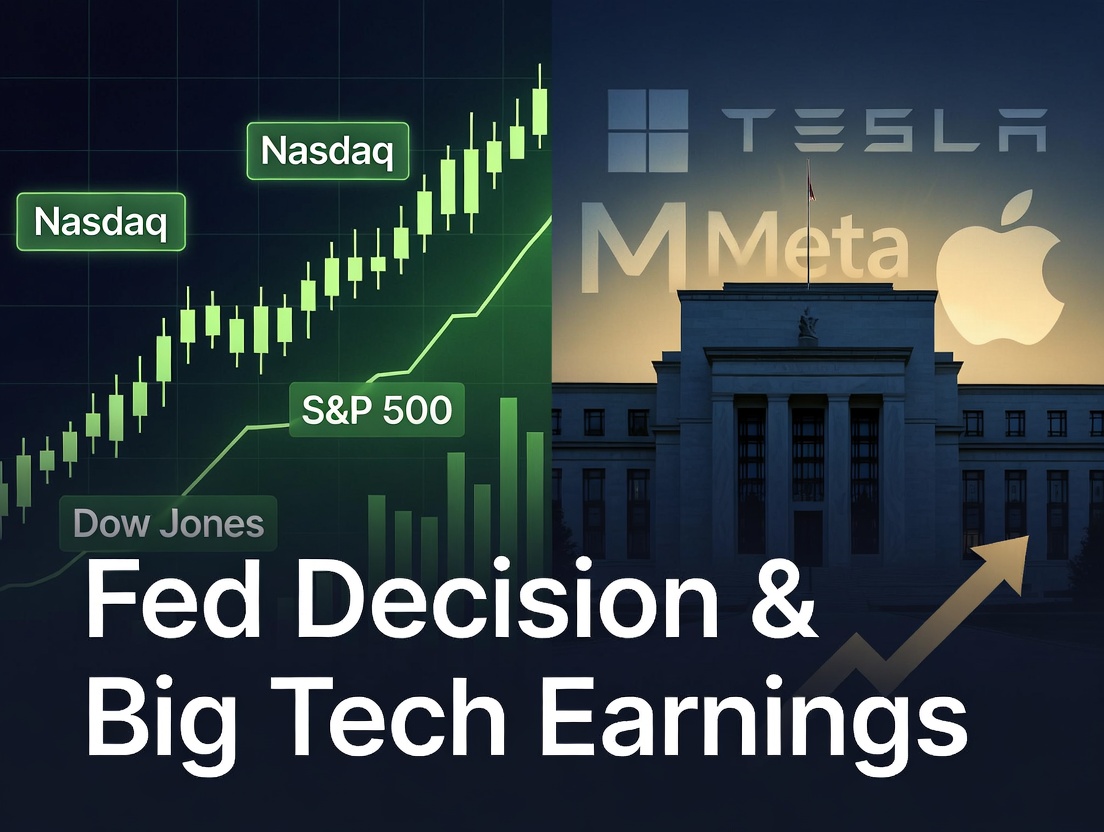
Wall Street opened Wednesday with cautious optimism, as investors positioned for a consequential convergence of monetary policy and corporate earnings that could define the market’s trajectory for months to come. Nasdaq 100 futures rose about 0.5% Yahoo Finance, leading the advance, while S&P 500 futures inched up 0.2% Yahoo Finance. The technology-heavy surge offered a counterpoint to Dow futures, which struggled near the flatline amid sector-specific pressures.
The stock market today reflects a delicate balancing act. The S&P 500 notched a record close on Tuesday of 6,978 Yahoo Finance, placing the benchmark index tantalizingly close to the psychological 7,000 threshold. Yet beneath this surface strength lies a web of uncertainties that few earnings seasons have had to navigate simultaneously: a Federal Reserve caught between political pressure and institutional independence, trillion-dollar questions about artificial intelligence returns, and the specter of policy upheaval at the world’s most powerful central bank.
The Fed Decision: Politics Meets Monetary Policy
Wednesday afternoon’s Federal Reserve announcement marks the central bank’s first rate decision of 2026, and the stakes extend well beyond the expected outcome. CME Group’s Fedwatch tool indicates a 97.2% probability that the Fed will maintain interest rates at the current 3.5% to 3.75% range Stocktwits, effectively pausing the easing cycle that delivered three consecutive quarter-point cuts in the final months of 2025.
The pause itself is unremarkable. What transforms this meeting into a pivotal moment is the extraordinary political backdrop. Earlier this month, the Justice Department served the Fed with subpoenas over testimony Powell made before Congress related to the $2.5bn renovation of the central bank’s headquarters Al Jazeera. In a rare video statement, Powell characterized these moves as pretexts designed to undermine the Fed’s independence, declaring that the threat of criminal charges stemmed from the central bank setting rates based on economic assessment rather than presidential preferences.
The tension between the White House and the Fed has been simmering for months. President Trump has repeatedly called for lower interest rates, even as inflation remains elevated above the Fed’s two percent target. Markets currently expect the Fed to cut once or twice this year — most likely in June and December, according to futures market pricing CNBC. That measured approach stands in sharp contrast to the administration’s more aggressive stance, creating what some economists describe as the most fraught period for central bank independence in modern American history.
According to CNBC, Chair Powell’s press conference will likely become a referendum on Fed autonomy as much as a policy briefing. The question hanging over Wednesday afternoon is whether Powell can navigate this political minefield while maintaining the institutional credibility that underpins effective monetary policy.
Big Tech Earnings: The AI Reckoning Begins
While the Fed commands immediate attention, the real test for equity markets arrives after the closing bell. Microsoft, Meta Platforms, and Tesla report fourth-quarter results Wednesday evening, followed by Apple on Thursday. Collectively, these technology behemoths will provide the first comprehensive read on whether the extraordinary capital expenditures flowing toward artificial intelligence infrastructure are beginning to generate commensurate returns.
The numbers tell a sobering tale of investor expectations. For Microsoft, the expectation is of $3.88 per share in earnings on $80.2 billion in revenues, representing year-over-year growth rates of +20.1% and +15.2% Yahoo Finance. Yet the stock has underperformed recently, pressured by concerns about margin compression as AI-related spending accelerates. Analysts polled by FactSet expect capex to rise to $99 billion this fiscal year CNBC, up substantially from prior periods.
Meta faces perhaps the most acute scrutiny. Analysts expect $8.15 per share in earnings on $58.4 billion in revenues, representing year-over-year growth rates of +1.6% and +20.7% Yahoo Finance. The modest earnings growth belies massive investments in AI and the metaverse. When Meta last reported in October, the stock tumbled despite solid fundamentals, a reaction driven entirely by elevated spending guidance. Investors want clarity on when these investments translate into bottom-line results.
Tesla’s position is equally precarious. The electric vehicle maker faces headwinds from increased competition and margin pressure in its core automotive business, even as it advances autonomous vehicle technology. Apple, meanwhile, must demonstrate that its iPhone supercycle thesis remains intact while addressing questions about its own AI strategy and capital allocation.
Bloomberg reports that the four hyperscalers — Microsoft, Meta, Alphabet, and Amazon — are expected to boost capital expenditures to over $470 billion in 2026 from approximately $350 billion in 2025. That represents an investment surge of historic proportions, predicated on the assumption that artificial intelligence will fundamentally reshape the technology landscape. Whether that thesis proves correct may hinge on the guidance these companies provide this week.
Market Breadth and Underlying Dynamics
The divergence in Wednesday’s pre-market action speaks to broader market tensions. While technology shares lifted Nasdaq futures, the Dow struggled under the weight of sector-specific disappointments. UnitedHealth’s shares tumbled over 15% Yahoo Finance after the Trump administration announced it would keep Medicare payment rates steady, triggering a broader retreat across healthcare insurers.
This uneven performance reflects a market grappling with rotating leadership and uncertain catalysts. The S&P 500’s record close Tuesday marked impressive resilience, yet that strength remains concentrated in a narrow cohort of stocks. The Magnificent Seven technology giants, which once powered market gains with seemingly effortless momentum, have lagged the broader market over the trailing twelve months. Their collective performance through this earnings season will likely determine whether market breadth finally expands or concentration intensifies.
The Path Forward: Scenarios and Implications
As Wednesday’s events unfold, three distinct scenarios emerge. In the first, Powell delivers a dovish hold, signaling patience on rates while emphasizing the Fed’s data-dependent approach. Big Tech earnings meet or exceed expectations, with management teams providing credible paths to AI monetization. Markets rally on reduced uncertainty, and the S&P 500 pushes decisively above 7,000.
The second scenario is less benign. Powell’s press conference devolves into repeated questions about political pressure, undermining confidence in Fed independence. Tech earnings disappoint, or worse, guidance points to continued spending without clear revenue visibility. Volatility spikes as investors reassess both policy support and growth assumptions.
The third possibility splits the difference: The Fed maintains its cautious stance successfully, but tech earnings prove mixed, with some companies demonstrating AI progress while others struggle. Markets digest the results without dramatic moves, entering a period of consolidation as investors await more data.
What seems increasingly clear is that 2026 will test market resilience in ways that 2025’s concentrated leadership never fully addressed. The stock market today stands at an inflection point, caught between political uncertainty, technological transformation, and the timeless challenge of valuation. How these forces resolve may well determine whether this year’s market narrative proves triumphant or cautionary.
Discover more from The Economy
Subscribe to get the latest posts sent to your email.


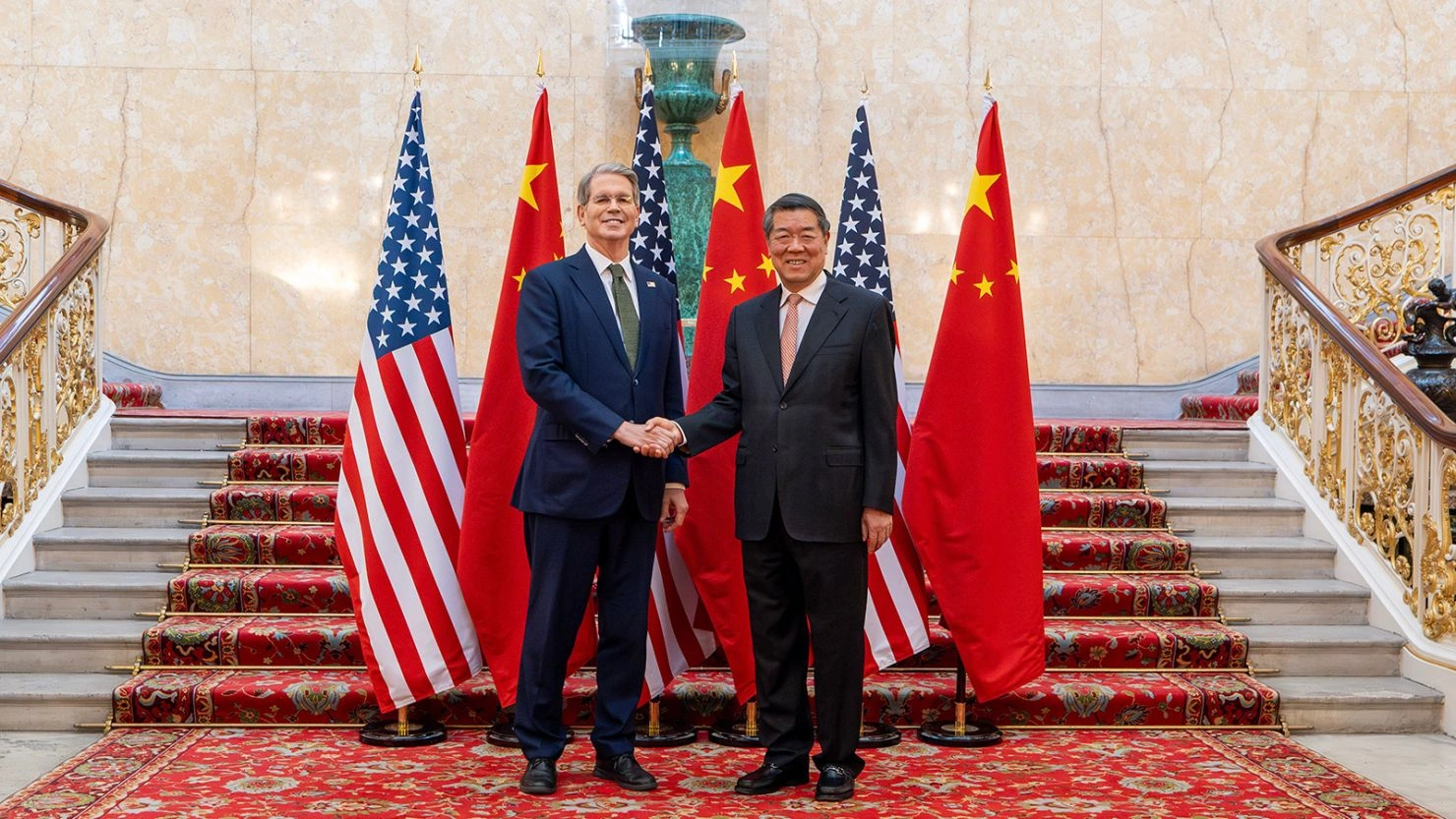
Bessent and He Lifeng meet at OECD Paris to review the Busan trade truce before Trump’s Beijing summit. Rare earths, Hormuz oil shock, and Section 301 cloud the path ahead.
The 16th arrondissement of Paris is not a place that announces itself. Discreet, residential, its wide avenues lined with haussmann facades, it is the kind of neighbourhood where power moves quietly. On Sunday morning, as French voters elsewhere in the city queued outside polling stations for the first round of local elections, a motorcade slipped through those unassuming streets toward the headquarters of the Organisation for Economic Co-operation and Development. Inside, the world’s two largest economies were attempting something rare in 2026: a structured, professional conversation.
Talks began at 10:05 a.m. local time, with Vice-Premier He Lifeng accompanied by Li Chenggang, China’s foremost international trade negotiator, while Treasury Secretary Scott Bessent arrived flanked by US Trade Representative Jamieson Greer. South China Morning Post Unlike previous encounters in European capitals, the delegations were received not by a host-country official but by OECD Secretary-General Mathias Cormann South China Morning Post — a small detail that spoke volumes. France was absorbed in its own democratic ritual. The world’s most consequential bilateral relationship was, once again, largely on its own.
The Stakes in Paris: More Than a Warm-Up Act
It would be tempting to dismiss the Paris talks as logistical scaffolding for a grander event — namely, President Donald Trump’s planned visit to Beijing at the end of March for a face-to-face with President Xi Jinping. That reading would be a mistake. The discussions are expected to cover US tariff adjustments, Chinese exports of rare earth minerals and magnets, American high-tech export controls, and Chinese purchases of US agricultural commodities CNBC — a cluster of issues that, taken together, constitute the structural skeleton of the bilateral relationship.
Analysts cautioned that with limited preparation time and Washington’s strategic focus consumed by the US-Israeli military campaign against Iran, the prospects for any significant breakthrough — either in Paris or at the Beijing summit — remain constrained. Investing.com As Scott Kennedy, a China economics specialist at the Center for Strategic and International Studies, put it with characteristic precision: “Both sides, I think, have a minimum goal of having a meeting which sort of keeps things together and avoids a rupture and re-escalation of tensions.” Yahoo!
That minimum — preserving the architecture of the relationship, not remodelling it — may, in the current environment, be ambitious enough.
Busan’s Ledger: What Has Been Delivered, and What Has Not
The two delegations were expected to review progress against the commitments enshrined in the October 2025 trade truce brokered by Trump and Xi on the sidelines of the APEC summit in Busan, South Korea. Yahoo! On certain metrics, the scorecard is encouraging. Washington officials, including Bessent himself, have confirmed that China has broadly honoured its agricultural obligations under the deal Business Standard — a meaningful signal at a moment when diplomatic goodwill is scarce.
The soybean numbers are notable. China committed to purchasing 12 million metric tonnes of US soybeans in the 2025 marketing year, with an escalation to 25 million tonnes in 2026 — a procurement schedule that begins with the autumn harvest. Yahoo! For Midwestern farmers and the commodity desks that serve them, these are not abstractions; they are the difference between a profitable season and a foreclosure notice.
But the picture darkens considerably when attention shifts to critical materials. US aerospace manufacturers and semiconductor companies are experiencing acute shortages of rare earth elements, including yttrium — a mineral indispensable in the heat-resistant coatings that protect jet engine components — and China, which controls an estimated 60 percent of global rare earth production, has not yet extended full export access to these sectors. CNBC According to William Chou, a senior fellow at the Hudson Institute, “US priorities will likely be about agricultural purchases by China and greater access to Chinese rare earths in the short term” Business Standard at the Paris talks — a formulation that implies urgency without optimism.
The supply chain implications are already registering. Defence contractors reliant on rare-earth permanent magnets for guidance systems, electric motors in next-generation aircraft, and precision sensors are operating on diminished buffers. The Paris talks, if they yield anything concrete, may need to yield this above all.
A New Irritant: Section 301 Returns
Against this backdrop of incremental compliance and unresolved bottlenecks, the US side has introduced a fresh complication. Treasury Secretary Bessent and USTR Greer are bringing to Paris a new Section 301 trade investigation targeting China and 15 other major trading partners CNBC — a revival of the legal mechanism previously used to justify sweeping tariffs during the first Trump administration. The signal it sends is deliberately mixed: Washington is simultaneously seeking to consolidate the Busan framework and reserving the right to escalate it.
For Chinese negotiators, the juxtaposition is not lost. Beijing has staked considerable domestic political credibility on the proposition that engagement with Washington produces tangible results. A Section 301 investigation, even if procedurally nascent, raises the spectre of a new tariff architecture layered atop the existing one — and complicates the case for continued compliance within China’s own policy bureaucracy.
The Hormuz Variable: When Geopolitics Enters the Room
No diplomatic meeting in March 2026 can be quarantined from the wider strategic environment, and the Paris talks are no exception. The ongoing US-Israeli military campaign against Iran has introduced a variable of potentially severe economic consequence: the partial closure of the Strait of Hormuz, the narrow waterway through which approximately a fifth of the world’s oil passes.
China sources roughly 45 percent of its imported oil through the Strait, making any disruption there a direct threat to its industrial output and energy security. Business Standard After US forces struck Iran’s Kharg Island oil loading facility and Tehran signalled retaliatory intent, President Trump called on other nations to assist in protecting maritime passage through the Strait. CNBC Bessent, for his part, issued a 30-day sanctions waiver to permit the sale of Russian oil currently stranded on tankers at sea CNBC — a pragmatic, if politically contorted, attempt to soften the energy-price spike.
For the Paris talks, the Hormuz dimension introduces a paradox. China has an acute economic interest in stabilising global oil flows and might, in principle, be receptive to coordinating with the United States on maritime security. Yet Beijing’s deep reluctance to be seen as endorsing or facilitating US-led military operations in the Middle East constrains how far it can go. The corridor between shared interest and political optics is narrow.
What Trump Wants in Beijing — and What Xi Can Deliver
With Trump’s Beijing visit now functioning as the near-term endpoint of this diplomatic process, the outlines of a summit package are beginning to take shape. The US president is expected to seek major new Chinese commitments on Boeing aircraft orders and expanded purchases of American liquefied natural gas Yahoo! — both commercially significant and symbolically resonant for domestic audiences. Boeing’s recovery from years of regulatory and reputational turbulence has made its order book a quasi-barometer of US industrial confidence; LNG exports represent a strategic diversification of American energy diplomacy.
For Xi, the calculus involves threading a needle between delivering enough to make the summit worthwhile and conceding so much that it invites criticism at home from nationalist constituencies already sceptical of engagement. China’s state media has consistently characterised the Paris talks as a potential “stabilising anchor” for an increasingly uncertain global economy Republic World — language carefully chosen to frame engagement as prudent statecraft rather than capitulation.
The OECD itself, whose headquarters serves as neutral ground for today’s meeting, cut its global growth forecast earlier this year amid trade fragmentation fears — underscoring that the bilateral relationship between Washington and Beijing carries systemic weight far beyond its two principals. A credible summit, even one short of transformative, would send a signal to investment desks and central banks from Frankfurt to Singapore that the world’s two largest economies retain the institutional capacity to manage their rivalry.
The Road to Beijing, and Beyond
What happens in the 16th arrondissement today will not resolve the structural tensions that define the US-China relationship in this decade. The rare-earth bottleneck is systemic, not administrative. The Section 301 investigation reflects a bipartisan American political consensus that China’s industrial subsidies represent an existential competitive threat. And the Iran war has introduced a geopolitical variable that neither side fully controls.
But the Paris talks serve a purpose that transcends their immediate agenda. They demonstrate, to a watching world, that diplomacy between great powers remains possible even as military operations unfold and supply chains fracture. They keep open the channels through which, eventually, more durable arrangements might be negotiated — whether at a Beijing summit, at the G20 in Johannesburg later this year, or in another European capital where motorcades slip, unannounced, through quiet streets.
The minimum goal, as CSIS’s Kennedy observed, is avoiding rupture. In the spring of 2026, with the Strait of Hormuz partially closed and yttrium shipments stalled, that minimum has acquired the weight of ambition.
Discover more from The Economy
Subscribe to get the latest posts sent to your email.
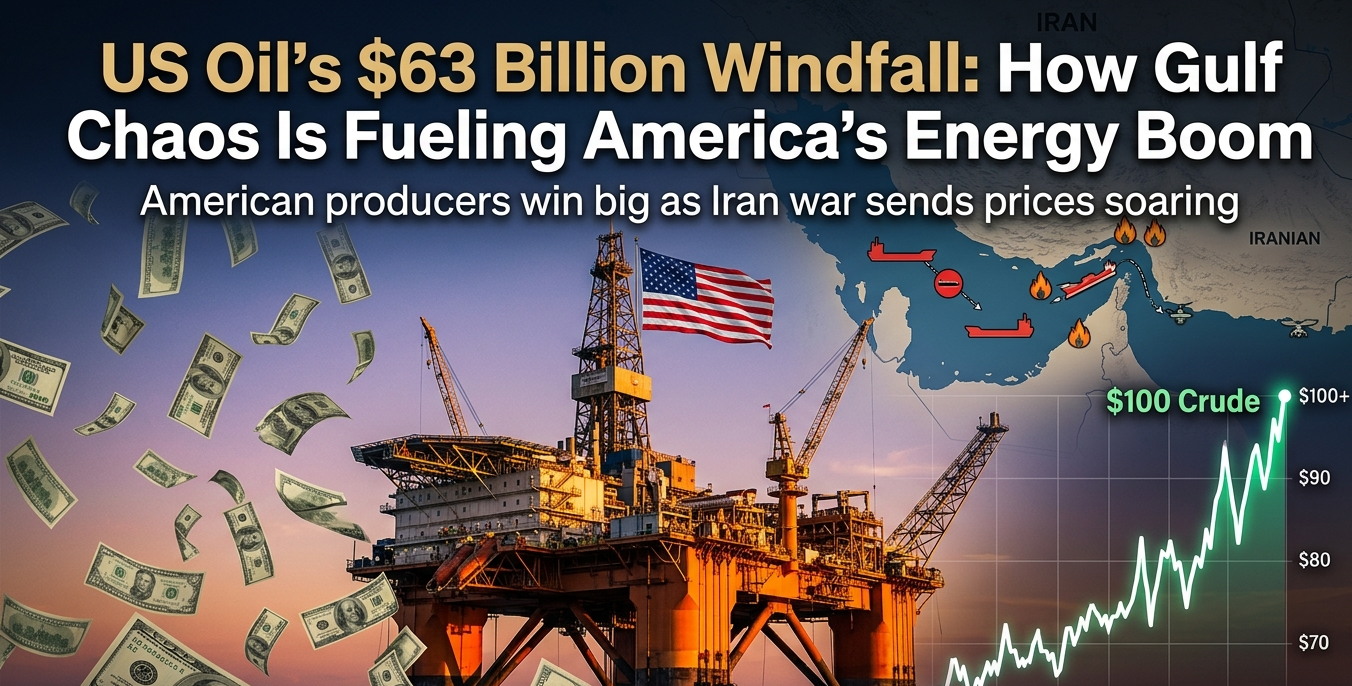
As the Strait of Hormuz closure pushes Brent past $100, US shale producers stand to gain $63bn this year. But geopolitical risk, inflationary pressure, and investor discipline complicate the narrative.
The tiny coral outcrop of Kharg Island, sitting astride Iran’s economic lifeline, was never supposed to be the epicentre of the world’s next great energy shock. Yet when US Central Command confirmed Saturday that precision strikes had taken out naval mine storage facilities on the island while carefully preserving its oil infrastructure, it encapsulated the paradoxical moment confronting global energy markets .
The war is real. The disruption is historic. And American oil producers are, by any conventional measure, about to make an extraordinary amount of money.
If crude prices average $100 per barrel this year—Brent closed Friday at $103.14, with WTI at $98.71—US oil companies will reap approximately $63.4 billion in additional revenue compared to pre-conflict expectations, according to Rystad Energy modelling cited by the Financial Times . Jefferies calculates that American producers are already generating an extra $5 billion in monthly cash flow following the 47 per cent price surge since February 28 .
But for C-suite executives and policymakers accustomed to reading this story as a straightforward tale of American energy dominance, the reality is considerably more layered. The $63 billion windfall arrives with strings attached: a schism between international majors and domestic shale players, the spectral return of 1970s-style stagflation fears, and an uncomfortable truth about who actually benefits when the world’s most critical waterway goes dark.
‘The Largest Supply Disruption in History’
To understand the magnitude of what is unfolding, one must start with the Strait of Hormuz. Before February 28, approximately 20 million barrels of crude and oil products flowed through this narrow passage daily—roughly a fifth of global consumption . Today, that figure has fallen to nearly zero.
The International Energy Agency, not given to hyperbole, described the situation in its March report as “the largest supply disruption in the history of the global oil market” . Gulf producers have been forced to cut at least 10 million barrels per day of total production—8 million barrels of crude plus 2 million barrels of condensates and natural gas liquids. Storage facilities across Iraq, Qatar, Kuwait, the UAE, and Saudi Arabia are filling rapidly, with tankers unable or unwilling to load .
What makes this crisis distinct from previous Gulf conflicts is its simultaneous impact on production, refining, and shipping. More than 3 million barrels per day of regional refining capacity have already shut down due to attacks and the absence of viable export routes . The liquefied natural gas market has been hit even harder, with approximately one-fifth of global LNG supply stalled—prompting Shell to declare force majeure on shipments from QatarEnergy’s Ras Laffan plant .
The $63 Billion Math
The windfall calculation is straightforward in theory, nuanced in practice.
Rystad’s $63.4 billion figure represents incremental revenue—the difference between what US producers would have earned at pre-conflict price levels and what they stand to capture at sustained $100 oil. But as any energy CFO will note, revenue is not profit, and profit is not free cash flow returned to shareholders.
The investment bank Jefferies offers a more granular window: US producers are generating an extra $5 billion in cash flow this month alone . If sustained across twelve months, that translates to approximately $60 billion in additional free cash flow—money that can be deployed toward dividends, share buybacks, debt reduction, or, in theory, new production.
The distinction matters because it reveals how this moment differs from previous oil shocks. During the 2011 Libyan crisis or even the immediate aftermath of Russia’s 2022 invasion of Ukraine, the US shale patch responded with alacrity, deploying rigs and completion crews to capture higher prices. This time, the response has been conspicuously muted.
The Discipline Paradox
Morgan Stanley analysts tracking the oilfield services sector note something unusual: American drilling and completion companies are “hesitant to underwrite significant gains in U.S. activity” despite the price spike . Public US exploration and production companies remain tethered to capital discipline, with private explorers considering only marginal activity increases.
This restraint reflects a fundamental shift in how US shale is governed. The era of growth-at-any-cost, which burned through billions of investor dollars during the 2010s, has given way to a return-on-capital ethos enforced by institutional shareholders who remember the previous decade’s disappointments. Patterson-UTI Energy and Helmerich and Payne are waiting for a more sustained signal before deploying additional rigs .
There is also a pragmatic calculation at work. The US Strategic Petroleum Reserve release of 172 million barrels, part of a coordinated 400-million-barrel IEA action, provides a temporary buffer but cannot substitute for resumption of Hormuz flows . Goldman Sachs projects Brent could exceed $128 per barrel within three to four weeks if the conflict persists . Yet the same bank also forecasts prices falling back to $85 by April—a volatility that makes multi-year capital commitments hazardous .
Winners and Losers in the New Calculus
The $63 billion windfall is not evenly distributed. US shale producers with minimal Middle East exposure—companies like Pioneer Natural Resources, EOG Resources, and ConocoPhillips—stand to capture the full benefit of higher prices without the offsetting operational pain afflicting their international peers .
For the global majors, the picture is more complicated.
ExxonMobil and Chevron, alongside European counterparts BP, Shell, and TotalEnergies, have spent years expanding their footprint across the Gulf region, signing agreements in Syria, Libya, and several Gulf states to increase reserves and production. That strategic bet has now become a liability. According to Rystad data, more than one-fifth of BP and ExxonMobil’s 2026 free cash flow was expected to come from their Middle East oil and LNG businesses . With those assets now shuttered or operating under force majeure, the parent companies face a direct hit to earnings even as commodity prices soar.
TotalEnergies acknowledged as much in a trading update Friday, noting that higher oil prices are “enough to offset the impact of declining Middle East output”—a formulation suggesting the calculus is close to neutral rather than unambiguously positive . ExxonMobil CEO Darren Woods offered a blunter assessment: the shutdown of the “world’s central supply source” will hit everyone in the industry, though the company’s scale provides some purchasing advantages .
The stock market has rendered its own verdict. Since the conflict began, ExxonMobil shares have risen only 2 per cent, lagging behind BP and Shell’s 11 per cent and 9 per cent gains . The divergence reflects investor expectations that European majors’ large trading operations will benefit from price volatility, while US majors’ Gulf exposure creates unwanted complexity.
Norwegian oil giant Equinor has outperformed them all—it has no Middle East business whatsoever .
The Inflation Conundrum
For the Biden (and potentially Trump) administration watching from Washington, the $63 billion windfall creates a policy dilemma of the first order.
The consumer price index showed energy prices rising 0.6 per cent month-over-month in February, pushing core PCE back to 3.0 per cent—well above the Federal Reserve’s target . Goldman Sachs has already pushed its first expected rate cut from June to September, with FedWatch data showing 99 per cent probability of a rate freeze at the March FOMC meeting .
Former President Donald Trump, never one for policy nuance, took to Truth Social to demand immediate rate cuts even as inflationary pressures mount—a contradiction not lost on markets . Columbia University’s Joseph Stiglitz warns of “stagflation,” invoking the 1974 oil crisis comparison that haunts central bankers’ nightmares .
The political economy here is brutal. American oil producers capture $63 billion. American consumers pay $4-plus gasoline. The Federal Reserve confronts a inflation shock it cannot address without potentially tipping the economy into recession. And the Strategic Petroleum Reserve, that hard-won buffer against supply disruptions, is being drawn down at the very moment when its long-term adequacy comes into question.
The Energy Transition Reckoning
There is a longer-term story buried beneath the immediate price volatility, and it concerns the fate of the energy transition.
Before February 28, the prevailing narrative in Davos and Dubai was one of managed decline for fossil fuels. The COP summits had enshrined transition language. Investment capital was flowing toward renewables. The major oil companies were repositioning themselves as “energy companies” with diversified portfolios.
That narrative has not been destroyed, but it has been complicated. RBC Capital Markets expects the conflict to last into spring, with all that implies for supply chains and investment certainty . Paul Sankey of Sankey Research notes that the crisis could drive a more active pivot toward domestic energy sources not affected by supply disruptions—but also warns that “this could turn into a demand destruction event, ultimately hurting everyone” .
The hardest-hit regions may be in Asia, where reliance on Gulf oil and LNG is highest. Sankey suggests some countries may reconsider their aversion to nuclear power—a development that would have seemed improbable before the Strait of Hormuz became a war zone .
What Comes Next
The $63 billion windfall is real, but it is not yet banked. Three variables will determine whether US producers ultimately capture these gains or watch them evaporate.
First, the duration of the Hormuz closure. Iran’s new Supreme Leader Mojtaba Khamenei has vowed to keep the waterway shut, seeking leverage over the US and Israel . But storage capacity is finite, and Gulf producers are already feeling the pain of curtailed output. Something will break—either the blockade or the region’s production infrastructure.
Second, the response of OPEC+ spare capacity. Before the conflict, OPEC held approximately 5 million barrels per day of spare capacity, predominantly in Saudi Arabia and the UAE. That capacity is now largely inaccessible due to the same shipping constraints affecting Gulf producers. The IEA’s coordinated reserve release buys time, but it does not solve the underlying supply problem .
Third, the reaction of US shale’s capital allocators. If discipline holds and producers return cash to shareholders rather than chasing growth, the $63 billion will manifest as dividends and buybacks rather than a supply response that eventually undercuts prices. If discipline fractures, the industry risks repeating the boom-bust cycle that left it vulnerable to the last decade’s price collapses.
A Double-Edged Sword
The historian Daniel Yergin has observed that oil markets are never just about oil—they are about the intersection of geology, technology, and human conflict. The current moment vindicates that observation in uncomfortable ways.
American oil companies are indeed line for a windfall that would have seemed improbable three weeks ago. The $63 billion figure will appear in earnings releases, investor presentations, and analyst notes throughout 2026. It will fuel debates about windfall profits taxes, strategic reserves, and the proper role of domestic production in national security.
But the same crisis that delivers this windfall also exposes the vulnerabilities beneath American energy dominance. The US is the world’s largest oil producer, yet it cannot insulate its economy from a supply shock originating 7,000 miles away. The shale revolution conferred resilience, but not immunity. And the energy transition, whatever its long-term merits, offers no protection against the immediate pain of $100 oil.
Martin Houston, the oil industry veteran now chairing Omega Oil & Gas, put it succinctly: “This is not a situation with any winners” . The $63 billion is real. But so is everything that comes with it.
Discover more from The Economy
Subscribe to get the latest posts sent to your email.
Analysis
Jazz Wins 190 MHz in Pakistan’s Historic 5G Auction – Triples Spectrum to 284.4 MHz for $239M

In a single, decisive afternoon that will be marked as a pivotal moment in Pakistan’s economic history, the nation has finally and forcefully entered the global 5G arena. The country’s long-anticipated 5G spectrum auction concluded today, March 10, 2026, raising a staggering $507 million for the national exchequer in a matter of hours.
Emerging as the undisputed heavyweight champion from this digital contest is Jazz, the nation’s largest mobile operator. Backed by its parent company, VEON, Jazz has committed $239.375 million to secure a massive 190 MHz block of new spectrum, a move that more than triples its total holdings and redraws the competitive map of South Asia’s telecommunications landscape. This wasn’t merely a business transaction; it was a declaration of intent, positioning Jazz—and by extension, Pakistan—to leapfrog years of digital latency and begin closing the profound connectivity gap that has long hampered its immense potential.
The results of the Pakistan 5G spectrum auction 2026 signal a tectonic shift. For a nation where nearly 40% of the population still lacks basic 4G access and per-user data consumption hovers at a modest 8 GB per month—well below the regional average of 20 GB—this auction is the starting gun for a digital revolution. Jazz’s aggressive acquisition, particularly its strategic capture of the coveted 700 MHz band, is a clear bet on a future where high-speed internet is not a luxury for the urban elite, but a utility for the masses, from the bustling markets of Karachi to the remote valleys of Gilgit-Baltistan. As the dust settles, the implications are clear: Pakistan’s digital future, for better or worse, will be largely shaped by the success of this monumental investment.
Breaking Down the Auction: Jazz Emerges Victorious
The auction, managed with notable transparency by the Pakistan Telecommunication Authority (PTA), was a swift and high-stakes affair. Of the 480 MHz of spectrum sold, the Jazz spectrum auction result was a clear victory. The company secured the largest and most diverse portfolio of frequencies, a strategic haul designed for both capacity and coverage.
The specifics of the Jazz 190 MHz Pakistan acquisition paint a detailed picture of its ambitions:
- 50 MHz in the 3500 MHz band: This is the prime global frequency for 5G, offering immense capacity and blazing-fast speeds. It will form the backbone of Jazz’s initial 5G rollout in dense urban centers like Lahore, Islamabad, and Karachi, where data demand is highest.
- 70 MHz in the 2600 MHz band: A crucial capacity layer that complements the 3500 MHz band, this spectrum will handle heavy data traffic and ensure a consistent, high-quality user experience as the 5G network matures.
- 50 MHz in the 2300 MHz band: Another vital capacity band, which provides a solid foundation for expanding 4G services and managing the transition to 5G.
- 20 MHz in the 700 MHz band: Perhaps the most strategically critical piece of the puzzle, this low-band spectrum is the key to unlocking the rural market.
This combination of low, mid, and high-band spectrum gives Jazz an unparalleled toolkit to execute a multi-layered network strategy, a sophisticated approach more akin to operators in developed markets than what is typical in the region.
From 94.4 MHz to 284.4 MHz: What Tripling Spectrum Really Means
For the layman, spectrum can be an abstract concept. In reality, it is the invisible real estate upon which all wireless communication is built. Before the auction, Jazz operated on a constrained 94.4 MHz of spectrum. This limited its ability to handle the exponential growth in data demand, leading to network congestion and a ceiling on potential service quality.
The headline, “Jazz triples spectrum holdings to 284.4 MHz,” barely does justice to the operational transformation this enables. It’s the difference between a two-lane country road and a six-lane superhighway. This dramatic expansion provides three immediate benefits:
- Massive Capacity Boost: The new frequencies, particularly in the mid-bands (2300 MHz, 2600 MHz, 3500 MHz), will immediately alleviate congestion on the existing 4G network. This means faster, more reliable speeds for millions of current users, even before a single 5G tower is activated.
- A Credible Path to 5G: True 5G requires wide, contiguous blocks of spectrum to deliver its promised gigabit speeds and ultra-low latency. With 50 MHz in the 3500 MHz band, Jazz now has the foundational asset to launch a world-class 5G service, enabling next-generation applications from the Internet of Things (IoT) to cloud gaming and smart cities.
- Future-Proofing the Network: By securing such a vast portfolio, Jazz has ensured it has the resources to meet Pakistan’s data demands for the next decade. It avoids the piecemeal, incremental upgrades that have plagued many emerging markets, allowing for long-term, strategic network planning.
The 700 MHz Prize: Game-Changer for Rural Pakistan
While the high-band spectrum grabs headlines for its speed, the quiet hero of this auction is the Jazz 700 MHz band Pakistan rural coverage plan. Low-band spectrum like 700 MHz possesses superior propagation characteristics, meaning its signals travel much farther and penetrate buildings more effectively than high-band signals.
This is a game-changer for a country with Pakistan’s geography and demographics. Building a network in sparsely populated or mountainous regions with traditional high-frequency spectrum is often economically unviable, requiring a dense grid of towers. The 700 MHz spectrum rural connectivity Pakistan strategy allows Jazz to cover vast swathes of the countryside with a fraction of the infrastructure.
This single allocation is the most concrete step taken to date to bridge Pakistan’s stubborn digital divide. It holds the promise of bringing reliable, high-speed mobile broadband to millions of citizens for the first time, unlocking access to education, e-health, digital finance, and modern agricultural practices. This directly addresses one of the most significant hurdles to inclusive economic growth. As Aamir Ibrahim, CEO of Jazz, noted, this investment is about “more than just 5G in cities; it’s about building a digital ecosystem that includes every Pakistani.” This sentiment, backed by the physics of the 700 MHz band, now carries the weight of genuine possibility.
Competitor Landscape: How Zong and Ufone Fared
While Jazz was the clear winner, it was not the only player. The Pakistan 5G auction results show a broader commitment to the country’s digital future from other key operators.
| Operator | Total Spectrum Won | Key Bands Acquired (MHz) | Total Outlay (Approx.) |
|---|---|---|---|
| Jazz | 190 MHz | 3500, 2600, 2300, 700 | $239.375 M |
| Ufone | 180 MHz | 3500, 2600, 2300 | $198 M |
| Zong | 110 MHz | 3500, 2600 | $69 M |
The Jazz vs Zong vs Ufone 5G spectrum allocation reveals distinct strategies. Ufone also made a significant play, securing a large 180 MHz block to bolster its position and compete aggressively in the 5G race. Zong, a subsidiary of China Mobile and an early pioneer of 4G in Pakistan, took a more modest 110 MHz, likely focusing its resources on upgrading its existing, robust network infrastructure for 5G services in its urban strongholds. The competitive dynamic is now set for a fierce three-way race, which will ultimately benefit consumers with better services and more competitive pricing.
Economic Ripple Effects: Closing the Digital Divide
The Pakistan 5G auction economic impact 2026 cannot be overstated. Beyond the immediate $507 million windfall for the government, the true value lies in the long-term multiplier effect on the economy. The Jazz $1 billion investment 5G Pakistan commitment, announced in conjunction with the auction, is a powerful vote of confidence in the country’s policy direction and economic stability.
This capital expenditure will flow into network hardware, local engineering talent, and civil works, creating thousands of jobs. More profoundly, the resulting digital infrastructure will serve as a platform for innovation across every sector. For a country with a youthful, entrepreneurial population, access to reliable, high-speed connectivity is the critical missing ingredient. It will catalyze the growth of the gig economy, e-commerce, fintech, and a burgeoning startup scene that has, until now, been constrained by digital scarcity. This is the macro-level story that international investors and bodies like the IMF will be watching closely.
Policy Verdict: A Win for Transparent Spectrum Management
Finally, the execution of the auction itself is a significant victory. In a region where spectrum allocation has often been a contentious and opaque process, the PTA has delivered a model of efficiency and transparency. Unlike the delayed and complex processes seen in neighboring India or Bangladesh, Pakistan’s ability to conduct a clean, multi-band auction in a single day sets a new regional benchmark. It sends a powerful signal to the global investment community that Pakistan is a serious and reliable destination for foreign direct investment in the technology sector. This successful policy execution, as detailed in reports by outlets like Dawn and Business Recorder, builds crucial sovereign credibility.
The road ahead is not without its challenges. Rolling out a nationwide 5G network while simultaneously expanding 4G to underserved areas is a monumental undertaking. It will require navigating complex regulatory hurdles, securing the supply chain for advanced equipment, and managing the significant debt load associated with such a large investment. However, as of today, the path is clear. With its newly tripled spectrum holdings and a clear strategic vision, as outlined in the official VEON announcement, Jazz has not just won an auction; it has accepted the mantle of leadership in powering Pakistan’s digital destiny. The nation, and the world, is watching.
Discover more from The Economy
Subscribe to get the latest posts sent to your email.
-

 Markets & Finance2 months ago
Top 15 Stocks for Investment in 2026 in PSX: Your Complete Guide to Pakistan’s Best Investment Opportunities
-

 Analysis1 month ago
Brazil’s Rare Earth Race: US, EU, and China Compete for Critical Minerals as Tensions Rise
-

 Banks2 months ago
Best Investments in Pakistan 2026: Top 10 Low-Price Shares and Long-Term Picks for the PSX
-

 Investment2 months ago
Top 10 Mutual Fund Managers in Pakistan for Investment in 2026: A Comprehensive Guide for Optimal Returns
-

 Asia2 months ago
China’s 50% Domestic Equipment Rule: The Semiconductor Mandate Reshaping Global Tech
-

 Analysis4 weeks ago
Top 10 Stocks for Investment in PSX for Quick Returns in 2026
-

 Global Economy3 months ago
Pakistan’s Export Goldmine: 10 Game-Changing Markets Where Pakistani Businesses Are Winning Big in 2025
-

 Global Economy3 months ago
15 Most Lucrative Sectors for Investment in Pakistan: A 2025 Data-Driven Analysis