
Analysis
UAE Stocks Fall as Fears of Prolonged Middle East Conflict Grip Investors — DFM, ADX Under Siege

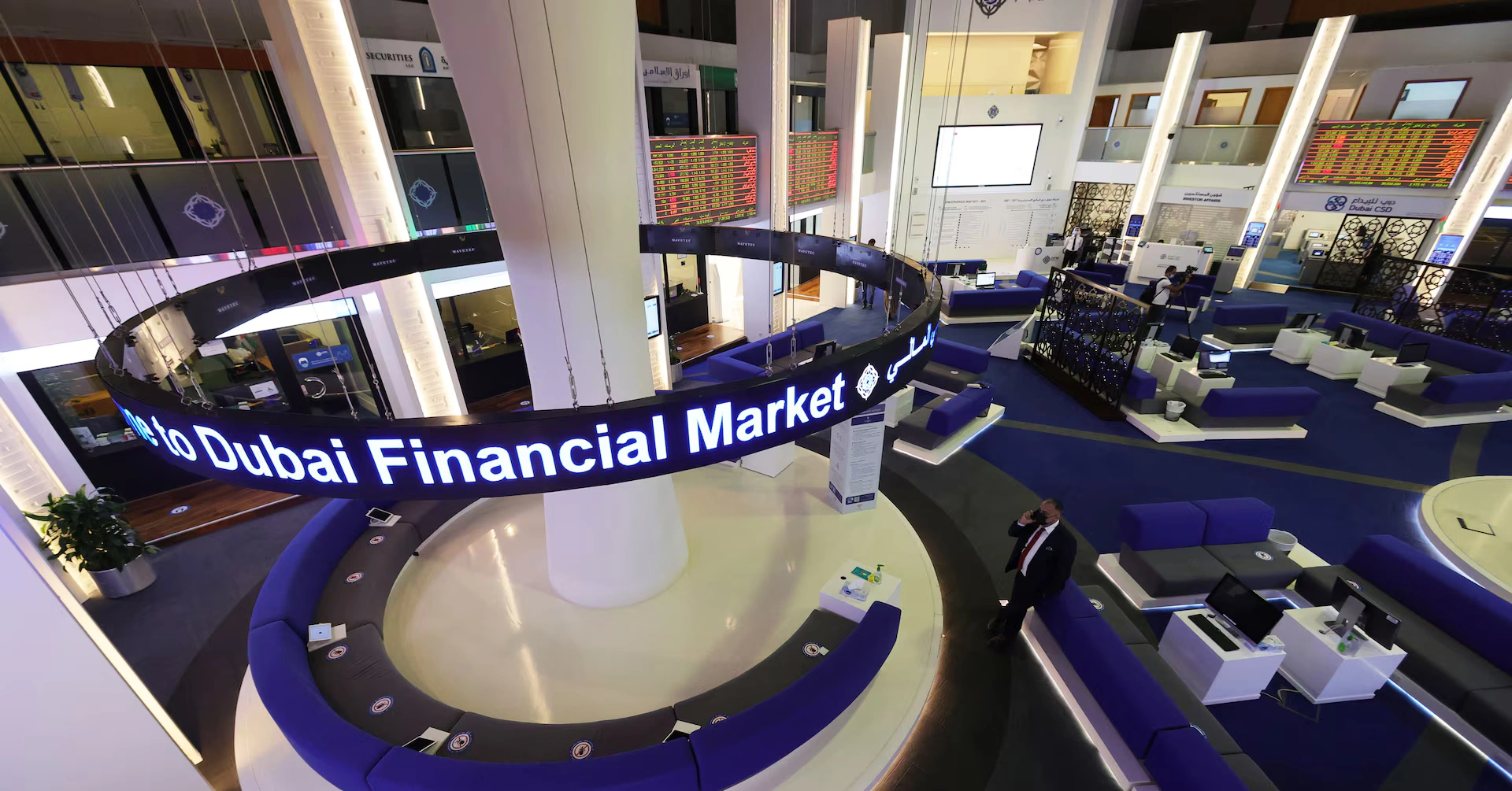
The smoke was still rising over the Gulf when the trading screens flickered back to life.
After two unprecedented days of enforced silence — the UAE equity markets shuttered by regulatory decree as Iranian missiles rained down on Abu Dhabi and Dubai — UAE stocks fell sharply on March 4, delivering the kind of gut-punch to investor confidence that takes months, sometimes years, to fully repair. As the war in the Middle East now approaches its two-week mark — with drone and missile exchanges intensifying rather than abating — the question confronting every portfolio manager from London to Singapore is no longer whether the UAE’s markets will recover, but how long they can sustain the pressure of being caught in the crosshairs of the region’s most dangerous confrontation in a generation.
Investor caution has intensified as the war in the Middle East approaches the two-week mark, with heavy exchanges of drone and missile strikes across the region, unsettling markets that had spent the better part of the decade repositioning the UAE as a geopolitically neutral financial sanctuary. ZAWYA
The Market Numbers: A Reckoning in Red
The data tells a stark story. The DFM General Index, the main equities gauge of the Dubai Financial Market, closed the first post-closure session 4.71 per cent lower — its steepest single-day drop since mid-2022 — while the benchmark gauge of the Abu Dhabi Securities Exchange ended the day 1.9 per cent lower, after falling more than 3 per cent at intraday lows. The National
The declines were across the board, with both the Dubai Financial Market and the Abu Dhabi Securities Exchange applying a temporary -5% lower price limit on securities to protect investors from extreme volatility. Aldar Properties, First Abu Dhabi Bank, Abu Dhabi Aviation, and Abu Dhabi National Hotels were among the stocks that hit the -5% limit. Dubai’s banking and airline stocks led the declines — Emirates NBD Bank and Mashreq closed 5% lower, while Air Arabia, the market’s sole airline stock, also declined nearly 5% to AED 5.14. TradingView
Major names such as Emaar Properties, Emaar Development, Deyaar Development, and Emirates NBD came under pressure, alongside logistics firm Aramex and infrastructure-related companies including DEWA, Salik, and Parkin. Gulf News
Key Market Performance Snapshot (March 4–14, 2026)
| Asset / Index | Move (Reopening Day) | Notable Detail |
|---|---|---|
| DFM General Index (DFMGI) | −4.71% | Steepest drop since May 2022 |
| ADX FTFADGI | −1.93% (−3.6% intraday) | Held above 200-day EMA |
| Emirates NBD | −5.0% (hit circuit) | Banking sector leader |
| Mashreq Bank | −5.0% (hit circuit) | Hit lower price limit |
| Emaar Properties | −4.93% | UAE’s flagship real estate stock |
| Air Arabia | ~−5.0% to AED 5.14 | Sole airline on DFM |
| DEWA / Salik | −5.0% (hit circuit) | Mobility/infrastructure linked |
| Aldar Properties (ADX) | −5.0% (hit circuit) | Abu Dhabi real estate bellwether |
| First Abu Dhabi Bank (FAB) | −5.0% (hit circuit) | UAE’s largest bank by assets |
| Gold (safe-haven) | +13% over six weeks | Inverse flight to safety |
| Crude oil | +~20% over six weeks | Hormuz disruption premium |
How We Got Here: The Arc of an Unprecedented Crisis
The conflict that is now reshaping Gulf financial markets began on Saturday, March 1, 2026, when coordinated US-Israeli military operations against Iran produced consequences that would reverberate far beyond the battlefield. The UAE’s financial regulator announced that its key exchanges in Dubai and Abu Dhabi would not immediately reopen after the weekend break amid the fallout of the US-Israeli attacks. The announcement came after the UAE was hit with hundreds of Iranian missile and drone attacks, including a strike on Abu Dhabi’s main airport that killed one person and wounded seven others. Al Jazeera
The UAE Capital Markets Authority announced that the ADX and DFM would be closed on Monday, March 2 and Tuesday, March 3, 2026, with the regulator continuing to “monitor developments in the region and assess the situation on an ongoing basis, taking any further measures as necessary.” The National
The two-day closure was, to put it plainly, historically extraordinary. Historically, no Middle Eastern state — including Israel during prior conflicts — had ever fully closed its stock exchange during a time of regional conflict. In prior exchanges, Israel modified trading hours, not days. The only modern analogues are Russia’s month-long freeze of the Moscow Exchange following its 2022 Ukraine invasion, and Egypt’s nearly two-month suspension during the Arab Spring upheaval of 2011. Al Jazeera
The symbolism of that comparison should not be lost on investors. In both precedents, the market closures preceded years of structural realignment.
The Strait of Hormuz: The World’s Most Expensive Chokepoint
No geopolitical variable concentrates the mind of global energy markets more immediately than the Strait of Hormuz — the 21-mile-wide channel through which the arteries of global commerce pulse. Iran’s strikes effectively blocked the Strait of Hormuz, the chokepoint through which roughly 20 million barrels of oil per day and nearly 20% of global LNG exports transit. A sustained Hormuz closure could push oil above $100 per barrel, spiking US CPI inflation toward 5%. War-risk insurance costs have reportedly jumped approximately 50%, adding hundreds of thousands of dollars per voyage and reducing global trade flow. Shipping reroutes around Africa add 10–14 extra days to deliveries, slowing just-in-time manufacturing supply chains. BeInCrypto
Iran’s new Supreme Leader Mojtaba Khamenei, in his first public comments following his predecessor’s death, said on Thursday that Tehran would keep the Strait of Hormuz closed and urged neighbouring countries to shut US bases on their territory or risk being targeted. ZAWYA That statement — part geopolitical ultimatum, part market-moving declaration — landed like a depth charge in energy trading rooms worldwide.
For the UAE, an economy whose extraordinary prosperity has been constructed on the premise of being both an oil-revenue beneficiary and a trade-neutral corridor, the irony is acute: the very geography that makes it valuable also makes it vulnerable.
Dubai’s Safe-Haven Brand: Tested, Not Broken — Yet
For two decades, Dubai’s value proposition to the world’s mobile capital was elegantly simple: maximum connectivity, minimum geopolitical friction. That narrative took its most serious blow yet on March 13, 2026. When debris from a successfully intercepted aerial threat, widely attributed to Iran by UAE air defence sources, struck the facade of a building in central Dubai near the DIFC Innovation Hub, it did far more damage than the structure itself. Investors and market watchers around the world saw cracks in the image that Dubai had spent two decades carefully polishing — an image of an unbreachable, neutral financial sanctuary in a turbulent neighbourhood. The Week
The UAE attracted $33.2 billion in FDI in 2025 and welcomed approximately 9,800 new millionaires in the same year. That extraordinary momentum is now facing its stiffest geopolitical test, and the world is watching whether the safe haven holds, or whether the smoke over the skyline marks a permanent shift in where global capital chooses to call home. The Week
The combined market capitalisation of the UAE exchanges stands at $1.1 trillion, the 19th highest in the world, carrying a 1.4 per cent weight on MSCI’s emerging markets benchmark, according to Bloomberg data. The National Capital at that scale does not flee quietly. It reprices, reroutes, and — in the worst case — relocates permanently.
Sector-by-Sector: Who Bears the Heaviest Burden?
Banking & Financial Services
The UAE’s banks entered this crisis from a position of structural strength. GCC banking systems carry robust capital buffers and have demonstrated through multiple prior stress periods — the 2020 pandemic, the 2015–16 oil correction — a capacity to maintain liquidity. Yet the market is pricing in something more insidious than near-term credit losses: a potential erosion of the correspondent-banking relationships and cross-border capital flows that underpin Dubai’s status as the Middle East’s financial clearing house. The flight of First Abu Dhabi Bank and Emirates NBD to their -5% circuit breakers on reopening day signals that institutional investors are not waiting to find out.
Real Estate
For UAE real estate stocks in the context of the Iran war, the dynamics are particularly complex. Indian buyers reportedly account for 20–30 per cent of prime Dubai residential property purchases, and high-net-worth individuals, family offices, and startup founders have parked billions in Dubai real estate and financial instruments. Disruption to DIFC’s operational ecosystem risks triggering capital reassessment, property transaction freezes, and turbulence in the remittance flows that many Indian families depend on. The Week Emaar Properties and Aldar’s near-5% drops are not merely equity corrections; they are referendum votes on the durability of Dubai’s real-estate premium.
Aviation & Tourism
Air Arabia’s near-5% decline reflects the raw arithmetic of a sector that cannot function when airspace is contested. Emirates confirmed that more than 100 flights would operate as UAE airspace partially reopened The National — a measure of normalisation that nonetheless underscores how profoundly abnormal conditions had become. Tourism, the sector Abu Dhabi and Dubai have invested billions to diversify into, faces a demand shock that will not be captured fully in equity prices until hotel occupancy and forward bookings data emerges in the coming weeks.
Energy Adjacents: The Counterintuitive Tailwind
Here lies the one sector where the conflict’s arithmetic inverts. Energy companies could receive support from rising oil prices, which have surged amid fears of supply disruptions linked to tensions around the Strait of Hormuz. As Saudi Arabia’s Aramco demonstrated during the UAE market closure by surging despite regional chaos, ADNOC and TAQA may see similar investor support Gulf News — a rerating driven not by fundamentals but by the premium embedded in every barrel of crude while Hormuz remains contested.
Investor Psychology: Between Panic and Price Discovery
The regulatory decision to apply -5% circuit breakers was a piece of sophisticated market engineering. The 5% cap offered some breathing space and partially curbed the initial panic among investors TradingView — preventing the kind of cascade selling that transforms a geopolitical repricing into a structural liquidity crisis. Market participants spent two days assessing regional developments while watching global markets and energy prices react to the escalating conflict. The initial session reflected rapid adjustment rather than panic selling — trading was dominated by price discovery as investors absorbed accumulated global and regional developments. Gulf News
Technically, both indices held above their 200-day EMA levels — DFMGI at Dh6,010 and FTSE ADX General Index at Dh10,060 — with the ADX closing above its 100-day EMA at Dh10,220. Gulf News Those technical floors matter enormously to algorithmic and institutional traders. Their preservation signals that this remains, for now, a fear-driven correction rather than a conviction-driven bear market.
“Equities in the United Arab Emirates are trading slightly lower, following a two-day closure aimed at protecting the Gulf state’s key markets amid the regional geopolitical developments. This temporary dip is likely to open up some interesting opportunities in the UAE’s accelerating long-term equity story,” Economy Middle East said Vijay Valecha, Chief Investment Officer at Century Financial — a view that encapsulates the tension every long-term investor now faces: the difference between a buying opportunity and a structural inflection point can only be assessed in hindsight.
Forward Scenarios: Three Paths Through the Fog
Scenario One — Rapid De-escalation (Low Probability, Near-Term): A ceasefire brokered through Qatari or Omani intermediaries within the next fortnight would trigger a sharp recovery rally. Historical precedent — the 2019 Abqaiq strikes in Saudi Arabia, the 2020 Soleimani assassination — suggests Gulf markets rebound powerfully once clarity returns. The UAE’s structural story (FDI pipeline, expo legacy infrastructure, diversification momentum) remains intact.
Scenario Two — Prolonged Stalemate (Most Probable): Trump’s stated policy goals — low inflation and $2 gas — conflict directly with a prolonged Iran conflict, which analysts say creates political pressure for a swift resolution. BeInCrypto A managed standoff, with Hormuz partially operational and oil stabilising between $90–$110, would produce a range-bound market: energy-related stocks supported, consumer and tourism stocks under pressure, and institutional foreign capital adopting a cautious “wait and observe” posture.
Scenario Three — Escalation to Regional War (Tail Risk, Severe Impact): Full Hormuz closure, sustained strikes on UAE infrastructure, and the paralysis of Dubai International Airport as a global aviation hub would constitute a genuine crisis for UAE equity markets. Dubai’s government has maintained a firm “business as usual” posture, with DIFC confirming full operational availability. The Week But if that posture cracks — if the messaging diverges from operational reality — the repricing would be severe.
The Longer View: Precedent, Resilience, and What Dubai Has Always Sold
History is instructive, if not entirely reassuring. The Gulf has endured the Iran-Iraq War, the first and second Gulf Wars, the 2006 Lebanon conflict, and the post-Arab Spring regional convulsions — and in each case, Dubai and Abu Dhabi emerged not merely intact but stronger, having absorbed displaced capital from less stable neighbours. The UAE’s model — benign authoritarianism married to cosmopolitan commerce — has consistently converted regional instability into competitive advantage.
But this moment is different in one critical respect: for the first time, the UAE itself is the theatre, not merely the sanctuary adjacent to one. The debris on a DIFC facade is not a metaphor; it is a datapoint that every institutional risk committee in New York, London, and Tokyo will process in the coming weeks.
By looking at the Saudi roadmap — which showed that the initial selling was short-lived and replaced by a focus on oil-price-driven gains — investors can approach the DFM and ADX with a balanced perspective. Gulf News That parallel is encouraging. Whether it holds depends entirely on decisions being made not in trading rooms, but in military command centres across the region.
Frequently Asked Questions: UAE Stocks and the Middle East Conflict
Why did UAE stocks fall so sharply when markets reopened? Markets were closed for two days while geopolitical events unfolded globally. The reopening session was a compressed price-discovery process — two days of global news, energy repricing, and risk-off sentiment priced in simultaneously.
What impact do Iran missile strikes have on UAE stocks? Direct strikes on UAE infrastructure — including Abu Dhabi airport — raise risk premiums across all asset classes, while signalling that the UAE’s traditional neutrality has been compromised. Banking and real estate stocks, as core pillars of UAE equity indices, bear the heaviest burden.
Is UAE real estate safe during the Iran war? Prime Dubai property continues to transact, and the government has maintained operational normalcy. However, forward bookings, luxury tourism, and foreign-buyer demand are under pressure — particularly from Indian and European HNI segments most sensitive to security perceptions.
What sectors could outperform in a prolonged Middle East conflict scenario? Energy producers (ADNOC, TAQA), defence-adjacent infrastructure, and gold-linked assets tend to outperform in sustained conflict environments. Banks with strong domestic deposit bases and minimal regional exposure may also prove relatively resilient.
Conclusion: The Price of Location
There has always been a geopolitical premium embedded in Gulf equity valuations — a discount applied to reflect the neighbourhood’s volatility. For years, the UAE’s extraordinary governance, economic diversification, and logistical prowess compressed that discount to near-zero. The events of the past two weeks have re-expanded it.
The fundamental UAE story — 9 million-strong consumer economy, $33 billion annual FDI, world-class infrastructure, and a regulatory environment that courts global capital with genuine sophistication — has not changed. But the backdrop against which that story is told has. There might be a way to be resilient, but there is no going back. The Week
For investors, the question is not whether to believe in the UAE’s long-term trajectory. That case remains compelling. The question is at what price, and with what geopolitical assumptions, that belief is worth making now.
Discover more from The Economy
Subscribe to get the latest posts sent to your email.



Key Takeaways
- Rolex’s secondary market rose approximately 7.9% year-over-year as of 2026 (per WatchCharts data) — trailing Patek Philippe (+16.2%) and Tudor (+11.4%) but still outperforming Audemars Piguet (+3.4%).
- Rolex raised U.S. retail prices 4–9% in January 2026 (steel models ~5.6%, gold models ~8.7%), narrowing the historical gap between retail and pre-owned pricing.
- Not every model appreciates: steel sports references (Submariner, GMT-Master II, Daytona) have held value far better than two-tone or widely available dress references like the standard Datejust.
- The Lady-Datejust posted the sharpest 2026 gain among tracked collections — up 22.73%, from roughly $9,269 to $11,376 — driven by demand for smaller, “everyday luxury” watches.
- Gold’s rise past $2,400/oz has directly lifted the investment case for Rolex’s precious-metal references (Day-Date, Sky-Dweller, Yacht-Master).
The Model-by-Model Picture
| Category | 2026 Trend |
|---|---|
| Lady-Datejust | +22.73% (strongest performer among tracked collections) |
| Steel sports models (Submariner, GMT-Master II) | Held value well; corrected from 2022 peak but stabilized above retail |
| Daytona | Corrected from highs above $50,000 to the mid-$30,000s; still among the most sought-after references |
| Two-tone/widely available Datejust | Flat to negative — “holds value” is an overstatement for this category |
| Gold references (Day-Date, Sky-Dweller) | Lifted by gold’s rise above $2,400/oz |
Why the “Rolex Always Appreciates” Myth Is Fading
The pandemic-era boom pushed some references — the Daytona above all — to speculative highs disconnected from historical norms. Since the March 2022 peak, steel sports models have compressed meaningfully, and dealers who bought inventory near the top have in some cases faced 20–40% markdowns on liquidation. The lesson for 2026 buyers: Rolex as a category is not a monolith. Value retention depends heavily on specific reference, condition, and whether the piece comes with box and papers (“full set”).
What’s Actually Driving 2026 Strength
- Retail price increases raise the floor. When a new Submariner retails at $10,050 (up from $9,500), a pre-owned example at $11,000–$12,000 suddenly represents a smaller premium — narrowing the gap without secondary prices actually moving.
- Supply discipline remains Rolex’s core lever. The brand has never confirmed production numbers, and secondary-market premiums remain entirely a function of Rolex’s own manufacturing decisions — a risk factor as much as a support.
- Certified Pre-Owned rollout. Rolex’s now fully rolled-out CPO program has changed how buyers transact in the used market, adding a layer of brand-verified legitimacy that supports pricing.
The Case for Rolex as a Portfolio Diversifier
Financial advisors increasingly frame luxury watches not as a replacement for equities or bonds, but as a tangible, historically low-correlation diversifier — one that carries its own risks (illiquidity, condition-dependent pricing, no yield) but has demonstrated multi-decade resilience for specific references.
Is Rolex a good investment in 2026?
It depends heavily on the specific reference. Steel sports models like the Submariner and Daytona have held or grown in value; two-tone and widely available dress models generally have not. Overall, Rolex’s secondary market rose about 7.9% year-over-year in 2026, trailing Patek Philippe but ahead of Audemars Piguet.
Discover more from The Economy
Subscribe to get the latest posts sent to your email.

Navigating Mortgage and Loan Refinancing in a High-Yield Environment
Global public debt crossing critical thresholds has kept central bank policies volatile, resulting in fluctuating US Treasury yields throughout 2026. For homeowners and commercial property holders burdened by previous high-interest borrowing cycles, finding optimal refinance windows has become a high-stakes financial puzzle. Stalled disinflation and stubborn employment numbers mean rate cuts are incremental, requiring borrowers to act with precision.
Timing your mortgage or commercial loan refinance in this environment requires a deep understanding of yield curve movements and lender risk appetites.
Decoding 2026 Refinance Dynamics
The 10-Year Treasury Yield Benchmark
Mortgage rates continue to track closely with the 10-year US Treasury yield. When macroeconomic anxiety spikes debt issuance, yields rise, tightening consumer borrowing capacity. Savvy borrowers monitor weekly Treasury auctions to lock in rates during brief dip windows.
Hybrid ARMs and Alternative Structures
With fixed rates remaining elevated, 7/1 and 10/1 adjustable-rate mortgages (ARMs) have surged in popularity. These products offer lower initial monthly payments, giving borrowers breathing room until central bank easing cycles fully materialize.
| Loan Product | Current Rate Range | Best For | Key Risk Factor |
| 30-Year Fixed Mortgage | 6.2% – 6.8% | Long-term predictability | Higher initial monthly outlay |
| 7/1 Hybrid ARM | 5.5% – 5.9% | Short-term ownership / flipping | Rate reset risk after year 7 |
| Commercial Refinance | 7.0% – 8.2% | Corporate asset restructuring | Strict DSCR lender covenants |
Actionable Steps for Successful Refinancing
To maximize your chances of securing favorable refinance terms in a volatile market, follow a disciplined preparation strategy.
Boost Your Credit Score Immediately: Lenders in 2026 are applying stringent credit tiering; a 20-point increase can drop your APR by a crucial quarter-point.
Shop Regional Credit Unions: Smaller financial institutions often offer portfolio loans with more flexible underwriting than major national banks.
Calculate the Break-Even Point: Ensure your total closing costs are recouped through monthly savings within 24 months of closing.
“Market Strategist View: Refinancing in 2026 is an exercise in opportunistic timing. Borrowers must maintain immaculate financial profiles ready to strike the moment Treasury yields dip.”
Mastering the complexities of today’s debt environment ensures you can successfully lower your debt service costs and protect your long-term financial stability.
Discover more from The Economy
Subscribe to get the latest posts sent to your email.

The days of pulling generic auto insurance quotes based purely on your zip code and age are officially over. In 2026, insurance comparison engines are powered entirely by generative AI and real-time telematics. These platforms digest thousands of live data points—ranging from your driving smoothness via connected vehicle sensors to real-time traffic congestion patterns—to generate hyper-personalized premiums instantly.
For consumers, this evolution represents both a massive opportunity for savings and a hidden trap for penalty pricing. Understanding how AI algorithms evaluate risk is essential for anyone looking to lower their monthly auto insurance premiums.
How AI Comparison Engines Evaluate Your Risk Profile
Behavioral Telematics and Connected Cars
Modern cars stream performance data directly to insurance aggregators. Generative AI models analyze braking sharpness, acceleration curves, cornering G-forces, and phone distraction metrics. Drivers who maintain smooth, defensive habits are rewarded with dynamic rate cuts of up to 40% compared to traditional rating tiers.
Predictive Traffic and Weather Modeling
AI tools now cross-reference your daily commute route with predictive weather and accident probability models. If your standard parking location or driving corridor has a statistically higher incidence of uninsured motorist claims, your quotes will reflect that hyper-local risk assessment.
| Comparison Factor | Traditional Rating Model | 2026 Generative AI Model | Impact on Premium |
| Mileage & Usage | Annual estimated odometer reading | GPS tracking & live trip duration | High (up to 35% savings) |
| Driving Behavior | MVR driving record & accidents | Real-time braking, speed, & G-force | Critical (determines tier) |
| Vehicle Tech | Make, model, and safety rating | ADAS calibration & repair cost data | Moderate |
Strategies to Lower Your AI-Driven Insurance Quote
To outsmart the algorithm and secure the lowest possible premium in 2026, drivers must proactively manage their digital footprint on insurance platforms.
Opt-In for Telematics Trial Periods: Many insurers offer immediate 15% discounts just for installing their driving app; let it track safe habits for 30 days to lock in permanent savings.
Scrub Unverified Public Records: Ensure your motor vehicle report is free of clerical errors that AI risk models misinterpret as reckless behavior.
Compare AI Aggregators: Use platforms that integrate multi-carrier API feeds rather than single-brand comparison sites to find the best risk-adjusted rate.
“Industry Note: AI-driven pricing rewards transparency and precision. Drivers who actively manage their telematics data consistently out-save those relying on legacy quote calculators.”
Embracing AI comparison tools allows savvy policyholders to customize coverage limits precisely to their driving habits, eliminating wasted premium spend while ensuring robust protection.
Discover more from The Economy
Subscribe to get the latest posts sent to your email.

Global Pension Systems Ranked: The World’s Best and Worst Retirement Frameworks

Global Supply Chain Vulnerabilities: From Eurasian Trade Corridors to Food Consumer Recalls

Why 5% U.S. Treasury Yields Signal a Global Market Regime Shift.

Federal Reserve Defies White House Pressure: Inside Trump’s Demand for Sub-1% Interest Rates After Historic 2026 Rate Hike

How Rising Interest Rates Impact Gig Economy Apps: DoorDash, Uber, and Urban Services

GasBuddy Market Insights: How Crude Price Shifts Impact Local Fuel Cost Averages

DoorDash Driver Payouts, Fee Structures, and Market Competition Analysis

OPINION:Breaking the 3.5% Growth Trap: How Pakistan Can Build a High-Productivity Export Economy

Global Equity Market Divergence: US Tech vs. European Dividend Stocks vs. Asian Growth

Asian Markets Analysis: Navigating Volatility in China, Japan, and Singapore Stocks

Stagflation vs. Soft Landing: How Central Bank Rates Are Reshaping European and Asian Economies

IMF & World Bank Global Economic Outlook: Growth Forecasts Across Europe and Asia

Fed Rate Hike Projections vs. Trump’s Interest Rate Policy: What Global Markets Expect Next

Singapore Stocks: The Ultimate Safe Haven for Markets and Finance in 2026?

State Farm’s $5B Dividend 2026: Who Qualifies & Payout Dates

US-China Relations in Q3 2026: Trade Tariffs and Supply Chain Risks

SpaceX Starship Flight 14: First Orbital Attempt & Starlink V3 Launch Explained

Top 30 Stocks for Investment in PSX for Massive ROI in 2026

The 2026 Crypto Regulatory Shift: What It Means for Institutional Investors

AI Chip Stocks 2026: The Best Semiconductor Investments Beyond Marvell

AI-Powered Training: The Next Multi-Billion Dollar Ecosystem in Fitness

Tween Back-to-School Trends 2026: What’s Driving the $85B Season

10-Year Treasury Yield Hits 4.80%: What It Means for Rates & Portfolios

Oil Prices Break $100 in 2026: Middle East Conflict & Energy Markets

Shein Clothes Quality & Safety in 2026: What Lab Tests Show

Fidelity Investments Review 2026: SPAXX Yields & Zero-Fee Funds

MRVL Earnings 2026: Why Marvell Sank Despite Beating Estimates

China’s US$10.8 Billion Trade Shortcut: Why the Pinglu Canal Matters
-

 Markets & Finance9 months ago
Top 15 Stocks for Investment in 2026 in PSX: Your Complete Guide to Pakistan’s Best Investment Opportunities
-

 Analysis7 months ago
Johor’s Investment Boom: The Hidden Costs Behind Malaysia’s Most Ambitious Economic Surge
-

 Analysis7 months ago
Top 10 Stocks for Investment in PSX for Quick Returns in 2026
-

 Analysis7 months ago
Brazil’s Rare Earth Race: US, EU, and China Compete for Critical Minerals as Tensions Rise
-

 Banks8 months ago
Best Investments in Pakistan 2026: Top 10 Low-Price Shares and Long-Term Picks for the PSX
-

 Investment8 months ago
Top 10 Mutual Fund Managers in Pakistan for Investment in 2026: A Comprehensive Guide for Optimal Returns
-

 Global Economy9 months ago
15 Most Lucrative Sectors for Investment in Pakistan: A 2025 Data-Driven Analysis
-

 Global Economy9 months ago
Pakistan’s Export Goldmine: 10 Game-Changing Markets Where Pakistani Businesses Are Winning Big in 2025