
Opinion
Pakistan’s Current Account Slips Back into Deficit: A Fragile Recovery Tested in December 2025

The chai shop owner in Karachi’s Saddar district doesn’t track monthly balance of payments data, but he feels it in his bones. When the rupee weakens and import costs rise, his supplier charges more for tea leaves shipped from Kenya. When remittances surge from his cousin in Dubai, neighborhood purchasing power ticks upward, and his modest business thrives. Pakistan’s external accounts—arcane to most citizens yet fundamental to everyday economic stability—tell a story that reverberates from corporate boardrooms in Lahore to family kitchens in rural Punjab.
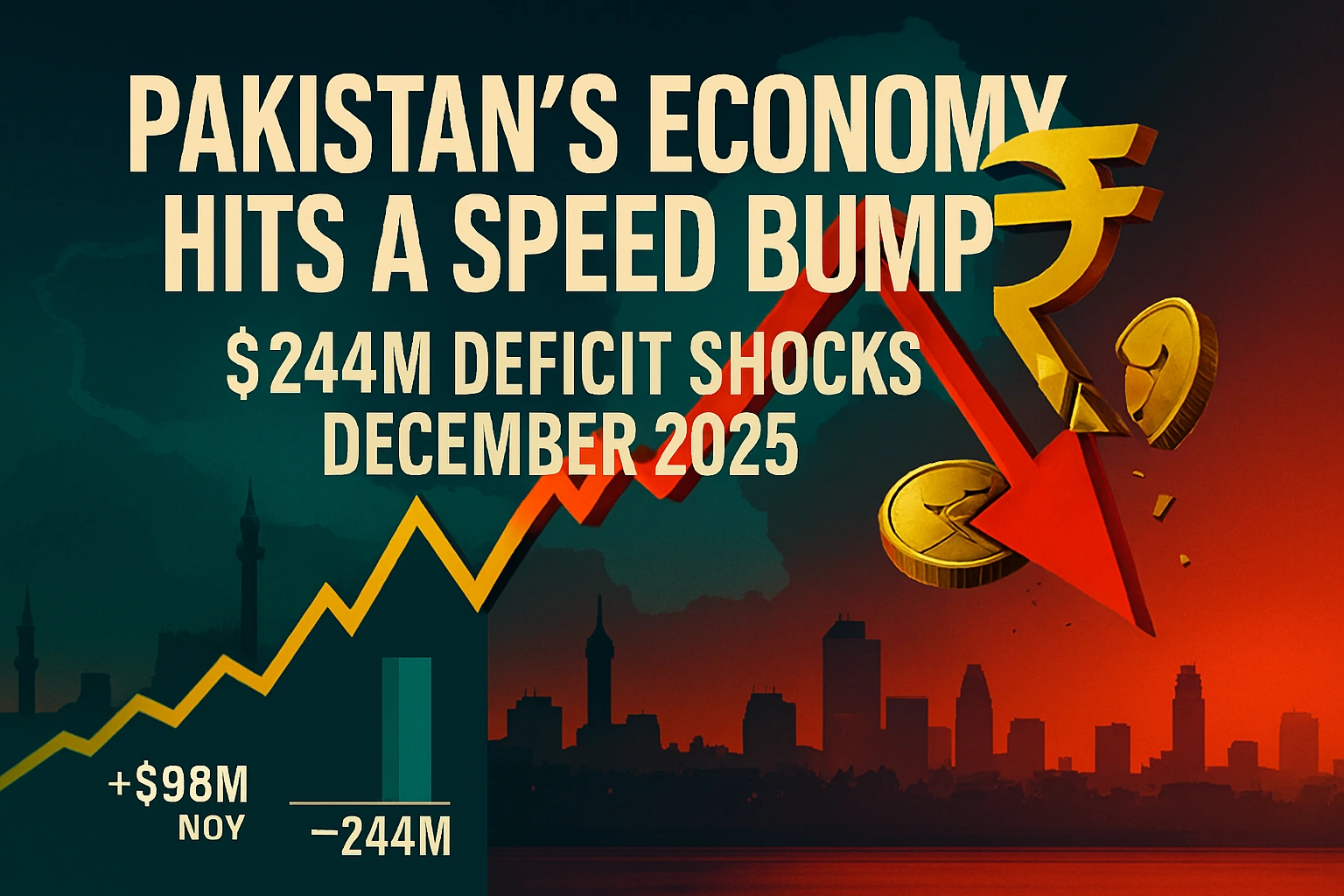
That story took an unexpected turn in December 2025. After eking out a modest $98 million current account surplus in November—a welcome sign that Pakistan’s post-crisis stabilization might be gaining traction—the State Bank of Pakistan (SBP) reported a sharp reversal: a $244 million deficit for December. The swing represents more than just monthly volatility; it encapsulates the fragile, two-steps-forward-one-step-back nature of Pakistan’s economic recovery following the near-meltdown of 2022-2023, when foreign exchange reserves plummeted to barely one month of import cover and default whispers rattled markets from Islamabad to Wall Street.
For context, December 2024 had delivered a comfortable $454 million surplus, making the year-on-year deterioration particularly striking. Yet zoom out further, and Pakistan’s fiscal year 2025 (July 2024–June 2025) still recorded a cumulative current account surplus—the first in years—offering a crucial buffer as the country navigates a $7 billion International Monetary Fund (IMF) Extended Fund Facility program designed to restore macroeconomic stability. December’s deficit, therefore, poses a critical question: Is this a temporary blip driven by seasonal import spikes and one-off factors, or an early warning that Pakistan’s external balance remains precariously dependent on remittance inflows and vulnerable to the slightest uptick in domestic demand or global commodity shocks?
This article dissects the December 2025 current account data with the rigor it demands, placing the numbers within broader historical trends, examining structural drivers from trade composition to energy dependence, comparing Pakistan’s trajectory with peer emerging markets, and assessing what this means for policymakers, investors, and ordinary Pakistanis as the country charts a course through 2026 and beyond.
Unpacking the December 2025 Numbers: Beyond the Headline Deficit
The Monthly Reversal: From Surplus to Shortfall
December’s $244 million deficit marks a $342 million swing from November’s revised $98 million surplus—a substantial shift in a single month for an economy where current account movements are measured in hundreds of millions rather than billions. More tellingly, the year-on-year comparison reveals a $698 million deterioration from December 2024’s $454 million surplus, signaling pressures beyond mere seasonal noise.
Breaking down the current account components clarifies the drivers:
- Trade Balance (Goods): Pakistan’s merchandise trade deficit widened appreciably in December, driven primarily by a surge in imports. Preliminary customs data from the Pakistan Bureau of Statistics suggests imports rose approximately 12-15% month-on-month, reflecting increased petroleum product shipments as winter heating demand spiked, higher machinery imports tied to delayed investment projects, and a restocking of intermediate goods by manufacturers anticipating Lunar New Year supply chain disruptions in China. Exports, while growing year-on-year at a modest 4-6%, failed to keep pace, constrained by energy shortages that intermittently shuttered textile mills—Pakistan’s export backbone—and sluggish demand from key European markets grappling with their own economic headwinds.
- Services Balance: This account remained persistently negative, albeit stable. Pakistan runs structural deficits in freight, transportation, and insurance services, exacerbated by reliance on foreign shipping for both exports and imports. Telecommunications and IT services exports—championed as a growth sector—contributed positively but remain insufficient to offset traditional service account drains.
- Primary Income Account: A chronic source of outflows, this component includes profit repatriation by multinational corporations, debt servicing payments to foreign creditors, and returns on foreign direct investment. December saw elevated outflows, likely tied to quarterly dividend payments by energy sector multinationals and scheduled debt obligations. According to World Bank data, Pakistan’s external debt stock exceeds $100 billion, with debt service ratios remaining elevated despite IMF-supported restructuring efforts.
- Secondary Income (Remittances): The undisputed bright spot. Pakistani workers abroad sent home a record $3.6 billion in December 2025, the highest monthly inflow on record and a 14% increase from December 2024’s $3.16 billion. This surge reflected seasonal patterns (expatriates sending funds for year-end festivities and winter expenses), improved formal banking channels following crackdowns on illegal hundi/hawala networks, and a modest depreciation of the rupee that enhanced the rupee-value of dollar remittances, incentivizing use of official channels. Remittances from Saudi Arabia, the UAE, the UK, and the US—Pakistan’s primary source countries—all posted gains, with Gulf Cooperation Council (GCC) countries alone accounting for nearly 60% of inflows.
Historical Context: FY25 Surplus Versus December Volatility
To appreciate December’s significance, consider Pakistan’s broader current account trajectory. Fiscal year 2023 (FY23, ending June 2023) saw a deficit exceeding $17 billion—over 6% of GDP—as import demand rebounded post-COVID while reserves hemorrhaged. This unsustainable imbalance triggered the 2022-2023 crisis, forcing stringent import controls, emergency IMF negotiations, and painful economic compression.
FY24 witnessed aggressive stabilization: import restrictions, steep interest rate hikes (the SBP’s policy rate peaked at 22% in mid-2023), and currency depreciation that dampened demand. The current account deficit shrank dramatically to approximately $1.2 billion for the full fiscal year—roughly 0.3% of GDP—a swing of over $15 billion. FY25 (July 2024–June 2025) went further, achieving a cumulative current account surplus of around $1.5-2 billion, driven by sustained remittance growth, contained imports, and marginally improved exports.
December 2025’s deficit, therefore, arrives against this backdrop of hard-won stability. Monthly volatility is normal—Pakistan’s current account has historically oscillated due to lumpy commodity imports (especially oil and LNG shipments), seasonal agricultural trade patterns, and irregular capital flows. A single deficit month doesn’t erase FY25’s surplus achievement. Yet it serves as a reminder: the underlying structure of Pakistan’s external accounts hasn’t fundamentally transformed. The economy remains heavily reliant on remittances to finance persistent trade deficits, with limited export diversification or import-substitution progress.
The Drivers Beneath the Surface: Trade Dynamics, Energy Dependence, and Remittance Resilience
The Persistent Trade Deficit: Import Addiction and Export Stagnation
Pakistan’s trade deficit—the gap between merchandise exports and imports—has long been the Achilles’ heel of its external balance. In December 2025, this gap widened notably, reflecting structural weaknesses decades in the making.
Import Composition and Vulnerabilities:
Pakistan imports roughly $50-60 billion annually, with several categories dominating:
- Energy (Petroleum, LNG, Coal): Constitutes 25-30% of total imports. Despite indigenous gas reserves, declining domestic production forces reliance on imported liquefied natural gas (LNG) for power generation and fertilizer manufacturing. Oil imports fluctuate with global crude prices and domestic consumption patterns. December’s import surge partly reflected higher LNG spot cargoes procured as winter power demand spiked and domestic gas shortfalls widened.
- Machinery and Transportation Equipment: Essential for industrial investment, these imports (15-20% of total) are economically productive but reflect limited local manufacturing capacity. December saw elevated machinery imports as businesses—buoyed by moderating interest rates and IMF program confidence—resumed delayed capital expenditure projects.
- Edible Oils, Pulses, and Food Products: Pakistan, despite its agricultural heritage, imports substantial food items due to population growth outpacing yield improvements and water scarcity constraining production. Palm oil from Indonesia and Malaysia alone accounts for billions annually.
- Chemicals, Plastics, and Intermediate Goods: Feedstock for textile and manufacturing sectors, these imports (20-25%) underscore the economy’s integration into global supply chains but also its vulnerability to input cost shocks.
The December import spike, while partly seasonal, highlights a critical policy tension: sustaining economic growth requires imports (machinery, energy, raw materials), yet unchecked import demand quickly exhausts foreign exchange reserves and widens the current account deficit. Pakistan’s growth-imports elasticity remains high—GDP growth of 3-4% typically correlates with 10-15% import growth unless demand is actively suppressed through monetary tightening or administrative controls.
Export Performance and Competitiveness Challenges:
Pakistan’s exports, hovering around $30-32 billion annually, are heavily concentrated:
- Textiles and Apparel: Account for 55-60% of merchandise exports. While Pakistan boasts competitive labor costs and proximity to cotton cultivation, the sector faces chronic challenges: energy shortages (load-shedding cripples production), outdated machinery, limited value-addition (focus on yarn and basic fabrics rather than high-end garments), and fierce competition from Bangladesh, Vietnam, and Cambodia. Recent reports from Dawn highlight how energy costs in Pakistan exceed regional competitors by 30-50%, eroding margins.
- Agriculture (Rice, Fruits, Vegetables): Contribute 15-20% but face quality standardization issues, inadequate cold chain infrastructure, and volatility tied to weather patterns and global commodity cycles.
- IT and Business Services: A bright spot, with exports exceeding $3 billion annually and growing at 15-20% yearly. However, this remains modest relative to India’s $200+ billion IT services sector.
December’s export growth, at 4-6% year-on-year, reflects incremental gains—textiles benefited from EU Generalized Scheme of Preferences (GSP+) status and recovering European demand—but insufficient to offset import surges. Structural constraints—inadequate investment in technology, skills mismatches, regulatory burdens, and infrastructure deficits (ports, logistics, power)—continue to hobble export competitiveness. According to the World Bank’s Logistics Performance Index, Pakistan ranks poorly (around 120th globally), impeding trade efficiency.
Remittances: The External Account’s Lifeline
December 2025’s record $3.6 billion remittance inflow underscores the Pakistani diaspora’s outsized role in propping up the external balance. Remittances have consistently exceeded $30 billion annually in recent years, often surpassing total merchandise exports. This dependence, while stabilizing, carries risks:
Drivers of Remittance Strength:
- Diaspora Demographics: Over 9 million Pakistanis work abroad, concentrated in GCC countries (Saudi Arabia, UAE, Qatar), the US, UK, and EU. GCC workers, typically in construction, hospitality, and services, send frequent, smaller remittances; Western diaspora remittances tend larger but less frequent.
- Policy Improvements: The SBP’s push to digitize remittances via fintech platforms (like JazzCash, Easypaisa), partnerships with international money transfer operators (Western Union, MoneyGram), and incentives (rupee credit at preferential rates) have channeled flows away from informal hawala networks. The Pakistan Remittance Initiative, launched years ago, has matured, enhancing tracking and convenience.
- Exchange Rate Dynamics: A weaker rupee incentivizes using formal channels—expatriates receive more rupees per dollar, enhancing purchasing power for families back home. December’s mild rupee depreciation likely contributed to record inflows.
- Global Economic Conditions: GCC economies, buoyed by moderating oil prices and economic diversification (Saudi Vision 2030, UAE’s non-oil growth), sustained employment for Pakistani workers. Western economies, despite slower growth, maintained demand for skilled professionals (IT, healthcare).
Vulnerabilities and Downside Risks:
- Oil Price Volatility: GCC economies—and thus Pakistani employment there—are highly sensitive to oil market dynamics. A sharp oil price collapse could trigger layoffs, reducing remittances by billions.
- Policy Shifts in Host Countries: Gulf states increasingly pursue “nationalization” policies (Saudization, Emiratization) to employ local citizens, potentially displacing South Asian expatriates. Geopolitical tensions or immigration policy changes in Western countries could also dampen flows.
- Demographic and Economic Shifts in Pakistan: As Pakistan’s economy develops (albeit slowly), remittance growth may plateau if opportunities at home improve, reducing emigration incentives. Conversely, economic distress could spur emigration but might also depress the asset base families can leverage for migration.
For now, remittances remain robust, but treating them as a perpetual safety net invites complacency. Sustainable external balance requires addressing the trade deficit’s root causes, not merely offsetting it with diaspora largesse.
Pakistan’s External Position in Global Context: Lessons from Peer Emerging Markets
How does Pakistan’s current account volatility compare with similarly positioned emerging economies? Examining peers illuminates both shared challenges and unique vulnerabilities.
Turkey: A Parallel in Chronic Deficits and Unorthodox Policies
Turkey, like Pakistan, has grappled with persistent current account deficits—averaging 3-5% of GDP—driven by energy import dependence (Turkey imports 75%+ of energy needs) and robust domestic consumption. Turkey’s deficits widened alarmingly in 2022-2023 amid unorthodox monetary policies (President Erdoğan’s low-interest-rate doctrine despite soaring inflation), sparking currency crises and reserve depletion eerily reminiscent of Pakistan’s travails.
However, Turkey differs crucially: its export base is far more diversified and technologically advanced (automotive, machinery, electronics), and tourism inflows contribute substantial services receipts. Turkey’s economy is also larger (GDP over $900 billion vs. Pakistan’s ~$350 billion), affording greater shock absorption capacity. Both nations share reliance on external financing and vulnerability to Fed rate hikes, yet Turkey’s NATO membership and EU integration (despite setbacks) provide geopolitical buffers Pakistan lacks.
Egypt: IMF Programs and Persistent External Fragility
Egypt offers perhaps the closest parallel. Both Egypt and Pakistan have cycled through multiple IMF programs over decades, facing recurrent foreign exchange crises rooted in import-dependent growth models, energy subsidies, and weak export competitiveness. Egypt’s current account deficit, traditionally 2-4% of GDP, spiked during the 2022 global commodity shock, triggering sharp currency devaluation (the pound lost 50%+ of value) and emergency IMF interventions.
Egypt’s Suez Canal receipts (a unique asset) provide substantial services income, yet like Pakistan, it relies heavily on remittances from expatriates in the Gulf and Europe. Both nations face similar structural challenges: youthful, rapidly growing populations outpacing job creation, heavy public debt burdens (constraining fiscal space), and political-economic governance issues that deter sustained foreign investment. Egypt’s recent economic struggles—despite $8 billion UAE investment deals and IMF support—underscore how fragile emerging market external balances can reverse quickly under adverse shocks.
Bangladesh and Vietnam: Export-Led Contrasts
Bangladesh and Vietnam present instructive contrasts. Both have achieved sustained current account surpluses or manageable deficits through export-led growth. Bangladesh’s ready-made garment (RMG) sector, while facing labor and safety challenges, generates $40+ billion in annual exports, surpassing Pakistan’s total goods exports despite a smaller economy. Vietnam’s integration into global manufacturing supply chains (electronics, footwear, furniture) has driven export growth exceeding 10% annually, attracting massive foreign direct investment.
These successes hinge on policy consistency, infrastructure investment, trade openness, and business-friendly environments—areas where Pakistan has struggled due to political instability, inconsistent economic policies across governments, and bureaucratic inefficiencies. The comparison underscores that Pakistan’s external account woes aren’t fate but reflect addressable policy failures and governance deficits.
Policy Implications and the Road Ahead: Navigating IMF Conditions, Monetary Policy, and Structural Reforms
The IMF Extended Fund Facility: Lifeline or Straitjacket?
Pakistan’s current $7 billion IMF Extended Fund Facility (EFF), approved in 2024 following protracted negotiations, imposes strict conditions: fiscal consolidation (reducing budget deficits through tax revenue increases and expenditure controls), energy sector reforms (tariff adjustments to eliminate circular debt), State-Owned Enterprise (SOE) restructuring, and exchange rate flexibility. Meeting these targets unlocks tranches of financing and signals credibility to bilateral lenders (China, Saudi Arabia, UAE) and markets.
December’s current account deficit, while modest, complicates the IMF program’s narrative of stabilization. IMF reviews scheduled for early 2026 will scrutinize whether the deficit represents a temporary aberration or a worrying trend. Key metrics monitored:
- Gross Official Reserves: As of late December 2025, SBP reserves stood around $11-12 billion—equivalent to roughly 2.5 months of import cover, a marked improvement from the sub-$4 billion nadir of mid-2023 but still below the comfortable 3-4 month buffer recommended for emerging markets. Sustained current account deficits could erode reserves, jeopardizing IMF targets.
- External Financing Gap: The IMF program assumptions include projections of bilateral support, FDI inflows, and bond market access. Widening current account deficits would increase the financing gap, potentially necessitating additional IMF disbursements or supplementary bilateral loans—complicating debt sustainability.
- Exchange Rate Management: The SBP has moved toward greater exchange rate flexibility, a key IMF demand. However, managing the rupee’s depreciation without sparking inflation or capital flight remains delicate. December’s modest weakening (rupee depreciated from ~278 to ~281 per USD) likely contributed to remittance inflows but also raised import costs, feeding inflation.
The policy tension is acute: supporting growth (which Pakistan desperately needs to reduce poverty and unemployment) requires accommodative conditions, yet unchecked growth risks import surges, reserve depletion, and current account blowouts. The SBP’s recent rate cuts—from the 22% peak to around 13% by late 2025—reflect confidence in declining inflation (down to single digits) and stabilization progress. December’s deficit may test whether further rate cuts are prudent or whether monetary policy needs to remain restrictive to cap import demand.
Fiscal Policy and Structural Reforms: Beyond Stabilization to Transformation
Monetary tightening and IMF programs can stabilize external accounts temporarily, but sustainable balance requires structural transformation:
- Export Diversification and Value Addition: Pakistan must move beyond low-value textiles to higher-margin products—branded garments, technical textiles, engineering goods. This demands investment in vocational training, R&D, quality certifications, and trade facilitation. Government initiatives like the Strategic Trade Policy Framework aim to incentivize non-traditional exports (pharmaceuticals, surgical instruments, sports goods), but implementation lags.
- Energy Sector Overhaul: Chronic energy shortages and high costs cripple competitiveness. Addressing this requires diversifying the energy mix (renewables, indigenous coal, hydroelectric), resolving circular debt (over $2.5 billion in payables), and improving distribution efficiency. Recent Chinese investments under the China-Pakistan Economic Corridor (CPEC) added generation capacity, but transmission bottlenecks and governance issues persist.
- Import Substitution in Agriculture and Industry: Reducing reliance on imported edible oils, pulses, and pharmaceuticals through productivity enhancements, agricultural R&D, and local manufacturing can narrow the trade deficit. Pakistan’s agricultural yields lag regional peers due to water scarcity, outdated farming techniques, and inadequate extension services.
- Investment Climate and FDI: Pakistan attracts only $2-3 billion in FDI annually—far below potential given its market size and location. Security concerns, regulatory unpredictability, corruption, and inconsistent policies deter investors. Successful examples like Bangladesh’s Special Economic Zones (SEZs) offer models, yet Pakistan’s SEZ progress remains slow.
- Debt Management: External debt servicing consumes substantial foreign exchange. Lengthening debt maturities, securing concessional financing, and improving debt transparency (addressing concerns from Financial Times reporting on hidden liabilities) are critical.
The Political Economy Wildcard: Stability Versus Turbulence
Economic policy in Pakistan is inseparable from political dynamics. The current government’s ability to sustain IMF program compliance depends on political stability—avoiding mass protests, military-civilian tensions, or populist pressures that derail reforms. Elections, coalition dynamics, and judicial interventions have historically disrupted economic policy continuity, with each government prioritizing short-term relief over long-term transformation.
December’s deficit, modest as it is, could embolden critics arguing that stabilization is choking growth and demanding stimulus measures (subsidies, lower interest rates, relaxed import controls). Resisting such pressures requires political courage and effective communication—explaining to the public why short-term pain (higher taxes, costlier imports) yields long-term gain (stable currency, lower inflation, job creation).
Outlook for 2026 and Beyond: Fragile Optimism Amid Persistent Risks
FY26 Current Account Projections: Navigating a Narrow Path
Most analysts, including the IMF and Asian Development Bank, project Pakistan’s FY26 (July 2025–June 2026) current account deficit to remain modest—between 0% and 1% of GDP, or roughly $0-3.5 billion. This forecast assumes:
- Continued Remittance Strength: Sustained inflows around $32-35 billion annually.
- Moderate Import Growth: GDP growth of 2.5-3.5% (below potential but stabilization-constrained) limiting import demand to $55-58 billion.
- Export Recovery: Gradual improvement toward $33-35 billion, aided by textile sector revival, IT services growth, and potential new export markets (Central Asia, Africa).
- Energy Price Stability: Global oil and LNG prices averaging $75-85/barrel and $10-12/MMBtu respectively, avoiding major import bill shocks.
December’s deficit complicates this picture only marginally if it proves transitory. However, downside risks loom large:
Domestic Risks:
- Political Instability: Governance crises, mass mobilizations, or civil-military discord could derail reforms, spook investors, and trigger capital flight.
- Energy Crisis Deepening: Another summer of severe load-shedding (likely if rainfall is poor and hydroelectric generation falls) could crush exports and industrial output.
- Fiscal Slippage: Missing IMF fiscal targets due to weak tax collection or populist spending could halt program disbursements, draining reserves.
External Risks:
- Global Recession: A sharp slowdown in the US, EU, or China would depress export demand and remittances. Recession in Gulf economies (tied to oil price crashes) could slash remittances by 15-20%, eliminating the current account’s safety buffer.
- Fed Rate Path: Continued or renewed Fed tightening could strengthen the dollar, making debt servicing costlier and reducing emerging market capital flows to Pakistan.
- Commodity Price Shocks: Geopolitical disruptions (Middle East conflicts, Russia-Ukraine escalation) could spike oil prices, widening the trade deficit by billions overnight.
- China Economic Malaise: Slower Chinese growth affects Pakistan via reduced CPEC-related inflows, weaker regional demand, and potential disruptions to supply chains Pakistani manufacturers depend upon.
Scenarios: Best Case, Base Case, Worst Case
Best Case (Probability: 20-25%):
Political stability holds, IMF program fully implemented, global growth surprises upward. Remittances exceed $36 billion, exports surge to $36 billion on textile revival and new sectors (IT crosses $4 billion), imports contained below $57 billion. Current account swings to a $2-3 billion surplus in FY26. Reserves climb toward $15 billion, improving investor confidence. The SBP can cut rates further (to 10-11%), spurring growth to 4%. Pakistan exits the “crisis loop” narrative.
Base Case (Probability: 50-55%):
Muddling through continues. IMF program stays on track with occasional hiccups. Remittances hold steady ($33-34 billion), exports grow modestly ($33 billion), imports edge up ($56-57 billion). Current account deficit widens slightly to 0.5-1% of GDP ($2-3.5 billion), manageable with IMF/bilateral inflows. Reserves stable at $11-13 billion. Growth stays subdued at 2.5-3%. December’s deficit seen as monthly noise, not trend reversal. Vulnerabilities persist but crisis averted for another year.
Worst Case (Probability: 20-25%):
Political turmoil erupts, halting reforms. Energy crisis worsens, crushing exports. Global recession slashes remittances to $28-30 billion. Imports jump on supply shocks or policy relaxation. Current account deficit balloons to 2-3% of GDP. Reserves plummet below $8 billion. IMF halts program over non-compliance. Currency crisis reemerges, inflation spikes, and another painful stabilization cycle begins. Pakistan returns to the brink.
Conclusion: Resilience Tested, Transformation Awaited
December 2025’s $244 million current account deficit—a sharp reversal from November’s surplus and a stark contrast to December 2024’s surplus—offers a sobering reminder: Pakistan’s external balance, though stabilized relative to the 2022-2023 abyss, remains fragile. The deficit isn’t catastrophic; in fact, monthly fluctuations of this magnitude are typical for an economy juggling import needs, energy dependencies, and external financing constraints. But context matters.
Pakistan has achieved remarkable stabilization over the past 18-24 months. Reserves have recovered from critically low levels, inflation has decelerated from over 30% to single digits, and the currency has stabilized. The cumulative FY25 current account surplus stands as a testament to painful but necessary adjustments—import compression, high interest rates, and policy discipline under IMF oversight. December’s deficit doesn’t erase these gains, but it underscores the work that remains.
The underlying drivers—persistent trade deficits rooted in import dependence and export stagnation, reliance on remittance inflows vulnerable to external shocks, and structural weaknesses in energy, productivity, and governance—haven’t fundamentally changed. December’s surge in imports, while partly seasonal and growth-related, highlights how quickly external balances can deteriorate if demand isn’t carefully managed. The record remittances, while reassuring, cannot indefinitely paper over a trade structure biased toward deficits.
For policymakers, the message is clear: stabilization is not transformation. Sustaining external balance through the IMF program’s duration (likely through mid-2026) requires vigilance—monitoring import trends, maintaining exchange rate flexibility, ensuring fiscal discipline, and preserving political commitment to reforms. Beyond stabilization, Pakistan must pursue deeper structural changes: diversifying exports, enhancing competitiveness, overhauling energy, attracting FDI, and improving governance. These transformations, admittedly difficult and politically contentious, are the only pathway to durable external stability and sustained growth.
For investors and international observers, December’s data warrants measured concern but not alarm. Pakistan remains on a tightrope—progress is real but reversible. The country’s trajectory depends critically on political stability, global economic conditions, and the resolve of its leadership to prioritize long-term transformation over short-term expediency.
And for the chai shop owner in Saddar? He’ll continue watching the rupee-dollar rate on his phone, feeling the pulse of remittance inflows when customers spend more freely, and weathering import price shocks that trickle down to his tea leaves. Pakistan’s external accounts are, ultimately, the story of millions of such individuals—navigating global economic forces far beyond their control, seeking stability and opportunity in a nation perennially balancing on the edge of crisis and recovery. December 2025’s deficit is one chapter in that unfolding story. Whether it’s a minor setback or the first crack in a fragile stabilization will become clear in the months ahead.
Sources and Further Reading:
- State Bank of Pakistan – Current Account Statistics
- International Monetary Fund – Pakistan Country Page
- World Bank – Pakistan Data
- Dawn – Pakistan Economy News
- Business Recorder – Latest Economic Updates
- Financial Times – Emerging Markets Coverage
- Reuters – Pakistan Economic News
- Trading Economics – Pakistan Indicators
- World Bank Logistics Performance Index
- Pakistan Bureau of Statistics
Discover more from The Economy
Subscribe to get the latest posts sent to your email.


How Repeated IMF Interventions Have Deepened Pakistan’s Social and Economic Crisis
I. Introduction
Pakistan holds the grim distinction of being one of the most frequent borrowers from the International Monetary Fund (IMF). Since first approaching the IMF in 1958, the country has entered into at least 24 formal programs — a number that places it among the most dependent nations in the institution’s history. As Dawn reported in January 2024, Pakistan has sought IMF bailouts 23 times in 75 years, reflecting the high unpredictability of its economy. This enduring reliance is not merely a footnote in Pakistan’s economic story; it is the story itself. Each program has arrived amid balance-of-payments crises, foreign exchange shortfalls, or spiraling fiscal deficits — and each has departed leaving behind an economy structurally no more resilient than before.
The central argument of this article is that the IMF’s repeated interventions in Pakistan have failed to deliver sustainable economic reform. Instead, they have deepened social and economic crises, imposed disproportionate burdens on ordinary citizens, and shielded a powerful elite from the structural adjustments required for genuine transformation. The Fund’s toolkit — fiscal austerity, currency depreciation, subsidy removal, and monetary tightening — addresses the symptoms of Pakistan’s economic dysfunction while leaving its roots untouched. As Observer Research Foundation analysis concludes, the literature on the effectiveness of bailouts has shown no clear evidence of sustained improvement in growth or economic conditions for Pakistan.
Understanding this dynamic is not merely an academic exercise. With Pakistan entering yet another $7 billion IMF program approved in September 2024, the same questions re-emerge: Will this program be different? Who will bear the costs? And can a country whose political economy is captured by entrenched elites ever translate IMF conditionalities into meaningful reform? The answers to these questions will shape Pakistan’s trajectory for the next generation.
II. Historical Background
A Timeline of Repeated Dependency
Pakistan’s relationship with the IMF spans more than six decades and more programs than almost any other country. The first agreement was signed in 1958, just eleven years after independence, under conditions of early fiscal stress. Per the IMF’s own lending history records, programs accelerated through the 1980s and 1990s as successive governments relied on IMF liquidity to patch persistent balance-of-payments crises without addressing their causes. The 2000s brought fresh programs under military and civilian governments alike, and the 2010s saw back-to-back engagements under the PPP, PML-N, and PTI governments.
By 2024, Pakistan had completed only a handful of these programs successfully — meaning the country met agreed targets and exited cleanly. The majority were either abandoned midway, suspended due to policy slippages, or left incomplete. As ORF analysis documents, of the previous 23 IMF programs, 15 were sought during times of oil crisis, and the cyclical pattern of seeking assistance highlights the structural inadequacy of these interventions. This pattern itself is revealing: if the programs were well-designed and properly owned by the host government, completion rates would be significantly higher.
Recurring Themes
Three structural pathologies recur across virtually every program period. First, persistent fiscal deficits driven by a chronically narrow tax base, bloated subsidies (particularly in the energy sector), and a public wage bill that cannot be sustained without borrowing. Second, external account imbalances — a yawning gap between imports and exports — that leave Pakistan perpetually dependent on external financing. Third, a rentier political economy in which powerful agricultural and industrial elites have historically avoided taxation, ensuring that the fiscal burden falls overwhelmingly on the salaried middle class and consumers of essential goods. The IMF’s own FAQ on Pakistan acknowledges that “increasing revenue fairly and efficiently is essential given the low tax-to-GDP ratio” and that shifting taxation towards “undertaxed sectors such as retailers, property, and agriculture” is critical.
Comparison with Countries That Broke the Cycle
The contrast with countries that have successfully exited IMF dependency is instructive. South Korea, which underwent a brutal IMF program following the 1997-98 Asian financial crisis, emerged from it through aggressive corporate restructuring, banking sector reform, and a sustained export drive underpinned by industrial policy. As the Korea Economic Institute documents, twenty years after the crisis, South Korea had not only recovered but become the world’s 14th largest economy — and has not borrowed from the IMF since. The program was painful but finite, because the Korean state had the institutional capacity and political will to implement structural changes rather than merely adjust headline fiscal numbers.
III. The Nature of IMF Programs in Pakistan
Austerity as the Default Prescription
IMF programs in Pakistan have followed a recognizable template. At their core is a demand for fiscal consolidation — reducing the government’s deficit, typically through a combination of revenue enhancement and expenditure reduction. In practice, the revenue measures have tended to focus on indirect taxes (sales tax, customs duties, and petroleum levies) that are relatively easy to collect but highly regressive in their impact. A peer-reviewed study published in BMC Globalization and Health (Springer) finds that austerity measures remain a core part of the IMF’s mandated policies for its borrowers: 15 of 21 countries studied experienced a decrease in fiscal space over the course of their programs.
The combined effect on ordinary Pakistanis is severe: higher prices for food, fuel, and electricity; costlier credit; and a government simultaneously cutting services while raising indirect taxes. Human Rights Watch’s landmark 2023 report on IMF social spending floors finds that 32 of 39 reviewed programs included at least one measure that risks undermining human rights — while only one explicitly assessed the impact on people’s effective income.
Short-Term Fixes vs. Long-Term Structural Reforms
The fundamental design flaw in IMF programs for Pakistan is their temporal mismatch. Programs are typically structured over 12 to 36 months — barely enough time to stabilize the balance of payments, let alone to restructure an economy as complex and politically contested as Pakistan’s. The measures that matter most for long-term sustainability — broadening the tax base to include agricultural income and the real estate sector, reforming state-owned enterprises, eliminating energy sector circular debt, and building a competitive manufacturing base — require years of sustained political effort and institutional investment that no short-term IMF program can deliver.
This mismatch creates a perverse dynamic. Governments in Islamabad implement just enough austerity to unlock IMF disbursements, but rarely pursue the deeper structural reforms that would make future programs unnecessary. As ORF’s assessment of IMF bailout effectiveness observes, macroeconomic vulnerabilities consistently resume after programs conclude — including a slowdown in fiscal consolidation, an escalating current account deficit, and a drop in foreign exchange reserves — despite IMF claims of success.
“Each program stabilizes, briefly. Then the same structural weaknesses — narrow tax base, energy subsidies, weak exports — reassert themselves, and the cycle begins again.”
The “Sham Austerity” Critique
A powerful critique that has gained traction among Pakistani economists and civil society analysts is what might be termed “sham austerity” — the phenomenon whereby headline fiscal adjustments are achieved through cosmetic measures that leave the underlying political economy intact. The most glaring example is Pakistan’s treatment of agricultural income, which constitutes roughly a quarter of GDP but is subject to minimal taxation owing to the political dominance of the large landowning class. The International Growth Centre notes that while agriculture contributes nearly one-fifth of Pakistan’s GDP, it accounts for less than 1% of national tax revenue — a structural distortion that IMF conditionalities have consistently flagged and equally consistently failed to fix.
IV. Socioeconomic Consequences
Rising Poverty and Unemployment
The human cost of repeated austerity cycles is visible in Pakistan’s poverty statistics. According to the World Bank’s Pakistan Development Update (October 2023), the poverty headcount reached 39.4% in FY23, with 12.5 million more Pakistanis falling below the Lower-Middle Income Country poverty threshold relative to the previous year. A comprehensive World Bank poverty assessment released in 2025 confirms that an additional 13 million Pakistanis were pushed into poverty by 2023-24, bringing the projected national poverty rate to 25.3% — its highest level in eight years. The report traces this reversal directly to “economic instability, rising inflation, and faltering policies.”
Pakistan’s labour market has been unable to absorb the approximately 2 to 2.5 million new entrants per year. IMF-mandated fiscal tightening reduces public investment, which is often the last resort for employment generation in economies where private sector dynamism is limited, further compressing job creation precisely when it is most needed. A peer-reviewed study on IMF loan conditions and poverty covering 81 developing countries from 1986 to 2016 finds consistent evidence that when countries participate in IMF arrangements, poverty increases and income distribution worsens.
Impact on Middle and Lower-Income Households
The burden of adjustment programs in Pakistan has been distributed in a profoundly regressive manner. Indirect taxes — particularly the General Sales Tax (GST) and petroleum levies — consume a disproportionate share of the income of lower and middle-income households. As the World Bank’s 2025 poverty analysis documents, “perverse institutional incentives and elite capture limit Pakistan’s expansion of its productive capacity and crowd out productive investments to equitably distribute the benefit of economic growth.” The aspiring middle class, constituting 42.7% of the population, is described as “struggling to achieve full economic security.”
Erosion of Public Trust in Economic Governance
Perhaps the most lasting damage of repeated IMF cycles is the erosion of public trust in economic governance. Each cycle — program entry, promises of stabilization, pain and sacrifice, partial recovery, renewed crisis — teaches citizens that economic policy is not designed for their benefit. The perception that ordinary Pakistanis pay the price of bailouts while elites bear no comparable burden is not merely a populist narrative. Eurodad research covering 26 countries with IMF programs finds that in 20 of them, “people have gone on strike or taken to the streets in protest against government cutbacks, the rising cost of living, tax restructuring or wage reforms resulting from IMF loan conditions.”
V. IMF’s Duty of Care and Accountability
Duty of Care in International Financial Institutions
The concept of a “duty of care” — the obligation to consider and mitigate foreseeable harms — is increasingly invoked in discussions of IMF accountability. Human Rights Watch’s September 2023 report calls on the IMF to “formally recognize a duty to respect, protect, and fulfil all human rights, including socioeconomic rights, in all its work, without discrimination.” The report’s analysis of 39 IMF programs found that the vast majority are conditioned on austerity policies that “reduce government spending or increase regressive taxes in ways likely to harm rights.”
The IMF has, in fairness, evolved its public commitments. The IMF’s own FAQ for Pakistan’s current program notes that BISP’s unconditional cash transfers will increase by 27% to 0.5% of GDP in FY25. But a peer-reviewed evaluation in Globalization and Health finds that social spending floors “lack ambition,” many “are not implemented,” and in practice often act as social spending ceilings rather than floors — meaning the IMF’s social protection commitments systematically underperform relative to its austerity conditions.
Ethical Responsibility vs. Technocratic Decision-Making
A central tension in IMF program design is between technocratic optimization — maximizing macroeconomic stability metrics — and ethical responsibility for human outcomes. As Human Rights Watch documents, the UN Human Rights Council has adopted guiding principles requiring that governments and financial institutions conduct and publish human rights impact assessments before pursuing austerity. Yet only one of 39 reviewed IMF programs explicitly sought to assess the impact on people’s effective income — a stark gap between stated principles and practice.
Case Studies: Education, Healthcare, and Social Safety Nets
Pakistan’s public education system, already grossly underfunded, has been hollowed out by repeated austerity cycles. UNESCO reports that approximately 26.2 million children in Pakistan are out of school — a figure that represents some of the starkest human capital underinvestment in the developing world. UNICEF confirms Pakistan has the world’s second-highest number of out-of-school children, with 35% of the relevant age cohort not attending school.
The situation has deteriorated further under fiscal pressure. Save the Children reported in June 2025 that government spending on education has fallen to a new low — dropping from 2% of GDP in 2018 to just 0.8% by 2025, with education expenditure falling 29% in the first nine months of fiscal year 2024-25 alone. This is taking place while Pakistan is in an active IMF program that nominally protects social spending.
VI. Structural Problems Ignored
Weak Tax Base and Elite Capture
Pakistan’s tax-to-GDP ratio — which Arab News reported stood at around 8.8% in FY2023-24, rising to 10.6% by June 2025 under IMF pressure — is among the lowest in the developing world for an economy of its size. The IMF’s own program FAQ acknowledges the “notably low tax-to-GDP ratio” and calls for broadening the base to cover “previously untaxed sectors — such as retailers, property owners, and agricultural income.” As the International Growth Centre documents, despite several donor-supported reform attempts, the tax-to-GDP ratio has consistently hovered around 10%. The agriculture sector, contributing nearly one-fifth of GDP, accounts for less than 1% of national tax revenue.
Energy Sector Inefficiencies and Circular Debt
Pakistan’s energy sector represents perhaps the single most concentrated source of fiscal hemorrhage in the economy. Arab News reported in 2025 that the power sector’s circular debt stood at approximately Rs2.396 trillion ($8.6 billion) by end-March 2025 — despite years of IMF-mandated tariff increases. The IMF’s own country report (2024) confirms that the combined power and gas circular debt reached approximately 5.25% of GDP at end-FY23, and that tariff adjustments have consistently failed to resolve the underlying structural problem.
As Business Recorder’s analysis documents, the circular debt structure was fundamentally created by IPP agreements that were “neither sustainable nor viable as stand-alone,” driven by vested interests and political patronage. Raising electricity prices without fixing these structural inefficiencies is not reform; it is simply cost transfer — from the state budget to household utility bills.
Governance Failures and Corruption
Corruption is not merely a moral problem in Pakistan; it is an economic problem of the first order. IMF programs have, by and large, not addressed corruption and governance directly, on the grounds that these are political matters beyond the Fund’s mandate. Yet Eurodad’s research demonstrates that most countries are “repeat borrowers from the IMF, which suggests that programmes are often ineffective, or even counter-productive, when it comes to resolving debt crises” — precisely because the governance deficits that generate those crises are not addressed. A fiscal adjustment program that extracts additional resources from the population while those resources continue to be diverted through corruption is not a reform program; it is an extraction program.
Lack of Industrial Policy and Export Diversification
Pakistan’s export basket has remained remarkably narrow for a country of its size and structure. Textiles and garments account for the vast majority of merchandise exports, leaving the country vulnerable to commodity cycles and competitors with lower labor costs. IMF programs, with their emphasis on fiscal consolidation and market liberalization, have generally been hostile to active industrial policy — yet the IGC notes that by skewing the tax system towards import duties, Pakistan’s firms are incentivized to sell domestically rather than compete globally, reinforcing the structural challenge of low exports that drives recurring balance-of-payments crises.
VII. Alternative Approaches
Homegrown Reforms: Broadening the Tax Base
The most important alternative to the current cycle of IMF dependency is the one that Pakistan’s political class has most consistently refused to pursue: genuine domestic tax reform that extends the fiscal burden to those with the greatest capacity to pay. The IMF’s program documentation itself identifies three key elements: increasing direct taxes by bringing retailers, property owners, and agricultural income into the tax net; reducing exemptions in the GST system; and expanding Federal Excise Duty coverage. These are not technically complex reforms — the legal frameworks exist, and administrative capacity, while imperfect, is present. What is absent is political will.
Investment in Human Capital and Social Protection
Pakistan’s long-term growth potential is fundamentally constrained by underinvestment in human capital. With 26.2 million out-of-school children (UNESCO), high rates of stunting and malnutrition, and a higher education system that reaches only a fraction of the relevant age cohort, the country is not building the human foundations necessary for sustained development. As the World Bank’s comprehensive poverty assessment concludes, “Pakistan stands at a pivotal moment to shape a more inclusive and equitable future.” Protecting and expanding social sector spending — even in the context of fiscal adjustment — is not a luxury; it is a prerequisite for growth.
Sustainable Growth Strategies
Pakistan has significant unrealized potential in renewable energy, regional connectivity, and technology services. Its geographic position at the intersection of South Asia, Central Asia, and the Middle East makes it a natural trade hub. Its renewable energy resources — solar radiation, wind, and hydroelectric potential — offer a pathway to cheaper, cleaner energy that could transform industrial competitiveness and reduce the import dependency that drives recurring balance-of-payments crises.
Lessons from Countries That Successfully Restructured
The international experience offers instructive comparisons. South Korea’s trajectory after its 1997-98 IMF program demonstrates that IMF engagement can catalyze rather than perpetuate dependency — but only where the domestic state has both the institutional capacity and political will to implement structural change. Twenty years after its crisis, South Korea had become the world’s 14th largest economy and had not returned to the IMF. Pakistan’s absence of comparable institutional capacity and political commitment is precisely what distinguishes its experience from the East Asian success stories.
VIII. Policy Recommendations
For Pakistan: Structural Reforms Over Short-Term Bailouts
The most urgent policy recommendation for Pakistan is the development and ownership of a comprehensive, multi-year structural reform agenda that goes beyond IMF conditionalities. This agenda should prioritize fiscal base broadening through agricultural income tax reform, real estate assessment reform, and retail sector documentation — areas the IMF itself has repeatedly identified as critical. Crucially, this agenda must be owned by Pakistani political actors and sustained across electoral cycles. Programs that are perceived as externally imposed are politically vulnerable and technically incomplete.
For the IMF: Social Impact Assessments as Non-Negotiable
The IMF should fundamentally reform its approach to program design for countries with high poverty rates. Human Rights Watch’s report calls on the Fund to redesign social spending floors to address systemic flaws, commit to supporting universal social protection programs, and stop promoting means-tested programs that exclude large proportions of the vulnerable population. Energy tariff increases should be accompanied by fully funded household support mechanisms that prevent the poorest households from being priced out of basic energy access. As Eurodad’s research argues, “creating fiscal space through debt restructuring must be the first option” — before imposing austerity that harms citizens.
Collaborative Frameworks for Inclusive Growth
Addressing Pakistan’s economic challenges requires coordination among multiple international institutions. The World Bank has mandate and expertise for structural reform programs in education, health, and governance that the IMF does not directly address. The World Bank’s Pakistan poverty assessment explicitly calls for “careful economic management and deep structural reforms” to “ensure macroeconomic stability and growth” while investing in “inclusive, sustainable, and climate-resilient development.” A coherent, coordinated engagement organized around a single shared framework would be significantly more effective than the current parallel-track approach.
Long-Term Vision: Breaking the Cycle of Dependency
The ultimate objective must be to make future IMF programs unnecessary — achieving a current account sustainable through export earnings, a fiscal position funded through domestic revenue, and an economy resilient enough to absorb external shocks. None of these objectives is achievable in the short term, but all are achievable within a decade with genuine structural reform. Arab News reporting on Pakistan’s current reform agenda notes the government’s stated commitment to raising the tax-to-GDP ratio to 13% over the medium term — a target that, if achieved through genuine base broadening rather than increased extraction from existing taxpayers, would represent a significant structural shift.
IX. Conclusion
The argument advanced in this article can be stated simply: the IMF’s repeated interventions in Pakistan have not failed because the programs were technically flawed, though some have been. They have failed because they were deployed in a political economy fundamentally inhospitable to the structural reforms they nominally required, and because neither the IMF nor Pakistan’s governing class had sustained commitment to address this reality. The result has been a cycle of stabilization and relapse that has imposed enormous costs on Pakistan’s poorest citizens — as documented by the World Bank, UNESCO, Human Rights Watch, and the IMF’s own country reports — while leaving the political and economic structures that generate crises largely intact.
“Stabilization without structural reform is not reform. It is postponement — and the deferred cost is always paid by those least able to bear it.”
The IMF’s culpability lies not in malice but in an institutional culture that has historically prioritized macroeconomic metrics over human outcomes. As peer-reviewed research in Globalization and Health confirms, the IMF’s social spending strategy “has not represented the sea-change that the organization advertised.” Reforming this culture — adopting mandatory human rights impact assessments, longer program timeframes, and genuine commitment to distributional equity — is both possible and necessary.
Pakistan’s responsibility is equally fundamental. The country must reclaim economic sovereignty through a domestically owned, politically sustained development strategy. This requires confronting the elite capture documented by the World Bank and ORF, investing in the human capital reflected in UNICEF’s education data, and building the institutional capacity necessary to implement complex policy reforms over long time horizons. Pakistan’s recurring crises are a mirror held up to global financial governance. The reflection is unflattering, and it demands a response — from Islamabad, from Washington, and from the international community that has tolerated this cycle for too long.
Discover more from The Economy
Subscribe to get the latest posts sent to your email.

A market battered by geopolitics and panic-selling staged one of its most convincing recoveries of the year — but seasoned investors know the hard work is just beginning
There is a peculiar kind of quiet that settles over a trading floor the morning after chaos. The screens are the same. The tickers keep scrolling. But the fingers on keyboards move with a different energy — cautious, calculating, then, as the session matures, something closer to conviction. That was the texture of Thursday’s session at the Pakistan Stock Exchange. By the time the closing bell rang on March 5, the benchmark KSE-100 Index had gained 5,433.46 points, settling at 161,210.67 — a rise of 3.49% that confirmed, at least for now, that the worst of the week’s freefall was behind Pakistan’s equity markets.
The intraday high of 161,476.84, touched in the closing minutes of trade, told an even more bullish story: buyers were not merely nibbling at discounts. They were pressing into the market with force.
The Week That Broke Records — and Nerves
To appreciate Thursday’s significance, one must first reckon with the magnitude of what preceded it. On March 2 — a session that Pakistani financial historians will struggle to contextualise — the KSE-100 collapsed by 16,089 points, or 9.57%, closing at 151,972.99. It was the single largest one-day point decline in the exchange’s history. The trigger: escalating Middle East hostilities following joint US-Israeli strikes on Iranian military infrastructure and Tehran’s retaliatory strikes on US installations across Gulf states. Panic-led liquidation, amplified by mutual fund redemptions and retail stop-losses, turned an anxious morning into a rout.
Tuesday brought a partial reprieve — the index clawed back 5,159 points to close at 157,132 — but the recovery lacked staying power. Wednesday saw a renewed retreat of 1,354 points, the index settling at 155,777.21 as investors, still shaken, remained unwilling to commit. It was the scale of Thursday’s surge — 5,433 points, or 3.49%, marking one of the strongest single-day gains in recent sessions — that finally signalled a genuine shift in sentiment. Minute Mirror
Despite the turbulence, the KSE-100 remains approximately 41.73% higher than it was a year ago TRADING ECONOMICS, a fact that sophisticated international investors, scanning Bloomberg’s KSE-100 quote page for entry points, will not have missed.
Anatomy of a Rally: Sectors That Drove the 5,433-Point Surge
Thursday’s PSX buying momentum was emphatically broad-based. This was not a sector-specific bounce driven by a single commodity supercycle or a policy announcement. It was, as Arif Habib Limited’s Deputy Head of Trading Ali Najib put it, a market-wide expression of renewed confidence.
A widespread buying spree swept across oil and gas exploration companies, oil marketing companies, power generation, automobile assemblers, cement, commercial banks, and refinery stocks. Profit by Pakistan Today The breadth of that buying matters: when rally participation is narrow, it often reflects short-covering rather than genuine re-engagement. When cement producers and automobile assemblers move alongside refiners and banks, it suggests institutional portfolios are being rebuilt from the ground up.
The index-heavy names that drove the arithmetic were formidable. Attock Refinery, Hub Power Company, Mari Petroleum, OGDC, Pakistan Petroleum Limited, Pakistan Oilfields, Pakistan State Oil, Sui Northern Gas Pipelines, Sui Southern Gas Company, MCB Bank, Meezan Bank, National Bank of Pakistan, and UBL all traded firmly higher. Profit by Pakistan Today Collectively, the leading contributors added approximately 3,334 points to the overall benchmark gain. Minute Mirror
The energy complex’s outperformance deserves special attention. Oil and gold prices moved higher globally amid ongoing supply concerns — a direct tailwind for Pakistan’s upstream exploration players and refiners, whose dollar-linked revenues benefit from any crude price elevation. For a country that imports a significant share of its energy needs, the calculus is complex: higher oil prices widen the current account deficit even as they lift exploration-sector equities. Investors, for now, chose to focus on the equity upside.
Total traded volume reached 718.6 million shares, with total transaction value standing at approximately PKR 35 billion Minute Mirror — robust figures that suggest this was not a low-liquidity, technically-driven drift upward but a session characterised by genuine two-way price discovery tilting decisively toward buyers.
Why It Matters: The Global Mirror
Pakistan’s markets rarely move in isolation from global risk appetite, and Thursday was no different. Asian equities advanced broadly as US Treasury prices declined, reflecting improved risk appetite after recent volatility linked to Middle East tensions. MSCI’s broad index of Asia-Pacific shares outside Japan rose 2.9%, South Korea’s KOSPI led the region with a gain of 10.4%, and Japan’s Nikkei added 2.9%. Profit by Pakistan Today
That global backdrop provided critical cover for PSX’s recovery. When risk-off sentiment dominates globally, frontier and emerging markets suffer disproportionately — capital flees to safe-haven assets and Pakistan’s thin foreign investor base tends to compress valuations sharply. Thursday’s shift in that global dynamic gave local institutional investors — the real swing factor in PSX liquidity — permission to re-engage without fear of being caught on the wrong side of an international tide.
US benchmark 10-year Treasury yields rose 2.7 basis points to 4.109%, while the 30-year bond yield climbed 3.1 basis points to 4.748%. Profit by Pakistan Today Rising yields typically signal a rotation away from bonds and into risk assets — including equities in frontier markets that had been beaten down to historically attractive valuations. Trading Economics data confirms that despite Thursday’s sharp recovery, the KSE-100 has still declined roughly 12.47% over the past month, leaving ample room for further mean-reversion if geopolitical anxieties continue to subside.
The IMF Variable and Pakistan’s Macro Scaffolding
No analysis of PSX momentum is complete without interrogating the broader macroeconomic architecture in which these market swings occur. Pakistan is currently operating within the framework of an IMF Extended Fund Facility — a programme that has done much of the structural heavy lifting to stabilise the rupee, compress the current account deficit, and begin unwinding the circular debt that has long strangled the power sector.
In a telling development this week, the IMF mission team decided to conduct virtual discussions for the third review of the Extended Fund Facility and the second review of the Resilience and Sustainability Facility, citing the prevailing security situation. The Express Tribune The decision to proceed virtually rather than suspend the review process entirely is significant. It signals that the Fund considers Pakistan’s reform trajectory sufficiently credible to maintain engagement — even as security conditions complicate standard operations. For foreign investors monitoring Pakistan’s sovereign risk profile, this is a quiet but meaningful confidence signal.
The rupee’s relative stability through this turbulent week also merits attention. A currency that holds its ground during an equity market shock of the magnitude seen on March 2 suggests underlying foreign exchange reserves and current account dynamics that are meaningfully more resilient than Pakistan’s position even eighteen months ago. That stability reduces hedging costs for international portfolio investors and lowers the barrier to re-entry.
Reading the Road Ahead: Catalysts and Risks
The KSE-100 Index closes at 161,210.67 with a convincing recovery narrative — but the intelligent investor must resist the temptation to extrapolate a single session into a trend.
The central risk remains geopolitical. The Middle East situation that triggered the March 2 sell-off has not resolved; it has merely paused. Any resumption of direct military exchanges between Iran and US-Israeli forces would almost certainly reignite the risk-off impulse that sent the KSE-100 to its worst single-day performance in history. Pakistan’s geographic proximity to multiple regional flashpoints — including continued uncertainty along the Afghan border — means that geopolitical tail risks are not abstract for PSX investors; they are priced with a premium.
On the domestic side, the upcoming IMF review outcome, energy sector reform progress, and any revision to the State Bank’s monetary policy stance will serve as the next key inflection points. The central bank has been cautiously easing — a trajectory that supports equity valuations by compressing the discount rate applied to future earnings — but inflation’s stickiness could complicate any further cuts.
The catalysts for sustained recovery are equally real. Analysts attributed Thursday’s rally partly to bargain hunting after recent heavy losses and improved sentiment among institutional investors Minute Mirror — the classic post-crash dynamic of sophisticated money stepping into the vacuum left by panic-sellers. If earnings season in the coming weeks confirms that the underlying corporate performance of Pakistan’s blue-chips remains intact, the valuation case for KSE-100 at these levels is compelling by any regional comparison.
The cement sector’s participation in Thursday’s rally is worth watching as a leading indicator of domestic economic momentum — cement volumes are a proxy for construction and infrastructure activity. Similarly, automobile assembler performance tracks consumer credit and disposable income trends. Both sectors buying in suggests that the damage to domestic economic confidence, while real, may be shallower than the March 2 panic implied.
A Market Finding Its Level
There is a question that every serious investor in frontier markets must eventually confront: at what point does volatility become opportunity? The KSE-100’s journey this week — from an all-time high earlier this year, through the historic 9.57% single-session collapse, through the grinding partial recoveries and renewed selloffs, to Thursday’s broad-based KSE-100 gains 3.5% vindication — has been, in miniature, the story of Pakistan’s equity market itself: high-drama, technically oversold, and carrying within its volatility the seeds of disproportionate returns for those with the patience and conviction to stay the course.
The PSX buying momentum on Thursday was not merely a technical bounce. It was a signal — tentative, yes, and hedged with legitimate near-term risks — that the market’s fundamentals have not broken. The index’s trajectory over the next four to six weeks will determine whether March 5 is remembered as the first day of recovery or merely as a false dawn. History suggests that in markets like Pakistan’s, where institutional depth is growing but retail sentiment remains prone to panic, the truth usually lies somewhere instructively between the two.
The KSE-100’s next chapter is unwritten. But Thursday’s 5,433-point script was, at minimum, a compelling opening act.
FAQ (FREQUENTLY ASKED QUESTIONS)
Q1: Why did the KSE-100 gain 3.5% today on March 5, 2026? The KSE-100 rebounded 5,433 points as broad-based buying returned across energy, banking, cement, and automotive sectors, aided by improving global risk appetite following easing Middle East tensions and a 2.9% rise in Asian equity indices.
Q2: What caused the KSE-100 to crash 16,000 points on March 2, 2026? The KSE-100 recorded its worst-ever single-day fall of 16,089 points (-9.57%) after joint US-Israeli airstrikes on Iran triggered global risk-off sentiment, panic selling, and mutual fund redemption pressure at the Pakistan Stock Exchange.
Q3: What is the KSE-100 intraday high for March 5, 2026? The KSE-100 hit an intraday high of 161,476.84 during the final minutes of Thursday’s trading session before closing at 161,210.67.
Q4: Which sectors led the KSE-100 recovery on March 5, 2026? Oil and gas exploration, oil marketing companies, commercial banks, power generation, cement, automobile assemblers, and refinery stocks all participated in the broad-based rally, contributing approximately 3,334 index points collectively.
Q5: Is the KSE-100 still down from its all-time high after the March 2026 crash? Yes. Despite Thursday’s 3.49% gain, the KSE-100 remains approximately 12.47% below its level from a month prior and well below its all-time high, though it remains roughly 41.73% higher year-on-year.
Q6: How does the IMF programme affect Pakistan Stock Exchange performance? Pakistan’s ongoing IMF Extended Fund Facility has stabilised the rupee and improved Pakistan’s macro fundamentals. The IMF’s decision to continue virtual review discussions despite security concerns signals sustained programme engagement, which supports investor confidence in PSX-listed equities.
Q7: What are the key risks that could reverse the KSE-100 recovery? The primary risks include a re-escalation of Middle East hostilities, a negative outcome from the IMF’s third EFF review, rupee instability, persistent inflation limiting State Bank rate cuts, and any deterioration in regional security along Pakistan’s borders.
Discover more from The Economy
Subscribe to get the latest posts sent to your email.
The Roosevelt Hotel saga — a century-old Midtown landmark, a cash-strapped Pakistani state airline, and Wall Street’s most powerful bank — has taken a turn that no one on Madison Avenue saw coming.
The Grand Dame Falls Silent Again
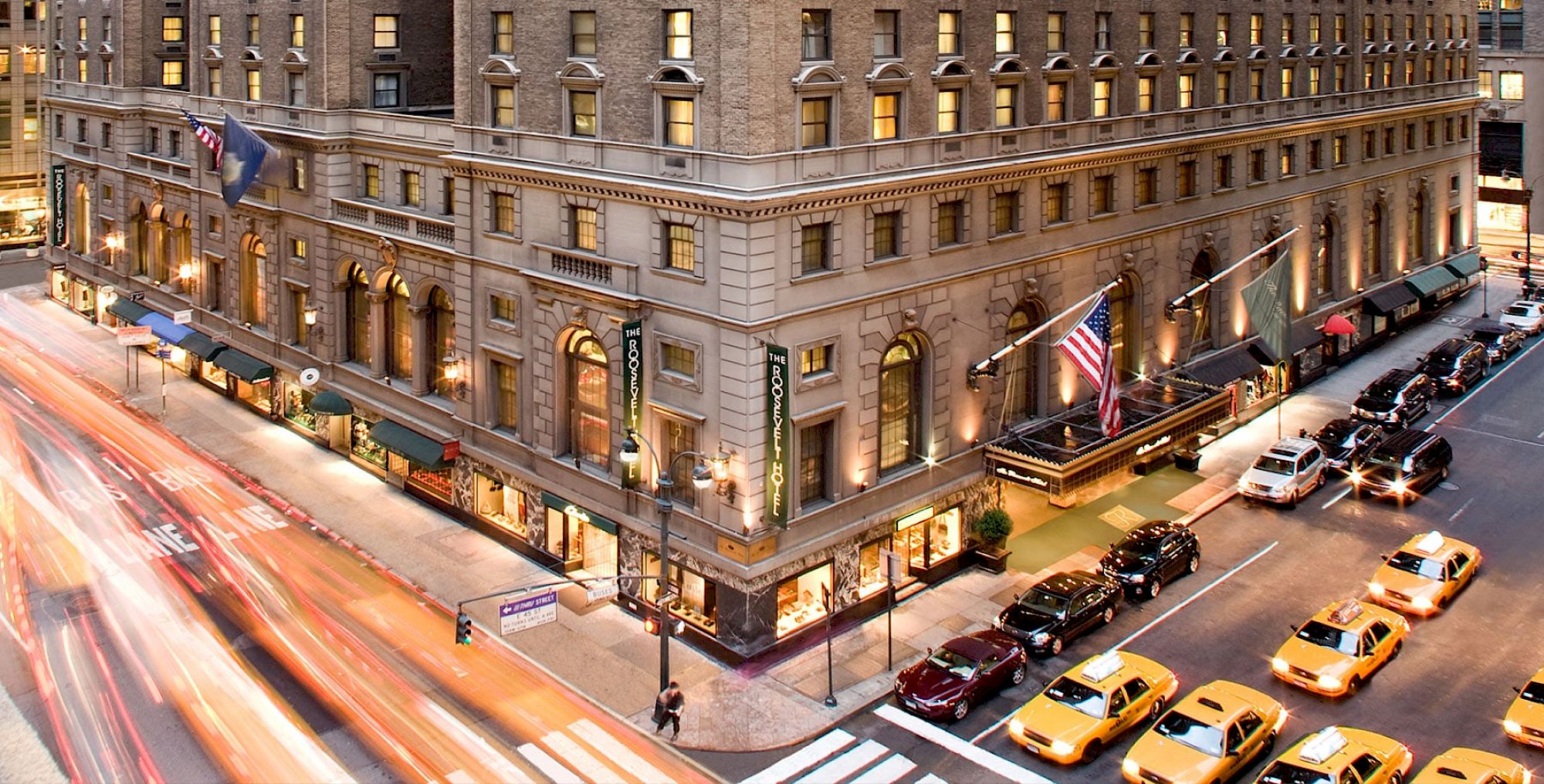
Walk past 45 East 45th Street on a winter morning in 2026 and you will find a building that once defined Midtown Manhattan’s glamour standing derelict and dark. The Roosevelt Hotel — a 22-story Beaux-Arts colossus designed by George B. Post and opened in 1924, named after President Theodore Roosevelt — once hosted Fiorello LaGuardia’s mayoral campaigns in its ballrooms, saw Guy Lombardo ring in the New Year from its bandstand for three decades, and appeared on the silver screen in The French Connection and Wall Street. Today its lobby is silent, its 1,025 rooms stripped of guests, and its fate the subject of one of the most convoluted geopolitical real-estate sagas in New York history.
At the center of this drama: Pakistan International Airlines, the state-controlled carrier that has owned the Roosevelt since 2000; JPMorgan Chase, the most powerful bank on earth, whose gleaming new headquarters at 270 Park Avenue looms just two blocks away; and, most improbably, the Trump White House, which has now inserted itself as Islamabad’s unlikely development partner.
Pakistan has effectively thwarted JPMorgan’s serious efforts to acquire the site — not through formal regulatory action, but through a strategic pivot that locked Wall Street out and invited Washington in.
JPMorgan’s Midtown Empire Play
To understand why JPMorgan wanted the Roosevelt, look north from Grand Central Terminal. The bank has spent years assembling one of the most formidable corporate campuses in American history. Its supertall headquarters at 270 Park Avenue — built after acquiring air rights from neighboring churches — rises 60 stories over Midtown. The adjacent property at 383 Madison Avenue, acquired following Bear Stearns’ collapse, is currently being reclad in a matching bronze facade.
The Roosevelt site sits precisely in the gap between these two towers, spanning the full block between Madison and Vanderbilt Avenues and East 44th and 45th Streets. For Jamie Dimon’s bank, acquiring it would not merely be a real-estate investment — it would be a generational campus consolidation, potentially giving JPMorgan control over roughly 7 million square feet of prime Midtown space.
JPMorgan emerged as one of the advanced bidders for the Roosevelt site, submitting a proposal to ground-lease the property for 99 years The Promote — a structure that would have allowed Pakistan to retain nominal ownership of the land while effectively ceding control for a century. According to reporting by The Promote, industry sources described JPMorgan as being among the most serious contenders, with a proposal that could have created “one of the most formidable corporate campuses in recent New York history.”
A JPMorgan analyst had separately noted that the Roosevelt “has essentially been a placeholder for a major office tower for many years” Crain’s New York Business — a recognition that the site’s value lies not in its hospitality bones but in the steel-and-glass tower that could replace them.
The bank was not alone. JPMorgan kicked the tires alongside Shahal Khan’s Burkhan World Investments, which pitched a plan to co-develop the site The Real Deal, while names including SL Green, Tishman Speyer, Related, and Vornado were variously reported to be circling.
Pakistan’s Long History of Indecision
That so many serious buyers materialized — and that none closed a deal — speaks to a dysfunction at the heart of PIA’s ownership that has frustrated New York’s development community for years.
PIA has leased or owned the Roosevelt Hotel since 1979 and has several times since sought to get rid of it. The Real Deal As far back as 2007, the airline put the hotel on the market asking $1 billion. In 2018, a Pakistani prime minister personally blocked a selloff plan, declaring that “apart from being a valuable property, the hotel also carries cultural significance for Pakistan.” PIA, meanwhile, refinanced the hotel’s debt that same year — notably with a $105 million loan from JPMorgan Chase itself, a detail that gives the bank’s subsequent acquisition bid a particularly layered quality.
In 2024, Pakistan hired JLL to market the property either for an outright sale or a joint venture development partnership — but after JPMorgan kicked the tires on it, JLL resigned in July, citing a conflict of interest from clients who were interested in bidding on the site. The Real Deal The explanation was widely viewed in the industry as a gracious exit from a messy situation.
Pakistan’s privatization commission was once again trying to find a broker, putting out a call for brokers and financial advisors with “proven experience of successful completion of similar transactions” in the New York metropolitan area. The Real Deal Five of the seven subsequent proposals were rejected for non-compliance. The reset had begun.
The Strategic Pivot: No Sale, Just JV
The decisive blow to JPMorgan’s ambitions came not from a regulator, a court, or a rival bidder — but from Islamabad’s own change of strategy.
Pakistan’s government approved a “transaction structure for the Roosevelt Hotel,” saying it won’t do an outright sale but has decided to adopt a joint venture model to maximize long-term value. Hotel Online The government’s position: it would contribute the land, while a development partner would inject approximately $1 billion in equity. Pakistan expected a $100 million initial payment from any JV partner by June 2026. The country’s privatization adviser, Muhammad Ali, was emphatic — the land was not for sale.
This single decision effectively killed JPMorgan’s 99-year ground-lease proposal. A ground lease over a century is an unusual instrument, but it is not ownership. If Pakistan won’t sell outright, won’t entertain a century-long lease, and insists on a JV where it retains strategic control, then the deal structure JPMorgan had in mind simply ceased to exist.
Analysts estimated the property could fetch at least $1 billion in an outright open-market sale AOL, and the site can be built up to nearly 2 million square feet if a developer exploits zoning bonuses tied to transit and public amenities. The prize remains enormous. Pakistan’s refusal to sell it reflects both strategic calculation and the Islamabad bureaucracy’s chronic inability to make a final decision.
Trump Enters the Building
Then came the twist no Manhattan power broker anticipated.
The Pakistani government signed a deal to cooperate with the U.S. federal government on the redevelopment and operation of the property. The Real Deal The agreement — negotiated by Trump’s special envoy Steve Witkoff, the New York developer who has become an unlikely global diplomat — was formalized in a Memorandum of Understanding between the U.S. General Services Administration and Pakistan’s Ministry of Finance.
The two parties “formally launched a strategic economic initiative, including collaboration with the U.S. General Services Administration regarding the operation, maintenance, renovation, and redevelopment of the Roosevelt Hotel in New York,” Pakistan’s finance division announced. Costar The stated goal: to “secure maximum value for this property while strengthening Pakistan-United States economic ties.”
The MOU is nonbinding. It says nothing about equity splits, financial contributions, or which side controls the design brief. The role of the GSA, which typically only manages federal properties, remains unclear. 6sqft Real estate professionals reacted with bewilderment — “Unbelievable,” said one Manhattan power broker. Others speculated that Witkoff, who built his career financing Manhattan hotels including the Times Square Edition, sees longer-term opportunity in the site.
What is clear: with the U.S. government now formally in the picture as a “partner,” an outright sale to any private buyer — JPMorgan included — becomes politically and practically far more complicated.
The Financial Pressure Behind Pakistan’s Moves
Islamabad’s posture throughout this process is impossible to understand without the context of Pakistan’s sovereign debt crisis.
The Pakistani government is $7 billion in hock to the International Monetary Fund and is desperate to sell off assets to pay off the debt. AOL That desperation explains why a deal was always theoretically possible. The obstruction comes from the countervailing force of political sensitivity — the Roosevelt is one of Pakistan’s most visible foreign assets, and any selloff carries domestic political risk.
Compounding the irony: the Pakistani government-owned Roosevelt Hotel pocketed $146.6 million to house migrants for two years, but now owes $13.6 million in overdue property taxes and nearly $1 million in unpaid water bills. National Today A potential federal joint venture could trigger a tax exemption, further inflaming New York City officials already frustrated by the situation.
The hotel’s annual property tax bill is $7.7 million, and a potential joint venture between Pakistan and the U.S. government to demolish and redevelop the Roosevelt could trigger a federal tax exemption, potentially costing the city tens of millions per year. National Today
What It Means: U.S.-Pakistan Relations, Wall Street, and Midtown’s Future
Geopolitical Chess in a Midtown Ballroom
The Roosevelt Hotel saga has become a microcosm of the broader U.S.-Pakistan bilateral relationship — transactional, frustrating, and perpetually unresolved. The Witkoff MOU is, on one reading, a diplomatic gesture: bringing Pakistan closer to Washington at a moment when geopolitical alignments in South Asia matter enormously. On another reading, it is a sign of the Trump administration’s comfort with inserting the federal government into unusual real-estate plays, particularly in New York City.
Either way, JPMorgan — an institution that famously operates on the principle that relationships and proximity to power matter — now finds itself on the outside of a deal involving two governments rather than one.
The Manhattan Office Market in 2026
The Roosevelt site remains one of the most consequential undeveloped parcels in Midtown. The office market around Grand Central Terminal — what analysts call the Plaza District — has continued to tighten even as the broader Manhattan market wrestles with remote-work headwinds. The hotel is located near marquee New York destinations such as Grand Central Terminal, One Vanderbilt, and JPMorgan Chase’s own headquarters, placing it in one of Manhattan’s most valuable commercial zones. Costar
Whatever ultimately rises on the site — whether under a U.S.-Pakistan JV, a reconstituted private deal, or some hybrid structure — it will be among the defining towers of Manhattan’s next decade. The question is whether Pakistan’s government can make a final, binding decision before the market moves on.
Sovereign Wealth Strategy — and Its Limits
Pakistan’s refusal to sell is not irrational. Sovereign wealth theory argues that revenue-generating or appreciating assets should not be liquidated under distress; they should be leveraged. By holding the land and seeking equity partners, Pakistan theoretically captures upside while preserving a strategic asset. The problem is execution: Pakistan has been “waffling over what to do with the hotel since acquiring it in 2000,” as The Real Deal noted recently, and every year of indecision is a year of $7.7 million in property taxes, maintenance costs on a shuttered building, and opportunity cost on a billion-dollar site earning nothing.
For sovereign fund analysts watching from Abu Dhabi, Singapore, or Oslo, Pakistan’s Roosevelt Hotel management is a cautionary tale — not of bad strategy, but of institutional dysfunction masquerading as strategy.
Looking Ahead: 2026 and Beyond
The MOU signed between Washington and Islamabad is nonbinding and time-bounded, and Pakistan’s privatization commission has already demonstrated a flair for restarting processes from scratch. It is entirely possible that the U.S. government partnership dissolves, that JPMorgan — or another Wall Street player — re-enters with a revised structure, or that Pakistan finally names a JV partner from among the several serious bidders who have circled the site.
Pakistan’s government is estimating the redevelopment will take four to five years, with “interest level extremely high” among potential partners. Hotel Online
What is not in doubt: the Roosevelt Hotel will be demolished. The economics of Manhattan’s office market are too compelling, and the structural condition of a century-old property shuttered since 2020 too deteriorated, for any other outcome. The only question — as it has been for a quarter century — is who will control what rises in its place, and whether Pakistan can bring itself to finally answer that question.
For now, JPMorgan will have to content itself with the view of the empty building from the glass spire of 270 Park Avenue.
Key Facts at a Glance
| Detail | Information |
|---|---|
| Property | Roosevelt Hotel, 45 East 45th Street, Manhattan |
| Year Built | 1924, designed by George B. Post (Beaux-Arts) |
| Current Owner | Pakistan International Airlines (state-controlled) |
| Ownership Since | 2000 |
| Estimated Site Value | $1 billion+ |
| Maximum Buildable Area | ~2 million sq ft (with zoning bonuses) |
| JPMorgan Proposal | 99-year ground lease |
| Pakistan’s Debt to IMF | $7 billion |
| Roosevelt Back Taxes Owed | $13.6 million |
| Migrant Housing Revenue | $146.6 million (2023–2025) |
| U.S. Government Deal | MOU via GSA / Steve Witkoff (Feb. 2026) |
| Pakistan’s Decision | No outright sale; JV only |
FAQ: People Also Ask
Q1: Why did Pakistan block JPMorgan from buying the Roosevelt Hotel? Pakistan did not block JPMorgan through a regulatory order, but its decision to rule out an outright sale and pursue only a joint-venture model effectively ended JPMorgan’s 99-year ground lease proposal. Pakistan’s government insists on retaining ownership of the land while seeking an equity development partner.
Q2: What is the Roosevelt Hotel in New York City? The Roosevelt Hotel is a landmark 22-story Beaux-Arts hotel at 45 East 45th Street in Midtown Manhattan, built in 1924 and named after President Theodore Roosevelt. It has been owned by Pakistan International Airlines since 2000 and closed in 2020.
Q3: What is JPMorgan’s interest in the Roosevelt Hotel site? JPMorgan submitted a proposal to ground-lease the Roosevelt site for 99 years, which would have extended its growing Midtown campus — anchored by 270 Park Avenue and 383 Madison — into a potential 7 million square foot corporate compound near Grand Central Terminal.
Q4: What deal did the U.S. government sign with Pakistan over the Roosevelt Hotel? In February 2026, the Trump administration’s General Services Administration signed a nonbinding Memorandum of Understanding with Pakistan’s government to jointly redevelop, renovate, and maintain the Roosevelt Hotel site. The deal was negotiated by Trump special envoy Steve Witkoff.
Q5: How much is the Roosevelt Hotel site worth? Real estate analysts estimate the site is worth at least $1 billion for its development potential, given its location in Midtown Manhattan’s Plaza District near Grand Central Terminal. With zoning bonuses, the site could accommodate nearly 2 million square feet of new construction.
Q6: What happened to the Roosevelt Hotel migrant shelter? New York City leased the Roosevelt Hotel from PIA for approximately $220 million to serve as the city’s primary migrant intake center from 2023 to early 2025. The lease was terminated when the migrant crisis abated, and Pakistan has since pursued redevelopment.
Q7: What is Pakistan’s financial situation with the Roosevelt Hotel? Pakistan owes $13.6 million in overdue property taxes and nearly $1 million in unpaid water bills on the Roosevelt, despite earning $146.6 million from the city’s migrant housing contract. Pakistan is also carrying $7 billion in IMF debt, making the Roosevelt one of its most strategically important foreign assets.
Targeted Keyword List
| Keyword | Est. Monthly Volume | Difficulty |
|---|---|---|
| Pakistan JPMorgan Roosevelt Hotel | 1,200–2,400 | Low–Medium |
| Pakistan blocks JPMorgan hotel deal | 800–1,600 | Low |
| Roosevelt Hotel New York sale 2025 2026 | 2,000–4,000 | Medium |
| historic New York hotel sale thwarted | 500–900 | Low |
| JPMorgan Chase New York real estate bid | 1,200–2,000 | Medium |
| Roosevelt Hotel Pakistan redevelopment | 1,500–3,000 | Low–Medium |
| Pakistan sovereign asset Roosevelt Hotel | 300–700 | Low |
| Roosevelt Hotel JV deal New York | 600–1,200 | Low |
| Steve Witkoff Roosevelt Hotel deal | 400–800 | Low |
| Pakistan IMF privatization hotel | 500–1,000 | Low |
| New York landmark hotel ownership dispute | 300–600 | Low |
| JPMorgan Midtown campus expansion | 700–1,400 | Medium |
Discover more from The Economy
Subscribe to get the latest posts sent to your email.
-

 Markets & Finance2 months ago
Top 15 Stocks for Investment in 2026 in PSX: Your Complete Guide to Pakistan’s Best Investment Opportunities
-

 Analysis4 weeks ago
Brazil’s Rare Earth Race: US, EU, and China Compete for Critical Minerals as Tensions Rise
-

 Investment2 months ago
Top 10 Mutual Fund Managers in Pakistan for Investment in 2026: A Comprehensive Guide for Optimal Returns
-

 Banks2 months ago
Best Investments in Pakistan 2026: Top 10 Low-Price Shares and Long-Term Picks for the PSX
-

 Asia2 months ago
China’s 50% Domestic Equipment Rule: The Semiconductor Mandate Reshaping Global Tech
-

 Global Economy2 months ago
Pakistan’s Export Goldmine: 10 Game-Changing Markets Where Pakistani Businesses Are Winning Big in 2025
-

 Global Economy2 months ago
What the U.S. Attack on Venezuela Could Mean for Oil and Canadian Crude Exports: The Economic Impact
-

 Global Economy2 months ago
15 Most Lucrative Sectors for Investment in Pakistan: A 2025 Data-Driven Analysis