
Telecom
Pakistan’s 5G Spectrum Auction: Which Networks Are Willing to Apply—Economic Impact and Prospects

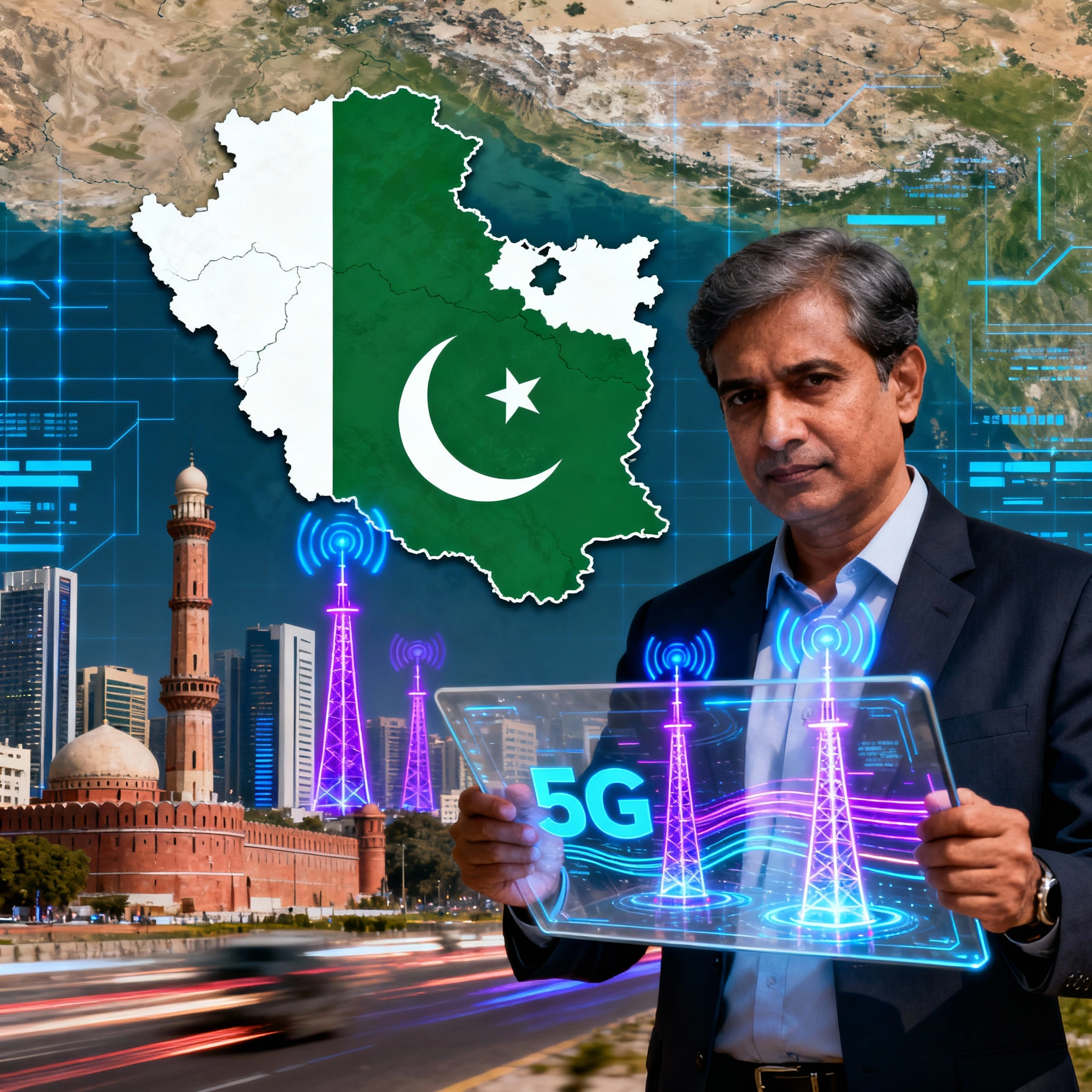
As Pakistan prepares for its pivotal mid-February 2026 spectrum auction, the telecommunications industry faces a strategic inflection point worth potentially trillions in economic value. Yet operator silence suggests the path to 5G leadership remains fraught with uncertainty.
Executive Summary
Pakistan’s telecommunications sector stands at a critical juncture as the Pakistan Telecommunication Authority (PTA) prepares to auction seven spectrum bands for 5G services by mid-February 2026. Despite regulatory momentum and global economic projections suggesting $1.3 trillion in GDP contribution by 2030 according to PwC research, not a single major operator has formally committed to bidding. This strategic hesitation reveals deeper tensions between ambitious government rollout mandates, infrastructure investment realities, and uncertain return-on-investment calculations that could determine whether Pakistan captures or misses its digital dividend.
The Regulatory Landscape: Ambition Meets Calculated Caution
The Pakistan Telecommunication Authority has orchestrated what appears to be an aggressive push toward 5G deployment, setting the stage for a spectrum auction that government officials frame as a strategic investment in the nation’s digital future. The regulatory framework demands that successful bidders upgrade at least 10% of their existing cellular towers to 5G technology within the first year, focusing initially on Pakistan’s economic nerve centers: Islamabad, Lahore, Karachi, and Peshawar.
This rollout strategy mirrors approaches taken by more developed telecommunications markets, yet Pakistan’s timeline appears compressed. According to GSMA’s Mobile Economy report, successful 5G deployments typically require 3-5 years of infrastructure preparation, spectrum planning, and ecosystem development. Pakistan’s accelerated schedule—particularly after missing its June 2025 launch deadline—suggests regulatory ambition may be outpacing market readiness.
The seven spectrum bands slated for auction represent a comprehensive approach to 5G deployment, including five entirely new frequency allocations. This spectrum diversity is strategically sound; research from the International Telecommunication Union demonstrates that optimal 5G performance requires a balanced portfolio of low-band spectrum for coverage, mid-band for capacity, and high-band millimeter-wave frequencies for ultra-high-speed applications.
Yet beneath this regulatory optimism lies a troubling silence from the industry itself. The Telecom Operators Association of Pakistan has issued warnings against premature deployment—a rare public expression of concern that signals deeper anxieties about market conditions, infrastructure costs, and competitive dynamics. This divergence between regulatory enthusiasm and operator caution represents more than mere negotiating posture; it reflects fundamental questions about Pakistan’s 5G value proposition.
The Operator Dilemma: Strategic Silence and ROI Anxiety
In telecommunications markets worldwide, spectrum auctions typically generate intense competitive positioning months before bidding begins. Operators announce strategic partnerships, secure financing, and publicly commit to investment levels that signal market leadership ambitions. Pakistan’s major networks—Jazz (owned by VEON), Zong (China Mobile Pakistan), Telenor Pakistan, and Ufone (PTCL)—have remained conspicuously quiet about their 5G intentions.
This strategic silence speaks volumes. Consider the economic calculus these operators face: McKinsey research on telecommunications capital expenditure indicates that 5G deployment requires substantially higher infrastructure investment per subscriber than 4G networks, primarily due to the need for dense small-cell networks and fiber backhaul capacity. Global mobile operators are projected to invest over $1 trillion in 5G infrastructure by 2025, yet revenue growth has lagged dramatically behind data traffic increases.
Pakistan’s market dynamics compound these challenges. The telecommunications sector operates in an intensely price-competitive environment where average revenue per user (ARPU) remains among the lowest in Asia. When consumers demonstrate satisfaction with existing 4G services for everyday applications—social media, video streaming, messaging—the willingness to pay premium prices for 5G capabilities becomes questionable. This is the killer application problem: 5G’s technical superiority in latency and throughput lacks compelling consumer-facing use cases that justify higher subscription fees.
Jazz, Pakistan’s largest operator with approximately 78 million subscribers, faces a particularly complex decision. As a subsidiary of Amsterdam-based VEON, the company must balance local market opportunities against global capital allocation priorities. Reuters analysis of emerging market telecommunications suggests that operators in price-sensitive markets increasingly prioritize network efficiency and cost optimization over technology leadership—a strategic posture that may explain Jazz’s public reticence.
Zong, backed by China Mobile’s substantial financial resources, theoretically possesses the capital strength for aggressive 5G deployment. Yet even well-capitalized operators must justify investment returns to parent companies and shareholders. The company’s silence may reflect Beijing’s broader recalibration of overseas telecommunications investments amid geopolitical tensions and domestic economic priorities.
Telenor Pakistan and Ufone face similar strategic dilemmas, complicated by questions of market positioning and competitive differentiation. Without clear signals that 5G deployment will drive subscriber growth or ARPU increases, rational economic actors hesitate—regardless of regulatory pressure or nationalist appeals to technological modernization.
Economic Potential: Quantifying the $13 Trillion Question
The global consulting industry has produced remarkably consistent projections about 5G’s transformative economic impact. PwC estimates $1.3 trillion in global GDP contribution by 2030, while McKinsey’s research suggests between $1.2 trillion and $2 trillion by the decade’s end. Most ambitiously, Qualcomm’s 5G Economy Study projects $13.1 trillion in goods and services enabled by 5G technology by 2035.
These figures, while impressive, require careful contextualization for Pakistan’s specific circumstances. The country’s GDP of approximately $340 billion represents roughly 0.35% of global economic output. Applying proportional allocation to these global projections suggests Pakistan could theoretically capture between $4-45 billion in 5G-enabled economic value by 2035—a substantial sum, yet one that must be weighed against deployment costs potentially exceeding $5-7 billion for nationwide infrastructure.
Industry-Specific Transformation Potential
The true economic potential lies not in consumer applications but in industrial transformation. Manufacturing, which contributes approximately 19% of Pakistan’s GDP, stands to benefit significantly from 5G-enabled automation, predictive maintenance, and supply chain optimization. World Bank research on digital infrastructure demonstrates that industrial IoT applications can improve manufacturing productivity by 15-25%, translating to billions in potential value creation for Pakistan’s textile, automotive, and pharmaceutical sectors.
Agriculture: Employing nearly 40% of Pakistan’s workforce, agriculture presents perhaps the most compelling 5G use case. Precision agriculture technologies—soil moisture sensors, drone-based crop monitoring, automated irrigation systems—require the low-latency, high-reliability connectivity that only 5G networks can provide at scale. Consider Punjab’s vast agricultural plains: 5G-enabled precision farming could optimize water usage in a water-stressed nation while increasing crop yields through data-driven cultivation practices.
Healthcare: Telemedicine applications, remote patient monitoring, and AI-assisted diagnostics could extend specialist medical services to rural areas chronically underserved by Pakistan’s healthcare infrastructure. According to OECD digital economy research, countries that successfully deploy 5G-enabled healthcare services report 20-30% reductions in unnecessary hospital visits and emergency room utilization.
Logistics and Transportation: Critical to Pakistan’s position in regional trade networks, this sector could leverage 5G for real-time fleet management, autonomous port operations, and blockchain-enabled customs clearance. Karachi Port, handling over 60% of Pakistan’s cargo, could dramatically improve throughput efficiency through 5G-connected sensors, autonomous vehicles, and AI-powered logistics optimization—competitive advantages that translate directly to trade competitiveness.
Yet translating these theoretical benefits into realized economic value requires more than network deployment. It demands complementary investments in digital literacy, software development capacity, regulatory frameworks that encourage innovation, and capital access for small and medium enterprises to adopt 5G-enabled technologies. The economic dividend is not automatic; it must be actively cultivated through coordinated industrial policy.
Barriers to Deployment: The $1 Trillion Infrastructure Challenge
If 5G’s economic potential appears compelling, why do Pakistan’s telecom operators hesitate? The answer lies in a brutal infrastructure economics equation that has challenged operators worldwide. Unlike 4G deployment, which could largely leverage existing cell tower infrastructure, 5G requires fundamentally different network architecture.
The Physics of 5G Economics
The physics of 5G dictate this complexity. Higher frequency spectrum—particularly the millimeter-wave bands that enable multi-gigabit speeds—suffers from significantly reduced propagation distance and building penetration compared to 4G frequencies. Ericsson’s Mobility Report calculates that achieving comparable coverage to 4G networks requires deploying 3-5 times as many transmission sites, each requiring fiber backhaul connections capable of handling hundreds of gigabits per second.
This infrastructure intensification creates a capital expenditure challenge that global operators have struggled to justify. In mature markets like South Korea and the United States, operators spent $30-50 billion on initial 5G deployments serving populations of 50-330 million. Extrapolating these costs to Pakistan’s 230 million population, accounting for lower per-unit infrastructure costs but also lower revenue potential, suggests total deployment costs between $5-10 billion—a staggering sum for operators already operating with constrained cash flows and substantial debt burdens.
The Revenue-Investment Disparity
The revenue-investment disparity compounds this challenge. Pakistani operators have witnessed dramatic increases in data traffic over the past decade—annual growth rates exceeding 40%—yet average revenue per user has remained stagnant or declined in real terms due to intense price competition and regulatory caps on tariff increases. This fundamental disconnect between traffic growth and revenue growth undermines the economic logic of capacity-expanding infrastructure investments.
Market Immaturity and Missing Killer Apps
Market immaturity presents another critical barrier. The killer applications that might justify consumer premium pricing for 5G services remain largely theoretical in Pakistan’s context. Virtual reality, augmented reality, cloud gaming, and immersive video experiences—the consumer applications that drive 5G adoption in developed markets—face adoption barriers including device costs, content availability, and cultural factors that limit near-term revenue potential.
New Competitive Threats
Competition from unexpected quarters further complicates operator economics. Bloomberg’s technology sector analysis highlights how cloud computing giants—Amazon Web Services, Google Cloud, Microsoft Azure—increasingly offer private 5G network solutions that allow enterprises to bypass traditional telecom operators entirely. These private networks, deployed in factories, warehouses, and corporate campuses, capture precisely the high-value enterprise customers that operators hoped would justify 5G infrastructure investments.
Cybersecurity Complexity
Cybersecurity considerations add another layer of complexity and cost. 5G networks’ software-defined architecture, network slicing capabilities, and massive device connectivity expand the threat surface for cyberattacks. Research from RAND Corporation on telecommunications security indicates that 5G operators must invest 15-25% more in cybersecurity infrastructure compared to 4G networks to maintain equivalent security postures—costs that further erode already marginal investment returns.
The Fiber Backhaul Challenge
The fiber backhaul challenge deserves particular emphasis for Pakistan. 5G’s promise of multi-gigabit speeds and ultra-low latency evaporates without fiber-optic connections linking every transmission site to core networks. Pakistan’s existing fiber infrastructure, concentrated in major urban centers, falls dramatically short of 5G requirements. Building this fiber backbone represents perhaps the single largest deployment cost—and one that generates no direct revenue, serving purely as enabling infrastructure.
Policy Imperatives: Unlocking the Digital Dividend
If Pakistan is to realize 5G’s transformative potential rather than merely deploy expensive infrastructure with disappointing returns, government policy must evolve beyond spectrum auctions to address fundamental market structure challenges. Several policy interventions could dramatically improve the investment calculus for operators while ensuring benefits flow broadly through Pakistan’s economy.
Spectrum Management Reform
Spectrum management reform represents the most immediate opportunity. Traditional spectrum auctions, which extract maximum revenue from operators through competitive bidding, create financial burdens that operators must recoup through subscriber fees—ultimately limiting adoption and constraining economic spillovers. Oxford Martin School research on spectrum policy suggests alternative models like Evolved Spectrum Usage Rights that prioritize deployment speed and coverage breadth over auction revenue maximization.
Infrastructure Sharing Mandates
Infrastructure sharing mandates could substantially reduce deployment costs while accelerating rollout timelines. Rather than each operator building redundant tower and fiber networks, regulated infrastructure sharing allows operators to focus capital on service differentiation and innovation. Markets including India and several European countries have successfully implemented such frameworks, reducing per-operator infrastructure costs by 40-60% according to industry analyses.
Tax Incentives and Fiscal Support
Tax incentives and accelerated depreciation schedules for 5G infrastructure investments would improve operator economics without requiring direct government expenditure. Pakistan’s corporate tax structure currently treats telecommunications infrastructure similarly to other capital equipment, failing to recognize the public-good characteristics and economic spillovers that justify preferential treatment. IMF research on digital infrastructure financing demonstrates that well-designed tax incentives can accelerate deployment by 2-3 years while generating net positive fiscal impacts through expanded economic activity.
Government Anchor Tenancy Programs
Government anchor tenancy programs could provide critical demand certainty for operators investing in 5G infrastructure. By committing to long-term contracts for 5G connectivity across government facilities, educational institutions, and healthcare networks, the public sector can de-risk private investment while simultaneously modernizing public service delivery. This approach has proven successful in broadband deployment programs globally.
SME Support and Technology Adoption
Support for small and medium enterprises adopting 5G-enabled technologies represents perhaps the highest-leverage policy intervention. The economic benefits of 5G accrue not primarily from consumer applications but from industrial transformation. Yet Pakistan’s SMEs—which contribute over 40% of GDP—often lack the capital, technical expertise, and risk tolerance to adopt emerging technologies. Targeted grant programs, technical assistance centers, and demonstration projects could catalyze adoption while distributing 5G’s economic benefits broadly across Pakistan’s industrial base.
Regulatory Flexibility for New Business Models
Regulatory flexibility around use cases and business models will prove equally critical. The shift from consumer-centric (B2C) to industrial and enterprise-focused (B2B) applications represents a fundamental business model transformation for operators. Regulations designed for consumer mobile services—including interconnection requirements, universal service obligations, and tariff structures—may inadvertently constrain the innovative enterprise applications where 5G’s true economic value lies.
Education and Workforce Development
Education and workforce development initiatives must parallel infrastructure deployment. World Economic Forum analysis on digital transformation consistently identifies skills gaps as the primary barrier to realizing technology benefits. Pakistan’s engineering universities and technical training institutions must rapidly expand programs in network engineering, IoT development, edge computing, and AI—the complementary skills that transform 5G connectivity into economic productivity.
Regional Context: Learning from Neighbors and Competitors
Pakistan’s 5G trajectory unfolds against a regional backdrop of varying approaches and outcomes. India, Pakistan’s largest neighbor and economic competitor, launched 5G services in October 2022 with substantial early momentum. Reliance Jio and Bharti Airtel invested heavily in infrastructure, driven partly by competitive dynamics and partly by expectations of enterprise revenue growth. Yet even in India’s larger, more affluent market, operators have struggled to monetize 5G investments, with ARPU growth remaining elusive despite network expansion.
Bangladesh, with economic and demographic similarities to Pakistan, has adopted a more cautious approach. The Bangladesh Telecommunication Regulatory Commission delayed 5G spectrum auctions pending comprehensive infrastructure assessments and market readiness studies—a strategy that Pakistani operators may view as validation of their own hesitation.
Gulf states, particularly the United Arab Emirates and Saudi Arabia, offer a different model: government-driven deployment with substantial public investment treating 5G as strategic infrastructure rather than commercial telecommunications. This approach has achieved rapid network rollout but raises questions about financial sustainability and whether government subsidy represents optimal capital allocation.
These regional experiences suggest that Pakistan’s optimal path may blend elements from multiple approaches: regulatory ambition tempered by market realism, selective government support for infrastructure bottlenecks, and patience in allowing viable business models to emerge rather than forcing premature deployment.
Three Scenarios: Mapping Pakistan’s 5G Futures
Pakistan’s 5G trajectory remains genuinely uncertain, with outcomes depending on policy choices, operator strategies, and market dynamics that continue evolving. Three plausible scenarios illustrate the range of possibilities.
Scenario One: Catalytic Deployment (Probability: 25%)
The February 2026 auction succeeds with at least two major operators bidding aggressively. Government implements supportive policies including infrastructure tax incentives and spectrum pricing restraint. Early enterprise adoption in manufacturing and logistics demonstrates compelling ROI, catalyzing broader industrial transformation. By 2030, 5G contributes measurably to GDP growth, Pakistan’s telecom sector attracts increased foreign investment, and digital services exports expand substantially. This optimistic scenario requires aligned incentives across government, operators, and enterprise customers—possible but demanding considerable coordination.
Scenario Two: Gradual Evolution (Probability: 50%)
The auction proceeds with limited enthusiasm, perhaps single-operator participation or heavily discounted spectrum pricing. Initial deployment concentrates in high-value urban areas with slow expansion to secondary cities. Consumer adoption remains modest, but niche enterprise applications in specific sectors (textile manufacturing, port logistics) demonstrate value. Economic impact materializes gradually over 7-10 years rather than 3-5 years. Pakistan neither leads nor lags dramatically in regional 5G adoption, capturing moderate economic benefits while avoiding financial strain on operators. This baseline scenario represents muddling through—neither triumph nor disaster.
Scenario Three: Delayed Disappointment (Probability: 25%)
The February auction fails to attract sufficient operator interest, forcing postponement and regulatory recalibration. Operators prioritize 4G network optimization and cost management over 5G deployment. Pakistan falls further behind regional competitors in digital infrastructure, constraining economic opportunities in manufacturing, logistics, and digital services. Brain drain accelerates as Pakistani technology talent migrates to markets offering more dynamic digital ecosystems. By 2030, Pakistan’s digital divide—both domestically and relative to global standards—has widened rather than narrowed. This pessimistic scenario reflects risks when regulatory ambition misaligns with market economics.
Conclusion: Strategic Choices at a Technological Crossroads
Pakistan’s 5G journey represents far more than a telecommunications technology upgrade. It constitutes a test of the country’s capacity to navigate complex technological transitions, align public and private sector incentives, and translate infrastructure investments into broadly shared economic prosperity. The February 2026 spectrum auction will reveal whether Pakistan has successfully constructed the policy frameworks, market conditions, and strategic visions necessary for this transformation—or whether the country faces extended delays as stakeholders recalibrate expectations and approaches.
The persistent silence from major operators suggests that fundamental questions remain unresolved. What business models justify the immense infrastructure investments 5G demands? How can operators serving price-sensitive consumers capture sufficient value to earn acceptable returns? Which policy interventions can bridge the gap between private incentives and public benefits?
These questions lack simple answers, yet avoiding them through regulatory pressure or nationalist appeals to technological pride risks expensive policy failures. Pakistan’s optimal path forward requires honest acknowledgment of market economics, creative policy design that addresses legitimate operator concerns, and patience in allowing sustainable business models to emerge. The potential rewards—manufacturing competitiveness, agricultural productivity, healthcare access, digital services exports—justify sustained attention and sophisticated policy craftsmanship.
As the February auction approaches, Pakistan’s telecommunications sector stands at a genuine inflection point. The strategic choices made in coming months—by regulators, operators, policymakers, and enterprise customers—will shape the country’s digital and economic trajectory for decades. Whether Pakistan captures or misses its 5G dividend depends not on technology itself, which continues advancing regardless of local adoption rates, but on the wisdom and coordination of human institutions navigating this consequential transition.
The economic projections and policy recommendations in this analysis reflect assessments current as of January 2026 and may require revision as market conditions, regulatory frameworks, and technological capabilities continue evolving.
About This Analysis: This comprehensive assessment draws on authoritative sources including PwC, McKinsey, GSMA, World Bank, OECD, Ericsson, Qualcomm, Reuters, Bloomberg, RAND Corporation, Oxford Martin School, IMF, and World Economic Forum research to provide evidence-based insights into Pakistan’s 5G readiness and economic prospects.
Discover more from The Economy
Subscribe to get the latest posts sent to your email.


Analysis
Why a 5G Network Is Mission Critical for Every Business in 2026 — And Why Most Leaders Still Don’t Get It

Imagine a pediatric cardiologist at Boston Children’s Hospital, somewhere between a parking structure and a patient room, receiving a high-resolution echocardiogram on her tablet in real time. The feed doesn’t buffer. The consultation doesn’t drop. The child on the other end of the line doesn’t wait. Now imagine that same scenario playing out over a congested hospital Wi-Fi network — pixelated, interrupted, borderline unusable in the moment that matters most. The difference between those two realities is not a software update or a better device. It is the network beneath them.
In 2026, connectivity is no longer a commodity. It is a competitive weapon, a safety infrastructure, and — in sectors like healthcare, logistics, and manufacturing — a life-or-death variable. And yet, a startling proportion of senior executives still treat their wireless strategy as an IT afterthought, something to be delegated to a procurement officer and reviewed annually alongside printer contracts. That complacency is no longer merely inefficient. It is strategically dangerous.
My argument is simple: a robust, enterprise-grade 5G network — particularly standalone, private, and network-sliced architectures — is now the non-negotiable backbone of every modern business operation. Dismissing it is not cautious conservatism. It is the 2026 equivalent of refusing to move to the cloud in 2015.
1: The New Meaning of “Mission Critical”
When Latency Becomes a Life Sentence
The phrase “mission critical” has been diluted by years of vendor marketing into near meaninglessness. But in healthcare, it retains its original, uncomfortably literal weight.
Karl Connolly, Vice President of Technology Infrastructure at Boston Children’s Hospital, has described the institution’s 5G journey not as a technology upgrade but as a patient care imperative. The hospital’s hybrid 5G deployment — integrating both indoor and outdoor coverage across its campus — enables clinical staff and patients to remain continuously connected regardless of physical location. For pediatric patients undergoing long-term treatment, consistent broadband access isn’t a luxury; it’s a therapeutic continuity tool, keeping children connected to remote schooling, family members, and digital therapy resources throughout extended stays.
But the more profound implication is clinical. Remote diagnostics, real-time telemetry, and AI-assisted imaging interpretation all demand latency measured in milliseconds, not seconds. According to GSMA Intelligence’s State of 5G 2026 report, global 5G subscriptions have now exceeded 3.1 billion, with network coverage reaching approximately 55% of the global population — yet healthcare-grade deployments with sub-10ms latency and guaranteed uptime remain the exception, not the rule.
The economic stakes are considerable. The global 5G IoT market — which encompasses remote patient monitoring, smart hospital infrastructure, and connected surgical robotics — is valued at over $8.1 billion in 2026, according to industry forecasts, with compound annual growth rates projected in double digits through the end of the decade. For healthcare executives still running clinical workflows over legacy Wi-Fi, that market is being built without them.
2: When Wi-Fi Isn’t Enough — The Mobility Gap Nobody Talks About
The Invisible Failure Mode of Modern Work
Craig Ward, Head of Business Mobility Solutions at T-Mobile for Business, poses a question that sounds deceptively simple: what happens to your workforce the moment they leave the building?
For millions of field service technicians, healthcare workers, logistics coordinators, and hybrid employees, the answer is: they fall off the corporate network. They scramble for Wi-Fi passwords in client offices, connect to unsecured hotspots in transit hubs, or — more dangerously — they continue working over public networks blissfully unaware of the exposure they’re creating.
Wi-Fi, for all its ubiquity, is architecturally unsuited to a mobile-first economy. It is location-dependent, password-gated, congestion-prone, and — critically — it was never designed with enterprise security as a first principle. The private 5G vs. Wi-Fi for business mobility debate is not, at its core, a technical argument. It is a business resilience argument.
5G’s SIM-based authentication eliminates the password problem entirely. Devices authenticate through the network itself, creating a frictionless, continuously secure connection that follows the employee — on the subway, in a client’s parking lot, across a hospital campus, or mid-flight on a domestic route. As McKinsey’s 2026 analysis of B2B connectivity trends notes, enterprises adopting carrier-grade mobile connectivity for field operations report statistically significant improvements in productivity, incident response time, and data security posture.
The security dimension deserves particular emphasis in a post-breach business environment. Wi-Fi’s shared-spectrum, access-point architecture makes it inherently vulnerable to man-in-the-middle attacks, rogue access points, and denial-of-service interference. 5G’s encrypted radio interface and network-level authentication create a materially harder target. For industries handling sensitive client data — finance, legal, healthcare, government contracting — that distinction is not academic. It is a compliance and liability issue.
3: Network Slicing — The Game-Changer Most Executives Have Never Heard Of
One Network, Many Realities
If 5G is the infrastructure revolution most executives are still underestimating, then 5G network slicing for enterprises is the capability within that revolution that almost nobody outside of telecom circles has properly grasped. That gap represents both a risk and an opportunity.
Will Whitehead, Director of Network Slicing and Advanced Solutions at T-Mobile for Business, illustrates the concept with an example that cuts through abstraction cleanly: during a major stadium event or city-center emergency, traditional wireless networks become functionally useless as thousands of simultaneous users compete for the same spectrum. First responders can’t get through. Business-critical applications stall. Real-time inventory systems go dark.
Network slicing solves this by partitioning a single physical 5G network into multiple virtualized, isolated networks — each with independently guaranteed bandwidth, latency, and priority. A first responder’s body camera feed gets its dedicated slice. A hospital’s patient monitoring system gets another. A logistics company’s fleet telemetry never competes with a concert-goer’s Instagram upload.
The practical implications for enterprise architecture are significant. Consider a manufacturing facility deploying autonomous mobile robots and edge AI quality-control systems. Both applications require deterministic, low-latency connectivity. Without slicing, a surge in corporate video conferencing traffic — or a software update pushed to hundreds of devices simultaneously — could degrade the robotic production line in real time. With a dedicated network slice, those operations are hermetically sealed from interference.
Ericsson’s 2026 analysis on private 5G as an intelligent-economy catalyst describes network slicing as the mechanism by which 5G transitions from a consumer technology to a true B2B platform — one capable of supporting Industry 4.0 deployments at scale. The firm projects that private 5G networks and sliced enterprise services will represent one of the fastest-growing segments of global telecom revenue through 2028, with 500% growth in private 5G deployments projected from 2024 baselines, according to Forbes’s 2026 Wireless Trends analysis.
For small and mid-market businesses, the opportunity is particularly compelling. Network slicing need not require a full private 5G buildout — carriers are increasingly offering sliced services as part of enterprise mobile plans, effectively democratizing a capability that was once available only to hyperscalers and defense contractors. The 5G adoption small business 2026 story is one of access, not just aspiration.
4: Future-Proofing — The Architecture Decisions You Make Today Will Haunt You in 2030
Beyond 5G: Building for What’s Coming
A reasonable objection to aggressive 5G investment in 2026 goes something like this: “Isn’t 6G coming? Shouldn’t we wait for the next cycle?” It is a sensible-sounding question that reflects a fundamental misunderstanding of infrastructure timelines and technological dependency chains.
6G standardization is proceeding, with the ITU’s IMT-2030 framework establishing the first formal technical requirements. Commercial 6G deployments are not realistically expected before the early 2030s. In the intervening period — roughly six to eight years — the businesses that will be best positioned to adopt 6G are those that have already built the organizational competencies, partner relationships, edge computing infrastructure, and data architectures that 5G demands. You cannot leapfrog from legacy Wi-Fi to 6G. The on-ramp runs through 5G Standalone.
T-Mobile’s network roadmap reflects this developmental logic. Its deployment of 5G Standalone — the architecture that enables true network slicing, ultra-low latency, and the network-as-a-service model — represents a qualitative departure from Non-Standalone 5G, which is essentially 4G LTE with a 5G marketing wrapper. SA 5G is the version that actually unlocks the enterprise use cases: edge AI inference, private slices, sub-1ms industrial control loops, and the precise kind of deterministic connectivity that autonomous systems require.
Private 5G networks represent an adjacent but distinct opportunity, particularly for large campuses, industrial facilities, and logistics hubs where outdoor macro coverage is insufficient and the security requirements of a shared carrier network are unacceptable. Deloitte’s 2026 Industry 4.0 report identifies private 5G as the connective tissue of the intelligent factory, enabling machine-to-machine communication at densities and speeds that no previous wireless standard could support.
The geopolitical dimension adds urgency. National competitiveness in AI, advanced manufacturing, and digital services is increasingly a function of wireless infrastructure quality. Countries and companies that invested in 5G early — South Korea, Japan, parts of Northern Europe — are already realizing measurable productivity advantages in sectors ranging from automotive manufacturing to precision agriculture. The CTIA’s economic impact analysis projects that 5G’s contribution to U.S. GDP could reach $1.5 trillion by 2030, with the bulk of that value concentrated in enterprise and industrial applications rather than consumer services.
5: The Economic and Competitive Imperative — Stop Treating Connectivity as a Cost Center
The CFO Conversation Nobody Is Having
Here is where the rubber meets the road for most organizations: the budget conversation. 5G connectivity — whether through enterprise mobile plans, network slicing agreements, or private infrastructure — requires capital expenditure. Finance committees want ROI. Boards want justification.
The data exists, and it is compelling. 5G Standalone enterprise ROI studies from both Ericsson and Nokia show that manufacturers deploying private 5G in warehouse and production environments report average defect-detection improvements of 15–25% through AI-enabled visual inspection, alongside 10–20% reductions in unplanned downtime attributable to predictive maintenance systems that require continuous, high-throughput sensor connectivity.
In healthcare, the math is starker. Remote patient monitoring enabled by reliable 5G connectivity reduces hospital readmission rates — each prevented readmission representing thousands of dollars in avoided cost and, more importantly, a better patient outcome. In logistics, real-time 5G-connected fleet telemetry has been shown to reduce fuel consumption, optimize routing, and improve delivery accuracy in ways that generate measurable margin improvement at scale.
For small and mid-market businesses, the entry point is more accessible than the enterprise conversation might suggest. Carrier-grade 5G mobile plans with enhanced security tiers, slice-aware routing, and guaranteed SLAs for business-critical applications are increasingly available at price points competitive with traditional broadband plus VPN plus mobile device management stacks. The 5G mission critical business 2026 opportunity is not reserved for Fortune 500 infrastructure budgets.
The competitive dynamics are also worth naming directly. In virtually every sector, the organizations that build on superior connectivity infrastructure will compound advantages in AI deployment, automation, supply chain visibility, and customer experience. Those running on legacy networks will face a widening capability gap — one that is difficult to close retroactively because the applications, the data pipelines, and the organizational muscle memory all develop in parallel with the infrastructure.
Conclusion: This Is Your Cloud Moment. Don’t Miss It Again.
In 2015, the business leaders who dismissed cloud migration as unnecessary complexity, vendor lock-in risk, or premature adoption paid for that caution in competitive decline, escalating on-premise infrastructure costs, and an inability to deploy the software-defined services that cloud-native competitors were scaling effortlessly.
We are at an identical inflection point with enterprise 5G in 2026. The network is no longer a passive pipe. It is an intelligent platform — one that determines the speed, security, reliability, and ultimately the strategic ceiling of every application your business runs and every service your customers experience. Whether you are a pediatric hospital trying to deliver seamless care across a complex campus, a logistics operator trying to maintain fleet visibility in real time, or a manufacturer deploying the first generation of truly autonomous production systems, the quality of your wireless infrastructure is now the quality of your business.
The good news is that the infrastructure exists, the providers have matured, and the ROI data is no longer speculative. Working with a carrier that offers proven 5G Standalone architecture, enterprise-grade network slicing, and a credible roadmap toward private and edge-integrated deployments is not a technology bet. It is a business imperative — as basic and as urgent as the transition to cloud computing a decade ago.
The leaders who treat it that way in 2026 will look prescient in 2030. The ones who don’t will spend that same period explaining why they fell behind.
Discover more from The Economy
Subscribe to get the latest posts sent to your email.
Analysis
Jazz Wins 190 MHz in Pakistan’s Historic 5G Auction – Triples Spectrum to 284.4 MHz for $239M

In a single, decisive afternoon that will be marked as a pivotal moment in Pakistan’s economic history, the nation has finally and forcefully entered the global 5G arena. The country’s long-anticipated 5G spectrum auction concluded today, March 10, 2026, raising a staggering $507 million for the national exchequer in a matter of hours.
Emerging as the undisputed heavyweight champion from this digital contest is Jazz, the nation’s largest mobile operator. Backed by its parent company, VEON, Jazz has committed $239.375 million to secure a massive 190 MHz block of new spectrum, a move that more than triples its total holdings and redraws the competitive map of South Asia’s telecommunications landscape. This wasn’t merely a business transaction; it was a declaration of intent, positioning Jazz—and by extension, Pakistan—to leapfrog years of digital latency and begin closing the profound connectivity gap that has long hampered its immense potential.
The results of the Pakistan 5G spectrum auction 2026 signal a tectonic shift. For a nation where nearly 40% of the population still lacks basic 4G access and per-user data consumption hovers at a modest 8 GB per month—well below the regional average of 20 GB—this auction is the starting gun for a digital revolution. Jazz’s aggressive acquisition, particularly its strategic capture of the coveted 700 MHz band, is a clear bet on a future where high-speed internet is not a luxury for the urban elite, but a utility for the masses, from the bustling markets of Karachi to the remote valleys of Gilgit-Baltistan. As the dust settles, the implications are clear: Pakistan’s digital future, for better or worse, will be largely shaped by the success of this monumental investment.
Breaking Down the Auction: Jazz Emerges Victorious
The auction, managed with notable transparency by the Pakistan Telecommunication Authority (PTA), was a swift and high-stakes affair. Of the 480 MHz of spectrum sold, the Jazz spectrum auction result was a clear victory. The company secured the largest and most diverse portfolio of frequencies, a strategic haul designed for both capacity and coverage.
The specifics of the Jazz 190 MHz Pakistan acquisition paint a detailed picture of its ambitions:
- 50 MHz in the 3500 MHz band: This is the prime global frequency for 5G, offering immense capacity and blazing-fast speeds. It will form the backbone of Jazz’s initial 5G rollout in dense urban centers like Lahore, Islamabad, and Karachi, where data demand is highest.
- 70 MHz in the 2600 MHz band: A crucial capacity layer that complements the 3500 MHz band, this spectrum will handle heavy data traffic and ensure a consistent, high-quality user experience as the 5G network matures.
- 50 MHz in the 2300 MHz band: Another vital capacity band, which provides a solid foundation for expanding 4G services and managing the transition to 5G.
- 20 MHz in the 700 MHz band: Perhaps the most strategically critical piece of the puzzle, this low-band spectrum is the key to unlocking the rural market.
This combination of low, mid, and high-band spectrum gives Jazz an unparalleled toolkit to execute a multi-layered network strategy, a sophisticated approach more akin to operators in developed markets than what is typical in the region.
From 94.4 MHz to 284.4 MHz: What Tripling Spectrum Really Means
For the layman, spectrum can be an abstract concept. In reality, it is the invisible real estate upon which all wireless communication is built. Before the auction, Jazz operated on a constrained 94.4 MHz of spectrum. This limited its ability to handle the exponential growth in data demand, leading to network congestion and a ceiling on potential service quality.
The headline, “Jazz triples spectrum holdings to 284.4 MHz,” barely does justice to the operational transformation this enables. It’s the difference between a two-lane country road and a six-lane superhighway. This dramatic expansion provides three immediate benefits:
- Massive Capacity Boost: The new frequencies, particularly in the mid-bands (2300 MHz, 2600 MHz, 3500 MHz), will immediately alleviate congestion on the existing 4G network. This means faster, more reliable speeds for millions of current users, even before a single 5G tower is activated.
- A Credible Path to 5G: True 5G requires wide, contiguous blocks of spectrum to deliver its promised gigabit speeds and ultra-low latency. With 50 MHz in the 3500 MHz band, Jazz now has the foundational asset to launch a world-class 5G service, enabling next-generation applications from the Internet of Things (IoT) to cloud gaming and smart cities.
- Future-Proofing the Network: By securing such a vast portfolio, Jazz has ensured it has the resources to meet Pakistan’s data demands for the next decade. It avoids the piecemeal, incremental upgrades that have plagued many emerging markets, allowing for long-term, strategic network planning.
The 700 MHz Prize: Game-Changer for Rural Pakistan
While the high-band spectrum grabs headlines for its speed, the quiet hero of this auction is the Jazz 700 MHz band Pakistan rural coverage plan. Low-band spectrum like 700 MHz possesses superior propagation characteristics, meaning its signals travel much farther and penetrate buildings more effectively than high-band signals.
This is a game-changer for a country with Pakistan’s geography and demographics. Building a network in sparsely populated or mountainous regions with traditional high-frequency spectrum is often economically unviable, requiring a dense grid of towers. The 700 MHz spectrum rural connectivity Pakistan strategy allows Jazz to cover vast swathes of the countryside with a fraction of the infrastructure.
This single allocation is the most concrete step taken to date to bridge Pakistan’s stubborn digital divide. It holds the promise of bringing reliable, high-speed mobile broadband to millions of citizens for the first time, unlocking access to education, e-health, digital finance, and modern agricultural practices. This directly addresses one of the most significant hurdles to inclusive economic growth. As Aamir Ibrahim, CEO of Jazz, noted, this investment is about “more than just 5G in cities; it’s about building a digital ecosystem that includes every Pakistani.” This sentiment, backed by the physics of the 700 MHz band, now carries the weight of genuine possibility.
Competitor Landscape: How Zong and Ufone Fared
While Jazz was the clear winner, it was not the only player. The Pakistan 5G auction results show a broader commitment to the country’s digital future from other key operators.
| Operator | Total Spectrum Won | Key Bands Acquired (MHz) | Total Outlay (Approx.) |
|---|---|---|---|
| Jazz | 190 MHz | 3500, 2600, 2300, 700 | $239.375 M |
| Ufone | 180 MHz | 3500, 2600, 2300 | $198 M |
| Zong | 110 MHz | 3500, 2600 | $69 M |
The Jazz vs Zong vs Ufone 5G spectrum allocation reveals distinct strategies. Ufone also made a significant play, securing a large 180 MHz block to bolster its position and compete aggressively in the 5G race. Zong, a subsidiary of China Mobile and an early pioneer of 4G in Pakistan, took a more modest 110 MHz, likely focusing its resources on upgrading its existing, robust network infrastructure for 5G services in its urban strongholds. The competitive dynamic is now set for a fierce three-way race, which will ultimately benefit consumers with better services and more competitive pricing.
Economic Ripple Effects: Closing the Digital Divide
The Pakistan 5G auction economic impact 2026 cannot be overstated. Beyond the immediate $507 million windfall for the government, the true value lies in the long-term multiplier effect on the economy. The Jazz $1 billion investment 5G Pakistan commitment, announced in conjunction with the auction, is a powerful vote of confidence in the country’s policy direction and economic stability.
This capital expenditure will flow into network hardware, local engineering talent, and civil works, creating thousands of jobs. More profoundly, the resulting digital infrastructure will serve as a platform for innovation across every sector. For a country with a youthful, entrepreneurial population, access to reliable, high-speed connectivity is the critical missing ingredient. It will catalyze the growth of the gig economy, e-commerce, fintech, and a burgeoning startup scene that has, until now, been constrained by digital scarcity. This is the macro-level story that international investors and bodies like the IMF will be watching closely.
Policy Verdict: A Win for Transparent Spectrum Management
Finally, the execution of the auction itself is a significant victory. In a region where spectrum allocation has often been a contentious and opaque process, the PTA has delivered a model of efficiency and transparency. Unlike the delayed and complex processes seen in neighboring India or Bangladesh, Pakistan’s ability to conduct a clean, multi-band auction in a single day sets a new regional benchmark. It sends a powerful signal to the global investment community that Pakistan is a serious and reliable destination for foreign direct investment in the technology sector. This successful policy execution, as detailed in reports by outlets like Dawn and Business Recorder, builds crucial sovereign credibility.
The road ahead is not without its challenges. Rolling out a nationwide 5G network while simultaneously expanding 4G to underserved areas is a monumental undertaking. It will require navigating complex regulatory hurdles, securing the supply chain for advanced equipment, and managing the significant debt load associated with such a large investment. However, as of today, the path is clear. With its newly tripled spectrum holdings and a clear strategic vision, as outlined in the official VEON announcement, Jazz has not just won an auction; it has accepted the mantle of leadership in powering Pakistan’s digital destiny. The nation, and the world, is watching.
Discover more from The Economy
Subscribe to get the latest posts sent to your email.
Analysis
Pakistan’s $507 Million 5G Spectrum Gamble: A Blueprint for Digital Destiny or a Fiscal Mirage?
Unlocking the Future: Pakistan’s Pivotal 5G Auction and its Global Ramifications
The recent conclusion of Pakistan’s 5G spectrum auction, yielding a substantial $507 million, is more than a mere fiscal event; it’s a strategic inflection point for a nation grappling with economic headwinds and vying for its place in the global digital economy. Beyond the impressive figures, this auction represents a profound bet on connectivity as the engine of future prosperity, inviting scrutiny from international economists, policymakers, and business leaders keen on understanding emerging market dynamics. The stakes are undeniably high, as the decisions made today will echo across Pakistan’s technological landscape and economic trajectory for decades to come.
The auction saw leading telecom operators Jazz, Ufone, and Zong secure critical frequency bands, ranging from 700MHz to 3500MHz. This allocation is poised to fundamentally reshape Pakistan’s digital future, promising not just faster internet, but a foundational shift towards an AI-driven, blockchain-enabled society, as envisioned by the Finance Minister.
Economic Lifeline or Temporary Reprieve? Dissecting the Financial Impact
The $507 million injection into Pakistan’s exchequer arrives at a critical juncture, offering a much-needed boost to government revenues. In a country often reliant on external financing and navigating complex fiscal challenges, this sum provides a welcome, albeit temporary, reprieve. Comparing this to historical telecom revenue trends, this auction demonstrates sustained government interest in leveraging the digital sector for economic benefit. For instance, previous spectrum sales have consistently contributed to the national treasury, highlighting the sector’s strategic importance.

However, the true economic impact transcends immediate revenue. The successful auction signals Pakistan’s commitment to modern infrastructure, a crucial factor in attracting foreign direct investment (FDI). International investors often view robust digital infrastructure as a prerequisite for market entry and expansion. By facilitating a more advanced and reliable telecom network, Pakistan enhances its appeal as a destination for tech companies, e-commerce giants, and digital service providers. The challenge now lies in ensuring that these funds are judiciously managed and reinvested into further infrastructure development and economic stabilization programs, preventing them from becoming a short-term fiscal mirage.
Market Reconfiguration: Strategic Moves by Jazz, Ufone, and Zong
The competitive landscape of Pakistan’s telecom sector is on the cusp of significant transformation following the strategic spectrum acquisitions by Jazz, Ufone, and Zong. Their choices in frequency bands—700MHz, 2300MHz, 2600MHz, and 3500MHz—reveal calculated strategies for 5G rollout and future market positioning.
The acquisition of lower frequency bands like 700MHz is particularly telling. These bands offer superior propagation characteristics, allowing signals to travel further and penetrate buildings more effectively, making them ideal for widespread rural coverage and dense urban indoor environments. This suggests an intent to rapidly achieve broad geographical reach and ensure robust indoor connectivity. Conversely, higher frequency bands (2300MHz, 2600MHz, 3500MHz) provide massive capacity and ultra-fast speeds, crucial for supporting data-intensive applications in urban centers and for enabling advanced industrial use cases.
The diverse spectrum holdings imply that operators will likely adopt differentiated rollout strategies. We might see Jazz, for instance, prioritize a blend of wide coverage and targeted high-capacity zones, while Ufone and Zong could focus on specific urban corridors or enterprise solutions where their acquired bands offer a competitive edge. This will undoubtedly lead to intensified competition, potentially driving innovation and service quality improvements across the board, benefiting Pakistani consumers and businesses alike.
Policy Innovation and Regulatory Foresight: A Global Benchmark?
The policy and regulatory environment surrounding this auction deserves particular attention. The active roles played by the Finance Minister, IT Minister, and Information Minister underscore a cross-governmental commitment to advancing Pakistan’s digital agenda. Critical assessment of the transparency claims, supported by the involvement of an advisory committee, is crucial for fostering investor confidence and ensuring equitable play. The government’s assertion of transparency, if upheld, is a significant positive signal for future investment.
Perhaps the most innovative policy move was the abolition of Right-of-Way (RoW) charges. This policy innovation, designed to streamline infrastructure deployment and reduce operational costs for telecom operators, positions Pakistan favorably on the global stage. In many emerging markets, complex and costly RoW regulations often act as significant impediments to rapid network expansion. By removing this barrier, Pakistan has demonstrated a forward-thinking approach that could serve as a blueprint for other nations seeking to accelerate their digital transformation initiatives. This move not only reduces rollout costs but also signals a proactive regulatory stance aimed at facilitating, rather than hindering, technological progress.
Beyond Speed: The Transformative Power of 5G Use Cases
The excitement surrounding 5G in Pakistan extends far beyond mere download speeds. The Finance Minister’s explicit mention of AI and blockchain as key beneficiaries of 5G connectivity highlights a vision for profound technological transformation. This isn’t just about consumer-grade internet; it’s about building the backbone for an advanced digital economy.
The specific “use cases” of 5G are poised to revolutionize various sectors:
- Industry 4.0: 5G’s ultra-low latency and massive connectivity will enable smart factories, remote-controlled machinery, and highly efficient supply chains, boosting productivity and industrial output.
- Healthcare: Remote surgery, real-time patient monitoring, and AI-powered diagnostics will become more viable, extending quality healthcare to underserved regions.
- Education: Enhanced broadband connectivity will facilitate immersive e-learning experiences, virtual classrooms, and access to global educational resources, bridging existing learning divides.
- E-commerce and Digital Services: Faster, more reliable networks will accelerate the growth of online businesses, digital payment systems, and innovative service delivery models, further integrating Pakistan into the global digital marketplace.
- IT Exports: A robust 5G infrastructure, coupled with skilled talent, could significantly boost Pakistan’s IT exports, attracting more outsourcing contracts and fostering a vibrant tech startup ecosystem. This alignment with global digital trends is crucial for boosting the country’s economic diversification efforts.
Navigating the Road Ahead: Challenges and Opportunities for Pakistan’s 5G Journey
While the success of the 5G auction is commendable, an objective analysis necessitates acknowledging the substantial challenges that lie ahead for a full-scale, equitable 5G rollout in Pakistan.
Potential Hurdles:
- Infrastructure Investment: Despite the abolition of RoW charges, significant capital expenditure will still be required for towers, fiber optic backbones, and energy solutions. Securing this long-term investment, both domestic and foreign, remains critical.
- Regulatory Consistency: Maintaining a stable and predictable regulatory environment is paramount. Any future policy shifts or inconsistencies could deter operators from making necessary long-term investments.
- Consumer Affordability: The cost of 5G-enabled devices and service plans could be a barrier for a significant portion of the population. Strategies for making 5G accessible and affordable are essential for maximizing its societal impact.
- Energy Costs: The energy demands of 5G networks are substantial. High electricity costs and unreliable power supply could impact operational expenses and network performance, necessitating sustainable energy solutions.
Immense Opportunities:
Despite these challenges, the opportunities presented by 5G for digital inclusion and economic diversification are immense. 5G can empower remote communities, facilitate innovation in various sectors, and create new job opportunities. It serves as a catalyst for the broader digital economy, fostering a cycle of innovation, investment, and growth.
Pakistan’s Digital Trajectory: Charting its Own Course
Contextualizing Pakistan’s 5G journey against other emerging and regional markets reveals a nation charting its own course. While some regional players have advanced rapidly, Pakistan’s deliberate steps, marked by policy innovations like the abolition of RoW charges, position it as a significant contender. Its approach suggests a focused effort to learn from global best practices while adapting to local economic realities. This strategic foresight is critical for long-term success, distinguishing Pakistan from nations that rush deployment without adequate regulatory and economic frameworks.
The Dawn of a Connected Pakistan: A Vision Realized
Pakistan’s $507 million 5G spectrum auction is more than a financial transaction; it’s a testament to a national ambition to harness digital transformation for economic resurgence and societal upliftment. The strategic decisions made by telecom operators, coupled with a proactive regulatory stance, lay the groundwork for a deeply connected future.
The journey ahead will undoubtedly be fraught with challenges, from infrastructure financing to ensuring equitable access. Yet, the immense potential for driving digital inclusion, fostering innovation in key sectors, and diversifying the national economy makes this gamble a necessary and potentially transformative one. Pakistan is not just acquiring spectrum; it is investing in its digital destiny, signaling to the world its unwavering commitment to a future powered by connectivity, intelligence, and innovation. The world watches to see if this bet will indeed change everything, propelling Pakistan into a new era of prosperity and global digital leadership.
Discover more from The Economy
Subscribe to get the latest posts sent to your email.

Balance of Payments (BOP)

The Falkland Islands Dispute: Sovereign Wealth, Offshore Drilling, and Market Impacts

Gross Domestic Product (GDP): Nominal vs. Real

What is Inflation and the Consumer Price Index (CPI)?

US-China Trade Competition 2026: Supply Chain Relocation Guide

Oil Prices Break $100 in 2026: Middle East Conflict & Energy Markets

South-South Trade Expansion: Digital Integration and Emerging Market Growth

$166B Tariff Refund Tapering Fast: Is Your Business Missing Out?

Stock Market Today: Dow Climbs 500 Points as Markets Shake Off Inflation Jitters

14th WTO Conference 2026: Tariffs & Global Supply Chain Impact

Swish Secures $24M Funding to Disrupt India’s $100B Food Market

Physical AI and Driverless Tech: The Next Trillion-Dollar Industrial Revolution

Enterprise AI Platforms Disrupting B2B SaaS in 2026: Full Analysis

Crypto vs. Safe Haven Assets 2026: Where Institutions Are Hedging

State Farm’s $5B Dividend 2026: Who Qualifies & Payout Dates

US-China Relations in Q3 2026: Trade Tariffs and Supply Chain Risks

Gold’s Wild 2026: From a Record $5,600 Peak to a 24% Crash and Back Toward $4,500

Oil Surges as Strait of Hormuz Traffic Collapses Again

The Rocket That Won’t Quit: Inside SpaceX’s Falcon 9 Launch Machine

Bank of England Set to Hold Rates Through Year-End, Reuters Poll Shows

SpaceX Starship Flight 14: First Orbital Attempt & Starlink V3 Launch Explained

The 2026 Crypto Regulatory Shift: What It Means for Institutional Investors

AI Chip Stocks 2026: The Best Semiconductor Investments Beyond Marvell

Retail Earnings Week: What Home Depot, Target & Walmart Reveal

AI-Powered Training: The Next Multi-Billion Dollar Ecosystem in Fitness

Russia’s Black Sea Oil Exports Fall for a Fifth Straight Week

Global Chip Selloff Deepens: What’s Driving the Aug. 19 Semiconductor Rout

Tween Back-to-School Trends 2026: What’s Driving the $85B Season
-

 Markets & Finance8 months ago
Top 15 Stocks for Investment in 2026 in PSX: Your Complete Guide to Pakistan’s Best Investment Opportunities
-

 Analysis7 months ago
Johor’s Investment Boom: The Hidden Costs Behind Malaysia’s Most Ambitious Economic Surge
-

 Analysis7 months ago
Top 10 Stocks for Investment in PSX for Quick Returns in 2026
-

 Analysis7 months ago
Brazil’s Rare Earth Race: US, EU, and China Compete for Critical Minerals as Tensions Rise
-

 Banks8 months ago
Best Investments in Pakistan 2026: Top 10 Low-Price Shares and Long-Term Picks for the PSX
-

 Investment8 months ago
Top 10 Mutual Fund Managers in Pakistan for Investment in 2026: A Comprehensive Guide for Optimal Returns
-

 Global Economy9 months ago
15 Most Lucrative Sectors for Investment in Pakistan: A 2025 Data-Driven Analysis
-

 Global Economy9 months ago
Pakistan’s Export Goldmine: 10 Game-Changing Markets Where Pakistani Businesses Are Winning Big in 2025