
Investment
Pakistan Stock Surge: KSE-100 Hits Record 188,000+ on Rate Cut Bets


KSE-100 index soars past 188,621 points amid Pakistan stock market rally fueled by SBP rate cut expectations. Analysis of drivers, risks, and global emerging market context for January 2026.
A Frontier Market’s Unexpected Ascent
The trading floor at the Pakistan Stock Exchange opened Tuesday morning with the nervous energy that has become characteristic of frontier markets in early 2026. By midday, the benchmark KSE-100 index had tumbled to an intraday low of 187,192 points, triggering familiar anxieties among investors who remember Pakistan’s volatility all too well. Yet what followed was a dramatic reversal that encapsulates the peculiar momentum gripping this South Asian economy.
The KSE-100 surged 860 points to close at a record 188,621.78, marking not just another milestone but a continuation of what has become one of the most compelling—and confounding—bull runs in emerging markets. For investors watching from afar, Pakistan’s bourse suddenly looks less like a frontier gamble and more like an opportunity that demands serious consideration.
The rally extends a remarkable streak. Over the past month alone, the index has climbed 10.20 percent, and stands up 63.99 percent compared to the same period last year, according to data from Trading Economics. This isn’t the ephemeral bounce of speculative fervor; it’s a sustained ascent driven by fundamentals that are quietly reshaping Pakistan’s investment narrative.
The January 20 Session: Volatility Gives Way to Conviction
Tuesday’s trading session offered a microcosm of Pakistan’s current market dynamics. The index swung between an intraday high of 188,958.38 and its morning low of 187,192.02, a range reflecting both persistent uncertainty and growing confidence. The volatility wasn’t surprising—frontier markets rarely move in straight lines—but the decisive close above 188,600 points signaled something more substantial than mere momentum.

Volume remained robust, with market participants noting sustained buying interest across heavyweight sectors. According to analysis from KTrade Securities, all-share traded volumes rose 2.3 percent day-over-day to 1,226 million shares, suggesting broad participation rather than narrow speculation. The breadth of the rally—spanning energy, financials, and fertilizers—indicates institutional conviction rather than retail exuberance.
Heavy stocks drove the gains. Engro Holdings, Pakistan Petroleum, Sazgar Engineering, Oil and Gas Development Company, and Pakistan State Oil collectively added 661 points to the index, underscoring how Pakistan’s largest companies are benefiting from improving macroeconomic conditions and sector-specific tailwinds.
The Rate Cut Catalyst: Monetary Easing in Focus
At the heart of Tuesday’s rally—and indeed, much of the recent bullishness—lies a simple calculation: investors are betting heavily that the State Bank of Pakistan will announce a rate cut at its Monetary Policy Committee meeting scheduled for January 26. The conviction behind this bet is remarkably strong.
Survey data indicates that approximately 80 percent of market participants expect the SBP to reduce interest rates, with 56 percent predicting a 50 basis point cut and 15 percent foreseeing a full percentage point reduction. These aren’t idle expectations. They’re grounded in a macroeconomic reality that has shifted dramatically over the past several months.
The central bank surprised markets in December by cutting rates 50 basis points to 10.5 percent, even as many analysts had forecast rates would remain on hold. The move followed the IMF’s approval of a $1.2 billion disbursement, which bolstered foreign exchange reserves to over $15.8 billion, according to Trading Economics data. That cut signaled the SBP’s confidence that inflation was being durably tamed without requiring the punishingly high real interest rates that had characterized much of 2024 and early 2025.
Market pricing now reflects expectations of further easing. Looking ahead, nearly 49 percent of survey participants believe the policy rate will remain at 10 percent until June 2026, while 46 percent expect it to fall below 10 percent. If realized, such cuts would represent a remarkable pivot from the 22 percent peak reached during Pakistan’s acute inflation crisis.
The broader context matters enormously. Pakistan’s real interest rate—the policy rate minus inflation—currently stands at approximately 450 basis points, well above the historical average of 200-300 basis points for the country. This substantial buffer provides the SBP meaningful room to ease without risking inflation expectations becoming unanchored.
Inflation’s Cooling Trajectory
The foundation for monetary easing rests on Pakistan’s remarkable inflation performance. After experiencing devastating price pressures that saw annual inflation surge above 30 percent in 2023, the country has achieved a disinflation that would have seemed implausible just 18 months ago.
Pakistan’s annual inflation eased to 5.6 percent in December 2025 from 6.1 percent in November, marking the lowest reading since August. More critically, this deceleration appears broad-based rather than driven by volatile components. Food and non-alcoholic beverage inflation decelerated significantly to 3.2 percent from 5.5 percent in November, with perishable food prices declining 17.8 percent, according to Trading Economics.
For a country where food comprises a substantial portion of household consumption baskets, this moderation provides genuine relief to ordinary Pakistanis while simultaneously creating space for the central bank to support growth through lower rates. The combination of falling inflation and a still-elevated policy rate creates what economists term “real policy easing”—even if nominal rates are unchanged, declining inflation makes monetary conditions more accommodative.
The inflation trajectory looks sustainable. Core inflation, which strips out volatile food and energy prices, has also moderated, though it remains somewhat sticky. The central bank’s target range of 5-7 percent appears achievable for the foreseeable future, barring external shocks.
The IMF Anchor: Credibility Through Commitment
Pakistan’s relationship with the International Monetary Fund has been tumultuous over decades—a pattern of crisis lending, temporary stabilization, and eventual backsliding that eroded investor confidence. The current program, however, appears different in execution if not always in rhetoric.
The successful completion of recent IMF reviews and the subsequent $1.2 billion disbursement represents more than just liquidity provision. It signals external validation of Pakistan’s fiscal and monetary policy trajectory, providing a credibility anchor that domestic institutions often struggle to establish independently.
The Monetary Policy Committee noted that despite sizable ongoing debt repayments, SBP’s foreign exchange reserves continued to increase, reaching above $15.8 billion, according to the December policy statement. Moreover, with the realization of planned official inflows, SBP’s reserves are projected to strengthen to $17.8 billion by June 2026.
These aren’t trivial numbers for Pakistan. Reserve adequacy has historically been a vulnerability—periods when reserves dipped below three months of import cover triggered currency crises and capital flight. The current trajectory, if sustained, would represent the strongest reserve position in recent memory, providing a crucial buffer against external shocks.
The fiscal side shows improvement as well, though challenges persist. Led by sizable SBP profit transfer, the overall and primary fiscal balances recorded surpluses during the first quarter of fiscal year 2026. However, tax collection remains a persistent weakness, with revenue growth lagging targets and necessitating potentially painful adjustments in coming months.
Economic Activity: Green Shoots Amid Caution
Beyond monetary and fiscal metrics, Pakistan’s real economy is showing signs of life that contrast with the torpor of recent years. High-frequency indicators point to continued momentum in industry and agriculture, with large-scale manufacturing up 4.1 percent year-over-year in the first quarter of fiscal year 2026, according to central bank data.
This manufacturing recovery is particularly notable given the sector’s struggles during the acute phase of Pakistan’s economic crisis. Industries ranging from textiles to automobiles are benefiting from improved power supply reliability, moderating input costs, and gradually recovering domestic demand.
The remittance story remains crucial. Worker remittances rose 17 percent year-over-year to $3.6 billion in December 2025, taking cumulative inflows in the first half of fiscal year 2026 to $19.7 billion, up 11 percent year-over-year. For an economy chronically short of foreign exchange, these inflows provide vital breathing room, supporting both the balance of payments and domestic consumption through transfers to households.
Yet headwinds persist. The State Bank reported a current account deficit of $244 million in December 2025, compared with surpluses of $454 million in December 2024 and $98 million in November 2025. While the deficit remains manageable within the projected 0-1 percent of GDP range, its reemergence after months of surplus warrants monitoring.
Sector Leadership: Banks, Energy, and Discovery
The composition of Pakistan’s equity rally reveals where investors see the most compelling opportunities. Banking stocks have been consistent leaders, benefiting from the prospect of lower funding costs, improving asset quality as the economy stabilizes, and the potential for credit growth resumption after years of contraction.
The energy sector, particularly oil and gas exploration companies, received a boost from recent discoveries. Hydrocarbon reserves were discovered in the TAL block, with expected production of 1.37 million cubic feet per day of gas. While not transformative in scale, such discoveries provide psychological lift to a sector that has long underperformed due to pricing disputes and regulatory uncertainty.
Pakistan Petroleum (PPL), Oil and Gas Development Company (OGDC), and Pakistan State Oil (PSO) have all participated in the rally, though for differing reasons. Exploration companies benefit from discovery potential and improving cash flows, while marketing companies like PSO gain from normalizing economic activity and reduced circular debt accumulation.
The fertilizer sector represents another area of strength, supported by government efforts to support agricultural production and moderating input costs, particularly natural gas pricing. Given agriculture’s central role in Pakistan’s economy and food security, policy support for this sector tends to be bipartisan and sustained.
The Historical Context: Unprecedented Territory
To fully appreciate the current rally’s magnitude, consider the historical perspective. The KSE-100 has previously reached all-time highs, with the index touching 170,719 points in earlier sessions. The current level of 188,621 represents a substantial advance beyond those previous peaks, taking the index into genuinely unprecedented territory.
The year-to-date performance is particularly striking. From January 5 to 9, the KSE-100 surged from 179,035 to 184,410, adding 5,375 points in a single week, according to Arif Habib Limited analysis. Such concentrated gains reflect both improving fundamentals and technical factors, including short-covering and momentum-based buying.
What distinguishes this rally from previous episodes is its foundation. Past bull markets in Pakistan often rested on fragile bases—temporary commodity windfalls, unsustainable fiscal expansions, or purely speculative fervor. The current advance, while certainly benefiting from momentum, appears anchored in more durable improvements: disinflation, external sector stability, and the resumption of economic activity after a brutal contraction.
Global Comparison: Pakistan’s Place in the Emerging Market Constellation
Pakistan’s equity performance becomes even more remarkable when viewed against the broader emerging market landscape. The year 2025 has been exceptional for emerging markets generally, with the MSCI Emerging Markets Index posting strong gains and outperforming developed markets.
The MSCI Emerging Markets Index has surged around 30 percent since the beginning of the year, outperforming all three major Wall Street averages. Within this cohort, certain markets have excelled. Greece’s Athens Composite has surged nearly 44 percent over the year and will be upgraded to developed market status in September 2026, while Chile and the Czech Republic’s benchmark indexes are both up around 50.8 percent year-to-date.
Pakistan’s 64 percent annual gain positions it among the top performers globally, though its frontier market classification and smaller free float mean it attracts less attention than larger emerging markets like India or Vietnam.
India, the regional giant, presents an interesting comparison. After a multi-year period of outperformance, Indian equities diverged from broader emerging market trends in 2025, entering a phase of consolidation. The Indian market’s valuation premium to other emerging markets had become stretched, prompting profit-taking even as the economic fundamentals remained solid.
Vietnam tells a different story. FTSE Russell announced in October 2025 that Vietnam will be upgraded from Frontier to Secondary Emerging Market status from September 21, 2026. The VN-Index rose from 1,100 points in April 2025 to nearly 1,700 points by October 2025, a 50 percent jump and a 33 percent year-to-date gain, making Vietnam the best-performing market in Southeast Asia.
Pakistan’s challenge is securing a similar reclassification. While its market has performed admirably, concerns about liquidity, governance, and regulatory predictability continue to keep it in the frontier category. Progress on these structural issues could unlock substantial passive inflows should international index providers upgrade Pakistan’s status.
The Dollar Dynamic: Currency as Catalyst
A crucial but often overlooked driver of emerging market performance in 2025-2026 has been the weakening U.S. dollar. One of the key catalysts for the continued strengthening of emerging market currencies and assets—U.S. dollar weakness—appears set to persist into the new year, according to VIG Asset Management analysis.
For Pakistan specifically, the Pakistani rupee strengthened slightly against the U.S. dollar, closing at 280.02 per dollar, up 0.03 percent week-over-week. While the magnitude of appreciation has been modest compared to some peers, the stabilization itself represents progress after years of serial devaluations that eroded purchasing power and investor confidence.
Currency stability creates multiple benefits for equity investors. It reduces the hedging costs for foreign investors, improves the predictability of earnings for companies with dollar-denominated debt, and signals macroeconomic competence to international audiences. For a country that has experienced repeated balance-of-payments crises, even modest currency strength carries outsize psychological weight.
Risks on the Horizon: What Could Derail the Rally
Prudent analysis demands acknowledging risks, and Pakistan’s rally faces several potential headwinds. The most immediate concerns fiscal slippage. Federal Board of Revenue collection slowed considerably to 10.2 percent year-over-year during July-November fiscal year 2026, implying significant acceleration required to achieve the budgeted tax collection target in the remaining seven months.
Tax revenue shortfalls create a familiar dilemma for Pakistani policymakers: either slash expenditures, potentially derailing growth, or accept higher deficits that risk triggering IMF concerns and currency pressure. The government’s ability to square this circle will be tested in coming months.
Foreign direct investment tells a sobering story. Net FDI stood at $808 million in the first six months of fiscal year 2025-26, down 43 percent year-over-year compared to $1,425 million in the same period last year. The country’s net FDI in December 2025 reported outflows of $135 million, with the largest outflow from Norway of $376 million in the IT sector due to Telenor’s exit from Pakistan following the sale of its assets to PTCL.
The FDI weakness reflects deeper structural issues: regulatory uncertainty, governance concerns, and the exit of multinational corporations that have concluded Pakistan’s market doesn’t justify the operational complexity. While portfolio inflows into equities have been strong, the absence of greenfield FDI limits Pakistan’s long-term growth potential and technological upgrading.
Geopolitical risks remain ever-present. Regional tensions, domestic political instability, and the perennial risk of security incidents all pose threats to investor confidence. Pakistan’s location in a volatile neighborhood means external shocks—from conflict escalation to border closures—can materialize with little warning.
Global factors matter as well. The global environment remains challenging, particularly for exports, which may have some implications for the macroeconomic outlook, the SBP noted. A global slowdown, particularly in key markets like China and the Gulf countries that absorb Pakistani exports, could undermine the current account trajectory.
The Valuation Question: Expensive or Just Getting Started?
For equity investors, the perennial question becomes whether Pakistan’s rally has run ahead of fundamentals or represents genuine value recognition. The KSE-100 currently trades at a price-to-earnings ratio of 9.2 times and offers a dividend yield of approximately 5.4 percent, according to analyst estimates.
These multiples appear modest relative to regional peers and global emerging markets, particularly given the earnings growth prospects. Yet valuations alone don’t determine market direction—sentiment, liquidity, and momentum frequently dominate in the short term.
The composition of buyers matters. Buying from local mutual funds, as reflected in recent flow data, played a key role in supporting the market’s upward trend. Domestic institutional participation provides a more stable foundation than purely retail-driven rallies, though it also means foreign investor participation remains limited relative to Pakistan’s market size.
For international investors, Pakistan presents a classic frontier market trade-off: exceptional returns potential balanced against liquidity constraints, governance uncertainty, and episodic volatility. The country lacks the institutional infrastructure and market depth of larger emerging markets, meaning position sizing must remain modest and exit liquidity cannot be taken for granted.
Forward Outlook: Momentum Versus Mean Reversion
As the January 26 Monetary Policy Committee meeting approaches, market attention will focus intensely on the magnitude of any rate cut and the accompanying forward guidance. A 50 basis point reduction is largely priced in; anything less could trigger profit-taking, while a larger cut might fuel further gains.
Beyond the immediate catalyst, Pakistan’s market trajectory depends on execution across multiple dimensions. Can the government close its fiscal gap without derailing growth? Will the current account remain manageable as imports recover? Can political stability be maintained through an election cycle? These questions will determine whether 2026 proves to be a continuation of 2025’s success or a return to familiar volatility.
The international context provides some tailwinds. Emerging market equities are positioned for robust performance in 2026, boosted by lower local interest rates, higher earnings growth, attractive valuations, ongoing improvements in corporate governance, healthier fiscal balance sheets and resilient global growth, according to J.P. Morgan Global Research.
For Pakistan to capture its share of emerging market flows, however, it must continue demonstrating policy credibility. The IMF program provides a framework, but sustained implementation matters more than announced intentions. Investors have heard promising narratives from Pakistani policymakers before; what distinguishes this cycle is the actual delivery on inflation reduction, reserve accumulation, and fiscal discipline.
Implications for Investors and Policymakers
For portfolio managers evaluating Pakistan, the opportunity set has clearly improved relative to the acute crisis years. The risk-reward proposition, while still tilted toward higher risk than established emerging markets, no longer appears as asymmetrically unfavorable as it did when reserves were perilously low and inflation was raging.
Tactical traders will focus on near-term catalysts: the January 26 rate decision, upcoming corporate earnings, and technical chart levels. Strategic investors might view Pakistan as a potential multi-year recovery play, betting that continued policy discipline could unlock a re-rating toward regional peer valuations.
For policymakers, the market’s strength creates both opportunities and responsibilities. Strong equity markets improve sentiment, facilitate capital raising for corporations, and can support wealth effects that boost consumption. Yet they also risk complacency—allowing market euphoria to substitute for the hard structural reforms that Pakistan desperately needs.
The agenda remains daunting: tax base expansion, energy sector reform, privatization of loss-making state enterprises, governance improvements in institutions ranging from power distribution to ports. These challenges won’t be solved by monetary easing or IMF programs alone. They require sustained political will, technical capacity, and societal consensus that have often proven elusive.
Conclusion: A Rally Grounded in Reality, Shadowed by Risks
Pakistan’s stock market surge past 188,600 points represents more than statistical milestone. It reflects a fundamental shift in the country’s macroeconomic trajectory—from crisis management to tentative normalization. The confluence of moderating inflation, improving reserves, and the prospect of further monetary easing has created conditions for equity appreciation that would have seemed implausible during the darkest days of 2023-2024.
Yet as Tuesday’s intraday volatility demonstrated, this remains a market where conviction and anxiety coexist. The path from frontier gamble to reliable emerging market investment requires more than favorable momentum—it demands institutional development, governance improvements, and sustained policy credibility that take years to build.
For now, Pakistan’s bourse continues to defy skeptics, posting returns that place it among the world’s top-performing markets. Whether this represents a durable re-rating or an ephemeral rally will be determined by execution on the structural challenges that have constrained Pakistan’s potential for decades. The central bank’s January 26 decision will provide the next chapter in this unfolding story.
Sources :
- Pakistan Stock Exchange Market Summary – Official PSX data and statistics
- KSE-100 Index Bloomberg Quote – Real-time index tracking
- State Bank of Pakistan Official Site – Monetary policy statements and economic data
- Trading Economics Pakistan Indicators – Comprehensive economic metrics
- MSCI Emerging Markets Analysis – Global EM context and comparisons
Discover more from The Economy
Subscribe to get the latest posts sent to your email.


Analysis
How Singapore’s Global Investor Programme Attracted 450 High-Net-Worth Investors and S$930 Million from 2015–2025
Imagine you are a founder who has spent two decades building a logistics technology company across Southeast Asia. Your business is profitable, your networks span a dozen countries, and you are quietly contemplating where to plant your family’s permanent roots. Hong Kong’s political climate gives you pause. Dubai is compelling but feels transactional. Then Singapore enters the conversation — not as a tax haven or a geographical convenience, but as a node where capital, talent, and institutional stability converge with remarkable precision. Within eighteen months, you have secured permanent residency through the Global Investor Programme, your holding company is registered in one-north, and you are attending Economic Development Board (EDB) roundtables alongside engineers, venture capitalists, and government ministers who actually return emails.
This is not a hypothetical unique to one entrepreneur. It is a pattern that has played out, in varying forms, roughly 450 times over the past decade.
The Numbers Behind Singapore’s Quiet Wealth Migration
As disclosed in Parliament on February 27, 2026, Minister of State for Trade and Industry Gan Siow Huang confirmed that approximately 450 high-net-worth investors were granted permanent residency under Singapore’s Global Investor Programme (GIP) between 2015 and 2025. Their combined capital deployment reached S$930 million — S$500 million invested directly into Singapore-based businesses, and another S$430 million channelled through GIP-select funds targeting local companies.
The disclosure came in response to a parliamentary question from Workers’ Party MP Fadli Fawzi, and while the numbers may appear modest against Singapore’s trillion-dollar financial ecosystem, their sectoral concentration tells a more consequential story. More than half of the direct investments flowed into professional services, info-communications, and financial services — precisely the knowledge-intensive sectors Singapore has prioritised in its successive economic restructuring blueprints.
The Straits Times noted the EDB’s broader framing: GIP investors contribute not merely capital, but market networks and operational know-how — the connective tissue that formal investment metrics rarely capture.
The Economic Ripple Effects of GIP Investments
The headline figure that warrants the most scrutiny is jobs. According to Minister Gan, GIP investors created over 30,000 positions in Singapore between 2010 and 2025, concentrated in engineering, research, and consulting roles within the same high-value sub-sectors that absorbed most direct investment.
Thirty thousand jobs across fifteen years averages to 2,000 annually — a figure that sounds incremental until one considers the quality dimension. These are not warehouse or hospitality roles. They are the kind of positions that anchor Singapore’s ambition to remain a centre of gravity for Asia-Pacific’s knowledge economy. For a city-state of 5.9 million, the multiplier effects of high-density, skills-intensive employment are disproportionate.
Business Times contextualised this within Singapore’s broader effort to attract substantive business activity rather than passive wealth parking — a distinction that has sharpened considerably in the programme’s post-2023 iteration.
Breaking Down the GIP Qualification Paths
The GIP is not a single instrument. It offers three distinct pathways, each calibrated to attract a different profile of investor:
- Direct Business Investment: Invest at least S$10 million into a new or existing Singapore-incorporated company.
- GIP-Select Fund: Place at least S$25 million in an approved fund that invests in Singapore-based businesses.
- Single Family Office: Establish a family office with a minimum of S$200 million in assets under management, with at least S$50 million deployed in EDB-specified investment categories.
The family office route deserves particular attention. Singapore now hosts over 1,100 single family offices — a number that has grown dramatically since 2020 — and the GIP’s S$200 million AUM threshold positions the programme squarely at the intersection of wealth management and productive investment. The S$50 million deployment requirement is the mechanism by which Singapore ensures these structures generate genuine economic activity rather than functioning as sophisticated tax minimisation vehicles.
Forbes Business Council has described Singapore’s framework as among the most rigorously structured investor residency pathways in Asia, noting that the combination of institutional transparency, rule of law, and targeted sector focus differentiates it meaningfully from competing regional programmes.
Singapore vs. the Global Field: How Does GIP Compare?
Investor residency programmes have proliferated globally, yet few have managed the balance between capital attraction and economic substance with Singapore’s consistency.
The United States EB-5 programme — the best-known benchmark — has been plagued by backlogs, fraud controversies, and legislative reforms that stretch processing times to a decade or more for certain nationalities. The minimum investment threshold sits at US$1.05 million for targeted employment areas, lower than Singapore’s equivalent entry points, but the programme’s structural dysfunctions have eroded its comparative advantage for Asian applicants.
Portugal’s Golden Visa, once a European favourite, effectively closed its real estate route in 2023 under pressure from housing affordability concerns. The UK’s Tier 1 Investor Visa was scrapped entirely in 2022 amid national security reviews. Hong Kong’s Capital Investment Entrant Scheme was relaunched in 2024 with a HK$30 million threshold, but the city’s shifting institutional landscape continues to weigh on its appeal to investors seeking long-term stability.
Singapore, by contrast, has raised its thresholds rather than retreating. The 2023 GIP revisions significantly increased investment minimums and tightened eligibility criteria — a counterintuitive move that has, if anything, reinforced the programme’s premium positioning. As one regional economist observed privately: “Singapore is not competing for volume. It is competing for the top decile of the top decile.”
IMI Daily noted that while 450 approvals over a decade appears selective compared to programmes in the Middle East or Caribbean that process thousands annually, Singapore’s preference for depth over breadth reflects a deliberate policy philosophy — one that prioritises integration into the productive economy over residency-as-a-service.
The Challenges: Selectivity, Scrutiny, and the S$3 Billion Shadow
Singapore’s GIP operates in the long shadow of the 2023 money laundering scandal, in which S$3 billion in assets were seized from a network of foreign nationals — some of whom had obtained residency through investment pathways. The episode prompted a sweeping review of anti-money laundering frameworks across the financial sector and accelerated due diligence requirements for investor residency applications.
The EDB has been emphatic that GIP applicants undergo rigorous background checks and that the programme’s business track record requirement — investors must demonstrate an established entrepreneurial history, not merely liquid wealth — provides a structural filter absent in many competing schemes. Nevertheless, the reputational dimension lingers, and Singapore’s authorities have had to balance openness to global capital with heightened vigilance about its provenance.
The revised 2023 criteria, which raised thresholds and introduced stricter sector requirements, can be read partly as a response to these concerns. Fewer approvals, higher quality, greater scrutiny: the architecture of a programme recalibrating its risk-reward calculus in real time.
Looking Forward: GIP’s Role in Singapore’s 2026 Economic Landscape
The geopolitical environment of 2026 is, in many respects, the ideal backdrop for Singapore’s value proposition. US-China technological decoupling has intensified corporate restructuring across Asia, with multinationals seeking neutral jurisdictions for regional headquarters, intellectual property holding structures, and treasury functions. The ASEAN economic corridor is attracting renewed attention from European and American firms diversifying supply chains. Singapore sits at the intersection of all these flows.
Channel NewsAsia’s coverage of Minister Gan’s parliamentary statement emphasised the forward-looking framing: GIP is not simply a residency programme but a mechanism for curating a cohort of investors whose businesses and networks actively deepen Singapore’s economic connective tissue.
The data supports cautious optimism. S$930 million in a decade is not a transformative sum for an economy of Singapore’s scale, but its concentration in strategic sectors — and the 30,000 jobs that accompanied it — suggests that the programme’s design is functioning broadly as intended. The question for the next decade is whether Singapore can sustain this selectivity while remaining genuinely competitive as rivals sharpen their own offerings and as ultra-high-net-worth individuals become increasingly sophisticated in comparing jurisdictions.
A Hub Built on More Than Tax Efficiency
What Singapore has constructed through the GIP is not merely an investor residency programme. It is a carefully engineered signal to the global wealth community: that permanent residency here is earned through substantive economic contribution, confers genuine institutional stability, and places the recipient inside one of the world’s most effective small-state economic ecosystems.
For the logistics entrepreneur who arrived eighteen months ago, the value is not the red passport booklet. It is the EDB roundtable, the talent pipeline from NUS and NTU, the contract enforceability, and the quiet confidence that the rules will not change arbitrarily by Tuesday morning.
That proposition — boring in the best possible way — may prove to be Singapore’s most durable competitive advantage in a world where predictability has become the scarcest luxury of all.
Discover more from The Economy
Subscribe to get the latest posts sent to your email.
How a single financing round is redrawing the map of global technology, capital markets, and the race to artificial general intelligence
What does it take to change the world? If you ask the investors who just signed off on the largest private technology funding round in history, the answer is apparently $110 billion—and a shared conviction that artificial intelligence is no longer a moonshot, but a civilizational infrastructure project.
On February 27, 2026, OpenAI announced it had secured up to $110 billion in new funding at a pre-money valuation of $730 billion, pushing its post-money valuation to approximately $840 billion. To put that in perspective: OpenAI is now worth more than ExxonMobil, Goldman Sachs, and Netflix combined. The generative AI funding boom that began with ChatGPT’s 2022 debut has arrived at a destination that, even a year ago, would have seemed fantastical.
As someone who has tracked AI development since the earliest public-facing days of ChatGPT—back when the question was whether anyone would actually use a chatbot for serious work—this moment feels less like a milestone and more like a rupture. The industry isn’t iterating. It’s transforming.
The Record-Breaking Funding Details
The $110 billion OpenAI funding round 2026 surpasses every prior benchmark in private technology finance. To understand its scale, consider that SoftBank’s storied Vision Fund—once the defining symbol of venture excess—raised $100 billion across its entire flagship vehicle. OpenAI has now exceeded that in a single raise.
Key facts at a glance:
- Total raise: Up to $110 billion
- Pre-money valuation: $730 billion
- Post-money valuation (OpenAI valuation $840B): ~$840 billion
- Weekly active users (ChatGPT): 900 million
- Consumer subscribers: 50 million
- Business users: 9 million
- Lead investors: Amazon ($50B), Nvidia ($30B), SoftBank ($30B)
As reported by The New York Times, the deal reflects not only investor confidence in OpenAI’s commercial trajectory but also a structural shift in how Big Tech perceives AI—not as a product feature, but as a foundational layer of the economy, akin to electricity or the internet.
The round was not simply a financial event. It was a statement of intent by three of the most powerful technology entities on the planet, each betting that the company behind ChatGPT will define how humanity interacts with machine intelligence for the next decade.
Strategic Partnerships Driving the Deal
Amazon’s $50 Billion Commitment and the AWS Expansion
The most consequential element of the OpenAI Amazon partnership is not the headline investment figure—it is what lies beneath it. Amazon’s $50 billion stake comes bundled with an expanded cloud infrastructure agreement worth $100 billion over eight years, cementing Amazon Web Services as a primary compute backbone for OpenAI’s operations.
This is AI infrastructure investment at a scale that strains comprehension. AWS will provide the raw computational horsepower needed to train and serve increasingly powerful models. For Amazon, the strategic logic is equally compelling: OpenAI’s 900 million weekly active users represent one of the largest and fastest-growing software audiences on Earth—an audience that will consume cloud compute voraciously.
Bloomberg characterized the AWS expansion as one of the most significant enterprise cloud contracts in history, noting it effectively locks OpenAI into Amazon’s ecosystem while giving AWS a marquee AI client to anchor its competitive positioning against Microsoft Azure and Google Cloud.
Nvidia’s $30 Billion and the Compute Architecture
The OpenAI Nvidia collaboration is equally telling. Nvidia’s $30 billion participation comes with commitments around inference and training capacity—specifically, 3 gigawatts of inference capacity and 2 gigawatts of training capacity. These are not software metrics. They are measurements of physical infrastructure: chips, power, cooling, facilities.
Nvidia’s investment is also strategically self-reinforcing. Every dollar OpenAI spends scaling its models translates, in substantial measure, into demand for Nvidia’s GPU architecture. As Reuters observed, Nvidia’s participation in OpenAI’s round blurs the line between supplier and investor in ways that will draw regulatory scrutiny—but also illustrates how deeply intertwined the AI supply chain has become.
SoftBank’s $30 Billion Return to Form
SoftBank’s $30 billion commitment marks Masayoshi Son’s most ambitious AI infrastructure investment since the Vision Fund era. Having weathered high-profile write-downs from WeWork and other overextended bets, SoftBank is positioning OpenAI as its generational redemption trade. Son has spoken publicly about artificial superintelligence as an inevitability; this investment is his wager that OpenAI will be the vehicle through which it arrives.
Implications for the AI Industry
The Competitive Landscape Intensifies
The AI record funding deal does not exist in a vacuum. OpenAI’s primary rivals—Anthropic, Google DeepMind, xAI, and Meta AI—must now reckon with a competitor that has secured resources at a scale that could prove structurally decisive.
| Company | Latest Valuation | Latest Funding | Key Backer |
|---|---|---|---|
| OpenAI | ~$840B | $110B (2026) | Amazon, Nvidia, SoftBank |
| Anthropic | ~$60B | $7.3B (2024) | Google, Amazon |
| xAI | ~$50B | $6B (2024) | Private investors |
| Google DeepMind | Alphabet-owned | N/A (internal) | Alphabet |
| Meta AI | Alphabet-scale | Internal R&D | Meta Platforms |
The funding gap between OpenAI and its nearest independent rival has now widened to an almost unbridgeable degree in the short term. CNBC noted that Anthropic—backed by both Amazon and Google—has so far raised roughly $7 to $8 billion in total, a figure that now represents less than 7% of OpenAI’s latest raise alone.
What does this mean practically? Compute is the limiting reagent of AI progress. More capital means more chips, more data centers, more researchers, more experiments run in parallel. The ChatGPT investment boom is, at its core, a bet that scale still matters—that the company with the most compute will build the most capable models.
AGI Development Moves from Vision to Infrastructure
OpenAI’s stated mission—developing artificial general intelligence that benefits all of humanity—has always been philosophically ambitious and practically vague. This funding round begins to give that mission material substance. AGI development requires not just algorithmic breakthroughs but the kind of sustained capital investment normally associated with semiconductor fabrication plants or space programs.
The 3GW of inference capacity tied to the Nvidia partnership is particularly significant. Inference—the process of running trained AI models to generate outputs—is where the economics of AI actually live. Every ChatGPT query, every API call, every enterprise automation workflow runs on inference infrastructure. Scaling this capacity by multiple orders of magnitude is a prerequisite for serving the next billion users.
Challenges and Future Outlook
The IPO Question
Wall Street is watching. OpenAI’s $840 billion post-money valuation places it in rarefied company: above Saudi Aramco’s recent market cap fluctuations, within striking distance of Meta, and not entirely implausible as a $1 trillion public company. The question of an OpenAI IPO has moved from speculative chatter to active boardroom consideration.
The structural complexity of OpenAI—a “capped-profit” company transitioning toward a more conventional corporate structure—has been a persistent obstacle to public market ambitions. But at $840 billion, the pressure from early investors to establish a liquid exit pathway will only intensify. The Wall Street Journal has reported ongoing discussions about corporate restructuring as a precondition for any eventual public offering.
An OpenAI IPO would be the defining technology market event of the decade. For context, it would likely exceed Alibaba’s 2014 record-setting $25 billion IPO by a factor that makes historical comparisons almost meaningless.
The Ethics and Concentration Risk
No analysis of this funding round is complete without confronting the uncomfortable questions it raises. When three companies—Amazon, Nvidia, and SoftBank—collectively deploy $110 billion into a single AI organization, the concentration of influence over transformative technology becomes a legitimate policy concern.
The impact of OpenAI’s $110 billion funding on the AI industry is not purely economic. It shapes research priorities, talent allocation, and the standards by which AI systems are built and deployed. If OpenAI’s models become the de facto infrastructure of global information processing, questions about governance, accountability, and bias become urgent public interest issues—not just academic ones.
There is also the question of over-reliance on Big Tech. Amazon’s expanded AWS agreement effectively ties critical AI infrastructure to a single cloud provider. Nvidia’s dual role as chip supplier and equity investor creates incentive misalignments that regulators in Brussels, Washington, and Beijing will scrutinize carefully. The Guardian has raised pointed questions about whether such concentrated AI investment is compatible with meaningful market competition.
Sector Applications: Healthcare, Education, and Beyond
The optimistic case for this funding—and it is genuinely compelling—centers on what OpenAI’s future of AI after its mega funding could deliver in applied domains. Healthcare is the most obvious candidate: AI systems capable of accelerating drug discovery, interpreting medical imaging, and personalizing treatment protocols at scale. Education represents another frontier, where AI tutoring systems could democratize access to high-quality learning in ways that physical institutions cannot match.
OpenAI has already signaled intent in both sectors. With 9 million business users and growing API adoption, the commercial pipeline for enterprise AI applications is substantial. The question is not whether these applications will emerge—it is whether the benefits will be broadly distributed or concentrated among organizations with the capital to access premium AI services.
Global Economic Impact
The ripple effects of the OpenAI valuation milestone extend well beyond Silicon Valley. In a meaningful sense, the $840 billion figure recalibrates what private technology companies can be worth—and what institutional investors are willing to pay for that potential.
This dynamic has already influenced valuations across the private technology ecosystem. Companies like SpaceX and ByteDance, which have traded at multiples that once seemed exceptional, now exist in a valuation landscape where OpenAI has established a new ceiling. Sovereign wealth funds, pension managers, and family offices that missed OpenAI’s earlier rounds are recalibrating their AI allocation strategies accordingly.
For emerging economies, the implications are double-edged. On one hand, AI tools developed with this capital will eventually diffuse globally, potentially accelerating productivity in markets that lack existing technological infrastructure. On the other, the concentration of AI capability in a handful of American technology companies raises genuine questions about digital sovereignty—questions that governments in India, Brazil, the EU, and Southeast Asia are actively grappling with.
The macroeconomic dimension is equally significant. Goldman Sachs has estimated that generative AI could add $7 trillion to global GDP over a decade. OpenAI’s funding round is, in one reading, the single largest private sector bet on that projection ever made.
Conclusion: The Age of AI Infrastructure Has Arrived
History rarely announces itself cleanly. But on February 27, 2026, something genuinely historic happened: the largest private technology funding round ever assembled coalesced around a single company and a single bet—that artificial intelligence will be the defining infrastructure of the 21st century.
OpenAI’s $110 billion raise, its $840 billion valuation, and the strategic commitments of Amazon, Nvidia, and SoftBank are not simply financial events. They are a declaration that the AI infrastructure investment supercycle is no longer a future phenomenon. It is here, now, being built at gigawatt scale and billion-user reach.
The questions that remain—about competition, ethics, governance, and equitable access—are the most important questions in technology policy today. They deserve the same seriousness of analysis that the funding itself commands.
What is certain is this: the AI industry after this deal is structurally different from the one that preceded it. For researchers, policymakers, investors, and anyone who uses a smartphone or searches the internet, that difference will become impossible to ignore.
The future of AI is no longer a question of whether. It is a question of who governs it, who benefits from it, and whether humanity proves equal to the opportunity it has created.
Discover more from The Economy
Subscribe to get the latest posts sent to your email.
Analysis
Trump’s 2026 State of the Union: Navigating Low Polls, Shutdowns, and Divisions in a Fractured America
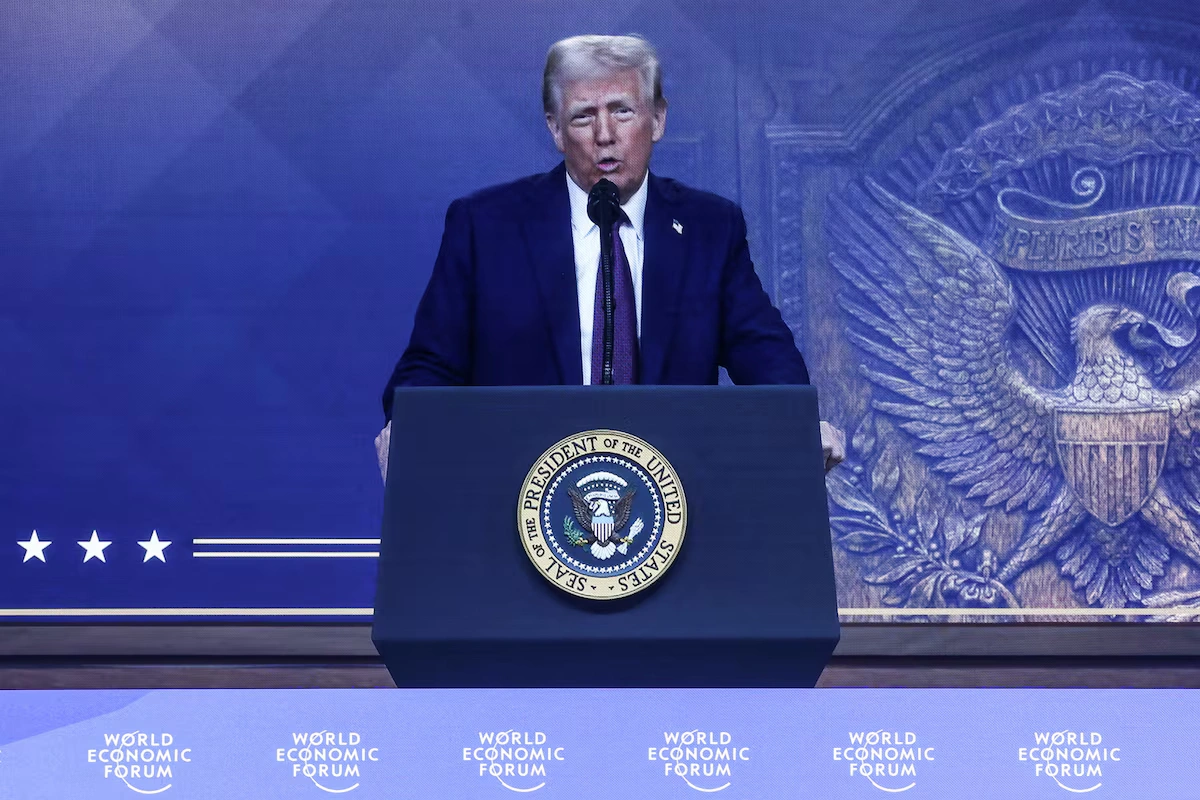
Explore President Trump’s upcoming 2026 SOTU address amid record-low approval and political turmoil—insights on the US economy, immigration, and foreign policy shifts.
A year after reclaiming the White House in a historic political comeback, President Donald Trump will step up to the House rostrum on Tuesday at 9 p.m. ET to deliver his State of the Union address. The political climate he faces, however, is one of unusual fragility. Midway between his inauguration and the critical November midterm elections, this 2026 SOTU preview reveals a commander-in-chief confronting a partial government shutdown, rare judicial rebukes, and deep fractures within his own coalition.
When Trump last addressed Congress in March 2025, his approval rating hovered near a career high, buoyed by the momentum of his return to power. Today, he faces an electorate thoroughly fatigued by persistent inflation and systemic gridlock. Tuesday’s address is intended to showcase a leader who has unapologetically reshaped the federal government. Yet, as the Trump State of the Union amid low polls approaches, the spectacle will inevitably be weighed against the stark economic and political realities defining his second act.
Sagging Polls and Economic Realities
Historically, Trump has leveraged economic metrics as his strongest political shield. But the US economy under Trump 2026 presents a complicated picture for international economist researchers and everyday voters alike. According to recent data from the Bureau of Economic Analysis, while the stock market has seen notable rallies, 2025 marked the slowest year for job and economic growth since the pandemic-induced recession of 2020.
A recent Gallup tracking poll places his overall approval rating near record lows. Furthermore, roughly two-thirds of Americans currently describe the nation’s economy as “poor”—a sentiment that mirrors the frustrations felt during the latter half of the Biden administration. Grocery, housing, and utility costs remain stubbornly high. Analysts at The Economist note that the US labor market has settled into a stagnant “low-hire, low-fire” equilibrium, heavily exacerbated by sweeping trade restrictions.
| Economic & Polling Indicator | March 2025 (Inauguration Era) | February 2026 (Current) |
| Overall Approval Rating | 48% | 39% |
| Immigration Handling Approval | 51% | 38% |
| GDP Growth (Quarterly) | 4.4% (Q3 ’25) | 1.4% (Q4 ’25 Advance) |
| Economic Sentiment (“Poor”) | 45% | 66% |
Trump has vehemently defended his record, insisting last week that he has “won” on affordability. In his address, he is widely expected to blame his predecessor, Joe Biden, for lingering systemic economic pain while claiming unilateral credit for recent Wall Street highs.
Immigration Backlash and Shutdown Stalemate
Adding to the drama of the evening, Tuesday will mark the first time in modern US history that a president delivers the annual joint address amid a funding lapse. The partial government shutdown, now in its second week, centers entirely on the Department of Homeland Security.
Funding for DHS remains frozen as Democratic lawmakers demand stringent guardrails on the administration’s sweeping immigration crackdown. The standoff reached a boiling point following the deaths of two American citizens by federal agents during border protests in January. This tragic incident sparked nationwide outrage and eroded what was once a core political advantage for the President. An AP-NORC poll recently revealed that approval of Trump’s handling of immigration has plummeted to just 38%. The political capital he once commanded on border security is now deeply contested territory.
The Supreme Court Rebuke and Congressional Dynamics
Trump will be speaking to a Republican-led Congress that he has frequently bypassed. While he secured the passage of his signature tax legislation last summer—dubbed the “Big, Beautiful Bill,” which combined corporate tax cuts and immigration enforcement funding with deep reductions to Medicaid—he has largely governed via executive order.
This aggressive use of executive authority recently hit a massive judicial roadblock. Last week, the Supreme Court struck down many of Trump’s sweeping global tariffs, a central pillar of his economic agenda. In a pointed majority opinion, Trump-nominated Justice Neil Gorsuch warned against the “permanent accretion of power in the hands of one man.”
This ruling has massive implications for global trade. Financial analysts at The Financial Times suggest that the removal of these tariffs could ease some inflationary pressures, though Trump has already vowed to pursue alternative legal mechanisms to keep import taxes active, promising prolonged uncertainty for international markets.
Simultaneously, Trump’s coalition is showing signs of fraying:
- Demographic Shifts: Americans under 45 have sharply turned against the administration.
- Latino Voters: A demographic that shifted rightward in 2024 has seen steep drops in approval following January’s border violence.
- Intra-Party Apathy: Nearly three in 10 Republicans report that the administration is failing to focus on the country’s most pressing structural problems.
Trump Foreign Policy Shifts and Global Tensions
Foreign policy is expected to feature heavily in the address, highlighting one of the most unpredictable evolutions of his second term. Candidate Trump campaigned heavily on an “America First” platform, promising to extract the US from costly foreign entanglements. However, Trump foreign policy shifts over the last twelve months have alarmed both critics and isolationist allies.
The administration has dramatically expanded US military involvement abroad. Operations have ranged from seizing Venezuela’s president and bolstering forces around Iran to authorizing a lethal campaign of strikes on alleged drug-smuggling vessels—operations that have resulted in scores of casualties. For global observers and defense analysts at The Washington Post, this muscular, interventionist approach contradicts his earlier populist rhetoric, creating unease among voters who favored a pullback from global policing.
What to Expect: A Trump Midterm Rally Speech
Despite the mounting pressures, Trump is unlikely to strike a chastened or conciliatory tone. Observers should expect a classic Trump midterm rally speech.
“It’s going to be a long speech because we have a lot to talk about,” Trump teased on Monday.
Key themes to watch for include:
- Defending the First Year: Aggressive framing of the “Big, Beautiful Bill” and an insistence that manufacturing is successfully reshoring.
- Attacking the Courts and Democrats: Expect pointed rhetoric regarding the Supreme Court’s tariff ruling and the ongoing DHS shutdown.
- Political Theater: Democratic leader Hakeem Jeffries has urged his caucus to maintain a “strong, determined and dignified presence,” but several progressive members have already announced plans to boycott the speech in silent protest. For details on streaming the event, see our guide on How to Watch Trump’s State of the Union.
Conclusion: A Test of Presidential Leverage
For a president who has built a global brand on dominance and disruption, Tuesday’s State of the Union represents a profoundly different kind of test. The visual of Trump speaking from the dais while parts of his own government remain shuttered and his signature tariffs sit dismantled by his own judicial appointees is a potent symbol of his current vulnerability.
The core question for international markets and domestic voters alike is no longer whether Trump can shock the system, but whether he can stabilize it. To regain his footing ahead of the November midterms, he must persuade a highly skeptical public that his combative priorities align with their economic needs—and prove that his second act in the White House is anchored by strategy rather than adrift in grievance.
Discover more from The Economy
Subscribe to get the latest posts sent to your email.
-

 Markets & Finance2 months ago
Top 15 Stocks for Investment in 2026 in PSX: Your Complete Guide to Pakistan’s Best Investment Opportunities
-

 Analysis4 weeks ago
Brazil’s Rare Earth Race: US, EU, and China Compete for Critical Minerals as Tensions Rise
-

 Banks2 months ago
Best Investments in Pakistan 2026: Top 10 Low-Price Shares and Long-Term Picks for the PSX
-

 Investment2 months ago
Top 10 Mutual Fund Managers in Pakistan for Investment in 2026: A Comprehensive Guide for Optimal Returns
-

 Asia2 months ago
China’s 50% Domestic Equipment Rule: The Semiconductor Mandate Reshaping Global Tech
-

 Global Economy2 months ago
Pakistan’s Export Goldmine: 10 Game-Changing Markets Where Pakistani Businesses Are Winning Big in 2025
-

 Global Economy2 months ago
What the U.S. Attack on Venezuela Could Mean for Oil and Canadian Crude Exports: The Economic Impact
-

 Global Economy2 months ago
15 Most Lucrative Sectors for Investment in Pakistan: A 2025 Data-Driven Analysis