
Global Economy
Global Economy Outlook 2026: What Ceasefire Talks Mean for the Tech Sector

Key Takeaways
- There is currently no active ceasefire in the US-Iran war as of mid-September 2026 — fighting has escalated this month after a relative lull in August, with the US destroying at least eight Iranian tankers since the weekend of September 6.
- President Trump has said he expects the war to end “immediately after” the November midterms, but a Wall Street Journal report cited by CNBC says White House advisors have discussed the possibility the conflict could drag on past January 2029.
- Brent crude has surged past $107 per barrel, up more than 18% in September alone, directly pressuring global inflation and the global economy outlook the IMF flagged in its July 2026 World Economic Outlook.
- Historical precedent from three separate 2026 ceasefire episodes shows a consistent pattern: tech and semiconductor stocks rally sharply — often 2-5% in a single session — whenever de-escalation headlines emerge, only to give back gains when talks falter.
- Every prior 2026 ceasefire has proven fragile and temporary, meaning investors should treat any future truce as a tradeable catalyst rather than a durable resolution until proven otherwise.
Six weeks before the US midterm elections, the question hanging over the global economy isn’t really whether the US-Iran war will end — it’s when, and whether markets can trust any announcement that it has. This piece lays out where ceasefire talks actually stand as of mid-September 2026, why the tech sector in particular has become the most reliable barometer of war-related market sentiment, and what history from this same conflict tells us about how the next de-escalation headline is likely to play out.
Where Things Actually Stand
Despite repeated predictions of an imminent resolution, the conflict has not been resolved, and September has brought renewed escalation rather than de-escalation. Fighting between Washington and Tehran resumed sharply this month after a period of relative calm in August, with the US military destroying at least eight Iranian tankers in retaliatory strikes since roughly September 6. Iran has continued attempting strikes on American warships, and attacks on Saudi oil infrastructure alongside Houthi advances have kept regional shipping routes under sustained threat.
President Trump told reporters on September 9, ahead of the Republican midterm convention in Dallas, that he expects the war to end “immediately after the election,” while also conceding that gas prices are unlikely to fall before then. By September 12, speaking from Dublin, he reiterated the same timeline: “I think very soon, I think it’ll be right after the midterms.” However, reporting citing US officials familiar with internal White House discussions suggests some senior advisors have privately considered a scenario in which the conflict extends well beyond that window — potentially past the end of Trump’s current term in January 2029.
The Oil Market Reality Check
Whatever the political timeline, the oil market is pricing continued conflict, not resolution. Brent crude settled above $107.63 per barrel in mid-September, up more than 18% for the month alone, with WTI crude topping $102 — the highest levels seen since May. Diesel is on track to cross $6 per gallon for the first time in history. These are not the price signals of a market anticipating imminent peace.
The Tech Sector’s Ceasefire Pattern
What makes this conflict distinctive for technology news and markets coverage is how consistently the tech and semiconductor sector has responded to every de-escalation signal throughout 2026 — and how consistently those rallies have reversed when talks broke down.
Three separate episodes illustrate the pattern:
- April 2026: A two-week ceasefire agreement sent the Nasdaq 100 up nearly 3% in a single session, with AI bellwethers Nvidia, Meta, and AMD surging between 4% and 10%. The rally proved short-lived — within 48 hours, doubts about the ceasefire’s stability sent tech giants lower again as Iran accused the US of violating the agreement.
- June 2026: A subsequent framework announcement to end the war triggered another surge, with Nasdaq futures up 1.8% and Asia-Pacific tech-heavy indices like Japan’s Nikkei and South Korea’s Kospi jumping more than 5%.
- September 2026 (ongoing): With no ceasefire currently in place, software and AI-adjacent names have instead been under renewed pressure — the iShares Expanded Tech-Software Sector ETF (IGV) fell roughly 12% over a recent one-month stretch, even as hardware-adjacent semiconductor names showed relative resilience.
Ceasefire Rally Pattern: 2026 Case Studies
| Episode | Market Reaction | Durability |
|---|---|---|
| April 2026 two-week ceasefire | Nasdaq 100 +2.8%, AI megacaps +4-10% | Reversed within 48 hours amid violation accusations |
| June 2026 framework announcement | Nasdaq futures +1.8%, Nikkei/Kospi +5%+ | Faded as fighting resumed within weeks |
| September 2026 (no ceasefire active) | Tech-software ETF -12% over trailing month | N/A — conflict actively escalating |
Why This Matters for the Global Economy
The IMF’s July 2026 World Economic Outlook Update already built this volatility into its baseline: global growth of 3.0% for 2026 and 3.4% for 2027, with the Fund explicitly framing the outlook as a tug-of-war between the Middle East war’s negative supply shock and the AI investment cycle’s positive demand pull. Global headline inflation, revised up to 4.7% for 2026, is directly tied to the same oil-price dynamics driving today’s $107 Brent crude — and the IMF’s own 2027 inflation improvement to 3.9% is explicitly contingent on a gradual reopening of the Strait of Hormuz, something that has not yet materialized.
For tech investors specifically, the practical takeaway is that ceasefire headlines — whenever they next arrive — are likely to produce another sharp, tradeable rally in AI and semiconductor names, given the pattern established across three separate episodes this year. But the same pattern suggests skepticism is warranted: every prior ceasefire in this conflict has proven fragile, and the smart position is treating any future announcement as a volatility event rather than an all-clear signal, at least until an agreement demonstrably holds for longer than the two-to-three week windows seen so far in 2026.
Frequently Asked Questions
Is there currently a ceasefire between the US and Iran?
No. As of mid-September 2026, the conflict has escalated rather than de-escalated, with the US striking Iranian tankers and Iran continuing attacks on shipping and US assets in the region.
How have tech stocks historically reacted to Iran ceasefire announcements in 2026? Tech and AI megacap stocks have rallied sharply — often 2-10% in a single session — on each of the three prior ceasefire or framework announcements in 2026, but each rally reversed within days to weeks as the agreements broke down.
What does the IMF say about how the Iran war is affecting the global economy?
The IMF’s July 2026 World Economic Outlook projects 3.0% global growth for 2026 and inflation rising to 4.7%, explicitly attributing the inflation increase to the war’s impact on energy markets, with improvement in 2027 contingent on Strait of Hormuz shipping resuming.
Discover more from The Economy
Subscribe to get the latest posts sent to your email.


Global Economy
Beyond Rhetoric: How the EU Is Deploying ‘All Tools’ to Rebalance Its €1 Billion-a-Day Trade Deficit with China
Key Takeaways
- The Tipping Point: European Commission President Ursula von der Leyen has declared that Europe’s trade deficit with China has reached an “unsustainable” €1 billion per day, pushing bilateral trade relations to a historical tipping point.
- Enforcement Over Engagement: Signaling a fundamental shift in doctrine, von der Leyen issued a direct ultimatum: “Words are good. But deeds are better.”
- The Defensive Arsenal: Brussels is escalating beyond traditional anti-dumping tariffs, actively deploying the Foreign Subsidies Regulation (FSR), the International Procurement Instrument (IPI), and establishing a centralized European Critical Raw Materials Corporation under the RESourceEU framework.
- Supply Chain Exposure: European and Asian enterprises face heightened compliance scrutiny, potential market access restrictions, and supply chain realignment risks across green-tech, automotive, and critical mineral sectors.
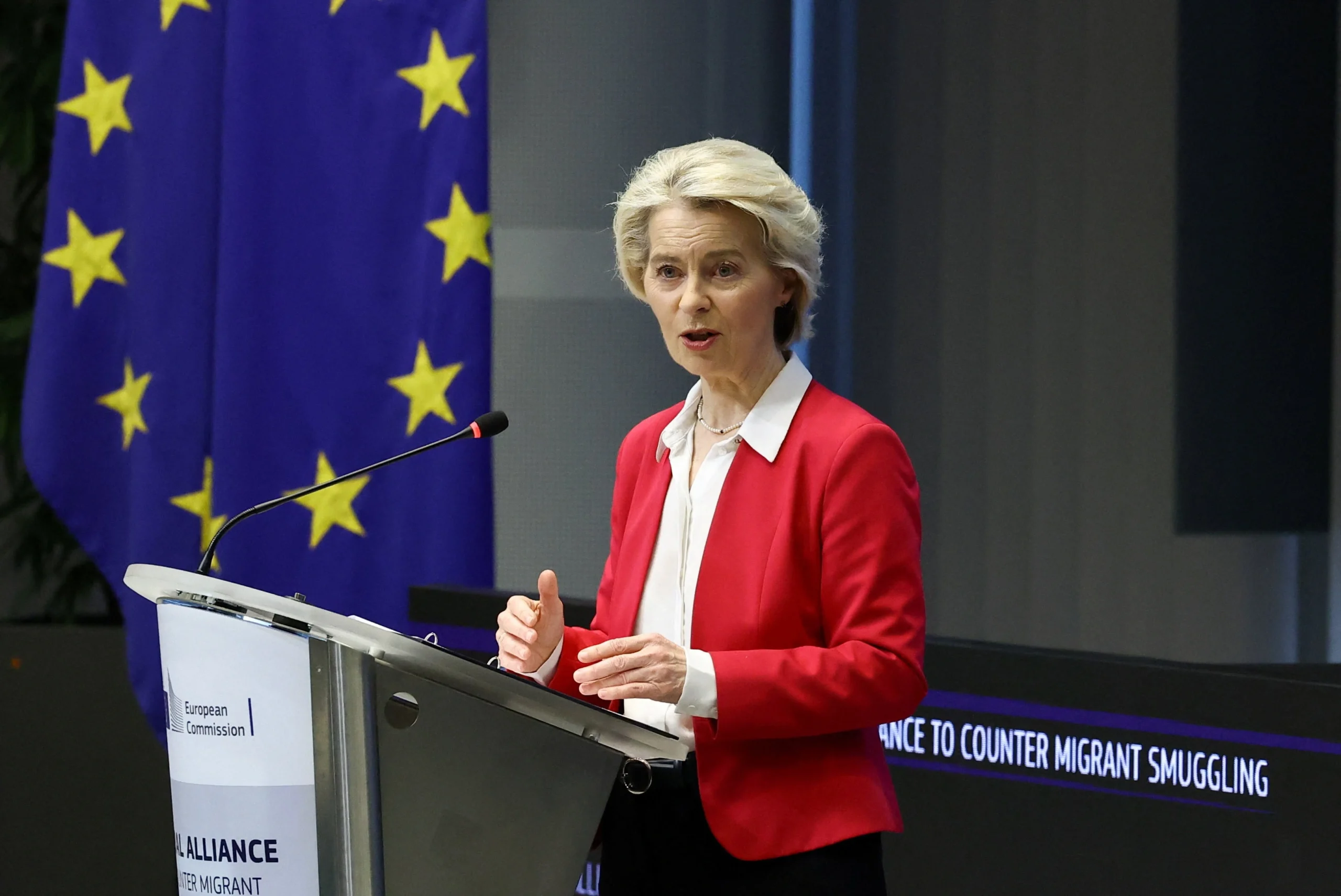
Commission President von der Leyen outlining EU trade policy in Brussels. Source: Yves Herman / REUTERS
The €1 Billion-a-Day Dilemma: Inside Brussels’ Trade Ultimatum
In her 2026 State of the Union address, European Commission President Ursula von der Leyen delivered her sternest warning to date regarding economic relations with Beijing. Citing structural industrial overcapacity in China and subsidized export dumping into the Single Market, von der Leyen emphasized that Europe’s trade deficit with China—now running at approximately €1 billion every single day—has crossed a critical threshold.
While reaffirming that diplomatic dialogue remains open, von der Leyen signaled that Brussels’ patience with protracted negotiations has expired:
“Words are good. But deeds are better. If market imbalances persist and level-playing-field conditions are not restored, the European Union will use all tools at its disposal to rebalance trade.” — Ursula von der Leyen, President of the European Commission
According to official data released alongside the address by the European Union External Action Service, the EU’s merchandise trade deficit with China has expanded sharply over the past decade. The expansion is driven by state-directed investments in clean technology, advanced industrial machinery, and automotive manufacturing, combined with persistent market barriers facing European exporters in mainland China.
Deconstruction of the EU’s Trade-Defence Arsenal
To move beyond political warnings, the European Commission is mobilizing a multi-layered regulatory architecture designed to shield European industries from non-market practices.
| Trade Defence Instrument | Legal Basis & Focus | Operational Impact on Chinese Exports |
|---|---|---|
| Foreign Subsidies Regulation (FSR) | EU Regulation 2022/2560 | Allows Brussels to inspect and block foreign state-subsidized companies from bidding on EU public tenders or acquiring European firms. |
| International Procurement Instrument (IPI) | EU Regulation 2022/1031 | Restricts access to EU public procurement markets for companies from countries that discriminate against EU businesses. |
| Anti-Subsidy & Anti-Dumping Duties | EU Regulation 2016/1037 | Enables retroactive tariffs on subsidized goods (e.g., Electric Vehicles, solar modules, wind turbines). |
| Critical Raw Materials Corporation (RESourceEU) | 2026 Industrial Strategy | Co-finances joint purchasing, strategic stockpiling, and processing of rare earth elements to reduce single-source dependency. |
As highlighted by macroeconomic analysis from Reuters Global Economic News, the Commission’s strategy represents a transition from reactive tariff enforcement to proactive market access restriction.
EU and China trade relations face growing regulatory and tariff barriers. Source: Bloomberg / Bloomberg via Getty Images
De-Risking in Action: Critical Minerals & the RESourceEU Imperative
A core pillar of von der Leyen’s strategic agenda is severing Europe’s vulnerable supply chain dependencies. China currently controls over 70% of global lithium refining, 85% of rare earth processing, and a dominant share of permanent magnet manufacturing.
To counter this vulnerability, von der Leyen confirmed the formal launch of the European Critical Raw Materials Corporation under the broader RESourceEU initiative. This entity will serve as a centralized buyer and investor, co-funding strategic mining, processing, and recycling projects within the EU, North America, and partner nations across Africa and Latin America.
Key objectives of the mineral security framework include:
- Extraction Mandates: At least 10% of the EU’s strategic raw materials extracted domestically by 2030.
- Processing Sovereignty: At least 40% of the EU’s annual consumption of strategic raw materials processed within the bloc.
- Diversification Caps: No more than 65% of any strategic raw material sourced from a single third country.
Economic reporting by the Financial Times Trade Analysis notes that these targets represent one of the most aggressive state-supported supply chain realignment efforts in modern European history.
Geopolitical Fallout & Beijing’s Countermeasures
Beijing’s Ministry of Commerce (MOFCOM) has expressed strong opposition to Brussels’ hardening stance, warning that increased trade barriers risk destabilizing global recovery and violating World Trade Organization (WTO) principles.
In response to European investigations under the FSR and anti-subsidy rules, China has initiated targeted anti-dumping probes into European exports, including brandy, dairy products, and agricultural machinery. Analysts anticipate that further unilateral measures by Brussels could prompt reciprocal restrictions on European automotive and chemical majors operating in mainland China.
+-----------------------------------------------------------------------+
|                 EU-CHINA TRADE TENSION CASCADE MATRIX                  |
+-----------------------------------------------------------------------+
| 1. EU Measures: FSR Inspections, Tariff Escalation, Raw Material Caps |
|    │                                                                  |
|    ▼                                                                  |
| 2. Chinese Countermeasures: Target Agribusiness, Spirits, Luxury Goods|
|    │                                                                  |
|    ▼                                                                  |
| 3. Corporate Impact: Supply Chain Realignment, Dual-Hub Production    |
+-----------------------------------------------------------------------+
Strategic Playbook for Global Business Leaders
For corporate executive teams and supply chain planners navigating this evolving landscape, the European Union Trade Policy Framework recommends three strategic adjustments:
- Audit State Subsidy Exposure: European subsidiaries of non-EU firms must conduct thorough audits of parent company subsidies, tax credits, and state grants to avoid disqualification under FSR procurement reviews.
- Diversify Critical Mineral Sourcing: Manufacturers reliant on graphite, neodymium, lithium, or cobalt should secure secondary supply contracts outside China ahead of 2027 compliance deadlines.
- Adopt “China + 1” Regionalization: Multinationals serving both European and Asian markets should decouple supply chains into distinct regional hubs to insulate operations from tariff hikes and export controls.
Discover more from The Economy
Subscribe to get the latest posts sent to your email.

Key Takeaways
- SpaceX reportedly completed a public listing in 2026, with reporting describing a valuation in the trillion-dollar range — a landmark event that shifted the bulk of Musk’s net worth away from Tesla and into SpaceX/xAI.
- xAI was folded into SpaceX in February 2026, combining Tesla, X, SpaceX, and xAI under increasingly overlapping ownership and infrastructure.
- Tesla’s Q2 2026 revenue came in at roughly $28 billion with a thin 1.4% operating margin, as capital expenditure surged toward AI and robotics rather than core EV production.
- Musk has reportedly been living near xAI’s Colossus supercomputer campus in Memphis during its latest expansion — a callback to his “production hell” habits at Tesla in 2017–18.
- Regulatory scrutiny is intensifying on multiple fronts: xAI’s Grok image generator has drawn investigations in Europe, Asia, Australia, and California, and Democratic senators have called for a Pentagon probe into SpaceX’s ownership structure.
The Portfolio, Reorganized
Musk’s business empire in 2026 looks structurally different than it did even eighteen months ago. Tesla, once the dominant source of his net worth, now sits alongside a combined SpaceX-xAI entity (sometimes referred to as SpaceXAI) that reporting has valued well into the trillions following its 2026 public-market debut. That shift matters for how markets should think about “Musk risk” — it’s no longer a single-stock story concentrated in Tesla.
Tesla: Thin Margins, Heavy AI Bet
Tesla’s Q2 2026 results showed the tension in the company’s current strategy:
- Revenue of roughly $28.2 billion against an operating margin of just 1.4% — among the thinnest in years.
- Capital expenditure up sharply year-over-year, directed heavily at AI and robotics infrastructure rather than incremental EV capacity.
- Robotaxi (Cybercab) and Optimus humanoid robot programs remain the company’s stated long-term growth bets, with Musk targeting expanded autonomous deployment across a meaningful share of the U.S. by year-end.
xAI: Burning Cash to Build Compute
xAI, now under the SpaceX umbrella, has been reported to consume roughly $1 billion per month in compute and infrastructure spend against an estimated $500 million in annualized revenue — a deliberately loss-leading posture aimed at building frontier AI capability (Grok) at scale. The Memphis “Colossus” supercomputer campus is the physical center of that buildout, and Musk’s decision to base himself near the site during its latest expansion signals how central it is to his current priorities.
The Regulatory Overhang
Musk’s expanding footprint has drawn parallel scrutiny across jurisdictions:
- xAI’s Grok image generator is under investigation in multiple countries over its capacity to generate harmful synthetic imagery.
- Senate Democrats have pushed for a Pentagon review of SpaceX’s ownership structure over undisclosed foreign investment concerns.
Neither issue has produced conclusive regulatory action as of this writing, but both represent tail risk for a portfolio increasingly concentrated in Musk-controlled entities.
Why This Matters Beyond Musk Himself
Musk’s 2026 moves are a useful proxy for a broader market theme: the shift of enormous private capital into AI infrastructure at a pace that outstrips current revenue generation. Whether that pattern resolves into durable competitive advantage (as bulls argue) or a capital-intensive cautionary tale (as skeptics argue) is likely to be one of the defining market questions through 2027.
What is Elon Musk’s biggest 2026 business move?
The completion of SpaceX’s public listing and its merger with xAI, reportedly valuing the combined entity in the trillions and shifting the majority of Musk’s net worth away from Tesla for the first time.
Discover more from The Economy
Subscribe to get the latest posts sent to your email.
Global Economy
Dow Jones vs. Middle East Tensions: How Wall Street Is Pricing In a 2026 Conflict Nobody Saw Coming
Key Takeaways
- The Dow Jones Industrial Average has swung by 400–1,200+ points in single sessions through September 2026 as fighting between the U.S. and Iran escalated and Brent crude broke through $100/barrel.
- Energy has been the standout sector; health care and rate-sensitive growth names have lagged.
- The 10-year Treasury yield has pushed to multi-year highs, pressuring the Fed’s rate-cut timeline.
- Semiconductor and AI-infrastructure names (Qualcomm, Intel) have decoupled from the broader sell-off on unrelated AWS chip deals — a reminder that not all volatility is geopolitical.
- Institutional allocators are rotating toward energy, defense, and inflation-hedged assets rather than exiting equities outright.
“Investors worry about additional inflation coming down the road. The main concern is that oil prices go to over $100 a barrel and stay there.” — a senior portfolio manager quoted on the sell-off, paraphrased from market coverage
Snapshot: The Dow’s Middle East Whiplash (September 2026)
| Date | Dow Move | Driver |
|---|---|---|
| Sept 2 | -628 pts (-1.2%) | Post-holiday risk-off, US-Canada trade friction, Brent nearing $100 |
| Sept 8 | -1.2% | Renewed geopolitical focus, rising crude |
| Sept 9 | -195 to -403 pts | Fighting escalation, Brent tops $100/bbl |
| Sept 10 | Four-day losing streak | Yields and oil both surging |
| Sept 11 | Rebound | Cooler inflation print, oil eases |
| Sept 14–15 | Renewed weakness | Fed meeting begins, 10-yr yield hits multi-year highs |
How is the Dow Jones reacting to 2026 Middle East tensions?
The Dow has posted volatile single-session swings of 200 to over 1,200 points since escalation began, driven primarily by Brent crude’s move past $100/barrel, rising Treasury yields, and a delayed Fed rate-cut timeline. Energy and defense stocks have outperformed; rate-sensitive and health care sectors have lagged.
Why the Middle East Is Moving Markets Again
Fighting between U.S. forces and Iran has stretched into its seventh month as of mid-September 2026, and the conflict has now drawn in shipping through the Strait of Hormuz — the corridor that carries roughly a fifth of global oil supply. Brent crude crossing $100 a barrel is the headline number, but the more important story for portfolio construction is what that price level does to the inflation and rate-cut calculus:
- Inflation pressure returns. Higher energy costs feed directly into headline CPI, complicating the Fed’s path toward further cuts.
- Treasury yields climb. The 10-year has touched its highest levels since 2023 as markets price in a “higher for longer” scenario.
- Sector rotation, not capitulation. Energy stocks have led the S&P 500’s 11 sectors on down days, while health care and long-duration growth names have underperformed.
Sectors Winning and Losing
Winners
- Energy majors — direct beneficiaries of the Brent/WTI spike.
- Defense and aerospace — reinforced by the Pentagon’s parallel disclosure of on-orbit space-control weapons (see our companion piece on defense stocks).
- Select semiconductor names — Qualcomm and Intel have rallied on AWS custom-silicon deals that are unrelated to the conflict, showing the market can compartmentalize.
Losers
- Rate-sensitive growth and health care — squeezed by higher-for-longer yield expectations.
- Consumer discretionary — vulnerable if elevated pump prices erode spending power heading into the holiday season.
What This Means for a 2026 Portfolio
For investors asking “should I sell,” the more useful frame is allocation, not timing:
- Energy exposure (equities or sector ETFs) has functioned as the clearest hedge against the conflict’s direct market channel — oil.
- Short-duration fixed income has become more attractive as yields rise, reducing duration risk.
- Diversification across defense, energy, and traditional blue chips — a theme we cover in depth in our companion piece on building a 2026 portfolio around Dow blue chips, crypto, and alternative assets.
Discover more from The Economy
Subscribe to get the latest posts sent to your email.

Beyond Rhetoric: How the EU Is Deploying ‘All Tools’ to Rebalance Its €1 Billion-a-Day Trade Deficit with China

Elon Musk’s Next Moves: Disrupting the 2026 Global Economy

INTC Stock Forecast 2026: Can Intel’s Government-Backed Turnaround Hold?

Bitcoin Price Action in Q4 2026: Safe-Haven Asset or High-Risk Tech Play?

The Target Pokémon x Owala Drop: Everything to Know Before It Sells Out

The U.S. Just Confirmed It Has Weapons in Space — Here’s What It Means for Defense Stocks

IRS 2027 Tax Bracket Projections: How to Get Ahead of Bracket Creep

Dow Jones vs. Middle East Tensions: How Wall Street Is Pricing In a 2026 Conflict Nobody Saw Coming

Bank of England’s September 17 Decision: Will UK Interest Rates Finally Move?

Inflation Is Outpacing Wage Growth Again: What It Means for Your Paycheck

10-Year Treasury Yield Tops 5%: What It Means for Mortgages, Stocks, and the Fed

Ceasefire Negotiations in 2026: Predicting the Rebound of European and Asian Economies

Emerging Markets Update: The Impact of World Bank Policies on PSX Stability

Costco Oil Shortage 2026: Will Prices Double for All Synthetic Motor Oils?

State Farm’s $5B Dividend 2026: Who Qualifies & Payout Dates

US-China Relations in Q3 2026: Trade Tariffs and Supply Chain Risks

Gold’s Wild 2026: From a Record $5,600 Peak to a 24% Crash and Back Toward $4,500

Oil Surges as Strait of Hormuz Traffic Collapses Again

Bank of England Set to Hold Rates Through Year-End, Reuters Poll Shows

SpaceX Starship Flight 14: First Orbital Attempt & Starlink V3 Launch Explained

The 2026 Crypto Regulatory Shift: What It Means for Institutional Investors

Top 30 Stocks for Investment in PSX for Massive ROI in 2026

AI Chip Stocks 2026: The Best Semiconductor Investments Beyond Marvell

AI-Powered Training: The Next Multi-Billion Dollar Ecosystem in Fitness

Tween Back-to-School Trends 2026: What’s Driving the $85B Season

Russia’s Black Sea Oil Exports Fall for a Fifth Straight Week

Global Chip Selloff Deepens: What’s Driving the Aug. 19 Semiconductor Rout

Shein Clothes Quality & Safety in 2026: What Lab Tests Show
-

 Markets & Finance8 months ago
Top 15 Stocks for Investment in 2026 in PSX: Your Complete Guide to Pakistan’s Best Investment Opportunities
-

 Analysis7 months ago
Johor’s Investment Boom: The Hidden Costs Behind Malaysia’s Most Ambitious Economic Surge
-

 Analysis7 months ago
Top 10 Stocks for Investment in PSX for Quick Returns in 2026
-

 Analysis7 months ago
Brazil’s Rare Earth Race: US, EU, and China Compete for Critical Minerals as Tensions Rise
-

 Banks8 months ago
Best Investments in Pakistan 2026: Top 10 Low-Price Shares and Long-Term Picks for the PSX
-

 Investment8 months ago
Top 10 Mutual Fund Managers in Pakistan for Investment in 2026: A Comprehensive Guide for Optimal Returns
-

 Global Economy9 months ago
15 Most Lucrative Sectors for Investment in Pakistan: A 2025 Data-Driven Analysis
-

 Global Economy9 months ago
Pakistan’s Export Goldmine: 10 Game-Changing Markets Where Pakistani Businesses Are Winning Big in 2025