
Global Economy
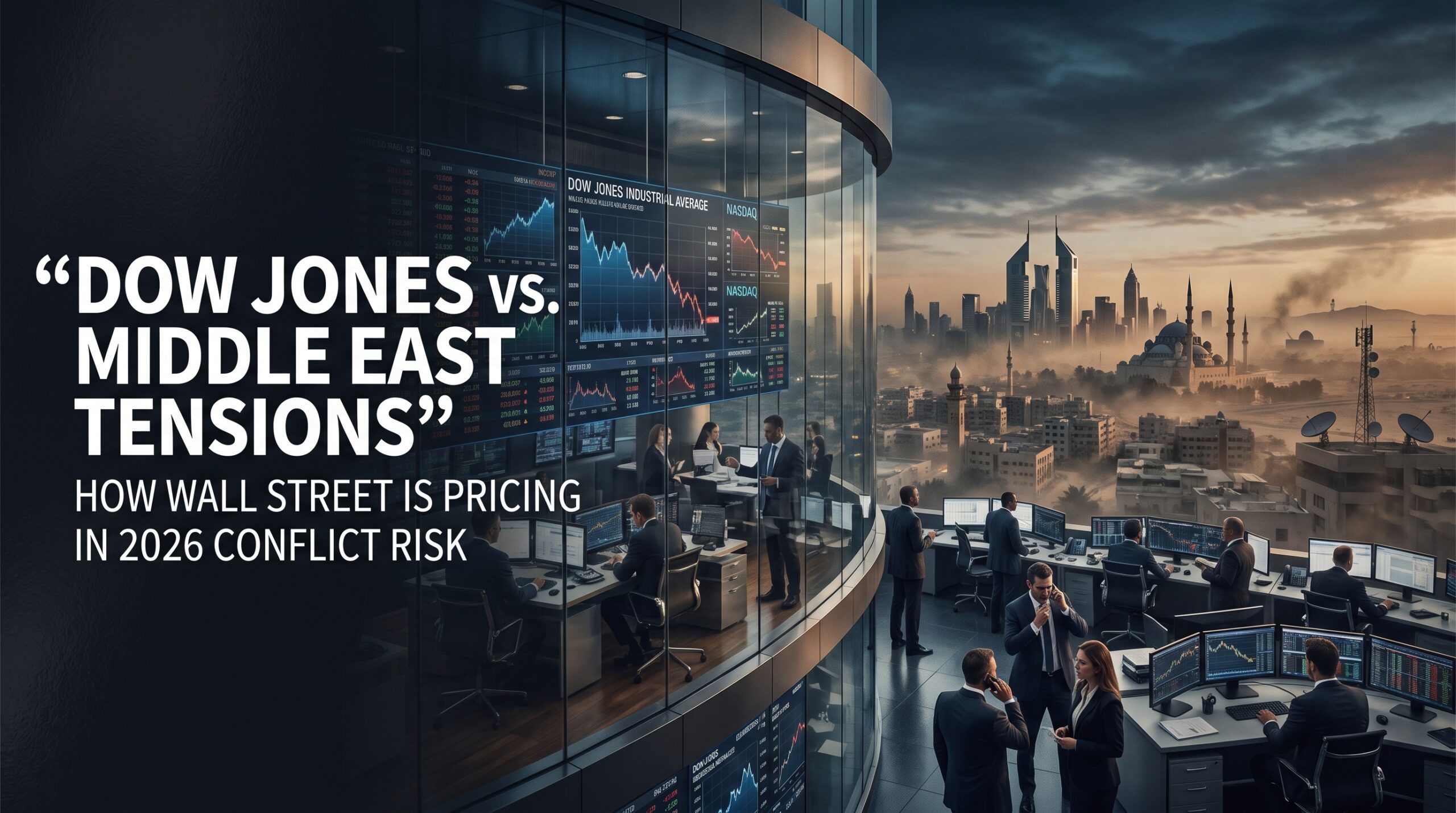
Dow Jones vs. Middle East Tensions: How Wall Street Is Pricing In a 2026 Conflict Nobody Saw Coming

Key Takeaways
- The Dow Jones Industrial Average has swung by 400–1,200+ points in single sessions through September 2026 as fighting between the U.S. and Iran escalated and Brent crude broke through $100/barrel.
- Energy has been the standout sector; health care and rate-sensitive growth names have lagged.
- The 10-year Treasury yield has pushed to multi-year highs, pressuring the Fed’s rate-cut timeline.
- Semiconductor and AI-infrastructure names (Qualcomm, Intel) have decoupled from the broader sell-off on unrelated AWS chip deals — a reminder that not all volatility is geopolitical.
- Institutional allocators are rotating toward energy, defense, and inflation-hedged assets rather than exiting equities outright.
“Investors worry about additional inflation coming down the road. The main concern is that oil prices go to over $100 a barrel and stay there.” — a senior portfolio manager quoted on the sell-off, paraphrased from market coverage
Snapshot: The Dow’s Middle East Whiplash (September 2026)
| Date | Dow Move | Driver |
|---|---|---|
| Sept 2 | -628 pts (-1.2%) | Post-holiday risk-off, US-Canada trade friction, Brent nearing $100 |
| Sept 8 | -1.2% | Renewed geopolitical focus, rising crude |
| Sept 9 | -195 to -403 pts | Fighting escalation, Brent tops $100/bbl |
| Sept 10 | Four-day losing streak | Yields and oil both surging |
| Sept 11 | Rebound | Cooler inflation print, oil eases |
| Sept 14–15 | Renewed weakness | Fed meeting begins, 10-yr yield hits multi-year highs |
How is the Dow Jones reacting to 2026 Middle East tensions?
The Dow has posted volatile single-session swings of 200 to over 1,200 points since escalation began, driven primarily by Brent crude’s move past $100/barrel, rising Treasury yields, and a delayed Fed rate-cut timeline. Energy and defense stocks have outperformed; rate-sensitive and health care sectors have lagged.
Why the Middle East Is Moving Markets Again
Fighting between U.S. forces and Iran has stretched into its seventh month as of mid-September 2026, and the conflict has now drawn in shipping through the Strait of Hormuz — the corridor that carries roughly a fifth of global oil supply. Brent crude crossing $100 a barrel is the headline number, but the more important story for portfolio construction is what that price level does to the inflation and rate-cut calculus:
- Inflation pressure returns. Higher energy costs feed directly into headline CPI, complicating the Fed’s path toward further cuts.
- Treasury yields climb. The 10-year has touched its highest levels since 2023 as markets price in a “higher for longer” scenario.
- Sector rotation, not capitulation. Energy stocks have led the S&P 500’s 11 sectors on down days, while health care and long-duration growth names have underperformed.
Sectors Winning and Losing
Winners
- Energy majors — direct beneficiaries of the Brent/WTI spike.
- Defense and aerospace — reinforced by the Pentagon’s parallel disclosure of on-orbit space-control weapons (see our companion piece on defense stocks).
- Select semiconductor names — Qualcomm and Intel have rallied on AWS custom-silicon deals that are unrelated to the conflict, showing the market can compartmentalize.
Losers
- Rate-sensitive growth and health care — squeezed by higher-for-longer yield expectations.
- Consumer discretionary — vulnerable if elevated pump prices erode spending power heading into the holiday season.
What This Means for a 2026 Portfolio
For investors asking “should I sell,” the more useful frame is allocation, not timing:
- Energy exposure (equities or sector ETFs) has functioned as the clearest hedge against the conflict’s direct market channel — oil.
- Short-duration fixed income has become more attractive as yields rise, reducing duration risk.
- Diversification across defense, energy, and traditional blue chips — a theme we cover in depth in our companion piece on building a 2026 portfolio around Dow blue chips, crypto, and alternative assets.
Discover more from The Economy
Subscribe to get the latest posts sent to your email.


Key Takeaways
- The Bank of England’s Monetary Policy Committee (MPC) announces its next interest rate decision on Thursday, September 17, 2026, with Bank Rate having held at 3.75% for five consecutive meetings.
- At the July meeting, the MPC voted 6-3 to hold rates, with three members — including chief economist Huw Pill — voting for an immediate 25-basis-point hike, a rare degree of open division within the committee.
- UK inflation has been climbing steadily due to the Middle East conflict’s energy impact: 2.6% in June, rising to 2.9% in July, with the Bank’s own central projection showing CPI peaking around 3.2% in Q4 2026.
- Markets have swung sharply from pricing two rate cuts in 2026 before the Middle East war began, to now pricing the possibility of rate hikes, with some forecasts showing four quarter-point increases by July 2027 that could push Bank Rate to 4.75%.
- Unlike its US and Eurozone counterparts, the Bank of England has explicitly stated that “monetary policy cannot affect global energy prices” — its job is preventing the current energy-driven spike from becoming embedded in longer-term inflation expectations.
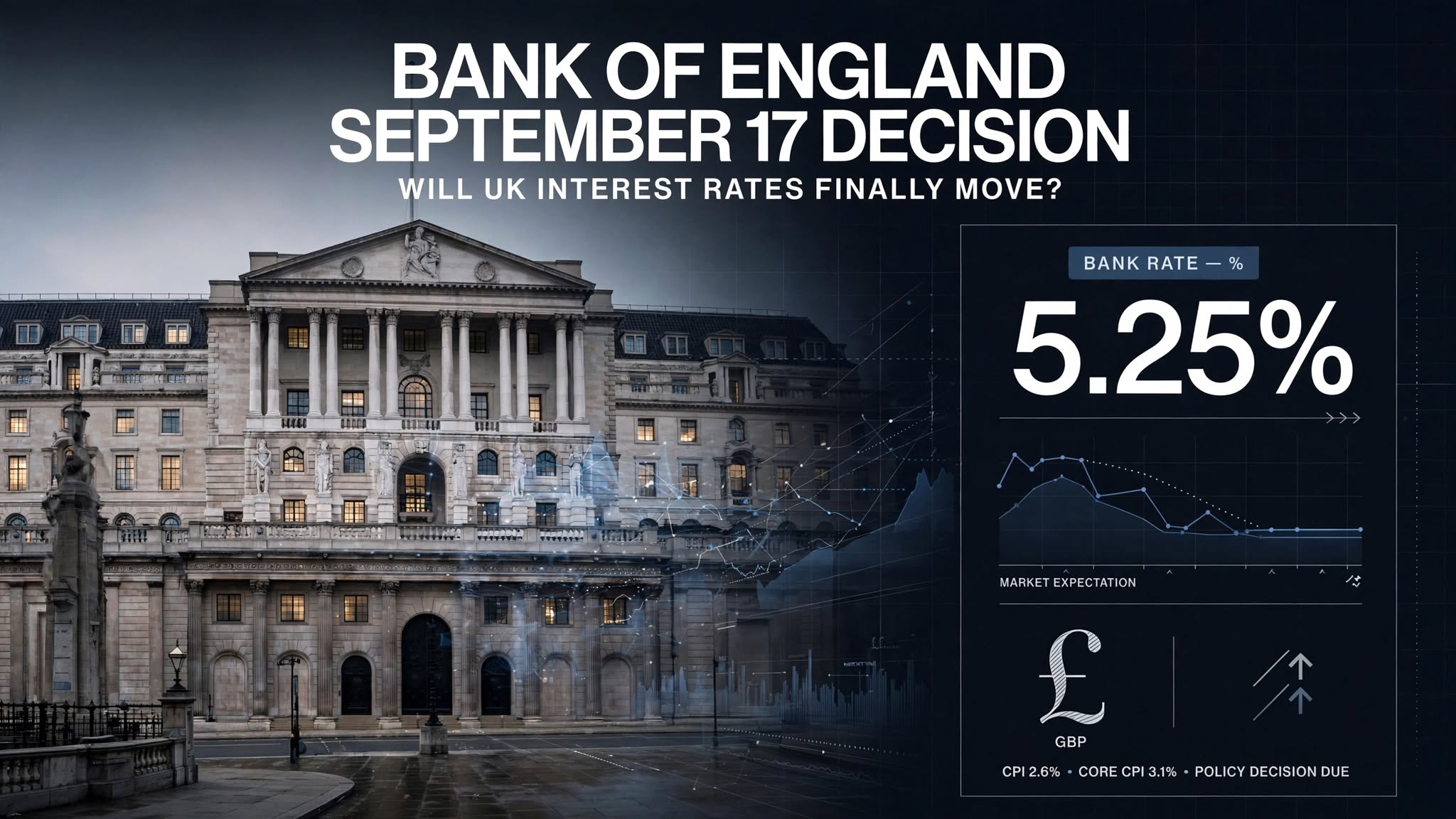
The Bank of England’s Monetary Policy Committee meets this Thursday, September 17, 2026, for a decision that carries more genuine uncertainty than it has in months — a marked shift from the largely telegraphed holds of earlier 2026. With inflation climbing on the back of the Middle East conflict and committee members increasingly split on the appropriate response, this meeting has become one of the more closely watched stock market today events for UK-exposed investors, mortgage holders, and businesses alike.
Where UK Rates Stand — And Why the Path Has Flipped
The Bank of England cut interest rates six times between August 2024 and December 2025 — roughly once a quarter, each by 0.25 percentage points — bringing Bank Rate down from a recent high of 5.25% to 3.75%. Since then, the MPC has held rates steady for five consecutive meetings, a pause that initially reflected a belief that rates were approaching the UK economy’s “neutral” level rather than any acute new concern.
That calculus has now shifted meaningfully. Before the Middle East conflict began, markets were pricing in two rate cuts for 2026. Since the war’s escalation and its energy-market spillover, market pricing has flipped toward the possibility of hikes instead — with some forecasts now showing as many as four quarter-point increases by July 2027, which would take Bank Rate to 4.75%.
The Inflation Trajectory Driving the Debate
UK headline inflation has been climbing steadily through the summer of 2026: 2.6% in June (a 15-month low at the time), rising to 2.9% in July, as higher energy costs tied to the Middle East conflict pushed price growth further above the Bank’s 2% target. The Bank’s own central projection, published alongside its July decision, showed CPI inflation peaking at around 3.2% in Q4 2026 — with the MPC explicitly cautioning that “risks to the inflation outlook are tilted to the upside.”
Governor Andrew Bailey summarized the Bank’s position bluntly following the July hold: “Inflation has fallen faster than we’d expected, but the conflict in the Middle East continues to mean high and volatile energy prices.” Crucially, the Bank has been explicit about the limits of its own policy tools in this situation: “Monetary policy cannot affect global energy prices; our job is to make sure that higher inflation does not persist and have long-lasting effects on the economy.”
A Divided Committee
Perhaps the clearest signal that Thursday’s decision is genuinely contested came from the July vote itself. The MPC split 6-3, with the majority voting to hold Bank Rate at 3.75%, while three members — Megan Greene, chief economist Huw Pill, and Catherine Mann — voted for an immediate 25-basis-point increase to 4%. Notably, Pill has publicly described himself as “uncomfortable with a ‘wait-and-see’ stance” from his fellow policymakers, an unusually direct public break from committee consensus for a sitting Bank of England chief economist.
What the Labour Market Says
Inflation isn’t the only variable feeding into the MPC’s calculus. UK unemployment held at 4.9% for the three months to June, unchanged for a third consecutive reading — a relatively stable labour market signal that hasn’t yet given policymakers a clear disinflationary counterweight to the energy-driven price pressure. A softer labour market with rising unemployment would typically argue for rate cuts; the current steady, if elevated, unemployment reading instead leaves the committee weighing inflation risk more heavily in isolation.
Comparing Central Banks’ Responses to the Same Shock
| Central Bank | Current Rate | Recent Move | Inflation Concern |
|---|---|---|---|
| Bank of England | 3.75% | Held 5 consecutive meetings | CPI to peak ~3.2% Q4 2026 |
| European Central Bank | 2.5% (deposit rate) | Hiked 25bps on Sept 10, 2026 | Inflation above 2% target, extended period |
| US Federal Reserve | TBD (decision imminent) | Markets pricing ~90% hike probability | August CPI at 3.4% |
Why This Matters for Mortgages and Markets
For UK homeowners and prospective buyers, the outcome directly affects fixed-rate mortgage pricing, since swap rates — which reflect market expectations for future Bank Rate moves — are the primary benchmark lenders use. Recent public surveys show genuine uncertainty among ordinary Britons too: roughly a quarter expect rates to rise, a similar share expect cuts, and nearly a quarter say they simply don’t know — reflecting how unsettled the broader economic picture has become since the Middle East conflict began reshaping every major central bank’s calculus simultaneously, from the Fed’s now-hawkish tilt to the ECB’s already-executed September hike.
Given the 6-3 split in July, the accelerating inflation trajectory toward a projected 3.2% Q4 peak, and Huw Pill’s public discomfort with further delay, Thursday’s decision is genuinely live in a way recent meetings have not been — markets, mortgage lenders, and UK-exposed investors will be watching closely for whether the committee finally moves, or extends its hold for a sixth consecutive meeting.
Frequently Asked Questions
What is the Bank of England’s current interest rate? Bank Rate has stood at 3.75% since December 2025, following six consecutive quarter-point cuts. The MPC has held that level for five consecutive meetings through July 2026, with the next decision due September 17, 2026.
Why might the Bank of England raise interest rates instead of cutting them? UK inflation has been climbing due to the Middle East conflict’s impact on energy prices, rising from 2.6% in June to 2.9% in July 2026, with the Bank’s own forecast showing a peak near 3.2% in Q4 — a reversal from earlier 2026 expectations of rate cuts.
How divided is the Bank of England’s rate-setting committee? Quite divided by recent standards — the July 2026 vote split 6-3, with three members including chief economist Huw Pill voting for an immediate rate hike rather than a hold, reflecting genuine disagreement about how to respond to the current inflation trajectory.
Discover more from The Economy
Subscribe to get the latest posts sent to your email.
Key Takeaways
- The World Bank’s most recent Pakistan Development Update projects FY26 GDP growth of just 3.0%, held back by catastrophic 2025 flood damage that cut agricultural output by nearly 10%, before growth picks up to 3.4% in FY27.
- The World Bank’s April 2026 regional update shows the wider Middle East, North Africa, Afghanistan, and Pakistan (MENAAP) region — excluding Iran — slowing sharply from 4.0% growth in 2025 to just 1.8% in 2026, a 2.4-percentage-point downgrade from January projections, driven by the Iran war’s regional spillover.
- Pakistan’s poverty data in the same reports is sobering: the share of the population living below the international $3-per-day poverty line surged from 16.5% to 46% between 2018 and 2023, with nearly nine in ten Pakistanis now below the $4.20-per-day threshold.
- The Bank credits Pakistan’s National Tariff Policy (2025–2030), which aims to halve tariffs over five years, as a potential long-term competitiveness driver — but cautions benefits depend on complementary reforms in logistics, taxation, and energy pricing that will take years to materialize.
- Despite the sobering structural picture, the KSE-100 has still outperformed dramatically on a market basis — closing FY26 up 44% — showing a persistent disconnect between equity-market sentiment and the World Bank’s underlying growth and poverty data.
While the IMF’s disbursing Extended Fund Facility gets most of the market-moving headlines for Pakistan, the World Bank’s parallel analytical work — through its biannual Pakistan Development Update and its MENAAP regional economic updates — provides a very different, and arguably more sobering, lens on the structural forces shaping PSX stability. This piece works through what the Bank’s own data actually says, and why it sits somewhat uneasily alongside the KSE-100’s blockbuster 2026 performance.
The World Bank’s Pakistan Growth Forecast
The World Bank’s Pakistan Development Update, titled Staying the Course for Growth and Jobs, projects Pakistan’s real GDP growth to remain at 3.0% for FY26 (the fiscal year ending June 2026) — unchanged from the 3.0% Pakistan actually achieved in FY25, itself an improvement from 2.6% the year before. The Bank attributes the flat FY26 forecast primarily to the devastating impact of the 2025 floods across Punjab and Sindh, which reduced agricultural output by nearly 10% and damaged major crops including rice, sugarcane, wheat, cotton, and maize.
Agriculture is not a marginal sector in this context — it supports nearly 40% of Pakistan’s labour force and contributes roughly one-fifth of GDP, meaning flood-related disruption there ripples through the broader economy well beyond the farm sector itself. The Bank projects growth picking up to 3.4% in FY27, contingent on continued macroeconomic stability and successful implementation of ongoing reforms — but explicitly notes that tight fiscal policy aimed at rebuilding economic buffers will continue to constrain the pace of any rebound.
The Regional Picture: MENAAP Under Pressure
Pakistan doesn’t sit in isolation from the wider region the World Bank tracks, and the regional numbers paint an even more difficult picture. The Bank’s Middle East, North Africa, Afghanistan, and Pakistan (MENAAP) regional economic update — most recently refreshed in April 2026 under the title Challenges of Conflict and Industrial Policy for Development — shows that, excluding Iran itself, overall regional growth is expected to slow from 4.0% in 2025 to just 1.8% in 2026, a downgrade of 2.4 percentage points versus the Bank’s January projections.
The Bank’s July 2026 Global Economic Prospects update reinforces this framing, explicitly identifying MENAAP as “the worst affected” region globally by the Middle East conflict, while noting that South Asia — the broader grouping that includes Pakistan alongside India and Bangladesh — remains comparatively the fastest-growing region, with impacts varying based on each country’s energy exposure, strategic reserves, and available policy buffers. For Pakistan specifically, that framing matters: as a net energy importer without the Gulf region’s oil-export offsets, Pakistan sits closer to the vulnerable end of that regional spectrum.
The Uncomfortable Poverty Data Behind the Growth Numbers
Perhaps the most striking figures in the World Bank’s Pakistan analysis aren’t growth rates at all, but poverty statistics. Between 2018 and 2023, the share of Pakistan’s population living below the international poverty line of $3 per day (PPP) surged from 16.5% to 46% — a reversal of years of prior progress. At the slightly higher $4.20-per-day threshold, the Bank estimates nearly nine in ten Pakistanis now live in poverty, reflecting the combined toll of pandemic-era disruption, sustained inflation, and repeated climate disasters including the 2022 and 2025 floods.
The Bank explicitly warns that this sharp deterioration risks entrenching inequality and social instability — a structural risk that sits in tension with the more optimistic, momentum-driven narrative often associated with the KSE-100’s record-breaking equity performance over the same period.
Reform Levers the World Bank Is Watching
On the policy side, the Bank has highlighted Pakistan’s National Tariff Policy (2025–2030), which aims to cut tariffs by roughly half over five years, as a potentially meaningful driver of longer-term export competitiveness. However, the Bank is careful to caveat that the benefits of tariff liberalization will take time to materialize and depend heavily on complementary reforms across logistics, taxation, and energy pricing — areas where Pakistan’s track record on sustained implementation has historically been mixed.
World Bank Data Snapshot
| Metric | Figure |
|---|---|
| Pakistan FY26 GDP growth (World Bank forecast) | 3.0% |
| Pakistan FY27 GDP growth (World Bank forecast) | 3.4% |
| MENAAP region 2026 growth (ex-Iran) | 1.8%, down from 4.0% in 2025 |
| Population below $3/day poverty line (2023) | 46%, up from 16.5% in 2018 |
| Population below $4.20/day poverty line | ~90% |
| Agricultural output loss from 2025 floods | ~10% |
Why the Disconnect Matters for PSX Investors
The tension here is real and worth naming directly: the KSE-100 delivered a 44% gain in FY26, even as the World Bank’s own growth forecast for that same fiscal year sat at a comparatively modest 3.0%, against a backdrop of surging poverty and a sharply downgraded regional outlook. This isn’t necessarily contradictory — equity markets often price forward-looking reform momentum, IMF program credibility, and remittance-driven currency stability well ahead of broad-based GDP or poverty statistics catching up. But it does mean investors relying purely on KSE-100 price action risk missing the structural fragility the World Bank’s data continues to flag: a economy still highly exposed to climate shocks, regional conflict spillover, and deep social strain that hasn’t meaningfully eased even as headline stock returns have soared.
Frequently Asked Questions
What does the World Bank forecast for Pakistan’s economy in 2026?
The World Bank’s Pakistan Development Update projects 3.0% GDP growth for FY26, held back by 2025 flood damage to agriculture, with growth expected to pick up to 3.4% in FY27 contingent on continued reforms.
Why has poverty risen so sharply in Pakistan despite stock market gains?
World Bank data shows the population below the $3-per-day poverty line surged from 16.5% to 46% between 2018 and 2023 due to pandemic disruption, inflation, and repeated flooding — a structural trend largely disconnected from the KSE-100’s recent equity-market rally.
How is the Middle East conflict affecting Pakistan’s regional growth outlook?
The World Bank’s MENAAP regional update shows growth excluding Iran slowing from 4.0% in 2025 to 1.8% in 2026, a downgrade attributed directly to the conflict’s spillover effects on energy prices and regional stability.
Discover more from The Economy
Subscribe to get the latest posts sent to your email.
Key Takeaways
- There is currently no active ceasefire in the US-Iran war as of mid-September 2026 — fighting has escalated this month after a relative lull in August, with the US destroying at least eight Iranian tankers since the weekend of September 6.
- President Trump has said he expects the war to end “immediately after” the November midterms, but a Wall Street Journal report cited by CNBC says White House advisors have discussed the possibility the conflict could drag on past January 2029.
- Brent crude has surged past $107 per barrel, up more than 18% in September alone, directly pressuring global inflation and the global economy outlook the IMF flagged in its July 2026 World Economic Outlook.
- Historical precedent from three separate 2026 ceasefire episodes shows a consistent pattern: tech and semiconductor stocks rally sharply — often 2-5% in a single session — whenever de-escalation headlines emerge, only to give back gains when talks falter.
- Every prior 2026 ceasefire has proven fragile and temporary, meaning investors should treat any future truce as a tradeable catalyst rather than a durable resolution until proven otherwise.
Six weeks before the US midterm elections, the question hanging over the global economy isn’t really whether the US-Iran war will end — it’s when, and whether markets can trust any announcement that it has. This piece lays out where ceasefire talks actually stand as of mid-September 2026, why the tech sector in particular has become the most reliable barometer of war-related market sentiment, and what history from this same conflict tells us about how the next de-escalation headline is likely to play out.
Where Things Actually Stand
Despite repeated predictions of an imminent resolution, the conflict has not been resolved, and September has brought renewed escalation rather than de-escalation. Fighting between Washington and Tehran resumed sharply this month after a period of relative calm in August, with the US military destroying at least eight Iranian tankers in retaliatory strikes since roughly September 6. Iran has continued attempting strikes on American warships, and attacks on Saudi oil infrastructure alongside Houthi advances have kept regional shipping routes under sustained threat.
President Trump told reporters on September 9, ahead of the Republican midterm convention in Dallas, that he expects the war to end “immediately after the election,” while also conceding that gas prices are unlikely to fall before then. By September 12, speaking from Dublin, he reiterated the same timeline: “I think very soon, I think it’ll be right after the midterms.” However, reporting citing US officials familiar with internal White House discussions suggests some senior advisors have privately considered a scenario in which the conflict extends well beyond that window — potentially past the end of Trump’s current term in January 2029.
The Oil Market Reality Check
Whatever the political timeline, the oil market is pricing continued conflict, not resolution. Brent crude settled above $107.63 per barrel in mid-September, up more than 18% for the month alone, with WTI crude topping $102 — the highest levels seen since May. Diesel is on track to cross $6 per gallon for the first time in history. These are not the price signals of a market anticipating imminent peace.
The Tech Sector’s Ceasefire Pattern
What makes this conflict distinctive for technology news and markets coverage is how consistently the tech and semiconductor sector has responded to every de-escalation signal throughout 2026 — and how consistently those rallies have reversed when talks broke down.
Three separate episodes illustrate the pattern:
- April 2026: A two-week ceasefire agreement sent the Nasdaq 100 up nearly 3% in a single session, with AI bellwethers Nvidia, Meta, and AMD surging between 4% and 10%. The rally proved short-lived — within 48 hours, doubts about the ceasefire’s stability sent tech giants lower again as Iran accused the US of violating the agreement.
- June 2026: A subsequent framework announcement to end the war triggered another surge, with Nasdaq futures up 1.8% and Asia-Pacific tech-heavy indices like Japan’s Nikkei and South Korea’s Kospi jumping more than 5%.
- September 2026 (ongoing): With no ceasefire currently in place, software and AI-adjacent names have instead been under renewed pressure — the iShares Expanded Tech-Software Sector ETF (IGV) fell roughly 12% over a recent one-month stretch, even as hardware-adjacent semiconductor names showed relative resilience.
Ceasefire Rally Pattern: 2026 Case Studies
| Episode | Market Reaction | Durability |
|---|---|---|
| April 2026 two-week ceasefire | Nasdaq 100 +2.8%, AI megacaps +4-10% | Reversed within 48 hours amid violation accusations |
| June 2026 framework announcement | Nasdaq futures +1.8%, Nikkei/Kospi +5%+ | Faded as fighting resumed within weeks |
| September 2026 (no ceasefire active) | Tech-software ETF -12% over trailing month | N/A — conflict actively escalating |
Why This Matters for the Global Economy
The IMF’s July 2026 World Economic Outlook Update already built this volatility into its baseline: global growth of 3.0% for 2026 and 3.4% for 2027, with the Fund explicitly framing the outlook as a tug-of-war between the Middle East war’s negative supply shock and the AI investment cycle’s positive demand pull. Global headline inflation, revised up to 4.7% for 2026, is directly tied to the same oil-price dynamics driving today’s $107 Brent crude — and the IMF’s own 2027 inflation improvement to 3.9% is explicitly contingent on a gradual reopening of the Strait of Hormuz, something that has not yet materialized.
For tech investors specifically, the practical takeaway is that ceasefire headlines — whenever they next arrive — are likely to produce another sharp, tradeable rally in AI and semiconductor names, given the pattern established across three separate episodes this year. But the same pattern suggests skepticism is warranted: every prior ceasefire in this conflict has proven fragile, and the smart position is treating any future announcement as a volatility event rather than an all-clear signal, at least until an agreement demonstrably holds for longer than the two-to-three week windows seen so far in 2026.
Frequently Asked Questions
Is there currently a ceasefire between the US and Iran?
No. As of mid-September 2026, the conflict has escalated rather than de-escalated, with the US striking Iranian tankers and Iran continuing attacks on shipping and US assets in the region.
How have tech stocks historically reacted to Iran ceasefire announcements in 2026? Tech and AI megacap stocks have rallied sharply — often 2-10% in a single session — on each of the three prior ceasefire or framework announcements in 2026, but each rally reversed within days to weeks as the agreements broke down.
What does the IMF say about how the Iran war is affecting the global economy?
The IMF’s July 2026 World Economic Outlook projects 3.0% global growth for 2026 and inflation rising to 4.7%, explicitly attributing the inflation increase to the war’s impact on energy markets, with improvement in 2027 contingent on Strait of Hormuz shipping resuming.
Discover more from The Economy
Subscribe to get the latest posts sent to your email.

The Target Pokémon x Owala Drop: Everything to Know Before It Sells Out

The U.S. Just Confirmed It Has Weapons in Space — Here’s What It Means for Defense Stocks

IRS 2027 Tax Bracket Projections: How to Get Ahead of Bracket Creep

Dow Jones vs. Middle East Tensions: How Wall Street Is Pricing In a 2026 Conflict Nobody Saw Coming

Bank of England’s September 17 Decision: Will UK Interest Rates Finally Move?

Inflation Is Outpacing Wage Growth Again: What It Means for Your Paycheck

10-Year Treasury Yield Tops 5%: What It Means for Mortgages, Stocks, and the Fed

Ceasefire Negotiations in 2026: Predicting the Rebound of European and Asian Economies

Emerging Markets Update: The Impact of World Bank Policies on PSX Stability

Costco Oil Shortage 2026: Will Prices Double for All Synthetic Motor Oils?

Trump’s $5,000 Promise: The Hidden Tax Implications for Retail Investors

Global Economy Outlook 2026: What Ceasefire Talks Mean for the Tech Sector

China Stocks Today: Are Big Economies in Asia Nearing a Market Bottom?

Stock Market Crash 2026? How the Trump $5,000 Dividend Impacts Global Inflation

State Farm’s $5B Dividend 2026: Who Qualifies & Payout Dates

US-China Relations in Q3 2026: Trade Tariffs and Supply Chain Risks

Gold’s Wild 2026: From a Record $5,600 Peak to a 24% Crash and Back Toward $4,500

Oil Surges as Strait of Hormuz Traffic Collapses Again

Bank of England Set to Hold Rates Through Year-End, Reuters Poll Shows

SpaceX Starship Flight 14: First Orbital Attempt & Starlink V3 Launch Explained

The 2026 Crypto Regulatory Shift: What It Means for Institutional Investors

Top 30 Stocks for Investment in PSX for Massive ROI in 2026

AI Chip Stocks 2026: The Best Semiconductor Investments Beyond Marvell

AI-Powered Training: The Next Multi-Billion Dollar Ecosystem in Fitness

Tween Back-to-School Trends 2026: What’s Driving the $85B Season

Russia’s Black Sea Oil Exports Fall for a Fifth Straight Week

Global Chip Selloff Deepens: What’s Driving the Aug. 19 Semiconductor Rout

Shein Clothes Quality & Safety in 2026: What Lab Tests Show
-

 Markets & Finance8 months ago
Top 15 Stocks for Investment in 2026 in PSX: Your Complete Guide to Pakistan’s Best Investment Opportunities
-

 Analysis7 months ago
Johor’s Investment Boom: The Hidden Costs Behind Malaysia’s Most Ambitious Economic Surge
-

 Analysis7 months ago
Top 10 Stocks for Investment in PSX for Quick Returns in 2026
-

 Analysis7 months ago
Brazil’s Rare Earth Race: US, EU, and China Compete for Critical Minerals as Tensions Rise
-

 Banks8 months ago
Best Investments in Pakistan 2026: Top 10 Low-Price Shares and Long-Term Picks for the PSX
-

 Investment8 months ago
Top 10 Mutual Fund Managers in Pakistan for Investment in 2026: A Comprehensive Guide for Optimal Returns
-

 Global Economy9 months ago
15 Most Lucrative Sectors for Investment in Pakistan: A 2025 Data-Driven Analysis
-

 Global Economy9 months ago
Pakistan’s Export Goldmine: 10 Game-Changing Markets Where Pakistani Businesses Are Winning Big in 2025