
Global Finance
Federal Constitutional Court upholds Super tax


ISLAMABAD — Pakistan’s Federal Constitutional Court’s, three-judge bench this week delivered a quiet revolution. By upholding the controversial ‘Super Tax’ on the country’s wealthiest entities, the court did more than green-light a potential Rs300 billion (approximately $1.08bn) revenue haul. It etched into constitutional jurisprudence a stark boundary: fiscal policy is the exclusive domain of the legislature, not the judiciary. The ruling, led by Chief Justice Amin-ud-Din Khan, is a landmark reassertion of parliamentary sovereignty in economic governance, setting aside what it termed “judicial overreach” by lower courts. In a nation perennially navigating a crisis of public finance, this is a decisive shift of power back to the tax-writing desks of Parliament and away from the benches of the High Courts.
Why This Ruling Reshapes Pakistan’s Economic Constitution
The core of the dispute was seductively simple: could Parliament, through Sections 4b and 4c of the Income Tax Ordinance, levy a one-off surcharge on companies and individuals with incomes exceeding Rs500 million? High Courts in Karachi and Lahore had struck down or ‘read down’ the provisions, arguing on grounds of equity and policy merit. The Federal Constitutional Court’s reversal is foundational. It hinges on a strict interpretation of the separation of powers, a doctrine as venerable in Western polities as it is often contested in developing democracies. The bench declared that determining “tax slabs, rates, thresholds, or fiscal policy” is not a judicial function. This judicial restraint aligns Pakistan with a global constitutional consensus, echoing principles long established in jurisdictions like the United Kingdom, where parliamentary supremacy over taxation is absolute, and reaffirmed in landmark rulings by constitutional courts worldwide.
The immediate ‘what next’ is fiscal. The Federal Board of Revenue (FBR) can now confidently collect a tax it estimates will bring Rs300 billion into a chronically anaemic public exchequer. For context, that sum nearly equals the entire annual development budget for Pakistan’s infrastructure and social projects. In a country where the tax-to-GDP ratio languishes at around 10.6%—among the world’s lowest—this injection is not merely significant; it is transformative for a government negotiating yet another International Monetary Fund (IMF) programme predicated on enhancing revenue mobilization. The IMF has explicitly called for Pakistan to raise its tax-to-GDP ratio by 3 percentage points to 13% over the 37-month Extended Fund Facility program, making this ruling critically important for fiscal consolidation.
The Doctrine of Judicial Restraint in a Hot Economy
Why did the court rule so emphatically? Beyond the black-letter law, the decision is a strategic retreat from judicial entanglement in macroeconomic management. Pakistan’s courts have historically been activist, even in complex economic matters. This ruling signals a pivot toward a philosophy of judicial restraint, recognizing that judges lack the electoral mandate and technocratic apparatus to micromanage the nation’s balance sheet. As recognized in constitutional scholarship on the limits of judicial review, courts venturing into fiscal policy often create market uncertainty and implementation chaos—precisely what the FCC seeks to avoid.
The ruling also clarifies the temporal application of the tax: Section 4b applies from 2015 and 4c from 2022, ending years of legal limbo for businesses. This provides the certainty that investors and the World Bank consistently argue is critical for economic growth. For the business elite in Karachi’s financial district or Lahore’s industrial hubs, the message is clear: future battles over tax policy must be fought in the parliamentary arena, not the courthouse.
What Next: The Real Test of Governance Begins
The court has handed Parliament and the FBR a powerful tool and, with it, a profound responsibility. The ‘what next’ question now shifts from constitutionality to capacity and fairness. Can the FBR, an institution often criticized for its opacity and broad discretionary powers, administer this super tax efficiently and without political favouritism? Will the revenue truly be deployed for its stated purposes—from rehabilitating displaced persons (the original 2015 rationale) to bridging the general budget deficit? Court observations during hearings revealed that of Rs144 billion collected between 2015 and 2020, only Rs37 billion was spent on rehabilitation of internally displaced persons, raising legitimate questions about fiscal accountability.
Furthermore, Parliament’s exclusive authority is now doubly underscored. This invites, indeed demands, more rigorous legislative scrutiny of future finance bills. The ruling empowers backbenchers and opposition members to engage deeply in tax design, knowing the courts will not provide a backstop for poorly crafted law. Sustainable revenue growth requires not just legal authority but broad-based political legitimacy—a challenge that remains for Pakistan’s democratic institutions.
A Global Signal in an Age of Inequality
Finally, this ruling resonates beyond Pakistan’s borders. In an era of rising wealth inequality and global debates on taxing the ultra-rich, the judgment affirms the state’s constitutional right to enact progressive fiscal measures. The OECD and World Bank have increasingly emphasized the importance of progressive taxation in addressing inequality, with research showing that countries sustainably increasing their tax-to-GDP ratio to 15% experience significantly higher GDP per capita growth compared to countries whose tax ratio stalls around 10%—exactly Pakistan’s predicament.
The court has not endorsed the Super Tax’s wisdom; it has endorsed Parliament’s right to decide. It places Pakistan within a contemporary movement toward progressive wealth taxation, yet grounds it in the ancient principle that only the representatives of the people hold the power to tax—a foundational tenet of parliamentary sovereignty recognized across democratic systems.
The Constitutional Architecture Emerges
The ruling carries particular significance given Pakistan’s recent constitutional evolution. The creation of the Federal Constitutional Court through the 27th Constitutional Amendment, as Arab News analysis suggests, represents an institutional opportunity to resolve longstanding ambiguities in economic governance. When constitutional rules governing taxation, resource allocation, and federal-provincial fiscal relations remain unclear, governments litigate instead of coordinate, and businesses defend rather than invest. The FCC’s decisive stance on parliamentary authority in taxation may signal the court’s broader approach to economic constitutionalism—one that prizes institutional clarity and democratic accountability over judicial management of complex policy questions.
The marble halls of the FCC have thus returned a weighty question to the carpeted chambers of Parliament: having won the constitutional right to tax, can they now craft a fiscal contract with the nation that is both solvent and just? The Rs300 billion figure is a start, but the real accounting of this ruling’s success will be measured in the credibility of the state it helps to build—and whether Pakistan can finally escape the cycle of perpetually low tax collection that has constrained its development aspirations for decades.
This landmark decision arrives at a critical juncture as Pakistan navigates its Extended Fund Facility program with the IMF, with fiscal reforms remaining central to the country’s economic stabilization. The court’s affirmation of parliamentary supremacy in taxation provides the constitutional foundation necessary for sustainable revenue mobilization—but parliamentary action must now match judicial clarity.
Discover more from The Economy
Subscribe to get the latest posts sent to your email.


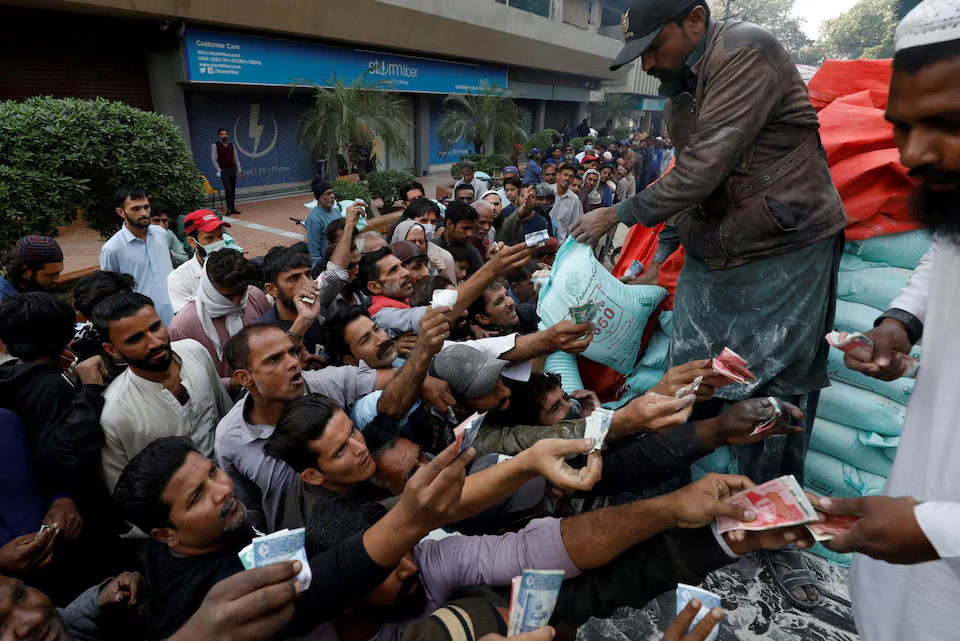
When a geopolitical earthquake in the Gulf meets a fragile emerging-market economy, the tremors travel fast — and reach deep into the pay packets of millions of public workers.
The Man at the Pump — and the Policy Behind It
Sohail Ahmed, a 27-year-old delivery rider in Karachi supporting a family of seven, is blunt about the government’s emergency measures. “There is no benefit to me if they work three days or five days a week,” he told Al Jazeera. “For me, the main concern is the fuel price because that increases the cost of every little thing.” Al Jazeera
Ahmed’s frustration is both viscerally human and economically precise. On the morning of Saturday, March 14, 2026, Prime Minister Shehbaz Sharif chaired a high-level review meeting in Islamabad. The outcome was stark: salary deductions of between 5% and 30% approved for employees of state-owned enterprises (SOEs) and autonomous institutions — extending austerity cuts already applied to the civil service — as part of a drive to mitigate the fallout from the ongoing Middle East war. Geo News
The announcement formalised a fiscal posture that has been hardening for a fortnight. It also sent an unmistakable signal to Islamabad’s most important creditor: the International Monetary Fund.
What SOEs Are — and Why They Matter So Much
To understand what is at stake, it helps to understand what state-owned enterprises actually are. In Pakistan, SOEs are government-owned or government-controlled companies spanning power generation, aviation, railways, ports, petrochemicals, steel, and telecommunications. They are simultaneously the backbone of essential services and, for decades, the most persistent drain on public finances. Unlike a civil servant whose salary comes from tax revenues, SOE workers are technically employed by commercial entities — many of which run structural losses that are ultimately underwritten by the exchequer.
Pakistan’s SOEs bled the exchequer over Rs 600 billion in just six months of FY2025 alone. Todaystance The IMF has made SOE governance reform a pillar of every engagement with Pakistan for years, and the current $7 billion Extended Fund Facility (EFF), approved in September 2024, is no exception. The 37-month programme explicitly requires the authorities to improve SOE operations and management as well as privatisation, and strengthen transparency and governance. International Monetary Fund
When a government imposes salary discipline on those same entities during a crisis, it is doing two things at once: cutting costs in the present, and — at least symbolically — demonstrating to Washington and Washington-adjacent institutions that reform intent is real.
The Scale and Mechanics of the Cuts
At a Glance — Pakistan’s March 2026 Austerity Package
- SOE/autonomous institution employees: 5%–30% salary reduction (tiered, based on pay grade)
- Federal cabinet ministers and advisers: full salaries foregone for two months
- Members of Parliament: 25% salary cut for two months
- Grade-20+ civil servants earning over Rs 300,000/month: two days’ salary redirected to public relief
- Government vehicle fleet: 60% grounded; fuel allocations cut by 50%
- Foreign visits by officials: banned (economy class only for obligatory trips)
- Board meeting fees for government-board representatives: eliminated
- March 23 Pakistan Day embassy celebrations: directed to be observed with utmost simplicity
- All savings: ring-fenced exclusively for public relief
The meeting also decided that government representatives serving on the boards of corporations and other institutions would not receive board meeting fees, which will instead be added to the savings pool. The Express Tribune The prime minister directed concerned secretaries to implement and monitor all austerity measures, submitting daily reports to a review committee. Geo News
The tiered structure — 5% at the lower end, 30% at the top — reflects a political calculation as much as a fiscal one. Flat cuts hit low-income workers hardest and generate the most social friction. A progressive scale preserves a veneer of equity. Whether that veneer survives contact with household budgets in the coming weeks remains to be seen.
Why Now? The Strait of Hormuz and Pakistan’s Achilles Heel
The proximate cause of Islamabad’s emergency posture is a crisis that began not in Pakistan but in the Persian Gulf. On February 28, 2026, the United States and Israel initiated coordinated airstrikes on Iran under Operation Epic Fury, targeting military facilities, nuclear sites, and leadership, resulting in the death of Supreme Leader Khamenei. Iran’s Islamic Revolutionary Guard Corps declared the Strait of Hormuz closed, and within days tanker traffic through the world’s most important oil chokepoint had ground to a near halt, with over 150 ships anchoring outside the strait. Wikipedia
The strait is a 21-mile-wide waterway separating Iran from Oman. In 2024, oil flow through the strait averaged 20 million barrels per day, the equivalent of about 20% of global petroleum liquids consumption. U.S. Energy Information Administration For Pakistan, the chokepoint is existential: the country relies on imports for more than 80% of its oil needs, and between July 2025 and February 2026, its oil imports totalled $10.71 billion. Al Jazeera
As of March 13, 2026, Brent crude has risen 13% since the war began, hitting $100 a barrel. If the situation does not move towards resolution, Brent could reach $120 a barrel in the coming weeks. IRU
The LNG exposure is equally severe. Qatar and the UAE account for 99% of Pakistan’s LNG imports. Seatrade Maritime LNG now provides nearly a quarter of Pakistan’s electricity supply. A Qatar production stoppage following Iranian drone strikes on Ras Laffan has thus hit Pakistan in the electricity sector and the fuel sector simultaneously — a dual shock for which the country has limited storage buffers and virtually no domestic alternative.
“Pakistan and Bangladesh have limited storage and procurement flexibility, meaning disruption would likely trigger fast power-sector demand destruction rather than aggressive spot bidding,” said Go Katayama, principal insight analyst at Kpler. CNBC
Pakistan has responded with speed if not sophistication. On March 4, Pakistan officially requested that Saudi Arabia reroute oil supplies through Yanbu’s Red Sea oil port, with Saudi Arabia providing assurances and arranging at least one crude shipment to bypass the closed strait. Wikipedia
The Embassy Directive: Austerity as Theatre and as Signal
Perhaps no single measure in the package better illustrates the dual logic of crisis governance than the instruction to Pakistani embassies worldwide. PM Shehbaz directed all Pakistani embassies worldwide to observe March 23 celebrations with utmost simplicity. Geo News
Pakistan Day — commemorating the 1940 Lahore Resolution that set the country on its path to independence — is typically marked by receptions at missions abroad that range from modest gatherings to elaborately catered affairs. This year, the message from Islamabad is: not now.
The directive is, on one level, symbolic. The savings generated by cutting embassy receptions are financially immaterial. But symbolism in fiscal signalling is rarely immaterial. Pakistan’s government is communicating — to citizens at home who are queueing at petrol stations and adjusting Eid budgets, and to investors and creditors watching from afar — that the state is willing to absorb visible sacrifice. The IMF counts perception as well as arithmetic.
Geopolitical Stress-Testing an Already Fragile Fiscal Framework
Pakistan’s public finances were already under acute pressure before the Hormuz crisis struck. Tax collection remained Rs 428 billion below the revised FBR target during the first eight months of the fiscal year, and the country may find it difficult to achieve its previously agreed tax-to-GDP ratio target of 11% for FY2025–26. Pakistan Observer
Against that backdrop, the IMF’s most recent reviews present a mixed picture. Pakistan achieved a primary surplus of 1.3% of GDP in FY25 in line with targets, gross reserves stood at $14.5 billion at end-FY25, and the country recorded its first current account surplus in 14 years. International Monetary Fund These are genuine achievements, hard-won through painful monetary tightening and a depreciation-induced adjustment.
But an oil shock of this magnitude — Brent crude rising from around $70 to over $110 per barrel within days of the conflict’s escalation, with analysts forecasting potential rises to $100 per barrel or higher if disruptions persisted Wikipedia — could erase months of fiscal progress in weeks. Every $10 per barrel rise in global crude prices adds roughly $1.5–2 billion to Pakistan’s annual import bill, according to analysts. A $40 spike, even partially absorbed, threatens the current account surplus, the reserve-rebuilding trajectory, and the primary surplus target in one stroke.
The government’s response — grounding vehicles, cutting salaries, banning foreign travel — is essentially a demand-side shock absorber. While some measures aim to show solidarity, their effectiveness on actual fuel demand remains in question, since the stopping of Cabinet members’ salaries and cuts to parliamentarians’ pay are essentially meant to demonstrate solidarity rather than conserve fuel in any meaningful way. Pakistan Today The analysis is correct. Energy analyst Amer Zafar Durrani, a former World Bank official, noted that roughly 80% of petroleum products are used in transport, meaning the country’s oil dependence is fundamentally a mobility problem Al Jazeera — one that no amount of reduced official-vehicle usage can meaningfully address.
Social Impact: Who Actually Bears the Cost
The SOE salary cuts will land on a workforce that is already under financial strain. Pakistan’s inflation, while having fallen dramatically from its 2023 peak of over 38%, is being pushed back up by the petrol price shock. The recent energy crisis triggered the largest fuel price increase in the country’s history, with petrol costing $1.15 a litre and diesel at $1.20 a litre — a 20% jump from the prior week. Al Jazeera
State-owned enterprises in Pakistan employ hundreds of thousands of workers, many in lower-middle-income brackets. A bus driver at Pakistan Railways, a junior technician at WAPDA (Water and Power Development Authority), or a clerk at the Steel Mills — all will see monthly take-home pay contract by between 5% and 30%, at precisely the moment transport costs and grocery bills are climbing. The government’s pledge that all savings will be ring-fenced for public relief offers some rhetorical comfort, but the mechanisms for distribution remain unspecified.
This asymmetry — pain certain for workers, relief uncertain for the poor — has been the structural weakness of every Pakistani austerity programme in living memory.
Historical Parallels and Reform Precedents
Pakistan has deployed austerity rhetoric many times before. It has also, many times before, proved unable to sustain it. The country has entered IMF programmes on 25 separate occasions since joining the Fund in 1950, often reversing structural reforms once the immediate crisis passed. The circular debt in Pakistan’s power sector has crossed Rs 4.9 trillion, largely due to inefficiencies, poor recovery ratios, and delays in tariff rationalisation. Meanwhile, SOEs continue to bleed financially, and on the political front, frequent changes in policy direction, weak enforcement of reforms, and resistance from vested interest groups pose major risks to continuity. Todaystance
The global parallel most instructive is not another emerging market crisis but rather a structural pattern: when oil shocks hit import-dependent countries with high SOE employment, the response typically oscillates between genuine reform opportunity and short-term retrenchment. Indonesia’s restructuring after the 1997-98 Asian financial crisis — which included painful but ultimately durable SOE privatisations — offers one model. Argentina’s repeated failure to hold fiscal consolidation gains through successive oil and commodity shocks offers the cautionary counterpoint.
Pakistan’s current challenge is to use this external shock as a reform accelerant rather than a mere political prop. The IMF’s third review under the current EFF, which will assess progress in the coming months, will determine whether the Fund sees these measures as sufficient structural movement or as cosmetic gestures.
What Comes Next: The IMF Review, Privatisation, and Credibility
According to the IMF, upcoming review discussions will assess Pakistan’s progress on agreed reform benchmarks and determine the next phase of loan disbursements. The implementation of the Governance and Corruption Diagnostic Report and the National Fiscal Pact will be central to the talks, particularly for the release of the next loan tranche. Energy Update
The current austerity measures, if implemented with the rigor of the daily reporting mechanism the prime minister has mandated, offer two potential gains. First, they provide a quantifiable demonstration of demand compression that the IMF values in its assessment of programme adherence. Second, extending salary discipline to SOEs — entities that operate in the nominally commercial rather than the governmental sphere — is a step, however modest, toward the SOE governance reforms that Washington has been pushing Islamabad to adopt since at least 2019.
The privatisation agenda is the harder test. The IMF has explicitly called for SOE governance reforms and privatisation, with the publication of a Governance and Corruption Diagnostic Report as a welcome step. International Monetary Fund Salary cuts keep workers in post and institutions intact; privatisation means structural change that generates permanent fiscal relief but also generates political resistance. The Pakistan Sovereign Wealth Fund, created to manage privatisation proceeds, remains operationally nascent.
A Measured Verdict
Pakistan’s March 2026 austerity package is simultaneously more than it appears and less than is needed.
It is more than it appears because the extension of salary cuts to SOEs — entities that have historically been treated as patronage preserves immune to market discipline — marks a genuinely wider perimeter for fiscal tightening than previous exercises. The daily reporting mandate, the board-fee elimination, the embassy directive: these collectively suggest a government that has at least understood the optics of credibility, if not yet fully operationalised its substance.
It is less than is needed because the structural drivers of Pakistan’s oil vulnerability — import dependence exceeding 80%, an LNG supply chain concentrated in a now-disrupted region, a transport sector consuming four-fifths of petroleum products — are entirely untouched by the package. Salary cuts and grounded ministerial vehicles are fiscal band-aids on an energy-architecture wound.
The coming weeks will clarify how durable the measures are and how seriously the IMF assesses them. A credible, sustained austerity programme — even one born of external shock rather than endogenous reform will — would improve Pakistan’s negotiating posture for the next tranche, steady foreign exchange reserves, and marginally restore the fiscal space that the oil shock is burning away.
Whether that translates into the deeper SOE privatisation and energy diversification that the country’s long-run fiscal sustainability actually demands is the question that March 23’s simplified embassy celebrations will not answer — but that every subsequent IMF review will insist on asking.
Discover more from The Economy
Subscribe to get the latest posts sent to your email.
Banks
Deutsche Bank Seeks to Expand Private Credit Offerings Amid $30 Billion Exposure and Mounting Industry Risks
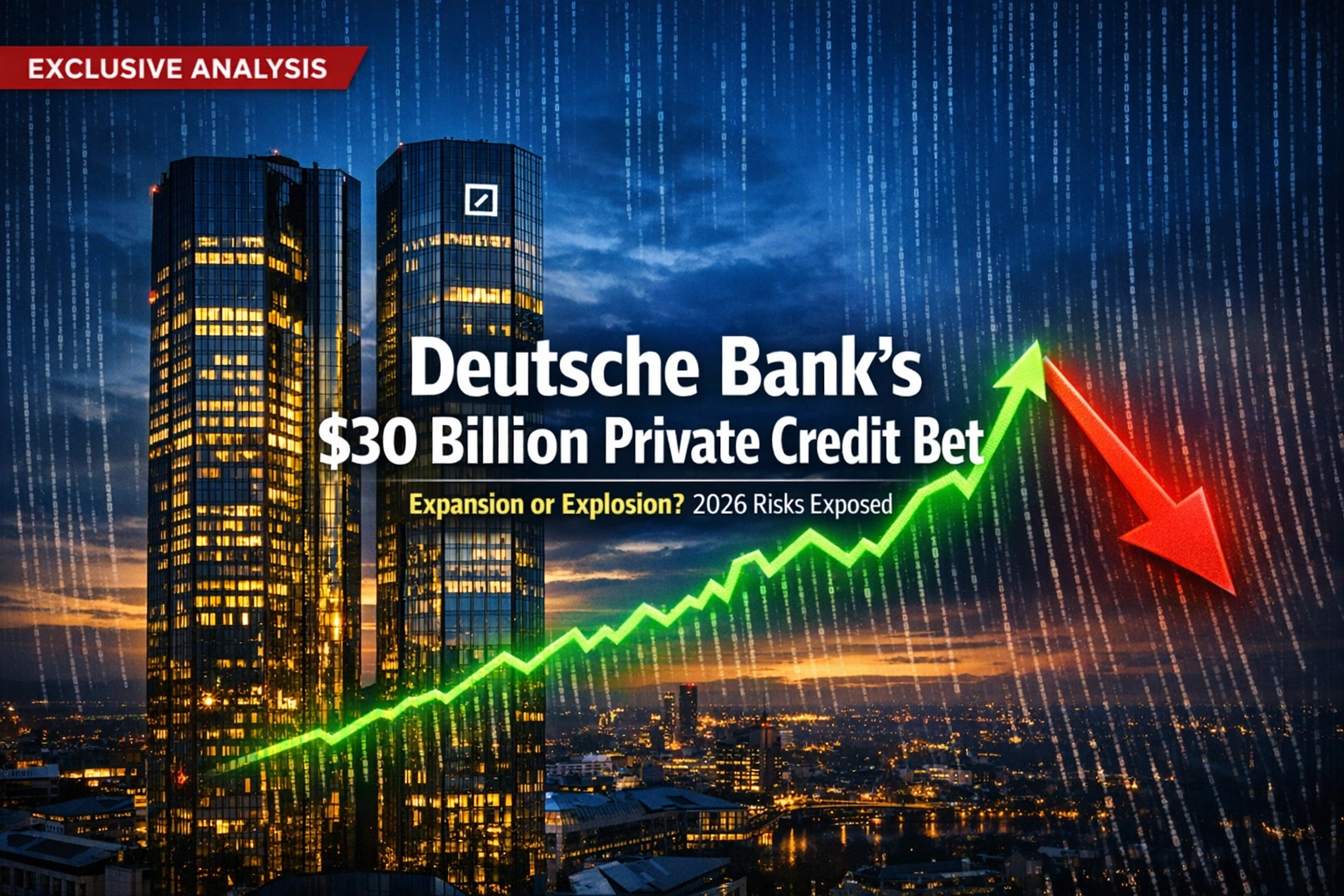
There is a peculiar kind of institutional courage — or, depending on your disposition, institutional hubris — in publishing a document that simultaneously discloses a €25.9 billion risk and announces your intention to take on more of it. Deutsche Bank did precisely that on Thursday morning when its 2025 Annual Report and Pillar 3 disclosures landed on investor terminals across three continents.
The numbers were striking enough on their own: the Frankfurt-headquartered lender’s private credit portfolio had grown roughly 6% year on year, rising from €24.5 billion in 2024 to nearly €26 billion — just over $30 billion at current exchange rates — making it one of the most substantial disclosed private-credit exposures on any European bank’s balance sheet. But it was the three words buried deeper in the filing that stopped seasoned credit analysts mid-scroll. Deutsche Bank, the report stated plainly, “seeks to expand private credit offerings.”
That phrase landed in a market already skittish about the asset class. Shares in Deutsche Bank fell in early Frankfurt trading, joining a broader rotation away from names perceived to carry outsized private-credit risk. The decline echoed a pattern seen six weeks earlier when a separate Deutsche Bank research note warned that software and technology companies — the sector most loved by private credit lenders — posed what its analysts called one of the “all-time great concentration risks” to speculative-grade credit markets. The analysts were speaking about an industry-wide problem. Today, their own institution disclosed that its technology-sector loan exposure had jumped to €15.8 billion, up sharply from €11.7 billion the prior year — an increase of 35% in a single twelve-month period.
To its critics, Thursday’s disclosure is evidence of a systemic contradiction at the heart of modern banking: institutions that identify a risk in public research simultaneously deepen their exposure to it in private transactions. To its defenders — and Deutsche Bank has articulate ones — the expansion is a deliberate, conservatively underwritten bet on a structural shift in how the world’s capital flows. Both positions deserve a serious hearing, because the stakes extend well beyond any single bank’s quarterly earnings.
1: The Numbers Behind Deutsche Bank’s Private Credit Bet
A Portfolio That Represents 5% of the Entire Loan Book
Deutsche Bank’s 2025 Annual Report is a document with the heft of a minor encyclopedia, but the private credit section rewards close reading. The €25.9 billion exposure — roughly 5% of the bank’s total loan book — did not arrive overnight. It has been built methodically, brick by brick, across the Corporate & Investment Bank, the Private Bank, and through the bank’s asset management arm, DWS.
That tripartite structure is deliberate. DWS, Germany’s largest asset manager, has been quietly building a private markets capability for institutional and increasingly retail clients, offering access through vehicles including a European Long-Term Investment Fund launched in partnership with Deutsche Bank and Partners Group. The Private Bank, meanwhile, has been developing digital investment solutions to bring private credit products to high-net-worth individuals who previously had no practical route into the asset class. The CIB provides origination firepower — deal flow, syndication, and leveraged finance relationships that few European peers can match.
The Technology Sector Concentration
The most acute number in Thursday’s filing, however, is the technology figure. At €15.8 billion, loans to the technology sector — including software companies — now account for approximately 61% of the bank’s total private credit book. This is not incidental. Software businesses became the flagship borrowers of the private credit boom for a set of well-understood reasons: predictable subscription revenues, high gross margins, low capital intensity, and sticky customer bases that offered lenders reliable cash flow visibility.
What changed — abruptly, and with world-historical speed — was the artificial intelligence revolution. As Bloomberg reported in February, Deutsche Bank’s own research analysts, led by Steve Caprio, warned that software companies account for roughly 14% of the speculative-grade credit universe, representing approximately $597 billion in debt outstanding. The AI disruption risk is not theoretical: it is already repricing loans. Payment-in-kind usage — where borrowers pay interest in additional debt rather than cash — has climbed to 11.3% in business development company portfolios, more than 2.5 percentage points above the already-elevated market average of 8.7%. These are the early signatures of distress.
Growth Ambitions Across Three Vectors
Deutsche Bank’s expansion strategy, as stated in its annual report, runs through three coordinated channels:
Selective regional expansion — deepening penetration in markets where private credit infrastructure remains underdeveloped, particularly continental Europe and selective Asia-Pacific corridors, where regulatory capital requirements have pushed traditional bank lending back and created origination vacuums that non-bank lenders, and bank-affiliated funds, are rushing to fill.
CIB integration — leveraging the Investment Bank’s leveraged finance, debt capital markets, and structured finance relationships to originate transactions that DWS-managed funds then hold.
Digital private banking solutions — using technology to distribute private credit products to a broader base of Private Bank clients, addressing the longstanding illiquidity premium that has historically confined the asset class to the largest institutional investors.
2: Conservative Underwriting vs. Industry Red Flags
Deutsche Bank’s Stated Defensive Architecture
In a period of mounting industry-wide scrutiny, Deutsche Bank has been emphatic — perhaps strategically so — about the conservative character of its underwriting. The annual report states that the bank applies “conservative underwriting standards” to its private credit portfolio, and that it is not exposed to “significant risks” through its relationships with non-bank financial institutions. It does, however, acknowledge that “the bank could face potential indirect credit risks through interconnected portfolios and counterparties.”
This language matters. The distinction between direct and indirect risk is not merely semantic — it is the central architectural question in private credit today. A bank that originates loans and holds them on balance sheet faces direct mark-to-market and default risk. A bank that originates, then distributes to third-party funds — while maintaining warehouse lines, revolving credit facilities, and fund-level leverage — faces indirect risk that is harder to quantify, harder to stress-test, and potentially far more systemic in a scenario of simultaneous redemptions.
Advance rates of approximately 65% — meaning Deutsche Bank typically lends against 65 cents of every dollar of collateral value — place it meaningfully below the leverage levels typical of the most aggressive direct lenders in the market. The portfolio is also weighted toward investment-grade or near-investment-grade borrowers rather than the deep-sub-investment-grade exposures that characterise some U.S.-based business development companies.
The Industry’s Red Flags in 2026
That conservatism, however, exists within an ecosystem that is developing structural fault lines. Reuters reporting on Thursday noted that “failures of a select number of sub-prime lenders in the U.S. increased investor focus on risks associated with private credit and raised wider concerns around underwriting standards and fraud risk.” The phrase in quotation marks came directly from Deutsche Bank’s own annual report — a remarkable degree of institutional candour.
Several interconnected pressures are now converging on the $2 trillion global private credit market simultaneously:
Redemption pressure — As CNBC documented in February, publicly traded business development companies with heavy software exposure experienced dramatic sell-offs, with Ares Management falling over 12%, Blue Owl Capital losing more than 8%, and KKR declining close to 10% in a single week. These are liquid proxies for an illiquid market, and their moves signal what institutional redemption pressure, if sustained, could do to private fund valuations.
AI-driven obsolescence risk — UBS Group has modelled a scenario in which, under aggressive AI adoption assumptions, default rates in U.S. private credit climb to 13% — substantially above the stress projections for leveraged loans (approximately 8%) and high-yield bonds (around 4%). Software payment-in-kind loans now represent a growing share of BDC portfolios precisely because many software borrowers are already struggling to service debt in cash.
Opacity and interconnection — JPMorgan’s Jamie Dimon warned in late 2025 about private credit’s “cockroaches” — the concern that stress in one borrower signals more hidden trouble elsewhere. The ECB and the Bank of England have both flagged concentration risk in their recent financial stability reviews, noting that banks’ indirect exposures through fund-level financing may be materially understated in regulatory disclosures.
3: Global Implications — European Banks, AI, and the $1.8 Trillion Private-Credit Shift
Europe’s Structural Opportunity
To understand why Deutsche Bank seeks to expand private credit offerings despite these headwinds, it is necessary to understand the structural logic that makes European banks’ private credit ambitions almost inevitable.
Following the Global Financial Crisis and successive rounds of Basel regulatory tightening, European banks sharply curtailed their lending to mid-market corporates, leveraged buyouts, and growth-stage technology companies. Non-bank lenders — Blackstone, Apollo, Ares, Blue Owl, and their peers — filled that vacuum with extraordinary efficiency. By most estimates, the global private credit market has grown from under $500 billion a decade ago to somewhere between $1.8 trillion and $2 trillion today, depending on definitional boundaries, with some forecasters projecting it reaching $3.5 trillion by the end of the decade.
European banks have watched this transfer of margin and relationship capital to predominantly U.S.-headquartered asset managers with the quiet fury of entities losing market share in their home territory. Deutsche Bank’s expansion strategy is, in part, a reclamation effort — an attempt to intermediate capital flows that would otherwise bypass Frankfurt entirely and flow directly from pension funds and sovereign wealth vehicles in Oslo, Abu Dhabi, and Seoul to private equity-owned software companies in San Francisco and London, with U.S. managers collecting the management fees.
The AI Dimension
The artificial intelligence disruption to software borrowers is not a risk that Deutsche Bank — or any lender — can underwrite away entirely. According to analysis published by S&P Global, software and technology companies account for approximately 25% of the private credit market through year-end 2025. Deutsche Bank’s own analysts have noted that the software sector’s exposure to AI-driven disruption “would rival that of the Energy sector in 2016” — a period that produced widespread credit losses and a restructuring cycle that took years to resolve.
What makes the current situation structurally different from the 2016 energy analogy is the speed of the disruption vector and the opacity of the affected portfolios. When oil prices collapsed, the mechanism of loss was transparent: commodity prices are public, reserves are reported, and the chain of causation from price to default was legible. AI disruption to software revenue is subtler, faster, and far harder to detect in quarterly borrower updates until it crystallises into a covenant breach or, worse, a payment default.
Macro Implications for Policymakers
The ECB’s most recent Financial Stability Review identified the nexus of banks and non-bank financial institutions as a primary risk amplification channel. What Deutsche Bank’s disclosure crystallises — in unusually stark terms for an institution not known for gratuitous transparency — is that European banks’ exposure to private credit is not merely an investment banking line item. It is a macro-financial variable.
If private credit suffers a disorderly repricing — triggered by AI-driven software defaults, a redemption cascade, or a combination of both — European banks with direct lending exposure face mark-to-market losses. Those with indirect exposure, through warehouse lines and fund-level leverage, face contingent liabilities that may not appear on regulatory balance sheets until stress has already propagated. The IMF’s Global Financial Stability Report has warned repeatedly that the non-bank sector’s interconnection with regulated banking creates channels of contagion that supervisors lack adequate tools to monitor in real time.
4: Peer Comparison — Deutsche Bank vs. Private Credit Titans
How Deutsche Bank’s Exposure Stacks Up
The following table provides a structured comparison of Deutsche Bank’s private credit approach against key peers and specialist alternative asset managers operating in the same market:
| Institution | Estimated Private Credit AUM / Exposure | Technology Sector Weight | Underwriting Approach | Key Risk Flag |
|---|---|---|---|---|
| Deutsche Bank | €25.9bn ($30bn) direct exposure | ~61% (€15.8bn tech) | Conservative; ~65% advance rates; investment-grade bias | Indirect NBFI contagion; tech concentration |
| Blackstone | ~$300bn credit & insurance AUM | Diversified; <20% software | Institutional, collateralised | Redemption queues in flagship vehicles |
| Apollo Global | ~$500bn total AUM; large private credit sleeve | Moderate software exposure | Originate-to-distribute; balance sheet light | NAV lending; leverage at fund level |
| Blue Owl Capital | ~$200bn AUM; pure-play direct lending | High; software-heavy BDCs | Senior secured, covenant-lite | AI disruption; stock -8% in Feb 2026 |
| Goldman Sachs Asset Mgmt | ~$130bn private credit | Diversified, IG bias | Hybrid bank/asset manager model | Regulatory capital consumption |
| Ares Management | ~$450bn AUM; ~$300bn+ credit | ~6% software of total assets | Conservative; low software weight | AUM growth costs; manager fee compression |
Sources: Company reports, Bloomberg, Reuters, Pitchbook, as of March 2026. AUM figures approximate and include broader credit franchises where private credit is not separately disclosed.
What the Comparison Reveals
Several conclusions emerge from even a cursory reading of this landscape. First, Deutsche Bank is not a private credit manager in the Blackstone or Apollo sense — it is a bank with lending relationships that overlap substantially with the same universe of borrowers those managers are financing. This creates both complementarity (the bank originates deals that asset managers hold) and potential competition (as asset managers build their own origination infrastructure).
Second, Deutsche Bank’s technology concentration — at roughly 61% of its disclosed private credit book — is high relative to conservative peers like Ares, which has deliberately capped software exposure at around 6% of total assets. This is the number most likely to attract regulatory attention.
Third, the bank’s disclosed exposure at €25.9 billion is, by global standards, a mid-tier position. It is dwarfed by the dedicated private credit franchises of Blackstone, Apollo, and Ares. But it is substantial enough — and sufficiently concentrated in a single stressed sector — to represent a material tail risk on Deutsche Bank’s balance sheet in an adverse scenario.
5: What This Means for Investors and Policymakers
The Investment Calculus
For institutional investors holding Deutsche Bank equity, Thursday’s disclosure contains both reassurance and residual unease. The reassurance: management has been transparent, the underwriting is described as conservative, there are no loss provisions against the private credit book, and the bank’s overall financial performance in 2025 was materially strong — revenues reached €32.1 billion, up 7% year on year, with net profits and capital distributions significantly improved from prior years. The bank’s CET1 ratio remains robust, and cumulative shareholder distributions for 2021–2025 have reached €8.5 billion, above the original €8 billion target.
The residual unease: the technology exposure has grown by 35% in a single year, from €11.7 billion to €15.8 billion, precisely as the AI disruption thesis has become more acute and more credible. If UBS’s stress scenario — 13% default rates in U.S. private credit — were to materialise, even a portfolio that is 65% loan-to-value and investment-grade-biased would generate meaningful losses at these concentrations.
For sovereign wealth funds and central bank reserve managers — who are both increasingly active as direct investors in private credit funds and as counterparties to the banks that finance those funds — the systemic question is more pressing than the idiosyncratic one. A banking system that is simultaneously the lender of last resort for private credit funds (through warehouse facilities and NAV loans) and an originator competing with those same funds is not a system whose risk exposures can be easily ring-fenced. The 2008 crisis demonstrated, with brutal efficiency, that what cannot be ring-fenced tends not to be.
The Regulatory Horizon
European banking supervisors at the ECB have signalled increasing discomfort with banks’ private-credit-adjacent activities since at least 2024. The ECB’s Single Supervisory Mechanism has sought more granular reporting on banks’ exposures to leveraged finance and non-bank financial institutions, and Deutsche Bank’s disclosure — voluntary, detailed, and self-critical — may be read partly as a pre-emptive act of regulatory diplomacy.
In Washington, the Federal Reserve has similarly flagged interconnection between banks and the private credit ecosystem as an emerging macro-prudential concern. The next round of stress tests, scheduled for mid-2026, is expected to include private credit scenarios that were not present in previous years.
Conclusion: The Inflection Point
There is a phrase used by geologists to describe the moment before a faultline slips: they call it “stress loading.” For years, pressure builds invisibly, tectonic plates locked against each other, until some marginal additional force triggers a release that had been inevitable for decades. Private credit in 2026 has the texture of a market under stress loading.
Deutsche Bank’s disclosure is important not because it reveals a crisis — it does not — but because it reveals, with unusual precision, the scale and composition of one institution’s position ahead of what could be a significant realignment. The bank’s €25.9 billion portfolio is conservatively underwritten relative to many peers. Its ambitions to expand are strategically coherent. Its transparency, in an asset class not known for it, is genuinely welcome.
And yet: a 35% increase in technology-sector loans in a single year, at precisely the moment when AI is rewriting software’s competitive dynamics, is not a trivial coincidence. Nor is the simultaneous reality that the private credit market’s fastest-growing risks — payment-in-kind escalation, redemption pressure, opacity, interconnection — are also the hardest to observe until they crystallise.
For international investors, the Deutsche Bank private credit expansion story is neither a disaster nor a triumph in waiting. It is something more uncomfortable: a test of whether European banking’s late arrival to the private credit party is disciplined reclamation or expensive imitation. The answer will likely arrive between 2026 and 2028 — precisely the window Deutsche Bank has identified as its “Scaling the Global Hausbank” strategic horizon.
Sophisticated readers will note the symmetry. So, presumably, will the ECB.
FAQ: Deutsche Bank Private Credit — Your Questions Answered
Q1: How large is Deutsche Bank’s private credit portfolio as of 2025?
Deutsche Bank’s private credit portfolio stood at approximately €25.9 billion ($30 billion) at year-end 2025, representing around 5% of the bank’s total loan book and a 6% increase from €24.5 billion at year-end 2024, according to the bank’s 2025 Annual Report published on 12 March 2026.
Q2: Why is Deutsche Bank expanding private credit despite rising risks?
Deutsche Bank seeks to expand private credit offerings through three strategic vectors: selective regional expansion into underserved markets, integration with its Corporate & Investment Bank for deal origination, and digital product development through its Private Bank for high-net-worth distribution. The rationale is structural — European banks lost significant mid-market lending share to U.S. non-bank managers over the past decade, and expanding private credit is partly an attempt to recapture that margin and relationship capital.
Q3: What is the biggest risk in Deutsche Bank’s private credit portfolio?
The single greatest concentration risk is technology-sector exposure, which reached €15.8 billion in 2025 — a 35% increase from €11.7 billion in 2024. This concentration is particularly sensitive to AI-driven disruption of software company business models, which has already caused payment-in-kind loan usage to rise and prompted analysts, including Deutsche Bank’s own research team, to warn of potential industry-wide default rates rivalling the energy sector crisis of 2016.
Q4: How does Deutsche Bank’s underwriting compare to industry peers?
Deutsche Bank applies conservative underwriting standards, including advance rates of approximately 65% and a bias toward investment-grade or near-investment-grade borrowers. This compares favourably to some U.S. business development companies that operate with higher leverage and deeper-sub-investment-grade exposure. However, the technology sector concentration remains high relative to conservative peers like Ares Management, which has capped its software exposure at around 6% of total assets.
Q5: What is the total size of the global private credit market?
Estimates vary by methodology, but the global private credit market is broadly estimated at $2–$3 trillion as of early 2026, depending on whether indirect structures such as NAV lending and warehouse facilities are included. Industry forecasters project growth to $3.5 trillion or beyond by 2030, driven by continued bank disintermediation, demand from institutional investors for yield premium, and expansion into new geographies and borrower segments.
Q6: Has Deutsche Bank reported any losses on its private credit portfolio?
As of the 2025 Annual Report, Deutsche Bank has not reported any losses or provisions directly tied to its private credit exposure. The bank has, however, flagged private credit as a “key risk” and acknowledged the potential for indirect credit risks through interconnected counterparties, representing an honest — and notable — departure from the more sanguine disclosures common in the sector.
Q7: How does AI specifically threaten private credit markets?
AI threatens private credit primarily through its disruption of software company revenue models. Software-as-a-service businesses — the largest single borrower segment in private credit, accounting for roughly 25% of the market — derive value from subscription revenue, sticky customer bases, and high gross margins. Generative AI and agentic coding tools risk eroding those moats by automating functions that enterprise software previously monopolised, compressing multiples and, in severe cases, triggering revenue declines that cannot be serviced from existing debt loads. UBS has modelled an aggressive-disruption scenario in which U.S. private credit default rates reach 13%, compared to 8% for leveraged loans and 4% for high-yield bonds.
Discover more from The Economy
Subscribe to get the latest posts sent to your email.
Analysis
Malaysia Holds 2026 Growth at 4–4.5% Despite Geopolitical Headwinds — Resilience or Caution?
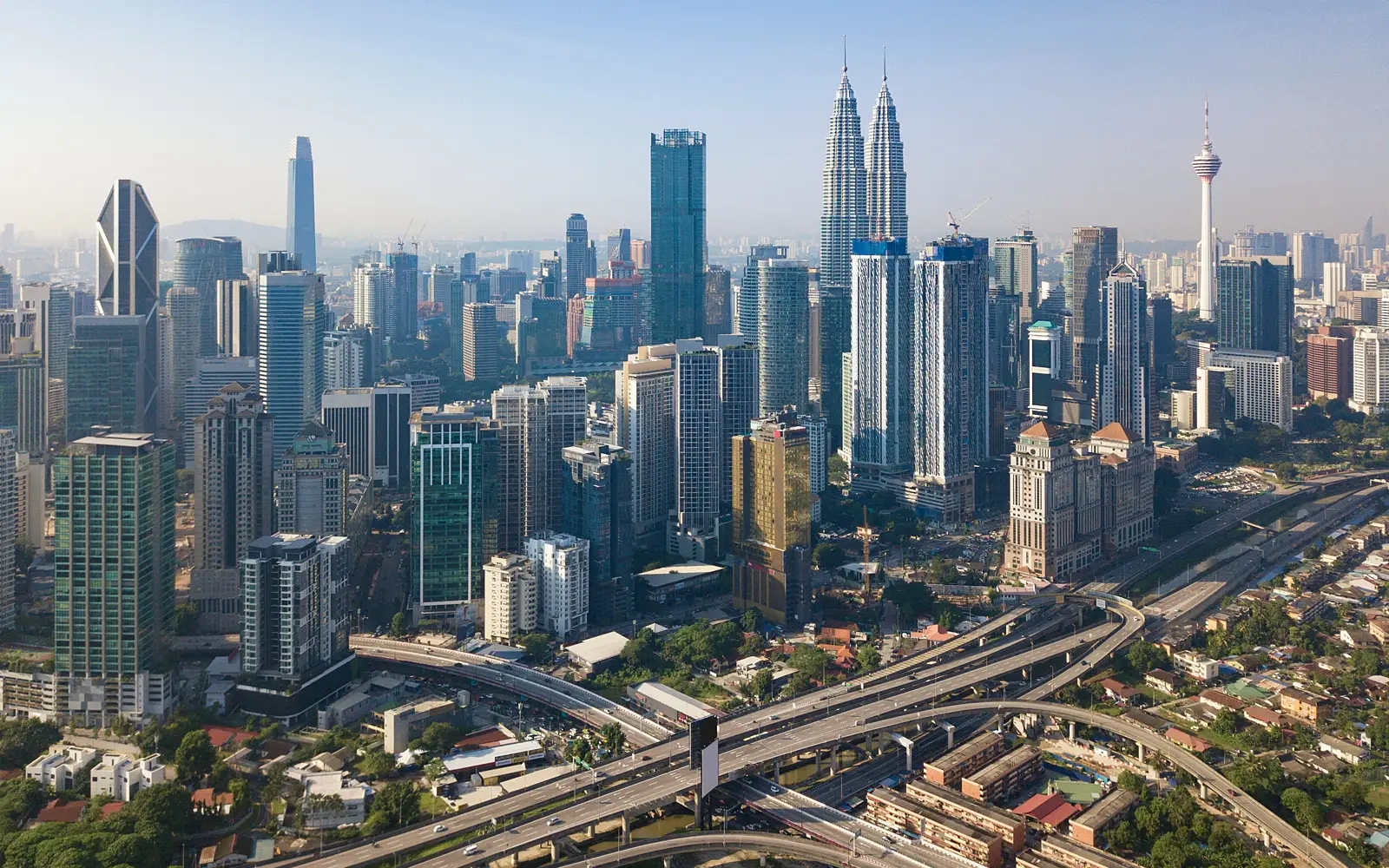
The scene outside Putrajaya’s Perdana Putra complex on Thursday morning said something quietly important about Malaysia’s mood.
Economy Minister Akmal Nasrullah Mohd Nasir stepped up to the lectern to launch the government’s new digital plan-monitoring tool — the 13th Malaysia Plan implementation tracker known as MyRMK — surrounded by the bureaucratic apparatus of a government that, for once, was not trying to manage expectations downward. The economy had just delivered its best back-to-back performance in a decade. The message from the minister, measured and deliberate, was: we are staying the course.
“This matter will always be reviewed by Bank Negara Malaysia and BNM will ultimately determine whether this target remains up or down. But so far, the indication is that we remain with this target,” Akmal told journalists after the event. The Star The target in question is Malaysia’s official 2026 GDP growth forecast of 4.0%–4.5% — a range the government has maintained since last year’s Budget and one that now sits conspicuously below where private-sector economists and multilateral institutions believe the economy is heading.
That gap — between official caution and analyst optimism — is the central question of Malaysia’s economic story in 2026. Is Putrajaya exercising prudent statecraft in a world clouded by Middle Eastern conflict and American tariff volatility? Or is the government, already eyeing a general election no later than February 2028, resisting the temptation to set a bar it might fail to clear?
2025: A Year That Surprised Everyone
To understand the government’s calculus, it helps to appreciate just how comprehensively Malaysia beat expectations last year.
Full-year GDP growth for 2025 was recorded at 5.2%, with the momentum accelerating sharply to 6.3% in the fourth quarter — the strongest quarterly print in years. The Star This Q4 surge was underpinned by services growth of 6.3% and manufacturing expansion of 6.1%, while on the demand side private consumption rose 5.3% and investment activity expanded by a striking 9.2%. Ram
The labour market delivered an equally striking result. The unemployment rate fell to 2.9% in Q4 2025 — the lowest level in 11 years, The Star a figure that carries genuine political weight for a Pakatan Harapan government that came to power on a cost-of-living mandate. Headline inflation remained subdued at 1.4% across the year, giving the Anwar administration a rare combination of strong growth and benign prices.
The country’s trade crossed a record RM3 trillion (~USD 780 billion) for the first time in 2025, Fortune driven in large part by Malaysia’s semiconductor and electrical equipment manufacturing base, which rode the global AI investment wave with exceptional timing. Approved investments surged 13.2% to RM285.2 billion in the first nine months of 2025, reflecting sustained investor confidence even as tariff turbulence shook regional supply chains. BusinessToday
In short: Malaysia outperformed not just its own official projections but also the preliminary estimates issued mid-year. The 2025 outturn has given Putrajaya both the confidence to reaffirm its 2026 target and the institutional credibility to resist inflating it.
Why the Government Is “Sticking” — Not Upgrading
Geopolitics: The Middle East Variable
Akmal was explicit that “the geopolitical situation is among the main challenges in 2026,” The Star a reference primarily to the escalating US-Israel-Iran confrontation that has injected acute uncertainty into global oil markets and seaborne trade routes.
US and Israeli military strikes against Iran, followed by Iranian retaliatory actions against US military bases across several Gulf states, have raised the spectre of sustained disruption to the Strait of Hormuz — the narrow chokepoint that handles close to 30% of global seaborne oil trade. Iran also accounts for roughly 3% of global crude output as the fourth-largest OPEC producer. Ram
For Malaysia, the transmission mechanism is not primarily via trade — the Middle East accounts for only 1.9% of Malaysian exports and 4.7% of imports. Ram The real exposure lies in oil prices and energy costs. Akmal noted that the ongoing conflict “does not provide strong indications for the government to make drastic changes to its existing policies or adjust domestic fuel prices,” The Star but the government is clearly not willing to assume the conflict will de-escalate quickly enough to justify a higher growth target.
The American Tariff Overhang
Export growth is expected to moderate in 2026 as the impact of US reciprocal tariffs and earlier front-loading activities begin to materialise. The IMF also projects global trade growth to slow from 3.6% in 2025 to 2.3% in 2026. Ram
While the US Supreme Court struck down the original reciprocal tariff measures, the US government swiftly introduced a new 10% global blanket tariff under alternative legislation, with a potential increase to 15% for some countries under consideration. The 150-day window for further tariff action under new legal frameworks keeps uncertainty elevated. Ram The most dangerous scenario for Malaysia specifically is a targeted levy on semiconductors — its single most valuable export category — which RAM Ratings flags as a key downside risk capable of materially impairing the country’s growth momentum.
After months of negotiations, Malaysia and the US reached a deal in 2025 whereby Malaysia reduced tariffs on certain American products in exchange for Washington lowering duties to 19%, with exemptions for key Malaysian exports including aviation components and electrical equipment. Fortune That agreement provides some floor of stability — but it does not eliminate the threat of new measures.
Where the Upside Lies
Despite these headwinds, the case for Malaysia outperforming its official 4.0–4.5% target is, if anything, stronger today than it was twelve months ago.
The Semiconductor and AI Supercycle
Malaysia is no longer merely a low-cost assembly hub in the global chip supply chain. It has become a mid-tier strategic node for advanced packaging, back-end testing, and increasingly for chip design — a repositioning driven partly by geopolitical necessity (as US-China tensions redirect investment) and partly by deliberate industrial policy under the New Industrial Master Plan 2030.
MBSB Research has projected that AI-related capital expenditure may be entering a “super cycle,” with AI infrastructure spending forecast to exceed USD 500 billion in 2026. Data centres are pushing global power demand up roughly 20% annually, creating significant equity opportunities in utilities and grid modernisation — sectors where Malaysia has major exposure. Notably, Malaysia captured 32% of Southeast Asia’s AI funding, Xinhua a market-share figure that would have seemed implausible five years ago.
The Johor-Singapore Special Economic Zone, which allows companies to tap Singapore’s financial and legal infrastructure while accessing Malaysia’s lower costs and larger land base, attracted almost one-third of all approved foreign direct investment into Malaysia in the first three quarters of 2025. Fortune Minister Akmal, himself a Johor native, has suggested the state may soon overtake Selangor as the country’s top FDI destination — a seismic shift in Malaysia’s economic geography that has not yet been fully priced by markets.
Visit Malaysia 2026: Tourism as a Structural Accelerant
The Visit Malaysia 2026 campaign targets up to 43 million tourists and aims to generate RM329 billion (~USD 83 billion) in revenue — potentially contributing 15% of GDP — with tourism already supporting 22% of jobs nationally as of 2024. Usasean That is not a niche catalyst; it is a full-scale services-sector expansion programme with multiplier effects across hospitality, transport, retail, and financial services.
Bank Negara expects this momentum to extend into early 2026, underpinned by the second round of the Sumbangan Asas Rahmah cash transfer programme, seasonal festival-related spending, and the Visit Malaysia 2026 campaign. New Straits Times The cash assistance programme itself has been upsized to RM15 billion in 2026 from RM13 billion in 2025, Ram providing a meaningful consumption floor for lower-income households even as external demand softens.
The 13MP Execution Dividend
Akmal has framed 2026 as a year of “execution and discipline,” with the 13th Malaysia Plan (RMK13) — which targets annual GDP expansion of 4.5% to 5.5% through structural reforms — serving as the government’s core organising framework. Fortune The MyRMK digital tracking system, launched this morning, is designed to hold agencies accountable to measurable KPIs in real time, reducing the chronic implementation gap that has plagued previous Malaysian development plans.
The 13MP’s emphasis on high-value industries, the ASEAN power grid, nuclear energy exploration, and talent development — Akmal noting pointedly that “capital can be injected by a government or investor, but talent is the one thing we need to build” Fortune — signals a government acutely aware that Malaysia’s middle-income trap cannot be escaped through investment incentives alone.
What the Analysts Are Saying
The divergence between official caution and market optimism is striking. Maybank Investment Bank projects GDP growth of 5.1% in 2026, maintaining the momentum of last year’s 5.2% outturn, and expects this to translate into 5.3% operating profit growth for the banking sector driven by 5% domestic loan expansion. Focus Malaysia
Apex Securities and Hong Leong Investment Bank have both revised their 2026 forecasts upward to 4.7%, driven by firmer growth momentum in late 2025. Kenanga Investment Bank holds at 4.5% with acknowledged upside potential toward 5.0% if current momentum holds. The Sun
The IMF revised its Malaysia growth forecast upward by 0.3 percentage points to 4.3% for 2026 and 2027 in its January World Economic Outlook update, itself a meaningful signal of improving fundamentals. The Edge Malaysia
The World Bank’s latest Malaysia Economic Monitor places growth at 4.1%, the most conservative of the major multilateral estimates, reflecting caution about the delayed tariff impact on export competitiveness.
RAM Ratings maintains its wider band of 4.0%–5.0%, with fiscal deficit projected to narrow to 3.5% of GDP in 2026 from 3.8% in 2025 as spending controls tighten, though government debt is expected to remain at 65.7% of GDP — a ratio that underscores the importance of continued fiscal discipline. Ram
HSBC ASEAN economist Yun Liu sits at 4.6%, citing the electrical equipment sector and tourism as the twin engines of outperformance.
The consensus arithmetic is clear: private-sector analysts expect Malaysia to beat the government’s own ceiling. The official 4.5% upper bound has become, in effect, a floor for institutional forecasters.
Regional Scoreboard: Malaysia in ASEAN Context
Malaysia’s growth trajectory looks respectable but not exceptional within Southeast Asia. The World Bank projects Vietnam at 6.3%, the Philippines at 5.3%, and Indonesia at 5.0% for 2026, with Thailand languishing at just 1.8% — the weakest performance among major ASEAN economies. Nation Thailand
Vietnam is ranked among the world’s fastest-growing economies for 2026 at 5.6–5.7%, trailing only India and the Philippines, StatisticsTimes.com bolstered by manufacturing diversification and rising FDI from export-relocated supply chains. Indonesia at 5.0% benefits from Prabowo Subianto’s fiscal stimulus and state-led investment programme, though governance risks remain a structural overhang.
Malaysia’s 4.3–4.5% positioning reflects a more mature economy with a higher GDP per capita base — but also the constraints of a relatively open economy more exposed to US trade policy volatility than Vietnam’s manufacturing-driven growth model. The comparison that should alarm policymakers most is with Vietnam, which has successfully climbed into higher-value electronics manufacturing while Malaysia risks being squeezed between Singapore’s services sophistication and Vietnam’s cost competitiveness in mid-range manufacturing.
Thailand’s 1.8% projection is a cautionary tale of what happens when structural reform stalls and political uncertainty persists — a trajectory Kuala Lumpur is determined to avoid as it approaches its own electoral moment.
Risks: The Three Scenarios
Base Case (4.3–4.5%): Middle East tensions persist but do not escalate to full Strait of Hormuz closure; US tariffs remain at current levels with no new semiconductor levies; Visit Malaysia 2026 delivers strong but not record-breaking tourism numbers; 13MP execution proceeds with typical government lag. BNM maintains the overnight policy rate with one possible 25 basis point cut in H2.
Upside Case (4.8–5.1%): AI data centre investment accelerates; Visit Malaysia 2026 beats arrival targets; Johor SEZ draws marquee technology investors; US-Malaysia tariff framework is extended and deepened; semiconductor upcycle spills over into the broader services sector. This is the Maybank scenario.
Downside Case (3.5–3.8%): A full escalation of the Iran-US-Israel conflict triggers an oil price spike above USD 120 per barrel; the US imposes sectoral tariffs on semiconductors; global trade growth slows below the IMF’s already-modest 2.3% projection; BNM is forced to hold rates higher to defend the ringgit. Maybank has estimated that a one percentage point reduction in world GDP growth would negatively impact Malaysia’s growth by approximately 0.8 percentage points — a coefficient that reveals the economy’s structural sensitivity to external shocks. Focus Malaysia
Investment Implications and Policy Recommendations
For international investors, the key insight from today’s announcement is not the headline 4.0–4.5% number but the direction of travel in Putrajaya’s risk calculus. A government that is confident enough to stand by its forecast while acknowledging geopolitical headwinds is a government that believes its domestic fundamentals are robust enough to absorb external shocks — and recent data supports that confidence.
Three investment themes deserve close attention:
First, the semiconductor and AI infrastructure complex — spanning Penang’s integrated circuit design clusters, Johor’s data centre corridor, and the Kulim Hi-Tech Park expansion — represents a multi-year structural opportunity that is only partially correlated with the government’s conservative GDP range. Malaysia’s 32% share of Southeast Asian AI funding is a durable competitive advantage, not a cyclical blip.
Second, the Visit Malaysia 2026 services trade is an underappreciated current account positive. A RM329 billion tourism revenue target, if even 70% achieved, would meaningfully narrow Malaysia’s services deficit and support the ringgit — reducing the currency risk premium that still deters some portfolio investors.
Third, 13MP execution risk cuts both ways. The MyRMK tracking system, launched this morning, is precisely the kind of institutional innovation that separates credible development plans from aspirational ones. If the system delivers genuine accountability — rather than the performative KPI dashboards that have historically adorned Malaysian public administration — the medium-term 4.5–5.5% annual growth target embedded in the 13MP becomes investable, not merely aspirational.
On policy, the central bank should be given room to act counter-cyclically if global headwinds intensify — a 25 basis point cut in H2 2026 would be defensible given benign inflation and the tariff-related drag on exports. The government, meanwhile, needs to resist the electoral temptation to front-load consumption transfers at the expense of the fiscal consolidation trajectory that RAM Ratings, the World Bank, and the IMF all identify as essential to Malaysia’s long-term credit credibility.
The 4.0–4.5% target, in the end, is less a forecast than a signal — a statement that Kuala Lumpur will not allow global turbulence to become a self-fulfilling prophecy. Whether it proves resilience or caution will be determined not in Putrajaya’s press conference rooms, but in the semiconductor fabs of Penang, the hotel lobbies of Langkawi, and the construction sites of Johor — where Malaysia’s actual 2026 story is already being written.
📊 Key Data at a Glance
- Malaysia 2025 full-year GDP growth: 5.2%
- Q4 2025 GDP growth: 6.3% (strongest quarter of the year)
- 2025 unemployment rate (Q4): 2.9% — lowest in 11 years
- 2025 headline inflation: 1.4%
- 2025 approved investments (Jan–Sep): RM285.2 billion (+13.2% YoY)
- 2025 total trade: Record RM3 trillion+
- Official 2026 GDP forecast: 4.0%–4.5%
- IMF 2026 forecast for Malaysia: 4.3%
- Maybank IB 2026 forecast: 5.1%
- Visit Malaysia 2026 target: 47 million visitors / RM329 billion receipts
- Cash transfers 2026: RM15 billion (up from RM13 billion)
- Fiscal deficit 2026 (RAM projection): 3.5% of GDP
🌏 ASEAN 2026 GDP Growth Comparison (World Bank / IMF)
| Economy | 2026 Forecast |
|---|---|
| Vietnam | 6.3% |
| Philippines | 5.3% |
| Indonesia | 5.0% |
| Malaysia | 4.1–4.5% |
| Thailand | 1.8% |
Sources & Further Reading
- Bank Negara Malaysia — Annual Report & Monetary Policy
- IMF World Economic Outlook — January 2026 Update
- World Bank Malaysia Economic Monitor
- RAM Ratings — Malaysia Quarterly Economic Update, March 2026
- Ministry of Finance Malaysia — Economic Outlook 2026
- 13th Malaysia Plan (MyRMK) — Economy Ministry
- Fortune — Akmal Nasrullah Interview, February 2026
- Visit Malaysia 2026 — Tourism Malaysia
- The Star — Government Maintains 2026 Growth Projection, 12 March 2026
❓ FAQ Schema (People Also Ask)
Q1: Why is Malaysia maintaining its 2026 GDP growth forecast at 4.0–4.5% instead of raising it? Economy Minister Akmal Nasrullah explained on 12 March 2026 that while 2025’s 5.2% growth demonstrates resilience, ongoing Middle Eastern geopolitical conflict and US tariff uncertainty justify a prudent, unchanged official target. Bank Negara Malaysia retains final authority to revise the figure upward or downward based on evolving conditions.
Q2: What are the biggest risks to Malaysia’s 2026 economic growth outlook? The three primary downside risks are: (1) an escalation of the Iran-US-Israel conflict disrupting global oil trade and raising energy costs; (2) the imposition of new US tariffs specifically targeting semiconductors — Malaysia’s largest export category; and (3) a sharper-than-expected global trade slowdown, which RAM Ratings estimates could reduce Malaysia’s growth by approximately 0.8 percentage points for every one percentage point drop in world GDP growth.
Q3: How does Malaysia’s 2026 GDP growth forecast compare to other ASEAN economies? Malaysia’s official 4.0–4.5% target and analyst consensus of 4.3–5.1% places it in the middle of the ASEAN pack. The World Bank forecasts Vietnam at 6.3%, the Philippines at 5.3%, and Indonesia at 5.0% for 2026, while Thailand trails significantly at 1.8%. Malaysia’s higher GDP per capita base partly explains the more moderate headline growth rate relative to frontier-stage peers like Vietnam.
Discover more from The Economy
Subscribe to get the latest posts sent to your email.
-

 Markets & Finance2 months ago
Top 15 Stocks for Investment in 2026 in PSX: Your Complete Guide to Pakistan’s Best Investment Opportunities
-

 Analysis1 month ago
Brazil’s Rare Earth Race: US, EU, and China Compete for Critical Minerals as Tensions Rise
-

 Banks2 months ago
Best Investments in Pakistan 2026: Top 10 Low-Price Shares and Long-Term Picks for the PSX
-

 Investment2 months ago
Top 10 Mutual Fund Managers in Pakistan for Investment in 2026: A Comprehensive Guide for Optimal Returns
-

 Asia2 months ago
China’s 50% Domestic Equipment Rule: The Semiconductor Mandate Reshaping Global Tech
-

 Global Economy3 months ago
Pakistan’s Export Goldmine: 10 Game-Changing Markets Where Pakistani Businesses Are Winning Big in 2025
-

 Analysis3 weeks ago
Top 10 Stocks for Investment in PSX for Quick Returns in 2026
-

 Global Economy3 months ago
15 Most Lucrative Sectors for Investment in Pakistan: A 2025 Data-Driven Analysis