
Banks
Fed Holds Rates Under Warsh as Trump Rolls Out New Tariffs

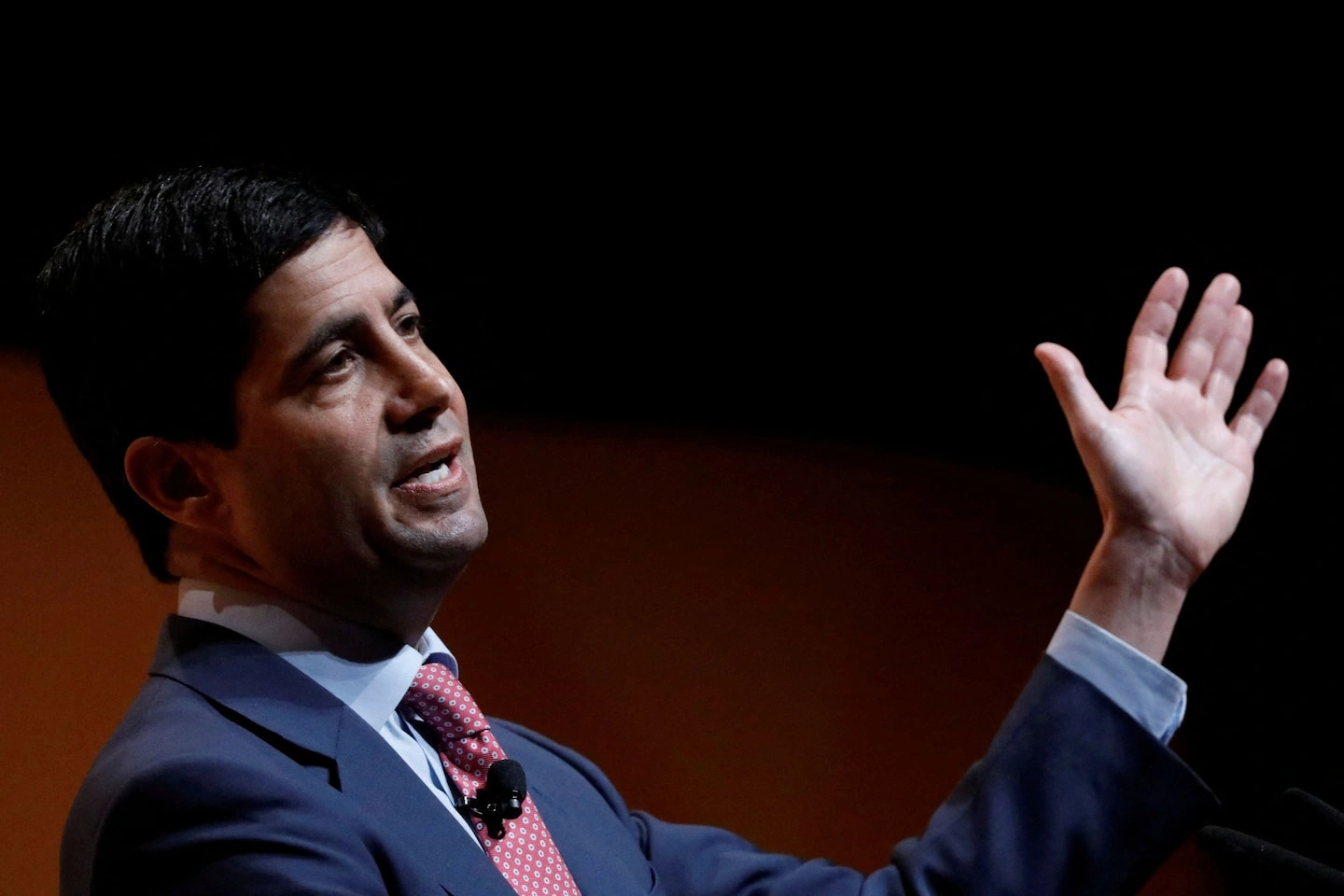
Federal Reserve Chair Kevin Warsh presided over a closely watched two-day policy meeting this week, with markets widely expecting the Federal Open Market Committee to hold interest rates steady even as the Trump administration prepares a new round of tariffs designed to replace the “Liberation Day” duties the Supreme Court struck down as illegal.
A Hawkish Hold, With Dissent in the Room
The FOMC’s July 28–29 meeting — the fifth of eight scheduled gatherings in 2026 — was expected to end with rates unchanged, according to a consensus among Fed watchers reported by U.S. News, though not without disagreement among the twelve committee members. Warsh, who has pledged that the Fed has “no tolerance” for elevated consumer and producer costs, faces a delicate balancing act: a steady labor market and solid GDP arguably justify holding rates, while cooling oil prices — following a pause in US strikes on Iran — have taken some pressure off the inflation outlook, according to TheStreet.
Replacement Tariffs Target 60 Countries
The monetary policy decision lands alongside a parallel fiscal shock. The administration is preparing new import duties of 10% to 12.5% affecting roughly 60 countries and jurisdictions, structured explicitly as replacements for the April 2025 “Liberation Day” tariffs that were ruled illegal by the Supreme Court, according to U.S. News. Independent modelling suggests the stakes are substantial: the Tax Foundation estimates the Trump administration’s tariff programme now represents the largest US tax increase as a share of GDP since 1993, equivalent to roughly $1,500 per household in 2026, while reducing long-run US GDP by an estimated 0.4% before accounting for foreign retaliation.
The Federal Reserve held interest rates steady at its July 28–29, 2026 meeting under new Chair Kevin Warsh, as the Trump administration prepared replacement tariffs of 10–12.5% on roughly 60 countries. The Tax Foundation estimates the tariff programme costs US households about $1,500 in 2026 and cuts long-run GDP by 0.4%.
Research from the Federal Reserve Bank of New York adds a further wrinkle for policymakers: tariff-driven cost increases are still working their way through supply chains, with more pass-through to consumer prices still in the pipeline months after the initial duties took effect — a dynamic that complicates any straightforward reading of near-term inflation data.
Fed Independence Remains an Open Wound
Warsh’s tenure has been shadowed by an unusually public fight over central bank independence. President Trump has publicly needled the Fed’s board, and an active federal court case is weighing whether the administration can remove Fed Governor Lisa Cook, while a separate effort may target Governor Michael Barr, according to Kiplinger’s live coverage of the meeting. Trump has called Warsh “fantastic” while simultaneously criticising the board’s “political” members — a dynamic that leaves the new chair navigating both markets and the administration’s expectations simultaneously.
Markets Weigh Tariffs Against a Cooling Energy Shock
Treasury yields have been volatile heading into the decision: the 10-year yield touched its highest level since January 2025 amid a surge tied to Middle East risk, before easing again as oil prices tumbled on news of a pause in US-Iran hostilities, according to CNBC’s US economy tracker. Import prices, meanwhile, posted a surprise gain in July, with the cost of goods from China reaching its highest level since 2008 — an early signal of the tariff pass-through the New York Fed has flagged.
What Investors Should Watch Next
The immediate market focus shifts to the Fed’s post-meeting statement and Warsh’s press conference for any signal on the committee’s tolerance for tariff-driven price increases layered atop an already-elevated cost environment. The bigger structural question — whether markets can continue to trust the Fed’s independence from the White House amid ongoing governor-removal litigation — is unlikely to be resolved by this meeting alone, and is likely to remain a persistent overhang on long-duration Treasury yields through the rest of 2026.
Discover more from The Economy
Subscribe to get the latest posts sent to your email.


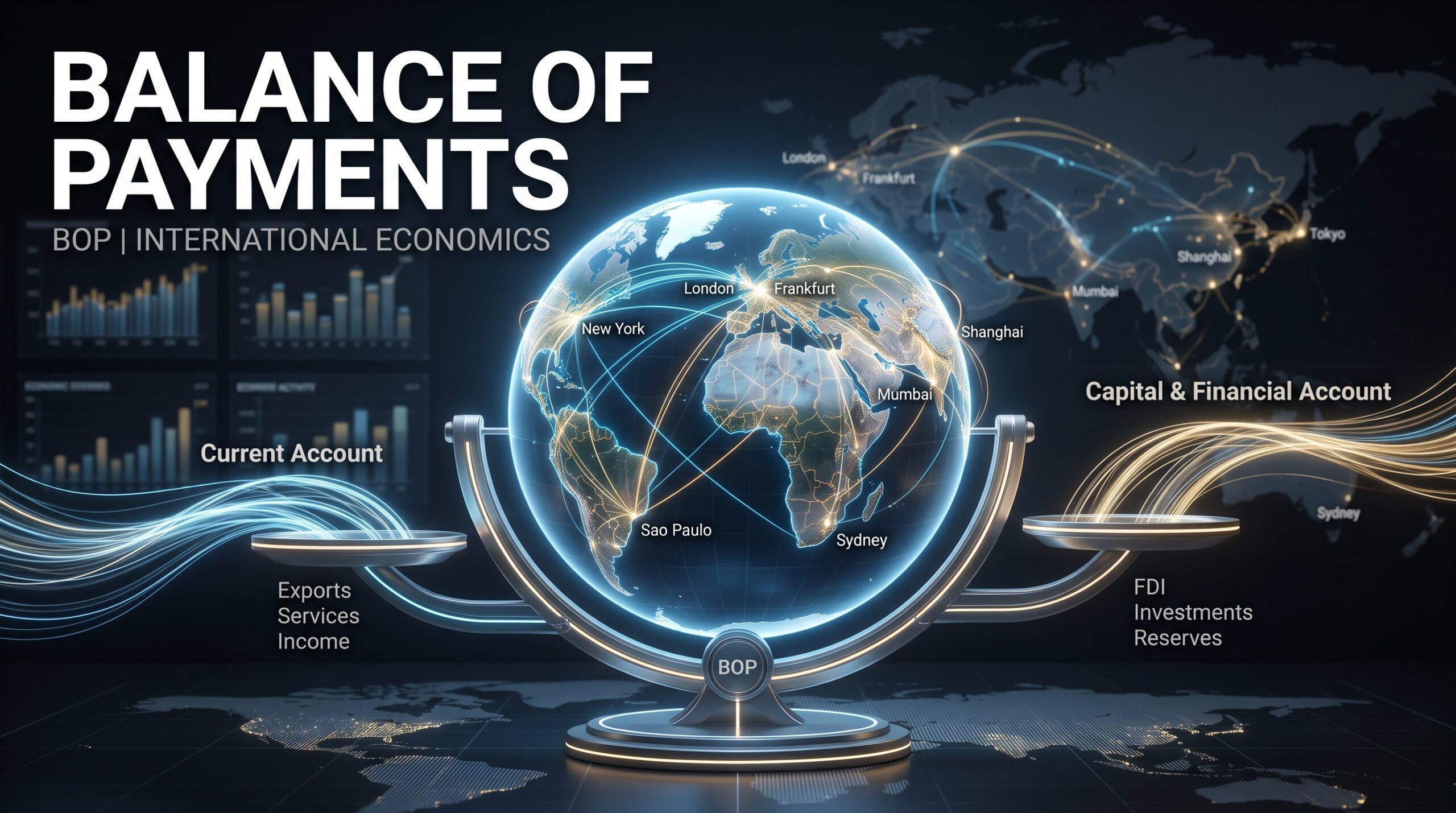
The Ultimate Ledger of a Nation’s International Economic Transactions
The Balance of Payments (BOP) is one of the most comprehensive and critical macroeconomic accounting tools used by economists, financial analysts, and policymakers. It is a systematic record of all economic transactions conducted between the residents of a country (including individuals, businesses, and the government) and the rest of the world over a specific period, typically a quarter or a year.
For platforms like Thefinance.pk and Economy.com.pk, analyzing a nation’s BOP is non-negotiable. While Gross Domestic Product (GDP) measures domestic production, the BOP measures a country’s financial sovereignty, trade competitiveness, and economic connectivity with global markets. If a country is an economic island, the BOP is the detailed logbook of every ship entering and leaving its ports.
The Accounting Identity of BOP
The fundamental rule of Balance of Payments accounting is that it operates on a double-entry bookkeeping system. Every international transaction results in two entries: a credit and a debit. Theoretically, the sum of all elements in the BOP must always equal zero.
$$\text{Current Account} + \text{Capital Account} + \text{Financial Account} + \text{Net Errors and Omissions} = 0$$
In reality, because data collection from thousands of trade ports, banks, and remittance channels is prone to discrepancies, central banks use a balancing item called Net Errors and Omissions to make the ledger balance. When economists talk about a “BOP surplus” or a “BOP deficit,” they are not referring to the entire ledger summing to zero; rather, they are looking at specific sub-accounts—most notably the current account and official reserve assets.
The Three Core Components of the BOP
The Balance of Payments is officially structured into three primary accounts:
1. The Current Account
The Current Account records the flow of goods, services, primary income, and secondary income. It represents the most tangible part of international trade.
- Trade in Goods (Visible Trade): Physical merchandise exports (e.g., textiles, agricultural products) and imports (e.g., machinery, crude oil, electronics).
- Trade in Services (Invisible Trade): Non-physical services such as IT exports, shipping logistics, tourism, insurance, and financial services.
- Primary Income: Compensation paid to non-resident workers and investment income (dividends, interest earned on foreign investments or paid on foreign debt).
- Secondary Income: Current transfers such as worker remittances, foreign aid, and international grants where no direct good or service is received in return. For developing economies like Pakistan, this sub-category—specifically worker remittances—acts as a vital economic cushion.
2. The Capital Account
The Capital Account is relatively small in most economies. It records non-market, non-produced, and intangible asset transfers. This includes the acquisition or disposal of non-produced, non-financial assets (such as patents, copyrights, trademarks, and franchises), as well as debt forgiveness granted by foreign governments.
3. The Financial Account
The Financial Account records international monetary transactions involving financial assets and liabilities. It tracks how a country finances its current account imbalances and invests its surplus capital. It is broken down into four main components:
- Foreign Direct Investment (FDI): Long-term investments where a foreign entity acquires a lasting interest or managerial control in a domestic enterprise (e.g., building a manufacturing plant or acquiring a local telecom company).
- Portfolio Investment: Transactions in financial securities like stocks and bonds. Unlike FDI, portfolio investment is liquid and can enter or leave a country rapidly based on market sentiment.
- Other Investment: Trade credits, loans, currency deposits, and transactions with the International Monetary Fund (IMF).
- Reserve Assets: Foreign currency reserves, gold holdings, and special drawing rights (SDRs) held by the central bank. Changes in reserve assets reflect how the central bank intervened to stabilize the currency.
Why a BOP Crisis Occurs
A Balance of Payments crisis (often referred to as an exchange rate crisis or currency crisis) happens when a country cannot pay for its essential imports or service its external debt obligations because its foreign exchange reserves have been completely depleted.
This typically unfolds through a predictable chain reaction:
- Persistent Current Account Deficits: The country imports vastly more goods and services than it exports, and remittances fail to cover the gap.
- Depleting Reserves: To defend the local currency from crashing, the central bank sells off its foreign exchange reserves (US Dollars, Euros) in the open market.
- Capital Flight: Foreign and domestic investors, sensing economic instability, pull their money out of local stocks and bonds (portfolio investments).
- Exhaustion: Foreign reserves hit critically low levels (sometimes falling below a few weeks’ worth of import cover).
- IMF Bailout: The government is forced to approach international lenders like the IMF for an emergency stabilization program, which usually comes with harsh conditions, including massive interest rate hikes, tax increases, and currency devaluation.
The Strategic Value of BOP Data
For readers of economist.media, monitoring the quarterly BOP statements published by the central bank provides a crystal ball into future economic policy. If the financial account fails to attract enough FDI or loans to cover a widening current account deficit, the writing is on the wall: currency depreciation and policy tightening are imminent. Conversely, a healthy BOP surplus allows a central bank to build up robust foreign reserves, stabilize inflation, and foster investor confidence.
Key Takeaways:
- The Balance of Payments is a complete ledger of all economic transactions between a country and the rest of the world.
- It consists of three main segments: the Current Account, the Capital Account, and the Financial Account.
- Worker remittances and international trade make up the core of the current account in developing nations.
- A BOP crisis occurs when foreign exchange reserves are depleted, forcing nations to seek emergency IMF bailouts.
Authoritative Sources & Further Reading:
- International Monetary Fund (IMF): Balance of Payments Manual (BPM6)
- World Bank: Global Financial Development and BOP Data
- State Bank of Pakistan (SBP): External Sector Statistics
Discover more from The Economy
Subscribe to get the latest posts sent to your email.

Borrowers hoping 2026 would be the year rates finally normalized have instead watched the refinance mortgage market whipsaw by double-digit basis points week to week. On September 10, the average 30-year fixed refinance rate briefly crossed 7%, just three days after sitting at 6.98%, and a week earlier had dropped as low as 7.10% before spiking to 7.29%. That volatility is the story: it isn’t that credit is expensive in any single, stable sense — it’s that the entire yield curve is repricing in real time against a Federal Reserve that may be about to raise rates rather than cut them, a Treasury market absorbing record issuance, and a global economy fragmenting into competing tariff and currency blocs.
For consumers and advisors alike, the operating question for Q4 2026 is no longer “when will rates fall?” — it’s “how do you build a borrowing and savings strategy that is resilient to genuine rate uncertainty in both directions?”
Key Takeaways
- 30-year fixed mortgage rates are oscillating in the 6.7%–7.3% range, with refinance rates typically running higher than purchase rates in September 2026.
- Personal loan rates average 12.2%–12.4% APR for good-credit borrowers (700 FICO), but range from 6.2% at the low end to over 36% for weaker credit profiles.
- High-yield savings accounts are still paying up to 4.2%–4.5% APY, roughly 10–12x the FDIC national average of 0.38%, making cash allocation a genuinely competitive strategy again.
- Refinance applications are up 62% year-over-year even amid rate volatility, driven by borrowers who locked in loans during the 2022–2025 rate-peak years.
- Bankrate’s “Hidden Homeownership Tax” research found 87% of borrowers from that period are overpaying an average of $3,343 a year — a powerful, quantifiable argument for a refinance review.
Refinance Mortgage Rates: Reading Through the Daily Noise
| Rate Type | Approx. Rate (Sept 2026) | 1-Week Range |
|---|---|---|
| 30-year fixed refinance | 6.98%–7.29% | ~30 bps swing |
| 30-year fixed purchase | 6.67%–6.73% | Typically 5–10 bps below refi |
| 15-year fixed refinance | ~6.05%–6.12% | Comfortably under 6.5% |
| 5/1 ARM | 6.64%–7.03% | Most volatile product this month |
The single most important structural fact for any client-facing conversation about refinance mortgage decisions right now: rates don’t track the Fed funds rate directly — they track the 10-year Treasury yield, which is itself being pushed higher by mounting concern over U.S. government debt issuance. When the Treasury announced plans to buy back only $6 billion in longer-term debt in early September — smaller than markets had hoped — yields moved higher and mortgage rates followed within days. This is the fragmentation dynamic in miniature: fiscal policy, not just monetary policy, is now a primary driver of household borrowing costs.
The Refinance Math That Actually Matters
Industry convention has long cited a “1% or 2% lower rate” rule of thumb for when refinancing makes sense, but Bankrate’s own research complicates that shorthand. Consider the payment difference on a $400,000 mortgage:
| Loan Structure | Rate | Monthly P&I | Total Interest Over Life of Loan |
|---|---|---|---|
| 30-year fixed | 6.19% | ~$2,447 | ~$481,021 |
| 15-year fixed | 5.65% | ~$3,300 | ~$194,047 |
The 15-year option cuts total interest paid by more than half — but at a monthly payment nearly $850 higher. For a wealth management advisory or mortgage broker, the right question isn’t “which rate is lower” but “does the client’s cash-flow profile support the shorter term, or does rate-locking on a 30-year with an eye toward a future refinance make more sense given continued volatility?”
Practical refinance triggers for Q4 2026:
- Current rate is at least 1 full percentage point above prevailing refinance rates (the Bankrate “overpaying” research suggests even smaller gaps can justify a review).
- Borrower can eliminate private mortgage insurance (PMI) through home-value appreciation.
- Borrower is consolidating high-interest debt (credit cards, personal loans above 15% APR) into a cash-out refinance at a materially lower blended rate.
- Borrower’s original loan dates to the 2022–2025 rate-peak window — Bankrate data shows this cohort is the most likely to be structurally overpaying.
Personal Loan Rates: A Wide and Widening Spread
Personal loan rates in September 2026 illustrate just how bifurcated consumer credit has become. Bankrate Monitor data puts the average rate at 12.2%–12.4% for a borrower with a 700 FICO score, $5,000 loan amount, and three-year term — but that average masks an enormous range:
| Lender Type | Typical Rate Range | Notes |
|---|---|---|
| Credit unions | 10.6%–10.7% average | Federal rate cap of 18%; best value for members |
| Online fintech lenders | 6.2%–36%+ | Widest range; best rates require excellent credit |
| Commercial banks | ~12.1% average | Requires strong credit and existing relationship |
| Borrowers with 720+ credit (Credible data) | 14.36% (3-yr) / 17.92% (5-yr) | Rose ~0.4 points week-over-week in early Sept |
The spread between a 6.2% best-case rate and a 36% worst-case rate on the same product category is the clearest illustration of “fragmented economy” at the household level: creditworthy borrowers are still finding attractively priced capital, while subprime and near-prime borrowers are facing genuinely punitive terms. For a $10,000 three-year personal loan, total interest costs range from roughly $1,800 at the best tier to $5,300 at the worst — a difference that dwarfs most other financial-planning line items for a middle-income household.
When a Personal Loan Beats a Cash-Out Refinance
- Loan amount is small relative to home equity — refinance closing costs (typically 2–5% of loan value) can erase the benefit of a marginally lower rate.
- Borrower needs funds fast — personal loans typically fund in days; refinances take 30–45 days to close.
- Borrower does not want to reset the amortization clock on their primary mortgage or risk their home as collateral for a non-housing expense.
High-Yield Savings: The Overlooked Half of the Borrowing Conversation
While borrowing costs dominate headlines, the high-yield savings side of the ledger is arguably the more actionable opportunity for most households right now. Top accounts are paying 4.15%–4.5% APY, and select credit-union products have been advertised as high as 10% APY on capped balances. Against a 0.38% national average, this is a 10x-plus differential that costs nothing to capture — no credit check, no underwriting, no risk beyond standard FDIC/NCUA insurance limits.
| Account Type | Typical APY (Sept 2026) | Best Use Case |
|---|---|---|
| Standard high-yield savings | 4.0%–4.5% | Emergency fund, short-term goals |
| Promotional/boosted rate accounts | Up to 4.91% (min. $25K deposit) | Larger cash reserves |
| Credit union tiered accounts | Up to 10% (capped balance) | Small, disciplined savings habit |
| Traditional bank savings | ~0.38% national average | Avoid for anything beyond transactional cash |
The strategic point for a wealth management advisory conversation: in a fragmented, volatile-rate environment, cash is no longer “dead money.” A properly allocated high-yield savings or money-market position can now do real work in a client’s balance sheet while borrowing decisions play out.
FAQ
Should I refinance my mortgage now or wait for lower rates?
With 30-year refinance rates swinging between roughly 6.7% and 7.3% week to week in September 2026, timing the exact bottom is unrealistic. Borrowers whose current rate sits at least a full percentage point above prevailing rates, or who can eliminate PMI, generally benefit from refinancing now rather than trying to time further Fed-driven moves.
What credit score do I need for the best personal loan rates?
Rates as low as 6.2% are generally reserved for borrowers with excellent credit (typically 720+ FICO) applying through online fintech lenders. Borrowers with good but not excellent credit (690–719) are seeing average rates closer to 14–19.5% depending on the lender and term.
Is a high-yield savings account still worth it if the Fed might raise rates?
Yes — HYSA rates have stayed in the 4%+ range through 2026 and would likely rise further if the Fed hikes, making this a rare environment where waiting to open an account costs a household meaningful, quantifiable yield with essentially no downside risk.
Why are refinance rates higher than purchase rates right now?
Refinance rates typically carry a small premium over purchase rates because lenders price in different risk and volume assumptions for refinance transactions; in September 2026 that gap has run roughly 5–14 basis points depending on the loan product.
Discover more from The Economy
Subscribe to get the latest posts sent to your email.

The reliable “tells” that once let a wary consumer spot a scam call — bad grammar, robotic cadence, obvious accent mismatches — have largely disappeared. In 2026, an AI-generated voice can convincingly clone a real person from as little as three to ten seconds of audio, adapt its script in real time under questioning, and pass through a spoofed number that appears to originate from a legitimate bank fraud line. The result is a category of fraud that has moved from a nuisance to a board-level risk, forcing financial institutions to rewrite verification protocols that have gone essentially unchanged for a decade.
Key Takeaways
- Financial institutions reported a 32% rise in deepfake-related fraud attempts in 2025, with over 10% of banks reporting individual deepfake vishing losses exceeding $1 million per case.
- Fraudsters need as little as 3–10 seconds of audio to clone a voice convincingly, with deepfake audio now achieving over 90% accuracy in mimicking real voices, according to multiple 2026 fraud research compilations.
- Vishing now accounts for over 60% of phishing-related incident response engagements, and in more than 80% of voice phishing attacks, attackers use spoofed caller IDs to make calls appear to originate from legitimate numbers.
- The 2024 Arup case remains the reference incident for enterprise risk: an employee at the UK engineering firm authorized 15 wire transactions totaling $25.6 million after joining a video call featuring convincing real-time deepfakes of the company’s CFO and several executives.
- Verizon’s 2026 Data Breach Investigations Report tracks pretexting (synchronous voice or chat manipulation) at 6% of initial access vectors, with phone-based phishing simulations showing a median click rate roughly 40% higher than email-based simulations.
Why Deepfake Vishing Broke the Old Verification Model
Voice-based identity verification has historically relied on a simple, largely unstated assumption: that a familiar voice, speaking in a familiar and contextually appropriate way, is a reasonably reliable signal of identity. That assumption depended on voice cloning being expensive, technically demanding, and largely confined to research labs and high-budget production environments. That constraint dissolved in 2024 and 2025, as open-source models, real-time inference, and cheap, abundant compute closed the technical gap — reducing the cost of a convincing voice-cloning attack from what industry practitioners describe as a “research lab” undertaking to a “weekend project.”
The critical architectural failure this exposes: any verification process that depends on a human listening to a voice and confirming it “sounds right” can now be defeated by AI, because the voice only needs to be convincing under pressure — not indefinitely, and not against forensic scrutiny, just long enough to complete a transaction.
First-Generation vs. Second-Generation AI Vishing
The evolution of AI voice phishing across 2025 and 2026 illustrates why static defenses have consistently fallen behind:
- First-generation (pre-rendered audio): Attackers scripted a short call, generated the audio in advance, and played it through a SIP gateway. Defenders could reliably defeat this by throwing the call off-script — asking an unexpected question, requesting a callback, or changing the topic — because pre-rendered audio could not adapt.
- Second-generation (real-time inference, 2025–2026): Real-time inference services now synthesize responses inside the call itself, with end-to-end latency low enough to feel like a normal conversation. The off-script defense that worked reliably against first-generation attacks is substantially weaker against a system that can adapt its responses live.
This progression matters directly for bank security protocol design: verification procedures built around the assumption that unpredictable questioning defeats vishing are now defending against a threat model that no longer exists in its original form.
The Arup Case: What $25.6 Million Bought as a Lesson
The 2024 Arup incident remains the most frequently cited case study in 2026 vishing analysis, and for good reason: it demonstrates the failure mode at enterprise scale. An employee at the UK engineering firm joined what appeared to be a routine video conference featuring the company’s CFO and several senior executives — everyone looked right, and everyone sounded right. The employee authorized 15 separate transactions totaling $25.6 million to Hong Kong bank accounts before the fraud was identified. The case has become the reference point specifically because it defeated not just voice verification but visual verification simultaneously, illustrating that multi-channel deepfake attacks — voice plus video plus contextually accurate scripting — represent the frontier threat model banks and enterprises must now defend against, not single-channel voice calls in isolation.
How Banks Are Rewriting Security Protocols in 2026
Several concrete protocol shifts are emerging across financial institutions in response to this threat environment:
- Out-of-band verification as a hard requirement. The consistent recommendation across 2026 fraud research is to verify any high-risk request on a channel the caller does not control — for example, calling back through an independently sourced phone number rather than a number provided during the suspicious call itself, or confirming through a separate app-based channel.
- Behavioral and telephony metadata analysis over voice recognition alone. Since caller identity and voice familiarity are no longer sufficient trust signals in high-risk workflows, leading practitioners now emphasize behavioral detection and telephony metadata analysis — call origination patterns, timing anomalies, SIP routing irregularities — as stronger risk signals than voice identity checks.
- Mandatory delay windows for high-value transfers. Given that wire recall success rates drop sharply after the first six hours following a fraudulent transfer, banks are increasingly building mandatory cooling-off periods for large or unusual transfers specifically to create a window for after-the-fact verification.
- Pre-established fraud team relationships. Practitioner guidance increasingly recommends that businesses establish a relationship with their bank’s fraud team before an incident occurs, since wire recall procedures, session revocation, and credential rotation all move faster when a pre-existing escalation path exists.
- No-blame reporting culture. Because deepfake vishing has higher success rates than traditional email phishing due to its emotional-manipulation component, organizations that punish employees for falling victim risk delayed incident discovery; a no-blame reporting culture surfaces incidents in real time rather than days later.
The Data Gap: Where Awareness Training Is Misallocated
A notable finding from 2026 security awareness research is a significant mismatch between actual risk and training prioritization: while 73% of security leaders prioritize phishing reporting training, only 10% prioritize deepfake recognition training specifically — despite 35% of organizations having already experienced a deepfake incident, according to Gartner’s 2025 AI Risk Management Survey. Phone-based phishing simulations show a median click rate roughly 40% higher than email-based simulations, according to Verizon’s 2026 Data Breach Investigations Report, suggesting that voice-channel vulnerability is measurably higher than email-channel vulnerability even as training investment remains skewed toward the latter.
A Practical Vishing Incident Response Framework
- Pre-written wire recall playbook, covering bank fraud-team contact procedures, session revocation, credential rotation, and forensic capture of call metadata
- Mandatory callback verification through independently sourced contact information for any request involving funds transfer, credential reset, or access changes
- Layered channel verification for high-risk requests — requiring confirmation through at least two independent channels (e.g., a callback plus an internal messaging system confirmation) rather than relying on any single channel, however convincing
- Regular, realistic vishing simulation exercises modeled on actual scenarios (bank fraud alerts, executive impersonation, SaaS support calls) rather than generic phishing awareness content alone, given the roughly 40% higher click-through vulnerability documented on phone-based channels
Frequently Asked Questions
How much audio does it take to clone someone’s voice in 2026?
As little as 3 to 10 seconds of audio is sufficient to produce a convincing voice clone using current AI tools, with resulting deepfake audio achieving over 90% accuracy in mimicking the real voice.
What was the Arup deepfake case?
In 2024, an employee at UK engineering firm Arup authorized 15 wire transactions totaling $25.6 million after joining a video call featuring real-time deepfakes of the company’s CFO and several executives — a case widely cited as the reference incident for enterprise multi-channel deepfake fraud risk.
How are banks defending against AI voice phishing in 2026?
Banks are shifting toward out-of-band verification on channels the caller cannot control, behavioral and telephony metadata analysis instead of voice-identity checks alone, mandatory delay windows for high-value transfers, and pre-established fraud-team relationships to speed wire recalls.
Conclusion
The 2026 vishing threat landscape reflects a broader pattern seen across AI-enabled fraud: the technology did not create a new category of crime so much as it removed the practical constraints — cost, technical skill, adaptability — that previously kept an old category of crime in check. Financial institutions rewriting security protocols around out-of-band verification, behavioral metadata, and multi-channel confirmation are responding to a threat model where “it sounded right” and “it looked right” have both stopped being reliable signals of anything at all.
Discover more from The Economy
Subscribe to get the latest posts sent to your email.

Crypto Daily Outlook: Bitcoin, Altcoins, and the Future of Decentralized Finance

Anthony Scaramucci’s Crypto Prediction: Why MicroStrategy’s Move Is Bitcoin’s “iPhone Moment”

Best Dividend Stocks 2026: European & Asian Blue Chips

World Bank & IMF Reports 2026: Why the “3% Growth” Consensus Is Actually a Debate

Elon Musk’s Boring Company Hits $23B Valuation After UAE-Led $3 Billion Series D

Middle East War Economics 2026: Oil Prices & Energy Markets

PSX Forecast 2026: KSE-100, IMF Reviews & Geopolitics

Asian Markets Outlook 2026: China, Japan & Singapore Stocks

Global Economy 2026: IMF Growth, Inflation & Private Credit

Current Account Deficit (CAD) : Causes and Impact

Balance of Payments (BOP)

The Falkland Islands Dispute: Sovereign Wealth, Offshore Drilling, and Market Impacts

Gross Domestic Product (GDP): Nominal vs. Real

What is Inflation and the Consumer Price Index (CPI)?

State Farm’s $5B Dividend 2026: Who Qualifies & Payout Dates

US-China Relations in Q3 2026: Trade Tariffs and Supply Chain Risks

Gold’s Wild 2026: From a Record $5,600 Peak to a 24% Crash and Back Toward $4,500

Oil Surges as Strait of Hormuz Traffic Collapses Again

The Rocket That Won’t Quit: Inside SpaceX’s Falcon 9 Launch Machine

Bank of England Set to Hold Rates Through Year-End, Reuters Poll Shows

SpaceX Starship Flight 14: First Orbital Attempt & Starlink V3 Launch Explained

The 2026 Crypto Regulatory Shift: What It Means for Institutional Investors

AI Chip Stocks 2026: The Best Semiconductor Investments Beyond Marvell

Retail Earnings Week: What Home Depot, Target & Walmart Reveal

AI-Powered Training: The Next Multi-Billion Dollar Ecosystem in Fitness

Top 30 Stocks for Investment in PSX for Massive ROI in 2026

Tween Back-to-School Trends 2026: What’s Driving the $85B Season

Russia’s Black Sea Oil Exports Fall for a Fifth Straight Week
-

 Markets & Finance8 months ago
Top 15 Stocks for Investment in 2026 in PSX: Your Complete Guide to Pakistan’s Best Investment Opportunities
-

 Analysis7 months ago
Johor’s Investment Boom: The Hidden Costs Behind Malaysia’s Most Ambitious Economic Surge
-

 Analysis7 months ago
Top 10 Stocks for Investment in PSX for Quick Returns in 2026
-

 Analysis7 months ago
Brazil’s Rare Earth Race: US, EU, and China Compete for Critical Minerals as Tensions Rise
-

 Banks8 months ago
Best Investments in Pakistan 2026: Top 10 Low-Price Shares and Long-Term Picks for the PSX
-

 Investment8 months ago
Top 10 Mutual Fund Managers in Pakistan for Investment in 2026: A Comprehensive Guide for Optimal Returns
-

 Global Economy9 months ago
15 Most Lucrative Sectors for Investment in Pakistan: A 2025 Data-Driven Analysis
-

 Global Economy9 months ago
Pakistan’s Export Goldmine: 10 Game-Changing Markets Where Pakistani Businesses Are Winning Big in 2025