
Bitcoin
Bitcoin Holds Near $90,000 as Fed Decision and Mag 7 Earnings Loom


Bitcoin trades near $90,000 ahead of the Federal Reserve’s January 2026 rate decision, with a weaker dollar and Magnificent Seven earnings driving risk appetite. Explore crypto’s cautious response, Fed pause expectations, and key market catalysts in this in-depth analysis.
On January 28, 2026, Bitcoin has settled into a familiar pattern: modest gains, quiet consolidation, and a stubborn refusal to breach the $90,000 threshold that has loomed large for weeks. As of late afternoon in Karachi—mid-morning in New York—the flagship cryptocurrency traded at approximately $89,250, up fractionally on the day , extending its recent resilience. Across the broader market, major tokens posted small but positive moves, yet the enthusiasm felt restrained, almost tentative.

This muted crypto rally unfolds against a classically risk-on backdrop in traditional markets. The US dollar index (DXY) has slipped to around 95.70, its lowest in years . Yet cryptocurrency, so often the vanguard of speculative exuberance, has played second fiddle—stabilising rather than leading the charge.
The Federal Reserve’s Delicate Balancing Act
Today marks the conclusion of the Federal Open Market Committee’s first meeting of 2026 .
For risk assets, the implications are nuanced. Lower rates would typically benefit non-yielding assets like Bitcoin and gold alike. Yet the dollar’s decline so far has favoured traditional safe havens and industrial commodities over digital assets, underscoring crypto’s evolving identity: neither pure “digital gold” nor uncomplicated risk play.
The Magnificent Seven’s Make-or-Break Moment
This week also brings earnings from four of the Magnificent Seven—Meta Platforms, Microsoft, Tesla, and Apple—companies whose performance has long served as a barometer for broader risk appetite .
The stakes are high. After a stellar 2025 driven by artificial intelligence optimism, investors are looking for evidence that capital expenditures on AI infrastructure will translate into tangible revenue growth. A strong showing could propel the Nasdaq toward fresh records, dragging risk-sensitive assets—including cryptocurrencies—higher in its wake .
A Weaker Dollar, But Crypto Lags Behind
The dollar’s retreat—down more than 7 per cent from its September peak—has provided classic tailwinds for hard assets . Gold’s surge reflects its status as the traditional beneficiary of currency debasement fears. Silver, with its dual role as monetary and industrial metal, has benefited even more. Cryptocurrency, by contrast, has merely stabilised.
Several factors explain the divergence. First, leverage in crypto futures markets has declined markedly from the peaks seen in late 2025. Open interest on major exchanges is down roughly 25 per cent from November highs . Liquidation clusters remain densely packed above $90,000 and below $85,000, levels that could cap near-term momentum or accelerate a reversal.
Second, opportunity cost dynamics persist. Even with rates on hold, real yields on short-dated Treasuries remain positive, offering a low-risk alternative to holding non-yielding Bitcoin .
Why Caution Prevails Despite Tailwinds
| Asset | 24-Hour Change | Weekly Change | Key Driver |
|---|---|---|---|
| Bitcoin (BTC) | +0.8% | +3.2% | Fed pause anticipation, Nasdaq correlation |
| Ether (ETH) | +2.1% | +5.4% | Staking yield appeal, layer-2 momentum |
| Solana (SOL) | +1.9% | +7.1% | DeFi activity recovery |
| Gold | +1.4% | +4.6% | Weaker dollar, safe-haven flows |
| Silver | +2.7% | +8.3% | Industrial + monetary demand |
| Nasdaq 100 | +0.6% (futures) | +2.9% | Mag 7 earnings optimism |
(Source: CoinGecko, Bloomberg – as of January 28, 2026, 16:00 PKT)
The table above illustrates the relative underperformance clearly. While precious metals have captured the dollar’s decline most directly, cryptocurrencies have posted respectable but hardly standout gains. Market participants cite deleveraging aftermath, regulatory caution, and technical resistance near all-time highs as restraining factors .
Outlook: Balancing Catalysts and Risks
The coming days offer a rare confluence of high-impact events. A dovish Fed—signalling cuts as early as March—combined with robust Magnificent Seven earnings could propel Bitcoin convincingly above $90,000, reopening the path toward six figures that many long-term holders still anticipate. The weaker dollar would provide additional support, particularly if it breaches 95 on the DXY.
Yet risks loom symmetrically. Should Powell emphasise lingering inflation risks and push back firmly against early easing, the dollar could stabilise or rebound, pressuring risk assets broadly . Disappointing tech earnings—particularly any hint that AI monetisation is slower than expected—might trigger a risk-off move, exposing crypto’s vulnerability when traditional growth leaders falter.
In this environment, cryptocurrency’s behaviour is instructive. No longer the pure speculative rocket of earlier cycles, it increasingly trades as a macro-sensitive asset—responsive to interest rates, dollar dynamics, and equity sentiment, yet not fully decoupled from its own internal rhythms of leverage and liquidity.
For now, Bitcoin holds near $90,000 not out of indecision, but deliberation. The market awaits clarity from Washington and Silicon Valley before committing to its next decisive leg. Investors, both institutional and individual, would do well to watch not only price action in crypto, but the performance of gold, the dollar, and the tech giants that still set the tone for global risk.
Discover more from The Economy
Subscribe to get the latest posts sent to your email.


Global Economy
Crypto’s Battle with the Banks is Splitting Trump’s Base: The Stablecoin Yield War That Could Reshape American Finance
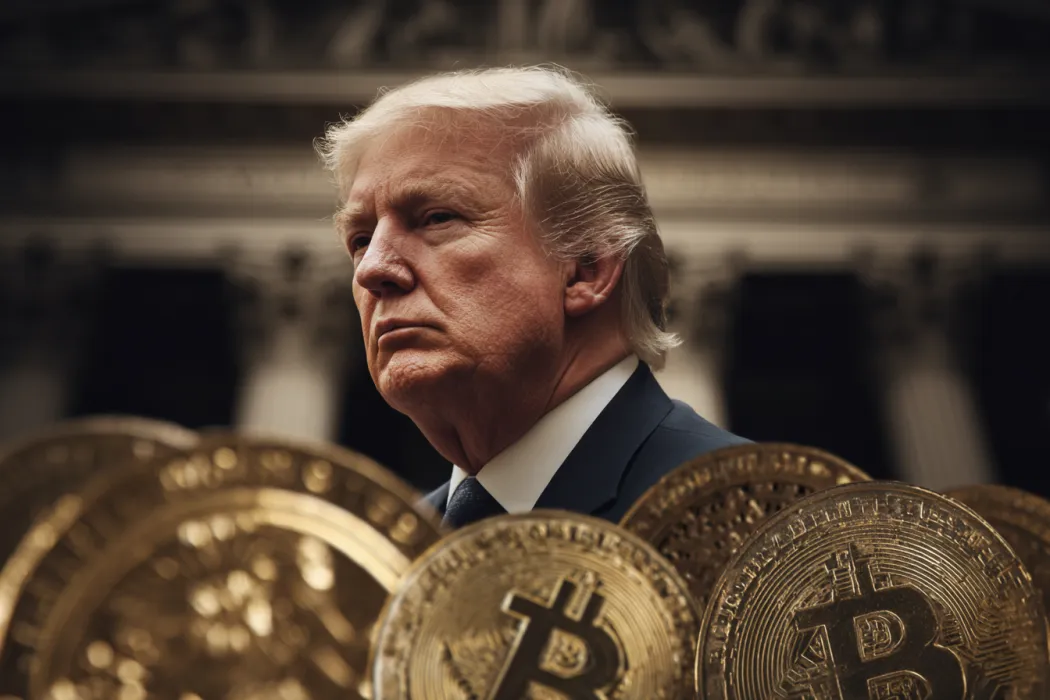
When President Donald Trump signed the GENIUS Act into law last July, the ceremony in the Rose Garden felt like a victory lap for his pro-crypto coalition. Brian Armstrong smiled for the cameras. Banks sent polite congratulations. Everyone claimed a win. Nine months later, that fragile truce has detonated into open warfare—and Trump finds himself caught between two factions of his own base, each demanding he choose a side in a fight that could determine whether traditional banking survives the digital age.
At stake is something far more consequential than regulatory minutiae: the future of roughly $18 trillion in U.S. bank deposits, and whether stablecoins—those dollar-pegged digital tokens—will function as benign payment rails or become what one bank executive privately called “digital vampires” draining the lifeblood from America’s financial system.
The Powder Keg: How Stablecoin Regulation Became Trump’s Toughest Call
The February 10, 2026 White House meeting wasn’t supposed to make headlines. Senior officials from Treasury, the Federal Reserve, and representatives from JPMorgan Chase, Bank of America, and Citigroup gathered ostensibly to “align on implementation frameworks” for stablecoin regulation. What actually transpired, according to three people familiar with the discussions, was a full-court press by traditional banks for a total prohibition on stablecoin yields—a move that would fundamentally alter the competitive landscape between crypto and conventional banking.
“They came with charts, projections, doomsday scenarios,” one White House adviser told reporters on background. “The message was clear: it’s us or them.”
The banks’ anxiety isn’t unfounded. Treasury Department estimates, first reported by CryptoSlate, suggest that without yield restrictions, stablecoins could attract between $500 billion and a staggering $6.6 trillion in deposits over the next decade—money that would otherwise sit in checking and savings accounts at traditional financial institutions. Standard Chartered’s more conservative forecast still projects $500 billion in bank deposit flight by 2028, enough to trigger capital adequacy concerns and force major institutions to restructure their balance sheets.
For context, that upper-end $6.6 trillion figure represents more than one-third of all U.S. bank deposits. It’s not an extinction event for banking, but it’s the financial equivalent of watching the ocean recede before a tsunami.
The GENIUS Act vs. The CLARITY Act: Two Visions, One Industry
Understanding this split requires decoding the legislative alphabet soup that’s consumed Washington’s crypto policy apparatus for the past year.
The GENIUS Act (Guiding and Ensuring Network Innovation for U.S. Stablecoins), signed by Trump in July 2025, was supposed to be the grand compromise. It established a federal framework for stablecoin issuers, mandated dollar-for-dollar backing with short-term Treasuries, and crucially, prohibited stablecoin issuers themselves from paying yields directly to token holders. The rationale, articulated by Treasury Secretary Scott Bessent at the signing, was to prevent stablecoins from becoming “unregulated money market funds in disguise.”
But here’s where the legal architecture gets interesting—and where the current battle lines have formed. While the GENIUS Act banned issuer yields, it explicitly permitted third-party platforms to offer rewards programs built on top of stablecoins. Think of it like credit card rewards: Visa doesn’t pay you 2% cashback, but Chase does for using its Visa card.
Crypto platforms immediately saw the loophole—or as they’d argue, the intentional design feature. Companies like Coinbase and Circle began structuring DeFi protocols and yield-bearing products that technically comply with the no-issuer-yield rule while effectively delivering returns to stablecoin holders. Some programs tout annual percentage yields of 4-6%, funded through lending protocols, transaction fees, and strategic partnerships.
The CLARITY Act (Comprehensive Legislation for Accountability and Regulatory Implementation in Tokenized Yields), by contrast, represents the banks’ preferred endgame. Introduced in the Senate last fall but currently stalled amid midterm political calculations, the bill would slam shut the third-party yield door entirely. Under its provisions, any entity—issuer, exchange, DeFi protocol, or intermediary—would be prohibited from offering compensation, rewards, or yields on stablecoin holdings above de minimis levels (defined as 0.1% annually).
“It’s the difference between competitive innovation and regulatory capture,” argues Coinbase CEO Brian Armstrong, who has emerged as the crypto industry’s most vocal opponent of the CLARITY Act’s yield ban. “Banks want to use government power to eliminate competition they can’t match through better service.”
Trump’s Tightrope: When Your Base Pulls in Opposite Directions
Donald Trump built his 2024 campaign partly on a promise to make America the “crypto capital of the world.” He accepted campaign donations in Bitcoin, spoke at crypto conferences, and stacked his administration with blockchain enthusiasts. His base includes everyone from Silicon Valley libertarians to Main Street bank executives—groups that rarely find themselves on the same side of regulatory debates.
Until now, that coalition worked. But the stablecoin yield ban debate has exposed the fault line between pro-crypto innovation advocates and financial stability traditionalists, both of whom consider themselves Trump allies.
On one side: tech entrepreneurs, crypto venture capitalists, and digital asset companies who funded super PACs supporting Trump and expected a light regulatory touch in return. They view stablecoins as the future of payments—faster, cheaper, and more accessible than legacy banking infrastructure. To them, yield bans are anti-competitive protectionism that would cripple American innovation and hand leadership to overseas competitors.
On the other: regional and national banks, whose executives contributed heavily to Trump’s campaign and who now face an existential question about their deposit base. At the World Economic Forum in Davos last month, JPMorgan Chase CEO Jamie Dimon didn’t mince words when asked about Armstrong’s position: “Brian is a smart guy running a valuable company, but he’s also fighting for his business model. Let’s not confuse entrepreneurial ambition with what’s best for financial stability.”
The split has gotten personal. Armstrong has publicly accused banks of orchestrating a coordinated lobbying campaign to “weaponize regulation” against competitors. Banking trade associations have fired back, arguing that yield-bearing stablecoins create systemic risk and could trigger bank runs during financial stress.
Trump’s response so far has been characteristic: strategic ambiguity. He’s praised “both sides” while declining to endorse the CLARITY Act explicitly. White House sources suggest he’s personally conflicted, appreciating the innovation story but nervous about bank CEOs warning of deposit flight and financial instability.
The Yield Debate: Innovation or Financial Alchemy?
Strip away the political theater, and the core dispute is surprisingly straightforward: should digital dollars be able to compete with bank accounts on interest rates?
The crypto argument runs like this: Stablecoins are more efficient than traditional banking. They don’t require expensive branch networks, legacy IT systems, or armies of compliance officers. That efficiency should translate into better returns for consumers. When DeFi protocols lend out stablecoins and earn interest, sharing those returns with token holders is just good business—the same model banks have used for centuries, just executed with smart contracts and blockchain rails.
Moreover, crypto advocates argue, the distinction between “issuer yields” and “third-party rewards” is economically meaningless. If Circle can’t pay yields on USDC but Coinbase can structure a wrapper product that does, you’ve simply added unnecessary complexity without achieving the policy goal. Better to allow transparent, well-regulated yield products than push activity into unregulated grey markets.
The banking counterargument emphasizes systemic risk and competitive fairness. Banks are subject to stringent capital requirements, stress testing, deposit insurance assessments, and extensive regulatory oversight—costs that translate to lower yields for depositors. Allowing stablecoins to offer higher returns without equivalent regulatory burden isn’t innovation; it’s regulatory arbitrage.
Furthermore, banks argue, yield-bearing stablecoins could exacerbate financial instability. During market stress, depositors might rapidly convert bank deposits to higher-yielding stablecoins, triggering the exact bank run dynamics that deposit insurance and Federal Reserve support are designed to prevent. The stability of the banking system depends on sticky deposits; making digital alternatives more attractive could undermine that foundation.
There’s also the matter of dollar dominance in global finance. Some analysts worry that if stablecoins become primarily yield-bearing investment vehicles rather than transaction mediums, they might attract regulatory crackdowns from the SEC as unregistered securities—potentially fragmenting the very innovation ecosystem Trump claims to support.
What February 2026 Tells Us: The Pressure Is Building
The immediate catalyst for the current crisis was the banks’ escalation strategy. Following the February 10 White House meeting, major financial institutions delivered a joint principles document to Congressional leadership—an unusual move that signals coordinated advocacy at the highest levels. The document, obtained by Politico, frames the debate in stark terms: either impose comprehensive yield bans or accept “the systematic dismantling of the traditional deposit base that has funded American economic growth for generations.”
Trump administration officials have reportedly set an internal deadline of March 1 to formulate a unified position, though sources caution that deadline might slip given the political sensitivity. The timing is particularly awkward given approaching midterm elections, where both crypto-friendly Republicans and banking-sector Democrats are jockeying for advantage.
Meanwhile, the CLARITY Act remains in legislative purgatory. Senate Banking Committee Chairman (name varies by political composition) has the votes to advance the bill, but several swing-state senators face pressure from both sides. Crypto industry PACs have threatened to fund primary challengers; banking associations have reminded lawmakers which sectors employ the most constituents.
Beyond Politics: What’s Really at Stake
Zoom out from the immediate political drama, and the stablecoin yield fight represents something larger: the latest chapter in an ongoing battle over whether technology will disrupt or complement traditional financial infrastructure.
History offers mixed lessons. Credit card networks didn’t destroy banks; they partnered with them. But online-only banks like Chime and SoFi have captured market share by offering better rates and user experiences, forcing incumbents to modernize. Money market funds, created in the 1970s, did siphon deposits from banks—prompting regulatory reforms that ultimately benefited consumers through competition.
The question is whether stablecoins represent evolutionary competition or revolutionary displacement. If they’re the former, yield restrictions might constitute unwarranted protectionism. If the latter, some guardrails might indeed be necessary to prevent financial instability.
What makes this fight uniquely complex is its intersection with geopolitics. U.S. stablecoins currently dominate global crypto markets, representing a form of digital dollar hegemony that extends American financial influence worldwide. But overly restrictive domestic regulations could push issuers offshore, fragmenting markets and potentially benefiting competitors in Asia or Europe.
Trump’s Commerce Secretary recently noted that China is watching American crypto policy closely, hoping regulatory overreach will create opportunities for yuan-denominated stablecoins to gain market share in international trade. That national security dimension adds another layer to Trump’s calculation.
The Path Forward: Compromise, Capitulation, or Continued Chaos?
Industry insiders are gaming out three scenarios for how this resolves:
Scenario One: The Grand Bargain. Trump brokers a compromise that caps third-party yields at moderate levels (say, 2-3% annually)—enough to allow crypto platforms to compete but not enough to trigger mass deposit flight. Banks accept some competitive pressure; crypto companies accept some restrictions. Both sides claim victory, legislation passes, and markets find equilibrium.
Scenario Two: Crypto Wins. Midterm election dynamics and public pressure force Congressional opponents to abandon the CLARITY Act. The GENIUS Act framework stands, third-party yields proliferate, and banks adapt by either acquiring crypto platforms or launching their own digital asset offerings. The banking lobby loses this round but continues fighting through regulatory agencies.
Scenario Three: Status Quo Gridlock. No additional legislation passes; the GENIUS Act remains the governing framework; legal ambiguity persists around third-party yields; and the issue gets decided through enforcement actions, agency rulemaking, and years of litigation. Markets hate uncertainty, but Washington delivers it anyway.
Prediction markets currently give the Grand Bargain scenario roughly 40% odds, Status Quo Gridlock 35%, and Crypto Wins 25%. But those probabilities shift with every Trump tweet and every banking lobby meeting.
Conclusion: A Defining Moment for Digital Finance
The stablecoin yield war of 2026 will likely be remembered as a hinge point—the moment when American policymakers either embraced digital finance innovation or retreated into protectionism and incumbency advantage.
For Trump, the stakes are both political and historical. His pro-crypto brand depends on following through on campaign promises, but his relationships with banking sector allies matter for both fundraising and economic credibility. Choose innovation too aggressively, and you risk financial instability narratives. Choose stability too conservatively, and you alienate the tech base that helped deliver your victory.
The deeper truth is that this fight transcends Trump or any individual political figure. The questions raised—how to balance innovation with stability, how to regulate emerging technologies without stifling them, how to maintain American competitiveness while ensuring consumer protection—will define financial policy for the next generation.
Stablecoins aren’t going away. Banks aren’t disappearing. The only question is whether these two forces will forge an uncomfortable partnership or wage a protracted war of attrition that benefits neither side.
As the March 1 deadline approaches, Washington insiders are watching closely. The decision Trump makes—or avoids—will echo far beyond the crypto world, shaping perceptions of American regulatory philosophy, signaling our approach to financial innovation, and potentially determining whether the next generation of digital finance is built in San Francisco, Shanghai, or Singapore.
One senior banker, speaking anonymously after the February 10 White House meeting, put it bluntly: “We’re not just fighting over basis points and yield curves. We’re fighting over what the word ‘deposit’ means in the 21st century. And whoever wins that fight wins the future of finance.”
The battle has been joined. Trump’s base is split. And the financial world is watching to see whether America’s traditional banking system and its crypto insurgency can coexist—or whether only one can survive.
Discover more from The Economy
Subscribe to get the latest posts sent to your email.
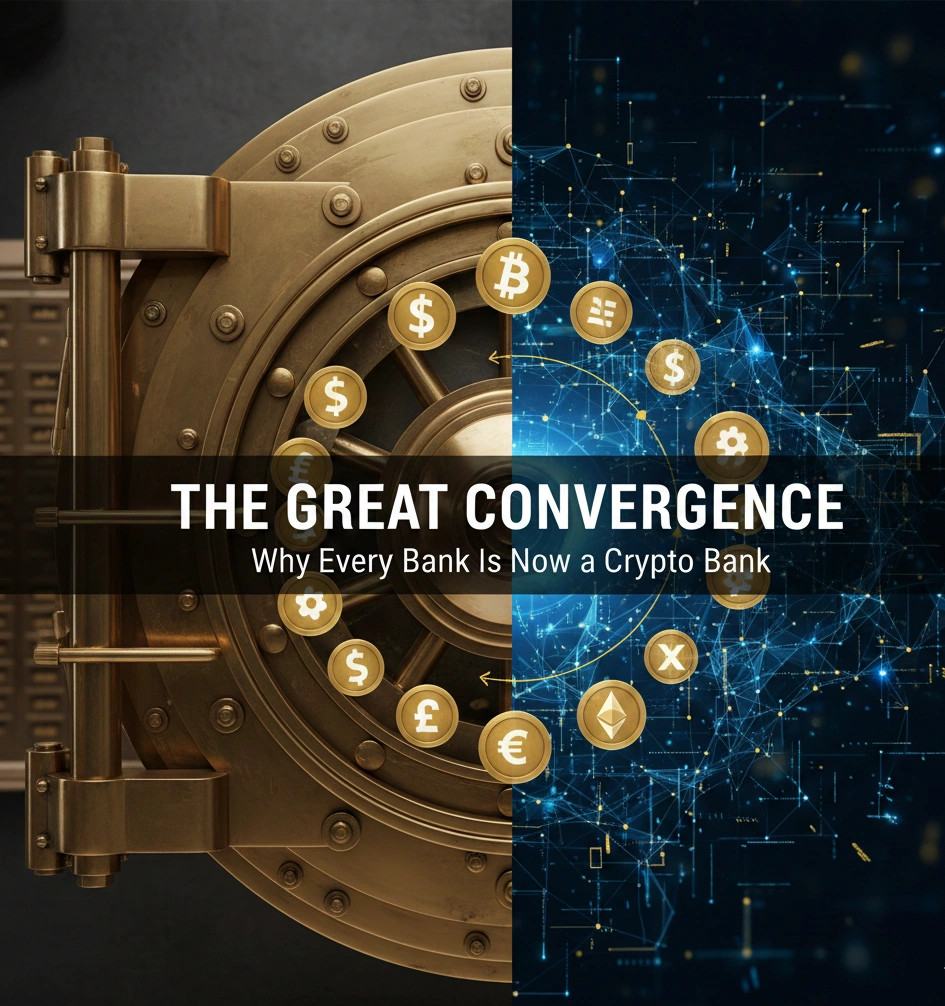
If you think your bank isn’t a crypto bank, look closer at your wire transfers. In 2026, every institution is a digital asset institution—whether they want to be or not.
The marriage certificate arrived quietly. No fanfare, no regulatory press conference—just a series of accounting bulletins, cross-border payment upgrades, and custody announcements that, taken together, signaled something profound: traditional finance and digital assets are no longer dating. They’re cohabiting, sharing infrastructure, and—most critically—sharing risk.
For decades, banks treated cryptocurrency as someone else’s problem. A libertarian sideshow. A compliance headache best avoided. Yet by early 2026, the invisible rails connecting Wall Street to Web3 have become impossible to ignore. Tokenized Treasury bills flow through the same clearing systems as sovereign debt. Stablecoin settlements undergird cross-border trade finance. And when a poorly governed Virtual Asset Service Provider (VASP) collapses in Singapore, the contagion doesn’t stay in crypto—it ripples through correspondent banking networks from London to São Paulo.
Welcome to the era of institutional crypto compliance 2026: where prudential risk and digital asset governance are no longer separate disciplines, but two sides of the same regulatory coin.
The Invisible Integration: How Banks Became Crypto Banks
The transformation happened in layers, each one barely perceptible until the whole edifice shifted.
Layer One: The Custody Revolution
When the SEC issued Staff Accounting Bulletin 122 (SAB 122) in late 2023, reversing its earlier SAB 121 guidance, it eliminated a bizarre accounting penalty: banks could finally custody crypto assets without being forced to recognize them as liabilities on their balance sheets. The impact was seismic. Within eighteen months, institutions from BNY Mellon to State Street launched digital asset custody desks. By 2026, custodial crypto holdings at traditional financial institutions exceed $400 billion globally, according to PwC’s Global Crypto Report 2026.
Layer Two: Tokenized Instruments
The second layer arrived through tokenization—not of meme coins, but of mundane financial instruments. BlackRock’s BUIDL fund, launched in 2024, now holds over $1.5 billion in tokenized U.S. Treasuries. Franklin Templeton’s OnChain U.S. Government Money Fund processes settlements on Polygon and Stellar. These aren’t experiments; they’re operational infrastructure. And they’re governed not by DeFi protocols, but by the same prudential frameworks that regulate money market funds—with one crucial difference: the settlement rails involve VASPs.
Layer Three: The Stablecoin Settlement Web
Perhaps most invisibly, stablecoins have become the grease in international trade. A garment manufacturer in Bangladesh receiving payment from a retailer in Texas might never touch USDC directly—but their banks do. Cross-border wire transfers increasingly route through stablecoin rails for speed and cost efficiency, a practice turbocharged by the U.S. GENIUS Act’s regulatory clarity on dollar-backed tokens. The Bank for International Settlements estimates that by Q1 2026, stablecoin-mediated settlements account for 12% of cross-border commercial payments between non-sanctioned jurisdictions.
The implication? Every correspondent bank is now, functionally, exposed to VASP inherent risk assessment questions—even if they’ve never onboarded a single crypto-native client.
From Financial Crime to Prudential Stability: The Risk Paradigm Shift
For years, the regulatory conversation around crypto centered on anti-money laundering (AML) and combating the financing of terrorism (CFT). The Financial Action Task Force’s Travel Rule for VASPs was the regulatory pinnacle: ensure that virtual asset transfers carry the same identifying information as traditional wire transfers.
But 2026 marks a pivot. The new frontier isn’t just crime prevention—it’s prudential risk digital assets introduce to the financial system at large.
Liquidity Risk in Disguise
When a major VASP experiences a bank run—say, due to rumors about reserve adequacy—institutional clients don’t just lose access to crypto. They lose access to fiat liquidity channels. In March 2026, a Tier-2 VASP in the UAE faced withdrawal freezes after a smart contract exploit. Within 48 hours, three European banks flagged delayed settlements on tokenized asset redemptions. The Basel Committee on Banking Supervision is now drafting guidance that treats VASP counterparty exposure with the same capital weighting traditionally reserved for emerging market sovereign debt.
Operational Resilience Concerns
Unlike traditional banks, many VASPs operate on semi-decentralized infrastructure. A compromise in a widely used wallet-as-a-service provider doesn’t just affect retail users—it affects institutional treasuries holding tokenized assets. The European Banking Authority’s 2026 stress-testing framework now includes “VASP operational failure” scenarios alongside traditional market shocks.
Settlement Finality Ambiguity
Here’s the kicker: when does a blockchain transaction achieve legal finality? Six confirmations? Twelve? What if there’s a chain reorganization? Traditional finance has spent centuries perfecting settlement finality through legal frameworks. Digital assets introduce computational finality—and the two don’t always align. This isn’t theoretical. In January 2026, a deep chain reorg on a proof-of-stake network invalidated what institutional traders believed were settled positions, triggering margin calls that propagated through connected prime brokers.
The Regulatory Armory: MiCA, AMLA, and the GENIUS Act
Regulators haven’t been asleep. The twin pillars of Europe’s crypto regulation—the Markets in Crypto-Assets Regulation (MiCA) and the Anti-Money Laundering Authority (AMLA)—reached full implementation by January 2026. MiCA establishes authorization regimes, capital requirements, and investor protections for VASPs operating in the EU. AMLA provides direct supervisory oversight, breaking the previous patchwork of national regulators.
Across the Atlantic, the GENIUS Act (Guiding and Establishing National Innovation for U.S. Stablecoins) brought federal clarity to stablecoin issuance, requiring reserves be held in high-quality liquid assets and subject to monthly attestations. The result? A proliferation of compliant, bank-grade stablecoins—and an extinction event for shadowy offshore issuers.
Yet despite these advances, a governance gap remains. VASP risk assessment frameworks are maturing, but they’re not standardized. A VASP might pass muster under Singapore’s MAS licensing yet fail basic operational resilience tests under EU standards. For banks with global custody operations, this creates a compliance Rubik’s Cube: which jurisdiction’s standards take precedence when a VASP serves clients in twelve countries?
The VASP Governance Frontier: What Best Practice Looks Like
Leading institutions are getting ahead of the curve by treating VASP relationships with the same rigor they apply to critical outsourcing partners.
Tiered Due Diligence
BNY Mellon’s digital asset unit reportedly maintains a three-tier classification for VASP counterparties:
- Tier 1: VASPs with bank-grade governance, external audits, and regulatory licenses in major jurisdictions.
- Tier 2: Emerging VASPs with solid infrastructure but limited regulatory history.
- Tier 3: Prohibited—VASPs operating in high-risk jurisdictions or with opaque ownership structures.
Real-Time Monitoring
JPMorgan’s Onyx division employs blockchain analytics not just for transaction screening, but for monitoring VASP reserves in real-time. If a VASP’s on-chain reserve ratio falls below thresholds, automated alerts trigger relationship reviews. This represents a paradigm shift: from periodic due diligence to continuous risk assessment.
Contractual Innovations
Legal teams are embedding digital-asset-specific terms into custody agreements. What happens if a hard fork creates two competing versions of an asset? Who bears the risk of smart contract failure? Cutting-edge contracts now include “chain-split protocols” and “immutability warranties”—clauses that would have been science fiction in 2020.
Why This Matters Beyond Banking
The convergence of traditional prudential oversight and crypto-native governance isn’t just a banking story—it’s a story about the architecture of 21st-century finance.
Consider supply chain finance. A multinational’s treasury desk tokenizes receivables, making them tradable on secondary markets via a licensed VASP. If that VASP lacks robust operational controls, the multinational’s working capital liquidity becomes hostage to blockchain uptime. If regulators treat this as equivalent to traditional securitization risk, capital requirements shift. If they don’t, systemic vulnerabilities emerge.
Or consider central bank digital currencies (CBDCs). As sovereigns experiment with digital cash, they’re partnering with—you guessed it—VASPs and banks to build distribution infrastructure. The People’s Bank of China’s e-CNY relies on commercial banks as intermediaries. The European Central Bank’s digital euro pilots involve both banks and supervised VASPs. Prudential oversight of these entities isn’t a nice-to-have; it’s foundational to monetary sovereignty.
The Path Forward: Integration, Not Isolation
The lesson of 2026 is clear: institutional crypto compliance isn’t about building moats between traditional finance and digital assets. It’s about building bridges—secure, well-governed, auditable bridges.
Financial institutions that treat VASP relationships as afterthoughts will find themselves exposed to risks they don’t fully understand. Those that embed tokenized asset governance into their enterprise risk frameworks—treating it as seriously as credit risk or market risk—will be positioned to capture the efficiencies digital infrastructure offers without courting catastrophe.
The great convergence is here. The question isn’t whether your institution is a digital asset institution. It’s whether you’re governing it like one.
Discover more from The Economy
Subscribe to get the latest posts sent to your email.
As Bitcoin tumbles beneath a critical psychological threshold and Ether hemorrhages double-digit value, a confluence of regulatory uncertainty and macroeconomic tremors is reshaping the cryptocurrency landscape—and testing investor resolve like never before.
The Weekend That Shook Crypto Markets
I’ve covered financial markets for over a decade, from the 2008 crisis aftermath to the pandemic-era asset bubbles, but the ferocity of this weekend’s cryptocurrency crash still caught me off guard. As of February 1, 2026, Bitcoin is trading at approximately $78,923—a jarring 5.87% decline in just 24 hours, according to CoinMarketCap‘s real-time data. Ether, meanwhile, has suffered an even steeper 11.76% plunge to $2,387, erasing months of painstaking recovery.
The broader crypto market capitalization has evaporated by over $100 billion in a matter of days—a wealth destruction event that’s reverberating from retail investors in Seoul to institutional desks in Manhattan. But unlike previous selloffs driven by exchange collapses or regulatory crackdowns in isolation, this cryptocurrency market decline stems from a more insidious cocktail: liquidity concerns, Federal Reserve leadership uncertainty, and geopolitical volatility.
Kevin Warsh and the Liquidity Time Bomb
The proximate catalyst? President Trump’s nomination of Kevin Warsh as Federal Reserve Chair, a move that’s sent shockwaves through risk assets globally. Warsh, a former Fed governor known for his hawkish monetary stance during the 2008 financial crisis, has publicly advocated for tighter liquidity controls and skepticism toward speculative assets—crypto included.
Forbes reported that Warsh’s nomination signals a potential pivot from the accommodative policies that fueled Bitcoin’s 2024-2025 bull run, when institutional adoption and spot ETF approvals propelled prices past $100,000. During his 2006-2011 Fed tenure, Warsh championed aggressive balance sheet normalization, a philosophy antithetical to the easy-money environment crypto thrives in.
As I’ve observed in my years covering markets, Fed chair appointments are inflection points—not just for interest rates, but for asset class narratives. When Jerome Powell hinted at tightening in late 2021, Bitcoin fell 50% within months. Warsh’s track record suggests he could pursue quantitative tightening 2.0, draining the liquidity that’s kept speculative investments afloat. Bloomberg analysts estimate this could reduce global dollar liquidity by $500 billion annually, a scenario that historically correlates with Bitcoin price drops of 30-40%.
Why Liquidity Matters for Crypto
Cryptocurrency markets are uniquely sensitive to liquidity shifts because:
- Leverage Dependency: Futures and perpetual swap markets amplify gains—and losses. Reduced liquidity triggers margin calls, cascading into forced liquidations (over $300 million liquidated this weekend alone).
- Institutional Flows: Hedge funds and family offices rely on cheap borrowing to fund crypto positions. Tighter Fed policy raises borrowing costs, forcing portfolio rebalancing away from volatile assets.
- Dollar Strength: Warsh’s policies could strengthen the U.S. dollar, making dollar-denominated Bitcoin less attractive to foreign buyers—a dynamic Financial Times highlighted as critical to 2022’s bear market.
Long-Term Holders Break: A Troubling Signal
Perhaps the most alarming indicator isn’t the price itself, but who’s selling. On-chain data reveals that long-term Bitcoin holders—defined as wallets dormant for over 155 days—are offloading coins at the fastest pace since August 2025, per Glassnode analytics. These “diamond hands,” typically immune to short-term volatility, capitulating suggests deeper structural concerns about Bitcoin’s risk-reward profile.
I spoke with a venture capital investor in San Francisco who liquidated 40% of his Bitcoin holdings this week. “It’s not panic,” he told me. “It’s recognition that the macro backdrop has fundamentally changed. If Warsh tightens into a slowing economy, crypto won’t be a hedge—it’ll be a liability.”
This sentiment echoes across forums and social media, where retail investors—many of whom bought Bitcoin above $90,000 in late 2025—are grappling with unrealized losses exceeding 20%. The psychological weight of breaking below $80,000, a level defended since December, cannot be overstated.
Geopolitical Gasoline on the Fire
Compounding crypto’s woes are escalating U.S.-Iran tensions, which erupted over the weekend following drone strikes near the Strait of Hormuz. Reuters confirmed oil prices spiked 7% on supply fears, triggering risk-off sentiment that drained capital from equities and crypto alike.
Historically, Bitcoin advocates have touted it as “digital gold”—a safe haven during geopolitical crises. Yet this weekend’s selloff demolishes that narrative. Instead, Bitcoin behaved like a tech stock: highly correlated with the Nasdaq (which fell 2.1%) and inversely correlated with the VIX volatility index (up 18%). The Economist recently argued that crypto’s correlation with traditional risk assets has reached all-time highs, undermining its diversification case.
What This Means for Investors: Three Scenarios
Based on historical precedent and current fundamentals, I see three plausible paths forward:
1. The Capitulation Scenario (Probability: 40%)
If Warsh is confirmed and implements aggressive tightening, Bitcoin could test $60,000-$65,000—its 2024 cycle lows. This would mirror 2022’s drawdown, when the Fed’s pivot crushed speculative assets. Institutional outflows from spot Bitcoin ETFs (already down 12% week-over-week) would accelerate, forcing further de-leveraging.
2. The Stabilization Scenario (Probability: 35%)
Bitcoin consolidates between $75,000-$85,000 as markets digest Warsh’s policies. If he adopts a gradualist approach—tightening slowly while signaling transparency—crypto could bottom here. Precedent: 2019’s post-bear market recovery, when measured Fed policy allowed Bitcoin to rally 300% over 18 months.
3. The Black Swan Scenario (Probability: 25%)
Geopolitical escalation or a sovereign debt crisis forces central banks to reverse course, reigniting liquidity flows. Bitcoin could surge past $100,000 as a genuine inflation hedge. However, this requires a macro shock—not the base case.
Lessons from Past Fed Transitions
History offers context. When Paul Volcker took the Fed helm in 1979, he crushed inflation by raising rates to 20%—but also triggered a recession. Gold, the safe haven of that era, fell 30% initially before rallying 800% as monetary debasement resumed. Bitcoin today occupies a similar niche: a non-sovereign store of value whose fortunes hinge on central bank credibility.
Kevin Warsh, if confirmed, faces a delicate balancing act: restore Fed authority without breaking markets. His Congressional testimony will be critical. Any hint of Powell-style pragmatism could stabilize crypto; hardline rhetoric could crater it.
The Human Cost of the Crash
Beyond charts and percentages are real people. A graphic designer in Austin emailed me this week, sharing that her retirement savings—70% allocated to Bitcoin via a self-directed IRA—had lost $180,000 in value. “I believed the decentralization story,” she wrote. “Now I’m not sure what to believe.”
Her story reflects a broader reckoning. Cryptocurrency’s promise of financial sovereignty rings hollow when external forces—Fed chairs, geopolitical conflicts—dictate outcomes as powerfully as in traditional markets. This isn’t to dismiss crypto’s innovation, but to acknowledge its immaturity. Regulatory clarity, institutional custody solutions, and macroeconomic resilience remain aspirational.
What I’m Watching Next
As this crypto market crash unfolds, several variables will determine whether we’re witnessing a healthy correction or the onset of a prolonged bear market:
- Warsh’s Confirmation Hearings: Scheduled for late February. Hawkish testimony could accelerate selling; dovish pivots might stabilize prices.
- Spot ETF Flows: Institutional redemptions from Bitcoin ETFs (like BlackRock’s iShares Bitcoin Trust) are a leading indicator. Sustained outflows suggest capitulation.
- On-Chain Metrics: Monitoring exchange inflows/outflows and miner selling behavior for bottoming signals.
- Macro Data: U.S. unemployment, inflation prints, and Treasury yields will shape Fed policy expectations—and by extension, crypto liquidity.
Resilience or Reckoning?
Standing at this crossroads, I’m reminded that every Bitcoin price drop below a key threshold—whether $20,000 in 2022 or $80,000 today—has separated true believers from tourists. The cryptocurrency crash reasons in 2026 are distinct from past cycles: not exchange fraud or regulatory bans, but the sobering realization that decentralized assets remain tethered to centralized monetary policy.
For investors, this is a moment for reflection, not reaction. Ask: Why did I buy Bitcoin? If the answer was “Fed liquidity,” reevaluate. If it was “long-term technological disruption,” consider dollar-cost averaging. And if it was “get rich quick,” perhaps this selloff is the education tuition you needed.
Markets are cyclical. Central bankers, geopolitical conflicts, and liquidity crises come and go. What endures is the question Bitcoin posed 17 years ago: Can we build a financial system beyond institutional control? The answer won’t be found in today’s price—but in whether the network survives this stress test.
As always, the most valuable asset isn’t Bitcoin or Ether—it’s perspective.
Discover more from The Economy
Subscribe to get the latest posts sent to your email.
-

 Markets & Finance2 months ago
Top 15 Stocks for Investment in 2026 in PSX: Your Complete Guide to Pakistan’s Best Investment Opportunities
-

 Analysis1 month ago
Brazil’s Rare Earth Race: US, EU, and China Compete for Critical Minerals as Tensions Rise
-

 Banks2 months ago
Best Investments in Pakistan 2026: Top 10 Low-Price Shares and Long-Term Picks for the PSX
-

 Investment2 months ago
Top 10 Mutual Fund Managers in Pakistan for Investment in 2026: A Comprehensive Guide for Optimal Returns
-

 Asia2 months ago
China’s 50% Domestic Equipment Rule: The Semiconductor Mandate Reshaping Global Tech
-

 Analysis4 weeks ago
Top 10 Stocks for Investment in PSX for Quick Returns in 2026
-

 Global Economy3 months ago
Pakistan’s Export Goldmine: 10 Game-Changing Markets Where Pakistani Businesses Are Winning Big in 2025
-

 Global Economy3 months ago
15 Most Lucrative Sectors for Investment in Pakistan: A 2025 Data-Driven Analysis