
Banks
Bank Jago’s Wealth Management Push:Indonesia’s 31.1 Million Investors boom

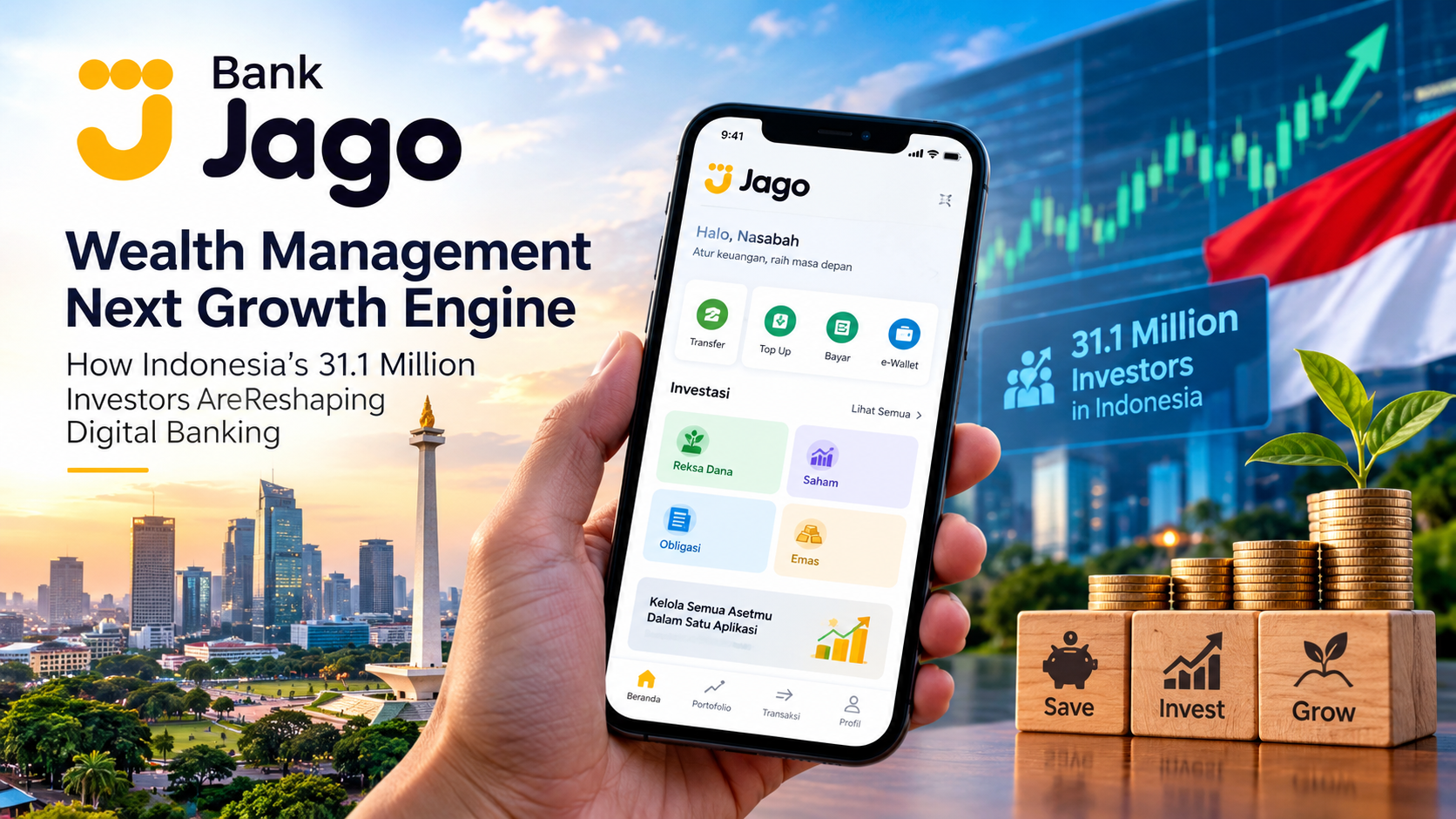
Bank Jago is expanding from digital banking into wealth management as Indonesia’s investor base reaches 31.1 million. Here’s what the strategy means for growth, deposits and digital investing.
Indonesia’s rapidly expanding investor population is creating a new battleground for digital banks, and Bank Jago is positioning wealth management as an increasingly important part of its growth strategy.
The GIC-backed Indonesian digital lender is moving beyond the traditional digital-bank proposition of payments, savings and lending. Through partnerships with investment platforms including Bibit and Stockbit, Bank Jago is connecting banking with stocks, bonds, mutual funds and other investment products.
The timing is significant. Indonesia’s capital-market investor population reached 31.14 million by the end of August 2026, according to the Financial Services Authority (OJK), representing a 52.90% increase year to date. OJK also reported that 1.07 million new investors were added during August alone.
For Bank Jago, the opportunity is not simply to sell more investment products. The larger strategic question is whether a digital bank can become the financial platform where customers save, transact, invest and manage their broader wealth in one ecosystem.
Bank Jago’s Wealth Management Strategy Is Entering a New Phase
Bank Jago’s approach differs from the traditional model in which a bank builds a large in-house investment-product supermarket.
Instead, the bank has developed an ecosystem strategy.
Its integration with Bibit and Stockbit allows customers to move between banking and investment services, while Bank Jago provides the underlying banking infrastructure and account relationships.
According to Bank Jago, more than 3.6 million Jago App users were connected to the Bibit and Stockbit ecosystem by mid-2026. Nearly 2 million Bank Jago customer accounts were also linked to investor accounts through the ecosystem.
That figure is strategically important because it shows that the bank already has a substantial pool of customers with investment activity.
The next stage is turning that connectivity into deeper and more persistent financial relationships.
Bank Jago has also introduced a Consolidated Asset View, designed to allow customers to see investment holdings alongside their banking relationship. The objective is to reduce the fragmentation that often exists between a bank account and separate investment platforms.
That creates a potentially powerful customer-retention mechanism: the more financial activity a customer conducts through one ecosystem, the greater the potential cost and inconvenience of moving elsewhere.
Indonesia’s Investor Boom Provides the Larger Market Opportunity
The Bank Jago story cannot be separated from the broader expansion of Indonesia’s capital market.
OJK reported that the country’s capital-market investor population reached 31.14 million in August 2026, up 52.90% from the end of 2025.
The growth is particularly relevant to digital financial platforms because younger Indonesians represent a large portion of the expanding investor population.
The trend suggests a gradual shift in how a growing segment of Indonesian consumers thinks about financial services.
The first relationship with a financial institution may once have been primarily about opening a savings account. Increasingly, the relationship can begin with a smartphone-based account and develop into payments, savings, mutual funds, equities, bonds and other investment products.
This creates a larger addressable market for banks capable of connecting everyday banking with investment services.
The opportunity is reinforced by the broader digitalization of Indonesia’s financial system. Bank Indonesia reported that digital-payment transaction volume reached 5.50 billion transactions in July 2026, up 28.69% year over year. Mobile-app transactions rose 24.25%, while QRIS transactions grew 82.42%.
The implication for financial institutions is straightforward: Indonesian consumers are becoming increasingly accustomed to managing financial activity digitally.
Bank Jago Is Already Scaling Beyond a Niche Digital Bank
The wealth-management strategy is being built on a much larger banking franchise.
Bank Jago reported 20.1 million customers at the end of June 2026, including 14.7 million funding customers using the Jago App. Its total third-party funds reached Rp27.6 trillion, representing 23% year-over-year growth.
The bank’s balance sheet has expanded alongside its customer base.
Total assets reached Rp41.4 trillion at the end of the first half of 2026, while net profit after tax increased 49% year over year to Rp189 billion.
Loan disbursements reached Rp26.6 trillion, up 24% from the same period of the previous year. Bank Jago reported a gross non-performing loan ratio of 0.8% for the period.
These numbers matter because wealth management is not replacing the bank’s core lending business.
Instead, it is being added to an existing banking engine.
That distinction is important. A digital bank does not necessarily need investment products to become its only source of growth. Wealth management can complement lending by generating fee income, increasing customer engagement and encouraging customers to retain more assets within the wider ecosystem.
Why Wealth Management Matters to Bank Jago’s Economics
Traditional banking economics depend heavily on the difference between the interest earned on loans and the interest paid on deposits.
But digital banking competition can make deposits expensive.
Customers can compare savings rates and promotional offers almost instantly, creating pressure on banks to compete for funding.
Bank Jago’s strategy therefore seeks to broaden the value proposition.
Instead of competing exclusively for deposits, the bank can attempt to become more deeply embedded in a customer’s overall financial life.
A customer might:
- Receive income into a Bank Jago account.
- Keep short-term savings in the account.
- Make payments through the digital banking platform.
- Purchase mutual funds through an integrated investment ecosystem.
- Buy stocks or bonds.
- Monitor investments through an integrated financial dashboard.
- Return to the bank for credit when borrowing becomes necessary.
The economic value of that relationship can extend beyond the interest margin generated by a conventional deposit account.
Bank Jago’s own financial results point to the growing relevance of non-interest revenue. During the first half of 2026, net interest income rose 28% year over year to around Rp1.5 trillion, while fee income increased 41% to approximately Rp455 billion.
That does not mean wealth management alone caused the increase in fee income. But it illustrates why digital banks have an incentive to develop businesses beyond lending.
The GIC Connection Adds a Long-Term Investor Dimension
Bank Jago’s association with Singapore sovereign wealth fund GIC is another part of the broader story.
GIC describes itself as a long-term global investor whose mandate is to preserve and enhance the international purchasing power of Singapore’s reserves. Its investment framework emphasizes diversification, long-term orientation and risk management.
That should not be interpreted as a guarantee of Bank Jago’s future performance.
However, the presence of a long-term institutional investor is relevant to the company’s broader shareholder and strategic context.
Bank Jago’s development also illustrates the growing intersection between Southeast Asian digital finance, institutional capital and consumer investment platforms.
The Bigger Market: Indonesia’s Wealth-Management Industry
Bank Jago is entering a market that extends far beyond digital banking.
OJK reported that Indonesia’s investment-management industry had approximately Rp1,013.03 trillion in assets under management at the end of August 2026. Mutual-fund net asset value stood at Rp652.88 trillion.
That market is large enough to attract banks, securities companies, fintech firms and established investment managers.
The competition is consequently shifting.
The question is no longer simply which company offers a savings account or brokerage account.
Instead, financial institutions increasingly need to answer:
Which platform can become the customer’s primary financial operating system?
This is where Bank Jago’s ecosystem approach becomes particularly relevant.
A Young Customer Base Could Accelerate the Strategy
Bank Jago has reported that approximately 83% of its customers are millennials or younger, according to figures cited in the Business Times’ September 2026 report.
That demographic profile has implications for wealth management.
Younger consumers typically have longer investment horizons, although their portfolios and risk tolerance can differ significantly from those of older investors.
A customer who starts with relatively small investments could potentially become more valuable to a financial institution over time as income, savings and investable assets increase.
This creates a customer-lifetime-value opportunity.
The challenge is that younger investors are also highly mobile. They can switch between apps, brokers, banks and fintech platforms with comparatively little friction.
For Bank Jago, therefore, convenience alone may not be enough.
The platform must continue to demonstrate value through product breadth, usability, reliability, pricing, financial education and customer trust.
Digital Gold Could Expand the Investment Funnel
Bank Jago is also expanding its wealth-management proposition beyond conventional securities.
The company has been preparing a digital gold savings product as another investment option for customers. Indonesian financial media reported in August 2026 that Bank Jago was planning to strengthen its wealth-management business with digital gold.
Gold can play a different role from equities or mutual funds.
For many retail investors, it is a familiar asset class and can provide a relatively simple entry point into investment products.
The addition of digital gold therefore potentially broadens the customer funnel.
Rather than designing wealth management solely around sophisticated investors, Bank Jago can offer products that correspond to different stages of financial development.
The World Bank’s Financial-Inclusion Data Adds Important Context
The expansion of digital finance is occurring against a broader financial-inclusion backdrop.
The World Bank’s Global Findex 2025 provides Indonesia-specific data on how people use accounts, mobile phones and digital financial services. Its 2024 Indonesia dataset shows substantial use of mobile phones and cards for accessing financial accounts and making payments.
The significance for digital banks is that the smartphone is increasingly becoming a gateway to multiple financial services.
That changes the competitive landscape.
A bank no longer necessarily needs to win customers through a dense physical branch network. It can compete through user experience, ecosystem integration, partnerships and digital distribution.
For Bank Jago, this model is particularly compatible with its partnership-led strategy.
Competition Will Be the Major Test
The opportunity is substantial, but Bank Jago is not operating in an empty market.
Indonesia’s financial sector includes large conventional banks, digital-bank challengers, securities firms, fintech platforms and investment applications.
Many of these companies are pursuing similar objectives: increasing digital engagement, attracting deposits, acquiring younger consumers and expanding investment products.
That means the central challenge is converting customer numbers into durable financial relationships.
Three areas will be particularly important.
1. Customer engagement
Connecting 3.6 million customers to an investment ecosystem is significant, but connection does not necessarily mean high investment activity.
The next question is how frequently those customers invest and how much of their financial assets remain inside the ecosystem.
2. Monetisation
Wealth management can generate fees, but products must achieve sufficient scale to become economically meaningful.
The growth in fee income will therefore be an important metric to watch.
3. Trust and risk management
Investment products carry different risks from ordinary banking deposits.
As financial platforms become more integrated, maintaining clear product information, suitability processes, cybersecurity and regulatory compliance becomes increasingly important.
OJK’s continuing enforcement activity across Indonesia’s capital market demonstrates why financial-sector growth has to be accompanied by investor protection and market-integrity measures.
Higher Interest Rates Make the Deposit Strategy More Complicated
Bank Jago’s expansion is also taking place in a relatively demanding interest-rate environment.
Bank Indonesia kept its benchmark 7-day reverse repurchase rate at 5.75% in September 2026, while maintaining its 2026 economic-growth forecast range at 4.9%–5.7%. Reuters reported that policymakers were also balancing growth, financial stability and rupiah pressures.
Higher rates can make deposit competition more intense.
Customers have more incentive to compare returns across banks and financial products.
This makes Bank Jago’s broader ecosystem strategy particularly relevant: rather than attempting to win solely by offering the highest deposit rate, the bank can seek to retain customers through an integrated set of financial services.
Whether that approach can consistently reduce the need for aggressive deposit pricing remains a key issue for investors to monitor.
What Investors Should Watch Next
Bank Jago’s next phase can be assessed through several measurable indicators rather than headline customer numbers alone.
Customer growth: Is the bank continuing to expand its active user base?
Third-party funds: Are deposits growing faster or slower than the broader banking market?
Fee income: Does non-interest revenue continue to grow alongside the investment ecosystem?
Investment engagement: How many customers actively invest rather than simply connect their accounts?
Asset retention: Are customers keeping more of their cash and investments within the wider ecosystem?
Credit quality: Can the bank continue expanding lending without a material deterioration in asset quality?
Profitability: Does the combination of lending, deposits and fee-based services translate into sustained earnings growth?
These metrics will provide a clearer picture of whether wealth management is becoming a meaningful business engine rather than simply an additional feature.
The Strategic Shift Is Bigger Than Bank Jago
Bank Jago’s wealth-management push reflects a broader transformation occurring across Indonesia’s financial sector.
The country is moving from a financial system in which banking, investing and payments were often separate experiences toward one where consumers can access multiple services through interconnected digital platforms.
The rapid expansion of Indonesia’s investor population provides the demand side of that equation.
The country’s growing digital-payment ecosystem provides the distribution infrastructure.
And digital banks provide the technology layer capable of connecting those services.
Bank Jago is attempting to occupy that intersection.
Its 20.1 million-customer banking franchise, 3.6 million-user investment ecosystem connection and growing fee-income contribution give it a substantial platform from which to pursue the strategy.
But the opportunity comes with equally clear tests.
Competition is intensifying, consumers remain price-sensitive, investment markets fluctuate and digital customers can switch providers quickly.
Bottom Line
Bank Jago’s move into wealth management represents a strategic expansion from digital banking toward integrated financial management.
Indonesia’s 31.14 million capital-market investors show that the potential customer pool is expanding rapidly, while the country’s digital-payment growth indicates that consumers are becoming increasingly comfortable managing financial activity through mobile platforms.
For Bank Jago, the objective is therefore not simply to sell stocks, bonds or mutual funds.
The larger ambition is to make the bank a central financial relationship for customers as they progress from saving money to investing and eventually managing increasingly complex portfolios.
Whether that strategy becomes a major source of long-term growth will depend on conversion, engagement, fee generation, asset retention and profitability.
The numbers to date show that Bank Jago has built a sizeable foundation. The next stage will determine whether that foundation can translate Indonesia’s rapidly expanding investor population into a durable wealth-management franchise.
Discover more from The Economy
Subscribe to get the latest posts sent to your email.


Business
US 10-Year Yield Hits 5.24%: What the Historic Bond Market Sell off Means for Mortgages and Investors
Key Takeaways
- Historic Highs: The US 10-year Treasury yield closed at 5.244%, a peak not seen since the prelude to the 2008 global financial crisis.
- Fed Rate Tightening: Markets are pricing in a 70% chance of another Federal Reserve rate hike at the late-October FOMC meeting following September’s shift to a 3.75%–4.00% target range.
- Borrowing Costs Surge: 30-year fixed mortgage rates are spiking past multidecade highs, suppressing real estate transaction volumes.
- Asset Reallocation: Bond yields above 5% create substantial headwind for growth stocks while elevating cash-equivalent instruments to prime investment status.
The Macroeconomic Catalyst: Why Yields Are Surging
The sudden acceleration in benchmark sovereign yields comes on the heels of persistent inflationary pressures driven by global energy disruptions and resilient labor data. When the Federal Reserve raised rates in September to the 3.75%–4.00% range, institutional bond traders initially anticipated a pause. However, hawkish central bank commentary coupled with persistent federal debt issuance has pushed the 10-year Treasury note to 5.244%, a level last recorded in 2007.
According to real-time market tracking from Trading Economics, global fixed-income markets are undergoing a fundamental repricing. High yields mean the government must offer higher returns to attract buyers for its expanding deficit, directly competing with private sector risk assets.
            US 10-Year Treasury Yield Trajectory
   5.5% |                                       * (5.244%)
   5.0% |                                *-----*
   4.5% |                         *-----*
   4.0% |                  *-----*
   3.5% |           *-----*
        +---------------------------------------------------
          Jan 2026    Apr 2026   Jul 2026    Sep 2026
Mortgage Rate Forecast 2026 & Real Estate Impact
The primary transmission mechanism of the benchmark yield spike into the everyday economy is through mortgage lending rates. Because mortgage-backed securities (MBS) are priced relative to the 10-year yield plus a risk spread, residential borrowing costs have responded immediately.
As detailed by financial coverage on CNBC, the spread between the 10-year yield and 30-year fixed mortgage rates remains historically wide due to secondary market volatility.
Housing Market Stress Points:
- Buyer Purchasing Power Reduction: Every 50-basis-point surge in mortgage rates reduces homebuyer purchasing capacity by approximately 5%.
- The “Lock-In” Effect: Existing homeowners with 3%–4% legacy mortgage rates refuse to list properties, driving inventory down to structural lows.
- Commercial Real Estate (CRE) Refinancing: Over $1.2 trillion in commercial debt requires refinancing before year-end, now facing interest expense shocks that threaten regional bank balance sheets.
Fed Rate Hike October Odds & Wall Street Strategy
Derivatives pricing monitored by Bloomberg indicates that money markets are placing roughly a 70% probability on an additional 25-basis-point rate hike at the late-October Federal Open Market Committee (FOMC) meeting.
Financial Sector Asset Class Comparison
| Asset Class | Yield / Return Outlook | Risk Profile | Strategic Investor Positioning |
| US 10-Year Treasury | $5.24\%$ Fixed Return | Low (Sovereign) | Strong buy for income locking; duration risk if yields hit 5.5% |
| S&P 500 Equities | $4.2\%$ Earnings Yield | Moderate / High | Overweight value/cash-flow; underweight non-profitable tech |
| 30-Year Fixed Mortgage | $7.85\% – 8.20\%$ Cost | Low (Consumer Credit) | Refinance freeze; shift toward adjustable-rate structures (ARMs) |
| Gold (Spot) | $-3.71\%$ ($4,127/oz) | Moderate | Tactical buy on dip if real yields stabilize |
Investor Playbook: Navigating a 5%+ Yield Environment
When baseline risk-free cash yields exceed 5%, traditional investment models like the classic 60/40 equity-to-bond portfolio demand recalibration.
- Short-Duration Fixed Income: Capitalize on elevated yield-to-maturity metrics by allocating into 1-to-3 year Treasuries or high-grade corporate debt without locking up capital in long-duration securities.
- Dividend Dividend Aristocrats over Growth: Shift equity exposure toward dividend-paying value stocks possessing robust balance sheets and low net-debt-to-EBITDA ratios.
- Hedging Rate Volatility: Institutional allocators are utilizing interest rate swaps and inverse Treasury ETFs to insulate equity gains against sustained yield spikes.
Frequently Asked Questions (FAQ)
How does the US 10-year yield affect home mortgage rates?
The 10-year Treasury yield serves as the benchmark for 30-year fixed-rate mortgages. Lenders add a spread (typically 1.5% to 3.0%) over the 10-year yield to cover credit risk and servicing costs. When the yield rises to 5.24%, mortgage rates naturally trend upward toward 7.5%–8.2%.
Why are yields rising if the Fed only raised rates to 3.75%-4%?
While the Fed controls short-term overnight rates, the 10-year yield is determined by market demand for long-term government debt. Factors like heavy Treasury debt supply, long-term inflation fears, and international central bank selloffs drive up long-term yields independently of overnight rate levels.
What happens to stock prices when bond yields hit multi-year highs?
Rising bond yields make risk-free fixed income more attractive compared to stocks. Higher discount rates are applied to future corporate earnings calculations, which tends to depress stock valuations, particularly for high-growth tech companies reliant on future earnings.
Discover more from The Economy
Subscribe to get the latest posts sent to your email.

With the September 24, 2026, US-China trade truce extended rather than permanently resolved, Citibank and institutional peers are pricing dólar estadounidense forecasts around a narrow, event-driven volatility window. For cross-border businesses and remittance senders, this compressed timeline shifts the focus from a clean directional currency bet to active hedging ahead of the new Q1 2027 deadline.
Why Citibank Is a Bellwether for Dólar Estadounidense Direction
Citibank’s global markets desk remains one of the most-cited authorities in dollar-peso forecasting due to its dual footprint: a deep US retail and corporate banking presence combined with one of the most extensive correspondent-banking networks across Latin America. When Citibank’s macroeconomic strategists adjust their USD/MXN forecasts, remittance companies, importers, and forex retail platforms typically follow suit within days. Therefore, tracking Citibank’s post-summit positioning offers a highly accurate proxy for where institutional capital expects the dollar to move next.
The September 24 Trade Truce Extension: What Changed
The September 24 Trump-Xi summit at the White House did not yield the durable macroeconomic trade agreement some forex analysts had priced in. Instead, US Treasury Secretary Scott Bessent confirmed a roughly two-month extension of the existing tariff pause, which had been originally set to lapse in November 2026. Analysts at preview briefings—including China specialists at CSIS—had already flagged rare-earth export controls and AI technology restrictions as the most difficult hurdles, which proved accurate.
For currency desks, an “extension-without-resolution” sends a specific technical signal: it eliminates the tail risk of an immediate, severe trade-war escalation, but maintains the uncertainty premium that emerging market currencies have priced in since the spring. This explains the sharp, localized spike in the USD/MXN pair following the September 24 announcement, as traders unwound overly optimistic positions and re-priced for continued negotiations.
Dólar Estadounidense: Current Post-Summit Positioning
Data updated as of late September 2026.
| Metric | Current Reading / Forecast | Market Context |
| USD/MXN Spot Rate | ~17.65–17.70 pesos per dollar | Spiked from 16.95 in mid-September following the Sept 24 summit. |
| USD 12-Month Change vs. Peso | Dollar down ~2% year-over-year | Late September volatility has narrowed the dollar’s YOY deficit. |
| Citi Analyst Survey (Year-End 2026) | ~17.50 pesos per dollar | Indicates expectations of slight stabilization. |
| Monex House Forecast (2026) | ~17.80 pesos per dollar | Pricing a higher geopolitical risk premium into Q4. |
Sources: Banxico FIX rate reporting; Citi Encuesta de Expectativas survey of 37 institutions; Monex economic research.
Why the Peso Remained Historically Strong in 2026
Despite the immediate post-summit dollar spike, the peso mexicano has maintained a broader resilience through much of 2026. Three macroeconomic forces explain this dynamic:
- Persistent Carry-Trade Demand: Even with central bank adjustments, Mexico’s benchmark interest rate remains significantly higher than the US Federal Reserve’s rate. This spread keeps peso-denominated sovereign debt highly attractive to yield-seeking capital.
- Resilient Remittance and Nearshoring Flows: Despite US-China trade friction, North American supply chain integration (nearshoring) and the US-Mexico goods trade have remained robust, ensuring structural dollar inflows into Mexico.
- A Weaker Broad Dollar Trend: Tied to the broader Fed easing cycle, the dollar has occasionally softened against a basket of global currencies, limiting its ability to achieve runaway momentum against the peso.
Citibank’s Forex Playbook for the Rest of 2026
Institutional desks like Citibank are advising corporate clients to treat the current Q4 window as a critical hedging opportunity rather than a speculative directional bet. With the new truce deadline landing in the opening weeks of Q1 2027, volatility will likely cluster around that date regardless of the ultimate macroeconomic outcome.
Practical takeaways for cross-border exposure:
- Lock in Forward Contracts: Secure forex pricing before the Q1 2027 truce deadline if your business has scheduled cross-border payments in that window.
- Monitor the 10-Year Treasury Yield: Yields have acted as a more responsive, real-time indicator of trade-risk pricing this year than delayed central bank statements.
- Track the Remittance Corridor: Treat US-Mexico remittance-corridor pricing as directional context; it is one of the most liquid, closely watched proxies for broader dollar sentiment.
Q4 2026 to Q1 2027 Predictive Scenarios
| Scenario | Anticipated USD/MXN Path | Market Probability |
| Base Case: Truce holds into Q1 2027, talks continue | Peso stabilizes near the 17.40–17.70 range | Highest |
| Tail Risk: Truce collapses before the new deadline | Dollar spikes toward 18.50+ on safe-haven risk-off flows | Moderate |
| Bullish Surprise: Durable US-China deal reached | Peso strengthens back toward 16.50–16.90 | Low (Near-term) |
Frequently Asked Questions
What is the dólar estadounidense worth in pesos today?
Following the late-September 2026 summit volatility, the dollar is trading in the 17.65–17.70 peso range, up from sub-17.00 levels earlier in the month. Because forex markets fluctuate continuously, always confirm against Banxico’s FIX rate or a live institutional feed before executing a transfer.
Why does a US-China summit affect the Mexican peso?
While Mexico is not a direct party to the Xi-Trump negotiations, US-China trade tension directly impacts the broad US dollar index and global risk appetite. These macroeconomic shifts immediately spill over into every dollar-paired emerging market currency, including the highly liquid Mexican peso.
Is now a good time to send money via the US-Mexico remittance corridor?
For dollar earners sending money to Mexico, the late-September bump to ~17.67 pesos per dollar offers slightly better purchasing power than the mid-September lows. However, timing depends heavily on individual cash-flow needs rather than attempts to perfectly time geopolitical news cycles.
Discover more from The Economy
Subscribe to get the latest posts sent to your email.
Mortgage
How the Trump-Xi White House Summit Is Reshaping Mortgage Rates Today for Real Estate Investors

The September 24 Trump-Xi summit produced a two-month trade-truce extension rather than a durable deal — and that ambiguity, not a headline breakthrough, is what’s now keeping the 10-year Treasury yield elevated and mortgage rates parked near 7% heading into the fourth quarter.
Mortgage Rates Today: The Q4 2026 Baseline
Freddie Mac’s benchmark survey put the 30-year fixed-rate mortgage at 6.95% for the week of September 17, 2026 — the fourth consecutive weekly increase and the highest reading since January 2025. The 15-year fixed climbed in tandem to 6.26%. A year earlier, the 30-year average sat more than half a point lower, near 6.26%.
| Loan Type | Rate (week of Sept. 17, 2026) | Rate (1 year prior) |
|---|---|---|
| 30-year fixed | 6.95% | 6.26% |
| 15-year fixed | 6.26% | 5.41% |
| 5/1 ARM | ~6.8%–7.0% | — |
| 30-year VA | ~6.2%–6.3% | — |
Source: Freddie Mac Primary Mortgage Market Survey; Zillow daily rate tracker.
The proximate driver is the bond market, not the housing market. Mortgage pricing tracks the 10-year Treasury yield, and that yield has been climbing toward the high-4% range through September on a combination of heavy government issuance and a Federal Reserve that has signaled it is in no hurry to cut. Layer geopolitical risk on top — oil above $90 a barrel amid Middle East disruption, plus unresolved US-China friction — and lenders are pricing in a wider risk premium.
Why the Summit Matters to Your Rate Lock
Real estate investors tend to treat foreign policy as background noise. That’s a mistake in Q4 2026. The Trump-Xi relationship is now the single largest swing factor in how bond markets price forward risk, because it touches three things that feed directly into Treasury yields: tariff policy, rare-earth and technology export controls, and the credibility of the disinflation narrative the Fed needs to justify future rate cuts.
What Actually Happened at the September 24 Summit
Xi Jinping’s September 24 visit to the White House was the second Trump-Xi meeting of 2026, following a May 14–15 state visit to Beijing where the two sides agreed to pursue what they termed a “constructive, strategically stable relationship.” The Washington leg was shorter on ceremony and shorter on breakthroughs. According to Reuters’ pool reporting, Treasury Secretary Scott Bessent confirmed the two sides extended their trade truce — originally due to lapse in November — by roughly two months, buying time rather than locking in a structural agreement.
That is the detail markets are trading on. An extension without resolution leaves tariff rates, Chinese purchasing commitments, rare-earth export licenses, and technology restrictions all still in play heading into the new year. For bond investors, unresolved trade risk is inflationary risk: tariffs raise input costs, and rare-earth bottlenecks squeeze manufacturers that feed into consumer prices. Both push against the case for near-term Fed easing, and Fed policy is the single biggest lever on where mortgage rates land.
Three Summit Threads With Direct Rate Impact
- The 60-day trade truce clock. With the new deadline now sometime in early 2026’s first quarter, expect renewed rate volatility as that date approaches — mortgage desks should treat any lock decision inside that window as elevated-risk.
- AI and export-control friction. Both sides used the September summit to air disagreements over AI development and chip/technology export controls, an area CSIS analysts have flagged as the least-resolved dimension of the relationship. Unresolved tech friction keeps a geopolitical risk premium baked into yields.
- No durable tariff resolution. Core tariff and purchasing questions were pushed into the next round of talks, meaning the inflation uncertainty that has kept the Fed cautious remains unresolved.
Featured Snippet: What Is the Average Mortgage Rate Today?
As of mid-to-late September 2026, the average 30-year fixed mortgage rate in the US is running just under 7%, per Freddie Mac’s weekly survey — the highest level since January 2025, driven by rising Treasury yields tied to heavy government borrowing and unresolved US-China trade risk following the September 24 Trump-Xi summit.
Asian Growth and the Global Rate Picture
The mortgage story doesn’t stop at the US border. The Asian Development Bank’s September 2026 outlook nudged developing Asia’s 2026 growth forecast up slightly to 5.0%, even as regional inflation stays elevated near 4.2%. Stronger Asian growth alongside sticky inflation is broadly consistent with the “higher for longer” global rate environment that’s keeping US mortgage rates elevated — it’s not just a domestic story.
Q4 2026 Predictive Outlook
- Base case: 30-year fixed rates hold in the 6.7%–7.1% band through year-end, with volatility clustering around the new US-China truce deadline and the next two Fed meetings.
- Upside risk (higher rates): A breakdown in the truce, renewed tariff escalation, or a hawkish surprise from the Fed pushes the 30-year toward 7.25%–7.5%.
- Downside risk (lower rates): A durable trade framework or a faster-than-expected inflation cooldown could pull rates back toward the low 6% range, though nothing in current Fed communication points to that in Q4.
FAQ
Will mortgage rates go down before the end of 2026?
Most forecasters, including those tracked by Freddie Mac and major bank research desks, see rates holding near current levels through Q4 2026 absent a clear resolution to US-China trade tensions or a faster Fed pivot.
How does the Xi-Trump summit affect US mortgage rates?
It affects rates indirectly, through Treasury yields. Unresolved trade and tech-export issues keep an inflation and geopolitical-risk premium in bond markets, which raises the yields that mortgage-backed securities are priced against.
What is a good mortgage rate right now?
Relative to the current national average near 6.9%–7.0%, well-qualified borrowers securing rates half a point or more below the weekly Freddie Mac average are getting a comparatively strong deal in today’s market.
Discover more from The Economy
Subscribe to get the latest posts sent to your email.

US 10-Year Yield Hits 5.24%: What the Historic Bond Market Sell off Means for Mortgages and Investors

Battle for the Farm Belt: How Tariff Pressures and Fuel Costs Are Reshaping Iowa’s 2026 Midterms

Southeast Asia’s Critical Minerals Power Play: Can ASEAN Avoid Choosing Between China and the US?

MAS Allocates S$1.45 Billion to Five Asset Managers in Third EQDP Batch: Total Deployment Reaches S$5.4 Billion

Beyond Singapore’s Borders: How Squeezed SMEs Can Unlock High-Yield Growth Across ASEAN

Bank Jago’s Wealth Management Push:Indonesia’s 31.1 Million Investors boom

Beyond the Four-Year Degree: The $100K+ Trade Careers Young Americans Are Overlooking

SpaceX Starship Achieves First Full Orbit on Historic 10-Hour Test Flight 14

Google’s $15B Finland AI Investment: Data Centers, Nuclear Power & Jobs

Fast Invoice Factoring: Rates, APR Math & Contract Traps

SOC 2 Type II Guide: Cost, Timeline & Compliance Companies

Hong Kong Wages Surge 3.4% in June: Sector Data & Analysis

Silver Price Today: Why the Xi-Trump AI Standoff Is Fueling a Safe-Haven Rally

Citibank & Dólar Estadounidense: Forex Playbook After the Xi-Trump Truce

Top 30 Stocks for Investment in PSX for Massive ROI in 2026

Oil Prices Break $100 in 2026: Middle East Conflict & Energy Markets

BRICS+ Cross-Border Payments 2026: Interoperability Explained

Fidelity Investments Review 2026: SPAXX Yields & Zero-Fee Funds

10-Year Treasury Yield Hits 4.80%: What It Means for Rates & Portfolios

Shein Clothes Quality & Safety in 2026: What Lab Tests Show

IMF & World Bank 2026 Global Economic Outlook: Growth, Inflation, Debt

China’s US$10.8 Billion Trade Shortcut: Why the Pinglu Canal Matters

High-CPM Finance Niches 2026: Publisher Monetization Blueprint

Middle East War Economics 2026: Oil Prices & Energy Markets

China Stocks Today: Are Big Economies in Asia Nearing a Market Bottom?

Social Security Trust Fund 2032: OASI Depletion Timeline Explained

Global Pension Systems Ranked: The World’s Best and Worst Retirement Frameworks

Gavin Baker AI Outlook: Why the Compute Shortage Persists Through 2028
-

 Markets & Finance9 months ago
Top 15 Stocks for Investment in 2026 in PSX: Your Complete Guide to Pakistan’s Best Investment Opportunities
-

 Analysis7 months ago
Johor’s Investment Boom: The Hidden Costs Behind Malaysia’s Most Ambitious Economic Surge
-

 Analysis7 months ago
Top 10 Stocks for Investment in PSX for Quick Returns in 2026
-

 Banks8 months ago
Best Investments in Pakistan 2026: Top 10 Low-Price Shares and Long-Term Picks for the PSX
-

 Analysis8 months ago
Brazil’s Rare Earth Race: US, EU, and China Compete for Critical Minerals as Tensions Rise
-

 Investment9 months ago
Top 10 Mutual Fund Managers in Pakistan for Investment in 2026: A Comprehensive Guide for Optimal Returns
-

 Global Economy9 months ago
15 Most Lucrative Sectors for Investment in Pakistan: A 2025 Data-Driven Analysis
-

 Global Economy9 months ago
Pakistan’s Export Goldmine: 10 Game-Changing Markets Where Pakistani Businesses Are Winning Big in 2025