
AI
AI Energy Demand 2026: Data Centres, Power Grids & the $725B Infrastructure Boom


Hyperscalers are spending $725 billion on AI infrastructure in 2026. The energy demands of this buildout are reshaping global power markets, utility valuations, and electricity costs. Here’s the full picture.
Behind every AI-generated image, every chatbot response, and every earnings forecast produced by a large language model is a data centre consuming electricity at a scale that is quietly reshaping global energy markets.
Microsoft, Google, Meta, and Amazon — the four hyperscaler giants powering the AI economy — are collectively spending more than $725 billion on AI infrastructure in 2026. This unprecedented wave of capital expenditure is building data centres that require power at a scale that has fundamentally changed the conversation around energy security, grid stability, electricity pricing, and the commercial viability of every power generation technology from natural gas to nuclear.
The AI energy story is not a footnote to the technology boom. It is one of the most consequential investment themes of the decade.
The Scale of the Demand Shock
To understand the magnitude of AI’s energy appetite, consider the trajectory. A single large AI training run — the computational process that creates a frontier model like those produced by OpenAI, Anthropic, or Google DeepMind — can consume more electricity than a medium-sized city uses in a month. Inference — the ongoing process of serving queries to users — multiplies that consumption across millions of simultaneous interactions.
OpenAI’s inference compute costs are projected at $14.1 billion for 2026. Inference compute is largely an energy and chip cost. The company’s gross margin of approximately 33% reflects how significant this load has become.
Across the hyperscalers, the $725 billion AI infrastructure budget funds:
- Data centre construction — new campuses in the US, Europe, Southeast Asia, and the Middle East
- Nvidia GPU procurement — the primary compute engine for AI workloads
- Network infrastructure — high-speed interconnects between training clusters and inference nodes
- Power infrastructure — substations, backup generation, and energy contracts
The power requirement for a modern AI training cluster can exceed 100 megawatts — enough to power approximately 80,000 US homes. Planned hyperscaler buildouts in 2026 will require gigawatts of additional generating capacity, much of which does not yet exist.
The Grid Cannot Keep Up
The fundamental constraint in the AI energy build is not capital or technology — it is the pace at which electrical grids can be upgraded to deliver power at the scale and reliability that data centres require.
In the United States, utilities are reporting data centre interconnection queues that extend three to five years into the future. The permitting and construction timelines for new transmission lines — often the binding constraint for connecting new power generation to load centres — have not accelerated at the pace of data centre demand.
In Northern Virginia — home to the world’s largest concentration of data centres — the PJM Interconnection grid has been grappling with the challenge of meeting rapidly growing load from AI campuses while maintaining reliability across the broader regional grid. Similar dynamics are playing out in Ireland, Singapore, and Texas.
The consequence: electricity prices in AI-intensive regions are rising as demand competes with existing industrial and residential load. This is not a temporary phenomenon — it reflects a structural demand shift that will persist for years as AI infrastructure deployment continues.
Who Wins in the AI Energy Build
The AI energy story is generating a distinct set of investment winners that extend well beyond the semiconductor and software sectors.
Utilities
Electric utilities with significant exposure to data centre load — particularly in Virginia, Texas, Georgia, and Ohio — are seeing accelerated earnings growth as hyperscalers sign long-term power purchase agreements. These agreements provide utilities with revenue visibility that justifies capital investment in generation and transmission capacity.
Dominion Energy (Virginia), AEP (Ohio and Texas), and Duke Energy (Georgia) are among the utilities that have flagged data centre load as a material driver of near-term demand growth.
Data Centre REITs
Real estate investment trusts focused on data centre infrastructure are trading at premium valuations as institutional capital seeks AI infrastructure exposure without the technology risk of individual semiconductor or AI software companies.
Equinix, Digital Realty, and Iron Mountain have seen significant demand from hyperscalers seeking colocation capacity. The constraint on their growth is increasingly power availability rather than capital.
Nuclear Energy Operators
Nuclear power has emerged as the preferred baseload generation technology for hyperscalers seeking 24/7 carbon-free electricity. Microsoft has signed a deal with Constellation Energy to restart the Three Mile Island nuclear plant in Pennsylvania specifically for data centre power. Amazon and Google have made direct investments in nuclear start-ups building small modular reactors.
Nuclear’s appeal for data centres is straightforward: it provides continuous, dispatchable power without the intermittency of solar and wind — a critical feature for high-reliability compute workloads.
Natural Gas Operators
In the near term — before new nuclear capacity comes online and before renewable build catches up with demand — natural gas is filling the gap. Gas-fired generation is being commissioned specifically to serve data centre load in multiple US markets. This has created demand for both gas generation capacity and for the pipeline infrastructure that delivers fuel to these plants.
The Geopolitical Dimension: AI Data Centres as Strategic Infrastructure
Governments increasingly view AI data centre capacity as strategic national infrastructure — comparable to port facilities, road networks, or military installations. The race to host hyperscaler AI infrastructure is shaping foreign investment policy, grid modernisation plans, and energy procurement strategies across Asia, Europe, and the Middle East.
Singapore, navigating its role as ASEAN chair in 2026, has positioned its AI infrastructure capacity as a key element of its regional leadership agenda. The city-state has approved new data centre construction after a moratorium, tying approvals to energy efficiency standards and renewable power commitments.
Saudi Arabia and the UAE have made massive commitments to attract AI infrastructure investment as part of their post-oil economic diversification strategies, offering land, regulatory expediting, and preferential power arrangements to major hyperscalers.
India is building AI data centre capacity at scale in Hyderabad, Mumbai, and Chennai, positioning itself as the primary alternative to Chinese AI infrastructure for global enterprises seeking supply chain diversification.
The Cost Pass-Through: Who Pays for AI’s Energy Appetite
The $725 billion AI infrastructure buildout is not self-contained. Its costs ripple through the economy in several ways:
Electricity price pressure: Rising data centre demand in grid-constrained markets pushes up wholesale power prices, increasing costs for all electricity consumers — industrial, commercial, and residential.
Enterprise AI licensing costs: The compute costs embedded in AI services translate directly into licensing fees for enterprise customers. Companies that have deployed AI copilots, coding assistants, and customer service automation are reporting costs that exceed initial projections — creating a “sticker shock” dynamic that is beginning to slow enterprise AI adoption.
Carbon accounting complexity: As hyperscalers procure renewable energy to offset data centre consumption, they are absorbing significant portions of new renewable generation capacity that might otherwise reduce costs for the broader grid. The interaction between data centre power procurement, renewable energy credits, and carbon markets is creating new complexities for corporate sustainability accounting.
The Investment Implications
The AI energy infrastructure theme represents one of the most durable and under-appreciated investment opportunities in the current cycle. While the market has priced AI enthusiasm into semiconductor and software valuations extensively, the downstream infrastructure beneficiaries — utilities, data centre REITs, nuclear operators, and gas pipeline companies — remain relatively less valued for the structural demand shift they are absorbing.
Key investment considerations:
- Data centre REITs offer exposure to AI demand without the valuation risk of pure-play AI companies, with dividend income providing a return buffer
- Regulated utilities in high-growth data centre markets offer earnings visibility supported by long-term power purchase agreements with investment-grade counterparties
- Nuclear energy operators benefit from a structural shift in hyperscaler procurement strategy that is likely to persist for a decade
- Grid infrastructure companies — transmission equipment manufacturers and engineering firms — are positioned for multi-year demand as utilities upgrade capacity to serve AI load
The Bottom Line
The $725 billion AI infrastructure buildout is not just an investment theme — it is a structural transformation of global energy markets. The data centres being built today will consume power for decades. The grid upgrades required to serve them will reshape electricity pricing, generation mix, and geopolitical energy strategy across the world’s major economies.
Investors who understand the energy dimension of the AI boom — not just the semiconductor and software dimensions — have access to investment opportunities that carry less valuation risk, more earnings visibility, and more durable competitive positions than the high-profile AI pure-plays currently commanding headlines.
FAQ
Q: How much energy do AI data centres use?
A: A single large AI training cluster can exceed 100 megawatts of power consumption. Across all hyperscalers, the collective AI infrastructure buildout of $725 billion in 2026 will add gigawatts of new demand to global electricity grids.
Q: What companies are building AI infrastructure in 2026?
A: Microsoft, Google, Meta, and Amazon are the four primary hyperscalers collectively spending over $725 billion on AI infrastructure. Nvidia supplies the primary GPU compute hardware. Data centre REITs including Equinix and Digital Realty provide co-location capacity.
Q: How is AI affecting electricity prices?
A: In grid-constrained regions with high data centre concentrations — particularly Northern Virginia, Texas, and Singapore — AI data centre demand is contributing to rising wholesale electricity prices. This affects all electricity consumers in these markets.
Q: Why are hyperscalers investing in nuclear energy for AI data centres?
A: Nuclear power provides continuous, dispatchable, carbon-free electricity — the ideal power source for high-reliability AI compute workloads that cannot tolerate intermittency. Microsoft, Amazon, and Google have all made commitments to nuclear generation specifically for data centre power.
Discover more from The Economy
Subscribe to get the latest posts sent to your email.



Singapore has spent the past two years becoming one of the primary beneficiaries of the global AI infrastructure buildout, alongside Taiwan’s semiconductor sector. The city-state’s role as a data-center hub allowed it to capture significant capital inflows even as the broader labour-market impact of that investment stayed limited, given how capital-intensive AI infrastructure spending tends to be (J.P. Morgan Private Bank).
Why the AI cycle didn’t stay contained to Singapore
What is changing in 2026 is the geography of that investment. J.P. Morgan’s Asia outlook notes Southeast Asian economies — traditionally anchored in commodities and export manufacturing — are now aligning more closely with the global AI investment cycle by deepening involvement in higher-value areas: infrastructure, hardware and complementary supply chains (J.P. Morgan Private Bank).
Land constraints in Singapore make expansion difficult, which is precisely where the Johor-Singapore Special Economic Zone becomes central to the region’s AI investment thesis rather than a side story.
The Johor SEZ as capacity release valve
Johor has launched a 7,300-acre innovation sandbox as part of the new special economic zone bordering Singapore, explicitly designed to combine Johor’s land and scale with Singapore’s capital and speed, according to the state investment committee’s chair (Fortune). One local official described the ambition bluntly: the zone is meant to be more than “an industrial park with a nicer brochure” (Fortune).
Malaysia’s structural beneficiary position
Malaysia’s electrical and electronics sector already accounts for roughly 40% of the country’s total exports, with semiconductors comprising about 65% of E&E exports — positioning Malaysia as a structural beneficiary of the AI-linked shift in regional trade, according to J.P. Morgan’s Asia analysis (J.P. Morgan Private Bank). Malaysia’s economy minister has framed 2026 explicitly as a year of “execution” for the Anwar administration as it tries to lock in these policy gains (Fortune).
Monetary policy backdrop supports the buildout
Asian central banks spent much of 2025 easing policy and are entering the final stages of that cycle in 2026, shifting more of the growth-support burden to fiscal policy — a backdrop J.P. Morgan expects to support stronger domestic credit growth and consumer demand across the region, reinforcing rather than competing with the AI capital cycle (J.P. Morgan Private Bank).
The regional risk to watch
Most of the region avoided the brunt of 2025’s tariff shock thanks to exemptions on semiconductors, electronics and pharmaceuticals, but that exemption structure remains a policy choice in Washington rather than a permanent feature — meaning the Singapore-Johor AI corridor’s growth case still carries meaningful US trade-policy risk that investors should not discount simply because 2025’s tariffs were absorbed relatively smoothly (J.P. Morgan Private Bank).
Discover more from The Economy
Subscribe to get the latest posts sent to your email.

Britain’s labour market has now been shedding jobs for as long as it did during the depths of the global financial crisis — and this time, employers are explicitly naming artificial intelligence as a reason for the cuts.
The closely watched S&P Global/CIPS Purchasing Managers’ Index showed services firms and the wider private sector reducing headcount for a 22nd consecutive month in July 2026, according to data reported by Bloomberg. That run now equals the length of the downturn seen during the 2008-09 crash in the dominant services sector, and is just one month short of matching it across the wider economy.
A Downturn Two Years in the Making
Unlike the 2008 crisis, which was triggered by a sudden banking collapse, this slump has crept up gradually. The survey shows the pace of job losses easing slightly in July compared with prior months, but the cumulative duration — nearly two full years of continuous headcount reduction — is what has alarmed economists watching the data, as detailed by Staffing Industry Analysts.
Crucially, firms surveyed gave two distinct explanations for the cuts: general cost-reduction efforts, and — increasingly — a reduced need for workers after investing in AI tools to boost productivity. That second factor marks a shift from earlier phases of the downturn, when cost pressure alone dominated employer commentary.
The PMI Numbers Behind the Story
The deterioration has been building for months. Earlier readings from S&P Global’s official PMI release showed the sector losing momentum steadily through the spring, with survey respondents explicitly citing the fallout from the US-Iran conflict as a drag on client confidence, layered on top of already-elevated domestic political uncertainty.
Separate flash data tracked by FX.co showed the UK Services PMI slipping to 48.7 in June — below the 50.0 threshold that separates expansion from contraction, and short of the 50.5 markets had expected. That marked the sharpest downturn since January 2023, driven by weaker new business volumes, shrinking order backlogs and further job cuts, even as input cost inflation — from transport to IT equipment surcharges — continued to squeeze margins.
The survey’s own methodology notes are telling: data collected in June found “a sustained reduction in backlogs of work across the service economy, largely reflecting a lack of pressure on business capacity due to weak demand,” according to the official S&P Global report. In plain terms, companies have less work to do, and they are responding by not replacing staff who leave rather than launching mass redundancy rounds — a slower but more persistent form of labour market erosion.
The Political Backdrop
The prolonged downturn deepens pressure on the Labour government, which took office in the summer of 2024 promising to reinvigorate growth. Nearly two years of continuous private-sector job losses is a difficult data point for any incumbent administration to explain away, particularly as it now sits alongside separately reported gilt market volatility and scrutiny of the Bank of England’s policy path.
Why AI Is a Different Kind of Headwind
What distinguishes this downturn from previous UK labour market slumps is the structural, rather than purely cyclical, nature of some of the job losses. Employers citing AI-driven productivity gains as a reason for not replacing departing staff suggests that even a rebound in demand may not translate into a proportional rebound in hiring — a dynamic that echoes concerns raised in the US, where financial-sector employment — an industry widely seen as exposed to AI adoption — has fallen to a four-year low.
Economists warn this creates a harder policy problem than a conventional cyclical downturn. Interest rate cuts and fiscal stimulus can revive demand, but they do less to reverse a structural shift in how many workers a given level of output requires.
What to Watch Next
Three data points will determine whether Britain’s labour market stabilises or deteriorates further into autumn:
- The August PMI releases, which will show whether July’s slight easing in the pace of job cuts was a genuine inflection point or a one-month pause.
- Bank of England commentary on how much weight it assigns to labour market weakness versus persistent inflation in setting the path for interest rates.
- Sector-level AI adoption data, particularly in financial and professional services, where the productivity-driven hiring freeze appears most entrenched.
The Bottom Line
Two years of continuous UK private-sector job cuts is no longer a temporary post-pandemic adjustment — it has become the longest sustained labour market downturn since the financial crisis. With employers now openly citing AI adoption alongside cost discipline as drivers of headcount reduction, the shape of any eventual recovery may look very different from past cycles: output could recover well before payrolls do.
Discover more from The Economy
Subscribe to get the latest posts sent to your email.
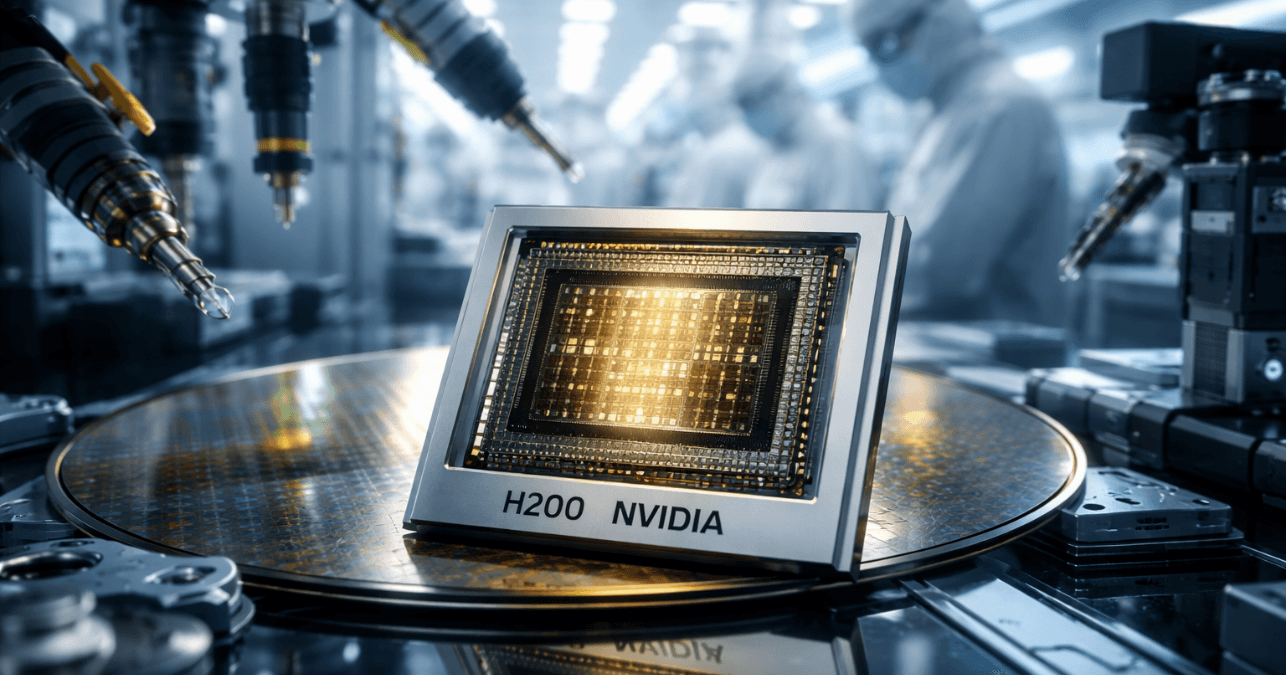
Nvidia has begun shipping its advanced H200 AI chips to China under a reversed US export policy, but the volumes moving so far are, in the words of a senior Commerce Department official, “trivial” — even as Chinese technology firms have collectively ordered more than two million units against a global Nvidia inventory of roughly 700,000.
A Policy Reversal That Remains Mostly Symbolic
Under Secretary of Commerce for Industry and Security Jeffrey Kessler told Congress on 14 July that H200 shipments to China remain minimal despite roughly $10 billion in approved licenses, according to TechTimes. Washington has approved sales to roughly ten Chinese firms — including Alibaba, Tencent, ByteDance, and JD.com — with each cleared buyer permitted to purchase up to 75,000 chips through Nvidia directly or via authorised distributors Lenovo and Foxconn.
The scale of pent-up Chinese demand dwarfs what can actually be delivered. Chinese technology companies have collectively ordered more than two million H200 chips for 2026, against Nvidia’s total global inventory of roughly 700,000 units — a supply gap severe enough to force emergency production discussions with TSMC to restart manufacturing of the older Hopper-generation chip architecture, according to the same TechTimes reporting.
Bipartisan Political Backlash in Washington
The limited shipments have nonetheless triggered a sharp political divide in Congress. Democratic Representative Gregory Meeks, the top Democrat on the House Foreign Affairs Committee, accused the administration of weakening safeguards by approving advanced AI chip licenses, describing export controls as being used as a bargaining chip in broader trade negotiations with China. Republican Representative Bill Huizenga separately criticised the Commerce Department over a reported loophole allowing Chinese subsidiaries operating outside mainland China to acquire the more advanced Blackwell-generation chips despite restrictions targeting the mainland market.
The Policy Architecture Is Genuinely Contradictory
The current framework traces back to a December 2025 announcement by President Trump permitting H200 sales to China, formally codified by the Commerce Department in January 2026 alongside conditions experts have called self-contradictory, according to detailed policy analysis from Semiconductor Insight. Those conditions include a 25% tariff on advanced AI chips meeting specific performance thresholds under Section 232 of the Trade Expansion Act, case-by-case licensing replacing a prior blanket presumption of denial, mandatory end-use certifications, and a volume cap estimated at roughly one million H200 units — about half of what Chinese buyers have already ordered.
The buyer list has continued to expand in recent weeks. Newly cleared purchasers include a unit of telecom equipment maker ZTE and a server assembly firm, alongside a cloud computing subsidiary of Kingsoft cleared to purchase competing AMD chips, according to Technetbook.
Why the Ambiguity Itself Is Costly
Perhaps the most consequential effect of the policy has been on long-term planning rather than near-term volume. Nvidia has not recovered the Chinese customer base it lost after roughly a year of regulatory uncertainty, as export controls introduced in 2022 and escalated under both the Biden and Trump administrations had already pushed the company’s China market share from roughly 95% toward zero, according to Semiconductor Insight’s analysis. Customers requiring long-term procurement certainty are reportedly reluctant to commit against a policy framework that could reverse again within months — while a bipartisan group of lawmakers has separately pushed Commerce Secretary Howard Lutnick and Secretary of State Marco Rubio toward a complete country-level ban on chipmaking equipment exports to China.
What It Means for Investors and the AI Supply Chain
For semiconductor investors, the H200 saga illustrates how thoroughly US-China technology policy has become entangled with broader trade diplomacy — a dynamic that leaves Nvidia’s China revenue outlook genuinely unpredictable regardless of near-term shipment volumes. For TSMC and its packaging partners, the emergency restart of Hopper-generation production lines signals capacity strain that may persist regardless of how the export-control debate ultimately resolves.
What to Watch
The Commerce Department’s enforcement posture on the reported Blackwell subsidiary loophole, along with any Congressional movement toward the proposed blanket equipment-export ban, will be the clearest signals of whether Washington’s China chip policy is heading toward further liberalisation or a renewed crackdown.
Discover more from The Economy
Subscribe to get the latest posts sent to your email.

Russia’s War Economy Got a Reprieve From Iran

China’s Economy Has a Structural Problem: Factories Are Winning, Households Are Losing

How Malaysia “Shrugged Off” Trump’s Tariffs — and What Comes Next

Singapore’s AI Boom Is Now a Two-Country Story

Why Global Family Offices Are Converging on Dubai in 2026

A Weak Jobs Report Just Rewired the Fed’s Autumn — And Wall Street Cheered

Britain’s Fragile Rebound Meets a Budget Deadline and a Trump Ultimatum

Pakistan’s Economy Grew 3.7% — So Why Doesn’t It Feel Like a Recovery?

Top 15 Financial Stocks for Investment in PSX

Pakistan Exports 2026: Record $35.6B Forecast Masks Trade Deficit Risk

UK’s Jobs Downturn Now Matches the 2008 Financial Crisis — And AI Is Accelerating It

Fed Rate Cut Bets Surge After Shock US Jobs Report Exposes Labor Market Cracks

Pakistan’s Trade Gap Widens to $3.95bn Despite Meeting FY26 Current Account Target

Why Ottawa Is Betting on Dubai: Inside Canada’s Gulf Trade Pivot

Gold Price Forecast 2026: Fed’s July 29 Decision and Record Central Bank Buying Explained

China Politburo July 2026: Stimulus Signals Explained

Pakistan Economy 2026: GDP Grows 3.7% as IMF Completes EFF Review Amid Middle East Risk

Strait of Hormuz Blockade 2026: Oil Prices Surge 9% as US-Iran Conflict Reignites

Down But Not Out: Inside the Slow Sinking of Russia’s War Economy

Gulf Capital Retreat From Pakistan 2026: UAE Loan Freeze & What It Means

Global Stock Market Selloff 2026: Stagflation Fears Return as Iran Conflict Reignites

Pakistan’s Economic Survey FY26: Inflation Spike Insights

Russia Fuel Shortages 2026: Inside a Cracking War Economy

Strait of Hormuz Crisis 2026: How Trump’s Toll U-Turn Exposes Global Economic Risk

Bank of England Rate Decision Amid Energy Crisis

Russia’s War Economy Model Is Starting to Crack, Think Tank Warns

Pakistan’s Economic Growth: Resilience Amid Challenges

Andy Burnham, UK Gilts and Mortgages: July 2026 Explainer
-

 Markets & Finance7 months ago
Top 15 Stocks for Investment in 2026 in PSX: Your Complete Guide to Pakistan’s Best Investment Opportunities
-

 Analysis6 months ago
Johor’s Investment Boom: The Hidden Costs Behind Malaysia’s Most Ambitious Economic Surge
-

 Analysis6 months ago
Top 10 Stocks for Investment in PSX for Quick Returns in 2026
-

 Analysis6 months ago
Brazil’s Rare Earth Race: US, EU, and China Compete for Critical Minerals as Tensions Rise
-

 Banks7 months ago
Best Investments in Pakistan 2026: Top 10 Low-Price Shares and Long-Term Picks for the PSX
-

 Investment7 months ago
Top 10 Mutual Fund Managers in Pakistan for Investment in 2026: A Comprehensive Guide for Optimal Returns
-

 Global Economy8 months ago
15 Most Lucrative Sectors for Investment in Pakistan: A 2025 Data-Driven Analysis
-

 Global Economy8 months ago
Pakistan’s Export Goldmine: 10 Game-Changing Markets Where Pakistani Businesses Are Winning Big in 2025