
Inflation
How to Control Rising Inflation Amid Hormuz Closure: A Case for South Asian States

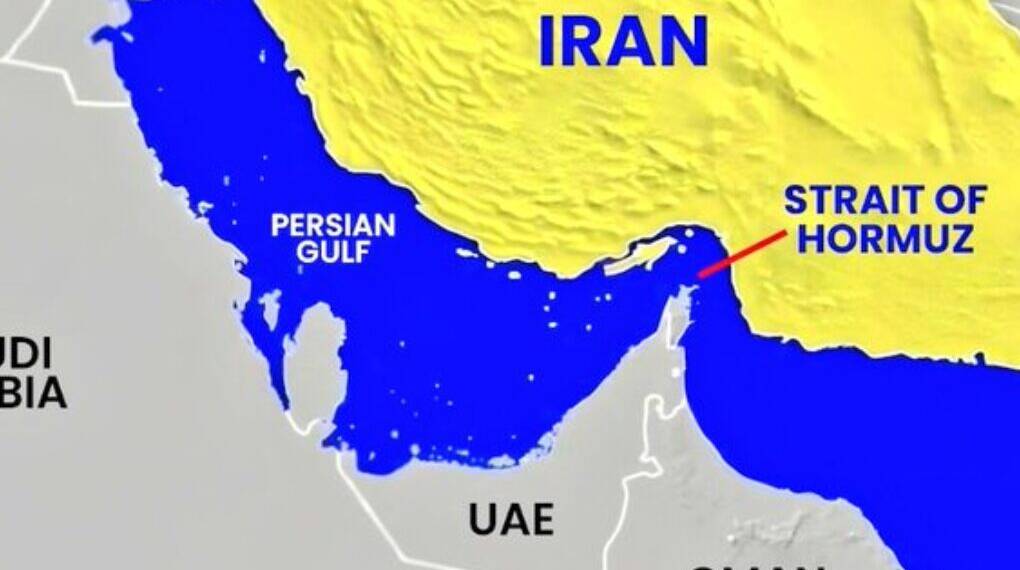
The Strait of Hormuz closure has unleashed the largest oil supply shock in history. Here’s how India, Pakistan, and Bangladesh can control rising inflation—and why the crisis is a structural wake-up call.
Something shifted in the world economy on February 28, 2026—and it is not coming back anytime soon.
When U.S.-Israeli strikes on Iran triggered the closure of the Strait of Hormuz, the world did not merely lose a shipping lane. It lost the circulatory artery of the global energy system. Tanker traffic through the strait—which ordinarily handles roughly 20% of global seaborne oil and a quarter of global LNG—collapsed from approximately 130 vessels per day in February to a near-standstill of just 6 in March, a 95% plunge almost without historical precedent. The International Energy Agency called it “the largest supply disruption in the history of the global oil market.” That is not hyperbole. That is a policy emergency.
For South Asia, the shock arrived like a tax bill no one budgeted for. Fuel queues snaked around petrol stations from Karachi to Chittagong. LPG cylinders vanished from market shelves in Lahore and Dhaka. Transport operators in Mumbai began passing surcharges onto consumers already squeezed by food prices. Small manufacturers—the backbone of South Asian employment—watched input costs spike while their customers pulled back. And everywhere, the question was the same: How long can governments hold the line?
The answer depends entirely on whether South Asian leaders treat this crisis as a temporary weather event requiring familiar relief measures—or as a structural indictment of a chronic, self-inflicted energy vulnerability that has been deferred for too long.
The Transmission Mechanism: How Hormuz Disruption Fuels South Asian Inflation
Understanding the inflation problem requires mapping the transmission chain from a narrow waterway in the Persian Gulf to a vegetable vendor’s stall in Dhaka.
The first channel is direct energy costs. Physical Dated Brent crude—the price Asian importers actually pay for delivered cargoes—surged to $132 per barrel in early April, even as futures markets drifted back to the low-$90s on ceasefire speculation. The gap between the futures price and the physical price tells you everything: markets believe the crisis will eventually resolve, but the cargo sitting in a tanker outside the Gulf cannot wait for resolution. For every $10 sustained increase in oil prices, global inflation rises by approximately 0.2–0.25 percentage points—a rule of thumb that becomes brutally consequential when prices jump $40 or $50.
The second channel is fertilizer. Up to 30% of globally traded fertilizers—urea, ammonia, and phosphates—transit the Strait of Hormuz. The Persian Gulf accounts for roughly 30–35% of global urea exports. With the strait closed, fertilizer prices in South Asia have spiked sharply, arriving precisely when planting seasons begin. This is not merely an economic problem. It is a food security crisis in the making, as higher fertilizer costs translate directly into lower crop yields and higher food prices in societies where food already commands 40–50% of household expenditure.
The third channel is currency depreciation. As investors pulled capital from emerging markets, the Pakistani rupee, Bangladeshi taka, and Sri Lankan rupee all faced renewed downward pressure. A weaker currency means costlier imports—denominated in dollars—feeding exchange rate pass-through into domestic prices. For Pakistan, navigating an IMF programme with thin foreign exchange reserves, this is the most dangerous second-order effect.
The fourth channel is LNG and power generation. After Iran struck Qatar’s Ras Laffan LNG complex in March 2026, northeast Asian LNG spot prices more than doubled to $22.5 per MMBtu. Bangladesh—which pivoted aggressively toward LNG-fired power in recent years—found its generation economics upended overnight. Pakistan, already mired in circular debt in its energy sector, faces similar pressures.
The IMF’s April 2026 World Economic Outlook now anticipates global inflation rising to 4.4%—up 0.6 percentage points from January projections—while global growth is expected to slow to 2.6% in 2026 from 2.9% in 2025. UNCTAD warns that developing nations face the ‘dual whammy’ of higher prices and weakening currencies simultaneously constricting their capacity to respond.
South Asia’s Structural Vulnerability: The Price of Chronic Dependence
Compared with economies most insulated from this shock—the United States, which exports energy; or China, which held approximately 1.2 billion barrels of crude reserves as of early 2026, providing over 100 days of import cover even under a scenario of zero new inflows—South Asia stands nakedly exposed.
India sources 40–50% of its crude imports via the Strait of Hormuz under normal conditions. Japan and South Korea—commonly cited as the most structurally vulnerable large Asian economies—at least benefit from decades of investment in strategic petroleum reserves exceeding 100 days of import cover, IEA membership, and deep institutional frameworks for crisis response. South Asian states, broadly, have none of these advantages at scale.
Pakistan immediately requested that Saudi Arabia reroute crude shipments through the Red Sea port of Yanbu—a pragmatic emergency measure, but illustrative of just how thin Pakistan’s contingency infrastructure has become. Bangladesh, among the most price-sensitive importers in Asia, faces fuel shortages that threaten to cascade through its garment sector—the country’s principal export earner and employer.
What makes South Asia’s position particularly precarious is the coincidence of vulnerabilities: high energy import dependence, thin fiscal buffers, food systems reliant on fertilizer imports, large informal workforces with no safety nets, and governments facing political pressure to cushion consumers precisely when doing so most strains public finances.
The Subsidy Trap: Why the Obvious Answer Is the Wrong One
Let us be clear-eyed about one temptation that will prove costly: using broad-based fuel subsidies as the primary response to this crisis.
Subsidies are politically seductive. They provide immediate, visible relief. They suppress headline inflation statistics in the short run. But the record is damning. Pakistan’s history of energy subsidies has contributed materially to its recurring fiscal crises, its addiction to IMF programmes, and the circular debt spiral that has made its power sector a structural liability rather than an asset. India’s fertilizer and fuel subsidy bill already runs into the hundreds of billions of rupees annually; adding another layer during an oil shock without structural reform merely postpones pain while accumulating fiscal dry tinder.
Subsidies also suppress the price signals that tell businesses and consumers to adapt—to shift to public transport, to invest in more efficient machinery, to explore renewable alternatives. The right model is targeted, time-bound support for the genuinely vulnerable—low-income households, small farmers, critical transport workers—combined with demand management measures across the broader economy.
A Framework for Controlling Inflation Amid the Hormuz Closure
Short-Term Measures: Absorbing the Shock (0–6 months)
- Strategic reserve management. India, having diversified its crude sources to over 41 suppliers and pivoted to Russian crude since 2022, received a U.S. Treasury emergency waiver in March 2026 permitting purchases of stranded Russian oil cargoes—a pragmatic lifeline. Other South Asian states should immediately inventory available reserves and coordinate drawdowns with transparency to avoid hoarding.
- Emergency import diversification. Pakistan’s request for Saudi rerouting via Yanbu is the template, not the ceiling. Bangladesh, India, and Sri Lanka should activate emergency procurement with suppliers in West Africa (Nigeria, Angola), the Americas (Colombia, Brazil, Ecuador), and the United States, whose LNG export capacity is insulated from the Hormuz disruption.
- Demand-side management. The IEA’s crisis guidance recommends remote working, reduced highway speeds, carpooling mandates, and optimised public transport. The Philippines has moved to a temporary four-day work week. South Asian governments should adopt contextually adapted equivalents—calibrated demand reduction that cuts import bills without destroying economic activity.
- Targeted cash transfers over blanket subsidies. Channel relief directly to low-income households through digital payment infrastructure (India’s JAM Trinity, Bangladesh’s mobile money networks). Protect purchasing power without distorting price signals economy-wide.
Medium-Term Measures: Reducing Structural Dependence (6–24 months)
- Accelerated crude and LNG source diversification. No South Asian state should source more than 25–30% of any single energy commodity from a single supplier corridor. Long-term offtake agreements with U.S. LNG exporters, African crude suppliers, and Central Asian pipeline sources should be treated as national security imperatives.
- Regional energy cooperation. The BIMSTEC framework offers mechanisms for South Asian states to share strategic reserves in crisis conditions, coordinate procurement for scale advantages, and develop regional transmission infrastructure. Nepal and Bhutan’s hydropower potential remains dramatically underutilised as a clean regional resource.
- Fertilizer production localisation. India and Pakistan have domestic natural gas resources that could be more systematically directed toward domestic urea production, reducing the 30%+ import dependence on Gulf fertilizer. Bangladesh should explore accelerated investment in domestic blended fertilizer formulations.
Long-Term Measures: Achieving Energy Sovereignty (2–10 years)
- Aggressive renewable energy scaling. India already targets 500 gigawatts of renewable capacity by 2030. The Hormuz crisis makes this not merely an environmental imperative but an economic security imperative. Every gigawatt of domestic solar or wind capacity installed is a barrel of oil not imported, a dollar of foreign exchange not spent, an inflation point avoided in the next supply shock.
- Energy efficiency and building codes. Mandatory efficiency standards for appliances, commercial buildings, and industrial processes can materially reduce electricity demand growth without reducing welfare—and should be treated as a structural inflation-control mechanism.
- Fiscal buffers and sovereign energy funds. South Asian states should consider establishing dedicated Energy Security Funds—capitalised during periods of lower oil prices—to finance strategic reserve acquisitions and energy transition investments without straining general budgets during shock periods.
The Geopolitical Dimension: South Asia Needs a Seat at the Table
The Hormuz crisis is ultimately a geopolitical crisis. And South Asian states—which between them represent nearly two billion people and some of the most oil-import-dependent large economies on earth—have historically been bystanders in the geopolitical conversations that determine their energy fates.
India, as the region’s largest economy and a G20 member, should use every diplomatic channel to advocate for Hormuz stabilisation, including through its traditionally non-aligned posture and its relationships with Gulf states, Russia, and the United States. Delhi should also push for South Asian integration into IEA-style emergency response frameworks—a conversation that has inched forward in recent years but has yet to produce binding mechanisms.
Pakistan, Bangladesh, and Sri Lanka should coordinate through the UN, UNCTAD, and the Commonwealth to ensure the international community’s crisis response includes adequate support for vulnerable energy-importing developing nations. The IMF and World Bank have signalled awareness of this imperative; South Asian governments must turn awareness into concrete concessional financing for energy security investments.
The Crisis That Could Change Everything
The Strait of Hormuz has always been South Asia’s Achilles’ heel. What has changed in 2026 is that the vulnerability can no longer be politely deferred.
UNCTAD’s assessment is unambiguous: regions more dependent on Middle East energy imports, particularly South Asia and Europe, will be more exposed to prolonged inflationary pressure if disruptions persist. The SolAbility modelling estimates cumulative GDP losses of 3–4% or more under prolonged closure scenarios, with South Asia absorbing some of the heaviest hits. These are not tail risks. They are baseline scenarios under conditions that show no imminent resolution.
The history of structural economic reform tells a consistent story: the deepest, most durable reforms happen under crisis conditions, when the political economy of inertia is finally overwhelmed by the political economy of necessity. The 1991 Indian reforms came on the back of a balance-of-payments crisis. Bangladesh’s garment sector rise came out of disciplined liberalisation under pressure. Pakistan’s most consequential fiscal adjustments have invariably come under IMF conditionality.
The 2026 Hormuz closure can be South Asia’s next inflection point—but only if leaders resist the narcotic of temporary relief and reach instead for structural transformation.
The strait may reopen. The lesson must not close with it.
Key Sources & Citations
• IMF Blog: How the War in the Middle East Is Affecting Energy, Trade, and Finance (March 2026)
• UNCTAD Rapid Assessment: Hormuz Disruption Deepens Global Economic Strain
• Bloomberg Economics SHOK Model – Hormuz Oil Shock Analysis
• IMF Regional Economic Outlook: MENAP, April 2026
• World Economic Forum: 6 Ways Countries Are Responding to the Historic Energy Shock
• IG Markets: Strait of Hormuz Closure – Implications for Asia
• SolAbility: Hormuz Economic Impact Model – Day 42 Update
• Al Jazeera: IMF Cuts Global Growth Forecast During Hormuz Blockade
• Wikipedia: 2026 Strait of Hormuz Crisis
• Allianz Research: Economic Outlook 2026–27 – The Fog of War
Discover more from The Economy
Subscribe to get the latest posts sent to your email.


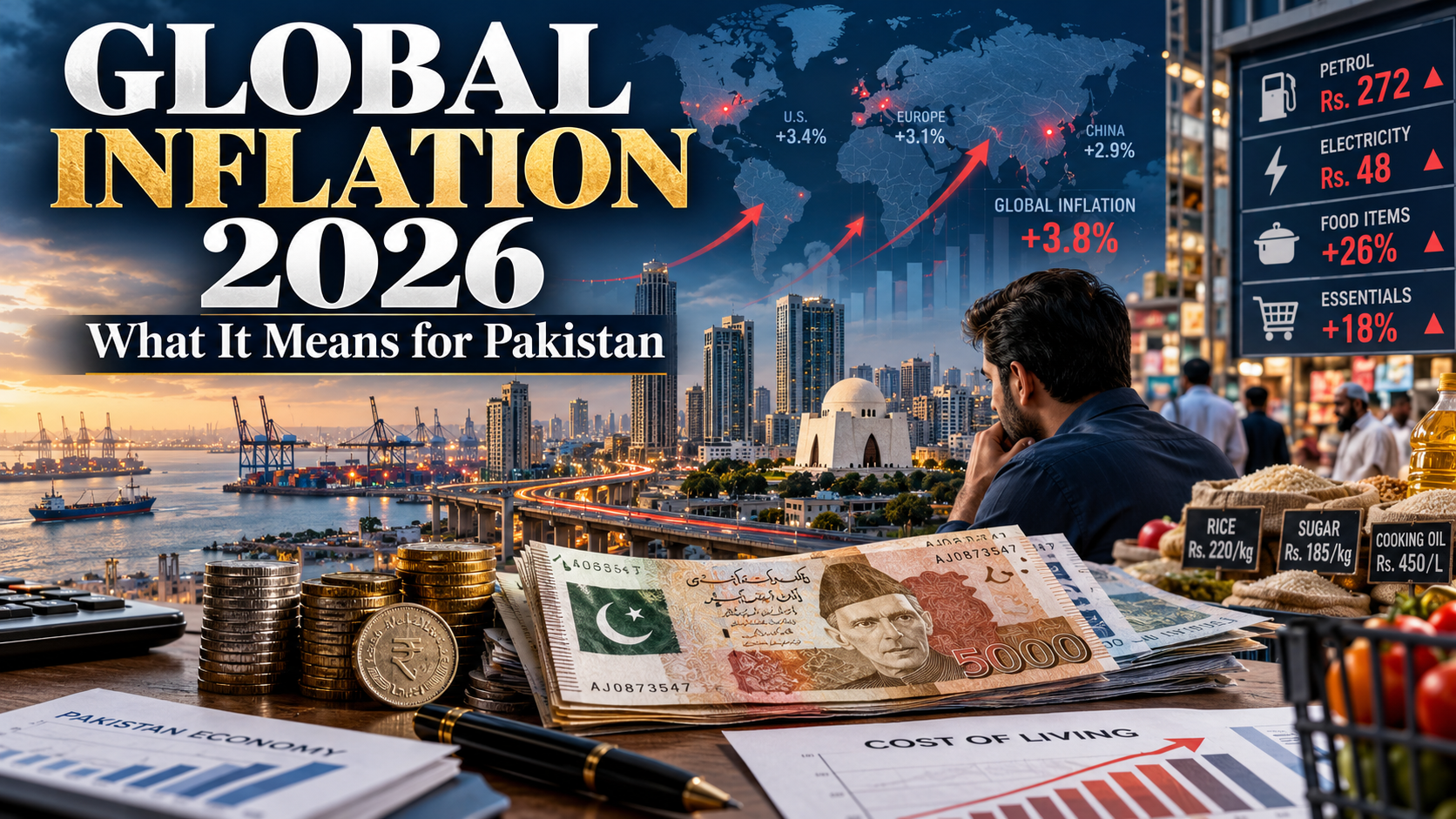
Global inflation is rising again in 2026, and energy is the main cause. The International Monetary Fund expects global headline inflation to climb to 4.7% this year, up from 4.1% in 2025, mainly because of higher energy and food prices (IMF, World Economic Outlook, October 2026). For import-dependent countries such as Pakistan, the shock arrives through fuel pumps, transport fares and the cost of imported goods.
Key Takeaways
- The IMF projects global inflation of 4.7% in 2026, easing to 4.1% in 2027.
- Energy and food prices are the main drivers, linked to the Middle East conflict and supply disruptions.
- Global growth is slowing at the same time, to about 3.1% in 2026, which makes the trade-off harder for central banks.
- Pakistan’s headline inflation was 10.26% year on year in September 2026, well above the State Bank’s 5 to 7% target range.
- Households and businesses should plan for higher transport and import costs, and should not assume a quick return to lower inflation.
The IMF numbers in brief
The IMF sees global growth slowing from 3.5% in 2025 to 3.1% in 2026, before recovering to 3.4% in 2027 (Trend.az, reporting the IMF release). The more worrying signal is that inflation is rising while growth slows. When an economy slows and prices rise together, policymakers have fewer good options.
The IMF has also said the global economy is resilient but increasingly uneven. Countries that benefit from the AI investment boom or favourable terms of trade are doing relatively well. Many energy-importing and low-income countries face much harder conditions (Trend.az).
Why energy is doing the damage
Energy feeds into almost everything: freight, fertiliser, food processing, manufacturing and electricity. One press summary of the IMF analysis reports that energy prices remain roughly a quarter higher than before the shock (Outlook India).
This is why interest rates alone cannot solve the problem. Higher borrowing costs reduce demand, but they do not produce more oil or gas. Central banks can slow second-round effects, where higher fuel costs feed into wages and expectations. They cannot lower the price of a barrel.
Supply shock or demand boom?
Demand-driven inflation comes from too much spending chasing too few goods. Supply-driven inflation comes from higher input costs that squeeze output. The 2026 episode is mostly supply-driven, and that changes the policy answer. Rate rises work well against demand-driven inflation. Against supply-driven inflation, they work more slowly and at a higher cost to growth.
A Pakistani analysis published in April made this point directly: inflation there is no longer driven solely by excess demand, yet policy still relies heavily on high interest rates (Bol News).
Our reading is that global inflation in 2026 is a supply problem that central banks will try to treat with demand tools. A prolonged period of high rates looks more likely than a sharp reversal.
Pakistan: inflation above 10% and the rate dilemma
Headline inflation in September 2026 was 10.26% year on year, and the monthly rise of 1.27% was driven by energy costs (ARY News, citing PBS data). Electricity and fuel offset a sharp slowdown in food prices. Core inflation, which excludes food and energy, ran between 8.1% and 8.6% (The Express Tribune).
The State Bank kept its policy rate at 11.5% in September, by a seven-to-three vote (The Express Tribune). It had raised rates by 100 basis points in April, the first hike in nearly three years (Bol News).
The government has told the IMF that inflation could fall to 7.5% if the Middle East situation normalises and Brent averages $80 a barrel in the current fiscal year. That is a conditional assumption, not a forecast. The IMF has urged Pakistan to adjust both exchange-rate and interest-rate policy to keep inflation and the current account deficit under control (The Express Tribune).
How the shock travels
For a Pakistani household, the chain is short. Petrol and diesel prices move first. Transport fares follow within weeks. Food prices rise through freight and packaging. Imported goods become more expensive as the rupee comes under pressure.
Food complicates the picture. Tomato prices fell about 25% month on month in the September data, and chicken prices fell about 8% (ARY News). Seasonal food swings can hide energy pressure for a month or two, which is why economists watch core inflation alongside headline figures.
What this means for households and businesses
Households: Treat transport and utility costs as fixed for budgeting purposes. If you carry variable-rate debt, remember that the policy rate feeds directly into repayments.
Small businesses and importers: Build fuel and freight surcharges into quotes where possible. Review supplier contracts for currency clauses. Keep working capital buffers, because higher rates raise the cost of bridging cash gaps.
Investors: A prolonged hold at high rates is a different environment from a rapid easing cycle. This is general information, not investment advice.
Risks, limitations and uncertainties
- IMF figures are projections. They will change as conflict and energy prices evolve, and the October outlook flags downside risks.
- The government’s 7.5% assumption depends on Brent averaging $80 a barrel. A sustained spike would push inflation higher.
- Pakistan’s monthly CPI and policy-rate figures are subject to revision.
- Pakistan can diverge from the global average because of the rupee, administered prices and food supply.
This article is for general information and is not personalised financial or economic advice.
FAQ
Will global inflation rise in 2026? The IMF expects global headline inflation to rise to 4.7% in 2026, from 4.1% in 2025 (IMF).
Why is inflation rising again? Energy and food costs are the main drivers, with supply disruptions linked to the Middle East conflict pushing fuel prices up.
Will inflation fall in 2027? The IMF projects global inflation easing to 4.1% in 2027. That could change quickly if energy supply worsens.
Why is Pakistan’s inflation above the global average? Pakistan imports much of its fuel, so energy shocks pass through quickly. Electricity and fuel rose in the latest data, and the rupee adds pressure.
Will the State Bank raise rates again? It has kept rates at 11.5% and has signalled it will tighten further if needed to prevent second-round effects. Future decisions depend on inflation, the exchange rate and energy prices.
Conclusion
Global inflation is rising in 2026 because energy and food costs have jumped, and the IMF expects it to ease only gradually. For Pakistan, the challenge is sharper, with inflation above 10% and limited room to cut rates. Watch oil prices, the State Bank’s next decision and monthly CPI releases. Those signals will show whether the shock is fading or becoming entrenched.
Discover more from The Economy
Subscribe to get the latest posts sent to your email.
Key Takeaways
- The IMF projects inflation of 9.9% for FY2026-27, which means prices are still rising much faster than most households would like.
- Energy import costs, exchange-rate moves, and global oil prices are the main drivers, and the government controls only some of them.
- Stabilisation has stopped the crisis from getting worse, but it has not yet brought prices back to comfortable levels.
- Lower inflation would most help people on fixed incomes, shopkeepers with thin margins, and workers whose wages lag behind food and fuel costs.
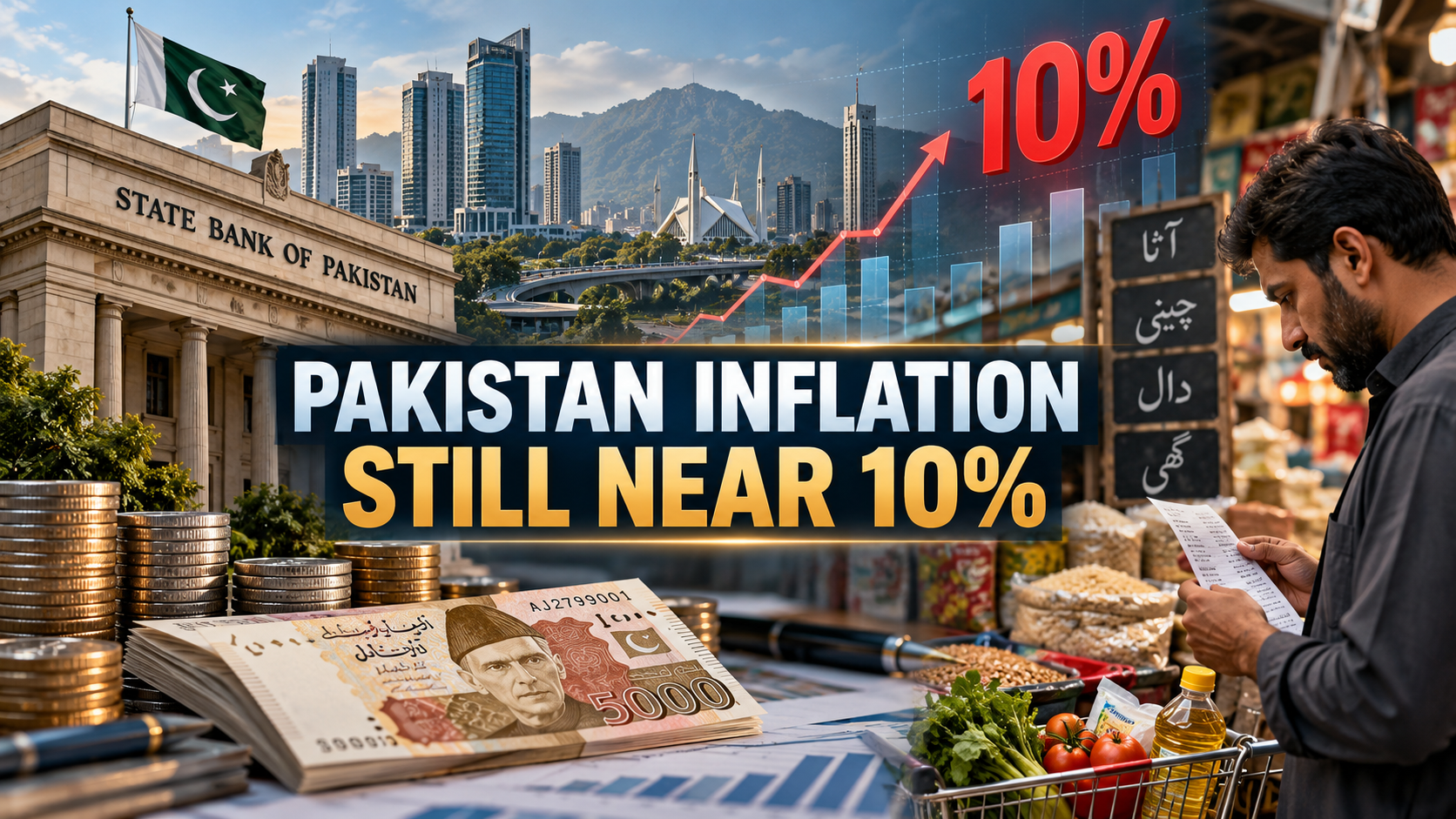
Pakistan’s economy has stopped sliding, but that is not the same as recovering. Inflation is still close to 10%, which means a basket of goods that cost 100 rupees a year ago now costs about 110. The IMF’s latest projection for FY2026-27 is 9.9%, so the state does not expect a sharp drop soon.
The reason is simple to describe and harder to fix. Pakistan imports much of its energy, pays for it in dollars, and passes the cost to households through fuel and electricity prices. When the rupee weakens or global oil rises, prices follow quickly. When they fall, the relief arrives more slowly.
Energy Is the Biggest Lever
Oil and gas make up a large share of Pakistan’s import bill. Each time the price of crude moves in global markets, the cost of petrol, diesel, and power changes at home. Transport costs then ripple through to food, because trucks carry vegetables, flour, and cooking oil across the country.
Think of a bus fare in Lahore. When diesel rises, the operator asks for more per trip. The vegetable seller at the next stop pays more to bring stock to market, so tomato prices climb too. Nobody decided that tomatoes should cost more. The energy bill did the deciding.
The Exchange Rate Problem
A weaker rupee makes imports more expensive in rupee terms. That includes fuel, machinery, medicines, and raw materials for factories. Exporters can benefit from a cheaper currency, but households and importers feel the pain first.
Policy has tried to manage this by holding the rupee within a controlled range. That approach limits sudden shocks, but it can also leave the currency overvalued in some periods, which hurts exporters. The balance between stability and competitiveness is one of the hardest choices facing policymakers.
What the IMF Projects
The IMF’s projection of 9.9% inflation and 3.5% growth for FY2026-27 tells a specific story. The economy is expected to expand modestly while prices stay high. Growth at that pace is not enough to create jobs quickly for a population that keeps growing.
The projection also depends on assumptions about oil prices, exchange rates, and fiscal discipline. If oil stays above current levels, inflation could stay higher for longer. If it falls, the outlook improves, but the government still needs to collect enough revenue to avoid borrowing more.
Where Economists Disagree
Some analysts argue that inflation will fall steadily once the effects of past currency moves pass through. Others warn that energy subsidies, circular debt in the power sector, and tax increases keep pushing prices up. Both views have evidence behind them, and the outcome will depend on which pressure proves stronger.
It is fair to say that inflation expectations matter. If businesses and workers expect prices to keep rising, they set prices and wages higher, which makes inflation harder to bring down.
What This Means for You
If your income rises slowly, focus on the categories where prices move most: food, fuel, and power. Track your own spending for three months to see where your money actually goes. A household budget built on real numbers is more useful than a general rule.
If you run a small shop, watch your supplier costs closely and review prices at least monthly. Passing on costs too late can hurt cash flow, and passing them on too quickly can cost you customers.
What to Watch Next
- Monthly consumer price index releases from the Pakistan Bureau of Statistics.
- State Bank of Pakistan policy rate decisions, which influence borrowing costs and inflation expectations.
- Global oil price movements and any changes to domestic petroleum pricing.
- The next IMF programme review, which will test whether the inflation path matches the projection.
Confirm each date on the official calendars before you plan around it.
Frequently Asked Questions
Why is inflation still high if the economy has stabilised?
Stabilisation means the most acute crisis has eased. It does not mean prices have fallen. Past currency falls and energy costs continue to work their way into shop prices over time.
Does the exchange rate cause inflation? It is one important cause. When the rupee weakens, imported goods and fuel cost more in local currency, and those costs spread across the economy.
Will inflation fall to pre-crisis levels soon?
Not on current projections. The IMF’s FY2026-27 figure of 9.9% suggests prices will stay elevated for some time.
What can households do right now?
Focus on fixed costs such as power and transport, compare prices across suppliers, and review any income-linked support you may qualify for.
Conclusion
Inflation near 10% is the price of a fragile recovery, and it will not disappear with one good month of data. The real test is whether energy, the currency, and public finances move in the same direction for long enough to lower prices. Watch the monthly CPI, and you will see the trend before the headlines do.
Discover more from The Economy
Subscribe to get the latest posts sent to your email.
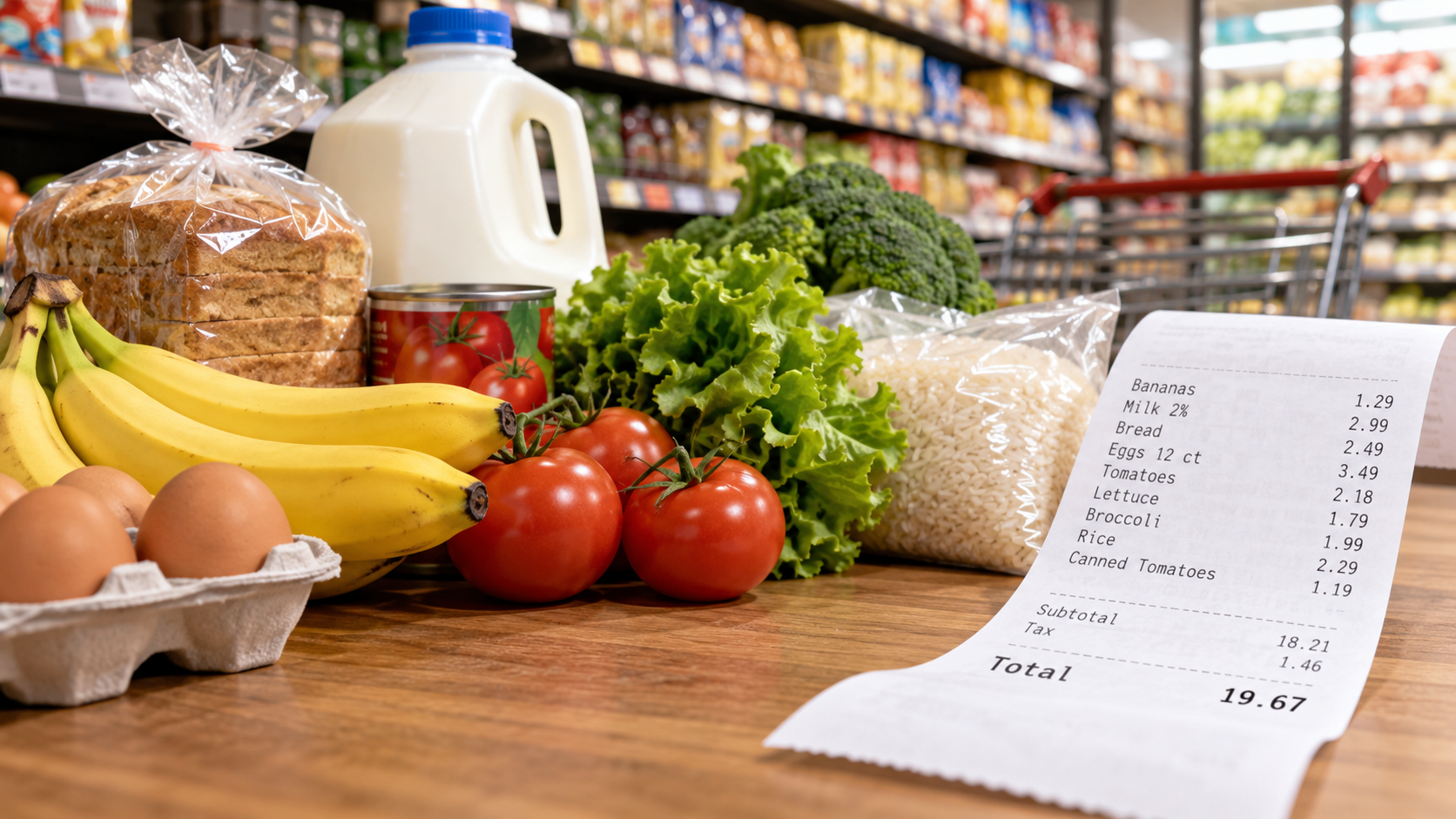
There is a paradox at the supermarket checkout: the latest monthly US grocery inflation reading showed a small decline, yet food producers and retailers are preparing for another wave of cost pressure. Both developments can be accurate because the consumer price index measures what happened to retail prices, not every expense that will influence prices over coming months.
The Bureau of Labor Statistics reported that the food-at-home index fell 0.1% in September 2026 from the previous month, while remaining 1.8% higher than a year earlier. Supermarket News covered that modest decrease. It would be misleading to turn one month’s decline into a claim that the cost-of-living problem has disappeared.
Why prices can pause while costs rise
Retailers do not change every shelf label the instant crude oil, fertilizer or packaging costs move. Many buy through contracts, hold inventories, hedge some inputs and adjust prices selectively. Competing stores may temporarily accept lower margins to maintain customer traffic. This creates a lag between changing supplier conditions and the consumer prices visible in official data.
Reporting by the Financial Times points to diesel, freight and other input costs as renewed sources of concern. That is a plausible channel: food must be produced, processed, refrigerated and transported, sometimes through several distribution centers, before it reaches a shelf.
Not every aisle moves together
A headline grocery index hides distinct markets. September’s BLS release showed declines in beef and dairy prices during the month but increases for some beverages, fruits and vegetables. Seasonal harvests, disease outbreaks, transportation costs and global commodity conditions affect different products on different schedules.
A household that spends heavily on fresh produce may experience a different inflation rate from one buying mostly shelf-stable goods. This is why household budgets often feel disconnected from the national average. Useful service journalism compares a consistent basket over time instead of selecting the most dramatic products after the fact.
Supermarket strategies during inflation
Large chains use private-label products, promotions, loyalty pricing, purchasing scale and supplier negotiations to compete for spending. Discount grocers may emphasize simple store formats and limited assortments. Premium formats may focus on convenience or prepared foods. These strategies do not change the official inflation rate mechanically, but they do affect the price choices consumers face.
Retailers also make trade-offs. Heavy discounts can boost traffic but reduce margins; frequent price changes can confuse shoppers; and private-label expansion can improve value while increasing reliance on a narrower pool of manufacturers.
What households can do without chasing every promotion
Compare unit prices, not only package prices. Plan around a handful of adaptable meals and substitute among comparable ingredients when one category spikes. Check whether a discount requires a loyalty account or bulk purchase that leads to waste. A lower price is not a saving if the product will expire before it is used.
For tracking inflation personally, retain a small set of recurring receipts and calculate the total for identical quantities monthly. Do not compare a holiday basket with a routine basket; the difference may reflect what you bought rather than price increases.
What could change the outlook?
Oil prices, freight costs, farm conditions, tariffs, labor costs and retailer competition will all matter. The 12-month measure can accelerate even if some individual months remain mild. Forecasts should be labelled as forecasts, not as prices already paid.
An effective supermarket news article serves two audiences: investors evaluating margins and families trying to budget. The relevant questions are connected but not identical. Higher selling prices may lift revenue while reducing volumes and worsening customer trust.
How to read the next inflation release
The difference between month-on-month and year-on-year inflation is especially important. A 0.1% monthly fall after earlier increases does not return the price level to where it was before the increases. Likewise, a 12-month inflation rate can ease because last year’s unusually large price rise drops out of the comparison, even if shoppers see no actual cut today. The food-at-home index is a standardized economic measure, while the household’s experience depends on its purchasing mix and store choices. When the next BLS release arrives, compare monthly moves for food at home, food away from home and energy, then assess whether higher freight costs are appearing across multiple categories.
Frequently asked questions
Did grocery prices fall in September 2026?
The US food-at-home index declined 0.1% month on month, but was still up 1.8% over 12 months, according to BLS.
Why do grocers expect pressure later?
Fuel, transportation, packaging and agricultural inputs can take time to show up in retail prices.
Are private-label groceries always cheaper?
Often, but not always. Compare price per unit, quality and the quantity actually needed.
Discover more from The Economy
Subscribe to get the latest posts sent to your email.

Neocloud Economics in 2026: GPU Debt, Utilization and Power

What Is a Neocloud? How AI GPU Clouds Work and Compare

Lula Re-elected in 2026: What Changes for the Dollar, Brazilian Stocks, and Interest Rates?

Lula Wins Brazil’s 2026 Election: Five Economic Tests for 2027

SSI November 2026 Payment: Why Benefits Arrive October 30

Russia Sanctions Waiver: What Asian Oil Buyers Gain

Asia Markets Weekly: How Oil, US Yields and the Fed Reach Tokyo, Kuala Lumpur and Karachi

Gold Near $4,000: Buy, Hold or Wait? A Pakistan Tola Price Guide

US 10-Year Treasury Yield Near 5%: The Hidden Cost for Pakistani Investors

Fed Meeting on October 28: Hike or Hold—and Why Pakistan Investors Should Care

Can Pakistan Turn US–Iran Mediation Into an Economic Dividend?

Oil Above $100: How Higher Crude Prices Reach Pakistan’s Rupee, Petrol and Imports

SBP Interest Rate at 11.5%: What Will Decide Pakistan’s Next Policy Move?

The Global South: Debt, Climate Finance and Investment in 2026

Crude Oil & Petroleum Market Analysis: OPEC+ Decisions and Price Forecasts

Top US Convenience Store Chains: Store Counts, EV Charging, and Sales Trends

Algorithmic Dogfights: Why the U.S. and China Must Establish Rules of Engagement for Autonomous Air Power

Who Is Shivon Zilis? The Neuralink Executive at the Center of the Musk–OpenAI Trial

Social Security Extra $90 Deposit: Who Qualifies for the October 2026 Medicare Rebate?

Corporate America Faces a New Debt Test as US Borrowing Costs Surge

Gold Price Outlook 2026: The Forces Behind the Forecasts—and What Could Reverse Them

Global Economic Outlook 2026: 7 Forces Reshaping Markets, Trade and Business

Gold Falls 3.7% as Yields Surge: Is Gold Still a Safe Haven in 2026?

Stock Market Crash in 2026? Warning Signs, Scenarios and a Calm Investor Checklist

MAS Allocates S$1.45 Billion to Five Asset Managers in Third EQDP Batch: Total Deployment Reaches S$5.4 Billion

Anthropic Bans Sustained Abuse of Claude AI Under New Usage Policy Effective November 12, 2026

Stock Market Today: Dow, S&P 500, and Nasdaq Retreat as Treasury Yields

Geopolitics and Your Portfolio: How International Affairs Move Global Markets
-

 Markets & Finance10 months ago
Top 15 Stocks for Investment in 2026 in PSX: Your Complete Guide to Pakistan’s Best Investment Opportunities
-

 Analysis8 months ago
Johor’s Investment Boom: The Hidden Costs Behind Malaysia’s Most Ambitious Economic Surge
-

 Analysis8 months ago
Top 10 Stocks for Investment in PSX for Quick Returns in 2026
-

 Banks9 months ago
Best Investments in Pakistan 2026: Top 10 Low-Price Shares and Long-Term Picks for the PSX
-

 Analysis9 months ago
Brazil’s Rare Earth Race: US, EU, and China Compete for Critical Minerals as Tensions Rise
-

 Investment10 months ago
Top 10 Mutual Fund Managers in Pakistan for Investment in 2026: A Comprehensive Guide for Optimal Returns
-

 Global Economy10 months ago
15 Most Lucrative Sectors for Investment in Pakistan: A 2025 Data-Driven Analysis
-

 Global Economy10 months ago
Pakistan’s Export Goldmine: 10 Game-Changing Markets Where Pakistani Businesses Are Winning Big in 2025