
Analysis
KSE-100 Surges 7,500 Points as Iran War De-escalation Hopes Grip Pakistan’s Markets

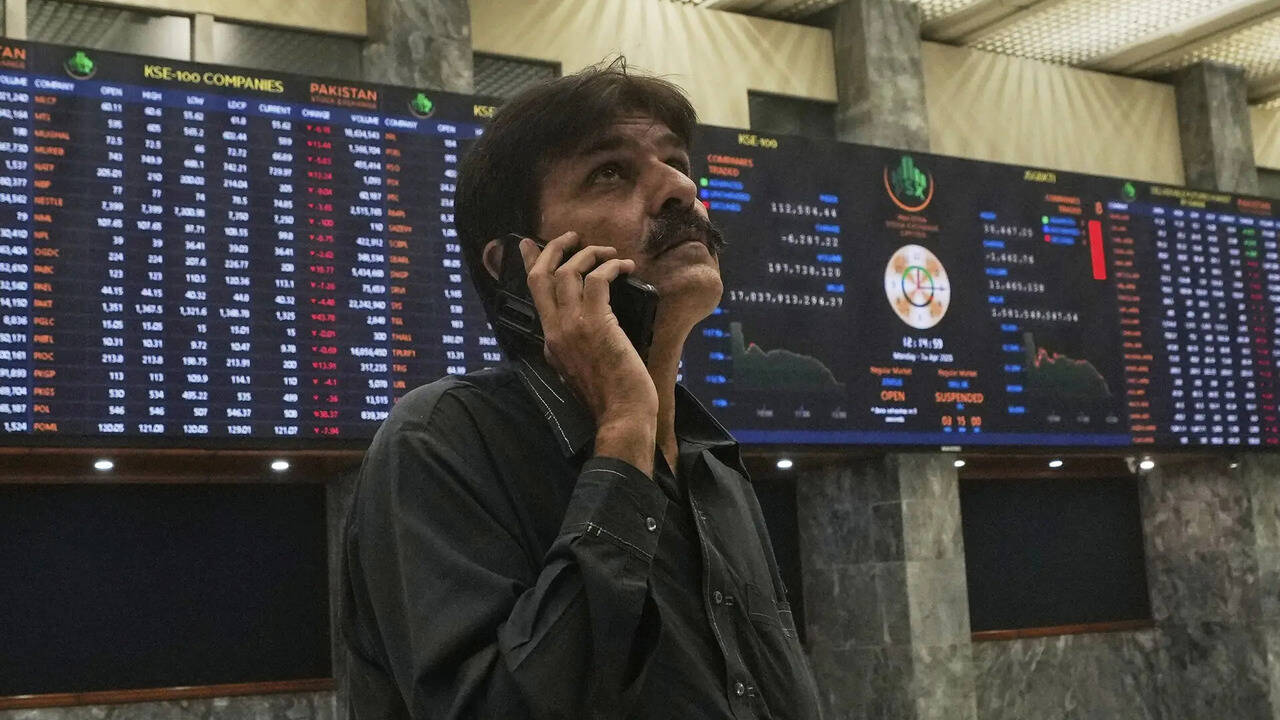
As foreign central banks dump $90 billion in US Treasuries and Brent crude convulses near $120, Islamabad’s unlikely role as peacebroker is paying an unexpected dividend on the trading floor.
There is a peculiar kind of optimism that only emerges in the eye of a hurricane. Wednesday morning at the Pakistan Stock Exchange felt exactly like that. At 12:05 p.m., the benchmark KSE-100 Index stood at 156,204.89 — having gained 7,461.58 points, or 5.02%, from the previous close — a move so violent that it triggered a mandatory market halt, suspending all equity-based trading under PSX circuit-breaker rules. ProPakistani The previous session had already closed higher. Tuesday’s KSE-100 session had ended at 148,743.32, up 1,900.34 points, as investors began pricing in whispers of a ceasefire from Washington. Profit by Pakistan Today By Wednesday noon, those whispers had become a roar.
This is not, however, a story only about Karachi. It is a story about a world economy convulsing under the weight of a war in the Persian Gulf, a $30 trillion US Treasury market being quietly liquidated by desperate central banks, and — most improbably — Pakistan sitting at the centre of the most consequential diplomatic negotiation of 2026. The KSE-100’s surge is at once a relief rally, a geopolitical signal, and a referendum on how tightly Pakistan’s financial fate is now knotted to its new role as peacebroker between Washington and Tehran.
Why Karachi Erupted: The Anatomy of a 5% Day
Buying momentum on Wednesday was broad-based, with strong activity across automobile assemblers, cement, commercial banks, fertiliser, oil and gas exploration, oil marketing companies, and power generation firms. Major index-heavyweights — HBL, MCB, MEBL, UBL, MARI, OGDC, PPL, POL, PSO, HUBCO, and ARL — all traded firmly in the green, reflecting renewed investor confidence amid easing geopolitical risk. ProPakistani
The rally follows emerging hopes of de-escalation in the Iran war after US President Donald Trump and Secretary of State Marco Rubio signalled that the conflict could end soon, with Washington indicating potential direct talks with Tehran’s leadership and a winding down of hostilities even without a formal deal. Profit by Pakistan Today Trump, speaking from the White House on Tuesday, said the US exit could come “within two weeks, maybe two or three.”
The market context matters enormously here. The rebound follows a brutal first-quarter correction, during which the Pakistan Stock Exchange benchmark declined around 15% amid geopolitical uncertainty and relentless selling pressure. Profit by Pakistan Today That selloff was not irrational. Pakistan’s economy is structurally exposed to Middle East energy prices — the country imports the overwhelming majority of its oil and LNG, and any sustained spike in Brent crude flows directly into inflation, the current account deficit, and State Bank of Pakistan reserves. When the war began on February 28, the PSX reacted the way a patient loses colour when told bad news: quickly, and all at once.
Wednesday’s reversal tells a different story. It tells you that the market had been pricing in far worse than what may now materialise. It tells you that institutional and retail buyers in Karachi, Lahore, and Islamabad are not just trading geopolitics abstractly — they are trading Pakistan’s specific role in ending this crisis.
The $90 Billion Treasury Liquidation: A Slow-Motion Earthquake Under Bond Markets
While traders in Karachi were celebrating, bond desks in New York, London, and Tokyo were navigating something far more structurally significant. New York Fed custody data shows that since the week before the conflict broke out — the week of February 25 — foreign monetary authorities have been net sellers of US Treasuries for five consecutive weeks, with the total sell-off exceeding $90 billion, and holdings falling to the lowest level since 2012. All-Weather Media
The Financial Times, citing Federal Reserve data, confirmed that the value of Treasuries held in custody at the New York Fed by official institutions — a group largely made up of central banks but also including governments and international institutions — has dropped by $82 billion since February 25 to $2.7 trillion. X
The mechanics driving this sell-off are not mysterious, even if their consequences are underappreciated. The direct cause of this round of selling is the urgent need for dollar liquidity among countries — from foreign exchange market intervention to paying energy import bills and financing defense spending, the surge in demand for dollars is forcing foreign central banks to liquidate their most liquid dollar assets: US Treasuries. Futu News
The single most striking data point in the disaggregated country-level picture is Turkey’s. Official figures show that since February 27 — the day before the US attacked Iran — Turkey’s central bank sold about $22 billion in foreign government bonds from its reserves, mainly US Treasuries. Turkey also sold or swapped about 58 tons of gold valued at over $8 billion. All-Weather Media
Brad Setser, Senior Fellow at the Council on Foreign Relations and arguably the world’s foremost tracker of sovereign reserve flows, has been clear about who else is in the queue. Setser stated that “many countries are unwilling to let their currencies depreciate further, as this would drive up oil prices denominated in local currencies — either implying more fiscal subsidies or increasing the burden on people’s daily lives. Therefore, many countries have generally decided to intervene in the foreign exchange market to try to limit the depreciation of their currencies.” Futu News India and Thailand, both large oil importers, have also seen foreign reserve drawdowns since the war began, though it remains unclear whether those represent outright Treasury sales or dollar deposit liquidations.
Bank of America US rates strategist Meghan Swiber has been unambiguous: the foreign official sector is selling US Treasuries, and the selling “confirms a more macro narrative — that foreign reserve managers and official accounts are diversifying away from US Treasuries.” All-Weather Media
The structural backdrop is equally sobering. A recent Morgan Stanley report shows the proportion of US Treasuries held by foreign investors has dropped to its lowest since 1997, with the share of coupon-bearing Treasuries held by foreign investors falling steadily since the 2008 peak of 64.4% and now near multi-decade lows. All-Weather Media The Iran war has not created this trend — but it has violently accelerated it. As the Financial Times reported on Tuesday, the bond market’s largest and most stable category of buyer is now, in a period of maximum global stress, a net seller.
This matters for Pakistan in a roundabout but real way. Higher US Treasury yields — the mathematical consequence of this selling pressure — tighten global dollar funding conditions, increase the cost of Pakistan’s external debt servicing, and strengthen the dollar in ways that amplify imported inflation. A faster resolution to the Iran conflict is, in this sense, not just a geopolitical good but a financial one for Islamabad.
The Strait, the Shock, and the Oil Market Nobody Saw Coming
The International Energy Agency has called it the biggest oil supply shock in history. Due to Iran’s selective blockade of the Strait of Hormuz, the world is losing as much as 20 million barrels of oil per day from Middle East producers. Since the war began five weeks ago, Brent crude has risen more than 50%. CNN
Brent crude was trading at just over $118 per barrel for May deliveries, while the more widely traded June delivery contract was around $103.50. The average price of gasoline in the United States crossed $4 per gallon for the first time since 2022. CBS News For emerging markets that import most of their energy, these numbers translate into something far more corrosive than headline inconvenience: they represent a structural transfer of wealth from oil-importing nations to a geopolitical standoff, mediated by a narrow chokepoint 21 miles wide at its narrowest point.
The Wall Street Journal, citing administration officials, reported that Trump and his aides had concluded that a military mission to reopen the Strait of Hormuz would extend beyond his four-to-six-week timeline, and he had decided to focus on targeting Iran’s missiles and navy before seeking to pressure Iran diplomatically to reopen it. Euronews
That shift — from military maximalism to diplomatic realism — is precisely what equity markets in Karachi, and indeed across emerging Asia, have been waiting for.
Pakistan’s Diplomatic Dividend: The Unlikely Peacebroker
The most remarkable subplot of this crisis is not the Treasury sell-off, nor the oil price spike. It is Islamabad’s transformation, over the past two weeks, from a country wracked by internal protests over the US strikes on Iran into a credible diplomatic interlocutor between Washington and Tehran.
Pakistan’s Foreign Minister Ishaq Dar confirmed that “US-Iran indirect talks are taking place through messages being relayed by Pakistan,” adding that Turkey and Egypt were also extending support to the initiative. US envoy Steve Witkoff confirmed presenting a 15-point action list as the framework for a peace deal, which mediator Pakistan gave to Iran. NPR President Trump then paused his deadline for the destruction of Iran’s energy plants by ten days to April 6, citing the ongoing talks. Special envoy Steve Witkoff confirmed at President Trump’s Cabinet meeting that the US has been negotiating with Iran through diplomatic channels with Pakistan as the conduit. CNN
Foreign Policy has described this as a role that makes more geopolitical sense than it initially appears. Pakistan is a rare country that has warm ties with both the United States and Iran and is engaged with the highest levels of both governments. Pakistan also represents Tehran’s diplomatic interests in Washington. Furthermore, Pakistan has dealt closely with the family of a key player on the US side — Middle East envoy Steve Witkoff. Foreign Policy
The domestic calculus is equally clear: Pakistan’s mediation push is driven by economic strain, security concerns, and strategic calculation. With energy markets volatile and the country reliant on Gulf oil and LNG imports, any sustained spike in global crude prices could deepen a crisis Pakistan can ill afford. Pakistan’s fragile economic recovery is under renewed stress, with constrained fiscal space and minimal strategic oil reserves. The Researchers
The PSX’s 7,500-point single-session surge is, in a narrow sense, investors pricing in the probability that Pakistan’s diplomatic gamble pays off. A ceasefire, even an imperfect one, would lower oil prices, ease imported inflation, reduce pressure on State Bank of Pakistan foreign reserves, and reopen the possibility of further monetary easing by the SBP — all of which are bullish for Pakistani equities.
Risks: The Rally Is Real, But the Ceasefire Isn’t — Yet
Markets have a well-documented habit of pricing in peace talks before those talks produce peace. The KSE-100’s gain on Wednesday is a bet, not a receipt.
Several credible risks remain. Iran has countered the US 15-point plan with its own five conditions, including recognition of Iran’s legitimate rights, payment of war reparations, and firm international guarantees against future aggression. Al Jazeera Those are not trivial demands from a country that has seen its Supreme Leader killed and its military infrastructure methodically dismantled. Ending the war with Iran retaining effective control of the Strait of Hormuz would be seen internationally as a strategic defeat for the United States — Iran would claim victory and might monetize its position by imposing tolls on transiting tankers, providing revenues to rebuild its military and nuclear programmes. CNN
Secretary of State Rubio has been clearer on the endgame than almost anyone. Rubio told Al Jazeera that “the Strait of Hormuz will be open when this operation is over — one way or another,” and rejected Iran’s demand to maintain sovereignty over the waterway as part of any agreement. Al Jazeera That language, while reassuring to oil markets in the abstract, leaves significant space for a breakdown in negotiations — and a resumption of exactly the kind of escalatory cycle that sent the KSE-100 down 15% in the first quarter.
Oil market participants appear to be processing this nuance already. Bond yields have been steadily rising throughout March as investors race to reprice the chances of rate hikes from central banks, with expectations of rate cuts at the Federal Reserve and the Bank of England having fallen sharply and in many cases being replaced by anticipations of hawkish monetary policy. CNBC That global repricing of central bank paths — driven directly by energy-led inflation — is a structural headwind for emerging market assets, Pakistan included, that does not disappear even if a ceasefire is signed.
Global Macro Implications: When the World’s Safe Asset Isn’t Safe Enough
Beneath the headline drama of the oil price spike and the stock market surge, the most consequential development of this crisis may be the one attracting the least retail attention: the systematic erosion of US Treasury demand at precisely the moment that Washington’s finances require it most.
Stephen Jones, Chief Investment Officer at Aegon Asset Management, described central banks’ actions as countries “raising war funds,” saying, “They are drawing on emergency reserves.” This round of selling is not an isolated event but a microcosm of a longer-term structural shift: global reserve management institutions are systematically reducing exposure to dollar assets. All-Weather Media
If the Iran conflict ends quickly, some of this pressure on the Treasury market will ease. Central banks in Turkey, India, and Thailand that have been intervening in FX markets to defend their currencies will face less pressure to continue liquidating reserves once oil prices fall. That normalisation would provide some relief to US bond yields. But the structural share of foreign holdings — already at a 27-year low — is not a tap that turns back on quickly. The trend that the war has accelerated was years in the making.
For Pakistan’s capital markets, the near-term playbook favours the bulls — as long as the diplomatic process holds. A ceasefire, lower Brent crude, a softer dollar, and resumed SBP rate cuts would be a nearly perfect cocktail for further PSX gains. The index, even after Wednesday’s surge, remains roughly 18% below its all-time high of approximately 189,556 points reached in January 2026. There is significant mean-reversion potential if geopolitical risk genuinely abates.
Outlook: Watch April 6 — and the Address to the Nation
The immediate calendar is unusually consequential. President Trump is scheduled to deliver a prime-time address to the nation on Wednesday evening providing what the White House described as “an important update on Iran.” The April 6 deadline for Iran to reopen the Strait of Hormuz — or face strikes on its energy infrastructure — creates a hard binary. Either the diplomatic track delivers a meaningful framework before that date, or markets face the prospect of a sharp escalatory spike.
Secretary of State Rubio, before departing for a G7 foreign ministers meeting in France, confirmed that “there are intermediary countries that are passing messages and progress has been made — some concrete progress has been made,” describing negotiations as “an ongoing and fluid process.” CNN
For investors in Karachi and beyond, the single most important watch item is not the KSE-100 level, nor the US Treasury yield, nor even Brent crude. It is whether Pakistan’s mediation — this extraordinary diplomatic intervention by a country whose consulate in its own largest city was attacked just a month ago — delivers enough of a framework before April 6 to allow both sides to step back from the precipice.
If it does, Wednesday’s 7,500-point surge will look, in hindsight, like the opening chapter of a recovery story rather than a false dawn in a prolonged storm. If it doesn’t, the circuit-breaker that paused trading on Wednesday could, in the weeks ahead, be pointing in the other direction.
Pakistan has been here before — not as a victim of great-power competition, but as its unexpected architect. It was Islamabad that facilitated Nixon’s 1971 opening to China. It may yet be Islamabad that writes the first line of a postwar order in the Persian Gulf. The KSE-100, for one day at least, has decided to believe it.
Discover more from The Economy
Subscribe to get the latest posts sent to your email.



Key Takeaways
- Rolex’s secondary market rose approximately 7.9% year-over-year as of 2026 (per WatchCharts data) — trailing Patek Philippe (+16.2%) and Tudor (+11.4%) but still outperforming Audemars Piguet (+3.4%).
- Rolex raised U.S. retail prices 4–9% in January 2026 (steel models ~5.6%, gold models ~8.7%), narrowing the historical gap between retail and pre-owned pricing.
- Not every model appreciates: steel sports references (Submariner, GMT-Master II, Daytona) have held value far better than two-tone or widely available dress references like the standard Datejust.
- The Lady-Datejust posted the sharpest 2026 gain among tracked collections — up 22.73%, from roughly $9,269 to $11,376 — driven by demand for smaller, “everyday luxury” watches.
- Gold’s rise past $2,400/oz has directly lifted the investment case for Rolex’s precious-metal references (Day-Date, Sky-Dweller, Yacht-Master).
The Model-by-Model Picture
| Category | 2026 Trend |
|---|---|
| Lady-Datejust | +22.73% (strongest performer among tracked collections) |
| Steel sports models (Submariner, GMT-Master II) | Held value well; corrected from 2022 peak but stabilized above retail |
| Daytona | Corrected from highs above $50,000 to the mid-$30,000s; still among the most sought-after references |
| Two-tone/widely available Datejust | Flat to negative — “holds value” is an overstatement for this category |
| Gold references (Day-Date, Sky-Dweller) | Lifted by gold’s rise above $2,400/oz |
Why the “Rolex Always Appreciates” Myth Is Fading
The pandemic-era boom pushed some references — the Daytona above all — to speculative highs disconnected from historical norms. Since the March 2022 peak, steel sports models have compressed meaningfully, and dealers who bought inventory near the top have in some cases faced 20–40% markdowns on liquidation. The lesson for 2026 buyers: Rolex as a category is not a monolith. Value retention depends heavily on specific reference, condition, and whether the piece comes with box and papers (“full set”).
What’s Actually Driving 2026 Strength
- Retail price increases raise the floor. When a new Submariner retails at $10,050 (up from $9,500), a pre-owned example at $11,000–$12,000 suddenly represents a smaller premium — narrowing the gap without secondary prices actually moving.
- Supply discipline remains Rolex’s core lever. The brand has never confirmed production numbers, and secondary-market premiums remain entirely a function of Rolex’s own manufacturing decisions — a risk factor as much as a support.
- Certified Pre-Owned rollout. Rolex’s now fully rolled-out CPO program has changed how buyers transact in the used market, adding a layer of brand-verified legitimacy that supports pricing.
The Case for Rolex as a Portfolio Diversifier
Financial advisors increasingly frame luxury watches not as a replacement for equities or bonds, but as a tangible, historically low-correlation diversifier — one that carries its own risks (illiquidity, condition-dependent pricing, no yield) but has demonstrated multi-decade resilience for specific references.
Is Rolex a good investment in 2026?
It depends heavily on the specific reference. Steel sports models like the Submariner and Daytona have held or grown in value; two-tone and widely available dress models generally have not. Overall, Rolex’s secondary market rose about 7.9% year-over-year in 2026, trailing Patek Philippe but ahead of Audemars Piguet.
Discover more from The Economy
Subscribe to get the latest posts sent to your email.

Navigating Mortgage and Loan Refinancing in a High-Yield Environment
Global public debt crossing critical thresholds has kept central bank policies volatile, resulting in fluctuating US Treasury yields throughout 2026. For homeowners and commercial property holders burdened by previous high-interest borrowing cycles, finding optimal refinance windows has become a high-stakes financial puzzle. Stalled disinflation and stubborn employment numbers mean rate cuts are incremental, requiring borrowers to act with precision.
Timing your mortgage or commercial loan refinance in this environment requires a deep understanding of yield curve movements and lender risk appetites.
Decoding 2026 Refinance Dynamics
The 10-Year Treasury Yield Benchmark
Mortgage rates continue to track closely with the 10-year US Treasury yield. When macroeconomic anxiety spikes debt issuance, yields rise, tightening consumer borrowing capacity. Savvy borrowers monitor weekly Treasury auctions to lock in rates during brief dip windows.
Hybrid ARMs and Alternative Structures
With fixed rates remaining elevated, 7/1 and 10/1 adjustable-rate mortgages (ARMs) have surged in popularity. These products offer lower initial monthly payments, giving borrowers breathing room until central bank easing cycles fully materialize.
| Loan Product | Current Rate Range | Best For | Key Risk Factor |
| 30-Year Fixed Mortgage | 6.2% – 6.8% | Long-term predictability | Higher initial monthly outlay |
| 7/1 Hybrid ARM | 5.5% – 5.9% | Short-term ownership / flipping | Rate reset risk after year 7 |
| Commercial Refinance | 7.0% – 8.2% | Corporate asset restructuring | Strict DSCR lender covenants |
Actionable Steps for Successful Refinancing
To maximize your chances of securing favorable refinance terms in a volatile market, follow a disciplined preparation strategy.
Boost Your Credit Score Immediately: Lenders in 2026 are applying stringent credit tiering; a 20-point increase can drop your APR by a crucial quarter-point.
Shop Regional Credit Unions: Smaller financial institutions often offer portfolio loans with more flexible underwriting than major national banks.
Calculate the Break-Even Point: Ensure your total closing costs are recouped through monthly savings within 24 months of closing.
“Market Strategist View: Refinancing in 2026 is an exercise in opportunistic timing. Borrowers must maintain immaculate financial profiles ready to strike the moment Treasury yields dip.”
Mastering the complexities of today’s debt environment ensures you can successfully lower your debt service costs and protect your long-term financial stability.
Discover more from The Economy
Subscribe to get the latest posts sent to your email.

The days of pulling generic auto insurance quotes based purely on your zip code and age are officially over. In 2026, insurance comparison engines are powered entirely by generative AI and real-time telematics. These platforms digest thousands of live data points—ranging from your driving smoothness via connected vehicle sensors to real-time traffic congestion patterns—to generate hyper-personalized premiums instantly.
For consumers, this evolution represents both a massive opportunity for savings and a hidden trap for penalty pricing. Understanding how AI algorithms evaluate risk is essential for anyone looking to lower their monthly auto insurance premiums.
How AI Comparison Engines Evaluate Your Risk Profile
Behavioral Telematics and Connected Cars
Modern cars stream performance data directly to insurance aggregators. Generative AI models analyze braking sharpness, acceleration curves, cornering G-forces, and phone distraction metrics. Drivers who maintain smooth, defensive habits are rewarded with dynamic rate cuts of up to 40% compared to traditional rating tiers.
Predictive Traffic and Weather Modeling
AI tools now cross-reference your daily commute route with predictive weather and accident probability models. If your standard parking location or driving corridor has a statistically higher incidence of uninsured motorist claims, your quotes will reflect that hyper-local risk assessment.
| Comparison Factor | Traditional Rating Model | 2026 Generative AI Model | Impact on Premium |
| Mileage & Usage | Annual estimated odometer reading | GPS tracking & live trip duration | High (up to 35% savings) |
| Driving Behavior | MVR driving record & accidents | Real-time braking, speed, & G-force | Critical (determines tier) |
| Vehicle Tech | Make, model, and safety rating | ADAS calibration & repair cost data | Moderate |
Strategies to Lower Your AI-Driven Insurance Quote
To outsmart the algorithm and secure the lowest possible premium in 2026, drivers must proactively manage their digital footprint on insurance platforms.
Opt-In for Telematics Trial Periods: Many insurers offer immediate 15% discounts just for installing their driving app; let it track safe habits for 30 days to lock in permanent savings.
Scrub Unverified Public Records: Ensure your motor vehicle report is free of clerical errors that AI risk models misinterpret as reckless behavior.
Compare AI Aggregators: Use platforms that integrate multi-carrier API feeds rather than single-brand comparison sites to find the best risk-adjusted rate.
“Industry Note: AI-driven pricing rewards transparency and precision. Drivers who actively manage their telematics data consistently out-save those relying on legacy quote calculators.”
Embracing AI comparison tools allows savvy policyholders to customize coverage limits precisely to their driving habits, eliminating wasted premium spend while ensuring robust protection.
Discover more from The Economy
Subscribe to get the latest posts sent to your email.

Stock Market Crash in 2026? Warning Signs, Scenarios and a Calm Investor Checklist

Peso Mexicano vs Dólar Estadounidense: A Practical USD/MXN Guide for October 2026

Is the Stock Market Open on Columbus Day 2026? NYSE, Nasdaq and Bonds Explained

Concert Ticket Prices in 2026: Dynamic Pricing, Fees and How to Buy Safely

High-Yield Savings Accounts in 2026: How to Compare APY Without Chasing a Headline

EU-China Trade Deal 2026: How Beijing and Brussels Avoided a Trade War—and Who Wins

Social Security 2027 COLA Announcement: Date, Formula and What Retirees Should Check

China’s AI Microdrama Boom: How Beijing Is Reshaping Global Media

Q3 2026 Earnings Preview: Can Record Profit Expectations Keep Wall Street’s Rally Alive?

Russia Diesel Deal 2026: Oil Prices and Inflation Risks

Fed Rates 2026: Treasury Yields, Bonds and SGOV Explained

S&P 500 Market Breadth 2026: Weak Rally or Rotation?

The AI Capex Boom: Data Centers Reshaping Growth

Palantir Stock in 2026: Extraordinary AI Growth

PSX Forecast 2026: KSE-100, IMF Reviews & Geopolitics

Middle East War Economics 2026: Oil Prices & Energy Markets

China Stocks Today: Are Big Economies in Asia Nearing a Market Bottom?

Crypto Daily Outlook: Bitcoin, Altcoins, and the Future of Decentralized Finance

Global Pension Systems Ranked: The World’s Best and Worst Retirement Frameworks

World’s Largest Economies: Ranking the Top Global Powers

Elon Musk’s Next Moves: Disrupting the 2026 Global Economy

Pakistan Economy 2026: Inside the SBP’s Balancing Act

GasBuddy Market Insights: How Crude Price Shifts Impact Local Fuel Cost Averages

World Bank & IMF Reports 2026: Why the “3% Growth” Consensus Is Actually a Debate

Global Equity Market Divergence: US Tech vs. European Dividend Stocks vs. Asian Growth

Crude Oil & Petroleum Market Analysis: OPEC+ Decisions and Price Forecasts

IMF & World Bank Global Economic Outlook: Growth Forecasts Across Europe and Asia

Silver Price Today: Why the Xi-Trump AI Standoff Is Fueling a Safe-Haven Rally
-

 Markets & Finance9 months ago
Top 15 Stocks for Investment in 2026 in PSX: Your Complete Guide to Pakistan’s Best Investment Opportunities
-

 Analysis8 months ago
Johor’s Investment Boom: The Hidden Costs Behind Malaysia’s Most Ambitious Economic Surge
-

 Analysis8 months ago
Top 10 Stocks for Investment in PSX for Quick Returns in 2026
-

 Banks9 months ago
Best Investments in Pakistan 2026: Top 10 Low-Price Shares and Long-Term Picks for the PSX
-

 Analysis8 months ago
Brazil’s Rare Earth Race: US, EU, and China Compete for Critical Minerals as Tensions Rise
-

 Investment9 months ago
Top 10 Mutual Fund Managers in Pakistan for Investment in 2026: A Comprehensive Guide for Optimal Returns
-

 Global Economy10 months ago
15 Most Lucrative Sectors for Investment in Pakistan: A 2025 Data-Driven Analysis
-

 Global Economy10 months ago
Pakistan’s Export Goldmine: 10 Game-Changing Markets Where Pakistani Businesses Are Winning Big in 2025