
Analysis
Amazon Prime vs Walmart+: Which Membership Saves You More in 2026?

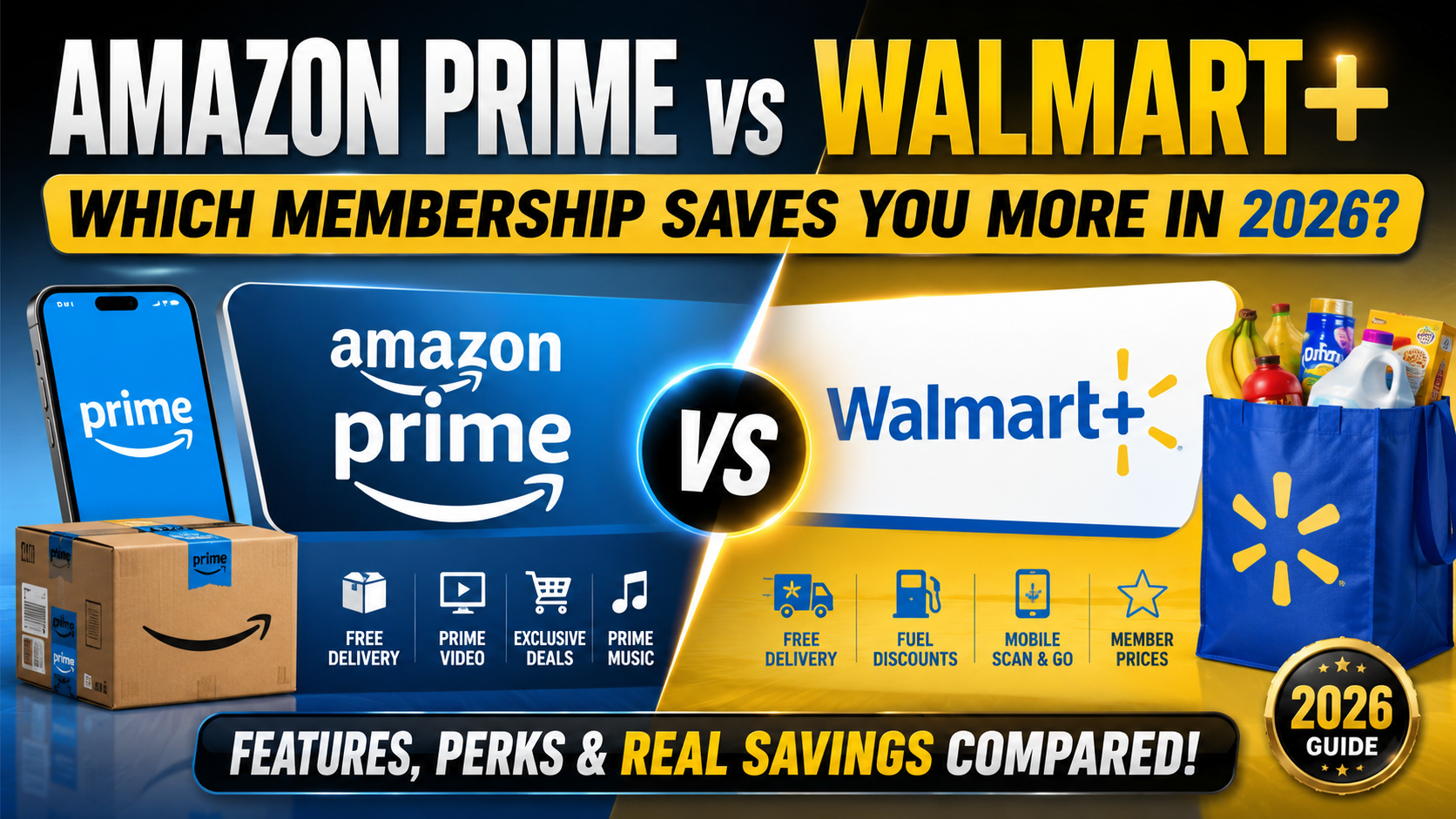
Subscription fatigue is real, and with both Amazon Prime and Walmart+ now priced close together, the question isn’t just “which has faster shipping” anymore — it’s which membership delivers more actual financial value once you account for every perk, discount, and hidden cost. Both programs have expanded well beyond free shipping into fuel discounts, streaming bundles, prescription savings, and cashback-style perks, making a direct comparison more complicated — and more important — than it used to be.
This breakdown compares Amazon Prime and Walmart+ specifically through a financial lens: what each membership actually costs after accounting for real usage, which perks translate into measurable savings, and which one makes more sense depending on your shopping habits. If you’re deciding between the two, or wondering whether you need both, this is the comparison that matters.
Base Membership Cost and What You’re Actually Paying For
Both memberships sit in a similar annual price range, but the value proposition diverges quickly once you look past shipping. Amazon Prime bundles in Prime Video, Prime Music, Prime Reading, and periodic exclusive shopping events like Prime Day, positioning itself as much as an entertainment subscription as a shopping perk. Walmart+ leans harder into everyday savings — fuel discounts at Walmart and Murphy USA/Sam’s Club stations, member prescription pricing, and early access to deals — positioning itself more explicitly as a cost-of-living savings tool than an entertainment bundle.
This distinction matters more than it might first appear: if you don’t watch Prime Video or use Amazon’s other entertainment perks, you’re effectively paying for value you never redeem, which changes the real cost-per-benefit calculation significantly in Walmart+’s favor for budget-focused shoppers.
Where Amazon Prime Wins Financially
Prime’s biggest financial edge comes from its sheer breadth — free shipping across a massive product catalog, frequent lightning deals, Prime Day and Black Friday exclusive pricing, and a genuinely valuable entertainment bundle that would cost more if purchased separately as standalone streaming subscriptions. For households that already shop heavily on Amazon and use its content ecosystem, the membership often pays for itself several times over.
Prime’s Strongest Financial Perks
- Prime Video and Music bundled in – Comparable standalone streaming subscriptions would cost more separately
- Prime Day and exclusive member deals – Some of the steepest discounts of the year are member-exclusive
- Same-day and next-day shipping on huge product selection – Reduces impulse in-store spending and time cost
- Amazon Fresh/Whole Foods discounts – Additional grocery savings layered on top of the core membership
- Prime Reading and Kindle deals – Added value for frequent readers, though a smaller factor for most households
Where Walmart+ Wins Financially
Walmart+’s value proposition is more directly tied to recurring, practical household spending — fuel savings that compound with regular driving, member pricing on prescriptions that can meaningfully offset healthcare costs, and free delivery from Walmart stores that competes directly with grocery delivery services that otherwise charge separately. For budget-conscious households prioritizing everyday cost reduction over entertainment bundling, Walmart+ often delivers a higher effective return relative to its membership cost.
Walmart+’s Strongest Financial Perks
- Fuel discounts at partner gas stations – Per-gallon savings that compound significantly for frequent drivers
- Free grocery delivery from Walmart stores – Comparable third-party grocery delivery often charges separate membership and delivery fees
- Member prescription pricing – Meaningful savings for households managing regular prescription costs
- Early access to deals and Walmart+ Week – Comparable to Prime Day but with a stronger everyday-essentials focus
- Included Walmart+ Assist option – Discounted membership rate for qualifying government assistance program participants
Side-by-Side Financial Comparison
| Perk Category | Amazon Prime | Walmart+ |
|---|---|---|
| Free shipping/delivery | Yes, vast catalog | Yes, Walmart stores + select delivery |
| Entertainment bundle | Extensive (Video, Music, Reading) | None |
| Fuel discounts | No | Yes |
| Prescription savings | Limited | Yes, member pricing |
| Grocery delivery | Amazon Fresh/Whole Foods | Walmart stores |
| Best for | Entertainment + broad shopping households | Everyday essentials + driving households |
| Approximate annual cost | Comparable to Walmart+ | Comparable to Prime |
How to Decide Which One Actually Saves You Money
- Calculate your realistic entertainment usage – If you’d otherwise pay for Prime Video separately, that alone can justify Prime’s cost
- Estimate your annual fuel spending – Frequent drivers often see Walmart+’s fuel discount outweigh Prime’s shipping perks
- Factor in prescription costs – Households with regular prescriptions may find Walmart+’s savings compound significantly over a year
- Consider where you already shop most – Membership perks only generate savings if they match your existing spending habits, not your aspirational ones
- Don’t rule out having both temporarily – Many households run both during peak sales events (Prime Day and Walmart+ Week) and cancel one afterward
Tracking Your Actual Usage Before Renewal
The most reliable way to determine which membership is worth keeping is to actually track your usage over a full billing cycle rather than relying on assumptions about your habits. Keep a simple running log for a month of every delivery, streaming session, fuel fill-up, or discount you used through each membership, then estimate what those same purchases or services would have cost without the membership. This exercise routinely reveals that households overestimate how much they use certain perks — streaming content they rarely watch, or delivery services they use less than they think — while underestimating others, like fuel savings that compound quietly over dozens of fill-ups a year. Doing this once before your next renewal date gives you an actual data-driven answer rather than a guess based on how valuable the membership felt when you first signed up.
Frequently Asked Questions
Can I get a free trial for either membership before committing?
Both programs have historically offered free trial periods, though exact lengths and availability change periodically and aren’t guaranteed to be offered indefinitely. Checking each program’s current sign-up page for an active trial offer before committing to a full annual membership is worth the two minutes it takes.
Is it worth paying for both memberships at once?
For some households, yes — particularly around major sales events like Prime Day and Walmart+ Week, when the potential savings from each platform’s exclusive deals can outweigh the cost of a short-term membership. Many people sign up for one during its peak sales event, capture the savings, then cancel before the next billing cycle if ongoing dual membership doesn’t otherwise pencil out.
Do student or family discounts apply to either membership?
Both programs have offered discounted rates for qualifying groups at various points, including student pricing and family or multi-account sharing options. Terms and eligibility change, so checking current program pages rather than relying on outdated information is important before assuming a discount applies to your situation.
Which membership is better if I mostly shop online rather than in physical stores? Amazon Prime generally has the edge for pure online shopping breadth given its larger third-party marketplace and product catalog, while Walmart+ perks are more closely tied to in-store and Walmart-specific online purchases. If your shopping is heavily concentrated on Amazon already, Prime’s broader catalog advantage becomes more relevant to your specific savings calculation.
Final Thoughts
There’s no universal winner between Amazon Prime and Walmart+ — the better financial choice depends entirely on whether your household spending leans toward broad online shopping and entertainment, or everyday essentials like fuel, groceries, and prescriptions. Run the actual numbers based on your last few months of spending in each category before committing to a full year of either membership, and don’t assume last year’s decision is still the right one as both programs continue adding and adjusting perks.
Which membership has actually saved you more money this year — Prime or Walmart+? Or are you running both? Share your real numbers in the comments.
Discover more from The Economy
Subscribe to get the latest posts sent to your email.



After years of explosive gains, AI and machine learning stocks have entered a more complicated phase — still central to the Dow Jones Industrial Average’s overall performance, but facing sharper questions about valuation, earnings durability, and whether the easy gains have already been captured. For investors trying to decide whether to keep adding to AI positions, trim exposure, or rotate into other sectors, 2026 requires a more nuanced read than the straightforward “buy the dip” narrative that worked reliably in prior years.
This analysis breaks down where AI and machine learning stocks currently stand within the broader Dow Jones and market context, what’s driving continued institutional investment despite valuation concerns, and how to think about position sizing if you’re building or maintaining exposure to this sector in your portfolio. Whether you’re a long-term investor or actively trading around AI-sector volatility, understanding the current landscape matters more than chasing last year’s returns.
Where AI Stocks Stand in the Dow Jones Right Now
AI-adjacent companies — spanning semiconductor manufacturers, cloud infrastructure providers, and enterprise software firms embedding AI capabilities — continue to represent an outsized share of overall market cap growth relative to their weighting in the index. This concentration has been a persistent feature of the market for several years now, and it means Dow Jones performance remains more tied to AI-sector sentiment than the historical diversification of the index would suggest.
What’s changed in 2026 is the market’s patience with growth-at-any-valuation stories. Earnings calls that once got a pass on questions about AI monetization timelines are now facing sharper analyst scrutiny, and companies unable to demonstrate a clear path from AI investment to revenue growth have seen more punishing reactions to earnings misses than in prior years.
The Bull Case for AI and ML Stocks in 2026
Despite valuation concerns, several structural tailwinds continue supporting the bull case for AI-sector investment. Enterprise AI adoption is still in relatively early innings for many industries — healthcare, logistics, and financial services in particular are still ramping infrastructure spending rather than winding it down. Capital expenditure guidance from major cloud and semiconductor companies has largely remained robust, suggesting the largest players still see multi-year runway for AI infrastructure investment rather than a near-term plateau.
Key Bullish Factors
- Continued enterprise adoption – Many industries remain in early-to-mid stages of AI integration, suggesting sustained demand
- Infrastructure capex guidance – Major cloud providers have maintained or increased AI infrastructure spending forecasts
- Margin expansion in software – AI-embedded enterprise software companies are showing improved margins as adoption scales
- International expansion – AI infrastructure investment is accelerating outside the US, broadening the addressable market
- Ongoing chip demand – Semiconductor demand tied to AI training and inference workloads remains structurally elevated
The Bear Case: Why Some Investors Are Cautious
The counterargument centers on valuation multiples that, even after some 2025-2026 volatility, remain elevated relative to historical norms for the broader market. Concerns persist about circular investment relationships between major AI infrastructure players, where the same handful of companies are simultaneously customers and investors in one another’s growth — a dynamic some analysts argue inflates reported demand signals. There’s also a legitimate question about how quickly AI capital expenditure will translate into durable free cash flow versus remaining a perpetually reinvested growth story.
Key Bearish Factors
- Elevated valuations – Price-to-earnings and price-to-sales multiples remain historically high for many AI-adjacent names
- Circular investment concerns – Interlocking investment relationships among major AI infrastructure players raise demand-durability questions
- Interest rate sensitivity – Growth stock valuations remain more sensitive to rate policy shifts than value-oriented sectors
- Monetization timeline uncertainty – Gap between AI infrastructure spend and proven enterprise ROI remains a persistent analyst concern
- Increased regulatory scrutiny – Antitrust and AI-specific regulatory attention has increased globally, adding a layer of policy risk
Sector Comparison: AI/ML Stocks vs. Broader Dow Jones Composition
| Factor | AI/ML Sector Stocks | Broader Dow Jones Average |
|---|---|---|
| Average valuation multiple | Elevated relative to historical norms | Closer to long-term historical average |
| Earnings growth expectations | High, but under increasing scrutiny | Moderate, more stable |
| Volatility | Higher | Lower |
| Capital expenditure trend | Aggressive, ongoing | Mixed by sector |
| Regulatory exposure | Increasing | Sector-dependent |
| Institutional sentiment | Cautiously bullish with rotation risk | Stable |
How to Think About Position Sizing in 2026
Given the more nuanced risk/reward picture, a disciplined approach matters more than it has in prior AI-sector bull runs. Consider these principles when managing exposure:
- Avoid overconcentration in a small handful of mega-cap AI names, even if they’ve driven most of your recent returns
- Diversify across the AI value chain — infrastructure, chips, and application-layer software carry different risk profiles
- Pay closer attention to free cash flow trends, not just revenue growth, as monetization scrutiny increases
- Consider dollar-cost averaging into positions rather than making large single entries given elevated volatility
- Reassess position sizing relative to your overall portfolio risk tolerance, not just recent sector momentum
Watching for Rotation Signals
Beyond the bull and bear fundamentals, it’s worth paying attention to sector rotation signals that often precede broader market sentiment shifts around AI valuations. Institutional fund flow data, options market positioning, and relative performance between AI-heavy growth indices and value-oriented sectors can all offer early signals of shifting sentiment before it fully shows up in individual stock prices. Historically, sharp AI-sector pullbacks have often been triggered less by fundamental deterioration and more by a specific catalyst — a disappointing earnings guidance from a bellwether company, a macro rate shock, or a high-profile regulatory action — that causes previously patient investors to reassess valuation assumptions all at once. Staying attentive to these catalysts, rather than assuming steady-state conditions will persist indefinitely, is part of maintaining a disciplined approach to sector exposure in a still-evolving investment theme.
Frequently Asked Questions
Should I sell my AI stocks if I think the sector is overvalued?
That depends entirely on your investment horizon and risk tolerance rather than a one-size-fits-all answer. Long-term investors with a diversified portfolio may choose to simply trim overconcentrated positions rather than exit entirely, while investors more sensitive to near-term volatility might reduce exposure more aggressively. This isn’t personalized financial advice, and consulting a financial advisor about your specific situation is worth considering before making significant portfolio changes.
How can I tell if an AI company’s revenue growth is sustainable versus inflated by circular investment deals?
Look closely at the customer concentration disclosed in earnings reports and investor filings — if a large share of a company’s reported revenue comes from a small number of other AI infrastructure companies rather than a broad, diversified customer base, that’s worth factoring into your assessment of demand durability.
Are AI stocks more volatile than the broader Dow Jones average?
Generally yes, particularly for higher-growth, less-established names within the sector. More established, cash-flow-positive AI-adjacent companies within the Dow Jones tend to show somewhat lower volatility than smaller, growth-stage AI-focused companies outside the index.
Is it too late to start investing in AI stocks in 2026?
Many analysts view the sector as being in a more mature, selective phase rather than an early-stage opportunity, which changes the risk/reward calculus compared to earlier years but doesn’t necessarily mean the opportunity has fully passed. Position sizing, diversification, and a longer time horizon matter more now than simply timing an entry point.
Final Thoughts
AI and machine learning stocks remain a legitimate long-term investment theme in 2026, but the easy, broad-based gains of previous years have given way to a market that’s demanding more evidence of durable monetization before rewarding further multiple expansion. This doesn’t necessarily mean it’s time to exit the sector — but it does mean position sizing, diversification within the AI value chain, and closer attention to fundamentals matter more now than they did in the earlier stages of the AI investment cycle.
Are you still adding to your AI stock positions in 2026, or have you started rotating into other sectors given the valuation concerns? Share your investment approach in the comments.
Discover more from The Economy
Subscribe to get the latest posts sent to your email.

E-commerce brands live and die by visual content — product photos, ad creative, listing graphics, social media assets — and the design software you choose to produce it has a direct impact on both your output speed and your bottom line. Canva and Adobe (primarily Photoshop, Illustrator, and Express) represent two fundamentally different philosophies: one built for speed and team collaboration, the other built for precision and professional-grade control. Choosing the wrong one for your team’s actual workflow can quietly cost you hours every week or thousands of dollars a year in unnecessary subscription costs.
This comparison breaks down exactly where Canva wins, where Adobe wins, and how to think about the decision based on your team size, design skill level, and content volume. If you’re running a lean e-commerce operation trying to maximize output without a full-time designer, or you’re scaling toward a dedicated creative team, the right answer genuinely differs — and we’ll help you land on it.
What E-commerce Brands Actually Need From Design Software
Before comparing features, it’s worth being clear about what matters for e-commerce specifically: fast turnaround on templated content (product listings, ad variations, seasonal promos), brand consistency across a growing catalog, and the ability for non-designers on marketing or operations teams to produce usable assets without bottlenecking on a single creative resource. This is a different use case than agency-level brand design work, and it changes which tool actually makes sense.
Canva was essentially built around this exact use case — templated, collaborative, fast — while Adobe’s tools were built for professional designers who need granular control over every pixel, layer, and color profile. Neither approach is “better” in the abstract; it depends entirely on your team’s skill level and output needs.
Where Canva Wins for E-commerce
Canva’s core strength is speed and accessibility. Its drag-and-drop interface means marketing managers, social media coordinators, or founders without design training can produce professional-looking assets in minutes rather than hours. The template library is specifically strong for e-commerce use cases — product mockups, Instagram and TikTok ad formats, email banners, and Amazon listing graphics are all readily available and easy to customize on brand.
Canva’s Best Features for E-commerce Teams
- Brand Kit – Lock in brand colors, fonts, and logos so every team member’s output stays consistent
- Bulk creation tool – Generate dozens of product variation graphics from a single template and a data set
- Team collaboration – Real-time multi-user editing without file-passing or version conflicts
- Built-in stock and AI image tools – Reduces dependency on separate stock photo subscriptions
- Magic Resize – Instantly reformat one design across every platform’s required dimensions
Where Adobe Wins for E-commerce
Adobe’s advantage shows up when brand quality and technical precision matter — professional product photography retouching, print-ready packaging design, or highly customized ad creative that needs to stand out in a crowded feed. Photoshop and Illustrator offer far more granular control over color accuracy, layering, and file formats needed for professional print and high-resolution digital advertising, which matters more as a brand scales and competitors’ creative quality rises.
Adobe’s Best Features for E-commerce Teams
- Advanced photo retouching (Photoshop) – Professional-grade product photo editing beyond what template tools offer
- Vector design precision (Illustrator) – Essential for logos, packaging, and print materials that need to scale cleanly
- Adobe Express – A faster, Canva-competitive layer within the Adobe ecosystem for quicker turnaround needs
- Color and file format control – Critical for brands managing print production alongside digital assets
- Firefly AI generative tools – Increasingly competitive AI image generation integrated directly into the professional workflow
Head-to-Head Comparison
| Factor | Canva | Adobe (Photoshop/Illustrator/Express) |
|---|---|---|
| Learning curve | Low — usable by non-designers | Moderate to steep — designed for trained users |
| Speed for templated content | Very fast | Slower without templates |
| Professional-grade editing | Limited | Extensive |
| Team collaboration | Strong, built-in | Requires Creative Cloud team plans |
| Best for | Lean teams, rapid content, social/ad creative | Brands needing high-end product photography and print design |
| Typical monthly cost (team plan) | Lower | Higher |
| AI generative tools | Included, consumer-friendly | Included (Firefly), more professional-grade control |
How to Decide: A Simple Framework
- If you’re a solo founder or small team producing high-volume social and ad content → Canva is almost certainly the better fit, both for cost and speed
- If you have a dedicated designer producing product photography, packaging, or print materials → Adobe’s professional tools justify the higher cost and learning curve
- If you’re scaling and need both → Many e-commerce brands run a hybrid stack: Adobe for core brand assets and product photography, Canva for day-to-day marketing content produced by non-designers
- If budget is the primary constraint → Canva’s lower cost per seat makes it easier to give broader team access without ballooning your software spend
The Hybrid Approach Most Scaling Brands End Up Using
In practice, a large share of growing e-commerce brands don’t pick one exclusively — they use Adobe for foundational brand assets (logo, packaging, professional product photography) created by a trained designer, then hand those brand assets off to a marketing team using Canva to rapidly produce day-to-day content within brand guidelines. This hybrid model captures Adobe’s quality ceiling while keeping Canva’s speed advantage for the high-volume content that actually drives daily sales.
Migration Considerations if You’re Switching Tools
If you’re currently on one platform and considering a switch, plan for a realistic transition period rather than expecting an overnight cutover. Moving from Adobe to Canva typically means rebuilding brand templates from scratch, since file compatibility between the two ecosystems is limited — Canva can import some Adobe file formats but doesn’t preserve complex layer structures or advanced effects. Moving from Canva to Adobe usually means investing in actual design training for team members used to drag-and-drop simplicity, since Adobe’s tools have a genuinely steeper learning curve that can temporarily slow content output during the transition. Budgeting a few weeks of reduced content velocity during any platform migration, and rebuilding your core brand templates early in that window, will minimize the disruption to your regular content cadence.
Frequently Asked Questions
Can I fully replace Adobe with Canva for an e-commerce brand?
For many lean, social-and-ad-content-focused brands, yes — Canva’s Pro and Teams tiers now cover the vast majority of daily content needs. Where it typically falls short is high-end product photo retouching and packaging design that requires the granular control Photoshop and Illustrator offer, which is why brands with heavier print or premium photography needs usually still keep some Adobe access.
Is Adobe Express a real alternative to Canva within the Adobe ecosystem?
Yes, and it’s closed much of the speed gap that used to favor Canva exclusively. Adobe Express gives teams already invested in the Adobe ecosystem a faster, more accessible tool without needing to also pay for a separate Canva subscription, though its template library and community content are still generally smaller than Canva’s.
How many seats do most small e-commerce teams actually need on either platform? This depends heavily on how many people are producing content versus just reviewing it. A common pattern is giving edit access to 2-4 core content creators while others use view/comment access, which keeps subscription costs proportional to actual content production needs rather than total headcount.
Does using Canva’s AI tools raise any copyright concerns for commercial e-commerce use?
Both platforms have addressed this to varying degrees with commercial usage licensing built into their paid tiers, but policies and legal protections continue to evolve. It’s worth reviewing each platform’s current commercial usage terms for AI-generated content specifically, rather than assuming standard stock image licensing terms automatically apply.
Final Thoughts
Neither Canva nor Adobe is objectively better for e-commerce brands — the right choice depends on your team’s design skill, content volume, and how much of your visual output needs professional-grade polish versus fast, on-brand templated content. Most lean, high-velocity e-commerce operations lean toward Canva for daily output, while brands investing heavily in premium product photography and packaging will find Adobe’s precision worth the steeper learning curve and cost.
Which tool does your e-commerce team currently rely on, and have you found a hybrid workflow that works better than picking just one? Let us know in the comments.
Discover more from The Economy
Subscribe to get the latest posts sent to your email.
Analysis
The 2026 Guide to Staking ADA and BNB: How to Earn Passive Crypto Income on the Best Platforms

Staking has quietly become the easiest way for everyday investors to turn idle crypto into a monthly paycheck, and in 2026 two coins are dominating the conversation: Cardano (ADA) and BNB. If you’ve been holding either asset in a wallet and watching its price bounce around without putting it to work, you’re leaving yield on the table. Staking rewards on ADA and BNB currently range from roughly 3% to over 6% annually depending on the platform and lock-up terms, which is a meaningfully better return than most savings accounts and far less volatile than active day-trading.
This guide breaks down exactly how staking works for both coins, which exchanges and wallets offer the best rates and lowest fees, and how to think about the trade-offs between flexible and locked staking. Whether you’re comparing crypto investment platforms for the first time or you’re a seasoned holder looking to optimize your annual percentage yield (APY), the goal here is simple: help you choose the right staking method so your crypto portfolio grows on autopilot.
Why Staking ADA and BNB Makes Sense in 2026
Cardano’s proof-of-stake network has matured significantly, and delegating ADA to a stake pool no longer requires technical expertise — most major exchanges and wallets let you do it in a few taps. BNB, meanwhile, benefits from Binance’s ecosystem incentives, including launchpool access and fee discounts that stack on top of base staking rewards. Both coins have avoided the extreme APY inflation that made some altcoin staking programs unsustainable, which is part of why institutional crypto investors have quietly increased their staking allocations this year.
There’s also a diversification angle worth considering. Unlike Bitcoin, which offers no native staking mechanism, ADA and BNB let you earn yield without touching derivatives or lending markets — both of which carry higher counterparty risk. For anyone building a long-term crypto investment strategy, staking these two assets is one of the more conservative ways to generate returns while still holding exposure to upside price movement.
How ADA Staking Works
Cardano uses a delegation model rather than a traditional lock-up. You delegate your ADA to a stake pool, and your coins never actually leave your wallet — they simply “vote” for that pool’s validation rights. This makes ADA staking one of the safest options in the space, since your funds stay liquid and can be withdrawn at almost any time.
Best Platforms for ADA Staking
- Coinbase – Beginner-friendly interface, staking rewards around 3-3.5% APY, ADA stays flexible with no lock-up period
- Kraken – Slightly higher yields (up to 4%), strong security reputation, supports on-chain delegation
- Daedalus / Yoroi (native wallets) – Best for maximizing yield since there’s no exchange fee cut, ideal for long-term holders who prioritize self-custody
- Binance – Competitive rates with flexible and locked options, useful if you’re already staking BNB on the same platform
How BNB Staking Works
BNB staking works differently depending on whether you use “locked staking” (fixed term, higher APY) or “flexible staking” (withdraw anytime, lower APY). Binance also offers BNB holders access to Launchpool farming, where staked BNB earns you allocations of new token launches — effectively a bonus yield layer on top of base staking rewards.
Comparing Staking Options: ADA vs BNB
| Feature | ADA (Cardano) | BNB (Binance Coin) |
|---|---|---|
| Average APY (2026) | 3% – 4.5% | 3.5% – 6% |
| Lock-up required? | No (native delegation) | Optional (flexible or locked) |
| Best for | Long-term, low-risk holders | Active traders, ecosystem users |
| Minimum stake | No minimum on most platforms | Varies by platform, often no minimum |
| Extra perks | None | Launchpool access, trading fee discounts |
| Custody risk | Low (funds stay in your wallet) | Depends on platform (custodial vs non-custodial) |
Choosing the Right Platform: What Actually Matters
Before you commit funds to any crypto platform, run through these questions:
- Is the platform regulated or licensed in your jurisdiction, and does it offer insured custody?
- What’s the real APY after platform fees are deducted, not just the advertised headline rate?
- Is there a lock-up period, and what’s the penalty for early withdrawal?
- Does the platform have a history of security incidents or unplanned staking suspensions?
- Can you track your staking rewards in real time through a dashboard or portfolio tracker?
Answering these honestly will save you from chasing a slightly higher APY on a platform that isn’t actually secure or liquid when you need your funds.
Tax and Risk Considerations
Staking rewards are generally treated as taxable income in most jurisdictions at the time they’re received, separate from any capital gains tax when you eventually sell. This is one of the most overlooked parts of a crypto investment strategy, and it’s worth consulting a tax professional or using dedicated crypto tax software to track your rewards accurately throughout the year. On the risk side, remember that staking doesn’t eliminate market volatility — your ADA or BNB can still lose value even while it’s earning yield, so staking should be viewed as a way to enhance returns on assets you already intend to hold, not a replacement for a diversified portfolio.
Building a Long-Term Staking Strategy
Rather than chasing the highest advertised APY across platforms every few months, the more durable approach is treating staking as one component of a broader crypto allocation strategy. Consider splitting your staking activity across both a centralized exchange and a native wallet — this hedges against single-platform risk while still letting you capture higher yields where they’re genuinely available. Many experienced holders also stagger their BNB lock-up terms, keeping a portion in flexible staking for liquidity needs while committing a larger share to locked staking for the higher rate, rather than going all-in on one structure. Revisiting your allocation quarterly, rather than setting it once and forgetting it, helps you stay responsive to rate changes and platform risk developments without overtrading.
Frequently Asked Questions
Is staking ADA or BNB safer than staking other altcoins?
Generally, yes. Both networks are well-established with years of consistent validator performance, and neither relies on the kind of aggressive, unsustainable reward emissions that have caused APY collapses on newer or smaller proof-of-stake chains. That said, “safer” doesn’t mean risk-free — smart contract risk, exchange custody risk, and ordinary price volatility still apply.
Can I lose my staked ADA or BNB?
With ADA’s native delegation model, your coins never leave your wallet, so the risk of loss is limited to the underlying asset’s price movement rather than the staking mechanism itself. With BNB, locked staking programs typically hold your funds for the term of the contract, so early withdrawal penalties or platform-specific risk (such as an exchange freezing withdrawals) are more relevant considerations.
How often are staking rewards paid out?
This varies by platform. Many exchanges distribute ADA staking rewards daily or every few days, while BNB rewards depend on whether you’re in a flexible or locked product, with locked staking sometimes paying out at the end of the term rather than continuously. Always check the specific payout schedule before committing funds, since compounding frequency has a real effect on your annualized return.
Do I need a minimum amount of ADA or BNB to start staking?
Most major exchanges have eliminated minimum staking thresholds for both coins, making it possible to start with a small position and scale up over time. Native wallet delegation for ADA similarly has no formal minimum, though very small amounts may not be practical after accounting for network transaction fees.
Final Thoughts
Staking ADA and BNB in 2026 remains one of the more accessible ways to generate passive income from crypto without taking on the risk profile of leveraged trading or high-yield lending platforms. ADA offers simplicity and liquidity through native delegation, while BNB offers higher potential yield through its ecosystem incentives — the right choice ultimately depends on whether you prioritize flexibility or maximum return. Compare a few platforms, check the real APY after fees, and start small before committing a large portion of your holdings.
Which platform are you currently using to stake your ADA or BNB, and how has your experience been with payout consistency? Drop a comment below — we’d love to hear what’s working for you.
Discover more from The Economy
Subscribe to get the latest posts sent to your email.

USPS vs FedEx Tracking 2026: How to Cut E-commerce Shipping Costs

Dow Jones Analysis 2026: Are AI and Machine Learning Stocks Still a Buy?

Amazon Prime vs Walmart+: Which Membership Saves You More in 2026?

Canva vs Adobe: Best Design Software for E-commerce Brands in 2026

Capital One vs Wells Fargo: Best Credit Card for Buying Crypto in 2026

The 2026 Guide to Staking ADA and BNB: How to Earn Passive Crypto Income on the Best Platforms

BigLaw Backlash 2026: Why Top US Firms Are Being Slammed for “Crazy” 1L Hiring

SpaceX Falcon 9 Upper Stage Crashes Into Moon, Creating New Crater Near Einstein

7-Eleven, GameStop, and Grocery Outlet Slash Hundreds of Stores in 2026 Restructuring Wave

Toyota Recalls 508,000 Camrys Over Blank Dashboard Screens That Disable Turn Signals

State Farm Mails Record $5 Billion Dividend to Auto Policyholders: How to Claim Your Check

Indonesia’s Rupiah and FDI Confidence Gap Widens Despite Headline Growth

Global Aviation Split: Cargo Boom Masks Falling Passenger Demand

Malaysia’s Chip Exports Defy the Wall Street Selloff

China Politburo July 2026: Stimulus Signals Explained

Russia Fuel Shortages 2026: Inside a Cracking War Economy

Top 15 Financial Stocks for Investment in PSX

Pakistan Passed Its Third IMF Review

SpaceX Stock Lockup Expiration Explained: Why $123B in Shares Could Hit the Market

Andy Burnham, UK Gilts and Mortgages: July 2026 Explainer

Pakistan IMF Program 2026: Inside the Push Toward an Interest-Free Economy

Russia Oil Revenue 2026: How Sanctions on Rosneft and Lukoil Are Draining the War Chest

Pakistan’s 2026 Monsoon Floods Threaten Fragile Economic Recovery as Inflation Nears 9%

Russia Oil Revenue 2026: The Iran War Windfall and What a Hormuz Deal Means for Moscow

Russia’s Budget Deficit Blew Past Its Full-Year Target in Three Months

Canada US Trade War 2026: Inside Carney’s Push to Cut Ties With Trump’s Tariffs

China Economy 2026: How AI Exports and a Property Crash Are Splitting Growth in Two

Oil Prices Fall as Strait of Hormuz Reopens: 2026 Update
-

 Markets & Finance8 months ago
Top 15 Stocks for Investment in 2026 in PSX: Your Complete Guide to Pakistan’s Best Investment Opportunities
-

 Analysis6 months ago
Johor’s Investment Boom: The Hidden Costs Behind Malaysia’s Most Ambitious Economic Surge
-

 Analysis6 months ago
Top 10 Stocks for Investment in PSX for Quick Returns in 2026
-

 Analysis7 months ago
Brazil’s Rare Earth Race: US, EU, and China Compete for Critical Minerals as Tensions Rise
-

 Banks7 months ago
Best Investments in Pakistan 2026: Top 10 Low-Price Shares and Long-Term Picks for the PSX
-

 Investment7 months ago
Top 10 Mutual Fund Managers in Pakistan for Investment in 2026: A Comprehensive Guide for Optimal Returns
-

 Global Economy8 months ago
15 Most Lucrative Sectors for Investment in Pakistan: A 2025 Data-Driven Analysis
-

 Global Economy8 months ago
Pakistan’s Export Goldmine: 10 Game-Changing Markets Where Pakistani Businesses Are Winning Big in 2025