Connect with us

Analysis

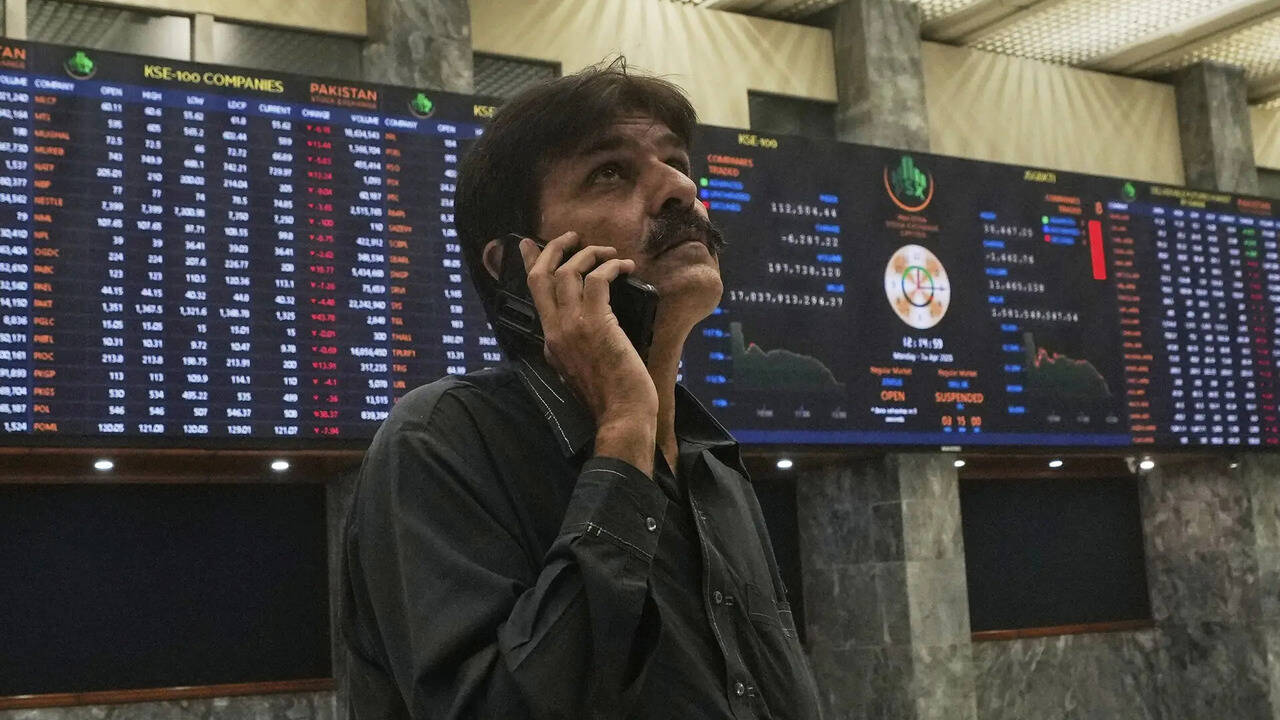
KSE-100 Surges 7,500 Points as Iran War De-escalation Hopes Grip Pakistan’s Markets

Published

on

As foreign central banks dump $90 billion in US Treasuries and Brent crude convulses near $120, Islamabad’s unlikely role as peacebroker is paying an unexpected dividend on the trading floor.

There is a peculiar kind of optimism that only emerges in the eye of a hurricane. Wednesday morning at the Pakistan Stock Exchange felt exactly like that. At 12:05 p.m., the benchmark KSE-100 Index stood at 156,204.89 — having gained 7,461.58 points, or 5.02%, from the previous close — a move so violent that it triggered a mandatory market halt, suspending all equity-based trading under PSX circuit-breaker rules. ProPakistani The previous session had already closed higher. Tuesday’s KSE-100 session had ended at 148,743.32, up 1,900.34 points, as investors began pricing in whispers of a ceasefire from Washington. Profit by Pakistan Today By Wednesday noon, those whispers had become a roar.

This is not, however, a story only about Karachi. It is a story about a world economy convulsing under the weight of a war in the Persian Gulf, a $30 trillion US Treasury market being quietly liquidated by desperate central banks, and — most improbably — Pakistan sitting at the centre of the most consequential diplomatic negotiation of 2026. The KSE-100’s surge is at once a relief rally, a geopolitical signal, and a referendum on how tightly Pakistan’s financial fate is now knotted to its new role as peacebroker between Washington and Tehran.

Why Karachi Erupted: The Anatomy of a 5% Day

Buying momentum on Wednesday was broad-based, with strong activity across automobile assemblers, cement, commercial banks, fertiliser, oil and gas exploration, oil marketing companies, and power generation firms. Major index-heavyweights — HBL, MCB, MEBL, UBL, MARI, OGDC, PPL, POL, PSO, HUBCO, and ARL — all traded firmly in the green, reflecting renewed investor confidence amid easing geopolitical risk. ProPakistani

The rally follows emerging hopes of de-escalation in the Iran war after US President Donald Trump and Secretary of State Marco Rubio signalled that the conflict could end soon, with Washington indicating potential direct talks with Tehran’s leadership and a winding down of hostilities even without a formal deal. Profit by Pakistan Today Trump, speaking from the White House on Tuesday, said the US exit could come “within two weeks, maybe two or three.”

The market context matters enormously here. The rebound follows a brutal first-quarter correction, during which the Pakistan Stock Exchange benchmark declined around 15% amid geopolitical uncertainty and relentless selling pressure. Profit by Pakistan Today That selloff was not irrational. Pakistan’s economy is structurally exposed to Middle East energy prices — the country imports the overwhelming majority of its oil and LNG, and any sustained spike in Brent crude flows directly into inflation, the current account deficit, and State Bank of Pakistan reserves. When the war began on February 28, the PSX reacted the way a patient loses colour when told bad news: quickly, and all at once.

Wednesday’s reversal tells a different story. It tells you that the market had been pricing in far worse than what may now materialise. It tells you that institutional and retail buyers in Karachi, Lahore, and Islamabad are not just trading geopolitics abstractly — they are trading Pakistan’s specific role in ending this crisis.

The $90 Billion Treasury Liquidation: A Slow-Motion Earthquake Under Bond Markets

While traders in Karachi were celebrating, bond desks in New York, London, and Tokyo were navigating something far more structurally significant. New York Fed custody data shows that since the week before the conflict broke out — the week of February 25 — foreign monetary authorities have been net sellers of US Treasuries for five consecutive weeks, with the total sell-off exceeding $90 billion, and holdings falling to the lowest level since 2012. All-Weather Media

The Financial Times, citing Federal Reserve data, confirmed that the value of Treasuries held in custody at the New York Fed by official institutions — a group largely made up of central banks but also including governments and international institutions — has dropped by $82 billion since February 25 to $2.7 trillion. X

The mechanics driving this sell-off are not mysterious, even if their consequences are underappreciated. The direct cause of this round of selling is the urgent need for dollar liquidity among countries — from foreign exchange market intervention to paying energy import bills and financing defense spending, the surge in demand for dollars is forcing foreign central banks to liquidate their most liquid dollar assets: US Treasuries. Futu News

The single most striking data point in the disaggregated country-level picture is Turkey’s. Official figures show that since February 27 — the day before the US attacked Iran — Turkey’s central bank sold about $22 billion in foreign government bonds from its reserves, mainly US Treasuries. Turkey also sold or swapped about 58 tons of gold valued at over $8 billion. All-Weather Media

Brad Setser, Senior Fellow at the Council on Foreign Relations and arguably the world’s foremost tracker of sovereign reserve flows, has been clear about who else is in the queue. Setser stated that “many countries are unwilling to let their currencies depreciate further, as this would drive up oil prices denominated in local currencies — either implying more fiscal subsidies or increasing the burden on people’s daily lives. Therefore, many countries have generally decided to intervene in the foreign exchange market to try to limit the depreciation of their currencies.” Futu News India and Thailand, both large oil importers, have also seen foreign reserve drawdowns since the war began, though it remains unclear whether those represent outright Treasury sales or dollar deposit liquidations.

Bank of America US rates strategist Meghan Swiber has been unambiguous: the foreign official sector is selling US Treasuries, and the selling “confirms a more macro narrative — that foreign reserve managers and official accounts are diversifying away from US Treasuries.” All-Weather Media

The structural backdrop is equally sobering. A recent Morgan Stanley report shows the proportion of US Treasuries held by foreign investors has dropped to its lowest since 1997, with the share of coupon-bearing Treasuries held by foreign investors falling steadily since the 2008 peak of 64.4% and now near multi-decade lows. All-Weather Media The Iran war has not created this trend — but it has violently accelerated it. As the Financial Times reported on Tuesday, the bond market’s largest and most stable category of buyer is now, in a period of maximum global stress, a net seller.

This matters for Pakistan in a roundabout but real way. Higher US Treasury yields — the mathematical consequence of this selling pressure — tighten global dollar funding conditions, increase the cost of Pakistan’s external debt servicing, and strengthen the dollar in ways that amplify imported inflation. A faster resolution to the Iran conflict is, in this sense, not just a geopolitical good but a financial one for Islamabad.

The Strait, the Shock, and the Oil Market Nobody Saw Coming

The International Energy Agency has called it the biggest oil supply shock in history. Due to Iran’s selective blockade of the Strait of Hormuz, the world is losing as much as 20 million barrels of oil per day from Middle East producers. Since the war began five weeks ago, Brent crude has risen more than 50%. CNN

Brent crude was trading at just over $118 per barrel for May deliveries, while the more widely traded June delivery contract was around $103.50. The average price of gasoline in the United States crossed $4 per gallon for the first time since 2022. CBS News For emerging markets that import most of their energy, these numbers translate into something far more corrosive than headline inconvenience: they represent a structural transfer of wealth from oil-importing nations to a geopolitical standoff, mediated by a narrow chokepoint 21 miles wide at its narrowest point.

The Wall Street Journal, citing administration officials, reported that Trump and his aides had concluded that a military mission to reopen the Strait of Hormuz would extend beyond his four-to-six-week timeline, and he had decided to focus on targeting Iran’s missiles and navy before seeking to pressure Iran diplomatically to reopen it. Euronews

That shift — from military maximalism to diplomatic realism — is precisely what equity markets in Karachi, and indeed across emerging Asia, have been waiting for.

Pakistan’s Diplomatic Dividend: The Unlikely Peacebroker

The most remarkable subplot of this crisis is not the Treasury sell-off, nor the oil price spike. It is Islamabad’s transformation, over the past two weeks, from a country wracked by internal protests over the US strikes on Iran into a credible diplomatic interlocutor between Washington and Tehran.

Pakistan’s Foreign Minister Ishaq Dar confirmed that “US-Iran indirect talks are taking place through messages being relayed by Pakistan,” adding that Turkey and Egypt were also extending support to the initiative. US envoy Steve Witkoff confirmed presenting a 15-point action list as the framework for a peace deal, which mediator Pakistan gave to Iran. NPR President Trump then paused his deadline for the destruction of Iran’s energy plants by ten days to April 6, citing the ongoing talks. Special envoy Steve Witkoff confirmed at President Trump’s Cabinet meeting that the US has been negotiating with Iran through diplomatic channels with Pakistan as the conduit. CNN

Foreign Policy has described this as a role that makes more geopolitical sense than it initially appears. Pakistan is a rare country that has warm ties with both the United States and Iran and is engaged with the highest levels of both governments. Pakistan also represents Tehran’s diplomatic interests in Washington. Furthermore, Pakistan has dealt closely with the family of a key player on the US side — Middle East envoy Steve Witkoff. Foreign Policy

The domestic calculus is equally clear: Pakistan’s mediation push is driven by economic strain, security concerns, and strategic calculation. With energy markets volatile and the country reliant on Gulf oil and LNG imports, any sustained spike in global crude prices could deepen a crisis Pakistan can ill afford. Pakistan’s fragile economic recovery is under renewed stress, with constrained fiscal space and minimal strategic oil reserves. The Researchers

The PSX’s 7,500-point single-session surge is, in a narrow sense, investors pricing in the probability that Pakistan’s diplomatic gamble pays off. A ceasefire, even an imperfect one, would lower oil prices, ease imported inflation, reduce pressure on State Bank of Pakistan foreign reserves, and reopen the possibility of further monetary easing by the SBP — all of which are bullish for Pakistani equities.

Risks: The Rally Is Real, But the Ceasefire Isn’t — Yet

Markets have a well-documented habit of pricing in peace talks before those talks produce peace. The KSE-100’s gain on Wednesday is a bet, not a receipt.

Several credible risks remain. Iran has countered the US 15-point plan with its own five conditions, including recognition of Iran’s legitimate rights, payment of war reparations, and firm international guarantees against future aggression. Al Jazeera Those are not trivial demands from a country that has seen its Supreme Leader killed and its military infrastructure methodically dismantled. Ending the war with Iran retaining effective control of the Strait of Hormuz would be seen internationally as a strategic defeat for the United States — Iran would claim victory and might monetize its position by imposing tolls on transiting tankers, providing revenues to rebuild its military and nuclear programmes. CNN

Secretary of State Rubio has been clearer on the endgame than almost anyone. Rubio told Al Jazeera that “the Strait of Hormuz will be open when this operation is over — one way or another,” and rejected Iran’s demand to maintain sovereignty over the waterway as part of any agreement. Al Jazeera That language, while reassuring to oil markets in the abstract, leaves significant space for a breakdown in negotiations — and a resumption of exactly the kind of escalatory cycle that sent the KSE-100 down 15% in the first quarter.

Oil market participants appear to be processing this nuance already. Bond yields have been steadily rising throughout March as investors race to reprice the chances of rate hikes from central banks, with expectations of rate cuts at the Federal Reserve and the Bank of England having fallen sharply and in many cases being replaced by anticipations of hawkish monetary policy. CNBC That global repricing of central bank paths — driven directly by energy-led inflation — is a structural headwind for emerging market assets, Pakistan included, that does not disappear even if a ceasefire is signed.

Global Macro Implications: When the World’s Safe Asset Isn’t Safe Enough

Beneath the headline drama of the oil price spike and the stock market surge, the most consequential development of this crisis may be the one attracting the least retail attention: the systematic erosion of US Treasury demand at precisely the moment that Washington’s finances require it most.

Stephen Jones, Chief Investment Officer at Aegon Asset Management, described central banks’ actions as countries “raising war funds,” saying, “They are drawing on emergency reserves.” This round of selling is not an isolated event but a microcosm of a longer-term structural shift: global reserve management institutions are systematically reducing exposure to dollar assets. All-Weather Media

If the Iran conflict ends quickly, some of this pressure on the Treasury market will ease. Central banks in Turkey, India, and Thailand that have been intervening in FX markets to defend their currencies will face less pressure to continue liquidating reserves once oil prices fall. That normalisation would provide some relief to US bond yields. But the structural share of foreign holdings — already at a 27-year low — is not a tap that turns back on quickly. The trend that the war has accelerated was years in the making.

For Pakistan’s capital markets, the near-term playbook favours the bulls — as long as the diplomatic process holds. A ceasefire, lower Brent crude, a softer dollar, and resumed SBP rate cuts would be a nearly perfect cocktail for further PSX gains. The index, even after Wednesday’s surge, remains roughly 18% below its all-time high of approximately 189,556 points reached in January 2026. There is significant mean-reversion potential if geopolitical risk genuinely abates.

Outlook: Watch April 6 — and the Address to the Nation

The immediate calendar is unusually consequential. President Trump is scheduled to deliver a prime-time address to the nation on Wednesday evening providing what the White House described as “an important update on Iran.” The April 6 deadline for Iran to reopen the Strait of Hormuz — or face strikes on its energy infrastructure — creates a hard binary. Either the diplomatic track delivers a meaningful framework before that date, or markets face the prospect of a sharp escalatory spike.

Secretary of State Rubio, before departing for a G7 foreign ministers meeting in France, confirmed that “there are intermediary countries that are passing messages and progress has been made — some concrete progress has been made,” describing negotiations as “an ongoing and fluid process.” CNN

For investors in Karachi and beyond, the single most important watch item is not the KSE-100 level, nor the US Treasury yield, nor even Brent crude. It is whether Pakistan’s mediation — this extraordinary diplomatic intervention by a country whose consulate in its own largest city was attacked just a month ago — delivers enough of a framework before April 6 to allow both sides to step back from the precipice.

If it does, Wednesday’s 7,500-point surge will look, in hindsight, like the opening chapter of a recovery story rather than a false dawn in a prolonged storm. If it doesn’t, the circuit-breaker that paused trading on Wednesday could, in the weeks ahead, be pointing in the other direction.

Pakistan has been here before — not as a victim of great-power competition, but as its unexpected architect. It was Islamabad that facilitated Nixon’s 1971 opening to China. It may yet be Islamabad that writes the first line of a postwar order in the Persian Gulf. The KSE-100, for one day at least, has decided to believe it.


Discover more from The Economy

Subscribe to get the latest posts sent to your email.

Analysis

Why Trump’s Iran Timeline Is Reshaping Currency Markets

Published

on

As safe-haven demand unwinds, the yen’s recovery from 160.46 tests the BOJ’s resolve and exposes a market desperate for clarity.

When President Donald Trump told reporters on April 1, 2026, that the U.S. military campaign against Iran could conclude “within two to three weeks,” he did something that months of tanker attacks and escalating airstrikes had failed to accomplish: he forced currency markets to reprice geopolitical risk in real time . Within hours, the Japanese yen had clawed its way back from this year’s low of 160.46 per dollar, the dollar index slipped to a one-week trough, and traders began unwinding the very safe-haven positions they had built since late February .

Here’s the uncomfortable truth that the wire-service headlines missed: the dollar stable after Trump Iran statement narrative is not a story about peace breaking out. It is a story about markets probabilistically trading a conflict window that hasn’t yet closed—and about the Federal Reserve, the Bank of Japan, and global investors navigating a landscape where a single presidential utterance can do more to move asset prices than weeks of diplomatic back-channeling.

This is the new normal. And for anyone holding yen, dollars, or exposure to emerging markets, understanding what happens next requires looking beyond the headline to the structural forces—oil, interest rates, and intervention risk—now colliding beneath the surface.

1: The Immediate Market Reaction—A Tale of Two Forces

By mid-morning Tokyo time on April 1, the market had absorbed Trump’s remarks alongside conflicting signals from Pentagon officials. The result was a currency market caught between relief and residual fear.

The dollar initially gave up some of its safe-haven premium, with the dollar index easing 0.03% to 99.70 as the euro climbed to $1.1576, its highest in more than a week . But the greenback did not collapse. As of the latest data, USD/JPY was trading near 158.55, a notable recovery from the 160.46 low recorded earlier this year, yet still historically elevated .

What explains the dollar’s relative stability? Three factors.

First, the U.S. remains a net energy exporter—a structural advantage that makes it more resilient to oil price shocks than import-dependent economies like Japan or the eurozone . Second, despite the relief rally, no formal ceasefire agreement exists. Defense Secretary Pete Hegseth simultaneously warned that “the next few days…would be decisive” and that conflict could intensify absent a deal . Third, and most critically, the market has not yet decided whether Trump’s timeline is credible or merely aspirational.

Kyle Rodda, senior market analyst at Capital.com, captured this tension perfectly: “While the headlines were worth a bit of a jump in risk assets, the state of the war and its impact on fundamentals haven’t materially changed yet and the overnight moves are liable to quickly reverse” .

In other words, April 1 was not a trend reversal. It was a pause—a moment of recalibration—with the dollar still supported by the possibility that the conflict could, in fact, drag on.

2: Geopolitical Context—Markets Trading a “Two-Week War”

What makes this moment distinct from previous Middle East flare-ups is the speed with which markets have incorporated a defined timeline into pricing. As Nigel Green, CEO of the deVere Group, put it: “Markets are, effectively, now trading a two- or three-week war scenario based on Trump’s latest comments” .

This is not merely semantic. It represents a fundamental shift in how geopolitical risk is being priced across asset classes.

Consider oil. Brent crude had spiked toward $119 per barrel amid fears of a prolonged conflict and potential Strait of Hormuz disruption. Following Trump’s remarks, it fell back toward $105—a move that has already begun feeding into inflation expectations and, by extension, interest rate projections . The S&P 500 futures extended gains, and Asian markets rallied, with South Korea’s Kospi jumping more than 6% .

Yet historical parallels suggest caution. The 2019–2020 tanker war in the Strait of Hormuz saw multiple escalatory cycles, each followed by temporary de-escalation headlines that failed to produce lasting stability. More recently, the 2022 Ukraine shock demonstrated how quickly geopolitical timelines can slip once conflict becomes entrenched.

The market is now pricing de-escalation faster than diplomacy can deliver. That gap—between market expectation and political reality—is where volatility lives.

3: Yen-Specific Analysis—Why 160.46 Was the Breaking Point

For Japan, the yen recovery 160 narrative is about more than just a currency rebound. The level 160.46 USD/JPY represented a psychological and policy red line—one that Japanese authorities had signaled they would not allow to be crossed without action.

The BOJ intervention risk yen recovery dynamic has been building for weeks. Japan’s top currency diplomat recently warned that officials could take “decisive” action—language markets interpret as a precursor to actual yen-buying intervention . Governor Kazuo Ueda has also stressed that currency movements now have a more pronounced impact on inflation than in the past, keeping the door open to further rate hikes .

Here’s what changed on April 1: as safe-haven demand faded, the yen strengthened without BOJ intervention. That matters because it suggests the market itself—not just official action—is beginning to reprice yen downside risks. Sho Suzuki, market analyst at Matsui Securities, noted that “the reversal of the long-running ‘buy dollars, sell yen’ trade is likely to continue” .

But he added a critical caveat: the move has not yet become a one-way shift, because concerns about the conflict linger.

For carry-trade investors, this is a moment of reckoning. The yen has been the world’s preeminent funding currency for years, with investors borrowing cheaply in yen to buy higher-yielding assets. A sustained yen recovery would unwind those positions—potentially amplifying the move. The Bank of Japan’s March Tankan survey showed improving business sentiment, but firms expect conditions to worsen in the coming months, underscoring the fragility of the domestic recovery .

4: Broader Macro & Investor Implications

Beyond the dollar-yen cross, the Trump Iran signal is reverberating across global markets in ways that demand portfolio rethinking.

The Federal Reserve is the elephant in the room. Markets had largely priced out rate cuts for 2026 as rising oil prices stoked inflation concerns. But if the conflict de-escalates and crude continues to pull back, inflation expectations ease—and the Fed regains flexibility. Friday’s jobs report will be pivotal: economists expect 60,000 new jobs in March, a rebound from February’s unexpected 92,000 loss . A sharp deterioration would revive rate-cut bets and pressure the dollar.

Oil remains the transmission mechanism. The Wall Street Journal reported that the United Arab Emirates is preparing to help the U.S. and allies force open the Strait of Hormuz if necessary . That would be a game-changer, but it also carries escalation risks. Energy-importing emerging markets—particularly in Asia—stand to benefit most from lower oil prices, while oil exporters face a double whammy of lower prices and reduced geopolitical risk premiums.

Portfolio implications: Investors should consider three adjustments.

  1. Reduce safe-haven dollar overweights if the conflict timeline holds, but maintain hedges given the fragility of the ceasefire narrative.
  2. Reassess yen exposure—the 160 level appears to be a policy floor, whether enforced by the market or the BOJ.
  3. Monitor carry-trade unwinding as a potential source of volatility, particularly in higher-yielding emerging market currencies.

5: Outlook & My Expert Opinion—Three Scenarios for the Next 3–6 Months

Over the next six months, the path for USD/JPY and global currency markets will be determined by the interplay of three variables: the conflict’s duration, the Fed’s reaction function, and BOJ policy.

ScenarioProbabilityUSD/JPY OutlookKey Drivers
Controlled De-escalation45%155–160Trump’s timeline holds; oil stabilizes near $100; Fed on hold; BOJ hikes once
Prolonged Conflict35%160–165Timeline slips; oil spikes to $120+; safe-haven dollar strength resumes; BOJ intervention
Disorderly Intervention20%145–155BOJ forced to act decisively; coordinated intervention; Fed cuts surprise

My view: the market is currently overweighting Scenario 1 and underweighting Scenario 2. Trump’s “two- to three-week” timeline is plausible, but the underlying issues—Strait of Hormuz access, Iranian nuclear ambitions, regional power dynamics—are not resolvable in that timeframe. Markets that have aggressively priced de-escalation are vulnerable to a sharp reversal if headlines turn negative.

The most likely outcome is a choppy range for USD/JPY between 155 and 160, with episodic spikes higher on conflict headlines and lower on intervention fears. Investors should treat the current dollar stability not as an all-clear signal, but as a reprieve to reposition.

Conclusion: The Currency Market’s New Reality

When a single presidential statement can move the yen from 160.46 to 158.55 in hours, we are witnessing something profound. The traditional separation between geopolitics and currency markets has collapsed. Every trader, every portfolio manager, every corporate treasurer now operates in a world where policy pronouncements carry the weight of central bank action.

For the dollar, stability is not strength—it is a measure of the market’s uncertainty about whether the war ends in weeks or months. For the yen, the recovery from 160 is a reminder that even the most oversold currencies have floors when policy credibility is on the line.

And for investors, the lesson is simple: in a market trading on a “two-week war” timeline, the greatest risk is not the headline you see—it is the timeline you assume.


Discover more from The Economy

Subscribe to get the latest posts sent to your email.

Continue Reading

Analysis

Pakistan’s 7.3% Inflation Surprise in March 2026: Relief or Red Flag for 2026 Growth?

Published

on

Economic Analysis · Pakistan

The headline number beat expectations—but with core prices still sticky, oil markets roiling, and an IMF programme watching closely, Pakistan’s policymakers have little room to celebrate.

In a modest flat in Karachi’s Gulshan-e-Iqbal, Fatima Naqvi spent the first morning after Eid ul-Fitr tallying her household ledger. The good news: her grocery bill was noticeably lighter than last year’s—tomatoes back to something approximating reason, chicken no longer a luxury purchase. The unsettling news: the gas cylinder had doubled in cost, the electricity bill arrived with a new surcharge, and her husband’s April salary raise had been swallowed whole by non-food expenses before the month even began. Pakistan’s inflation for March 2026, confirmed by the Pakistan Bureau of Statistics at 7.3% year-on-year, captures both of those realities simultaneously.

The 7.3% CPI Pakistan 2026 reading was, on paper, a genuine positive surprise. The Ministry of Finance had bracketed its forecast at 7.5–8.5%. Brokerage houses Arif Habib Limited and JS Global had pencilled in a range of 7.3–7.6%. Almost every analyst on Karachi’s I.I. Chundrigar Road had warned that March would bring the most punishing base-effect spike of the year, given that Pakistan’s March 2025 CPI had crashed to a six-decade low of 0.7%—a statistical anomaly that made any year-on-year comparison brutally difficult. That the final print landed at the floor of expectations rather than the ceiling is, genuinely, the least bad outcome policymakers could have hoped for.

Yet the Pakistan headline inflation March 2026 figure also carries a caveat as wide as the Indus in monsoon season. Strip away the flattering food components, stare directly at core prices, fuel sub-indices, and the fine print of the IMF’s freshly inked third review, and the story becomes considerably more complicated. This is a moment for sober analysis, not a victory lap.

7.3% — Pakistan CPI, March 2026 (YoY) Below MoF forecast of 7.5–8.5% · Above February’s 7.0% · Versus 0.7% in March 2025 Source: Pakistan Bureau of Statistics (PBS), April 2026


The Numbers Behind the Surprise

To understand why 7.3% qualifies as a surprise, you need to appreciate the arithmetic of base effects. Pakistan’s inflation trajectory over the past 14 months has been defined by comparisons against extraordinarily benign prior-year benchmarks. In February 2026, CPI hit 7.0% year-on-year, up sharply from 5.8% in January—because February 2025’s base was itself only 1.5%. March 2025’s base of 0.7% is even lower, meaning the mechanical arithmetic alone suggested a print north of 8%. The fact that March 2026 avoided that territory reflects genuine underlying price moderation in at least some categories.

Category / IndicatorMarch 2026 (YoY)February 2026 (YoY)Direction
Headline CPI (National)7.3%7.0%↑ +0.3pp
Urban CPI~7.1%*6.8%
Rural CPI~7.6%*7.3%
Core Inflation (Non-food, Non-energy)~7.2–7.4%*~7.2%→ Sticky
Food & Non-Alcoholic Beverages~5.5%*~3.9%↑ (base-driven)
Housing, Water, Utilities, Gas~8.5%*7.3%↑ Elevated
LPG (SPI YoY, late March)+34.7%↑↑ Severe
Petrol (SPI YoY, late March)+25.8%↑↑ Severe
Diesel (SPI YoY, late March)+29.9%↑↑ Severe
Wheat Flour (SPI YoY, late March)+25.8%↑↑ Persistent
Potatoes (SPI YoY, late March)-45.7%↓↓ Deflationary
Eggs (SPI YoY, late March)-13.6%↓ Deflationary

*Estimated based on February 2026 PBS data and SPI trajectory. Full PBS March CPI release pending. Sources: PBS, Trading Economics.

The disaggregated picture is clarifying. The national headline number was rescued by dramatic declines in perishable vegetables—potatoes down nearly 46%, eggs off 14%, garlic falling 13%. This reflects good crop supply and normal seasonal correction post-winter. But these are precisely the categories that reverse fastest. Meanwhile, the structural pain points—fuel, gas, utilities, processed food—are not only elevated but trending upward. Rural households, who spend a larger share of income on food staples like wheat flour (up 26%), experienced considerably more pressure than the 7.3% aggregate implies. Rural CPI in February was already running at 7.3% against urban’s 6.8%; March likely widened that gap.

“A 7.3% headline masks a tale of two Pakistans: urban middle-class shoppers who benefited from cheap vegetables, and rural households still crushed by wheat flour and fuel costs running at 25–35% above last year.”


Why Lower Than Expected? (And Why It Still Matters)

Three forces pushed the March print below consensus. First, the Eid ul-Fitr effect on food supply—remittance inflows ahead of the holiday, combined with improved cross-border trade flows and a reasonable winter crop, helped dampen the post-Ramadan food spike that markets had feared. Second, the global oil correction: Brent crude pulled back from its March peak following brief US-Iran diplomatic signals, providing transitory relief on pump prices at precisely the measurement moment. Third, and most importantly for the analytical record, the statistical contribution of volatile perishables in the PBS CPI basket—weighted at roughly 35% for food and non-alcoholic beverages—proved more disinflationary than models projected.

None of these forces is durable. Remittance-driven food demand is seasonal. Oil diplomacy in the Middle East is fragile—at the time of writing, the region remains in active conflict with ongoing supply disruptions. And the crop year’s perishable surplus will normalise by Q2. This is why the Pakistan CPI vs Finance Ministry estimate March 2026 miss, while welcome, should not be read as a trend break.

📊 Context: The Base Effect Explained

Pakistan’s March 2025 CPI of 0.7% was the lowest reading in six decades, the result of aggressive SBP rate hikes (peak: 23% in May 2024), rupee stabilisation, and a global commodity correction. Any March 2026 reading was statistically guaranteed to look high against that base. A 7.3% print therefore still represents genuine easing relative to a purely mechanical-base scenario—but the absolute level of prices Fatima Naqvi faces in her kitchen has not fallen. The index has just risen more slowly than feared.

Comparatively, Pakistan’s trajectory holds up reasonably against its peer group. India’s CPI has been hovering around 4–5%, benefiting from more diversified energy supply and larger agricultural buffers. Bangladesh has faced its own food inflation pressures above 9%. Among IMF programme countries in emerging Asia, Pakistan’s 7.3% sits in the middle of the distribution—not alarming, not reassuring.

Global and Domestic Headwinds Looming

The timing of the March CPI release could not be more loaded with context. Just days earlier, on March 27, 2026, the IMF completed its third review of Pakistan’s 37-month Extended Fund Facility—reaching a staff-level agreement that unlocks approximately $1.2 billion in disbursements ($1.0 billion under the EFF and $210 million under the Resilience and Sustainability Facility). The IMF’s statement was diplomatically careful but strategically explicit: the Middle East conflict “casts a cloud over the outlook” as volatile energy prices and tighter global financial conditions risk pushing inflation higher and weighing on growth.

The Fund went further. The SBP was explicitly reminded to stand ready to raise interest rates “should price pressures intensify.” That is not boilerplate language; it is a conditional threat embedded in a bilateral agreement. Pakistan’s policymakers understand that the 7.3% March print—while below forecast—does not represent the all-clear.

⚠️ Risk Radar: What Could Push Inflation Back Above 9%

The SBP’s own March 2026 policy statement cited analysts warning of inflation reaching approximately 9.25% by Q2 FY2026. The key transmission mechanisms: (1) oil price pass-through via petrol and diesel—already at +26% and +30% YoY respectively on weekly SPI data; (2) electricity and gas tariff adjustments required under IMF energy sector viability conditions; (3) currency depreciation pressure if Middle East tensions tighten global dollar liquidity; (4) wheat flour stubbornly at +26% YoY, an anchor commodity in the rural poor’s consumption basket.

Pakistan’s energy situation deserves particular attention. The SBP held its benchmark policy rate at 10.5% in March, extending the pause in its easing cycle—but the reasons cited were almost entirely external. Oil prices had surged amid Middle East escalation. Pakistan, as a heavy importer of refined fuels, transmits global energy shocks directly into its CPI with a lag of four to eight weeks. The LPG price spike visible in the SPI data—up 35% year-on-year by the final week of March—is a leading indicator, not a coincidence. Energy sector circular debt remains the structural ulcer that no monetary policy can treat.

Remittances, by contrast, remain a genuine bright spot. The SBP’s January 2026 monetary policy statement noted that worker remittances continue to run strongly, and the IMF’s third review acknowledged their role in containing current account pressures. Eid-season inflows in late March 2026 provided a real demand buffer. With SBP foreign exchange reserves expected to surpass $18 billion by June 2026, the external account is in its healthiest position in years. But reserves and food-price relief are not the same thing for the 60% of Pakistanis who live on incomes below the median.

What This Means for Pakistanis and Policymakers

The gap between the headline statistic and the lived experience of ordinary Pakistanis is the central policy communication failure of this moment. Core inflation—which strips out volatile food and energy—has been running at approximately 7.2–7.4% since late 2025, unchanged despite the headline number oscillating. Core inflation is the signal; it tells you what employers are implicitly pricing into wage offers, what landlords are building into rent reviews, and what service-sector firms are assuming about input costs. At 7.2–7.4%, core inflation remains above the SBP’s 5–7% target band’s midpoint. Real wages for formal-sector workers—assuming nominal raises of 10–12%—are barely keeping pace. For the informal sector, which accounts for the majority of Pakistan’s labour force, real purchasing power has not recovered to 2022 levels.

For the State Bank, the SBP policy rate after March 2026 inflation is an easier decision than it was three months ago, but not a comfortable one. The 10.5% rate was held in March; a cut before June looks nearly impossible given the IMF’s explicit hawkish guidance. The earliest credible window for easing is late FY2026—June or July—and only if energy prices stabilise and the Q2 CPI print does not validate the 9.25% projection. The SBP’s own December 2025 rate cut, which surprised markets, now looks like a calculated bet that the base-effect spike would be temporary. The March 2026 data gives that bet a modest early validation—but not yet vindication.

For fiscal policy, the picture is sharper still. The IMF requires Pakistan to achieve a primary budget surplus of 1.6% of GDP in FY2026, progressing toward 2% in FY2027. The Federal Board of Revenue’s tax collection growth has slowed to approximately 9.5%, well below last year’s 26% pace, creating a Rs 329 billion shortfall. Lower-than-expected inflation mathematically reduces nominal tax revenues. That fiscal tightness, combined with energy sector tariff obligations, means the government has very little room for consumer-protecting interventions—even as middle-class purchasing power remains under real strain.

IndicatorValueStatus
Headline CPI, March 20267.3% YoY✓ Below MoF forecast
Core Inflation (Jan 2026, latest)~7.2–7.4%⚠ Above SBP target midpoint
SBP Policy Rate10.5%→ On hold (Mar 2026)
SBP Inflation Target Range5–7%⚠ Breached on upper end
FX Reserves (SBP)$15.8B+✓ Rising; target $18B by Jun
IMF EFF Status3rd review SLA signed✓ $1.2B unlocked (Mar 27)
GDP Growth Target, FY20264.2%⚠ At risk; SBP sees 3.75–4.75%
LSM Growth, Q1 FY2026+4.1% YoY✓ Broad-based recovery
FBR Tax Revenue Growth+9.5% YoY⚠ Rs 329B shortfall

Sources: PBS, SBP Monetary Policy Statements, IMF Third Review Staff-Level Agreement (March 27, 2026), Trading Economics.


Lessons for 2026 and Beyond: The Reform Imperative

Here is the honest, uncomfortable truth that Pakistan’s inflation data keeps telling us, month after month: the stabilisation is real, but it is shallow. Pakistan has achieved headline inflation below double digits by combining IMF-conditioned fiscal discipline, SBP rate hikes that briefly hit 23%, and the extraordinary statistical luck of an ultra-low comparison base. None of that is structural disinflation. None of it addresses why wheat flour costs 26% more than a year ago, why LPG has become a luxury item in rural Sindh, or why electricity tariffs must keep rising to service a circular debt that has been accumulating for three decades.

The countries that have genuinely conquered inflation—India in the 2010s, Indonesia post-2015, even Bangladesh through much of the 2010s—did so by investing heavily in agricultural supply chains, diversifying energy sources away from imported fossil fuels, and broadening the tax base so that fiscal deficits did not repeatedly force monetary tightening. Pakistan has undertaken partial versions of all three under the current EFF, but partial is the operative word. The IMF’s third review noted progress on energy sector reforms while flagging that circular debt prevention requires “timely tariff adjustments that ensure cost recovery”—a polite formulation for: tariffs will keep rising, and the poor will bear a disproportionate share of that burden unless social protection scales accordingly.

The Benazir Income Support Programme has been expanded, with inflation-adjusted transfers and broader coverage explicitly acknowledged in the IMF staff-level agreement. That is meaningful. But BISP reaches approximately 9 million households; Pakistan’s population is 245 million. The middle class—the salaried professionals, the small traders, the schoolteachers—falls precisely in the gap between BISP eligibility and meaningful real wage recovery. They are the group for whom 7.3% inflation is not relief; it is just a slower form of erosion.

This is where opinion must be plainly stated: Pakistan cannot afford to treat a below-forecast CPI print as an excuse to delay structural reform. The window that the current IMF programme, rising reserves, and recovering industrial output has opened is narrow. Energy sector privatisation, agricultural investment, tax base broadening, and exchange rate flexibility as a genuine shock absorber rather than a managed decline—these are not optional supplements to the stabilisation programme. They are the programme, in its meaningful form.

The bottom line on Pakistan inflation March 2026: 7.3% is genuinely lower than feared, and analysts, policymakers, and ordinary households alike are entitled to take a moment’s breath. Pakistan has come a long way from the 30.8% inflation peak of 2023. But core prices are sticky, fuel costs are brutal, rural households remain under severe pressure, and the IMF’s own assessment warns that Middle East volatility could still push Q2 CPI toward 9%. The SBP will hold rates. The government must hold its fiscal nerve. And Pakistan’s political economy must find the courage to push through energy and agricultural reforms while the external account is, for now, in reasonable shape.

Fatima Naqvi’s ledger tells you what the index cannot: stability is not the same as relief, and relief is not the same as prosperity. The next six months will determine which of those three words defines Pakistan’s 2026.

Frequently Asked Questions

Was Pakistan’s inflation lower than expected in March 2026? Yes. Pakistan’s headline CPI inflation for March 2026 registered at 7.3% year-on-year, below the Ministry of Finance’s forecast range of 7.5–8.5% and at the lower end of brokerage estimates of 7.3–7.6%. The positive surprise was driven largely by steep declines in perishable vegetable prices (potatoes -46%, eggs -14%) that offset persistent fuel and utility inflation.

What is the impact of 7.3% inflation on Pakistan’s economy in 2026? The reading provides the SBP justification to keep the policy rate on hold at 10.5% rather than hiking, supporting the IMF EFF programme narrative. However, core inflation remains sticky at 7.2–7.4%, real wage growth for informal workers is barely positive, and Pakistan’s 4.2% GDP growth target for FY2026 is under pressure from Middle East-related supply chain disruptions and a Rs 329 billion tax revenue shortfall.

How does Pakistan’s CPI compare to the Finance Ministry estimate for March 2026? The Ministry of Finance had forecast March 2026 inflation at 7.5–8.5%, anticipating a base-effect spike from March 2025’s historically low 0.7% CPI. The actual 7.3% print came in below the floor of that range—a roughly 20–30 basis point positive surprise—reflecting better-than-expected food supply conditions and a temporary Brent crude correction.

Will the SBP cut rates after the March 2026 inflation data? A near-term rate cut is unlikely. The SBP held at 10.5% in March 2026, citing Middle East oil risks. While the CPI surprise reduces hike pressure, the IMF’s explicit call for “appropriately tight” monetary policy and sticky core inflation mean the earliest realistic window for easing is late FY2026 (June–July) or into FY2027, and only if Q2 CPI avoids the feared 9%+ range.

What are the main risks to Pakistan’s inflation outlook for the rest of 2026? The primary risks are: (1) Middle East-driven oil price volatility transmitting through LPG (+35% YoY), petrol (+26%), and diesel (+30%); (2) mandatory electricity and gas tariff increases under the IMF’s energy sector viability conditions; (3) rupee depreciation pressure amid global financial tightening; and (4) any monsoon-related agricultural disruption in H2 2026 that reverses the current perishable price relief.


Discover more from The Economy

Subscribe to get the latest posts sent to your email.

Continue Reading

Analysis

The Global Economy Turns Out to Be More Resilient Than We Had Feared

Published

on

There was a moment, somewhere in the fog of mid-2025, when the prevailing consensus on Wall Street and in the marble corridors of multilateral institutions was something close to dread. U.S. tariffs had mushroomed into the most aggressive trade barriers since Smoot-Hawley. Shipping lanes were fractured. Geopolitical fault lines — in the Middle East, in the Taiwan Strait, across the ruins of eastern Ukraine — had not so much deepened as multiplied. The prophets of doom were well-provisioned with data. And yet, here we are. The global economy, battered and limping, is still standing — and in certain respects, walking rather faster than feared.

This is not a triumphalist story. The global economy more resilient than feared narrative deserves neither uncritical celebration nor smug vindication. What it demands is honest, clear-eyed examination. Why did the worst not happen? What forces absorbed the blows? And — most critically — does the resilience we are witnessing reflect structural strength, or is it a borrowed grace, a temporary reprieve before deeper reckonings arrive?

The numbers, for now, tell a story of surprising steadiness. The IMF’s January 2026 World Economic Outlook projects global growth at 3.3 percent for 2026 and 3.2 percent for 2027 — a small but meaningful upward revision from October 2025 estimates. IMF Managing Director Kristalina Georgieva, speaking at Davos in January 2026, called this outcome “the biggest surprise” — a remarkable concession from the head of the institution whose job it is, partly, to anticipate exactly this. Meanwhile, the UN Department of Economic and Social Affairs estimated 2025 global growth at 2.8 percent, better than expected given the tariff storm that rolled through international trade. The OECD, for its part, subtitled its December 2025 Economic Outlook “Resilient Growth but with Increasing Fragilities” — a formulation that is, in its cautious way, almost poetic.

The Four Pillars of an Unlikely Resilience

So what happened? Why didn’t it break?

1. The Private Sector Adapted Faster Than Governments Could Fragment

Perhaps the single most underappreciated force in the global economy’s durability is the sheer agility of the private sector. Georgieva at Davos was blunt about it: globally, governments have stepped back from running companies, and the private sector — “more adaptable, more agile” — has filled the void. When tariffs on certain trade corridors spiked, supply chains did not collapse so much as reroute. Manufacturers diversified sourcing from China to Vietnam, Mexico, and India. Companies front-loaded exports ahead of anticipated barriers, producing a short-term trade surge that buffered 2025 GDP figures across multiple economies. The OECD noted that global growth continued at a resilient pace, driven in part by the front-loading of trade in anticipation of higher tariffs earlier in the year, alongside strong AI investment and supportive macroeconomic policies.

This is, of course, a partial answer. Front-loading is not structural growth — it borrows demand from the future. But it bought time, and time, in economics, is often everything.

2. Technology Investment as the New Growth Engine

The second pillar is one that carries both the greatest promise and the most dangerous ambiguity: the relentless surge in artificial intelligence and broader information technology investment. The IMF’s analysis identified continued investment in the technology sector — especially AI — as a key driver of resilience, acting as “a very powerful driver of growth and potentially prosperity”. The OECD’s data underscores the geography of this boom: AI-related trade now accounts for roughly 15.5 percent of total world merchandise trade, with two-thirds of that originating in Asia. Tech exports from Korea and Chinese Taipei continued rising into late 2025. In the United States, the numbers are almost surreal: strip out AI-related investments, and U.S. GDP contracted slightly in the first half of 2025.

This tells you something important. The global economy’s resilience in 2025–26 is, in significant measure, a tech-sector story. It is a story concentrated in a handful of companies, a handful of geographies, and a single technological paradigm. That concentration is both the source of its power and the root of its fragility — a point we will return to.

3. Monetary and Fiscal Policy Did Not Drop the Ball

History will be reasonably kind to the monetary policymakers of this era — not because they were brilliant, but because they did not, on balance, panic. Central banks that had raised rates aggressively through 2022–23 began easing with measured care as inflation declined. Global headline inflation fell from 4.0 percent in 2024 to an estimated 3.4 percent in 2025, with further moderation projected toward 3.1 percent in 2026. This easing in price pressures gave central banks room to cut, which in turn supported financial conditions, credit availability, and investment flows. The IMF noted that “accommodative financial conditions” were among the key offsetting tailwinds to trade disruptions.

Fiscal policy, too, surprised — though not without cost. Governments spent. Defence budgets expanded. Industrial policy packages — from the remnants of U.S. clean energy subsidies to the EU’s Recovery and Resilience Facility — continued channelling public money into capital formation. The bill, of course, is accumulating. But in 2025 and into 2026, fiscal firepower helped absorb shocks that might otherwise have cascaded.

4. Emerging Market Resilience Held the Global Average

The fourth pillar is often underweighted in Western commentary: the developing world, especially in Asia, continued to grow. South Asia is forecast to expand 5.6 percent in 2026, led by India’s 6.6 percent expansion, driven by resilient consumption and substantial public investment. Africa is projected at 4.0 percent. These are not trivial numbers. When commentators in New York or London describe the global economy as “resilient,” they are describing an aggregate that is substantially upheld by hundreds of millions of consumers and workers in economies whose stories rarely make the front page of financial newspapers. The heterogeneity is stark: the OECD bloc muddles along; the emerging world, in many places, runs.

The Data Beneath the Headlines: A Comparative Snapshot

Institution2025 Global Growth2026 ForecastKey Drivers Cited
IMF (Jan 2026)3.3%3.3%AI investment, fiscal/monetary support, private sector agility
OECD (Dec 2025)3.2%2.9%Front-loading, AI trade, macroeconomic policy
UN DESA (Jan 2026)2.8%2.7%Consumer spending, disinflation, EM domestic demand

The discrepancies in headline figures reflect genuine methodological differences — purchasing power parity weighting, country coverage, base year choices. But the directional consensus is unmistakable: the world grew more in 2025 than it was expected to when tariff escalation peaked. That is a fact worth sitting with.

Why the Resilience Is Under-Appreciated (and Why That Matters)

Here is an inconvenient truth about economic discourse: bad news travels faster, and fear is more monetisable than optimism. The financial media ecosystem is structurally incentivised to amplify downside scenarios. The think tanks that warned loudest about a tariff-induced recession in 2025 are not, by and large, issuing prominent corrections.

This matters because misread resilience breeds misguided policy. If policymakers believe the economy is weaker than it actually is, they over-stimulate — running up debt, inflating asset prices, postponing necessary reforms. If investors believe fragility is the baseline, they underallocate capital to productive long-term investments in favour of short-term hedging. Getting the diagnosis right is not academic; it shapes behaviour, and behaviour shapes outcomes.

The IMF noted that the trade shock “has not derailed global growth” and that global economic growth “continues to show considerable resilience despite significant trade disruptions caused by the US and heightened uncertainty”. Georgieva’s “biggest surprise” framing is telling: even the IMF, with all its modelling resources, did not anticipate the degree of offset. That should prompt a certain epistemic humility about our collective ability to forecast economic shocks — and perhaps a corresponding caution about declaring the worst inevitable next time.

The Fragilities That Resilience Is Masking

And yet. Here is where intellectual honesty demands a sharp turn.

The IMF warned explicitly that the current resilience “masks underlying fragilities tied to the concentration of investment in the tech sector,” and that “the negative growth effects of trade disruptions are likely to build up over time.” The OECD’s subtitle — “Resilient Growth but with Increasing Fragilities” — deserves to be read in full, not just the first half. There are at least five structural vulnerabilities that the headline growth numbers obscure.

The AI Bubble Risk Is Real and Underpriced

The same technology boom that is holding up the global economy today could become its undoing if expectations are not met. The IMF cautioned explicitly about the risk of a correction in AI-related valuations, warning that if tech firms fail to “deliver earnings commensurate with their lofty valuations,” a correction could trigger lower-than-expected growth and productivity losses. The OECD echoes this: weaker-than-expected returns from net AI investment could trigger widespread risk repricing in financial markets, given stretched asset valuations and optimism about corporate earnings.

Strip out AI investment from U.S. GDP and the economy contracted in early 2025. That is a remarkable statement of concentration risk, and it deserves to be said plainly: a significant portion of what we are calling “global resilience” is a bet on AI productivity gains materialising at scale, on schedule. That bet may be correct. It may also be the largest speculative bubble since the dot-com era, dressed in more sophisticated clothes.

Public Debt Is a Ticking Clock

Governments spent their way through the pandemic, then through the inflation crisis, then through the tariff shock. The fiscal bills are accumulating. The OECD flagged that high public spending pressures from rising defence requirements and population ageing are increasing fiscal risks, while NATO countries plan to raise core military spending to at least 3.5% of GDP by 2035. The IMF maintains that governments still have “important work to do to reduce public debt to safeguard financial stability.” None of this is new, but the accumulation of deferred reckoning is reaching levels where the next shock — a pandemic, a financial crisis, a major military conflict — will find fiscal buffers meaningfully depleted.

Geopolitical Fragmentation Has Not Stabilised

The Strait of Hormuz, through which roughly a fifth of global oil supply normally flows, saw shipping traffic fall 90 percent during a fresh Middle East escalation. The IMF’s Georgieva warned that if the new conflict proves prolonged, it has “clear and obvious potential to affect market sentiment, growth, and inflation”. For Japan alone, close to 60 percent of oil imports transit through the strait. For Asia broadly, the exposure is existential in energy security terms. The tariff wars between the U.S. and China have eased somewhat from their 2025 peaks, but the WTO’s Director-General has warned that a full U.S.-China economic decoupling could reduce global output by 7 percent in the long run — a figure that dwarfs any AI productivity upside currently modelled.

Inequality Is Widening, Not Narrowing

The resilience of the global aggregate conceals a distributional disaster. The UN Secretary-General António Guterres noted that “many developing economies continue to struggle and, as a result, progress towards the Sustainable Development Goals remains distant for much of the world”. High prices continue to erode real incomes for low- and middle-income households across the globe, even as headline inflation falls. AI productivity gains, where they materialise, are accruing disproportionately to capital owners and highly skilled workers in a handful of advanced economies. The Davos consensus on AI-as-equaliser remains aspirational, not empirical.

Supply Chain Concentration Has Not Been Solved

The pandemic briefly sensitised policymakers to the fragility of hyper-concentrated global supply chains. Yet China still accounts for more than 50 percent of all rare earth mining and lithium globally, and more than 90 percent of all magnet manufacturing and graphite. These are not peripheral materials — they are the physical substrate of the AI economy, the clean energy transition, and modern defence systems. A single supply disruption event here would cascade through semiconductors, electric vehicles, wind turbines, and data centres simultaneously. The diversification rhetoric remains largely rhetoric.

What Genuine Resilience Would Actually Look Like

Reading the data carefully, one is struck by the difference between resilience as a condition and resilience as a strategy. What the global economy has demonstrated since 2022 is resilience of the first kind: absorption capacity, improvisational agility, the ability to muddle through. What it has not yet demonstrated is resilience of the second kind: the deliberate construction of buffers, the investment in systemic redundancy, the political willingness to accept short-term costs for long-term stability.

Georgieva’s injunction at Davos — “learn to think of the unthinkable, and then stay calm, adapt” — is good personal advice. As a framework for global economic governance, it is insufficient. Here, then, is what bold, prescription-level thinking demands:

1. A Multilateral AI Investment Framework. The AI boom cannot continue to be managed as a purely national or corporate phenomenon. A framework housed at the WEF or the OECD should establish shared standards for AI investment disclosure, productivity accounting, and systemic risk assessment. If AI is indeed driving 15 percent of world merchandise trade, it deserves the kind of multilateral oversight that financial instruments won — slowly, imperfectly — after 2008.

2. Coordinated Fiscal Consolidation Timelines. The IMF’s calls for debt reduction need to be backed by credible multilateral timelines, not just bilateral conditionality. A G20-level framework that sequences fiscal consolidation against growth indicators — rather than imposing austerity into downturns — would give markets clearer signals while protecting public investment in strategic sectors.

3. Strategic Supply Chain Diversification, Funded Publicly. The World Bank and regional development banks should establish dedicated financing windows for critical minerals diversification and processing capacity outside current concentration zones. This is not protectionism — it is systemic risk management, and it is overdue.

4. A Green and Digital Investment Compact for the Global South. The differential between 6.6 percent growth in India and negative growth in parts of sub-Saharan Africa is not inevitable — it reflects infrastructure deficits and financing gaps that multilateral institutions have the tools, if not always the will, to address. The UN DESA report is explicit: without stronger policy coordination, today’s pressures risk locking the world into a lower-growth path, with developing nations shouldering a disproportionate share of the pain.

5. Central Bank Independence as a Non-Negotiable. The IMF has stressed that central bank independence remains critical for both price stability and credibility. In an era when political leaders are increasingly tempted to subordinate monetary institutions to short-term electoral calculations — particularly around the inflation-tariff nexus — this point deserves repetition, loudly, without apology.

The Verdict: Resilient, But Not Invulnerable

Let us be precise about what the evidence shows. The global economy has absorbed, without breaking, a series of shocks that would have qualified as catastrophic by pre-pandemic standards. It has done so through a combination of technological investment, fiscal and monetary firepower, private sector adaptability, and the sheer demographic and economic weight of emerging economies continuing to grow. This is genuinely impressive. It should not be dismissed.

But resilience in a storm is not the same as being sea-worthy. The hull is holding — for now. The debt levels are high and rising. The geopolitical weather is worsening. The AI boom is either the most transformative force since the industrial revolution or the most dangerous speculative bubble since tulips, and the honest answer is that we do not yet know which. As the IMF’s own blog put it in January 2026, the challenge for policymakers and investors alike is “to balance optimism with prudence, ensuring that today’s tech surge translates into sustainable, inclusive growth rather than another boom-bust cycle.”

Georgieva’s injunction rings true: “We need to not only understand why it is resilient, but nurture this resilience for the future.” That is the work that has not yet been done. The economy has surprised us. The question is whether we are surprised enough to actually change course — or whether, as so often in history, relief becomes complacency, and complacency becomes the seed of the next crisis.

The global economy is more resilient than we feared. It is less resilient than we need it to be. That gap — between the relief of today and the demands of tomorrow — is the most important space in contemporary economic policy. Filling it requires not optimism alone, nor pessimism, but something rarer and more valuable: clarity.


📊 Key Growth Forecasts at a Glance (2025–2027)

Economy2025 (Est.)2026 (Forecast)2027 (Forecast)
World (IMF)3.3%3.3%3.2%
World (UN DESA)2.8%2.7%2.9%
World (OECD)3.2%2.9%3.1%
United States~1.9–2.0%2.0–2.4%1.9–2.0%
China5.0%4.4–4.5%4.3%
Euro Area1.3%1.2–1.3%1.4%
India~6.3%6.3–6.6%6.5%
Japan1.1–1.3%0.7–0.9%0.6–0.9%

Sources: IMF WEO January 2026; OECD Economic Outlook December 2025; UN DESA WESP 2026


Discover more from The Economy

Subscribe to get the latest posts sent to your email.

Continue Reading

Trending

Copyright © 2025 The Economy, Inc . All rights reserved .

Discover more from The Economy

Subscribe now to keep reading and get access to the full archive.

Continue reading