Opinion
Pakistan’s Current Account Slips Back into Deficit: A Fragile Recovery Tested in December 2025
The chai shop owner in Karachi’s Saddar district doesn’t track monthly balance of payments data, but he feels it in his bones. When the rupee weakens and import costs rise, his supplier charges more for tea leaves shipped from Kenya. When remittances surge from his cousin in Dubai, neighborhood purchasing power ticks upward, and his modest business thrives. Pakistan’s external accounts—arcane to most citizens yet fundamental to everyday economic stability—tell a story that reverberates from corporate boardrooms in Lahore to family kitchens in rural Punjab.
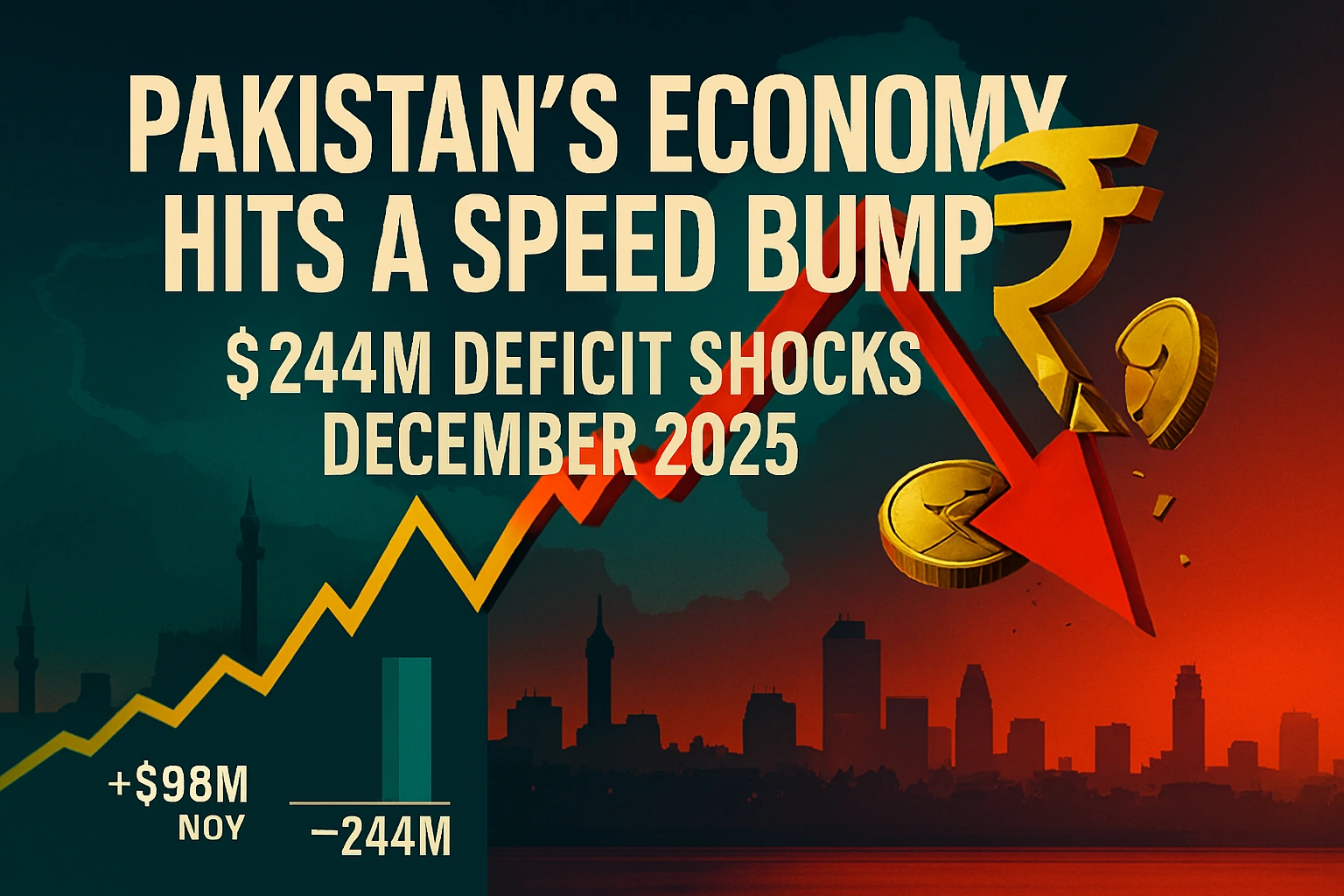
That story took an unexpected turn in December 2025. After eking out a modest $98 million current account surplus in November—a welcome sign that Pakistan’s post-crisis stabilization might be gaining traction—the State Bank of Pakistan (SBP) reported a sharp reversal: a $244 million deficit for December. The swing represents more than just monthly volatility; it encapsulates the fragile, two-steps-forward-one-step-back nature of Pakistan’s economic recovery following the near-meltdown of 2022-2023, when foreign exchange reserves plummeted to barely one month of import cover and default whispers rattled markets from Islamabad to Wall Street.
For context, December 2024 had delivered a comfortable $454 million surplus, making the year-on-year deterioration particularly striking. Yet zoom out further, and Pakistan’s fiscal year 2025 (July 2024–June 2025) still recorded a cumulative current account surplus—the first in years—offering a crucial buffer as the country navigates a $7 billion International Monetary Fund (IMF) Extended Fund Facility program designed to restore macroeconomic stability. December’s deficit, therefore, poses a critical question: Is this a temporary blip driven by seasonal import spikes and one-off factors, or an early warning that Pakistan’s external balance remains precariously dependent on remittance inflows and vulnerable to the slightest uptick in domestic demand or global commodity shocks?
This article dissects the December 2025 current account data with the rigor it demands, placing the numbers within broader historical trends, examining structural drivers from trade composition to energy dependence, comparing Pakistan’s trajectory with peer emerging markets, and assessing what this means for policymakers, investors, and ordinary Pakistanis as the country charts a course through 2026 and beyond.
Unpacking the December 2025 Numbers: Beyond the Headline Deficit
The Monthly Reversal: From Surplus to Shortfall
December’s $244 million deficit marks a $342 million swing from November’s revised $98 million surplus—a substantial shift in a single month for an economy where current account movements are measured in hundreds of millions rather than billions. More tellingly, the year-on-year comparison reveals a $698 million deterioration from December 2024’s $454 million surplus, signaling pressures beyond mere seasonal noise.
Breaking down the current account components clarifies the drivers:
- Trade Balance (Goods): Pakistan’s merchandise trade deficit widened appreciably in December, driven primarily by a surge in imports. Preliminary customs data from the Pakistan Bureau of Statistics suggests imports rose approximately 12-15% month-on-month, reflecting increased petroleum product shipments as winter heating demand spiked, higher machinery imports tied to delayed investment projects, and a restocking of intermediate goods by manufacturers anticipating Lunar New Year supply chain disruptions in China. Exports, while growing year-on-year at a modest 4-6%, failed to keep pace, constrained by energy shortages that intermittently shuttered textile mills—Pakistan’s export backbone—and sluggish demand from key European markets grappling with their own economic headwinds.
- Services Balance: This account remained persistently negative, albeit stable. Pakistan runs structural deficits in freight, transportation, and insurance services, exacerbated by reliance on foreign shipping for both exports and imports. Telecommunications and IT services exports—championed as a growth sector—contributed positively but remain insufficient to offset traditional service account drains.
- Primary Income Account: A chronic source of outflows, this component includes profit repatriation by multinational corporations, debt servicing payments to foreign creditors, and returns on foreign direct investment. December saw elevated outflows, likely tied to quarterly dividend payments by energy sector multinationals and scheduled debt obligations. According to World Bank data, Pakistan’s external debt stock exceeds $100 billion, with debt service ratios remaining elevated despite IMF-supported restructuring efforts.
- Secondary Income (Remittances): The undisputed bright spot. Pakistani workers abroad sent home a record $3.6 billion in December 2025, the highest monthly inflow on record and a 14% increase from December 2024’s $3.16 billion. This surge reflected seasonal patterns (expatriates sending funds for year-end festivities and winter expenses), improved formal banking channels following crackdowns on illegal hundi/hawala networks, and a modest depreciation of the rupee that enhanced the rupee-value of dollar remittances, incentivizing use of official channels. Remittances from Saudi Arabia, the UAE, the UK, and the US—Pakistan’s primary source countries—all posted gains, with Gulf Cooperation Council (GCC) countries alone accounting for nearly 60% of inflows.
Historical Context: FY25 Surplus Versus December Volatility
To appreciate December’s significance, consider Pakistan’s broader current account trajectory. Fiscal year 2023 (FY23, ending June 2023) saw a deficit exceeding $17 billion—over 6% of GDP—as import demand rebounded post-COVID while reserves hemorrhaged. This unsustainable imbalance triggered the 2022-2023 crisis, forcing stringent import controls, emergency IMF negotiations, and painful economic compression.
FY24 witnessed aggressive stabilization: import restrictions, steep interest rate hikes (the SBP’s policy rate peaked at 22% in mid-2023), and currency depreciation that dampened demand. The current account deficit shrank dramatically to approximately $1.2 billion for the full fiscal year—roughly 0.3% of GDP—a swing of over $15 billion. FY25 (July 2024–June 2025) went further, achieving a cumulative current account surplus of around $1.5-2 billion, driven by sustained remittance growth, contained imports, and marginally improved exports.
December 2025’s deficit, therefore, arrives against this backdrop of hard-won stability. Monthly volatility is normal—Pakistan’s current account has historically oscillated due to lumpy commodity imports (especially oil and LNG shipments), seasonal agricultural trade patterns, and irregular capital flows. A single deficit month doesn’t erase FY25’s surplus achievement. Yet it serves as a reminder: the underlying structure of Pakistan’s external accounts hasn’t fundamentally transformed. The economy remains heavily reliant on remittances to finance persistent trade deficits, with limited export diversification or import-substitution progress.
The Drivers Beneath the Surface: Trade Dynamics, Energy Dependence, and Remittance Resilience
The Persistent Trade Deficit: Import Addiction and Export Stagnation
Pakistan’s trade deficit—the gap between merchandise exports and imports—has long been the Achilles’ heel of its external balance. In December 2025, this gap widened notably, reflecting structural weaknesses decades in the making.
Import Composition and Vulnerabilities:
Pakistan imports roughly $50-60 billion annually, with several categories dominating:
- Energy (Petroleum, LNG, Coal): Constitutes 25-30% of total imports. Despite indigenous gas reserves, declining domestic production forces reliance on imported liquefied natural gas (LNG) for power generation and fertilizer manufacturing. Oil imports fluctuate with global crude prices and domestic consumption patterns. December’s import surge partly reflected higher LNG spot cargoes procured as winter power demand spiked and domestic gas shortfalls widened.
- Machinery and Transportation Equipment: Essential for industrial investment, these imports (15-20% of total) are economically productive but reflect limited local manufacturing capacity. December saw elevated machinery imports as businesses—buoyed by moderating interest rates and IMF program confidence—resumed delayed capital expenditure projects.
- Edible Oils, Pulses, and Food Products: Pakistan, despite its agricultural heritage, imports substantial food items due to population growth outpacing yield improvements and water scarcity constraining production. Palm oil from Indonesia and Malaysia alone accounts for billions annually.
- Chemicals, Plastics, and Intermediate Goods: Feedstock for textile and manufacturing sectors, these imports (20-25%) underscore the economy’s integration into global supply chains but also its vulnerability to input cost shocks.
The December import spike, while partly seasonal, highlights a critical policy tension: sustaining economic growth requires imports (machinery, energy, raw materials), yet unchecked import demand quickly exhausts foreign exchange reserves and widens the current account deficit. Pakistan’s growth-imports elasticity remains high—GDP growth of 3-4% typically correlates with 10-15% import growth unless demand is actively suppressed through monetary tightening or administrative controls.
Export Performance and Competitiveness Challenges:
Pakistan’s exports, hovering around $30-32 billion annually, are heavily concentrated:
- Textiles and Apparel: Account for 55-60% of merchandise exports. While Pakistan boasts competitive labor costs and proximity to cotton cultivation, the sector faces chronic challenges: energy shortages (load-shedding cripples production), outdated machinery, limited value-addition (focus on yarn and basic fabrics rather than high-end garments), and fierce competition from Bangladesh, Vietnam, and Cambodia. Recent reports from Dawn highlight how energy costs in Pakistan exceed regional competitors by 30-50%, eroding margins.
- Agriculture (Rice, Fruits, Vegetables): Contribute 15-20% but face quality standardization issues, inadequate cold chain infrastructure, and volatility tied to weather patterns and global commodity cycles.
- IT and Business Services: A bright spot, with exports exceeding $3 billion annually and growing at 15-20% yearly. However, this remains modest relative to India’s $200+ billion IT services sector.
December’s export growth, at 4-6% year-on-year, reflects incremental gains—textiles benefited from EU Generalized Scheme of Preferences (GSP+) status and recovering European demand—but insufficient to offset import surges. Structural constraints—inadequate investment in technology, skills mismatches, regulatory burdens, and infrastructure deficits (ports, logistics, power)—continue to hobble export competitiveness. According to the World Bank’s Logistics Performance Index, Pakistan ranks poorly (around 120th globally), impeding trade efficiency.
Remittances: The External Account’s Lifeline
December 2025’s record $3.6 billion remittance inflow underscores the Pakistani diaspora’s outsized role in propping up the external balance. Remittances have consistently exceeded $30 billion annually in recent years, often surpassing total merchandise exports. This dependence, while stabilizing, carries risks:
Drivers of Remittance Strength:
- Diaspora Demographics: Over 9 million Pakistanis work abroad, concentrated in GCC countries (Saudi Arabia, UAE, Qatar), the US, UK, and EU. GCC workers, typically in construction, hospitality, and services, send frequent, smaller remittances; Western diaspora remittances tend larger but less frequent.
- Policy Improvements: The SBP’s push to digitize remittances via fintech platforms (like JazzCash, Easypaisa), partnerships with international money transfer operators (Western Union, MoneyGram), and incentives (rupee credit at preferential rates) have channeled flows away from informal hawala networks. The Pakistan Remittance Initiative, launched years ago, has matured, enhancing tracking and convenience.
- Exchange Rate Dynamics: A weaker rupee incentivizes using formal channels—expatriates receive more rupees per dollar, enhancing purchasing power for families back home. December’s mild rupee depreciation likely contributed to record inflows.
- Global Economic Conditions: GCC economies, buoyed by moderating oil prices and economic diversification (Saudi Vision 2030, UAE’s non-oil growth), sustained employment for Pakistani workers. Western economies, despite slower growth, maintained demand for skilled professionals (IT, healthcare).
Vulnerabilities and Downside Risks:
- Oil Price Volatility: GCC economies—and thus Pakistani employment there—are highly sensitive to oil market dynamics. A sharp oil price collapse could trigger layoffs, reducing remittances by billions.
- Policy Shifts in Host Countries: Gulf states increasingly pursue “nationalization” policies (Saudization, Emiratization) to employ local citizens, potentially displacing South Asian expatriates. Geopolitical tensions or immigration policy changes in Western countries could also dampen flows.
- Demographic and Economic Shifts in Pakistan: As Pakistan’s economy develops (albeit slowly), remittance growth may plateau if opportunities at home improve, reducing emigration incentives. Conversely, economic distress could spur emigration but might also depress the asset base families can leverage for migration.
For now, remittances remain robust, but treating them as a perpetual safety net invites complacency. Sustainable external balance requires addressing the trade deficit’s root causes, not merely offsetting it with diaspora largesse.
Pakistan’s External Position in Global Context: Lessons from Peer Emerging Markets
How does Pakistan’s current account volatility compare with similarly positioned emerging economies? Examining peers illuminates both shared challenges and unique vulnerabilities.
Turkey: A Parallel in Chronic Deficits and Unorthodox Policies
Turkey, like Pakistan, has grappled with persistent current account deficits—averaging 3-5% of GDP—driven by energy import dependence (Turkey imports 75%+ of energy needs) and robust domestic consumption. Turkey’s deficits widened alarmingly in 2022-2023 amid unorthodox monetary policies (President Erdoğan’s low-interest-rate doctrine despite soaring inflation), sparking currency crises and reserve depletion eerily reminiscent of Pakistan’s travails.
However, Turkey differs crucially: its export base is far more diversified and technologically advanced (automotive, machinery, electronics), and tourism inflows contribute substantial services receipts. Turkey’s economy is also larger (GDP over $900 billion vs. Pakistan’s ~$350 billion), affording greater shock absorption capacity. Both nations share reliance on external financing and vulnerability to Fed rate hikes, yet Turkey’s NATO membership and EU integration (despite setbacks) provide geopolitical buffers Pakistan lacks.
Egypt: IMF Programs and Persistent External Fragility
Egypt offers perhaps the closest parallel. Both Egypt and Pakistan have cycled through multiple IMF programs over decades, facing recurrent foreign exchange crises rooted in import-dependent growth models, energy subsidies, and weak export competitiveness. Egypt’s current account deficit, traditionally 2-4% of GDP, spiked during the 2022 global commodity shock, triggering sharp currency devaluation (the pound lost 50%+ of value) and emergency IMF interventions.
Egypt’s Suez Canal receipts (a unique asset) provide substantial services income, yet like Pakistan, it relies heavily on remittances from expatriates in the Gulf and Europe. Both nations face similar structural challenges: youthful, rapidly growing populations outpacing job creation, heavy public debt burdens (constraining fiscal space), and political-economic governance issues that deter sustained foreign investment. Egypt’s recent economic struggles—despite $8 billion UAE investment deals and IMF support—underscore how fragile emerging market external balances can reverse quickly under adverse shocks.
Bangladesh and Vietnam: Export-Led Contrasts
Bangladesh and Vietnam present instructive contrasts. Both have achieved sustained current account surpluses or manageable deficits through export-led growth. Bangladesh’s ready-made garment (RMG) sector, while facing labor and safety challenges, generates $40+ billion in annual exports, surpassing Pakistan’s total goods exports despite a smaller economy. Vietnam’s integration into global manufacturing supply chains (electronics, footwear, furniture) has driven export growth exceeding 10% annually, attracting massive foreign direct investment.
These successes hinge on policy consistency, infrastructure investment, trade openness, and business-friendly environments—areas where Pakistan has struggled due to political instability, inconsistent economic policies across governments, and bureaucratic inefficiencies. The comparison underscores that Pakistan’s external account woes aren’t fate but reflect addressable policy failures and governance deficits.
Policy Implications and the Road Ahead: Navigating IMF Conditions, Monetary Policy, and Structural Reforms
The IMF Extended Fund Facility: Lifeline or Straitjacket?
Pakistan’s current $7 billion IMF Extended Fund Facility (EFF), approved in 2024 following protracted negotiations, imposes strict conditions: fiscal consolidation (reducing budget deficits through tax revenue increases and expenditure controls), energy sector reforms (tariff adjustments to eliminate circular debt), State-Owned Enterprise (SOE) restructuring, and exchange rate flexibility. Meeting these targets unlocks tranches of financing and signals credibility to bilateral lenders (China, Saudi Arabia, UAE) and markets.
December’s current account deficit, while modest, complicates the IMF program’s narrative of stabilization. IMF reviews scheduled for early 2026 will scrutinize whether the deficit represents a temporary aberration or a worrying trend. Key metrics monitored:
- Gross Official Reserves: As of late December 2025, SBP reserves stood around $11-12 billion—equivalent to roughly 2.5 months of import cover, a marked improvement from the sub-$4 billion nadir of mid-2023 but still below the comfortable 3-4 month buffer recommended for emerging markets. Sustained current account deficits could erode reserves, jeopardizing IMF targets.
- External Financing Gap: The IMF program assumptions include projections of bilateral support, FDI inflows, and bond market access. Widening current account deficits would increase the financing gap, potentially necessitating additional IMF disbursements or supplementary bilateral loans—complicating debt sustainability.
- Exchange Rate Management: The SBP has moved toward greater exchange rate flexibility, a key IMF demand. However, managing the rupee’s depreciation without sparking inflation or capital flight remains delicate. December’s modest weakening (rupee depreciated from ~278 to ~281 per USD) likely contributed to remittance inflows but also raised import costs, feeding inflation.
The policy tension is acute: supporting growth (which Pakistan desperately needs to reduce poverty and unemployment) requires accommodative conditions, yet unchecked growth risks import surges, reserve depletion, and current account blowouts. The SBP’s recent rate cuts—from the 22% peak to around 13% by late 2025—reflect confidence in declining inflation (down to single digits) and stabilization progress. December’s deficit may test whether further rate cuts are prudent or whether monetary policy needs to remain restrictive to cap import demand.
Fiscal Policy and Structural Reforms: Beyond Stabilization to Transformation
Monetary tightening and IMF programs can stabilize external accounts temporarily, but sustainable balance requires structural transformation:
- Export Diversification and Value Addition: Pakistan must move beyond low-value textiles to higher-margin products—branded garments, technical textiles, engineering goods. This demands investment in vocational training, R&D, quality certifications, and trade facilitation. Government initiatives like the Strategic Trade Policy Framework aim to incentivize non-traditional exports (pharmaceuticals, surgical instruments, sports goods), but implementation lags.
- Energy Sector Overhaul: Chronic energy shortages and high costs cripple competitiveness. Addressing this requires diversifying the energy mix (renewables, indigenous coal, hydroelectric), resolving circular debt (over $2.5 billion in payables), and improving distribution efficiency. Recent Chinese investments under the China-Pakistan Economic Corridor (CPEC) added generation capacity, but transmission bottlenecks and governance issues persist.
- Import Substitution in Agriculture and Industry: Reducing reliance on imported edible oils, pulses, and pharmaceuticals through productivity enhancements, agricultural R&D, and local manufacturing can narrow the trade deficit. Pakistan’s agricultural yields lag regional peers due to water scarcity, outdated farming techniques, and inadequate extension services.
- Investment Climate and FDI: Pakistan attracts only $2-3 billion in FDI annually—far below potential given its market size and location. Security concerns, regulatory unpredictability, corruption, and inconsistent policies deter investors. Successful examples like Bangladesh’s Special Economic Zones (SEZs) offer models, yet Pakistan’s SEZ progress remains slow.
- Debt Management: External debt servicing consumes substantial foreign exchange. Lengthening debt maturities, securing concessional financing, and improving debt transparency (addressing concerns from Financial Times reporting on hidden liabilities) are critical.
The Political Economy Wildcard: Stability Versus Turbulence
Economic policy in Pakistan is inseparable from political dynamics. The current government’s ability to sustain IMF program compliance depends on political stability—avoiding mass protests, military-civilian tensions, or populist pressures that derail reforms. Elections, coalition dynamics, and judicial interventions have historically disrupted economic policy continuity, with each government prioritizing short-term relief over long-term transformation.
December’s deficit, modest as it is, could embolden critics arguing that stabilization is choking growth and demanding stimulus measures (subsidies, lower interest rates, relaxed import controls). Resisting such pressures requires political courage and effective communication—explaining to the public why short-term pain (higher taxes, costlier imports) yields long-term gain (stable currency, lower inflation, job creation).
Outlook for 2026 and Beyond: Fragile Optimism Amid Persistent Risks
FY26 Current Account Projections: Navigating a Narrow Path
Most analysts, including the IMF and Asian Development Bank, project Pakistan’s FY26 (July 2025–June 2026) current account deficit to remain modest—between 0% and 1% of GDP, or roughly $0-3.5 billion. This forecast assumes:
- Continued Remittance Strength: Sustained inflows around $32-35 billion annually.
- Moderate Import Growth: GDP growth of 2.5-3.5% (below potential but stabilization-constrained) limiting import demand to $55-58 billion.
- Export Recovery: Gradual improvement toward $33-35 billion, aided by textile sector revival, IT services growth, and potential new export markets (Central Asia, Africa).
- Energy Price Stability: Global oil and LNG prices averaging $75-85/barrel and $10-12/MMBtu respectively, avoiding major import bill shocks.
December’s deficit complicates this picture only marginally if it proves transitory. However, downside risks loom large:
Domestic Risks:
- Political Instability: Governance crises, mass mobilizations, or civil-military discord could derail reforms, spook investors, and trigger capital flight.
- Energy Crisis Deepening: Another summer of severe load-shedding (likely if rainfall is poor and hydroelectric generation falls) could crush exports and industrial output.
- Fiscal Slippage: Missing IMF fiscal targets due to weak tax collection or populist spending could halt program disbursements, draining reserves.
External Risks:
- Global Recession: A sharp slowdown in the US, EU, or China would depress export demand and remittances. Recession in Gulf economies (tied to oil price crashes) could slash remittances by 15-20%, eliminating the current account’s safety buffer.
- Fed Rate Path: Continued or renewed Fed tightening could strengthen the dollar, making debt servicing costlier and reducing emerging market capital flows to Pakistan.
- Commodity Price Shocks: Geopolitical disruptions (Middle East conflicts, Russia-Ukraine escalation) could spike oil prices, widening the trade deficit by billions overnight.
- China Economic Malaise: Slower Chinese growth affects Pakistan via reduced CPEC-related inflows, weaker regional demand, and potential disruptions to supply chains Pakistani manufacturers depend upon.
Scenarios: Best Case, Base Case, Worst Case
Best Case (Probability: 20-25%):
Political stability holds, IMF program fully implemented, global growth surprises upward. Remittances exceed $36 billion, exports surge to $36 billion on textile revival and new sectors (IT crosses $4 billion), imports contained below $57 billion. Current account swings to a $2-3 billion surplus in FY26. Reserves climb toward $15 billion, improving investor confidence. The SBP can cut rates further (to 10-11%), spurring growth to 4%. Pakistan exits the “crisis loop” narrative.
Base Case (Probability: 50-55%):
Muddling through continues. IMF program stays on track with occasional hiccups. Remittances hold steady ($33-34 billion), exports grow modestly ($33 billion), imports edge up ($56-57 billion). Current account deficit widens slightly to 0.5-1% of GDP ($2-3.5 billion), manageable with IMF/bilateral inflows. Reserves stable at $11-13 billion. Growth stays subdued at 2.5-3%. December’s deficit seen as monthly noise, not trend reversal. Vulnerabilities persist but crisis averted for another year.
Worst Case (Probability: 20-25%):
Political turmoil erupts, halting reforms. Energy crisis worsens, crushing exports. Global recession slashes remittances to $28-30 billion. Imports jump on supply shocks or policy relaxation. Current account deficit balloons to 2-3% of GDP. Reserves plummet below $8 billion. IMF halts program over non-compliance. Currency crisis reemerges, inflation spikes, and another painful stabilization cycle begins. Pakistan returns to the brink.
Conclusion: Resilience Tested, Transformation Awaited
December 2025’s $244 million current account deficit—a sharp reversal from November’s surplus and a stark contrast to December 2024’s surplus—offers a sobering reminder: Pakistan’s external balance, though stabilized relative to the 2022-2023 abyss, remains fragile. The deficit isn’t catastrophic; in fact, monthly fluctuations of this magnitude are typical for an economy juggling import needs, energy dependencies, and external financing constraints. But context matters.
Pakistan has achieved remarkable stabilization over the past 18-24 months. Reserves have recovered from critically low levels, inflation has decelerated from over 30% to single digits, and the currency has stabilized. The cumulative FY25 current account surplus stands as a testament to painful but necessary adjustments—import compression, high interest rates, and policy discipline under IMF oversight. December’s deficit doesn’t erase these gains, but it underscores the work that remains.
The underlying drivers—persistent trade deficits rooted in import dependence and export stagnation, reliance on remittance inflows vulnerable to external shocks, and structural weaknesses in energy, productivity, and governance—haven’t fundamentally changed. December’s surge in imports, while partly seasonal and growth-related, highlights how quickly external balances can deteriorate if demand isn’t carefully managed. The record remittances, while reassuring, cannot indefinitely paper over a trade structure biased toward deficits.
For policymakers, the message is clear: stabilization is not transformation. Sustaining external balance through the IMF program’s duration (likely through mid-2026) requires vigilance—monitoring import trends, maintaining exchange rate flexibility, ensuring fiscal discipline, and preserving political commitment to reforms. Beyond stabilization, Pakistan must pursue deeper structural changes: diversifying exports, enhancing competitiveness, overhauling energy, attracting FDI, and improving governance. These transformations, admittedly difficult and politically contentious, are the only pathway to durable external stability and sustained growth.
For investors and international observers, December’s data warrants measured concern but not alarm. Pakistan remains on a tightrope—progress is real but reversible. The country’s trajectory depends critically on political stability, global economic conditions, and the resolve of its leadership to prioritize long-term transformation over short-term expediency.
And for the chai shop owner in Saddar? He’ll continue watching the rupee-dollar rate on his phone, feeling the pulse of remittance inflows when customers spend more freely, and weathering import price shocks that trickle down to his tea leaves. Pakistan’s external accounts are, ultimately, the story of millions of such individuals—navigating global economic forces far beyond their control, seeking stability and opportunity in a nation perennially balancing on the edge of crisis and recovery. December 2025’s deficit is one chapter in that unfolding story. Whether it’s a minor setback or the first crack in a fragile stabilization will become clear in the months ahead.
Sources and Further Reading:
- State Bank of Pakistan – Current Account Statistics
- International Monetary Fund – Pakistan Country Page
- World Bank – Pakistan Data
- Dawn – Pakistan Economy News
- Business Recorder – Latest Economic Updates
- Financial Times – Emerging Markets Coverage
- Reuters – Pakistan Economic News
- Trading Economics – Pakistan Indicators
- World Bank Logistics Performance Index
- Pakistan Bureau of Statistics
Discover more from The Economy
Subscribe to get the latest posts sent to your email.
Startups
Pakistan’s Startup Revival: How Hybrid Financing Drove a $74 Million Surge in 2025
After years of contraction, a strategic pivot to debt-equity blends signals maturation—not just survival—in one of South Asia’s most resilient tech ecosystems
In early April 2025, Omer bin Ahsan faced a familiar dilemma. The founder of Haball, a Karachi-based fintech enabling shariah-compliant supply chain financing, had spent months courting investors for a pre-Series A round. Traditional venture capital appetite remained tepid—Pakistan startup funding 2025 had opened with a dismal $196,000 across three disclosed deals in Q1, marking the ecosystem’s lowest quarterly performance in years. Yet Ahsan’s company had processed over $3 billion in payments since inception, serving nearly 8,000 small and medium enterprises across sectors from retail to aerospace. The fundamentals were solid. What Pakistan lacked wasn’t viable startups—it was capital willing to deploy at scale.
By late April, Haball announced a $52 million raise, comprising $5 million in equity from Zayn VC and a strategic $47 million financing component from Meezan Bank, Pakistan’s largest Islamic financial institution. The structure was a watershed: not pure venture equity, but a hybrid blend of ownership and debt, calibrated to minimize dilution while leveraging established banking infrastructure. It was also emblematic of a broader shift reshaping Pakistan’s startup landscape—one driven less by Silicon Valley playbooks and more by local pragmatism forged through years of macroeconomic turbulence.
When the year closed, Invest2Innovate’s full-year report revealed that Pakistani startups raised over $74 million across 16 deals in 2025, a 121% increase from $33.5 million in 2024. The headline figure, however, concealed the more profound transformation: $66.04 million came through hybrid financing models blending debt, quasi-equity, and structured instruments, while just $8.18 million represented pure equity. It was the clearest signal yet that Pakistan’s startup ecosystem, battered by three years of funding drought and global venture capital winter, had evolved a distinctly localized survival—and growth—mechanism.
The Numbers in Context: Recovery, Not Rebound
To understand Pakistan startup funding 2025, one must first grasp where the ecosystem stood. Between 2021 and 2023, Pakistani startups rode a wave of global liquidity, raising $347 million and $331 million in 2021 and 2022 respectively, according to Data Darbar, a Karachi-based research firm tracking venture activity since 2015. Then came the correction. Funding collapsed 77% to $75.6 million in 2023 amid Federal Reserve rate hikes and a global venture pullback, then tumbled further to $42.5 million in 2024—a nadir unseen since the ecosystem’s nascent years.
The 2025 recovery to $74 million, while encouraging, remained well below pre-2023 peaks. Yet the composition mattered more than the quantum. Data Darbar, in a parallel year-end analysis, reported that pure equity funding reached $36.6 million across 10 disclosed rounds—a 63% increase from 2024’s $22.5 million. The discrepancy between Invest2Innovate’s $74 million total and Data Darbar’s $36.6 million equity-only figure reflects differing methodologies: Invest2Innovate counts all capital deployed, including debt-like instruments, whereas Data Darbar isolates traditional venture equity.
Both narratives are true. Pakistani startups raised more total capital in 2025, but the structure of that capital had fundamentally changed. Consider the quarterly trajectory:
- Q1 2025: $196,000 disclosed (3 deals). A paralytic start as investors awaited IMF program clarity.
- Q2 2025: $58 million, dominated by Haball’s $52 million hybrid round.
- Q3 2025: $15.2 million across six deals, featuring BusCaro’s $2 million hybrid deal and Trukkr’s $10 million mixed equity-debt raise.
- Q4 2025: Modest, sub-$1 million disclosed volumes, but critical for structural shifts—KalPay secured shariah-compliant structured debt from Accelerate Prosperity, while agritech Agrilift and creator economy platform Echooo AI both raised debt financing.
The average disclosed equity deal size climbed to approximately $3.7 million, up from previous years, signaling that investors—when they did commit—deployed more concentrated capital into fewer, higher-conviction bets. This is the hallmark of market maturation: selectivity over spray-and-pray.
Key Deals and Winners: The 2025 Titans
Haball: The Hybrid Pioneer
Haball’s $52 million raise was the defining transaction of 2025. The fintech, founded in 2017, provides digital invoicing, payment collection, tax compliance, and working capital to SMEs—functions critical in a market where less than 5% of small businesses access traditional bank financing. By structuring its round as $5 million in equity plus $47 million in strategic financing from Meezan Bank, Haball achieved two objectives: securing growth capital without excessive dilution, and validating hybrid models as viable for scaling B2B fintechs in emerging markets.
The company plans to enter Saudi Arabia’s $9 billion supply chain finance market in 2025, with further Gulf Cooperation Council (GCC) expansion eyed for 2026. As CEO Omer bin Ahsan noted, “We’re responding to clear market demand for shariah-compliant SME-focused digital financial services”—a thesis resonating not just in Pakistan but across MENA’s Islamic finance corridors.
MedIQ: Female-Founded, GCC-Bound
In April, Dr. Saira Siddique’s MedIQ raised $6 million in a Series A led by Qatar’s Rasmal Ventures and Saudi Arabia’s Joa Capital. The healthtech, born from Siddique’s personal experience navigating Pakistan’s fragmented healthcare system while recovering from paralysis, offers a digitally integrated hybrid ecosystem—telehealth, e-pharmacy, AI-powered facility digitization, and insurance backend automation.
MedIQ’s trajectory underscores a critical trend: Pakistani startups pivoting to GCC markets not as Plan B, but as core strategy. With over 10 million customers served in Pakistan and EBITDA-positive operations, MedIQ exemplifies the product-market fit achievable when founders solve genuine, large-scale inefficiencies. The raise also marked a milestone for gender diversity—female-led startups captured $8.8 million (24%) of 2025’s total equity funding, per Data Darbar, a notable improvement in a historically male-dominated ecosystem.
Mobility, Fintech, and the Long Tail
Beyond mega-rounds, 2025 saw seed-stage activity across diverse verticals:
- BusCaro (mobility): $2 million hybrid deal, female-founded, addressing intercity transport inefficiencies.
- Metric (fintech): $1.3 million seed for infrastructure finance enablement.
- ScholarBee (edtech): $350,000 convertible note, targeting affordable learning platforms.
- Qist Bazaar (fintech BNPL): Rs55 million (~$196,000) disclosed portion of a larger Series A from Bank Alfalah.
- Shadiyana (wedding-tech): $800,000 pre-seed, tapping Pakistan’s multi-billion-dollar wedding industry.
- Myco.io (Web3): $1.5 million, reflecting nascent but persistent interest in decentralized tech.
These transactions, while modest individually, signaled ecosystem resilience. Founders were fundraising—just under radically different assumptions than 2021’s exuberance.
The Hybrid Financing Revolution: Necessity Becomes Strategy
Why did Pakistan startup funding 2025 pivot so decisively to hybrid models? The answer lies in supply-demand asymmetries and risk-adjusted returns.
On the supply side, traditional venture capital remained scarce. Global VC funding reached $512.6 billion in 2025, up 30.8% year-over-year, but concentration was extreme: AI captured 46.4% of Q3 2025 global VC, with mega-rounds ($500M+) to Anthropic, xAI, and others dominating deployment. Emerging markets outside India and select MENA hubs saw limited allocations. Pakistan, with its history of political volatility and currency risk, struggled to compete for the shrinking pool of “generalist” VC dollars.
On the demand side, Pakistani startups needed capital, but on terms preserving founder control. After witnessing down rounds and fire-sale exits across the region during 2022-2024’s contraction, founders sought structures minimizing dilution. Debt or quasi-debt instruments—repayable at fixed schedules with or without convertible features—offered that optionality.
Enter hybrid financing: structures blending equity stakes with revenue-based financing, shariah-compliant murabaha (cost-plus) arrangements, supply chain receivables financing, or convertible notes with conservative caps. Haball’s model epitomizes this: Zayn VC took equity exposure, betting on upside, while Meezan Bank deployed a $47 million financing facility tied to Haball’s transaction volumes—essentially supply chain capital leveraging Haball’s platform as intermediary.
For investors like Meezan Bank, the appeal is clear: lower risk than pure equity, secured by tangible cash flows, and aligned with Islamic banking mandates prohibiting interest (riba) yet permitting profit-sharing and asset-backed financing. For startups, it’s growth capital without governance concessions. For the ecosystem, it’s a localization of financing norms—adapting global venture structures to Pakistan’s financial and regulatory realities.
Sector Spotlight: Where the Money Flowed
Fintech: Still the Heavyweight
Fintech dominated Pakistani startups funding 2025, accounting for the largest share of both disclosed equity and hybrid capital. Beyond Haball and Metric, the sector includes Qist Bazaar (BNPL), KalPay (shariah-compliant payments), and established players like Bazaar Technologies, which acquired rival Keenu in late 2025, signaling consolidation.
Pakistan’s fintech appeal is structural: Islamic banking assets reached Rs9,689 billion ($34.54 billion) by mid-2024, representing 18.8% of banking sector assets, with the State Bank targeting 30% by 2028. Digital payments via Raast, Pakistan’s instant payment system, surged, and SME financing gaps remained vast. Fintechs offering compliance-friendly, digitally native solutions tapped into multi-billion-dollar addressable markets.
Healthtech: The Female Founder Vanguard
Healthtech emerged as the second most-funded sector, led by MedIQ’s $6 million and complemented by seed rounds for diagnostics and preventive health startups. Pakistan’s healthcare system—fragmented, cash-based, and inaccessible to rural populations—presents massive digitization opportunities. Telemedicine uptake accelerated post-pandemic, and corporate health insurance mandates are slowly expanding coverage.
Notably, female founders have disproportionately shaped healthtech: MedIQ (Dr. Saira Siddique), Sehat Kahani (Drs. Sara Saeed Khurram and Iffat Zafar Aga, which raised $2.7 million in 2023), and emerging players like Ailaaj and Marham. Women comprise 74% of MedIQ’s user base, per Arab News interviews—a demographic underserved by traditional clinic models requiring male accompaniment or lengthy travel in conservative regions.
Edtech, Mobility, and Climate: Early-Stage Activity
Edtech startups like ScholarBee secured convertible notes, targeting affordable skill development for Pakistan’s youth bulge (over 60% of the population under 30). Mobility players like BusCaro and Trukkr raised hybrid rounds to address intercity transport and logistics inefficiencies. Climate-linked ventures—Agrilift (agritech) and energy platforms—attracted debt financing from impact-focused vehicles like Accelerate Prosperity, reflecting growing alignment between climate resilience mandates (Pakistan is among the world’s most climate-vulnerable nations) and venture deployment.
Web3 and IoT saw niche activity (Myco.io, undisclosed IoT deals), indicating experimentation persists despite limited exits and regulatory ambiguity.
Global and Macroeconomic Backdrop: Pakistan’s Stabilization Gambit
Pakistan startup funding 2025 unfolded against a volatile but ultimately stabilizing macroeconomic canvas. The country entered 2025 under its 25th IMF program since 1950—a 37-month Extended Fund Facility (EFF) approved in August 2024, coupled with a 28-month Resilience and Sustainability Facility (RSF) targeting climate vulnerabilities.
By year-end, the IMF’s second EFF review in December 2025 confirmed progress: Pakistan achieved a primary fiscal surplus of 1.3% of GDP in FY25, inflation fell from 26% in 2024 to 4.7% over the year’s first ten months, and gross foreign reserves climbed from $9.4 billion (August 2024) to $14.5 billion by year-end—projected to reach $21 billion in 2026. The State Bank of Pakistan cut policy rates by 1,100 basis points since June 2025, easing borrowing costs.
These improvements mattered. Investor confidence, globally, correlates with macroeconomic stability and reserve adequacy. Pakistan’s first current account surplus in 14 years, achieved in FY25, signaled reduced external vulnerabilities. Yet GDP growth remained tepid—2.7% in FY25, projected 3.2% for FY26—barely outpacing population growth. For startups, the message was mixed: stability had returned, but explosive growth remained distant.
Comparatively, India’s startup ecosystem raised $3.1 billion in Q1 2025 alone, dwarfing Pakistan’s full-year $36.6 million equity tally. Pakistan’s total VC funding since 2015—approximately $1.037 billion across 368 deals, per Invest2Innovate—pales against India’s $161 billion deployed since 2014. The gap is structural: India’s scale, deeper capital markets, and diaspora networks create self-reinforcing flywheel effects Pakistan lacks.
Yet within emerging markets, context matters. Southeast Asia saw VC funding drop 42% YoY to $1.71 billion in H1 2025, while Africa’s $676 million (up 56%) remained concentrated in Nigeria, Kenya, and Egypt. Pakistan’s $74 million, while modest, outperformed its own recent trough—and the hybrid financing pivot offers a replicable playbook for markets where traditional VC flows remain constrained.
Challenges Ahead: The Structural Headwinds
Despite 2025’s recovery, Pakistan’s startup ecosystem confronts formidable obstacles:
Limited Domestic Capital
Institutional venture capital remains nascent. Gobi Partners’ Techxila Fund II ($50 million, announced Q4 2024) and Sarmayacar’s Climaventures Fund ($40 million target, $15 million anchor from UN’s Green Climate Fund) represent progress, but Pakistan lacks the density of local VC firms—family offices, pension funds, and corporate venture arms—that India, Indonesia, or even Kenya enjoy. Without robust domestic LP pools, international investors’ risk perceptions dominate, and Pakistan’s geopolitical optics (terrorism concerns, political instability) deter allocations.
Regulatory and Infrastructure Gaps
Startups cite slow regulatory approvals, opaque tax frameworks, and energy/internet outages as persistent friction. The IMF’s 2025 Governance and Corruption Diagnostic estimated Pakistan loses 5-6.5% of GDP annually to “elite capture”—policy distortions favoring entrenched interests. For startups, this manifests as uneven playing fields: established businesses leverage connections for subsidies or licenses, while digital-first ventures navigate bureaucratic mazes.
The State Bank of Pakistan has made strides—Raast adoption, licensing frameworks for digital invoicing (Haball was the first fintech to receive such a license from the Federal Board of Revenue)—but broader structural reforms lag. State-owned enterprise (SOE) losses hemorrhage fiscal resources that could otherwise fund innovation, and privatization efforts (e.g., Pakistan International Airlines) proceed glacially.
Talent Retention and Brain Drain
Pakistan produces over 15,000 IT graduates annually, yet emigration rates are high. Gulf markets, Europe, and North America offer salaries multiples higher than local startups can afford. Top founders increasingly “de-risk” by incorporating in Dubai or Delaware, maintaining development teams in Pakistan but moving corporate entities offshore—a pragmatic but double-edged strategy that limits ecosystem depth.
Exit Drought
Pakistan has recorded zero venture-backed IPOs since Careem’s 2019 acquisition by Uber (a $3.1 billion exit, though Careem was Dubai-domiciled). Without consistent exits—IPOs, strategic acquisitions, or secondary sales—early investors cannot realize returns, limiting LP appetite to reinvest. The absence of a Nasdaq-style tech exchange or active M&A market (few multinational acquirers operate locally at scale) perpetuates this cycle.
Future Outlook: Toward 2026 and Beyond
What does Pakistan startup funding 2025’s hybrid pivot augur for the ecosystem’s next phase?
Optimistic Case: The hybrid model becomes a sustainable competitive advantage. If Haball successfully scales across GCC, MedIQ replicates Pakistan learnings in Saudi Arabia, and debt-equity blends prove scalable for B2B SaaS, logistics, and agritech verticals, Pakistan could carve a niche as a “hybrid capital lab” for emerging markets. Islamic finance alignment is non-trivial: GCC investors managing trillions in shariah-compliant assets seek deployment opportunities, and Pakistani startups fluent in murabaha, tawarruq, and wakalah structures have first-mover advantages.
Further, macroeconomic stability—if sustained—creates virtuous cycles. Lower inflation and interest rates reduce cost of capital, IMF program credibility attracts development finance institutions (DFIs) and multilateral capital, and sectoral growth (IT exports surpassed $3.2 billion in FY25, per government data) generates wealth reinvestable locally.
Cautious Case: 2025’s recovery is a dead-cat bounce. If global VC remains concentrated in AI and developed markets, Pakistani startups continue battling for scraps. Hybrid financing, while pragmatic, may limit upside—debt requires repayment, constraining burn rates and growth velocity. Founders opting for conservative capital structures might achieve profitability but miss transformative scale. Meanwhile, India’s ecosystem compounds advantages, Gulf markets attract Pakistani founders directly, and the domestic market’s 240.5 million people remains fragmented by low digital penetration and purchasing power.
The likeliest path lies between extremes. Pakistan’s startup ecosystem in 2025 demonstrated resilience, adaptability, and strategic pragmatism. It won’t replicate India’s scale or Silicon Valley’s density, but it could build sustainable, profitable tech businesses solving real problems for Pakistan’s SMEs, diaspora, and underserved populations—and increasingly, for GCC markets seeking culturally aligned solutions.
Key signposts for 2026 include:
- Fund Formation: Will local LPs (family offices, corporates) launch more $20-50 million seed/early-stage vehicles? Climaventures and Techxila II are starts, but scale matters.
- Exits: Any M&A activity (e.g., Bazaar-Keenu)? Secondary sales via platforms like Forge/EquityZen?
- Government Policy: Will the new administration (post-2024 elections) deliver on promised tax incentives, streamlined approvals, or tech-zone infrastructure?
- GCC Traction: Do Haball, MedIQ, and others convert Saudi/UAE market entry into revenue scale validating cross-border models?
Azfar Hussain, Project Director at National Incubation Center Karachi, captured the moment succinctly: “2025 marked a period of correction and maturity. Capital became more selective, filtering out hype-driven ventures while strengthening founders focused on solving real-world problems. Growth in 2026 will increasingly favor founders who invest in governance, product depth, and regional scalability rather than pursuing rapid expansion or vanity metrics.”
Conclusion: A Pivot, Not a Peak
The story of Pakistan startup funding 2025 is not one of triumphant return to 2021’s heady days. It is, instead, a narrative of adaptation—founders and investors recalibrating expectations, structures, and strategies in response to prolonged capital scarcity and macroeconomic volatility. The pivot to hybrid financing, far from signaling weakness, reflects ecosystem maturation: recognition that sustainable growth, not blitzscaling on cheap capital, suits Pakistan’s current conditions.
When Omer bin Ahsan closed Haball’s $52 million round in April, or Dr. Saira Siddique secured MedIQ’s $6 million in May, they weren’t just fundraising—they were validating new templates. Templates where debt and equity coexist, where Islamic finance principles align with venture returns, where regional expansion to GCC markets complements domestic consolidation, and where profitability timelines matter as much as user acquisition curves.
For Pakistan’s digital economy—still nascent, still fragile, still shadowed by structural challenges—2025’s $74 million across hybrid and equity instruments represents neither arrival nor defeat. It is progress, incremental but real, toward an ecosystem that may never match India’s scale but could nonetheless produce resilient, profitable businesses improving millions of lives. In venture capital, as in geopolitics, survival itself can be a victory. Pakistan’s startups, battered by funding winters and macro headwinds, survived 2025—and in doing so, they sowed seeds for the next phase of growth.
The question is no longer whether Pakistan can build a startup ecosystem. It already has one. The question is whether it can sustain, deepen, and scale what 2025’s hybrid financing surge began.
This analysis synthesizes data from Invest2Innovate, Data Darbar, IMF reports, KPMG Venture Pulse, MAGNiTT, and reporting by Business Recorder, The Express Tribune, Arab News, Financial Times, and other premium sources. All figures current as of January 2026.
Discover more from The Economy
Subscribe to get the latest posts sent to your email.
Asia
10 Reasons Why Austerity Measures Will Help Boost Pakistan’s Economy: Practices and Prospects
The summer of 2025 marked a quiet turning point for Pakistan’s economy. After years of lurching from one balance-of-payments crisis to another, foreign exchange reserves climbed past $21 billion—their highest level in over a decade. Inflation, which had terrorized households by peaking above 38% in mid-2023, fell to single digits. The rupee stabilized. The International Monetary Fund projected GDP growth of 3.6% for fiscal year 2026, a modest figure by global standards but a meaningful recovery for a country that had teetered on the edge of default just two years earlier.
These improvements did not arrive by accident. They emerged from a painful, politically fraught program of austerity measures Pakistan economy policymakers implemented under the IMF’s $7 billion Extended Fund Facility agreed in September 2024. The government slashed subsidies on fuel and electricity, raised tax revenues through aggressive broadening of the tax net, cut public sector development spending, and imposed discipline on loss-making state-owned enterprises. Civil servants saw hiring freezes. The poor faced higher electricity bills. The middle class watched as government services contracted.
Austerity has always been controversial. Critics argue it deepens recessions, punishes the vulnerable, and serves the interests of international creditors rather than citizens. Pakistan’s streets have echoed with protests against IMF-dictated reforms, and understandably so—when a family’s monthly electricity bill doubles, abstract arguments about fiscal sustainability offer cold comfort. Yet the alternative Pakistan faced was not between austerity and some pain-free path to prosperity. It was between controlled adjustment and uncontrolled collapse: hyperinflation, sovereign default, inability to import essential goods, and the social chaos that accompanies economic disintegration.
This article makes a data-driven case that austerity measures, despite their immediate hardships, represent necessary medicine for Pakistan’s long-term economic health. Drawing on recent evidence from Pakistan’s stabilization program, comparative examples from emerging markets that successfully reformed, and rigorous analysis from institutions like the IMF, World Bank, and leading economic research centers, we examine ten specific mechanisms through which fiscal discipline can catalyze sustainable growth. We acknowledge the real costs, particularly for vulnerable populations, while arguing that well-designed austerity—coupled with social protections and structural reforms—offers Pakistan’s best path from chronic crisis to durable prosperity.
1. Restoring Fiscal Discipline and Reducing Chronic Deficits
Pakistan’s fiscal deficits have plagued economic stability for decades. Between 2008 and 2023, the country ran an average fiscal deficit exceeding 6% of GDP annually, according to World Bank data. This persistent overspending forced the government to borrow continuously, crowding out private investment and creating dangerous debt dynamics. By fiscal year 2023, total public debt had ballooned to approximately 78% of GDP, consuming nearly 40% of federal revenues just to service interest payments.
Austerity measures directly attack this structural imbalance. Pakistan’s FY2025 budget targeted a primary surplus—revenues exceeding non-interest expenditures—for the first time in years, a key IMF program requirement. The government achieved this through spending cuts totaling roughly 1.5% of GDP and revenue mobilization efforts adding another 1% of GDP. The IMF’s October 2025 review confirmed Pakistan met these fiscal targets, marking a decisive break from decades of indiscipline.
The mechanism is straightforward but powerful: lower deficits mean reduced borrowing needs, which frees up capital for productive private-sector investment rather than financing government consumption. When the government stops competing for domestic credit, interest rates can fall, making business expansion more affordable. Pakistan’s policy rate declined from 22% in mid-2024 to 15% by November 2025, partly reflecting improved fiscal credibility.
Critics rightly note that procyclical austerity—cutting spending during recessions—can deepen downturns. Pakistan’s GDP growth did slow to 2.4% in FY2024. Yet the counterfactual matters: without fiscal correction, Pakistan faced imminent default, which would have triggered far more severe contraction, as Argentina experienced in 2001 or Sri Lanka in 2022. The pain of adjustment, while real, remains preferable to the catastrophe of uncontrolled crisis.
2. Breaking the Cycle of External Borrowing and Debt Dependency
For decades, Pakistan has operated in a doom loop: fiscal and current account deficits necessitate foreign borrowing, which creates debt service obligations requiring more borrowing, eventually triggering balance-of-payments crises requiring IMF bailouts. Since 1988, Pakistan has entered 24 IMF programs—a record of serial dependence that signals fundamental policy failure.
Austerity measures target this cycle’s root causes. By reducing fiscal deficits, the government needs less external financing. By allowing the rupee to trade at market-determined rates rather than defending overvalued pegs—another key reform accompanying austerity—imports become less artificially cheap and exports more competitive, narrowing the current account gap. Pakistan’s current account deficit shrank from $17.5 billion in FY2022 to approximately $1 billion in FY2024, according to the State Bank of Pakistan, a dramatic adjustment.
Lower external financing needs translate to reduced vulnerability. When Pakistan can cover import needs from export earnings and remittances rather than borrowed dollars, it escapes the perpetual anxiety about whether the next loan tranche will arrive. Foreign exchange reserves, which had collapsed to barely three weeks of import cover in early 2023, rebuilt to over four months by late 2025—still modest by international standards but representing genuine breathing room.
The World Bank’s October 2025 Pakistan Development Update emphasized this stabilization as prerequisite for any sustainable growth strategy. Breaking free from serial IMF dependence requires enduring fiscal discipline, not because the IMF demands it but because the laws of economics do. Countries that perpetually spend beyond their means eventually face markets’ verdict, and that verdict is invariably harsh.

3. Rebuilding Investor Confidence Through Credible Policy Commitments
Capital is cowardly. It flees uncertainty and gravitates toward predictability. Pakistan’s history of policy reversals—implementing reforms under IMF pressure, then abandoning them once the program ends—has taught investors, both domestic and foreign, to treat Pakistani assets with extreme caution. Foreign direct investment collapsed to $1.9 billion in FY2023, among the lowest in South Asia relative to GDP size.
Austerity measures, particularly when embedded in multi-year IMF programs with regular reviews, signal credible commitment to macroeconomic stability. The September 2024 Extended Fund Facility spans 37 months with quarterly reviews—a structure that makes policy backsliding costly and transparent. This institutional scaffolding helps solve the time-consistency problem that plagues developing country policymaking: governments’ temptation to promise reforms but deliver populism.
Evidence of returning confidence has emerged. The Pakistan Stock Exchange’s KSE-100 index surged over 80% between September 2024 and November 2025, making it one of the world’s best-performing equity markets. Bloomberg reported that foreign portfolio investors returned after years of net outflows. While equity gains partly reflect low starting valuations, they also indicate investors pricing in reduced macroeconomic risk.
More critically, the cost of insuring Pakistan’s sovereign debt against default—measured by credit default swap spreads—declined by over 400 basis points between mid-2023 and late 2025, according to financial data providers. This translates to lower borrowing costs when Pakistan accesses international bond markets, saving taxpayers substantial sums. Fiscal discipline doesn’t just balance budgets; it rebuilds the trust that makes economic activity possible.
4. Forcing Efficiency in Bloated State-Owned Enterprises
Pakistan’s state-owned enterprises have functioned as employment agencies, political patronage machines, and fiscal black holes rather than commercially viable businesses. Pakistan International Airlines, the national power distribution companies, Pakistan Steel Mills, and numerous other SOEs collectively generated losses exceeding $3 billion annually—roughly 1% of GDP—while delivering unreliable services.
Austerity measures force confrontation with this dysfunction. IMF program requirements included ending automatic bailouts, implementing cost-recovery pricing for utilities, and beginning privatization or restructuring of the worst performers. The government raised electricity tariffs toward cost-recovery levels, eliminating subsidies that primarily benefited industrial and commercial users while being financed by regressive taxation. Pakistan Railways began route rationalization, cutting unprofitable services that drained resources.
These reforms generate two benefits. First, direct fiscal savings: every dollar not spent covering PIA losses or subsidizing artificially cheap electricity can fund infrastructure, education, or social protection. Second, efficiency gains: when enterprises face hard budget constraints, managers have incentives to cut waste, improve service, and innovate. Private sector participation, whether through management contracts or ownership transfer, brings commercial discipline.
The political difficulty of SOE reform cannot be understated. State enterprises employ hundreds of thousands; their unions wield considerable power. Yet as the Economist Intelligence Unit noted, Pakistan cannot afford to indefinitely subsidize inefficiency. Countries that successfully reformed SOEs—India in the 1990s, Egypt more recently—demonstrated that public sector downsizing, while painful in transition, releases resources for higher-productivity uses throughout the economy.
5. Broadening the Tax Base and Reducing Distortions
Pakistan’s tax-to-GDP ratio has long ranked among the world’s lowest for countries at its income level—barely 10% in recent years. This reflects not just evasion but fundamental design flaws: a narrow tax base heavily reliant on indirect taxes, widespread exemptions benefiting powerful constituencies, and minimal documentation of economic activity. The result is inadequate revenue for public goods and highly distortionary taxation.
Austerity-linked revenue reforms address these pathologies. The government expanded the tax net, adding hundreds of thousands of retailers and professionals to the income tax rolls through improved documentation systems. Agricultural income, long politically sacrosanct, faced new taxation in Punjab and Sindh provinces. Sales tax exemptions were curtailed. The Federal Board of Revenue increased collections by approximately 30% in FY2025 compared to the previous year, according to government data, though much work remains.
Broader tax bases permit lower rates, reducing distortions. When taxes fall on all economic activity rather than narrow sectors, rates can be moderate while generating adequate revenue. This improves efficiency—resources flow to productive uses rather than tax-minimization schemes. The IMF’s fiscal analysis emphasized that Pakistan’s challenge isn’t high tax rates but narrow coverage: closing loopholes generates more revenue and more fairness than squeezing existing taxpayers harder.
Tax reform also addresses inequality. Pakistan’s current system relies heavily on indirect taxes that burden the poor disproportionately. Shifting toward broader income taxation with progressive rates, while politically difficult, would make the system more equitable. Austerity programs that condition fiscal adjustment on such reforms don’t just reduce deficits—they restructure public finance toward sustainability and fairness.
6. Creating Fiscal Space for Targeted Social Protection
This reason may seem paradoxical: how does spending less create capacity to spend on social programs? The answer lies in composition and sustainability. Pakistan’s pre-austerity budget allocated enormous sums to untargeted subsidies—cheap electricity for wealthy neighborhoods, fuel subsidies benefiting car owners, food subsidies captured by millers and wholesalers. Meanwhile, direct assistance to the poorest remained minimal.
Austerity measures that cut untargeted subsidies while expanding means-tested cash transfers improve both fiscal arithmetic and social outcomes. Pakistan’s Benazir Income Support Programme expanded coverage and benefit levels even as overall spending fell, with disbursements reaching approximately 8 million families by late 2025. Beneficiaries receive quarterly cash payments digitally, reducing leakage and ensuring resources reach intended recipients.
The World Bank has documented that well-designed social safety nets make fiscal adjustment politically sustainable and economically beneficial. When vulnerable households receive direct support, they can maintain consumption despite subsidy cuts, preserving aggregate demand and enabling human capital investment. Children stay in school rather than entering labor markets; families access healthcare; consumption smoothing prevents permanent poverty traps.
Creating durable fiscal space requires breaking the addiction to poorly targeted spending. A dollar saved from subsidizing diesel for commercial transporters can fund five dollars of targeted assistance to the ultra-poor. Austerity that redirects rather than merely cuts transforms public finance from a patronage distribution mechanism into a development tool. This composition shift matters more than aggregate spending levels.
7. Stabilizing the Currency and Controlling Inflation
Pakistan’s inflation crisis of 2022-2023, with consumer prices rising nearly 40% year-over-year at the peak, devastated household purchasing power and eroded savings. Inflation is the cruelest tax, falling hardest on those least able to protect themselves. Its root causes included fiscal deficits monetized by the central bank, energy price shocks, and import compression triggering supply shortages.
Austerity measures attack inflation’s fiscal drivers. When governments finance deficits through central bank borrowing—printing money—the result is predictably inflationary. Reducing fiscal deficits eliminates pressure on the central bank to monetize debt, allowing monetary policy to focus on price stability. Pakistan’s State Bank largely ended government financing in 2024, a key program commitment that enabled credible monetary tightening.
Tighter fiscal policy also reduces aggregate demand pressure on prices. When the government competes less for goods, services, and labor, inflationary pressure subsides. Combined with exchange rate flexibility that prevents imported inflation from accumulating in suppressed form, these policies brought inflation down to 7.2% by October 2025, according to official statistics.
Currency stability followed. The Pakistani rupee, which had depreciated over 60% against the dollar between 2021 and 2023, stabilized around 280-285 rupees per dollar through late 2024 and 2025. This stability reduces business uncertainty, makes import planning feasible, and gradually rebuilds confidence in domestic currency savings. The Financial Times reported that currency stability has been central to Pakistan’s improved economic outlook, enabling businesses to plan and invest.
Lower inflation disproportionately benefits the poor, who hold few inflation hedges and spend large income shares on necessities. Austerity’s contribution to price stability represents perhaps its most immediate pro-poor outcome, even if politically less visible than subsidy cuts.
8. Encouraging Private Sector Investment and Entrepreneurship
Pakistan’s private sector has long operated in the shadows of a bloated public sector that crowds out investment, distorts markets through subsidies and protection, and creates uncertainty through erratic policy. The country’s gross fixed capital formation—investment in productive capacity—has languished below 15% of GDP, far short of the 25-30% typical of rapidly growing Asian economies.
Austerity-driven public sector retrenchment creates space for private initiative. When government withdraws from commercial activities—power distribution, airlines, manufacturing—opportunities open for private operators who can deliver services more efficiently. When fiscal discipline reduces government borrowing from domestic banks, credit flows to businesses rather than financing deficits. When exchange rates reflect market conditions rather than arbitrary pegs, entrepreneurs can plan investments with realistic assumptions.
Early evidence suggests response. The State Bank of Pakistan reported private sector credit growth accelerating to over 10% year-over-year by mid-2025, concentrated in manufacturing, construction, and agriculture. The International Finance Corporation noted increasing interest from foreign investors in Pakistani infrastructure and manufacturing as macroeconomic stability improved.
Entrepreneurship requires predictability. When inflation is stable, currencies don’t collapse, and policies aren’t reversed after elections, the calculus of long-term investment becomes feasible. Pakistan’s tech sector, despite challenges, has demonstrated this potential—companies like Airlift (though later failed), Bykea, and Daraz built businesses predicated on Pakistan’s large, young population. Macroeconomic stability allows such enterprises to scale.
The transition from public-led to private-led growth requires patience. Austerity creates necessary conditions—fiscal space, monetary stability, market-determined prices—but sufficient conditions require complementary reforms: contract enforcement, competition policy, infrastructure investment. Still, no country has achieved sustained growth without a vibrant private sector, and no vibrant private sector emerges amid fiscal chaos.
9. Sending Positive Signals to Multilateral Lenders and Credit Rating Agencies
Pakistan’s creditworthiness, as assessed by rating agencies and international lenders, directly affects borrowing costs and access to global capital markets. Ratings downgrades in 2022-2023 pushed Pakistan to the brink of default, with credit default swap spreads implying over 90% probability of sovereign default within five years. Such assessments become self-fulfilling: when markets price in default, borrowing costs rise prohibitively, making default more likely.
Austerity measures signal serious policy intent to rating agencies and multilateral institutions. When Pakistan met IMF program benchmarks—achieving primary surpluses, raising tax revenues, implementing structural reforms—ratings agencies responded. Moody’s upgraded Pakistan’s outlook from negative to stable in early 2025. Fitch made similar adjustments. These technical changes have real consequences: they expand the investor base willing to hold Pakistani debt and reduce required yields.
Multilateral support extends beyond the IMF. The World Bank approved a $2.2 billion development policy loan in 2025, contingent on reform implementation. The Asian Development Bank increased lending. Such multilateral engagement not only provides financing at below-market rates but also catalyzes private co-financing and signals international community endorsement.
The Atlantic Council’s analysis emphasized that Pakistan’s relationship with international financial institutions, while often politically controversial domestically, provides essential external validation of policy credibility. Markets trust IMF assessments of macroeconomic programs; their approval reduces perceived risk. This isn’t about surrendering sovereignty but recognizing that countries with weak domestic institutions can borrow credibility from strong international ones.
Long-term, Pakistan must build indigenous policy credibility that makes IMF programs unnecessary. Short-term, leveraging multilateral support to reduce borrowing costs saves taxpayer resources and buys time for institutional development.
10. Demonstrating Political Capacity for Difficult Reforms
Perhaps austerity’s most important long-term benefit is intangible: demonstrating that Pakistan’s political system can make and sustain difficult choices in the national interest despite short-term costs. This capacity has been questioned repeatedly as programs begin with fanfare but end in reversal. The currency of political credibility matters as much as fiscal credibility.
Successful implementation of austerity measures signals that civilian governments can govern responsibly even when electorally costly. The political coalition that implemented subsidy cuts, tax increases, and spending restraint in 2024-2025 faced protests and declining poll numbers. Yet they persisted, meeting program benchmarks quarter after quarter. This builds institutional memory and precedent: difficult reforms are possible.
Such demonstrations create path dependence toward good policy. When one government implements painful adjustment and the economy stabilizes, reversing course becomes politically harder—the public can see the connection between discipline and improvement. Opposition parties learn they cannot simply promise free lunches; they must propose credible alternatives. Political competition gradually shifts toward competent management rather than populist outbidding.
International observers watch closely. The Economist noted that Pakistan’s 2024-2025 program implementation represented its most serious reform effort in decades, raising hopes that the country might finally break the boom-bust cycle. If sustained through electoral transitions, these reforms could fundamentally alter Pakistan’s economic trajectory.
State capacity—the government’s ability to formulate and implement policy effectively—doesn’t emerge automatically. It’s built through practice, through navigating politically fraught decisions, through developing bureaucratic competence. Austerity programs, for all their flaws, force governments to build this capacity under international supervision and market pressure.
Austerity in Practice: Lessons from Pakistan’s Recent Reforms
The theoretical case for austerity means little without successful implementation. Pakistan’s 2024-2025 experience offers lessons in both achievements and challenges. The government’s approach combined traditional fiscal consolidation with targeted structural reforms, supported by international financing that smoothed adjustment costs.
Key successes included revenue mobilization exceeding targets. The Federal Board of Revenue implemented automated systems that cross-checked income tax returns against property holdings, bank accounts, and vehicle registrations—simple digitization that dramatically reduced evasion. Tax collection from retailers increased significantly through mandatory integration of point-of-sale systems with FBR databases. These administrative improvements prove that enforcement capacity matters as much as tax rates.
Energy sector reforms made substantial progress. Circular debt—arrears throughout the power sector value chain—had reached approximately $2.5 trillion rupees (over $9 billion) by 2023, requiring continuous fiscal injections. The government imposed cost-recovery tariffs, began privatizing distribution companies, and restructured power purchase agreements with independent producers. Circular debt growth slowed markedly, though eliminating the stock remains a long-term challenge.
Social protection expansion cushioned impacts. Benazir Income Support Programme beneficiaries received increased payments indexed to inflation, while coverage expanded in the poorest districts. Health insurance coverage through Sehat Sahulat expanded to over 100 million people, providing free healthcare at empaneled hospitals. These programs demonstrate that austerity and social protection are complements, not substitutes, when properly designed.
Challenges persist. Tax evasion remains endemic despite improvements; agricultural taxation faces political resistance; provincial governments lag behind federal reforms. State-owned enterprise restructuring proceeds slowly given union opposition and political sensitivities. Implementation capacity varies across provinces and institutions. The IMF’s 2025 review noted that while Pakistan has met fiscal targets, deeper structural reforms require sustained commitment beyond program duration.
Comparative lessons from other countries inform assessment. Egypt’s 2016-2019 IMF program achieved macroeconomic stabilization through similar measures—subsidy cuts, tax increases, exchange rate liberalization—while maintaining social spending. India’s 1991 reforms, though broader than austerity per se, demonstrated that crisis can catalyze transformative change when political leadership commits. Indonesia’s 1997-1998 adjustment, despite severe short-term pain, set foundations for subsequent growth.
The critical lesson: austerity works when embedded in broader reform programs, accompanied by social protection, and sustained beyond initial stabilization. Pakistan’s challenge is ensuring reforms outlast the current IMF program and political cycle.
Future Prospects: From Stabilization to Sustainable Growth
Macroeconomic stabilization, while essential, represents only the first phase of Pakistan’s economic transformation. The country must now transition from crisis management to growth strategy, from external-debt dependence to domestic-resource mobilization, from public-sector dominance to private-sector dynamism.
Pakistan’s medium-term growth potential remains significant despite challenges. The country’s young population—median age around 22 years—offers demographic dividends if human capital investment accelerates. Geographic location between Central Asia, South Asia, and the Middle East provides trade advantages if regional connectivity improves. Agricultural productivity gains remain achievable through better inputs, irrigation management, and value chain development.
Unlocking this potential requires building on austerity’s foundations. Fiscal discipline creates space for infrastructure investment—roads, ports, electricity generation—that raises private sector productivity. Monetary stability enables long-term contracting and financial deepening. Exchange rate flexibility facilitates export competitiveness in labor-intensive manufacturing, where Pakistan has proven comparative advantages in textiles, leather, and increasingly surgical instruments and sports goods.
The digital economy offers particular promise. Pakistan’s IT services exports exceeded $3 billion in FY2024, growing over 20% annually despite macroeconomic turbulence. Companies like Systems Limited, NetSol, and TRG Pakistan demonstrate global competitiveness in software development and business process outsourcing. With improved internet penetration, skills development, and payment system integration, this sector could scale dramatically—Bangladesh’s IT sector provides a relevant model, growing from negligible to over $1.5 billion in exports over 15 years.
Energy security remains critical. Pakistan’s electricity generation relies heavily on imported fossil fuels, creating balance-of-payments vulnerability and pricing challenges. Expanding renewable capacity—particularly solar and wind, where costs have fallen dramatically—can reduce import dependence while lowering long-term energy costs. The World Bank’s energy sector assessment identified this transition as central to sustainable growth.
Human capital investment requires renewed focus. Pakistan’s literacy rate, around 60%, lags South Asian peers. Female labor force participation, below 25%, represents massive untapped potential. Health indicators—maternal mortality, child malnutrition—remain concerning. Reallocating resources from inefficient subsidies toward education and health, enabled by fiscal discipline, could generate high social and economic returns.
Governance reforms complement macroeconomic adjustment. Contract enforcement, property rights protection, regulatory predictability, and anti-corruption efforts determine whether macroeconomic stability translates into investment and growth. Pakistan’s governance indicators have long ranked poorly globally; improvement requires institutional strengthening that extends beyond any single program.
The Economist Intelligence Unit’s medium-term forecast projects Pakistan’s GDP growth averaging 3.5-4.5% through 2028 if reforms continue—modest by Asian standards but sufficient for per capita income gains given population growth slowing. Acceleration toward 6-7% growth would require substantial productivity improvements and investment increases, which depend on sustaining the policy discipline austerity has begun to establish.
Political economy considerations loom large. Pakistan’s reform history shows repeated cycles of adjustment followed by backsliding. Breaking this pattern requires building constituencies for reform—exporters benefiting from competitive exchange rates, consumers enjoying lower inflation, businesses accessing cheaper credit. As these constituencies strengthen, policy reversal becomes politically costlier.
External environment matters significantly. Global interest rate trends affect Pakistan’s borrowing costs; Chinese growth influences demand for Pakistani exports; geopolitical developments in Afghanistan and India shape security expenditures; climate change impacts agricultural productivity. Pakistan cannot control these factors but can build resilience through diversified exports, foreign exchange buffers, and adaptive policies.
The path from stabilization to prosperity remains long and uncertain. Yet austerity measures have provided something Pakistan has lacked for years: a foundation of macroeconomic stability upon which to build. Whether Pakistan capitalizes on this opportunity depends on choices made in coming years—choices to sustain fiscal discipline, deepen structural reforms, invest in people, and integrate into global economy.
Conclusion
The case for austerity measures in Pakistan’s context rests not on ideology but on arithmetic and evidence. A country cannot indefinitely spend beyond its means, accumulate debt unsustainably, run persistent current account deficits, and expect anything but recurring crises. Pakistan’s economic history validates this simple truth: every period of growth has ended in balance-of-payments crisis requiring adjustment, which then creates conditions for recovery until the next cycle of indiscipline.
The ten reasons examined—fiscal consolidation, breaking debt dependency, rebuilding investor confidence, SOE efficiency, tax base expansion, social protection, currency stability, private sector space, international credibility, and demonstrated reform capacity—collectively describe how austerity catalyzes transition from crisis to stability to growth. Each mechanism has theoretical foundation and empirical support from Pakistan’s recent experience and comparative examples.
Acknowledging austerity’s benefits does not require dismissing its costs. Subsidy cuts increase household expenses. Public sector hiring freezes limit job opportunities. Reduced development spending delays infrastructure. These impacts fall unevenly, often hitting vulnerable populations hardest. Critics who emphasize these costs make valid points that demand policy responses—targeted compensation, social safety nets, progressive taxation—not dismissal.
The relevant question is not whether austerity causes pain but whether alternatives exist that achieve stabilization with less suffering. Pakistan’s recent history suggests they do not. The country attempted growth-through-spending strategies repeatedly, most recently in 2020-2022, with predictable results: unsustainable deficits, accelerating inflation, currency collapse, near-default. The path of least resistance—populist spending, subsidies, delayed reforms—leads to catastrophic adjustment imposed by markets rather than managed adjustment guided by policy.
Pakistan’s journey from crisis to sustainable prosperity requires more than austerity. It requires regulatory reform, governance improvements, human capital investment, private sector development, regional integration, and technological upgrading. But austerity creates preconditions for these advances by establishing macroeconomic stability and fiscal credibility. A government perpetually managing currency crises and inflation cannot focus on long-term development; a government that has stabilized the economy can.
The test ahead involves sustaining discipline beyond crisis. Pakistan’s historical pattern shows commitment during IMF programs followed by backsliding after program completion. Breaking this cycle requires institutionalizing reforms—embedding tax compliance systems, locking in energy pricing mechanisms, establishing independent fiscal institutions—that make reversal difficult. It requires building political coalitions around productive investment rather than subsidy distribution.
International examples provide cautious optimism. Countries like South Korea, Indonesia, and more recently Bangladesh and Vietnam faced similar challenges and achieved transformation through sustained reform. Pakistan’s advantages—young population, strategic location, existing industrial base, entrepreneurial talent—match or exceed those of countries that succeeded. The question is political will and institutional capacity to maintain course.
For Pakistani citizens who have endured economic turbulence, austerity measures represent difficult medicine with bitter taste but potentially curative properties. The alternative is not pain-free prosperity but chronic instability and recurring crises that erode living standards, destroy savings, and block opportunity. Choosing hard adjustment today offers hope for stability tomorrow; postponing adjustment guarantees harder adjustment later.
As Pakistan moves through 2026 and beyond, the outcomes of current policies will become clear. If fiscal discipline holds, inflation stays moderate, and growth accelerates toward 4-5% annually, the case for austerity will strengthen. If reforms stall, imbalances re-emerge, and another crisis looms, skeptics will find vindication. The evidence will ultimately settle debates that ideology cannot.
What remains certain is that Pakistan stands at a crossroads. One path leads through continued discipline and structural reform toward economic stability and eventual prosperity. The other leads back to familiar cycles of boom, crisis, adjustment, and repeated dependence. The choice belongs to Pakistan’s leaders and citizens. The stakes—whether the country’s enormous potential is finally realized or remains perpetually deferred—could not be higher.
Discover more from The Economy
Subscribe to get the latest posts sent to your email.
Exclusive
Why Economists Are Raising the US Economic Outlook for 2026 Above 2% Despite Trumponomics
There’s a peculiar rhythm to economic forecasting in polarized times. Last year, as President Trump’s second term began with talk of sweeping tariffs and aggressive trade renegotiations, professional economists did what they’re trained to do: they downgraded their growth projections. The US economic outlook 2026 dimmed considerably, with consensus forecasts sliding from a comfortable 2.4% GDP growth to a more anemic 1.8% by mid-2025.
Now, barely six months later, those same economists are quietly walking back their pessimism. The latest Wall Street Journal survey of forecasters shows the 2026 GDP forecast rebounding to 2.2%—a meaningful revision that signals something important has shifted in how the professional class views Trumponomics impact on the American economy.
It’s a classic case of markets—and economists—hating uncertainty more than bad news. What we’re witnessing isn’t necessarily a vindication of Trump’s economic policies, nor is it a repudiation. Rather, it’s a sophisticated recalibration based on three critical insights: the policies are more predictable than feared, the underlying economy has proven remarkably resilient, and the full policy mix includes growth-positive elements that may offset the drag from protectionism.
This article examines why economic sentiment has reversed course, what the latest data reveals about US GDP growth 2026 forecast, and what this recalibration means for investors, policymakers, and everyday Americans navigating an economy caught between competing forces.
The Evolution of Forecasts: From Pre-Election Optimism to Tariff Fears and Back
To understand where we are, we need to trace where we’ve been. The forecast trajectory for 2026 reads like a volatility chart.
In late 2024, before the November election, economists were cautiously optimistic. The Federal Reserve had engineered what looked increasingly like a soft landing—inflation cooling from its 2022 peaks without triggering recession. The Blue Chip Economic Indicators survey showed consensus 2026 GDP forecast hovering around 2.3%, roughly in line with estimates of potential growth. The Conference Board projected similar numbers, while the IMF’s October 2024 World Economic Outlook pegged US growth at 2.2% for 2026.
Then came the election and its aftermath. President Trump’s victory brought promises of universal baseline tariffs, potential 60% levies on Chinese imports, and sweeping immigration restrictions. For economists schooled in the costs of protectionism, alarm bells rang. The Trump tariffs economic growth calculus looked decidedly negative.
By February 2025, the downgrades began in earnest. Goldman Sachs economists, who had been relatively optimistic, trimmed their 2026 forecast from 2.4% to 1.9%. The Wall Street Journal’s monthly survey saw its consensus plummet to 1.8% by March 2025—the lowest reading since the COVID recovery. The National Association for Business Economics (NABE) survey told a similar story, with members citing trade policy uncertainty as their top concern. Even typically sanguine forecasters like Vanguard’s economic team reduced their baseline scenario.
The concerns were well-founded in economic theory. Tariffs function as consumption taxes, raising prices for businesses and consumers. Immigration restrictions, in an economy near full employment, threatened to constrain labor supply and boost wage pressures. The Tax Foundation estimated that comprehensive tariff implementation could reduce GDP by 0.5-0.7 percentage points. Oxford Economics modeled potential scenarios showing growth dropping below 1.5% under aggressive trade action.
But here’s what economists didn’t fully anticipate: the gap between campaign rhetoric and implemented policy, the market’s growing comfort with Trump’s negotiating style, and the resilience of the underlying economic fundamentals.
What the Latest Surveys Reveal: A Quiet Consensus Emerges
Fast forward to January 2026, and the forecast landscape looks strikingly different. The latest Wall Street Journal survey, conducted in early January and released last week, shows the consensus US economic outlook 2026 rising to 2.2%—a 40-basis-point upgrade from the trough just months ago.
But the WSJ survey doesn’t stand alone. A convergence is happening across the forecasting community:
Major Forecast Revisions (2026 GDP Growth):
- Goldman Sachs: Now projecting 2.5%, up from 1.9% (June 2025 revision)
- Morgan Stanley: 2.3%, revised from 1.7%
- JP Morgan: 2.1%, up from 1.8%
- Deloitte Economic Outlook: 2.2% baseline scenario
- Blue Chip Economic Indicators: Consensus 2.2% (January 2026)
- IMF World Economic Outlook Update: 2.3% (January 2026 release)
- World Bank Global Economic Prospects: 2.1% (January 2026)
- Conference Board: 2.0% (December 2025 revision)
The pattern is unmistakable. Institutions that slashed forecasts in late 2024 and early 2025 are now rebuilding their growth expectations. Goldman Sachs economist Jan Hatzius, whose team produces some of Wall Street’s most closely watched forecasts, noted in a recent client note that “the policy uncertainty premium has declined meaningfully as the administration’s approach has become clearer and more selective than initially feared.”
The Federal Reserve’s own Summary of Economic Projections, released at the December 2025 FOMC meeting, shows Fed governors’ median 2026 GDP forecast at 2.0%—unchanged from September but notably not downgraded despite ongoing policy uncertainty. The Atlanta Fed’s GDPNow model, which provides real-time tracking, has been running consistently above 2% for Q1 2026.
Even international observers are upgrading. The OECD’s November 2025 Economic Outlook raised its US forecast to 2.2%, while private European forecasters like Capital Economics shifted from recession warnings to modest growth projections.
What explains this collective revision? The answer lies not in economists becoming Trump enthusiasts, but in three interconnected developments that have reduced tail risks and clarified the policy trajectory.
Why Concerns Have Receded: Pricing In Predictability
The first and perhaps most important factor: policy clarity has increased, and actual implementation has been more measured than feared.
While President Trump imposed selective tariffs—including 20% levies on certain steel and aluminum imports and targeted increases on Chinese electric vehicles and semiconductors—the promised universal baseline tariff never materialized. The threatened 60% across-the-board China tariffs were replaced by sector-specific measures and ongoing negotiations. The administration has clearly prioritized using tariff threats as negotiating leverage rather than as a comprehensive policy overhaul.
“We’ve essentially moved from pricing in worst-case scenarios to pricing in what’s actually happening,” explains Mark Zandi, chief economist at Moody’s Analytics, in a recent podcast. “The administration has proven more pragmatic than the campaign suggested.”
This matters enormously for economic modeling. A 10% universal tariff has very different effects than targeted 20-25% tariffs on specific sectors. The former would ripple through the entire price system; the latter creates manageable adjustments in affected industries while leaving broader consumption patterns largely intact.
The immigration policy follow-through has similarly been less disruptive than modeled. While border enforcement has tightened and deportations have increased, mass deportation scenarios haven’t materialized. The labor market, while showing some regional tightness in agriculture and construction, hasn’t experienced the supply shock that February 2025 forecasts assumed. Initial claims for unemployment insurance remain near historic lows, and workforce participation has actually edged up.
Second, the underlying economic fundamentals have proven remarkably robust, providing a buffer against policy headwinds.
Consumer spending, which accounts for roughly 70% of US GDP, has maintained momentum through the uncertainty. Retail sales grew 3.2% in Q4 2025 (year-over-year), supported by solid wage growth, accumulated pandemic savings still working through the system, and a strong labor market. The unemployment rate stood at 3.9% in December 2025—above the 3.5% lows of 2023 but still historically tight.
Corporate balance sheets remain healthy. S&P 500 companies entered 2026 with leverage ratios near two-decade lows and cash positions that can fund investment even if financing conditions tighten. Capital expenditure plans, particularly in technology and infrastructure, continue to show strength. The Deloitte CFO Signals survey indicates that 64% of chief financial officers plan to increase capital spending in 2026—a vote of confidence in medium-term growth prospects.
The financial system is stable. Banks are well-capitalized, credit spreads remain reasonable, and there are no obvious bubbles threatening systemic stability. The Fed’s financial stability report, released in November 2025, identified no major vulnerabilities requiring immediate policy action. This stands in sharp contrast to the fragile conditions that preceded the 2008 financial crisis or even the regional banking stress of early 2023.
Third, economists have recalibrated their models to account for growth-positive policy elements that were underweighted in initial assessments.
The extension and expansion of the 2017 Tax Cuts and Jobs Act provisions—which were set to expire in 2025—provides meaningful fiscal stimulus. The Tax Foundation estimates that making these cuts permanent and adding new provisions (including expanded bonus depreciation and R&D expensing) could add 0.3-0.5 percentage points to GDP growth over a two-year horizon.
Deregulation across energy, finance, and technology sectors has proceeded faster than anticipated. While the economic effects of regulatory relief are notoriously difficult to quantify, surveys of business sentiment show meaningful improvement in perceived operating freedom. The National Federation of Independent Business (NFIB) optimism index rose 8 points between mid-2025 and January 2026, with “government regulations” dropping from the top concern to fourth place.
Energy policy has tilted decisively toward production maximization. Permits for drilling on federal lands have accelerated, and the administration has fast-tracked LNG export facilities. While this carries environmental costs, the economic modeling clearly shows near-term GDP benefits from increased domestic energy production and exports. The Energy Information Administration projects US crude oil production reaching 13.5 million barrels per day in 2026—a record that supports both GDP growth and the trade balance.
Potential Upside Drivers: Tax Cuts, Productivity, and the AI Wildcard
Beyond the recession of specific fears, there are genuine positive scenarios that some economists now see as plausible upside risks to the 2.2% consensus.
The most significant involves productivity growth. After decades of disappointing productivity performance—the so-called “productivity slowdown” that puzzled economists since the early 2000s—there are tantalizing hints of acceleration. Labor productivity grew at a 2.3% annual rate in Q3 2025, following 2.5% in Q2. These numbers, if sustained, would represent a meaningful break from the 1.3% average of the 2010-2019 period.
The driver? Artificial intelligence and related technologies may finally be showing up in the productivity statistics. Goldman Sachs research suggests that generative AI could boost productivity growth by 0.3-0.5 percentage points annually over the next decade as adoption spreads beyond early-adopting tech firms into traditional sectors. While productivity is notoriously hard to forecast, the possibility of sustained acceleration represents the most consequential upside scenario for long-term growth.
“If we’re entering a genuine productivity boom driven by AI diffusion, then 2.5-3% growth becomes achievable without triggering inflation,” notes Northwestern University economist Diane Swonk. “That would be the best-case scenario—and it’s not impossible.”
Tax policy provides another potential accelerant. Beyond simply extending existing cuts, there’s discussion of further corporate tax reduction and expanded investment incentives. While the fiscal sustainability of such measures is questionable, the growth effects in the near term could be meaningful. The Penn Wharton Budget Model estimates that comprehensive tax reform along the lines being discussed could add 0.2-0.4 percentage points to 2026 growth, though at the cost of significantly larger deficits.
Infrastructure spending, ironically, could provide bipartisan stimulus. Despite political dysfunction, there’s surprising consensus on the need for infrastructure investment, particularly in broadband, the electrical grid (to support AI data centers and EV charging), and water systems. The Infrastructure Investment and Jobs Act passed in 2021 continues to ramp up spending, and there are indications of potential additional packages. These have multiplier effects that many mainstream models may be underestimating.
Consumer balance sheets also carry upside potential. Household debt service ratios remain well below pre-2008 levels, suggesting capacity for increased borrowing if consumers choose to leverage themselves. The median FICO score has risen to 717—the highest in decades—indicating broad creditworthiness. If confidence continues improving and consumers decide to spend rather than save, consumption growth could exceed the modest projections embedded in current forecasts.
Lingering Risks: Inflation Persistence, Trade Escalation, and Fiscal Limits
Yet for all the upgraded optimism, significant downside risks remain—and prudent analysts are quick to enumerate them.
Inflation hasn’t fully surrendered. Core PCE inflation stood at 2.8% in December 2025, still uncomfortably above the Fed’s 2% target. The disinflationary progress that characterized 2023-2024 has stalled. If tariffs broaden or immigration restrictions tighten further, price pressures could reaccelerate. The Cleveland Fed’s inflation nowcast suggests core inflation may tick up to 3.0% by mid-2026 under current policy trajectories.
The Fed faces an uncomfortable dilemma. With inflation above target but growth forecasts modest, the central bank has limited room for error. The market currently prices in one 25-basis-point rate cut in 2026—far fewer than the four cuts anticipated a year ago. If inflation proves stickier than expected, the Fed may need to maintain restrictive policy longer, or even hike again, which would pressure growth. Goldman Sachs assigns a 25% probability to a “no-landing” scenario where persistent inflation forces renewed tightening.
Trade policy remains a wildcard. While the administration has been more selective than feared, the tariff toolkit remains on the table. Negotiations with China remain contentious, and there are indications of potential new actions on autos and pharmaceuticals. Each escalation carries ripple effects through supply chains that are difficult to model. The Peterson Institute for International Economics maintains that comprehensive tariff implementation could still reduce GDP by 0.5-1.0 percentage points if deployed broadly.
Global retaliation poses additional risks. The EU has already implemented measured counter-tariffs on $6 billion in US goods. China has responded with restrictions on rare earth exports and agricultural purchases. If tit-for-tat escalation accelerates, US exporters—particularly in agriculture, aerospace, and professional services—could face significant headwinds. The National Association of Manufacturers warns that export-dependent sectors remain vulnerable to policy shifts.
Fiscal sustainability concerns are mounting. The Congressional Budget Office projects the federal deficit reaching $2.0 trillion in fiscal 2026—roughly 7% of GDP during a period of relative prosperity. If tax cuts expand without offsetting spending reductions, these deficits could swell further. While markets have thus far absorbed Treasury issuance without difficulty, there are limits to fiscal tolerance.
Higher deficits push up long-term interest rates, crowd out private investment, and create vulnerability to future crises. The 10-year Treasury yield has climbed from 3.8% in mid-2025 to 4.4% currently—not yet problematic, but moving in a concerning direction. If foreign buyers (particularly China and Japan) reduce Treasury holdings or if inflation fears intensify, financing costs could jump, creating a drag on growth that swamps policy stimulus.
Political dysfunction in Washington adds uncertainty. With narrow margins in Congress, legislative gridlock on fiscal and regulatory matters could prevent coherent policy implementation. The debt ceiling fight looms again in mid-2026, carrying the risk of another damaging standoff. These political economy factors don’t appear directly in GDP models but affect business confidence and planning horizons.
Global Ripple Effects and Comparative Outlooks
The US economic trajectory doesn’t unfold in isolation. How America performs relative to other major economies shapes capital flows, currency movements, and global growth dynamics.
The latest forecasts show US GDP growth 2026 forecast outpacing most developed economies. The Eurozone faces persistent structural challenges—aging demographics, energy dependence, and fiscal fragmentation—that constrain growth to around 1.3%. Germany, Europe’s largest economy, may barely reach 1.0% as manufacturing weakness persists. The UK, still managing post-Brexit adjustments and political uncertainty, is projected at 1.5%.
Japan presents an interesting case. After decades of stagnation, modest reforms and inflation returning to positive territory have created cautious optimism. The IMF projects 1.1% growth for Japan in 2026—underwhelming in absolute terms but representing relative improvement. The yen’s weakness has boosted export competitiveness, though at the cost of eroding real purchasing power for Japanese consumers.
China’s trajectory remains the great uncertainty in global forecasting. Official targets suggest 4.5-5.0% growth, but private analysts are increasingly skeptical. The property sector downturn continues to metastasize, local government debt pressures mount, and demographic headwinds intensify. Consensus among Western forecasters has settled around 4.2% for 2026—still high by developed economy standards but representing continued deceleration for the world’s second-largest economy.
This comparative context matters because US outperformance attracts capital. The dollar has strengthened against most major currencies, reflecting both higher relative growth and more attractive yields. This creates a virtuous cycle for US assets but potentially complicates the Fed’s inflation fight, as a strong dollar pressures commodity prices upward and tightens financial conditions globally.
Emerging markets face squeeze from multiple directions. Higher US yields pull capital away from riskier markets. A strong dollar increases debt servicing costs for the many countries that borrowed in dollars. Trade policy uncertainty disrupts supply chains that many emerging economies depend upon. The Institute of International Finance notes that emerging market growth forecasts have been revised down by 0.3 percentage points on average for 2026, partly reflecting spillovers from US policy uncertainty.
Yet there are winners in the new configuration. Mexico benefits from nearshoring trends and USMCA trade advantages, with forecasts around 2.7%. India continues to attract investment as a China alternative, with projections near 6.5%. Vietnam, Indonesia, and Poland have emerged as beneficiaries of supply chain diversification.
The global picture, then, shows the US growing faster than most developed economies but slower than major emerging markets—a middle ground that reflects both American strengths (dynamism, innovation, deep capital markets) and constraints (high debt levels, political polarization, demographic pressures).
What This Means for Investors, Policymakers, and Everyday Americans
So economists are upgrading forecasts. What does that actually mean beyond wonky spreadsheets and academic debates?
For investors, the message is nuanced. A 2.2% growth environment is neither boom nor bust—it’s a Goldilocks scenario where corporate earnings can expand modestly without triggering inflation that forces aggressive Fed tightening. Equity market valuations currently reflect considerable optimism, with the S&P 500 trading near 21x forward earnings. That’s sustainable if earnings grow 8-10%, which is plausible in a 2.2% GDP environment with healthy margins.
Fixed income becomes more interesting. If the Fed cuts once in 2026 as markets expect, the yield curve should steepen, benefiting longer-duration bonds. But inflation risks argue for caution on long-duration exposure. The classic 60/40 portfolio may finally find firmer footing after years of challenges, though with returns likely in the high single digits rather than the double-digit bonanza of recent years.
Real assets deserve attention. If inflation proves persistent in the 2.5-3.0% range, commodities, real estate, and infrastructure investments provide natural hedges. Gold has already rallied to near-record levels, reflecting both inflation hedging and geopolitical risk premiums. Energy equities could benefit from both production-friendly policy and constrained global supply.
For policymakers, the upgraded outlook creates breathing room but not comfort. The Fed can likely hold rates steady rather than hiking again, but cuts depend on inflation cooperating. Fiscal authorities face the awkward reality that deficits remain high despite solid growth—a structural problem that will require painful adjustments eventually.
Trade negotiators operate in a window where economic resilience allows aggressive bargaining without immediate crisis, but the patience of affected industries has limits. The agricultural sector, for example, has absorbed significant export losses from retaliatory tariffs; continued pain could force policy adjustments.
Regulatory agencies implementing deregulation must balance growth objectives with prudential oversight. The 2008 financial crisis demonstrated the costs of regulatory capture and inadequate supervision. Finding the right equilibrium—enough oversight to prevent systemic risk, enough freedom to enable innovation—remains deeply challenging.
For everyday Americans, a 2.2% growth economy means the labor market should remain relatively healthy. Unemployment may drift up toward 4.2-4.5% but not spike toward recessionary levels. Wage growth should continue modestly above inflation, supporting real income gains. That said, the gains will be uneven—knowledge workers in tech hubs fare better than manufacturing workers in legacy industries.
Housing affordability remains challenged. With mortgage rates likely staying in the 6-7% range and home prices elevated, homeownership hurdles persist for younger households. Renters face similar pressures as construction hasn’t kept pace with household formation.
The wealth gap continues widening. Asset price appreciation disproportionately benefits the already-wealthy, while those dependent on wages face stagnant or modestly improving living standards. This dynamic, while not new, carries political implications that feed back into economic policy debates.
Perhaps most importantly, everyday Americans should recognize that consensus forecasts have error bars. A 2.2% forecast could easily become 1.5% if trade escalation accelerates or 3.0% if productivity surges. The range of outcomes remains wide, and individual circumstances vary enormously based on industry, geography, and skill level.
Looking Ahead: Confidence Tempered by Uncertainty
The story of economists Trump policies 2026 assessment is ultimately one of professionals adjusting their models to reality. The downgrade cycle of late 2024 and early 2025 reflected genuine concerns about policy direction; the upgrade cycle now underway reflects recognition that implementation has been more measured and the economy more resilient than feared.
But let’s be clear: raising forecasts from 1.8% to 2.2% doesn’t mean all is well. It means the probability of near-term recession has diminished while the likelihood of moderate, unspectacular growth has increased. It’s the economic equivalent of revising a student’s grade from a C-minus to a C-plus—better, but hardly honor roll material.
The US economic outlook 2026 remains clouded by uncertainty that no model fully captures. Geopolitical tensions from Ukraine to the Middle East to Taiwan carry tail risks. Technological disruption could accelerate or disappoint. Political polarization could intensify or ease. Climate events grow more frequent and severe, creating economic costs not fully reflected in GDP forecasts.
What economists have learned—or relearned—through this cycle is humility. The confident downgrades of early 2025 now look premature, just as the comfortable 2.4% forecasts of late 2024 proved naïve. Economic forecasting remains more art than science, particularly in an era where policy whiplash and structural change make historical relationships less reliable.
The honest assessment is this: The US economy appears positioned for moderate growth in 2026, supported by resilient fundamentals and more predictable policy than initially feared. Inflation pressures remain elevated but not runaway. The labor market continues near full employment. Financial stability looks sound. Productivity may be inflecting upward.
Yet meaningful risks persist across multiple dimensions—inflation, trade, fiscal sustainability, political dysfunction, and global spillovers. The margin for error remains thin. Policy mistakes could tip the economy toward stagnation; external shocks could disrupt even the most carefully constructed forecasts.
For those watching from outside the economics profession, the takeaway should be measured optimism tempered by realism. The worst-case scenarios of early 2025 have receded. The best-case scenarios remain plausible but not assured. What’s most likely is muddle-through growth—enough to keep recession at bay, not enough to solve structural challenges.
And perhaps that’s fitting. In an era of extraordinary change and genuine uncertainty, muddling through with modest growth and manageable risks might be the best outcome we can reasonably expect. Economists have upgraded their forecasts because that’s what the data suggests. Whether those forecasts prove accurate will depend on countless decisions—by policymakers, business leaders, consumers, and global actors—that haven’t yet been made.
The one certainty? Six months from now, economists will be revising their forecasts again. And the cycle will continue.
Discover more from The Economy
Subscribe to get the latest posts sent to your email.
-
Markets & Finance2 weeks agoTop 15 Stocks for Investment in 2026 in PSX: Your Complete Guide to Pakistan’s Best Investment Opportunities
-
Global Economy2 weeks agoWhat the U.S. Attack on Venezuela Could Mean for Oil and Canadian Crude Exports: The Economic Impact
-
Asia3 weeks agoChina’s 50% Domestic Equipment Rule: The Semiconductor Mandate Reshaping Global Tech
-
Global Economy3 weeks agoPakistan’s Economic Outlook 2025: Between Stabilization and the Shadow of Stagnation
-
China Economy3 weeks agoChina’s Property Woes Could Last Until 2030—Despite Beijing’s Best Censorship Efforts
-
Global Economy3 weeks ago15 Most Lucrative Sectors for Investment in Pakistan: A 2025 Data-Driven Analysis
-
Global Economy3 weeks agoPakistan’s Export Goldmine: 10 Game-Changing Markets Where Pakistani Businesses Are Winning Big in 2025
-
Investment1 week agoTop 10 Mutual Fund Managers in Pakistan for Investment in 2026: A Comprehensive Guide for Optimal Returns