
AI
What a Chocolate Company Can Tell Us About OpenAI’s Risks: Hershey’s Legacy and the AI Giant’s Charitable Gamble


The parallels between Milton Hershey’s century-old trust and OpenAI’s restructuring reveal uncomfortable truths about power, philanthropy, and the future of artificial intelligence governance.
In 2002, the board of the Hershey Trust quietly floated a plan that would have upended a century of carefully constructed philanthropy. They proposed selling the Hershey Company—the chocolate empire—to Wrigley or Nestlé for somewhere north of $12 billion. The proceeds would have theoretically enriched the Milton Hershey School, the boarding school for low-income children that the company’s founder had dedicated his fortune to sustaining. It was, on paper, an act of fiscal prudence. In practice, it was a near-catastrophe—one that Pennsylvania’s attorney general halted amid public outcry, conflict-of-interest investigations, and the uncomfortable revelation that some trust board members had rather too many ties to the acquiring parties.
The deal collapsed. But the architecture that made such a maneuver possible—a charitable trust wielding near-absolute voting control over a publicly traded company, insulated from traditional accountability structures—never changed.
Fast forward two decades, and a strikingly similar structure is taking shape at the frontier of artificial intelligence. OpenAI’s 2025 restructuring into a Public Benefit Corporation, with a newly formed OpenAI Foundation holding approximately 26% of equity in a company now valued at roughly $130 billion, has drawn comparisons from governance scholars, philanthropic historians, and antitrust economists alike. The OpenAI Hershey structure comparison is not merely rhetorical—it is, structurally and legally, one of the most instructive precedents available to anyone trying to understand where this gamble leads.
The Hershey Precedent: A Century of Sweet Success and Bitter Disputes
Milton Hershey was not a villain. He was, by most accounts, a genuinely idealistic industrialist who built a company town in rural Pennsylvania, provided workers with housing, schools, and parks, and then—with no children of his own—donated the bulk of his fortune to a trust that would fund the Milton Hershey School in perpetuity. When he died in 1945, the trust he established owned the majority of Hershey Foods Corporation stock. That arrangement was grandfathered under the 1969 Tax Reform Act, which capped charitable foundation holdings in for-profit companies at 20% for new entities—but allowed existing arrangements to stand.
The result, still operative today: the Hershey Trust controls roughly 80% of Hershey’s voting power while holding approximately $23 billion in assets. It is one of the most concentrated governance arrangements in American corporate history. And it has produced, over the decades, a remarkable catalogue of governance pathologies—self-perpetuating boards, lavish trustee compensation, conflicts of interest, and the periodic temptation to treat a $23 billion asset base as something other than a charitable instrument.
The 2002 sale attempt was the most dramatic episode, but hardly the only one. Pennsylvania’s attorney general has intervened repeatedly. A 2016 investigation found board members had approved millions in questionable real estate transactions. Trustees have cycled in and out amid ethics violations. And yet the fundamental structure—concentrated voting control in a charitable entity, largely exempt from the market discipline that shapes ordinary corporations—persists.
This is the template against which OpenAI’s new architecture deserves to be measured.
OpenAI’s Charitable Gamble: Anatomy of the New Structure
When Sam Altman and the OpenAI board announced the company’s transition to a capped-profit and then Public Benefit Corporation model, they framed it as a solution to a genuine tension: how do you raise the capital required to develop artificial general intelligence—measured in the tens of billions—while maintaining a mission ostensibly oriented toward humanity rather than shareholders?
The answer they arrived at is, structurally, closer to Hershey than to Google. Under the restructured arrangement, the OpenAI Foundation holds approximately 26% equity in OpenAI PBC at the company’s current ~$130 billion valuation—making it, by asset size, larger than the Gates Foundation, which manages roughly $70 billion. Microsoft retains approximately 27% equity. Altman and employees hold the remainder under various compensation and vesting structures.
The Foundation’s stated mandate is to direct resources toward health, education, and AI resilience philanthropy—a mission broad enough to accommodate almost any expenditure. Crucially, as California Attorney General Rob Bonta’s 2025 concessions made clear, the restructuring required commitments around safety and asset protection, but the precise mechanisms for enforcing those commitments remain opaque. Bonta’s office won language requiring that charitable assets not be diverted for commercial benefit—a standard that sounds robust until you consider how difficult it is to operationalize when the “charitable” entity is the commercial enterprise.
The OpenAI charitable risks embedded in this structure are not hypothetical. They are legible from history.
The Governance Gap: Where Philanthropy Ends and Power Begins
| Feature | Hershey Trust | OpenAI Foundation |
|---|---|---|
| Equity stake | ~80% voting control | ~26% equity (~$34B) |
| Total assets | ~$23B | ~$34B (at current valuation) |
| Regulatory exemption | 1969 Tax Reform Act grandfathered | California AG concessions (2025) |
| Oversight body | Pennsylvania AG | California AG + FTC (emerging) |
| Primary beneficiary | Milton Hershey School | Health, education, AI resilience |
| Board independence | Recurring conflicts of interest | Overlapping board memberships |
| Market accountability | Partial (listed company) | Limited (PBC structure) |
The comparison table above reveals a foundational asymmetry. Hershey, for all its governance problems, operates within a framework where the underlying company is publicly listed, analysts scrutinize quarterly earnings, and the attorney general of Pennsylvania has decades of institutional practice monitoring the trust. OpenAI is a private company. Its Foundation’s equity is illiquid. Its valuation is determined by private funding rounds, not public markets. And the regulatory apparatus designed to oversee it is, bluntly, improvising.
Critics have been vocal. The Midas Project, a nonprofit focused on AI accountability, has argued that the AI governance nonprofit model OpenAI has constructed creates precisely the conditions for what they term “mission drift under incentive pressure”—a dynamic where the commercial imperatives of a $130 billion company gradually subordinate the charitable mandate of its controlling foundation. This is not speculation; it is the documented history of every large charitable trust that has ever governed a commercially valuable enterprise.
Bret Taylor, OpenAI’s board chair, has offered the counter-argument: that the Foundation structure provides a durable check against pure profit maximization, creating legally enforceable obligations that a traditional corporation could simply disclaim. In an era where AI companies face pressure to ship products faster than safety research can validate them, Taylor argues, structural constraints matter.
Both positions contain truth. The question is which force—structural obligation or commercial gravity—proves stronger over the decade ahead.
Economic Modeling the Downside: The $250 Billion Question
What does it actually cost if the charitable mission is subordinated to commercial interests? The figure is not immaterial.
The OpenAI foundation equity stake, at current valuation, represents approximately $34 billion in charitable assets. If OpenAI achieves the kind of transformative commercial success its investors are pricing in—scenarios in which AGI-adjacent systems generate trillions in economic value—the Foundation’s stake could appreciate dramatically. Some economists modeling AI’s macroeconomic impact have suggested transformative AI could contribute $15-25 trillion to global GDP by 2035. Even a modest fraction of that value flowing through a properly governed charitable structure would represent an unprecedented philanthropic resource.
But the Hershey precedent suggests the gap between potential and realized charitable value can be enormous. Scholars at HistPhil.org, who have tracked the OpenAI Hershey structure comparison in detail, estimate that governance failures at large charitable trusts have historically diverted between 15-40% of potential charitable value toward administrative costs, trustee enrichment, and mission-misaligned expenditure. Applied to OpenAI’s trajectory, that range implies a potential public value loss exceeding $250 billion over a 20-year horizon—larger than the annual GDP of many mid-sized economies.
This is why the regulatory dimension matters so profoundly.
The Regulatory Frontier: U.S. vs. EU Approaches to AI Charity
American nonprofit law was not designed for entities like OpenAI. The legal scaffolding governing charitable trusts—built incrementally from the 1969 Tax Reform Act through various state attorney general statutes—assumes a relatively stable enterprise with predictable revenue streams and defined charitable outputs. OpenAI is none of these things. It operates at the intersection of defense contracting, consumer software, and scientific research, in a market where the underlying technology is evolving faster than any regulatory framework can track.
The European Union’s approach, by contrast, builds AI governance into product and deployment regulation rather than entity structure. The EU AI Act, fully operative by 2026, imposes obligations on AI systems regardless of the corporate form of their developers. A Public Benefit Corporation operating in Europe faces the same high-risk AI obligations as a shareholder-maximizing competitor. This structural neutrality has advantages: it prevents regulatory arbitrage where companies adopt charitable structures primarily to access regulatory goodwill.
The divergence creates a genuine cross-border governance problem. A company structured to satisfy California’s attorney general may simultaneously face EU compliance requirements that presuppose entirely different accountability mechanisms. For international researchers tracking AI philanthropy challenges and AGI public interest governance, this regulatory patchwork is arguably the most consequential design problem of the next decade.
What History’s Verdict on Hershey Actually Says
It would be unfair—and inaccurate—to characterize the Hershey Trust as a failure. The Milton Hershey School today serves approximately 2,200 students annually, providing free education, housing, and healthcare to children from low-income families. That outcome is real, durable, and directly attributable to the trust structure Milton Hershey designed. The governance pathologies that have periodically afflicted the trust have not, ultimately, destroyed its mission.
But this is precisely the danger of using Hershey as a template for optimism. The trust survived its governance crises because Pennsylvania’s attorney general had clear jurisdictional authority, because the Hershey Company’s public listing created external accountability, and because the charitable mission was concrete enough to defend in court. Educating low-income children is an unambiguous charitable purpose. “Ensuring that artificial general intelligence benefits all of humanity” is not.
The vagueness of OpenAI’s charitable mandate is a feature to its architects—it provides flexibility to pursue the company’s evolving commercial and research agenda under a philanthropic umbrella. To governance scholars, it is a vulnerability. Vague mandates are harder to enforce, easier to reinterpret, and more susceptible to capture by the very commercial interests they nominally constrain. As Vox’s analysis of the nonprofit-to-PBC transition noted, the devil is almost always in the enforcement mechanism, not the stated mission.
The Forward View: What Investors and Policymakers Must Demand
The public benefit corporation risks embedded in OpenAI’s structure are not an argument against the structure’s existence. They are an argument for the kind of rigorous, institutionalized oversight that the structure currently lacks.
What would adequate governance look like? At minimum, it would require independent audit of the Foundation’s charitable expenditures by bodies with no commercial relationship to OpenAI. It would require clear, justiciable standards for what constitutes mission-aligned versus mission-diverting Foundation activity. It would require mandatory disclosure of board member relationships—commercial, financial, and social—with OpenAI PBC. And it would require international coordination between U.S. state attorneys general and EU regulatory bodies to prevent jurisdictional arbitrage.
None of these mechanisms currently exist in robust form. The California AG’s 2025 concessions are a beginning, not an architecture.
For AI investors, the governance question is increasingly a financial one. Companies operating under poorly structured philanthropic control have historically underperformed market expectations when governance conflicts surface—as Hershey’s periodic crises have demonstrated. For policymakers in Washington, Brussels, and beyond, the OpenAI model represents either a template for responsible AI development or a cautionary tale in the making. Which it becomes depends almost entirely on decisions made in the next three to five years, before the company’s commercial scale makes course correction prohibitively difficult.
Milton Hershey built something remarkable and something flawed in the same gesture. A century later, those flaws are still being litigated. The architects of OpenAI’s charitable gamble would do well to study that inheritance—not for reassurance, but for warning.
Discover more from The Economy
Subscribe to get the latest posts sent to your email.


Nvidia CEO Jensen Huang called it the “ChatGPT moment for physical AI” at CES in early 2026 — and by September, the capital markets have taken the claim seriously. Physical AI robotics has moved decisively from research demo to commercial deployment: PepsiCo is running 35 driverless trucks on public Arizona highways, Tesla has committed $20 billion in capital expenditure to convert Model S/X production lines into Optimus humanoid robot manufacturing, and venture capital poured $47.4 billion into physical AI startups across 521 deals in just the first half of 2026. This is not a speculative technology narrative anymore — it is an industrial IoT and supply chain automation software buildout with real revenue, real deployed hardware, and a credible multi-trillion-dollar addressable market.
Key Takeaways
- The global physical AI market was valued at $81.4 billion in 2025 and is projected to reach roughly $1.145 trillion by 2035 (33.5% CAGR), with some more conservative estimates putting the narrower AI-robotics segment at $15.24 billion by 2032.
- Humanoid robot shipments in China were revised sharply upward by Morgan Stanley — from 14,000 units at the start of 2026 to a projected 50,000 units by year-end, following Tesla’s own Optimus Gen 3 production ramp.
- Autonomous trucking has crossed from pilot to paid commercial operation: Gatik has completed 60,000 driverless orders incident-free with $600 million in contracted revenue, and Volvo plans to remove safety drivers entirely on U.S. highways by Q1 2027.
- Full trucking automation could save the U.S. economy an estimated $300 billion annually in labor costs, with $100–125 billion in net savings after accounting for technology costs.
- Roland Berger projects the humanoid robot industry alone could reach $750 billion by 2035 and $4 trillion by 2050 — a scale comparable to today’s global automotive industry.
From Pilot to Production: The 2026 Inflection Point
For years, physical AI robotics and driverless tech lived in the same category as flying cars — perpetually five years away. That changed in mid-2026, when a cluster of commercial milestones landed within days of each other. PepsiCo became the first major U.S. consumer-goods company to disclose large-scale autonomous truck use on public roads, running driverless vehicles between bottling plants, storage facilities, and retail customers including Walmart and Dollar General. Simultaneously, Einride completed its business combination and began trading on Nasdaq, and multiple autonomous trucking developers — Aurora, PlusAI, Waabi, Kodiak Robotics — began preparing factory-built, driver-out trucks for mass production rather than retrofitted pilot vehicles.
| Milestone | Company | 2026 Status |
|---|---|---|
| Driverless highway trucking at scale | PepsiCo / Aurora | 35 trucks operating in Arizona |
| Fully driver-out commercial deliveries | Gatik | 60,000 orders completed, $600M contracted revenue |
| 1,000-mile validated driverless lane | Aurora Innovation | Fort Worth–Phoenix, 250,000+ driverless miles, zero system-attributed collisions |
| Long-haul paid delivery with no human in cab | Bot Auto | Houston–Dallas (230 miles) completed |
| Full safety-driver removal target | Volvo Autonomous Solutions | Q1 2027, U.S. Sunbelt corridor, 300+ trucks by end of 2027 |
| Humanoid production scale-up | Tesla Optimus | $20B capex; Gen 3 with 22 degrees of freedom, 50 actuators |
The Regulatory Map Is Catching Up
Autonomous freight is no longer operating in a legal gray zone in its core markets. Over half of U.S. states now have autonomous truck testing or operation rules, and 24+ states explicitly permit self-driving trucks, led by Texas, Arizona, Florida, Arkansas, and Nebraska — where the majority of current commercial operations run. Both Aurora and Gatik briefed the FMCSA and NHTSA ahead of launching driverless operations, establishing a federal engagement pattern other operators are now following. Internationally, Japan is targeting Level 4 autonomous trucks in 2026, UN regulatory harmonization for autonomous vehicles is expected by mid-2026, and Dubai has launched Apollo Go robotaxis via Uber with an explicit goal of 25% autonomous transportation by 2030.
The Humanoid Robot Market: From Demonstrators to Factory Floors
The industrial IoT story of 2026 isn’t just wheels — it’s hands. Hyundai Motor Group debuted its Atlas humanoid robot for production settings at CES 2026, and BMW Group is deploying Figure AI’s Figure 02 humanoid to improve productivity, safety, and consistency in automotive operations. Tesla’s Optimus Gen 3, now in production at the Fremont facility, features 22 degrees of freedom and 50 actuators — a meaningful dexterity leap that is the underlying justification for Tesla’s unprecedented $20 billion capex commitment to convert core vehicle production lines toward robot manufacturing, the single largest physical-AI capital investment made by any automotive OEM to date.
| Market Sizing Estimate | 2025/2026 Baseline | Long-Term Projection | Source Methodology |
|---|---|---|---|
| Broad physical AI market | $81.4B (2025) | $1.145T by 2035 (33.5% CAGR) | Kaiso Research |
| Narrower AI-robotics component | $0.89B (2025) | $15.24B by 2032 (47.2% CAGR) | Edge AI/perception-focused definition |
| Humanoid robotics specifically | ~$4.2B (2026) | $40.5B by 2033 (38.2% CAGR) | Industrial + service applications |
| Humanoid industry (long-run) | — | $750B by 2035 / $4T by 2050 | Roland Berger |
The variance across these estimates — spanning more than a factor of three — reflects genuine definitional disagreement in the industry: some trackers count only AI-native perception/planning software, others include the full hardware, sensor, and actuator supply chain. What’s consistent across every methodology is the direction and steepness of the growth curve, not the exact terminal number.
Where the Capital Is Actually Flowing
Investment in supply chain automation software and industrial IoT is concentrated in a few clear categories:
- Logistics and warehousing — the single largest application vertical by 2026 market share, spanning autonomous forklifts, pick-and-pack robotics, and warehouse fleet orchestration software.
- Automotive manufacturing — both as a deployment site (BMW, Hyundai) and as a capital source (Tesla’s Optimus pivot).
- Long-haul freight — Aurora, Gatik, Kodiak, Waabi, Bot Auto, and Volvo Autonomous Solutions collectively represent the most commercially mature driverless segment.
- Compute infrastructure — Nvidia’s Isaac GR00T and Cosmos models underpin a large share of the perception and planning stack across multiple manufacturers, making Nvidia a structural beneficiary regardless of which individual robotics vendor wins.
Amazon, notably, already operates over 1 million robots handling roughly 75% of its global fulfillment volume, illustrating that at true hyperscale, physical AI has already moved well past the pilot stage into core operational infrastructure — a preview of where the broader industrial economy is heading.
Risk Factors Every Investor and Operator Should Price In
| Risk Category | Detail |
|---|---|
| Deployment pace overstatement | IFR (International Federation of Robotics) takes a more conservative view than industry vendors, noting real-world humanoid deployment remains largely limited to demonstrators/pilots, with true commercialization sitting later in China’s 2026–2030 plan period |
| Battery and power limitations | Cited as a persistent technical constraint on humanoid endurance and continuous operation |
| Labor market disruption framing | Industry voices like Gatik’s VP of Government Relations argue automation is complementing, not replacing, the existing truck-driver workforce — a narrative distinction with real policy implications |
| Capital concentration risk | A small number of players (Tesla, Nvidia, Amazon, Figure AI, Aurora) account for a disproportionate share of both funding and deployed units |
| Cybersecurity and compliance readiness | Analysts now cite this as mandatory for global and regional market access, not an optional add-on |
FAQ
How large is the physical AI market expected to become? Estimates vary by methodology, but the most-cited long-run figures point to roughly $1.1–1.15 trillion by 2035 for the broad physical AI market, with the humanoid robotics segment alone potentially reaching $750 billion by 2035 and $4 trillion by 2050.
Are driverless trucks actually operating commercially today, or is this still a pilot technology? Both, depending on the operator. Companies like Gatik and Aurora have moved beyond pilots into paid, driver-out commercial operations with real contracted revenue, while others are still in supervised testing phases. Volvo has publicly committed to full driverless highway operations by Q1 2027.
Which industries are adopting physical AI robotics fastest? Logistics and warehousing hold the largest current market share, followed closely by automotive manufacturing and long-haul freight. Amazon’s fulfillment network, handling roughly 75% of its volume via over 1 million robots, represents the most mature large-scale deployment today.
What is the biggest risk to the physical AI investment thesis? Deployment-pace overstatement is the most commonly cited risk — more conservative industry bodies like the IFR note that real-world humanoid deployment remains largely limited to demonstrators and pilots, with full commercialization likely later in the decade than some vendor projections suggest.
Discover more from The Economy
Subscribe to get the latest posts sent to your email.

The B2B SaaS pricing model that has held for two decades — per-seat licensing tied to human users logging into a dashboard — is breaking down in real time. Enterprise AI platforms and automation software are no longer bolt-on features; they are becoming the primary interface through which enterprise software delivers value. Gartner now projects that agentic AI will disrupt up to $234 billion in enterprise application software spending through 2030, with 20% of enterprise SaaS spending by 2030 directly attributable to market price adjustments driven by this shift. For CIOs, CFOs, and the vendors selling into them, this is not a future trend to monitor — it is a repricing event already underway.
Key Takeaways
- Gartner projects $201.9 billion in agentic AI spending in 2026, up 141% year-over-year, with spending on agents expected to exceed spending on chatbots and assistants by 2027.
- The global AI agents market is projected to reach $10.9–12.06 billion in 2026 (44–46% CAGR through 2030), separate from the broader agentic spending figure, which includes embedded agent capability inside existing enterprise software.
- There is a wide “adoption gap”: 88% of enterprises are using AI, but only 23% are actually scaling agents into production workflows.
- CFOs are tightening AI budgets, shifting from open-ended experimentation to hard ROI requirements — average reported ROI is 49% ($1.49 per dollar invested), but over 40% of agentic AI projects are at risk of cancellation by 2027 per Gartner.
- Per-seat pricing is structurally under pressure: the average enterprise runs 305 SaaS applications and wastes $19.8 million annually on unused licenses, according to Zylo’s 2026 SaaS Management Index.
The Shift From Seats to Outcomes: Why B2B SaaS Trends Are Inverting
For fifteen years, B2B SaaS trends followed a predictable script: land a customer, expand seat count, grow net revenue retention through upsells. Automation software built on agentic AI inverts that model entirely. When an AI agent can autonomously execute a multi-step workflow — closing a support ticket, qualifying a sales lead, reconciling an invoice — the enterprise no longer needs to buy a seat for every human who might otherwise have touched that workflow. Gartner’s own framing is blunt: agentic AI is creating “an existential threat for vendors… defending legacy dashboards and seat-based models” while simultaneously creating a “substantial revenue opportunity for vendors… enabling agentic-enabled cross-domain workflows.”
| Old B2B SaaS Model | Emerging Agentic Model |
|---|---|
| Price per human seat/login | Price per outcome, workflow, or “agentic work unit” |
| Value measured in feature adoption | Value measured in task completion / ROI |
| Growth via seat expansion | Growth via workflow automation depth |
| UI/dashboard is the product | UI is optional; the agent is the product |
Evidence the Shift Is Already Generating Revenue
This isn’t theoretical. Salesforce’s Agentforce platform reached $800 million in annual recurring revenue in Q4 fiscal 2026, up 169% year-over-year, closing 29,000 deals and processing 2.4 billion “agentic work units” to date. That single data point — a major enterprise resource planning-adjacent vendor generating nine-figure ARR from an agent product in roughly a year — is the clearest available proof that enterprise AI platforms have moved from pilot budgets to committed, renewable spend.
Anthropic’s share of enterprise LLM spend has also risen sharply — from 24% to 40% year-over-year in comparable measurement periods — reflecting how quickly enterprise model-vendor selection is itself becoming a strategic, budget-line decision rather than a developer-level technical choice.
The Adoption Gap: Why 88% “Using AI” Doesn’t Mean 88% Succeeding
The most important number for any procurement or strategy conversation about B2B SaaS trends in 2026 is the gap between experimentation and scaled deployment:
| Stage | Share of Enterprises |
|---|---|
| Using AI in some capacity | 88% |
| Actually scaling agents into production | 23% |
| Reporting a mature governance model for autonomous agents | 21% |
| Citing data quality as the primary deployment blocker | 52% |
| At risk of project cancellation by 2027 (Gartner) | 40%+ |
The gap between “using AI” and “scaling agents” is where most enterprise AI budget is currently being wasted — and where CFO scrutiny is now concentrated. Forbes’ enterprise-technology coverage in 2026 has documented a clear pattern: organizations unable to demonstrate measurable productivity gains, cost reduction, or revenue impact are facing project cancellations and budget freezes, a sharp reversal from the open-ended experimentation posture that defined 2023–2025.
The Platform Landscape: Who Is Actually Winning
| Segment | Leading Platforms | Target Buyer |
|---|---|---|
| SME / no-code | Zapier Agents, TinyAgents | Fast deployment, $19.99/mo entry pricing |
| Mid-market | Salesforce Agentforce, HubSpot Breeze AI Agents, Microsoft Copilot Studio | Standardized automation blueprints |
| Enterprise-grade governance | Google Vertex AI Agent Builder, ServiceNow AI Agents | High-compliance, global-scale IAM requirements |
| Cross-function orchestration | UiPath, Workday, IBM | End-to-end workflow automation across systems |
Integration has become the primary competitive differentiator. Vendors that embed agentic capability inside existing enterprise software — rather than selling a standalone “AI agent product” — are capturing disproportionate growth, echoing the Agentforce pattern. This has direct implications for B2B SaaS procurement strategy: buyers evaluating enterprise AI platforms should weight vendors’ ability to orchestrate across an existing tech stack more heavily than point-solution feature depth.
A CFO/CIO Framework for Evaluating Enterprise AI Platforms in Q4 2026
- Demand a defined ROI baseline before approving spend. With the average reported ROI at 49% but project cancellation risk above 40%, budget approval should be tied to a scoped pilot with a pre-agreed measurement method, not an open-ended platform license.
- Prioritize vertical, task-specific agents over general-purpose ones. The enterprises compounding value from agentic AI in 2026 are those deploying narrowly scoped agents with human-in-the-loop architecture from day one, not broad “do everything” agent platforms.
- Audit existing SaaS spend before adding agentic licenses. With the average enterprise running 305 applications and wasting nearly $20 million annually on unused seats, agentic AI procurement should be paired with a parallel SaaS rationalization exercise — agentic capability is frequently available as an add-on to tools already licensed.
- Build governance before scaling, not after. Only 21% of organizations report a mature governance model for autonomous agents; this is the single most cited structural risk and the most common reason cited for project cancellation.
- Choose between managed and open agent infrastructure deliberately. A managed platform from a hyperscaler simplifies deployment but constrains future flexibility; open standards offer interoperability at the cost of greater integration effort — this is now a board-level infrastructure decision, not a developer preference.
FAQ
How much is being spent on agentic AI in enterprises in 2026?
Gartner projects $201.9 billion in agentic AI spending in 2026, a 141% increase year-over-year, with spending on agents projected to surpass spending on chatbots and assistants by 2027.
Why are CFOs tightening AI budgets in 2026?
After several years of open-ended experimentation, CFOs are now demanding measurable ROI. Over 40% of agentic AI projects are considered at risk of cancellation by 2027 due to unclear returns, governance gaps, and integration costs.
What is causing the shift away from per-seat SaaS pricing?
When AI agents can autonomously complete multi-step workflows across systems, the traditional justification for per-human-seat pricing weakens. Roughly 48% of B2B SaaS companies are already restructuring pricing models to reflect outcome- or workflow-based value rather than seat count.
Which enterprise AI platforms are generating the most proven revenue?
Salesforce’s Agentforce is one of the most cited examples, reaching $800 million in annual recurring revenue in Q4 fiscal 2026 (up 169% year-over-year) by embedding agentic capability directly into its existing CRM platform rather than selling a standalone product.
Discover more from The Economy
Subscribe to get the latest posts sent to your email.
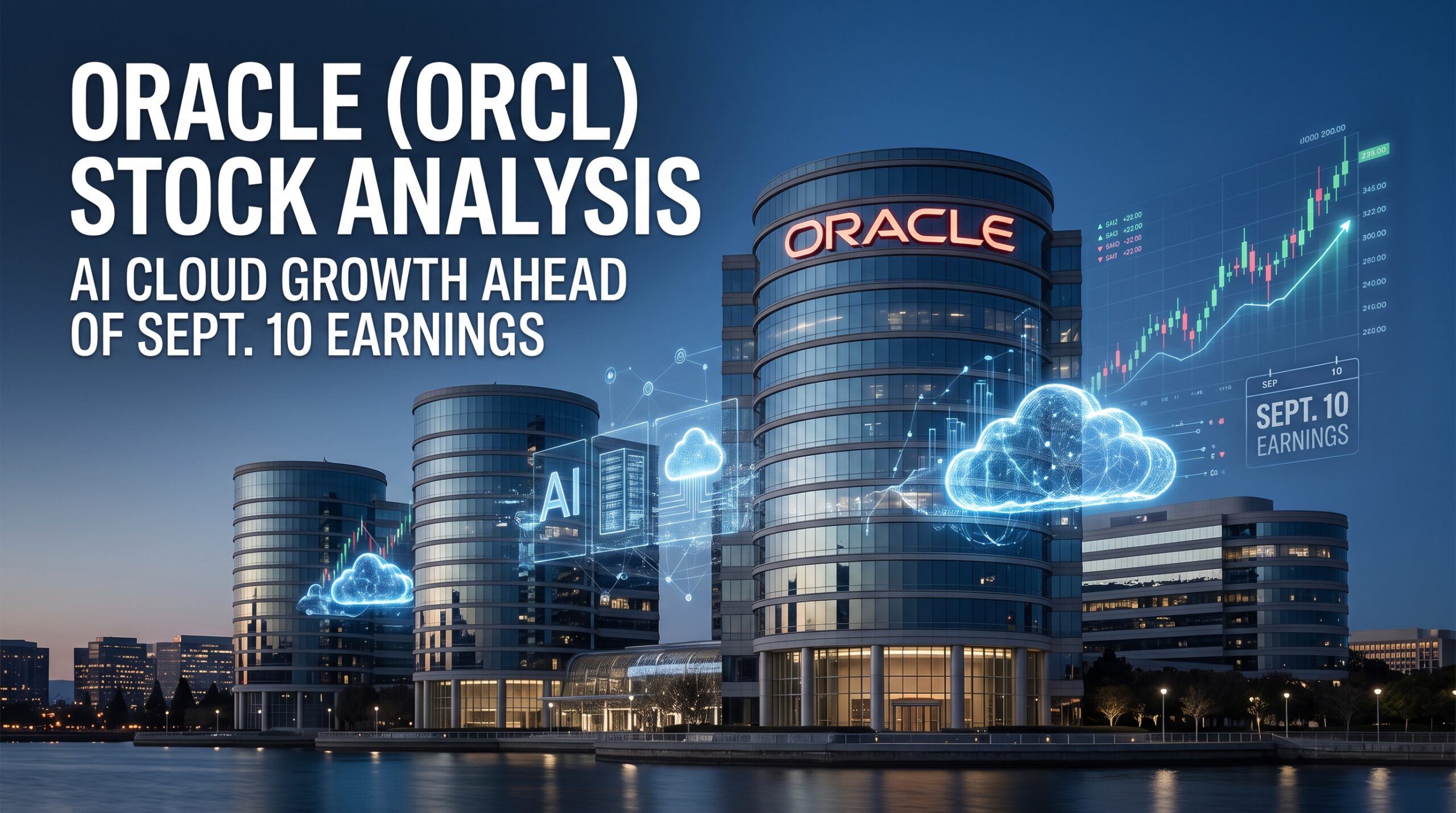
Oracle reports fiscal Q1 2027 earnings on September 10, 2026, the first test of whether the company’s pivot from legacy database vendor to hyperscale AI infrastructure provider can sustain the growth rate management itself guided to just three months ago. The stakes are unusually high: Oracle is guiding to the fastest quarterly revenue growth in its recent history, backed by a $638 billion order backlog that now anchors nearly every bull and bear argument on the stock.
The Setup Heading Into Q1 FY2027
Oracle closed fiscal 2026 with record numbers that reset the market’s understanding of its growth ceiling:
| Metric | FY2026 Q4 (Reported) | FY2027 Q1 (Guided/Consensus) |
|---|---|---|
| Total Revenue | $19.18B (+21% YoY) | ~$19.13B, guided 27–29% YoY growth |
| Cloud Infrastructure (OCI) Revenue Growth | +93% YoY | Guided 58–64% cloud growth |
| Adjusted EPS | $2.11 (beat $1.96 consensus) | Guided $1.72–$1.76 |
| Remaining Performance Obligations (RPO) | $638B | — |
| FY2027 Capex Guidance | Up to $95B | — |
The headline figure investors keep returning to is the $638 billion RPO — Oracle’s contracted-but-not-yet-recognized revenue — which includes a five-year, $300 billion cloud-computing agreement with OpenAI. That single contract now anchors a meaningful share of Wall Street’s bull case, and just as prominently, its bear case: multiple analysts have flagged that nearly half of Oracle’s contracted revenue traces back to one AI-lab counterparty, concentrating execution risk if OpenAI’s own capital plans shift.
Why the Market Is Split on Valuation
Sentiment on ORCL has bifurcated sharply over 2026:
- The bull case rests on Oracle’s transformation into critical AI-training infrastructure. J.P. Morgan has maintained an Overweight rating, arguing the buildout thesis extends beyond raw infrastructure into cloud applications and database modernization — a “diversified growth” argument meant to counter the OpenAI-concentration criticism. Consensus analyst price targets run as high as $400, with a mean around $253, implying substantial upside from levels near $160.
- The bear case centers on financing risk. Oracle raised $43 billion in debt and $5 billion in equity in fiscal 2026 alone, and management has guided to roughly $40 billion in additional financing for fiscal 2027 — including a previously announced $20 billion at-the-market equity issuance. Combined with capex guidance of up to $95 billion, that spending pace has pushed free cash flow negative, a structural feature bears argue the market has under-priced relative to Oracle’s historically conservative balance sheet.
Oracle stock dropped roughly 7% after-hours following its June 2026 fiscal Q4 report, despite beating on both revenue and earnings — a reaction driven almost entirely by the market reading an unchanged full-year revenue outlook as a signal that AI-driven demand might be plateauing relative to hyperscaler peers who had raised their own guidance more aggressively in the same window.
What to Watch in the September 10 Report
- Cloud infrastructure (OCI) growth cadence. Guidance calls for 58–64% growth — a deceleration from Q4’s 93%, but off a much larger base. Any print materially below that range would revive the demand-plateau narrative that hit the stock in June.
- RPO conversion. Investors will scrutinize how much of the $638 billion backlog is converting into recognized revenue on schedule, since the entire bull thesis depends on data-center capacity coming online fast enough to bill against signed contracts.
- Financing disclosures. With another ~$40 billion in planned fiscal 2027 financing, any update on debt terms, equity dilution pace, or credit-rating commentary will move the stock independent of the topline numbers.
- Customer concentration commentary. Any additional color on the OpenAI relationship, or disclosure of new large enterprise commitments (Oracle signed $67 billion in new AI infrastructure contracts in Q4 alone, including four customers each committing more than $8 billion), will factor into how analysts model durability of the RPO figure.
- Government and enterprise contract wins. Oracle secured a $400 million, 10-year federal contract in mid-2026, part of a broader push into public-sector cloud that diversifies revenue away from pure hyperscaler-AI exposure.
Institutional Investor Framework
For portfolio construction purposes, Oracle now trades less like a legacy enterprise software name and more like AI infrastructure peers (Nvidia, Broadcom, hyperscaler capex plays). That reclassification matters for valuation multiples: applying a 20–22x multiple to elevated fiscal 2028 earnings estimates supports price targets in the $240–$250 range cited by several sell-side desks, implying meaningful upside from current levels if execution holds — but also meaning the stock now carries the multiple compression risk associated with capex-heavy AI infrastructure plays broadly, not just software-company risk.
Bottom Line
Oracle’s September 10 fiscal Q1 2027 report is a referendum on whether 27–29% guided revenue growth and 58–64% cloud growth are achievable without further financing-driven balance sheet strain. The $638 billion RPO remains the single most important number in the Oracle thesis — both as the source of extraordinary growth visibility and as the concentration risk that keeps institutional bears engaged even as price targets on the Street continue to climb.
Discover more from The Economy
Subscribe to get the latest posts sent to your email.

Balance of Payments (BOP)

The Falkland Islands Dispute: Sovereign Wealth, Offshore Drilling, and Market Impacts

Gross Domestic Product (GDP): Nominal vs. Real

What is Inflation and the Consumer Price Index (CPI)?

US-China Trade Competition 2026: Supply Chain Relocation Guide

Oil Prices Break $100 in 2026: Middle East Conflict & Energy Markets

South-South Trade Expansion: Digital Integration and Emerging Market Growth

$166B Tariff Refund Tapering Fast: Is Your Business Missing Out?

Stock Market Today: Dow Climbs 500 Points as Markets Shake Off Inflation Jitters

14th WTO Conference 2026: Tariffs & Global Supply Chain Impact

Swish Secures $24M Funding to Disrupt India’s $100B Food Market

Physical AI and Driverless Tech: The Next Trillion-Dollar Industrial Revolution

Enterprise AI Platforms Disrupting B2B SaaS in 2026: Full Analysis

Crypto vs. Safe Haven Assets 2026: Where Institutions Are Hedging

State Farm’s $5B Dividend 2026: Who Qualifies & Payout Dates

US-China Relations in Q3 2026: Trade Tariffs and Supply Chain Risks

Gold’s Wild 2026: From a Record $5,600 Peak to a 24% Crash and Back Toward $4,500

Oil Surges as Strait of Hormuz Traffic Collapses Again

The Rocket That Won’t Quit: Inside SpaceX’s Falcon 9 Launch Machine

Bank of England Set to Hold Rates Through Year-End, Reuters Poll Shows

SpaceX Starship Flight 14: First Orbital Attempt & Starlink V3 Launch Explained

The 2026 Crypto Regulatory Shift: What It Means for Institutional Investors

AI Chip Stocks 2026: The Best Semiconductor Investments Beyond Marvell

Retail Earnings Week: What Home Depot, Target & Walmart Reveal

AI-Powered Training: The Next Multi-Billion Dollar Ecosystem in Fitness

Russia’s Black Sea Oil Exports Fall for a Fifth Straight Week

Top 30 Stocks for Investment in PSX for Massive ROI in 2026

Tween Back-to-School Trends 2026: What’s Driving the $85B Season
-

 Markets & Finance8 months ago
Top 15 Stocks for Investment in 2026 in PSX: Your Complete Guide to Pakistan’s Best Investment Opportunities
-

 Analysis7 months ago
Johor’s Investment Boom: The Hidden Costs Behind Malaysia’s Most Ambitious Economic Surge
-

 Analysis7 months ago
Top 10 Stocks for Investment in PSX for Quick Returns in 2026
-

 Analysis7 months ago
Brazil’s Rare Earth Race: US, EU, and China Compete for Critical Minerals as Tensions Rise
-

 Banks8 months ago
Best Investments in Pakistan 2026: Top 10 Low-Price Shares and Long-Term Picks for the PSX
-

 Investment8 months ago
Top 10 Mutual Fund Managers in Pakistan for Investment in 2026: A Comprehensive Guide for Optimal Returns
-

 Global Economy9 months ago
15 Most Lucrative Sectors for Investment in Pakistan: A 2025 Data-Driven Analysis
-

 Global Economy9 months ago
Pakistan’s Export Goldmine: 10 Game-Changing Markets Where Pakistani Businesses Are Winning Big in 2025