
Investment
US Oil Giants Demand Investment Guarantees Before Venezuela Entry as Trump Negotiates Access to World’s Largest Reserves

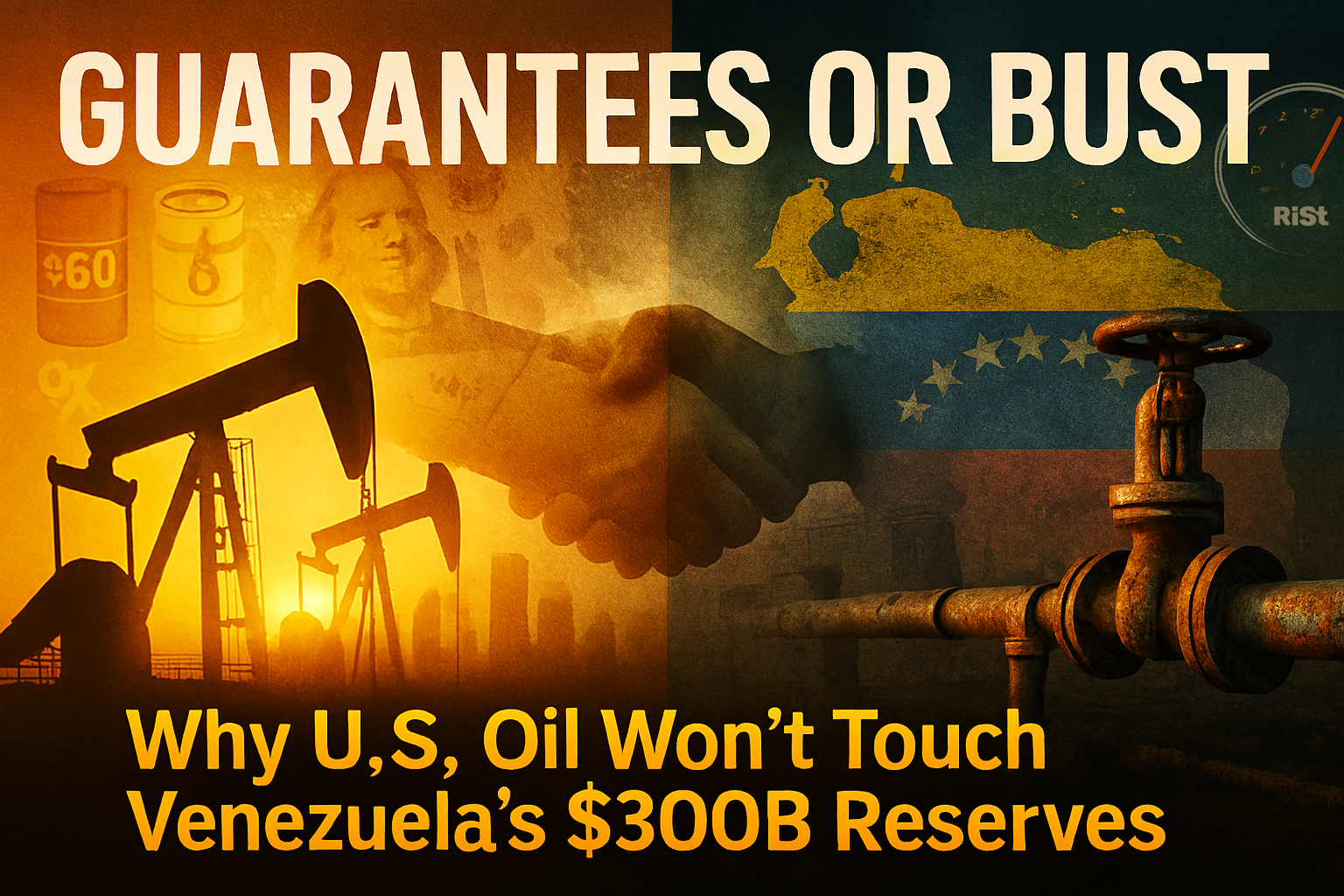
Behind closed doors this week, America’s most powerful oil executives delivered an uncomfortable message to President Donald Trump’s administration: Venezuela’s vast oil reserves—the world’s largest at 303 billion barrels—remain off-limits without unprecedented investment protections.
As Trump seeks to reshape global energy markets following the dramatic U.S. military operation that captured Venezuelan President Nicolás Maduro, industry leaders from ExxonMobil, Chevron, and ConocoPhillips are demanding written guarantees against nationalization, sanctions reversals, and political interference before committing capital to a country that expropriated more than $30 billion in foreign assets just over a decade ago.
The stakes extend far beyond Venezuela’s borders. Trump’s ability to broker a deal could define his administration’s energy dominance strategy and test whether economic incentives can stabilize a failed petrostate 1,200 miles from Florida’s coast. Yet three days after Maduro’s capture, oil companies remain deeply skeptical—and the numbers explain why.
The Reluctant Billionaires: Why Big Oil Is Saying “Not So Fast”
Despite Trump’s public optimism that U.S. oil companies are “ready and willing” to invest, industry sources paint a starkly different picture. Energy Secretary Chris Wright met with oil executives Wednesday at the Goldman Sachs Energy Conference in Miami, followed by a White House meeting Friday with CEOs from ExxonMobil, Chevron, and ConocoPhillips—but no companies have committed to new investments.
“The appetite for jumping into Venezuela right now is pretty low,” a senior energy executive familiar with discussions told CNN, speaking on condition of anonymity. The executive cited three insurmountable obstacles: collapsing oil prices, Venezuela’s nightmarish track record, and complete uncertainty about who actually controls the country.
The Price Problem Nobody’s Talking About
Global oil markets are drowning in oversupply. Brent crude tumbled 20% in 2025, closing the year near $60 per barrel—its worst annual performance since the pandemic. The U.S. Energy Information Administration projects Brent will average just $55 per barrel through 2026, with some analysts warning prices could dip below $50.
These depressed prices fundamentally undermine the investment case for Venezuela. Consulting firm Rystad Energy estimates that maintaining Venezuela’s current production of roughly 1 million barrels per day would require $53 billion through 2040. Returning the country to its 1990s peak of 3.5 million barrels daily demands a staggering $183 billion—nearly impossible to justify when oil hovers around $60.
“Just because there are oil reserves—even the largest in the world—doesn’t mean you’re necessarily going to produce there,” another industry source told CNN. “This isn’t like standing up a food truck operation.”
Francisco Monaldi, director of the Latin America Energy Program at Rice University’s Baker Institute, reinforced this reality: rebuilding Venezuela’s infrastructure to reach 4 million barrels per day would require more than $100 billion and take at least a decade.
What Companies Are Demanding: The Non-Negotiable Investment Protections
Behind the scenes, oil executives have outlined specific conditions they’ll need before risking capital in Venezuela. These demands reflect hard-won lessons from 2007, when President Hugo Chávez nationalized the oil sector and forced foreign companies to accept minority stakes or exit entirely.
Legal Shields Against Nationalization
At the top of every company’s list: ironclad protections against expropriation. When Chávez seized control in 2007, ExxonMobil and ConocoPhillips refused the new terms and walked away from billions in assets. International arbitration courts later ruled in their favor—ConocoPhillips won an $8.7 billion award in 2019, while ExxonMobil secured $1.6 billion—but Venezuela has paid only a fraction of these judgments.
According to CNBC’s reporting, Venezuela currently owes ConocoPhillips approximately $10 billion and ExxonMobil around $2 billion when interest is included. These unpaid debts cast a long shadow over any new investment discussions.
Industry experts say companies now want bilateral investment treaties with teeth—agreements that allow immediate recourse to international arbitration and specify compensation at full market value, not the artificially low “book value” Venezuela offered in 2007.
Sanctions Certainty and Congressional Buy-In
Oil companies fear the “sanctions whiplash” that could occur if a future administration reverses Trump’s policies. Current U.S. sanctions, expanded under both Trump and Biden, have essentially embargoed Venezuelan oil exports. Any Trump-era deal based solely on executive authority could evaporate when he leaves office.
“No one’s going to start investing on the ground in a place where there’s no legal contract and viable permission to operate or if there’s concerns about political stability and violence,” Ryan Kepes, an energy analyst, told NPR.
Companies want legislative backing—either new laws or amendments to existing sanctions frameworks—that would survive beyond Trump’s presidency. Without congressional approval, any investment represents a billion-dollar bet on political continuity that few executives are willing to make.
Operational Autonomy and Profit Repatriation
Venezuela’s state oil company, PDVSA, is effectively bankrupt. The entity that once generated 95% of Venezuela’s export earnings now struggles to maintain basic operations. Yet under current Venezuelan law, PDVSA must hold majority stakes in all oil projects.
Oil executives are demanding unprecedented operational control—the ability to hire international staff, import equipment without bureaucratic delays, and most critically, repatriate profits without Venezuela’s crushing currency controls. The country’s black market exchange rate differs so dramatically from official rates that companies fear losing billions to government-mandated conversions.
Venezuela’s Collapsing Infrastructure: A $100 Billion Problem
The physical reality on the ground makes investment even more daunting. Venezuela’s oil infrastructure has deteriorated dramatically over two decades of underinvestment, mismanagement, and sanctions.
Current production stands at approximately 950,000 barrels per day—down from 3.5 million barrels daily in the late 1990s and a peak of 3.7 million in 1970. PDVSA itself acknowledged that its pipelines haven’t been updated in 50 years, according to CNN reporting.
The technical challenges are immense. Venezuela produces predominantly “extra-heavy” crude from the Orinoco Belt—oil so dense it barely flows and requires specialized processing. This crude contains high sulfur content, making it more expensive to refine and less attractive in an era when many refiners have invested in lighter, sweeter crude infrastructure.
A World Bank analysis published late last year noted that even optimistic scenarios—assuming immediate sanctions relief and political stability—would require 18-24 months before any new production comes online. More realistic projections stretch to 3-5 years for meaningful output increases.
“Venezuela’s oil infrastructure has also been heavily degraded by decades of underinvestment and much of Venezuela’s oil is extremely heavy, making it relatively costly to extract and process,” Neal Shearing, group chief economist at Capital Economics, explained in a report.
The Geopolitical Chess Match: Why Trump Needs This Deal
For the Trump administration, success in Venezuela represents a geopolitical trifecta: undercutting Russian and Chinese influence, providing heavy crude to U.S. Gulf Coast refiners, and demonstrating American power projection in the Western Hemisphere.
The Russia-China Factor
For years, Venezuela has relied on economic lifelines from Moscow and Beijing. Russia’s state oil company Rosneft provided billions in prepayment deals, while China extended over $60 billion in loans-for-oil arrangements. Yet neither country invested the massive capital needed to reverse production declines—they simply extracted value from existing, deteriorating assets.
Trump’s intervention disrupts this model. Energy Secretary Wright emphasized at the Goldman Sachs conference that the administration will control Venezuelan oil sales “indefinitely,” redirecting barrels that previously flowed to China toward U.S. markets instead.
Marco Rubio, Trump’s Secretary of State, has been even more explicit about geopolitical objectives. The administration is pressing Venezuela’s interim government to expel all Chinese, Russian, Cuban, and Iranian intelligence operatives—a demand that reveals how deeply national security concerns drive the oil agenda.
The Refinery Economics Nobody Discusses
There’s a hidden economic logic behind Trump’s Venezuela push that rarely makes headlines: U.S. Gulf Coast refineries desperately need heavy crude.
These refineries—concentrated in Texas and Louisiana—invested billions in complex processing units specifically designed to handle heavy, high-sulfur crude. When Venezuelan supplies disappeared, they turned to Canadian oil sands and occasional Mexican imports. But Venezuela’s Orinoco crude remains uniquely suited to their equipment.
S&P Global Commodity Insights data shows that heavy crude typically trades at a $10-15 discount to lighter grades—a margin that makes these refineries highly profitable when they can source steady supplies. Restoring Venezuelan flows could lower gasoline and diesel prices along the Gulf Coast while boosting refinery margins.
Skip York, a fellow at Rice University’s Center for Energy Studies, noted that if Venezuela achieves political and economic stability, investors could expect returns of 15-20%—competitive with other global opportunities. But that’s a massive “if.”
The Historical Scar Tissue: Why 2007 Still Matters
The shadow of Hugo Chávez’s 2007 nationalization hangs over every conversation about Venezuela today. Understanding what happened then is essential to grasping why companies remain so hesitant now.
The Forced Renegotiation
In early 2007, Chávez ordered all foreign oil companies operating in the strategic Orinoco Belt to convert their projects into joint ventures with PDVSA holding at least 60% control. Companies had a stark choice: accept minority status under worse terms or exit entirely.
Chevron accepted and stayed. ExxonMobil and ConocoPhillips refused and were effectively expelled. CBC News reporting describes this as “the biggest seizure of private property in the country since Chavez took power.”
The Arbitration Marathon
What followed was a decade-long legal battle that still hasn’t concluded. ExxonMobil filed claims under bilateral investment treaties, initially seeking $16.6 billion. In 2014, an ICSID tribunal awarded $1.6 billion—far less than sought but still unpaid. The company continues pursuing additional claims.
ConocoPhillips initially won $2 billion in 2018, but a fuller ICSID decision in 2019 increased the award to $8.7 billion plus interest. Venezuela appealed unsuccessfully, with an annulment committee upholding the entire award in January 2025. Yet ConocoPhillips has collected virtually nothing.
These unpaid judgments create a unique leverage point. Trump has hinted that settling these debts might be prerequisite to new investment, telling reporters the oil companies will “take back the oil that, frankly, we should have taken back a long time ago.”
However, Energy Secretary Wright suggested old debts aren’t an immediate priority. “The huge debts that are owed Conoco and Exxon, those are very real and need to be recompensed in the future,” Wright told CNBC. “But that’s a longer-term issue. That’s not a short-term issue.”
Chevron’s Unique Position: The Only Player on the Ground
While ExxonMobil and ConocoPhillips nurse old wounds, Chevron stands alone as the only U.S. major with current Venezuelan operations—making it the most important company in any restoration scenario.
Chevron accepted Chávez’s 2007 terms and maintained a presence through two decades of sanctions, economic collapse, and political upheaval. The Biden administration granted a limited license in 2022 allowing Chevron’s PDVSA joint venture to export oil, which Trump’s administration later modified.
Kpler data shows Chevron exported approximately 140,000 barrels per day from Venezuela in Q4 2025—modest volumes but critically important for maintaining relationships and operational knowledge.
“Chevron is the best positioned among US oil companies—by far,” Francisco Monaldi, the Rice University energy expert, told CNN. The company has 3,000 employees in Venezuela, existing infrastructure, and relationships with PDVSA that could enable rapid production increases if conditions improve.
Yet even Chevron has been circumspect. In a carefully worded statement, the company said it “remains focused on the safety and well-being of our employees, as well as the integrity of our assets,” while declining to comment on expansion plans. Translation: we’re watching and waiting.
The Market Reality Check: Oversupply Kills Investment Appetite
Perhaps the most fundamental obstacle to Trump’s Venezuela vision is one he cannot control: the global oil glut.
International Energy Agency data shows the oil market has been in surplus since early 2025, with production outpacing consumption by approximately 2.5 million barrels per day in the second half of the year. The IEA projects this oversupply will reach 3.8 million barrels daily in 2026.
OPEC+ production increases, booming U.S. shale output, and rising volumes from Brazil, Guyana, and Canada have flooded markets while demand growth stalls. Chinese economic weakness and accelerating electric vehicle adoption have dampened consumption just as supply surges.
For oil companies, this creates a brutal calculation. At $60 per barrel, many U.S. shale producers remain profitable—barely. But investing tens of billions in a risky foreign venture with a 5-10 year payback period makes no economic sense when prices are falling and domestic opportunities exist.
“The bottom line is that adding Venezuelan oil makes the oversupply worse,” said Bob McNally, president of Washington-based consulting firm Rapidan Energy Group. “Companies are cutting back on drilling in the Permian Basin because of oversupply. Why would they rush to Venezuela?”
Bloomberg analysis noted that ExxonMobil, Chevron, and ConocoPhillips are collectively laying off about 14,000 employees as profits decline. These are not companies eager to embark on massive new capital projects in unstable jurisdictions.
What Happens Next: Three Scenarios for Venezuela’s Oil Future
Industry analysts and policy experts are mapping out possible paths forward, each with dramatically different implications.
Best Case: Phased Sanctions Relief With Investment Guarantees
In this scenario, the Trump administration negotiates a comprehensive framework that includes:
- Legislative sanctions modifications providing long-term certainty
- Bilateral investment treaties with international arbitration rights
- Gradual production targets tied to democratic reforms
- Settlement mechanisms for old expropriation claims
- PDVSA restructuring to allow operational autonomy
Timeline: 18-24 months to first new production; 5-7 years to reach 2 million barrels per day.
Francisco Monaldi suggests even a “trustworthy government” could boost production to 1.5-2 million barrels daily within two years by enabling existing operators like Chevron, Eni, and Repsol to increase spending within current licenses.
Most Likely: Limited Waivers With Slow Capital Deployment
This middle scenario reflects current reality: the administration grants specific licenses to particular companies under strict conditions, but comprehensive protections remain elusive.
Chevron expands modestly, perhaps doubling current output to 300,000 barrels daily over 3-4 years. ConocoPhillips and ExxonMobil secure debt settlements before committing new capital. Independent U.S. producers enter small projects in less complex areas.
Timeline: Gradual increases reaching 1.3-1.5 million barrels daily by 2030; still well below historical peaks.
The Council on Foreign Relations notes this scenario most closely matches how investments typically unfold in post-conflict petrostates—incremental, cautious, and constantly reassessed against political developments.
Worst Case: Talks Collapse, Status Quo Continues
If the Trump administration cannot provide adequate guarantees, or if Venezuela’s political situation deteriorates further, oil companies simply walk away.
Chinese and Russian state entities might deepen partnerships, but without the capital or technology to meaningfully boost production. Venezuela remains trapped producing 800,000-1 million barrels daily, with aging infrastructure continuing to decay.
Timeline: Indefinite stagnation; possible production declines to 500,000-700,000 barrels daily by 2030.
This scenario would represent a complete failure of Trump’s energy diplomacy but seems increasingly plausible given industry skepticism and adverse market conditions.
The Congressional Obstacle Course
Even if Trump convinces companies to invest, he faces a significant political problem: Congress.
Democrats immediately criticized the Venezuela operation as potentially illegal, questioning the military authority to capture a foreign head of state. Progressive members like Rep. Alexandria Ocasio-Cortez and Sen. Bernie Sanders condemned what they called “imperialism” and expressed concerns about repeating Iraq War mistakes.
But Trump’s challenges extend beyond predictable Democratic opposition. Several Republican senators, particularly those from oil-producing states, have raised questions about sanctions policy and whether Venezuela investments might undermine U.S. energy producers.
Secretary of State Marco Rubio faced skeptical lawmakers during classified briefings this week. One senator, speaking anonymously, told CNN: “There are more questions than answers, and I’m not convinced this administration has thought through the second- and third-order effects.”
The Center for Strategic and International Studies, a Washington think tank, published analysis suggesting any lasting Venezuela framework would require bipartisan legislative backing—an increasingly rare commodity in today’s polarized environment.
What Investment Guarantees Actually Mean in Practice
For readers unfamiliar with international oil contracts, understanding what companies are demanding requires explaining some technical structures.
Bilateral Investment Treaties (BITs): These government-to-government agreements establish protections for investors, including the right to international arbitration if a host country violates commitments. The U.S. has BITs with numerous countries, but Venezuela withdrew from many after Chávez’s nationalization.
Production Sharing Agreements (PSAs): Unlike traditional concessions where companies own the oil, PSAs allow governments to retain ownership while contractors receive a share of production as compensation. Iraq, Kurdistan, and other challenging markets use PSAs to attract investment while maintaining resource sovereignty.
Political Risk Insurance: Private insurers and multilateral agencies like MIGA (World Bank) offer coverage against expropriation, currency inconvertibility, and political violence. However, premiums for Venezuela would be extraordinarily high given its track record.
Sovereign Guarantee Agreements: The government issues binding commitments to compensate investors under specific conditions. These guarantees become enforceable debts if triggered—though collecting remains challenging, as ExxonMobil and ConocoPhillips can attest.
Companies want a combination of all four mechanisms, creating multiple layers of protection. Yet even this multilayered approach cannot eliminate political risk entirely, which explains the persistent hesitation.
The Bottom Line: Trump’s Energy Gambit Faces Long Odds
Six days after U.S. forces captured Nicolás Maduro, Donald Trump’s vision of American oil companies rapidly revitalizing Venezuela’s energy sector appears increasingly disconnected from commercial reality.
Oil executives want guarantees the administration cannot easily provide. Market conditions undermine investment economics. Congressional support remains uncertain. Venezuela’s physical infrastructure requires generational investment. And historical experience suggests promises made in crisis can evaporate when political winds shift.
Energy Secretary Wright has been more candid than Trump about these challenges. “We’re not going to be twisting or convincing anyone’s arms,” Wright told reporters. “We need to have that leverage and that control of those oil sales to drive the changes that simply must happen in Venezuela.”
Yet leverage alone won’t convince companies to risk billions. They need legal certainty, operational autonomy, market conditions that justify massive capital deployment, and confidence that any framework will outlast Trump’s presidency.
As of now, none of those conditions exist.
The industry’s message to Trump remains consistent: show us the guarantees, show us the profits, show us the stability—then we’ll talk about billions in investments. Until then, Venezuela’s 303 billion barrels might as well be on Mars.
Key Takeaways
For Investors: Venezuelan oil stocks and related companies will remain speculative until concrete investment frameworks emerge. Chevron has the clearest exposure, but near-term production increases appear limited.
For Energy Markets: Don’t expect Venezuelan supply to materially impact global oil balances before 2027-2028 at earliest. The current oversupply will persist regardless of Venezuela developments.
For Policy Watchers: Trump’s Venezuela strategy represents his administration’s most ambitious test of economic statecraft. Success or failure will influence how allies and adversaries view American power projection.
For Companies: The Friday White House meeting will be telling. If executives emerge with specific commitments, markets will react. More likely, they’ll offer cautious support while awaiting concrete protections.
The world’s largest proven oil reserves remain tantalizingly out of reach—not for lack of geological potential, but because history, economics, and politics create barriers that presidential bravado alone cannot overcome.
Discover more from The Economy
Subscribe to get the latest posts sent to your email.



How once-unimaginable catastrophes become baseline assumptions
There is a particular kind of hubris that infects markets in the long stretches between catastrophes. Volatility compresses. Risk premia decay. The insurance gets quietly cancelled because it hasn’t paid out in years and the premiums feel like wasted money. Then the disaster arrives — not as a distant rumble but as a wall of water — and the entire analytical framework investors have spent years constructing turns out to have been a map of the wrong country.
We are living through one of the most instruction-rich moments in modern financial history. Since February 28, 2026, when the United States launched military operations against Iran and Tehran responded by closing the Strait of Hormuz, markets have been running a live masterclass in catastrophe pricing. West Texas Intermediate crude surged from $67 to $111 per barrel in under a fortnight — the fastest oil spike in four decades. War-risk insurance premiums on shipping through the Gulf soared more than 1,000 percent. The S&P 500 lost 5 percent in a single week, and the ECB and Bank of England are now staring down a renewed tightening scenario they spent the first quarter of 2026 insisting was off the table.
And yet — and this is the part that should make every portfolio manager uncomfortable — the analytical mistakes driving losses right now are not new. They are the same six structural errors investors have made in every previous crisis. Understanding them, really understanding them, is not an academic exercise. It is the difference between surviving the next disaster and being liquidated by it.
Key Takeaways at a Glance
- Markets price first-order disaster impacts; second- and third-order cascades are systematically underpriced
- Volatility is information; price-discovery failure is the true systemic risk — monitor private-to-public valuation spreads
- Tight CAT bond spreads signal capital crowding, not benign risk — use compression as a contrarian indicator
- Emerging market currencies and credit spreads lead developed-market pricing of global disasters
- Geopolitical risk premia decay faster than structural damage — separate the transitory from the permanent
- The best time to buy tail protection is when every indicator says you do not need it
Lesson One: Markets price the disaster they know, not the one that is compounding behind it
The economics of disaster pricing contain a fundamental asymmetry. Markets are reasonably good at incorporating a known risk — geopolitical tension, elevated VIX, stretched valuations — into current prices. What they catastrophically underprice is the second-order cascade that no single model captures.
Consider what the Hormuz closure actually detonated. Yes, oil went to $111 per barrel. Obvious. What was less obvious: the inflation feedback loop that forced investors to reprice central bank paths they had already discounted as settled. The Federal Reserve was expected to hold rates in 2026; futures now assign a 74 percent probability it does not cut at all this year. Europe’s energy import dependency made the ECB’s position worse. That transmission — from oil shock to rate-repricing to credit stress to equity multiple compression — is a chain, not a point event. Most risk models price the first link.
The academic framework for this is well established but rarely operationalised. The NBER disaster-risk literature, particularly Wachter (2013) and Barro (2006), argues that rare disasters produce risk premia that appear irrational in calm periods but are in fact the rational price of tail exposure across long time horizons. What these models miss, however, is that real-world disasters rarely arrive as clean, isolated point events. They arrive as cascades. The COVID-19 pandemic was not just a health shock — it was simultaneously a supply-chain shock, a demand shock, a sovereign-debt shock, and a labour-market restructuring shock. The Hormuz closure is not just an oil shock. It is an inflation shock, a monetary policy shock, a EM balance-of-payments shock, and an AI-investment sentiment shock, all at once.
Key takeaway: Map not just the primary disaster scenario but every second- and third-order transmission mechanism it activates. The primary impact is already partially in the price. The cascades are not.
Lesson Two: The real crisis is not volatility — it is the collapse of price discovery
Scott Bessent, the US Treasury Secretary, said something in March 2026 that deserves to be read not as politics but as a precise financial concept. Asked what genuinely frightened him after 35 years in markets, Bessent answered: “Markets go up and down. What’s important is that they are continuous and functioning. When people panic is when you’re not able to have price discovery — when markets close, when there is the threat of gating.”
Volatility is information. A price moving sharply up or down is a market doing exactly what it should: integrating new signals, adjusting expectations, clearing. The true systemic catastrophe is not a 10 percent drawdown. It is the moment when buyers and sellers can no longer find each other at any price — when the mechanism that produces prices breaks entirely.
This is not theoretical. Private credit markets are currently exhibiting exactly this dynamic. US BDCs — business development companies that provide credit to mid-market companies — have seen share prices fall 10 percent and trade 20 percent or more below their latest stated NAVs. Alternative asset managers that collect fees from these vehicles are down more than 30 percent. The public market is rendering a verdict on private valuations that the private market itself cannot yet deliver, because the private marks have not moved. There is no continuous clearing mechanism. There is no daily price discovery. There is only the last funding round — which is a negotiated fiction, not a price.
Investors who understand this distinction can do something useful with it: treat the spread between public-market pricing and private-market marks as a real-time fear gauge. When that gap widens sharply, the market is not panicking irrationally. It is pricing the absence of price discovery itself.
Key takeaway: Distinguish between volatility (information-rich, manageable) and price-discovery failure (structurally dangerous, contagion-prone). Monitor private-to-public valuation spreads as a leading indicator of the latter.
Lesson Three: Catastrophe bond complacency is always a warning, never a reassurance
In February 2026, Bloomberg reported that catastrophe-bond risk premia had fallen to levels not seen since before Hurricane Ian struck Florida in 2022. The cause was a surge of fresh capital chasing ILS yields. Managers called it a healthy market. A more honest reading is that it was a market pricing the wrong risk for the wrong reasons.
Here is the structural problem with catastrophe bonds, and indeed with most insurance-linked securities: the risk premium is set by the supply of capital chasing the trade, not by the true probability distribution of the underlying disaster. When capital floods in — as it has, driven by institutional allocators seeking uncorrelated returns — spreads compress regardless of whether the actual hurricane, flood, or geopolitical catastrophe risk has changed. The academic literature on CAT bond pricing, including recent work in the Journal of the Operational Research Society, confirms that cyclical capital flows consistently distort the risk-neutral pricing of catastrophe events.
The counter-intuitive lesson: when CAT bond spreads are tightest, protection is cheapest to buy and most expensive to have sold. The compression that looks like market efficiency is often capital crowding masquerading as a risk assessment. A catastrophe-bond market trading at pre-Ian yields six months before an Iran-driven energy crisis was not a serene market. It was a complacent one.
Key takeaway: Use catastrophe-bond spread compression not as a signal of benign risk conditions but as a contrarian indicator of under-priced tail exposure. Buy protection when it is cheap; do not sell it because it is cheap.
Lesson Four: Emerging markets absorb the shock first — and price it most honestly
There is a geographic hierarchy to disaster pricing that sophisticated global investors routinely ignore. When a major geopolitical or macro catastrophe detonates, the signal appears first in emerging market currencies, credit spreads, and energy import bills — not in the S&P 500 or the Dax. This is not because EM markets are more efficient. It is because they have less capacity to absorb shocks and therefore less incentive to pretend the shock is temporary.
The Hormuz closure is a case study. Developed-market investors spent the first week debating whether oil at $111 per barrel was “priced in.” Meanwhile, Gulf states were issuing precautionary production-cut announcements and Middle Eastern shipping had effectively ceased. Economies in South and Southeast Asia — which import 80 percent or more of their petroleum needs — faced simultaneous currency pressure (oil is dollar-denominated), fiscal pressure (fuel subsidies explode), and inflation pressure (food and transport costs surge). Countries like Pakistan, Sri Lanka, and Bangladesh were pricing a recession before most DM economists had updated their Q1 2026 forecasts.
The BIS research on disaster-risk transmission across 42 countries documents precisely this dynamic: world and country-specific disaster probabilities co-move in complex, non-linear ways. When global disaster probability rises, EM asset prices move first and fastest. For a DM investor, this is an early-warning system hiding in plain sight.
Key takeaway: Monitor EM currency indices, sovereign credit spreads, and fuel import data as leading indicators of how the global market is actually pricing a disaster — before the consensus in New York or London has caught up.
Lesson Five: Geopolitical risk premia have a half-life problem — and it is shorter than you think
Markets are extraordinarily good at normalising the catastrophic. This is not a character flaw; it is a survival mechanism. But for investors, the normalisation of extreme risk is one of the most financially treacherous dynamics in markets.
Consider the structural pattern Tyler Muir documented in his landmark paper Financial Crises and Risk Premia: equity risk premia collapse by roughly 20 percent at the onset of a financial crisis, then recover by around 20 percent over the following three years — even when the underlying structural damage persists. Wars display an even more dramatic version of this pattern. The initial shock is priced aggressively. But as weeks become months, the equity market begins to discount the conflict as background noise, even if oil remains $20 per barrel above pre-war levels and inflation continues to compound.
This half-life problem cuts in two directions. On the way in: investors are often too slow to price a new geopolitical risk, underestimating how durable its effects will be. On the way out: investors often reprice risk premia too quickly back to baseline, treating a structural change in the global system as if it were a weather event that has now passed. The Strait of Hormuz may reopen. But global shipping has permanently re-priced war-risk. Sovereign wealth funds in the Gulf are permanently reconsidering their US dollar reserve holdings. Indian and Japanese energy policymakers are permanently accelerating domestic diversification. These structural changes do not vanish when the headline risk premium fades.
Key takeaway: When pricing geopolitical disasters, separate the acute risk premium (which will fade) from the structural repricing (which will not). The former is a trading signal. The latter is an asset allocation decision that most portfolios have not yet made.
Lesson Six: The moment you feel safest is precisely when you are most exposed
The final lesson is the most counter-intuitive, and arguably the most important. There is a specific period in any market cycle — often 18 to 36 months after the previous crisis — when the cost of tail protection is at its cheapest, investor confidence is high, and catastrophe risk feels entirely theoretical. This is exactly when the next disaster is being loaded.
We can locate this period with precision in the current cycle. In early 2026, the CAPE ratio on US equities reached 39.8, its second-highest reading in 150 years. The Buffett Indicator (total market cap to GDP) hovered between 217 and 228 percent — historically associated with the period immediately before major corrections. CAT bond spreads were at post-Ian lows. VIX had compressed back to mid-teens. Private-credit redemption queues were elevated but not yet alarming. And the macroeconomic consensus — including, notably, within the US Treasury — was that tariff-driven inflation would prove transitory and that central banks would be cutting before mid-year.
Every one of those conditions has now reversed. The reversal took six weeks.
The academic literature on learning and disaster risk, particularly the Kozlowski, Veldkamp, and Venkateswaran (2020) framework on “scarring” from rare events, finds that markets systematically underestimate disaster probability in long stretches without disasters, then over-correct sharply when one arrives. This is not irrationality in the pejorative sense — it is Bayesian updating in the presence of genuinely ambiguous information. But the practical implication is stark: the time to buy disaster insurance is not after the disaster has arrived and the VIX has spiked to 45. It is in the quiet months when every indicator says you don’t need it.
Key takeaway: Maintain systematic, rule-based disaster hedges that do not depend on a real-time catastrophe forecast. The moment it feels unnecessary to hold tail protection is the moment the portfolio is most exposed to needing it.
The Synthesis: From Lessons to Portfolio Architecture
These six lessons converge on a single architectural principle: disaster pricing is not a moment-in-time forecast exercise. It is a permanent structural feature of portfolio construction.
The real mistake — the one that has cost investors dearly in 2020, in 2022, and again in 2026 — is not failing to predict the next disaster. It is believing that markets have already priced it in. The history of catastrophe pricing teaches us, with brutal consistency, that they have not. The cascade is underpriced. The price-discovery failure is unmodelled. The CAT bond spread is supply-driven, not risk-driven. The EM signal is ignored. The geopolitical risk premium is given a shorter half-life than the structural damage it caused. And the tail hedge is cancelled precisely when it is most needed.
The investors who will outperform across the full cycle are not those who predicted the Hormuz closure or the tariff escalation or the next crisis that has not yet been named. They are those who understood that unpriceable disasters are not unpriceable because they are impossible to imagine. They are unpriceable because the incentive structures of the investment industry consistently penalise the premiums required to hedge them.
That gap between what disasters cost and what markets charge for protection is not a market inefficiency. It is the most durable alpha in finance. Learning to harvest it is, in the deepest sense, the only lesson that matters.
Discover more from The Economy
Subscribe to get the latest posts sent to your email.

Investment trusts offer the smartest, most democratic route into private equity in 2026—with wide discounts, rate-cut tailwinds, and a $8.6trn asset class finally opening its doors.
In my two decades covering global capital markets, I have watched retail investors be told, repeatedly and emphatically, that private equity is not for them. It is the preserve of Yale’s endowment, of Kuwaiti sovereign wealth funds, of family offices with nine-figure balance sheets and the patience of a Benedictine monk. Everyone else, so the story went, would have to make do with the public markets and whatever crumbs of innovation happened to trickle through the IPO window.
That story was always partially false. And in 2026, it is becoming demonstrably, structurally, and commercially obsolete.
The vehicle quietly dismantling this exclusivity is one of Britain’s oldest and most elegant financial inventions: the investment trust. Specifically, a cohort of listed, closed-end funds that invest in private equity—companies and strategies that never appear on a public exchange, cannot be bought on Robinhood, and have historically outperformed their listed counterparts over long investment horizons. These are investment trusts that have gone big on private equity, and the case for following them has rarely been more compelling than it is right now.
The Opportunity Set: Why Private Equity Matters More Than Ever
Let us begin with the most underappreciated fact in modern investing. The universe of publicly listed companies has been shrinking for decades. In the United States, the number of exchange-listed firms has halved since its peak in the 1990s. In Europe, the pattern is similar. Meanwhile, the private markets have exploded. According to Preqin data, global private equity assets under management stood at $8.6 trillion as of December 2024—almost ten times the figure from two decades earlier.
Think about what that means for a conventional investor. The most dynamic companies—the software champions, the healthcare innovators, the infrastructure builders of tomorrow—are increasingly choosing to remain private for longer, or forever. When HgCapital, the private equity giant behind HgCapital Trust (HGT), acquired OneStream Software in a $6.4 billion deal in January 2026, it was taking a profitable, high-growth cloud software business out of public investors’ reach, not into it. If you are not in private equity, you are simply being cut out of whole chapters of the economy.
Preqin and BlackRock’s “Private Markets in 2030” report forecasts global alternative assets reaching $32 trillion in AUM by end of the decade—a structural shift, not a cyclical blip, driven by AI infrastructure build-out, energy transition spending, and the relentless migration of ambitious companies away from the scrutiny and quarterly-earnings tyranny of public markets. Investors who are not finding ways to participate in this migration will, over the coming decade, find their portfolios increasingly anaemic.
The Investment Trust Advantage: Closed-End Structure as a Feature, Not a Bug
The mechanism by which ordinary investors can access this vast private universe—without locking up capital for a decade, without writing a million-dollar cheque to a Mayfair GP, without navigating a J-curve of zero-returns for the first five years—is the listed investment trust.
Here is why the structure matters. Open-ended funds holding illiquid private assets are inherently fragile. When markets panic and retail investors rush for the exits, fund managers of open-ended vehicles are forced to sell assets at fire-sale prices to meet redemptions. We have seen this movie before; it never ends well. The investment trust structure, because it is a closed-end vehicle whose shares trade on a stock exchange, eliminates this mismatch entirely. The manager never has to sell a portfolio company prematurely because a panicking investor in Peterborough wants their money back on a Tuesday afternoon. The underlying assets can breathe, compound, and mature on their own timescales—which is precisely how private equity is meant to work.
This structural elegance is especially powerful for the asset class. The AIC notes that over the past ten years, the average investment company has returned approximately 10% annually, but that aggregate disguises the extraordinary performance of the Private Equity sector, where the top names have generated returns that belong in a different universe.
The Numbers: A Decade of Exceptional Performance
See our guide to investment trust performance across AIC sectors.
Private equity investment trusts, as a category, have been among the best-performing assets available to retail investors over the past decade. 3i Group, the UK’s largest investment trust at £26.2 billion in net assets, has delivered a 10-year share price total return of 1,100%—an annualised gain of 26.39%. Over 20 years, 3i has returned 15.85% annualised, beating its FTSE 350 benchmark by nearly 9 percentage points. HgCapital Trust, the software-focused private equity trust managing approximately £2.5 billion in assets, has delivered 526% over 10 years at an annualised 17.75%—comfortably beating FTSE All-Share’s 7.62% annual gain by a margin of 10 percentage points.
These are not cherry-picked outliers. Morningstar’s analysis of private equity investment trusts finds the category has returned an average of 9% per year over the past decade, a figure that, while below the headline acts, still substantially outpaces most passive global equity indices on a risk-adjusted basis over comparable periods.
Performance Comparison Table: Private Equity Investment Trusts vs Benchmarks (to end-2025)
| Trust / Benchmark | 10-Year Annualised Return | Current Discount/Premium |
|---|---|---|
| 3i Group (III) | ~26% | Wide discount (post-correction) |
| HgCapital Trust (HGT) | ~17.75% | ~14–27% discount (volatile 2026) |
| HarbourVest Global PE (HVPE) | ~10%+ | ~26–28% discount |
| Pantheon International (PIN) | Competitive | ~27% discount |
| AIC PE Sector Average | ~9% p.a. | Double-digit discounts prevalent |
| FTSE All-Share Index | ~7.62% | — |
| Morningstar Global Markets Index | ~13% | — |
Sources: AIC/Morningstar; Trustnet; QuotedData. Data to early 2026. Past performance is not a guide to future returns.
2026: Why This Is the Inflection Point
I have seen plenty of “inflection points” declared prematurely in my career. I am using the phrase here with deliberate care, because the evidence from multiple credible sources is unusually convergent.
Bain & Company’s 17th annual Global Private Equity Report, published February 2026, confirmed that global buyout deal value climbed 44% to $904 billion in 2025, while exit value rose 47% to $717 billion—both figures representing the second-highest values on record, behind only 2021’s peak. The engine driving this recovery is a combination of aging dry powder ($1.3 trillion in global buyout dry powder, much of it under deployment pressure), falling interest rates across both Europe and North America, and a reopened corporate M&A market hungry for acquisitions.
Critically, Hugh MacArthur, Bain’s chairman of global PE practice, stated that “2026 is shaping up as promising—interest rates are moving south, deal pipelines are well stocked. The conditions for deal and exit activity are rosier than for some time.” Why does this matter for listed PE trusts? Because lower interest rates directly unlock exit opportunities. Higher borrowing costs made it nearly impossible for GPs to sell portfolio companies at the prices they expected, since trade buyers rely heavily on debt. As rates normalise, the logjam of unrealised assets—Bain estimates 32,000 unsold companies worth $3.8 trillion globally—begins to flow. And as exits materialise, NAVs grow, distributions increase, and discounts narrow.
The IPO pipeline is equally significant. Global IPOs rose 36% in 2025, though from a very low base. HgCapital Trust’s largest single holding, Visma—the Norwegian enterprise software giant—has been considering an IPO in 2026. The Revolut and Stripe IPOs, both imminent according to QuotedData’s analysis, could deliver significant NAV uplifts to trusts holding stakes in these companies. Each exit, realised above carrying value, is a signal that these trusts’ underlying assets are worth more than their share prices suggest—which is precisely the argument for buying them now.
The Discount Opportunity: Buying a Pound for 70 Pence
For value-conscious investors, the case for private equity investment trusts is sharpened by one of the most persistent market inefficiencies of the current cycle: wide share price discounts to net asset value.
AIC data shows that when the average investment trust discount exceeds 10%, the average trust has gone on to generate a return of 89.3% over the following five years. That compares to a 56.1% return when discounts are below 5%. We are currently in the former territory—and then some.
Trusts in the private equity sector have dominated the list of best-performing funds trading on double-digit discounts, accounting for eight of 20 featured companies in AIC analysis. Six of those were trading at discounts exceeding 30%, including NB Private Equity Partners, HarbourVest Global Private Equity, CT Private Equity Trust, and Abrdn Private Equity Opportunities. These are not distressed funds. They are well-run vehicles holding portfolios of companies that have, in the words of the AIC’s Annabel Brodie-Smith, “performed well over the long term”—and whose shares can now be acquired at a discount to the value of the underlying assets.
HarbourVest Global Private Equity’s discount narrowed from 46% in April 2025 to approximately 28% by early 2026—still wide, but directionally telling. The fund has responded to shareholder pressure (including a 5% stake acquired by activist Saba Capital) with an enhanced buyback programme, structural simplification through a separately managed account, and a continuation vote scheduled for July 2026 AGM. In 2025, HarbourVest received $424 million in distributions and repurchased $90 million of its own shares, generating a 12.5% uplift in share price from buyback activity alone. This is exactly the kind of proactive capital allocation that should attract patient investors.
Meanwhile, boards across the sector have taken heed. Record share buybacks, strategic reviews, mergers and acquisitions are all in motion as trust boards seek to close the gap between share price and asset value. As Brodie-Smith put it: “Investment trust boards are keenly focused on enhancing returns for shareholders. There have been lots of mergers and acquisitions and this is likely to continue, which will create exciting opportunities for investors.”
The Democratisation Argument: Private Equity for the Many
Here is the paradox that has long frustrated me: the asset class that most needs patient, long-term capital from individual investors is the one that has historically been most inaccessible to them.
Retail investors currently own approximately 10% of the shares in private equity investment trusts—compared with around 50% of investment trust shares in most other sectors. That gap is not a reflection of performance or suitability. It is a legacy of complexity, opacity, and the received wisdom that private equity is not for ordinary people. But those barriers are structural, not fundamental.
A pension saver in Manchester, a retail investor in Singapore, a family office in Dubai: all of them can buy shares in HgCapital Trust or Pantheon International on the London Stock Exchange for the same price per share as a Mayfair hedge fund. They can sell those shares the same day if they need to. They can invest £500 or £500 million. The minimum ticket is whatever a single share costs. That is genuinely democratic access to an asset class that is being excluded from the conventional 60/40 portfolio to everyone’s detriment.
Preqin’s 2030 outlook notes that Hamilton Lane forecasts 20% of all private market capital will be held in evergreen structures within a decade—up from around 5% today. The introduction of private market assets into US 401(k) pension plans, alongside ELTIF and LTAF structures in Europe, signals that regulators and policy-makers have finally recognised what has been obvious to close observers for years: ordinary investors are being systematically denied access to returns that institutions take for granted.
Listed investment trusts investing in private equity are, in this context, not a niche product. They are the most fully developed, most liquid, most transparent, and most regulated vehicle through which anyone can gain this exposure today.
The Structural Tailwinds: Rate Cuts, AI, and the New Deal Cycle
Three forces are converging in 2026 to make private equity investment trusts particularly timely.
First, interest rate normalisation. Central banks in the UK, eurozone, and United States have been cutting rates through 2025 and into 2026. Lower rates reduce the cost of leveraged buyout financing, increase the attractiveness of deal multiples, and make it easier for GPs to execute the exits that return capital to investors. Preqin’s 2026 outlook explicitly identifies lower interest rates as “usually beneficial to deal-making,” noting that the annualised growth rates for alternatives AUM are expected to accelerate through the cycle.
Second, the AI revolution is creating a private equity opportunity, not a threat. HgCapital has spent over two decades quietly accumulating one of the world’s largest portfolios of private business software companies—back-office automation, compliance technology, payroll, ERP. These are exactly the businesses that AI is now making dramatically more valuable, because they provide the infrastructure layer on which enterprise AI will be deployed. Hg has built $185 billion of investments across 60 privately owned software providers, and access to that portfolio, available via HgCapital Trust on the London exchange, is extraordinary.
Third, exit activity is broadening. After three years in which PE exits were concentrated at the mega-deal level, Pantheon’s managers forecast in early 2026 that the recovery would start to “trickle down” into smaller and mid-market companies—which is where the bulk of listed PE trusts’ portfolios reside. GP-led continuation vehicles grew 62% year-on-year in 2025, while secondary deal volumes rose 41%, providing alternative routes to liquidity that had been largely frozen in 2022–2024.
Risks Worth Taking Seriously
I would not be doing my job if I presented this as a one-way bet. Private equity investment trusts carry specific risks that must be understood before investing, and each deserves honest treatment.
Valuation opacity. Private companies are not marked to market daily. NAVs are typically updated quarterly and use methodologies that can lag reality in both directions. Some investors have expressed concern that portfolio valuations remain too optimistic in a world of higher discount rates. Counterargument: where exits have been executed, prices have often come in ahead of carrying values—suggesting the conservatism runs in the investor’s favour.
Discount risk. Buying at a discount is only advantageous if the discount eventually narrows. If sentiment towards the sector deteriorates further, discounts can widen before they tighten—as the painful 2022–2024 period demonstrated. The 3i Group story of 2025–2026 is instructive here: a trust that reached a 70% premium to NAV at its peak fell dramatically as concerns about its concentrated bet on European retailer Action materialised. Even the best manager cannot fully insulate a listed vehicle from sentiment cycles.
Fees. Many PE trusts operate a two-tier structure—fees at the trust level, and underlying fees charged by the GPs in which they invest. The total expense ratio can meaningfully exceed that of a passive global equity ETF. Investors need to satisfy themselves that the incremental return potential justifies the incremental cost.
Liquidity mismatch (in extremis). While the closed-end structure eliminates forced selling, it does mean that in severe market stress, bid-ask spreads can widen sharply. In a full-blown financial crisis, the shares of even well-managed PE trusts can fall dramatically, regardless of underlying portfolio performance. This is a long-term asset class for long-term investors.
See our guide to investment trust discounts for a fuller treatment of discount dynamics.
Where to Look: A Framework, Not a Stock Tip
I do not dispense individual investment recommendations. But I can offer a framework for investors considering private equity investment trusts in 2026.
For diversification and breadth: Funds-of-funds structures such as Pantheon International (PIN) or HarbourVest Global Private Equity (HVPE) offer exposure to hundreds of underlying private companies across geographies, vintages, and strategies. They are trading at significant discounts to NAV and have been actively engaging with shareholders on capital return and governance.
For concentrated sector focus: HgCapital Trust (HGT) offers a unique window into the European and North American software ecosystem, with a manager that has over 30 years of experience and a portfolio built around recurring revenue businesses with strong pricing power. Its largest investment, Visma, is considering an IPO in 2026—a potential NAV catalyst.
For thematic diversification: Oakley Capital Investments (OCI) and ICG Enterprise Trust offer concentrated but well-researched access to pan-European private businesses across a range of sectors.
In all cases, the investment should be considered as part of a diversified portfolio, given the higher-risk nature of concentrated sector exposure.
The Forward View: Patient Capital, Patient Investor
The private equity cycle is beginning to turn. The exits are starting to flow. The discounts are historically wide. The structural case for the asset class has never been stronger. And the listed investment trust—Britain’s 155-year-old financial innovation—remains the most elegant, most accessible, most liquid, and most transparent vehicle through which any investor, from any starting point, can participate in the private equity premium.
Preqin’s data points to 2025 as the probable low point of the fundraising cycle, with across-the-board increases in fund inflow activity forecast through to at least 2030. History is consistent on this point: the AIC’s 30-year data shows that discounts have always eventually narrowed, and the investment trust sector has always rebounded. The question is not whether this cycle ends. The question is whether you will have positioned yourself before it does.
The family offices already know the answer. The pension allocators are slowly learning it. It is time for sophisticated retail investors to recognise that private equity, accessed via listed investment trusts, is not the elite asset class of the few. It is the opportunity of this decade—and 2026 may be the year the door is most open.
Discover more from The Economy
Subscribe to get the latest posts sent to your email.

“WHY are there so few exits in South-east Asia?”
This is a fair and increasingly common question from limited partners in venture capital (VC). With disappointing initial public offerings (IPOs), struggling unicorns and a funding slowdown since 2022, it is natural to ponder whether the rewards for investing in South-east Asia still justify the risk.
It is also, if you look carefully at the data, the wrong question.
The right question is not whether South-east Asia is producing enough exits. It is whether investors conditioned by the extraordinary aberration of 2021 — a year in which the region attracted over US$25 billion in venture capital — have recalibrated their expectations to match the fundamentally different, and arguably healthier, market that has emerged. As someone who has tracked LP sentiment through three regional cycles, the answer is: not yet, but the evidence is unmistakable for those willing to look past the headline numbers.
South-east Asia’s startup ecosystem is not stalling. It is maturing — into something more disciplined, more profitable, and more durable than the froth-driven growth phase that preceded it. The exit drought narrative is, at best, an incomplete reading of partial data. At worst, it risks becoming a self-fulfilling prophecy that deters exactly the patient capital the region now needs.
The 2021 Illusion: Why Expectations Were Always Going to Disappoint
A Distorted Baseline
Understanding what is happening in South-east Asia today requires being honest about what happened in 2021. That year was not a baseline — it was an anomaly. Zero-interest-rate environments, post-Covid stimulus liquidity, and a global surge in digital adoption combined to push venture funding across South-east Asia to levels that no sober analyst believed were sustainable. Grab went public via SPAC at a valuation north of US$39 billion. Gojek and Tokopedia merged under the GoTo banner with a combined implied valuation of roughly US$18 billion. Sea Limited, the region’s most successful tech crossover, briefly touched a US$200 billion market capitalisation before losing more than 80% of its value by 2023.
For LPs who entered funds during that window, every subsequent year has felt like a correction. They are right — but they are measuring against a mirage.
The Numbers in Context
According to the Southeast Asia Startup Funding Report: Full Year 2025 by DealStreetAsia and Kickstart Ventures, the region’s startups raised US$5.37 billion across 461 equity deals in 2025 — roughly one-quarter of the 2021 peak, but a figure that needs to be read in context. The H2 rebound was sharp and meaningful: funding value climbed from US$1.86 billion in H1 to US$3.51 billion in H2, reflecting genuine late-stage conviction rather than broad-based euphoria.
Crucially, the e-Conomy SEA 2025 report by Google, Temasek, and Bain & Company tells a parallel — and more encouraging — story about the underlying economy. The digital economy is on track to surpass US$300 billion in gross merchandise value (GMV) in 2025, a 7.4-fold increase from US$40 billion a decade ago. Revenues are forecast to hit US$135 billion, representing an 11.2-fold increase since the programme began. Food delivery platforms are now profitable or approaching profitability. The digital economy, in other words, is not shrinking — it is becoming more efficient, more monetised, and more investable.
The divergence between the venture funding headline and the digital economy reality is not a sign of stagnation. It is a sign of maturation.
What the Exit Data Actually Shows
Diversification, Not Drought
The “exit drought” framing assumes that IPOs are the only legitimate exit mechanism — a bias imported from the US market that does not travel well to South-east Asia. In 2025, that assumption was quietly dismantled.
According to DealStreetAsia’s Southeast Asia Private Equity Readout 2025, liquidity events increased meaningfully last year, driven by PE-backed IPOs reaching their highest volume since before the pandemic, alongside a significant expansion in secondary transactions. Nine PE-backed IPO listings raised approximately US$1.39 billion in aggregate — the most in five years. More importantly, 35 secondary exits were completed during 2025, the highest annual count since 2020. The exit market is not closed. It has simply changed shape.
The distinction matters. Secondary buyouts and strategic M&A are structurally superior exit mechanisms for many South-east Asian companies, whose domestic public markets lack the liquidity depth of the Nasdaq or even the Hong Kong Stock Exchange. EQT’s US$1.1 billion acquisition of PropertyGuru — Southeast Asia’s leading property technology platform — which closed in December 2024, exemplifies this logic perfectly. PropertyGuru’s delisting from the NYSE, supported by TPG and KKR, was not a failure. It was a disciplined reset: freeing the company from short-term public market pressures to pursue long-term regional expansion under a sophisticated PE sponsor with deep marketplace expertise.
Singapore-based AI startup Manus’s acquisition by Meta at a reported US$2 billion valuation at the end of 2025 represents another data point: the global strategic M&A market for high-quality South-east Asian technology assets is open, and it is increasingly willing to pay premium prices for the right companies.
The Public Market Reopening
The IPO market is also reopening — selectively, and on more demanding terms. The standout event of 2025 was UltraGreen.ai’s debut on the Singapore Exchange (SGX): the largest non-REIT IPO in Singapore since 2017, raising over US$400 million following a US$188 million pre-IPO funding round. The surgical imaging company’s 12% jump on its first trading day signalled that public market appetite exists for defensible, technology-differentiated businesses with clear revenue visibility. Health technology emerged as the leading IPO sector by value, with Singapore’s Mirxes joining UltraGreen.ai for a combined listing haul of approximately US$581 million — the best headline from Singapore’s public markets in years.
Across the region, 15 tech IPOs were completed in 2025, with the Indonesia Stock Exchange remaining the most consistently accessible market by volume. There is a robust pipeline of over 150 IPO candidates across Indonesia, Malaysia, and Singapore heading into 2026, as noted in the e-Conomy SEA 2025 report.
The narrative of a shut-down IPO window is simply inaccurate. The window has narrowed and raised its bar — which is exactly what it should do after a period of speculative excess.
Sector Rotation: Where the Smart Capital Is Going
The Fintech Correction and AI Surge
South-east Asia’s startup ecosystem in 2025 looked very different from 2021 at the sector level. Fintech, which dominated the last cycle, recorded one of its weakest annual outcomes in six years despite leading by deal count (111 transactions, US$1.3 billion). The pullback reflects a structural correction: the easy money in digital payments and lending has been captured by Grab Financial, Sea’s SeaMoney, and regional neobanks, leaving less room for newcomers without differentiated technology or data moats.
The capital is flowing toward artificial intelligence and deep technology. AI startups in the region saw funding grow by over 200% in recent periods, according to sector data. Data centre infrastructure — the unglamorous but essential backbone of AI deployment — attracted the single largest deal of 2025: a US$1.3 billion fundraise by Singapore-based Princeton Digital Group. The e-Conomy SEA 2025 report notes that SEA consumers’ interest in general AI and multimodal AI runs at three times and 1.7 times the global average respectively — a demand signal that investors are beginning to price seriously.
The Profitability Imperative
Perhaps the most structurally significant shift in 2025 was the normalisation of profitability as a precondition for serious funding, not an afterthought. This is not a temporary market constraint. It is a permanent recalibration.
“Startups need to show that they can make money and that the business model can scale,” said Maisy Ng, managing partner at Singapore-based Delight Capital. The sentiment is nearly universal across the LP community now. Joan Yao, General Partner at Kickstart Ventures, put it more precisely in the firm’s full-year report: “Capital is returning selectively, increasingly to later-stage, higher-conviction opportunities, as the market continues to shift from growth at all costs toward business fundamentals — governance, unit economics, and credible paths to profitability.”
This shift has a clear precedent in every mature ecosystem. The US market went through the same transition between 2000 and 2005. India went through it between 2016 and 2020. South-east Asia is going through it now. The companies that emerge from this crucible will be structurally stronger than the cash-burning unicorns of the previous cycle.
The Singapore Concentration Question
Strength and Vulnerability
One data point from the 2025 full-year report has generated significant debate: Singapore captured over 60% of South-east Asia’s total deal count, and Tracxn data suggests the city-state accounted for as much as 91–92% of all regional capital at certain points in the year. For LPs accustomed to investing in “South-east Asia” as a diversified regional story, this concentration raises legitimate questions.
There are two ways to read it. The pessimistic reading is that capital has retreated to the safest, most familiar jurisdiction — effectively abandoning Indonesia, Vietnam, the Philippines, and Thailand to their own devices. The governance scandals of 2024-25, including the eFishery accounting fraud that implicated investors including Temasek, SoftBank, and Sequoia, and the collapse of Investree amid rising non-performing loans, provide some support for this view.
The optimistic reading — and the more accurate one in the medium term — is that Singapore is functioning as a concentration point for South-east Asian capital precisely because it has developed the institutional infrastructure, regulatory quality, and talent density that global LPs require. As the Financial Revolutionist noted in January 2026, “Singapore remains the dominant hub, but secondary centres such as Jakarta, Ho Chi Minh City, and Manila are quietly gaining momentum and merit closer attention from global capital.”
The region is not shrinking into a city-state. It is building a hub-and-spoke model: Singapore as the capital formation and holding structure centre, with operating businesses increasingly spread across the ASEAN archipelago. This is how mature ecosystems work. Look at how London functions relative to Edinburgh and Dublin in Europe, or how San Francisco functions relative to Austin and New York.
The New Unicorn Class
South-east Asia minted four new unicorns in 2025 — sharply up from one in 2024 and two in 2023. The additions — Malaysian group Ashita, Singapore-based payments firm Thunes, digital asset bank Sygnum, and UltraGreen.ai — represent a meaningfully different profile from the consumer app unicorns of the previous decade. They are financial infrastructure players, medical technology companies, and AI-native businesses with global addressable markets. The region now counts 58 unicorn-status companies, according to Tracxn, representing a compounding base of potential future exit value.
The quality of the 2025 unicorn cohort matters as much as the quantity. These are not growth-at-all-costs consumer apps burning through cash in pursuit of GMV. They are businesses with institutional-grade governance, global revenue visibility, and real paths to liquidity.
The Honest Counter-Arguments
The Zombie Problem Is Real
This analysis would be incomplete without acknowledging the structural challenges that are genuine. The persistence of “zombie” companies — businesses that raised at peak valuations and are now limping along without fresh capital or a credible exit path — is a real drag on LP confidence and fund-level DPI metrics. Edgar Hardless, CEO of Singtel Innov8, said in early 2026 that high valuations from prior years have made it harder for startups to find local acquirers, and that he expects caution to persist into the first half of 2026.
The reluctance of South-east Asian VC funds to execute down rounds — unlike their more battle-hardened counterparts in the US or India — is a structural problem identified by Takahiro Suzuki, General Partner at Genesia Ventures. Without down rounds, over-valued companies cannot attract new institutional capital, creating a log-jam that benefits neither founders nor LPs.
The eFishery and Investree scandals have also created a governance premium that is likely permanent. LPs are now conducting materially more rigorous due diligence on financial controls and board composition than they were in 2020-2021. This raises costs and extends timelines, but it is the correct market response to documented failures.
The Global Comparison Gap
A comparative look at global venture markets is sobering. According to Crunchbase, global startup funding rose approximately 30% in 2025 — while South-east Asia’s recovery lagged. India, now the world’s fourth-largest VC market by deal volume, continues to attract significantly more capital per capita than South-east Asia, with deeper domestic institutional investor participation and a more liquid IPO market. The US AI boom, driven by companies like OpenAI, Anthropic, and a new cohort of AI infrastructure players, has made US venture returns hard to compete with on a risk-adjusted basis for many global LPs.
The region must do more to develop domestic institutional LP participation, deepen secondary market infrastructure, and create more genuine cross-ASEAN capital flows. These are decade-long projects, not quarter-by-quarter fixes.
The 2025 vs. 2024 Scorecard
| Metric | 2024 | 2025 | Change |
|---|---|---|---|
| Total VC Funding | ~US$5.0B | US$5.37B | +7% |
| Total Equity Deals | ~649 | 461 | -29% |
| New Unicorns | 1 | 4 | +300% |
| PE-Backed IPOs | ~4 | 9 | +125% |
| Secondary Exits | ~25 | 35 | +40% |
| Digital Economy GMV | US$263B | >US$300B | +15% |
| Digital Economy Revenue | US$89B | US$135B | +52% |
| Singapore % of Deal Count | ~55% | >60% | Increasing |
| Climate Tech % of Deals | 13.0% | 15.4% | +2.4pp |
| AI/Health Tech Late-Stage Share | ~35% | ~45–50% | Expanding |
Sources: DealStreetAsia/Kickstart Ventures Full Year 2025 Report; e-Conomy SEA 2025 (Google, Temasek, Bain & Company); Tracxn SEA Tech 2025; DealStreetAsia PE Readout 2025.
The 2026–2028 Outlook: What Sophisticated LPs Should Expect
Three Scenarios
Base Case (60% probability): Funding stabilises at US$6–8 billion annually by 2027, driven by AI infrastructure, digital financial services, and health technology. Exit activity continues to diversify, with secondary buyouts and strategic M&A running at 30–40 transactions per year. Singapore’s SGX and the IDX gradually absorb the 150+ IPO pipeline candidates, generating more consistent public market liquidity than the 2022-2025 drought. LP returns for 2019-2022 vintage funds remain disappointing; 2024-2026 vintage funds outperform on compressed entry valuations.
Bull Case (25% probability): A significant US-China tech decoupling accelerates the re-routing of global technology supply chains through ASEAN, driving a wave of corporate VC from US and Japanese technology companies. Singapore cements its position as Asia’s neutral technology hub, attracting AI talent and infrastructure investment at scale. The Manus/Meta acquisition becomes the template for a series of high-value strategic M&A transactions involving global technology companies acquiring South-east Asian AI and health tech companies. Funding surpasses US$10 billion by 2028.
Bear Case (15% probability): Zombie company failures and additional governance scandals generate a severe LP confidence crisis, triggering fund closures and a further contraction in early-stage capital. Singapore’s concentration increases to the point where secondary markets effectively cease to function, and the broader ASEAN ecosystem fails to develop meaningful capital depth outside the city-state. Indonesia’s regulatory environment deteriorates, removing the region’s largest consumer market from the investable universe for institutional capital.
The Structural Tailwinds Are Intact
Against these scenarios, the structural tailwinds that originally justified South-east Asia’s venture premium have not disappeared. ASEAN is the world’s fifth-largest economy, with a population of over 680 million, a median age well below 35, and a smartphone penetration rate that continues to climb. The e-Conomy SEA 2025 report documents that 75% of digital economy users say AI-powered tools have made their tasks materially easier — a consumer adoption rate that would be the envy of any Western market. The US-China technology tension, far from being a headwind, creates genuine opportunity for ASEAN as a geopolitically neutral manufacturing, data, and R&D location.
Fock Wai Hoong, Head of Southeast Asia at Temasek, captured the nuance well: “Funding levels in Southeast Asia’s digital economy have stabilised as investors are continuing to emphasise a focus on quality growth and efficient capital allocation over absolute capital deployment.” That is not a retreat. That is a re-rating.
What LPs Should Do Now
For sophisticated limited partners reassessing South-east Asia exposure heading into 2026, the evidence suggests a differentiated rather than binary approach. The 2024-2026 vintage entry point, with valuations compressed to 2017-2018 levels in many categories, represents one of the most attractive risk-reward windows the region has offered since the pre-2019 period. But the selection criteria must be fundamentally different: governance quality, path to profitability, and exit mechanism diversity should now rank alongside addressable market size in any LP diligence framework.
The LPs who will generate outperformance from this vintage are not those who are asking “why are there so few exits?” They are asking: “Which GP has the portfolio construction and LP relationship sophistication to create exits through secondary markets and strategic M&A — not just IPO pipelines?” That is a better question. And South-east Asia, finally, has credible answers.
Conclusion: The Ecosystem Is Not Stalling. It Is Being Tested.
Maturation is rarely comfortable to watch. It involves write-downs, pivots, failures, and the slow, painful repricing of assets that were overpromised. South-east Asia’s startup ecosystem is going through exactly that process — and doing so while the underlying digital economy continues to compound at 15% annually, while AI adoption accelerates at rates above the global average, and while a new cohort of governance-conscious, profitability-focused companies builds the credibility that the next wave of institutional capital will require.
The exit drought narrative is overstated. The maturation narrative is real. Investors who confuse the two will miss what may be one of the decade’s most interesting vintage windows in emerging market technology.
The question for 2026 is not whether South-east Asia’s startup ecosystem is stalling. It is whether the LPs who ask that question are willing to do the work to understand what they are actually looking at.
Discover more from The Economy
Subscribe to get the latest posts sent to your email.
-

 Markets & Finance3 months ago
Top 15 Stocks for Investment in 2026 in PSX: Your Complete Guide to Pakistan’s Best Investment Opportunities
-

 Analysis2 months ago
Brazil’s Rare Earth Race: US, EU, and China Compete for Critical Minerals as Tensions Rise
-

 Banks3 months ago
Best Investments in Pakistan 2026: Top 10 Low-Price Shares and Long-Term Picks for the PSX
-

 Investment3 months ago
Top 10 Mutual Fund Managers in Pakistan for Investment in 2026: A Comprehensive Guide for Optimal Returns
-

 Analysis2 months ago
Top 10 Stocks for Investment in PSX for Quick Returns in 2026
-

 Asia3 months ago
China’s 50% Domestic Equipment Rule: The Semiconductor Mandate Reshaping Global Tech
-

 Global Economy3 months ago
Pakistan’s Export Goldmine: 10 Game-Changing Markets Where Pakistani Businesses Are Winning Big in 2025
-

 Global Economy3 months ago
15 Most Lucrative Sectors for Investment in Pakistan: A 2025 Data-Driven Analysis