
Analysis
Two Capitals, One Budget, Zero Consensus: Inside NATO’s Turf War with the EU Over Europe’s Defence Future

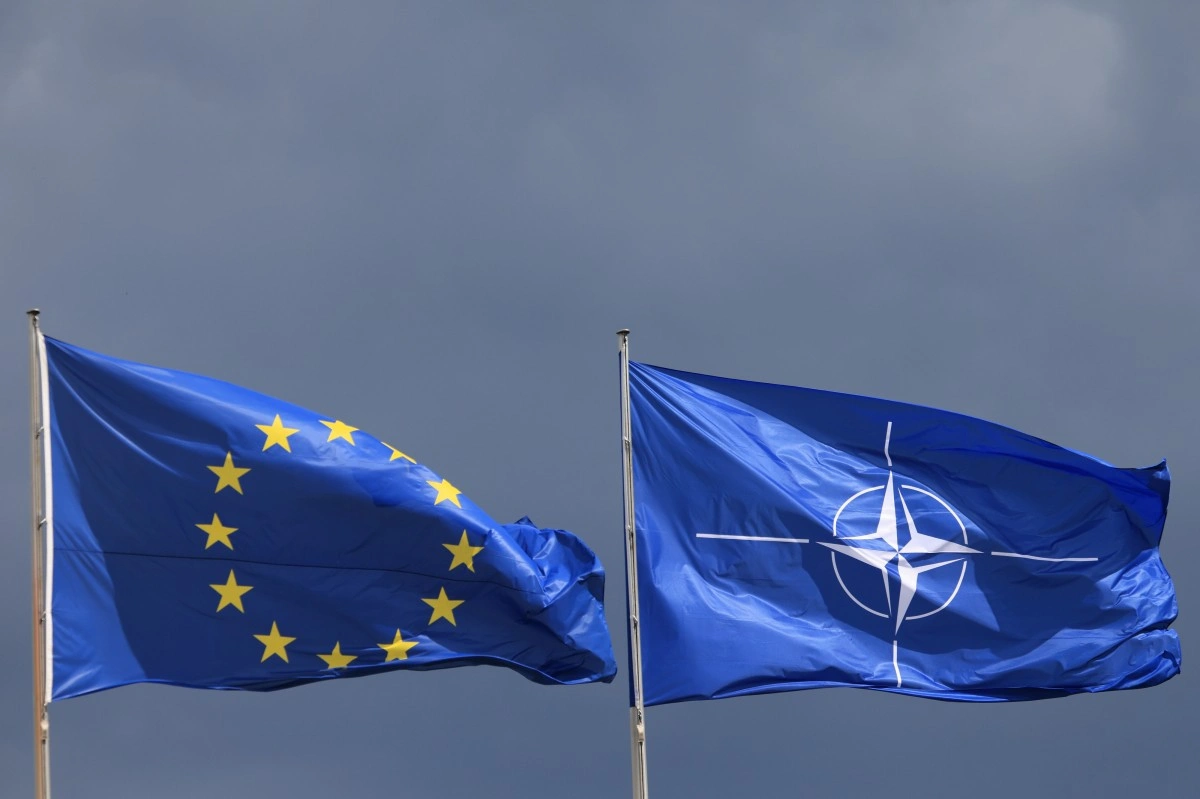
The row between Brussels and NATO headquarters is not a procedural squabble. It is a civilisational argument about who governs the security of a continent — and it is happening right now, in real time, with real money.
When NATO Secretary General Mark Rutte stood before the European Parliament’s security committee on 26 January 2026 and told MEPs they were “dreaming” if they thought Europe could defend itself without America, the room didn’t applaud. It erupted. French Foreign Minister Jean-Noël Barrot shot back within hours: “Europeans can and must take charge of their own security.” Former European Council President Charles Michel was blunter still: “Europe will defend itself. And Donald Trump is not my daddy.” Nathalie Loiseau, a senior French MEP, called the moment “disgraceful.”
That exchange — raw, public, and utterly undiplomatic — was not a bad day at the office. It was the visible surface of something deeper and far more consequential: a genuine NATO–EU turf war over defence spending, industrial sovereignty, and the fundamental question of who controls Europe’s security architecture. The money involved — well over a trillion euros by 2030 — means the stakes could hardly be higher.
The Numbers That Started the Fight
To understand why the tension has turned existential, start with the scale of the transformation underway.
At NATO’s Hague Summit in June 2025, allies shattered the old 2% GDP benchmark that had defined the burden-sharing debate since 2014. All 32 members had finally reached that floor — for the first time in the Alliance’s recorded history — but rather than declare victory, they committed to an audacious new pledge: 3.5% of GDP on core defence by 2035, with a broader 5% target encompassing defence-related security expenditure. As Rutte presented his 2025 Annual Report in Brussels on 26 March 2026, he confirmed that European allies and Canada had already increased defence spending by 20% in a single year, a surge without precedent outside of wartime.
The national figures are staggering in their own right. Germany’s defence budget rose to €95 billion in 2025 — double its 2021 level — and is projected to reach €117.2 billion in 2026 and €162 billion by 2029, equivalent to roughly 3.2% of GDP. Berlin’s reform of its constitutional debt brake, secured by Chancellor Friedrich Merz in early 2025, was perhaps the single most consequential defence policy decision in post-Cold War European history. France raised its 2026 defence allocation to €68.5 billion, or 2.25% of GDP, despite wider fiscal pressures. Poland — long the scold of NATO’s free-riders — is now spending an extraordinary 4.48% of GDP, with the Baltic states not far behind: Lithuania at 4.00%, Latvia at 3.73%, and Estonia at 3.38%. Norway, improbably, has become the first European ally to surpass the United States in defence spending per capita.
And then there is Brussels. The European Commission’s ReArm Europe/Readiness 2030 framework is designed to unlock up to €800 billion in defence investment over four years, principally through fiscal flexibility, EU-backed bonds, and its centrepiece instrument: SAFE (Security Action for Europe), a €150 billion low-interest loan facility for joint procurement that entered into force in May 2025. By early April 2026, the Council had already greenlighted SAFE funding for 18 EU member states.
Two institutions. One security continent. And increasingly, a fundamental disagreement about who is in charge.
The Architecture of Friction
The NATO-EU defence spending turf war is not new, but it has never been this consequential. For decades, institutional friction was managed through well-worn diplomatic formulas: “complementarity,” “no duplication,” “single set of forces.” These phrases papered over a genuine structural tension — NATO is a treaty-based military alliance that includes the United States, the United Kingdom, Turkey, Canada and Norway as non-EU members; the EU is a political-economic union with growing but constitutionally limited defence ambitions.
The friction points have now crystallised into three distinct fault lines.
Fault Line One: Who Defines the Target?
The most visible dispute concerns the headline numbers. NATO’s Hague pledge of 3.5-5% of GDP is a political commitment made by heads of government to an Atlantic alliance. The EU’s €800 billion ReArm Europe envelope is a separate institutional initiative developed by the European Commission under Ursula von der Leyen, in parallel and with its own governance, its own priorities, and — critically — its own conditionalities about where the money must be spent.
When Rutte addressed the European Parliament in January 2026, he was careful in his language about complementarity, calling for “NATO setting standards, capabilities, command and control, and the EU focusing on resilience, the industrial base, regulation, and financing.” But this apparently tidy division conceals a sovereignty question of the highest order: who decides what capabilities Europe needs? Who arbitrates between NATO Capability Targets and EU capability priorities? Who writes the procurement specifications that determine which fighter jet, which missile system, which munition gets built?
Rutte himself warned explicitly against creating a “European pillar” as a parallel structure, calling it “a bit of an empty word” that would require “men and women in uniform on top of what is happening already” and make coordination harder. “I think Putin will love it,” he said. Paris heard this as a threat. Warsaw heard it as common sense. The gap between those two interpretations is not merely tactical — it is civilisational.
Fault Line Two: The Industrial Sovereignty Battle
The sharpest and least-reported dimension of this NATO-EU turf war is industrial. SAFE is not simply a financing instrument — it is, by design, a mechanism for building a European Defence Technological and Industrial Base (EDTIB) that privileges European suppliers. The regulation is explicit: at least 65% of the value of any SAFE-funded contract must go to suppliers from EU member states, EEA countries, or Ukraine. Non-EU components are capped at 35% of total contract costs.
In practice, this means that €150 billion of defence procurement — and by extension, the industrial choices that will define European military capacity for a generation — will be steered away from US and UK defence companies. The implications for transatlantic industrial integration are profound. Since 2022, European NATO allies have spent $184 billion purchasing defence equipment from American companies — roughly half of all procurement spending. SAFE’s “European preference” provisions are designed, at least in part, to reverse that flow.
The United Kingdom provides the most vivid case study of what this means in practice. Despite signing a Security and Defence Partnership with the EU in May 2025, London’s negotiations over SAFE participation collapsed in November 2025. The Commission reportedly proposed a UK financial contribution of between €4 billion and €6.75 billion for full participation — a figure Britain’s Defence Secretary John Healey confirmed was unacceptable. Canada, by contrast, secured participation for a one-off fee of roughly €10 million. The contrast — a key NATO ally and close security partner asked to pay six hundred times what a non-European country paid — illustrates how far the EU’s defence industrial logic has drifted from NATO’s alliance-first framework.
Türkiye, a NATO member for over seven decades and a significant defence industrial power in its own right — producing drones that European militaries have purchased in quantity — sits in institutional limbo, deepening what analysts have called “the EU-NATO coordination problem” at its very heart.
The consequences are not abstract. The Franco-British Storm Shadow missile — among the most operationally significant precision weapons deployed in Europe — could under current SAFE rules only be procured from its French production site, not its British one. In a conflict scenario, that is not a procurement inefficiency. It is a capability risk.
Fault Line Three: The Strategic Autonomy Paradox
Behind the institutional friction lies a philosophical rupture that no amount of joint declarations can fully paper over. The EU’s quest for strategic autonomy — the ability to act independently in matters of security without reflexive dependence on Washington — has accelerated dramatically under the pressure of Donald Trump’s second presidency.
Trump’s threat to annex Greenland, his public declaration that America “never needed” its NATO allies, his suspension of military assistance to Kyiv — these were not rhetorical provocations. They were strategic shocks that convinced a critical mass of European leaders that the old bargain, under which Europe bought American security by hosting American troops and purchasing American equipment, could no longer be taken for granted. As Rutte himself acknowledged, “without Trump, none of this European rearmament would have happened.”
And yet the logic of strategic autonomy, pursued to its conclusion, undermines the very alliance that provides Europe’s most credible military guarantee. Rutte made this point with unusual directness: if Europe truly wanted to go it alone, he argued, it would need not 5% of GDP in defence spending but 10%, plus its own independent nuclear deterrent, at a cost of “billions and billions of euros.” The European pillar, in his formulation, risks becoming a competitor to the transatlantic one rather than a reinforcement of it.
France, predictably, sees this differently. Macron has insisted on a “European Strategic Autonomy” that includes an eventual European nuclear dimension, a “Made in Europe” defence industrial preference, and the right of European nations to have their own seat at any future arms control negotiations with Russia — not as a supplicant of Washington but as a sovereign actor in their own right. At the Munich Security Conference in February 2026, Macron explicitly invoked the Greenland crisis as evidence that European sovereignty was under threat not just from Russia, but from allied coercion.
The paradox is this: the constituencies most willing to invest in European rearmament — Poland, the Baltic states, the Nordic nations — are precisely those that remain the most committed Atlanticists, believing rearmament strengthens NATO rather than supplementing it. The states most aligned with Macron’s autonomy thesis — France, Belgium, to some degree Germany — have historically been the most reluctant to spend. The political economy of European defence was always peculiar; it has now become actively contradictory.
The Risk of Duplication — and Something Worse
The bluntest warning about where all this leads came not from a politician but from a bureaucratic observation buried in SAFE’s own legislative architecture. The European Parliament’s December 2025 resolution warned that poor investment coordination could lead to “inefficiencies and unnecessary costs.” In the bland vocabulary of EU institutional documents, that is a category-five alarm.
Europe’s defence industrial landscape was already characterised by fragmentation, overlapping national programmes, and a persistent failure to achieve the economies of scale that only joint procurement can deliver. Rutte noted this directly in a speech that deserves far wider quotation: “We have to get rid of that idiotic system where every Ally is having these detailed requirements, which makes it almost impossible to buy together. One nation needs the rear door of an armoured personnel carrier opening to the left. Another needs it to open to the right. And a third one needs it to open upwards. This has got to change.”
Now consider what happens if NATO’s capability targets pull in one direction while EU procurement priorities pull in another, and member states — each seeking to protect their own defence industrial champions — game both systems simultaneously. You get not complementarity but competitive fragmentation at industrial scale. You get a continent spending more than at any point since the Cold War while delivering less collective capability than the sum of its parts.
The EU’s own White Paper on the Future of European Defence acknowledged that over 70% of defence acquisitions by EU member states in the two years following Russia’s full-scale invasion of Ukraine were made outside the EU, chiefly from the United States. The SAFE mechanism is explicitly designed to reverse this. NATO’s position is that this reversal, if managed poorly, will raise costs, reduce innovation, and create capability gaps that adversaries will exploit.
Both sides are right. And that is the most dangerous kind of institutional disagreement.
The Ankara Summit and the Reckoning Ahead
All of this converges on the NATO Ankara Summit scheduled for July 2026. The agenda will nominally focus on demonstrating allied unity and confirming the credibility of the 5% GDP pathway. In reality, it will be a stress test of how far NATO’s European members have drifted toward a parallel institutional logic — and how much of that drift is recoverable.
The NATO common fund is itself growing — €5.3 billion for 2026, with a military budget of €2.42 billion — but these figures represent barely 0.3% of total allied defence spending. The Alliance runs on national contributions, nationally procured equipment, and nationally designed capabilities. Its genius was always to coordinate all of this under a common planning framework and a credible Article 5 guarantee. The EU’s genius, if it can claim one in the defence domain, lies in its financial firepower, its regulatory authority over the single market, and its unique capacity to channel collective resources through institutions that Washington cannot veto.
What Europe actually needs is not a choice between these two logics but a synthesis of them. The building blocks for such a synthesis exist — the NATO-EU Joint Declaration of January 2023, the various cooperation frameworks between OCCAR and NATO’s Support and Procurement Agency, the role of the European Defence Agency as a bridge institution. Rutte himself sketched the appropriate division of labour: NATO for standards, capabilities, command and control; the EU for resilience, industrial capacity, regulation, and financing.
But a division of labour requires trust and agreed boundaries. Right now, the boundaries are contested at the highest levels. When an EU regulation can exclude the United Kingdom — America’s closest military ally and a permanent UN Security Council member with independent nuclear capability — from preferred status in a procurement programme built on European taxpayers’ money, the division of labour has curdled into something resembling a protection racket for European defence industry incumbents.
The Opinion: This Is Not Bureaucratic Friction. It Is a Power Struggle.
Let me be direct about what I think this is, because the diplomatic language that surrounds it obscures rather than illuminates.
The NATO-EU turf war over defence spending is a genuine power struggle — one that will determine whether Europe’s security architecture in the 2030s is transatlantic or continental, whether the United Kingdom remains integrated into European defence or is structurally excluded, and whether the enormous spending surge now underway produces actual collective military capability or a fragmented, expensive, politically managed industrial complex that looks formidable on paper and performs badly in the field.
The EU is not wrong to want a stronger industrial base. European strategic autonomy is not a French fantasy — it is a rational response to the demonstrated unreliability of the Trump administration. The SAFE mechanism, whatever its imperfections, represents the most serious attempt in the history of European integration to build common defence industrial capacity. This matters.
But NATO is not wrong either. The alliance’s planning standards, interoperability requirements, and command structures are the tested, proven infrastructure of collective European defence. Rutte’s warning that duplicating these structures would be ruinously expensive and operationally counterproductive is not self-interested institutional advocacy — it is a serious strategic argument. The exclusion of the UK and Turkey from full participation in EU defence programmes is not a minor administrative detail — it is a fracture in the Western defence community at exactly the moment when coherence is most needed.
What is missing — and what Ankara must provide — is not a winner in this turf war but a genuine governing framework for the trillion-euro rearmament now underway. That means, at minimum, three things.
First, a formal agreement that NATO’s Defence Planning Process provides the primary capability requirements against which EU procurement — including SAFE — is measured and designed. Industrial preference is legitimate; industrial fragmentation in the name of preference is self-defeating.
Second, a resolution of the UK-SAFE impasse before the Ankara summit. The spectacle of Britain — which hosts America’s most important intelligence-sharing infrastructure, contributes the Alliance’s second-largest conventional military, and provides nuclear deterrence alongside France — being locked out of European defence procurement on the basis of Brexit accounting is strategically absurd. The European Parliament itself has called for talks to resume. Leadership, rather than institutional inertia, should now deliver them.
Third, and most fundamentally, a candid conversation — at head-of-government level, not delegated to defence ministers and bureaucrats — about the nuclear question. France has an independent deterrent. Britain has one. Germany does not, and Germany is the largest conventional spender on the continent. Sweden is reportedly exploring nuclear cooperation with France and the UK. The United States’ nuclear umbrella is the article of faith on which NATO’s ultimate deterrence rests. If that umbrella is genuinely no longer reliable, Europe needs to know — and to plan accordingly, together.
The turf war between NATO and the EU is, at its core, an argument about whether Europe’s security future is to be governed by the logic of an alliance or the logic of a union. These are not mutually exclusive — but they are currently in fierce competition. The continent is spending more on its own defence than at any point in living memory. Whether that spending makes Europe safer depends entirely on whether NATO and the EU can stop fighting over the budget long enough to agree on what it’s for.
Key Figures at a Glance
| Country | 2025 Defence Spend (% GDP) | 2026 Budget (€bn) |
|---|---|---|
| Poland | 4.48% | ~55bn |
| Lithuania | 4.00% | — |
| Latvia | 3.73% | — |
| Estonia | 3.38% | — |
| Germany | 2.14% | 117.2bn |
| France | 2.25% | 68.5bn |
| Denmark | 2.65% | — |
| EU-27 Total | ~1.9% avg | ~381bn |
Sources: European Parliament Think Tank, NATO Annual Report 2025, EU Council
The Ankara summit in July 2026 will be, above all else, a test of whether Europe’s leaders can govern the century’s most consequential security spending surge — or whether they will let it be dissipated in institutional competition. History will not be patient with the outcome.
Discover more from The Economy
Subscribe to get the latest posts sent to your email.



Key Takeaways
- Rolex’s secondary market rose approximately 7.9% year-over-year as of 2026 (per WatchCharts data) — trailing Patek Philippe (+16.2%) and Tudor (+11.4%) but still outperforming Audemars Piguet (+3.4%).
- Rolex raised U.S. retail prices 4–9% in January 2026 (steel models ~5.6%, gold models ~8.7%), narrowing the historical gap between retail and pre-owned pricing.
- Not every model appreciates: steel sports references (Submariner, GMT-Master II, Daytona) have held value far better than two-tone or widely available dress references like the standard Datejust.
- The Lady-Datejust posted the sharpest 2026 gain among tracked collections — up 22.73%, from roughly $9,269 to $11,376 — driven by demand for smaller, “everyday luxury” watches.
- Gold’s rise past $2,400/oz has directly lifted the investment case for Rolex’s precious-metal references (Day-Date, Sky-Dweller, Yacht-Master).
The Model-by-Model Picture
| Category | 2026 Trend |
|---|---|
| Lady-Datejust | +22.73% (strongest performer among tracked collections) |
| Steel sports models (Submariner, GMT-Master II) | Held value well; corrected from 2022 peak but stabilized above retail |
| Daytona | Corrected from highs above $50,000 to the mid-$30,000s; still among the most sought-after references |
| Two-tone/widely available Datejust | Flat to negative — “holds value” is an overstatement for this category |
| Gold references (Day-Date, Sky-Dweller) | Lifted by gold’s rise above $2,400/oz |
Why the “Rolex Always Appreciates” Myth Is Fading
The pandemic-era boom pushed some references — the Daytona above all — to speculative highs disconnected from historical norms. Since the March 2022 peak, steel sports models have compressed meaningfully, and dealers who bought inventory near the top have in some cases faced 20–40% markdowns on liquidation. The lesson for 2026 buyers: Rolex as a category is not a monolith. Value retention depends heavily on specific reference, condition, and whether the piece comes with box and papers (“full set”).
What’s Actually Driving 2026 Strength
- Retail price increases raise the floor. When a new Submariner retails at $10,050 (up from $9,500), a pre-owned example at $11,000–$12,000 suddenly represents a smaller premium — narrowing the gap without secondary prices actually moving.
- Supply discipline remains Rolex’s core lever. The brand has never confirmed production numbers, and secondary-market premiums remain entirely a function of Rolex’s own manufacturing decisions — a risk factor as much as a support.
- Certified Pre-Owned rollout. Rolex’s now fully rolled-out CPO program has changed how buyers transact in the used market, adding a layer of brand-verified legitimacy that supports pricing.
The Case for Rolex as a Portfolio Diversifier
Financial advisors increasingly frame luxury watches not as a replacement for equities or bonds, but as a tangible, historically low-correlation diversifier — one that carries its own risks (illiquidity, condition-dependent pricing, no yield) but has demonstrated multi-decade resilience for specific references.
Is Rolex a good investment in 2026?
It depends heavily on the specific reference. Steel sports models like the Submariner and Daytona have held or grown in value; two-tone and widely available dress models generally have not. Overall, Rolex’s secondary market rose about 7.9% year-over-year in 2026, trailing Patek Philippe but ahead of Audemars Piguet.
Discover more from The Economy
Subscribe to get the latest posts sent to your email.

Navigating Mortgage and Loan Refinancing in a High-Yield Environment
Global public debt crossing critical thresholds has kept central bank policies volatile, resulting in fluctuating US Treasury yields throughout 2026. For homeowners and commercial property holders burdened by previous high-interest borrowing cycles, finding optimal refinance windows has become a high-stakes financial puzzle. Stalled disinflation and stubborn employment numbers mean rate cuts are incremental, requiring borrowers to act with precision.
Timing your mortgage or commercial loan refinance in this environment requires a deep understanding of yield curve movements and lender risk appetites.
Decoding 2026 Refinance Dynamics
The 10-Year Treasury Yield Benchmark
Mortgage rates continue to track closely with the 10-year US Treasury yield. When macroeconomic anxiety spikes debt issuance, yields rise, tightening consumer borrowing capacity. Savvy borrowers monitor weekly Treasury auctions to lock in rates during brief dip windows.
Hybrid ARMs and Alternative Structures
With fixed rates remaining elevated, 7/1 and 10/1 adjustable-rate mortgages (ARMs) have surged in popularity. These products offer lower initial monthly payments, giving borrowers breathing room until central bank easing cycles fully materialize.
| Loan Product | Current Rate Range | Best For | Key Risk Factor |
| 30-Year Fixed Mortgage | 6.2% – 6.8% | Long-term predictability | Higher initial monthly outlay |
| 7/1 Hybrid ARM | 5.5% – 5.9% | Short-term ownership / flipping | Rate reset risk after year 7 |
| Commercial Refinance | 7.0% – 8.2% | Corporate asset restructuring | Strict DSCR lender covenants |
Actionable Steps for Successful Refinancing
To maximize your chances of securing favorable refinance terms in a volatile market, follow a disciplined preparation strategy.
Boost Your Credit Score Immediately: Lenders in 2026 are applying stringent credit tiering; a 20-point increase can drop your APR by a crucial quarter-point.
Shop Regional Credit Unions: Smaller financial institutions often offer portfolio loans with more flexible underwriting than major national banks.
Calculate the Break-Even Point: Ensure your total closing costs are recouped through monthly savings within 24 months of closing.
“Market Strategist View: Refinancing in 2026 is an exercise in opportunistic timing. Borrowers must maintain immaculate financial profiles ready to strike the moment Treasury yields dip.”
Mastering the complexities of today’s debt environment ensures you can successfully lower your debt service costs and protect your long-term financial stability.
Discover more from The Economy
Subscribe to get the latest posts sent to your email.

The days of pulling generic auto insurance quotes based purely on your zip code and age are officially over. In 2026, insurance comparison engines are powered entirely by generative AI and real-time telematics. These platforms digest thousands of live data points—ranging from your driving smoothness via connected vehicle sensors to real-time traffic congestion patterns—to generate hyper-personalized premiums instantly.
For consumers, this evolution represents both a massive opportunity for savings and a hidden trap for penalty pricing. Understanding how AI algorithms evaluate risk is essential for anyone looking to lower their monthly auto insurance premiums.
How AI Comparison Engines Evaluate Your Risk Profile
Behavioral Telematics and Connected Cars
Modern cars stream performance data directly to insurance aggregators. Generative AI models analyze braking sharpness, acceleration curves, cornering G-forces, and phone distraction metrics. Drivers who maintain smooth, defensive habits are rewarded with dynamic rate cuts of up to 40% compared to traditional rating tiers.
Predictive Traffic and Weather Modeling
AI tools now cross-reference your daily commute route with predictive weather and accident probability models. If your standard parking location or driving corridor has a statistically higher incidence of uninsured motorist claims, your quotes will reflect that hyper-local risk assessment.
| Comparison Factor | Traditional Rating Model | 2026 Generative AI Model | Impact on Premium |
| Mileage & Usage | Annual estimated odometer reading | GPS tracking & live trip duration | High (up to 35% savings) |
| Driving Behavior | MVR driving record & accidents | Real-time braking, speed, & G-force | Critical (determines tier) |
| Vehicle Tech | Make, model, and safety rating | ADAS calibration & repair cost data | Moderate |
Strategies to Lower Your AI-Driven Insurance Quote
To outsmart the algorithm and secure the lowest possible premium in 2026, drivers must proactively manage their digital footprint on insurance platforms.
Opt-In for Telematics Trial Periods: Many insurers offer immediate 15% discounts just for installing their driving app; let it track safe habits for 30 days to lock in permanent savings.
Scrub Unverified Public Records: Ensure your motor vehicle report is free of clerical errors that AI risk models misinterpret as reckless behavior.
Compare AI Aggregators: Use platforms that integrate multi-carrier API feeds rather than single-brand comparison sites to find the best risk-adjusted rate.
“Industry Note: AI-driven pricing rewards transparency and precision. Drivers who actively manage their telematics data consistently out-save those relying on legacy quote calculators.”
Embracing AI comparison tools allows savvy policyholders to customize coverage limits precisely to their driving habits, eliminating wasted premium spend while ensuring robust protection.
Discover more from The Economy
Subscribe to get the latest posts sent to your email.

Lula Re-elected in 2026: What Changes for the Dollar, Brazilian Stocks, and Interest Rates?

Lula Wins Brazil’s 2026 Election: Five Economic Tests for 2027

SSI November 2026 Payment: Why Benefits Arrive October 30

Russia Sanctions Waiver: What Asian Oil Buyers Gain

Asia Markets Weekly: How Oil, US Yields and the Fed Reach Tokyo, Kuala Lumpur and Karachi

Gold Near $4,000: Buy, Hold or Wait? A Pakistan Tola Price Guide

US 10-Year Treasury Yield Near 5%: The Hidden Cost for Pakistani Investors

Fed Meeting on October 28: Hike or Hold—and Why Pakistan Investors Should Care

Can Pakistan Turn US–Iran Mediation Into an Economic Dividend?

Oil Above $100: How Higher Crude Prices Reach Pakistan’s Rupee, Petrol and Imports

SBP Interest Rate at 11.5%: What Will Decide Pakistan’s Next Policy Move?

The Global South: Debt, Climate Finance and Investment in 2026

Energy Security Is the New Economic Security

Can Global Tourism Survive Geopolitical Shocks?

Crude Oil & Petroleum Market Analysis: OPEC+ Decisions and Price Forecasts

Silver Price Today: Why the Xi-Trump AI Standoff Is Fueling a Safe-Haven Rally

Top US Convenience Store Chains: Store Counts, EV Charging, and Sales Trends

Algorithmic Dogfights: Why the U.S. and China Must Establish Rules of Engagement for Autonomous Air Power

Who Is Shivon Zilis? The Neuralink Executive at the Center of the Musk–OpenAI Trial

Social Security Extra $90 Deposit: Who Qualifies for the October 2026 Medicare Rebate?

Global Economic Outlook 2026: 7 Forces Reshaping Markets, Trade and Business

Corporate America Faces a New Debt Test as US Borrowing Costs Surge

Gold Price Outlook 2026: The Forces Behind the Forecasts—and What Could Reverse Them

Gold Falls 3.7% as Yields Surge: Is Gold Still a Safe Haven in 2026?

Stock Market Today: Dow, S&P 500, and Nasdaq Retreat as Treasury Yields

Anthropic Bans Sustained Abuse of Claude AI Under New Usage Policy Effective November 12, 2026

MAS Allocates S$1.45 Billion to Five Asset Managers in Third EQDP Batch: Total Deployment Reaches S$5.4 Billion

US 10-Year Yield Hits 5.24%: What the Historic Bond Market Sell off Means for Mortgages and Investors
-

 Markets & Finance10 months ago
Top 15 Stocks for Investment in 2026 in PSX: Your Complete Guide to Pakistan’s Best Investment Opportunities
-

 Analysis8 months ago
Johor’s Investment Boom: The Hidden Costs Behind Malaysia’s Most Ambitious Economic Surge
-

 Analysis8 months ago
Top 10 Stocks for Investment in PSX for Quick Returns in 2026
-

 Banks9 months ago
Best Investments in Pakistan 2026: Top 10 Low-Price Shares and Long-Term Picks for the PSX
-

 Analysis9 months ago
Brazil’s Rare Earth Race: US, EU, and China Compete for Critical Minerals as Tensions Rise
-

 Investment10 months ago
Top 10 Mutual Fund Managers in Pakistan for Investment in 2026: A Comprehensive Guide for Optimal Returns
-

 Global Economy10 months ago
15 Most Lucrative Sectors for Investment in Pakistan: A 2025 Data-Driven Analysis
-

 Global Economy10 months ago
Pakistan’s Export Goldmine: 10 Game-Changing Markets Where Pakistani Businesses Are Winning Big in 2025