
AI
The Hidden Cost of AI ‘Workslop’: Why Professionals Are Creating It — and How Organisations Can Stop It

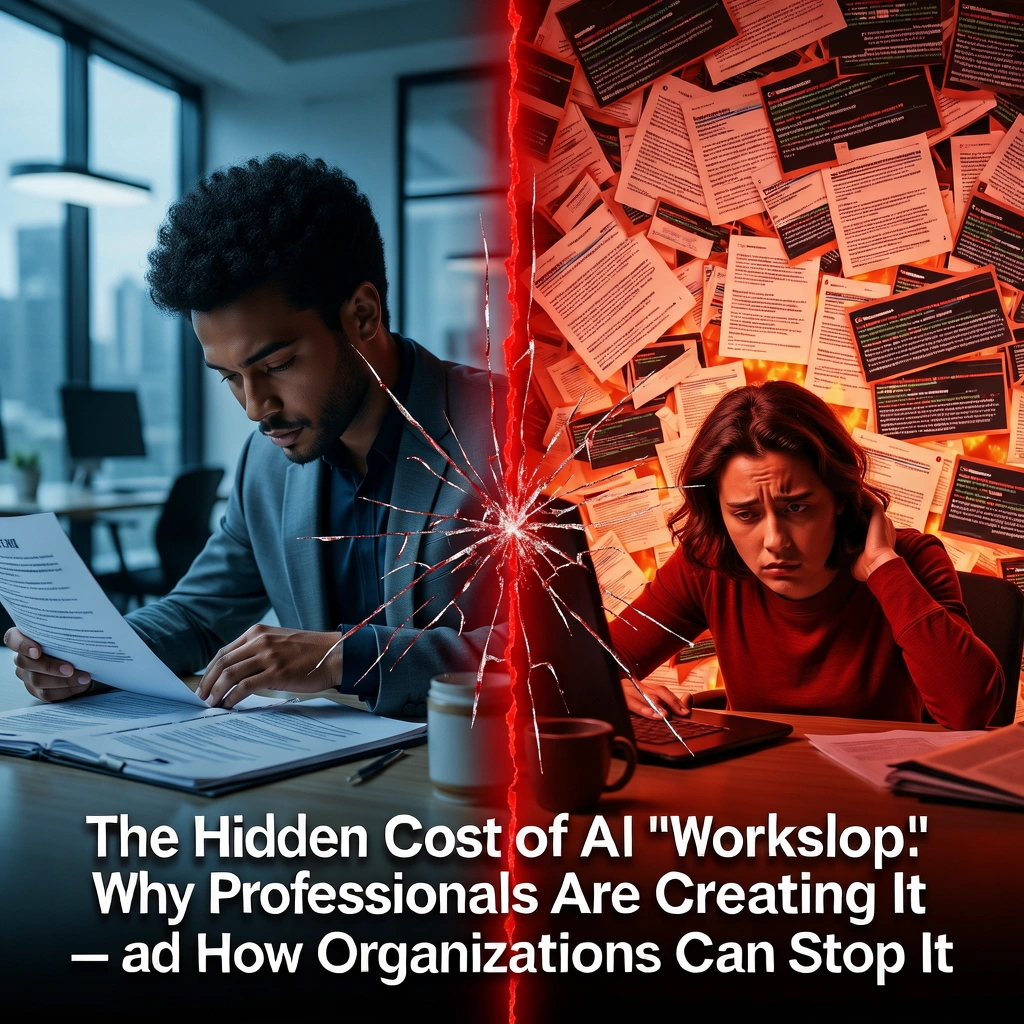
On a frigid Tuesday morning in January, a senior product manager at a Fortune 500 technology company opened what appeared to be a thoughtful three-page strategy memo from her colleague. The formatting was impeccable. The executive summary promised “actionable insights.” But as she read deeper, something felt wrong. The prose was oddly verbose yet strangely hollow—sentences that said everything and nothing simultaneously. Bullet points proliferated without prioritisation. Key decisions were buried in passive constructions. By the third paragraph, she recognised the telltale signs: this was AI-generated work, polished just enough to seem legitimate, but fundamentally empty.
She’d just encountered workslop.
Welcome to 2026’s defining workplace problem—one that paradoxically intensifies even as organisations invest billions in generative AI to boost productivity. While executives herald artificial intelligence as the great accelerator of knowledge work, something darker is emerging from the spreadsheets: a flood of low-quality AI generated content that masquerades as professional output while offloading cognitive labour onto everyone else.
What Is AI Workslop—and Why Should Leaders Care?
The term “workslop,” coined by researchers at Stanford University and BetterUp in 2025, describes AI-generated workplace content that meets minimum formatting standards but lacks substance, clarity, or genuine insight. Think of it as the professional equivalent of content farm articles: superficially plausible, fundamentally worthless, and designed more to signal effort than to communicate ideas.
Workslop AI manifests across every digital workplace surface. That rambling email that could’ve been two sentences. The slide deck with stock phrases like “synergistic opportunities” and “strategic imperatives” but no actual strategy. The meeting summary that somehow requires three pages to convey what everyone already discussed. The report that reads like a thesaurus exploded onto a template.
Unlike obviously bad writing, workslop is insidious precisely because it appears acceptable at first glance. It has proper grammar, professional vocabulary, formatted headers. It follows templates. But consuming it—trying to extract actual meaning—becomes exhausting cognitive work that the creator has outsourced to the reader.
According to research published in Harvard Business Review in January 2026, the average knowledge worker now encounters workslop in roughly 35% of internal communications, up from virtually zero two years ago. More alarmingly, the same research found that processing workslop consumes approximately four hours per week of professional time—time spent deciphering, clarifying, and essentially doing the cognitive work the original creator avoided.
The math is brutal. For a 1,000-person organisation where the average employee earns $80,000 annually, that’s approximately $9.2 million in annual productivity loss. And that’s the conservative estimate, accounting only for direct time costs. It excludes strategic errors from misunderstood communications, damaged professional relationships, and the slow erosion of organisational trust.
The Generative AI Productivity Paradox Takes Shape
Here’s the uncomfortable truth: we’re witnessing a generative AI productivity paradox.
Organisations have embraced AI tools at unprecedented speed. Forbes reported in late 2025 that 78% of Fortune 1000 companies now provide employees with access to ChatGPT, Claude, or similar platforms. Microsoft Copilot has penetrated 65% of enterprise customers. The promise seemed obvious: automate routine communications, accelerate document creation, amplify individual productivity.
Yet productivity gains remain stubbornly elusive. Research from the National Bureau of Economic Research found that while individuals using AI tools report feeling more productive, their colleagues frequently report the opposite—spending more time on email, meetings, and clarifications. The pattern emerging is stark: AI doesn’t eliminate work; it redistributes it, often unfairly.
When one person uses AI to generate a meandering three-page email in 30 seconds, they’ve saved themselves time. But if that email requires five recipients to spend 10 minutes each deciphering it, the organisation has lost 50 minutes to save one person half a minute of careful writing. It’s productivity theatre masquerading as innovation.
“We’re creating a tragedy of the commons in corporate communications,” explains Dr. Sarah Chen, an organisational psychologist who studies technology adoption. “Every individual has an incentive to use AI to reduce their own cognitive load, but when everyone does it simultaneously, the collective burden actually increases.”
Why Intelligent Professionals Create Workslop: The Psychology of Cognitive Offloading
Understanding how to avoid AI workslop begins with understanding why people create it—and the answer is more nuanced than simple laziness.
The Seduction of Effortless Output
Generative AI tools offer something intoxicating to overwhelmed knowledge workers: instant competence. Faced with a blank screen and a looming deadline, the ability to summon 500 professionally formatted words with a single prompt feels like magic. The cognitive relief is immediate and powerful.
Neuroscience research shows that our brains are wired to take the path of least resistance. When AI offers to handle the “tedious” work of structuring arguments, finding synonyms, or expanding bullet points into paragraphs, declining feels almost irrational. Why struggle with phrasing when the machine can do it instantly?
But here’s what’s lost in that exchange: the struggle is the work. Transforming vague thoughts into precise language forces clarity. Wrestling with how to structure an argument reveals which ideas actually matter. The friction of writing is where understanding happens. When we outsource that friction to AI, we outsource the thinking itself.
Performance Pressure and the AI Arms Race
Many professionals create AI slop workplace content not from laziness but from fear.
In organisations where colleagues are using AI, abstaining feels like unilateral disarmament. If your peer can produce a 20-slide deck in an hour while you’re still outlining yours, are you falling behind? If the team expects rapid-fire email responses and AI makes that possible, can you afford to slow down and craft thoughtful replies?
This dynamic creates a vicious cycle. As The Washington Post reported, many professionals describe feeling “obligated” to use AI tools even when they suspect the output is inferior. The perception that everyone else is using AI—whether accurate or not—becomes self-fulfilling.
“I know my AI-generated status reports aren’t as clear as what I used to write by hand,” admitted one consultant who spoke on condition of anonymity. “But leadership expects them weekly now instead of monthly, and I simply don’t have time to write four thoughtful reports a month. So I prompt, I polish for ten minutes, and I send. I hate that my name is on something mediocre, but what choice do I have?”
Organisational Incentives That Reward Volume Over Value
The workslop epidemic isn’t solely a people problem—it’s a systems problem.
Many organisations have inadvertently created incentive structures that reward the appearance of productivity over actual value creation. When success metrics emphasise deliverables completed, emails sent, or reports filed rather than decisions improved or problems solved, AI becomes an enabler of performative work.
Consider the phenomenon of “AI mandates without guidance.” CNBC documented how several major corporations have encouraged or even required employees to use generative AI tools—framed as “staying competitive” or “embracing innovation”—without providing clear frameworks for appropriate use. The message employees receive is essentially: use AI more, but we won’t tell you when or how.
The result is predictable. If using AI is valorised regardless of outcome, and quality is difficult to measure, employees will use AI for everything. Quantity becomes the proxy for competence.
Tool Design Flaws: When AI Makes Slop Too Easy
Finally, we must acknowledge that current generative AI tools are almost designed to produce workslop.
Most AI assistants operate on a principle of prolixity—when uncertain, they add words. A single sentence of input can yield paragraphs of output, all grammatically correct, much of it filler. The tools don’t naturally distinguish between situations requiring depth and those requiring brevity. They don’t ask, “Is this the right medium for this message?” or “Have I actually said anything meaningful?”
Moreover, the friction required to create workslop is near-zero, while the friction required to create something genuinely good remains high. Generating mediocre content takes one prompt. Creating exceptional content still requires human judgment, iteration, editing—the very work AI was supposed to eliminate.
Until tool designers build in more friction for low-value outputs or more support for high-value thinking, the path of least resistance will continue producing slop.
The Real Cost: Why AI Reduces Productivity Despite Individual Gains
The damage from AI workslop extends far beyond wasted time.
The Productivity Tax Compounds
Research from Axios and workplace analytics firm ActivTrak found that processing low-quality AI content doesn’t just consume time—it fragments attention and depletes decision-making capacity.
When professionals encounter workslop, they face a choice: invest energy trying to extract meaning, or request clarification (which creates more work for everyone). Either option imposes costs. The first depletes cognitive resources needed for strategic work. The second generates additional communication overhead and delays.
Over time, these micro-costs accumulate into macro-dysfunction. Teams spend more time in “alignment meetings” because written communications no longer align anyone. Projects stall because requirements documents are simultaneously verbose and vague. Strategic initiatives falter because the business case was generated rather than reasoned.
“We’re seeing organisations where 60% of email volume is essentially noise,” notes Michael Torres, a management consultant who advises on digital workplace practices. “People have started assuming that anything longer than three paragraphs can be safely ignored, which means genuinely important communications are now getting buried alongside the slop.”
Trust Erosion in Professional Relationships
Perhaps more corrosive than the time cost is the damage to professional credibility and trust.
When colleagues recognise that someone is routinely submitting AI-generated work with minimal thought, respect diminishes. The implicit message is clear: “I don’t value your time enough to think carefully before communicating with you.” Over time, this erodes the social capital required for effective collaboration.
Several organisations interviewed for this article reported a concerning trend: professionals increasingly ignore communications from colleagues known to produce workslop. One executive described creating an informal “filter list” of people whose emails he automatically skims for essential information while disregarding analysis or recommendations.
“It’s a tragedy,” he acknowledged. “Some of these are talented people. But I’ve learned that their AI-generated memos are unreliable, so I just extract the data and ignore their conclusions. That’s probably causing me to miss good ideas, but I don’t have time to sift through the filler.”
This dynamic is particularly damaging for early-career professionals who haven’t yet established reputations. When senior leaders encounter workslop from junior team members, they form lasting impressions about competence and judgment—impressions that may be undeserved but difficult to reverse.
Decision-Making Degradation
Most dangerous is workslop’s impact on organisational decision-making.
AI-generated work problems often hide in the space between what’s written and what’s meant. A strategy recommendation might sound plausible but rest on flawed assumptions the AI didn’t understand. A risk assessment might list generic concerns without identifying the actual specific vulnerabilities. A project post-mortem might catalogue events without extracting lessons.
When leaders make decisions based on AI-generated analysis they assume was human-reasoned, they’re building on potentially unstable foundations. Several executives described situations where strategic decisions were made based on compelling-sounding recommendations, only to discover later that the underlying analysis was superficial—the product of AI summarising publicly available information rather than domain expertise.
“We nearly acquired the wrong company because the due diligence memo was beautifully formatted nonsense,” confided one private equity principal. “The analyst had used AI to expand his notes into a full report, but the AI didn’t understand our investment thesis. We only caught it when someone noticed a logical inconsistency buried in paragraph fourteen.”
Workslop in the Wild: Real-World Examples Across Sectors
To understand the phenomenon’s pervasiveness, consider these anonymised examples from different industries:
Technology sector: A product team at a major software company implemented a policy requiring weekly written updates. Within a month, these updates—once concise and insightful—had bloated to multi-page documents filled with phrases like “optimising for synergistic outcomes” and “leveraging agile methodologies to drive stakeholder value.” Product managers were spending 90 minutes weekly generating these reports and roughly the same reading everyone else’s. Actual status could have been communicated in a 5-minute standup.
Professional services: At a global consulting firm, junior consultants began using AI to draft client deliverables, then having senior partners review and approve. Partners initially appreciated the time savings—until clients started providing feedback that reports were “generic” and “lacking industry insight.” The firm’s differentiation had always been deep contextual understanding; AI was systematically stripping that away. Client renewals declined 12% year-over-year.
Financial services: A European investment bank encouraged traders and analysts to use AI for market commentary and research notes. Within weeks, recipients were complaining that the analysis had become “undifferentiated” and “obvious.” The AI could summarise public information beautifully but couldn’t offer the proprietary insights that justified premium fees. The bank quietly reversed its AI encouragement policy.
Government/public sector: A national regulatory agency (outside the US) began using AI to draft policy guidance documents. The resulting materials were so dense and jargon-heavy that compliance officers reported spending more time interpreting the guidance than they would have under the previous, simpler system. What was intended to accelerate regulatory clarity instead created confusion.
These aren’t isolated incidents. They represent a pattern: organisations adopting AI for efficiency gains, initially seeing positive signals, then discovering that quality degradation imposes costs that eventually exceed the efficiency benefits.
How Organisations Can Stop the Workslop Epidemic: Evidence-Based Solutions
Addressing workslop requires interventions at multiple levels: cultural, structural, and technological. Leading organisations are pioneering approaches that preserve AI’s benefits while preventing its misuse.
1. Establish Clear Guidelines for Appropriate AI Use
The most effective organisations don’t ban AI—they define when and how it should be used.
Financial Times documented how several European firms have implemented “traffic light” frameworks:
- Green (encouraged): Using AI for initial research, brainstorming, formatting assistance, grammar checking, translation
- Yellow (use with caution): Drafting external communications, summarising complex documents, creating templates
- Red (prohibited or requires disclosure): Final client deliverables without human verification, strategic recommendations, performance reviews, legal documents
The key is specificity. Generic guidance like “use AI responsibly” proves meaningless in practice. Concrete rules—”all client-facing documents must be reviewed and edited by a human, with AI assistance disclosed if substantial”—provide actionable boundaries.
2. Train for Human-in-the-Loop Best Practices
Simply providing AI tools without training is like distributing scalpels without medical school. Leading organisations are investing in structured training programmes that teach effective AI collaboration.
These programmes emphasise several principles:
- Use AI as a thought partner, not a ghostwriter: Engage AI in dialogue to refine your thinking, then write the final version yourself
- Never send AI-generated content without substantial editing: If you can’t improve the AI’s output meaningfully, you probably don’t understand the topic well enough
- Apply the “telephone test”: If you couldn’t explain the content verbally with the same clarity, don’t send the written version
- Favour brevity over AI-generated expansion: If AI suggests adding paragraphs to your bullet points, resist unless each addition adds genuine value
Some organisations have implemented “AI literacy” certification programmes, similar to data security training, ensuring all employees understand both capabilities and limitations.
3. Redesign Incentives to Reward Quality Over Quantity
Stopping workslop ultimately requires addressing the organisational conditions that incentivise it.
Progressive firms are shifting metrics:
- Instead of tracking “reports completed,” measure “decisions improved” or “clarity ratings” from recipients
- Replace requirements for lengthy updates with brief, structured formats (Amazon’s famous six-page memos, but actually written by humans)
- Implement 360-degree feedback that specifically assesses communication quality and efficiency
- Recognise and reward professionals who communicate effectively with fewer, better-crafted messages
One technology company experimented with a provocative policy: any email longer than 200 words required VP approval. While ultimately too restrictive, the initial trial dramatically reduced communication volume and improved clarity. The modified version—any email over 200 words must include a three-sentence summary at the top—proved sustainable.
4. Build Technical Controls and Transparency
Some organisations are implementing technical measures to create accountability:
- Watermarking or disclosure requirements: Some enterprise AI tools now include metadata indicating AI involvement, allowing recipients to calibrate expectations
- Usage monitoring: Analytics that identify individuals generating unusually high volumes of AI content, triggering coaching conversations
- Quality checking tools: AI-powered systems that ironically detect AI-generated content and flag it for human review before sending
While these approaches raise legitimate privacy concerns and shouldn’t become surveillance systems, transparent implementation can help organisations understand usage patterns and identify where intervention is needed.
5. Model Alternative Behaviour from Leadership
Perhaps most critically, senior leaders must demonstrate that thoughtful, concise human communication is valued and rewarded.
When executives send brief, carefully considered emails rather than AI-generated essays, they signal priorities. When leaders openly discuss their AI use—”I used ChatGPT to research this topic, then wrote this analysis based on what I learned”—they model appropriate transparency. When promotions go to people who communicate with clarity rather than volume, the message resonates.
“I started ending important emails with a note: ‘This email was written by me without AI assistance because this decision matters,'” shared one CFO. “It sounds almost comical, but the feedback was overwhelmingly positive. People told me they noticed the difference and appreciated the care.”
The Path Forward: Will Workslop Fade or Persist?
Looking ahead, several scenarios could unfold.
The optimistic view suggests that workslop represents growing pains—an inevitable phase as organisations learn to integrate powerful new tools. As AI literacy improves, social norms against slop solidify, and tools become more sophisticated at generating genuinely useful content, the problem may naturally recede.
Some evidence supports this optimism. The Economist noted in late 2025 that organisations in their second or third year of widespread AI adoption show better usage patterns than those in their first year. Cultures develop antibodies. People learn what works and what doesn’t.
The pessimistic view holds that workslop may be symptomatic of deeper limitations in how we’re deploying generative AI. If the fundamental value proposition is “create more content with less effort,” we shouldn’t be surprised when people create more low-value content. The problem isn’t user education—it’s the mismatch between the tool’s capabilities and the actual needs of knowledge work.
This perspective suggests we need different tools entirely. Rather than AI that helps you write more, perhaps we need AI that helps you think more clearly, summarise more concisely, or communicate more precisely. Tools designed for quality rather than quantity.
The likely reality probably lies between these poles. Workslop won’t disappear entirely—it’s too easy to create and too tempting under pressure. But organisations that take it seriously as a cultural and operational challenge can substantially mitigate it. Those that don’t will find themselves drowning in a flood of plausible-sounding nonsense, watching productivity gains evaporate despite significant AI investment.
The broader question is whether the current generation of generative AI tools will prove to be genuinely transformative for knowledge work or merely another technology that seems revolutionary until organisations discover its hidden costs. Workslop may be our first clear signal that the answer is more complicated than the hype suggested.
Conclusion: Choose Clarity Over Convenience
Two years into the generative AI revolution, we’re learning an uncomfortable truth: tools that make it easier to create content don’t automatically make communication more effective. Sometimes, they make it worse.
The solution isn’t to reject AI—the technology offers genuine value when deployed thoughtfully. But we must resist the siren call of effortless output and recognise that good communication, like good thinking, requires effort. There are no shortcuts to clarity.
For leaders, the imperative is clear: establish guardrails, model best practices, and redesign systems that inadvertently reward slop. Create cultures where concision is prized and where the quality of thinking matters more than the volume of deliverables.
For individual professionals, the choice is equally stark: you can either do the cognitive work yourself and build a reputation for clear thinking, or you can outsource that work to AI and accept the professional consequences. Your colleagues will notice the difference, even if they don’t say so.
The hidden cost of AI workslop isn’t just measured in dollars or hours. It’s measured in degraded decision-making, eroded trust, and the slow corrosion of professional standards. We’re at a fork in the road: one path leads toward more thoughtful integration of AI that amplifies human judgment; the other leads toward increasingly automated mediocrity.
Which path your organisation takes isn’t determined by technology. It’s determined by choices—about what you value, what you reward, and what you’re willing to tolerate.
Choose carefully. The clarity of your communications may determine the quality of your future.
Discover more from The Economy
Subscribe to get the latest posts sent to your email.



Analysis | China’s AI Strategy | Global Technology Review
How China’s low-cost AI models—10 to 20 times cheaper than US equivalents—are quietly building global tech dependence, reshaping the AI race, and challenging American dominance.
In late February 2026, ByteDance unveiled Seedance 2.0, a video-generation model so capable—and so strikingly inexpensive—that it sent tremors through Silicon Valley boardrooms. The timing was no accident. Within days, Anthropic filed a legal complaint alleging that a Chinese national had systematically harvested outputs from Claude to train a rival model, a practice known in the industry as “distillation.” The accusation crystallized what many AI executives had quietly been saying for months: China is not simply competing in artificial intelligence. It is running a fundamentally different play.
The strategy is elegant in its ruthlessness. While American frontier labs—OpenAI, Google DeepMind, Anthropic—compete on the technological frontier, racing to build the most powerful and most expensive models imaginable, China’s leading AI developers are racing in the opposite direction. They are making AI astonishingly cheap, broadly accessible, and deeply entangled in the infrastructure of developing economies. Understanding how cheap AI tools from China compare to American frontier models is not merely a technology question. It is a question about who writes the rules of the next era of the global economy.
| Metric | Figure |
|---|---|
| Chinese AI global market share, late 2025 | 15% (up from 1% in 2023) |
| Cost advantage vs. US equivalents | Up to 20× cheaper |
| Alibaba AI investment commitment through 2027 | $53 billion |
The Sputnik Moment That Changed Everything
When DeepSeek released its R1 reasoning model in January 2025, the reaction in Washington was somewhere between bewilderment and alarm. US officials, accustomed to treating American AI supremacy as a structural given, struggled to explain how a Chinese startup—operating under heavy export restrictions that denied it access to Nvidia’s most advanced chips—had produced a model that matched, or in certain benchmarks exceeded, OpenAI’s o1. Reuters (2025) described the release as “a wake-up call for the US tech industry.”
The label that stuck was borrowed from Cold War history. Investors, policymakers, and researchers began calling DeepSeek’s R1 “a Sputnik moment”—a demonstration that the adversary had capabilities that had been systematically underestimated. The reaction was visceral: Nvidia lost nearly $600 billion in market capitalization in a single trading session. But the deeper implication was not about one model or one company. It was about a method.
“The real disruption isn’t that China built a good model. It’s that China built a cheap model—and cheap changes everything about adoption curves, lock-in, and geopolitical leverage.”
— Senior analyst, Brookings Institution Center for Technology Innovation
DeepSeek’s R1 was trained at an estimated cost of under $6 million, a fraction of what OpenAI reportedly spent on GPT-4. The model was open-sourced, triggering an avalanche of derivative models across Southeast Asia, Latin America, and sub-Saharan Africa. The impact of low-cost Chinese AI on US dominance had moved from hypothetical to measurable. By the fourth quarter of 2025, Chinese AI models had captured approximately 15% of global market share, up from roughly 1% just two years earlier, according to estimates cited by CNBC (2025).
Five Models and Counting: The Pace Accelerates
DeepSeek was only the opening act. Within weeks, five additional significant Chinese AI models had shipped—a pace that surprised even close observers of China’s technology sector. ByteDance’s Doubao and the Seedance family of multimodal models, Alibaba’s Qwen series, Baidu’s ERNIE updates, and Tencent’s Hunyuan collectively constitute what The Economist (2025) termed China’s “AI tigers.”
American labs have pushed back hard. Anthropic’s legal complaint over distillation practices reflects a broader industry concern: that Chinese developers are not merely competing on engineering talent but systematically harvesting the intellectual output of Western models to accelerate their own. The accusation is significant because distillation—training a smaller, cheaper model on the outputs of a larger one—is not illegal in most jurisdictions, but it sits in a legal and ethical gray zone that could reshape how frontier AI outputs are licensed and protected. Chatham House (2025) has observed that the practice “blurs the line between legitimate benchmarking and intellectual property extraction at scale.”
UBS Picks Its Winners
Not all Chinese models are created equal, and sophisticated institutional actors are drawing distinctions. Analysts at UBS, in a widely circulated note from early 2026, indicated a preference for several Chinese models—specifically Alibaba’s Qwen and ByteDance’s Doubao—over DeepSeek for enterprise deployments, citing more consistent performance on structured reasoning tasks and better compliance tooling for regulated industries. The note was striking precisely because it came from a global financial institution with every incentive to avoid geopolitical controversy. The risks of dependence on Chinese AI platforms, apparently, are acceptable to some of the world’s most sophisticated institutional investors when the price differential is this large.
Key Strategic Insights
- China’s cost advantage is structural, not temporary. Priced 10 to 20 times cheaper per API call, the gap reflects architectural innovation, lower energy costs, and in some cases state subsidy—making it durable over time.
- Emerging markets are the primary battleground. In Indonesia, Nigeria, Brazil, and Vietnam, Chinese AI tools have penetrated developer ecosystems faster than US equivalents because local startups and governments simply cannot afford American pricing.
- Open-sourcing is a deliberate geopolitical instrument. By releasing models under permissive licenses, Chinese developers seed global ecosystems with their architectures, creating dependency on Chinese tooling, Chinese fine-tuning expertise, and Chinese cloud infrastructure.
- The distillation controversy signals a new phase. As US labs tighten access and output monitoring, the cat-and-mouse dynamics of knowledge extraction will intensify, potentially reshaping how AI models are licensed globally.
- Hardware self-reliance is advancing faster than anticipated. Cambricon’s revenue surged over 200% in 2025 as domestic chip demand spiked, while Baidu’s Kunlun AI chips are now deployed across major Chinese data centers at scale.
The Comparison Table: US vs. Chinese AI
| Model | Origin | Relative API Cost | Global Reach Strategy | Open Source? | Hardware Dependency |
|---|---|---|---|---|---|
| OpenAI GPT-4o | 🇺🇸 US | Baseline (1×) | Enterprise, developer API; premium pricing | No | Nvidia (Azure) |
| Anthropic Claude 3.5 | 🇺🇸 US | ~0.9× | Safety-focused enterprise; selective access | No | Nvidia (AWS, GCP) |
| Google Gemini Ultra | 🇺🇸 US | ~0.85× | Google ecosystem integration; enterprise cloud | Partial (Gemma) | Google TPUs |
| DeepSeek R1 | 🇨🇳 CN | ~0.05–0.10× | Global open-source seeding; developer ecosystems | Yes | Nvidia H800 / domestic chips |
| Alibaba Qwen 2.5 | 🇨🇳 CN | ~0.07× | Emerging markets via Alibaba Cloud; multilingual | Yes | Alibaba custom silicon |
| ByteDance Doubao / Seedance | 🇨🇳 CN | ~0.06× | Consumer apps; TikTok ecosystem integration | Partial | Mixed (domestic + Nvidia) |
| Baidu ERNIE 4.0 | 🇨🇳 CN | ~0.08× | Government contracts; domestic enterprise | No | Baidu Kunlun chips |
Winning the Hardware War From Behind
No analysis of how China’s cheap AI is creating global tech dependence is complete without confronting the chip question. The Biden and Trump administrations’ export controls—restricting Nvidia’s H100, A100, and subsequent architectures from reaching Chinese buyers—were designed to create a permanent computational ceiling. The assumption was that frontier AI requires frontier silicon, and frontier silicon would remain American. That assumption is under sustained pressure.
Huawei’s Atlas 950 AI training cluster, unveiled in late 2025, represents the most credible challenge yet to Nvidia’s dominance in the Chinese market. Built around Huawei’s Ascend 910C processor, the cluster offers training performance that analysts at the Financial Times (2025) described as “approaching, though not yet matching, Nvidia’s H100 at scale.” More telling is the trajectory. Cambricon Technologies, China’s leading AI chip specialist, reported revenue growth exceeding 200% in fiscal 2025 as domestic AI developers pivoted aggressively to domestic silicon under regulatory pressure and patriotic procurement directives.
Baidu’s Kunlun chip line, meanwhile, is now powering a significant share of the company’s own inference workloads—reducing dependence on imported hardware at the exact moment when US export restrictions are tightening. China’s AI strategy for becoming an economic superpower is not predicated on surpassing American chip technology in the near term. It is predicated on becoming self-sufficient enough to sustain its cost advantage while US competitors remain anchored to expensive, constrained silicon supply chains. Brookings (2025) has noted that “China’s domestic chip ecosystem has advanced by at least two to three years relative to projections made in 2022.”
The Emerging Market Gambit
Silicon Valley’s pricing model was always implicitly designed for Silicon Valley’s clients: well-capitalized Western enterprises with robust cloud budgets and tolerance for compliance complexity. The rest of the world—which is to say, most of the world—was an afterthought. Chinese AI developers recognized this gap and moved into it with precision.
In Vietnam, government agencies have begun piloting Alibaba’s Qwen models for document processing and citizen services, drawn by price points that make comparable US offerings economically untenable for a developing-economy public sector. In Nigeria, startup accelerators report that the majority of AI-native companies in their cohorts are building on Chinese model APIs—not out of ideological preference but because the economics are simply not comparable. Indonesian developers have contributed tens of thousands of fine-tuned model variants to open-source repositories built on DeepSeek and Qwen foundations, creating exactly the kind of community lock-in that platform companies spend billions trying to manufacture.
The implications for tech sovereignty are profound and troubling. As Chatham House (2025) argues, when a country’s critical AI infrastructure is built on a foreign model’s weights, architecture, and increasingly its cloud services, the notion of digital sovereignty becomes largely theoretical. Data flows toward Chinese servers. Fine-tuning expertise clusters around Chinese tooling ecosystems. Regulatory leverage accrues to Beijing.
“Ubiquity is more powerful than superiority. The question is not which AI is best—it is which AI is everywhere.”
Alibaba’s $53 Billion Signal
If there was any residual doubt about the strategic ambition behind China’s AI push, Alibaba’s announcement of a $53 billion AI investment commitment through 2027 should have resolved it. The scale dwarfs most national AI strategies and rivals the combined R&D budgets of several major US technology companies. Critically, the investment is not concentrated in a single prestige project. It is spread across cloud infrastructure, model development, developer tooling, international data centers, and—pointedly—subsidized access programs for emerging-market customers.
This is the architecture of dependency, built deliberately. Offer cheap access. Embed your tools in critical workflows. Build the developer community on your frameworks. Then, when the switching costs are high enough and the alternatives have atrophied from neglect, the pricing conversation changes. It is the playbook that Amazon ran with AWS, that Google ran with Search, and that Microsoft ran with Office—now being executed at geopolitical scale by a state-aligned corporate champion with essentially unlimited political backing. Forbes (2025) characterized the investment as “less a corporate bet than a national infrastructure program wearing a corporate uniform.”
Is China Winning the AI Race?
The question is, in one sense, the wrong question. “Winning” implies a finish line, a moment when one competitor’s supremacy is declared and ratified. Technological competition does not work that way, and the AI race least of all. What China is doing is more subtle and, in the long run, potentially more consequential: it is restructuring the terms of global AI participation in ways that favor Chinese platforms, Chinese architectures, and Chinese geopolitical interests.
On pure technical capability, American frontier labs retain meaningful advantages at the absolute cutting edge. OpenAI’s reasoning models, Google’s multimodal systems, and Anthropic’s safety-focused architectures represent genuine innovations that Chinese competitors are still working to match. The New York Times (2025) noted that US models continue to lead on complex multi-step reasoning and long-context tasks by measurable margins. But capability at the frontier matters far less than capability at the median—at the price point, integration depth, and ecosystem richness that determine what the world actually uses.
China is winning that race. Not through theft or brute force, though allegations of distillation practices suggest the competitive lines are not always clean, but through a coherent, patient, and strategically sophisticated campaign to make Chinese AI the default choice for a world that cannot afford American alternatives. The risks of dependence on Chinese AI platforms—data sovereignty concerns, potential for access interruption under geopolitical pressure, embedded architectural assumptions that may encode specific values—are real and documented. They are also, increasingly, being accepted as the price of access by a world that Western AI pricing has effectively priced out.
History suggests that the technology that becomes ubiquitous becomes infrastructure, and infrastructure becomes power. China’s AI developers have understood this clearly. The rest of the world is just beginning to reckon with what it means.
Discover more from The Economy
Subscribe to get the latest posts sent to your email.
AI
What a Chocolate Company Can Tell Us About OpenAI’s Risks: Hershey’s Legacy and the AI Giant’s Charitable Gamble

The parallels between Milton Hershey’s century-old trust and OpenAI’s restructuring reveal uncomfortable truths about power, philanthropy, and the future of artificial intelligence governance.
In 2002, the board of the Hershey Trust quietly floated a plan that would have upended a century of carefully constructed philanthropy. They proposed selling the Hershey Company—the chocolate empire—to Wrigley or Nestlé for somewhere north of $12 billion. The proceeds would have theoretically enriched the Milton Hershey School, the boarding school for low-income children that the company’s founder had dedicated his fortune to sustaining. It was, on paper, an act of fiscal prudence. In practice, it was a near-catastrophe—one that Pennsylvania’s attorney general halted amid public outcry, conflict-of-interest investigations, and the uncomfortable revelation that some trust board members had rather too many ties to the acquiring parties.
The deal collapsed. But the architecture that made such a maneuver possible—a charitable trust wielding near-absolute voting control over a publicly traded company, insulated from traditional accountability structures—never changed.
Fast forward two decades, and a strikingly similar structure is taking shape at the frontier of artificial intelligence. OpenAI’s 2025 restructuring into a Public Benefit Corporation, with a newly formed OpenAI Foundation holding approximately 26% of equity in a company now valued at roughly $130 billion, has drawn comparisons from governance scholars, philanthropic historians, and antitrust economists alike. The OpenAI Hershey structure comparison is not merely rhetorical—it is, structurally and legally, one of the most instructive precedents available to anyone trying to understand where this gamble leads.
The Hershey Precedent: A Century of Sweet Success and Bitter Disputes
Milton Hershey was not a villain. He was, by most accounts, a genuinely idealistic industrialist who built a company town in rural Pennsylvania, provided workers with housing, schools, and parks, and then—with no children of his own—donated the bulk of his fortune to a trust that would fund the Milton Hershey School in perpetuity. When he died in 1945, the trust he established owned the majority of Hershey Foods Corporation stock. That arrangement was grandfathered under the 1969 Tax Reform Act, which capped charitable foundation holdings in for-profit companies at 20% for new entities—but allowed existing arrangements to stand.
The result, still operative today: the Hershey Trust controls roughly 80% of Hershey’s voting power while holding approximately $23 billion in assets. It is one of the most concentrated governance arrangements in American corporate history. And it has produced, over the decades, a remarkable catalogue of governance pathologies—self-perpetuating boards, lavish trustee compensation, conflicts of interest, and the periodic temptation to treat a $23 billion asset base as something other than a charitable instrument.
The 2002 sale attempt was the most dramatic episode, but hardly the only one. Pennsylvania’s attorney general has intervened repeatedly. A 2016 investigation found board members had approved millions in questionable real estate transactions. Trustees have cycled in and out amid ethics violations. And yet the fundamental structure—concentrated voting control in a charitable entity, largely exempt from the market discipline that shapes ordinary corporations—persists.
This is the template against which OpenAI’s new architecture deserves to be measured.
OpenAI’s Charitable Gamble: Anatomy of the New Structure
When Sam Altman and the OpenAI board announced the company’s transition to a capped-profit and then Public Benefit Corporation model, they framed it as a solution to a genuine tension: how do you raise the capital required to develop artificial general intelligence—measured in the tens of billions—while maintaining a mission ostensibly oriented toward humanity rather than shareholders?
The answer they arrived at is, structurally, closer to Hershey than to Google. Under the restructured arrangement, the OpenAI Foundation holds approximately 26% equity in OpenAI PBC at the company’s current ~$130 billion valuation—making it, by asset size, larger than the Gates Foundation, which manages roughly $70 billion. Microsoft retains approximately 27% equity. Altman and employees hold the remainder under various compensation and vesting structures.
The Foundation’s stated mandate is to direct resources toward health, education, and AI resilience philanthropy—a mission broad enough to accommodate almost any expenditure. Crucially, as California Attorney General Rob Bonta’s 2025 concessions made clear, the restructuring required commitments around safety and asset protection, but the precise mechanisms for enforcing those commitments remain opaque. Bonta’s office won language requiring that charitable assets not be diverted for commercial benefit—a standard that sounds robust until you consider how difficult it is to operationalize when the “charitable” entity is the commercial enterprise.
The OpenAI charitable risks embedded in this structure are not hypothetical. They are legible from history.
The Governance Gap: Where Philanthropy Ends and Power Begins
| Feature | Hershey Trust | OpenAI Foundation |
|---|---|---|
| Equity stake | ~80% voting control | ~26% equity (~$34B) |
| Total assets | ~$23B | ~$34B (at current valuation) |
| Regulatory exemption | 1969 Tax Reform Act grandfathered | California AG concessions (2025) |
| Oversight body | Pennsylvania AG | California AG + FTC (emerging) |
| Primary beneficiary | Milton Hershey School | Health, education, AI resilience |
| Board independence | Recurring conflicts of interest | Overlapping board memberships |
| Market accountability | Partial (listed company) | Limited (PBC structure) |
The comparison table above reveals a foundational asymmetry. Hershey, for all its governance problems, operates within a framework where the underlying company is publicly listed, analysts scrutinize quarterly earnings, and the attorney general of Pennsylvania has decades of institutional practice monitoring the trust. OpenAI is a private company. Its Foundation’s equity is illiquid. Its valuation is determined by private funding rounds, not public markets. And the regulatory apparatus designed to oversee it is, bluntly, improvising.
Critics have been vocal. The Midas Project, a nonprofit focused on AI accountability, has argued that the AI governance nonprofit model OpenAI has constructed creates precisely the conditions for what they term “mission drift under incentive pressure”—a dynamic where the commercial imperatives of a $130 billion company gradually subordinate the charitable mandate of its controlling foundation. This is not speculation; it is the documented history of every large charitable trust that has ever governed a commercially valuable enterprise.
Bret Taylor, OpenAI’s board chair, has offered the counter-argument: that the Foundation structure provides a durable check against pure profit maximization, creating legally enforceable obligations that a traditional corporation could simply disclaim. In an era where AI companies face pressure to ship products faster than safety research can validate them, Taylor argues, structural constraints matter.
Both positions contain truth. The question is which force—structural obligation or commercial gravity—proves stronger over the decade ahead.
Economic Modeling the Downside: The $250 Billion Question
What does it actually cost if the charitable mission is subordinated to commercial interests? The figure is not immaterial.
The OpenAI foundation equity stake, at current valuation, represents approximately $34 billion in charitable assets. If OpenAI achieves the kind of transformative commercial success its investors are pricing in—scenarios in which AGI-adjacent systems generate trillions in economic value—the Foundation’s stake could appreciate dramatically. Some economists modeling AI’s macroeconomic impact have suggested transformative AI could contribute $15-25 trillion to global GDP by 2035. Even a modest fraction of that value flowing through a properly governed charitable structure would represent an unprecedented philanthropic resource.
But the Hershey precedent suggests the gap between potential and realized charitable value can be enormous. Scholars at HistPhil.org, who have tracked the OpenAI Hershey structure comparison in detail, estimate that governance failures at large charitable trusts have historically diverted between 15-40% of potential charitable value toward administrative costs, trustee enrichment, and mission-misaligned expenditure. Applied to OpenAI’s trajectory, that range implies a potential public value loss exceeding $250 billion over a 20-year horizon—larger than the annual GDP of many mid-sized economies.
This is why the regulatory dimension matters so profoundly.
The Regulatory Frontier: U.S. vs. EU Approaches to AI Charity
American nonprofit law was not designed for entities like OpenAI. The legal scaffolding governing charitable trusts—built incrementally from the 1969 Tax Reform Act through various state attorney general statutes—assumes a relatively stable enterprise with predictable revenue streams and defined charitable outputs. OpenAI is none of these things. It operates at the intersection of defense contracting, consumer software, and scientific research, in a market where the underlying technology is evolving faster than any regulatory framework can track.
The European Union’s approach, by contrast, builds AI governance into product and deployment regulation rather than entity structure. The EU AI Act, fully operative by 2026, imposes obligations on AI systems regardless of the corporate form of their developers. A Public Benefit Corporation operating in Europe faces the same high-risk AI obligations as a shareholder-maximizing competitor. This structural neutrality has advantages: it prevents regulatory arbitrage where companies adopt charitable structures primarily to access regulatory goodwill.
The divergence creates a genuine cross-border governance problem. A company structured to satisfy California’s attorney general may simultaneously face EU compliance requirements that presuppose entirely different accountability mechanisms. For international researchers tracking AI philanthropy challenges and AGI public interest governance, this regulatory patchwork is arguably the most consequential design problem of the next decade.
What History’s Verdict on Hershey Actually Says
It would be unfair—and inaccurate—to characterize the Hershey Trust as a failure. The Milton Hershey School today serves approximately 2,200 students annually, providing free education, housing, and healthcare to children from low-income families. That outcome is real, durable, and directly attributable to the trust structure Milton Hershey designed. The governance pathologies that have periodically afflicted the trust have not, ultimately, destroyed its mission.
But this is precisely the danger of using Hershey as a template for optimism. The trust survived its governance crises because Pennsylvania’s attorney general had clear jurisdictional authority, because the Hershey Company’s public listing created external accountability, and because the charitable mission was concrete enough to defend in court. Educating low-income children is an unambiguous charitable purpose. “Ensuring that artificial general intelligence benefits all of humanity” is not.
The vagueness of OpenAI’s charitable mandate is a feature to its architects—it provides flexibility to pursue the company’s evolving commercial and research agenda under a philanthropic umbrella. To governance scholars, it is a vulnerability. Vague mandates are harder to enforce, easier to reinterpret, and more susceptible to capture by the very commercial interests they nominally constrain. As Vox’s analysis of the nonprofit-to-PBC transition noted, the devil is almost always in the enforcement mechanism, not the stated mission.
The Forward View: What Investors and Policymakers Must Demand
The public benefit corporation risks embedded in OpenAI’s structure are not an argument against the structure’s existence. They are an argument for the kind of rigorous, institutionalized oversight that the structure currently lacks.
What would adequate governance look like? At minimum, it would require independent audit of the Foundation’s charitable expenditures by bodies with no commercial relationship to OpenAI. It would require clear, justiciable standards for what constitutes mission-aligned versus mission-diverting Foundation activity. It would require mandatory disclosure of board member relationships—commercial, financial, and social—with OpenAI PBC. And it would require international coordination between U.S. state attorneys general and EU regulatory bodies to prevent jurisdictional arbitrage.
None of these mechanisms currently exist in robust form. The California AG’s 2025 concessions are a beginning, not an architecture.
For AI investors, the governance question is increasingly a financial one. Companies operating under poorly structured philanthropic control have historically underperformed market expectations when governance conflicts surface—as Hershey’s periodic crises have demonstrated. For policymakers in Washington, Brussels, and beyond, the OpenAI model represents either a template for responsible AI development or a cautionary tale in the making. Which it becomes depends almost entirely on decisions made in the next three to five years, before the company’s commercial scale makes course correction prohibitively difficult.
Milton Hershey built something remarkable and something flawed in the same gesture. A century later, those flaws are still being litigated. The architects of OpenAI’s charitable gamble would do well to study that inheritance—not for reassurance, but for warning.
Discover more from The Economy
Subscribe to get the latest posts sent to your email.

Jeff Bezos’s Project Prometheus raised $6.2B at a $30B valuation and now seeks tens of billions more to acquire AI-disrupted manufacturers. Here’s why it matters.
It started, as the most consequential stories often do, not with a press release but with a whisper. In late 2025, word quietly leaked from Silicon Valley’s most guarded corridors that Jeff Bezos—the man who once upended retail, logistics, and cloud computing—had quietly incubated a new venture so ambitious it made Amazon look like a pilot project. Its name: Project Prometheus. Its mission: to buy the industrial companies that artificial intelligence is destroying, and rebuild them from the inside out.
Now, as of February 2026, that whisper has become a roar. The startup—already valued at $30 billion after raising $6.2 billion in a landmark late-2025 funding round—is in active talks with Abu Dhabi sovereign wealth funds and JPMorgan Chase to raise what sources familiar with the negotiations describe as “tens of billions” more. The purpose? A systematic, large-scale acquisition of companies across manufacturing, aerospace, computers, and automobiles that have been destabilized by the AI revolution they didn’t see coming.
This is not just another tech story. This is a story about who owns the future of physical labor, industrial infrastructure, and the global supply chain.
What Exactly Is Project Prometheus?
When The New York Times first revealed the existence of Project Prometheus, the details were sparse but electric: a Bezos-backed venture targeting the physical economy with AI tools designed not for screens, but for factory floors, jet engines, and automotive assembly lines.
What has since emerged paints a far more detailed picture. At its operational core, Project Prometheus is structured as a “manufacturing transformation vehicle”—an entity that combines private equity acquisition logic with frontier AI deployment capabilities. Unlike a traditional buyout firm, it doesn’t merely acquire distressed assets and optimize balance sheets. It embeds AI systems directly into a target company’s engineering and production processes, aiming to extract efficiencies, automate key workflows, and reposition legacy industrial players as AI-native competitors.
Leading the venture alongside Bezos is Vikram Bajaj, who serves as co-CEO—a pairing that blends Bezos’s unmatched capital-deployment instincts with Bajaj’s deep background in applied engineering and operational transformation. As reported by the Financial Times, the startup’s talent pipeline reflects its ambitions: engineers and researchers have been systematically recruited from Meta’s AI division, OpenAI, and DeepMind, assembling what insiders describe as one of the most concentrated collections of applied AI talent operating outside the established big-tech ecosystem.
The company has also made notable acquisitions in the AI tooling space. Wired reported on the acquisition of General Agents, a startup specializing in autonomous AI agents capable of executing complex, multi-step industrial tasks—a signal that Project Prometheus intends to bring genuine autonomous decision-making to the physical world, not just the digital one.
The AI Disruption Dividend: Why Industrial Companies Are Vulnerable
To understand what Bezos is buying, you have to understand what’s being broken.
The last five years have seen artificial intelligence move from a back-office efficiency tool to an existential competitive variable in physical industry. Companies in aerospace manufacturing, precision engineering, automobile production, and industrial computing now face a brutal paradox: the AI tools that could modernize their operations require capital expenditures, talent, and organizational transformation that most incumbents—many saddled with legacy cost structures and aging workforces—simply cannot self-fund at the speed the market demands.
The result is a growing class of what economists are beginning to call “AI-disrupted industrials”: fundamentally sound companies with valuable physical assets, established customer relationships, and critical supply chain positions, but lacking the technological agility to compete in an AI-accelerated market. Their valuations have compressed. Their boards are anxious. Their options are narrowing.
This is precisely the window Project Prometheus is engineered to exploit.
By pairing frontier AI capabilities with the kind of patient, large-scale capital that only sovereign wealth funds and bulge-bracket banks can mobilize, the venture is positioned to do something no traditional private equity firm or pure-play AI startup can do alone: acquire struggling industrials at distressed valuations, deploy AI at scale within their operations, and capture the resulting productivity gains as equity upside.
It is, in essence, an arbitrage strategy—buying the gap between what these companies are worth today and what they could be worth tomorrow, if only someone with the right tools and checkbook showed up.
The Capital Stack: Abu Dhabi, JPMorgan, and the New Industrial Finance
The involvement of Abu Dhabi sovereign wealth funds in Project Prometheus’s next capital raise is significant beyond the dollar amounts involved. It signals a broader geopolitical and economic alignment: Gulf states, flush with hydrocarbon revenues and acutely aware of the need to diversify into productive assets before the energy transition accelerates, are increasingly willing to bet on AI-driven industrial transformation as a long-duration investment theme.
For Abu Dhabi’s wealth funds—which have historically favored real assets, infrastructure, and established financial instruments—backing a Bezos-led AI acquisition vehicle represents a meaningful strategic pivot. It suggests that sovereign capital is beginning to treat “AI for physical economy” as infrastructure-class investment, not speculative technology.
JPMorgan Chase’s participation in structuring and potentially participating in the raise adds another layer of institutional credibility. The bank’s involvement suggests that the deal architecture being contemplated likely includes complex leveraged financing structures—potentially combining equity from sovereign and institutional investors with debt facilities secured against the industrial assets to be acquired. This kind of blended capital stack could meaningfully amplify the acquisition firepower available to Project Prometheus, potentially enabling a portfolio of acquisitions that, in aggregate, dwarfs what the equity raise alone would support.
The arithmetic becomes staggering quickly. If Project Prometheus raises $50 billion in equity and deploys 2:1 leverage across its acquisitions, it would command over $150 billion in total deal capacity—enough to acquire several mid-to-large industrial conglomerates simultaneously.
How Jeff Bezos Is Using AI to Reshape Manufacturing
To appreciate the operational model, consider a hypothetical that closely tracks what Project Prometheus appears to be building in practice.
Imagine a mid-sized aerospace components manufacturer—say, a Tier 2 supplier of precision-machined parts for commercial aviation. Pre-AI, the company’s competitive advantage rested on engineering expertise, tooling investments, and long-term customer contracts. Post-AI, those same advantages are being eroded: AI-assisted design tools are enabling competitors to produce comparable parts faster; generative manufacturing software is reducing the engineering labor content of each job; and autonomous quality inspection systems are compressing the time-to-market for new components.
Our hypothetical manufacturer, unable to afford the $200 million AI transformation program its consultants have outlined, watches its margins compress and its customer retention weaken. Its stock price—or private valuation—falls to reflect the uncertainty.
Project Prometheus acquires it. Within 18 months, the venture deploys a suite of AI tools—autonomous agents managing production scheduling, machine-learning models optimizing materials procurement, computer vision systems conducting real-time quality assurance—that would have taken the company a decade to develop independently. The manufacturer’s cost structure improves materially. Its capacity utilization rises. Its customer retention stabilizes.
This is industrial AI arbitrage at institutional scale. And if it works—if Bezos and Bajaj have correctly identified both the depth of industrial AI disruption and the transformative potential of their AI toolkit—the returns could be extraordinary.
The Ripple Effects: Supply Chains, Labor Markets, and the Ethics of AI-Driven Consolidation
No analysis of Project Prometheus would be complete without examining the broader economic consequences of what it proposes to do.
On global supply chains: The systematic AI-transformation of manufacturing companies across sectors could fundamentally alter cost structures and competitive dynamics in global supply chains. If AI-transformed industrials can produce goods more cheaply and reliably than their non-transformed competitors, the resulting competitive pressure will accelerate consolidation across entire manufacturing sectors. The geographic implications are significant: lower-cost-labor countries that have historically competed on wage arbitrage may find that cost advantage eroded if AI enables comparable productivity at higher-wage locations.
On labor markets: The question of what happens to workers at AI-transformed industrial companies is both urgent and contested. Proponents argue that AI augments rather than replaces workers, enabling human employees to focus on higher-value tasks while AI handles repetitive processes. Skeptics—including economists at institutions like MIT’s Work of the Future task force—argue that the productivity gains from industrial AI will, in practice, translate into workforce reduction at the companies where it is deployed, at least in the medium term. Project Prometheus’s acquisition model will inevitably surface this tension in concrete, visible ways.
On competitive ethics and market power: There is a harder question lurking beneath the capital raises and talent hires. If a single Bezos-backed vehicle acquires a significant swath of AI-disrupted industrial companies across sectors, it will accumulate substantial market power across multiple industries simultaneously. Antitrust regulators in the United States, European Union, and elsewhere are already scrutinizing big tech’s expansion into adjacent markets. The question of whether an AI-powered industrial conglomerate assembled through distressed acquisitions raises similar concentration concerns will inevitably reach regulators’ desks.
The Prometheus Paradox: Disrupting the Disruptor
There is an elegant and slightly unsettling irony at the heart of Project Prometheus. The AI tools that Bezos’s venture deploys to transform industrial companies are, in many ways, the same tools—or close cousins of them—that created the disruption those companies are struggling with in the first place.
Prometheus, in Greek mythology, stole fire from the gods and gave it to humanity. Bezos, characteristically, appears to be doing something slightly different: acquiring the humans already scorched by the fire, and teaching them—for equity—to wield it themselves.
Whether this is industrial philanthropy, ruthless capitalism, or some complex admixture of both is a question the market will take years to answer. What is already clear is that the venture reflects a bet of staggering confidence: that AI’s disruption of physical industry is not a temporary dislocation but a permanent structural shift, and that the companies best positioned to profit from that shift are those willing to own both the AI and the industry it is transforming.
Key Takeaways at a Glance
- Project Prometheus raised $6.2 billion in late 2025 at a $30 billion valuation, making it one of the largest AI startup raises in history.
- The startup is co-led by Jeff Bezos and Vikram Bajaj and has recruited aggressively from OpenAI, Meta, and DeepMind.
- It targets AI-disrupted companies in manufacturing, aerospace, computers, and automobiles for acquisition and transformation.
- Current capital raise talks involve Abu Dhabi sovereign wealth funds and JPMorgan, potentially mobilizing tens of billions in acquisition firepower.
- The venture’s acquisition of General Agents signals intent to deploy autonomous AI systems in physical industrial environments.
- Broader economic implications span global supply chains, labor market displacement, and emerging antitrust concerns.
Looking Ahead: The Industrial AI Revolution Has a Name
The industrial AI revolution has been discussed in academic papers, OECD reports, and McKinsey decks for the better part of a decade. What Project Prometheus represents is something qualitatively different: the moment that revolution acquires capital, management, and strategic intent on a scale commensurate with the challenge.
Whether Bezos succeeds in his bet on the physical economy will tell us something profound about the limits—and possibilities—of AI as an economic transformation engine. If Project Prometheus delivers on its promise, it will reshape global manufacturing supply chains, redefine the competitive landscape of industrial companies, and generate returns that make the Amazon IPO look modest by comparison. If it stumbles, it will offer an equally valuable lesson: that the gap between AI’s laboratory promise and its factory-floor reality is wider than even the most well-capitalized optimists anticipated.
Either way, the industrial world will not look the same on the other side.
Sources & Citations:
- The New York Times — Original Project Prometheus Reveal
- Financial Times — Project Prometheus Funding & Acquisition Strategy
- Wired — General Agents Acquisition Coverage
- Yahoo Finance — Project Prometheus $6.2B Funding Round
- MIT Work of the Future — AI and Labor Markets
- OECD — Global Industrial AI Policy
- Wikipedia — Jeff Bezos Background
Discover more from The Economy
Subscribe to get the latest posts sent to your email.
-

 Markets & Finance2 months ago
Top 15 Stocks for Investment in 2026 in PSX: Your Complete Guide to Pakistan’s Best Investment Opportunities
-

 Analysis4 weeks ago
Brazil’s Rare Earth Race: US, EU, and China Compete for Critical Minerals as Tensions Rise
-

 Investment2 months ago
Top 10 Mutual Fund Managers in Pakistan for Investment in 2026: A Comprehensive Guide for Optimal Returns
-

 Banks2 months ago
Best Investments in Pakistan 2026: Top 10 Low-Price Shares and Long-Term Picks for the PSX
-

 Asia2 months ago
China’s 50% Domestic Equipment Rule: The Semiconductor Mandate Reshaping Global Tech
-

 Global Economy2 months ago
What the U.S. Attack on Venezuela Could Mean for Oil and Canadian Crude Exports: The Economic Impact
-

 Global Economy2 months ago
Pakistan’s Export Goldmine: 10 Game-Changing Markets Where Pakistani Businesses Are Winning Big in 2025
-

 Global Economy2 months ago
15 Most Lucrative Sectors for Investment in Pakistan: A 2025 Data-Driven Analysis