
Gaming
The Business of Gaming and Tech: How Global Economies Are Driven by Digital Consumerism


The global video game industry now generates more annual revenue than the entire GDP of Hungary — and it did so with an audience of 3.6 billion people, close to half of humanity, playing regularly. Gaming has quietly become one of the most reliable case studies in how digital consumerism scales into genuine macroeconomic weight, reshaping everything from U.S. GDP contribution figures to sovereign wealth fund allocation strategy in the Gulf. Here’s the full economic picture as of 2026.
The Headline Numbers: A Market the Size of a Mid-Sized Economy
Sizing the global games market precisely depends heavily on methodology — narrower estimates that track only direct consumer game spending land meaningfully lower than broader “gaming market” figures that fold in hardware, services, and adjacent digital media. Using the more conservative, widely cited Newzoo-based figures, the global games market reached $188.8 billion in 2025 and was forecast to hit roughly $205 billion in 2026, a 4.6% rise, according to SQ Magazine’s 2026 data breakdown. Visa’s own economic analysis frames that 2026 figure in a striking way: at roughly $205 billion, the games market is now “close to the value of a mid-sized European economy such as Hungary,” according to Visa’s consulting and analytics team.
Broader market-sizing methodologies that include hardware and adjacent digital services put the figure considerably higher — Statista’s forecast projects $577.9 billion in 2026 games-market revenue growing at a 6.58% CAGR through 2030, while other industry trackers cite figures ranging from $250 billion to over $400 billion depending on scope, according to a range of 2026 market reports from Straits Research, Mordor Intelligence, and Grand View Research. Whichever methodology is used, the direction is consistent: gaming is one of the fastest-structurally-growing segments of the global entertainment economy, and unlike film or television, its growth curve has held up through multiple macroeconomic cycles.
Gaming market size by source (2026 estimates — note methodology varies):
| Source | 2026 Estimate | Scope |
|---|---|---|
| Newzoo / SQ Magazine | $205 billion | Direct consumer game spend |
| Visa Consulting | $205 billion | Consistent with Newzoo |
| Straits Research | $250.9 billion | Broader market definition |
| Mordor Intelligence | $224.7 billion | Platform + regional breakdown |
| Grand View Research | $374.8 billion | Includes adjacent segments |
| Statista Market Forecast | $577.9 billion | Broadest — includes hardware/services |
The Player Base: Nearly Half the Planet
The scale of gaming’s consumer base is the real driver of its macroeconomic relevance. The worldwide player base reached 3.58 billion in 2025 — over 60% of the world’s online population — and is forecast to approach 4 billion by 2028, according to Newzoo data cited by SQ Magazine. Visa’s analysis separately projects 3.8 billion gamers by 2026, or nearly half the world’s population.
Mobile dominates that base by a wide margin: mobile gaming reaches roughly 3 billion players (83% of all gamers), well ahead of PC at 936 million and console at 645 million, per SQ Magazine’s 2026 breakdown. That platform split matters commercially — mobile also leads on revenue share at 55% of total industry spend, even though console posted the fastest year-on-year segment growth in 2025 at +5.5%.
Regional revenue leaders (2025 data):
| Region | Revenue | Notes |
|---|---|---|
| Asia-Pacific | $87.6 billion | Largest region by revenue |
| North America | $52.7 billion | — |
| China | $49.8 billion | Largest single country |
| United States | $49.6 billion | Close second to China |
The U.S. Case Study: Gaming as Measurable GDP Contribution
Gaming’s economic footprint is now formally tracked as a discrete GDP contributor in the United States. The Entertainment Software Association’s 2026 Economic Impact Report put the U.S. video game industry’s contribution to GDP at $65.5 billion for 2025, with total economic impact — including indirect and induced effects — reaching $95.8 billion, according to SQ Magazine’s summary of ESA data. U.S. weekly players reached 212.3 million, up 3% year-on-year, with the average American player now 37 years old — decisively undercutting the persistent stereotype that gaming is a youth-only pastime.
Emerging Markets: Where the Growth Actually Is
While mature markets like the U.S. and Europe have been largely flat, emerging markets have driven the sharpest growth in mobile game consumer spending. Turkey grew mobile game spending 28% year-on-year, Mexico grew 21%, and India grew 17% in 2024, according to SensorTower data cited by Udonis’ gaming industry report. By contrast, Japan’s mobile gaming revenue actually fell roughly 7% amid domestic economic headwinds during the same period — a reminder that even within a structurally growing global category, individual national markets remain exposed to local macroeconomic conditions.
The Middle East’s Sovereign-Fund Bet on Gaming
Perhaps the clearest sign that gaming has become genuine macroeconomic infrastructure — rather than just consumer entertainment — is the scale of Gulf state investment in the sector. Saudi Arabia has pledged $38 billion toward gaming and esports development, explicitly targeting a $13.3 billion contribution to its own GDP and 39,000 new jobs by 2030, according to Mordor Intelligence’s 2026 regional analysis. Riyadh’s Esports World Cup functions as the public-facing showcase of that sovereign-fund ambition, while the UAE has separately built out incentive programs to attract regional game publishing operations. The Middle East and North Africa region is now growing at a 9.16% CAGR, nearly matching the global average — a striking figure for a region with no prior gaming-industry legacy infrastructure to build on.
The Creator Economy Layer
Gaming’s economic footprint extends beyond direct game sales into an increasingly monetized creator and streaming layer. Total live-streaming hours watched grew approximately 12% in 2024 to 32.5 billion hours, according to Stream Hatchet data cited by Udonis, reversing a slight 2022 dip. Major publishers now build content-creator outreach into launch strategy as standard practice, and esports co-streaming arrangements — where popular streamers broadcast alongside official tournament coverage — have become a deliberate audience-expansion tool for titles like League of Legends and Valorant.
Layoffs Amid Growth: The Industry’s Own Contradiction
Despite the headline growth figures, the games industry has simultaneously undergone significant workforce contraction. Over 10,000 game developer jobs were cut in 2023 alone amid post-pandemic economic tightening and project cancellations, according to Udonis — a pattern that has pushed surviving studios toward cross-platform-first development from day one, using engines that deploy to PC, console, and mobile simultaneously with minimal additional engineering cost, maximizing revenue reach per unit of development spend.
Final Verdict
Gaming’s 2026 economic story is less about any single blockbuster launch and more about scale of ordinary, recurring consumer spending compounding across nearly 4 billion people globally. Whether measured conservatively at roughly $205 billion or more expansively above $500 billion depending on methodology, the industry has crossed a threshold where national governments — not just corporate boardrooms — now treat it as deliberate economic infrastructure, exemplified by Saudi Arabia’s $38 billion sovereign bet and the U.S. government’s own formal GDP-contribution tracking through the ESA. For investors and policymakers alike, the more useful lens going forward is not “is gaming growing” — that question is settled — but which regional and platform segments (emerging-market mobile spend, Gulf sovereign-backed esports infrastructure, and the creator-economy layer built on top of both) capture the next leg of that growth.
Discover more from The Economy
Subscribe to get the latest posts sent to your email.


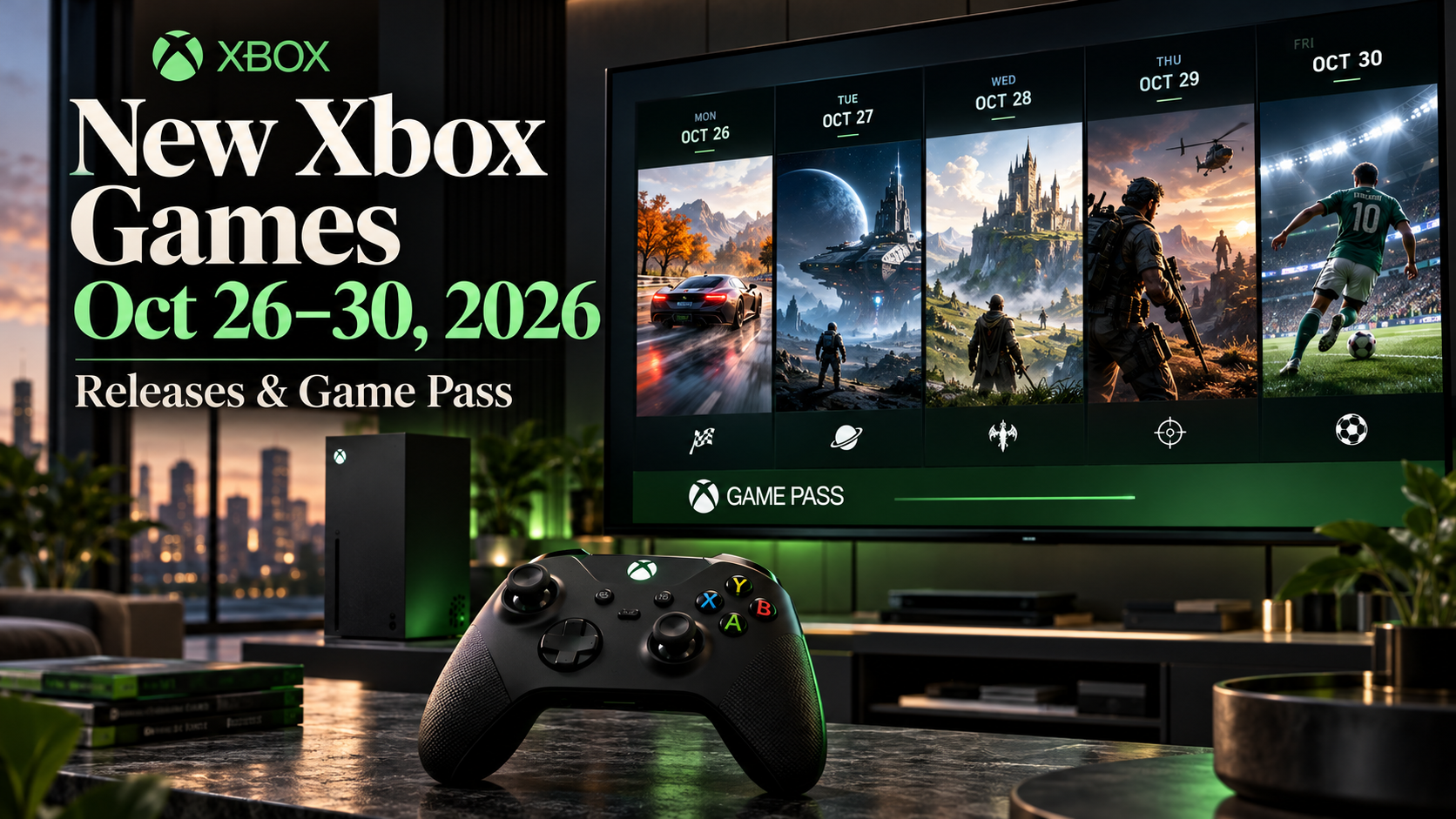
Players looking for new Xbox games in the week of October 26–30, 2026 have a wide release calendar covering mystery adventures, independent puzzle games, remasters, management titles and horror releases. Microsoft published its Next Week on Xbox schedule on October 23, with titles spread across Xbox Series X|S, older hardware, PC and subscription services depending on the game. For anyone deciding what to download or buy, the essential distinction is that a listed release date does not itself guarantee availability on every Xbox device or inclusion in Game Pass.
A second official announcement, the October 20 Game Pass update, identifies specific subscription additions and tiers. Read the two announcements together: one is a marketplace release overview, the other a service entitlement list. The information below was checked October 26, before most listed releases took place, and should therefore be treated as scheduled rather than retroactively described as already launched.
Selected releases and Game Pass additions this week
| Date (2026) | Title | What is verified | Game Pass status from official announcement |
|---|---|---|---|
| October 26 | Scramble Knights Online (Game Preview) | Online fantasy adventure scheduled | Game Pass Ultimate and PC Game Pass |
| October 27 | The Séance of Blake Manor | Supernatural detective mystery | Ultimate, Premium and PC Game Pass |
| October 27 | Dog Man: Bark in Action | Comic-inspired action game | Not established by this table as Game Pass |
| October 28 | Primal Planet | Dinosaur-era survival/metroidvania | Not established by this table as Game Pass |
| October 28 | SULFUR | First-person action/roguelike | Not established by this table as Game Pass |
| October 29 | Mouthwashing | Psychological horror game | Ultimate, Premium and PC Game Pass |
| October 29 | Final Fantasy VII Remake Intergrade | Major RPG addition to the subscription catalog | Ultimate, Premium and PC Game Pass |
| October 29 | Terrible Lizards | Horror parkour experience | Ultimate and PC Game Pass |
| October 29 | The Wolf Among Us Remastered | Remastered narrative mystery | Do not infer inclusion without a service listing |
| October 30 | Queen’s Domain | Retro-inspired fantasy action RPG | Do not infer inclusion without a service listing |
Dates and descriptions above originate from the Xbox Wire weekly release article and the Game Pass wave-two announcement. Their wording matters. “Not established” is not the same as “never joining Game Pass”; it simply prevents a claim that the source does not support. Microsoft warns that dates are subject to change, and regional storefronts can display different availability.
The Séance of Blake Manor: the detective pick
Of the week’s smaller-profile releases, The Séance of Blake Manor has a clearly described premise and an explicit Game Pass listing. According to the publisher-focused Xbox Wire feature, the game sends players to 1897 Ireland to investigate a disappearance in a remote manor. The emphasis is on interviewing characters, comparing evidence and drawing conclusions rather than completing a conventional shooting campaign.
The game is scheduled for October 27 on Xbox Series X|S and Xbox on PC, and the service announcement includes it in applicable Game Pass tiers and cloud access categories. That combination makes it a comparatively low-friction choice for a subscriber who enjoys investigative stories, provided the title is available in their region and subscription tier.
The genre label deserves attention. Someone looking for constant combat may be disappointed by a deduction-heavy investigation. Someone who likes taking notes, examining contradictions and advancing a mystery through dialogue is much more likely to enjoy the design. The useful search question is not merely “when does it release?” but whether the actual game loop suits the player.
Mouthwashing and the horror-heavy October slate
Mouthwashing, listed for October 29 on Xbox, is a psychological horror narrative about a space-freighter crew in crisis. Xbox Wire identifies its publisher as CRITICAL REFLEX, and the October 20 Game Pass update includes it in specified subscription tiers. The release timing aligns with the late-October appetite for horror, but thematic suitability matters more than a seasonal label.
The game’s subject matter is bleak. A buyer should not assume that every game released before Halloween is a family-friendly haunted-house experience. Read storefront content warnings and ratings for the exact regional edition. For households sharing a console, checking age guidance and accessibility settings ahead of time is as important as checking a price.
Other Xbox Wire entries this week include Remothered: Red Nun’s Legacy, with its survival-horror setting, and The Night of the Exorcism, listed for October 30. These titles may appeal to different segments of the horror audience: cinematic investigative play on one hand, decision-based supernatural narrative on the other. Being on the same calendar does not mean they share platform features, subscription arrangements or the same maturity rating.
Final Fantasy VII Remake Intergrade: release versus subscription addition
A headline that says “new Xbox games” can include products that are not brand-new works worldwide. Final Fantasy VII Remake Intergrade is one of the important October 29 Game Pass additions identified in Microsoft’s service announcement. Its arrival on a particular service or platform should not be confused with the original first release of the underlying game.
For subscribers, the immediate question is entitlement. The company lists Game Pass Ultimate, Premium and PC Game Pass, together with cloud, console and PC categories in its October announcement. Someone on another tier should check their library directly rather than taking the bare phrase “included in Game Pass” as a blanket promise.
The distinction also matters for purchase decisions. A subscriber who expects to retain a game permanently after a title leaves the catalog may misunderstand how subscription rights work. If you want continuing access regardless of rotation, investigate a separate license purchase and its platform terms. Xbox’s subscription listing is not, by itself, a promise of permanent ownership.
Smaller releases worth checking by genre
The week’s list is unusually broad. Primal Planet mixes prehistoric survival with exploration and platform progression. Fallen City Brawl invokes the side-scrolling arcade brawler tradition. House Builder 2 focuses on construction simulation, while Candy Shop Simulator takes a more relaxed shop-management approach. Croc 2 Kingdom of the Gobbos revisits an established platforming character. These are descriptions of scheduled product offerings drawn from Microsoft’s weekly overview, not firsthand game reviews.
That range makes a genre-first buying strategy sensible. A player who enjoys careful planning may prefer simulation to a reflex-based title. A player seeking short sessions may consider puzzle-oriented releases. Parents selecting games for children should inspect age ratings and platform compatibility, not rely on cute artwork or a familiar literary property.
Independent releases are sometimes sold under separate versions for Xbox Series X|S, Xbox One and PC. Confirm the version you are viewing before purchasing a key or making a wishlist decision. Similarly, a game preview is explicitly a development-stage offering rather than a guarantee that every planned feature is finished or that all progress will carry over unchanged.
What do Smart Delivery and Xbox Play Anywhere mean?
Xbox Wire sometimes adds product labels next to a title, such as Smart Delivery and Xbox Play Anywhere. These are not synonyms for Game Pass. Smart Delivery is associated with obtaining the appropriate supported Xbox console version of eligible titles, while Xbox Play Anywhere indicates eligible digital ownership across Xbox and Windows PC under program terms. Whether a title is included depends on its specific listing.
A game might carry Xbox Play Anywhere labeling but not be available through your Game Pass tier. Conversely, a Game Pass catalog title does not automatically grant a permanent Play Anywhere purchase. The differences are technical and commercial, so verify what the storefront shows for your account, region and device before paying.
Players using cloud streaming should check it separately. Cloud availability is not guaranteed merely because a product is playable on Windows PC or Xbox Series X|S. Streaming may also require a compatible subscription, region, network connection and supported device. These limitations matter for travelers and people playing on lower-powered hardware.
How to verify a game before you buy it
Start with the publisher or official Xbox storefront entry for the exact product. Look for the release date, platform list, edition details, region, age rating and the purchase or subscription button visible in your account. Then compare the game’s inclusion against the current Game Pass announcement, paying attention to tier names. If a release is advertised as “coming soon,” it may not yet be downloadable on the day you read the article.
Do not assume that a price shown in a U.S. article is universal. Currency, taxes, exchange conditions and local discounts may differ. Some markets receive titles later or have different age-classification requirements. Review download size, storage space and performance options before committing to a large installation, particularly if the household uses metered internet.
A sensible personal shortlist contains perhaps three games: one high-confidence purchase or subscription download, one smaller experimental title and one alternative for a different mood. This is more actionable than copying an entire storefront calendar into a “best games” list. The purpose of a release guide is to help readers make better choices, not merely to produce the longest table.
What about the claim of 50 new Xbox games?
That is a separate fact-checking question. A weekly release list should not be rewritten as proof that Microsoft announced exactly 50 games through a particular showcase, nor should a year-round catalog be described as 50 titles launching this week. Xbox Wire’s October 26–30 roundup is a specific dated schedule that also warns of possible changes. If an online claim says “fifty new releases,” ask whether it refers to a showcase, preorders, Game Pass additions or a broader editorial list.
Titles sometimes appear in more than one category. A game may be both a new console release and a Game Pass addition; counting it twice inflates the headline. Remasters and editions also complicate totals. Readers deserve clearly defined counting rules before being given a dramatic number.
Quick questions
What is new on Xbox on October 27, 2026?
Microsoft’s list includes The Séance of Blake Manor, Dog Man: Bark in Action and several other releases. Confirm the exact platform and region in each game’s storefront entry.
Is The Séance of Blake Manor on Game Pass?
Yes, it is listed for October 27 in Ultimate, Premium and PC Game Pass through Microsoft’s October 20 announcement, subject to applicable regional availability.
Is Final Fantasy VII Remake Intergrade included in Game Pass?
Microsoft lists its service addition on October 29 for specified tiers. It is not automatically included with every subscription plan.
Are every week’s releases available on Xbox One?
No such blanket claim is justified. The weekly lineup spans Xbox Series X|S, Xbox One and PC, but eligibility varies by title and edition. Read the individual product listing.
Can the release dates change?
Yes. Microsoft explicitly says its weekly dates are subject to change. Check again before purchasing or scheduling a launch-day download.
The useful way to read the October calendar
The most important releases for you depend on genre fit, supported hardware and access rights. The official schedule tells you what is planned; the separate Game Pass update clarifies subscription inclusion. Together they offer a much stronger basis for planning than a generic “50 brand-new games” claim or an undated list copied from social media.
Discover more from The Economy
Subscribe to get the latest posts sent to your email.

Gold at the $4,000 Line: Possible December Fed Hike

Oil at $100+: Hormuz, a Qatari Peace Draft and the Iran Deadline

The Fed’s 10-2 Hold: Why Two Dissenters Wanted a Rate Hike

SBP Raises Policy Rate to 12%: What It Means for Your Loans, Savings and Business

IMF’s $1.2bn Staff-Level Deal: What Pakistan Promised on Surplus

Decoding the DBS–BCA Merger Rumour: Market Volatility, Strategic Realities

New Xbox Games October 26–30, 2026: Releases and Game Pass

Tokyo Disneyland Peter Pan’s Flight Closure: January–February 2027 Guide

Neocloud Economics in 2026: GPU Debt, Utilization and Power

What Is a Neocloud? How AI GPU Clouds Work and Compare

Lula Re-elected in 2026: What Changes for the Dollar, Brazilian Stocks, and Interest Rates?

Lula Wins Brazil’s 2026 Election: Five Economic Tests for 2027

SSI November 2026 Payment: Why Benefits Arrive October 30

Russia Sanctions Waiver: What Asian Oil Buyers Gain

Crude Oil & Petroleum Market Analysis: OPEC+ Decisions and Price Forecasts

Top US Convenience Store Chains: Store Counts, EV Charging, and Sales Trends

Social Security Extra $90 Deposit: Who Qualifies for the October 2026 Medicare Rebate?

Who Is Shivon Zilis? The Neuralink Executive at the Center of the Musk–OpenAI Trial

Algorithmic Dogfights: Why the U.S. and China Must Establish Rules of Engagement for Autonomous Air Power

Gold Price Outlook 2026: The Forces Behind the Forecasts—and What Could Reverse Them

Corporate America Faces a New Debt Test as US Borrowing Costs Surge

Global Economic Outlook 2026: 7 Forces Reshaping Markets, Trade and Business

Stock Market Crash in 2026? Warning Signs, Scenarios and a Calm Investor Checklist

Stock Market Today: Dow, S&P 500, and Nasdaq Retreat as Treasury Yields

Geopolitics and Your Portfolio: How International Affairs Move Global Markets

Anthropic Bans Sustained Abuse of Claude AI Under New Usage Policy Effective November 12, 2026

US–Iran Conflict in October 2026: Hormuz, Oil Prices and Diplomacy

Why Did I Get $90 From Social Security? 8 Reasons Behind an Unexpected SSA Payment
-

 Markets & Finance10 months ago
Top 15 Stocks for Investment in 2026 in PSX: Your Complete Guide to Pakistan’s Best Investment Opportunities
-

 Analysis8 months ago
Johor’s Investment Boom: The Hidden Costs Behind Malaysia’s Most Ambitious Economic Surge
-

 Analysis8 months ago
Top 10 Stocks for Investment in PSX for Quick Returns in 2026
-

 Banks10 months ago
Best Investments in Pakistan 2026: Top 10 Low-Price Shares and Long-Term Picks for the PSX
-

 Analysis9 months ago
Brazil’s Rare Earth Race: US, EU, and China Compete for Critical Minerals as Tensions Rise
-

 Investment10 months ago
Top 10 Mutual Fund Managers in Pakistan for Investment in 2026: A Comprehensive Guide for Optimal Returns
-

 Global Economy10 months ago
15 Most Lucrative Sectors for Investment in Pakistan: A 2025 Data-Driven Analysis
-

 Global Economy10 months ago
Pakistan’s Export Goldmine: 10 Game-Changing Markets Where Pakistani Businesses Are Winning Big in 2025