
Global Economy
PSX Bull Run 2025: Why Pakistan’s Market Is Suddenly on Every Global Radar

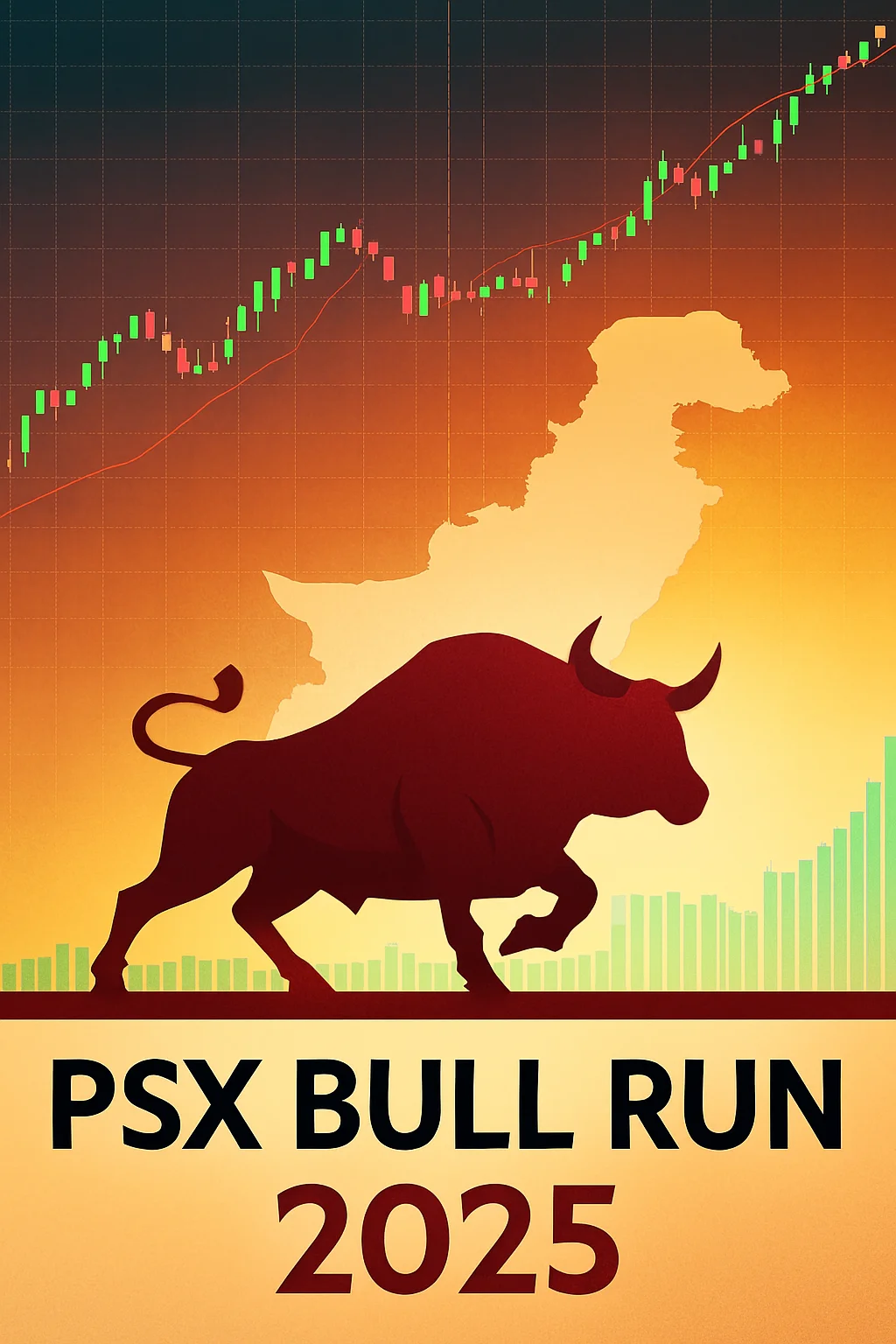
By any conventional metric, Pakistan should not be leading the pack of global equity returns in 2025. It is a frontier‑to‑emerging‑market hybrid with a long history of fiscal slippage, external vulnerability, and political volatility. Yet the Pakistan Stock Exchange (PSX) has staged one of the most remarkable bull runs in its modern history, turning what was once seen as a high‑beta, crisis‑prone market into a surprising outperformer.
From late 2024 into 2025, the benchmark KSE‑100 index has powered through successive resistance levels, with rallies often accompanied by surging trading volumes and broad‑based sector participation. In December 2025, the index is trading near record territory, with cumulative returns that put it ahead of many larger emerging markets. The question that investors—domestic and foreign alike—are now asking is straightforward: what is really fueling this confidence, and is it sustainable?
The answer lies at the intersection of macroeconomic stabilization, monetary policy recalibration, geopolitical risk repricing, and underappreciated structural changes in market infrastructure and participation. The PSX rally is not just a story of “cheap valuations”; it is a case study in how a market moves from the brink of recurring crisis to a cautiously credible recovery narrative.
From Crisis Narrative to Reform Story
For much of the past decade, Pakistan featured in headlines for all the wrong reasons: balance‑of‑payments stress, repeated IMF engagements, a sliding currency, and a persistent trust deficit between policymakers and markets. The 2022–2023 period in particular cemented perceptions of Pakistan as a perennially fragile economy, with the KSE‑100 under heavy pressure, foreign investors exiting, and the rupee in freefall.
The turning point began when the government—under intense domestic and external pressure—finally embraced orthodox stabilization. Subsidies were cut, energy prices adjusted, tax measures introduced, and a new IMF program negotiated. Painful as they were, these steps helped achieve three critical outcomes:
- Inflation peaked and started to trend lower, reducing the sense of macroeconomic freefall.
- Foreign exchange reserves stabilized, even if at modest levels, helped by concessional inflows, remittances, and controlled imports.
- The rupee found a floor, with volatility subdued relative to the worst of the crisis period.
By late 2024 and into 2025, investors began to see a discernible shift in narrative: from “Pakistan might default” to “Pakistan has bought time and breathing space.” For equity markets, this distinction is enormous. A market that survives the worst‑case scenario often gets repriced, not merely to reflect current fundamentals, but on the expectation that the worst risks have already been realized.
Monetary Policy: From Punishing to Supportive
No bull market in a macro‑fragile country is possible without a visible pivot in monetary policy. Pakistan’s central bank spent years running one of the most aggressive tightening cycles in the region. Policy rates were kept high to rein in inflation, defend the currency, and signal seriousness to international creditors and the IMF.
By 2025, that phase had largely run its course. With inflation finally decelerating—helped by base effects, moderation in global commodity prices, and domestic demand compression—the State Bank had room to shift gears. Even the anticipation of rate cuts was enough to move markets.
For equity investors, particularly those running discounted cash flow (DCF) models, the implication of a lower policy rate is straightforward:
- Lower discount rates increase the present value of future corporate earnings.
- Reduced borrowing costs improve profitability, especially for capital‑intensive firms.
- Portfolio rebalancing favors equities as the relative attractiveness of fixed‑income instruments declines.
Banks, in particular, benefited from a complex but favorable combination: they had enjoyed windfall gains during the high‑rate period via elevated yields, and now stood to gain from an eventual revival in credit growth as rates normalized. The market began to price in this dual advantage.
For foreign investors, a credible path to lower inflation and easing rates was a signal that Pakistan’s macro orthodoxy was returning. It reduced the perceived probability of a disorderly adjustment and improved the risk‑reward profile of the PSX relative to peers.
Earnings, Valuations, and the “Re‑Rating” of Pakistan
The PSX was not simply rising on the back of sentiment; it was rebounding from deeply depressed valuation levels. In the worst periods of the crisis, the KSE‑100 traded at price‑to‑earnings multiples that were not merely low—they were indicative of a market priced for failure.
As macro conditions stabilized, several factors drove a re‑rating:
- Corporate earnings proved more resilient than feared. Exporters benefited from a weaker rupee, remittance‑linked consumption held up reasonably well, and large conglomerates demonstrated cost discipline.
- Banks and energy names, long seen as systemically exposed, adjusted to new regulatory and fiscal realities.
- A handful of listed companies continued to deliver strong free cash flows, even under stress, reinforcing the idea that Pakistan hosts pockets of world‑class businesses despite the macro noise.
When a market trades at distressed multiples for too long, it only takes a modest shift in the macro narrative to trigger a sharp upside move. That is precisely what happened in 2025. Rising earnings, combined with still‑reasonable valuations, created the conditions for a powerful bull run once capital began to return.
Sector‑Wise Drivers: Where the Confidence Is Concentrated
Though broad‑based rallies make better headlines, serious investors know that bull markets are rarely uniform; they are led by sectors with convincing narratives. In the PSX’s 2025 rally, four clusters stand out.
1. Banking and Financials
Banks are at the heart of Pakistan’s financial system and often the first to react to shifts in policy. Investors saw a multi‑layered story:
- High yields on government securities previously padded earnings, providing a cushion through the worst of the crisis.
- Prospects of renewed private‑sector credit growth as rates normalize suggested new revenue opportunities.
- Improving asset quality, once the worst of the economic contraction passed, reassured analysts that non‑performing loans would not spiral out of control.
As risk premiums compressed, financials became core holdings in both domestic and foreign portfolios, amplifying the overall index move.
2. Energy and Utilities
Energy has long been central to Pakistan’s macro vulnerabilities: circular debt, price distortions, and under‑investment. By 2025, incremental steps to rationalize tariffs, streamline subsidies, and improve billing and recovery mechanisms gave investors hope that the sector was finally moving toward a more sustainable model.
Listed energy companies benefited from:
- Clearer tariff regimes
- Better prospects of receivables recovery
- Ongoing discussions on restructuring legacy obligations
This translated into multiple expansion and renewed investor interest—especially among institutions looking for yield and hard‑asset exposure.
3. Export‑Oriented Industrials and Textiles
Pakistan’s textile and export‑oriented sectors found themselves in a position to take advantage of global supply chain reconfiguration. As multinational firms continued to diversify away from over‑reliance on a single geography, countries like Pakistan—offering competitive labor, improving infrastructure, and trade links—stood to gain.
Exporters saw a double benefit: a weaker rupee improved price competitiveness abroad, while local cost structures, despite inflation, remained manageable relative to peers. The equity market responded by rewarding firms that demonstrated the ability to secure orders, move up the value chain, and reinvest in capacity.
4. Technology, Telecom, and the Digital Economy
The story of Pakistan’s tech and telecom sectors is more nascent but no less important. Rising connectivity, a young demographic profile, and government rhetoric around “Digital Pakistan” created a supportive backdrop for listed telecom firms and tech‑adjacent plays.
Although the PSX remains underweight on pure‑play tech relative to regional exchanges, increased interest in digital payments, fintech, and data services added a structural growth narrative to an otherwise traditional market.
The Infrastructure Beneath the Rally: Speed, Uptime, and Market Plumbing
One of the least discussed contributors to the PSX’s bull run has been its own quiet evolution as a trading platform. In the modern equity ecosystem, investor confidence is shaped not only by macro and policy, but by the perceived reliability, transparency, and efficiency of the venue itself.
Over recent years, the PSX has invested in:
- Improved trading engines and matching systems, capable of handling higher order volumes with lower latency.
- Better uptime and system reliability, reducing instances of market disruption, halts, or technical outages.
- Enhanced connectivity and co‑location services, enabling brokers and institutions to execute faster and more efficiently.
- Upgraded surveillance and compliance tools, improving the detection of abnormal trading behavior and bolstering market integrity.
While the PSX does not always broadcast granular metrics such as average execution time in milliseconds or annualized uptime percentages, the lived experience of market participants has changed. Days with exceptionally high volumes—where hundreds of millions of shares change hands—are now processed with fewer technical hiccups than in previous cycles. For sophisticated institutional investors, this matters: they are more willing to deploy large orders into a market whose “plumbing” they trust.
The cumulative effect of these improvements is subtle but powerful: liquidity begets liquidity. As more participants trade with confidence that the system will not fail them mid‑session, spreads tighten, depth improves, and the market becomes more investable for global funds.
Foreign Investors: From Capitulation to Gradual Re‑Entry
Foreign portfolio investors are often caricatured as fickle, but in reality, they respond to a combination of fundamentals, valuation, and global risk appetite. In Pakistan’s case, the 2025 bull run has coincided with several favorable global and local shifts:
- Global search for yield: As major central banks move from aggressive tightening to a more neutral or easing stance, capital begins to flow back into higher‑risk, higher‑return markets.
- Relative valuation appeal: When compared to other emerging and frontier markets, Pakistan’s equities, even after the rally, still look cheap on a historical and cross‑country basis.
- Perception of “risk already priced in”: After years of underperformance, many of the worst‑case scenarios—political disruption, fiscal slippage, external stress—were already reflected in prices. Any move away from the brink justifies re‑entry.
Flows remain measured rather than exuberant; foreign investors have not forgotten how quickly Pakistan can move from calm to crisis. But the direction of travel has shifted. Instead of being incremental net sellers, foreigners are selectively adding exposure in areas where earnings visibility is strong, governance is credible, and liquidity is sufficient.
Geopolitics and Regional Positioning: A Narrow Window of Stability
Markets do not trade in economic isolation. Pakistan’s 2025 rally is playing out against a backdrop of shifting geopolitical alignments and regional recalibration.
On one side, global investors are reassessing supply chains, energy routes, and security commitments in light of conflicts and tensions elsewhere. On the other, South Asia’s demographic and consumption stories continue to attract attention. Pakistan, positioned at the intersection of key trade corridors, is once again being marketed as a “gateway” to multiple regions.
More importantly, the domestic political environment, while hardly tranquil, has been less disruptive than in some recent years. Policy continuity—especially in areas of economic management, energy pricing, and fiscal reform—has improved. For investors with long memories, the absence of fresh shocks sometimes feels as bullish as good news.
All of this is precarious, of course. Pakistan’s political and security risks have not vanished; they have merely receded enough to allow the market to focus on earnings, valuations, and reforms. Whether this window stays open will play a significant role in determining whether the bull run becomes a sustained multi‑year story or just a powerful but finite rebound.
The Psychology of Confidence: From Survival to Strategy
Investor confidence is not solely a function of spreadsheets and macro charts; it is also psychological. The PSX’s 2025 bull run is, in part, a collective exhale after years of living at the edge of crisis.
When investors spend too long in defensive mode—rolling over positions, protecting cash, questioning solvency—there is a pent‑up demand for a more constructive story. As soon as macro stabilization becomes credible and early‑cycle signals appear, positioning can change rapidly:
- Domestic investors rotate from cash and property back into equities.
- Brokers, after years of depressed business, see volumes rise and become vocal advocates of the rally.
- The media narrative shifts from “how bad can it get?” to “have you missed the rally?”
The PSX has benefited from this psychological flip. Once the move began, it reinforced itself: each new high brought sidelined investors back in, while early entrants felt vindicated and emboldened.
SEO‑Visible Themes: How the Market Story Travels Beyond the Ticker
From a digital and editorial perspective, the PSX bull run intersects with several high‑interest themes that naturally attract global and regional readership:
- “Pakistan stock market 2025 performance”
- “PSX bull run analysis”
- “KSE‑100 index outlook”
- “Pakistan IMF program and stock market”
- “Emerging markets opportunity 2025”
- “Is Pakistan investable again?”
These search phrases map onto real investor questions. They also provide a framework through which this narrative is being disseminated to a wider audience. The more Pakistan appears in global financial discourse as a comeback story rather than a crisis case, the more self‑reinforcing the confidence cycle can become.
For seasoned investors, of course, the nuance matters: Pakistan is still a high‑risk market, with deep structural vulnerabilities and institutional constraints. But the recalibration from “uninvestable” to “selectively investable” is significant.
Is the Bull Run Sustainable?
The most important question for any serious investor is not why a rally has occurred, but whether it can last. On that front, Pakistan’s case is neither unequivocally bullish nor inevitably doomed. It is contingent.
Several factors will determine whether the PSX of 2025 is the start of a durable multi‑year trend or merely a powerful cyclical rebound:
- Fiscal Credibility: The government must move beyond budget‑day optics and credibly implement tax reforms, broaden the base, rationalize expenditure, and reduce reliance on unsustainable borrowing. Without this, debt dynamics could again spook markets.
- Monetary Prudence: The central bank’s eventual easing must remain anchored in inflation realities, not political pressure. Cutting too fast or too far could reignite inflation and undermine currency stability—killing the very confidence that underpins the bull run.
- Structural Reforms: Energy sector restructuring, state‑owned enterprise reform, digitalization of tax and payments infrastructure, and improvements in ease of doing business are not optional. They are the foundation on which any credible long‑term bull market must rest.
- External Resilience: Pakistan’s external account remains vulnerable to global shocks. Commodity price spikes, sudden stops in funding, or geopolitical flare‑ups can quickly reverse capital flows. Building buffers—reserves, reliable credit lines, diversified export markets—is essential.
- Institutional Strength and Governance: Markets ultimately thrive in environments where rules are predictable, contracts are respected, and governance is improving. Any regression in these areas will show up, sooner or later, in risk premiums and valuations.
The Final Verdict: A Market Re‑Rated, Not Yet Redeemed
The PSX bull run of 2025 is best understood not as an irrational exuberance, nor as a purely technical rally, but as a re‑rating of Pakistan’s risk profile after a period of extreme pessimism. Macroeconomic stabilization, a credible monetary pivot, incremental fiscal improvements, and better market infrastructure have collectively nudged investors from survival mode into selective optimism.
Yet optimism is not destiny. Pakistan’s stock market has been here before: episodes of strong performance followed by abrupt reversals when politics, policy, or global conditions turned. The challenge now is to avoid replaying that script.
If the country uses this window of market confidence to deepen reforms, strengthen institutions, and build resilience, the PSX of 2025 may mark the beginning of a longer secular story: a frontier market maturing into a more robust, though still volatile, emerging market opportunity.
If, however, complacency sets in—if reform fatigue returns, if fiscal and monetary discipline frays, if governance regresses—the bull run will, in hindsight, be remembered as another missed opportunity: a technically impressive rally that failed to translate into a durable re‑write of Pakistan’s economic trajectory.
For now, the verdict is still being written. What is clear is that investors have given Pakistan another chance. Whether policymakers, corporates, and institutions make good on that chance will determine whether the PSX remains a tactical trade—or finally earns its place as a strategic allocation in global portfolios.
Discover more from The Economy
Subscribe to get the latest posts sent to your email.


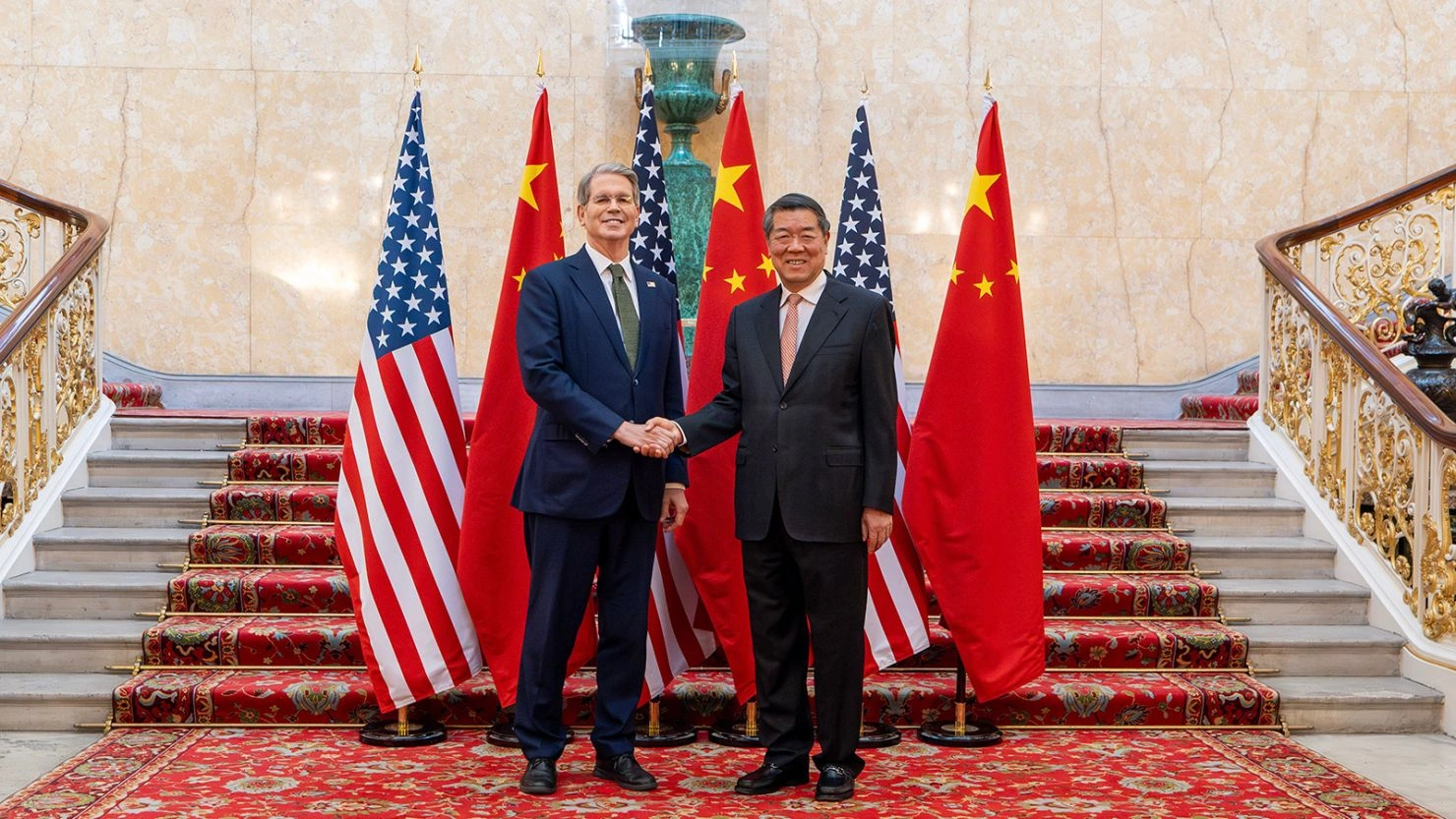
Bessent and He Lifeng meet at OECD Paris to review the Busan trade truce before Trump’s Beijing summit. Rare earths, Hormuz oil shock, and Section 301 cloud the path ahead.
The 16th arrondissement of Paris is not a place that announces itself. Discreet, residential, its wide avenues lined with haussmann facades, it is the kind of neighbourhood where power moves quietly. On Sunday morning, as French voters elsewhere in the city queued outside polling stations for the first round of local elections, a motorcade slipped through those unassuming streets toward the headquarters of the Organisation for Economic Co-operation and Development. Inside, the world’s two largest economies were attempting something rare in 2026: a structured, professional conversation.
Talks began at 10:05 a.m. local time, with Vice-Premier He Lifeng accompanied by Li Chenggang, China’s foremost international trade negotiator, while Treasury Secretary Scott Bessent arrived flanked by US Trade Representative Jamieson Greer. South China Morning Post Unlike previous encounters in European capitals, the delegations were received not by a host-country official but by OECD Secretary-General Mathias Cormann South China Morning Post — a small detail that spoke volumes. France was absorbed in its own democratic ritual. The world’s most consequential bilateral relationship was, once again, largely on its own.
The Stakes in Paris: More Than a Warm-Up Act
It would be tempting to dismiss the Paris talks as logistical scaffolding for a grander event — namely, President Donald Trump’s planned visit to Beijing at the end of March for a face-to-face with President Xi Jinping. That reading would be a mistake. The discussions are expected to cover US tariff adjustments, Chinese exports of rare earth minerals and magnets, American high-tech export controls, and Chinese purchases of US agricultural commodities CNBC — a cluster of issues that, taken together, constitute the structural skeleton of the bilateral relationship.
Analysts cautioned that with limited preparation time and Washington’s strategic focus consumed by the US-Israeli military campaign against Iran, the prospects for any significant breakthrough — either in Paris or at the Beijing summit — remain constrained. Investing.com As Scott Kennedy, a China economics specialist at the Center for Strategic and International Studies, put it with characteristic precision: “Both sides, I think, have a minimum goal of having a meeting which sort of keeps things together and avoids a rupture and re-escalation of tensions.” Yahoo!
That minimum — preserving the architecture of the relationship, not remodelling it — may, in the current environment, be ambitious enough.
Busan’s Ledger: What Has Been Delivered, and What Has Not
The two delegations were expected to review progress against the commitments enshrined in the October 2025 trade truce brokered by Trump and Xi on the sidelines of the APEC summit in Busan, South Korea. Yahoo! On certain metrics, the scorecard is encouraging. Washington officials, including Bessent himself, have confirmed that China has broadly honoured its agricultural obligations under the deal Business Standard — a meaningful signal at a moment when diplomatic goodwill is scarce.
The soybean numbers are notable. China committed to purchasing 12 million metric tonnes of US soybeans in the 2025 marketing year, with an escalation to 25 million tonnes in 2026 — a procurement schedule that begins with the autumn harvest. Yahoo! For Midwestern farmers and the commodity desks that serve them, these are not abstractions; they are the difference between a profitable season and a foreclosure notice.
But the picture darkens considerably when attention shifts to critical materials. US aerospace manufacturers and semiconductor companies are experiencing acute shortages of rare earth elements, including yttrium — a mineral indispensable in the heat-resistant coatings that protect jet engine components — and China, which controls an estimated 60 percent of global rare earth production, has not yet extended full export access to these sectors. CNBC According to William Chou, a senior fellow at the Hudson Institute, “US priorities will likely be about agricultural purchases by China and greater access to Chinese rare earths in the short term” Business Standard at the Paris talks — a formulation that implies urgency without optimism.
The supply chain implications are already registering. Defence contractors reliant on rare-earth permanent magnets for guidance systems, electric motors in next-generation aircraft, and precision sensors are operating on diminished buffers. The Paris talks, if they yield anything concrete, may need to yield this above all.
A New Irritant: Section 301 Returns
Against this backdrop of incremental compliance and unresolved bottlenecks, the US side has introduced a fresh complication. Treasury Secretary Bessent and USTR Greer are bringing to Paris a new Section 301 trade investigation targeting China and 15 other major trading partners CNBC — a revival of the legal mechanism previously used to justify sweeping tariffs during the first Trump administration. The signal it sends is deliberately mixed: Washington is simultaneously seeking to consolidate the Busan framework and reserving the right to escalate it.
For Chinese negotiators, the juxtaposition is not lost. Beijing has staked considerable domestic political credibility on the proposition that engagement with Washington produces tangible results. A Section 301 investigation, even if procedurally nascent, raises the spectre of a new tariff architecture layered atop the existing one — and complicates the case for continued compliance within China’s own policy bureaucracy.
The Hormuz Variable: When Geopolitics Enters the Room
No diplomatic meeting in March 2026 can be quarantined from the wider strategic environment, and the Paris talks are no exception. The ongoing US-Israeli military campaign against Iran has introduced a variable of potentially severe economic consequence: the partial closure of the Strait of Hormuz, the narrow waterway through which approximately a fifth of the world’s oil passes.
China sources roughly 45 percent of its imported oil through the Strait, making any disruption there a direct threat to its industrial output and energy security. Business Standard After US forces struck Iran’s Kharg Island oil loading facility and Tehran signalled retaliatory intent, President Trump called on other nations to assist in protecting maritime passage through the Strait. CNBC Bessent, for his part, issued a 30-day sanctions waiver to permit the sale of Russian oil currently stranded on tankers at sea CNBC — a pragmatic, if politically contorted, attempt to soften the energy-price spike.
For the Paris talks, the Hormuz dimension introduces a paradox. China has an acute economic interest in stabilising global oil flows and might, in principle, be receptive to coordinating with the United States on maritime security. Yet Beijing’s deep reluctance to be seen as endorsing or facilitating US-led military operations in the Middle East constrains how far it can go. The corridor between shared interest and political optics is narrow.
What Trump Wants in Beijing — and What Xi Can Deliver
With Trump’s Beijing visit now functioning as the near-term endpoint of this diplomatic process, the outlines of a summit package are beginning to take shape. The US president is expected to seek major new Chinese commitments on Boeing aircraft orders and expanded purchases of American liquefied natural gas Yahoo! — both commercially significant and symbolically resonant for domestic audiences. Boeing’s recovery from years of regulatory and reputational turbulence has made its order book a quasi-barometer of US industrial confidence; LNG exports represent a strategic diversification of American energy diplomacy.
For Xi, the calculus involves threading a needle between delivering enough to make the summit worthwhile and conceding so much that it invites criticism at home from nationalist constituencies already sceptical of engagement. China’s state media has consistently characterised the Paris talks as a potential “stabilising anchor” for an increasingly uncertain global economy Republic World — language carefully chosen to frame engagement as prudent statecraft rather than capitulation.
The OECD itself, whose headquarters serves as neutral ground for today’s meeting, cut its global growth forecast earlier this year amid trade fragmentation fears — underscoring that the bilateral relationship between Washington and Beijing carries systemic weight far beyond its two principals. A credible summit, even one short of transformative, would send a signal to investment desks and central banks from Frankfurt to Singapore that the world’s two largest economies retain the institutional capacity to manage their rivalry.
The Road to Beijing, and Beyond
What happens in the 16th arrondissement today will not resolve the structural tensions that define the US-China relationship in this decade. The rare-earth bottleneck is systemic, not administrative. The Section 301 investigation reflects a bipartisan American political consensus that China’s industrial subsidies represent an existential competitive threat. And the Iran war has introduced a geopolitical variable that neither side fully controls.
But the Paris talks serve a purpose that transcends their immediate agenda. They demonstrate, to a watching world, that diplomacy between great powers remains possible even as military operations unfold and supply chains fracture. They keep open the channels through which, eventually, more durable arrangements might be negotiated — whether at a Beijing summit, at the G20 in Johannesburg later this year, or in another European capital where motorcades slip, unannounced, through quiet streets.
The minimum goal, as CSIS’s Kennedy observed, is avoiding rupture. In the spring of 2026, with the Strait of Hormuz partially closed and yttrium shipments stalled, that minimum has acquired the weight of ambition.
Discover more from The Economy
Subscribe to get the latest posts sent to your email.
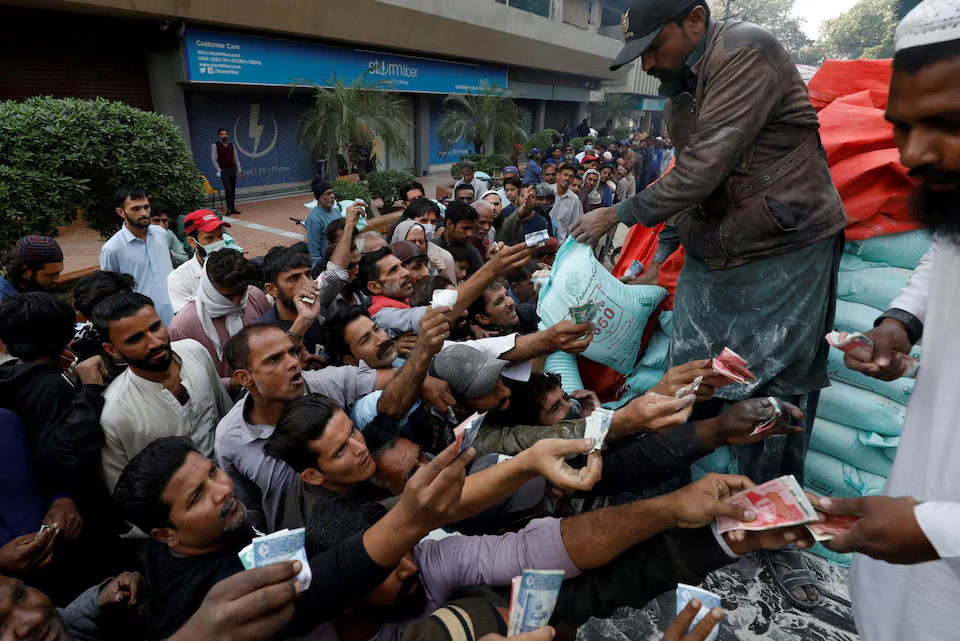
When a geopolitical earthquake in the Gulf meets a fragile emerging-market economy, the tremors travel fast — and reach deep into the pay packets of millions of public workers.
The Man at the Pump — and the Policy Behind It
Sohail Ahmed, a 27-year-old delivery rider in Karachi supporting a family of seven, is blunt about the government’s emergency measures. “There is no benefit to me if they work three days or five days a week,” he told Al Jazeera. “For me, the main concern is the fuel price because that increases the cost of every little thing.” Al Jazeera
Ahmed’s frustration is both viscerally human and economically precise. On the morning of Saturday, March 14, 2026, Prime Minister Shehbaz Sharif chaired a high-level review meeting in Islamabad. The outcome was stark: salary deductions of between 5% and 30% approved for employees of state-owned enterprises (SOEs) and autonomous institutions — extending austerity cuts already applied to the civil service — as part of a drive to mitigate the fallout from the ongoing Middle East war. Geo News
The announcement formalised a fiscal posture that has been hardening for a fortnight. It also sent an unmistakable signal to Islamabad’s most important creditor: the International Monetary Fund.
What SOEs Are — and Why They Matter So Much
To understand what is at stake, it helps to understand what state-owned enterprises actually are. In Pakistan, SOEs are government-owned or government-controlled companies spanning power generation, aviation, railways, ports, petrochemicals, steel, and telecommunications. They are simultaneously the backbone of essential services and, for decades, the most persistent drain on public finances. Unlike a civil servant whose salary comes from tax revenues, SOE workers are technically employed by commercial entities — many of which run structural losses that are ultimately underwritten by the exchequer.
Pakistan’s SOEs bled the exchequer over Rs 600 billion in just six months of FY2025 alone. Todaystance The IMF has made SOE governance reform a pillar of every engagement with Pakistan for years, and the current $7 billion Extended Fund Facility (EFF), approved in September 2024, is no exception. The 37-month programme explicitly requires the authorities to improve SOE operations and management as well as privatisation, and strengthen transparency and governance. International Monetary Fund
When a government imposes salary discipline on those same entities during a crisis, it is doing two things at once: cutting costs in the present, and — at least symbolically — demonstrating to Washington and Washington-adjacent institutions that reform intent is real.
The Scale and Mechanics of the Cuts
At a Glance — Pakistan’s March 2026 Austerity Package
- SOE/autonomous institution employees: 5%–30% salary reduction (tiered, based on pay grade)
- Federal cabinet ministers and advisers: full salaries foregone for two months
- Members of Parliament: 25% salary cut for two months
- Grade-20+ civil servants earning over Rs 300,000/month: two days’ salary redirected to public relief
- Government vehicle fleet: 60% grounded; fuel allocations cut by 50%
- Foreign visits by officials: banned (economy class only for obligatory trips)
- Board meeting fees for government-board representatives: eliminated
- March 23 Pakistan Day embassy celebrations: directed to be observed with utmost simplicity
- All savings: ring-fenced exclusively for public relief
The meeting also decided that government representatives serving on the boards of corporations and other institutions would not receive board meeting fees, which will instead be added to the savings pool. The Express Tribune The prime minister directed concerned secretaries to implement and monitor all austerity measures, submitting daily reports to a review committee. Geo News
The tiered structure — 5% at the lower end, 30% at the top — reflects a political calculation as much as a fiscal one. Flat cuts hit low-income workers hardest and generate the most social friction. A progressive scale preserves a veneer of equity. Whether that veneer survives contact with household budgets in the coming weeks remains to be seen.
Why Now? The Strait of Hormuz and Pakistan’s Achilles Heel
The proximate cause of Islamabad’s emergency posture is a crisis that began not in Pakistan but in the Persian Gulf. On February 28, 2026, the United States and Israel initiated coordinated airstrikes on Iran under Operation Epic Fury, targeting military facilities, nuclear sites, and leadership, resulting in the death of Supreme Leader Khamenei. Iran’s Islamic Revolutionary Guard Corps declared the Strait of Hormuz closed, and within days tanker traffic through the world’s most important oil chokepoint had ground to a near halt, with over 150 ships anchoring outside the strait. Wikipedia
The strait is a 21-mile-wide waterway separating Iran from Oman. In 2024, oil flow through the strait averaged 20 million barrels per day, the equivalent of about 20% of global petroleum liquids consumption. U.S. Energy Information Administration For Pakistan, the chokepoint is existential: the country relies on imports for more than 80% of its oil needs, and between July 2025 and February 2026, its oil imports totalled $10.71 billion. Al Jazeera
As of March 13, 2026, Brent crude has risen 13% since the war began, hitting $100 a barrel. If the situation does not move towards resolution, Brent could reach $120 a barrel in the coming weeks. IRU
The LNG exposure is equally severe. Qatar and the UAE account for 99% of Pakistan’s LNG imports. Seatrade Maritime LNG now provides nearly a quarter of Pakistan’s electricity supply. A Qatar production stoppage following Iranian drone strikes on Ras Laffan has thus hit Pakistan in the electricity sector and the fuel sector simultaneously — a dual shock for which the country has limited storage buffers and virtually no domestic alternative.
“Pakistan and Bangladesh have limited storage and procurement flexibility, meaning disruption would likely trigger fast power-sector demand destruction rather than aggressive spot bidding,” said Go Katayama, principal insight analyst at Kpler. CNBC
Pakistan has responded with speed if not sophistication. On March 4, Pakistan officially requested that Saudi Arabia reroute oil supplies through Yanbu’s Red Sea oil port, with Saudi Arabia providing assurances and arranging at least one crude shipment to bypass the closed strait. Wikipedia
The Embassy Directive: Austerity as Theatre and as Signal
Perhaps no single measure in the package better illustrates the dual logic of crisis governance than the instruction to Pakistani embassies worldwide. PM Shehbaz directed all Pakistani embassies worldwide to observe March 23 celebrations with utmost simplicity. Geo News
Pakistan Day — commemorating the 1940 Lahore Resolution that set the country on its path to independence — is typically marked by receptions at missions abroad that range from modest gatherings to elaborately catered affairs. This year, the message from Islamabad is: not now.
The directive is, on one level, symbolic. The savings generated by cutting embassy receptions are financially immaterial. But symbolism in fiscal signalling is rarely immaterial. Pakistan’s government is communicating — to citizens at home who are queueing at petrol stations and adjusting Eid budgets, and to investors and creditors watching from afar — that the state is willing to absorb visible sacrifice. The IMF counts perception as well as arithmetic.
Geopolitical Stress-Testing an Already Fragile Fiscal Framework
Pakistan’s public finances were already under acute pressure before the Hormuz crisis struck. Tax collection remained Rs 428 billion below the revised FBR target during the first eight months of the fiscal year, and the country may find it difficult to achieve its previously agreed tax-to-GDP ratio target of 11% for FY2025–26. Pakistan Observer
Against that backdrop, the IMF’s most recent reviews present a mixed picture. Pakistan achieved a primary surplus of 1.3% of GDP in FY25 in line with targets, gross reserves stood at $14.5 billion at end-FY25, and the country recorded its first current account surplus in 14 years. International Monetary Fund These are genuine achievements, hard-won through painful monetary tightening and a depreciation-induced adjustment.
But an oil shock of this magnitude — Brent crude rising from around $70 to over $110 per barrel within days of the conflict’s escalation, with analysts forecasting potential rises to $100 per barrel or higher if disruptions persisted Wikipedia — could erase months of fiscal progress in weeks. Every $10 per barrel rise in global crude prices adds roughly $1.5–2 billion to Pakistan’s annual import bill, according to analysts. A $40 spike, even partially absorbed, threatens the current account surplus, the reserve-rebuilding trajectory, and the primary surplus target in one stroke.
The government’s response — grounding vehicles, cutting salaries, banning foreign travel — is essentially a demand-side shock absorber. While some measures aim to show solidarity, their effectiveness on actual fuel demand remains in question, since the stopping of Cabinet members’ salaries and cuts to parliamentarians’ pay are essentially meant to demonstrate solidarity rather than conserve fuel in any meaningful way. Pakistan Today The analysis is correct. Energy analyst Amer Zafar Durrani, a former World Bank official, noted that roughly 80% of petroleum products are used in transport, meaning the country’s oil dependence is fundamentally a mobility problem Al Jazeera — one that no amount of reduced official-vehicle usage can meaningfully address.
Social Impact: Who Actually Bears the Cost
The SOE salary cuts will land on a workforce that is already under financial strain. Pakistan’s inflation, while having fallen dramatically from its 2023 peak of over 38%, is being pushed back up by the petrol price shock. The recent energy crisis triggered the largest fuel price increase in the country’s history, with petrol costing $1.15 a litre and diesel at $1.20 a litre — a 20% jump from the prior week. Al Jazeera
State-owned enterprises in Pakistan employ hundreds of thousands of workers, many in lower-middle-income brackets. A bus driver at Pakistan Railways, a junior technician at WAPDA (Water and Power Development Authority), or a clerk at the Steel Mills — all will see monthly take-home pay contract by between 5% and 30%, at precisely the moment transport costs and grocery bills are climbing. The government’s pledge that all savings will be ring-fenced for public relief offers some rhetorical comfort, but the mechanisms for distribution remain unspecified.
This asymmetry — pain certain for workers, relief uncertain for the poor — has been the structural weakness of every Pakistani austerity programme in living memory.
Historical Parallels and Reform Precedents
Pakistan has deployed austerity rhetoric many times before. It has also, many times before, proved unable to sustain it. The country has entered IMF programmes on 25 separate occasions since joining the Fund in 1950, often reversing structural reforms once the immediate crisis passed. The circular debt in Pakistan’s power sector has crossed Rs 4.9 trillion, largely due to inefficiencies, poor recovery ratios, and delays in tariff rationalisation. Meanwhile, SOEs continue to bleed financially, and on the political front, frequent changes in policy direction, weak enforcement of reforms, and resistance from vested interest groups pose major risks to continuity. Todaystance
The global parallel most instructive is not another emerging market crisis but rather a structural pattern: when oil shocks hit import-dependent countries with high SOE employment, the response typically oscillates between genuine reform opportunity and short-term retrenchment. Indonesia’s restructuring after the 1997-98 Asian financial crisis — which included painful but ultimately durable SOE privatisations — offers one model. Argentina’s repeated failure to hold fiscal consolidation gains through successive oil and commodity shocks offers the cautionary counterpoint.
Pakistan’s current challenge is to use this external shock as a reform accelerant rather than a mere political prop. The IMF’s third review under the current EFF, which will assess progress in the coming months, will determine whether the Fund sees these measures as sufficient structural movement or as cosmetic gestures.
What Comes Next: The IMF Review, Privatisation, and Credibility
According to the IMF, upcoming review discussions will assess Pakistan’s progress on agreed reform benchmarks and determine the next phase of loan disbursements. The implementation of the Governance and Corruption Diagnostic Report and the National Fiscal Pact will be central to the talks, particularly for the release of the next loan tranche. Energy Update
The current austerity measures, if implemented with the rigor of the daily reporting mechanism the prime minister has mandated, offer two potential gains. First, they provide a quantifiable demonstration of demand compression that the IMF values in its assessment of programme adherence. Second, extending salary discipline to SOEs — entities that operate in the nominally commercial rather than the governmental sphere — is a step, however modest, toward the SOE governance reforms that Washington has been pushing Islamabad to adopt since at least 2019.
The privatisation agenda is the harder test. The IMF has explicitly called for SOE governance reforms and privatisation, with the publication of a Governance and Corruption Diagnostic Report as a welcome step. International Monetary Fund Salary cuts keep workers in post and institutions intact; privatisation means structural change that generates permanent fiscal relief but also generates political resistance. The Pakistan Sovereign Wealth Fund, created to manage privatisation proceeds, remains operationally nascent.
A Measured Verdict
Pakistan’s March 2026 austerity package is simultaneously more than it appears and less than is needed.
It is more than it appears because the extension of salary cuts to SOEs — entities that have historically been treated as patronage preserves immune to market discipline — marks a genuinely wider perimeter for fiscal tightening than previous exercises. The daily reporting mandate, the board-fee elimination, the embassy directive: these collectively suggest a government that has at least understood the optics of credibility, if not yet fully operationalised its substance.
It is less than is needed because the structural drivers of Pakistan’s oil vulnerability — import dependence exceeding 80%, an LNG supply chain concentrated in a now-disrupted region, a transport sector consuming four-fifths of petroleum products — are entirely untouched by the package. Salary cuts and grounded ministerial vehicles are fiscal band-aids on an energy-architecture wound.
The coming weeks will clarify how durable the measures are and how seriously the IMF assesses them. A credible, sustained austerity programme — even one born of external shock rather than endogenous reform will — would improve Pakistan’s negotiating posture for the next tranche, steady foreign exchange reserves, and marginally restore the fiscal space that the oil shock is burning away.
Whether that translates into the deeper SOE privatisation and energy diversification that the country’s long-run fiscal sustainability actually demands is the question that March 23’s simplified embassy celebrations will not answer — but that every subsequent IMF review will insist on asking.
Discover more from The Economy
Subscribe to get the latest posts sent to your email.
Banks
Deutsche Bank Seeks to Expand Private Credit Offerings Amid $30 Billion Exposure and Mounting Industry Risks
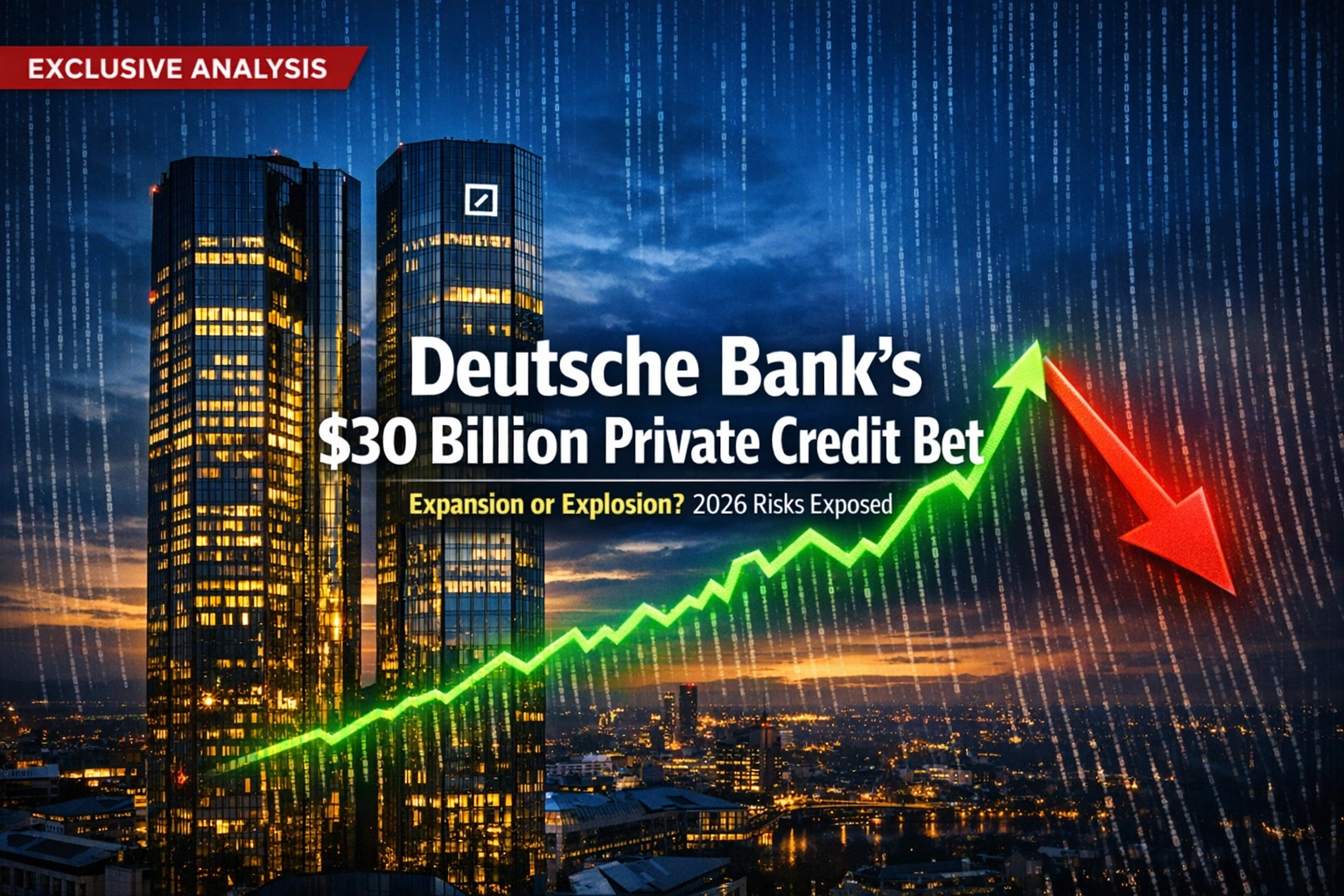
There is a peculiar kind of institutional courage — or, depending on your disposition, institutional hubris — in publishing a document that simultaneously discloses a €25.9 billion risk and announces your intention to take on more of it. Deutsche Bank did precisely that on Thursday morning when its 2025 Annual Report and Pillar 3 disclosures landed on investor terminals across three continents.
The numbers were striking enough on their own: the Frankfurt-headquartered lender’s private credit portfolio had grown roughly 6% year on year, rising from €24.5 billion in 2024 to nearly €26 billion — just over $30 billion at current exchange rates — making it one of the most substantial disclosed private-credit exposures on any European bank’s balance sheet. But it was the three words buried deeper in the filing that stopped seasoned credit analysts mid-scroll. Deutsche Bank, the report stated plainly, “seeks to expand private credit offerings.”
That phrase landed in a market already skittish about the asset class. Shares in Deutsche Bank fell in early Frankfurt trading, joining a broader rotation away from names perceived to carry outsized private-credit risk. The decline echoed a pattern seen six weeks earlier when a separate Deutsche Bank research note warned that software and technology companies — the sector most loved by private credit lenders — posed what its analysts called one of the “all-time great concentration risks” to speculative-grade credit markets. The analysts were speaking about an industry-wide problem. Today, their own institution disclosed that its technology-sector loan exposure had jumped to €15.8 billion, up sharply from €11.7 billion the prior year — an increase of 35% in a single twelve-month period.
To its critics, Thursday’s disclosure is evidence of a systemic contradiction at the heart of modern banking: institutions that identify a risk in public research simultaneously deepen their exposure to it in private transactions. To its defenders — and Deutsche Bank has articulate ones — the expansion is a deliberate, conservatively underwritten bet on a structural shift in how the world’s capital flows. Both positions deserve a serious hearing, because the stakes extend well beyond any single bank’s quarterly earnings.
1: The Numbers Behind Deutsche Bank’s Private Credit Bet
A Portfolio That Represents 5% of the Entire Loan Book
Deutsche Bank’s 2025 Annual Report is a document with the heft of a minor encyclopedia, but the private credit section rewards close reading. The €25.9 billion exposure — roughly 5% of the bank’s total loan book — did not arrive overnight. It has been built methodically, brick by brick, across the Corporate & Investment Bank, the Private Bank, and through the bank’s asset management arm, DWS.
That tripartite structure is deliberate. DWS, Germany’s largest asset manager, has been quietly building a private markets capability for institutional and increasingly retail clients, offering access through vehicles including a European Long-Term Investment Fund launched in partnership with Deutsche Bank and Partners Group. The Private Bank, meanwhile, has been developing digital investment solutions to bring private credit products to high-net-worth individuals who previously had no practical route into the asset class. The CIB provides origination firepower — deal flow, syndication, and leveraged finance relationships that few European peers can match.
The Technology Sector Concentration
The most acute number in Thursday’s filing, however, is the technology figure. At €15.8 billion, loans to the technology sector — including software companies — now account for approximately 61% of the bank’s total private credit book. This is not incidental. Software businesses became the flagship borrowers of the private credit boom for a set of well-understood reasons: predictable subscription revenues, high gross margins, low capital intensity, and sticky customer bases that offered lenders reliable cash flow visibility.
What changed — abruptly, and with world-historical speed — was the artificial intelligence revolution. As Bloomberg reported in February, Deutsche Bank’s own research analysts, led by Steve Caprio, warned that software companies account for roughly 14% of the speculative-grade credit universe, representing approximately $597 billion in debt outstanding. The AI disruption risk is not theoretical: it is already repricing loans. Payment-in-kind usage — where borrowers pay interest in additional debt rather than cash — has climbed to 11.3% in business development company portfolios, more than 2.5 percentage points above the already-elevated market average of 8.7%. These are the early signatures of distress.
Growth Ambitions Across Three Vectors
Deutsche Bank’s expansion strategy, as stated in its annual report, runs through three coordinated channels:
Selective regional expansion — deepening penetration in markets where private credit infrastructure remains underdeveloped, particularly continental Europe and selective Asia-Pacific corridors, where regulatory capital requirements have pushed traditional bank lending back and created origination vacuums that non-bank lenders, and bank-affiliated funds, are rushing to fill.
CIB integration — leveraging the Investment Bank’s leveraged finance, debt capital markets, and structured finance relationships to originate transactions that DWS-managed funds then hold.
Digital private banking solutions — using technology to distribute private credit products to a broader base of Private Bank clients, addressing the longstanding illiquidity premium that has historically confined the asset class to the largest institutional investors.
2: Conservative Underwriting vs. Industry Red Flags
Deutsche Bank’s Stated Defensive Architecture
In a period of mounting industry-wide scrutiny, Deutsche Bank has been emphatic — perhaps strategically so — about the conservative character of its underwriting. The annual report states that the bank applies “conservative underwriting standards” to its private credit portfolio, and that it is not exposed to “significant risks” through its relationships with non-bank financial institutions. It does, however, acknowledge that “the bank could face potential indirect credit risks through interconnected portfolios and counterparties.”
This language matters. The distinction between direct and indirect risk is not merely semantic — it is the central architectural question in private credit today. A bank that originates loans and holds them on balance sheet faces direct mark-to-market and default risk. A bank that originates, then distributes to third-party funds — while maintaining warehouse lines, revolving credit facilities, and fund-level leverage — faces indirect risk that is harder to quantify, harder to stress-test, and potentially far more systemic in a scenario of simultaneous redemptions.
Advance rates of approximately 65% — meaning Deutsche Bank typically lends against 65 cents of every dollar of collateral value — place it meaningfully below the leverage levels typical of the most aggressive direct lenders in the market. The portfolio is also weighted toward investment-grade or near-investment-grade borrowers rather than the deep-sub-investment-grade exposures that characterise some U.S.-based business development companies.
The Industry’s Red Flags in 2026
That conservatism, however, exists within an ecosystem that is developing structural fault lines. Reuters reporting on Thursday noted that “failures of a select number of sub-prime lenders in the U.S. increased investor focus on risks associated with private credit and raised wider concerns around underwriting standards and fraud risk.” The phrase in quotation marks came directly from Deutsche Bank’s own annual report — a remarkable degree of institutional candour.
Several interconnected pressures are now converging on the $2 trillion global private credit market simultaneously:
Redemption pressure — As CNBC documented in February, publicly traded business development companies with heavy software exposure experienced dramatic sell-offs, with Ares Management falling over 12%, Blue Owl Capital losing more than 8%, and KKR declining close to 10% in a single week. These are liquid proxies for an illiquid market, and their moves signal what institutional redemption pressure, if sustained, could do to private fund valuations.
AI-driven obsolescence risk — UBS Group has modelled a scenario in which, under aggressive AI adoption assumptions, default rates in U.S. private credit climb to 13% — substantially above the stress projections for leveraged loans (approximately 8%) and high-yield bonds (around 4%). Software payment-in-kind loans now represent a growing share of BDC portfolios precisely because many software borrowers are already struggling to service debt in cash.
Opacity and interconnection — JPMorgan’s Jamie Dimon warned in late 2025 about private credit’s “cockroaches” — the concern that stress in one borrower signals more hidden trouble elsewhere. The ECB and the Bank of England have both flagged concentration risk in their recent financial stability reviews, noting that banks’ indirect exposures through fund-level financing may be materially understated in regulatory disclosures.
3: Global Implications — European Banks, AI, and the $1.8 Trillion Private-Credit Shift
Europe’s Structural Opportunity
To understand why Deutsche Bank seeks to expand private credit offerings despite these headwinds, it is necessary to understand the structural logic that makes European banks’ private credit ambitions almost inevitable.
Following the Global Financial Crisis and successive rounds of Basel regulatory tightening, European banks sharply curtailed their lending to mid-market corporates, leveraged buyouts, and growth-stage technology companies. Non-bank lenders — Blackstone, Apollo, Ares, Blue Owl, and their peers — filled that vacuum with extraordinary efficiency. By most estimates, the global private credit market has grown from under $500 billion a decade ago to somewhere between $1.8 trillion and $2 trillion today, depending on definitional boundaries, with some forecasters projecting it reaching $3.5 trillion by the end of the decade.
European banks have watched this transfer of margin and relationship capital to predominantly U.S.-headquartered asset managers with the quiet fury of entities losing market share in their home territory. Deutsche Bank’s expansion strategy is, in part, a reclamation effort — an attempt to intermediate capital flows that would otherwise bypass Frankfurt entirely and flow directly from pension funds and sovereign wealth vehicles in Oslo, Abu Dhabi, and Seoul to private equity-owned software companies in San Francisco and London, with U.S. managers collecting the management fees.
The AI Dimension
The artificial intelligence disruption to software borrowers is not a risk that Deutsche Bank — or any lender — can underwrite away entirely. According to analysis published by S&P Global, software and technology companies account for approximately 25% of the private credit market through year-end 2025. Deutsche Bank’s own analysts have noted that the software sector’s exposure to AI-driven disruption “would rival that of the Energy sector in 2016” — a period that produced widespread credit losses and a restructuring cycle that took years to resolve.
What makes the current situation structurally different from the 2016 energy analogy is the speed of the disruption vector and the opacity of the affected portfolios. When oil prices collapsed, the mechanism of loss was transparent: commodity prices are public, reserves are reported, and the chain of causation from price to default was legible. AI disruption to software revenue is subtler, faster, and far harder to detect in quarterly borrower updates until it crystallises into a covenant breach or, worse, a payment default.
Macro Implications for Policymakers
The ECB’s most recent Financial Stability Review identified the nexus of banks and non-bank financial institutions as a primary risk amplification channel. What Deutsche Bank’s disclosure crystallises — in unusually stark terms for an institution not known for gratuitous transparency — is that European banks’ exposure to private credit is not merely an investment banking line item. It is a macro-financial variable.
If private credit suffers a disorderly repricing — triggered by AI-driven software defaults, a redemption cascade, or a combination of both — European banks with direct lending exposure face mark-to-market losses. Those with indirect exposure, through warehouse lines and fund-level leverage, face contingent liabilities that may not appear on regulatory balance sheets until stress has already propagated. The IMF’s Global Financial Stability Report has warned repeatedly that the non-bank sector’s interconnection with regulated banking creates channels of contagion that supervisors lack adequate tools to monitor in real time.
4: Peer Comparison — Deutsche Bank vs. Private Credit Titans
How Deutsche Bank’s Exposure Stacks Up
The following table provides a structured comparison of Deutsche Bank’s private credit approach against key peers and specialist alternative asset managers operating in the same market:
| Institution | Estimated Private Credit AUM / Exposure | Technology Sector Weight | Underwriting Approach | Key Risk Flag |
|---|---|---|---|---|
| Deutsche Bank | €25.9bn ($30bn) direct exposure | ~61% (€15.8bn tech) | Conservative; ~65% advance rates; investment-grade bias | Indirect NBFI contagion; tech concentration |
| Blackstone | ~$300bn credit & insurance AUM | Diversified; <20% software | Institutional, collateralised | Redemption queues in flagship vehicles |
| Apollo Global | ~$500bn total AUM; large private credit sleeve | Moderate software exposure | Originate-to-distribute; balance sheet light | NAV lending; leverage at fund level |
| Blue Owl Capital | ~$200bn AUM; pure-play direct lending | High; software-heavy BDCs | Senior secured, covenant-lite | AI disruption; stock -8% in Feb 2026 |
| Goldman Sachs Asset Mgmt | ~$130bn private credit | Diversified, IG bias | Hybrid bank/asset manager model | Regulatory capital consumption |
| Ares Management | ~$450bn AUM; ~$300bn+ credit | ~6% software of total assets | Conservative; low software weight | AUM growth costs; manager fee compression |
Sources: Company reports, Bloomberg, Reuters, Pitchbook, as of March 2026. AUM figures approximate and include broader credit franchises where private credit is not separately disclosed.
What the Comparison Reveals
Several conclusions emerge from even a cursory reading of this landscape. First, Deutsche Bank is not a private credit manager in the Blackstone or Apollo sense — it is a bank with lending relationships that overlap substantially with the same universe of borrowers those managers are financing. This creates both complementarity (the bank originates deals that asset managers hold) and potential competition (as asset managers build their own origination infrastructure).
Second, Deutsche Bank’s technology concentration — at roughly 61% of its disclosed private credit book — is high relative to conservative peers like Ares, which has deliberately capped software exposure at around 6% of total assets. This is the number most likely to attract regulatory attention.
Third, the bank’s disclosed exposure at €25.9 billion is, by global standards, a mid-tier position. It is dwarfed by the dedicated private credit franchises of Blackstone, Apollo, and Ares. But it is substantial enough — and sufficiently concentrated in a single stressed sector — to represent a material tail risk on Deutsche Bank’s balance sheet in an adverse scenario.
5: What This Means for Investors and Policymakers
The Investment Calculus
For institutional investors holding Deutsche Bank equity, Thursday’s disclosure contains both reassurance and residual unease. The reassurance: management has been transparent, the underwriting is described as conservative, there are no loss provisions against the private credit book, and the bank’s overall financial performance in 2025 was materially strong — revenues reached €32.1 billion, up 7% year on year, with net profits and capital distributions significantly improved from prior years. The bank’s CET1 ratio remains robust, and cumulative shareholder distributions for 2021–2025 have reached €8.5 billion, above the original €8 billion target.
The residual unease: the technology exposure has grown by 35% in a single year, from €11.7 billion to €15.8 billion, precisely as the AI disruption thesis has become more acute and more credible. If UBS’s stress scenario — 13% default rates in U.S. private credit — were to materialise, even a portfolio that is 65% loan-to-value and investment-grade-biased would generate meaningful losses at these concentrations.
For sovereign wealth funds and central bank reserve managers — who are both increasingly active as direct investors in private credit funds and as counterparties to the banks that finance those funds — the systemic question is more pressing than the idiosyncratic one. A banking system that is simultaneously the lender of last resort for private credit funds (through warehouse facilities and NAV loans) and an originator competing with those same funds is not a system whose risk exposures can be easily ring-fenced. The 2008 crisis demonstrated, with brutal efficiency, that what cannot be ring-fenced tends not to be.
The Regulatory Horizon
European banking supervisors at the ECB have signalled increasing discomfort with banks’ private-credit-adjacent activities since at least 2024. The ECB’s Single Supervisory Mechanism has sought more granular reporting on banks’ exposures to leveraged finance and non-bank financial institutions, and Deutsche Bank’s disclosure — voluntary, detailed, and self-critical — may be read partly as a pre-emptive act of regulatory diplomacy.
In Washington, the Federal Reserve has similarly flagged interconnection between banks and the private credit ecosystem as an emerging macro-prudential concern. The next round of stress tests, scheduled for mid-2026, is expected to include private credit scenarios that were not present in previous years.
Conclusion: The Inflection Point
There is a phrase used by geologists to describe the moment before a faultline slips: they call it “stress loading.” For years, pressure builds invisibly, tectonic plates locked against each other, until some marginal additional force triggers a release that had been inevitable for decades. Private credit in 2026 has the texture of a market under stress loading.
Deutsche Bank’s disclosure is important not because it reveals a crisis — it does not — but because it reveals, with unusual precision, the scale and composition of one institution’s position ahead of what could be a significant realignment. The bank’s €25.9 billion portfolio is conservatively underwritten relative to many peers. Its ambitions to expand are strategically coherent. Its transparency, in an asset class not known for it, is genuinely welcome.
And yet: a 35% increase in technology-sector loans in a single year, at precisely the moment when AI is rewriting software’s competitive dynamics, is not a trivial coincidence. Nor is the simultaneous reality that the private credit market’s fastest-growing risks — payment-in-kind escalation, redemption pressure, opacity, interconnection — are also the hardest to observe until they crystallise.
For international investors, the Deutsche Bank private credit expansion story is neither a disaster nor a triumph in waiting. It is something more uncomfortable: a test of whether European banking’s late arrival to the private credit party is disciplined reclamation or expensive imitation. The answer will likely arrive between 2026 and 2028 — precisely the window Deutsche Bank has identified as its “Scaling the Global Hausbank” strategic horizon.
Sophisticated readers will note the symmetry. So, presumably, will the ECB.
FAQ: Deutsche Bank Private Credit — Your Questions Answered
Q1: How large is Deutsche Bank’s private credit portfolio as of 2025?
Deutsche Bank’s private credit portfolio stood at approximately €25.9 billion ($30 billion) at year-end 2025, representing around 5% of the bank’s total loan book and a 6% increase from €24.5 billion at year-end 2024, according to the bank’s 2025 Annual Report published on 12 March 2026.
Q2: Why is Deutsche Bank expanding private credit despite rising risks?
Deutsche Bank seeks to expand private credit offerings through three strategic vectors: selective regional expansion into underserved markets, integration with its Corporate & Investment Bank for deal origination, and digital product development through its Private Bank for high-net-worth distribution. The rationale is structural — European banks lost significant mid-market lending share to U.S. non-bank managers over the past decade, and expanding private credit is partly an attempt to recapture that margin and relationship capital.
Q3: What is the biggest risk in Deutsche Bank’s private credit portfolio?
The single greatest concentration risk is technology-sector exposure, which reached €15.8 billion in 2025 — a 35% increase from €11.7 billion in 2024. This concentration is particularly sensitive to AI-driven disruption of software company business models, which has already caused payment-in-kind loan usage to rise and prompted analysts, including Deutsche Bank’s own research team, to warn of potential industry-wide default rates rivalling the energy sector crisis of 2016.
Q4: How does Deutsche Bank’s underwriting compare to industry peers?
Deutsche Bank applies conservative underwriting standards, including advance rates of approximately 65% and a bias toward investment-grade or near-investment-grade borrowers. This compares favourably to some U.S. business development companies that operate with higher leverage and deeper-sub-investment-grade exposure. However, the technology sector concentration remains high relative to conservative peers like Ares Management, which has capped its software exposure at around 6% of total assets.
Q5: What is the total size of the global private credit market?
Estimates vary by methodology, but the global private credit market is broadly estimated at $2–$3 trillion as of early 2026, depending on whether indirect structures such as NAV lending and warehouse facilities are included. Industry forecasters project growth to $3.5 trillion or beyond by 2030, driven by continued bank disintermediation, demand from institutional investors for yield premium, and expansion into new geographies and borrower segments.
Q6: Has Deutsche Bank reported any losses on its private credit portfolio?
As of the 2025 Annual Report, Deutsche Bank has not reported any losses or provisions directly tied to its private credit exposure. The bank has, however, flagged private credit as a “key risk” and acknowledged the potential for indirect credit risks through interconnected counterparties, representing an honest — and notable — departure from the more sanguine disclosures common in the sector.
Q7: How does AI specifically threaten private credit markets?
AI threatens private credit primarily through its disruption of software company revenue models. Software-as-a-service businesses — the largest single borrower segment in private credit, accounting for roughly 25% of the market — derive value from subscription revenue, sticky customer bases, and high gross margins. Generative AI and agentic coding tools risk eroding those moats by automating functions that enterprise software previously monopolised, compressing multiples and, in severe cases, triggering revenue declines that cannot be serviced from existing debt loads. UBS has modelled an aggressive-disruption scenario in which U.S. private credit default rates reach 13%, compared to 8% for leveraged loans and 4% for high-yield bonds.
Discover more from The Economy
Subscribe to get the latest posts sent to your email.
-

 Markets & Finance2 months ago
Top 15 Stocks for Investment in 2026 in PSX: Your Complete Guide to Pakistan’s Best Investment Opportunities
-

 Analysis1 month ago
Brazil’s Rare Earth Race: US, EU, and China Compete for Critical Minerals as Tensions Rise
-

 Banks2 months ago
Best Investments in Pakistan 2026: Top 10 Low-Price Shares and Long-Term Picks for the PSX
-

 Investment2 months ago
Top 10 Mutual Fund Managers in Pakistan for Investment in 2026: A Comprehensive Guide for Optimal Returns
-

 Asia2 months ago
China’s 50% Domestic Equipment Rule: The Semiconductor Mandate Reshaping Global Tech
-

 Analysis4 weeks ago
Top 10 Stocks for Investment in PSX for Quick Returns in 2026
-

 Global Economy3 months ago
Pakistan’s Export Goldmine: 10 Game-Changing Markets Where Pakistani Businesses Are Winning Big in 2025
-

 Global Economy3 months ago
15 Most Lucrative Sectors for Investment in Pakistan: A 2025 Data-Driven Analysis