
Global Economy
PSX Bull Run 2025: Why Pakistan’s Market Is Suddenly on Every Global Radar

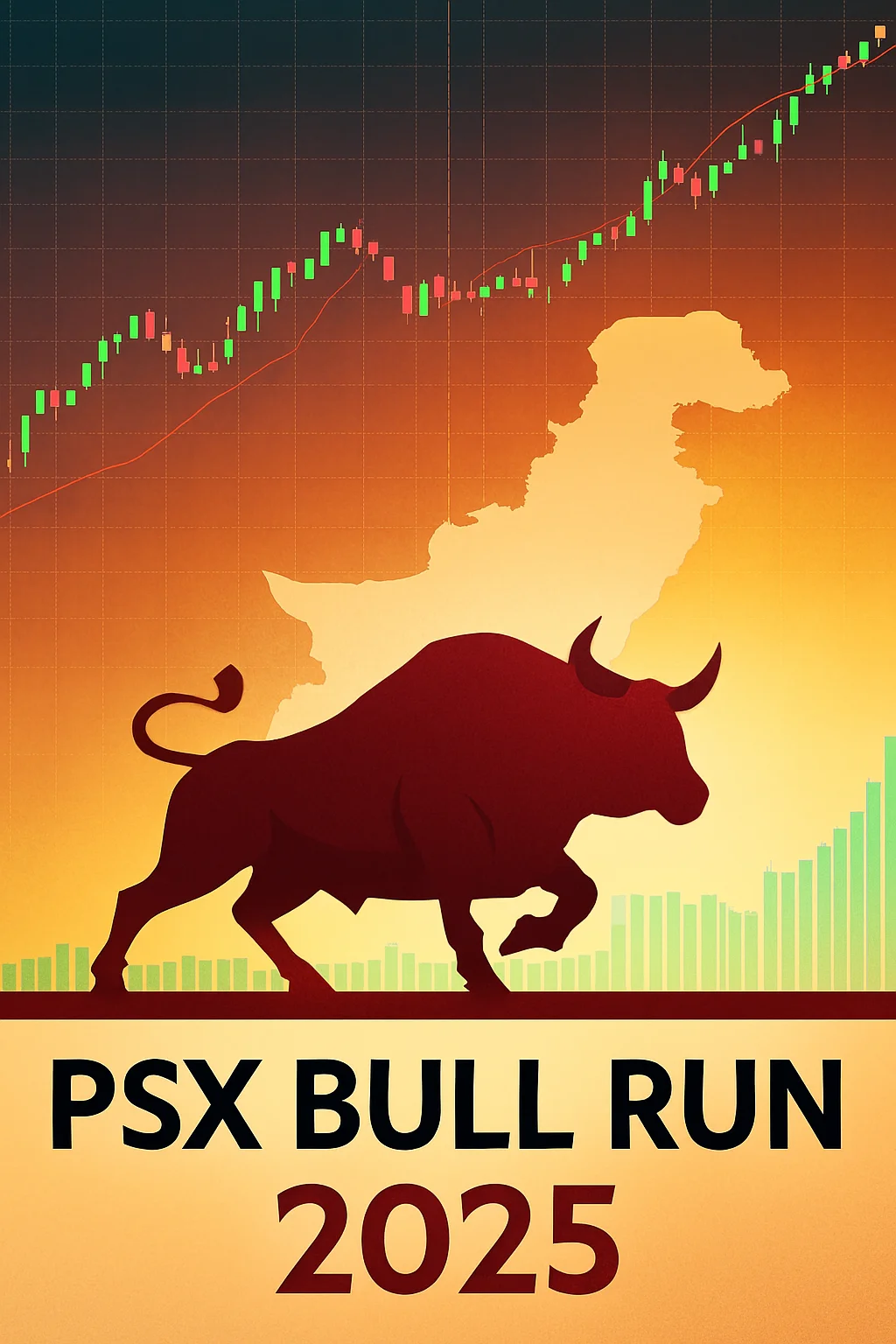
By any conventional metric, Pakistan should not be leading the pack of global equity returns in 2025. It is a frontier‑to‑emerging‑market hybrid with a long history of fiscal slippage, external vulnerability, and political volatility. Yet the Pakistan Stock Exchange (PSX) has staged one of the most remarkable bull runs in its modern history, turning what was once seen as a high‑beta, crisis‑prone market into a surprising outperformer.
From late 2024 into 2025, the benchmark KSE‑100 index has powered through successive resistance levels, with rallies often accompanied by surging trading volumes and broad‑based sector participation. In December 2025, the index is trading near record territory, with cumulative returns that put it ahead of many larger emerging markets. The question that investors—domestic and foreign alike—are now asking is straightforward: what is really fueling this confidence, and is it sustainable?
The answer lies at the intersection of macroeconomic stabilization, monetary policy recalibration, geopolitical risk repricing, and underappreciated structural changes in market infrastructure and participation. The PSX rally is not just a story of “cheap valuations”; it is a case study in how a market moves from the brink of recurring crisis to a cautiously credible recovery narrative.
From Crisis Narrative to Reform Story
For much of the past decade, Pakistan featured in headlines for all the wrong reasons: balance‑of‑payments stress, repeated IMF engagements, a sliding currency, and a persistent trust deficit between policymakers and markets. The 2022–2023 period in particular cemented perceptions of Pakistan as a perennially fragile economy, with the KSE‑100 under heavy pressure, foreign investors exiting, and the rupee in freefall.
The turning point began when the government—under intense domestic and external pressure—finally embraced orthodox stabilization. Subsidies were cut, energy prices adjusted, tax measures introduced, and a new IMF program negotiated. Painful as they were, these steps helped achieve three critical outcomes:
- Inflation peaked and started to trend lower, reducing the sense of macroeconomic freefall.
- Foreign exchange reserves stabilized, even if at modest levels, helped by concessional inflows, remittances, and controlled imports.
- The rupee found a floor, with volatility subdued relative to the worst of the crisis period.
By late 2024 and into 2025, investors began to see a discernible shift in narrative: from “Pakistan might default” to “Pakistan has bought time and breathing space.” For equity markets, this distinction is enormous. A market that survives the worst‑case scenario often gets repriced, not merely to reflect current fundamentals, but on the expectation that the worst risks have already been realized.
Monetary Policy: From Punishing to Supportive
No bull market in a macro‑fragile country is possible without a visible pivot in monetary policy. Pakistan’s central bank spent years running one of the most aggressive tightening cycles in the region. Policy rates were kept high to rein in inflation, defend the currency, and signal seriousness to international creditors and the IMF.
By 2025, that phase had largely run its course. With inflation finally decelerating—helped by base effects, moderation in global commodity prices, and domestic demand compression—the State Bank had room to shift gears. Even the anticipation of rate cuts was enough to move markets.
For equity investors, particularly those running discounted cash flow (DCF) models, the implication of a lower policy rate is straightforward:
- Lower discount rates increase the present value of future corporate earnings.
- Reduced borrowing costs improve profitability, especially for capital‑intensive firms.
- Portfolio rebalancing favors equities as the relative attractiveness of fixed‑income instruments declines.
Banks, in particular, benefited from a complex but favorable combination: they had enjoyed windfall gains during the high‑rate period via elevated yields, and now stood to gain from an eventual revival in credit growth as rates normalized. The market began to price in this dual advantage.
For foreign investors, a credible path to lower inflation and easing rates was a signal that Pakistan’s macro orthodoxy was returning. It reduced the perceived probability of a disorderly adjustment and improved the risk‑reward profile of the PSX relative to peers.
Earnings, Valuations, and the “Re‑Rating” of Pakistan
The PSX was not simply rising on the back of sentiment; it was rebounding from deeply depressed valuation levels. In the worst periods of the crisis, the KSE‑100 traded at price‑to‑earnings multiples that were not merely low—they were indicative of a market priced for failure.
As macro conditions stabilized, several factors drove a re‑rating:
- Corporate earnings proved more resilient than feared. Exporters benefited from a weaker rupee, remittance‑linked consumption held up reasonably well, and large conglomerates demonstrated cost discipline.
- Banks and energy names, long seen as systemically exposed, adjusted to new regulatory and fiscal realities.
- A handful of listed companies continued to deliver strong free cash flows, even under stress, reinforcing the idea that Pakistan hosts pockets of world‑class businesses despite the macro noise.
When a market trades at distressed multiples for too long, it only takes a modest shift in the macro narrative to trigger a sharp upside move. That is precisely what happened in 2025. Rising earnings, combined with still‑reasonable valuations, created the conditions for a powerful bull run once capital began to return.
Sector‑Wise Drivers: Where the Confidence Is Concentrated
Though broad‑based rallies make better headlines, serious investors know that bull markets are rarely uniform; they are led by sectors with convincing narratives. In the PSX’s 2025 rally, four clusters stand out.
1. Banking and Financials
Banks are at the heart of Pakistan’s financial system and often the first to react to shifts in policy. Investors saw a multi‑layered story:
- High yields on government securities previously padded earnings, providing a cushion through the worst of the crisis.
- Prospects of renewed private‑sector credit growth as rates normalize suggested new revenue opportunities.
- Improving asset quality, once the worst of the economic contraction passed, reassured analysts that non‑performing loans would not spiral out of control.
As risk premiums compressed, financials became core holdings in both domestic and foreign portfolios, amplifying the overall index move.
2. Energy and Utilities
Energy has long been central to Pakistan’s macro vulnerabilities: circular debt, price distortions, and under‑investment. By 2025, incremental steps to rationalize tariffs, streamline subsidies, and improve billing and recovery mechanisms gave investors hope that the sector was finally moving toward a more sustainable model.
Listed energy companies benefited from:
- Clearer tariff regimes
- Better prospects of receivables recovery
- Ongoing discussions on restructuring legacy obligations
This translated into multiple expansion and renewed investor interest—especially among institutions looking for yield and hard‑asset exposure.
3. Export‑Oriented Industrials and Textiles
Pakistan’s textile and export‑oriented sectors found themselves in a position to take advantage of global supply chain reconfiguration. As multinational firms continued to diversify away from over‑reliance on a single geography, countries like Pakistan—offering competitive labor, improving infrastructure, and trade links—stood to gain.
Exporters saw a double benefit: a weaker rupee improved price competitiveness abroad, while local cost structures, despite inflation, remained manageable relative to peers. The equity market responded by rewarding firms that demonstrated the ability to secure orders, move up the value chain, and reinvest in capacity.
4. Technology, Telecom, and the Digital Economy
The story of Pakistan’s tech and telecom sectors is more nascent but no less important. Rising connectivity, a young demographic profile, and government rhetoric around “Digital Pakistan” created a supportive backdrop for listed telecom firms and tech‑adjacent plays.
Although the PSX remains underweight on pure‑play tech relative to regional exchanges, increased interest in digital payments, fintech, and data services added a structural growth narrative to an otherwise traditional market.
The Infrastructure Beneath the Rally: Speed, Uptime, and Market Plumbing
One of the least discussed contributors to the PSX’s bull run has been its own quiet evolution as a trading platform. In the modern equity ecosystem, investor confidence is shaped not only by macro and policy, but by the perceived reliability, transparency, and efficiency of the venue itself.
Over recent years, the PSX has invested in:
- Improved trading engines and matching systems, capable of handling higher order volumes with lower latency.
- Better uptime and system reliability, reducing instances of market disruption, halts, or technical outages.
- Enhanced connectivity and co‑location services, enabling brokers and institutions to execute faster and more efficiently.
- Upgraded surveillance and compliance tools, improving the detection of abnormal trading behavior and bolstering market integrity.
While the PSX does not always broadcast granular metrics such as average execution time in milliseconds or annualized uptime percentages, the lived experience of market participants has changed. Days with exceptionally high volumes—where hundreds of millions of shares change hands—are now processed with fewer technical hiccups than in previous cycles. For sophisticated institutional investors, this matters: they are more willing to deploy large orders into a market whose “plumbing” they trust.
The cumulative effect of these improvements is subtle but powerful: liquidity begets liquidity. As more participants trade with confidence that the system will not fail them mid‑session, spreads tighten, depth improves, and the market becomes more investable for global funds.
Foreign Investors: From Capitulation to Gradual Re‑Entry
Foreign portfolio investors are often caricatured as fickle, but in reality, they respond to a combination of fundamentals, valuation, and global risk appetite. In Pakistan’s case, the 2025 bull run has coincided with several favorable global and local shifts:
- Global search for yield: As major central banks move from aggressive tightening to a more neutral or easing stance, capital begins to flow back into higher‑risk, higher‑return markets.
- Relative valuation appeal: When compared to other emerging and frontier markets, Pakistan’s equities, even after the rally, still look cheap on a historical and cross‑country basis.
- Perception of “risk already priced in”: After years of underperformance, many of the worst‑case scenarios—political disruption, fiscal slippage, external stress—were already reflected in prices. Any move away from the brink justifies re‑entry.
Flows remain measured rather than exuberant; foreign investors have not forgotten how quickly Pakistan can move from calm to crisis. But the direction of travel has shifted. Instead of being incremental net sellers, foreigners are selectively adding exposure in areas where earnings visibility is strong, governance is credible, and liquidity is sufficient.
Geopolitics and Regional Positioning: A Narrow Window of Stability
Markets do not trade in economic isolation. Pakistan’s 2025 rally is playing out against a backdrop of shifting geopolitical alignments and regional recalibration.
On one side, global investors are reassessing supply chains, energy routes, and security commitments in light of conflicts and tensions elsewhere. On the other, South Asia’s demographic and consumption stories continue to attract attention. Pakistan, positioned at the intersection of key trade corridors, is once again being marketed as a “gateway” to multiple regions.
More importantly, the domestic political environment, while hardly tranquil, has been less disruptive than in some recent years. Policy continuity—especially in areas of economic management, energy pricing, and fiscal reform—has improved. For investors with long memories, the absence of fresh shocks sometimes feels as bullish as good news.
All of this is precarious, of course. Pakistan’s political and security risks have not vanished; they have merely receded enough to allow the market to focus on earnings, valuations, and reforms. Whether this window stays open will play a significant role in determining whether the bull run becomes a sustained multi‑year story or just a powerful but finite rebound.
The Psychology of Confidence: From Survival to Strategy
Investor confidence is not solely a function of spreadsheets and macro charts; it is also psychological. The PSX’s 2025 bull run is, in part, a collective exhale after years of living at the edge of crisis.
When investors spend too long in defensive mode—rolling over positions, protecting cash, questioning solvency—there is a pent‑up demand for a more constructive story. As soon as macro stabilization becomes credible and early‑cycle signals appear, positioning can change rapidly:
- Domestic investors rotate from cash and property back into equities.
- Brokers, after years of depressed business, see volumes rise and become vocal advocates of the rally.
- The media narrative shifts from “how bad can it get?” to “have you missed the rally?”
The PSX has benefited from this psychological flip. Once the move began, it reinforced itself: each new high brought sidelined investors back in, while early entrants felt vindicated and emboldened.
SEO‑Visible Themes: How the Market Story Travels Beyond the Ticker
From a digital and editorial perspective, the PSX bull run intersects with several high‑interest themes that naturally attract global and regional readership:
- “Pakistan stock market 2025 performance”
- “PSX bull run analysis”
- “KSE‑100 index outlook”
- “Pakistan IMF program and stock market”
- “Emerging markets opportunity 2025”
- “Is Pakistan investable again?”
These search phrases map onto real investor questions. They also provide a framework through which this narrative is being disseminated to a wider audience. The more Pakistan appears in global financial discourse as a comeback story rather than a crisis case, the more self‑reinforcing the confidence cycle can become.
For seasoned investors, of course, the nuance matters: Pakistan is still a high‑risk market, with deep structural vulnerabilities and institutional constraints. But the recalibration from “uninvestable” to “selectively investable” is significant.
Is the Bull Run Sustainable?
The most important question for any serious investor is not why a rally has occurred, but whether it can last. On that front, Pakistan’s case is neither unequivocally bullish nor inevitably doomed. It is contingent.
Several factors will determine whether the PSX of 2025 is the start of a durable multi‑year trend or merely a powerful cyclical rebound:
- Fiscal Credibility: The government must move beyond budget‑day optics and credibly implement tax reforms, broaden the base, rationalize expenditure, and reduce reliance on unsustainable borrowing. Without this, debt dynamics could again spook markets.
- Monetary Prudence: The central bank’s eventual easing must remain anchored in inflation realities, not political pressure. Cutting too fast or too far could reignite inflation and undermine currency stability—killing the very confidence that underpins the bull run.
- Structural Reforms: Energy sector restructuring, state‑owned enterprise reform, digitalization of tax and payments infrastructure, and improvements in ease of doing business are not optional. They are the foundation on which any credible long‑term bull market must rest.
- External Resilience: Pakistan’s external account remains vulnerable to global shocks. Commodity price spikes, sudden stops in funding, or geopolitical flare‑ups can quickly reverse capital flows. Building buffers—reserves, reliable credit lines, diversified export markets—is essential.
- Institutional Strength and Governance: Markets ultimately thrive in environments where rules are predictable, contracts are respected, and governance is improving. Any regression in these areas will show up, sooner or later, in risk premiums and valuations.
The Final Verdict: A Market Re‑Rated, Not Yet Redeemed
The PSX bull run of 2025 is best understood not as an irrational exuberance, nor as a purely technical rally, but as a re‑rating of Pakistan’s risk profile after a period of extreme pessimism. Macroeconomic stabilization, a credible monetary pivot, incremental fiscal improvements, and better market infrastructure have collectively nudged investors from survival mode into selective optimism.
Yet optimism is not destiny. Pakistan’s stock market has been here before: episodes of strong performance followed by abrupt reversals when politics, policy, or global conditions turned. The challenge now is to avoid replaying that script.
If the country uses this window of market confidence to deepen reforms, strengthen institutions, and build resilience, the PSX of 2025 may mark the beginning of a longer secular story: a frontier market maturing into a more robust, though still volatile, emerging market opportunity.
If, however, complacency sets in—if reform fatigue returns, if fiscal and monetary discipline frays, if governance regresses—the bull run will, in hindsight, be remembered as another missed opportunity: a technically impressive rally that failed to translate into a durable re‑write of Pakistan’s economic trajectory.
For now, the verdict is still being written. What is clear is that investors have given Pakistan another chance. Whether policymakers, corporates, and institutions make good on that chance will determine whether the PSX remains a tactical trade—or finally earns its place as a strategic allocation in global portfolios.
Discover more from The Economy
Subscribe to get the latest posts sent to your email.


Analysis
Canada’s Central Bank Holds the Line at 2.25% as Tariffs and a Middle East Oil Shock Collide
The Bank of Canada has maintained its policy rate at 2.25% for a consecutive meeting, navigating a rare combination of tariff-driven trade disruption and Middle East-driven energy inflation that is squeezing the economy from two directions at once, according to the Bank of Canada’s June 2026 rate announcement.
A Soft Economy Absorbing Two Shocks
Canadian GDP edged down 0.1% in the first quarter, weaker than the Bank’s April projection, even as global equity markets stayed buoyant and the Canadian dollar weakened against its US counterpart. Governing Council says it will “look through” the near-term inflation impact of the Middle East conflict but will not allow higher energy prices to become entrenched, a distinction the Bank has drawn explicitly to avoid repeating the policy mistakes of the 2021-22 inflation surge, per the Bank’s official statement.
The Bank’s April Monetary Policy Report forecasts GDP growth of just 1.2% in 2026, rising to 1.6% in 2027, as exports and business investment recover only gradually from a US tariff regime the Bank now treats as a structural, not cyclical, feature of the outlook, according to the Bank of Canada’s April 2026 report.
The Tariff Toll So Far
RBC Economics estimates the US has imposed a roughly 6% average effective tariff rate on Canadian exports, with most trade remaining exempt under CUSMA compliance rules, based on RBC’s structural-damage assessment. Steel, aluminum, and auto exports have declined sharply, while other sectors have proven more resilient than initially feared. HSB Pricing Lab research conducted with Bank of Canada staff found roughly a quarter of Canada’s own retaliatory tariff costs passed through to consumer prices before being rapidly unwound once most retaliatory measures were lifted.
The Canada-United States-Mexico Agreement (CUSMA) review is, in the words of Desjardins Group economists, “the defining issue” of 2026 for Canadian policy, with FTSE Russell analysts suggesting the agreement is unlikely to survive in its current form even as the broader global trading system adapts around it, according to Yahoo Finance Canada’s economist survey.
Structural Damage, Not Just a Cyclical Dip
Bank of Canada officials have been unusually direct about the long-run cost of trade disruption. The Bank’s own commentary describes Canada’s potential output growth falling to roughly 1.0% in 2026 before a modest recovery to 1.3% in 2027, driven by both trade friction and slower population growth from reduced immigration, according to the Bank of Canada’s “Structural change” commentary. The labour market remains soft, with unemployment in the 6.5%–7% range reflecting weak hiring rather than mass layoffs — what Indeed Canada economist Brendon Bernard describes as a “low-hire, low-fire” dynamic.
Watching the Same AI Risk From Ottawa
Notably, the Bank of Canada’s own risk assessment flags the same concern now dominating global financial commentary: a “sudden tightening in global financial conditions sparked by a correction in AI related stock market valuations” as a distinct downside risk to its inflation projections, according to RBC’s analysis of the Bank’s scenario planning. That makes Canada one of the first G7 central banks to formally embed AI-valuation risk into its published monetary policy framework.
The Bank’s next rate decision and full Monetary Policy Report are due July 15, 2026.
Discover more from The Economy
Subscribe to get the latest posts sent to your email.
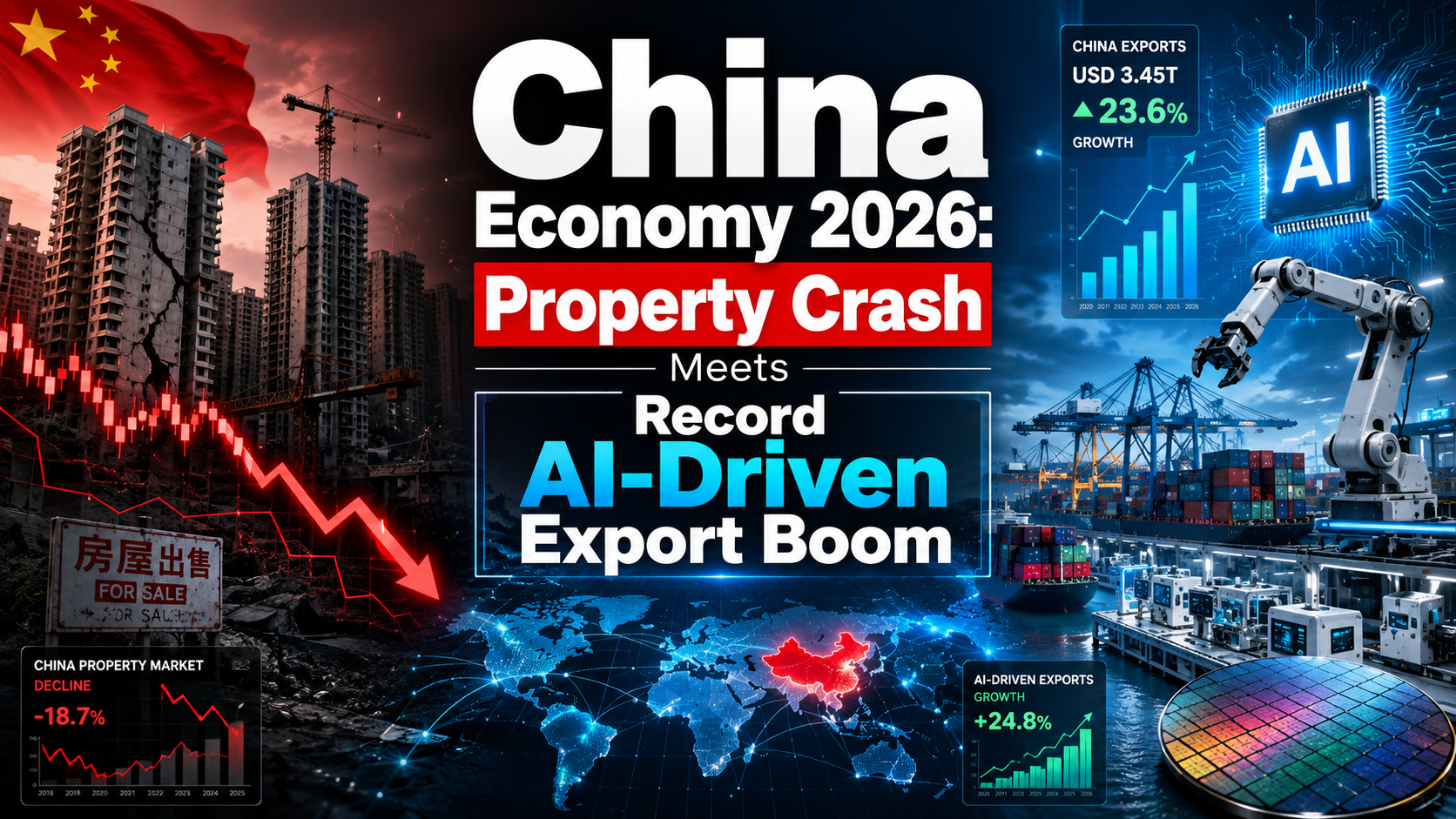
China’s economy is being pulled in two directions at once. Fixed-asset investment fell 4.1% year-on-year in the first five months of 2026 — the steepest decline since May 2020 — while exports surged 19.6% in May alone, powered overwhelmingly by semiconductor and AI-hardware demand, according to Deloitte’s Weekly Global Economic Update.
The Property Sector’s Deepening Slide
Property investment within that fixed-asset figure fell 16.2% year-on-year, the sharpest drop recorded in the current downturn. Roughly two-thirds of Chinese household wealth is held in property, so the sustained decline in home values is pushing consumers toward higher savings and lower spending as they attempt to rebuild balance sheets, per Deloitte’s analysis from chief global economist Ira Kalish. Government efforts to stabilize the housing market have so far failed to reverse the trend, with the excess capacity built during the prior debt-fueled construction boom still working through the system.
Exports Riding the Global AI Supercycle
The export side of the ledger tells a starkly different story. Semiconductor exports rose 110% year-on-year in May, mobile phone exports climbed 44%, and exports of automatic data-processing machines — the category covering computer and data-storage components — increased 66%. The May export growth of 19.6% was the second-largest year-on-year increase since January 2022, trailing only the 39.6% surge recorded in January–February 2026. Part of that strength reflects inventory build-up by global buyers anticipating further supply-chain disruption from the ongoing Middle East conflict.
Tariff Investigations Add a New Layer of Risk
Even as exports boom, the trade environment China and its partners face is becoming more adversarial. The US administration has launched an investigation into 60 countries — including the European Union — to determine whether they are importing goods made with forced labor, with the goal of imposing tariffs ranging from 10% to 12.5%. The move sets the stage for renewed friction even after the US and EU reached a trade agreement approved by the European Parliament the previous year, according to Deloitte’s tracking of the administration’s tariff strategy.
The China-Russia Financial Relationship Under New Strain
China’s export strength has not shielded it from secondary pressure tied to its economic relationship with Russia. US Treasury sanctions actions have begun targeting cross-border payment channels between Russian and Chinese entities used to facilitate sensitive-goods transactions, and Chinese banks have reportedly started refusing payments from Russian counterparties amid the threat of US secondary sanctions, according to CEPA’s analysis of the sanctions squeeze. China has supplied more than 90% of Russia’s semiconductor imports since the Ukraine war began, per CSIS’s research on sanctions reshaping Russia’s economy, making Beijing’s compliance posture a critical swing factor for Moscow’s continued access to Western-branded technology.
What It Means for the Regional Outlook
Asia House projects China’s growth easing modestly from 4.8% in 2025 to 4.6% in 2026, a relatively soft landing given the scale of tariffs imposed on Chinese exports, reflecting redirected trade flows toward Asian and European markets and a weaker real effective exchange rate, according to Asia House’s Annual Outlook. For ASEAN economies plugged into China’s supply chains — Malaysia and Vietnam in particular — the divergence between China’s property drag and export strength will remain a key variable shaping regional growth through the rest of 2026.
Discover more from The Economy
Subscribe to get the latest posts sent to your email.
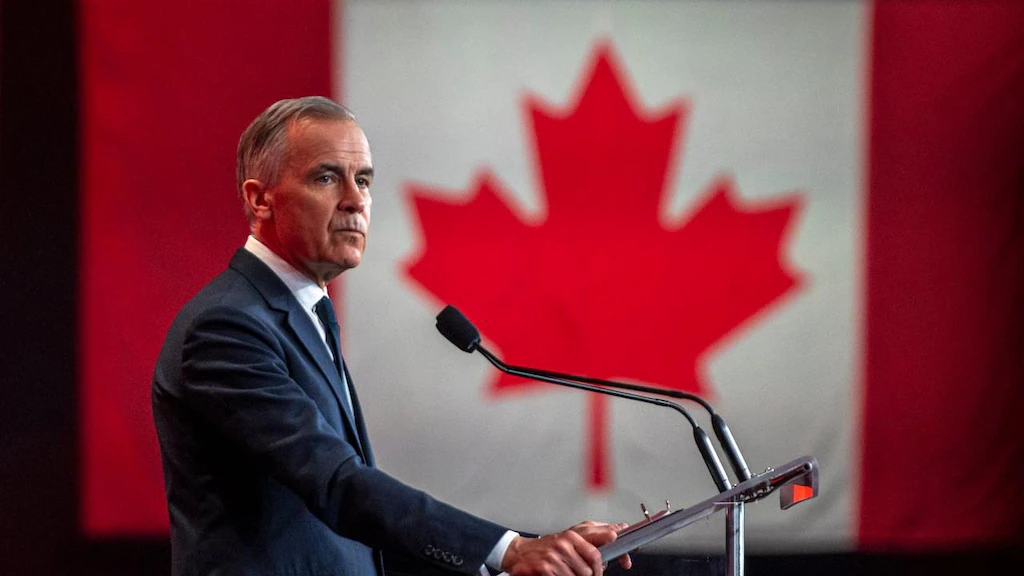
Canada’s economy has slipped into what Deloitte calls being “on pause,” with the mandatory July 1 review of the Canada-United States-Mexico Agreement having passed without a clear resolution, leaving businesses across the country’s most trade-exposed sectors unable to plan with any confidence, according to Global News’ reporting on the Deloitte assessment.
A Technical Recession, Officially Disputed
The economic backdrop into which the CUSMA review has landed is already fragile. Canada’s GDP data show a technical recession spanning October 2025 through March 2026, with business investment falling for five consecutive months, per Deloitte’s report as covered by Global News. Several Bank of Canada officials, along with Prime Minister Mark Carney, have pushed back on the recession framing, with Deloitte itself describing the claims as “exaggerated” even while acknowledging that the headline numbers, a one percent GDP drop in the fourth quarter of 2025 followed by a first-quarter 2026 decline, technically meet the standard definition.
Deloitte’s report identifies the core problem plainly: “unresolved trade issues with the U.S. remains the leading risk to the outlook,” warning that a failure to extend CUSMA or further American tariff escalation would hit Canadian exports and confidence hard. The firm now expects 2026 GDP growth of just 0.7%, down from 1.7% in 2025.
What CUSMA’s Review Actually Means
The stakes of the review are structural, not just cyclical. Under its current terms, CUSMA could be renewed for another 16 years under existing terms, extended for 10 years with annual reviews, or replaced entirely, according to Global News’ reporting. Canada and Mexico have both pushed for the longer, more stable extension, while President Trump has said he would be willing to sign the agreement but would “prefer to see it terminated,” a comment that has done little to settle business planning.
The Bank of Canada has held its policy rate steady at 2.25% through the middle of 2026, citing both the trade uncertainty and a separate inflationary pressure from the Iran war’s effect on oil prices, according to the central bank’s own rate announcement. The Bank’s April forecast projects GDP growth of just 1.2% in 2026, rising gradually to 1.6% in 2027 and 1.7% in 2028, contingent on exports and business investment resuming along what the Bank describes as “a lower trajectory” than pre-tariff projections assumed.
The Regional Damage Is Uneven
Not every part of Canada is being hit equally. RBC Economics research shows that manufacturers of steel, aluminum, copper, motor vehicles and parts, and softwood lumber have borne the brunt of US trade actions, concentrating the economic pain in Ontario and Quebec, which face the highest effective tariff rates on exports to the US, both exceeding 6%, according to RBC’s year-one tariff assessment. By contrast, provinces with smaller exposure to those industries, including Newfoundland and Labrador, New Brunswick, Alberta, Saskatchewan, and Prince Edward Island, face effective tariff rates below 1%.
There is evidence of adaptation underway. Canada’s merchandise exports to non-US economies rose 17% year-over-year in the twelve months to January 2026, even as exports to the US fell 10% over the same period, RBC’s data shows. The federal government has set a goal of doubling non-US exports by 2035, backed by infrastructure spending and new trade-diversification programs, though RBC notes that shifting supply chains and building new trade relationships outside the US “is a lengthy process” that cannot offset near-term losses.
Where the Upside Case Comes From
Not every recent analysis is downbeat. A separate RBC assessment argues that Canada’s resource base, agriculture, energy, and critical minerals, is increasingly well positioned to meet growing global demand for AI infrastructure and defense spending, representing what the bank’s economists call “a moment for Canada to invest in itself,” according to RBC’s separate outlook note. That report points to five specific positives: most Canadian exports remain exempted from the broadest US tariff increases, monetary policy retains flexibility, government net debt levels remain relatively low compared with other advanced economies, and both federal and provincial governments have signaled willingness to provide additional fiscal support if needed.
TD Economics strikes a similarly cautious-but-not-dire tone, forecasting real GDP growth accelerating from 2025’s “anemic” 0.7% pace to 1.3% in 2026 and 1.8% in 2027, contingent on the CUSMA talks not deteriorating further, according to TD’s quarterly forecast. TD’s baseline assumes the tariff status quo holds, a 10% rate on non-CUSMA-compliant goods alongside sector-specific Section 232 tariffs, while flagging that new Section 301 tariffs on forced-labor violations, set to take effect in late July and covering 60 countries, add a fresh layer of complexity just as the CUSMA question remains unresolved.
The Structural Shift Ahead
Bank of Canada officials have framed the moment as something bigger than a cyclical downturn. In a recent address, the central bank described the economy as being “at a crossroads,” warning that if Canada fails to restructure around new trade relationships, “productivity and GDP growth do not recover,” and the country becomes a less attractive place to invest, according to the Bank of Canada’s own address. Roughly half of the GDP shortfall attributable to US tariffs comes from reduced potential output rather than simple cyclical weakness, the Bank’s own projections show, a distinction that matters because potential-output damage does not automatically reverse once trade tensions ease.
Discover more from The Economy
Subscribe to get the latest posts sent to your email.

The Money Is Drying Up: How US Pressure Is Choking Off Russia-China Payment Channels

Indonesia GDP Growth 2026: 5.61% Expansion Marks Fastest Pace in Three Years

Singapore Makes Its Move to Become Asia’s Precious-Metals Capital

Malaysia Bets Its 2026 on “Execution” — And the Semiconductor Upcycle Is Doing the Heavy Lifting

Canada’s Central Bank Holds the Line at 2.25% as Tariffs and a Middle East Oil Shock Collide

China Economy 2026: Property Crash Meets Record AI-Driven Export Boom

Pakistan IMF Deal 2026: Third Review Cleared, Budget 2026-27 and Inflation Outlook

Bank of England Interest Rates 2026: Why Inflation Is Rising Again Despite a Hold

Fed Ends Forward Guidance: What Kevin Warsh’s Policy Shift Means for Markets

AI Bubble Warning 2026: Why BIS, IMF and Bank of England Fear a Market Crash

Russia Raised VAT to 22% to Pay for the War. It Still Isn’t Enough

Six Straight Quarters of Falling Prices: Inside China’s Deflation Trap

Canada Missed Its CUSMA Deadline. Now Its Economy Is “On Pause”

UK Stagflation 2026: Why the Bank of England May Hike Rates, Not Cut Them

Investors Pile Into Bullish Dollar Bets as ‘US Exceptionalism’ Trade Returns

Nasdaq Tumbles 4% as Chip and Memory Stocks Sink: A $1.2 Trillion Wipeout

How to Fix Pakistan’s Debt Economy: A Structural Blueprint

Japan’s Nikkei Scales Record Peak as AI Shares Track US Chip Rally

Grinding the Already Ground: Pakistan’s Inflation Crisis

JPMorgan Cuts Anthropic AI Access in Hong Kong

Smash Capital Leads $200M Funding for Allen Control Systems

New Investment Super-Cycle: AI, Green Energy & Re-Shoring

Middle East Conflict Oil Prices: The $4 Surge Explained

Xponential Fitness Franchise Lawsuit: The $3.97M Judgment

Germany Rail Network Upgrade: Inside the €100bn Rescue Plan

The End of the Chatbot: Why OpenAI is Tearing Up Its Most Successful Product

The Global Sovereign Debt Crisis: Fiscal Strain in a High-Rate Era

Fiscal Policy under Pressure: High Debt, Rising Risks
-

 Markets & Finance6 months ago
Top 15 Stocks for Investment in 2026 in PSX: Your Complete Guide to Pakistan’s Best Investment Opportunities
-

 Analysis5 months ago
Top 10 Stocks for Investment in PSX for Quick Returns in 2026
-

 Analysis5 months ago
Brazil’s Rare Earth Race: US, EU, and China Compete for Critical Minerals as Tensions Rise
-

 Analysis4 months ago
Johor’s Investment Boom: The Hidden Costs Behind Malaysia’s Most Ambitious Economic Surge
-

 Banks6 months ago
Best Investments in Pakistan 2026: Top 10 Low-Price Shares and Long-Term Picks for the PSX
-

 Investment6 months ago
Top 10 Mutual Fund Managers in Pakistan for Investment in 2026: A Comprehensive Guide for Optimal Returns
-

 Global Economy6 months ago
15 Most Lucrative Sectors for Investment in Pakistan: A 2025 Data-Driven Analysis
-

 Global Economy6 months ago
Pakistan’s Export Goldmine: 10 Game-Changing Markets Where Pakistani Businesses Are Winning Big in 2025