
Global Finance
Pakistan’s IMF Deal: Reform or Recoil?

As Pakistan enters yet another phase of IMF‑mandated reform, the country stands at a familiar crossroads: the tension between sovereignty and sustainability. The IMF’s latest Staff Report Directives—an 11‑point matrix of governance, fiscal, and sectoral reforms—signal a shift from short‑term stabilization to long‑delayed structural overhaul. But can a politically fragmented state absorb the socio‑economic shockwaves these reforms will unleash?
To understand the magnitude of the challenge, the conditions can be grouped into three analytical pillars: Governance & Transparency, Fiscal Consolidation, and Sectoral Liberalization. Each pillar carries its own economic rationale—and its own political landmines.
A. Governance & Transparency: The Anti‑Corruption Mandate
At the heart of the IMF’s governance agenda lies a symbolic yet politically explosive requirement: mandatory asset declarations for all federal civil servants by December next year, followed by provincial-level disclosures by October. According to the IMF Staff Report Directives, this measure is intended to operationalize the recommendations of the Governance Diagnostic Report and align Pakistan with global transparency norms.
“Pakistan’s path to sustainability demands a surrender of fiscal sovereignty—starting with bureaucratic transparency and ending with sectoral disruption.”
On paper, the economic logic is straightforward. Transparency reduces corruption risk, improves investor confidence, and strengthens institutional credibility. The World Bank’s simulated “Governance Effectiveness Index” suggests that countries with mandatory public disclosures experience a measurable improvement in FDI inflows over a five‑year horizon.
But the socio‑political cost is far from trivial.
Pakistan’s bureaucracy—one of the most entrenched power centers in the country—views asset disclosure as an existential threat. Resistance is likely to be fierce, particularly from senior cadres who perceive the requirement as an erosion of administrative sovereignty. Will a bureaucracy accustomed to opacity willingly embrace radical transparency?
The IMF’s demand for amendments to the Companies Act, 2017 and the SECP Act further deepens the governance overhaul. These changes aim to align corporate governance with international best practices, a move consistent with ADB’s Regional Economic Outlook, which has repeatedly flagged Pakistan’s weak regulatory enforcement as a barrier to private‑sector growth.
Economic Outcome: Improved governance, reduced corruption risk, enhanced investor confidence.
Political Cost: Institutional pushback, bureaucratic inertia, and potential legal challenges.
B. Fiscal Consolidation: Taxes, Mini‑Budgets, and the Politics of Pain
The second pillar—fiscal consolidation—is the most politically combustible. The IMF has explicitly tied program continuity to Pakistan’s ability to meet revenue targets by end‑December 2025, failing which a mini‑budget will be required. This is not merely a fiscal safeguard; it is a structural test of Pakistan’s political will.
Among the most contentious measures are:
- A 5% increase in federal excise duty on fertilisers and pesticides
- New excise duties on high‑value sugary items
These taxes are economically rational but politically radioactive.
The agricultural lobby—one of the most powerful in Pakistan—will resist higher input costs, arguing that the duty increase will raise food inflation and depress rural incomes. Meanwhile, the sugary‑items tax directly targets the influential sugar lobby, a group with deep political roots and cross‑party influence. The IMF’s insistence on these measures reflects a broader push to expand Pakistan’s chronically narrow tax base, which the World Bank estimates captures less than 10% of potential taxpayers.
But what is the socio‑economic trade‑off?
Higher taxes on sugary items may reduce consumption and improve public health outcomes, but they will also raise retail prices in an already inflation‑sensitive consumer market. The fertiliser and pesticide duty increase risks pushing up agricultural production costs, potentially feeding into food inflation—a politically sensitive metric in any emerging market.
Economic Outcome: Revenue expansion, reduced fiscal deficit, alignment with IMF sustainability benchmarks.
Political Cost: Rural backlash, industry lobbying, inflationary pressure, and heightened risk of street‑level protest.
C. Sectoral Liberalization: Power and Sugar—The Twin Fault Lines
The third pillar—sectoral liberalization—targets two of Pakistan’s most distortion‑ridden sectors: power and sugar.
The IMF’s directive requires:
- Full liberalization of the sugar sector
- Enhanced private participation in the power sector by next June
These reforms strike at the core of Pakistan’s political economy.
The sugar sector is dominated by politically connected conglomerates whose influence extends from parliament to provincial assemblies. Liberalization—removing price controls, export restrictions, and preferential subsidies—will face fierce resistance. Yet the IMF views this as essential to dismantling market distortions and improving competitiveness.
The power sector, meanwhile, remains a fiscal black hole. Circular debt continues to balloon, and losses persist despite repeated tariff hikes. The IMF’s push for private participation is aligned with global best practices; ADB’s energy-sector diagnostics have long argued that Pakistan’s state‑dominated model is unsustainable.
But the political cost is immediate. Private participation implies tariff rationalization, subsidy reduction, and stricter enforcement—all deeply unpopular measures in a country where electricity prices are already a flashpoint for public anger.
Economic Outcome: Reduced circular debt, improved sector efficiency, enhanced investor participation.
Political Cost: Resistance from entrenched lobbies, public backlash over tariffs, and potential provincial‑federal tensions.
Sovereignty vs. Sustainability: The Central Dilemma
The IMF’s 11 conditions collectively underscore a deeper philosophical tension: Can Pakistan achieve long‑term sustainability without ceding short‑term sovereignty?
The asset declaration requirement is emblematic of this dilemma. For many policymakers, it symbolizes external intrusion into domestic governance. Yet for investors, it signals a long‑overdue shift toward transparency.
Similarly, the mini‑budget trigger—if revenues fall short by December 2025—places Pakistan’s fiscal policy under external surveillance. Critics argue this undermines sovereignty; proponents counter that Pakistan’s fiscal sovereignty has long been compromised by structural weaknesses, not IMF oversight.
Forward-Looking Assessment: Can Pakistan Meet the Deadlines?
Given Pakistan’s political fragmentation, bureaucratic resistance, and entrenched economic interests, meeting all IMF deadlines will be challenging. The governance milestones—particularly asset declarations—are achievable but politically costly. Fiscal consolidation will depend heavily on inflation dynamics and the government’s ability to withstand lobbying pressure. Sectoral liberalization, especially in sugar and power, remains the most uncertain.
Yet if Pakistan does manage to comply, the payoff could be significant. Successful implementation would strengthen macroeconomic stability, improve sovereign creditworthiness, and unlock new avenues for foreign direct investment, particularly in energy, agritech, and manufacturing. Investors value predictability—and nothing signals predictability more than a government capable of meeting difficult structural benchmarks.
The cost of compliance is high. But the cost of non‑compliance may be higher still.
Discover more from The Economy
Subscribe to get the latest posts sent to your email.


Pakistan has returned to the International Monetary Fund twenty-three times. Twenty-three. At some point, the conversation must shift from “how do we secure the next program” to “why does the machinery keep breaking down?”
The answer is not technical. It is not about capacity. It is about choice—specifically, the choice to maintain an economic system that rewards extraction over production, protects incumbents over entrants, and treats governance as a series of ad hoc deals rather than enforceable rules.
The Illusion of Planning
Every few years, a new committee is formed. A blueprint is drafted. Exports will be doubled. Investment will flood in. Growth will accelerate. Then nothing happens, because aspirations are not policies.
The real question is simpler: can a business start, scale, and operate without seeking permission at every turn? In Pakistan, the answer is no. The economy runs on discretion, not rules. Tariffs are negotiated. Tax exemptions are lobbied for. Energy prices are political decisions dressed up as technical adjustments.
This is not an economy designed for growth. It is designed for control. And control, by definition, limits entry. When entry is limited, competition dies. When competition dies, so does productivity.
The Energy Albatross
If there is a single sector that deserves to be called “ground zero” of Pakistan’s fiscal collapse, it is energy. The sector is fragmented across nearly two dozen entities, each with overlapping mandates and conflicting incentives. Prices are set not by cost recovery but by political calculus. The result is circular debt—a euphemism for a subsidy black hole that consumes billions annually and forces the government back to the IMF.
According to the World Bank’s Pakistan Development Update, the energy sector’s inefficiencies contribute significantly to the country’s fiscal imbalances. The problem is not technical complexity. It is governance failure. State-owned distribution companies operate as monopolies with no accountability for losses. Tariffs do not reflect costs. Political actors intervene when bills come due.
The solution is not another bailout. It is a shift to cost-reflective pricing, enforced through transparent contracts and independent regulation. This is not ideological. It is arithmetic. You cannot subsidize your way to solvency.
Taxation: From Predation to Participation
Pakistan’s tax system is broken by design. Rates are high for the few already in the net. Exemptions are widespread for those with influence. The result is a narrow base, crushing compliance costs for formal businesses, and a massive informal sector that operates entirely outside the tax system.
The Pakistan Institute of Development Economics (PIDE) Reform Agenda has consistently argued for what should be obvious: if you want more people to pay taxes, make it easier and cheaper to do so. Lower rates. Broaden the base. Remove exemptions. Digitize enforcement so that compliance becomes automatic, not adversarial.
Instead, the system does the opposite. It punishes formality and rewards informality. Businesses stay small to avoid detection. Transactions move to cash. The state responds by raising rates on those it can reach, which pushes more businesses underground.
This is not a growth strategy. It is a slow bleed.
What Growth Actually Requires
Growth is not engineered. It is not the output of a five-year plan or a committee report. Growth happens when firms can enter markets, compete on merit, and scale without bureaucratic gatekeeping.
The Asian Development Bank’s forecasts for Pakistan consistently note that structural constraints—particularly in trade policy, energy costs, and regulatory unpredictability—hold back potential. These are not external shocks. They are internal choices.
The state does not need to “create” growth. It needs to stop blocking it. That means shifting from a permission-based economy to a rules-based one. It means enforcing contracts rather than negotiating exemptions. It means allowing prices to signal costs rather than political preferences.
None of this is radical. It is what every functional economy does.
The Uncomfortable Truth
The IMF is not the problem. It is a symptom. The real problem is a political economy that depends on discretion, rewards rent-seeking, and treats public resources as bargaining chips.
Exiting the IMF permanently requires dismantling that machinery. It requires accepting that the state cannot subsidize, protect, and plan its way to prosperity. It requires shifting the source of economic dynamism from bureaucratic approval to market competition.
This is not a question of ideology. It is a question of survival. Pakistan can continue to seek programs every few years, each time promising reform and delivering adjustment. Or it can confront the fact that the system itself is the obstacle.
The choice, as always, remains political. But the consequences are already visible in the numbers: twenty-three programs and counting. At some point, pattern becomes policy. And the policy, whether deliberate or not, is dependence.
The alternative is not complicated. It is just uncomfortable. Remove the discretion. Enforce the rules. Let competition do its work. Growth will follow. But first, the machinery that prevents it must be dismantled.
The author is an independent economic analyst.
Discover more from The Economy
Subscribe to get the latest posts sent to your email.

ISLAMABAD — Pakistan’s Federal Constitutional Court’s, three-judge bench this week delivered a quiet revolution. By upholding the controversial ‘Super Tax’ on the country’s wealthiest entities, the court did more than green-light a potential Rs300 billion (approximately $1.08bn) revenue haul. It etched into constitutional jurisprudence a stark boundary: fiscal policy is the exclusive domain of the legislature, not the judiciary. The ruling, led by Chief Justice Amin-ud-Din Khan, is a landmark reassertion of parliamentary sovereignty in economic governance, setting aside what it termed “judicial overreach” by lower courts. In a nation perennially navigating a crisis of public finance, this is a decisive shift of power back to the tax-writing desks of Parliament and away from the benches of the High Courts.
Why This Ruling Reshapes Pakistan’s Economic Constitution
The core of the dispute was seductively simple: could Parliament, through Sections 4b and 4c of the Income Tax Ordinance, levy a one-off surcharge on companies and individuals with incomes exceeding Rs500 million? High Courts in Karachi and Lahore had struck down or ‘read down’ the provisions, arguing on grounds of equity and policy merit. The Federal Constitutional Court’s reversal is foundational. It hinges on a strict interpretation of the separation of powers, a doctrine as venerable in Western polities as it is often contested in developing democracies. The bench declared that determining “tax slabs, rates, thresholds, or fiscal policy” is not a judicial function. This judicial restraint aligns Pakistan with a global constitutional consensus, echoing principles long established in jurisdictions like the United Kingdom, where parliamentary supremacy over taxation is absolute, and reaffirmed in landmark rulings by constitutional courts worldwide.
The immediate ‘what next’ is fiscal. The Federal Board of Revenue (FBR) can now confidently collect a tax it estimates will bring Rs300 billion into a chronically anaemic public exchequer. For context, that sum nearly equals the entire annual development budget for Pakistan’s infrastructure and social projects. In a country where the tax-to-GDP ratio languishes at around 10.6%—among the world’s lowest—this injection is not merely significant; it is transformative for a government negotiating yet another International Monetary Fund (IMF) programme predicated on enhancing revenue mobilization. The IMF has explicitly called for Pakistan to raise its tax-to-GDP ratio by 3 percentage points to 13% over the 37-month Extended Fund Facility program, making this ruling critically important for fiscal consolidation.
The Doctrine of Judicial Restraint in a Hot Economy
Why did the court rule so emphatically? Beyond the black-letter law, the decision is a strategic retreat from judicial entanglement in macroeconomic management. Pakistan’s courts have historically been activist, even in complex economic matters. This ruling signals a pivot toward a philosophy of judicial restraint, recognizing that judges lack the electoral mandate and technocratic apparatus to micromanage the nation’s balance sheet. As recognized in constitutional scholarship on the limits of judicial review, courts venturing into fiscal policy often create market uncertainty and implementation chaos—precisely what the FCC seeks to avoid.
The ruling also clarifies the temporal application of the tax: Section 4b applies from 2015 and 4c from 2022, ending years of legal limbo for businesses. This provides the certainty that investors and the World Bank consistently argue is critical for economic growth. For the business elite in Karachi’s financial district or Lahore’s industrial hubs, the message is clear: future battles over tax policy must be fought in the parliamentary arena, not the courthouse.
What Next: The Real Test of Governance Begins
The court has handed Parliament and the FBR a powerful tool and, with it, a profound responsibility. The ‘what next’ question now shifts from constitutionality to capacity and fairness. Can the FBR, an institution often criticized for its opacity and broad discretionary powers, administer this super tax efficiently and without political favouritism? Will the revenue truly be deployed for its stated purposes—from rehabilitating displaced persons (the original 2015 rationale) to bridging the general budget deficit? Court observations during hearings revealed that of Rs144 billion collected between 2015 and 2020, only Rs37 billion was spent on rehabilitation of internally displaced persons, raising legitimate questions about fiscal accountability.
Furthermore, Parliament’s exclusive authority is now doubly underscored. This invites, indeed demands, more rigorous legislative scrutiny of future finance bills. The ruling empowers backbenchers and opposition members to engage deeply in tax design, knowing the courts will not provide a backstop for poorly crafted law. Sustainable revenue growth requires not just legal authority but broad-based political legitimacy—a challenge that remains for Pakistan’s democratic institutions.
A Global Signal in an Age of Inequality
Finally, this ruling resonates beyond Pakistan’s borders. In an era of rising wealth inequality and global debates on taxing the ultra-rich, the judgment affirms the state’s constitutional right to enact progressive fiscal measures. The OECD and World Bank have increasingly emphasized the importance of progressive taxation in addressing inequality, with research showing that countries sustainably increasing their tax-to-GDP ratio to 15% experience significantly higher GDP per capita growth compared to countries whose tax ratio stalls around 10%—exactly Pakistan’s predicament.
The court has not endorsed the Super Tax’s wisdom; it has endorsed Parliament’s right to decide. It places Pakistan within a contemporary movement toward progressive wealth taxation, yet grounds it in the ancient principle that only the representatives of the people hold the power to tax—a foundational tenet of parliamentary sovereignty recognized across democratic systems.
The Constitutional Architecture Emerges
The ruling carries particular significance given Pakistan’s recent constitutional evolution. The creation of the Federal Constitutional Court through the 27th Constitutional Amendment, as Arab News analysis suggests, represents an institutional opportunity to resolve longstanding ambiguities in economic governance. When constitutional rules governing taxation, resource allocation, and federal-provincial fiscal relations remain unclear, governments litigate instead of coordinate, and businesses defend rather than invest. The FCC’s decisive stance on parliamentary authority in taxation may signal the court’s broader approach to economic constitutionalism—one that prizes institutional clarity and democratic accountability over judicial management of complex policy questions.
The marble halls of the FCC have thus returned a weighty question to the carpeted chambers of Parliament: having won the constitutional right to tax, can they now craft a fiscal contract with the nation that is both solvent and just? The Rs300 billion figure is a start, but the real accounting of this ruling’s success will be measured in the credibility of the state it helps to build—and whether Pakistan can finally escape the cycle of perpetually low tax collection that has constrained its development aspirations for decades.
This landmark decision arrives at a critical juncture as Pakistan navigates its Extended Fund Facility program with the IMF, with fiscal reforms remaining central to the country’s economic stabilization. The court’s affirmation of parliamentary supremacy in taxation provides the constitutional foundation necessary for sustainable revenue mobilization—but parliamentary action must now match judicial clarity.
Discover more from The Economy
Subscribe to get the latest posts sent to your email.
Asia
Defying Global Headwinds: How the AIIB’s New Leadership is Mobilizing Critical Infrastructure Investment Across Asia
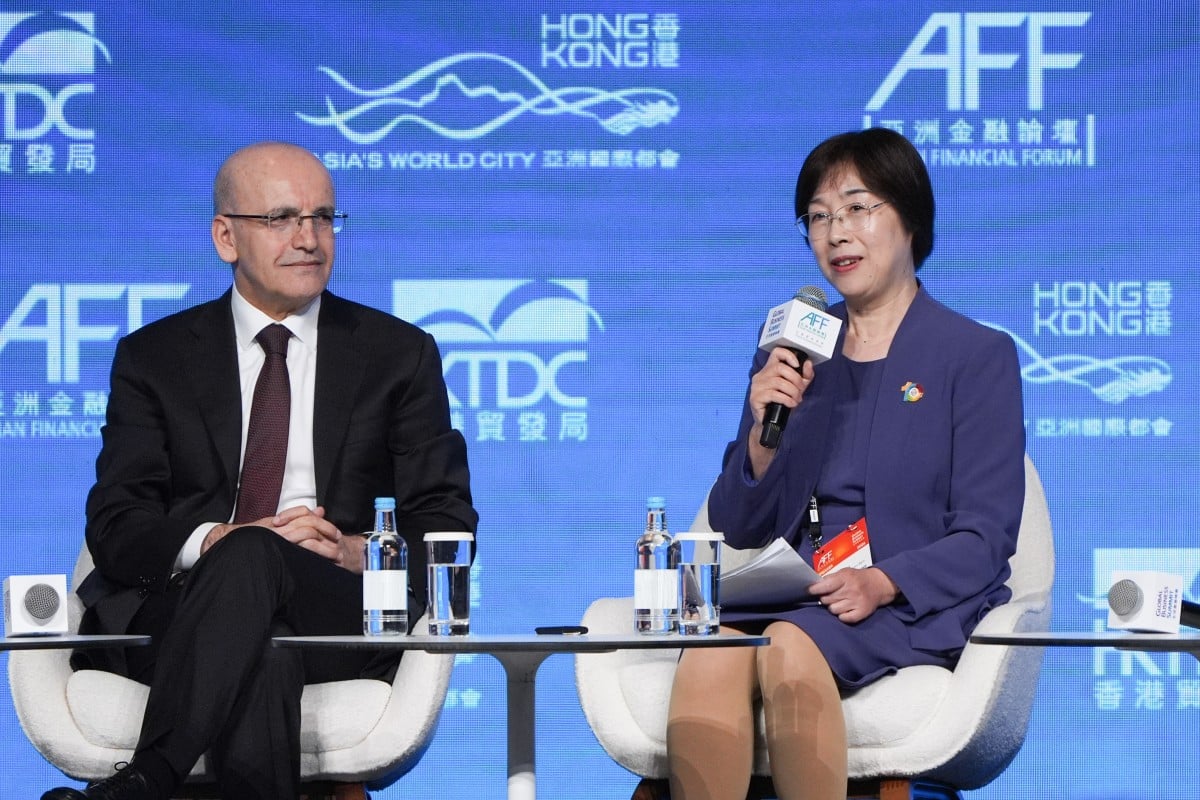
Ten days into her presidency, Zou Jiayi chose Hong Kong’s Asian Financial Forum as the venue for a message that was simultaneously reassuring and urgent. Speaking on January 26 to an audience of financial heavyweights and policymakers, the new president of the Asian Infrastructure Investment Bank emphasized that multilateral cooperation has become “an economic imperative” for sustaining long-term investment amid rising global economic uncertainty aiib. Her debut overseas speech signaled both continuity with her predecessor’s vision and a sharpened focus on the formidable challenges that lie ahead.
The timing was deliberate. As geopolitical fractures deepen, borrowing costs rise, and concessional finance dwindles, Zou noted that countries across Asia and beyond continue to require “reliable energy, resilient infrastructure, digital connectivity, effective climate mitigation and adaptation” aiib—needs that grow more pressing even as fiscal space tightens. For the AIIB, which has grown from 57 founding members to 111 approved members with USD100 billion in capitalization, the question is no longer whether multilateral development banks matter. It is whether they can mobilize capital at sufficient scale to bridge Asia’s infrastructure chasm—and whether China’s most prominent multilateral initiative can navigate an increasingly polarized global landscape.
A Decade in the Making: The AIIB’s Unlikely Journey
The AIIB’s establishment in 2016 represented something rare in contemporary geopolitics: a Chinese-led initiative that Western powers, with the notable exceptions of the United States and Japan, chose to join rather than oppose. The bank emerged from China’s frustration with what it perceived as inadequate representation in the post-war Bretton Woods institutions. Despite China’s economic ascent, its voting share in the Asian Development Bank remained disproportionately small—just 5.47 percent compared to the 26 percent combined voting power held by Japan and the United States—while governance reforms moved at glacial pace.
Yet the AIIB was designed, perhaps strategically, to avoid direct confrontation with the existing order. Its governance frameworks deliberately mirror those of the World Bank and ADB, incorporating international best practices on environmental and social safeguards, procurement transparency, and project evaluation. More than half of the bank’s approved projects have involved co-financing with established multilateral institutions. The institution maintains AAA credit ratings from all major rating agencies—a testament to its financial discipline and multilateral governance structure, where developing countries hold approximately 70 percent of shares.
This hybrid identity—simultaneously embedded within and distinct from Western-led development architecture—has allowed the AIIB to endure even as US-China strategic competition has intensified. But it also creates tensions. Western observers continue to scrutinize whether Beijing wields excessive influence through its 30.5 percent shareholding, which gives China effective veto power over major decisions. Meanwhile, China itself walks a tightrope, managing the AIIB as a genuinely multilateral institution while also pursuing its more opaque Belt and Road Initiative through state-owned banks.
Zou’s Inheritance: Scale, Ambition, and Sobering Constraints
Zou Jiayi assumed the AIIB presidency on January 16, the bank’s tenth anniversary, inheriting an institution that has approved nearly USD70 billion across 361 projects in 40 member economies. Her predecessor, Jin Liqun, spent a decade building credibility, expanding membership, and establishing operational systems. The accomplishments are tangible: over 51,000 kilometers of transportation infrastructure supported, 71 million people gaining access to safe drinking water, and 410 million beneficiaries of improved transport connectivity.
Yet measured against Asia’s infrastructure needs, these achievements remain a drop in a very deep bucket. The Asian Development Bank estimates that developing Asia requires USD1.7 trillion annually through 2030 simply to maintain growth momentum, address poverty, and respond to climate change. That figure balloons to USD1.8 trillion when climate adaptation and mitigation measures are fully incorporated. Against this backdrop, the AIIB’s USD8.4 billion in 2024 project approvals across 51 projects—impressive by institutional growth metrics—captures less than 0.5 percent of annual regional needs.
The bank’s updated corporate strategy acknowledges this reality with aggressive targets: doubling annual financing to USD17 billion by 2030, deploying at least USD75 billion over the strategy period, and ensuring over 50 percent goes toward climate-related investments. These are ambitious goals. They are also, quite clearly, insufficient to close the infrastructure gap without massive private capital mobilization—which brings us to the central challenge Zou articulated in Hong Kong.
The Private Capital Conundrum
Zou was unequivocal in Hong Kong: public resources “alone will not be sufficient” scmp. Private capital mobilization, alongside support from peer development banks, would be crucial. This recognition reflects a fundamental tension in development finance: traditional multilateral lending, even at unprecedented scale, cannot come close to meeting infrastructure needs. The private sector must be induced to invest in projects that carry political risks, long payback periods, regulatory uncertainties, and—increasingly—climate vulnerabilities.
Yet coaxing private investors into emerging market infrastructure has proven maddeningly difficult. Risk-return profiles often don’t align with institutional investor requirements. Currency mismatches create vulnerabilities. Weak regulatory frameworks and corruption concerns add further friction. Development banks have experimented with various mechanisms to address these challenges: partial credit guarantees, first-loss tranches, blended finance structures, and on-lending facilities through local financial institutions.
The AIIB has embraced this “finance-plus” approach, exemplified by three projects Zou highlighted in her speech: initiatives in Türkiye, Indonesia, and Kazakhstan that demonstrate how multilateral cooperation enables sustainable investment across diverse country contexts aiib. The Türkiye project involves sustainable bond investments channeled through private developers. Indonesia’s multifunctional satellite project operates as a public-private partnership bringing digital connectivity to remote areas. Kazakhstan’s Zhanatas wind power plant demonstrated how multilateral backing can catalyze commercial financing for renewable energy in frontier markets.
These successes, however, remain exceptions rather than the rule. The AIIB’s nonsovereign (private sector) portfolio remains modest compared to sovereign lending. Scaling private capital mobilization requires not just financial innovation but also patient institution-building: strengthening regulatory frameworks, improving project preparation, enhancing local capital markets, and building pipelines of bankable projects. It’s intricate, time-consuming work that doesn’t lend itself to dramatic announcements or swift results.
Climate Imperatives Meet Geopolitical Realities
Climate financing represents both the AIIB’s greatest opportunity and its most complex challenge. In 2024, 67 percent of the bank’s approved financing contributed to climate mitigation or adaptation—surpassing its 50 percent target for the third consecutive year. Nearly every approved project (50 of 51) aligned with Sustainable Development Goal 13 on climate action. The bank introduced Climate Policy-Based Financing instruments to support members’ reform programs, issued digitally native bonds through Euroclear, and raised nearly USD10 billion in sustainable development bonds.
These achievements matter enormously. Infrastructure decisions made today will lock in emissions patterns for decades. Asia accounts for the majority of global infrastructure investment and a disproportionate share of future emissions growth. Getting infrastructure right—prioritizing renewable energy over coal, building climate-resilient transport networks, investing in water management systems that can withstand extreme weather—is arguably the most important contribution development banks can make to global climate stability.
Yet climate finance also illuminates geopolitical fault lines. While the AIIB has officially aligned its operations with the Paris Agreement and maintains rigorous environmental standards, China—the bank’s largest shareholder and second-largest borrower—continues to finance coal projects through bilateral mechanisms. This creates uncomfortable contradictions. Western members value the AIIB’s climate commitments; they simultaneously worry about whether Chinese influence might soften environmental standards or prioritize projects that serve Beijing’s strategic interests.
The answer, to date, appears to be no. The AIIB’s multilateral governance structure, AAA credit rating, and co-financing relationships create powerful incentives for maintaining high standards. The bank’s environmental and social framework, while sometimes criticized for placing too much monitoring responsibility on clients, aligns with international best practices. Projects undergo independent evaluation. A public debarment list includes dozens of Chinese entities excluded from bidding on AIIB contracts.
Still, perception matters. In an era of intensifying US-China competition, economic “de-risking,” and fractured value chains, even genuinely multilateral institutions face scrutiny based on their leadership’s nationality. The AIIB must continuously demonstrate that it operates according to professional merit rather than geopolitical calculation—a burden that Western-led institutions, whatever their flaws, rarely face.
Navigating Treacherous Waters: The “De-Risking” Dilemma
Zou acknowledged in Hong Kong that the global economy faces “a convergence of challenges, including a weakening of traditional drivers of global growth such as strong investment and integrated value chains” aiib. This was diplomatic language for a more stark reality: the post-Cold War consensus on economic integration has fractured, perhaps irreparably. Supply chains are being reconfigured along geopolitical lines. Export controls proliferate. “Friend-shoring” replaces globalization as the operative principle in advanced economies.
For multilateral development banks, this environment presents what Zou called “geopolitical tensions,” “fragmentation of global value chains,” and “declining concessional resources” scmp. Infrastructure connectivity—long viewed as an unalloyed good—now triggers security concerns. Digital infrastructure projects face scrutiny over data governance and technological dependencies. Energy projects must navigate not just climate considerations but also great power competition over supply chains for batteries, solar panels, and rare earth minerals.
The AIIB finds itself in a particularly delicate position. Its mission of enhancing regional connectivity can be read as complementary to—or in competition with—various initiatives: the US-led Indo-Pacific Economic Framework, the European Union’s Global Gateway, Japan’s Partnership for Quality Infrastructure, and of course China’s Belt and Road Initiative. Zou must articulate a value proposition that transcends these competing visions while avoiding entanglement in their conflicts.
Her emphasis on multilateral cooperation as an economic imperative, rather than a geopolitical strategy, suggests one approach: positioning the AIIB as a pragmatic problem-solver focused on tangible development outcomes rather than ideological alignment. The bank’s co-financing relationships with the World Bank, ADB, and European development banks provide concrete evidence of this positioning. These partnerships reduce duplication, leverage expertise, share risks, and signal commitment to international standards.
Yet cooperation has its limits. Research examining AIIB project patterns finds that co-financing with the World Bank occurs less frequently in countries with strong Belt and Road Initiative ties to China, suggesting that geopolitical considerations do influence project selection, even if indirectly. The AIIB’s role as host institution for the China-led Multilateral Cooperation Center for Development Finance—whose relationship to the BRI remains deliberately opaque—further complicates claims of pure multilateralism.
The Road to 2030: Realistic Ambitions or Inevitable Disappointment?
As Zou settles into her five-year term, the central question is whether the AIIB can meaningfully contribute to closing Asia’s infrastructure gap or whether it will remain, despite growth, a marginal player relative to the scale of needs. The bank’s goal of reaching USD17 billion in annual approvals by 2030 would represent impressive institutional expansion. It would still capture less than one percent of annual regional infrastructure requirements.
This gap between ambition and reality suggests three possible futures. The first is transformative success: the AIIB becomes a genuine catalyst for private capital mobilization, leveraging its balance sheet to unlock multiples of private investment, pioneering innovative financial instruments, and demonstrating that multilateral cooperation can transcend geopolitical divisions. In this scenario, the bank’s impact is measured not in its direct lending but in its role as orchestrator, de-risker, and standard-setter.
The second possibility is respectable incrementalism: the AIIB continues growing steadily, maintains its AAA rating, delivers solid development outcomes in member countries, and co-finances projects with peer institutions. It becomes a useful but not transformative addition to the development finance architecture—valuable primarily for providing borrower countries with an additional funding source and slightly more voice in governance compared to Western-dominated institutions.
The third scenario is slow decline into irrelevance or, worse, becoming a vehicle for Chinese strategic interests that alienates Western members and undermines the bank’s multilateral character. This seems unlikely given the institution’s governance structures and Jin Liqun’s decade of credibility-building, but geopolitical pressures could push in this direction if not carefully managed.
Zou’s Hong Kong speech positioned her firmly in pursuit of the first scenario. Her emphasis on cooperation, private capital, and shared development priorities reflects understanding that the AIIB’s influence will be determined not by its balance sheet alone but by its ability to convene actors, mobilize resources, and demonstrate that multilateral solutions can deliver results in an age of nationalism and competition.
The Verdict: Indispensable but Insufficient
The infrastructure gap facing developing Asia represents both a development crisis and an opportunity. Inadequate infrastructure constrains economic growth, perpetuates poverty, limits access to education and healthcare, and increases vulnerability to climate shocks. Yet infrastructure investment, done well, can be transformative: connecting markets, enabling industrialization, providing clean energy access, and building climate resilience.
Zou characterized infrastructure investment as a “duty” for development banks to support industrialization and help countries provide goods and services to the global market scmp. This framing is telling. It positions the AIIB not as a charity but as a catalyst for economic transformation—aligning with the bank’s focus on sustainable returns, economic viability, and productive infrastructure rather than pure poverty alleviation.
The AIIB’s first decade demonstrated that a Chinese-led multilateral institution could operate according to international standards, attract broad membership, and deliver substantive development outcomes. Zou’s challenge is to scale this success while navigating increasingly treacherous geopolitical waters. Her insistence on multilateral cooperation as an economic imperative—not just a diplomatic nicety—suggests recognition that fragmentation serves no one’s interests when infrastructure needs are so vast.
Yet realism demands acknowledging that even a successful AIIB operating at peak efficiency cannot, alone or with peer institutions, close Asia’s infrastructure gap. The private sector must be decisively engaged. Domestic resource mobilization must be strengthened. Project preparation must improve. Regulatory frameworks must evolve. These changes require patient, painstaking work that extends far beyond any single institution’s mandate.
The AIIB under Zou’s leadership will likely prove indispensable but insufficient—a useful, professionally managed multilateral development bank that makes meaningful contributions to Asian infrastructure while remaining orders of magnitude too small relative to needs. That’s not a failure of vision or execution. It’s a reflection of the enormous scale of challenges facing developing Asia and the structural limits of multilateral development finance in an era of constrained public resources and hesitant private capital.
Whether the bank can transcend these limits—whether it can truly become the catalyst and mobilizer Zou envisions—will depend not just on Beijing’s commitment or Western engagement, but on whether Asia’s developing economies can create the enabling conditions that make infrastructure projects genuinely bankable. That transformation, ultimately, is one that development banks can support but not substitute for. And it’s a challenge that will extend well beyond Zou’s five-year term, or indeed the AIIB’s second decade. The question is whether, in a world of deepening divisions, multilateral institutions retain the credibility and capacity to help nations build the future—together.
Discover more from The Economy
Subscribe to get the latest posts sent to your email.
-

 Markets & Finance3 weeks ago
Top 15 Stocks for Investment in 2026 in PSX: Your Complete Guide to Pakistan’s Best Investment Opportunities
-

 Global Economy4 weeks ago
What the U.S. Attack on Venezuela Could Mean for Oil and Canadian Crude Exports: The Economic Impact
-

 Asia4 weeks ago
China’s 50% Domestic Equipment Rule: The Semiconductor Mandate Reshaping Global Tech
-

 Investment3 weeks ago
Top 10 Mutual Fund Managers in Pakistan for Investment in 2026: A Comprehensive Guide for Optimal Returns
-

 Global Economy1 month ago
Pakistan’s Export Goldmine: 10 Game-Changing Markets Where Pakistani Businesses Are Winning Big in 2025
-

 Global Economy1 month ago
15 Most Lucrative Sectors for Investment in Pakistan: A 2025 Data-Driven Analysis
-

 Global Economy1 month ago
Pakistan’s Economic Outlook 2025: Between Stabilization and the Shadow of Stagnation
-

 China Economy4 weeks ago
China’s Property Woes Could Last Until 2030—Despite Beijing’s Best Censorship Efforts