
Analysis
Indonesian Stocks Plunge Amid MSCI Transparency Warning and Leadership Shake-Up: A $80 Billion Rout and Path Forward

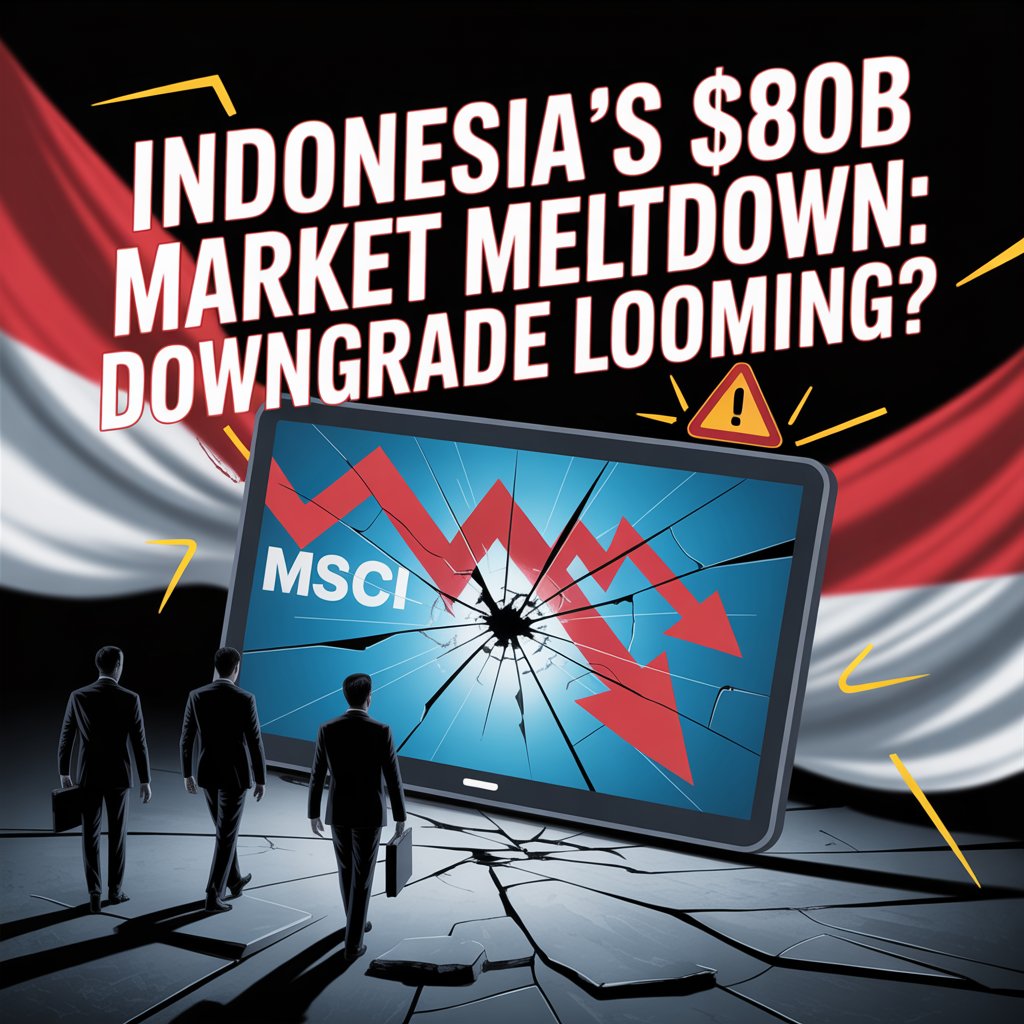
Jakarta’s financial markets are reeling from a perfect storm of regulatory scrutiny, capital flight, and leadership chaos. As of February 2, 2026, the Jakarta Composite Index closed at approximately 7,881 points—down more than 5% in a single session after suffering a nearly 7% drop the previous week, marking the steepest decline in a year. The carnage has erased roughly $80 billion in market value, triggered the resignation of Indonesia’s top financial regulators, and set off alarm bells across Southeast Asia about the future of Jakarta as an emerging market hub.
The catalyst? A stark warning from MSCI Inc., the global index provider whose decisions influence the allocation of trillions of dollars in passive investment funds. On January 28, 2026, MSCI froze all positive changes to Indonesian stocks in its indices, citing concerns over ownership transparency, free-float data accuracy, and potential coordinated trading practices that undermine fair price formation. The move immediately raised the specter of a downgrade from emerging market to frontier market status—a demotion that would place Indonesia alongside Bangladesh, Pakistan, and Sri Lanka, and trigger automatic sell-offs by index-tracking funds.
What followed was a market bloodbath rarely seen outside of systemic crises. Foreign investors, already nursing cumulative outflows of 13.96 trillion rupiah ($834 million) throughout 2025—the worst year since 2020—accelerated their exodus. Mining stocks led the selloff, with Merdeka Copper Gold plummeting 15%, Bumi Resources down 14%, and Aneka Tambang shedding 12%. By the end of the week, year-to-date foreign net selling in 2026 had reached 9.88 trillion rupiah, according to Indonesia Stock Exchange data. The rupiah, meanwhile, hovered near its record low of 16,985 to the dollar—levels not seen since the devastating Asian financial crisis of 1998.

Yet this is more than a market correction. It is a referendum on Indonesia’s institutional credibility, its commitment to market transparency, and the broader trajectory of President Prabowo Subianto’s economic policies. The crisis has exposed deep fault lines: opaque ownership structures dominated by a handful of ultra-wealthy families, insufficient free-float requirements that give controlling shareholders outsized influence, and regulatory frameworks that have failed to keep pace with international standards. The question now is whether Indonesia can implement the reforms necessary to restore investor confidence—or whether it will face the humiliation and economic consequences of a frontier market downgrade by May 2026, MSCI’s stated deadline for reassessment.
The Trigger: MSCI’s Transparency Bombshell
MSCI’s January 28 announcement was a bombshell precisely because it came without the usual diplomatic niceties. The index compiler didn’t merely express concern or request additional data—it imposed an immediate freeze on all positive changes for Indonesian stocks. This meant no new additions to MSCI indices, no increases in index weightings, no upgrades from small-cap to standard categories, and no adjustments to free-float factors. For a market desperate for foreign capital inflows, this was tantamount to being placed in regulatory purgatory.
The core of MSCI’s complaint centered on three interrelated issues. First, ownership data for Indonesian equities remains insufficiently transparent, with unclear ownership structures that make it difficult to determine who truly controls listed companies. Second, high ownership concentration—often with a single family or conglomerate holding dominant stakes—raises concerns about minority shareholder protections and the investability of securities. Third, MSCI flagged potential coordinated trading practices that could distort fair price formation, a polite way of saying the regulator suspected market manipulation.
Indonesia’s minimum free-float requirement of just 7.5% has long been a source of criticism. By comparison, most developed markets require 15-25% public ownership to ensure liquidity and prevent controlling shareholders from exerting undue influence. In a market where a handful of extremely wealthy families—many with ties to the Suharto-era oligarchy—control vast swathes of the economy, such lax standards create fertile ground for governance abuses. BRI Danareksa Sekuritas (BRIDS) noted that despite improvements in data provided by the Indonesia Stock Exchange, core investability issues remain unresolved.
The stakes are enormous. Indonesia accounts for roughly 1% of the MSCI Emerging Markets Index, which tracks some $10 trillion in global investments. While that may sound modest, Goldman Sachs estimates potential outflows of $2.2 billion to $7.8 billion if Indonesia is downgraded to frontier status—enough to devastate liquidity and further undermine the rupiah. More ominously, BRIDS warned that if ownership transparency does not improve by May 2026 and no clear monitoring system is established, MSCI could not only downgrade Indonesia’s classification but also reduce its weighting in the EM index, triggering structural foreign outflows rather than just temporary selling pressure.
Market Fallout: Billions Wiped Out and Foreign Flight
The market’s response to MSCI’s warning was swift and brutal. The Jakarta Composite Index plunged 7.4% on January 28, marking the biggest one-day slide in over nine months. The gauge plummeted as much as 8.8% earlier in the session, triggering a 30-minute trading halt—a circuit breaker designed to prevent panic selling. The following day brought more carnage, with another 8% intraday drop forcing a second trading suspension. By the time the dust settled on January 29, Indonesian stocks had suffered their worst two-day rout in nearly three decades, erasing approximately $80 billion in market capitalization.
The selloff was indiscriminate but hit certain sectors with particular ferocity. Mining stocks bore the brunt, as commodity exporters—already vulnerable to global price fluctuations—saw their valuations collapse amid fears of forced selling by index funds. Financial stocks also took heavy losses, with major banks like Bank Central Asia and Bank Mandiri shedding billions in market value before staging modest recoveries late in the week. The energy and property sectors, both heavily reliant on foreign capital and credit, faced similar pressures.
Perhaps most tellingly, the crisis exposed the market’s dependence on foreign institutional capital. While domestic retail participation has grown—Single Investor Identification accounts reached 21.04 million by end-January 2026, up by 673,218 from the end of 2025—retail investors lack the firepower to offset massive institutional outflows. DBS Group analyst William Simadiputra noted that persistent foreign selling since 2025 has already put downward pressure on valuations, meaning the MSCI freeze compounds an existing vulnerability rather than creating a new one.
Investment banks wasted no time downgrading their recommendations. On January 29, Goldman Sachs cut Indonesian equities to underweight, citing not just the MSCI risk but also broader macro challenges including soft private consumption, slowing credit growth, and a fiscal deficit approaching the legal 3% of GDP limit. UBS followed suit, downgrading to neutral. These moves signal that even if Indonesia avoids an MSCI downgrade, the structural headwinds facing the economy remain formidable.
Leadership Vacuum: Resignations and Immediate Reactions
If the market rout was shocking, the subsequent leadership exodus was nothing short of dramatic. On January 30, mere hours after assuring investors that regulators would lead efforts to address MSCI’s concerns, Indonesia Stock Exchange CEO Iman Rachman resigned, saying he was stepping down to take responsibility for the crisis. By day’s end, the contagion had spread to the Financial Services Authority (OJK), Indonesia’s top financial regulator.
In a stunning announcement released after markets closed on Friday, January 31, OJK Chairman Mahendra Siregar resigned alongside three other senior officials: Deputy Chairman Mirza Adityaswara, Capital Markets Executive Head Inarno Djajadi, and Deputy Commissioner I.B. Aditya Jayaantara. In a statement, Siregar cited moral responsibility to support the necessary recovery steps for Indonesia’s financial sector. The timing was particularly jarring given that Inarno had, just hours earlier, told reporters that Rachman’s resignation would not disrupt operations and that OJK aimed to resolve MSCI’s concerns by May.
The wave of resignations—unprecedented in Indonesia’s modern financial history—reflects both the gravity of the crisis and the intense political pressure on regulators. Mohit Mirpuri, portfolio manager at SGMC Capital in Singapore, observed that someone had to take responsibility for the loss of confidence. While accountability is commendable, the abrupt departure of so many senior figures raises serious questions about continuity and institutional memory at a time when steady leadership is desperately needed.
Acting appointments were swiftly announced. Friderica Widyasari Dewi assumed the role of acting OJK chairwoman, while Hasan Fawzi took on oversight of capital markets, financial derivatives, and carbon exchange supervision previously held by Djajadi. At the IDX, Jeffrey Hendrik was expected to assume the role of interim president director. In a press conference, Friderica pledged to ensure all programs, policies, and regulations are implemented properly while prioritizing progress and stability in the financial services sector. Investors will be watching closely to see whether these new leaders can deliver on that promise—or whether they become scapegoats for systemic failures beyond their control.
Broader Economic Ripples: Fiscal Fears and Regional Context
The Indonesian stock market crisis cannot be viewed in isolation from broader macroeconomic concerns and President Prabowo Subianto’s ambitious—and controversial—policy agenda. Since assuming office, Prabowo has embarked on an aggressive fiscal expansion, increasing government spending on infrastructure, subsidies, and social programs while widening the budget deficit to levels that test the legal 3% of GDP ceiling. Critics warn that this fiscal looseness, combined with greater state involvement in financial markets, risks undermining investor confidence in Indonesia’s institutional framework.
Adding fuel to these concerns was Prabowo’s January appointment of his nephew, Thomas Djiwandono, as deputy governor of the central bank, Bank Indonesia. The move sparked immediate fears about central bank independence—a bedrock principle for maintaining monetary credibility and currency stability. The rupiah’s plunge to near-record lows following the announcement was no coincidence. As TheStreet Pro noted, Prabowo remains the son-in-law of late dictator Suharto, even though technically separated from his wife, and his governance style carries echoes of the crony capitalism and patronage networks that defined the Suharto era. For foreign investors wary of political interference in economic policy, these developments are deeply unsettling.
The rupiah’s weakness compounds the market’s woes. At 16,790 to the dollar as of late January 2026—just shy of the record low of 16,985 set the previous week—the currency is facing pressures reminiscent of the 1998 Asian financial crisis. A weak rupiah inflates import costs, stokes inflationary pressures, and makes dollar-denominated debt more expensive to service, creating a vicious cycle that drags down both the real economy and financial markets. With Indonesia’s inflation rate already elevated and consumer spending soft, the central bank faces the unenviable task of defending the currency without choking off growth.
Regionally, the crisis has sent shockwaves through Southeast Asia. If Indonesia—Southeast Asia’s largest economy and most populous nation—is vulnerable to a frontier market downgrade, what does that say about the broader investment climate in the region? Investors are already drawing unflattering comparisons to Vietnam, which has long battled similar transparency and governance challenges. The risk is that MSCI’s warning to Indonesia becomes a template for greater scrutiny of other emerging markets in the region, triggering a broader reassessment of risk premiums and capital allocation.
Yet there are also reasons for cautious optimism. Indonesia’s domestic consumer base remains formidable, with a young, growing population and rising middle class. The country’s natural resource wealth—from nickel and copper to coal and palm oil—provides significant export earnings, even if commodity prices remain volatile. And unlike the late 1990s, Indonesia’s banks are far better capitalized and less exposed to short-term foreign debt. The question is whether policymakers can harness these strengths while addressing the structural weaknesses that have made Indonesia so vulnerable to external shocks.
Path to Recovery: Reforms and Investor Confidence
In the immediate aftermath of the crisis, Indonesian authorities moved quickly to signal reform intent. On January 29, Chief Economic Minister Airlangga Hartarto announced a package of measures designed to address MSCI’s concerns and restore investor confidence. The centerpiece: doubling the minimum free-float requirement from 7.5% to 15%, with a longer-term goal of reaching 25%. Authorities also pledged to exclude investors in corporate and other categories from free-float calculations and publish shareholdings above and below 5% for each ownership category—moves aimed at increasing transparency and reducing the influence of opaque ownership structures.
Additional measures included allowing pension and insurance funds to increase capital market investments to 20% of their portfolios, up from 8%, to boost domestic institutional participation and reduce reliance on fickle foreign capital. Regulators also promised to scrutinize shareholder affiliations for stakes below 5%, addressing concerns about coordinated trading and hidden control structures. Airlangga emphasized that the government guarantees protection for all investors by maintaining good governance and transparency.
Markets responded positively, if tentatively, to these announcements. On January 30, the Jakarta Composite Index staged a modest recovery, closing up 1.18% after regulators unveiled the reform package. By February 2, however, the index had fallen back to 7,881 points—down more than 5% on the day—suggesting that investor skepticism remains high. As Josua Pardede, chief economist at PermataBank, noted, the two-day selloff looked less like a reaction to fundamentals and more like a repricing of market access risk.
The crucial question is whether these reforms will satisfy MSCI. Mahendra Siregar, in one of his final statements before resigning, said communication with MSCI had been positive and that OJK was awaiting a response to its proposed measures, with hopes of implementation soon and resolution by March. Yet MSCI’s May 2026 deadline looms large, and index reclassifications typically involve months of consultation and observation before decisions are finalized. If regulators fail to demonstrate tangible progress—not just policy announcements but verifiable improvements in data transparency and enforcement—MSCI may follow through on its threat to downgrade Indonesia or reduce its weighting in the EM index.
Longer-term reforms must go deeper. Indonesia needs not just higher free-float requirements but robust enforcement mechanisms to ensure compliance. Corporate governance standards must be strengthened, with independent directors, transparent related-party transactions, and meaningful penalties for violations. Market surveillance systems must be upgraded to detect and deter coordinated trading and manipulation. And perhaps most critically, Indonesia needs to foster a culture of transparency and rule of law that extends beyond cosmetic regulatory tweaks to fundamental shifts in how business is conducted.
Some market participants see opportunity in the chaos. Mohit Mirpuri of SGMC Capital argued that this is an ongoing process, not a single announcement, and that what investors needed to see was alignment and intent—both of which were clearly delivered. He noted that policy clarity usually comes after volatility, not before it, and that the last two days of selling were fairly indiscriminate. Historically, he suggested, you don’t wait for everything to look perfect before stepping in. Patient capital, he implied, could find compelling valuations amid the wreckage.
Conclusion: Crossroads for Indonesian Capital Markets
The $80 billion rout in Indonesian stocks is more than a market correction—it is a reckoning. For years, Indonesia has enjoyed the benefits of emerging market status while maintaining governance standards and transparency practices that fell short of international norms. MSCI’s warning has exposed this gap with brutal clarity, forcing policymakers to confront uncomfortable truths about opacity, concentration of ownership, and regulatory shortcomings.
The path forward is fraught with challenges but not without hope. If Indonesian authorities follow through on their reform pledges—raising free-float requirements, enhancing transparency, strengthening market surveillance, and demonstrating a genuine commitment to good governance—there is a reasonable chance MSCI will refrain from a downgrade. The resignation of top regulators, while disruptive, may ultimately prove cathartic, clearing the way for fresh leadership unburdened by past failures.
Yet the risks remain substantial. Even if Indonesia avoids an MSCI downgrade, the broader economic headwinds—fiscal deficits, currency weakness, inflationary pressures, and concerns about political interference in economic policy—will continue to weigh on investor sentiment. Foreign capital, once burned by rapid selloffs and governance lapses, will demand a higher risk premium, making it more expensive for Indonesian companies to access global markets. And with the May 2026 deadline approaching, time is running short to demonstrate meaningful progress rather than just policy rhetoric.
For investors, the crisis underscores the importance of governance, transparency, and institutional credibility in emerging markets. Index classifications are not mere academic exercises—they reflect assessments of market investability and carry real consequences for capital flows and valuations. Indonesia’s experience serves as a cautionary tale: no matter how promising an economy’s growth prospects or natural resource endowments, opacity and weak governance will eventually exact a price.
The coming months will be critical. If Indonesia can demonstrate that it is serious about reform—not through announcements alone but through verifiable improvements in data quality, enforcement, and market practices—there is a path to recovery. But if reform efforts stall or prove cosmetic, the specter of a frontier market downgrade will loom ever larger, with potentially devastating consequences for Indonesia’s integration into global capital markets.
As the Jakarta Composite Index hovers near multi-month lows and the rupiah tests historic weaknesses, Indonesia stands at a crossroads. The choice is stark: embrace transparency, strengthen governance, and rebuild investor confidence—or risk becoming a cautionary tale of an emerging market that failed to emerge. For Southeast Asia’s largest economy, the stakes could not be higher.
Import : Investors and market observers should closely monitor Indonesia’s reform implementation over the coming weeks. Key indicators to watch include: concrete steps to raise free-float requirements, publication of detailed ownership data above and below 5% thresholds, upgrades to market surveillance systems, and MSCI’s official response to proposed reforms. The May 2026 reassessment deadline represents both a threat and an opportunity—a chance for Indonesia to demonstrate it can meet global standards for market transparency and governance. Whether it seizes that opportunity will determine not just the Jakarta Composite Index’s trajectory, but Indonesia’s standing in the global financial system for years to come.
Discover more from The Economy
Subscribe to get the latest posts sent to your email.



Key Takeaways
- Rolex’s secondary market rose approximately 7.9% year-over-year as of 2026 (per WatchCharts data) — trailing Patek Philippe (+16.2%) and Tudor (+11.4%) but still outperforming Audemars Piguet (+3.4%).
- Rolex raised U.S. retail prices 4–9% in January 2026 (steel models ~5.6%, gold models ~8.7%), narrowing the historical gap between retail and pre-owned pricing.
- Not every model appreciates: steel sports references (Submariner, GMT-Master II, Daytona) have held value far better than two-tone or widely available dress references like the standard Datejust.
- The Lady-Datejust posted the sharpest 2026 gain among tracked collections — up 22.73%, from roughly $9,269 to $11,376 — driven by demand for smaller, “everyday luxury” watches.
- Gold’s rise past $2,400/oz has directly lifted the investment case for Rolex’s precious-metal references (Day-Date, Sky-Dweller, Yacht-Master).
The Model-by-Model Picture
| Category | 2026 Trend |
|---|---|
| Lady-Datejust | +22.73% (strongest performer among tracked collections) |
| Steel sports models (Submariner, GMT-Master II) | Held value well; corrected from 2022 peak but stabilized above retail |
| Daytona | Corrected from highs above $50,000 to the mid-$30,000s; still among the most sought-after references |
| Two-tone/widely available Datejust | Flat to negative — “holds value” is an overstatement for this category |
| Gold references (Day-Date, Sky-Dweller) | Lifted by gold’s rise above $2,400/oz |
Why the “Rolex Always Appreciates” Myth Is Fading
The pandemic-era boom pushed some references — the Daytona above all — to speculative highs disconnected from historical norms. Since the March 2022 peak, steel sports models have compressed meaningfully, and dealers who bought inventory near the top have in some cases faced 20–40% markdowns on liquidation. The lesson for 2026 buyers: Rolex as a category is not a monolith. Value retention depends heavily on specific reference, condition, and whether the piece comes with box and papers (“full set”).
What’s Actually Driving 2026 Strength
- Retail price increases raise the floor. When a new Submariner retails at $10,050 (up from $9,500), a pre-owned example at $11,000–$12,000 suddenly represents a smaller premium — narrowing the gap without secondary prices actually moving.
- Supply discipline remains Rolex’s core lever. The brand has never confirmed production numbers, and secondary-market premiums remain entirely a function of Rolex’s own manufacturing decisions — a risk factor as much as a support.
- Certified Pre-Owned rollout. Rolex’s now fully rolled-out CPO program has changed how buyers transact in the used market, adding a layer of brand-verified legitimacy that supports pricing.
The Case for Rolex as a Portfolio Diversifier
Financial advisors increasingly frame luxury watches not as a replacement for equities or bonds, but as a tangible, historically low-correlation diversifier — one that carries its own risks (illiquidity, condition-dependent pricing, no yield) but has demonstrated multi-decade resilience for specific references.
Is Rolex a good investment in 2026?
It depends heavily on the specific reference. Steel sports models like the Submariner and Daytona have held or grown in value; two-tone and widely available dress models generally have not. Overall, Rolex’s secondary market rose about 7.9% year-over-year in 2026, trailing Patek Philippe but ahead of Audemars Piguet.
Discover more from The Economy
Subscribe to get the latest posts sent to your email.

Navigating Mortgage and Loan Refinancing in a High-Yield Environment
Global public debt crossing critical thresholds has kept central bank policies volatile, resulting in fluctuating US Treasury yields throughout 2026. For homeowners and commercial property holders burdened by previous high-interest borrowing cycles, finding optimal refinance windows has become a high-stakes financial puzzle. Stalled disinflation and stubborn employment numbers mean rate cuts are incremental, requiring borrowers to act with precision.
Timing your mortgage or commercial loan refinance in this environment requires a deep understanding of yield curve movements and lender risk appetites.
Decoding 2026 Refinance Dynamics
The 10-Year Treasury Yield Benchmark
Mortgage rates continue to track closely with the 10-year US Treasury yield. When macroeconomic anxiety spikes debt issuance, yields rise, tightening consumer borrowing capacity. Savvy borrowers monitor weekly Treasury auctions to lock in rates during brief dip windows.
Hybrid ARMs and Alternative Structures
With fixed rates remaining elevated, 7/1 and 10/1 adjustable-rate mortgages (ARMs) have surged in popularity. These products offer lower initial monthly payments, giving borrowers breathing room until central bank easing cycles fully materialize.
| Loan Product | Current Rate Range | Best For | Key Risk Factor |
| 30-Year Fixed Mortgage | 6.2% – 6.8% | Long-term predictability | Higher initial monthly outlay |
| 7/1 Hybrid ARM | 5.5% – 5.9% | Short-term ownership / flipping | Rate reset risk after year 7 |
| Commercial Refinance | 7.0% – 8.2% | Corporate asset restructuring | Strict DSCR lender covenants |
Actionable Steps for Successful Refinancing
To maximize your chances of securing favorable refinance terms in a volatile market, follow a disciplined preparation strategy.
Boost Your Credit Score Immediately: Lenders in 2026 are applying stringent credit tiering; a 20-point increase can drop your APR by a crucial quarter-point.
Shop Regional Credit Unions: Smaller financial institutions often offer portfolio loans with more flexible underwriting than major national banks.
Calculate the Break-Even Point: Ensure your total closing costs are recouped through monthly savings within 24 months of closing.
“Market Strategist View: Refinancing in 2026 is an exercise in opportunistic timing. Borrowers must maintain immaculate financial profiles ready to strike the moment Treasury yields dip.”
Mastering the complexities of today’s debt environment ensures you can successfully lower your debt service costs and protect your long-term financial stability.
Discover more from The Economy
Subscribe to get the latest posts sent to your email.

The days of pulling generic auto insurance quotes based purely on your zip code and age are officially over. In 2026, insurance comparison engines are powered entirely by generative AI and real-time telematics. These platforms digest thousands of live data points—ranging from your driving smoothness via connected vehicle sensors to real-time traffic congestion patterns—to generate hyper-personalized premiums instantly.
For consumers, this evolution represents both a massive opportunity for savings and a hidden trap for penalty pricing. Understanding how AI algorithms evaluate risk is essential for anyone looking to lower their monthly auto insurance premiums.
How AI Comparison Engines Evaluate Your Risk Profile
Behavioral Telematics and Connected Cars
Modern cars stream performance data directly to insurance aggregators. Generative AI models analyze braking sharpness, acceleration curves, cornering G-forces, and phone distraction metrics. Drivers who maintain smooth, defensive habits are rewarded with dynamic rate cuts of up to 40% compared to traditional rating tiers.
Predictive Traffic and Weather Modeling
AI tools now cross-reference your daily commute route with predictive weather and accident probability models. If your standard parking location or driving corridor has a statistically higher incidence of uninsured motorist claims, your quotes will reflect that hyper-local risk assessment.
| Comparison Factor | Traditional Rating Model | 2026 Generative AI Model | Impact on Premium |
| Mileage & Usage | Annual estimated odometer reading | GPS tracking & live trip duration | High (up to 35% savings) |
| Driving Behavior | MVR driving record & accidents | Real-time braking, speed, & G-force | Critical (determines tier) |
| Vehicle Tech | Make, model, and safety rating | ADAS calibration & repair cost data | Moderate |
Strategies to Lower Your AI-Driven Insurance Quote
To outsmart the algorithm and secure the lowest possible premium in 2026, drivers must proactively manage their digital footprint on insurance platforms.
Opt-In for Telematics Trial Periods: Many insurers offer immediate 15% discounts just for installing their driving app; let it track safe habits for 30 days to lock in permanent savings.
Scrub Unverified Public Records: Ensure your motor vehicle report is free of clerical errors that AI risk models misinterpret as reckless behavior.
Compare AI Aggregators: Use platforms that integrate multi-carrier API feeds rather than single-brand comparison sites to find the best risk-adjusted rate.
“Industry Note: AI-driven pricing rewards transparency and precision. Drivers who actively manage their telematics data consistently out-save those relying on legacy quote calculators.”
Embracing AI comparison tools allows savvy policyholders to customize coverage limits precisely to their driving habits, eliminating wasted premium spend while ensuring robust protection.
Discover more from The Economy
Subscribe to get the latest posts sent to your email.

Social Security Extra $90 Deposit: Who Qualifies for the October 2026 Medicare Rebate?

Anthropic Bans Sustained Abuse of Claude AI Under New Usage Policy Effective November 12, 2026

Jeff Bezos Three-Day Workweek View: What He Really Said

Celeste Frozen Pizza Discontinued: What Conagra Confirmed

US–China Critical Minerals Competition: Why a Trade Deal Cannot Fix Every Supply Risk

Oil Price Outlook 2026: How Supply Risks Reach Fuel Bills, Inflation and Business Costs

AI in Business 2026: Why Faster Employees Do Not Automatically Mean Higher Profits

Mortgage Rates in 2026: Why They Remain High and How to Compare the True Cost

Gold Price Outlook 2026: The Forces Behind the Forecasts—and What Could Reverse Them

Global Economic Outlook 2026: Growth, Inflation and Risks

Trump–Putin Diesel Deal: Why Zelensky Is Angry and What It Means for Fuel Prices

Anthropic Draws the Line: Why Claude’s New Usage Policy Explicitly Bans ‘Cruel Behavior’ Toward AI

Ynon Kreiz & Mattel’s Digital Transformation: Franchise Strategy and Financial Growth

Crude Oil & Petroleum Market Analysis: OPEC+ Decisions and Price Forecasts

Oil Prices Break $100 in 2026: Middle East Conflict & Energy Markets

Middle East War Economics 2026: Oil Prices & Energy Markets

China Stocks Today: Are Big Economies in Asia Nearing a Market Bottom?

PSX Forecast 2026: KSE-100, IMF Reviews & Geopolitics

Crypto Daily Outlook: Bitcoin, Altcoins, and the Future of Decentralized Finance

Global Pension Systems Ranked: The World’s Best and Worst Retirement Frameworks

Enterprise AI Platforms Disrupting B2B SaaS in 2026: Full Analysis

World’s Largest Economies: Ranking the Top Global Powers

Elon Musk’s Next Moves: Disrupting the 2026 Global Economy

Pakistan Economy 2026: Inside the SBP’s Balancing Act

GasBuddy Market Insights: How Crude Price Shifts Impact Local Fuel Cost Averages

World Bank & IMF Reports 2026: Why the “3% Growth” Consensus Is Actually a Debate

Global Equity Market Divergence: US Tech vs. European Dividend Stocks vs. Asian Growth

Stock Market Today: Dow Climbs 500 Points as Markets Shake Off Inflation Jitters
-

 Markets & Finance9 months ago
Top 15 Stocks for Investment in 2026 in PSX: Your Complete Guide to Pakistan’s Best Investment Opportunities
-

 Analysis8 months ago
Johor’s Investment Boom: The Hidden Costs Behind Malaysia’s Most Ambitious Economic Surge
-

 Analysis8 months ago
Top 10 Stocks for Investment in PSX for Quick Returns in 2026
-

 Banks9 months ago
Best Investments in Pakistan 2026: Top 10 Low-Price Shares and Long-Term Picks for the PSX
-

 Analysis8 months ago
Brazil’s Rare Earth Race: US, EU, and China Compete for Critical Minerals as Tensions Rise
-

 Investment9 months ago
Top 10 Mutual Fund Managers in Pakistan for Investment in 2026: A Comprehensive Guide for Optimal Returns
-

 Global Economy10 months ago
15 Most Lucrative Sectors for Investment in Pakistan: A 2025 Data-Driven Analysis
-

 Global Economy10 months ago
Pakistan’s Export Goldmine: 10 Game-Changing Markets Where Pakistani Businesses Are Winning Big in 2025