
Banks
Global Order Is Changing, Not Collapsing: Finance Chiefs Challenge Mark Carney’s Davos Warning on Rules-Based System

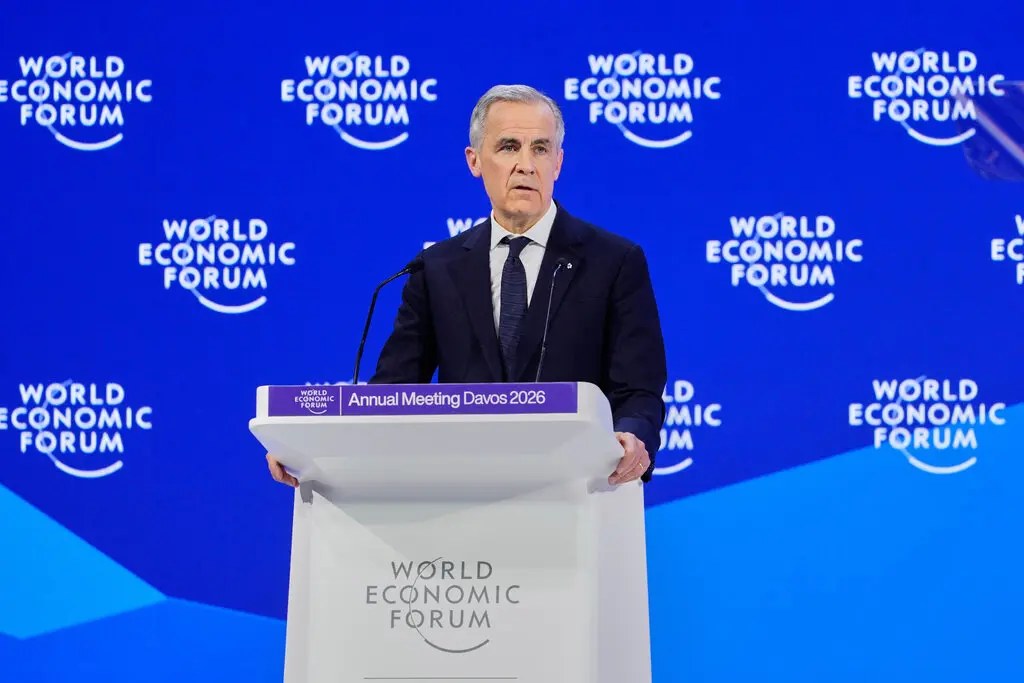
When former Bank of England governor Mark Carney declared at Davos this week that the rules-based international order is “effectively over,” he articulated a fashionable pessimism that has become almost reflexive among global elites. Yet within hours, a chorus of finance ministers and central bankers pushed back—not with denial, but with a more textured reading of transformation. The global order, they insisted, is fragmenting and rebalancing, not rupturing. The distinction matters enormously.
The debate playing out in the Swiss Alps is less about whether change is happening—that much is obvious—and more about whether we are witnessing institutional evolution or systemic collapse. The answer shapes everything from capital allocation to climate diplomacy, from trade policy to the very architecture of multilateral cooperation that has underpinned prosperity since 1945.
Carney’s Realism Meets Institutional Inertia
Mark Carney’s assessment was stark. Speaking at a World Economic Forum panel on January 23, he argued that the post-war consensus built on open markets, multilateral institutions, and predictable rules has given way to a world governed increasingly by power politics rather than legal frameworks. His diagnosis drew on a Thucydidean realism: nations pursue interest, not principle, and the veneer of rules merely reflects the balance of power beneath.
The evidence he marshaled is familiar but potent. The World Trade Organization has been functionally paralyzed for years, its appellate body dormant since 2019. Climate negotiations lurch from compromise to gridlock. The International Monetary Fund and World Bank remain dominated by voting structures that lag decades behind shifts in economic gravity. Even the language of “America First” or “strategic autonomy” signals a retreat from collective governance toward unilateral assertion.
Yet Carney’s framing—an ending, a collapse—struck several finance chiefs as both premature and misleading. German Finance Minister Christian Lindner, who has rarely shied from confrontation with Berlin’s partners, countered that “what we are experiencing is not the end of rules but their multiplication and contestation.” French Economy Minister Bruno Le Maire echoed the point: the global system is not breaking; it is becoming plural, regionalized, and more contested.
Fragmentation Is Not Failure

The distinction between rupture and fragmentation is not semantic. A collapsing order implies chaos, unpredictability, and the breakdown of cooperation. Fragmentation, by contrast, suggests a more complex reality: overlapping spheres of governance, competing rule-sets, and selective adherence depending on interests and power.
Consider the evidence. Global trade has not collapsed—it has regionalized. The Comprehensive and Progressive Agreement for Trans-Pacific Partnership, the Regional Comprehensive Economic Partnership in Asia, and the European Union’s expanding network of bilateral deals show that rule-making continues, just not universally. The WTO’s failure has not stopped countries from negotiating enforceable agreements; it has merely shifted the locus.
Similarly, climate governance has not ended with the stalling of UN processes. The Paris Agreement remains legally operative, and coalitions of willing actors—from the EU’s carbon border mechanism to the U.S. Inflation Reduction Act—are embedding climate rules into trade and investment. These are not perfect substitutes for universal frameworks, but they are frameworks nonetheless.
Financial regulation offers another case study. The Basel Committee on Banking Supervision, the Financial Stability Board, and networks of central bank cooperation continue to set standards that shape trillions in cross-border capital flows. These institutions lack the drama of summits but possess the durability of technocratic consensus. As Agustín Carstens, general manager of the Bank for International Settlements, noted at Davos, “the plumbing still works, even if the architects are arguing.”
Thucydides in the Age of Capital Flows
Carney’s invocation of Thucydidean realism is intellectually compelling but risks overstating its modern applicability. The ancient historian’s world was one of zero-sum struggles for security and dominance. Today’s global economy, by contrast, is defined by deep interdependence that makes pure power politics costly and often self-defeating.
China and the United States may compete for technological supremacy and strategic influence, but their economies remain entangled through supply chains, debt holdings, and consumer markets. Europe may chafe at American extraterritoriality in sanctions, but it depends on the dollar system and NATO security guarantees. Even as geopolitical tensions rise, the incentives for selective cooperation in finance, health, and technology remain high.
This is not naiveté about cooperation—it is recognition that power in a globalized system is exercised differently than in antiquity. Economic statecraft, regulatory leverage, and technological dominance matter as much as military might. The rules-based order was never purely rules-based; it always reflected American hegemony. What is changing is not the presence of power but its distribution and the willingness of other actors to contest its terms.
The Myth of the Liberal Order
Part of the confusion at Davos stems from a lingering myth: that the post-1945 order was ever a pure expression of liberal values. In reality, it was a Cold War construct designed to contain Soviet influence, underwritten by American military and economic dominance, and sustained by institutions that favored Western interests.
The Bretton Woods institutions were never neutral technocracies—they were instruments of American and European power. The WTO’s trade liberalization benefited advanced economies disproportionately for decades. The very language of a “rules-based order” obscured the extent to which those rules were written by the victors of World War II and tailored to their interests.
What we are witnessing now is not the collapse of a liberal utopia but the end of Western monopoly over rule-making. Emerging economies—China, India, Brazil, Indonesia—are demanding seats at the table and, when denied, building parallel institutions. The Asian Infrastructure Investment Bank, the BRICS New Development Bank, and regional payment systems are not rejections of rules; they are alternative rule-sets that reflect different priorities and power balances.
This is profoundly uncomfortable for those invested in the old architecture, but it is not apocalyptic. It is competitive multilateralism, messy and contested, but still multilateral.
Markets Price in Managed Disorder, Not Chaos
Financial markets, often sensitive barometers of systemic risk, have not behaved as though the global order is collapsing. Sovereign bond yields in advanced economies remain historically low, cross-border capital flows continue at scale, and currency markets—while volatile—show no signs of breakdown.
This does not mean markets are sanguine. Geopolitical risk premiums are rising, and investors are diversifying supply chains and currency reserves. But the behavior suggests adaptation to fragmentation, not preparation for collapse. Capital is finding new routes, not hoarding in panic.
As Christine Lagarde, president of the European Central Bank, observed at Davos, “we are moving from a single highway to a network of roads—some smoother than others, but still navigable.” This is a world of higher transaction costs and more complex coordination, not one of disintegration.
Middle Powers and the New Geometry of Influence
One of the most significant shifts in the changing global order is the rise of middle powers as swing actors. Countries like South Korea, Indonesia, Saudi Arabia, and Turkey are no longer content to align reflexively with blocs. They are pursuing hedging strategies, maintaining economic ties with China while preserving security relationships with the United States.
This flexibility reflects a new geometry of influence. In a multipolar world, middle powers can extract concessions, broker deals, and shape regional outcomes in ways that were impossible in a bipolar or unipolar system. The Gulf Cooperation Council‘s pivot toward Asia, ASEAN’s centrality in Indo-Pacific trade, and the African Union’s assertiveness in global forums all signal this shift.
For the finance chiefs at Davos, this presents both challenge and opportunity. Fragmentation means more negotiating partners, more diverse coalitions, and more customized agreements. But it also means more durable, interest-based cooperation rather than ideological alignment. This is not the end of order—it is the beginning of a more pluralistic one.
Climate, Technology, and the Test Cases Ahead
If the global order is evolving rather than collapsing, the next few years will reveal whether fragmentation can sustain cooperation on the issues that matter most. Climate finance, pandemic preparedness, and the governance of artificial intelligence are test cases.
On climate, the proliferation of national and regional mechanisms may paradoxically accelerate action. The EU’s carbon border adjustment, China’s emissions trading system, and U.S. subsidies for green technology are competitive as much as cooperative, but competition can drive innovation and adoption faster than consensus.
On technology, the absence of universal rules is spurring regulatory experimentation. The EU’s AI Act, China’s data sovereignty laws, and U.S. antitrust enforcement represent divergent models, but they are all attempts to impose order. Over time, convergence or interoperability may emerge from this competition.
The risk, of course, is that fragmentation hardens into blocs that cannot cooperate even when existential threats demand it. But the history of international relations suggests that necessity eventually forces coordination, even among rivals. The question is whether we can afford to wait for necessity.
Conclusion: Mutation, Not Collapse
Mark Carney’s warning at Davos was valuable precisely because it forced a reckoning with uncomfortable realities. The old order is not coming back. American dominance is waning, European influence is constrained, and new powers are rising with different values and interests. The institutions built in the last century are outdated and under strain.
But the finance chiefs who pushed back were not in denial—they were offering a different diagnosis. The global order is not collapsing into chaos; it is mutating into managed disorder. Rules still matter, but they are contested, plural, and harder to enforce universally. Cooperation continues, but it is transactional, conditional, and coalition-based rather than institutional and automatic.
For investors, policymakers, and citizens, this means navigating a world of higher complexity and greater uncertainty—but not one of breakdown. The highways may be cracking, but the roads still connect. The challenge is not to mourn the old map but to learn the new terrain.
The question is not whether the rules-based order is over. It is whether we are wise enough to build something better from its fragments.
Discover more from The Economy
Subscribe to get the latest posts sent to your email.


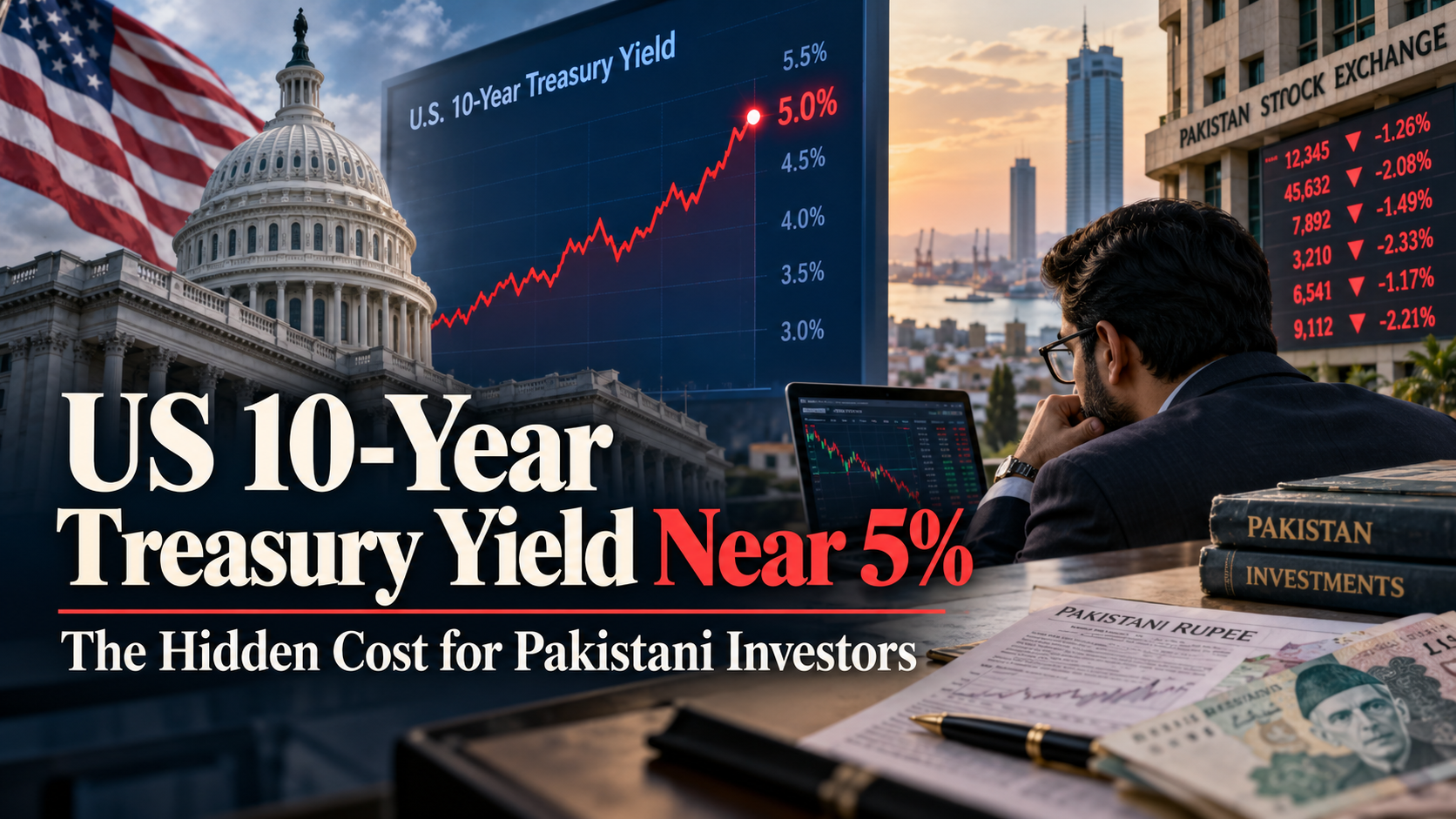
A US government bond can change the required return on a Pakistani investment without a single dollar physically crossing the border. The link runs through a basic idea: when a benchmark asset yields more, investors demand a stronger reason to take additional currency, liquidity and credit risks elsewhere.
The yield on the US 10-year Treasury stood near 5.00% on October 23, 2026, after reaching about 5.24% on October 9, according to historical Treasury-yield data. The user-friendly phrase above 5% should therefore be treated as a description of much of October, not a guaranteed quote for every moment of the latest trading day.
A bond yield is not a savings-account rate
A government-bond yield is the return implied by its market price and promised cash flows, assuming the relevant payment and holding assumptions. When investors sell an existing fixed-coupon bond and its price falls, its yield typically rises. That inverse relationship is central to interpreting the US Treasury market.
The 10-year yield reflects a mixture of expected short-term policy rates, expected inflation and a term premium for holding longer-dated debt. It can fall even while central-bank inflation concerns persist, for example if growth fears rise or investor demand for safe securities strengthens. Reading any single yield move as a pure Fed forecast is a mistake.
Four ways it reaches Pakistan
1. Dollar funding becomes a tougher benchmark. Investors weighing dollar-denominated assets may compare emerging-market returns with those available in US government debt. Pakistani external bonds must compensate for additional sovereign and market risk, although observed spreads change independently of benchmark yields.
2. Currency calculations shift. A domestic bond offering a high rupee yield can still disappoint a foreign investor if depreciation erodes converted returns. For Pakistani investors with future dollar obligations, currency exposure is similarly relevant.
3. Valuations face a higher discount rate. Equity valuations are sensitive to the interest rate used to discount expected future earnings. Companies promising distant profits may be more exposed than businesses generating cash immediately, but there is no perfect sector rule.
4. Sovereign refinancing risk draws scrutiny. Global debt investors assess not only current yields but also how costly it will be for governments to refinance existing obligations. Local T-bills and PIBs are nevertheless priced mainly by Pakistan-specific inflation, liquidity, central-bank policy and credit conditions; US yields do not mechanically set auction cutoffs.
The price-risk example
Imagine a fixed-coupon bond with a duration of seven years. A one-percentage-point increase in yields would imply an approximate 7% price decline, all else equal, using the basic duration approximation. That is not a prediction and not an exact valuation; convexity, yield-curve changes and cash-flow structure matter. It illustrates why holding a bond fund is different from locking in a bank deposit.
Duration risk also works in reverse: bond prices can rise when market yields fall. An investor buying only because the quoted coupon looks attractive may discover later that the resale price has moved against them.
What the latest global backdrop adds
The Federal Reserve raised its policy range to 3.75%–4.00% in September, amid persistent inflation concerns. At the same time, oil-market instability has made imported inflation a more acute concern for Pakistan. The IMF’s October World Economic Outlook forecasts 3.1% world growth for 2026 and highlights downside risks from conflict and financing strains.
This combination means bond yields may be high for reasons that are not benign. A superficially attractive yield could reflect inflation anxiety, fiscal uncertainty or a global risk premium. Investors need to ask why the yield is high, not just how high it is.
A useful comparison table
| Asset | Return quoted in | Main extra risk to examine |
|---|---|---|
| US 10-year Treasury | USD | Duration, inflation, reinvestment |
| Pakistan T-bill | PKR | Domestic rate/inflation, reinvestment |
| Pakistan Investment Bond | PKR | Duration, inflation, liquidity |
| Pakistan dollar bond | USD | Sovereign credit spread, liquidity, duration |
| PSX equity | PKR | Earnings, valuation, currency and market risk |
Currency hedging is not a free lunch
A Pakistani saver comparing foreign-currency investments with domestic government paper must think about more than headline yield. Converting rupees to dollars and back can involve spreads, banking charges, legal requirements and foreign-exchange movement. A hedging instrument, where available and suitable, usually embeds a cost related to interest-rate differences and market conditions. It cannot simply erase currency risk without consequence.
Tax treatment also matters. A quoted yield before withholding tax, custody expense or fund fees is not comparable with an after-tax return from another product. Similarly, a dollar asset can generate a positive dollar return but a different return in rupees. The investor should calculate both if future expenses are split between currencies.
For institutional portfolios, bond duration and liquidity become central. A long-maturity bond may have an attractive yield to maturity but be unsuitable for liabilities due next month. For individuals, the ability to meet an emergency expense without selling at a loss may be worth more than an extra percentage point of advertised return.
The sound comparison is liability-matched, not headline-driven: decide when the money is needed, in what currency and how much market-price movement is tolerable before selecting an asset.
Does a 5% US yield mean Pakistan must offer 5% plus a fixed margin?
No. Each instrument differs in currency, maturity, credit, liquidity and taxation; spreads vary with markets and policy.
Are US Treasuries risk-free?
They are commonly treated as a benchmark for dollar credit risk, but their market prices are not risk-free. Inflation and interest-rate changes can erode purchasing power and resale value.
What should a Pakistani retail investor do first?
List liabilities by currency and timing, then compare instruments on an after-tax, after-inflation and liquidity-adjusted basis. Seek licensed guidance where suitable.
The takeaway: a 5% US benchmark changes the world’s price of patience. Pakistani investors should respond by measuring real cash flows and risks, not by chasing whichever country advertises the biggest nominal yield.
Discover more from The Economy
Subscribe to get the latest posts sent to your email.
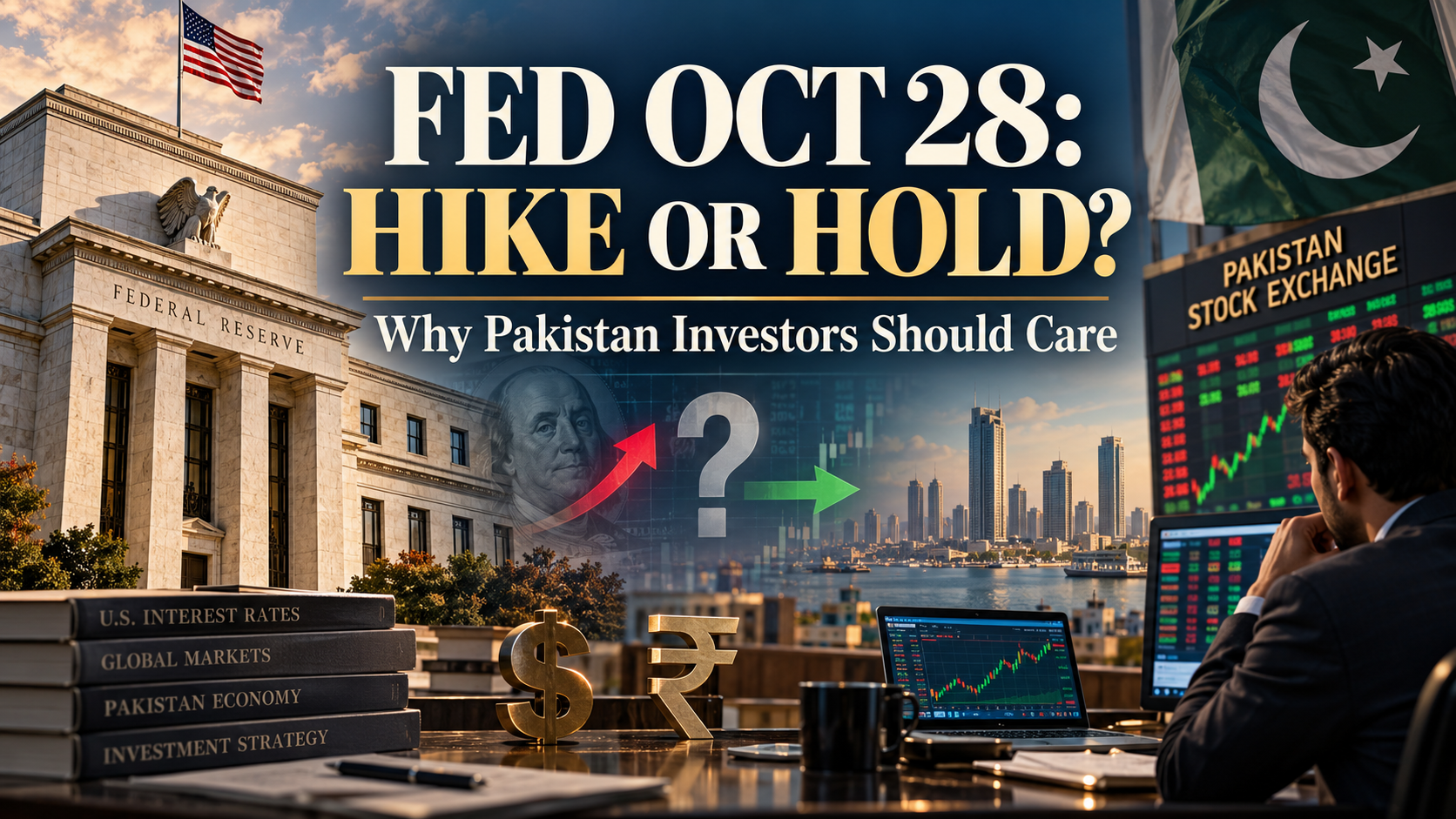
The Federal Reserve’s next interest-rate decision is scheduled for October 28, 2026, at the conclusion of a two-day Federal Open Market Committee meeting. For investors in Karachi, New York or Kuala Lumpur, the question is bigger than whether the Fed raises rates by another quarter point. It is whether persistent inflation and an energy shock will keep global financing conditions restrictive for longer.
The Federal Reserve’s September 16 statement confirmed a 25-basis-point increase in the federal funds target range to 3.75%–4.00%. The official October calendar fixes the next announcement for Wednesday, October 28. Predictions about the decision remain predictions until the statement is published.
Why the market cannot simply assume a hold
The Fed faces two forces pulling in different directions. A resilient US economy can withstand tighter financial conditions better than a slowing one, while high energy prices can feed inflation expectations. At the same time, tightening further risks increasing pressure on rate-sensitive sectors and debt-servicing costs. The September meeting minutes describe concern about elevated inflation and the geopolitical backdrop.
Traders often express their expectations through futures pricing, but a specific percentage quoted earlier in October may no longer be representative on October 25. A responsible preview should avoid presenting an old implied probability as a live market estimate. The announcement, accompanying statement and press conference deserve more attention than any one probability screen.
The three policy scenarios
Hold, with a hawkish message. The Fed leaves its target at 3.75%–4.00% but stresses persistent inflation. Treasury yields and the dollar could remain firm if investors infer that further increases are possible. A hold is not necessarily dovish.
Another 25-basis-point rise. A new increase could push short-term dollar funding costs higher, depending on whether it is already priced in. For emerging markets, this may sharpen competition for capital and raise the hurdle rate for risky assets.
Hold, with a softer outlook. If the language signals growing confidence on inflation, longer yields might ease and investors could reassess the attractiveness of emerging-market equities and bonds. Any such response would also depend on earnings, geopolitics and risk appetite.
How the Fed reaches the Pakistan Stock Exchange
The direct transmission is limited by Pakistan’s domestic policy and market structure, but there are real channels. The first is the US dollar: a stronger dollar can raise the local price of imports and influence emerging-market currency expectations. The second is global yields: investors compare returns across sovereign debt markets and require compensation for currency and credit risks. The third is equity valuation: higher discount rates can reduce the present value of future corporate earnings, particularly for expensive growth assets.
For Pakistan, imported energy complicates that picture. If a Fed hike reflects sticky US inflation linked to oil, local investors must evaluate both international monetary tightening and Pakistan’s own fuel-import exposure. The World Bank’s Pakistan Development Update reports improving macroeconomic conditions but also acknowledges conflict-related pressure.
Bonds versus stocks: the difference matters
Pakistan Treasury bills and investment bonds primarily respond to domestic rates, inflation expectations, liquidity and sovereign risk. Their yields need not mirror US Treasuries day for day. PSX sectors also differ: banks, exporters, highly leveraged firms and energy producers can react quite differently to the same exchange-rate or interest-rate surprise.
A simplistic Fed hikes, PSX falls formula misses positioning. Prices often move on the gap between expectations and the actual decision. Even a rate hike can coincide with a stock rally if the market expected a larger move or welcomes clarity.
A practical announcement-day checklist
| Watch | Why |
|---|---|
| Fed funds target range | Immediate policy decision |
| Statement language on inflation | Signal for coming meetings |
| Treasury yield reaction | Changing dollar discount rates |
| Dollar index and EM currencies | Cross-border risk sentiment |
| Brent crude | Separate but powerful inflation channel |
| Pakistan KIBOR, rupee and SBP communications | Local transmission |
The IMF’s October outlook cautions that energy importers outside the AI investment value chain have a difficult growth outlook. This makes risk diversification and the distinction between nominal yields and real returns especially relevant.
Why the press conference may matter more than the quarter-point move
Central-bank announcements bundle several messages. A policy-rate decision tells markets what the committee did today. The statement signals which risks officials emphasise. The chair’s subsequent explanations can change expectations about the next several meetings. Traders may initially react to the rate itself, then reverse direction as they digest the path implied by the language.
For emerging-market investors, that distinction is crucial. A 25-basis-point increase accompanied by confidence that inflation pressure is subsiding may prove less restrictive for global risk appetite than an unchanged rate accompanied by warnings of more tightening. The yield curve, dollar and market-implied path are useful contemporaneous checks, although each has competing drivers.
Pakistan-based investors should also consider market hours. US decisions may arrive after domestic exchanges have closed, while other Asian markets trade the following session. A next-day index move can reflect overnight global earnings or geopolitical events as well as the Fed. Attribution requires comparing the timing of all material news.
For a rigorous post-meeting update, include the exact target range, vote, key wording changes and a timestamped Treasury yield. Replace the scenarios with the actual decision rather than leaving the preview to masquerade as a live result.
When will the Fed decision be released?
The Fed lists the October 27–28 meeting and a 2 p.m. Eastern announcement on October 28. Verify time conversion and possible schedule changes before publishing a live ticker.
Is a rate hike guaranteed?
No. September’s action and October’s risks do not predetermine the committee’s vote.
Should Pakistani investors sell stocks because of the Fed?
There is no universal answer. Investment time horizon, portfolio concentration, company balance sheets and currency exposure matter more than a one-day headline.
Bottom line: October 28 is a test of the Fed’s inflation tolerance. For Pakistan, the most important signal will be how the decision reshapes the dollar, energy costs and global demand for emerging-market risk—not the label hike or hold alone.
Discover more from The Economy
Subscribe to get the latest posts sent to your email.

The global Banking growth is becoming more uneven, capital is increasingly sensitive to financing costs, and investors must distinguish a convincing story from an investable price. This guide focuses on research methods and risks rather than predictions of guaranteed returns. The IMF October 2026 outlook projects 3.1% global growth and 4.7% inflation for 2026, while the IMF financial-stability assessment warns that market resilience coexists with important vulnerabilities.
Key takeaways
- Match each investment decision to its time horizon, currency and ability to withstand losses.
- Separate observable earnings or contractual cash flows from optimistic forecasts.
- Compare diversification, fees, taxes, liquidity and regulatory restrictions before committing capital.
- Track primary institutional evidence and update assumptions when conditions change.
- Readers in Pakistan should consider rupee exposure and availability of regulated investment channels.
Why this matters now
The central question behind global banking trends 2026 is not merely what may happen next. It is which economic mechanisms could change cash flow, purchasing power or risk. The Bank for International Settlements’ 2026 review describes an economy supported by technological investment but constrained by geopolitical and fiscal pressures. A robust financial plan must therefore survive both a favourable and an adverse scenario.
Digital banks are extending beyond borders
Technology can reduce the need to duplicate large physical branch networks, but banking remains subject to local licensing, deposit protection, consumer law and capital rules. Cross-border scale is a business model, not a regulatory exemption. Readers should distinguish a licensed bank from an e-money provider, broker or unregulated payments application. See the primary institutional research.
For practical analysis, separate the baseline, the upside case and the downside case. Document the specific development that would change your assessment. Assess timing: a promising long-term theme may still be inappropriate for cash needed within twelve months.
Artificial intelligence in credit and fraud
Banks use machine learning for transaction screening, fraud detection, service operations and risk analysis. The operational promise is significant, but opaque credit models can create unfair outcomes, and false-positive fraud alerts can disrupt customers. Model governance requires testing, human accountability, explainability and correction routes. Customer consent does not remove every data-protection obligation. See the primary institutional research.
For practical analysis, separate the baseline, the upside case and the downside case. Document the specific development that would change your assessment. Assess timing: a promising long-term theme may still be inappropriate for cash needed within twelve months.
Cybersecurity is now systemic finance risk
An attack against a large processing vendor can affect many institutions simultaneously. The IMF’s October 2026 stability assessment identifies sophisticated cyber threats alongside sovereign-yield and AI valuation shocks. Banks should test recovery procedures, third-party concentration, authentication controls and incident communications, not merely purchase security software. See the primary institutional research.
For practical analysis, separate the baseline, the upside case and the downside case. Document the specific development that would change your assessment. Assess timing: a promising long-term theme may still be inappropriate for cash needed within twelve months.
Compliance: technology must support judgment
Anti-money-laundering monitoring, sanctions screening and know-your-customer processes are increasingly automated. False matches and poor data can cause excessive account restrictions, while under-detection carries serious legal exposure. Institutions need measurable controls, independent audits and escalation channels. The Financial Stability Board provides international coordination context but rules vary by jurisdiction. See the primary institutional research.
For practical analysis, separate the baseline, the upside case and the downside case. Document the specific development that would change your assessment. Assess timing: a promising long-term theme may still be inappropriate for cash needed within twelve months.
What Pakistani customers and banks should do
Customers should verify a provider’s licensing status, understand complaint mechanisms, enable strong authentication and never disclose one-time passcodes. Financial firms need resilient payment systems, staff training and clear consent practices. Track SBP circulars for locally applicable requirements rather than extrapolating foreign regulations to Pakistan. See the primary institutional research.
For practical analysis, separate the baseline, the upside case and the downside case. Document the specific development that would change your assessment. Assess timing: a promising long-term theme may still be inappropriate for cash needed within twelve months.
Comparison and decision framework
| Question | Stronger evidence | Warning sign |
|---|---|---|
| What drives returns? | Audited cash flows, clear contract or transparent index | Undefined or projected returns |
| What can go wrong? | Explicit scenario and downside analysis | Claims of guaranteed gains |
| Is it affordable to hold? | Low transparent fees and adequate liquidity | Leverage, costly spreads or lockups |
| Is access legitimate? | Appropriate licensing and clear legal rights | Unverified brokers or custody |
| Is the exposure diversified? | Multiple independent sources of return | One company, sector or currency |
What it means for Pakistani savers and investors
A Pakistani reader faces both international investment risk and local purchasing-power risk. For example, a foreign asset can rise in US-dollar terms while the rupee conversion and transaction costs alter the realized local outcome. The opposite can also occur. Record the starting exchange rate, applicable taxes, custody charges and capital-transfer restrictions, and confirm current requirements with the State Bank of Pakistan and the relevant securities regulator. Overseas access should not be assumed universally available.
An emergency reserve, expensive consumer debt and near-term family obligations deserve attention before any speculative allocation. A portfolio that cannot meet a sudden cash requirement may force sales at the worst moment. The objective is not to remove risk—impossible in markets—but to choose risks that fit the investor’s actual liabilities.
Risks, limitations and uncertainty
Institutional forecasts are conditional and can change after policy decisions, commodity shocks, conflict escalation or unexpectedly weak earnings. Historic correlations are not binding promises about future asset performance. The analysis does not provide live stock prices, current investment product quotes, real-time exchange rates or individualized tax advice. Prices, regulations and product eligibility should be checked on the transaction date.
Frequently asked questions
Is this a guaranteed investment opportunity?
No. Every financial asset or strategy involves uncertainty. The existence of a popular investment theme is not evidence that an individual security is fairly priced.
What should beginners examine first?
Understand the product, the financial loss you could tolerate, fees and liquidity. Verify the provider and decide whether the money may be needed soon.
How do interest rates affect the analysis?
They influence financing costs, discount rates, exchange rates and demand. The effect differs by sector, maturity and business balance sheet.
Can Pakistani residents invest in foreign markets?
Access depends on current foreign-exchange, banking, brokerage, securities and tax rules, and on the investor’s individual circumstances. Check current regulations and regulated providers rather than assuming access.
How often should this analysis be refreshed?
Review institutional economic releases monthly and re-evaluate immediately after material earnings, regulatory or policy changes. Avoid reacting mechanically to every daily market movement.
Is diversification enough to prevent losses?
No. Diversification may reduce company-specific risk but cannot eliminate broad market, currency, inflation or systemic risks.
Conclusion
Sound financial decisions begin with verifiable evidence, reasonable valuation, awareness of uncertainty and a plan that survives adverse outcomes. Readers should compare multiple independent sources and avoid letting a compelling headline substitute for due diligence.
Discover more from The Economy
Subscribe to get the latest posts sent to your email.

Neocloud Economics in 2026: GPU Debt, Utilization and Power

What Is a Neocloud? How AI GPU Clouds Work and Compare

Lula Re-elected in 2026: What Changes for the Dollar, Brazilian Stocks, and Interest Rates?

Lula Wins Brazil’s 2026 Election: Five Economic Tests for 2027

SSI November 2026 Payment: Why Benefits Arrive October 30

Russia Sanctions Waiver: What Asian Oil Buyers Gain

Asia Markets Weekly: How Oil, US Yields and the Fed Reach Tokyo, Kuala Lumpur and Karachi

Gold Near $4,000: Buy, Hold or Wait? A Pakistan Tola Price Guide

US 10-Year Treasury Yield Near 5%: The Hidden Cost for Pakistani Investors

Fed Meeting on October 28: Hike or Hold—and Why Pakistan Investors Should Care

Can Pakistan Turn US–Iran Mediation Into an Economic Dividend?

Oil Above $100: How Higher Crude Prices Reach Pakistan’s Rupee, Petrol and Imports

SBP Interest Rate at 11.5%: What Will Decide Pakistan’s Next Policy Move?

The Global South: Debt, Climate Finance and Investment in 2026

Crude Oil & Petroleum Market Analysis: OPEC+ Decisions and Price Forecasts

Top US Convenience Store Chains: Store Counts, EV Charging, and Sales Trends

Algorithmic Dogfights: Why the U.S. and China Must Establish Rules of Engagement for Autonomous Air Power

Who Is Shivon Zilis? The Neuralink Executive at the Center of the Musk–OpenAI Trial

Social Security Extra $90 Deposit: Who Qualifies for the October 2026 Medicare Rebate?

Corporate America Faces a New Debt Test as US Borrowing Costs Surge

Global Economic Outlook 2026: 7 Forces Reshaping Markets, Trade and Business

Gold Price Outlook 2026: The Forces Behind the Forecasts—and What Could Reverse Them

Gold Falls 3.7% as Yields Surge: Is Gold Still a Safe Haven in 2026?

MAS Allocates S$1.45 Billion to Five Asset Managers in Third EQDP Batch: Total Deployment Reaches S$5.4 Billion

Stock Market Today: Dow, S&P 500, and Nasdaq Retreat as Treasury Yields

Anthropic Bans Sustained Abuse of Claude AI Under New Usage Policy Effective November 12, 2026

Geopolitics and Your Portfolio: How International Affairs Move Global Markets

US 10-Year Yield Hits 5.24%: What the Historic Bond Market Sell off Means for Mortgages and Investors
-

 Markets & Finance10 months ago
Top 15 Stocks for Investment in 2026 in PSX: Your Complete Guide to Pakistan’s Best Investment Opportunities
-

 Analysis8 months ago
Johor’s Investment Boom: The Hidden Costs Behind Malaysia’s Most Ambitious Economic Surge
-

 Analysis8 months ago
Top 10 Stocks for Investment in PSX for Quick Returns in 2026
-

 Banks9 months ago
Best Investments in Pakistan 2026: Top 10 Low-Price Shares and Long-Term Picks for the PSX
-

 Analysis9 months ago
Brazil’s Rare Earth Race: US, EU, and China Compete for Critical Minerals as Tensions Rise
-

 Investment10 months ago
Top 10 Mutual Fund Managers in Pakistan for Investment in 2026: A Comprehensive Guide for Optimal Returns
-

 Global Economy10 months ago
15 Most Lucrative Sectors for Investment in Pakistan: A 2025 Data-Driven Analysis
-

 Global Economy10 months ago
Pakistan’s Export Goldmine: 10 Game-Changing Markets Where Pakistani Businesses Are Winning Big in 2025