
Exclusive
Geo-Economic Confrontation: The World’s Top Risk in 2026 and What It Means for Global Stability

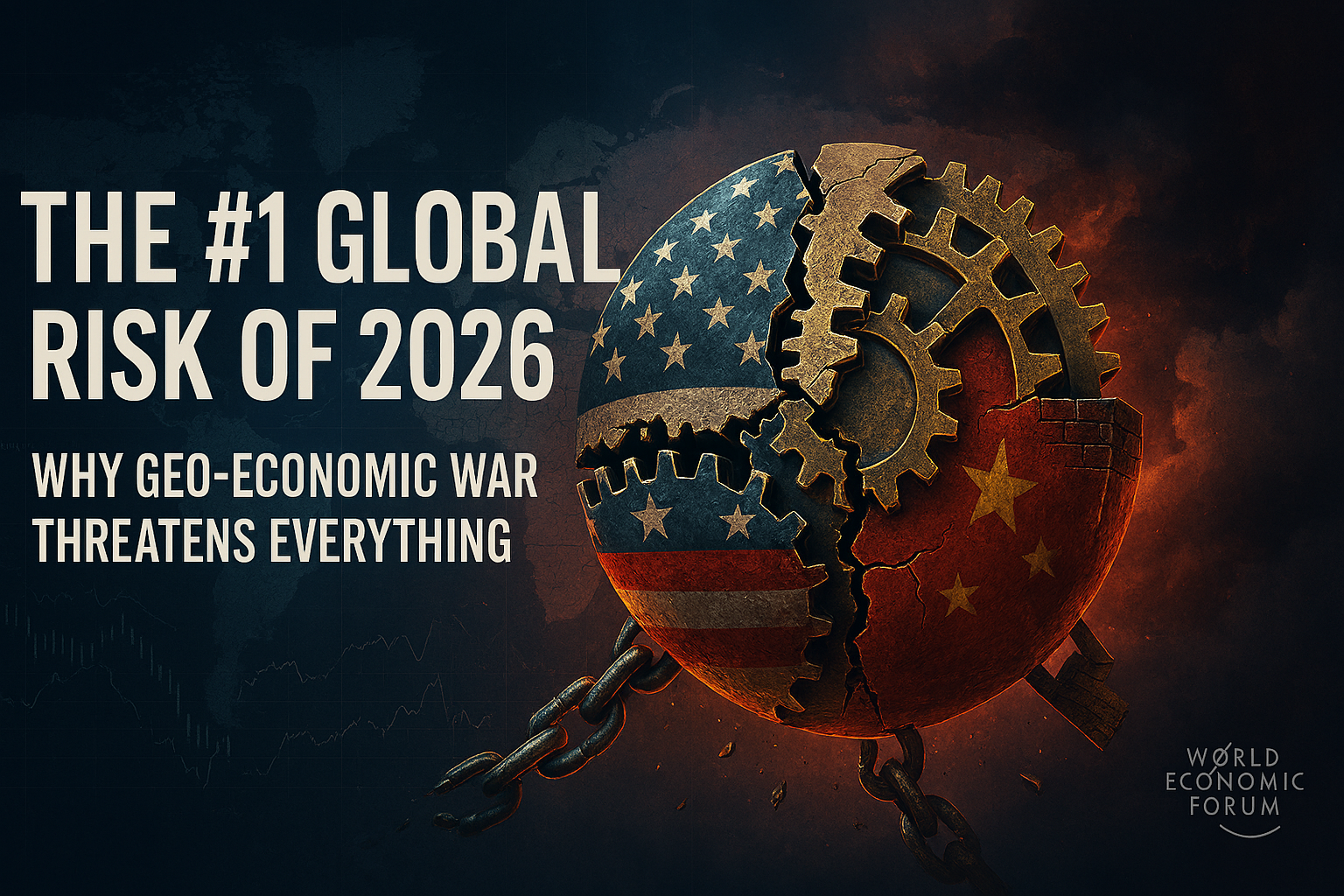
On a cold January morning in 2026, a container ship idled outside Rotterdam’s harbour, its cargo of semiconductors and rare earth minerals caught in the crossfire of the latest transatlantic trade dispute. Inside those steel boxes lay the raw materials for everything from smartphones to solar panels—products now subject to a bewildering array of tariffs, counter-tariffs, and export controls that shift almost weekly. This scene, replicated across dozens of ports from Shanghai to Los Angeles, captures the defining crisis of our era: the world is fracturing along economic battle lines, and the consequences reach far beyond trade statistics.
The World Economic Forum’s Global Risks Report 2026, released this month and drawing on insights from over 1,300 global experts, delivers a stark verdict: geo-economic confrontation has surged to become the single most likely risk to trigger a material global crisis over the next two years. This marks a dramatic escalation from previous editions, where the threat lurked in the top five but never claimed the crown. More troubling still, fully half of the report’s respondents now anticipate a “turbulent or stormy” world ahead—a 14-percentage-point leap from last year’s already pessimistic assessment. Only 9% expect anything resembling stability.
What exactly does geo-economic confrontation mean, and why should it concern anyone beyond trade negotiators and foreign policy specialists? At its core, it describes the weaponisation of economic policy—tariffs, sanctions, investment restrictions, technology controls—to advance geopolitical objectives. Unlike traditional warfare, these battles are fought with export bans rather than bombs, yet their impact can be equally devastating to prosperity, security, and the cooperative frameworks that have underpinned seven decades of relative peace and unprecedented growth.
The Anatomy of Economic Statecraft: Why Geo-Economics Claimed the Top Spot
The elevation of geo-economic confrontation to the number one global risk reflects a fundamental shift in how power is exercised in the 21st century. Where previous generations witnessed ideological struggles played out through proxy wars and alliance systems, today’s great power competition increasingly manifests through supply chain disruptions, semiconductor export controls, and strategic competition over critical minerals.
The WEF report warns explicitly that “in a world of rising rivalries and prolonged conflicts, confrontation threatens supply chains and broader global economic stability as well as the cooperative capacity required to address economic shocks.” This isn’t abstract theory. Consider the tangible evidence: US-China technology decoupling accelerated dramatically throughout 2024 and 2025, with American restrictions on advanced chip exports matched by Chinese dominance over rare earth processing. The European Union’s Carbon Border Adjustment Mechanism, while nominally environmental, functions as a geo-economic tool that disadvantages emerging market exporters. Russia’s energy leverage over Europe, though diminished since 2022, demonstrated how resource dependencies can be exploited for strategic gain.
What distinguishes the current moment from past episodes of economic nationalism—say, the trade tensions of the 1930s or the Cold War era—is the sheer interconnectedness of modern supply chains combined with their strategic sensitivity. When critical dependencies exist for technologies essential to both economic competitiveness and national security, from artificial intelligence to renewable energy systems, economic policy becomes inseparable from security policy. The result is a world where almost every major economic decision carries geopolitical weight, and vice versa.
According to analysis from the Council on Foreign Relations, this convergence of economics and security creates particularly acute risks in semiconductors, pharmaceuticals, green technology supply chains, and undersea cables carrying global data traffic. Each represents a potential flashpoint where commercial disputes could rapidly escalate into strategic crises.
The Complete Risk Landscape: Beyond Geo-Economics
While geo-economic confrontation dominates the immediate horizon, the Global Risks Report 2026 paints a multifaceted picture of threats that interact and amplify one another. Understanding these interconnections is crucial, as isolated risk management will fail when challenges cascade across domains.
The top five risks most likely to trigger a global crisis over the next two years are:
- Geo-economic confrontation – The fragmentation of global markets along geopolitical fault lines
- State-based armed conflict – Including proxy wars, regional flare-ups, and the risk of great power conflict
- Extreme weather events – Intensifying storms, floods, droughts, and heatwaves with immediate economic impact
- Societal polarisation – Deepening divisions within countries that undermine governance and social cohesion
- Misinformation and disinformation – The systematic undermining of shared reality through coordinated information manipulation
What makes 2026 particularly hazardous is how these risks intersect. Geo-economic confrontation doesn’t occur in a vacuum—it exacerbates armed conflicts by limiting diplomatic channels, complicates climate response by fracturing cooperation on green technology, feeds societal polarisation as economic pain creates scapegoats, and creates fertile ground for disinformation as competing powers wage information warfare.
Consider how these dynamics played out even before 2026 began. The Houthi attacks on Red Sea shipping in late 2023 and throughout 2024 demonstrated how a regional conflict could instantly become a global economic crisis, disrupting supply chains already strained by US-China tensions. Reporting from The Guardian on the WEF report notes that shipping costs tripled on key routes, inflation expectations surged, and insurance markets convulsed—all from a conflict involving non-state actors in a narrow waterway thousands of miles from major powers.
Similarly, extreme weather events create immediate economic shocks that geo-economic fragmentation makes harder to address collectively. When flooding devastates agricultural production in South Asia or drought cripples hydroelectric capacity in South America, the traditional response would involve international aid, market mechanisms to redistribute supplies, and coordinated investment in resilience. But in a world of economic blocs and strategic competition, these responses come slowly if at all, as nations prioritise securing their own supplies and view assistance through a geopolitical lens.
Two Horizons, Different Threats: The Short-Term Versus Long-Term Calculus
One of the most revealing aspects of the WEF report is the divergence between two-year and ten-year risk perceptions. While geo-economic tensions and their associated political-security risks dominate the immediate future, environmental challenges reassert themselves decisively over the longer horizon.
Looking out to 2036, the top risks shift dramatically:
- Critical change to Earth systems (crossing irreversible climate tipping points)
- Biodiversity loss and ecosystem collapse
- Extreme weather events (persistent and worsening)
- Natural resource shortages
- Adverse outcomes of AI technologies
This temporal split reflects a uncomfortable truth: humanity appears wired to prioritise immediate threats over existential but slower-moving ones. The latest analysis from the Brookings Institution suggests this mismatch between short-term political incentives and long-term environmental imperatives represents one of the most fundamental governance challenges of our time.
Yet even this division proves somewhat artificial upon closer examination. Environmental risks and geo-economic confrontation are not separate tracks but deeply intertwined trajectories. Competition over green technology supply chains—lithium, cobalt, rare earths, and the manufacturing capacity to turn these into batteries and solar panels—is simultaneously an environmental issue, an economic confrontation, and a security concern. The International Energy Agency has documented how clean energy transitions are creating new dependencies that may prove as problematic as fossil fuel dependencies they replace, particularly when critical mineral processing concentrates in single countries pursuing strategic objectives.
Water scarcity, agricultural disruption, and climate-driven migration will create precisely the conditions that fuel both geo-economic competition (as nations scramble to secure resources) and armed conflict (as climate stress interacts with existing tensions). The Chatham House risk assessment framework identifies climate-security nexuses as among the most probable and impactful scenarios over the next decade.
The Business Implications: Operating in a Fragmented World
For corporate leaders and investors, the ascendance of geo-economic confrontation as the top global risk carries profound strategic implications that extend far beyond quarterly earnings calls. The era of borderless optimisation—where companies designed supply chains purely for efficiency, manufactured wherever costs were lowest, and served a unified global market—is ending. In its place emerges a messier landscape of regional blocs, friend-shoring, and strategic autonomy imperatives.
According to Reuters coverage of the WEF report, business leaders now face a trilemma: maintaining efficiency, ensuring resilience, and navigating political expectations increasingly point in different directions. A supply chain optimised for cost might run through regions of geopolitical tension. Resilient supply chains with redundancy and diversification are inherently more expensive. And political pressures—whether American calls to reshore manufacturing, European strategic autonomy initiatives, or Chinese dual circulation policies—create regulatory and reputational risks for companies that appear to prioritise efficiency over national interests.
The semiconductor industry illustrates these tensions perfectly. Taiwan Semiconductor Manufacturing Company, which fabricates the majority of the world’s advanced chips, represents a single point of failure sitting astride the most dangerous geopolitical flashpoint on earth. Governments from the United States to the European Union to Japan have committed hundreds of billions in subsidies to build alternative capacity, explicitly acknowledging that pure economic efficiency must give way to strategic considerations. Yet building new foundries takes years and enormous capital investment, creating a vulnerable transition period where risks peak.
Financial services face equally stark adjustments. The weaponisation of the SWIFT payments system and dollar clearing mechanisms during the Ukraine crisis demonstrated how financial infrastructure can become a geopolitical tool. This has accelerated efforts to develop alternative payment systems—China’s Cross-Border Interbank Payment System (CIPS), central bank digital currencies, and even renewed interest in commodity-backed settlements. The result is a gradually fragmenting financial architecture that increases transaction costs and creates new operational complexities.
For investors, geo-economic risks translate into systematic repricing of assets as risk premiums adjust to reflect political risks that markets previously ignored or underpriced. CNBC’s analysis of the report notes that portfolio diversification strategies predicated on global integration face fundamental challenges when the assumption of continued integration no longer holds. Emerging markets may face persistent discounts not due to economic fundamentals but due to their position in geopolitical fault lines. Commodities, particularly those central to energy transitions, may experience elevated volatility as strategic stockpiling and export restrictions become normalised policy tools.
The Policy Paralysis: When Cooperation Becomes Impossible
Perhaps the most insidious aspect of geo-economic confrontation as the leading global risk is its self-reinforcing nature. The very fragmentation and mistrust that characterise the current moment make it harder to address the other major risks on the WEF list—creating a vicious cycle where cooperative capacity atrophies precisely when we need it most.
Consider the challenge of pandemic preparedness. The COVID-19 crisis revealed deep vulnerabilities in global health supply chains and highlighted the benefits of international cooperation on vaccine development and distribution. Yet the intervening years have seen vaccine nationalism, hoarding of critical supplies, and recriminations rather than reformed institutions. When the next pandemic emerges—and epidemiologists warn it’s a question of when, not if—the response will unfold in a world of deeper divisions and greater mistrust than 2020.
Climate change presents an even starker example of how geo-economic confrontation undermines collective action. The physics of climate change care nothing for geopolitical rivalries; greenhouse gases mix uniformly in the atmosphere regardless of their national origin. Yet meaningful climate action requires sustained cooperation on technology sharing, financing mechanisms, and emissions reductions commitments. The analysis from The Economist suggests that current trajectories point toward climate policies increasingly subordinated to industrial policy goals, with green subsidies designed as much to advantage domestic industries as to reduce emissions efficiently.
The erosion of multilateral institutions compounds these challenges. The World Trade Organization, once the arbiter of global trade disputes, has seen its appellate body non-functional since 2019, with no resolution in sight as major powers pursue preferential agreements and unilateral measures. The United Nations Security Council remains paralysed by great power rivalry on issue after issue. Even relatively technical institutions like the International Telecommunications Union face politicisation as standards-setting for 5G and other technologies becomes a proxy for technological leadership battles.
What emerges is a paradox: as global challenges become more complex and interdependent—pandemics, climate change, financial contagion, cyber threats—our collective capacity to address them through coordinated action deteriorates. This institutional decay may prove as consequential as any specific risk on the WEF list.
Misinformation, Polarisation, and the Battle for Reality
Two risks on the WEF top-five list deserve special attention for their role as threat multipliers: misinformation/disinformation and societal polarisation. These function not merely as standalone risks but as conditions that make every other challenge harder to address.
The information ecosystem has fractured in ways that would have seemed dystopian just a decade ago. BBC reporting on the Global Risks Report highlights how artificial intelligence tools now enable the creation of synthetic media—deepfakes, fabricated documents, manipulated audio—at scale and with minimal cost. When combined with algorithmic amplification on social media platforms optimised for engagement rather than truth, the result is an environment where coordinated disinformation campaigns can reach millions before fact-checkers even identify the falsehoods.
The geopolitical dimension is crucial. State and state-sponsored actors increasingly view information manipulation as a core tool of statecraft, cheaper and more deniable than kinetic military action yet potentially as effective in achieving strategic objectives. Russian interference in Western elections, Chinese information operations regarding Taiwan and Xinjiang, American broadcasting and digital presence globally—all represent investments in shaping narratives and undermining adversary cohesion.
This warfare over reality feeds directly into societal polarisation. When citizens inhabit separate information universes, sharing neither facts nor interpretive frameworks, democratic deliberation becomes impossible. Political compromise requires some shared understanding of problems and trade-offs; absent that common ground, politics devolves into existential struggles where opponents become enemies and every issue a hill to die on.
The economic implications are profound yet underappreciated. Polarised societies struggle to make long-term investments in infrastructure, education, and innovation. Policy volatility increases as political pendulums swing more wildly. Trust in institutions—from central banks to courts to electoral systems—erodes, raising the cost of governance and reducing the effectiveness of policy interventions. Research from Bloomberg suggests that elevated political risk now commands measurable premiums in corporate borrowing costs and equity valuations in polarised democracies.
Scenarios for 2026 and Beyond: Paths Through Turbulence
Given the constellation of risks identified in the WEF report, what plausible scenarios might unfold over the coming years? While prediction remains perilous, exploring potential pathways helps frame strategic thinking and identify critical junctures where interventions might make a difference.
The Fragmentation Scenario: Geo-economic confrontation intensifies, leading to the emergence of distinct trading blocs—a Western/Atlantic sphere, a Chinese-centric Asian sphere, and perhaps a non-aligned middle ground of nations attempting to navigate between them. Trade flows reorient dramatically, with significant welfare losses from reduced specialisation and increased costs. This scenario sees periodic crises as bloc boundaries are tested—perhaps over Taiwan, perhaps in the South China Sea, perhaps through proxy conflicts in resource-rich regions of Africa or Latin America. Environmental cooperation stalls as blocs compete rather than collaborate. By 2030, the world looks less like the integrated system of 2010 and more like the Cold War era, though with more sophisticated economic interdependence within blocs.
The Crisis Cascade Scenario: Multiple risks from the WEF list trigger simultaneously or in rapid succession—perhaps a major armed conflict (Taiwan contingency, Indo-Pakistani escalation, Iran-Israel war) coinciding with extreme climate impacts (multi-breadbasket failure, major coastal flooding) and financial instability (sovereign debt crisis, banking system stress). In this scenario, the fragmented international system proves unable to mount effective collective responses. Economic shocks amplify, social unrest spreads, and authoritarian responses increase. This represents the darkest timeline, where the loss of cooperative capacity that geo-economic confrontation entails combines with bad luck on other risk dimensions.
The Muddling Through Scenario: Perhaps most probable given historical precedent, this sees neither collapse nor renewed cooperation but ongoing turbulence that societies and markets gradually adapt to. Some supply chains fragment while others persist. Certain domains see effective cooperation (perhaps pandemic response improves, perhaps some climate initiatives continue) while others remain contested. Volatility becomes the new normal—periodic crises, policy uncertainty, shifting alignments—but systemic collapse is avoided through some combination of resilience, luck, and last-minute course corrections. Growth slows, inequality may worsen, but civilization persists.
The Adaptive Renaissance Scenario: The least probable but not impossible optimistic path envisions that the very severity of current challenges prompts a revival of multilateral cooperation and institutional innovation. Perhaps a major climate disaster or financial crisis provides a focal point for renewed coordination. Perhaps enlightened leadership emerges in key countries simultaneously. New frameworks develop that acknowledge legitimate security concerns while preventing economic fragmentation—perhaps trusted intermediaries for technology transfer, perhaps reformed trade institutions with built-in security exemptions. This scenario requires both good fortune and wise leadership, but it’s worth noting that humans have occasionally risen to civilisational challenges when the alternative became sufficiently clear.
What Can Be Done? A Path Forward Through Complexity
Confronting the risk landscape outlined in the Global Risks Report 2026 requires action at multiple levels—individual, corporate, national, and international. While the challenges are daunting, several principles might guide more constructive approaches.
For policymakers, the priority must be preventing the complete collapse of cooperative frameworks even while managing legitimate security concerns. This means distinguishing between genuinely sensitive sectors requiring protection (perhaps advanced AI, quantum computing, certain biotechnologies) and the vast majority of economic activity where continued integration benefits all parties. It means investing in the redundancy and resilience of critical supply chains without attempting autarky in every domain. And it means reviving dialogue mechanisms even between rival powers—arms control during the Cold War demonstrated that adversaries can still cooperate on shared existential threats.
For business leaders, the new environment demands what might be called “strategic resilience”—supply chains designed with geopolitical risks explicitly modelled, scenario planning that includes tail risks previously ignored, and stakeholder engagement that recognises employees and customers care about more than quarterly returns. This doesn’t mean abandoning global markets but operating within them more thoughtfully, with clear-eyed assessment of political risks and investment in relationships that can weather turbulence.
For international institutions, reform and adaptation are essential if these bodies are to remain relevant. This may mean accepting a more modest but achievable mandate rather than holding out for comprehensive solutions that political realities make impossible. A WTO that can adjudicate limited disputes reliably may be more valuable than one with broad formal authority it cannot exercise. A climate regime that achieves incremental progress through coalitions of the willing beats one that pursues unanimity and achieves gridlock.
For citizens and civil society, the imperative is to resist the siren call of simplistic narratives and zero-sum thinking. Geo-economic competition is real, and nations have legitimate security interests, but this need not mean viewing every interaction as conflict or every foreign nation as enemy. Maintaining people-to-people ties, supporting independent journalism, demanding accountability from platforms spreading disinformation—these grassroots actions matter more than they may appear in an era of great power rivalry.
Conclusion: The Choice Before Us
The World Economic Forum’s identification of geo-economic confrontation as the paramount global risk for 2026 serves as both warning and opportunity. The warning is clear: we are on a path toward a more fragmented, conflictual, and volatile world, where the cooperative mechanisms that enabled decades of prosperity and (relative) peace are fraying. The cascading risks—from armed conflict to climate crisis, from societal polarisation to technological disruption—will prove far harder to manage in such an environment.
Yet embedded in this warning lies opportunity. Unlike earthquakes or pandemics, geo-economic confrontation is not an external shock visited upon us but a choice we are making collectively. The policies that produce fragmentation—tariffs, sanctions, investment restrictions, technology controls—are human decisions, and human decisions can be reconsidered. The question is whether we will recognise the danger before cascading crises force adaptation under far less favourable circumstances.
History offers both cautionary tales and grounds for hope. The 1930s demonstrated how economic nationalism and geopolitical rivalry can spiral into catastrophe. But the post-1945 order showed that even after devastating conflict, nations could build cooperative frameworks that serve mutual interests. We stand now at a similar juncture, with the additional complexity that our challenges—climate change especially—admit no unilateral solutions.
The turbulent world that half of WEF respondents now expect for the next two years need not be destiny. But avoiding the darkest scenarios will require something that seems in short supply: the wisdom to distinguish between genuine threats and imagined ones, the courage to cooperate even with rivals when shared interests demand it, and the foresight to build resilience for the long haul rather than seeking short-term advantages that may prove pyrrhic.
As that container ship finally clears port, its cargo will eventually reach its destination—perhaps delayed, perhaps more expensive, but ultimately delivered. The question for 2026 and beyond is whether global cooperation proves as resilient as global supply chains have been, capable of adapting and persisting even under stress. The risks are real and mounting. How we respond will define not just this year but the trajectory of decades to come.
Sources
- World Economic Forum Global Risks Report 2026
- WEF: Geo-economic confrontation tops global risks
- Council on Foreign Relations: Geoeconomics and Statecraft
- The Guardian: Global Risks Report 2026 coverage
- Brookings Institution: Governance and Long-term Risks
- International Energy Agency: Critical Minerals
- Chatham House: Climate Security
- Reuters: Business implications of Global Risks 2026
- CNBC: Investment implications of WEF Report
- The Economist: Special Report on Global Risks
- BBC: Misinformation and Global Risks
- Bloomberg: Political Risk Premiums
Discover more from The Economy
Subscribe to get the latest posts sent to your email.


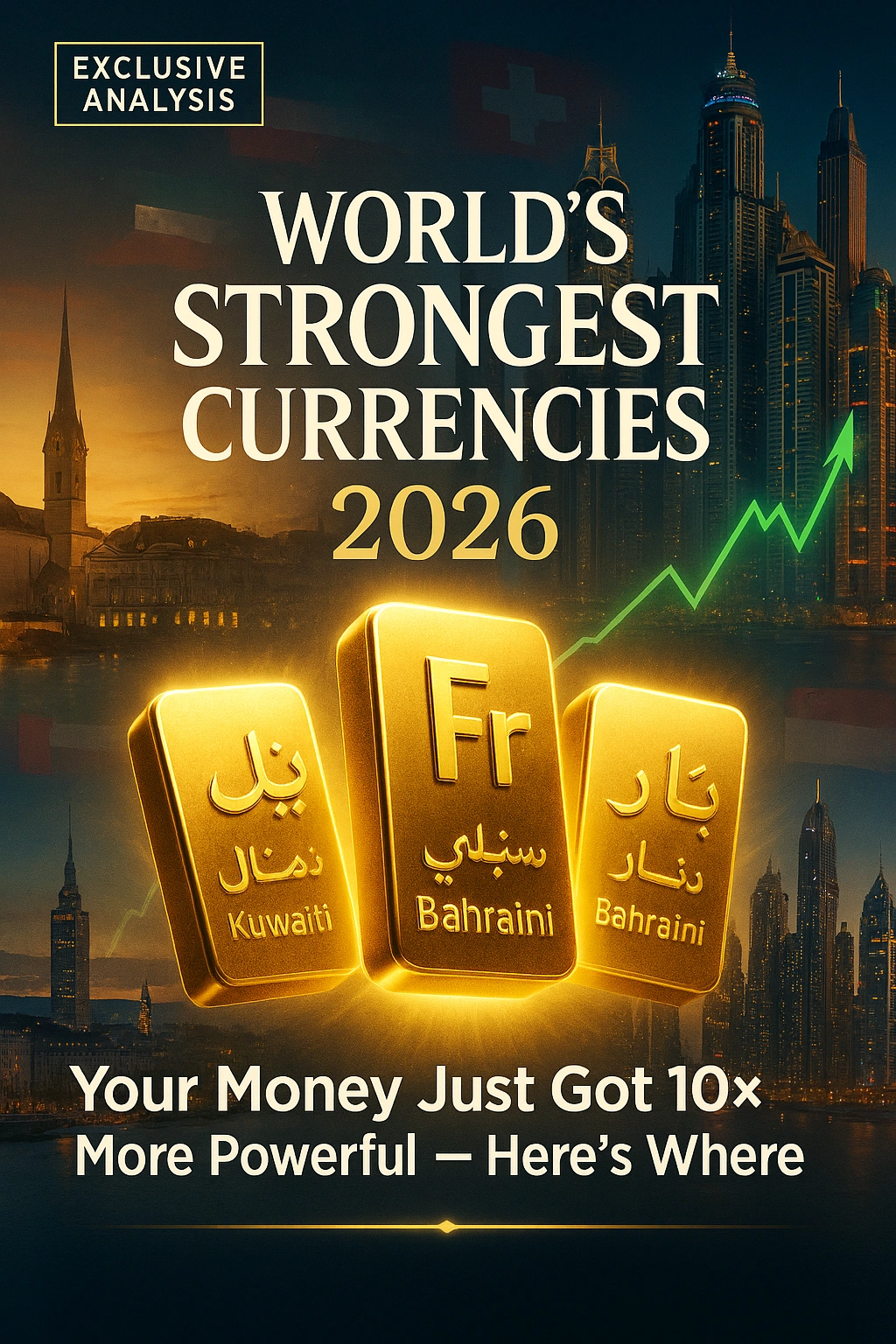
Discover the world’s strongest currencies in 2026 — ranked by exchange value, economic backing & purchasing power. From Kuwait’s $3.27 dinar to the Swiss franc’s unmatched stability, the definitive guide.
Where Money Is Worth More Than You Think
There is a question that unsettles most travellers the moment they land at an unfamiliar airport and squint at a currency board: how much, exactly, is this money worth? The instinct is to reach for the US dollar as a yardstick — to ask, almost reflexively, whether the local note in your hand represents more or less than a single greenback. That reflex is understandable. The dollar remains, by a vast margin, the most traded and most held reserve currency on the planet. But it is not the strongest.
That distinction belongs to a small Gulf emirate whose population would fit comfortably inside greater Manchester, and whose currency has quietly dominated every global ranking for more than two decades. It is joined on the podium by neighbours whose names rarely make mainstream financial headlines, and by a landlocked Alpine republic whose monetary tradition has become almost mythological in global finance circles.
Currency strength is, of course, a deceptively complicated concept. A high nominal exchange rate — the number of US dollars one unit of a foreign currency can buy — is the most intuitive measure, but it captures only part of the picture. Purchasing power parity (PPP), the stability of the issuing central bank, inflation history, current-account balances, and forex reserve depth all feed into a fuller assessment of monetary credibility. The rankings below attempt to honour that complexity: they are ordered primarily by nominal value against the USD as of early March 2026, but enriched with structural and macroeconomic context at every step.
For travellers, the implications are vivid and practical: a strong home currency means your holiday budget stretches further in weaker-currency markets. For investors, it signals where monetary policy is disciplined, inflation is tamed, and capital preservation is most plausible. For economists, it is a mirror of a nation’s fiscal choices — and occasionally its geological luck.
Here, then, is the definitive ranking of the world’s strongest currencies in 2026.

Methodology: How We Ranked the World’s Strongest Currencies
Ranking currencies by strength is not a single-variable exercise. Our methodology combines four weighted criteria:
1. Nominal exchange rate vs. USD (primary weight: 50%) — the most cited metric globally; how many US dollars one unit of the currency buys as of early March 2026.
2. Purchasing Power Parity (PPP) and domestic price stability (25%) — drawing on the IMF World Economic Outlook database and World Bank ICP data to assess what each currency actually buys at home.
3. Central bank credibility, forex reserves, and current-account balance (15%) — using BIS data, central bank publications, and IMF Article IV consultations.
4. Long-term inflation track record and monetary regime stability (10%) — a currency pegged rigidly to the dollar for decades earns credit for predictability; a currency that preserved purchasing power across multiple global crises earns even more.
Geographic territories whose currencies are pegged 1:1 to a sovereign currency (Gibraltar Pound, Falkland Islands Pound) are noted but not separately ranked; they effectively mirror their parent currency’s fundamentals.
The World’s Strongest Currencies in 2026: Comparative Table
| Rank | Country / Territory | Currency | Code | Value vs. USD (Mar 2026) | 1-Year Change | Exchange Regime |
|---|---|---|---|---|---|---|
| 1 | Kuwait | Kuwaiti Dinar | KWD | ≈ $3.27 | Stable (±0.5%) | Managed basket peg |
| 2 | Bahrain | Bahraini Dinar | BHD | ≈ $2.66 | Stable (fixed) | Hard USD peg |
| 3 | Oman | Omani Rial | OMR | ≈ $2.60 | Stable (fixed) | Hard USD peg |
| 4 | Jordan | Jordanian Dinar | JOD | ≈ $1.41 | Stable (fixed) | Hard USD peg |
| 5 | United Kingdom | Pound Sterling | GBP | ≈ $1.26 | −1.8% | Free float |
| 6 | Cayman Islands | Cayman Dollar | KYD | ≈ $1.20 | Stable (fixed) | Hard USD peg |
| 7 | Switzerland | Swiss Franc | CHF | ≈ $1.13 | +2.1% | Managed float |
| 8 | European Union | Euro | EUR | ≈ $1.05 | −1.2% | Free float |
| 9 | Singapore | Singapore Dollar | SGD | ≈ $0.75 | +1.4% | NEER-managed |
| 10 | United States | US Dollar | USD | $1.00 | Benchmark | Free float |
Exchange rates are indicative mid-market values, early March 2026. Sources: Central Bank of Kuwait, Central Bank of Bahrain, Central Bank of Oman, Bloomberg, Reuters.
#10 — United States: The Dollar That Rules the World (Even When It Isn’t the Strongest)
USD/USD: 1.00 | Reserve share: ~56% of global FX reserves (IMF COFER, mid-2025)
It would be intellectually dishonest to construct any list of monetarily significant currencies without beginning — or in this case, ending — with the US dollar. Technically ranked tenth by nominal exchange rate, the dollar’s omission from any strong-currency discussion would be absurd. It is the global reserve currency, the denomination of roughly 90% of all international foreign-exchange transactions, and the standard against which every other currency on this list is measured.
The dollar’s structural power derives not from its face value but from the depth and liquidity of US capital markets, the legal enforceability of US-dollar-denominated contracts, and the unrivalled network effects that come from decades of institutional entrenchment. When the world is frightened — by a banking crisis, a pandemic, or a geopolitical rupture — capital flows into dollars, not away from them. That is the ultimate credential.
The Federal Reserve’s aggressive rate-hiking cycle of 2022–2023 temporarily turbocharged the greenback to multi-decade highs. Since then, a gradual easing cycle has modestly softened the dollar index (DXY), which hovered around the mid-100s range in early 2026. Yet its dominance in global trade invoicing and central bank reserves remains essentially unchallenged.
Travel angle: For American travellers abroad, the dollar’s reserve status means widespread acceptance and generally favourable conversion, particularly in emerging markets. The caveat: in the Gulf states above the dollar on this list, the local currencies are pegged to the dollar, so there is no exchange-rate advantage — the mathematics are already baked in.
#9 — Singapore: The Asian Precision Instrument
SGD/USD: ≈ 0.75 | Inflation: ~2.1% (MAS, 2025) | Current account: strong surplus
Singapore manages its currency with the kind of institutional exactitude one might expect from a city-state that has spent sixty years treating good governance as a competitive export. The Monetary Authority of Singapore (MAS) does not set interest rates in the conventional sense; it manages the Singapore dollar’s value against an undisclosed basket of currencies through a “nominal effective exchange rate” (NEER) policy band — a mechanism that gives it enormous flexibility to use currency appreciation as an anti-inflation tool.
The result is a currency that, while not high in nominal USD terms, has consistently outperformed peers in Asia on purchasing-power stability. Singapore’s AAA sovereign credit rating (Standard & Poor’s, Fitch), perennially current-account surplus, and status as Asia’s pre-eminent financial hub all feed into the SGD’s credibility premium. The SGD appreciated modestly against the dollar in 2025 as MAS maintained a slightly appreciating NEER slope — a deliberate policy response to residual imported inflation from elevated global commodity prices.
For investors, the Singapore dollar is one of very few Asian currencies worth holding as a diversification tool in a hard-currency portfolio. For travellers from weaker-currency nations, Singapore’s cost of living will feel punishing — this is, after all, consistently one of the world’s most expensive cities. But that high cost is the precise reflection of the currency’s strength.
#8 — The Euro: Collective Strength, Individual Tensions
EUR/USD: ≈ 1.05 | ECB deposit rate: 2.25% (as of Feb 2026) | Eurozone GDP growth: ~0.9% (IMF 2026 forecast)
The euro is the world’s second most traded currency and the reserve currency of choice after the dollar, held in roughly 20% of global central bank foreign exchange portfolios. It represents the collective monetary credibility of twenty nations — a fact that is simultaneously its greatest source of strength and its most persistent structural vulnerability.
The European Central Bank’s prolonged rate-hiking campaign of 2022–2024 was executed with more determination than many in financial markets expected, and it produced results: eurozone core inflation fell from its 2022 peak of above 5% to below 2% by mid-2025, a trajectory that restored considerable credibility to the ECB’s inflation-targeting framework. The subsequent easing cycle has been cautious; the deposit rate stood at approximately 2.25% in early 2026, a level the ECB’s governing council has characterised as still moderately restrictive.
The euro’s Achilles heel remains the fiscal divergence between its member states. Germany’s near-recessionary growth in 2024–2025, combined with France’s persistent budget deficit challenges and Italy’s elevated debt-to-GDP ratio (above 135%), keeps sovereign risk premia alive in bond markets and periodically unsettles the currency. Still, the Eurozone’s aggregate current-account position is in surplus, and the ECB’s “Transmission Protection Instrument” — its bond-buying backstop — has effectively capped the threat of another existential sovereign debt crisis for now.
Travel angle: For USD- or GBP-holders, the euro’s current rate around $1.05 represents a relatively modest barrier. Western European travel remains expensive not because of the exchange rate but because of local price levels — a function of high wages and robust social provision rather than currency manipulation.
#7 — Switzerland: The Safe-Haven That Earned Its Reputation
CHF/USD: ≈ 1.13 | SNB policy rate: 0.25% | Inflation: ~0.3% (SNB, Feb 2026) | Current account surplus: ~9% of GDP
If the Kuwaiti dinar wins on headline exchange rate, the Swiss franc wins on something arguably more impressive: institutional longevity. Switzerland has managed its monetary affairs with such consistent discipline that the franc has preserved real purchasing power across multiple global crises, two world wars (in which Switzerland remained neutral), the collapse of the Bretton Woods system, the 2008 global financial crisis, and the COVID-19 shock. That record of monetary continuity, spanning more than 175 years since the franc’s introduction in 1850, is essentially without parallel among modern fiat currencies.
The Swiss National Bank (SNB) operates with an independence and a long-termism that remains the envy of its peers. Its mandate — price stability, defined as annual CPI inflation of 0–2% — has been met with remarkable consistency. Swiss inflation in early 2026 stood at approximately 0.3%, one of the lowest in the developed world, and a reflection of the SNB’s willingness in previous years to tolerate the economic pain of a strong franc (which reduces import costs and anchors domestic prices) rather than engineer currency weakness for short-term competitiveness.
Switzerland’s current-account surplus, running at roughly 9% of GDP, reflects a country that consistently exports more value than it imports — in pharmaceuticals, precision machinery, financial services, and, of course, the world’s most trusted watches. That structural external surplus is a bedrock of franc credibility.
The SNB’s policy rate stood at 0.25% in early 2026 — low, because very low inflation means there is no need for restrictive policy. The franc’s strength is not conjured by high interest rates attracting hot capital; it is built on structural surpluses, institutional credibility, and a century and a half of monetary conservatism.
Investor angle: The CHF remains one of the most reliable safe-haven plays in global markets. When geopolitical risk flares — and it has consistently done so across 2024–2026 — capital rotates into the franc. Its appreciation during such episodes is the price of insurance.
#6 — Cayman Islands: Offshore Stronghold, Surprising Currency
KYD/USD: 1.20 (fixed since 1974) | Sector: International financial centre
The Cayman Islands may be small — approximately 65,000 residents across three Caribbean islands — but their currency punches well above its geographic weight. The Cayman Islands dollar has been pegged to the US dollar at a fixed rate of 1.20 since 1974, a peg that has held without interruption for over five decades.
The peg is sustainable because the Cayman Islands economy generates exceptional foreign currency inflows. As one of the world’s leading offshore financial centres, the Cayman Islands hosts thousands of hedge funds, private equity vehicles, structured finance vehicles, and the regional offices of major global banks. This financial infrastructure creates persistent capital inflows that underpin the peg’s credibility without recourse to the kind of oil revenues that sustain Gulf currencies.
The absence of direct taxation — no corporate tax, no income tax, no capital gains tax — also functions as a structural attractor for international capital, further reinforcing demand for the local currency.
For travellers, the Cayman Islands’ combination of strong currency and luxury resort economy makes it one of the Caribbean’s more expensive destinations. But that premium reflects something real: it is, genuinely, one of the most politically stable and financially sophisticated jurisdictions in the Western Hemisphere.
#5 — United Kingdom: History’s Most Enduring Major Currency
GBP/USD: ≈ 1.26 | Bank of England base rate: 4.25% (Feb 2026) | UK GDP growth forecast: 1.3% (IMF 2026)
The pound sterling has a plausible claim to being the world’s oldest currency still in active use. Predating the United States by more than a millennium in its earliest forms, sterling carries the weight of institutional memory — and the scars of historical crises, from the 1976 IMF bailout to Black Wednesday in 1992 to the post-Brexit adjustment of 2016. That the pound has navigated all of this and still trades above $1.25 says something significant about the resilience of UK monetary institutions.
The Bank of England, established in 1694, has been on a cautious easing path since mid-2024, reducing its base rate from the post-pandemic peak of 5.25% to 4.25% by early 2026 as UK inflation — which ran brutally hot in 2022–2023 — returned closer to the 2% target. Core CPI had moderated to approximately 2.7% by early 2026, still slightly elevated but no longer the acute political crisis it was.
The UK’s economic structure — highly service-oriented, with the City of London representing one of the world’s two or three most important financial centres — means sterling’s value has always been intimately connected to confidence in UK financial governance. Post-Brexit trade frictions have not destroyed that confidence, though they have permanently restructured some trade flows and depressed productivity estimates.
Travel angle: Sterling’s strength makes UK residents among the best-positioned travellers in the world, particularly when visiting North Africa, South-East Asia, or Eastern Europe, where exchange rate differentials translate into substantial purchasing power advantages. The pound buys significantly more in emerging markets today than it did five years ago.
#4 — Jordan: Strength Without Oil
JOD/USD: 1.41 (fixed peg) | Inflation: ~2.8% | IMF programme: Extended Fund Facility (ongoing)
Jordan’s presence in the top four is the most intellectually interesting entry on this list, because it is a standing refutation of the narrative that strong currencies require oil. Jordan has no significant hydrocarbon reserves. Its economy depends on phosphate exports, manufacturing, services, remittances from a large diaspora, foreign aid — primarily from the United States, Saudi Arabia, and the EU — and its strategic geopolitical position at the intersection of three continents and several of the region’s most complex political dynamics.
The Jordanian dinar has been pegged to the US dollar at a fixed rate of 0.709 JOD per dollar (implying approximately $1.41 per dinar) since 1995, a commitment the Central Bank of Jordan has maintained through multiple regional crises — the 2003 Iraq war, the 2011 Arab Spring, the Syrian refugee crisis (Jordan hosts one of the world’s largest refugee populations relative to its size), and the ongoing regional tensions of 2024–2025.
The peg’s credibility is purchased at a fiscal cost: Jordan must maintain sufficient foreign exchange reserves to defend it, which constrains domestic monetary flexibility and requires disciplined fiscal policy, often in collaboration with IMF structural adjustment programmes. That discipline — painful as it has periodically been — is precisely what makes the dinar’s high nominal value sustainable.
Investor angle: The JOD peg makes Jordan one of the more predictable currency environments in the Middle East, which partly explains why Amman has attracted meaningful foreign direct investment in logistics, technology, and pharmaceuticals in recent years.
#3 — Oman: The Prudent Gulf State
OMR/USD: 2.60 (fixed peg) | Oil production: ~1 mbpd | Moody’s rating: Ba1
The Omani rial’s fixed exchange rate of 2.6008 USD per rial has been unchanged for decades — a testament to the consistency of Oman’s monetary framework. Like its Gulf neighbours, Oman’s currency strength is anchored in hydrocarbon wealth, but the sultanate has pursued a more earnest diversification agenda than some of its neighbours, with meaningful investment in tourism, logistics, fisheries, and renewable energy under its Vision 2040 framework.
Oman’s fiscal position has improved markedly since the turbulence of the low-oil-price years of 2015–2016, when the country ran significant budget deficits and accumulated external debt. Higher oil prices in the early 2020s rebuilt fiscal buffers, and the government has since pursued subsidy reform and revenue diversification with greater determination than before. Moody’s upgraded Oman’s sovereign credit in 2023, reflecting improving balance-of-payment dynamics.
The Central Bank of Oman manages the currency through a currency board-style arrangement, holding sufficient USD reserves to back every rial in circulation at the fixed rate. This mechanistic commitment is what gives the OMR its enviable nominal stability — and what keeps it permanently ranked as the world’s third most valuable currency by exchange rate.
Travel angle: Oman’s strong currency, combined with its emergence as a luxury-eco-tourism destination, means it is not an especially cheap place to visit. But for holders of stronger currencies like the pound or the Swiss franc, the arithmetic is favourable — and Oman’s landscapes, from the Musandam fjords to the Wahiba Sands, make the cost worthwhile.
#2 — Bahrain: The Gulf’s Financial Hub
BHD/USD: 2.659 (fixed peg since 1980) | Financial sector: ~17% of GDP | Moody’s: B2
Bahrain’s dinar has been fixed to the US dollar at 0.376 BHD per dollar — implying approximately $2.66 per dinar — since 2001, maintaining an unchanged peg for a quarter century. That consistency, in a region not historically associated with monetary conservatism, is itself a form of credibility.
Bahrain’s economy is more diversified than Kuwait’s: the financial services sector contributes roughly 17% of GDP, making Manama one of the Gulf’s two dominant financial centres alongside Dubai. The country also has a more developed manufacturing base, including aluminium smelting, and has positioned itself as a regional hub for Islamic finance. This economic diversification is strategically significant because Bahrain has proportionally lower oil reserves than Kuwait or Saudi Arabia — the financial sector was, to some extent, a deliberate hedge against that exposure.
The BHD’s nominal strength is reinforced by Saudi Arabia’s implicit backstop role: the two countries share a causeway, a deep economic relationship, and a security alliance. Saudi Arabia’s vast financial resources have historically been seen as an informal guarantor of Bahraini monetary stability — a factor markets price into the risk premium attached to the dinar’s peg.
Investment angle: Bahrain’s status as a relatively open economy with few capital controls makes the BHD more accessible to international investors than most Gulf currencies. Its fintech regulatory sandbox and digital banking framework have drawn growing interest from global financial institutions in 2024–2025.
#1 — Kuwait: The Uncontested Crown
KWD/USD: ≈ 3.27 | Oil reserves: world’s 6th largest | Inflation: ~2.1% | FX reserves: > $45bn (CBK)
The Kuwaiti dinar is, by the most direct measure available — how many US dollars it takes to buy one unit — the strongest currency in the world. One dinar buys approximately $3.27 at current exchange rates, a premium that has been maintained, with only modest fluctuation, for decades.
Kuwait’s monetary position begins with geology. The country sits atop the world’s sixth-largest proven oil reserves, estimated at approximately 101 billion barrels — a figure that, relative to the country’s population of around 4.3 million citizens (and a total population of roughly 4.7 million including expatriates), represents extraordinary per-capita resource wealth. Oil and petroleum products account for more than 85% of government revenue and over 90% of export earnings. When oil prices are elevated — as they broadly have been across 2022–2025 — the fiscal arithmetic is essentially self-reinforcing.
The Central Bank of Kuwait manages the dinar through a managed peg to an undisclosed basket of international currencies, with the US dollar believed to constitute the largest single weight, given Kuwait’s oil revenues are denominated in dollars. This basket arrangement gives the CBK marginally more flexibility than a simple USD peg — it insulates the dinar slightly from bilateral dollar volatility.
Kuwait’s sovereign wealth fund, the Kuwait Investment Authority (KIA), is among the oldest and largest in the world, with assets variously estimated at over $900 billion. This vast stock of externally held financial wealth provides an additional buffer for the currency — in extremis, the KIA’s assets could theoretically be liquidated to defend the dinar. In practice, they have never needed to be. The combination of ongoing oil revenues, low domestic inflation (circa 2.1%), and conservative fiscal management has kept the dinar stable in nominal terms for as long as most investors can remember.
It is worth acknowledging the critique: Kuwait’s currency strength reflects resource rents and fiscal subsidies rather than diversified economic productivity. The dinar has not been “stress-tested” in the way the Swiss franc has, across multiple non-commodity-linked monetary regimes. A world permanently transitioning away from fossil fuels would eventually restructure the fiscal basis of KWD strength. But “eventually” is doing considerable work in that sentence. In March 2026, with global oil demand still running at near-record levels and the energy transition proceeding more slowly than many modelled, the Kuwaiti dinar remains — unchallenged — the most valuable currency on the planet by exchange rate.
Travel angle: For visitors holding stronger currencies (GBP, CHF, EUR), Kuwait is a genuinely affordable destination for what it offers — a sophisticated urban environment, world-class dining, and proximity to the rest of the Gulf. For those arriving with weaker currencies, the dinar’s strength can feel formidable at the exchange counter.
The Big Picture: What Strong Currencies Mean for Travel and Investment in 2026
The Travel Equation
Currency strength creates a purchasing-power asymmetry that sophisticated travellers have long exploited. Holding a strong currency — Kuwaiti dinar, British pound, Swiss franc, or euro — means that destinations with weaker currencies effectively go “on sale” from the holder’s perspective.
In 2026, the most compelling value gaps are between strong-currency nations and emerging markets where inflation has eroded local purchasing power without triggering proportionate currency depreciation. South-East Asia (Thailand, Vietnam, Indonesia), parts of Central and Eastern Europe, and much of Sub-Saharan Africa offer exceptional experiential value for travellers from the currencies on this list.
For travellers from weaker-currency nations visiting strong-currency countries — the United Kingdom, Switzerland, or the Gulf states — the inverse applies. The exchange rate headwind is real and material. Budget accordingly.
The Investment Case
Strong currencies are not automatically superior investment vehicles. A currency that is strong because it is pegged to the dollar (BHD, OMR, JOD, KYD) offers exchange-rate stability but does not offer upside appreciation. The Swiss franc and Singapore dollar — both managed floats — have historically appreciated in real terms over time, making them genuine long-term stores of value.
The broader investment signal from strong-currency nations is less about the currency itself and more about the policy environment it implies: low inflation, institutional independence, disciplined fiscal management, and rule of law. These are also the conditions most conducive to long-term capital preservation and, frequently, to strong equity market performance.
The Geopolitical Dimension
Several currencies on this list are exposed to geopolitical tail risks that their stable exchange rates do not fully price. Gulf currencies depend on continued hydrocarbon demand and regional stability. The pound is permanently sensitive to UK fiscal credibility and any resurgence of concerns about debt sustainability. The euro faces structural tensions that have been managed but not resolved.
The Swiss franc and Singapore dollar stand apart: their strength is built on institutional foundations that are largely independent of any single commodity price, political decision, or regional dynamic. In a world of elevated geopolitical uncertainty, that institutional bedrock commands a premium that is likely to persist.
Conclusion: Currency Strength as a Mirror of National Character
The currencies at the top of this ranking are not accidents. The Kuwaiti dinar is strong because Kuwait made conservative choices about how to manage extraordinary resource wealth — choices that not every resource-rich nation has made. The Swiss franc is strong because Switzerland has maintained institutional discipline across a century and three-quarters of monetary history. The pound retains its position because British financial markets have earned global trust over decades, even while political decisions have periodically tested it.
For travellers, the lesson is straightforward: when your home currency is strong, the world effectively gives you a discount on its experiences. For investors, the lesson is more nuanced: strength by nominal exchange rate and strength by structural monetary credibility are not the same thing — and in the long run, the latter matters more.
In 2026, the world’s currency hierarchy reflects, as it always has, the aggregate of every monetary policy decision, every fiscal choice, and every institutional investment that preceded it. The dinar, the franc, the pound, the rial — each is a ledger of its nation’s choices, settled daily on the world’s foreign exchange markets.
Frequently Asked Questions (FAQ Schema)
Q1: What is the strongest currency in the world in 2026?
The Kuwaiti Dinar (KWD) is the strongest currency in the world in 2026 by nominal exchange rate, trading at approximately $3.27 per dinar as of early March 2026. Its strength is underpinned by Kuwait’s vast oil reserves, conservative central bank management, and a managed basket peg that maintains extraordinary stability.
Q2: Which country has the strongest currency for travel in 2026?
For travellers, holding UK Pounds Sterling (GBP), Swiss Francs (CHF), or Euros (EUR) provides the most practical travel purchasing power advantage globally, as these currencies are widely accepted worldwide and deliver significant exchange-rate advantages in emerging markets across Asia, Africa, and Eastern Europe.
Q3: Why is the Kuwaiti Dinar so strong?
The Kuwaiti Dinar’s strength derives from Kuwait’s position as one of the world’s largest per-capita oil exporters, responsible fiscal management by the Central Bank of Kuwait, a managed currency peg to a basket of international currencies, low domestic inflation, and the backing of the Kuwait Investment Authority — one of the world’s largest sovereign wealth funds, with assets estimated at over $900 billion.
Q4: Is a strong currency good for a country’s economy?
A strong currency has both benefits and costs. Benefits include lower import costs (reducing inflation), greater purchasing power for citizens abroad, and stronger investor confidence. Costs include reduced export competitiveness, as locally produced goods become more expensive for foreign buyers, and potential pressure on manufacturing sectors. Countries like Switzerland and Singapore manage this tension deliberately through monetary policy.
Q5: What are the best currencies to hold as an investment in 2026?
For capital preservation, the Swiss Franc (CHF) and Singapore Dollar (SGD) have the strongest track records of long-term purchasing-power preservation among free-floating or managed-float currencies. For nominal stability, USD-pegged Gulf currencies (KWD, BHD, OMR) offer predictable exchange rates but limited upside appreciation. The US Dollar retains unparalleled liquidity and reserve-currency status. Diversification across multiple hard currencies remains the consensus recommendation from institutional investors.
Sources : Data sourced from Central Bank of Kuwait, Central Bank of Bahrain, Central Bank of Oman, Monetary Authority of Singapore, Swiss National Bank, Bank of England, European Central Bank, IMF World Economic Outlook (Oct 2025 / Jan 2026 update), World Bank International Comparison Programme, BIS Triennial Survey, Bloomberg FX data, and Reuters market data. Exchange rates are indicative mid-market values as of early March 2026 and are subject to market fluctuation.
Discover more from The Economy
Subscribe to get the latest posts sent to your email.
Analysis
China Plays the Long Game: What Beijing’s Measured Response to Trump’s New Tariffs Means for US-China Trade Talks 2026
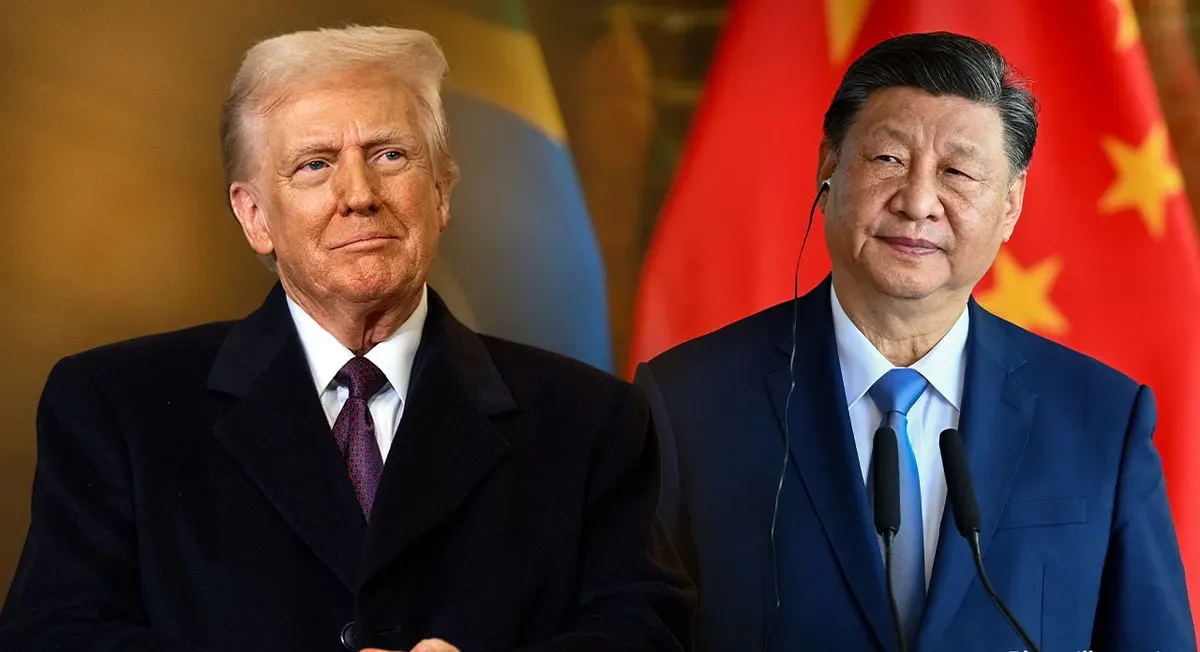
As a Supreme Court ruling strips Washington of its most powerful tariff weapon, Beijing signals strategic patience ahead of a high-stakes presidential summit — and the world’s markets are watching.
China vows to decide on US tariff countermeasures “in due course” while welcoming the sixth round of US-China trade consultations. Here’s what the Supreme Court ruling, Trump’s China visit, and Beijing’s record trade surplus mean for global markets in 2026.
There is an old Chinese proverb that patience is power. In the escalating theater of US-China trade tensions, Beijing appears to have taken that maxim as official policy. On Tuesday, China’s Ministry of Commerce signaled it would respond to President Donald Trump’s newly announced 15% blanket tariff on all US imports — not with an immediate salvo, but with carefully calibrated restraint, pledging to decide on countermeasures “in due course.” That phrase, deceptively simple, conceals a sophisticated geopolitical calculation made infinitely more complex by a landmark US Supreme Court ruling that has fundamentally altered the architecture of the trade war.
Welcome to the newest chapter of US-China trade talks 2026 — and it may be the most consequential one yet.
The Supreme Court Ruling That Changed Everything
To understand Beijing’s composure, you first have to understand what happened in Washington last Friday. The US Supreme Court struck down tariffs imposed under the International Emergency Economic Powers Act (IEEPA), the legal scaffolding Trump had used to levy sweeping duties on Chinese goods. Those tariffs had subjected Chinese imports to an additional 20% charge. With that authority now invalidated, Trump announced a substitute measure: a 15% temporary tariff on imports from all countries, a blunter instrument that legal scholars and trade analysts immediately flagged as constitutionally fragile.
For Beijing, the ruling was not merely a legal technicality — it was a strategic windfall. As the Council on Foreign Relations has noted, the Supreme Court’s decision meaningfully constrains the executive branch’s ability to deploy emergency tariff authority unilaterally, weakening the credibility of future tariff threats and handing China’s trade negotiators a structural advantage at the bargaining table. The impact of the Supreme Court ruling on US-China tariffs in 2026 cannot be overstated: Washington’s tariff weapon has been legally blunted, and Beijing knows it.
China’s commerce ministry official was measured but unmistakably pointed in response. “China has consistently opposed all forms of unilateral tariff measures,” the official said Tuesday, “and urges the US side to cancel unilateral tariffs and refrain from further imposing such tariffs.” Translation: China is not going to blink — and it no longer has to.
China’s Negotiating Position: Stronger Than the Headlines Suggest
Analysts assessing China’s response to new US tariffs in the post-IEEPA era should resist the temptation to read Beijing’s patience as weakness. The data tells a different story.
Despite the full weight of US tariff pressure across 2025, China’s economy grew at 5% in 2025, meeting its official target and confounding forecasters who predicted a more severe slowdown. Yes, US imports from China fell sharply — by approximately 29% over the year — but Chinese exporters demonstrated remarkable adaptability, pivoting aggressively toward Southeast Asia, Japan, and India. The result: a record trade surplus of roughly $1 trillion in the first eleven months of 2025, according to Chinese customs data. That figure is not just an economic statistic; it is a geopolitical statement.
Global supply chain shifts from the US-China trade war have, paradoxically, expanded China’s trade network rather than isolated it. Vietnamese factories now process Chinese intermediate goods before export to the United States. Indian manufacturers source Chinese components at scale. The diversification that Washington hoped would weaken Beijing has instead made Chinese trade flows more resilient and more globally embedded.
Key data points underpinning China’s leverage:
- GDP growth of 5% in 2025 despite sustained US tariff pressure
- US imports from China down 29%, but export diversification to Asia offsets losses
- Record $1 trillion trade surplus in the first 11 months of 2025
- Supreme Court ruling invalidating IEEPA tariffs, limiting Trump’s unilateral authority
- Sixth round of US-China economic and trade consultations on the near-term horizon
The Sixth Round: “Frank Consultations” in a Charged Atmosphere
The commerce ministry’s announcement that China is willing to hold frank consultations during the upcoming sixth round of US-China economic and trade talks is diplomatically significant. In the lexicon of Chinese official communication, “frank” is a carefully chosen word. It signals both seriousness of purpose and a willingness to engage on difficult issues — without promising concessions.
What should the sixth round US-China trade consultations analysis account for? First, the structural asymmetry created by the Supreme Court ruling means the US arrives at the table with reduced coercive leverage. Second, China’s domestic economic performance insulates Beijing from the urgency that might otherwise force hasty compromise. Third, the approaching Trump-Xi summit creates a diplomatic deadline that cuts both ways: both sides have incentives to show progress, but neither wants to appear to have capitulated.
The Wall Street Journal has reported that Beijing views the court ruling as an opening — a chance to reframe negotiations on more equitable terms rather than under the shadow of maximalist tariff threats. That reframing will likely define the sixth round’s tone.
Trump’s China Visit: Summit Diplomacy Under a New Tariff Reality
Perhaps the most dramatic element of this unfolding story is the announcement that President Trump is scheduled to visit China from March 31 to April 2 for direct talks with President Xi Jinping. The economic implications of the Trump-Xi summit in April 2026 are substantial, and they extend well beyond bilateral trade.
Markets have already taken note — and not optimistically. US stocks stumbled following Trump’s 15% tariff announcement, with investors recalibrating expectations for a near-term trade resolution. The prospect of a presidential summit offers hope for de-escalation, but the diplomatic road between now and April is strewn with obstacles.
Taiwan remains a structural irritant in any trade discussion. Beijing has consistently insisted that its “one China” position is non-negotiable, and any US moves on Taiwan arms sales or official contacts risk derailing economic negotiations entirely. Meanwhile, Trump’s domestic political constituency demands visible toughness on China — a constraint that limits his negotiating flexibility even as the courts limit his tariff authority.
As CNBC has observed, China’s leverage before this high-stakes summit has materially increased since the Supreme Court’s ruling. The question is whether Trump can construct a face-saving framework that satisfies his base while offering Beijing enough substantive concessions to justify Xi Jinping’s engagement.
What Does China’s Stance Mean for Global Markets?
For investors and policymakers monitoring the situation, China’s “in due course” posture on countermeasures to US tariffs carries a specific signal: Beijing is in no hurry to escalate, because it doesn’t need to. The current trajectory favors strategic patience.
But patience has limits. If the 15% blanket tariff survives legal challenge and takes full effect, China’s commerce ministry has both the rhetorical justification and economic capacity to respond — whether through targeted duties on US agricultural exports, restrictions on rare earth materials critical to American technology supply chains, or regulatory pressure on US companies operating in China.
The global implications are equally consequential. The WTO’s dispute resolution mechanisms, already strained by years of US unilateralism, face further stress as both sides maneuver outside established multilateral frameworks. Emerging economies caught between Washington and Beijing — particularly in Southeast Asia — face mounting pressure to choose sides in a bifurcating trade architecture.
China’s trade surplus amid US tariffs in 2026 also raises uncomfortable questions for the European Union and other trading partners. A flood of Chinese goods diverted from the US market is already generating trade friction in Europe and Asia, creating pressure for their own defensive measures and complicating the global supply chain shifts from the US-China trade war.
Looking Ahead: Three Scenarios for the Summit
Scenario One: Managed De-escalation. The sixth round of talks produces a face-saving framework — a pause on new tariffs, renewed market access commitments from Beijing, and a summit declaration emphasizing “strategic communication.” Markets rally, tensions simmer but stabilize. Probability: moderate, contingent on domestic political constraints on both sides.
Scenario Two: Symbolic Summit, Structural Stalemate. Trump and Xi meet, photos are taken, statements are issued. But the fundamental disagreements over technology decoupling, Taiwan, and trade imbalances remain unresolved. The 15% tariff stays. China holds its countermeasures in reserve. The trade war continues by other means. Probability: high, reflecting the structural depth of the conflict.
Scenario Three: Escalatory Breakdown. Legal challenges to the 15% tariff succeed, Trump seeks new legislative authority, and China responds to a hardened US position with targeted countermeasures on agriculture and rare earths. The summit is postponed or canceled. Global markets reprice risk sharply downward. Probability: lower but non-trivial, especially if Taiwan developments intervene.
The Bottom Line
The phrase “in due course” may sound like bureaucratic evasion, but in the context of US-China trade talks in 2026, it represents a sophisticated strategic posture. China is not reacting — it is calibrating. The Supreme Court’s ruling has handed Beijing a structural advantage at precisely the moment a presidential summit demands careful choreography. China’s economic resilience, its record trade surplus, and its expanding export network have all strengthened its hand.
As the New York Times has noted, Trump arrives at this summit with both an opportunity and a liability: the chance for a landmark diplomatic achievement, burdened by reduced legal leverage and an electorate expecting visible wins. For Xi Jinping, the calculus is simpler — wait, negotiate with clarity, and let Washington’s internal contradictions do some of the work.
In a trade war that has reshaped global supply chains and tested the limits of economic statecraft, Beijing’s patience may prove to be its most effective weapon of all.
Discover more from The Economy
Subscribe to get the latest posts sent to your email.
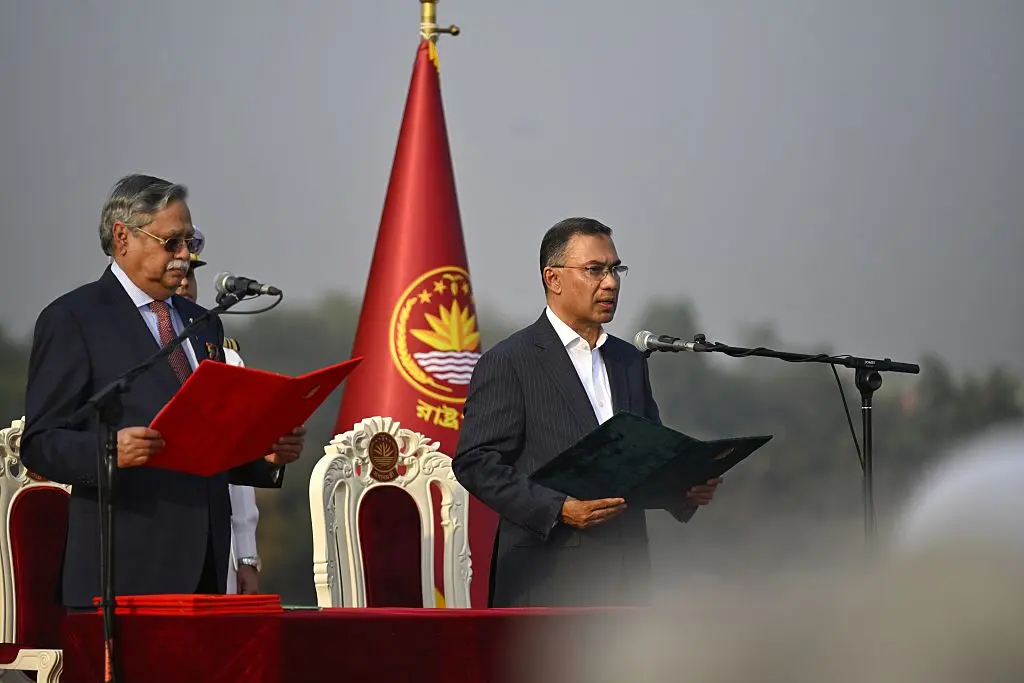
Explore how Bangladesh’s new PM Tarique Rahman aims to boost GDP growth, manage remittances, and navigate China-US relations amid post-election revival.
When Tarique Rahman finally set foot on Bangladeshi soil after nearly two decades in London exile, the crowds that greeted him weren’t merely celebrating a political homecoming. They were, in a very real sense, betting their livelihoods on him. The BNP’s sweeping two-thirds majority in February 2026 — an election made possible only by the extraordinary student-led uprising that drove Sheikh Hasina from power in 2024 — handed Rahman a mandate that is simultaneously historic and terrifying in its weight. Bangladesh’s GDP stands at roughly $460 billion, growth has decelerated to a sluggish 4%, and a geopolitical tightrope stretches in every direction. The question isn’t whether Rahman wants to revive Bangladesh’s economy. The question is whether the tools he has are equal to the task.
The Economic Inheritance: More Fragile Than It Looks
Bangladesh’s macro story has long been one of development economics’ favorite fairy tales — a low-income country that outpaced neighbors through garment exports, microfinance, and disciplined remittance flows. That story has grown considerably more complicated.
The IMF projects GDP growth to rebound to 4.7% in FY2026, a modest recovery from the post-Hasina political turbulence that rattled investor confidence in late 2024 and through 2025. But 4.7% is not the 6–7% Bangladesh needs to absorb its vast young workforce, reduce poverty meaningfully, or finance the public investment that decades of cronyism left underfunded. The structural gaps are significant: private investment hovers well below the 35% of GDP economists identify as necessary for sustained high growth. Public institutions — tax administration, the judiciary, anti-corruption bodies — carry the scars of 15 years of systematic politicization.
Agriculture still employs roughly 44% of the workforce, a share that underscores both the rural depth of economic vulnerability and the limits of an export-led model that has concentrated prosperity in Dhaka and Chittagong. When a cyclone hits the Sundarbans or global cotton prices spike, nearly half the country feels it in their bones.
Then there’s the remittance lifeline. Bangladeshis abroad sent home $30 billion in 2025 — a remarkable surge driven partly by the depreciation of the taka making dollar transfers more attractive, and partly by the expanded diaspora built up across the Gulf, Malaysia, and Europe. Remittances now rival garment export earnings as the backbone of foreign exchange reserves. That’s a double-edged asset: invaluable as a buffer, but structurally fragile because it depends on labor-market conditions in Riyadh and Dubai, not Dhaka.
The Garment Sector: A Crown Jewel Under Pressure
Bangladesh’s readymade garment industry — a $40+ billion export engine that dresses much of the Western world — faces its most complex moment in a generation. The challenges are formidable: automation threatens lower-skill sewing jobs, Western buyers are demanding ESG compliance that many Bangladeshi factories can’t yet afford, and competitors from Vietnam and Ethiopia are chipping away at market share.
US tariff policy adds another layer of uncertainty. Bangladesh’s garment exports to America — its single largest market — flow under preferences that have never been fully secure and are now subject to the broader unpredictability of Washington’s trade posture. Rahman’s government has signaled it will pursue a formal trade framework with the US, a pragmatic move that would reduce vulnerability but requires diplomatic capital Bangladesh is only beginning to rebuild.
The harder domestic challenge is labor. The 2024 revolution was partly ignited by garment workers and students united by economic grievance. Any BNP government that ignores wage stagnation in the sector risks repeating the political miscalculations that ultimately doomed Hasina. Rahman has spoken of a “social compact” with workers — the test will be whether that translates into enforceable minimum wages and functional unions, or remains campaign rhetoric.
Navigating the Great Power Triangle: China, the US, and India
China: Partner, Creditor, or Competitor?
Bangladesh’s trade relationship with China is the defining economic relationship most Western analysts underestimate. Bilateral trade runs at approximately $18 billion, overwhelmingly weighted toward Chinese exports — machinery, raw materials, electronics — that Bangladesh’s industry desperately needs but can’t yet produce domestically. Chinese firms have also financed key infrastructure, from the Padma Bridge rail link to power plants, creating debt obligations that constrain fiscal flexibility.
Rahman’s stated approach is “multipolar pragmatism” — maintaining strong economic ties with Beijing while signaling openness to Washington and Tokyo. It’s a reasonable strategy, and it reflects a broader trend across Southeast and South Asia. But it requires a diplomatic dexterity that Bangladesh’s foreign ministry has not traditionally needed to exercise. The risk is that both great powers interpret hedging as hostility rather than prudence.
The India Question: Thaw or Freeze?
Relations with India are the most emotionally charged variable in Rahman’s foreign policy inbox. New Delhi was perceived as Hasina’s patron — a relationship Bangladeshi nationalists resented and the BNP stoked for electoral advantage. Border tensions have flared since the revolution, with incidents along the fencing that runs most of the 4,000-kilometer frontier. The Teesta water-sharing agreement, long in diplomatic limbo, remains unsigned.
And yet the economics of India-Bangladesh interdependence are powerful enough to compel engagement regardless of political temperature. Indian goods flood Bangladeshi markets via both formal and informal channels. Bangladesh’s northeast-facing connectivity — ports, power grids, transit routes — cannot be optimized without Indian cooperation. A sustained chill with Delhi would cost Rahman more than it costs Modi. The smart money is on a gradual, face-saving thaw: enough symbolism to satisfy nationalist sentiment at home, enough pragmatism to keep the border economy functioning.
ASEAN: The Aspiration That Requires Homework
Bangladesh’s ASEAN aspirations have been discussed for years with more enthusiasm than strategy. Joining ASEAN — even as a dialogue partner — would require institutional reforms, trade liberalization, and a regional diplomatic posture that Dhaka has not historically prioritized. Rahman’s team has floated ASEAN engagement as part of a broader Indo-Pacific pivot. It’s an appealing vision. Translating it into policy requires, first, getting the basics right at home.
The Political Economy of Reform: Who’s Really in the Room?
Any honest assessment of Bangladesh’s economic outlook has to grapple with the coalition Rahman is governing within. The BNP’s two-thirds majority is a powerful instrument — but it came partly on the back of Jamaat-e-Islami’s organizational muscle in constituencies where the BNP had been weakened during the Hasina years. Jamaat’s social conservatism and ambiguous attitude toward Bangladesh’s secular liberal elite creates real tension with the reform agenda that investors and multilaterals are expecting.
Youth are the other critical constituency. The students who brought down Hasina want jobs — real ones, not patronage positions — transparency, and an end to the culture of political violence that has made Bangladeshi politics so costly to its own institutions. Rahman’s government has promised a crackdown on corruption and civil service reform. These are not merely good governance talking points; they are the precondition for private investment to grow toward that 35% of GDP target. Foreign capital follows institutional credibility, and Bangladesh’s institutional credibility is currently being rebuilt from a low base.
The Awami League, despite its electoral collapse, commands deep roots in parts of the bureaucracy, the military officer class, and civil society. A wise BNP government manages this not through purges — which historically backfire — but through transparent accountability processes that don’t look like victors’ justice.
LDC Graduation: The November 2026 Cliff
Looming over everything is Bangladesh’s scheduled graduation from Least Developed Country status in November 2026. This is, in development terms, a success story — Bangladesh has met the income, human assets, and economic vulnerability thresholds for graduation. But success brings a cost: the erosion of preferential trade terms that have underpinned garment export competitiveness for decades.
Duty-free access to the EU under the Everything But Arms initiative will phase out. WTO-TRIPS flexibilities on pharmaceuticals will tighten. The IMF and World Bank have urged Bangladesh to negotiate transition arrangements and diversify its export base before the preferences expire. Rahman’s government has approximately two years of post-graduation transition runway — time that must be used to move up the value chain, attract technology-intensive investment, and build the trade infrastructure that makes Bangladeshi exports competitive on merit rather than preference.
This is where the $460 billion economy’s future is genuinely being written. Not in political speeches, but in whether Chittagong port gets the upgrades it needs, whether the power grid can reliably supply the industrial zones, and whether the education system starts producing graduates with skills the 21st-century economy demands rather than the 20th.
Opportunities and Pitfalls: A Forward Look
Where the optimists have a point:
- The remittance surge provides a genuine foreign exchange cushion that buys reform time.
- Bangladesh’s demographic dividend — a young, urbanizing population — is a real asset if youth employment programs gain traction.
- The global supply chain diversification away from China creates an opening for Bangladesh in electronics and light manufacturing if the enabling environment improves.
- The BNP’s large majority, paradoxically, gives Rahman room to absorb short-term political pain from reform — a luxury narrow coalition governments rarely have.
Where the pessimists may be right:
- Jamaat-e-Islami’s influence in the coalition could slow liberal economic reforms and deter Western investors with ESG mandates.
- India-Bangladesh tensions, if they deepen, could disrupt the connectivity projects that unlock northeastern Bangladesh’s economic potential.
- LDC graduation without adequate preparation could trigger a garment sector shock that reverberates across the 4 million workers — mostly women — who depend on it.
- Institutional rebuilding takes longer than election cycles. The IMF’s 4.7% projection is predicated on policy continuity and reform progress that is far from guaranteed.
The Bottom Line
Tarique Rahman inherits a Bangladesh that is more resilient than its critics acknowledge and more fragile than its boosters admit. The $460 billion economy has real foundations — a hardworking diaspora, an adaptable garment sector, a tradition of pragmatic policymaking that survived even the Hasina years’ worst excesses. But those foundations need serious maintenance: institutional reform, investment in human capital, and a foreign policy sophisticated enough to manage great power competition without becoming a casualty of it.
The students who made this government possible are watching with the same energy they brought to the streets in 2024. They are not an audience to be managed with press releases. They are Bangladesh’s most important economic asset — and its most demanding constituency. Getting the economy right, for Rahman, is not just a technocratic challenge. It’s the condition of his political survival, and the measure by which history will judge whether the 2024 revolution delivered on its promise.
Discover more from The Economy
Subscribe to get the latest posts sent to your email.
-

 Markets & Finance2 months ago
Top 15 Stocks for Investment in 2026 in PSX: Your Complete Guide to Pakistan’s Best Investment Opportunities
-

 Analysis4 weeks ago
Brazil’s Rare Earth Race: US, EU, and China Compete for Critical Minerals as Tensions Rise
-

 Investment2 months ago
Top 10 Mutual Fund Managers in Pakistan for Investment in 2026: A Comprehensive Guide for Optimal Returns
-

 Banks2 months ago
Best Investments in Pakistan 2026: Top 10 Low-Price Shares and Long-Term Picks for the PSX
-

 Asia2 months ago
China’s 50% Domestic Equipment Rule: The Semiconductor Mandate Reshaping Global Tech
-

 Global Economy2 months ago
What the U.S. Attack on Venezuela Could Mean for Oil and Canadian Crude Exports: The Economic Impact
-

 Global Economy2 months ago
Pakistan’s Export Goldmine: 10 Game-Changing Markets Where Pakistani Businesses Are Winning Big in 2025
-

 Global Economy2 months ago
15 Most Lucrative Sectors for Investment in Pakistan: A 2025 Data-Driven Analysis