
China Economy
China’s Record $1.2 Trillion Trade Surplus in 2025 Defies Trump Tariffs — And Signals a New Global Order

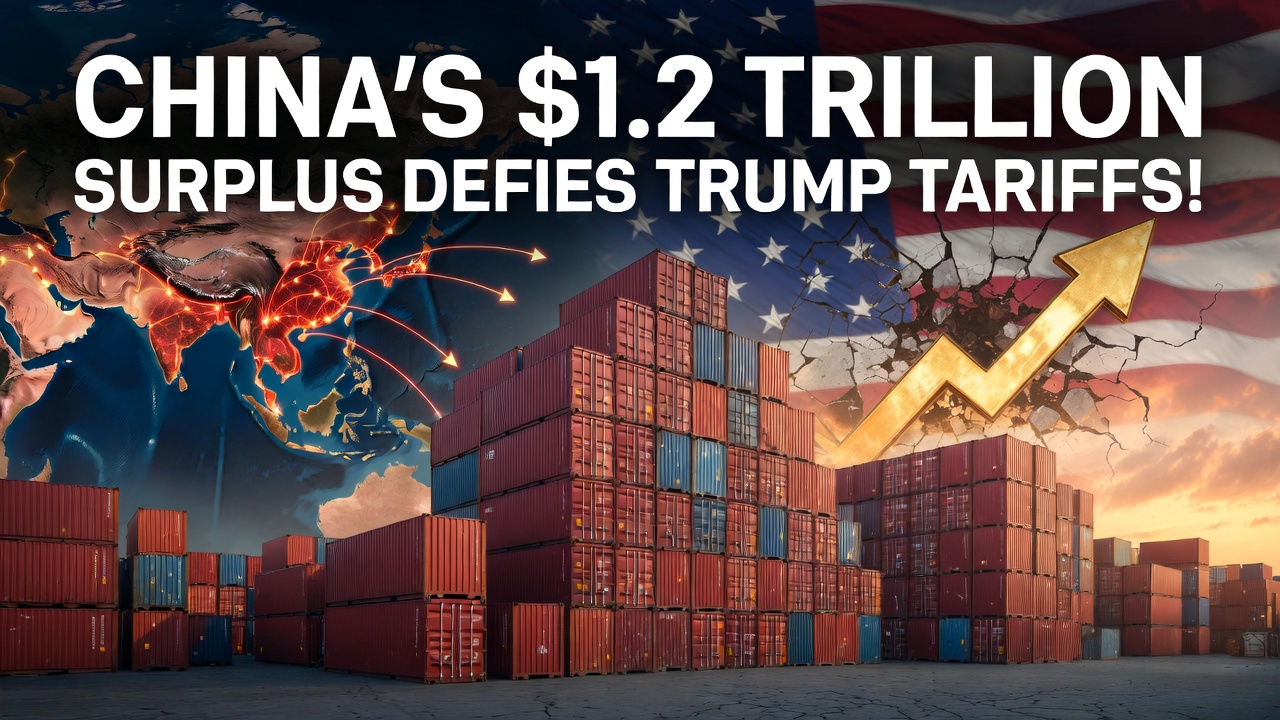
Beijing’s strategic pivot to Southeast Asia, Africa, and Latin America pays dividends as Chinese exporters outmaneuver US trade barriers
On a humid January morning at Shenzhen’s Yantian Port, one of the world’s busiest container terminals, the rhythmic clang of cranes loading shipping containers tells a story that Washington policymakers didn’t anticipate. Despite President Donald Trump’s aggressive tariff regime, which slashed Chinese exports to the United States by roughly 20% in 2025, the port’s traffic has surged. The destination tags reveal the plot twist: Lagos, Jakarta, São Paulo, Ho Chi Minh City—everywhere, it seems, except American shores.
This scene encapsulates China’s remarkable trade performance in 2025. The country closed the year with a record-breaking trade surplus of approximately $1.19 trillion—a 20% jump from 2024’s $992 billion—according to data released January 14, 2026, by China’s General Administration of Customs. The figures represent not just a numerical milestone but a fundamental recalibration of global trade flows, one that challenges assumptions about America’s economic leverage and heralds what some analysts are calling a “post-Atlantic” trading order.
The Numbers: A Surplus Built on Strategic Diversification
China’s 2025 trade data reveals an economy executing a carefully orchestrated pivot. Total exports climbed 5.5% to $3.77 trillion, while imports remained virtually flat at $2.58 trillion, expanding the trade imbalance to unprecedented levels. December alone saw exports surge 6.6% year-over-year—faster than any economist predicted—defying concerns about front-loading effects from 2024’s rush to beat anticipated tariffs.

The composition of this growth tells the real story. While shipments to the United States plummeted—declining in nine consecutive months and dropping 30% in December alone, for a full-year decline of approximately 20%—Chinese exporters found eager customers elsewhere. According to customs spokesperson Lv Daliang, growth rates to emerging markets “all surpassed the overall rate,” revealing Beijing’s successful execution of what trade analysts call the most significant export diversification campaign by a major economy in modern history.
Africa led the charge with a stunning 26% increase in Chinese exports, followed by ASEAN nations at 13%, Latin America at 7%, and the European Union at 8%. These aren’t marginal markets absorbing overflow; they represent a structural reorientation. In absolute terms, China’s trade with ASEAN countries alone is projected to have exceeded $1.05 trillion in 2025, cementing the bloc’s position as Beijing’s largest trading partner—surpassing both the United States and European Union.
The product mix has also evolved. Higher-value exports—semiconductors, automobiles, and ships—all recorded gains exceeding 20%, while lower-end products like toys, shoes, and clothing contracted. Auto exports alone surged 21% to more than 7 million units, driven by electric vehicles and plug-in hybrids that are reshaping global automotive supply chains.
The Tariff Jolt and Beijing’s Long Game
The Trump administration’s tariff offensive, which escalated throughout 2025 with duties approaching 60% on some Chinese goods, was designed to bring Beijing to heel. Instead, it accelerated trends that Chinese policymakers had been cultivating since the first trade war began in 2018. The difference this time was both the scale of US measures and the sophistication of China’s response.
Beijing’s playbook drew heavily from its Dual Circulation strategy, articulated in 2020 but turbocharged after Trump’s 2024 election victory signaled renewed trade hostilities. As described by the World Economic Forum, this framework emphasized reducing vulnerability to Western pressure through trade diversification, industrial upgrading, and domestic resilience—precisely the pillars that bore fruit in 2025.
“The authorities have been preparing for this moment since at least 2017,” notes Markus Herrmann Chen, founder of China Macro Group. Trade with Belt and Road Initiative participating countries reached RMB 11.6 trillion ($1.6 trillion) by 2021, according to the Atlantic Council—far surpassing trade with the EU or United States. By 2025, this diversification had reached critical mass.
The policy infrastructure supporting this shift included export financing facilities, expedited customs clearance for emerging market destinations, upgraded free trade agreements (including the newly enhanced China-ASEAN FTA finalized in May 2025), and diplomatic campaigns that paired infrastructure investments with market access. Meanwhile, a weakening yuan—reflecting domestic deflationary pressures—made Chinese goods even more price-competitive globally, with export prices declining for their third consecutive year.
Diversification in Action: Three Theaters of Expansion
Southeast Asia: The Manufacturing Nexus
Vietnam, Indonesia, Thailand, and Malaysia have become the frontline states in China’s geographic pivot. Chinese exports to ASEAN grew 13% in 2025, but the relationship runs deeper than simple trade flows. As Rhodium Group documents, Chinese manufacturing FDI into ASEAN averaged $10 billion over the past three years—nearly four times the 2014-2017 average—with Indonesia and Vietnam together attracting 56% of investment value.
This isn’t merely about circumventing tariffs through “transshipment”—though that certainly occurs and has triggered US scrutiny. Chinese firms are establishing genuine production capacity, particularly in electric vehicles, solar panels, electronics, and steel. BYD’s multi-billion-dollar EV plants in Thailand, CATL’s battery facilities across the region, and countless component manufacturers represent a reconfiguration of supply chains that will outlast any tariff regime.
The integration is symbiotic but asymmetric. ASEAN countries rely heavily on Chinese intermediate inputs—averaging one-third of their imported materials, according to East Asia Forum—meaning Chinese value-added content in “ASEAN-made” exports remains substantial. Vietnam’s exports to the US surged 30% in 2025, powered by electronics and textiles, but many incorporate Chinese components assembled by Chinese-invested factories employing Chinese supply chain management.
Yet this dependence cuts both ways. As Asia Society research warns, the flood of finished Chinese goods—particularly EVs, solar panels, and consumer electronics—is displacing local production. Indonesia’s textile sector shed 80,000 jobs in 2024, with 280,000 more at risk in 2025. Thailand has seen Japanese automakers like Subaru, Suzuki, and Nissan close factories as Chinese EVs capture market share. The challenge for ASEAN is navigating between benefiting from Chinese investment and protecting nascent industries from predatory pricing.
Africa: The Consumption Frontier
China’s 26% export surge to Africa in 2025 marks a qualitative shift in the relationship. While infrastructure projects and resource extraction have long defined China-Africa ties, 2025 saw Beijing pivot decisively toward consumer markets. Chinese exports to the continent in the first three quarters rose 28% year-over-year to approximately $122 billion, according to Bloomberg analysis, driven by construction machinery, passenger cars, steel, electronics, and solar panels (which jumped 60%).
Nigeria led African imports, accounting for 11% of the total at approximately 4.66 trillion naira, followed by South Africa (10%), Egypt (9%), and others. The CNBC investigation of social media posts and business registrations reveals thousands of Chinese entrepreneurs establishing small businesses across African cities—selling electronics, bubble tea, furniture, press-on nails—targeting Africa’s emerging middle class of 350 million consumers.
This expansion comes as profit margins narrow at home amid deflation and intense competition. “Africa benefits from cheap consumer goods,” observes Capital Economics, “but risks undermining local manufacturing and deepening trade imbalances.” Indeed, Africa’s trade deficit with China ballooned to nearly $60 billion through August 2025, perpetuating colonial-era patterns: raw materials (oil, minerals, cobalt, copper) flow to China while manufactured goods flow back.
Kenya exemplifies both opportunity and vulnerability. Chinese construction machinery and solar panels support infrastructure development, while Chinese EVs offer affordable transport options. Yet as ISS Africa notes, much of Africa’s exports to China are controlled by Chinese-owned firms operating on the continent, with earnings flowing back to foreign investors rather than stimulating local value chains. Without aggressive local content requirements and industrial policy, the $200 billion projected for China-Africa trade in 2025 may reinforce dependency rather than catalyze development.
Latin America: The EV Battleground
Latin America absorbed approximately $276 billion in Chinese exports by November 2025—up nearly 8% despite the ongoing US-China trade conflict. Brazil emerged as China’s prize market, with exports soaring over 25% to reach $30 billion in the first five months alone, according to Americas Market Intelligence. The star attraction: electric vehicles.
Brazil imported approximately 130,000 Chinese EVs in just the first five months of 2025—a tenfold increase from 2024—making it China’s largest EV export market globally. BYD is investing heavily in Brazilian production facilities, planning to manufacture 10,000 units in 2025 and 20,000 by end-2026. American Century Investments reports similar dynamics in Mexico, where Chinese auto exports rose 36%, and Argentina, where imports of Chinese goods nearly doubled amid bilateral RMB payment agreements that eased dollar shortages.
Beyond autos, Chinese exports span industrial machinery, telecommunications equipment, steel, and construction materials supporting infrastructure development. Peru’s Chancay megaport, a Chinese-funded deep-water facility designed to service ultra-large container ships, symbolizes Beijing’s long-term regional ambitions—creating logistics infrastructure that will funnel South American commodities to Asia while providing entry points for Chinese manufactured goods.
Yet geopolitical tensions simmer beneath the commerce. Mexico faces intense US pressure to impose tariffs on Chinese goods and guard against “transshipment” of China-made products bound for American markets. In December 2025, Mexico approved a sweeping overhaul of import taxes affecting 1,463 tariff lines across 17 strategic sectors, targeting China and other nations. The Trump administration has explicitly warned Mexico that failure to curb Chinese imports could trigger US tariffs on Mexican exports—a pressure campaign that reveals Washington’s anxieties about losing influence in its own hemisphere.
Domestic Drivers: Deflation as Export Engine
The paradox of China’s export boom is that it reflects economic weakness as much as strength. Behind the record surplus lies a structural malady: anemic domestic consumption and persistent deflation that has forced Chinese manufacturers to seek markets abroad rather than building demand at home.
China’s consumer prices remained flat in 2025, missing the official 2% target, while the GDP deflator—a broad price gauge—declined for ten consecutive quarters through late 2025. Factory-gate prices have been in deflationary territory since October 2022. This isn’t a statistical quirk; it reflects weak household demand, a property sector that has contracted by half since its 2021 peak, and local government fiscal crises that constrain public spending.
“No economy has recorded 5% real GDP growth while facing years of persistent deflation,” argues Logan Wright of Rhodium Group in a December 2025 analysis. He estimates China’s actual 2025 growth fell short of 3%, far below the official 5% target, with domestic demand “anemic and confined to modest household consumption expansion.”
The International Monetary Fund’s December 2025 assessment is blunt: “The prolonged property sector adjustment, spillovers to local government finances, and subdued consumer confidence have led to weak domestic demand and deflationary pressures.” IMF Managing Director Kristalina Georgieva called for “more forceful and urgent” policies to transition to consumption-led growth, warning that “reliance on exports is less viable for sustaining robust growth” given China’s massive economic size and heightened global trade tensions.
The feedback loop is pernicious. Deflation encourages households to delay purchases and increase savings (China’s household savings rate remains among the world’s highest). Weak domestic demand forces manufacturers to cut prices, triggering brutal price wars—particularly in automotive, solar, and steel—that further erode profitability and investment. Unable to earn returns domestically, companies dump products abroad at marginal cost, creating the export surge that manifests as a trade surplus.
“The swelling surplus underscores the imbalance between China’s manufacturing strength and stubbornly weak domestic consumption,” observes Business Standard. It’s a symptom, not a sign of health—akin to Germany’s persistent surpluses during its “sick man of Europe” phase or Japan’s export dependence during lost decades of deflation.
Global Ripples: Winners, Losers, and Backlash
China’s export offensive creates ripple effects across the global economy, producing both opportunities and tensions that will shape trade policy for years.
Emerging market pressures: While developing nations benefit from affordable Chinese capital goods, consumer electronics, and infrastructure inputs, they face mounting risks. Local manufacturers struggle against subsidized competition. Capital Economics warns that “governments in Nigeria, South Africa, and Kenya may seek to defend respective industries,” but most commodity-dependent African nations “are likely to prioritize trade ties with China over industrialization ambitions.” The trade-off between cheap imports and industrial development presents a Faustian bargain.
Currency effects and financial flows: China’s deflationary pressures have driven real exchange rate depreciation, making exports even more competitive. The current account surplus reached 3.7% of GDP in Q1 2025, but this was offset by significant capital outflows as Chinese investors sought returns abroad and hedged against domestic uncertainties. The World Bank’s December 2025 update notes that “larger net capital outflows outweighed the current account surplus,” reflecting private-sector concerns about China’s economic trajectory.
Protectionist backlash: The flood of Chinese goods is triggering defensive measures globally. The European Union faces growing political pressure to counter what officials describe as unfair competition from state-subsidized Chinese manufacturers, particularly in EVs, solar panels, and steel. Preliminary EU tariffs on Chinese EVs reached as high as 45%, while solar panel duties from Southeast Asian countries (themselves hosting Chinese production) range from 21% to 271%. Brazil, Turkey, and India have imposed automotive tariffs. Even Russia—China’s largest auto export market in 2023-2024—recently enacted non-tariff barriers to protect domestic production.
US strategic concerns: Washington’s anxieties extend beyond economics. The Trump administration’s “transshipment” provisions, which threaten 40% tariffs on goods deemed to have been illegally rerouted through third countries, aim squarely at Chinese supply chain strategies in ASEAN and Mexico. S&P Global analysis warns that strict rules-of-origin enforcement could “adversely affect export competitiveness” of Malaysia, Singapore, Thailand, and Vietnam—countries with low domestic value content but high Chinese integration.
The geopolitical subtext is unmistakable. As Americas Quarterly notes, China’s infrastructure investments and manufacturing presence in Latin America represent “a direct challenge to US dominance in the region.” Chinese space facilities in Argentina, ports in Peru, and 5G networks across the hemisphere trigger national security debates in Washington, revealing that trade battles mask deeper great-power competition.
What Comes Next: Risks and Rebalancing
The sustainability of China’s export-driven model faces mounting challenges that will test Beijing’s economic management in 2026 and beyond.
Overcapacity and market saturation: China’s manufacturers expanded production capacity dramatically during the pandemic, anticipating continued growth. As domestic demand faltered, this capacity became stranded, forcing companies to export at unsustainably low prices. The risk, as Rhodium Group observes, is that “overcapacity flooding” will provoke coordinated international responses—tariffs, anti-dumping duties, investment restrictions—that close off markets faster than Beijing can diversify.
Lynn Song, chief economist for Greater China at ING Groep, warns China faces “some pushback” as its higher-end products become globally competitive. The more successfully Chinese firms move up the value chain—competing in EVs, semiconductors, renewable energy—the more likely they are to trigger defensive industrial policies from advanced economies protecting strategic sectors.
Geopolitical fragmentation: The rules-based trading system that facilitated China’s rise is fracturing. As emerging markets become battlegrounds between Chinese commercial interests and Western political pressure, countries face increasingly binary choices. The US is weaponizing market access, conditioning trade relationships on partners’ willingness to limit Chinese participation. Mexico’s tariff reforms exemplify this squeeze—economic logic suggests embracing Chinese investment, but geopolitical realities demand demonstrating alignment with Washington.
Domestic rebalancing imperatives: Every major international institution—the IMF, World Bank, OECD—agrees that China must transition to consumption-driven growth. Yet 2025 demonstrated how difficult this transformation is. Retail sales growth barely exceeded 1% by year-end, despite trade-in subsidies and consumption vouchers. The property crisis shows no signs of resolution, local government debt problems worsen, and deflationary psychology becomes more entrenched with each passing quarter.
The IMF’s December 2025 assessment projects China’s growth will moderate to 4.5% in 2026 (down from 5% in 2025) as “it would take time for domestic sources of growth to kick in.” Sonali Jain-Chandra, the IMF’s China Mission Chief, argues that “macro policies need to focus forcefully on boosting domestic demand” to “reflate the economy, lift inflation, and lead to real exchange rate appreciation”—precisely the medicine Beijing has been reluctant to administer.
The 2026 outlook: Natixis economist Gary Ng forecasts Chinese exports will grow about 3% in 2026, down from 5.5% in 2025, but with slow import growth, he expects the trade surplus to remain above $1 trillion. This would represent a third consecutive year of record surpluses—unprecedented for an economy of China’s scale and development level.
The comparison to historical precedents is instructive. Germany ran persistent current account surpluses approaching 8% of GDP in the 2010s, triggering criticism but ultimately reflecting structural savings-investment imbalances. Japan’s export dominance in the 1980s provoked “voluntary” export restraints and contributed to asset bubbles when yen appreciation finally arrived. China’s $1.2 trillion surplus in 2025 represented roughly 6-7% of GDP—a figure that would be unsustainable indefinitely without either forced adjustment through currency appreciation or external pressure through coordinated tariffs.
Conclusion: A Pyrrhic Victory?
China’s record $1.2 trillion trade surplus in 2025 demonstrates the resilience and adaptability of the world’s manufacturing superpower. Against expectations, Chinese exporters not only survived the Trump administration’s tariff assault but thrived, finding eager customers from Lagos to Jakarta to São Paulo. The successful execution of trade diversification—years in planning, accelerated by necessity—has reduced China’s vulnerability to any single market and cemented commercial relationships across the Global South.
Yet this triumph carries hidden costs and uncertain longevity. The surplus reflects not vibrant economic health but the malaise of a economy unable to generate sufficient domestic demand to absorb its own productive capacity. Deflation, property crisis, and weak consumer confidence reveal structural imbalances that export growth merely postpones addressing rather than resolving. Every major international economic institution warns that export-led growth is reaching its natural limits for an economy of China’s scale.
Geopolitically, China’s export offensive is hardening Western resolve to reduce dependencies and rebuild domestic industrial capacity—the very “decoupling” Beijing sought to avoid. The more successful Chinese manufacturers become at penetrating global markets, the more protectionist the response grows. We are witnessing not the end of US-China trade conflict but its globalization, as secondary markets become contested terrain and supply chains fragment along geopolitical lines.
For global policymakers, 2025’s trade data poses a fundamental question: Can the international economy accommodate a manufacturing superpower running trillion-dollar surpluses year after year? History suggests not without significant adjustment—through currency appreciation, domestic rebalancing, or external pressure. The lesson of 2025 is that Chinese firms are extraordinarily capable of adapting to barriers and finding new markets. The lesson of 2026 may be that even the most successful export diversification cannot indefinitely substitute for robust domestic demand.
As containers continue loading at Shenzhen’s ports, bound for an ever-widening array of destinations, the numbers tell a story of tactical success masking strategic vulnerability. China has won the battle against Trump’s tariffs. The war for sustainable economic growth, however, requires victories on the home front that remain frustratingly elusive.
Discover more from The Economy
Subscribe to get the latest posts sent to your email.


Analysis
How the Iran Conflict Has Rattled Global Energy Markets: Tehran’s Grip on the Strait of Hormuz Fuels Worldwide Disruptions

Explore how the 2026 Iran conflict and Strait of Hormuz disruptions are shaking global energy markets, with real-time price surges, supply chain breakdowns, and what comes next for oil, LNG, and the global economy.
For decades, energy analysts have marked the Strait of Hormuz in red on their risk maps — a narrow, 21-mile-wide corridor threading between Iran and Oman through which roughly one-fifth of the world’s oil flows every single day. The scenario they feared most has now arrived. In the span of four days, the Iran conflict global energy markets have been dreading has become a full-blown reality: a waterway that underpins the price of everything from gasoline in Ohio to heating bills in Hamburg to factory output in Guangdong has effectively gone dark.
The catalyst was swift and seismic. A coordinated US-Israeli air campaign launched in late February struck Iranian military and governmental targets with precision, killing Supreme Leader Ali Khamenei. Tehran’s response — retaliatory strikes, naval mobilization, and the threat of asymmetric warfare — has choked off one of the most critical chokepoints in the global trading system. As of March 3, 2026, the Strait of Hormuz blockade effects on oil supply are being felt from Houston to Hanoi. The question now is not whether this hurts — it manifestly does — but how long the pain lasts, and whether the world’s energy architecture can absorb a shock of this magnitude.
The Strategic Chokepoint: Strait of Hormuz Under Siege
To understand why markets have responded with such alarm, consider the geometry. The Strait of Hormuz — barely navigable by supertankers at its narrowest — is not just another shipping lane. It is the jugular vein of global petroleum trade. Approximately 20 million barrels of crude oil pass through it daily, alongside roughly 20% of the world’s liquefied natural gas exports, primarily from Qatar’s colossal North Field operations.
When Iranian naval and missile assets make that corridor too dangerous to traverse, the downstream consequences are near-instantaneous. Tanker insurance premiums — already elevated heading into the crisis — have spiked by multiples. Several major shipping operators have suspended transits entirely. Qatar’s LNG export terminals, operating under threat posture, have curtailed loading. Iraqi oil flowing south through Basra faces disruption. Even Saudi Arabia’s eastern oil fields and their Red Sea-bound pipelines are operating under emergency protocols.
Bloomberg reported that this threatens to be the worst disruption in global gas markets since Russia’s 2022 invasion of Ukraine — a benchmark that, in energy policy circles, carried nearly apocalyptic connotations. That comparison is sobering: the 2022 shock rewired European energy infrastructure, sent utilities to the brink, and triggered a continent-wide scramble for alternative supply that lasted years.
This time, the geographic scope may be even wider.
Surging Prices and Supply Shocks: The Numbers Don’t Lie
Markets have reacted with textbook crisis reflexes, but the scale is striking. As CNBC’s coverage of Strait of Hormuz global oil and gas trade disruptions documented, Brent crude — the global benchmark — surged between 7% and 13% in the first 72 hours of the closure, settling in a range of $80–$83 per barrel as of this writing. That represents a significant re-pricing of risk, though it still sits below the $100-plus levels that analysts warn could materialize if the disruption extends beyond a week.
The downstream effects are already visible at the consumer level:
| Energy Metric | Pre-Conflict Level | Current Level (Mar 3, 2026) | Change |
|---|---|---|---|
| Brent Crude ($/barrel) | ~$72–$74 | $80–$83 | +7–13% |
| US Regular Gasoline ($/gallon) | ~$2.78 | Above $3.00 | +8–10% |
| European TTF Natural Gas (€/MWh) | ~€38 | €46–€49 | +20–30% |
| LNG Spot Prices ($/MMBtu) | ~$11–$12 | ~$14–$16 | +25–35% |
| Global Dry Bulk Shipping Index | Elevated | All-time high | Record |
Sources: Reuters, Bloomberg, CNBC, BBC Energy Desk, March 2026
For American motorists, the gasoline price crossing the psychologically and politically significant $3-per-gallon threshold is an unwelcome reminder that Middle East instability has never been truly distant from the US domestic economy — whatever the strategic independence afforded by shale production. The US Strategic Petroleum Reserve (SPR), partially restocked after the 2022 drawdowns, offers some buffer, but its release would be a political decision as much as an economic one, carrying its own messaging risks amid an ongoing military operation.
European natural gas futures have borne perhaps the sharpest repricing. The continent entered 2026 with storage levels modestly above seasonal averages, but that cushion looks thinner now. Qatar’s LNG — which Europe came to depend on heavily post-Ukraine — has seen loading disruptions, and the timing, still technically late winter, is painfully inconvenient.
Geopolitical Ripples Across Asia and Europe
If the financial mathematics are stark, the geopolitical algebra is even more complex. The Iran conflict global energy market disruption does not affect all nations equally, and the asymmetries matter enormously for diplomatic positioning.
Asia: Maximum Pain, Minimum Leverage
Asia, bluntly, is where this crisis hits hardest. Japan, South Korea, India, and China collectively import a staggering share of their crude oil through the Strait of Hormuz. For Japan and South Korea — both US security allies with negligible domestic production — there is almost no realistic near-term alternative. Their refineries are calibrated for Gulf crude grades; switching supply origin is neither fast nor cheap.
China’s position is particularly nuanced. Beijing imports approximately 40–45% of its crude through Hormuz, and it has long maintained energy relationships with Tehran as a hedge against Western-dominated supply chains. The death of Khamenei and the subsequent power vacuum in Tehran create genuine uncertainty for Chinese planners who valued predictable, if troubled, Iranian partnerships. Xi Jinping faces a situation where condemning the US-Israeli operation risks straining Washington relations at a sensitive moment in trade negotiations, while staying silent signals acquiescence to an action that directly threatens Chinese energy security. Expect Beijing’s diplomatic communications to be measured, multilateral in framing, and ultimately self-interested.
India, for its part, has in recent years secured significant discounts on Russian oil routed around Western sanctions. But the Hormuz disruption is a different problem — it affects the physical movement of tankers, not just pricing arrangements. New Delhi’s government will be watching carefully, managing both inflation risks and the political optics of being seen as dependent on a conflict-ridden supply corridor.
Europe: Higher Bills and Harder Choices
BBC coverage of the crisis noted that gas and oil prices have surged while shares tumble as the crucial shipping lane faces closure — a headline that captures the dual squeeze European governments are navigating. Higher energy costs feed directly into headline inflation, complicating the European Central Bank’s already delicate balancing act between growth support and price stability.
For European consumers, the how Iran war rattles energy supply chains dynamic is not abstract. It means higher heating bills, elevated transport costs, and broader inflationary pressure across supply chains still recovering from the 2022–2024 energy shock cycle. Industrial users — particularly energy-intensive sectors like chemicals, glass, and aluminum smelting — face margin compression that could accelerate the ongoing debate about European industrial competitiveness.
On the geopolitical dimension, European governments that have been cautious about the Iran military operation will now face domestic pressure to publicly distance themselves from a conflict that is directly raising their citizens’ energy costs. This creates awkward dynamics within NATO and the broader Western alliance.
Tehran’s Influence: More Than Just Oil
It would be reductive to frame the Tehran influence on Strait of Hormuz shipping disruptions as purely a petroleum story. The closure — or even the credible threat of closure — of the strait weaponizes Iran’s geographic position in ways that outlast any individual political leadership. Khamenei may be gone, but the Revolutionary Guard’s naval assets, the Houthi proxy networks in Yemen, and the broader architecture of Iranian asymmetric capability remain operational.
The Guardian’s analysis highlighted what disrupting the strait could mean for global cost-of-living pressures — and the answer is: considerably more than just expensive gasoline. Shipping rate spikes propagate through entire supply chains. When it costs dramatically more to move a supertanker from Ras Tanura to Yokohama, those costs eventually appear in manufacturing inputs, finished goods, and ultimately consumer prices across dozens of economies.
There is also the LNG dimension. Global LNG shortages from the Iran crisis represent a newer and in some ways more structurally significant threat than the oil disruption. The 2026 global LNG market is tighter than in previous years, with demand growth from Asia consistently outpacing new supply project completions. A sustained Qatari export curtailment — even partial — would stress-test every LNG supply contract and spot market simultaneously.
Market Forecasts and Mitigation Strategies
What happens next depends on variables that analysts model but cannot predict: the duration of the closure, the trajectory of Iranian political succession, US military objectives, and the diplomatic space available to regional actors like Saudi Arabia, the UAE, and Oman.
The Bull Case for Oil Prices
If the Strait of Hormuz remains effectively closed for two weeks or more, the consensus emerging from energy desks at major banks and trading houses is that $100-per-barrel oil becomes a base case, not a tail risk. Some models, incorporating production halt cascades from Iraq and Kuwait (whose eastern export routes are also affected), project spikes toward $110–$120 under sustained disruption. At those levels, the global economy faces a stagflationary headwind not seen since 2008: energy-driven inflation colliding with weakening consumer sentiment and tightening financial conditions.
Mitigation Levers
The strategic response toolkit is familiar if imperfect. The International Energy Agency (IEA) member countries collectively hold strategic reserves designed for exactly this contingency; a coordinated release announcement would likely exert immediate downward pressure on futures prices, even if physical supply relief takes weeks to materialize. The US has already signaled readiness to tap the SPR; whether European nations coordinate through IEA mechanisms will be a test of multilateral energy governance.
OPEC+ nations with spare capacity — primarily Saudi Arabia and the UAE, whose production is already disrupted but whose political calculus may favor market stabilization — face an unusual situation: production increases that would typically benefit them financially are constrained by the same conflict that is creating the price opportunity. Saudi Aramco’s Ras Tanura complex, facing regional threat postures, cannot easily increase output it cannot export.
Meanwhile, US LNG exporters have received a windfall in the form of soaring spot prices, and American shale producers are accelerating permitting and rig deployments. But the timelines for meaningful new supply are measured in months, not days.
The Long View: Energy Transition in a Conflict World
There is a bitter irony embedded in the current crisis that energy economists are already noting. The global energy transition — the multi-decade shift toward renewables, battery storage, and electrification — has been partly justified on energy security grounds: reducing dependence on volatile petrostates and conflict-prone regions. Yet in 2026, most of the world’s major economies remain profoundly exposed to exactly the kind of Hormuz disruption that renewables advocates have long cited as justification for faster transition.
The crisis will almost certainly accelerate certain policy decisions. European governments will fast-track offshore wind permitting and battery storage investment, citing Hormuz as a national security imperative. Asian economies will revisit nuclear energy timelines. The US will likely see renewed political support for both domestic production and clean energy infrastructure — an unusual alignment of typically opposing interests.
But transitions take decades. In the meantime, the world runs on oil and gas, and a 21-mile strait still holds the global economy partly hostage to the decisions of actors thousands of miles from the financial capitals that price that risk.
Conclusion: The Price of Dependence
Four days into the Strait of Hormuz closure, the full economic damage remains incomplete and still accumulating. What is already clear is that the Iran conflict’s global energy market impact is neither a blip nor a manageable disruption — it is a structural stress test exposing vulnerabilities that years of relative stability had obscured.
Brent crude at $80+ may feel manageable compared to historical peaks. But the trajectory matters more than the current level. If Iranian political succession proves chaotic, if proxy forces escalate in Yemen or Iraq, if the strait closure extends into weeks rather than days, the $100 threshold is not a worst-case scenario — it is a median one.
For policymakers, the coming weeks demand both tactical crisis management and strategic honesty. SPR releases buy time; they do not buy energy independence. The world has known for decades that its dependence on a 21-mile waterway was a systemic risk. The 2026 Iran crisis is not a surprise. It is a reckoning.
Sources:
- Reuters: Global energy prices soar as Iran crisis disrupts shipping
- Bloomberg: Iran Crisis Threatens Worst Gas Market Disruption Since 2022
- CNBC: Strait of Hormuz Global Oil, Gas Trade Disrupted Amid Iran War
- BBC: Gas and oil prices soar and shares tumble as crucial shipping lane threatened
- The Guardian: What disrupting the Strait of Hormuz could mean for global cost-of-living pressures
Discover more from The Economy
Subscribe to get the latest posts sent to your email.
Analysis
China Two Sessions 2026: What Investors Need to Know About Beijing’s Tech Ambitions and Economic Stimulusop

As the National People’s Congress convenes, global markets are watching for signals that could reshape portfolios from Shanghai to Silicon Valley
Picture Li Wei, a portfolio manager at a mid-sized asset management firm in Hong Kong, scanning his Bloomberg terminal at 6 a.m. on a Tuesday in late February. Chinese equities have been quietly underperforming since January, weighed down by renewed U.S. tariff threats and a consumer sector that still hasn’t found its footing. But Li isn’t panicking. He’s waiting — like thousands of institutional investors across Asia, Europe, and North America — for the annual ritual that could recalibrate China’s economic trajectory for the next half-decade.
That ritual is the China Two Sessions 2026, the most consequential political gathering on Beijing’s calendar.
Starting March 5, the National People’s Congress (NPC) will convene for its weeklong session, bringing together roughly 3,000 delegates to ratify policy priorities that Beijing’s leadership has been quietly assembling since late 2025. This year’s meeting carries unusual weight: it coincides with the unveiling of China’s 14th Five-Year Plan successor, a blueprint that will define the country’s economic architecture through 2030, and arrives at a moment when deflation, demographic headwinds, and a battered property market are complicating the official narrative of resilience.
What Investors Need to Know About China’s 2026 Growth Target
The headline number that markets will parse first is the China growth target 2026: officials are widely expected to announce a range of 4.5 to 5 percent GDP expansion, a subtle but meaningful downgrade from the roughly 5 percent targets of recent years. As Bloomberg has reported, that adjustment signals something significant — Beijing appears willing to accept a structurally slower pace of expansion rather than deploy debt-fueled stimulus indiscriminately.
That’s a more sophisticated posture than many Western observers credit China’s policymakers with. After years of defending round-number targets as political totems, the shift to a range reflects a leadership that has internalized the limits of the old growth model. Property, which once accounted for roughly a quarter of GDP, remains in a prolonged slump. Deflation, while modest in headline terms, has been persistent enough to suppress corporate margins and household spending confidence.
“The Two Sessions will be critical for setting the policy tone,” noted one emerging-market strategist at Société Générale in a client note circulated earlier this month. “A credible growth target paired with specific fiscal commitments could be the catalyst that brings foreign allocators back to Chinese equities.”
Whether that catalyst materializes depends on specifics — and specifics have historically been the meeting’s weakest output.
China Tech Self-Reliance 2026: The Investment Theme Driving Markets
If there is one area where Beijing has been anything but vague, it is technology. The China tech self-reliance 2026 agenda has been building momentum since DeepSeek’s surprise emergence in early 2025 rattled assumptions about America’s lead in artificial intelligence. That episode — a relatively resource-efficient large language model outperforming Western benchmarks — became a Sputnik moment in reverse: proof, Beijing argued, that indigenous innovation could compete globally even under export control constraints.
Investors in Chinese tech stocks rode that narrative hard. The Hang Seng Tech Index surged in the first half of 2025, with robotics and semiconductor names leading the charge. But 2026 has been more subdued, and the market is now looking for policy reinforcement.
At the NPC, analysts expect the government to announce R&D budget allocations exceeding 400 billion yuan, with priority channels directed toward AI infrastructure, quantum computing, and advanced semiconductor fabrication. The Financial Times has documented how China’s chip ambitions have evolved from catch-up mode to a genuine push for process-node leadership, even as U.S. restrictions on equipment exports from ASML and Applied Materials have created real bottlenecks.
The robotics sector, meanwhile, has become something of a proxy trade for China’s broader manufacturing upgrade story. Shares in domestic robotics manufacturers have been among the most volatile in the Chinese market — prone to sharp rallies on policy signals and equally sharp corrections when details disappoint. Investors will be watching for whether the Five-Year Plan framework enshrines robotics as a “strategic emerging industry” with dedicated subsidy channels.
China Economic Stimulus 2026: Consumer Demand Takes Center Stage
Beyond tech, the second major pillar of investor focus is domestic consumption — and here, optimism must be tempered with historical caution.
The phrase “boosting domestic demand” has appeared in nearly every major Chinese policy document for the past decade. It is, as one economist at UOB Bank put it in a recent research note, “the white whale of Chinese economic policy — perpetually pursued, never quite caught.” The structural barriers are real: a social safety net that encourages precautionary saving, a property market that has eroded household wealth, and a labor market where youth unemployment remains elevated even as headline jobless figures look manageable.
China economic stimulus 2026 is expected to take several forms. Consumer voucher programs — essentially digitally distributed spending credits targeted at electronics, appliances, and dining — have gained renewed attention after modest successes in select municipalities. A more proactive fiscal stance, with the deficit potentially widening to 4 percent of GDP or beyond, would give local governments the firepower to support infrastructure investment without purely relying on debt rollovers.
Perhaps more structurally significant is the anti-involution campaign — Beijing’s effort to curb the destructive price wars that have battered margins in electric vehicles and solar panels. As the South China Morning Post has covered extensively, the government has become alarmed that cutthroat competition among domestic firms, while producing globally competitive products, is hollowing out profitability and discouraging long-term R&D investment. Expect the NPC to signal stronger enforcement of anti-involution guidelines in these sectors.
Marvin Chen, a strategist at Bloomberg Intelligence, has argued that cyclical and property stocks have historically delivered the strongest gains in the month following the Two Sessions — a pattern that reflects the market’s tendency to price in policy optimism before details fully emerge. Whether 2026 follows that pattern depends significantly on whether the stimulus language translates into implementable programs.
China Five-Year Plan 2026–2030: The Decade Bet
The backdrop to all of this is the China Five-Year Plan 2026–2030, which makes this NPC session more consequential than a typical annual gathering. Five-Year Plans are not mere aspiration documents — they set industrial policy priorities, direct state financing, and signal to private sector actors where returns are most likely to be politically protected.
Based on pre-meeting signals, the new plan is expected to center on four axes: technology leadership, green transition, demographic resilience, and supply chain security.
The green transition component is particularly interesting for international investors. China is simultaneously the world’s largest producer of solar panels and EVs and a country still heavily reliant on coal for electricity generation. The Five-Year Plan is expected to accelerate renewable deployment targets while managing the social transition for coal-dependent regions — a balancing act the Economist has described as one of the most complex industrial policy challenges in economic history.
Demographic resilience is the quieter crisis. China’s working-age population has been shrinking since the early 2020s, and the post-COVID recovery in birth rates has been minimal despite financial incentives. The Five-Year Plan is expected to expand eldercare infrastructure investment and experiment with more flexible immigration frameworks for skilled foreign workers — neither of which is a quick fix, but both of which signal a leadership that is starting to grapple seriously with the long-term growth arithmetic.
The US-China Tech Race: Context That Cannot Be Ignored
No analysis of the China NPC meeting 2026 is complete without acknowledging the geopolitical frame. U.S. tariffs, which have been ratcheted up incrementally since 2018 and have intensified through the mid-2020s, remain a structural headwind for Chinese export sectors. More consequentially, technology export controls have forced China to accelerate domestic substitution in semiconductors, electronic design automation software, and cloud infrastructure.
The New York Times has noted in its coverage of the US-China technology competition that the export control strategy has produced a paradox: by restricting China’s access to leading-edge tools, Washington has created powerful incentives for Beijing to invest at scale in domestic alternatives. Whether those alternatives can close the gap — or whether they will plateau at a competitive but not frontier level — is the central uncertainty in the long-term technology investment thesis.
For global investors, this dynamic creates asymmetric opportunities. Chinese AI and semiconductor names trade at significant discounts to their U.S. equivalents, reflecting geopolitical risk premiums that may or may not be permanently warranted. If the Two Sessions delivers credible policy support for the technology sector, the compression of those premiums could generate meaningful alpha for investors with sufficient risk tolerance and time horizon.
TD Securities’ Asia macro team has flagged that currency positioning will also be critical context: a stable or strengthening yuan during the NPC period would reinforce the signal that Beijing is confident in its policy toolkit, while renewed depreciation pressure would suggest capital flow dynamics are constraining the government’s room for maneuver.
What Happens Next: Scenarios for Global Investors
The range of outcomes from the China Two Sessions 2026 is wider than usual, precisely because the Five-Year Plan cycle amplifies the stakes.
In the optimistic scenario, the NPC delivers a credible 4.5–5 percent growth target paired with specific fiscal commitments, a robust R&D budget, concrete consumer stimulus mechanisms, and strong language on technology self-sufficiency. This combination could re-rate Chinese equities meaningfully, particularly in tech and green sectors, and attract the foreign institutional capital that has been parked cautiously on the sidelines.
In the cautious scenario, the meeting produces broad commitments without implementable mechanisms — a pattern that has repeated itself often enough that sophisticated investors have built in discount factors for Chinese policy announcements. In this case, markets may rally briefly on headline numbers before retreating as analysts parse the details and find familiar vagueness.
The tail risk scenario involves external escalation — a significant tariff move from Washington, or a geopolitical flare-up in Taiwan Strait or South China Sea waters — that overwhelms domestic policy signals entirely. This is not the base case, but it is the reason that position sizing matters as much as directional conviction in Chinese assets.
As the Asia Society Policy Institute has analyzed, the broader question is whether China’s leadership has the institutional capacity to execute the transition from an investment-and-export model to an innovation-and-consumption model at the speed the Five-Year Plan timelines imply. History suggests such transitions take longer than planned and produce more volatility than anticipated.
The View From the Terminal
Back in Hong Kong, Li Wei closes his terminal and heads to a morning briefing. He’s not betting the portfolio on a single NPC outcome. But he has shifted his positioning: trimmed exposure to consumer discretionary names that need a demand surge to justify their valuations, added selectively to semiconductor equipment and AI infrastructure plays where the policy tailwind is more durable, and kept a close watch on the yuan.
“The Two Sessions,” he tells a junior analyst before the meeting starts, “won’t solve China’s structural challenges in a week. But they’ll tell you a lot about whether the people making decisions understand those challenges — and whether they’re serious about addressing them.”
That, ultimately, is what global investors are flying to Beijing to hear. The answer won’t come in the opening ceremony or the first press conference. It will emerge slowly, in the fine print of budget allocations, the specificity of subsidy programs, and the particular industries that find themselves named in the Five-Year Plan’s priority tables.
Markets, as always, will price in the narrative before the details arrive. The details, as always, will be what matters.
Discover more from The Economy
Subscribe to get the latest posts sent to your email.

After three bruising years of deficit spending, Hong Kong’s finances have staged a remarkable comeback. The Hong Kong budget surplus 2026 tells a story of discipline, sacrifice, and a city betting on its own reinvention — but the fine print deserves a closer read.
There is a particular satisfaction in watching a city defy its own pessimism. Twelve months ago, Financial Secretary Paul Chan stood before the Legislative Council and projected a deficit of HK$67 billion for the 2025–2026 financial year. This week, he delivered something far more surprising: a consolidated surplus of HK$2.9 billion (approximately S$469 million), ending a three-year run of red ink a full two years ahead of schedule. For a global financial hub that has spent much of the past half-decade navigating geopolitical headwinds, a pandemic hangover, and an exodus of capital and talent, the numbers feel almost cinematic.
But fiscal turnarounds rarely arrive without a reckoning. Hong Kong’s return to surplus carries the fingerprints of austerity as surely as it does good fortune — and understanding both is essential to grasping where Asia’s most storied financial centre is genuinely headed.
How Hong Kong Turned Its Deficit Around: The Numbers Behind the Narrative
The Hong Kong budget surplus 2026 did not materialise from thin air. Two powerful forces converged: a surging asset market and a government that, for once, held the line on spending with unusual resolve.
On the revenue side, stamp duties from property and equity transactions surged as Hong Kong’s asset markets came alive in the second half of 2025. The Hang Seng Index recovered meaningful ground after years of suppressed valuations, drawing back institutional investors who had previously rotated into alternative Asian markets. Land premium income — long the bedrock of Hong Kong’s fiscal architecture — also recovered modestly as developers, sensing a floor in residential prices, resumed land bids at competitive levels.
According to data from the Hong Kong Government Budget, fiscal reserves are projected to stand at approximately HK$657.2 billion by March 31, 2026 — still a substantial war chest by most international standards, though notably lower than the HK$900-billion-plus reserves of a decade ago. That erosion, gradual but telling, is the quiet subplot beneath the headline surplus.
GDP growth for 2025 came in at the upper end of expectations, with the government projecting a 2.5–3.5% expansion for 2026, buoyed by tourism recovery, financial services activity, and growing integration with mainland China’s consumption economy. Reuters reported that a buoyant broader economy had helped tip Hong Kong’s public finances back into positive territory, with trade flows through the port recovering beyond post-pandemic lows.
The Sacrifices Behind the Surplus: A Closer Look at Hong Kong Austerity Measures
Numbers on a budget page are abstractions. The Hong Kong austerity measures impact is considerably more concrete for the city’s 7.5 million residents.
Civil service job cuts have been among the most visible instruments of fiscal consolidation. The government has allowed natural attrition to reduce headcount while implementing hiring freezes across multiple departments — a policy that has drawn muted criticism from public sector unions but limited political resistance in a legislature now dominated by pro-establishment voices. The effect is real: leaner government, slower public services, and a workforce increasingly asked to do more with structurally less.
More contentious has been the reduction in education funding. Hong Kong’s universities — once ranked among Asia’s finest and lavished with public investment — have faced successive budget squeezes. Several institutions have responded by raising tuition, cutting interdisciplinary research programmes, and, in some cases, offering voluntary redundancy schemes to academic staff. At a moment when Hong Kong is pivoting toward an innovation-driven economy, the irony of underinvesting in education has not been lost on economists.
“You cannot simultaneously declare yourself an innovation hub and defund the universities that produce your innovators,” one senior academic at the University of Hong Kong told this correspondent, requesting anonymity given the political sensitivity of the topic. The tension is structural, not incidental.
Healthcare and social welfare programmes have also faced tighter allocations, with real per-capita spending declining in inflation-adjusted terms over the past three years. For the city’s rapidly ageing population — a demographic pressure that will only intensify through the 2030s — this creates fiscal risks that the current surplus does not resolve.
Paul Chan’s Fiscal Strategy: Skilled Accounting or Structural Gamble?
Paul Chan’s fiscal strategy has attracted both admirers and sceptics in roughly equal measure. Chan himself has been careful to contextualise the turnaround. “The global environment has remained volatile, and Hong Kong has continued to undergo economic transformation,” he noted in his budget speech. “Yet, Hong Kong has always thrived amid changes and progressed through innovation… Our economy has recalibrated its course and is advancing steadily.”
The framing is deliberate. Chan knows that a single surplus year, driven in part by asset market timing rather than structural reform, is a fragile foundation for confidence. Bloomberg observed that Hong Kong was “suddenly flush with cash,” but also flagged that the revenue windfall was partially cyclical — dependent on the continuation of asset market conditions that are notoriously difficult to forecast.
To Chan’s credit, the government has simultaneously pursued bond issuance for infrastructure spending — a pragmatic separation of capital and recurrent expenditure that mirrors practices common in advanced economies. Infrastructure bonds have funded projects in the Northern Metropolis development zone near the mainland border, a signature initiative designed to attract technology companies and create a new economic engine north of the traditional urban core. Whether this bet on Hong Kong’s asset boom recovery through spatial economic diversification pays off remains the central question of the decade.
The Asia Times has been less charitable in its analysis, arguing that the surplus “masks a mounting structural deficit” driven by an ageing population, declining workforce participation, and an exodus of younger, higher-earning residents who have not fully been replaced. That structural critique deserves serious engagement rather than bureaucratic dismissal.
Hong Kong Asset Boom Recovery: Durable or Cyclical?
The Hong Kong asset boom recovery that underpins this fiscal improvement carries its own vulnerabilities. Property markets, which contribute directly and indirectly to a significant share of government revenue, remain sensitive to interest rate differentials between Hong Kong, the United States (given the currency peg), and mainland China. Any deterioration in U.S.–China relations — still the defining geopolitical variable for the city — could reverse capital flows with speed that Hong Kong’s relatively thin fiscal buffer may struggle to absorb.
Equity markets have been more encouraging. The Hang Seng’s partial rehabilitation has been driven by a combination of Chinese state-directed liquidity, genuine earnings recovery in tech and financial stocks, and a repositioning of global portfolios toward undervalued Asian assets. The Financial Times has tracked this rotation closely, noting that Hong Kong’s role as a capital markets gateway between China and the West — much pronounced dead in the early 2020s — has proven more resilient than many assumed.
The Northern Metropolis, meanwhile, is beginning to take physical shape. Early-stage technology clusters and cross-border data infrastructure projects have attracted a modest but meaningful cohort of mainland Chinese and international firms, suggesting that the government’s spatial economic strategy is not entirely illusory. Still, the timeline from infrastructure investment to sustained fiscal dividends is measured in years, not quarters.
Projections to 2030: The Road Ahead for Hong Kong’s Fiscal Health
| Indicator | 2025 Actual | 2026 Forecast | 2028 Projection | 2030 Projection |
|---|---|---|---|---|
| Fiscal Balance (HK$ bn) | +2.9 | +3.5–5.0 est. | Marginal surplus | Risk of deficit without reform |
| Fiscal Reserves (HK$ bn) | ~657 | ~660–665 | ~670–680 | TBD (population pressure) |
| GDP Growth | ~2.8% | 2.5–3.5% | 2.0–3.0% | 1.8–2.5% (demographic drag) |
| Public Debt-to-GDP | Low | Rising modestly | Moderate | Watch level |
The projections above, informed by government forecasts and commentary from Deloitte and KPMG’s Hong Kong practices, illustrate a medium-term fiscal picture that is cautiously optimistic but structurally unresolved. KPMG’s local economists have highlighted that without meaningful broadening of the tax base — a long-taboo conversation in Hong Kong — recurrent revenue growth will continue to lag expenditure demands from an ageing society.
The Economist has previously argued that Hong Kong’s fiscal model, built on land sales and financial transaction taxes rather than broad-based income or consumption taxes, is a legacy structure designed for different demographic and economic conditions. That argument has gained rather than lost force in the intervening years.
What This Means for Everyday Hongkongers
Behind the macro numbers are human stories that balance sheets do not capture. Teachers navigating underfunded classrooms. Civil servants managing heavier workloads with frozen pay progression. Young families who left during the upheaval years between 2019 and 2022 and are now weighing, tentatively, whether the city they grew up in has found its footing again.
The Hong Kong fiscal black 2026 achievement is real, and it matters. Confidence in fiscal management is not a luxury — it is a precondition for the investment and talent attraction that Hong Kong requires. But confidence cannot be manufactured by a single surplus year, particularly one substantially aided by asset market timing that may not repeat.
The city’s genuine long-term asset is its institutional quality: its legal system, its financial infrastructure, its connectivity to the world’s second-largest economy, and the compressed genius of its skyline. These are not the kinds of things that appear on a budget spreadsheet, but they are what international investors and mobile talent actually price.
Conclusion: A Surplus Worth Celebrating — and Interrogating
Hong Kong’s return to fiscal surplus is a genuine achievement, and Paul Chan deserves credit for the discipline required to get here ahead of schedule. The Hong Kong budget surplus 2026 is a signal worth heeding: this city is not the cautionary tale its harshest critics predicted.
But the more demanding question is what comes next. A city that has cut education budgets and reduced public sector capacity in the name of fiscal consolidation will need to reinvest — and reinvest generously — if its innovation economy ambitions are to be credible. The Northern Metropolis strategy is promising but unproven. The structural demographic challenge is advancing regardless of the business cycle.
Hong Kong has always been a city that thrives by navigating improbable circumstances with extraordinary skill. The dice, as Chan notes, are rolling in its favour again. The question is whether the city uses this window of relative fiscal stability to make the transformative investments that austerity deferred — or whether it banks the surplus and waits for the next storm.
History suggests Hong Kong performs best when it chooses ambition over caution. The budget numbers suggest it has earned, narrowly, the right to make that choice again.
Discover more from The Economy
Subscribe to get the latest posts sent to your email.
-

 Markets & Finance2 months ago
Top 15 Stocks for Investment in 2026 in PSX: Your Complete Guide to Pakistan’s Best Investment Opportunities
-

 Analysis4 weeks ago
Brazil’s Rare Earth Race: US, EU, and China Compete for Critical Minerals as Tensions Rise
-

 Investment2 months ago
Top 10 Mutual Fund Managers in Pakistan for Investment in 2026: A Comprehensive Guide for Optimal Returns
-

 Banks2 months ago
Best Investments in Pakistan 2026: Top 10 Low-Price Shares and Long-Term Picks for the PSX
-

 Asia2 months ago
China’s 50% Domestic Equipment Rule: The Semiconductor Mandate Reshaping Global Tech
-

 Global Economy2 months ago
What the U.S. Attack on Venezuela Could Mean for Oil and Canadian Crude Exports: The Economic Impact
-

 Global Economy2 months ago
Pakistan’s Export Goldmine: 10 Game-Changing Markets Where Pakistani Businesses Are Winning Big in 2025
-

 Global Economy2 months ago
15 Most Lucrative Sectors for Investment in Pakistan: A 2025 Data-Driven Analysis