Connect with us

Geopolitics

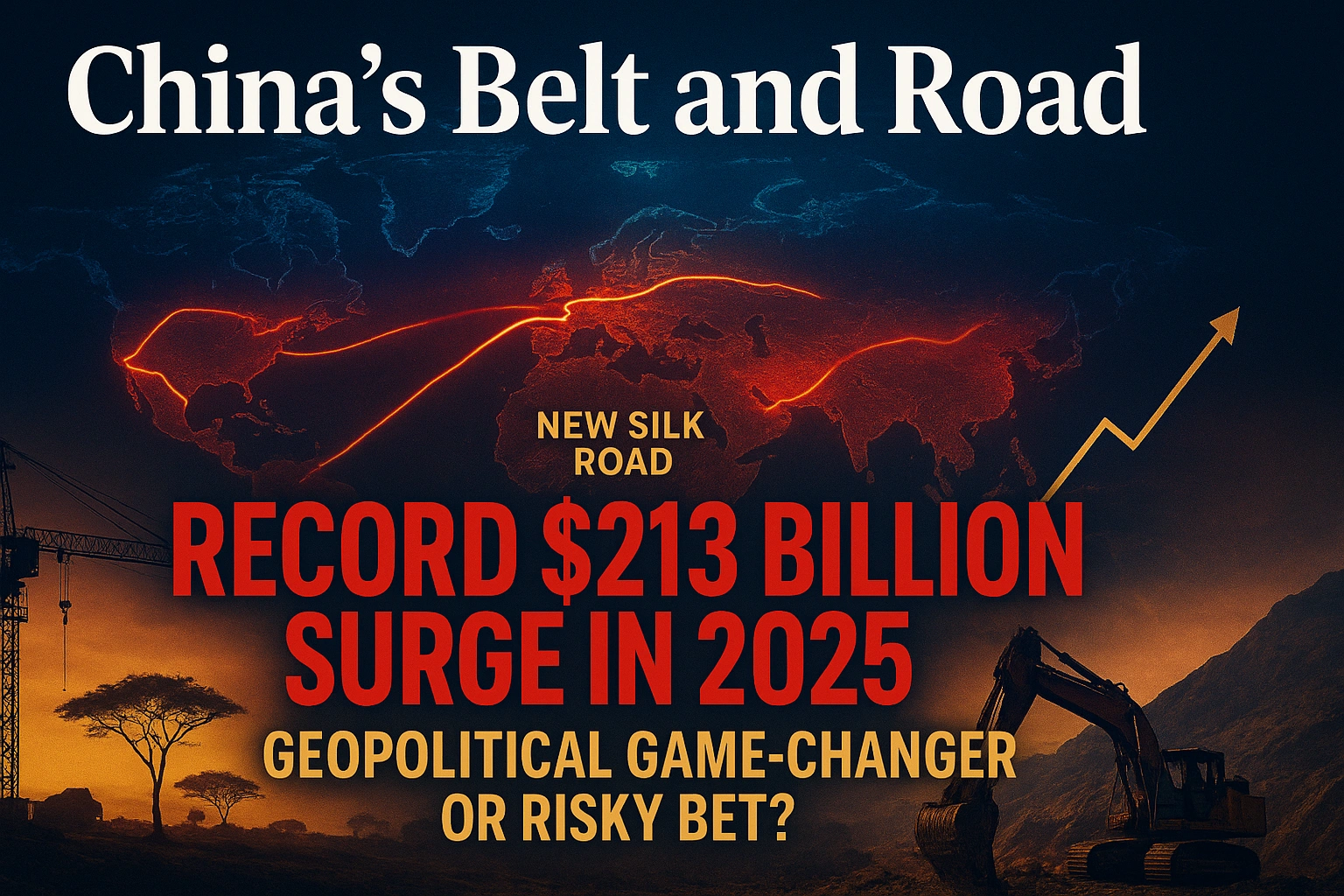
China’s Belt and Road Roars Back: A Record $213 Billion Surge in 2025 and What It Means for the World

Published

on

As Western infrastructure promises stall, Beijing’s flagship initiative delivers its strongest year yet—fueling a dramatic global realignment

On a sweltering afternoon in Port Harcourt, Nigeria, construction crews break ground on what will become one of Africa’s largest liquefied natural gas facilities. In the snow-dusted steppes of Kazakhstan, Chinese engineers finalize contracts for a sprawling wind farm complex. Thousands of miles away in the Democratic Republic of Congo, surveyors map terrain for copper mining operations that will feed the world’s electric vehicle revolution. These disparate projects share a common thread: they represent fragments of the most ambitious infrastructure undertaking in modern history, one that in 2025 achieved a resurgence few observers predicted.

China’s Belt and Road Initiative recorded $213.5 billion in new deals during 2025, according to the Griffith Asia Institute’s comprehensive annual report released in January 2026. This staggering figure—comprising $128.4 billion in construction contracts and $85.2 billion in direct investments—represents a 75% surge from 2024 and marks the Belt and Road’s strongest performance since Beijing launched the initiative in 2013. The cumulative total now stands at $1.399 trillion across more than 150 countries, cementing the BRI as the defining infrastructure project of the 21st century.

But raw numbers tell only part of the story. Beneath this remarkable resurgence lies a complex narrative of geopolitical repositioning, environmental contradictions, and shifting global power dynamics that will shape international relations for decades to come.

The Numbers Behind the Comeback

To understand the magnitude of 2025’s acceleration, context is essential. The Belt and Road Initiative 2025 performance represents a dramatic reversal from recent years of stagnation and retrenchment. Following peak activity in the late 2010s, Chinese overseas infrastructure engagement contracted sharply during the pandemic years, dropping below $80 billion annually as Beijing confronted domestic economic headwinds and mounting international skepticism about debt sustainability.

The turnaround began cautiously in 2024 before exploding into 2025’s record-breaking figures. Christoph Nedopil Wang, director of the Griffith Asia Institute’s Green Finance & Development Center and author of the definitive BRI tracking report, describes the shift as “the most significant single-year expansion in the initiative’s history—one that fundamentally alters calculations about China’s global economic footprint.”

Year-over-Year BRI Engagement Comparison:

YearTotal EngagementConstruction ContractsDirect Investment% Change
2023$75.9 billion$48.2 billion$27.7 billion-8%
2024$122.1 billion$76.8 billion$45.3 billion+61%
2025$213.5 billion$128.4 billion$85.2 billion+75%

This acceleration occurred despite—or perhaps because of—intensifying geopolitical tensions, persistent Western skepticism, and domestic Chinese economic challenges including property sector troubles and deflationary pressures. The paradox raises fundamental questions: What drove this remarkable surge? And what does it signal about the global economic order’s evolution?

The Energy Paradox: Greenest and Dirtiest Year

Perhaps no aspect of China’s Belt and Road investments surge 2025 embodies contemporary contradictions more vividly than the energy sector’s composition. This was simultaneously the initiative’s “greenest” and “dirtiest” year—a paradox reflecting both China’s genuine renewable energy ambitions and its pragmatic resource security imperatives.

Energy transactions dominated the year’s activity, commanding $93.9 billion or 44% of total engagement. Within this massive portfolio lies a striking duality: renewable energy projects reached unprecedented heights while fossil fuel investments surged to levels unseen since the Paris Agreement era.

On the green ledger, solar and wind projects captured $31.2 billion in new commitments—triple the 2024 figure. China’s dominant position in renewable technology manufacturing allowed it to export turnkey solutions at prices Western competitors cannot match. The Zhambyl Wind Energy Complex in Kazakhstan, contracted at $4.8 billion, will generate 3,000 megawatts when completed in 2028, making it Central Asia’s largest renewable installation. In Egypt, Chinese firms secured contracts for solar parks totaling 6,500 megawatts across three desert sites.

Yet fossil fuels claimed an even larger share. Natural gas infrastructure absorbed $42.7 billion, led by Nigeria’s Brass LNG Project ($12 billion) and expansion of Mozambique’s offshore gas facilities ($8.3 billion). Coal-fired power plants—supposedly phased out under China’s 2021 pledge to cease overseas coal financing—found backdoor continuation through “already committed” projects and loopholes for facilities incorporating carbon capture technology. The Financial Times noted that Beijing “pours cash into Belt and Road financing in global resources grab,” highlighting how climate pledges bend when energy security concerns intensify.

This contradiction reflects pragmatic calculation rather than hypocrisy. Chinese policymakers view energy security as existential, particularly as Western sanctions regimes demonstrate how resource dependencies create vulnerabilities. Partner nations share this calculus: for countries like Pakistan, Bangladesh, and Indonesia, immediate electrification needs trump long-term climate considerations. Western offers of renewable-only infrastructure financing often arrive with conditions these nations find onerous or delayed by bureaucratic processes BRI streamlines.

“China offers what developing nations actually want, not what Western development agencies think they should want,” observes Dr. Sarah Chen, senior fellow at the Council on Foreign Relations. “That distinction explains much of BRI’s competitive advantage.”

Metals, Mining, and the Battery Arms Race

The second-largest sectoral surge occurred in metals and mining, which captured $32.6 billion in 2025—a near-quadrupling from 2024’s $8.7 billion. This explosion directly correlates with global electric vehicle production scaling and renewable energy infrastructure deployment, both requiring vast quantities of copper, lithium, cobalt, and rare earth elements.

The Democratic Republic of Congo emerged as the epicenter of BRI mining expansion, with Chinese firms securing or expanding operations across fourteen separate projects worth a combined $11.4 billion. The most significant, the Kamoa-Kakula Copper Complex expansion, will more than double output at what’s already the world’s second-largest copper mine. Separately, lithium extraction operations in Chile’s Atacama Desert and Argentina’s Lithium Triangle secured $6.2 billion in Chinese financing and technical partnership agreements.

These investments serve dual purposes. Commercially, they position Chinese firms at chokepoints in supply chains for technologies dominating the 21st-century economy. Geopolitically, they reduce dependence on Western-controlled commodity trading networks while cultivating influence in resource-rich nations courted by multiple great powers.

The strategy shows sophistication absent from earlier BRI phases. Rather than merely financing extraction, Chinese firms increasingly pursue integrated value chains—from mining through processing to component manufacturing. In Indonesia, a $3.8 billion nickel processing complex will produce battery-grade materials rather than exporting raw ore, creating local employment while ensuring Chinese EV manufacturers secure stable supplies.

Critics note environmental and labor concerns accompanying this mining boom. Independent monitors report inadequate environmental impact assessments, insufficient community consultation, and exploitative labor practices at some sites. Yet defenders counter that Chinese-backed operations increasingly meet international standards and compare favorably to Western mining firms’ historical records in the same regions.

Africa and Central Asia: The New Frontiers

Geographic reorientation constitutes the third defining feature of Belt and Road’s 2025 resurgence. While Southeast Asia remains important, the initiative dramatically pivoted toward Africa (up 283% to $67.8 billion) and Central Asia (up 156% to $31.4 billion).

Africa’s Transformative Moment

The China BRI record deals 2025 in Africa span infrastructure categories from ports to power grids, railways to refineries. Beyond sheer dollar figures, the qualitative shift matters: China increasingly finances transformative mega-projects rather than scattered smaller initiatives.

Top Five African BRI Projects in 2025:

  1. Nigeria Brass LNG Complex – $12.0 billion (energy)
  2. Republic of Congo Pointe-Noire Port Expansion – $6.8 billion (maritime infrastructure)
  3. DRC Kamoa-Kakula Copper Expansion – $5.7 billion (mining)
  4. Ethiopia Abay Grand Infrastructure Corridor – $4.9 billion (multi-modal transport)
  5. Tanzania Standard Gauge Railway Phase III – $3.8 billion (rail transport)

These projects reflect African nations’ infrastructure deficit—estimated at $100 billion annually by the African Development Bank—and Western development finance’s chronic inability to deliver at comparable scale and speed. While the United States’ Partnership for Global Infrastructure and Investment (PGII) announced with fanfare in 2022, has struggled to deploy even $10 billion of its promised $200 billion, China moves from commitment to groundbreaking in months rather than years.

The South China Morning Post reported that African leaders increasingly view BRI as the only viable mechanism for achieving infrastructure parity with developed regions. This perception, whether entirely accurate or not, shapes diplomatic alignments and voting patterns in multilateral forums where China seeks support on issues from Taiwan to trade rules.

Central Asia’s Strategic Significance

Central Asia’s 156% surge reflects both geography and geopolitics. These former Soviet republics occupy the literal heartland of Eurasia, controlling energy corridors, mineral deposits, and overland routes linking China to Europe and the Middle East.

Kazakhstan led regional engagement with $14.2 billion in new BRI contracts, headlined by the Zhambyl wind project but extending to oil pipeline upgrades, railway modernization, and industrial park development. Uzbekistan ($8.7 billion) and Turkmenistan ($4.3 billion) followed, with transactions heavy on gas infrastructure and textile manufacturing.

Russia’s invasion of Ukraine accelerated this pivot. Western sanctions severed many Central Asian republics’ traditional economic links through Russian territory, creating openings for Chinese alternatives. Transportation projects now explicitly route around Russian networks—the Trans-Caspian International Transport Route expansion ($2.1 billion in Chinese financing) creates a China-Central Asia-Caucasus-Europe corridor bypassing Russian railways entirely.

This geographic shift also serves domestic Chinese objectives. Xinjiang, China’s westernmost province and focal point of international human rights criticism, borders three Central Asian nations. BRI projects creating economic interdependence with neighbors potentially complicate Western pressure campaigns while absorbing output from Xinjiang’s industrial capacity.

Geopolitical Drivers: Resource Security in an Age of Fragmentation

Strip away the development rhetoric, and Belt and Road fundamentally represents China’s response to strategic vulnerabilities exposed by intensifying US-China competition. The 2025 surge occurred against backdrop of tightening Western export controls on semiconductors and other critical technologies, expanding AUKUS security cooperation, and increasingly explicit American efforts to limit Chinese economic influence.

Three overlapping security imperatives drive Beijing’s doubling down on BRI:

Supply Chain Resilience

The pandemic and subsequent geopolitical tensions demonstrated catastrophic vulnerabilities in globalized supply chains. Chinese policymakers concluded that resource security requires not just diversified suppliers but also controlled infrastructure connecting extraction sites to Chinese industry. BRI investments lock in access through ownership stakes, long-term contracts, and strategic infrastructure like ports and railways that Chinese firms operate.

The mining sector surge exemplifies this logic. With Western nations pursuing “friend-shoring” and “de-risking” strategies to reduce China dependencies, Beijing races to secure physical control over resources before such initiatives mature. The battery metals boom means Chinese firms must lock in cobalt, lithium, and rare earth supplies now or face potential exclusion later.

Diplomatic Leverage

Each billion dollars invested buys not just commodities or construction contracts but diplomatic capital. BRI partner nations frequently support Chinese positions in UN voting, remain neutral on Xinjiang and Hong Kong criticisms, and resist pressure to exclude Huawei from telecom networks. While crude “debt trap diplomacy” narratives oversimplify complex relationships, patterns of alignment are undeniable.

The Africa surge particularly matters for multilateral diplomacy. African nations comprise more than one-quarter of UN General Assembly votes and increasingly assert collective agency on global governance reforms where China seeks greater influence.

Counter-Hegemonic Infrastructure

More ambitiously, BRI aims to create alternative networks reducing global dependence on Western-dominated financial and logistical infrastructure. Chinese payment systems, satellite networks, telecommunications equipment, and standardized railway gauges gradually build parallel systems that function independently of American or European control.

This creates optionality for partner nations and complications for Western coercive diplomacy. When the United States or EU threaten sanctions, targeted nations increasingly can pivot to Chinese-backed alternatives—a dynamic fundamentally altering traditional Western leverage.

The Debt Question: Sustainability Versus Development

No discussion of Belt and Road reaches equilibrium without addressing debt sustainability—the initiative’s most persistent criticism. By late 2025, more than 60 countries owed China over $1.1 trillion in BRI-related debt, with several African and South Asian nations dedicating 15-25% of government revenues to Chinese loan servicing.

High-profile cases fuel debt trap narratives: Sri Lanka’s Hambantota Port lease, Zambia’s Chinese-held debt exceeding $6 billion, Pakistan’s chronic renegotiation requests. Research from organizations like the World Bank and AidData document numerous cases where BRI projects failed to generate promised returns, leaving recipients with white elephant infrastructure and crushing debt obligations.

Yet nuance matters. Recent academic research challenges simplistic debt trap framings, finding that Chinese creditors frequently renegotiate terms, accept delays, and restructure obligations rather than seizing collateral. The China Africa Research Initiative at Johns Hopkins documented 93 debt restructuring cases between 2000 and 2024, with Chinese lenders showing flexibility comparable to Paris Club creditors.

Moreover, the counterfactual matters: absent BRI financing, many recipient nations would simply lack infrastructure entirely. The Tanzania railway transporting copper from landlocked Zambia to ports generates measurable economic activity impossible without the initial debt-financed construction. Bangladesh’s Chinese-built power plants ended decades of crippling electricity shortages, enabling industrial growth that enhanced debt servicing capacity.

“The debt sustainability question is real but often posed dishonestly,” argues Dr. Deborah Brautigam, director of the China Africa Research Initiative. “Western critics ignore that multilateral development banks also saddle poor countries with debt, often with more stringent conditions and slower disbursement. The relevant question is whether projects generate sufficient development benefits to justify borrowing, not whether debt exists at all.”

The 2025 surge included modest improvements toward sustainability. Average interest rates declined to 4.2% from 5.7% in prior years. Concessional loan percentages increased slightly. More projects incorporated revenue-sharing arrangements rather than fixed repayment schedules. Whether these shifts represent genuine reform or cosmetic adjustments to deflect criticism remains debatable.

Western Alternatives: Promises Versus Performance

Understanding BRI’s resurgence requires examining the competitive landscape. Western democracies belatedly recognized infrastructure’s geopolitical significance, launching initiatives explicitly framed as BRI alternatives: the G7’s Build Back Better World (B3W) in 2021, rebranded as Partnership for Global Infrastructure and Investment (PGII) in 2022, the EU’s Global Gateway, and Japan’s Partnership for Quality Infrastructure.

These programs promised hundreds of billions in infrastructure financing emphasizing sustainability, transparency, and good governance. Three years later, delivery lags embarrassingly behind rhetoric. PGII’s $200 billion commitment over five years has deployed under $15 billion in actual projects. Global Gateway’s €300 billion pledge has yielded scattered small-scale initiatives rather than transformative mega-projects.

Multiple factors explain this gap. Western financing mechanisms involve multilateral coordination, environmental impact assessments, labor standards compliance, and procurement transparency that—while laudable—create bureaucratic obstacles Chinese state-owned enterprises bypass. Private sector participation requires bankable returns that many developing market projects cannot guarantee. Recipient nations face conditions on governance, transparency, and policy reform that BRI loans avoid.

The result: Western financing promises attract headlines while Chinese construction crews break ground. For African or Asian leaders seeking tangible infrastructure on electoral timelines, the choice becomes stark. BRI’s appeal lies less in Chinese superiority than Western ineffectiveness.

Some observers detect shifting Western approaches in response. Recent PGII announcements emphasize fewer conditions and faster deployment. Whether these adjustments can match BRI’s pace without sacrificing standards remains uncertain.

The Human Dimension: Winners, Losers, and Complexities

Beyond geopolitical abstractions and billion-dollar figures, Belt and Road manifests in human experiences across partner nations—experiences far more complex than either cheerleading or condemnation acknowledges.

In Kenya, Chinese-built Standard Gauge Railway reduced Mombasa-Nairobi transit time from twelve hours to four, slashing business costs and enabling small traders to access larger markets. Yet the same railway displaced thousands of families, many inadequately compensated, and employs primarily Chinese workers in skilled positions while reserving menial labor for locals.

In Pakistan’s Gwadar, Chinese investment created port infrastructure transforming a fishing village into a potential trading hub. Yet locals complain of marginalization as Chinese-developed enclaves restrict access and fishing grounds shrink to accommodate industrial development. Promised prosperity hasn’t materialized for many residents who now live in limbo between traditional livelihoods lost and modern employment opportunities not yet arrived.

In Central Asia, BRI highway construction connects remote communities to markets and services previously inaccessible. But the same roads facilitate resource extraction that enriches Chinese firms and local elites while providing little benefit to ordinary citizens beyond low-wage construction employment.

These complexities defy simplistic narratives. BRI simultaneously drives development and creates dependencies, generates employment and displaces communities, builds infrastructure and extracts resources. Partner nation governments bear responsibility for negotiating terms, ensuring environmental protections, and distributing benefits equitably—responsibilities many fail to discharge effectively.

Civil society organizations increasingly recognize this complexity, moving beyond blanket opposition toward demanding better project design, stronger safeguards, and more equitable benefit-sharing. Some Chinese institutions show responsiveness: debt restructuring, improved environmental standards, increased local employment targets. Whether this represents genuine learning or tactical adaptation to criticism remains contested.

Looking Forward: Trajectories and Transformations

As 2026 unfolds, several trends will shape Belt and Road’s evolution:

Sectoral Focus: Energy transition pressures and battery technology demands will sustain mining and renewable investments. Fossil fuel projects face increasing reputational costs, potentially moderating the 2025 surge even as energy security concerns persist. Technology infrastructure—5G networks, data centers, digital payment systems—will likely capture growing shares as China exports digital economy capabilities.

Regional Shifts: Africa and Central Asia will probably retain prominence, with possible expansion into Latin America if commodity prices remain elevated. Southeast Asia may see relatively slower growth as earlier BRI phases already developed much infrastructure. Middle Eastern petrostates flush with oil revenues present interesting opportunities, particularly around renewable energy and high-tech manufacturing.

Financial Innovation: Expect continued movement toward local currency financing, reducing dollar dependencies that create vulnerabilities for both China and partner nations. Yuan internationalization receives subtle but steady advancement through BRI transactions. Blended finance mechanisms combining Chinese state capital with private investment may increase as Beijing seeks to reduce fiscal exposure.

Governance Improvements: Whether from genuine commitment or diplomatic necessity, modest improvements in transparency, environmental standards, and labor practices will likely continue. Multilateral cooperation on debt restructuring through frameworks like the G20 Common Framework may increase as defaults multiply. These changes will remain incremental rather than transformative.

Geopolitical Competition: Western infrastructure initiatives will probably improve delivery but remain unlikely to match BRI’s scale. The competition shifts toward selective counterprogramming in strategic regions and technologies rather than comprehensive alternatives. Middle power nations like Japan, South Korea, and UAE pursue independent infrastructure diplomacy, fragmenting what was once clearer Western-Chinese dichotomy.

The most significant question involves sustainability—not just debt sustainability but BRI’s viability within China’s evolving domestic context. With economic growth slowing, property sector troubles persisting, and local government debt mounting, can Beijing sustain massive overseas infrastructure financing indefinitely?

Analysts divide on this question. Skeptics note that China’s domestic challenges necessitate capital retention rather than export. Defenders counter that BRI serves strategic interests justifying financial costs, particularly as domestic investment opportunities diminish in saturated infrastructure markets.

Conclusion: Recalibrating Global Order

China’s Belt and Road Initiative record $213 billion year represents far more than construction contracts and commodity deals. It signals a fundamental recalibration of global economic geography, one where developing nations increasingly turn to Beijing rather than Washington for infrastructure, investment, and development models.

This shift unfolds against broader patterns of fragmentation replacing the integrated globalization that characterized the post-Cold War era. Supply chains regionalize. Payment systems diverge. Technology standards multiply. Infrastructure networks realign along geopolitical rather than purely economic logic.

Whether this trajectory proves sustainable remains uncertain. China’s domestic economic headwinds could force retrenchment. Debt crises could trigger partner nation backlash. Western alternatives might eventually deliver on promises. Environmental and social criticisms could impose constraints Chinese policymakers cannot ignore.

Yet for now, the momentum runs decisively in BRI’s favor. While Western nations debate infrastructure financing mechanisms in Brussels and Washington conference rooms, Chinese firms pour concrete, string power lines, and lay rail tracks from Lagos to Lahore, Quito to Astana. Grand strategy manifests in tangible construction, development aspiration meets engineering capacity, and geopolitical influence accumulates one project at a time.

The global order that emerges from this infrastructure revolution will differ profoundly from what preceded it. Roads, railways, ports, and power grids built today will shape economic possibilities, political alignments, and strategic calculations for generations. Understanding Belt and Road’s 2025 resurgence means understanding the future being built, quite literally, right now.

For policymakers in Washington, Brussels, Tokyo, and New Delhi, the message is stark: competing effectively requires moving beyond rhetoric to deliver tangible alternatives at scale and speed. For leaders in Nairobi, Dhaka, and Jakarta, the challenge involves negotiating terms that advance development without mortgaging sovereignty. And for observers everywhere, the imperative is seeing Belt and Road clearly—neither as development panacea nor neo-colonial trap, but as complex reality reshaping our interconnected world.

The road ahead remains under construction, but its direction increasingly runs eastward.


Discover more from The Economy

Subscribe to get the latest posts sent to your email.

Business

Gold Hits Record High 2026 as Trump Davos-Greenland Crisis Deepens

Published

on

Gold prices soar past $4,800 amid Trump’s Greenland tariff threats and Davos arrival. Analysis of safe-haven demand, geopolitical risks, and market outlook.

The yellow metal has spoken, and its message reverberates from trading floors in London to the Alpine corridors of power. Gold prices shattered all previous records on January 21, 2026, surging past $4,850 per troy ounce as President Donald Trump departed for the World Economic Forum in Davos—a journey briefly interrupted when Air Force One experienced an electrical malfunction, forcing a return to base and a switch to the backup aircraft. The incident, minor in technical terms but symbolically resonant, seemed to mirror the turbulence roiling global markets as investors flee to the ultimate safe haven amid escalating tensions over Greenland.

The timing could scarcely be more charged. Trump’s renewed push to acquire Greenland—dismissed as improbable during his first term—has evolved from rhetorical flourish to concrete policy threat, complete with proposed tariffs on Denmark and the European Union should they resist American overtures. As the president’s plane finally lifted off for Switzerland, gold traders were already pricing in scenarios that would have seemed fantastical mere months ago: a transatlantic trade war triggered by Arctic territorial ambitions, a fracturing of NATO’s unity, and the potential unraveling of the post-1945 consensus on sovereignty and territorial integrity.

This is not merely another spike in precious metals pricing. The gold record high January 2026 represents a profound vote of no confidence in the stability of the international order, a hedge against the unthinkable becoming routine. As Trump prepares to address global elites in Davos—many of whom view his Greenland gambit with alarm bordering on disbelief—the question is no longer whether markets will react, but how far the contagion will spread.

The Gold Rally in Context: Safe Haven Demand Meets Dollar Doubt

To understand why gold prices hit record high January 2026, one must first grasp the convergence of forces that have transformed bullion from a defensive play into a must-own asset. According to data compiled by Bloomberg, spot gold has risen approximately 18% since the start of the year, obliterating the previous all-time high of $4,150 set in late 2025. The surge accelerates a trend that began when Trump’s transition team first floated the Greenland acquisition in December, but the current rally reflects broader anxieties.

The immediate catalyst is clear: Trump’s tariff threats over Greenland have injected extraordinary uncertainty into transatlantic trade relations. The president has suggested levies as high as 200% on select Danish and European goods should Copenhagen refuse to negotiate Greenland’s status—a position that The Financial Times describes as “without precedent in modern diplomatic history.” European Commission President Ursula von der Leyen has called the proposal “an assault on the principles that have governed relations between democracies for eight decades,” setting the stage for confrontation rather than compromise.

But the Trump Greenland tariffs represent only one dimension of gold’s safe haven appeal. The dollar, traditionally an alternative refuge during geopolitical stress, has weakened against a basket of currencies as investors question whether the United States can simultaneously pursue aggressive unilateral policies and maintain the reserve currency’s privileged status. The dollar index has declined nearly 4% since early January, a significant move that makes gold more attractive to holders of other currencies while also reflecting doubts about American policy coherence.

Historical parallels abound, though none align perfectly. The 1970s stagflation era saw gold surge from $35 per ounce to over $800 as the Bretton Woods system collapsed and geopolitical shocks—oil embargoes, Cold War tensions—eroded confidence in fiat currencies. More recently, Trump’s first-term trade war with China in 2019 drove gold above $1,500 as investors hedged against tariff escalation and growth slowdowns. Yet the current rally differs in velocity and breadth: central banks from China to Poland are reportedly accelerating gold purchases, while retail demand in Asia has surged despite record prices—a sign that even price-sensitive buyers view current risks as extraordinary.

“Gold is doing what it’s supposed to do,” noted a commodities strategist at a major investment bank in a Reuters interview, “but the speed and magnitude suggest markets are pricing in tail risks that we normally associate with wartime or financial crisis. The Greenland situation has become a focal point for broader anxieties about American reliability and the rules-based order.”

The Federal Reserve’s policy stance adds another layer of complexity. With inflation still above target but growth showing signs of deceleration, the Fed faces an impossible trilemma: maintain credibility through continued restraint, support growth through easing, or absorb the inflationary shock of potential tariffs. Gold, which pays no interest and thus competes with bonds when rates rise, has historically thrived in environments where real yields—nominal rates minus inflation—turn negative or uncertainty renders yield calculations irrelevant. Current market pricing suggests investors believe the Fed will ultimately prioritize growth over inflation control, a calculation that favors hard assets.

Greenland Becomes the Fault Line: Arctic Ambitions and Atlantic Fractures

The question of how Greenland transformed from a peripheral issue to the potential trigger for a transatlantic rupture deserves careful examination. The autonomous Danish territory, home to approximately 57,000 people and vast deposits of rare earth minerals critical for modern technology, has long attracted interest from great powers. Yet Trump’s renewed campaign—characterized by public statements describing Greenland’s acquisition as essential for national security and economic competitiveness—represents a sharp departure from diplomatic norms.

As The New York Times reported, Trump’s advisers have framed Greenland through the lens of strategic competition with China, which has sought Arctic access and rare earth dominance for over a decade. Greenland’s mineral wealth includes neodymium, praseodymium, and dysprosium—elements essential for electric vehicle motors, wind turbines, and advanced military systems. China currently controls approximately 70% of global rare earth processing, a monopoly that American policymakers view as an unacceptable vulnerability.

Beyond minerals, Greenland occupies critical geography as Arctic ice melt opens new shipping routes and resource extraction opportunities. The Northwest Passage, increasingly navigable due to climate change, could reduce shipping times between Asia and Europe by roughly 40% compared to traditional routes through the Suez or Panama canals. Military strategists note that Thule Air Base, already operated by the United States in northwestern Greenland, would become even more valuable in any scenario involving Russian or Chinese Arctic expansion.

Denmark’s position, however, remains unambiguous. Prime Minister Mette Frederiksen has stated repeatedly that “Greenland is not for sale,” a position supported unanimously by the Danish parliament. Greenland’s own government, led by Premier Múte Bourup Egede, has emphasized the territory’s right to self-determination while noting its constitution does not permit unilateral secession from the Kingdom of Denmark without Danish consent—a legal complexity that makes any transfer of sovereignty extraordinarily difficult even if Greenlanders desired it.

The escalation to tariff threats marks a dangerous inflection point. The Economist notes that using trade policy to coerce territorial concessions from an ally violates both World Trade Organization principles and the spirit of NATO, potentially setting precedents that could undermine the entire framework of Western economic and security cooperation. European officials have responded with unusual unity, warning that American tariffs would trigger immediate retaliation and could force a fundamental reassessment of the transatlantic relationship.

NATO complications add further volatility. Both the United States and Denmark are founding members of the alliance, which operates on principles of collective defense and mutual respect for sovereignty. Article 5—the collective defense clause—has been invoked only once, following the September 11 attacks, when European allies rallied to America’s defense. The prospect of the alliance’s most powerful member threatening economic warfare against a small fellow member over territorial acquisition raises existential questions about NATO’s purpose and viability.

Geopolitical analysts suggest several factors explain the timing of Trump’s push. The Ukraine war has demonstrated the strategic value of resource security and territorial control. China’s Belt and Road Initiative continues expanding into the Arctic through partnerships with Russia. And domestic American politics increasingly reward bold nationalist postures over traditional diplomatic caution. Yet the gap between Trump’s stated objectives and feasible outcomes remains vast—a disconnect that markets are pricing into safe haven assets like gold.

Davos Under Strain: Global Elites Confront American Unilateralism

The World Economic Forum’s annual gathering in Davos typically serves as a venue for consensus-building among political and business elites, a place where disagreements are aired but common ground is sought. Trump’s arrival this week, however, has transformed the event into something approaching a reckoning with American power and its limits.

According to reports from The Wall Street Journal, European leaders have coordinated their messaging in advance of Trump’s expected address, preparing to confront the Greenland issue directly while seeking to preserve broader economic ties. French President Emmanuel Macron, German Chancellor Friedrich Merz, and European Commission officials plan to emphasize that territorial sovereignty is non-negotiable regardless of economic inducements or threats—a message intended for domestic audiences as much as for Trump.

The president’s Davos speech, scheduled for the forum’s main stage, will be scrutinized for signals about how far he intends to push the Greenland confrontation. Trump’s advisers have suggested he will frame the issue in terms of “American renewal” and “correcting historic mistakes,” language that could either provide face-saving ambiguity or double down on maximalist demands. Markets appear positioned for the latter, with gold’s continued strength suggesting traders expect escalation rather than de-escalation.

Business leaders attending Davos face their own dilemmas. American companies with significant European operations—a category that includes most Fortune 500 firms—would suffer severe disruption from any transatlantic trade war. Yet corporate executives have limited leverage over Trump’s foreign policy and risk domestic political backlash if they appear to prioritize foreign relationships over American interests as the administration defines them.

The International Monetary Fund’s managing director is expected to warn during the forum that a trade conflict between the United States and Europe could shave up to 1.5% from global GDP growth, a shock comparable to the initial impact of COVID-19 lockdowns. The IMF’s analysis, as covered by the Financial Times, suggests that even if tariffs are implemented briefly before negotiation, the uncertainty costs alone would trigger capital flight, supply chain disruptions, and investment delays that could take years to reverse.

China’s absence from high-profile Davos discussions is notable, as Beijing has carefully avoided entanglement in the Greenland dispute while quietly positioning itself to benefit from transatlantic discord. Chinese officials have signaled willingness to deepen economic ties with Europe should American relationships fray, offering a strategic alternative that European leaders find simultaneously attractive and concerning given their own worries about Chinese influence.

Potential outcomes range widely. Optimistic scenarios envision Trump using tariff threats as negotiating leverage to extract concessions on other issues—Arctic cooperation agreements, rare earth supply chains, defense burden-sharing—before declaring victory and stepping back. Pessimistic scenarios involve actual tariff implementation, European retaliation, and a downward spiral that fragments Western economic integration. Markets currently price probabilities somewhere between these extremes, with gold’s rally suggesting greater weight on downside risks.

Broader Implications and Outlook: When Safe Havens Become the Trade

The gold record high 2026 extends far beyond precious metals markets, sending ripples through currencies, sovereign debt, equities, and commodities. The dollar’s decline, already mentioned, accelerates as foreign central banks reportedly diversify reserves away from U.S. Treasury securities—not yet at panic levels, but sufficient to pressure yields higher and complicate Federal Reserve policy. The euro has strengthened despite Europe’s own economic challenges, reflecting a relative assessment that European institutions, whatever their flaws, present less immediate risk than American policy volatility.

Equity markets have responded with characteristic schizophrenia: technology stocks decline on fears that rare earth supply disruptions could raise input costs, while defense contractors rally on expectations of increased military spending. European indices underperform American counterparts as investors price in recession risk from potential tariffs, yet both lag the relentless upward march of gold and other hard assets.

Cryptocurrency advocates have sought to position Bitcoin and other digital assets as alternative safe havens, noting Bitcoin’s own surge above $105,000 this month. Yet analysis from Bloomberg suggests crypto’s rally reflects different dynamics—liquidity flows and speculative positioning—rather than the genuine flight-to-safety driving gold demand. When markets price genuine systemic risk, the argument goes, five thousand years of precedent favor the metal over the algorithm.

Commodity markets more broadly reveal growing concern about supply chain fragmentation. Industrial metals have rallied alongside gold as traders position for a world where geopolitical barriers replace just-in-time efficiency. Oil prices remain subdued, reflecting demand concerns, but natural gas has spiked on European fears about energy security should broader conflicts emerge. Agricultural commodities show increased volatility as weather uncertainties compound with trade policy unpredictability.

The question now dominating trading desk conversations: can gold breach $5,000 per ounce, and if so, when? Technical analysts point to chart patterns suggesting momentum remains strong, with limited resistance levels until $5,200. Fundamental analysts note that if Trump’s Greenland push triggers even a moderate trade conflict, safe haven demand could easily propel prices higher. Central bank buying—particularly from China, Russia, and emerging markets seeking to reduce dollar exposure—provides a steady bid that wasn’t present during previous gold rallies.

Yet risks to the gold thesis exist. Any genuine de-escalation in Davos or afterward would likely trigger profit-taking, potentially sharp given how rapidly positions have built. If the Federal Reserve signals greater tolerance for market volatility or commits to maintaining high rates regardless of growth concerns, real yields could rise enough to make interest-bearing assets competitive again. And gold’s rally itself could prove self-limiting: at current prices, mine supply increases while jewelry demand—particularly from price-sensitive Asian consumers—softens.

Policy risks extend beyond trade. The European Union faces internal challenges as member states debate how firmly to confront American demands, with some Eastern European nations prioritizing security ties over economic principles. NATO’s credibility hangs in the balance, with unclear implications for defense spending, strategic planning, and alliance cohesion. And the precedent of using economic coercion to pursue territorial claims, should it succeed, would fundamentally alter the post-1945 international system in ways that extend far beyond the Arctic.

Conclusion: The Price of Disruption

Gold’s ascent to record highs amid Trump’s Davos arrival and the Greenland standoff crystallizes a moment of profound uncertainty about the architecture of global order. The electrical issue that briefly grounded Air Force One—a minor technical glitch resolved within hours—serves as an unintended metaphor for the larger questions now confronting markets and policymakers. When established systems encounter unexpected turbulence, do they adapt and continue, or do cascade failures follow?

The answer matters enormously. Gold prices, for all their drama, are merely symptoms of deeper anxieties about reliability, predictability, and the rules that govern interaction between nations. If the United States can threaten tariffs to coerce territorial concessions from allies, what other norms might be negotiable? If Europe cannot defend the sovereignty of its own members without risking economic catastrophe, what does collective security mean? If markets must price the previously unthinkable as merely improbable, what risk-free rate truly exists?

These are not questions with easy answers, which is precisely why gold—that most ancient of safe havens—trades at prices that would have seemed fantastical even a year ago. Davos will provide some clarity in coming days, though perhaps not the reassurance that markets crave. Until then, the yellow metal’s message remains clear: in an age of disruption, the ultimate hedge is the asset that predates the disruption itself.

The world watches Switzerland this week, waiting to learn whether American ambition and European principle can find accommodation, or whether the fractures now visible will deepen into chasms. Gold traders, characteristically, are not waiting for the answer—they’re betting that asking the question is reason enough to buy.


Discover more from The Economy

Subscribe to get the latest posts sent to your email.

Continue Reading

Business

Trump’s Greenland Tariffs Trigger Sharp Stock Market Slide as Fear Gauge Spikes

Published

on

Trump’s Greenland tariff threats sparked a 2% market plunge, pushing the VIX above 20 as investors flee U.S. assets. Analysis of the transatlantic crisis reshaping global markets.

Market Carnage as Geopolitical Gambit Rattles Investors

The trading floor of the New York Stock Exchange descended into controlled chaos on Tuesday, January 20, 2026, as President Donald Trump’s ultimatum over Greenland sent tremors through global financial markets. By the closing bell, the S&P 500 had hemorrhaged 143.15 points—a brutal 2.1% decline to 6,796.86—marking the benchmark index’s steepest single-day drop since October and erasing all gains accumulated in the young year.

“The fear trade is absolutely on right now,” observed Krishna Guha, head of global policy and central banking strategy at Evercore ISI, capturing the sentiment that gripped Wall Street as investors confronted an unprecedented scenario: the world’s most powerful economy threatening trade war against its closest military allies over territorial ambitions in the Arctic.

The Nasdaq Composite fared worse, plummeting 561.07 points or 2.4% to 22,954.32, while the Dow Jones Industrial Average shed 870 points—a 1.7% decline that wiped more than $1.2 trillion in market capitalization from the S&P 500 alone. The CBOE Volatility Index, Wall Street’s closely watched “fear gauge,” surged past the psychologically significant 20 threshold, reaching an intraday high of 20.99—levels not witnessed since mid-November when markets grappled with Federal Reserve policy uncertainty.

European markets mirrored the distress. Germany’s DAX plunged 1.0% to close at 24,703, while Britain’s FTSE 100 declined 0.7% and the pan-European STOXX 600 tumbled 0.7%, with the selloff intensifying throughout Tuesday’s session as the magnitude of the transatlantic rupture became apparent.

This was no ordinary market correction driven by earnings disappointments or macroeconomic data. This was a fundamental reassessment of geopolitical risk premiums, a repricing of American exceptionalism, and the emergence of what strategists termed the “Sell America” trade—a phenomenon not seen with such intensity since April 2025’s “Liberation Day” tariff tumult.

The convergence of Trump’s Greenland gambit with the annual World Economic Forum gathering in Davos created a surreal juxtaposition: global business leaders convening to discuss cooperation and prosperity even as the U.S. president threatened economic coercion against NATO allies. For investors navigating an already precarious landscape of elevated valuations, persistent inflation concerns, and approaching Federal Reserve leadership transitions, Trump’s Saturday announcement proved the catalyst for a long-anticipated reckoning.

The Greenland Escalation: From Sideshow to Systemic Crisis

President Trump’s interest in Greenland—the vast, ice-covered autonomous territory of Denmark—first surfaced during his initial term in 2019, when he privately floated the idea of purchasing the strategically located island. Danish officials dismissed the proposal as “absurd,” and the episode quickly faded from headlines, relegated to the category of Trumpian provocations that generated brief controversy before evaporating.

But what began as a seemingly quixotic fascination has metastasized into a full-blown diplomatic crisis with profound market implications. On Saturday, January 17, Trump announced via Truth Social that he would impose 10% tariffs on “any and all goods” from eight European nations—Denmark, Norway, Sweden, France, Germany, the United Kingdom, the Netherlands, and Finland—effective February 1, 2026. These levies would escalate to 25% on June 1 unless an agreement was reached for “the Complete and Total purchase of Greenland.”

Trump’s rationale combined national security imperatives with sweeping claims about Arctic geopolitics. “China and Russia want Greenland, and there is not a thing that Denmark can do about it,” Trump wrote, characterizing the joint military exercises recently conducted by European forces in Greenland as “a very dangerous situation for the Safety, Security, and Survival of our Planet.”

The timing of these military deployments—specifically by Danish, German, Norwegian, and French forces—was not coincidental. NATO allies had dispatched small contingents to Greenland in a calculated show of support for Denmark and a signal that they took Arctic security seriously, precisely the concern Trump claimed motivated his acquisition push. Yet Trump interpreted this allied solidarity as a “dangerous game” warranting punitive tariffs.

The targeted European nations represent some of America’s oldest and most strategically vital allies. Combined, these eight countries accounted for approximately $750 billion in bilateral trade with the United States in 2024, with Germany alone responsible for $236 billion, the United Kingdom $147.7 billion, and the Netherlands $122.3 billion, according to U.S. Census Bureau data. Imposing across-the-board tariffs on this volume of trade would constitute the largest unilateral trade action against allies in modern American history.

European leaders responded with unusual unity and force. In a joint statement released Sunday, leaders from the eight targeted nations warned that the tariff threats “undermine transatlantic relations and risk a dangerous downward spiral,” pledging to “stand united and coordinated in our response.” European Commission President Ursula von der Leyen and European Council President António Costa declared that “Europe will remain united, coordinated, and committed to upholding its sovereignty.”

French President Emmanuel Macron, attending the Davos forum, spoke of preferring “respect to bullies,” while Swedish Prime Minister Ulf Kristersson stated bluntly: “We will not let ourselves be blackmailed. Only Denmark and Greenland decide on issues concerning Denmark and Greenland.”

By Monday evening, the situation had further deteriorated when Trump threatened 200% tariffs on French wine after reports emerged that Macron had declined to join Trump’s proposed “Board of Peace” for Gaza. The escalation suggested a pattern of impulsive retaliation that heightened market anxiety about policy unpredictability.

Perhaps most revealing of the administration’s approach came during Tuesday’s White House briefing, when Trump was asked how far he would be willing to go to secure control of Greenland. His two-word response—”You’ll find out”—sent chills through diplomatic channels and trading desks alike. The president had declined to rule out military action in previous statements, and his cryptic answer did nothing to dispel concerns that the Greenland pursuit represented more than mere negotiating posture.

Anatomy of Tuesday’s Market Meltdown

The selloff that engulfed global markets on January 20 bore the hallmarks of a classic risk-off rotation, but with troubling undertones that distinguished it from routine volatility spikes. Investors weren’t merely seeking shelter from a passing squall; they were fundamentally reassessing the United States’ role as a stable anchor for global capital.

Equity Markets Under Siege

The carnage was broadly distributed across sectors, with only defensive consumer staples holding ground. Colgate-Palmolive gained 1.1% and Campbell’s rose 1.5% as investors sought refuge in recession-resistant names. But for cyclical and growth-oriented equities, Tuesday delivered punishing losses.

Technology stocks, which had led the market’s ascent through 2025, bore the brunt. The Nasdaq’s 2.4% decline reflected heightened concern that tariff-induced economic disruption would crimp corporate earnings precisely when valuations remained stretched. European technology shares fared no better, with the region’s tech-heavy sectors declining sharply.

Industrial conglomerate 3M plummeted 7% after reporting mixed quarterly results and CEO William Brown warned that proposed European tariffs could slice $60-70 million from 2026 earnings—a concrete example of how Trump’s Greenland strategy was already flowing through to corporate guidance. Automotive manufacturers, facing the prospect of severely disrupted transatlantic supply chains, suffered disproportionate losses. BMW, Volkswagen, Daimler Truck, Porsche, and Mercedes-Benz each declined between 3% and 3.7%, reflecting Germany’s particular vulnerability as an export-oriented economy.

European luxury goods makers, sensitive to both consumer confidence and currency movements, also stumbled. Shares of LVMH—owner of Moët & Chandon, Dom Pérignon, and Veuve Clicquot—fell 2.1% on concerns about Trump’s 200% wine tariff threat, while Rémy Cointreau declined modestly.

The breadth of the decline was striking: on the New York Stock Exchange, decliners outnumbered advancers by a 1.19-to-1 ratio, while the Nasdaq saw a 1.34-to-1 ratio favoring declining issues. A total of 18.77 billion shares changed hands, well above the recent 20-session average of 16.85 billion—a sign of forced repositioning rather than measured profit-taking.

The VIX Surge: Fear Reclaims 20

The CBOE Volatility Index’s breach of 20 represented more than a statistical milestone. The VIX had spent much of late 2025 oscillating between 12 and 16, reflecting market complacency despite elevated absolute valuations. Its jump to an intraday high of 20.99 on Tuesday—closing at approximately 20.71—signaled that the “honeymoon period” with Trump’s second-term economic policies had decisively ended.

Historically, VIX readings above 20 indicate heightened investor anxiety and often presage periods of sustained turbulence. The index’s surge reflected surging demand for portfolio insurance through S&P 500 options, with traders paying premiums to protect against further downside. Notably, VIX futures curves inverted slightly, suggesting near-term volatility concerns outweighed long-term fears—a pattern consistent with event-driven spikes rather than structural bear markets.

“The VIX reclaiming the 20 level is more than just a statistical milestone; it is a clear signal that the market’s ‘honeymoon period’ with the current administration’s economic policies has ended,” noted analysts at FinancialContent, emphasizing that the convergence of the Greenland tariff threat with earnings uncertainty and lingering effects of the 43-day government shutdown had created a “visibility gap” making every headline a potential market-mover.

Safe-Haven Flows: Gold, Silver, and Treasury Dynamics

The flight to safety manifested most dramatically in precious metals markets. Gold surged to new all-time highs, trading near $4,600 per ounce—a gain of approximately 6% year-to-date. Silver outperformed even gold’s impressive advance, soaring above $95 per ounce, representing a remarkable 16% gain since January 1 and more than 200% appreciation from year-ago levels.

The precious metals rally reflected multiple anxieties: inflation hedging, currency debasement concerns, and pure geopolitical risk aversion. Analysts at Bank of America noted that gold was serving as “the primary hedge and performance driver in 2026,” with some forecasts suggesting silver could reach as high as $135-$309 per ounce if industrial demand for green energy applications continued accelerating alongside safe-haven buying.

Paradoxically, U.S. Treasury prices fell sharply Tuesday despite their traditional safe-haven status, sending yields spiking. The 10-year Treasury yield jumped approximately 6 basis points to 4.29%, while 20- and 30-year yields also climbed—making it more expensive for the U.S. government to service its $36 trillion debt burden. This atypical behavior signaled something more troubling than routine risk rotation: international investors were actively selling American sovereign debt, questioning the reliability of U.S. policy commitments.

Denmark’s announcement that pension fund Akademikerpension would sell $100 million in U.S. Treasuries—citing “poor U.S. government finances” but clearly motivated by the Greenland dispute—provided a concrete example of the “Sell America” dynamic. While Treasury Secretary Scott Bessent dismissed the move as “irrelevant” given its modest size, the symbolic importance was unmistakable: even small, wealthy U.S. allies were beginning to weaponize their dollar holdings.

Currency Markets Signal Confidence Crisis

The U.S. Dollar Index, which measures the greenback against a basket of six major currencies, tumbled nearly 1%—its sharpest single-day decline since April 2025. The euro gained 0.6% against the dollar, reflecting not European economic strength but rather a repricing of American political risk.

“This is ‘sell America’ again within a much broader global risk off,” wrote Krishna Guha of Evercore ISI, noting that the dollar’s weakness and euro’s strength suggested global investors were “looking to reduce or hedge their exposure to a volatile and unreliable” United States. The currency movements were particularly significant given that international capital had flooded into dollar-denominated assets throughout 2024 and 2025, drawn by American growth outperformance and the AI investment boom.

Guha warned that if Trump failed to walk back his Greenland plans—a trade known colloquially as “TACO” (Trump Always Chickens Out)—or find a diplomatic compromise, the impacts on the dollar and other U.S. assets “could be severe and long-term.”

The Geopolitical Stakes: Why Greenland Matters

To understand why markets reacted with such alarm to Trump’s Greenland gambit requires examining the island’s unique strategic significance and the broader Arctic competition reshaping 21st-century geopolitics.

Geographic Imperative: The GIUK Gap and Arctic Chokepoints

Greenland occupies a position of extraordinary strategic importance, sitting astride the GIUK Gap—the maritime corridor between Greenland, Iceland, and the United Kingdom. During the Cold War, this choke point was crucial for monitoring Soviet submarine movements between the Arctic and the Atlantic. Today, as Russia rebuilds its Northern Fleet and increases Arctic military activity, the GIUK Gap has regained salience as a surveillance and potential interdiction zone.

The United States maintains Pituffik Space Base (formerly Thule Air Base) in northwestern Greenland—a critical installation for missile early warning, space surveillance, and satellite tracking. Established in 1951 under a defense agreement with Denmark, Pituffik provides coverage of potential ballistic missile launches from Russia and gives the U.S. strategic depth for Arctic operations.

Climate change has dramatically elevated Greenland’s importance. Melting Arctic ice is opening new shipping routes—the Northwest Passage along North America’s northern coast and the Transpolar Sea Route through the central Arctic Ocean—that could slash transit times between Asia, Europe, and North America. These emerging corridors will require infrastructure, maritime governance, and security frameworks. Greenland’s geographical position makes it central to managing this transformation.

The Rare Earth Dimension: Critical Minerals and Supply Chain Vulnerability

Beyond military geography, Greenland harbors substantial deposits of rare earth elements and other critical minerals essential for modern technology, renewable energy systems, and defense applications. The island’s mineral wealth includes rare earths, uranium, iron ore, and potentially significant oil and gas reserves.

Rare earth elements—comprising 17 minerals crucial for high-performance magnets, electronics, and precision guidance systems—represent a particular vulnerability for Western economies. China currently dominates the global rare earth supply chain, controlling approximately 60% of mining and more than 90% of processing capacity. This monopoly position grants Beijing potential leverage over industries ranging from electric vehicles to wind turbines to advanced weaponry.

Greenland’s Tanbreez and Kvanefjeld deposits contain substantial heavy rare earth reserves that could diversify supply chains away from Chinese dominance. In June 2025, the U.S. Export-Import Bank expressed interest in providing a $120 million loan to fund Tanbreez mining development—signaling the Trump administration’s recognition of Greenland’s resource value.

However, exploiting these resources faces daunting obstacles: extreme climate conditions, mountainous terrain, virtually non-existent infrastructure, and stringent environmental regulations championed by Greenland’s largely Indigenous Inuit population. Mining development remains aspirational rather than imminent, and any projects would require sustained multi-billion-dollar investments over decades.

The China Factor: Arctic Ambitions and the Polar Silk Road

China declared itself a “near-Arctic state” in 2018—a geographically questionable designation given China’s distance from the Arctic Circle—and announced its “Polar Silk Road” strategy as an extension of the Belt and Road Initiative. Beijing has pursued scientific research stations, infrastructure investments, and resource acquisition throughout the Arctic, though with limited success in Greenland specifically.

Chinese attempts to invest in Greenlandic airports were blocked in 2018 after Danish and U.S. pressure, and other mining ventures involving Chinese partners have stalled or failed. Nevertheless, China’s Arctic ambitions remain a persistent concern for Washington, particularly as Beijing deepens its relationship with Russia and expands its ice-capable naval fleet.

Trump administration officials have framed Greenland acquisition as essential to countering Chinese influence. Former national security adviser Mike Waltz stated explicitly that the focus was “about critical minerals” and “natural resources,” while Trump himself has alternately emphasized national security and economic imperatives.

Russia’s Arctic Militarization: The Northern Fleet Resurgence

Russia has systematically rebuilt its Arctic military capabilities since 2014, reopening Cold War-era bases, constructing new facilities, and expanding its Northern Fleet—the world’s largest ice-capable naval force. Moscow views the Arctic as central to its strategic deterrent, with nuclear-armed submarines operating from Arctic ports and new hypersonic missile systems deployed in the region.

Russian President Vladimir Putin, speaking at the March 2025 International Arctic Forum in Murmansk, acknowledged Trump’s Greenland ambitions and warned that “Russia has never threatened anyone in the Arctic, but we will closely follow the developments and mount an appropriate response by increasing our military capability and modernising military infrastructure.”

European leaders’ Arctic concerns intensified following Russia’s 2022 invasion of Ukraine, which shattered assumptions about post-Cold War cooperation. The recent deployment of small European military contingents to Greenland—the very exercises Trump characterized as “dangerous”—reflected NATO’s growing focus on Arctic security in an era of renewed great-power competition.

Market Implications: Unpacking the “Fear Trade”

The question confronting investors as markets opened Wednesday was whether Tuesday’s selloff represented a one-day event-driven correction or the opening chapter of a more sustained revaluation of American asset attractiveness.

The “Sell America” Trade: Structural or Cyclical?

The “Sell America” phenomenon—simultaneous selling of U.S. stocks, bonds, and currency—first emerged during April 2025’s “Liberation Day” tariff announcement, when Trump unveiled sweeping global tariffs. That episode proved temporary as administration officials walked back some of the more extreme measures and markets recovered.

The Greenland situation differs in crucial respects. First, it involves military allies rather than economic competitors, raising fundamental questions about alliance cohesion and American reliability. Second, Trump’s willingness to risk NATO unity over territorial acquisition suggests a foreign policy approach less constrained by traditional diplomatic considerations. Third, the convergence with approaching Supreme Court rulings on presidential tariff authority creates legal uncertainty layered atop policy volatility.

Citi strategist Beata Manthey captured the shift in market dynamics: “The latest step-up in transatlantic tensions and tariff uncertainty dents the near-term investment case for European equities, casting doubt on broad-based EPS inflection in 2026.” Manthey downgraded Continental Europe to Neutral for the first time in over a year and specifically downgraded “internationally exposed” sectors including autos and chemicals.

JPMorgan strategist Greg Fuzesi warned that if the Greenland issue “triggers a larger sentiment effect by generating more profound uncertainty, its economic implications could be larger” than the direct trade impact. This observation highlights the distinction between calculable first-order effects (tariff costs) and incalculable second-order effects (confidence collapse, investment paralysis, alliance dissolution).

Sector Vulnerabilities: From Industrials to Luxury Goods

Specific sectors face disproportionate exposure to transatlantic trade disruption. Automotive supply chains, highly integrated across the Atlantic, would suffer severe dislocation from 25% tariffs. German manufacturers, already grappling with transition to electric vehicles and Chinese competition, could see European production become economically unviable for U.S. export.

Aerospace and defense contractors paradoxically face both risks and opportunities. Deteriorating transatlantic relations could jeopardize collaborative programs like the F-35 fighter jet, which involves components from multiple European suppliers. Conversely, increased European defense spending in response to perceived American unreliability could boost European defense stocks at the expense of American contractors.

Luxury goods makers face demand destruction from weakened consumer confidence alongside currency headwinds. The dollar’s decline makes European luxury items less affordable for American consumers, while tariff costs would force either price increases (dampening demand) or margin compression (reducing profitability).

Financial services firms confront operational complexity from fragmented regulatory landscapes and heightened compliance costs if transatlantic economic coordination breaks down. The prospect of the European Union deploying its “anti-coercion instrument”—the so-called “trade bazooka” permitting restrictions on U.S. firms’ access to European markets—represents an existential threat for American financial institutions with significant European operations.

Valuation Multiples in a Higher-Risk Environment

Perhaps most consequential for long-term investors: elevated equity valuations predicated on assumptions of policy stability, earnings growth, and dollar dominance suddenly appear vulnerable. The S&P 500’s cyclically adjusted price-to-earnings (CAPE) ratio hovers near 40—historically associated with subsequent decade-long underperformance. Such valuations presume sustained corporate profitability and investor confidence.

If geopolitical risk premiums permanently expand due to American foreign policy unpredictability, equity valuations must compress to compensate investors for increased uncertainty. A modest 10% valuation haircut would imply S&P 500 levels around 6,100—roughly 10% below Tuesday’s close—without any change to underlying earnings prospects.

“Markets may already be pricing in full the concept of American exceptionalism, at least barring an epic, crack-up economic boom,” observed strategist Mould. “It may therefore not take too much to persuade investors to hedge their bets and diversify.”

European Response: The Anti-Coercion Instrument and Retaliation Scenarios

European leaders convened emergency consultations immediately following Trump’s Saturday announcement, with EU ambassadors holding Sunday meetings and further discussions scheduled throughout the week at the Davos forum. The range of potential responses spans from diplomatic protest to economic warfare.

The “Trade Bazooka”: Europe’s Nuclear Option

The European Union’s anti-coercion instrument (ACI), adopted in 2023 and colloquially termed the “trade bazooka,” provides Brussels with sweeping retaliatory powers against economic coercion by non-EU countries. French President Emmanuel Macron reportedly requested ACI activation during emergency meetings, with German MEP Bernd Lange, who chairs the European Parliament’s trade committee, explicitly calling for immediate deployment.

The ACI permits the EU to:

  • Restrict U.S. businesses’ access to Europe’s single market
  • Exclude American suppliers from EU public procurement tenders
  • Impose export and import restrictions on U.S. goods and services
  • Limit foreign direct investment from American firms
  • Suspend preferential trade agreements

These measures would represent the most significant transatlantic economic rupture since World War II, dwarfing trade disputes of the 1970s and 1980s. European officials have indicated that a package exceeding $100 billion in counter-tariffs is already prepared, targeting American products from bourbon to Harley-Davidson motorcycles to agricultural commodities—classic retaliatory items designed to inflict political pain in swing states.

Legal and Institutional Constraints

European leaders face delicate calibration challenges. Overreacting to Trump’s threats risks accelerating a downward spiral and potentially playing into narratives of European aggression that could fracture transatlantic unity. Underreacting invites further coercion and signals weakness that could embolden not only the Trump administration but also authoritarian powers watching to gauge Western resolve.

Moreover, Trump’s tariffs target individual member states rather than the EU collectively, creating a technical complexity: does Brussels possess authority to retaliate on behalf of sovereign nations for bilateral disputes? This loophole—whether intentional or accidental—could provide a face-saving mechanism for de-escalation but also creates enforcement ambiguity.

The Supreme Court’s pending ruling on whether Trump can use the International Emergency Economic Powers Act (IEEPA) to impose tariffs adds another layer of uncertainty. If the Court curtails presidential tariff authority, Trump’s Greenland leverage evaporates—but the damage to alliance trust may prove lasting. If the Court upholds broad executive discretion, European leaders must contemplate a permanent shift in the transatlantic economic architecture.

Congressional Pushback and Partisan Divisions

Notably, Trump faces significant opposition from within his own party regarding the Greenland strategy. Republican Senators Lisa Murkowski, Thom Tillis, and Representative Don Bacon have sharply criticized the tariff threats and territorial ambitions.

“This is appalling. Greenland is a NATO ally. Denmark is one of our best friends… so the way we’re treating them is really demeaning and it has no upside,” stated Rep. Bacon. Senator Murkowski, who represents Alaska and possesses deep Arctic expertise, warned that pressuring allies “plays directly into Putin’s hands” and urged Congress to “reassert our Constitutional authority over tariffs so that they are not weaponized in ways that harm our alliances.”

Senate Minority Leader Chuck Schumer announced plans to introduce legislation blocking tariffs against countries opposing Greenland acquisition, though passage faces long odds in the narrowly divided Congress. Nevertheless, the bipartisan congressional delegation that visited Copenhagen and Greenland during the tariff announcement sent a powerful message that Trump lacks unified domestic support for his approach.

Forward Scenarios: From Davos Diplomacy to Constitutional Crisis

As Trump arrived in Davos on Wednesday for meetings with European leaders and CEOs, market participants confronted multiple potential outcomes, each carrying distinct implications for asset prices.

Scenario 1: De-escalation and Strategic Ambiguity

In this optimistic case, face-to-face meetings in Davos yield tacit understandings that allow both sides to step back from the brink. Trump might secure enhanced U.S. military access to Greenland, expanded cooperation on Arctic security, and European commitments to facilitate American rare earth mining investments—while formally abandoning acquisition demands.

Denmark and Greenland could frame such concessions as pragmatic security cooperation consistent with existing defense agreements rather than capitulation to coercion. The tariff threats would be postponed or quietly shelved, allowing markets to rebound as immediate crisis dissipates.

This scenario presumes Trump values deal-making optics over ideological commitment to territorial expansion and that European leaders possess sufficient domestic political capital to make concessions without appearing weak. Market probability: 35-40%.

Scenario 2: Legal Resolution through Supreme Court Ruling

If the Supreme Court rules against the administration’s use of IEEPA for tariff imposition—a decision potentially imminent—Trump’s Greenland leverage collapses absent alternative legal authorities. The Court appeared skeptical during oral arguments about executive branch claims that emergency economic powers implicitly include tariff authority.

A favorable ruling for plaintiffs challenging presidential tariff powers would trigger market relief, with possible 3-5% equity rallies erasing Tuesday’s losses. However, Trump’s pursuit of Greenland through other means (diplomatic pressure, military posturing, congressional legislation) would remain possible, sustaining elevated uncertainty even as immediate tariff risks recede.

This scenario hinges entirely on Supreme Court jurisprudence regarding executive power scope and statutory interpretation. Market probability: 25-30%.

Scenario 3: Escalation and Transatlantic Economic Warfare

In this bleakest scenario, Trump implements the threatened tariffs on February 1, Europe retaliates with its prepared counter-tariff package and potentially activates the ACI, and the situation cascades into full-scale trade war. Corporate supply chains fracture, cross-border investment collapses, and NATO cohesion erodes as economic conflict spills into security cooperation.

Extended market volatility would likely see the VIX sustained above 25, equity indexes declining an additional 10-15% from Tuesday’s levels, and recession risks spiking as business confidence evaporates. Gold could surge toward $5,000 per ounce while the dollar enters a protracted decline as foreign central banks diversify reserves away from Treasury securities.

This scenario assumes both sides misjudge the other’s resolve, domestic political pressures prevent compromise, and institutional guardrails prove insufficient to arrest the deterioration. Market probability: 15-20%.

Scenario 4: Chronic Uncertainty and Range-Bound Markets

Perhaps most likely: an extended period of elevated uncertainty without definitive resolution. Trump neither abandons Greenland ambitions nor implements maximum tariffs, while Europeans maintain retaliatory threats without activation. The situation becomes a persistent background risk factor that elevates volatility premiums and depresses valuations without triggering acute crisis.

In this scenario, markets trade in choppy ranges with frequent volatility spikes on headline developments. The VIX remains structurally elevated in the 18-22 range rather than reverting to sub-15 complacency. Investors demand higher risk premiums for holding equities, particularly those with international exposure, while defensive sectors and dividend aristocrats outperform growth stocks.

This outcome reflects the broader challenge of valuing assets in an environment of perpetual policy uncertainty, where traditional forecasting models break down and political risk becomes a dominant variable. Market probability: 25-30%.

Investment Implications: Navigating the New Volatility Regime

For investors seeking to position portfolios amid this geopolitical maelstrom, several considerations merit attention.

Geographic Diversification Beyond U.S. Exposure

The Greenland crisis reinforces the case for geographic diversification away from excessive U.S. concentration. While American equities have delivered extraordinary returns over the past decade, the combination of peak valuations and heightened policy risk argues for rebalancing toward European, Asian, and emerging market exposures.

Paradoxically, European equities may offer relative value if the Greenland situation resolves without full-scale trade war. Depressed valuations following Tuesday’s selloff create entry points for patient investors willing to accept elevated near-term volatility. German industrials and French luxury goods, trading at depressed multiples, could deliver substantial returns if transatlantic tensions ease.

Sector Rotation Toward Defensives and Quality

Within U.S. equity portfolios, shifting toward defensive sectors with stable cash flows and limited international exposure offers some protection. Utilities, consumer staples, healthcare, and telecommunications historically outperform during periods of geopolitical stress and elevated volatility.

The concept of “quality” investing—emphasizing strong balance sheets, consistent profitability, and robust competitive advantages—gains relevance when macro uncertainty dominates. Companies with pricing power, low debt levels, and diversified revenue streams possess superior resilience during extended periods of turbulence.

Precious Metals as Portfolio Insurance

Gold and silver’s Tuesday surge underscores their continuing relevance as portfolio diversifiers and inflation hedges. While precious metals generate no income and can experience extended periods of underperformance, they provide non-correlated returns during equity market stress.

Analysts at Bank of America and other institutions suggest allocating 5-10% of portfolios to precious metals exposure through physical holdings, ETFs, or mining equities. Silver’s industrial applications in solar panels, electric vehicles, and electronics create dual support from both safe-haven demand and green energy transition tailwinds.

Fixed Income Complexity: Duration Risk and Credit Selection

The Treasury market’s Tuesday behavior—declining prices despite equity selloff—illustrates the challenges facing bond investors. Traditional stock-bond diversification benefits may prove less reliable if foreign creditors reduce U.S. sovereign debt holdings or inflation concerns resurface.

Shorter-duration bonds and floating-rate instruments provide some protection against rising yields, while investment-grade corporate bonds from companies with minimal international exposure offer alternatives to government securities. Municipal bonds, insulated from federal trade policy, represent another consideration for taxable accounts.

Volatility as an Asset Class

Sophisticated investors might consider volatility-linked products that benefit from elevated VIX levels. VIX futures, options, and structured notes allow tactical positioning around volatility spikes, though these instruments carry complexity and risks unsuitable for retail portfolios.

For those comfortable with options strategies, purchasing protective puts on equity positions or implementing collar strategies (selling upside calls while buying downside puts) can limit losses during extended volatility regimes, albeit at the cost of capping gains.

The Davos Reckoning: Policy Uncertainty as Permanent Condition

As global leaders gathered in the Swiss Alps for the World Economic Forum’s annual meeting, the cognitive dissonance was palpable. CEOs and heads of state convening to discuss cooperation, innovation, and sustainable development found themselves confronting an American president threatening territorial conquest and economic warfare against democratic allies.

Treasury Secretary Scott Bessent, attempting to calm nerves at Davos, drew distinctions between the Greenland situation and routine trade negotiations: “What President Trump is threatening on Greenland is very different than the other trade deals. So I would urge all countries to stick with their trade deals, we have agreed on them, and it does provide great certainty.” The message—that Greenland represents a unique national security imperative rather than a template for future coercive tactics—offered limited reassurance given the administration’s track record.

Bank CEOs, including Goldman Sachs International co-CEO Anthony Gutman, acknowledged the new reality: “This is the new normal,” he told CNBC, noting that volatility from policy uncertainty now represented a persistent feature of the investment landscape rather than an aberration. ING Group CEO Steven Van Rijswijk characterized Europe’s experience with Trump’s first-term “Liberation Day” tariffs as “a wake-up call” regarding the weaponization of trade policy.

The broader question confronting the Davos elite: whether Trump’s Greenland pursuit represents an isolated fixation or harbingers a fundamental reordering of American foreign policy priorities, where territorial ambition, unilateral coercion, and transactional alliance relationships supersede post-World War II norms of multilateral cooperation and institutional restraint.

Conclusion: When Geopolitics Trumps Economics

The market carnage of January 20, 2026, delivered an uncomfortable lesson about the limits of economic modeling in an age of resurgent great-power competition and nationalist foreign policy. Investors accustomed to parsing Federal Reserve communications, analyzing corporate earnings, and projecting growth trajectories suddenly confronted a different calculus: the political risk of an American president threatening force and economic coercion to acquire allied territory.

The fear that gripped markets Tuesday extended beyond tariff arithmetic or trade flow disruptions. It reflected deeper anxieties about American reliability, alliance cohesion, and the potential unraveling of the rules-based international order that has underpinned globalization and cross-border capital flows for eight decades.

For Europe, the Greenland crisis forces a reckoning postponed since Trump’s first term: whether the continent can continue relying on American security guarantees and economic partnership, or must chart a more autonomous path with all the costs and complexities that entails. For Asian and Middle Eastern allies observing from afar, the spectacle of the United States threatening NATO partners over territorial desires raises uncomfortable questions about Washington’s commitment to longstanding alliance frameworks.

For investors, the imperative becomes managing portfolios in an environment where geopolitical shocks can materialize with minimal warning and political risk dominates traditional financial analysis. The comfortable assumption that American assets represent a safe harbor in troubled times—a presumption dating to the Bretton Woods era—faces its most serious challenge since the 1970s stagflation.

As dawn broke over Asian markets Wednesday morning, with traders in Tokyo, Hong Kong, and Shanghai watching European close figures and awaiting Trump’s Davos appearances, the question dominating investor consciousness was elegantly simple yet profoundly difficult to answer: Is this the beginning of a new regime of persistent policy uncertainty and elevated volatility, or merely another tempest that will pass as quickly as it arrived?

The market will deliver its verdict in the days ahead. What remains certain is that Tuesday, January 20, 2026, marked a inflection point—the day when Wall Street’s fear gauge spiked, global equity markets hemorrhaged value, and investors began seriously contemplating a world where American exceptionalism could no longer be taken for granted.

The fear trade, as one analyst observed, is absolutely on. And it may be on for considerably longer than anyone anticipated.

Sources Referenced

  1. Market Data: Real-time financial data from major exchanges (NYSE, Nasdaq, European bourses)
  2. CBOE Global Markets: VIX index levels and volatility metrics
  3. Trump Statements: Truth Social posts and White House briefing transcripts
  4. European Response: Joint statements from EU leaders, European Commission, European Council
  5. Analyst Commentary: Evercore ISI (Krishna Guha), Citi (Beata Manthey), JPMorgan, Bank of America
  6. Corporate Guidance: 3M earnings report and tariff impact projections
  7. Congressional Response: Statements from Senators Murkowski, Tillis, Rep. Bacon, Sen. Schumer
  8. Davos Coverage: World Economic Forum proceedings, Treasury Secretary Bessent remarks
  9. Precious Metals Markets: Gold and silver spot prices, analyst forecasts
  10. Currency Markets: U.S. Dollar Index, euro-dollar exchange rates
  11. Geopolitical Analysis: Arctic security assessments, rare earth supply chain reports
  12. Historical Context: Previous Trump tariff episodes, transatlantic trade history


Discover more from The Economy

Subscribe to get the latest posts sent to your email.

Continue Reading

Exclusive

The Trade Bazooka: How the EU’s Retaliatory Powers Could Reshape the US Economy in 2026 Amid Trump’s Tariffnomics

Published

on

The Arctic chill descending on Nuuk this January is nothing compared to the deep freeze threatening transatlantic relations. As Greenlandic citizens march through their capital’s snowy streets protesting President Trump’s demands to purchase their homeland, a far more potent economic weapon is being primed in Brussels. The European Union stands poised to deploy what French officials have dubbed the “trade bazooka”—a never-before-used instrument that could fundamentally reshape the American economy in ways that Trump’s own tariff strategy never anticipated.

The standoff crystallizes a broader transformation in global economic governance. On one side: Trump’s “tariffnomics,” a doctrine of aggressive protectionism designed to extract concessions through economic coercion. On the other: Europe’s Anti-Coercion Instrument, legislation explicitly crafted to punish precisely this kind of behavior. As both sides escalate toward what could become the most consequential trade confrontation since the Smoot-Hawley tariffs deepened the Great Depression, the United States economy faces headwinds that even optimistic forecasters cannot dismiss.

The question is no longer whether Europe will retaliate, but how severely—and what that means for American consumers, businesses, and the broader economic trajectory of 2026.

Trump’s Tariffnomics in 2026: Greenland, Geopolitics, and Economic Nationalism

President Trump’s tariff strategy has entered unprecedented territory. On January 18, 2026, he announced that eight European nations—Denmark, Norway, Sweden, France, Germany, the United Kingdom, the Netherlands, and Finland—would face 10% tariffs beginning February 1, escalating to 25% by June 1 unless Denmark agrees to sell Greenland to the United States. The ultimatum marked a dramatic fusion of territorial ambition and trade policy unmatched in modern American history.

The timing was no accident. These tariffs target NATO allies who deployed military personnel to Greenland for joint exercises—a move Trump characterized as interference with American national security interests. “China and Russia want Greenland, and there is not a thing that Denmark can do about it,” Trump declared on social media, justifying the economic pressure as essential to prevent adversarial powers from gaining Arctic influence.

This Greenland gambit represents the latest escalation in what analysts have termed “tariffnomics”—Trump’s conviction that tariffs function not merely as trade tools but as multipurpose instruments of statecraft. Throughout 2025, the administration imposed what it called “Liberation Day” tariffs, bringing the weighted average applied tariff rate to 15.8%, the highest since 1943. The cumulative effect amounts to what the Tax Foundation estimates as a $1,500 annual tax increase per American household in 2026.

But the Greenland tariffs differ in crucial respects from previous measures. Unlike tariffs justified by national security concerns or trade imbalances, these explicitly aim to pressure a sovereign ally into ceding territory—a colonial-era objective dressed in 21st-century economic warfare. Even within Trump’s own Republican Party, the move has drawn condemnation. Senator Thom Tillis called it “great for Putin, Xi and other adversaries who want to see NATO divided,” while Senator Rand Paul rejected the notion that emergency powers could justify such unilateral taxation.

The economic rationale behind tariffnomics rests on several pillars: protecting American manufacturing, reducing trade deficits, and compelling foreign governments to make concessions. Proponents argue that decades of free trade agreements hollowed out America’s industrial base, and that aggressive tariffs—despite short-term pain—will ultimately reshore production and strengthen national resilience.

Yet as Peterson Institute economists have documented, the evidence from Trump’s first-term trade war tells a different story. Research shows that tariffs reduce US growth rates by 0.23 percentage points in 2025 and 0.62 percentage points in 2026, while temporarily raising inflation by approximately one percentage point. Employment declines most sharply in sectors most exposed to global supply chains: durable goods manufacturing, mining, and agriculture. The jobs lost often fail to materialize elsewhere, as industries cannot easily onshore complex production networks built over decades.

The Greenland tariffs compound these effects. By targeting major European economies whose combined GDP exceeds $15 trillion, Trump has effectively placed the world’s second-largest economic bloc in his crosshairs. European leaders, meeting in emergency session in Brussels, have made clear they will not accede to what Danish Prime Minister Mette Frederiksen called “blackmail.”

The EU’s Trade Bazooka Explained: How the Anti-Coercion Instrument Works

Enter the Anti-Coercion Instrument—the European Union’s most powerful economic countermeasure and one that has never been deployed in its three-year existence. Adopted in November 2023 and entering force in December of that year, the ACI was designed explicitly to deter economic blackmail by third countries seeking to influence EU policy through trade restrictions or investment threats.

The instrument’s scope extends far beyond conventional retaliatory tariffs. As EU officials have outlined, the ACI allows Brussels to:

  • Restrict US suppliers’ access to the EU’s single market of 450 million consumers
  • Exclude American companies from public procurement contracts across member states
  • Impose limitations on foreign direct investment from the United States
  • Restrict trade in both goods and services
  • Target intellectual property rights and financial market access

This comprehensive toolkit earned the ACI its menacing nickname. Unlike standard tariffs that simply tax imports, the trade bazooka can effectively shut American businesses out of entire market segments. For US tech giants deriving substantial revenue from European operations, the implications are profound. For American manufacturers relying on European components or sales, the disruption could be existential.

The ACI’s procedural architecture balances deterrence with deliberation. Once triggered, the European Commission has four months to investigate whether economic coercion has occurred—defined as a third country “applying or threatening to apply measures affecting trade or investment in order to prevent or obtain the cessation, modification or adoption of a particular act by the European Union or a member state.” Following the investigation, EU member states must approve activation by qualified majority vote, removing the veto power that has historically paralyzed European trade policy.

If approved, the Commission enters a negotiation phase with the coercing country. Should diplomacy fail, Brussels can implement response measures within six months. Critically, these measures can target specific companies, sectors, or even individuals—a surgical precision that contrasts sharply with Trump’s blunt-instrument approach.

French President Emmanuel Macron has emerged as the ACI’s most vocal champion, urging immediate activation in response to the Greenland tariffs. French Finance Minister Roland Lescure stated Monday that the EU “must be prepared” to deploy the mechanism. Yet not all member states share France’s enthusiasm. Germany, heavily dependent on exports and wary of escalation, has historically resisted deploying the instrument. The debate reflects deeper tensions within European economic policy: whether to match American aggression measure-for-measure or pursue de-escalation to preserve economic stability.

The EU has already prepared substantial groundwork. During last year’s trade tensions, Brussels compiled a list of American goods worth €93 billion ($108 billion) for potential retaliation. Those targets were strategically selected to maximize political impact: bourbon from Kentucky, Harley-Davidson motorcycles from Wisconsin, aircraft components affecting Boeing’s production—products concentrated in Republican-leaning states. The EU learned from China’s 2018 playbook, which targeted agricultural products from electorally sensitive regions to pressure Trump domestically.

But the ACI goes further. Rather than simply taxing imports, it could impose what amounts to regulatory exile. American companies might find themselves barred from competing for lucrative European infrastructure projects, excluded from financial services markets, or facing restrictions on data flows that underpin digital commerce. For an American economy where services represent roughly 70% of GDP and technology companies generate enormous profits from European operations, these measures could inflict damage far exceeding traditional tariff retaliation.

The Activation Question: Will Europe Pull the Trigger?

As European leaders convene this week at the World Economic Forum in Davos, the activation debate has moved from theoretical to imminent. Reports indicate that officials are drawing up retaliation measures to provide leverage in pivotal meetings with Trump, though whether those measures will actually be implemented remains uncertain.

Several scenarios could trigger ACI deployment:

Scenario One: Graduated Retaliation. The EU might opt for proportional tariffs on the $108 billion worth of American goods identified, avoiding the more drastic measures of market exclusion. This approach preserves escalation options while demonstrating resolve. However, it also risks appearing weak—matching Trump’s tariffs dollar-for-dollar rather than exploiting Europe’s more powerful legal instrument.

Scenario Two: Full-Spectrum Response. France’s preferred approach would activate the ACI comprehensively, combining tariffs with restrictions on services, investment, and procurement access. This maximalist strategy aims to impose costs substantial enough to force Trump to recalculate. The risk: such aggressive action could trigger an all-out economic war, with Trump responding by escalating further rather than backing down.

Scenario Three: Surgical Strikes. Brussels could deploy targeted measures against specific American sectors or companies most vulnerable to European market exclusion. Technology companies like Apple, Google, Microsoft, and Amazon derive between 20-30% of revenues from Europe. Restrictions on their European operations—perhaps through stringent data localization requirements or limits on public sector contracts—could deliver concentrated pain while avoiding broader economic spillover.

Scenario Four: Strategic Delay. The EU might initiate the ACI investigation process without immediate action, using the four-month timeline as a negotiating period. This approach signals seriousness while preserving diplomatic off-ramps. However, it risks emboldening Trump, who might interpret hesitation as weakness.

The internal European debate reflects divergent economic philosophies and national interests. France, with its tradition of economic dirigisme and strategic autonomy, views the ACI as essential to defending European sovereignty. Germany, whose export-dependent economy thrives on open markets, fears that retaliation could damage its own interests as much as America’s. Smaller member states worry about becoming collateral damage in a superpower clash.

Deutsche Bank has issued stark warnings: if Trump persists with Greenland tariffs, European governments might begin selling off US assets worth approximately $8 trillion, potentially weakening both the dollar and the American economy substantially. Such capital reallocation would represent a fundamental reconfiguration of transatlantic financial relationships.

Economic Impact on the United States: GDP, Inflation, and Sectoral Disruption

To assess the potential damage, we must layer the EU’s retaliatory measures atop existing economic headwinds. The American economy enters 2026 with mixed signals: strong GDP growth driven by AI investment and consumer spending, but mounting pressures from tariff-induced inflation, slowing employment growth, and deteriorating business confidence.

Baseline Projections vs. Trade War Scenarios

The IMF projects US real GDP growth of 2.1% for 2026, with inflation gradually returning to the Federal Reserve’s 2% target. Goldman Sachs forecasts slightly higher growth at 2.6%, citing technology investment and fiscal stimulus. Morgan Stanley anticipates moderate expansion with core PCE inflation reaching 2.6% by year-end before declining in 2027.

These projections, however, assume no major trade disruptions. The Greenland tariffs and potential EU retaliation were not factored into models finalized before January. Updated assessments paint a darker picture.

Peterson Institute modeling of comprehensive trade war scenarios—combining US tariffs and foreign retaliation—estimates cumulative GDP losses of 0.4% to 0.7% relative to baseline by 2026. Their analysis shows that tariffs alone might reduce growth by 0.62 percentage points in 2026, but retaliation could more than double these losses. The total economic cost to American households from tariffs and retaliatory measures could approach $1,500 annually, with effects concentrated among middle- and lower-income families who spend larger shares of income on tradeable goods.

If the EU deploys its full ACI arsenal, the damage intensifies. Restrictions on American services exports—where the US maintains a substantial trade surplus with Europe—would hit particularly hard. Financial services, technology licensing, management consulting, and entertainment sectors could face European regulatory barriers that effectively shrink their addressable market. For companies like Goldman Sachs, JPMorgan, and major tech platforms, losing unfettered European access would directly impact bottom lines.

Inflation: The Hidden Tax of Trade Wars

The inflationary impact of tariffs represents perhaps the most insidious economic consequence. Tax Foundation estimates indicate that Trump’s tariffs will reduce after-tax incomes by 1.2% on average in 2026 through higher consumer prices. The Greenland tariffs, affecting approximately $200 billion in European imports annually, would add further upward pressure on prices for vehicles, machinery, pharmaceuticals, and consumer goods.

European retaliation compounds this effect. If Brussels targets American agricultural exports—a likely scenario given the sector’s political sensitivity—US farmers lose key markets, depressing commodity prices and farm incomes. Simultaneously, retaliatory tariffs on American machinery and technology exports raise costs for European businesses, some of which might respond by shifting production to non-US suppliers, permanently eroding American market share.

The Federal Reserve faces an unenviable dilemma. Tariff-driven inflation typically proves transitory, as one-time price level increases work through the system. But sustained trade war escalation creates persistent inflationary pressure, potentially forcing the Fed to maintain higher interest rates longer than otherwise necessary. Current projections anticipate the Fed reducing rates to 3.0-3.25% by mid-2026, but significant trade disruption could pause or reverse that easing cycle.

Higher-for-longer interest rates cascade through the economy: more expensive mortgages dampen housing markets, elevated borrowing costs constrain business investment, and the strong dollar makes American exports less competitive globally. The irony is palpable—tariffs intended to protect American industry might inadvertently strengthen the very currency that undermines export competitiveness.

Sectoral Analysis: Winners and Losers

The distributional effects of EU retaliation vary dramatically across American economic sectors:

Technology: Maximum Vulnerability
American tech giants face existential threats from comprehensive EU countermeasures. Apple, which generates approximately 25% of revenue from Europe, could see restrictions on iPhone sales, App Store operations, or regulatory requirements so burdensome that profit margins collapse. Google and Meta derive substantial advertising revenue from European markets; restrictions on data processing or targeted advertising would directly hit earnings. Microsoft’s cloud services business depends on seamless transatlantic data flows—flows that ACI measures could severely constrain.

The EU has already demonstrated willingness to challenge American tech dominance through regulations like GDPR and the Digital Markets Act. Weaponizing these regulatory frameworks within the ACI context could exclude US companies from lucrative government contracts, impose prohibitive compliance costs, or effectively balkanize digital markets. For a sector that has driven much of America’s recent GDP growth, the consequences would ripple throughout the broader economy.

Automotive: Supply Chain Catastrophe
The automotive sector operates through intricate transatlantic supply chains. A single vehicle might incorporate components sourced from a dozen countries, with engines manufactured in Germany, electronics from Taiwan, and final assembly in the United States or Mexico. EU restrictions on American auto parts exports, or retaliatory tariffs on vehicles, would disrupt these networks catastrophically.

Ford and General Motors maintain substantial European operations; both companies could face impossible choices about where to allocate investment if transatlantic commerce fragments. Tesla, despite CEO Elon Musk’s calls for free trade, operates a major manufacturing facility in Berlin—one that could become a liability if US-EU economic relations deteriorate further.

Agriculture: Political Flashpoint
American farmers have already borne significant costs from previous trade wars. China’s retaliatory tariffs during 2018-2019 devastated soybean exports, requiring tens of billions in federal bailouts to keep farms solvent. The EU commands smaller agricultural import volumes from the US than China, but the products at risk—pork, poultry, corn, and wheat—represent core commodities for American farm states.

European retaliation targeting agriculture would hit Republican strongholds particularly hard, potentially creating domestic political pressure on Trump to de-escalate. Yet history suggests Trump may double down rather than retreat, viewing farmer pain as acceptable cost for broader strategic objectives.

Financial Services: The Silent Killer
American banks and investment firms dominate global finance, with European operations contributing substantially to profits. ACI measures restricting US financial institutions’ access to European capital markets, or limiting their ability to serve European clients, would reshape the industry. While less visible to consumers than tariffs on consumer goods, such restrictions could reduce American GDP significantly given finance’s economic importance.

JP Morgan and other major banks have warned that Trump’s tariff escalation could trigger market instability. If European retaliation includes financial market restrictions, the consequences could extend to asset prices, credit availability, and overall financial stability.

Labor Markets: Job Losses and Structural Shifts

Employment effects of trade wars prove notoriously difficult to isolate, as job losses from tariffs often occur gradually and are obscured by broader economic trends. Yet Peterson Institute research provides sobering estimates. Analysis shows that trade-exposed sectors—durable goods manufacturing, mining, and agriculture—would experience the sharpest employment declines. Total employment might eventually return to baseline, but with permanent structural shifts from manufacturing to services at lower real wages.

For workers, this means that jobs lost in auto parts manufacturing or agricultural equipment production don’t return—they’re replaced by positions in healthcare or hospitality paying significantly less. The geographic concentration of these effects amplifies their impact: manufacturing job losses cluster in Midwest states already struggling with industrial decline, while service sector job growth concentrates in coastal cities with higher costs of living.

The political ramifications are profound. Trump’s core electoral coalition includes precisely the workers most vulnerable to trade war fallout. If economic pain intensifies in swing states like Pennsylvania, Michigan, and Wisconsin, the 2026 midterm elections could deliver harsh judgment.

Financial Markets: Volatility and Valuation Concerns

Stock markets have already reacted negatively to escalating trade tensions. On January 20, futures showed the Nasdaq 100 falling 2%, the S&P 500 declining 1.8%, and the Dow Jones retreating 1.6% as traders processed Trump’s Greenland threats and EU retaliation discussions. Bond markets reflected similar anxiety, with 30-year Treasury yields rising to 4.909% as investors demanded higher premiums for long-term US debt.

The volatility reflects fundamental uncertainty about policy direction. Corporate executives face impossible planning challenges when tariff rates fluctuate weekly and trade partnerships dissolve overnight. This uncertainty depresses business investment—why build a new factory when you don’t know whether your supply chain will exist next quarter?

For equity valuations, the calculus is straightforward: earnings projections decline as costs rise and revenues face pressure from retaliatory measures. Technology stocks, which drove much of 2025’s market gains, appear particularly vulnerable. If EU countermeasures meaningfully restrict European revenue streams for mega-cap tech companies, their valuations must adjust downward. Given these firms’ outsized weight in major indices, market-wide corrections could follow.

The dollar’s trajectory adds complexity. Deutsche Bank has warned that European asset sales—potentially liquidating $8 trillion in US holdings—could weaken the dollar significantly. A weaker dollar has mixed effects: it makes American exports more competitive but also raises import costs and could reignite inflation. For foreign investors holding dollar-denominated assets, currency depreciation compounds losses from declining asset prices.

Counterarguments: Could Tariffnomics Actually Work?

To present a balanced analysis, we must consider the case for Trump’s approach, however unconvincing mainstream economists find it.

Argument One: Negotiating Leverage
Proponents contend that tariff threats serve primarily as bargaining chips rather than permanent policy. Trump, they argue, is willing to inflict short-term economic pain to extract long-term concessions—whether in the form of reduced foreign tariffs, increased defense spending by allies, or territorial acquisitions like Greenland. Once adversaries recognize American resolve, they will capitulate, allowing Trump to declare victory and reduce tariffs.

This theory assumes rational actors on all sides and clear exit ramps from escalation. Yet Trump’s Greenland demands—asking Denmark to sell sovereign territory—appear non-negotiable from the European perspective. No conceivable concession short of territorial cession would satisfy the stated ultimatum, suggesting either that Trump is bluffing (undermining credibility) or that he’s committed to an escalatory path with no clear resolution.

Argument Two: Reshoring Benefits
Tariff advocates argue that even if trade wars inflict short-term costs, they accelerate the reshoring of manufacturing capacity essential for national security and economic resilience. By making foreign production more expensive, tariffs theoretically incentivize domestic investment in factories, supply chains, and worker training.

Evidence from Trump’s first-term tariffs provides limited support. While some reshoring occurred—particularly in steel and aluminum production—the magnitude fell far short of promised manufacturing renaissance. Studies by the Peterson Institute found that tariff-induced job gains in protected industries were more than offset by job losses in downstream sectors facing higher input costs. Global supply chains, built over decades, cannot be reconfigured quickly or cheaply.

Moreover, Europe’s retaliatory measures would work directly against reshoring objectives. If American companies lose European market access, they have less incentive to invest domestically for production ultimately barred from major export markets. The result might be investment flight rather than reshoring—companies relocating to third countries that maintain access to both American and European markets.

Argument Three: Exposing European Weakness
Some analysts suggest Trump is deliberately forcing Europe to choose between economic relationship with the United States and strategic autonomy. By demanding impossible concessions and threatening disproportionate retaliation, Trump may be testing whether European unity can withstand serious pressure. If the EU fractures—with Germany prioritizing trade access while France demands confrontation—American leverage increases.

This gambit carries enormous risks. European leaders across the political spectrum have expressed outrage at Trump’s Greenland demands, creating rare unity on an issue that transcends typical left-right divides. Rather than exploiting divisions, Trump may be inadvertently strengthening European cohesion around the principle that territorial sovereignty cannot be purchased or coerced.

Argument Four: Inflation is Manageable
Tariff proponents downplay inflationary concerns, noting that even with elevated tariffs, inflation has remained relatively moderate. They argue that global commodity price declines—particularly for energy—offset tariff effects, and that Federal Reserve competence ensures inflation expectations remain anchored.

This argument ignores composition effects and distributional consequences. While headline inflation might remain near target, that average masks significant divergence across product categories. Goods subject to tariffs have experienced sharp price increases, hitting lower-income households hardest. Research by the Tax Foundation shows that tariffs function as regressive taxes, placing disproportionate burdens on those least able to afford them.

Furthermore, Fed credibility depends partly on fiscal and trade policy sanity. If markets conclude that the administration will pursue economically destructive policies regardless of consequences, inflation expectations could become unanchored, forcing the Fed into painful tightening that triggers recession.

Global Ripple Effects: Beyond the Transatlantic Theater

The US-EU confrontation cannot be contained bilaterally. Trade war escalation inevitably spills over into broader global commerce, finance, and geopolitics.

China’s Strategic Opportunity
Beijing has watched transatlantic tensions with evident satisfaction. As the United States alienates traditional allies and fragments Western economic integration, China positions itself as a champion of stable multilateralism. Canada recently announced a “strategic partnership” with China including reduced tariffs and increased technology transfer, signaling that American allies may hedge by deepening relationships with Washington’s primary rival.

For China, a trade war between the US and EU delivers multiple benefits: reduced Western solidarity on issues like Taiwan and human rights, opportunities to capture market share that American companies lose in Europe, and validation of China’s narrative that American hegemony is unstable and unreliable. The EU and South America’s Mercosur bloc finalized a major trade agreement in 2025, reducing dependence on transatlantic commerce and creating alternative trade axes.

Emerging Market Vulnerability
Developing economies face collateral damage from great power trade wars. Higher US interest rates driven by tariff-induced inflation make dollar-denominated debt more expensive to service. Reduced global trade volumes shrink export markets for emerging economies dependent on commodity sales. Currency volatility increases as investors flee to safety.

The IMF notes that trade policy shifts are a key reason global growth is forecast to slow to 3.3% in 2026, down from pre-pandemic trends. For vulnerable nations with limited fiscal space, this slowdown could trigger debt crises, political instability, and humanitarian emergencies. The ripple effects of US-EU economic warfare extend far beyond wealthy nations capable of absorbing shocks.

Dollar Hegemony at Risk
Perhaps most consequentially, sustained trade conflict threatens the dollar’s role as global reserve currency. This status has afforded the United States tremendous economic and geopolitical advantages: the ability to borrow cheaply, sanction adversaries effectively, and maintain financial dominance. But reserve currency status rests on trust—trust that the United States will act predictably, honor commitments, and manage its economy competently.

Trump’s erratic trade policy and willingness to weaponize economic relationships against allies undermines that trust. If major economies begin diversifying away from dollar reserves—a process already underway as China promotes yuan internationalization and Europe considers digital euro alternatives—American economic hegemony slowly erodes. This shift might take years or decades, but once initiated, it becomes difficult to reverse.

Historical Lessons: Smoot-Hawley and the Perils of Protectionism

The parallels between Trump’s tariff escalation and the Smoot-Hawley Tariff Act of 1930 are impossible to ignore. That Depression-era legislation, raising tariffs on over 20,000 goods, sparked immediate retaliation from trading partners and contributed to a collapse in global commerce that exacerbated economic depression.

President Herbert Hoover signed Smoot-Hawley despite warnings from over 1,000 economists that protectionism would prove disastrous. Auto executive Henry Ford personally lobbied Hoover to veto the bill, calling it “economic stupidity.” J.P. Morgan’s chief executive Thomas Lamont said he “almost went down on [his] knees” to prevent passage. Hoover yielded to political pressure from his party and signed anyway.

The consequences were swift and severe. Canada imposed retaliatory tariffs on 16 products accounting for roughly 30% of US exports. France, Italy, Spain, and other European nations followed suit. American exports and imports both plummeted by approximately two-thirds between 1930 and 1933. While the Great Depression had broader causes, Smoot-Hawley unquestionably deepened and prolonged the economic catastrophe.

The political consequences were equally dramatic: Representative Hawley lost re-nomination, Senator Smoot lost his re-election bid, and Republicans suffered one of their worst Senate defeats in history. The debacle so discredited protectionism that for generations afterward, invoking Smoot-Hawley served as shorthand for economic policy malpractice.

Contemporary analysis reveals Trump’s tariffs may be even more economically destructive. While Smoot-Hawley raised average tariff rates by approximately 6 percentage points, Trump’s escalating tariffs have increased rates by nearly 13 percentage points—more than double the Depression-era increase. Economic historian Barry Eichengreen notes that Trump’s tariffs are “every bit as high” as Smoot-Hawley and carry similar risks of global trade collapse.

The key lesson from Smoot-Hawley is not that tariffs automatically cause depressions—the economic literature remains divided on causality. Rather, it’s that trade wars, once initiated, escalate unpredictably and inflict damage far exceeding initial estimates. Retaliation breeds counter-retaliation, supply chains fragment, and economic relationships that took decades to build can collapse in months.

Trump appears to believe he can avoid Smoot-Hawley’s fate through superior negotiating prowess. Yet Hoover likely believed the same—that trading partners would see reason, that economic pain would force concessions, that American economic power would prevail. History suggests such confidence is misplaced.

Policy Recommendations: Off-Ramps and De-Escalation

The current trajectory leads toward mutually assured economic destruction. Neither the United States nor Europe benefits from full-scale trade war, yet both appear committed to escalatory paths. Breaking the cycle requires political courage and strategic creativity currently absent from either side.

For the United States, the most obvious off-ramp involves abandoning the Greenland territorial demand. Trump might reframe the issue as successful pressure forcing Europe to increase Arctic security spending—declaring victory while quietly shelving annexation plans. This saves face while removing the immediate catalyst for EU retaliation. The challenge: Trump’s ego makes strategic retreat difficult, particularly on issues he’s emphasized publicly.

Alternatively, the administration could pursue sectoral trade deals addressing specific grievances while reducing overall tariff levels. Europe has signaled willingness to negotiate on issues like agricultural market access, regulatory harmonization, and technology standards. Comprehensive agreements take years to negotiate, but narrower deals on targeted issues could reduce tensions relatively quickly.

For Europe, the calculus involves balancing deterrence with pragmatism. Deploying the ACI demonstrates that economic coercion carries costs, potentially deterring future American threats. Yet full activation risks triggering escalation spirals difficult to reverse. A middle path might involve initiating the ACI investigation to signal seriousness while simultaneously proposing negotiated solutions.

Multilateral institutions could theoretically mediate, but Trump has systematically undermined bodies like the World Trade Organization, which lacks credibility as neutral arbiter. Perhaps summits like the upcoming Davos gathering provide informal venues for de-escalation discussions, though track records for resolving trade disputes through elite conferences remain poor.

The sobering reality is that resolution requires political will on both sides—will that appears scarce in the current environment. European elections in multiple member states through 2026 incentivize leaders to demonstrate toughness rather than compromise. American midterm elections in November create similar political constraints for Trump, who cannot appear weak to his electoral base.

The 2026 Outlook: Three Scenarios for Trade Bazooka Impact on the US Economy

As we navigate through January 2026, three plausible scenarios emerge for how EU retaliation might reshape the American economic landscape:

Scenario Alpha: Limited Engagement (30% Probability)
In this optimistic case, last-minute diplomatic efforts produce a face-saving compromise. Trump quietly shelves Greenland annexation while claiming European security commitments as victory. The EU imposes modest retaliatory tariffs on $20-30 billion worth of American goods—enough to demonstrate resolve without triggering full economic warfare. The ACI remains in reserve, unactivated but ready.

Economic Impact: US GDP growth slows to 1.8% for 2026 (down from 2.1% baseline), inflation peaks at 3.2% before declining, and equity markets experience 10-12% correction before recovering. Job losses total approximately 150,000, concentrated in agriculture and durable goods manufacturing. Financial markets stabilize once trade tensions plateau.

This scenario requires both sides to act rationally, prioritizing economic welfare over political posturing—a requirement that history suggests may be optimistic.

Scenario Beta: Graduated Escalation (50% Probability)
The most likely outcome sees Europe implementing substantial but not comprehensive retaliation. Brussels activates the ACI, imposes tariffs on the full $108 billion target list, and introduces selected restrictions on American services and investment. Trump responds with additional tariffs on European automobiles and pharmaceuticals. Neither side pursues maximum escalation, but both inflict significant economic damage.

Economic Impact: GDP growth falls to 1.3% as trade disruptions ripple through supply chains and business investment collapses. Inflation rises to 3.8% as tariff costs pass through to consumers, forcing the Federal Reserve to maintain higher interest rates longer. Equity markets decline 18-22%, with technology and industrial sectors most affected. Employment falls by 400,000-500,000 jobs, with manufacturing job losses partially offset by service sector growth. Consumer confidence plummets, weakening household spending in the second half of 2026.

The dollar initially strengthens as a safe haven but weakens substantially by year-end if European asset liquidation accelerates. Corporate earnings decline 8-12% as both revenue and margins compress. Small businesses dependent on imported components face potential bankruptcy as financing costs rise and revenue falls.

This scenario describes a serious recession that stops short of financial crisis—painful but manageable, especially for an economy entering from a position of relative strength.

Scenario Gamma: Full Economic Warfare (20% Probability)
In the darkest timeline, both sides pursue maximum damage. Europe deploys comprehensive ACI measures: tariffs on $108 billion in goods, severe restrictions on American tech companies’ European operations, exclusion from public procurement contracts, limits on financial services access, and potential sanctions on individual American executives. Trump retaliates with 100% tariffs on all European imports, restrictions on European investment in the US, and potential weaponization of dollar-clearing systems.

Economic Impact: The United States enters recession, with GDP contracting 0.5% to 1.2% for full-year 2026. Inflation spikes to 4.5-5.0% as supply chain disruptions and tariff costs compound. The Federal Reserve faces stagflation dilemma: recession argues for rate cuts, but inflation requires tightening. Equity markets enter bear market territory, declining 30-35%. Credit spreads widen dramatically as corporate default risks rise.

Employment falls by 1.2-1.5 million jobs, with unemployment rising from current 4.1% to approximately 5.5-6.0%. Consumer spending collapses as households simultaneously face higher prices, job insecurity, and declining wealth from market losses. Business investment essentially halts as uncertainty makes capital allocation impossible.

Financial stability concerns emerge if European asset sales trigger disorderly dollar decline. The Fed might be forced to intervene in currency markets or coordinate emergency liquidity measures with European central banks. The 2008 financial crisis playbook—coordinated global central bank action, fiscal stimulus, extraordinary market interventions—might be necessary to prevent economic catastrophe.

Geopolitically, this scenario damages American credibility irreparably. Allies conclude that economic relationships with the United States carry unacceptable risks, accelerating efforts to build alternative trade and financial architectures that exclude American dominance.

The Trade Bazooka Impact on the US Economy in 2026: A Reckoning Arrives

The fundamental question underlying this analysis is whether European retaliation can meaningfully damage the American economy—whether the “trade bazooka” represents legitimate threat or empty rhetoric.

The evidence strongly suggests the former. The European Union commands the world’s second-largest economy, the largest single market, and regulatory authority that shapes global standards. American companies derive enormous value from European operations: technology firms earn hundreds of billions in European revenue, financial services companies access critical European capital markets, and manufacturers depend on European components and customers.

The ACI’s comprehensive scope allows Brussels to inflict damage far exceeding conventional tariff retaliation. Excluding American technology companies from European public sector contracts alone could cost tens of billions annually. Restrictions on transatlantic data flows could fragment digital markets in ways that permanently reduce American tech dominance. Limits on financial services access could reshape global finance’s geography.

For individual Americans, the consequences manifest through higher prices, fewer job opportunities, and diminished economic security. The Tax Foundation’s research demonstrates that tariffs function as regressive taxation, hitting low- and middle-income households hardest. A full-scale trade war would amplify these distributional effects dramatically.

The timing compounds the challenge. The American economy has demonstrated remarkable resilience through 2025, but sustained trade war would test that resilience severely. Consumer spending—which drives roughly 70% of GDP—depends on household confidence that jobs remain secure and real incomes continue growing. Trade war erosion of both employment and purchasing power could trigger self-reinforcing contractionary dynamics.

Stock markets provide real-time assessment of trade war damage. The January 20 market decline, with the Nasdaq falling 2% on EU retaliation news, suggests investors take the threat seriously. If corporate earnings projections decline substantially due to lost European access, equity valuations must adjust. For retirement accounts heavily weighted toward stocks, these adjustments translate directly into household wealth destruction.

The dollar’s trajectory under trade war conditions remains uncertain. Traditional safe-haven dynamics might initially strengthen the currency, but European asset liquidation of potentially $8 trillion in US holdings—as Deutsche Bank has warned—would exert enormous downward pressure. Currency volatility adds another layer of uncertainty to business planning already paralyzed by trade policy unpredictability.

Conclusion: Economic Nationalism Meets Economic Reality

The Greenland standoff has crystallized fundamental tensions in early 21st-century global governance. Can nations with nuclear weapons and enormous economies subordinate short-term political objectives to long-term economic welfare? Can alliances built over seven decades survive leaders who view partnerships transactionally? Can economic interdependence prevent conflict when political actors actively seek confrontation?

The answers emerging from January 2026 are not encouraging. Trump’s tariffnomics represents a deliberate rejection of the liberal international order that American policymakers constructed after World War II. By weaponizing trade against allies, demanding territorial concessions, and dismissing economic costs as acceptable collateral damage, the administration has signaled that no norm, commitment, or relationship enjoys immunity from sacrifice.

Europe’s impending decision on whether to deploy the trade bazooka will largely determine how severely these tensions damage the American economy. If Brussels chooses comprehensive retaliation, the United States will experience economic consequences more severe than any policy-induced shock since the 2008 financial crisis. Supply chains will fragment, industries will contract, jobs will disappear, and household living standards will decline.

Yet even modest European retaliation carries substantial risks. The trade war psychology—where each side’s response seems justified to itself but appears escalatory to opponents—creates dynamics difficult to control once unleashed. Economic warfare, like military conflict, tends toward escalation rather than de-escalation. First-move advantages incentivize pre-emptive strikes; retaliatory pride prevents backing down; domestic constituencies demand victories that negotiated settlements rarely deliver.

The supreme irony is that Trump’s objective—strengthening American economic power through tariffs—will likely achieve the opposite. By alienating allies, fragmenting markets, and undermining the institutional architecture that magnifies American influence, tariffnomics may accelerate precisely the relative American decline it purports to arrest. China’s strategic patience, Europe’s growing autonomy, and emerging economies’ diversification away from dollar dependence all benefit from American economic self-isolation.

For American businesses, workers, and families, the coming months will test resilience in ways unexpected at the start of 2026. Economic forecasts released just weeks ago assumed relative stability; that assumption now appears dangerously optimistic. The trade bazooka’s destructive potential is real, and European leaders appear increasingly willing to pull the trigger.

Perhaps last-minute diplomacy will produce off-ramps from full-scale economic warfare. Perhaps cooler heads will prevail, recognizing that mutually assured destruction makes poor policy regardless of political considerations. Perhaps domestic political constraints will force both sides toward compromise before damage becomes catastrophic.

But perhaps not. The lesson of Smoot-Hawley—that protectionism, once embraced, escalates unpredictably—suggests caution about optimistic scenarios. The historical record shows that economic nationalism, given sufficient political support, can override economic rationality for years at immense cost.

As European officials gather in Brussels to debate ACI activation and American officials double down on tariff threats, the world watches to see whether 2026 will be remembered as the year when economic interdependence finally prevented great power conflict—or as the year when great powers demonstrated that interdependence cannot constrain ambition.

For the American economy, the stakes could hardly be higher. The trade bazooka is loaded, aimed, and ready to fire. Whether it gets deployed depends on decisions made in the coming weeks by leaders in Brussels and Washington. One can only hope they choose wisely, though recent evidence provides little reassurance.

The Arctic wind still blows cold across Greenland, and the economic chill threatening transatlantic relations shows no signs of thawing. The question is no longer whether the EU’s retaliatory powers can reshape the US economy in 2026—it’s how severely, and whether American policymakers will recognize the damage before it becomes irreversible.


Discover more from The Economy

Subscribe to get the latest posts sent to your email.

Continue Reading

Trending

Copyright © 2025 The Economy, Inc . All rights reserved .

Discover more from The Economy

Subscribe now to keep reading and get access to the full archive.

Continue reading