
China Economy
China’s 5% Growth Target: The Calculated Pivot From Speed to Substance

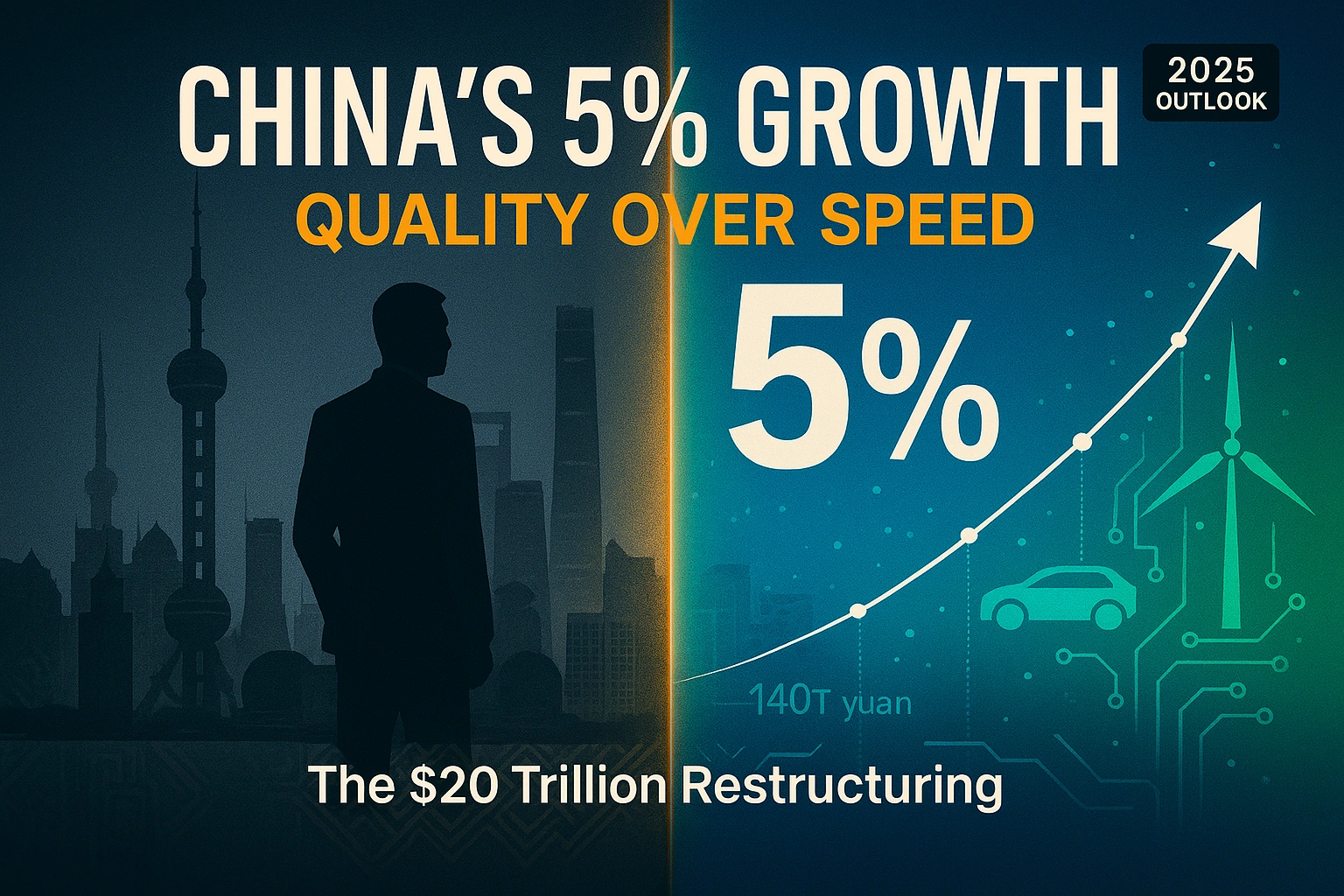
How Beijing’s quality-over-quantity doctrine signals the most consequential restructuring of the world’s second-largest economy in a generation
On the final day of 2025, as the world prepared to usher in a new year, President Xi Jinping announced China’s economy would reach its growth target of around 5% for 2025, reaching approximately 140 trillion yuan ($20 trillion) in total economic output. The declaration came not with triumphant fanfare but with measured emphasis on what Xi called China’s economy moving forward “under pressure…showing strong resilience and vitality.”
That qualifier—”under pressure”—reveals everything about where China stands at this inflection point.
For the first time in four decades, Beijing is publicly embracing a growth model that prizes quality over velocity. Xi emphasized the country will promote “effective qualitative improvement and reasonable quantitative growth”, a carefully calibrated phrase that marks China’s most significant economic pivot since Deng Xiaoping’s market reforms. The shift arrives as manufacturing data validates Xi’s confidence while exposing the economy’s underlying fragility.
December’s official manufacturing PMI reached 50.1, crossing the expansion threshold and beating forecasts, while factory activity expanded for the first time in nine months. Yet beneath these green shoots lies an economy wrestling with property sector paralysis, deflationary pressures, and youth unemployment approaching crisis proportions. This is the paradox of modern China: achieving its growth targets while simultaneously engineering its most fundamental structural transformation since opening to global markets.
The Numbers Behind the Narrative
In the first three quarters of 2025, China’s GDP reached 101.5 trillion yuan, expanding by 5.2% year-on-year. The trajectory appeared solid until momentum faltered in Q3, when growth decelerated to 4.8%, revealing the economy’s dependence on external demand.
Exports’ contribution to GDP growth hit its highest level since 1997, producing a record trade surplus of nearly $1 trillion. This export surge, driven by manufacturers front-loading shipments ahead of anticipated tariffs and trade tensions, provided the crucial buffer that enabled Beijing to declare victory on its growth target. But export-led growth contradicts Xi’s stated ambition of consumption-driven development.
The International Monetary Fund, in its December 2025 Article IV consultation, upgraded China’s growth projections to 5.0% for 2025 and 4.5% for 2026, revisions of 0.2 and 0.3 percentage points respectively from October forecasts. The World Bank followed suit, estimating 4.9% growth in 2025 and projecting 4.4% in 2026. Both institutions cited recent fiscal stimulus and lower-than-expected tariffs as catalysts, but their projections also acknowledged persistent structural drags.
China’s GDP exceeded 130 trillion yuan in 2024, marking continued expansion despite headwinds. Yet this aggregate figure obscures critical sectoral divergence. Manufacturing GDP reached 33.55 trillion yuan ($4.67 trillion) in 2024, representing approximately 24.86% of total GDP, while the service industry’s share rose to 56.7% in 2024. This gradual rebalancing toward services aligns with Beijing’s quality-growth doctrine, though the pace remains insufficient to offset manufacturing sector pressures.
The inflation picture reveals deeper troubles. Headline inflation averaged 0% in 2025 and is projected to reach only 0.8% in 2026, indicating persistent deflationary pressures that undermine corporate profitability and consumer confidence. The share of zombie firms—companies whose operating earnings cannot cover interest expenses—rose from 5% in 2018 to 16% in 2024, with the real estate sector particularly afflicted at 40% zombie share.
The Property Sector: Beijing’s $5 Trillion Problem
No force has constrained China’s economic trajectory more than the real estate crisis that began in 2020 when regulators implemented the “Three Red Lines” policy to curb excessive developer debt. The sector that once contributed up to 30% of GDP and served as the primary wealth accumulation vehicle for Chinese households now represents Beijing’s most intractable challenge.
Investment in real estate development for the first ten months of 2025 declined by 14.7%, with sales of new homes projecting a decrease of 8% for the full year, marking the fifth consecutive year of negative growth. Housing prices continued their relentless descent, with new and secondhand home prices falling at an accelerated pace in 2024.
The human toll appears in stark relief. Evergrande, once the world’s most indebted property developer, was ordered liquidated in January 2024 owing more than $300 billion. China Vanke reported a record 49.5 billion yuan ($6.8 billion) annual loss for 2024, becoming the first state-backed developer to signal debt restructuring needs. Country Garden reported a net loss of 12.8 billion yuan for the first half of 2024, with revenue plummeting 55% year-over-year.
The contagion extends beyond developers. Land sale revenue, which made up 24% of total local government income in 2022, dropped by 23% that year. China’s total debt exceeded 300% of GDP as of June 2025, with local government financing vehicles holding estimated debt at 46% of GDP in 2023. The IMF estimates resolving property-sector distortions could require resources equivalent to around 5% of GDP over several years, underscoring this is a medium-term structural adjustment, not a cyclical correction.
Beijing’s response has been measured but increasingly assertive. In May 2024, authorities reduced minimum down payment ratios to 15% for first homes and 25% for second homes, while the one-year loan prime rate stood at 3.0% and five-year at 3.5%, down 1.25 percentage points from 2019 peaks. Yet these monetary interventions cannot offset the fundamental problem: excess supply meeting cratering demand in an economy where household debt surged from less than 20% of GDP in 2008 to more than 60% by 2023.
The property crisis reveals Beijing’s shifting priorities. Rather than engineering a full-scale rescue that would perpetuate moral hazard and misallocated capital, authorities are accepting short-term pain for long-term rebalancing. The latest household income data showed housing-related expenditure declining to 21.6% from 22.2% in 2024, while China accumulated a historical high of 160 trillion yuan in total household savings by May 2025. This represents both a problem—weak consumption—and an opportunity: a pool of capital available for redirection if confidence can be restored.
The Youth Employment Crisis: Counting What Can’t Be Hidden
Few statistics have proven as politically sensitive as youth unemployment. After the rate hit a record 21.3% in June 2023, authorities suspended publication for six months, later resuming with a revised methodology excluding students. Even with this adjustment, youth unemployment for ages 16-24 stood at 17.3% in October 2025, while the 25-29 age bracket reached 7.2%.
Conservative estimates suggest at least 20 million urban Chinese youth aged 15-29 are out of work, representing just over 12% of that demographic excluding students. The true figure likely exceeds this, as official methodology counts anyone working even one hour per week as employed and excludes those not actively seeking work.
The timing could not be worse. China’s 2025 graduating class numbered 12.22 million, the largest in history, entering a labor market disrupted by AI automation, manufacturing overcapacity, and service sector weakness. By 2022, the average age of a Chinese worker reached 40, creating generational tensions as younger workers struggle to find footholds while the economy relies on an aging workforce with diminishing productivity.
The social implications extend beyond statistics. Young Chinese increasingly embrace “lying flat” (tangping) and “letting it rot” (bai lan)—movements rejecting hustle culture and intense competition. Migration patterns shift as Chengdu recorded a 71,000 increase in residents in 2024, the only Chinese megacity to grow, as youth flee expensive first-tier cities for lower-cost alternatives. More alarmingly, the number of Chinese citizens seeking political asylum overseas climbed to 120,000 in 2023, a twelvefold increase since the Hu Jintao era.
Beijing recognizes youth unemployment threatens social stability—the Party’s paramount concern. Yet the structural causes—manufacturing overcapacity, property sector stagnation, and service sector underperformance—resist quick fixes. Throughout 2024, 12.56 million new jobs were created in urban areas, but these positions increasingly consist of precarious gig economy work rather than stable employment offering paths to middle-class prosperity.
The Electric Vehicle Triumph: China’s Industrial Policy Vindication
If property represents Beijing’s greatest vulnerability, electric vehicles exemplify its strategic success. One in nearly every two cars sold in China in 2024 was an electric vehicle, a penetration rate unmatched globally and achieved through coordinated industrial policy, massive subsidies, and protected domestic markets.
BYD Auto delivered 4.27 million vehicles in 2024, capturing 34.1% market share, overtaking Tesla as the world’s largest EV manufacturer. The company’s vertical integration—manufacturing both vehicles and batteries—provides cost advantages and supply chain control that legacy automakers cannot match. China’s EV exports exceeded 1.25 million vehicles in 2024, flooding markets from Brazil to Thailand and triggering protectionist responses in Europe and North America.
The numbers reveal China’s dominance. In 2024, over 85% of new electric cars sold in Brazil came from China, while Chinese imports accounted for 85% of EV sales in Thailand. Chinese EV exports to Mexico skyrocketed over 2,000% in November 2025 as BYD aggressively expanded. China shipped 5.5 million vehicles in 2024, making it the world’s largest auto exporter, with projections exceeding 7 million by end of 2025.
This export surge partly reflects overcapacity at home. Despite selling around 4.3 million vehicles, BYD leads multiple rounds of price cuts in a discounting war that started in early 2023. The brutal domestic competition—with dozens of manufacturers vying for market share—forces weaker players to exit while strengthening survivors through Darwinian selection.
Beijing’s EV strategy demonstrates several critical advantages. First, technological leapfrogging: China bypassed internal combustion engine expertise to lead in battery technology, with CATL controlling 37.9% of the global EV battery market. Second, coordinated policy: subsidies, charging infrastructure investment, and purchase incentives created demand while restrictions on traditional vehicles accelerated transition. Third, scale economies: China’s massive domestic market enabled manufacturers to achieve cost structures unreachable by foreign competitors.
The geopolitical implications are profound. Chinese automakers are projected to capture 30% of global car sales by 2030, up from 21% in 2024. BYD commissioned the world’s largest roll-on/roll-off vessel in 2025, bringing total shipping capacity to more than 30,000 electric cars, while establishing manufacturing facilities in Brazil, Thailand, and Turkey to circumvent tariffs. This represents not merely exports but comprehensive industrial ecosystem replication globally.
Western responses—100% US tariffs, up to 45% EU tariffs—slow but don’t halt Chinese expansion. Despite tariffs, over 600,000 Chinese EVs entered Europe in the first eleven months of 2025. Manufacturers absorb costs through efficiency gains and premium positioning, or establish local production to sidestep barriers entirely. The EV sector validates Xi’s insistence that state-directed industrial policy, when executed with sufficient capital and coordination, can create commanding positions in strategic industries.
Quality Growth: Translating Rhetoric Into Reality
Xi’s quality-growth doctrine rests on three pillars: technological advancement, green development, and shared prosperity. Each confronts formidable obstacles.
Technological self-sufficiency remains paramount given US-China technology decoupling. Production of 3D printing devices, industrial robots, and new energy vehicles grew by 40.5%, 29.8%, and 29.7% year-on-year respectively in the first three quarters of 2025. China leads in AI applications, 5G deployment, and renewable energy capacity. Yet semiconductor independence—critical for technological sovereignty—remains elusive despite massive investment, as advanced chip manufacturing requires equipment and expertise concentrated in the US, Netherlands, Japan, and Taiwan.
Green development shows tangible progress. China dominates solar panel manufacturing, wind turbine production, and battery technology. China contributed around 30% of global manufacturing added value in 2024, maintaining its position as the world’s largest manufacturing powerhouse for 15 consecutive years. Yet this manufacturing prowess comes with environmental costs that conflict with carbon neutrality pledges. The contradiction between export-led growth driven by energy-intensive manufacturing and climate commitments requires reconciliation.
Common prosperity—reducing inequality while maintaining growth—presents perhaps the greatest challenge. Real wage growth lags productivity gains, urban-rural disparities persist, and the gig economy proliferates without adequate social protections. Low inflation relative to trading partners led to real exchange rate depreciation, contributing to strong exports but exacerbating external imbalances, with the current account surplus projected to reach 3.3% of GDP in 2025. This imbalance reflects weak domestic consumption, the inverse of consumption-led growth.
The IMF articulates the central tension clearly: China’s large economic size and heightened global trade tensions make reliance on exports less viable for sustaining robust growth. Yet pivoting to domestic consumption requires reforms Beijing has resisted: strengthening social safety nets, improving pension systems, reducing healthcare costs, and allowing yuan appreciation. Each measure would boost consumer confidence and spending power but requires fiscal expenditure or policy adjustments that conflict with other priorities.
The Path Forward: Navigating Contradictions
The central government allocated 62.5 billion yuan from special treasury bonds to local governments for the consumer goods trade-in scheme for 2026, while the state planner released early investment plans involving about 295 billion yuan in central budget funding. These measures represent incremental support rather than transformative intervention.
Three scenarios emerge for China’s trajectory through 2026 and beyond:
Base case: Growth decelerates to the 4.5% range as export momentum fades, property adjusts gradually, and consumption improvements remain modest. This scenario reflects institutional consensus—the IMF, World Bank, and major investment banks cluster around similar projections. Deflationary pressures persist, youth unemployment improves marginally, and structural imbalances narrow slowly. China remains globally significant but growth normalizes closer to potential output given demographic constraints and capital saturation.
Upside case: Beijing implements more aggressive fiscal stimulus—beyond the incremental measures announced—focusing on direct household transfers, accelerated pension reform, and consumption subsidies. Export competitiveness in EVs and advanced manufacturing offsets property weakness. Technological breakthroughs in semiconductors reduce foreign dependencies. Growth stabilizes around 5% through 2026-2027 with improving internal balance. This requires policy choices Beijing has historically resisted but growing external pressures could force adaptation.
Downside case: Property crisis deepens, triggering financial system stress and consumption collapse. Trade tensions escalate beyond current assumptions, shrinking export markets. Youth unemployment breeds social instability, forcing authorities to prioritize security over growth. Growth falls to 3-4% range, deflationary spiral intensifies, and “middle-income trap” concerns materialize. This scenario remains possible but looks less probable given authorities’ demonstrated willingness to support growth and financial system stability.
The most likely outcome falls between base and upside cases. Xi has consolidated sufficient authority to implement difficult reforms if convinced they’re necessary. The 15th Five-Year Plan (2026-2030) provides framework for consumption emphasis, though implementation determines outcomes. External pressures—Western tariffs, geopolitical tensions, technology restrictions—paradoxically may accelerate internal reforms by reducing export-dependency viability.
What Investors and Policymakers Should Watch
Several indicators will signal China’s trajectory:
Property stabilization: Monitor new home sales volume and pricing trends in first-tier cities. Stabilization there precedes broader recovery, but sustained improvement requires at least four consecutive quarters of positive data.
Consumption metrics: Retail sales year-over-year growth, service sector PMI, and household savings rate. Household savings reached 160 trillion yuan by May 2025—mobilizing even a fraction toward consumption significantly boosts growth.
Youth unemployment: The political sensitivity indicates this metric matters for stability. Sustained improvement below 15% for 16-24 age group would signal labor market health, while deterioration above 20% risks social instability.
Manufacturing profit margins: Industrial enterprise profits were up only 0.9% year-on-year in the first eight months of 2025. Margin improvement indicates pricing power recovery and demand strengthening; continued compression suggests overcapacity persists.
Yuan valuation: Real effective exchange rate movements reveal whether authorities prioritize export competitiveness or consumption rebalancing. Appreciation signals confidence in domestic demand; depreciation indicates continued export reliance.
Fiscal stance: Central government deficit size and composition matter. Direct household transfers and consumption subsidies signal genuine rebalancing intent; infrastructure investment and manufacturing subsidies indicate path dependency.
The December PMI uptick and export resilience enabled Xi’s confident 5% achievement declaration. But whether China masters the transition from speed to substance—from investment-driven to consumption-led, from quantity to quality—remains the defining economic question of this decade. Beijing has the resources and policy tools for success. What’s uncertain is whether political economy constraints allow their deployment before external pressures force less optimal adjustments.
For global markets, China’s rebalancing represents both opportunity and threat. A consumption-driven Chinese economy offers expanded markets for services, luxury goods, and consumer brands. But the transition period—characterized by volatile growth, sectoral disruption, and policy experimentation—creates uncertainty that challenges long-term capital allocation.
The world’s second-largest economy is attempting something unprecedented: engineering a fundamental growth model shift while maintaining social stability, geopolitical strength, and technological advancement. Xi’s 5% target achievement provides political validation, but the harder work of structural transformation extends far beyond 2025. Whether China emerges as a balanced, sustainable major economy or stumbles into the middle-income trap will shape global economic geography for the coming generation.
Statistical Sources: National Bureau of Statistics of China, International Monetary Fund, World Bank, China Passenger Car Association, Trading Economics, MERICS, Bloomberg, PwC China Economic Quarterly
Discover more from The Economy
Subscribe to get the latest posts sent to your email.


Analysis
When Rivals Share a Rocket: The China-Europe SMILE Mission and the Fragile Promise of Space Science Diplomacy
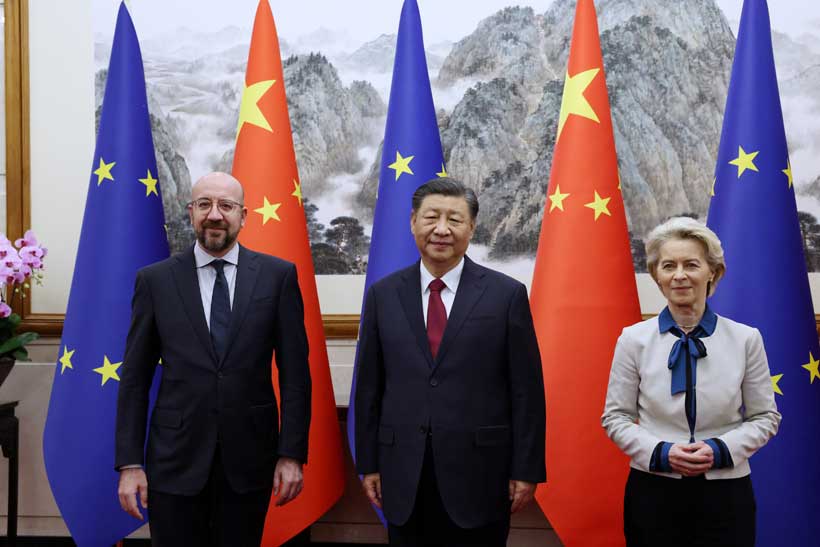
On April 9, a European rocket will lift a Chinese-European spacecraft into orbit from the jungle coast of French Guiana. In a world tearing itself apart over chips, trade routes, and strategic chokepoints, this is not nothing.
The Countdown the World Isn’t Watching — But Should Be
At 08:29 CEST on April 9, 2026, an Avio-built Vega-C rocket — designated mission VV29, the first Vega-C flight operated by Avio Avio — will ignite its first-stage engines at Europe’s Spaceport in Kourou, French Guiana. Riding atop it will be SMILE: the Solar wind Magnetosphere Ionosphere Link Explorer, a 2,250-kilogram spacecraft nearly a decade in the making. The mission is a joint undertaking between the European Space Agency (ESA) and the Chinese Academy of Sciences (CAS) — and it is, by any reasonable measure, the most symbolically weighted space launch of 2026.
Not because of its destination. Not because of the science alone, though the science is genuinely groundbreaking. But because of what it represents at this particular moment in history: two of the world’s major technology powers, locked in an increasingly fraught geopolitical relationship, sharing data, sharing hardware, and sharing a launchpad.
SMILE is China’s first mission-level, fully comprehensive in-depth cooperation space science exploration mission with ESA GitHub — a statement that, when you sit with it, reveals how exceptional this collaboration actually is. After years of US-led pressure to isolate Chinese space activities, after the Wolf Amendment that has effectively banned NASA from bilateral cooperation with China since 2011, after wave after wave of technology export restrictions, here is a European rocket carrying instruments built simultaneously in Leicester and Beijing, tested jointly in the Netherlands, fuelled in Kourou, and aimed at a shared scientific horizon.
This is worth examining closely — not with naïve optimism, but with clear eyes.
What SMILE Actually Does, and Why It Matters
Before the geopolitics, the science — because the science is the point, and it deserves more serious attention than it typically receives in the English-language press.
Earth is constantly bombarded by gentle streams — and occasionally stormy bursts — of charged particles from the Sun. Luckily, a massive magnetic shield called the magnetosphere stops most of these particles from reaching us. If it weren’t for the magnetosphere, life could not survive on planet Earth. ESA
SMILE’s purpose is to give humanity its first comprehensive, simultaneous, global view of how that shield actually works — how it bends, buckles, and recovers under the assault of solar wind and coronal mass ejections (CMEs). Although several spacecraft have observed the effects of the solar wind and coronal mass ejections on Earth’s magnetic shield, they have mostly done so piecemeal ESA, through point measurements that are a bit like trying to understand a hurricane by sticking your hand out a single window.
SMILE changes that. The mission is a novel self-standing effort to observe the coupling of the solar wind and Earth’s magnetosphere via X-ray imaging of the solar wind-magnetosphere interaction zones, UV imaging of global auroral distributions, and simultaneous in-situ solar wind, magnetosheath plasma and magnetic field measurements. SPIE Digital Library
The four instruments it carries — the Soft X-ray Imager (SXI) built at the University of Leicester, a UV Aurora Imager, a Light Ion Analyser, and a Magnetometer — will work in concert from a highly inclined, highly elliptical orbit, with an apogee of 121,000 km and a perigee of 5,000 km. Avio From that sweeping vantage, SMILE will watch in real time as solar storms slam into Earth’s magnetic bubble, deform its boundaries, and trigger the geomagnetic disturbances we call space weather.
The Economic Stakes of Space Weather
Here is where the science becomes urgently, uncomfortably practical.
A severe geomagnetic storm — the kind triggered by a powerful CME — can induce electrical currents in long-distance transmission lines powerful enough to melt transformer cores. It can cripple GPS satellites, knock out shortwave radio communications, accelerate the degradation of satellite hardware, and expose astronauts to dangerous radiation doses. The Carrington Event of 1859 — the largest geomagnetic storm in recorded history — set telegraph offices on fire and produced auroras visible from the Caribbean.
Were a Carrington-scale event to strike the modern infrastructure-dependent world, the consequences would be catastrophic. Lloyd’s of London has estimated that a severe geomagnetic storm striking North America could leave between 20 and 40 million people without power for periods ranging from weeks to years, at a cost that would run into the trillions. The May 2024 geomagnetic storm — the most powerful in two decades — disrupted GPS signals and degraded satellite operations across the globe, offering a modest preview of what a truly extreme event might look like.
Better forecasting requires better physics. And better physics requires exactly what SMILE is designed to provide: a complete, global picture of how the magnetosphere actually responds to solar assault. By improving our understanding of the solar wind, solar storms and space weather, SMILE will fill a stark gap in our understanding of the Solar System and help keep our technology and astronauts safe in the future. ESA
A Mission Born in a Different World
The story of how SMILE came to be is, in itself, a small geopolitical parable.
The SMILE project was selected in 2015 out of 13 other proposals, and became the first deep mission-level cooperation between the European Space Agency and China. Orbital Today It was conceived when relations between China and the West, while not without tension, still operated under a broadly cooperative logic — when the prevailing assumption in Brussels and Beijing alike was that economic interdependence would gradually soften political friction and that scientific collaboration was a relatively safe space for engagement.
The Principal Investigators were Graziella Branduardi-Raymont from Mullard Space Science Laboratory, University College London, and Chi Wang from the State Key Laboratory of Space Weather at NSSC, CAS. ESA
What strikes me most about this pairing is its elegance and its tragedy. Professor Branduardi-Raymont — who, it should be noted, passed away in November 2023 after a lifetime of X-ray astronomy — had spent decades frustrated that no existing observatory could directly image X-ray emission from Earth’s magnetosphere. Her perseverance eventually produced this mission. She did not live to see its launch. But her instrument, built at the University of Leicester and calibrated with painstaking care across multiple European institutions, will fly on April 9 in the spacecraft she helped conceive. There is something moving in that continuity.
Professor Chi Wang, her Chinese counterpart, continued the work — a collaboration that survived COVID-era isolation, supply chain disruptions, and the gathering chill of US-China technology competition.
The SMILE mission entered full launch implementation phase after passing the joint China-Europe factory acceptance review on October 28, 2025. At the end of November 2025, the propellant required for the satellite departed from Shanghai, arriving at Kourou port in early February 2026. CGTN
On February 11, 2026, the flight model and ground support equipment departed from ESTEC in the Netherlands, sailing across the Atlantic from Amsterdam port aboard the cargo vessel Colibri, arriving at Kourou port on February 26, 2026, and being successfully transferred to the launch site. CGTN
That detail — a cargo ship named Colibri, sailing from Amsterdam to French Guiana carrying a satellite built in two countries on opposite ends of the Eurasian continent — is, to me, the most vivid emblem of what scientific cooperation can accomplish when given enough time, enough stubbornness, and enough shared wonder.
Europe’s Delicate Balancing Act
The launch of SMILE does not occur in a geopolitical vacuum. It occurs at a moment when Europe’s relationship with both China and the United States has become extraordinarily complex.
Washington has grown increasingly vocal about the risks of European technological cooperation with Beijing. The US-China Economic and Security Review Commission has flagged joint space missions as a potential vector for technology transfer. The US Space Force has publicly warned allies about sharing sensitive sensor data with Chinese partners. And while SMILE is a pure science mission — studying solar-terrestrial physics, not military reconnaissance — the distinction between civilian and dual-use space technology is one that Washington now views with considerable scepticism.
ESA, for its part, has walked this line with notable care. ESA Director General Josef Aschbacher confirmed SMILE’s launch timeline in January 2025, framing the mission squarely within the agency’s Cosmic Vision scientific programme — an agenda governed by scientific merit, not geopolitical alignment. “Building on the 24-year legacy of our Cluster mission,” said ESA Director of Science Prof. Carole Mundell, “SMILE is the next big step in revealing how our planet’s magnetic shield protects us from the solar wind.” ESA
That framing matters. ESA is positioning SMILE not as a concession to Beijing, but as the natural scientific successor to decades of European magnetospheric research — a mission that happens to have a Chinese partner because the Chinese partner brought the best science proposal to the table in 2015.
Strategic Autonomy in Orbit
Europe’s Strategic Autonomy agenda — the drive to reduce dependency on both American and Chinese platforms — finds an interesting expression in SMILE. The mission uses a European launcher (Vega-C), European testing facilities (ESTEC in the Netherlands), and a European payload module built by Airbus in Spain. China contributes three scientific instruments and the spacecraft platform and operations. The division of labour is not equal, but it is genuine.
This is different from the model China has pursued in, say, its International Lunar Research Station programme — a Beijing-led effort to build a Moon base with selective partner participation on China’s terms. SMILE was born from a joint call for proposals, adjudicated by both ESA and CAS, on scientific merit alone. The symmetry of its origins is a meaningful safeguard.
What the mission also illustrates, however, is the limits of that safeguard. Despite ongoing delays of the launch and geopolitical tensions between Europe and China, this mission marks an important collaboration between the two parties. Orbital Today Delays stretched from an original 2021 target across five years. COVID disrupted joint testing. Geopolitics hovered over every logistics decision. That the satellite is sitting on a Vega-C in Kourou today is a testament to institutional resilience on both sides — and a reminder of how fragile such resilience can be when the political weather changes.
What Comes Next: Blueprint or One-Off?
The successful implementation of the SMILE mission will set a benchmark for China-EU space science cooperation and lay the technological foundation for deeper future collaboration. GitHub
That Chinese Academy of Sciences statement is aspirational in tone. Whether it reflects reality will depend on choices that neither ESA nor CAS alone can make.
The scientific case for continued China-Europe cooperation in space is actually strong. China has developed formidable capabilities in solar and heliospheric science, planetary exploration, and space weather monitoring. ESA brings world-class instrumentation, launcher independence, and an institutional culture of multinational collaboration forged across 22 member states. Together, they have demonstrated — through SMILE — that the logistics of joint mission development are solvable, even across supply chain disruptions and a pandemic.
The geopolitical case is harder. As US pressure on European technology transfer policies intensifies, as China’s own space ambitions grow more assertive, and as the Artemis Accords effectively create a US-aligned coalition in cislunar space, Europe faces a binary pressure: join Washington’s bloc or preserve its own lane.
SMILE suggests a third option — cautious, science-first, mission-specific cooperation, carefully ring-fenced from military and surveillance applications, conducted through multilateral institutions with independent governance. It is not a grand geopolitical declaration. It is a pragmatic transaction between research agencies who share a genuine scientific puzzle.
That may, in the end, be its most important lesson. The most durable forms of international cooperation are rarely born from summit communiqués or diplomatic ambition. They are built from specific problems, shared curiosity, and the grinding, unglamorous work of building something together over a decade. SMILE’s cargo ship sailed from Amsterdam. Its fuel was loaded in Shanghai. Its instruments were calibrated in Leicester. Its launcher was assembled in Colleferro.
On the morning of April 9, all of that will rise together over the Atlantic, riding a column of fire into a highly elliptical orbit 121,000 kilometres above the Earth, where it will spend three years watching our planet’s invisible magnetic shield absorb the fury of the Sun.
Whatever one thinks of the geopolitics, that image is worth holding onto.
The View From the Launchpad
In a world increasingly defined by decoupling — technological, financial, diplomatic — SMILE is a small, luminous exception. It will not resolve the fundamental tensions between Beijing and Brussels. It will not answer the question of whether Europe can maintain scientific ties with China while deepening security cooperation with Washington. It will not make the next CME less dangerous or the next trade war less likely.
But it will, if all goes to plan, give us something genuinely new: a complete, real-time picture of how Earth’s magnetic shield breathes, bends, and holds against the solar wind. And it will have done so because two sets of scientists — from Milan and Beijing, from Leicester and Shanghai — decided that the problem was important enough to work on together, regardless of the weather in Washington.
What strikes me most, in the end, is not the geopolitics. It is the image of Professor Branduardi-Raymont at Mullard Space Science Laboratory, frustrated for years that no observatory could image X-ray emission from the magnetosphere, proposing mission concepts until one finally stuck. The Colibri will not carry her name. But the instrument riding inside the fairing of that Vega-C, the lobster-eye X-ray telescope that will for the first time map the shape of Earth’s magnetic boundary, is her life’s work.
The rocket lifts off at 08:29 CEST. The world should be watching.
Discover more from The Economy
Subscribe to get the latest posts sent to your email.
Analysis
How China Reinvented the BRI: Western Tariffs Accelerated Its Transformation Into a Sophisticated Extension of China’s Industrial Policy
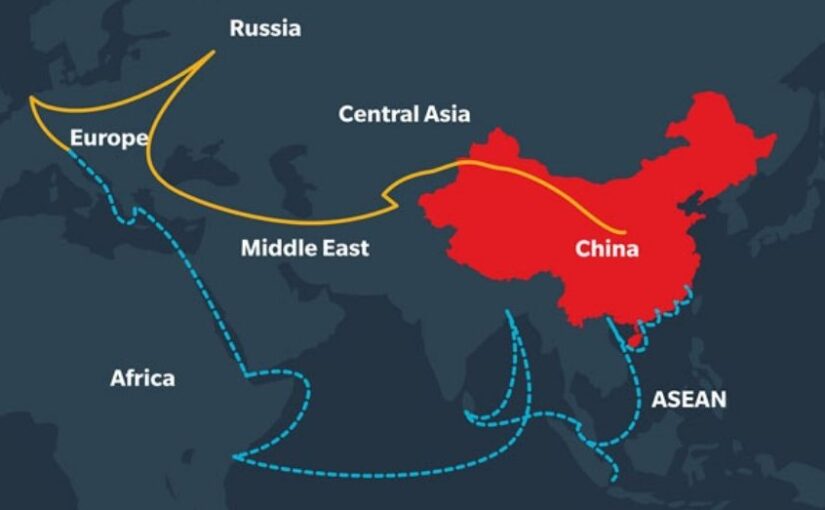
There is a particular kind of policy failure that announces itself quietly—not with a crisis, but with a statistic that arrives too late to matter. For Western capitals still congratulating themselves on having exposed the “debt-trap diplomacy” of China’s Belt and Road Initiative, that statistic arrived in early 2025: $213.5 billion. That is the total value of BRI engagement last year, the highest figure ever recorded, driven by $128.4 billion in construction contracts and $85.2 billion in investments, according to the definitive annual tracking report by the Green Finance & Development Center at Fudan University and the Griffith Asia Institute.
The West had been writing the BRI’s obituary for years. It turns out the patient wasn’t dying—it was in surgery, emerging leaner, smarter, and considerably more dangerous to ignore.
This is the story of how China reinvented the BRI, and why the transformation is Beijing’s most consequential geopolitical pivot since Deng Xiaoping told his country to hide its strength and bide its time. Except now, China isn’t hiding anything.
From Debt-Trap Fears to Industrial Powerhouse: The Narrative That Aged Poorly
Cast your mind back to 2018. Western think-tanks were publishing breathless reports about “debt-trap diplomacy.” The IMF was warning about unsustainable Chinese loans. Hambantota port in Sri Lanka had become shorthand for everything allegedly predatory about the BRI. American officials quietly believed the initiative would collapse under its own contradictions—bad loans, political backlash, COVID disruptions, and the rising chorus of recipient-country grievances would do what sanctions could not.
Some of that critique was legitimate. Early BRI lending was frequently opaque, environmentally careless, and calibrated more toward Chinese state-owned construction firms than the development needs of host countries. AidData’s landmark 2021 research documented “hidden debt” problems in dozens of countries and found that a significant share of projects generated local frustration.
But here is where the Western analysis went badly wrong: it assumed Beijing would respond to criticism the way a Western institution might—with retrenchment, reform panels, and lengthy consultations. Instead, China did something far more strategically coherent. It quietly dismantled the version of the BRI that was failing and replaced it with one calibrated for a new era of great-power competition.
The result? While the West debated whether the BRI was dead, China’s total foreign trade hit approximately $6.4 trillion in 2024, with a historic trade surplus of roughly $1.19–1.2 trillion—figures reported by Reuters that would have seemed fantastical just a decade ago. The BRI isn’t a side project anymore. It is the arterial system through which that surplus finds its geopolitical purpose.
Tariffs as Catalyst: The 2025 Rebound Numbers Tell a Specific Story
The conventional wisdom holds that Western tariffs—Biden’s chips restrictions, the EU’s EV duties, Trump’s sweeping trade barriers—put China on the defensive. The 2025 BRI data suggests exactly the opposite dynamic: tariffs functioned as an accelerant, forcing Beijing to accelerate the very industrial-policy upgrades the BRI now embodies.
Consider the logic. When Washington raised tariffs on Chinese goods and Brussels slapped duties on Chinese EVs, it created an immediate problem for China’s manufacturing export machine: where do the goods go? The answer, executed with characteristic patience, was to restructure the BRI not just as a market for Chinese exports, but as a platform for relocating Chinese production—or at least assembly—to tariff-exempt or tariff-advantaged third countries.
This is BRI supply chain rerouting tariffs in practice, not theory. Chinese firms, particularly in solar, EVs, and batteries, have been quietly establishing manufacturing footholds in BRI partner countries—Morocco, Indonesia, Hungary, Uzbekistan, Ethiopia—that enjoy preferential trade access to Western markets. The BRI’s infrastructure investments, once mocked as vanity ports and empty highways, now serve as the backbone for this industrial relocation strategy.
Key 2025 data points from the GFDC/Griffith report:
- $128.4 billion in construction contracts—the single largest component, reflecting continued hard-infrastructure buildout, now increasingly in energy and digital sectors
- $85.2 billion in direct investments—up sharply, and skewed toward manufacturing and green-tech rather than traditional ports and roads
- Africa and Central Asia led in project volume; Latin America showed the most dramatic investment value growth
- The private sector—companies like LONGi Green Energy, CATL, and East Hope Group—now drives a meaningful share of BRI deals, replacing the lumbering state-owned enterprises of the initiative’s first decade
That last point deserves emphasis. The shift from SOE-dominated lending to private-sector industrial investment is arguably the single most important structural change in the BRI’s reinvention. It is also the change that Western policymakers have been slowest to register.
The New BRI Playbook: Minerals, Green Tech, and Friends-with-Benefits Deals
If the old BRI was about concrete—ports, roads, pipelines, stadiums—the new BRI is about control of the materials and technologies that will define the next economic epoch. Three interlocking strategies define what might be called Beijing’s BRI 2.0 playbook.
First: Critical minerals security. China already refines the lion’s share of the world’s lithium, cobalt, nickel, and rare earths. The new BRI deepens this advantage by securing upstream supply through investment and long-term offtake agreements with mining countries across Africa (DRC, Zimbabwe, Zambia), Central Asia (Kazakhstan, Kyrgyzstan), and Latin America (Chile, Bolivia, Argentina’s lithium triangle). This isn’t charity—it’s vertical integration on a geopolitical scale. When Western nations talk about “friend-shoring” critical mineral supply chains, they are largely scrambling to catch up with arrangements China has been cementing through BRI frameworks for years.
Second: Green-tech export platforms. The EU’s Carbon Border Adjustment Mechanism and American clean-energy subsidies under the IRA were designed, partly, to create a market for Western green technology. Beijing read the same signals and moved faster. Chinese solar manufacturers, EV producers, and battery firms are using BRI partner countries as manufacturing hubs and as captive markets simultaneously. LONGi is building solar panel factories in the Middle East and Southeast Asia; CATL is establishing battery plants in Hungary and Morocco; East Hope is processing aluminium in Southeast Asia using cheaper regional energy. The BRI corridor isn’t just a trade route—it’s a China Belt and Road industrial policy shift writ in gigawatts and gigafactories.
Third: De-dollarization infrastructure. This is the most contested element, but it is real and accelerating. An increasing share of BRI transactions are settled in renminbi or via bilateral currency arrangements. The digital yuan—e-CNY—is being piloted in several BRI corridors. This is not imminent dollar displacement, but it is the patient construction of an alternative plumbing system for global finance, one that could matter enormously in a future sanctions scenario. The Council on Foreign Relations’ BRI backgrounder notes the financial architecture of the BRI as one of its most underappreciated dimensions.
What This Means for the Global South—and the West
The Global South’s relationship with the new BRI is more complicated than either its cheerleaders or its critics admit.
On one hand, recipient countries are more sophisticated than they were in 2013. Governments in Africa, Southeast Asia, and Latin America have watched the Hambantota cautionary tale; many now negotiate harder, demand local employment provisions, and push back on terms that seem tilted too heavily toward Chinese interests. The South China Morning Post has documented a genuine evolution in BRI deal structures—shorter loan tenors, more equity-participation arrangements, greater (if still imperfect) attention to environmental standards.
On the other hand, the fundamental power asymmetry remains. China offers something no other actor currently provides at scale: the combination of capital, construction capacity, and market access in a single package. The EU’s Global Gateway initiative—announced with considerable fanfare as the Western answer to the BRI—has pledged €300 billion through 2027, but disbursement has been slow, governance conditions can be onerous for developing-nation governments, and it cannot match China’s speed of project execution. Foreign Policy’s recent analysis captures the frustration among Global South policymakers who find Western alternatives rhetorically appealing but operationally disappointing.
This creates a dynamic that the West has not adequately grappled with: the BRI rebound 2025 is not primarily a story about Chinese aggression—it is a story about a vacuum the West has failed to fill. Countries that might prefer Western investment are accepting Chinese terms not because they love Beijing, but because the alternative is waiting indefinitely for funds that never quite materialize.
The geopolitical implications compound. Every BRI manufacturing hub established in a third country is a potential hedge against Western market access for that country. Every critical-mineral offtake agreement is a node in a supply chain that circumvents Western leverage. Every e-CNY transaction is a small withdrawal from the dollar’s gravitational pull. Individually, these are manageable. Aggregated over a decade, they constitute a structural shift in global economic architecture.
Why the BRI Is Now “Tariff-Proof”—And a Model for 21st-Century Industrial Statecraft
Here is the contrarian argument that Western analysts need to sit with: Western tariffs didn’t weaken China—they handed Beijing the perfect excuse to upgrade the BRI from concrete to competitive advantage.
The tariff pressure of 2018–2025 forced Chinese industrial policy to become more sophisticated. Firms that might have been content to export finished goods from home factories were pushed—by tariffs, by the risk of further escalation—to internationalize their production. The BRI provided the geographic framework, the infrastructure, and increasingly the regulatory and financial architecture to make that internationalization possible.
The result is a version of the BRI that is, paradoxically, more resilient to Western pressure than its predecessor. When the BRI was primarily about loans and construction contracts, Western pressure could target Chinese banks and state firms. Now that private Chinese industrial companies are the driving force, using locally incorporated entities, partnering with third-country firms, and settling deals in non-dollar currencies, the leverage points are harder to identify and harder to squeeze.
This is what makes the China BRI 2025 moment genuinely novel: it represents the emergence of a model for 21st-century industrial statecraft that Western nations don’t have a clear answer to. It blends state strategy with private-sector execution, hard infrastructure with technology transfer, financial architecture with trade facilitation—all in service of a coherent industrial-policy vision that links domestic manufacturing capacity to overseas market and resource access.
The Economist has noted that China’s approach to industrial policy has grown more sophisticated precisely under the pressure of Western countermeasures—a dynamic that mirrors historical cases where external pressure accelerated rather than retarded technological development.
What the West Should Do Differently: A Pragmatic Agenda
Diagnosis without prescription is just complaint. Here is what a more effective Western response might look like.
Stop celebrating the BRI’s supposed failures. Every time a Western think-tank declares the BRI dead and China proves otherwise, Western credibility takes a quiet hit in exactly the capitals that matter most. Accurate threat assessment is the prerequisite for effective strategy.
Accelerate Global Gateway and PGI disbursement—radically. The Partnership for Global Infrastructure and Investment (G7’s answer to BRI) and the EU’s Global Gateway need to move from pledges to projects at Chinese speeds. This requires cutting bureaucratic timelines, accepting more risk, and being willing to fund imperfect projects in imperfect countries. Development finance cannot be held to standards that make it functionally unavailable.
Compete on the private sector, not just the public sector. China’s most powerful new BRI instrument is private industry—CATL, LONGi, Huawei—backed by state industrial policy but operating with commercial agility. Western governments need to find ways to mobilize their own private sectors into developing-world markets at scale, through blended finance, risk guarantees, and trade facilitation that makes it commercially viable for Western firms to compete where Chinese firms currently dominate.
Engage on critical minerals with genuine urgency. The window to build alternative supply chains for lithium, cobalt, and rare earths is narrowing with each new BRI offtake agreement signed. The World Bank’s minerals framework provides useful architecture; what’s missing is the political will to fund it at the necessary scale.
Stop treating the Global South as a passive audience. The most effective counter-BRI strategy is not to badmouth the BRI—it is to offer recipient countries genuine choices. That means engaging with their actual development priorities, not just Western strategic preferences. Countries that feel they have real alternatives are countries that will negotiate harder with Beijing. Countries that feel they have no choice will sign whatever China puts in front of them.
The View from 2030
Project forward five years. If current trajectories hold, the BRI will have established a durable manufacturing and supply-chain ecosystem across Africa, Central Asia, the Middle East, and Latin America—one calibrated to Chinese industrial priorities, financed through diversified instruments, and partially insulated from Western financial pressure. The critical-minerals supply chains feeding China’s green-tech export machine will be deeper and harder to disrupt. The renminbi’s role in trade settlement will be meaningfully larger, if not yet dominant.
This is not inevitable. China faces real headwinds: domestic economic stress, growing recipient-country pushback on debt and local employment, competition from India and middle powers in specific corridors, and the possibility that some of its industrial bets—particularly in green tech—will be disrupted by technology shifts it doesn’t control.
But the West’s continued tendency to misread the BRI—to see it as a failing initiative rather than an evolving strategic instrument—makes the pessimistic scenario more likely. How China reinvented the BRI is not just an economic story. It is a masterclass in strategic adaptation under pressure, executed by a state that is patient, pragmatic, and playing a longer game than its rivals typically recognize.
The $213.5 billion that moved through BRI channels in 2025 is not a number. It is a signal. The question is whether Washington, Brussels, and London are finally ready to read it correctly.
Discover more from The Economy
Subscribe to get the latest posts sent to your email.
In the early 1980s, something extraordinary was happening in rural China. Incomes were surging. Families who had known only collective poverty under Mao Zedong’s commune system were suddenly trading at market prices, leasing land, and tasting prosperity for the first time in a generation. To most observers — Western economists, development agencies, awed foreign correspondents — this was an unambiguous miracle. But inside the halls of the Chinese Communist Party, one senior official was deeply unsettled by what he saw.
His name was Deng Liqun — no relation to Deng Xiaoping, China’s paramount leader who had initiated these reforms — and he was alarmed not by poverty, but by its opposite: the emergence of rural businesses hiring large numbers of workers. Citing Das Kapital directly, Deng Liqun invoked Marx’s analysis of surplus extraction and warned his colleagues that China was breeding a new exploiter class from within the revolutionary state itself. His warnings were dismissed, sidelined, or quietly buried. Forty years later, as Chinese factory workers report daily wages collapsing to less than 100 yuan amid a record export boom, the uncomfortable question is: was Deng Liqun right all along?
The Seven-Worker Loophole: When Marx Became a Management Consultant
To understand the ideological contortion at the heart of modern China, one must revisit a peculiar episode in the history of economic thought. As Deng Xiaoping’s reformers sought to legalize private enterprise in the early 1980s, they faced a Marxist problem: how could a Communist Party permit capitalist employers? Their solution was as creative as it was absurd.
Party theorists dug into Volume IV of Das Kapital and located a passage in which Marx cited the example of an employer with eight workers as the threshold at which genuine capitalist exploitation begins. The inference was swift and convenient: hire no more than seven workers, and you are not a capitalist. The “seven-worker rule” became, briefly, the ideological boundary between socialism and sin. As one analyst of the period put it, the Party had transformed Marx into a management consultant — and a lenient one at that.
The rule did not last. Entrepreneurs like Nian Guangjiu, the Shazi Guazi (“Fool’s Sunflower Seeds”) magnate, hired hundreds of workers and dared Beijing to intervene. Deng Xiaoping, pragmatist to the bone, let it pass. The seven-worker rule was quietly abandoned. China’s private sector began its long, relentless ascent.
But Deng Liqun continued to press his case. Throughout the 1980s, as China’s reformist faction consolidated power, he remained one of the party’s most vocal critics of market liberalization, warning that unchecked private capital would reproduce exactly the exploitative dynamics Marx had described. He was repeatedly outmaneuvered. He died in 2015, at age 99, largely forgotten — a curio of ideological defeat.
What he could not have known is that the data would eventually vindicate him.
The Numbers Behind the Narrative
China’s economic rise remains one of history’s most astonishing chapters. Hundreds of millions lifted from poverty. A GDP that expanded from a fraction of the United States’ to roughly 70 percent of it in nominal terms. The construction of entire cities from bare earth. No serious analyst dismisses this achievement.
But growth and fairness are different metrics. And on the metrics that matter most to a self-proclaimed workers’ state, the picture is quietly damning.
According to estimates by the International Labour Organization, China’s output per hour worked in 2025 stood at just $20 in constant international dollars — behind the global average of $23, and roughly on par with Brazil and Mexico. The United States, by comparison, registers $82 per hour. China does not achieve its manufacturing dominance through efficiency or technological leverage. It achieves it through sheer volume of hours — the kind of raw labor extraction that, as a recent analysis in Foreign Affairs argued, is precisely the dynamic Deng Liqun warned about four decades ago.
Income inequality tells an equally uncomfortable story. China’s official Gini coefficient stands at 0.47 — already above the internationally recognized warning threshold of 0.40, beyond which social instability becomes a material risk. But economists at Cornell University and Peking University, working with alternative datasets, place the true figure closer to 0.52, putting China in the company of some of the world’s most unequal societies. Meanwhile, data from Peking University’s China Development Report reveals that the top 1 percent of Chinese households own roughly one-third of the country’s property — a concentration of wealth that would have struck the founders of the People’s Republic as counterrevolutionary.
The public-private wage gap compounds the picture. According to data from China Briefing, the average annual urban wage in China’s public sector reached RMB 120,698 in 2023, while the average in the private sector — where the vast majority of Chinese workers are employed — was just RMB 68,340. Those who work for the state earn nearly twice those who do not. In a country that officially represents the proletariat, the proletariat is still on the outside looking in.
The Factory Floor in 2026
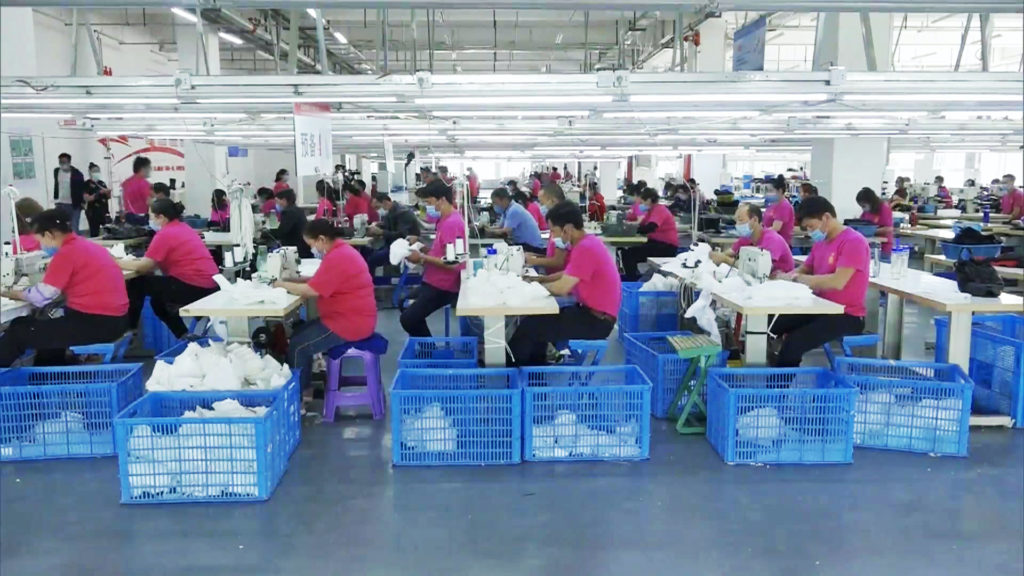
Abstract statistics find their most vivid expression on the ground. A Bloomberg investigation from March 2026 documented day laborers in Guangzhou waiting in winter cold for factory agents to offer work. One worker, Sheng, 55, described his income having more than halved to less than 100 yuan — roughly $14 — per day. Some workers cannot find employment for months at a time, he said. This is occurring while China posts record export numbers, defying the Trump administration’s escalating tariffs with a manufacturing juggernaut that continues to flood global markets.
The paradox is complete: the export machine hums, profits accumulate, trade surpluses swell — and the workers who power all of it are left behind. It is not incidental. It is structural. As China Labor Watch’s executive director Li Qiang argued in January 2026, China’s decisive competitive advantage lies in its weak labor protections, and it is now exporting this low-rights model globally — a race to the bottom dressed in the language of development.
Nowhere is this more starkly illustrated than in the platform economy. According to the All-China Federation of Trade Unions, the number of workers in “new forms of employment” — overwhelmingly gig-economy roles with minimal protections — surpassed 84 million in 2024, representing 21 percent of the total workforce. Among food-delivery riders on Meituan alone, nearly half worked fewer than 30 days per year, pointing to an army of precarious, intermittent laborers with no benefits, no unions, and no recourse. As of 2022, at least 70,000 of these riders held master’s degrees.
996, Involution, and the Vocabulary of Exhaustion
China’s young workers have developed their own lexicon for what Marxist theory would call surplus extraction. The “996” schedule — work from 9 a.m. to 9 p.m., six days a week — became the defining norm of China’s tech industry, a practice that a joint study by Chinese and Australian universities, published in October 2025, described as “modern labour slavery,” directly linking it to chronic burnout, mental health decline, and fertility postponement. Officially illegal under China’s Labor Law, 996 persists through what labor researchers describe as “informal-flexible despotism” — the unspoken threat of unemployment for those who refuse to comply.
The cultural response has been the phenomenon of neijuan, or “involution” — the sense of being trapped in relentless, self-defeating competition that produces no advancement. As youth unemployment reached 17.8% in July 2025 — six times the official urban headline rate — and this year’s graduating class of 12.22 million enters a trade-war-disrupted economy also disrupted by artificial intelligence, neijuan has metastasized from internet slang into political critique. Its counterpart, tangping — “lie flat” — is the passive resistance of those who have concluded that the system is designed not to reward their labor but to extract it.
These are not marginal, youth-culture curiosities. They are symptoms of a structural contradiction at the heart of the Chinese political economy: a party that claims to represent workers presiding over conditions that would have warranted a chapter in Volume I of Das Kapital.
Xi Jinping’s Marxist Revival: Signal or Noise?
Against this backdrop, Xi Jinping’s periodic invocations of Marxist rhetoric acquire a particular ambiguity. His “common prosperity” campaign, elevated in August 2021 as “an essential requirement of socialism,” set targets to reduce the Gini coefficient from 0.47 toward 0.40 by 2025 and 0.35 by 2035. The crackdown on tech giants — Alibaba, DiDi, Meituan — was framed in language recognizable to any student of Marx: reining in monopoly capital, redistributing to the people.
Yet the common prosperity campaign has conspicuously failed to deliver on its core promise. The Gini has not meaningfully declined. Minimum wages, while rising nominally, remain well below levels that would allow Chinese households to become the robust consumers the economy urgently needs. The crackdown on tech billionaires proved more politically convenient than structurally transformative: it punished visible wealth without redistributing it, and it chilled private investment without replacing it with workers’ power.
As CSIS’s Interpret: China project has noted, the common prosperity campaign’s success will ultimately be judged not by economics but by whether it can “maintain social harmony and stability” — which is to say, by whether the CCP can suppress the political consequences of inequality without addressing its material causes. That is not Marxism. That is its managed inverse.
The Overproduction Trap: What Karl Marx Got Right, and What China Ignored
Marx’s central warning in Capital was not simply about exploitation in isolation. It was about the systemic consequences of treating workers purely as inputs: overproduction crises, demand collapse, competitive race-to-the-bottom dynamics that ultimately undermine the capitalist system itself. He called it “the epidemic of overproduction.”
China in 2026 is exhibiting textbook symptoms. The electric vehicle sector’s median net profit margin collapsed to just 0.83% in 2024, down from 2.7% in 2019, as brutal price wars among BYD, Tesla, and dozens of domestic brands hollowed out margins. The solar manufacturing industry lost $40 billion to overcapacity. Steel, cement, food delivery — sector after sector is caught in the deflationary spiral that Chinese policymakers euphemistically call “involution” but that economists recognize as classic overproduction: too much supply chasing too little domestic demand, because workers who make the goods cannot afford to buy them.
The CCP’s own theorists have identified the root: household consumption remains stubbornly low as a share of GDP — hovering near 37-38 percent, compared with 68 percent in the United States and over 50 percent in most developed economies. The Foreign Affairs analysis draws the Henry Ford parallel with precision: Ford famously raised his workers’ wages so they could afford his cars. China’s economy does the reverse — it suppresses wages to make exports price-competitive, and then wonders why domestic demand refuses to ignite.
The Global Stakes: What China’s Labor Model Exports
The implications extend well beyond China’s borders. As China Labor Watch has documented, Beijing’s manufacturing dominance is now being actively exported through Belt and Road projects, industrial parks across Africa and Southeast Asia, and Chinese-owned factories in countries from Ethiopia to Cambodia. The labor conditions travel with the capital. A race to the bottom in labor rights is a deliberate feature, not an accident, of China’s industrial model — and it sets the competitive benchmark to which other manufacturing nations must respond or decline.
For Western policymakers, this reframes the trade debate. Tariffs address the symptom — price-competitive imports — without touching the cause, which is systematic wage compression underwritten by a state that suppresses independent unions, restricts collective bargaining, and classifies labor organizing as a political threat. The US-China trade war’s escalating tariff regime, which has seen duties on Chinese goods reach 145 percent, is economically disruptive for both sides. But it does not change the structural reality that China’s manufacturing advantage is built on a foundation that would have been recognizable to Friedrich Engels touring Manchester in 1845.
Conclusion: The Haunting of Deng Liqun
History’s ironies rarely arrive cleanly. Deng Liqun was, in many respects, a problematic figure — a hardliner who helped orchestrate ideological campaigns that silenced liberal reformers and contributed to the atmosphere of repression that culminated in Tiananmen. His Marxism was often a political instrument as much as a philosophical commitment.
But on this one point, his analysis was structurally sound: a Communist Party that permits unlimited private capital accumulation without empowering workers to claim a proportionate share of the value they create is not transcending Marx. It is fulfilling him. The exploitation he predicted has arrived — not in the form of Victorian factory owners with top hats, but in the form of platform algorithms calculating delivery routes to the nearest yuan, 996 schedules enforced through the threat of precarity, and a gig economy that has absorbed 84 million workers without offering a single one a union card.
Xi Jinping’s “common prosperity” rhetorical architecture is vast and elaborate. The material delivery, forty years after Deng Liqun’s warnings, remains insufficient. China’s economy runs on labor exploitation. Marx would have recognized it immediately. He would have found it almost unremarkable. What would have astonished him — what should astonish us — is that the party invoking his name is the one enforcing it.
Discover more from The Economy
Subscribe to get the latest posts sent to your email.
-

 Markets & Finance3 months ago
Top 15 Stocks for Investment in 2026 in PSX: Your Complete Guide to Pakistan’s Best Investment Opportunities
-

 Analysis2 months ago
Brazil’s Rare Earth Race: US, EU, and China Compete for Critical Minerals as Tensions Rise
-

 Banks3 months ago
Best Investments in Pakistan 2026: Top 10 Low-Price Shares and Long-Term Picks for the PSX
-

 Investment3 months ago
Top 10 Mutual Fund Managers in Pakistan for Investment in 2026: A Comprehensive Guide for Optimal Returns
-

 Analysis2 months ago
Top 10 Stocks for Investment in PSX for Quick Returns in 2026
-

 Asia3 months ago
China’s 50% Domestic Equipment Rule: The Semiconductor Mandate Reshaping Global Tech
-

 Global Economy3 months ago
Pakistan’s Export Goldmine: 10 Game-Changing Markets Where Pakistani Businesses Are Winning Big in 2025
-

 Global Economy3 months ago
15 Most Lucrative Sectors for Investment in Pakistan: A 2025 Data-Driven Analysis