
China Economy
10 Ways Academia and Research Are Driving China’s Economic Growth

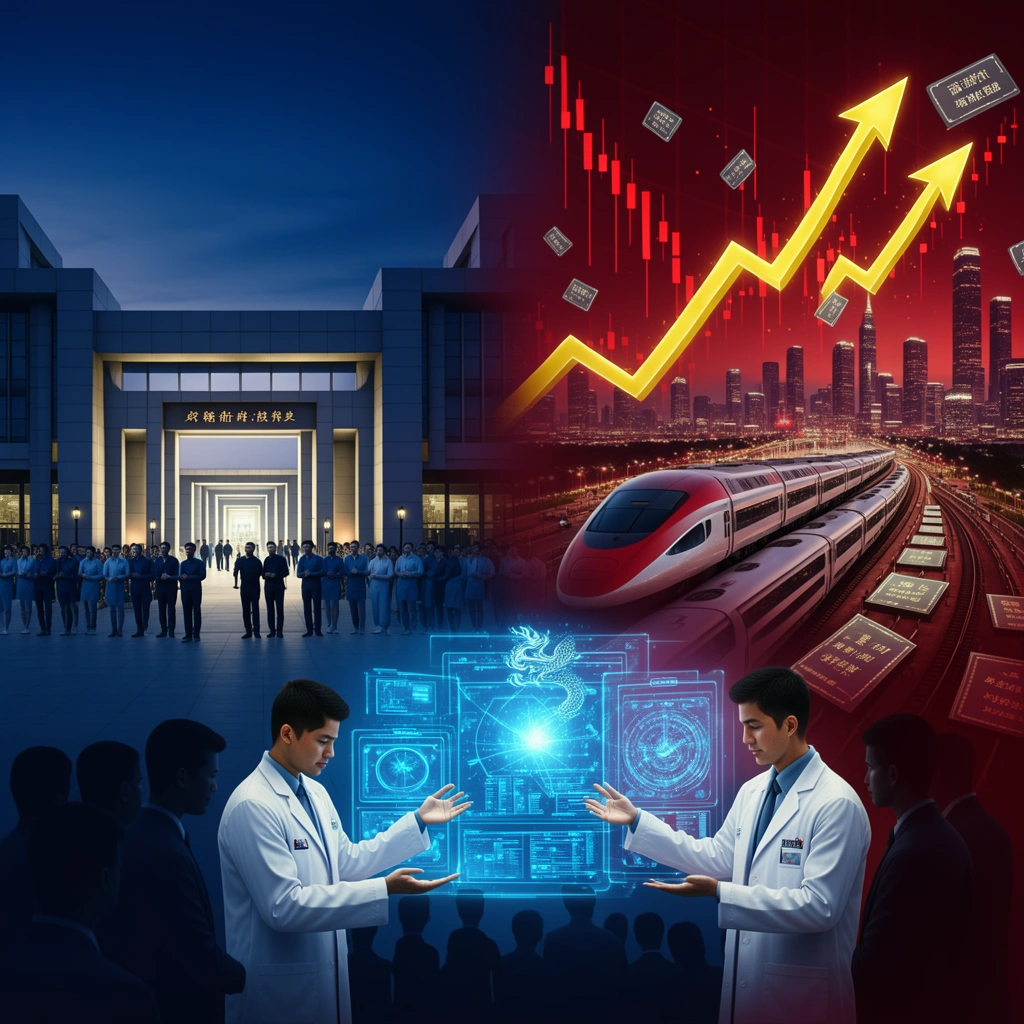
In a sleek laboratory at the University of Science and Technology of China in Hefei, researchers huddle around the Jiuzhang photonic quantum computer, a machine that can complete certain computational tasks in 200 seconds that would take classical supercomputers an estimated half-billion years. Just down the corridor, graduate students test components for next-generation electric vehicle batteries, their work funded by partnerships with BYD and Contemporary Amperex Technology. This scene, replicated across dozens of Chinese research institutions, captures a profound transformation: China’s evolution from the world’s factory floor to an innovation powerhouse where academic research increasingly determines economic competitiveness.
The numbers tell a remarkable story. In 2025, China’s research and development spending reached 2.8 percent of GDP, surpassing the average level of OECD countries for the first time, according to the National Bureau of Statistics. This milestone represents more than statistical achievement—it signals a fundamental reorientation of the world’s second-largest economy toward knowledge-intensive growth. With R&D expenditure rising 8.9 percent year-on-year to exceed 3.6 trillion yuan in 2024, China now stands as the world’s second-largest R&D investor, trailing only the United States but gaining ground rapidly.
Yet China’s research-driven transformation extends far beyond headline spending figures. The country has systematically built an innovation ecosystem where universities, research institutes, and industry collaborate with unprecedented intensity. The results manifest across multiple dimensions: Chinese institutions now dominate the Nature Index rankings, with nine of the world’s top ten academic institutions coming from China, while patent applications reached 1.8 million in 2024, accounting for nearly half of the global total. In strategic sectors from artificial intelligence to quantum computing, electric vehicles to biotechnology, academic research increasingly provides the foundation for commercial breakthroughs that reshape global markets.
This article examines ten distinct ways that China’s academic and research institutions fuel economic expansion. Drawing on the latest data from 2025-2026, it analyzes how university-industry partnerships, talent pipelines, patent commercialization, and regional innovation clusters collectively drive China’s transition toward innovation-led growth. The analysis also acknowledges persistent challenges—inefficiencies in spending allocation, geopolitical tensions constraining international collaboration, and questions about research quality versus quantity—that complicate assessments of China’s research performance. Understanding these dynamics matters not only for evaluating China’s economic trajectory but for anticipating shifts in global technological leadership and competitive advantage.
1. Building a World-Class Talent Pipeline Through Elite Universities
China’s research-driven economic growth begins with human capital cultivation at elite universities that have rapidly ascended global rankings. Tsinghua University and Peking University, China’s flagship institutions, consistently rank among the world’s top 20 universities and produce thousands of STEM graduates annually who populate both domestic industries and international research labs. The University of Science and Technology of China now ranks as the top university in China and second globally in the Nature Index with a total paper count of 2,585, demonstrating research output that rivals Harvard.
This talent pipeline operates at unprecedented scale. China produces more than four million STEM graduates annually, creating the world’s largest pool of technically trained workers. These graduates don’t merely fill existing positions—they drive innovation across emerging sectors. At Zhejiang University, dubbed the “mother of little dragons” because so many founders of top startups, including DeepSeek and Unitree, came from its programs, students transition seamlessly from academic research to entrepreneurship, often with university support providing subsidized infrastructure, mentorship, and capital.
The quality of this talent pool has improved alongside its expansion. Chinese universities have invested heavily in attracting top faculty, including returnee scholars from Western institutions and international researchers. The “Thousand Talents Program” and similar initiatives, despite generating geopolitical controversy, successfully recruited experienced researchers who elevated China’s academic capabilities. These faculty members not only conduct research but train the next generation, creating multiplier effects that compound over time.
Beyond individual institutions, China has developed tiered excellence through initiatives like Project 985 and the Double First-Class Construction project, which concentrate resources at top universities while raising standards across the system. This hierarchical approach allows specialization: while Tsinghua excels in engineering, Peking University leads in humanities and social sciences, and USTC dominates in physics and quantum research. Such specialization enables Chinese universities to compete globally across multiple disciplines simultaneously, rather than concentrating strengths in limited areas.
2. Dominating Global Patent Filings and Intellectual Property Creation
China’s intellectual property generation has reached extraordinary levels, fundamentally altering global innovation dynamics. The country’s patent filing surge reflects not merely bureaucratic productivity but increasingly sophisticated research capabilities that translate into commercial applications. In 2024, China maintained its position as the global leader with 1.8 million patent applications, a figure that dwarfs the 501,831 applications filed in the United States and represents nearly half the global total.
These patents span critical technological domains. Computer technology, electrical machinery, and digital communications lead filing activity, sectors where China seeks competitive advantage and where patents can protect lucrative markets. Huawei Technologies alone filed 6,600 Patent Cooperation Treaty applications in 2024, making it the world’s most prolific corporate filer and demonstrating how Chinese firms use IP strategy to secure market position. Contemporary Amperex Technology, the battery manufacturer, ranked fifth globally with nearly 2,000 applications, illustrating patent activity in sectors like electric vehicles where China has already achieved market dominance.
The quality question surrounding Chinese patents deserves nuanced assessment. Critics correctly note that quantity doesn’t equal quality, and that some Chinese patent filings have historically aimed to meet bureaucratic targets rather than protect genuine innovations. The Chinese government has acknowledged this concern, reducing subsidies that encouraged low-quality filings and implementing stricter quality checks, meaning that while the total number is still impressive, there is a clear focus on ensuring patents are meaningful. Recent data suggests improvement: Chinese patent citations have increased, foreign filings (an indicator of commercial value) have grown, and Chinese-origin patents increasingly appear in high-value litigation globally.
Patent commercialization presents another dimension of economic impact. Chinese universities and research institutes have established technology transfer offices that actively license patents to industry. Tsinghua University operates dedicated tech transfer infrastructure designed to ensure that research outcomes result in products and services that benefit the public, transforming innovations from concept to real-world application. This commercialization creates direct economic value through licensing revenues while generating spillover effects as patented technologies diffuse through supply chains.
3. Forging Deep University-Industry Partnerships and Tech Transfer Hubs
The integration of academic research with industrial application has become a hallmark of China’s innovation system, creating feedback loops where industry funding supports university research that generates commercially relevant findings. This model differs from Western arms-length relationships, instead featuring close collaboration that accelerates technology transfer. Major tech firms maintain extensive research partnerships with leading universities, jointly funding labs, co-supervising graduate students, and sharing research facilities.
The Tsinghua Berkeley Shenzhen Institute exemplifies this model, bringing together U.S. expertise and technological capabilities developed by U.S. professors with Chinese commercialization infrastructure. While such partnerships have generated security concerns in Washington, they demonstrate how Chinese institutions leverage global knowledge networks while building domestic capabilities. Similar institutes linking Chinese universities with international partners have proliferated, particularly in fields like artificial intelligence, semiconductor design, and renewable energy.
Regional tech transfer hubs amplify these partnerships. The China International Technology Transfer Center, established by the Ministry of Science and Technology, promotes technology transfer between universities, research centers, and industry while facilitating international collaboration. These platforms reduce transaction costs associated with moving research from lab to market, providing matchmaking services, incubation support, and commercialization expertise that individual universities might lack.
Financial mechanisms support this ecosystem. Universities increasingly participate as limited partners in venture funds, with Tsinghua University, Peking University, Fudan University, and others establishing science and technology funds that invest directly in startups commercializing university research. In 2024, Sichuan Province partnered with Tsinghua to establish a 10 billion yuan University Science and Technology Achievement Transformation Fund, providing patient capital for translating research into commercial products. Such funds align university incentives with commercialization outcomes while providing startup capital for ventures emerging from academic research.
The economic impact extends beyond individual transactions. Systematic university-industry collaboration creates knowledge spillovers as researchers gain practical problem-solving experience while industry partners access cutting-edge findings. Graduate students exposed to industry challenges produce more relevant research, while companies gain early access to emerging technologies before competitors. These advantages compound across sectors, from pharmaceuticals where university labs conduct drug discovery research funded by biotech firms, to semiconductors where university-designed architectures inform commercial chip development.
4. Achieving Dominance in Strategic High-Tech Sectors
China’s research excellence increasingly concentrates in sectors deemed strategically critical, where academic breakthroughs directly enhance national competitiveness and economic performance. This focused approach reflects deliberate policy choices that channel research funding toward areas with commercial and security significance, creating clusters of excellence that drive sectoral leadership.
Artificial intelligence represents perhaps the clearest example. Chinese institutions have rapidly advanced AI capabilities, with applications ranging from facial recognition and natural language processing to autonomous systems. The release of DeepSeek-R1 in early 2025, developed by researchers with ties to Chinese universities, demonstrated that Chinese AI development could achieve competitive performance while requiring far less computational power than Western models—a crucial advantage given semiconductor access constraints. Universities provide the talent pipeline, with institutions like Tsinghua embedding AI throughout curricula and research programs while companies like Alibaba, Tencent, and Baidu recruit graduates and fund academic research.
Quantum computing showcases similar dynamics. Chinese researchers have achieved multiple breakthroughs, including the Jiuzhang photonic quantum computer that performed a boson-sampling task in 200 seconds that would have taken a classical supercomputer an estimated half-billion years. Pan Jianwei, a quantum physicist and Chinese Academy of Sciences academician, has built a formidable research group at USTC that leads globally in quantum communications and ranks among the world’s best in quantum computing. China’s quantum program spans computing, communications, and sensing, with quantum computing firms increasing from 93 in 2023 to 153 in 2024, a rise of nearly 40 percent.
Electric vehicle and battery technology illustrates how academic research translates into market dominance. Chinese universities conduct extensive research on battery chemistry, power electronics, and electric drivetrain design, often in partnership with firms like BYD and CATL. These collaborations have helped China achieve commanding market positions: the country produced over 16 million new energy vehicles in 2025, accounting for more than half of domestic car sales and roughly two-thirds of global electric vehicle production. University research in materials science enabled improvements in battery energy density, charging speed, and cost that made this scale possible.
Biotechnology and pharmaceuticals represent an emerging area of strength. While China historically lagged in drug development, academic research has accelerated. Universities conduct basic research in genetics, protein folding, and disease mechanisms that inform drug discovery, while pharmaceutical firms increasingly partner with academic labs. The pandemic accelerated vaccine and therapeutic development, with Chinese academic institutions contributing to multiple COVID-19 vaccines. Looking forward, quantum computing applications in drug discovery could compound these advantages, as Chinese startups explore using quantum algorithms for molecular modeling and compound screening.
5. Advancing the Made in China 2025 Initiative Through Research
The Made in China 2025 initiative, launched in 2015 to transform China into a high-tech manufacturing powerhouse, has fundamentally relied on academic and research contributions to achieve its ambitious goals. While the program officially disappeared from public discourse in 2018 amid international criticism, its core objectives have persisted under alternative frameworks, with universities playing central roles in developing technologies across target sectors.
Assessment of Made in China 2025’s success yields mixed but generally positive results. A 2024 analysis found that 86 percent of the over 260 goals proposed under the plan have been achieved, with targets in sectors such as electric vehicles and renewable energy far surpassed. Academic research contributed significantly to sectors where China exceeded targets: renewable energy benefited from university research in solar cell efficiency and wind turbine design, while electric vehicles drew on battery and power electronics research conducted at universities nationwide.
Achievements vary substantially across sectors. In robotics, Chinese universities conduct extensive research in control systems, machine vision, and human-robot interaction that supports the country’s industrial automation. By 2025, China accounted for approximately 54% of all new industrial robot installations, driven partly by domestic suppliers whose technologies often originate in university labs. Agricultural machinery and biopharmaceuticals achieved all stated goals, with university contributions in precision agriculture technology and biological manufacturing proving crucial.
However, significant gaps remain in advanced semiconductors and commercial aircraft—precisely the areas where academic research faces greatest challenges. Despite massive investment, China continues relying on foreign lithography equipment and chip design software, constraints that limit progress despite strong university research programs. The semiconductor challenge illustrates limits of academic research alone: while Chinese universities produce excellent research in chip architecture and materials science, translating findings into manufacturing capabilities requires equipment, processes, and tacit knowledge that prove harder to acquire.
The program’s university-industry collaboration mechanisms have driven technology diffusion. Government guidance funds, many managed through university-affiliated entities, channel capital toward commercializing research. The third iteration of the China Integrated Circuit Industry Investment Fund, at $47.5 billion, and a new $8.2 billion government guidance fund for AI investments in January 2025 both aim to commercialize university research at scale. These funds explicitly prioritize transforming academic findings into industrial capabilities, creating financial incentives that align research agendas with national strategic goals.
6. Attracting Global Talent and Leveraging Diaspora Knowledge Networks
China’s research ascent has been significantly enhanced by talent attraction programs that bring international expertise into Chinese institutions while leveraging overseas Chinese researchers’ knowledge and networks. These initiatives address a historical challenge—brain drain to Western universities and companies—by creating incentives for talented researchers to work in China, either permanently or through collaborative arrangements.
The Thousand Talents Program, despite becoming controversial and largely discontinued amid U.S. security concerns, successfully recruited experienced researchers from abroad. While exact numbers remain unclear, estimates suggest thousands of scientists and engineers returned to China, bringing expertise gained at top Western institutions. Many established research groups at Chinese universities that rapidly achieved international recognition, accelerating China’s research capabilities in fields from materials science to artificial intelligence.
Successor programs continue talent recruitment through different mechanisms. Many Chinese universities offer competitive salaries, research funding, and laboratory facilities that rival Western institutions, particularly for mid-career researchers who might struggle to secure major grants or tenure in the United States or Europe. The appeal extends beyond compensation: Chinese researchers often access larger research teams, more willing industry partners, and faster paths from research to application given China’s manufacturing capabilities and less restrictive regulatory environment in some domains.
Chinese diaspora scientists and engineers, even when remaining abroad, contribute to China’s research ecosystem through collaborations, conferences, and knowledge exchange. Universities maintain extensive international partnerships that facilitate researcher exchanges, joint publications, and shared facilities. While geopolitical tensions have constrained some collaborations, particularly in sensitive technologies, broad networks persist across fields from climate science to mathematics.
These talent flows create economic value through multiple channels. Experienced researchers accelerate capability development, shortening learning curves and avoiding dead ends that junior researchers might pursue. Their international networks provide access to global knowledge while their presence signals institutional quality that attracts additional talent. Returnees often maintain connections abroad that facilitate technology licensing, equipment acquisition, and recruitment of additional researchers, creating network effects that compound advantages.
National talent recruitment complements institutional efforts. Research by China’s national talent recruitment programs shows measurable impact, with “talent hats” improving performance and encouraging collaboration, particularly benefiting experimental and applied research that feeds into commercial innovation. This structured support helps recruited talent navigate China’s academic system, access funding, and build research teams quickly.
7. Cultivating Regional Innovation Clusters and Science Parks
China’s geography of innovation features concentrated regional clusters where universities, research institutes, and industry collocate, generating agglomeration effects that enhance productivity and accelerate knowledge diffusion. These innovation clusters operate at city and sub-city scales, creating dense networks where ideas flow rapidly from research to application.
Beijing’s Zhongguancun district exemplifies this model, functioning as China’s Silicon Valley with concentrations of universities including Tsinghua and Peking, Chinese Academy of Sciences institutes, and thousands of technology companies ranging from startups to giants like ByteDance and Baidu. The proximity enables researchers to consult for companies, graduate students to intern at tech firms, and entrepreneurs to recruit talent directly from university labs. Zhongguancun firms collectively hold hundreds of thousands of patents, many originating from university research, while venture capital flows abundantly given the density of investors and deal flow.
Shenzhen demonstrates how cities without prestigious traditional universities can build innovation clusters through different mechanisms. The city hosts research institutes affiliated with leading universities, including Tsinghua Berkeley Shenzhen Institute and Chinese University of Hong Kong Shenzhen, while its manufacturing ecosystem provides unparalleled resources for hardware innovation. The combination of research capabilities and manufacturing prowess enables rapid prototyping and iteration, advantages that hardware startups globally struggle to replicate. Companies like BYD, Huawei, and DJI have grown into global leaders while maintaining deep ties to research institutions.
Shanghai, Hangzhou, and Guangzhou each cultivate distinct cluster characteristics. Shanghai excels in life sciences and semiconductors, leveraging Fudan University and Shanghai Jiao Tong University alongside pharmaceutical and chip firms. Hangzhou benefits from Zhejiang University’s research strength and Alibaba’s presence, creating a digital economy cluster. Guangzhou’s proximity to Hong Kong and manufacturing base in Guangdong supports hardware and automotive innovation.
Provincial governments actively support cluster development through subsidies, infrastructure investment, and preferential policies. Multiple provinces have established university science and technology funds and transformation funds that commercialize local university research. Beijing invested 327.84 billion yuan in R&D, representing 6.58 percent of its GDP, while Shanghai reached 4.35 percent, both far exceeding the national average. These investments support research universities, technology parks, and innovation districts that anchor regional clusters.
The economic impacts of these clusters extend beyond direct participants. Supplier networks develop around anchor firms, creating ecosystems where specialized services—from IP law to equipment calibration—flourish. Knowledge spillovers occur as employees move between firms or start new ventures, taking expertise developed elsewhere. The density of technical talent creates labor markets thick enough to support specialized skills, reducing costs for firms seeking particular capabilities.
8. Leading in Basic Research and Scientific Publications
China’s basic research capabilities have advanced dramatically, moving from marginal participant to global leader in high-quality scientific output across multiple disciplines. This transformation in fundamental research creates knowledge foundations that support applied research and commercial innovation, while demonstrating research maturity beyond merely scaling up existing approaches.
The Nature Index, which tracks contributions to research articles in elite scientific journals, illustrates China’s ascent. The Chinese Academy of Sciences maintains first position globally with a 2024 Share of 2,776.90, extending its lead over second-place Harvard University. More remarkably, Chinese institutions increased from having 31 institutions in the Nature Index top 100 in 2022 to 43 in 2024, demonstrating breadth alongside excellence at the very top.
China’s strength concentrates particularly in physical sciences and chemistry. In the Nature Index physical sciences rankings, China holds eight of the top ten positions globally, with institutions including CAS, USTC, Tsinghua, and Peking University dominating. In earth and environmental sciences, similar patterns emerge. These subject areas represent traditional Chinese strengths but also fields with enormous economic significance—materials science informs semiconductor and battery development, while earth science research supports renewable energy siting and climate adaptation.
Basic research output has practical economic significance beyond prestige. Fundamental discoveries in quantum physics enable quantum computing development, while advances in materials science inform battery chemistry improvements. Chinese researchers’ work on catalysis and chemical processes contributes to pharmaceutical manufacturing and industrial chemistry. The lag between basic research and commercial application varies by field, but systematic investment in fundamental science creates option value—the possibility that today’s esoteric research enables tomorrow’s breakthrough products.
China’s basic research investment has grown substantially, with spending on basic research, applied research, and experimental development growing by 10.7 percent, 17.6 percent, and 7.6 percent respectively in 2024. This reflects government recognition that leadership requires discovery, not merely development. While critics note that China’s basic research still lags the United States in some metrics—Nobel Prize recognition, citations of most influential papers—the trajectory shows rapid improvement.
Institutional structures support basic research excellence. The Chinese Academy of Sciences operates as a massive research organization with over 100 institutes conducting fundamental research across disciplines. Universities emphasize publication in top-tier international journals, creating incentives for high-quality basic research. State Key Laboratories provide sustained funding for long-term research programs, insulating researchers from short-term commercial pressures that might discourage fundamental inquiry.
9. Incubating Startups and Fostering Entrepreneurial Ecosystems
Chinese universities have evolved into startup incubators, systematically commercializing research through new venture creation while cultivating entrepreneurial mindsets among students and faculty. This transformation reflects both institutional evolution and policy support, creating pathways from academic research to market impact that generate economic growth and employment.
China hosts 158 unicorns—privately held companies valued above $1 billion—in 2025, with collective market capitalization exceeding $500 billion. Many trace origins to university research or were founded by recent graduates. DeepSeek, the AI startup that shocked Western observers with its efficient large language model, emerged from research at Chinese universities. Unitree, which produces advanced quadruped and humanoid robots, similarly benefited from Zhejiang University’s ecosystem. These unicorns don’t merely represent paper wealth—they employ thousands of workers, generate tax revenue, and drive innovation in strategic sectors.
University-affiliated venture funds increasingly invest in student and faculty startups. Fudan University established a science and technology innovation mother fund with initial scale of 1 billion yuan in 2023, expanded to national and overseas funds by 2025. These funds provide patient capital while leveraging university expertise to evaluate technical viability. Beyond capital, universities offer incubation services including subsidized laboratory space, business mentorship, and IP licensing on favorable terms.
The startup ecosystem extends beyond individual unicorns to encompass thousands of small technology companies. Beijing alone hosts over 1.6 million micro, small, and medium enterprises, many technology-focused, which contribute more than 30% of the city’s tax revenue, more than 40% of its revenue, more than 50% of its patents for technological inventions and more than 60% of its jobs. Universities feed this ecosystem with talent, technology, and entrepreneurial energy.
Funding dynamics have shifted recently, with government-affiliated investors replacing some foreign venture capital following U.S.-China tensions. In Q1 2025, government-affiliated investment companies took part in roughly 16% of funding rounds, up from less than 5% a decade earlier. This substitution maintains capital availability for university spin-offs while aligning investment with national priorities in areas like semiconductors, AI, and advanced manufacturing.
Cultural shifts complement structural support. Entrepreneurship has gained social prestige in China, with successful founders achieving celebrity status and “mass entrepreneurship and innovation” becoming a government slogan. Universities cultivate entrepreneurial mindsets through courses, competitions, and exposure to startup ecosystems. This cultural change matters economically because it increases the supply of potential entrepreneurs willing to leave secure academic or corporate positions to commercialize research findings.
10. Generating Productivity Spillovers and Export Competitiveness
The cumulative impact of China’s research ecosystem manifests in productivity improvements and export performance across the broader economy, as knowledge generated in universities and research institutes diffuses through supply chains, labor mobility, and technology adoption. These spillover effects represent perhaps the most important but least visible way that research drives economic growth.
Total factor productivity growth—the portion of economic expansion not explained by capital and labor inputs—depends fundamentally on technological progress and efficiency improvements. China experienced TFP stagnation in recent years amid challenges including resource misallocation and debt accumulation. However, research-intensive sectors show different patterns, with productivity gains concentrated in industries where academic research contributes to process improvements and product innovation.
Manufacturing competitiveness increasingly depends on research capabilities. Chinese manufacturers in sectors from electric vehicles to consumer electronics benefit from domestic research that generates intellectual property, reduces dependence on foreign technology licensing, and enables rapid product iterations. When BYD develops new battery chemistries in partnership with university researchers, it gains cost and performance advantages over competitors using licensed technology. Similar dynamics play across industries, from pharmaceutical manufacturing to telecommunications equipment.
Export performance reflects these advantages. China’s exports of high-tech products have grown dramatically, with the country now leading globally in electric vehicle exports and dominating solar panel production. These export successes rest on research capabilities that enable Chinese firms to compete not merely on price but on technical sophistication. Research also supports export competitiveness indirectly by training engineers who staff export-oriented manufacturers and generate process innovations that improve quality while reducing costs.
Knowledge diffusion mechanisms amplify research impacts. Personnel mobility transfers knowledge as researchers move between universities and companies, or as university-trained engineers join manufacturers. Supplier relationships spread knowledge when technology firms work with component suppliers, sharing technical requirements and problem-solving approaches. Industry-university conferences, training programs, and consulting relationships create additional diffusion channels.
Measurement challenges complicate quantification of these spillovers. Standard economic statistics struggle to capture knowledge flows, making spillover effects difficult to measure precisely. However, sectoral patterns provide suggestive evidence: industries with stronger university linkages generally show higher productivity growth, while regions with denser research ecosystems tend toward faster economic expansion. China’s rise in the Global Innovation Index, entering the top ten for the first time in 2025, reflects accumulated spillover effects as research capabilities translate into broader innovative capacity.
Looking Forward: Challenges and Sustainability
China’s research-driven economic growth faces significant challenges alongside its impressive achievements. Understanding these limitations matters for realistic assessment of the model’s sustainability and likely evolution.
Efficiency concerns deserve serious attention. China’s rapid R&D spending growth doesn’t automatically translate into proportional innovation output. Some investment goes toward duplicative projects as local governments compete for prestige, while other spending supports research of questionable commercial relevance. The government has acknowledged these inefficiencies, adjusting policies to emphasize quality over quantity, but fundamental tensions remain between bureaucratic incentive systems and innovative discovery’s unpredictable nature.
Geopolitical tensions increasingly constrain China’s research ecosystem. U.S. export controls limit access to advanced semiconductor manufacturing equipment and high-end AI chips, handicapping research in affected areas. International collaborations have contracted in sensitive technologies, reducing knowledge flows that previously accelerated Chinese capabilities. Talent recruitment programs face scrutiny and restrictions, complicating efforts to attract overseas researchers. These constraints particularly impact fields where China lags technically and would most benefit from international cooperation.
Quality versus quantity remains an ongoing question in Chinese research. While metrics like patent filings and publication counts show impressive growth, citation impact and breakthrough discoveries represent different challenges. China has produced incremental advances across many fields but fewer paradigm-shifting discoveries that redefine technological possibilities. Whether this reflects measurement timing—with current investment ultimately yielding breakthrough discoveries—or more fundamental limitations remains contested among observers.
The transition from catch-up growth to frontier innovation presents challenges. When developing countries can license, reverse-engineer, or recruit talent from technological leaders, innovation becomes primarily a deployment challenge. At the frontier, innovation requires original discovery with higher uncertainty and failure rates. China’s research system, optimized for rapid scaling and directed toward specific goals, may struggle with frontier research’s inherent unpredictability and longer time horizons.
Sustainability questions also arise regarding the heavy state role in directing research agendas. While state coordination enables focused efforts in strategic technologies, it risks missing opportunities in areas that appear less important to planners but might prove transformative. The balance between directed research and investigator-initiated exploration remains under constant negotiation in China’s system, with economic implications depending on achieving appropriate balance.
Despite these challenges, China’s research ecosystem has demonstrated remarkable capabilities and resilience. The country’s research spending continues growing faster than GDP, indicating sustained commitment despite economic headwinds. Universities continue ascending global rankings, patent quality improves alongside quantity, and commercialization mechanisms mature. The combination of scale, focus, and institutional learning suggests that China’s research contributions to economic growth will persist and likely expand, even if the path forward presents more challenges than the catch-up phase.
The global implications extend beyond China itself. As Chinese research capabilities rise, they create both opportunities and tensions for the broader international research community. Collaboration with Chinese institutions offers access to unique capabilities and resources, while competition intensifies in many technology domains. The resulting dynamic—part collaboration, part competition—will shape innovation trajectories globally in coming decades, with economic consequences extending far beyond China’s borders as research-driven competitive advantages shift and new technological possibilities emerge from the world’s largest scientific enterprise.
Discover more from The Economy
Subscribe to get the latest posts sent to your email.


China’s exports surged 19.6% in May 2026, driven by AI semiconductors. But property investment fell 16.2% and fixed-asset investment hit its worst decline since COVID. Here’s the full picture.
China’s economy in 2026 is running a structural split that masks deep fragility behind impressive headline numbers. Exports are booming—up 19.6% in May from a year earlier, the second largest increase since January 2022—while the property sector, which underpins roughly two-thirds of household wealth, is contracting at its fastest pace since the early months of the COVID-19 pandemic.
The divergence is not sustainable indefinitely. Until the housing market stabilizes, the export engine—however powerful—cannot compensate for the structural drag on domestic demand, household confidence, and private investment that the property collapse creates.
The Export Machine Is Running on AI
The export numbers are genuinely striking. Semiconductor exports from China were up 110% year-over-year in May 2026, according to data from Deloitte Insights. Mobile phone exports grew 44%. Automatic data-processing machines—a category that captures computers and data storage equipment used in AI infrastructure—rose 66%. Between January and February 2026, total exports surged 39.6% from the prior year period, the largest two-month gain since 2022.

Two forces are driving this export strength. The first is genuine technological demand: global AI infrastructure buildout, particularly across Southeast Asia, the Gulf states, and Europe, is creating enormous appetite for Chinese-produced hardware components at every tier of the supply chain. The second is a more defensive dynamic—inventory building. Companies in trade-sensitive markets are pulling forward purchases in anticipation of further global supply chain disruptions linked to the Middle East conflict and continued U.S.-China trade friction.
That second driver carries embedded risk. If the supply chain disruption that motivated the inventory building does not materialize at the severity that buyers feared, a demand hangover could follow—slowing export growth sharply in the back half of 2026 and into 2027.
Property Investment Is Collapsing
Against the export strength, the property picture is alarming. Property investment fell 16.2% in the first five months of 2026 compared to the same period a year earlier. Fixed-asset investment overall declined 4.1% in the same period—the steepest contraction since May 2020. Even excluding property, fixed-asset investment was down 1.2% year-on-year. Manufacturing investment grew just 0.4%, suggesting businesses are reluctant to expand capacity when demand signals are uncertain.
The property crisis matters disproportionately because of its wealth effect. Roughly two-thirds of Chinese household wealth is held in real estate. When home prices fall, households do not merely lose nominal value—they respond by saving more and spending less, attempting to rebuild or stabilize balance sheets. That behavioral response deepens the demand shortfall, reinforces the cycle of developer distress, and makes a bottom in the market harder to reach.
National home prices continued falling in May, at a faster pace than April. Weakness was evident across most cities. The one pocket of relative stability was in first-tier cities—Beijing, Shanghai, Guangzhou, Shenzhen—where new-home prices rose for the third consecutive month, suggesting that government support measures may be gaining marginal traction in the most liquid and desirable markets. But analysts describe the national recovery as “uneven rather than broad-based.”
The PBOC Moves on Infrastructure, Not Stimulus
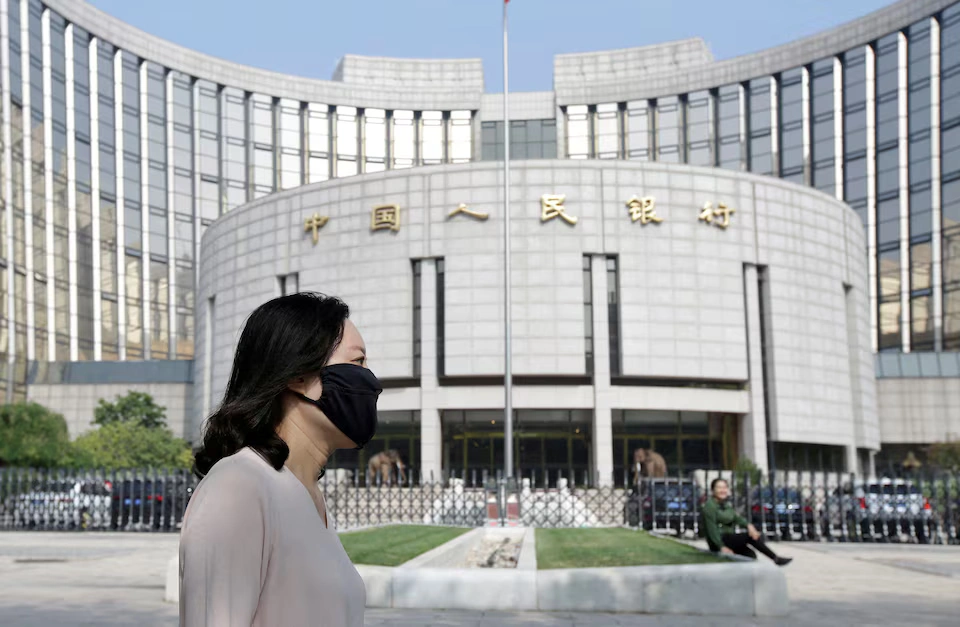
The People’s Bank of China Governor Pan Gongsheng announced a series of financial market measures in late June, including steps to increase the use of overnight reverse repo operations, narrow the short-term interest rate corridor, and promote offshore use of the renminbi. The announcements appeared to be part of a longer-term effort to strengthen monetary transmission and support yuan internationalization.
Critically, the package did not represent broad-based monetary stimulus. No major rate cuts were announced. No large-scale property rescue fund was launched. Analysts interpreted the measures as policymakers signaling continued focus on financial market development and liquidity management rather than a shift toward aggressive easing.
The restraint reflects a genuine policy dilemma. Chinese household debt levels have risen significantly. Property developers are burdened by debt accumulated during the excess-capacity boom of the 2010s. Aggressive stimulus risks inflating new bubbles rather than resolving underlying imbalances. Until organic demand—rather than government support—can fill the gap left by falling property investment, the recovery will remain patchy.
Industrial Production Holds, Investment Doesn’t
Industrial production grew 4.5% year-on-year in May, slightly below the average of the past two years. By subsector: manufacturing output grew 4.4%, utilities climbed 7.6%, and mining rose 2.3%. These are positive numbers—not crisis-level readings—but they reflect an economy in which output is sustained by export demand rather than by the kind of capital formation and domestic consumption that generate self-reinforcing growth cycles.
China’s full-year 2026 GDP growth is expected to remain in positive territory, driven by the export surge and infrastructure spending, but the Deloitte forecast notes that growth is “not being fueled by domestic demand”—meaning the economy is not generating inflationary pressure at home. That permits the PBOC to maintain a relatively stable interest rate environment, but it also means that any slowdown in export demand could quickly transmit into a broader growth deceleration with limited domestic offsets available.
The medium-term question for China’s economy in 2026 is whether the property market finds a floor before the export tailwind fades. The historical precedent for property-led downturns in emerging markets suggests the adjustment period is measured in years, not quarters.
Discover more from The Economy
Subscribe to get the latest posts sent to your email.
China’s exports surged 19.6% in May 2026, with semiconductor shipments up 110% year over year. But behind the headline growth lies a collapsing property market, falling consumer spending, and a looming Japan-style deflationary trap. Here is the full analysis.
The Paradox at the Heart of China’s Economy
China in 2026 presents one of the most striking paradoxes in modern economic history. On the surface, the data looks impressive: exports were up 19.6% from a year earlier in May 2026 — the second biggest increase since January 2022. Exports of semiconductors soared 110% year over year, while mobile phones rose 44% and automatic data-processing machines jumped 66%. The manufacturing engine is roaring.
Beneath the surface, a different China is visible — one where property values are collapsing, households are saving rather than spending, youth unemployment remains elevated at 16.9%, and consumer price inflation has been near zero for years. China’s GDP stands at $20.8 trillion in 2026, but deflation has persisted for a tenth consecutive quarter and property investment has collapsed 50–80% from peak.
The paradox resolves when you understand the structure: China is growing because of exports and government investment, not because its people are getting richer and spending more. That is an inherently fragile foundation.
The Export Surge: AI Demand Driving China’s Manufacturing Machine
The headline numbers on China’s export performance are extraordinary. Semiconductor exports rising 110% year over year reflect two intersecting forces: booming global AI infrastructure demand sucking in chips and electronics components, and Chinese manufacturers stockpiling inventories ahead of anticipated further disruptions to global supply chains from the Iran conflict.
China holds a dominant position in many semiconductor supply chain stages below the most advanced chips — packaging, substrates, legacy node chips — and these have been in extreme demand from AI data center builders worldwide. The AI economy is, perhaps inadvertently, providing a significant lifeline to China’s export sector at precisely the moment when domestic demand remains depressed.
The Property Collapse: A Crisis Now in Its Fifth Year
While the export engine hums, China’s property sector — for decades the central pillar of household wealth and economic growth — continues its multi-year implosion. Property investment fell 16.2% year over year in the first five months of 2026 — the steepest decline in fixed-asset investment since May 2020.
Secondary home prices have declined for 44 consecutive months, and rents have fallen for 23 months. For a country where residential property constitutes approximately 70% of urban household assets, this sustained decline has had a devastating effect on consumer psychology. Falling housing prices have made people feel poorer. As a result, people choose to spend less and save more. In the past five years, household deposits in Chinese banks have almost doubled.
The property downturn is estimated to have reduced annual real GDP growth by about 2 percentage points per annum in 2024 and 2025, according to Goldman Sachs. Though this drag is expected to narrow, it has fundamentally altered the trajectory of the world’s second-largest economy.
The Japan Comparison: Is China Walking Into a Deflationary Trap?
The comparison that haunts Chinese policymakers — and that has been referenced repeatedly by leading economists including Harvard’s Kenneth Rogoff — is Japan’s “Lost Decade” that followed the burst of its property and equity bubble in 1990.
China’s policymakers are acutely aware of this risk. The PBOC has announced a series of financial sector measures including steps to increase the use of overnight reverse repo operations and support the offshore use of the renminbi. But these measures did not appear to represent a major broad-based monetary stimulus package — suggesting Beijing is still reluctant to unleash the scale of fiscal intervention that might break the deflationary psychology.
The Global Implications
China’s export surge, paradoxically, creates pressure for its trading partners. A country growing primarily through exports necessarily runs trade surpluses — which creates political friction with trade partners, particularly the United States and the European Union, who already face domestic pressure on trade deficits with China.
Meanwhile, China’s weak domestic demand is deflationary for the global goods sector — exporting low prices to the world at a time when services inflation remains stubbornly elevated in most developed economies. This creates a complex environment for central banks: cheap goods from China pushing inflation down, expensive services keeping it up.
For investors, China in 2026 presents an asymmetric opportunity clouded by structural uncertainty. The export machine is delivering, but the domestic recovery remains elusive.
FREQUENTLY ASKED QUESTIONS (FAQs)
Q: Why are China’s semiconductor exports up 110%? AI infrastructure buildout worldwide is driving massive demand for chips and electronic components. China holds significant market share in many semiconductor supply chain stages, and AI data center builders are a major buyer of these products. Additionally, anticipation of further supply chain disruptions is driving inventory stockpiling.
Q: Is China’s economy in a recession? No — GDP growth remains positive, projected around 4–5% in 2026. However, deflation has persisted for over two years, property investment is collapsing, and consumer spending growth is far below historical norms. Economists describe it as “growth without demand.”
Q: How severe is China’s property crisis? Property investment in the first five months of 2026 fell 16.2% year over year, the steepest decline since May 2020. Secondary home prices have fallen for 44 consecutive months. The property sector, which at its peak accounted for nearly 30% of China’s GDP including related industries, has shrunk dramatically.
Discover more from The Economy
Subscribe to get the latest posts sent to your email.
In a supermarket in Fuyang this past February, shoppers pushed carts past red lanterns and “Golden Horse Welcoming Spring” banners during China’s longest Lunar New Year holiday on record. Rail networks carried more than 18.7 million passengers in a single day, and Hainan’s duty-free counters rang up 30.8% more sales than a year earlier. For a few weeks, it looked like Beijing’s demand stimulus push might finally be taking hold. The relief didn’t last. By May, retail sales had fallen 0.6% year-on-year — the first monthly decline in more than three years. Xi Jinping has spent eighteen months promising to make households, not factories, the engine of Chinese growth. The data keep saying otherwise.
That gap between rhetoric and reality sits at the centre of China’s economic story heading into the first year of the 15th Five-Year Plan. For two decades, growth has leaned on investment and exports — a model the IMF’s chief economist, Pierre-Olivier Gourinchas, has said needs to “pivot to a more domestically-driven engine of growth.” The IMF now projects China’s GDP growth will slow to 4.5% in 2026, down from 5% in 2025, with private domestic demand described as lackluster even as headline inflation averaged zero percent last year. The World Bank reaches a similar conclusion: households kept funnelling savings into bank deposits through 2025 despite real interest rates that were flat or negative, while local government revenue stayed squeezed by a continued slide in land-lease income. Beijing has answered with trade-in subsidies, interest-rate cuts and a 48-measure consumption action plan. None of it has shifted the basic arithmetic: China still saves more, and spends less, than almost any economy its size.
China’s Demand Stimulus Keeps Hitting the Same Wall
The headline number from May was stark. China’s National Bureau of Statistics reported retail sales fell 0.6% year-on-year, the first such drop since December 2022, reversing April’s 0.2% gain and missing even the most pessimistic forecasts in a Reuters poll. Home appliance and audiovisual equipment sales plunged 15.6%; auto sales tumbled 16.1%, extending an eighth consecutive month of decline in the world’s largest car market. Only services kept the picture from looking worse: spending on catering, travel and entertainment grew 5.4%, outpacing goods retail by 4.2 percentage points, according to Caixin Global.
Beijing’s response was immediate but modest. The government injected a fresh 62.5 billion yuan ($9.2 billion) into the consumer trade-in scheme by the end of June, even as it quietly scaled the 2026 program back to 250 billion yuan from 300 billion yuan in 2025, narrowing eligibility to cars, appliances and smart glasses. Nine government departments also rolled out a joint action plan built around 48 separate measures, spanning:
- Subsidised dining and catering vouchers in lower-tier cities
- Expanded reimbursement for elder-care and healthcare services
- Relaxed visa rules to draw foreign tourist spending
- Additional tax-refund points at border crossings for inbound shoppers
It’s a familiar pattern. The Ministry of Commerce says the broader trade-in program has driven 4.16 trillion yuan in cumulative sales since launch — real money, by any measure. Yet the same dataset shows why the lift keeps fading: full-year 2025 retail sales growth came in at 3.7%, trailing industrial output’s 5.9% expansion and the economy’s overall 5% growth rate, Reuters reported. Growth bottomed at 0.9% year-on-year in December, recovered to 2.8% in early 2026, then slipped to 1.7% by March as the subsidy cycle turned, in the words of analysts at ING, “from a tailwind to a headwind.” Auto sales fell 9.1% in the first quarter even as China’s passenger-car exports jumped 60.6% — a sign that excess domestic production is increasingly finding buyers abroad rather than at home.
Monetary policy moved alongside the fiscal support. The People’s Bank of China entered 2026 promising a “moderately loose” stance and in January cut interest rates on several structural lending tools by 0.25 percentage points, lowering the one-year central bank lending facility rate from 1.5% to 1.25%. Governor Pan Gongsheng has signalled more is coming, telling Xinhua there is “still room for further RRR and interest rate cuts this year.” New refinancing tools are now earmarked specifically for services consumption and elder care — a quiet admission that goods subsidies alone weren’t going to do the job. Consumer prices briefly perked up too: CPI rose 1.3% year-on-year in February, the fastest pace in three years, before easing to 1.0% in March as core inflation slipped from 1.8% back to 1.1%. Producer prices, meanwhile, are still falling, extending a fourth straight year of factory-gate deflation.
There’s also a self-inflicted wound. Beijing’s “anti-involution” campaign, aimed at curbing cut-throat price wars among manufacturers of everything from solar panels to electric vehicles, is meant to fix a supply-side problem. But the IMF’s Article IV report warns that continued industrial-policy support for priority sectors risks perpetuating the very overcapacity it’s trying to cure, adding to deflationary pressure rather than easing it. Subsidise demand with one hand and subsidise supply with the other, and the price level barely moves.
Why China’s Household Savings Rate Won’t Budge
Subsidies treat a symptom. The disease is precautionary saving, and it’s structural rather than cyclical. A December 2025 IMF working paper by economists Yizhi Xu, Fan Zhang, Rongyu Cui and Ding Hua traces China’s stubbornly high household savings rate to three forces that reinforce one another: thin social spending in rural areas, the hukou household-registration system that denies many migrant workers full access to urban healthcare, schooling and pensions, and a property-market correction that has eroded the wealth of homeowners, who make up more than 90% of Chinese households.
Why Is China’s Domestic Demand Still Weak?
China’s domestic demand stays weak because three forces compound: a property slump that erased household wealth, thin social safety nets that force precautionary saving, and a hukou system denying migrant workers full urban benefits. Subsidies lift spending briefly, but they don’t fix why households save first.
The mechanics matter. The IMF researchers find that falling housing wealth pushes homeowners to save more, not less, as they try to rebuild lost equity — an effect that has held steady since the property correction began in 2021. More than 50 Chinese developers have defaulted since then; Country Garden, once the country’s largest, saw contracted sales fall by 70% to 6.91 billion yuan in a single December after an October debt default. What’s shifted is the other side of the ledger: would-be buyers, once forced to save aggressively for a down payment, are increasingly just postponing the purchase altogether amid uncertainty over future prices — which means the old “save to buy” motive is weakening even as the “save because I lost equity” motive intensifies.
Hukou reform has made real, if uneven, progress. Beijing has eased registration restrictions in dozens of cities since 2024, and the National Development and Reform Commission has continued chipping away at residency limits in smaller cities. But the IMF’s modelling suggests reform alone won’t be enough. Pair stronger social safety nets with hukou liberalisation and a smoother property-market transition, the paper argues, and Beijing could meaningfully cut precautionary saving. Pursue trade-in subsidies in isolation, and the savings rate barely moves — which is more or less what’s happened since 2024.
The Second-Order Costs of a Spending Gap That Won’t Close
The consequences extend well past China’s borders. With factory-gate prices still falling, manufacturers facing weak domestic orders are doing what they’ve always done: exporting the surplus. That’s part of why passenger-car exports surged even as domestic auto sales fell, and a similar pattern is playing out across solar panels, batteries and steel. Trading partners in Europe and Southeast Asia have noticed, and China’s trillion-dollar annual trade surplus keeps surfacing as a flashpoint in talks with Washington and Brussels alike.
Inside China, the strain shows up in local-government finances and in investment data that are now flashing red alongside consumption. Fixed-asset investment fell 4.1% in the first five months of 2026, and property investment extended its slide, dropping 16.2% over the same period — a sharper fall than January-April’s 13.7% decline, Reuters reported. NBS spokesperson Fu Linghui attributed part of the slowdown to extreme summer heat and heavy rain in some regions, along with the broader transition from old growth drivers to new ones. Land-lease revenue, once a primary funding source for cities, kept contracting through 2025, and the World Bank found consolidated fiscal revenue growth barely turned positive — just 0.2% year-on-year through October. That squeezes precisely the public services, healthcare, pensions, childcare subsidies, that economists say would do the most to unlock household spending in the first place.
Underneath the headline weakness, consumer behaviour is shifting in ways the subsidy programs weren’t built to capture. Chinese travellers are spending less overseas and more at home — a swing Bloomberg Intelligence estimates could redirect roughly $27 billion in outbound tourism spending back into the domestic market, while relaxed visa rules and a softer yuan are expected to draw in an additional $15 billion from inbound visitors. That’s a genuine bright spot, but it’s also a reminder of what’s actually growing: travel and experiences, not the durable-goods spending the trade-in subsidies were built to support.
Then there’s demography, which makes the 2026–2030 window unusually urgent. China’s population could shrink by close to 60 million people between 2026 and 2035, according to projections from the China-focused research firm Rhodium Group, as annual deaths climb toward 15 million a year while births keep falling — the ratio of new births to total population dropped to just 0.563% in 2025, down from 1.199% a decade earlier. Beijing’s 15th Five-Year Plan includes, for the first time, an entire chapter devoted to population policy. The retirement-age increase passed in 2024, to 63 for men and 58 for white-collar women, is expected to add roughly 0.2 percentage points to annual growth through 2030, the IMF estimates, but it does nothing to fix the underlying birth-rate collapse. For small and mid-sized exporters squeezed between soft domestic orders and rising trade friction, the math keeps getting harder, not easier.
Not Everyone Thinks the Strategy Is Failing
Not every economist reads the data this way. Standard Chartered’s Liao Wei points to China’s rising total factor productivity, climbing since 2021, as evidence the export engine can keep absorbing domestic slack without derailing growth, particularly as global appetite for AI-related hardware lifts demand for technology-intensive Chinese exports, she told China Daily. Tao Chuan, chief economist at Guolian Minsheng Securities, goes further, forecasting 2026 growth “no lower than 5%” and describing a shift toward what he calls an export-consumption equilibrium, in which subsidy-driven spending gradually gives way to sustainable services growth.
Beijing’s own assessment, delivered through the Central Economic Work Conference and echoed in Caixin’s opinion pages, holds that the economy’s fundamental trend remains positive and that 2025’s growth, officially 5%, in line with target, proves the model is working, just more slowly than critics would like.
That said, the gap between official confidence and independent estimates is wide enough to give pause. Rhodium Group’s analysts calculate that China’s real 2025 GDP growth likely landed between 2.5% and 3%, roughly half the 5.2% pace the National Bureau of Statistics reported through the first three quarters, with the biggest divergence concentrated in investment figures rather than consumption. If that estimate is closer to the mark, the resilience Beijing points to owes more to production and exports than to any genuine pickup in household spending. The picture is more complicated than either side’s headline number suggests.
A Pivot Beijing Can Postpone But Not Avoid
Strip away the subsidy cycles and the trade data, and the tension is simple: Xi Jinping wants Chinese households to spend like an advanced economy’s consumers while the state still taxes, spends and insures like a developing one. Trade-in vouchers can pull a few months of auto and appliance sales forward. They can’t replace a pension system, fix a broken property market, or convince a young professional in Chengdu that her job is secure enough to stop saving for the worst. The IMF’s own modelling suggests a serious reform package, stronger safety nets, faster hukou liberalisation, a real housing-market transition, could lift consumption’s share of GDP by roughly four percentage points over five years. That’s the size of the prize. It’s also the size of the political and fiscal commitment Beijing has so far avoided making. Until that changes, the trade-in subsidies will keep buying time rather than buying confidence, and the gap between Xi’s ambition and his households’ bank balances will keep showing up in the data, one weak month at a time.
Discover more from The Economy
Subscribe to get the latest posts sent to your email.

Trump Tariffs 2026: Economic Impact, Household Costs & Trade War Outlook

China Economy 2026: Export Boom Masks Property Crisis & Investment Slump

US Inflation 4% May 2026: Is the Worst Over? Fed, Oil Prices

AI Memory Chip Shortage 2026: Nvidia, Apple & What Comes Next

US $39 Trillion National Debt 2026: Bond Market Warning Signs Explained

Ray Dalio US Suez Moment 2026: Dollar Decline, $39 Trillion Debt & Empire’s End

Kevin Warsh Fed Rate Hike 2026: What His Hawkish Pivot Means for Markets

Gold Price 2026: Will Gold Hit $6,000? JPMorgan Forecast, Drivers & Investment Guide

US Recession 2026: Four Key Threats, Warning Signs & How to Protect Your Portfolio

AI Energy Demand 2026: Data Centres, Power Grids & the $725B Infrastructure Boom

AI Semiconductor Selloff 2026: Micron Crash, Nasdaq Pullback & What Comes Next

US Tariffs 2026: How Trump’s 11.7% Effective Rate Is Reshaping Global Trade & Inflation

Global Stock Markets 2026: S&P 500 at Record Highs Amid War, Inflation & Rate Risk

Spain Near 100M Tourists: A Structural Travel Map Shift : Booming Travel Economy

KPMG Australia CEO Resigns After Whistleblower Claims Exposed Investigation Failures

PwC China Partner Payouts Cut Amid Evergrande Audit Fraud

Broadcom Market Value Loss: Revenue Forecast Disappoints

Investors Pile Into Bullish Dollar Bets as ‘US Exceptionalism’ Trade Returns

Here’s How Much It’ll Cost You to Be Part of SpaceX’s Record-Breaking $75 Billion IPO

Nasdaq Tumbles 4% as Chip and Memory Stocks Sink: A $1.2 Trillion Wipeout

How to Fix Pakistan’s Debt Economy: A Structural Blueprint

Smash Capital Leads $200M Funding for Allen Control Systems

Democrats Draw a Red Line Around Military AI — And the Pentagon Is Already Pushing Back

New Investment Super-Cycle: AI, Green Energy & Re-Shoring

Russia Overspends on Putin’s War in Ukraine by $28bn

Xponential Fitness Franchise Lawsuit: The $3.97M Judgment

Middle East Conflict Oil Prices: The $4 Surge Explained

The End of the Chatbot: Why OpenAI is Tearing Up Its Most Successful Product
-

 Markets & Finance6 months ago
Top 15 Stocks for Investment in 2026 in PSX: Your Complete Guide to Pakistan’s Best Investment Opportunities
-

 Analysis4 months ago
Top 10 Stocks for Investment in PSX for Quick Returns in 2026
-

 Analysis5 months ago
Brazil’s Rare Earth Race: US, EU, and China Compete for Critical Minerals as Tensions Rise
-

 Analysis4 months ago
Johor’s Investment Boom: The Hidden Costs Behind Malaysia’s Most Ambitious Economic Surge
-

 Banks5 months ago
Best Investments in Pakistan 2026: Top 10 Low-Price Shares and Long-Term Picks for the PSX
-

 Investment6 months ago
Top 10 Mutual Fund Managers in Pakistan for Investment in 2026: A Comprehensive Guide for Optimal Returns
-

 Global Economy6 months ago
15 Most Lucrative Sectors for Investment in Pakistan: A 2025 Data-Driven Analysis
-

 Global Economy6 months ago
Pakistan’s Export Goldmine: 10 Game-Changing Markets Where Pakistani Businesses Are Winning Big in 2025