
Global Economy
Pakistan’s Export Goldmine: 10 Game-Changing Markets Where Pakistani Businesses Are Winning Big in 2025

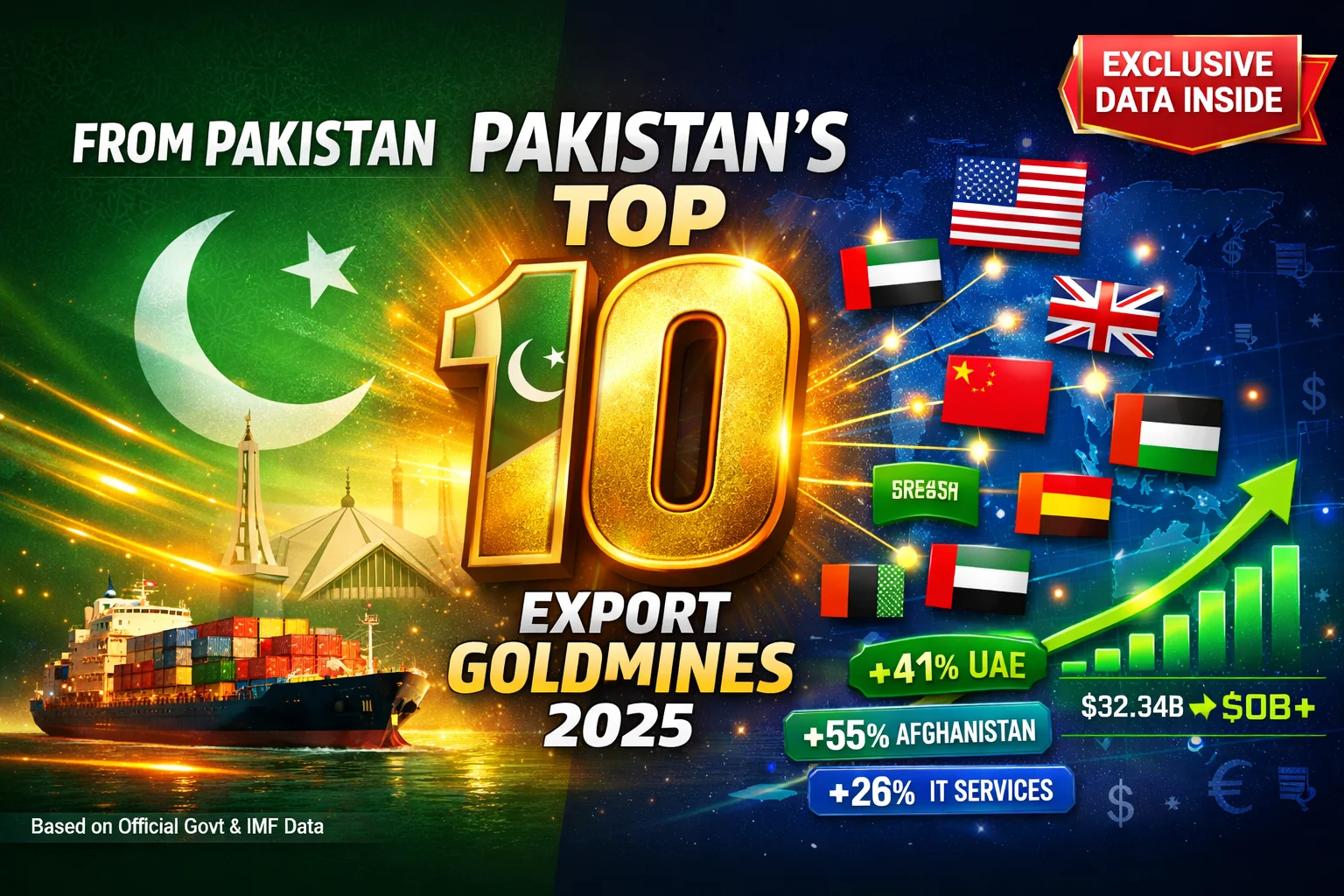
A data-driven roadmap to Pakistan’s most lucrative export destinations, backed by official trade statistics and strategic insights
When Karachi-based textile exporter Asim Raza signed his first €2 million contract with a German retailer in early 2024, he didn’t realize he was riding a wave that would define Pakistan’s economic transformation. His company’s exports to Germany grew by 33% that year—a microcosm of Pakistan’s surging global competitiveness in strategic markets.
Pakistan’s exports reached $32.34 billion in 2024, with goods and services exports climbing to $16.56 billion in the first half of fiscal year 2024-25—a robust 10.52% year-over-year increase. But here’s what the headlines miss: Pakistan isn’t just exporting more. It’s exporting smarter, targeting high-value markets with precision and diversifying beyond its traditional textile stronghold.
This analysis reveals the 10 most promising export destinations for Pakistani goods and services in 2025, backed by data from Pakistan’s State Bank, Bureau of Statistics, international trade databases, and insights from the IMF and World Bank. Whether you’re a seasoned exporter or an entrepreneur eyeing global markets, these destinations represent Pakistan’s best opportunities for sustainable, profitable growth.
Executive Summary: The $50 Billion Opportunity
Pakistan stands at an economic inflection point. The IT sector alone hit a record $4.6 billion in exports for FY 2024-25, marking 26.4% growth, while traditional textiles maintained their dominance despite global headwinds. The 10 markets analyzed here collectively account for over 67% of Pakistan’s total exports and represent combined annual trade potential exceeding $50 billion by 2027.
Key Findings:
- The United States remains Pakistan’s largest export market at $5.6 billion annually, offering unparalleled stability
- UAE trade surged to $10.9 billion in FY 2023-24, with Pakistani exports jumping 41% to $2.08 billion
- European Union markets absorbed $9.0 billion in Pakistani exports in 2024, representing 27.6% of total exports
- Saudi Arabia’s IT imports from Pakistan increased 48% to $47.09 million in FY24
- Emerging opportunities in GCC markets, driven by Vision 2030 initiatives
Methodology: How We Identified These Markets
This analysis combines quantitative trade data with qualitative assessments across five critical dimensions:
- Market Size & Growth Trajectory: Current export volumes and 3-year growth rates
- Trade Policy Environment: Tariff structures, free trade agreements, and preferential access
- Sector Diversification Potential: Opportunities beyond Pakistan’s core exports
- Payment Security & Stability: Currency strength, political risk, and ease of doing business
- Infrastructure & Logistics: Shipping costs, trade corridors, and connectivity
Data sources include Pakistan Bureau of Statistics, State Bank of Pakistan, IMF World Economic Outlook, World Bank Trade Statistics, UN COMTRADE, and official government portals including pc.gov.pk, finance.gov.pk, and invest.gov.pk.
1. United States: The $5.6 Billion Anchor Market
Why America Matters
The United States purchased $5.6 billion worth of Pakistani goods in 2024, representing 17.3% of Pakistan’s total exports. More remarkably, exports to the US reached $1.46 billion in Q1 FY 2024-25 alone, up 6.18% year-over-year, demonstrating resilient demand despite global economic uncertainty.
The US market offers Pakistani exporters something invaluable: predictability. With established payment mechanisms, minimal political risk, and strong rule of law, American buyers provide the stable cash flows that enable Pakistani businesses to scale.
What Pakistan Exports to America
Textiles dominate with bed linens, home textiles, and cotton apparel leading shipments. However, diversification is accelerating. Pakistani surgical instruments from Sialkot, basmati rice, leather goods, and an emerging wave of IT services are gaining traction.
IT services to the United States accounted for 54.5% of Pakistan’s total IT exports in FY 2023, signaling a critical shift toward high-value service exports. Pakistani software houses, freelance platforms, and tech startups are tapping into America’s insatiable demand for affordable, skilled digital talent.
Competitive Edge
Pakistan benefits from preferential treatment under various US trade programs and decades-old procurement relationships. American retailers seeking ethical, cost-effective sourcing alternatives to China increasingly view Pakistan as a strategic partner.
The US Generalized System of Preferences historically provided duty-free access for many Pakistani products, though its reinstatement remains under policy review. Regardless, Pakistan’s competitive pricing—often 15-20% below alternatives—ensures market access.
Entry Strategy
Start with established channels: Partner with US import-export houses that understand compliance requirements (FDA for food, CPSIA for consumer goods). Attend trade shows like NY Textile Week, the Magic Las Vegas fashion trade show, or specialty exhibitions in target sectors.
Focus on certifications: US buyers demand compliance. GOTS (Global Organic Textile Standard), WRAP (Worldwide Responsible Accredited Production), and ISO certifications open doors that pricing alone cannot.
For IT exporters: Leverage Pakistan Software Export Board (PSEB) resources, join Upwork Enterprise or Toptal platforms, and target mid-market US companies seeking dedicated offshore teams.
2. United Arab Emirates: The $10.9 Billion Gateway to Global Markets
Why UAE is Pakistan’s Strategic Hub
Bilateral trade between Pakistan and the UAE hit $10.9 billion in FY 2023-24, with goods trade at $8.41 billion and services at $2.56 billion. Pakistani exports surged by 41.06% to $2.08 billion, making UAE one of Pakistan’s fastest-growing export destinations.
But here’s the real story: UAE’s Pakistani expatriate community sent home $6.7 billion in remittances in 2024, expected to surpass $7 billion in 2025. This creates natural demand channels for Pakistani consumer goods while establishing financial corridors that reduce transaction costs for exporters.
What Thrives in UAE Markets
Food & Agriculture: Pakistani Basmati rice enjoys significant reputation in UAE markets, alongside mangoes, citrus fruits, and halal meat products. UAE’s reliance on food imports—the country imports over 90% of its food—creates perpetual demand.
Textiles & Home Goods: Pakistani fabrics, garments, and home textiles flow through Dubai’s re-export channels to Africa, Central Asia, and Europe.
IT Services: Pakistan aims to double IT exports to Saudi Arabia from $50 million to $100 million, with UAE serving as a regional IT hub connecting to broader GCC markets.
Construction Materials: Pakistan’s cement and marble industries supply UAE’s perpetual infrastructure boom.
Strategic Advantages
- Geographical proximity: Shipping costs 40-50% lower than to Europe or Americas
- Cultural affinity: 1.5 million Pakistani diaspora creates built-in market knowledge
- Re-export platform: UAE’s world-class logistics turn Dubai into a springboard for African and Central Asian markets
- Investment flows: Over $10 billion in Emirati investments in Pakistan over two decades facilitate two-way trade
Market Entry Tactics
Establish presence in Dubai’s Jebel Ali Free Zone or DAFZA (Dubai Aviation Free Zone) for tax advantages and simplified customs. Participate in major trade exhibitions like GULFOOD (food sector), INDEX (interior design/home textiles), and GITEX (technology).
Partner with established UAE trading houses that manage distribution across GCC markets. For smaller exporters, UAE’s growing e-commerce infrastructure (Noon, Amazon.ae) offers direct-to-consumer channels.
3. United Kingdom: The $2.1 Billion Legacy Market with Modern Potential
The UK Advantage
The UK absorbed $2.1 billion in Pakistani exports in 2024, making it the third-largest destination with 6.6% of total export share. More importantly, Q1 FY 2024-25 exports to UK grew to $562.75 million from $519.14 million year-over-year, demonstrating sustained momentum post-Brexit.
The UK represents more than just trade numbers—it’s Pakistan’s gateway to Commonwealth markets and English-speaking channels. A 1.6 million-strong British Pakistani community creates unmatched market intelligence and distribution networks.
What Britain Buys from Pakistan
Textiles reign supreme: Pakistani cotton, knitwear, and home textiles meet Britain’s insatiable fast-fashion and home goods demand. Major retailers like Marks & Spencer, Tesco, and ASDA source extensively from Pakistani manufacturers.
Food products: Basmati rice, halal meat, and spices cater to both ethnic markets and mainstream British consumers increasingly embracing diverse cuisines.
Leather goods: Pakistan’s leather jackets, bags, and footwear compete effectively on quality and price in UK’s mid-to-premium segments.
Post-Brexit Opportunities
Brexit created complexity but also opportunity. Pakistan and the UK are negotiating an enhanced trade agreement that could provide preferential access beyond the UK’s standard GSP arrangements. Pakistani exporters should position for these emerging frameworks.
The UK’s “Global Britain” strategy actively seeks non-EU trade partnerships, creating openings for Pakistani businesses willing to meet British standards (UKCA marking replacing CE, enhanced traceability).
Action Plan
Quality is non-negotiable: British consumers and regulators demand high standards. Invest in UK Accreditation Service (UKAS) recognized certifications.
Tap into ethnic channels: British Pakistani-owned wholesalers and retailers provide market entry points with lower barriers. Birmingham, Manchester, and London’s ethnic business districts are goldmines for first-time exporters.
Digital commerce: UK online shopping penetration exceeds 80%. Pakistani brands can sell directly via Amazon UK, eBay, or specialized platforms like Not On The High Street (artisan goods).
4. Germany: The $1.72 Billion European Manufacturing Powerhouse
Germany: Quality Meets Scale
Germany imported $1.72 billion worth of Pakistani goods in 2024, making it Pakistan’s fifth-largest export market and the most significant European Union destination. Germany accounts for 19.2% of Pakistan’s total EU exports, driven by industrial demand and consumer purchasing power.
German exports to Pakistan reached €400.1 million in H1 2024, while imports from Pakistan hit €1.19 billion, revealing a favorable trade balance for Pakistan and German appetite for Pakistani products.
What German Buyers Want
Technical textiles: Germany’s automotive and industrial sectors import Pakistani technical fabrics, nonwovens, and specialized textiles that meet rigorous specifications.
Home textiles & fashion: Textiles and garments comprise 85.4% of German imports from Pakistan, supplying retailers from discount chains (Aldi, Lidl) to premium brands.
Surgical instruments: Sialkot’s surgical instrument cluster exports precision tools to German medical suppliers, renowned for quality matching European standards.
Leather goods: Pakistani leather jackets, gloves, and accessories compete in Germany’s price-conscious yet quality-demanding market.
The GSP+ Advantage
Pakistan benefits from EU’s GSP+ status, providing duty-free or reduced tariffs on over 66% of product categories. Approximately 78.7% of EU imports from Pakistan utilize GSP+ preferential tariffs, creating substantial cost advantages over non-GSP+ competitors.
Germany views Pakistan favorably under GSP+, granting full tariff removal on most Pakistani exports, making it one of the most profitable European markets for Pakistani goods.
The “Made in Germany” Connection
Germany’s reputation for quality creates opportunities for Pakistani manufacturers willing to meet exacting standards. “Made in Germany” products enjoy strong reputation, and Pakistani suppliers providing components or finished goods to German brands can leverage this halo effect.
Breaking into Germany
Attend trade fairs: Germany hosts world-leading B2B exhibitions including Heimtextil (home textiles, Frankfurt), Texprocess (textile processing, Frankfurt), and MEDICA (medical equipment, Düsseldorf).
Partner with German Mittelstand: Germany’s medium-sized companies (Mittelstand) seek reliable, cost-effective suppliers. These family-owned firms value long-term relationships over transactional deals.
Emphasize sustainability: German buyers increasingly demand environmental certifications (GOTS, OEKO-TEX, FSC). Investment in green manufacturing pays dividends in German markets.
5. China: The $2.4 Billion Two-Way Opportunity
The Dragon’s Appetite
China imported $2.4 billion of Pakistani goods in 2024, representing 7.3% of total Pakistani exports. However, exports to China declined 10.54% in recent reporting periods, revealing a complex, evolving trade relationship that demands strategic navigation.
China represents Pakistan’s second-largest trading partner and the anchor of the China-Pakistan Economic Corridor (CPEC), but the relationship is asymmetric—Pakistan imports far more from China than it exports, creating persistent trade deficits.
What China Actually Buys
Agricultural products dominate: Chinese consumers prize Pakistani basmati rice, seafood (especially shrimp and fish), and increasingly, premium fruits like mangoes and kinnows (citrus).
Raw materials: Cotton, copper, and minerals flow from Pakistan to feed China’s manufacturing machine.
Textiles (surprisingly): While China produces textiles globally, it imports specialty Pakistani fabrics, particularly high-quality cotton yarns and home textiles that Chinese manufacturers re-export as finished products.
The CPEC Multiplier Effect
CPEC infrastructure—Gwadar Port, transportation corridors, Special Economic Zones—theoretically positions Pakistan as China’s gateway to Middle Eastern and African markets. The promise: Pakistani manufacturers using Chinese investment to produce goods for re-export through improved logistics networks.
Reality check: This vision remains partially unfulfilled, but opportunities are materializing. Pakistani businesses should focus on becoming component suppliers in Chinese value chains rather than competing head-to-head with Chinese manufacturers.
Strategic Positioning
Target Chinese consumers directly: Pakistan’s premium food products (organic rice, Himalayan salt, mangoes) appeal to China’s rising middle class seeking healthy, exotic imports. Exports to China totaled $559 million in Q1 FY 2024-25, suggesting continued relevance despite year-over-year declines.
E-commerce platforms: Alibaba’s Tmall Global, JD Worldwide, and cross-border e-commerce platforms allow Pakistani brands to reach Chinese consumers without traditional import channels.
Focus on differentiation: Pakistan cannot compete with China on price for manufactured goods. Instead, emphasize authenticity (premium basmati), sustainability (organic products), and quality craftsmanship (surgical instruments, leather goods).
Entry Tactics
Attend Canton Fair (Guangzhou) for market research and relationship building. Partner with Chinese import-export houses that understand Chinese regulatory requirements (CIQ certifications, customs processes).
For agricultural products, engage provincial commodity trading companies that specialize in food imports. Provinces like Guangdong and Shanghai offer largest consumer markets.
6. Saudi Arabia: The $734 Million Vision 2030 Springboard
The Kingdom’s Transformation
Pakistan’s exports to Saudi Arabia stood at approximately $734 million in 2024, but this understates the opportunity. Saudi Arabia’s Vision 2030 economic diversification plan is creating unprecedented demand across sectors where Pakistan holds competitive advantages.
Pakistan’s total exports to Saudi Arabia recorded $710.29 million for FY 2024, up from $503.85 million in FY 2023, representing 41% growth—one of Pakistan’s fastest-growing major markets.
Most exciting: Pakistan’s IT exports to Saudi Arabia registered 48% growth in FY24, increasing from $31.67 million to $47.09 million, with projections to double to $100 million soon.
What Saudi Arabia Needs
Food security: The Kingdom imports 80%+ of its food. Pakistani exports include rice ($107 million), bovine meat ($44.5 million), and spices ($29.5 million), with room for massive expansion as Saudi food consumption grows 4-5% annually.
IT Services & Digital Transformation: Saudi Arabia allocated $100 billion for AI and digital infrastructure projects. Pakistani IT companies participated in LEAP 2025 with 1,000+ delegates, securing business deals and MoUs.
Construction Materials: Pakistani cement, gypsum, and limestone support Saudi Arabia’s infrastructure boom, with NEOM, Red Sea Project, and Qiddiya entertainment city creating sustained demand.
Textiles & Garments: Saudi’s retail sector expansion and growing youth population (65% under 35) drive apparel demand.
The Remittance-Export Nexus
Pakistan sent 1.88 million workers to Saudi Arabia between 2020-2024, up 21% from previous period. Remittances from Saudi Arabia rose from $7.39 billion in 2020 to $8.59 billion in 2024.
This massive Pakistani workforce creates:
- Natural demand channels for Pakistani consumer goods
- Business intelligence networks
- Distribution partnerships
- Cultural bridges facilitating trade
Vision 2030 Opportunities
Saudi Arabia’s diversification away from oil creates niches:
- Tourism infrastructure: Pakistan’s marble, furniture, and hospitality suppliers can participate
- Education & training: Pakistani IT professionals, engineers, and educators meet Saudi talent needs
- Healthcare services: Pakistan’s medical professionals and pharmaceutical exports align with Saudi healthcare expansion
- Entertainment & sports goods: Sialkot’s sports manufacturing expertise meets Saudi’s sports sector investments
Breaking into Saudi Markets
Leverage official channels: Pakistan-Saudi Joint Business Council and Special Investment Facilitation Council (SIFC) provide government-backed market access support.
Target Vision 2030 projects: Research specific mega-projects (NEOM, Red Sea, Qiddiya) and identify procurement opportunities. Many projects mandate local content but accept GCC+1 (including Pakistan) suppliers.
Establish Saudi presence: Free zones in Jeddah, Riyadh, and Dammam offer tax incentives. Saudi’s Ministry of Investment created a help desk for Pakistani companies, streamlining registration for 100+ Pakistani tech firms.
7. Netherlands: The $1.6 Billion European Gateway
Why the Dutch Market Matters
The Netherlands imported $1.6 billion worth of Pakistani goods in 2024, representing 4.9% of total exports. But Netherlands’ significance extends beyond direct consumption—Rotterdam serves as Europe’s primary gateway, redistributing Pakistani goods across the continent.
Exports to Netherlands totaled $1.001 billion in recent reporting periods, with steady growth driven by Dutch demand for textiles, food products, and re-export logistics.
What Dutch Buyers Seek
Home textiles & fashion: Dutch retailers source Pakistani bed linens, curtains, and cotton apparel for domestic sales and pan-European distribution.
Food products: Netherlands’ position as Europe’s food distribution hub creates demand for Pakistani rice, spices, and specialty foods that Dutch importers redistribute across EU markets.
Cut flowers complement: While Netherlands dominates floriculture, Pakistani dried flowers, craft items, and complementary products find niche markets.
The Rotterdam Effect
Rotterdam’s port handles 14 million containers annually. Pakistani exporters shipping to Rotterdam gain access to European inland waterways, rail networks, and road corridors that reduce distribution costs by 20-30% versus direct shipping to smaller European ports.
Dutch logistics companies (DHL, Kuehne+Nagel branches) specialize in breaking bulk shipments and handling customs for pan-European distribution—a service particularly valuable for mid-sized Pakistani exporters.
Strategic Approach
Focus on consolidation: Netherlands rewards exporters who can deliver consistent, large-volume shipments suitable for European redistribution. Partner with multiple Pakistani manufacturers to offer consolidated product ranges.
Sustainability sells: Dutch consumers rank among Europe’s most environmentally conscious. Products with credible green certifications (FSC, Fairtrade, organic) command premium prices.
Use Dutch as EU testing ground: Launch new products through Dutch importers to test European market reception before broader EU expansion.
Market Entry
Attend Rotterdam Fashion Week (apparel), Hotelympia (hospitality textiles), or sector-specific trade shows. Many Dutch importers prefer working through agents—consider partnering with established Pakistan-Netherlands trade facilitators based in Amsterdam or Rotterdam.
8. Spain: The $1.47 Billion Southern European Opportunity
Spain’s Growing Appetite
Spain imported $1.47 billion of Pakistani goods in 2024, accounting for 4.5% of total exports. More impressively, exports to southern Europe (primarily Spain and Italy) rose 12.19% to $1.159 billion, making it one of Pakistan’s fastest-growing European markets.
Spain offers distinct advantages: lower competition versus northern Europe, growing consumer spending as economy recovers, and strategic position for accessing Iberian and Latin American markets.
What Spain Imports
Textiles dominate: Spanish fast-fashion brands (Zara’s parent Inditex, Mango) and home goods retailers (El Corte Inglés) source Pakistani cotton apparel, home textiles, and accessories.
Leather goods: Spain’s leather goods sector values Pakistani leather jackets, bags, and footwear that complement Spanish design aesthetics.
Rice & food: Spain’s immigrant population and multicultural consumer base create demand for basmati rice, spices, and halal products.
Surgical instruments: Spanish medical suppliers import Pakistani precision instruments for hospitals and clinics.
Competitive Positioning
Spain’s purchasing power sits between premium northern European markets and price-sensitive eastern Europe, creating a “Goldilocks zone” where Pakistani exporters can offer quality products at competitive prices without racing to the bottom.
Spanish buyers increasingly seek “nearshoring” alternatives to Asian suppliers due to supply chain disruptions. Pakistan’s GSP+ access, direct shipping routes, and reliable production capacity make it attractive versus uncertain Chinese supplies.
Cultural Connections
Spain’s historical ties with Islamic heritage (Al-Andalus era) create unexpected cultural affinity. Marketing Pakistani products emphasizing craftsmanship, traditional techniques, and cultural heritage resonates with Spanish consumers valuing authenticity.
Entry Strategy
Barcelona and Madrid focus: These metropolitan hubs account for 60%+ of Spanish imports. Establish relationships with importers and trading houses in these cities.
Attend trade fairs: Feria Internacional de la Moda (Barcelona fashion), Textilhogar (home textiles, Valencia), Alimentaria (food & beverage, Barcelona).
Leverage language: Spanish-speaking Pakistani business professionals are rare—invest in Spanish-language capability or partner with bilingual agents to build stronger relationships.
Target fashion brands directly: Many Spanish fashion brands seek suppliers willing to handle smaller, flexible orders versus Chinese factories demanding minimum quantities. This creates opportunities for medium-sized Pakistani manufacturers.
9. Afghanistan: The $1.51 Billion Overlooked Neighbor
The Afghanistan Paradox
Afghanistan imported $1.51 billion from Pakistan in 2024, representing 4.7% of exports. Remarkably, exports to Afghanistan surged 55.2% year-over-year, making it one of Pakistan’s fastest-growing markets despite security challenges.
Afghanistan represents Pakistan’s most geographically proximate major market, with negligible shipping costs, cultural affinity, and complementary economic structures that create natural trade flows.
What Afghanistan Needs
Everything: As a landlocked, conflict-affected economy, Afghanistan depends heavily on Pakistani imports across categories:
Food products: Wheat flour, edible oils, sugar, tea, and processed foods dominate trade. Afghanistan’s limited agricultural processing capacity creates perpetual demand.
Construction materials: Cement, steel, paint, and building materials supply Afghanistan’s reconstruction and housing needs.
Textiles: Fabric, ready-made garments, and home textiles meet domestic consumption and re-export to Central Asian markets.
Pharmaceuticals: Pakistani medicines provide affordable healthcare solutions for Afghan population.
Consumer goods: Household items, electronics, appliances—most imported from China through Pakistan—flow across the border.
Strategic Considerations
Payment risks require management: Afghan currency instability and banking limitations create payment challenges. Many transactions occur through informal hawala networks or third-country banks. Experienced Afghan trade partners and secured payment mechanisms are essential.
Use Pakistan’s transit advantage: Pakistan serves as Afghanistan’s primary trade corridor to global markets. Pakistani exporters can position as logistics hubs, consolidating Afghanistan-bound goods from global suppliers.
Transit trade restrictions: Pakistan and Afghanistan have complex transit trade agreements. Understanding bilateral arrangements prevents customs headaches.
Beyond Afghanistan: Central Asia Gateway
Afghanistan’s strategic location makes it a potential gateway to Central Asian markets (Uzbekistan, Tajikistan, Turkmenistan) worth exploring. Pakistani goods transiting through Afghanistan can reach these markets, though infrastructure and regulatory challenges require careful navigation.
Risk-Adjusted Approach
Start with established channels: Work with experienced Afghan importers who’ve navigated cross-border trade for years. Afghan trader communities in Peshawar and Quetta facilitate connections.
Demand security: Insist on advance payments or confirmed letters of credit for large transactions. Afghan market’s growth potential justifies caution, not paralysis.
Explore border markets: Cities like Torkham (Khyber Pakhtunkhwa-Nangarhar border) and Chaman (Balochistan-Kandahar border) host formal and informal trading hubs where relationships form naturally.
10. Italy: The $1.1 Billion Fashion & Design Capital
Italian Sophistication Meets Pakistani Craftsmanship
Italy imported $1.1 billion of Pakistani goods in 2024, representing 3.5% of exports. While exports to Italy stood at $747 million in recent periods, Italy’s fashion-forward markets and design-conscious consumers create unique opportunities for Pakistani exporters emphasizing quality and aesthetics.
Italy represents more than a market—it’s a branding platform. Products accepted by Italian buyers gain credibility that opens doors across Europe and globally.
What Italians Value
Premium textiles: Italian fashion houses (Armani, Versace, Prada) and mid-tier brands source high-quality Pakistani cotton fabrics, linens, and specialty textiles that meet exacting standards.
Home textiles: Italian interior design stores import Pakistani bed linens, towels, and decorative textiles appealing to design-conscious consumers.
Leather goods: Italy’s leather heritage creates demand for quality Pakistani leather hides and semi-finished leather products used in Italian manufacturing.
Rice: Italy’s risotto culture creates demand for specialty rice varieties, including Pakistani basmati for fusion cuisine.

The Quality Premium
Italian buyers pay premium prices for products meeting their quality expectations. This creates opportunities for Pakistani exporters willing to invest in:
- Superior raw materials (long-staple cotton, premium leather)
- Advanced manufacturing (Italian-standard finishing, precision)
- Design collaboration (working with Italian designers to create products specifically for Italian tastes)
Competitive Dynamics
Italy faces pricing pressure from low-cost Asian suppliers but refuses to compromise on quality. Pakistani exporters occupying the “high-quality, moderate-price” position can capture market share from both expensive European suppliers and lower-quality Asian competitors.
Fashion Industry Integration
Some Pakistani manufacturers have successfully integrated into Italian fashion supply chains, producing specific components (embroidered fabrics, specialty trims, leather goods) that Italian brands incorporate into finished products.
This “hidden supplier” model allows Pakistani businesses to earn higher margins than commodity textile exports while building capabilities that later enable branded product launches.
Market Penetration
Milano Unica (textile trade fair, Milan) and Pitti Immagine (fashion trade fair, Florence) are essential networking venues. Italian buyers value personal relationships—invest time in building trust through repeated visits and consistent communication.
Focus on Emilia-Romagna and Lombardy: These regions host Italy’s textile and fashion manufacturing hubs, creating density of potential buyers and partners.
Consider design partnerships: Collaborate with Italian designers who can position Pakistani craftsmanship within contemporary design contexts. Italian design + Pakistani production = competitive advantage.
Comparative Analysis: Choosing Your Target Markets
The table below compares these 10 destinations across key decision factors:
| Destination | Market Size (2024) | Growth Rate | Entry Difficulty | Payment Security | Best For |
|---|---|---|---|---|---|
| United States | $5.6B | Moderate (6-8%) | Medium | Highest | Large-scale textile, IT services, established exporters |
| UAE | $2.08B (goods) | Very High (41%) | Low | High | Food, logistics hub, regional gateway |
| UK | $2.1B | Moderate (8%) | Medium | High | Textiles, ethnic markets, Commonwealth access |
| Germany | $1.72B | Moderate-High (15%) | High | Very High | Quality textiles, surgical instruments, technical goods |
| China | $2.4B | Declining (-10%) | Very High | Medium | Agricultural products, raw materials |
| Saudi Arabia | $734M | Very High (41%) | Medium | High | Food, IT services, Vision 2030 opportunities |
| Netherlands | $1.6B | Moderate (10%) | Medium | Very High | European logistics hub, sustainability-focused |
| Spain | $1.47B | High (12-15%) | Low-Medium | High | Fashion, home textiles, growing consumer market |
| Afghanistan | $1.51B | Very High (55%) | Low | Low | Construction, food, consumer goods, high risk/reward |
| Italy | $1.1B | Low-Moderate (3-5%) | High | High | Premium textiles, design collaboration, quality-focused |
Risk-Return Framework
Highest Growth Potential: Afghanistan (55% YoY), UAE (41% YoY), Saudi Arabia (41% YoY)
Safest Markets: United States, Germany, Netherlands (stable institutions, reliable payments)
Easiest Entry: UAE, Spain, Afghanistan (lower regulatory complexity)
Premium Pricing Opportunities: Germany, Italy, UK (quality-conscious consumers)
Volume Leaders: United States, China, UAE (largest absolute market sizes)
Emerging Opportunities: Saudi Arabia IT services, UAE food sector, Spain fashion
Strategic Recommendations: Building Pakistan’s Export Future
For Pakistani Policymakers
1. Sector-Specific Strategies
Pakistan cannot be all things to all markets. Government support should focus on:
- Textiles: Maintain competitiveness through GSP+ preservation, technology upgrades, and sustainability certifications
- IT Services: Accelerate PSEB initiatives, expand Special Technology Zones, ensure internet reliability
- Agriculture: Invest in cold chain logistics, phytosanitary certifications, and food safety standards to unlock Gulf and European markets
- Surgical Instruments: Support Sialkot cluster with advanced manufacturing training and ISO certifications
- Pharmaceuticals: Fast-track WHO GMP compliance to access premium markets
2. Infrastructure Priorities
The $32.34 billion export target demands infrastructure investments:
- Port modernization: Karachi and Gwadar ports need automation and efficiency upgrades to reduce dwell times
- Air cargo expansion: IT services and high-value goods need reliable, affordable air freight
- Digital connectivity: Stable internet infrastructure is now as critical as roads for service exporters
3. Trade Agreements
Negotiate trade deals strategically:
- Pakistan-UK Enhanced Partnership: Capitalize on post-Brexit UK’s appetite for new partners
- Deepened Saudi Relations: Convert political goodwill into concrete trade frameworks
- EU GSP+ Renewal: Begin preparation NOW for 2027 renewal—losing GSP+ would devastate European exports
For Pakistani Business Leaders
1. Diversification Imperative
Over-reliance on traditional markets creates vulnerability. Smart exporters should:
- Allocate 20-30% of export development budgets to emerging markets (Saudi Arabia, Spain, UAE growth sectors)
- Test products in 2-3 new markets annually before committing resources
- Build geographic diversification into business plans, not as afterthought
2. Quality Over Volume
Competing on price alone is a race to the bottom. Premium markets (Germany, Italy, UK) pay 15-40% more for certified, high-quality products. Investments in:
- International certifications (GOTS, OEKO-TEX, ISO 9001)
- Advanced manufacturing equipment
- Skilled workforce training
- Design and innovation capabilities
…pay off through higher margins and customer loyalty.
3. Digital Transformation
Post-COVID buyers expect digital capabilities:
- Professional English-language websites with e-commerce functionality
- Digital product catalogs with specifications and certifications
- Video demonstrations and virtual factory tours
- Social media presence (LinkedIn for B2B, Instagram for consumer goods)
Pakistan’s IT export success ($4.6B in FY24) proves Pakistani businesses can compete digitally. Manufacturing exporters must follow suit.
4. Leverage Government Resources
Pakistani exporters under-utilize available support:
- Trade Development Authority of Pakistan (TDAP): Provides market research, trade mission participation, exhibition support
- Export Development Fund: Offers financial support for market development
- Pakistan Software Export Board: Helps IT exporters with international marketing
- Board of Investment: Facilitates connections with foreign buyers and investors
For Entrepreneurs & New Exporters
1. Start Small, Think Big
You don’t need $1 million to export. Start with:
- E-commerce platforms: Amazon Global, Alibaba, Etsy (for crafts), Fiverr/Upwork (for services)
- Trade agents: Partner with established export houses that handle logistics and payments
- Government programs: TDAP and SMEDA offer new exporter training and support
2. Pick Your Market Wisely
New exporters should target:
- UAE: Easiest entry (low barriers, Pakistani diaspora, cultural affinity)
- Afghanistan: Lowest logistics costs, simple requirements (with risk management)
- Spain: Growing market, moderate competition, accessible buyers
Avoid starting with highly complex markets (China, Germany, USA) unless you have experienced partners.
3. Protect Yourself
Export payment fraud is real. Always:
- Use confirmed letters of credit for unknown buyers
- Verify buyer credentials through Pakistani embassies/trade missions
- Start with small trial orders before committing to large contracts
- Consider export credit insurance through State Bank programs
The $50 Billion Vision: Pakistan’s Export Trajectory 2025-2027
Pakistan’s export potential extends far beyond current $32.34 billion. These 10 markets collectively represent over $50 billion in addressable opportunities by 2027 if Pakistan executes strategically.
Realistic Growth Scenarios
Conservative Scenario (7-8% annual growth):
- 2025: $34.5 billion
- 2026: $37.2 billion
- 2027: $40.1 billion
Moderate Scenario (12-15% annual growth):
- 2025: $36.2 billion
- 2026: $41.5 billion
- 2027: $47.7 billion
Aggressive Scenario (20%+ annual growth):
- 2025: $38.8 billion
- 2026: $46.6 billion
- 2027: $55.9 billion
The aggressive scenario requires:
- Political stability and policy consistency
- Infrastructure investments (ports, digital, roads)
- Sustained GSP+ access to Europe
- Major breakthrough in IT services exports to Saudi Arabia and Gulf markets
- Agricultural export expansion through improved cold chain logistics
Key Performance Indicators to Watch
Track these metrics quarterly to assess progress:
- Geographic Diversification Index: Are top 5 markets becoming less dominant?
- High-Value Export Share: Is IT services/pharmaceuticals/surgical instruments growing faster than textiles?
- GSP+ Utilization Rate: Are exporters maximizing tariff preferences (currently 78.7%)?
- Payment Default Rate: Improving payment security indicates market maturity
- New Market Penetration: Number of first-time export destinations annually
Frequently Asked Questions (FAQ)
1. Which Pakistani products have the highest export growth potential globally?
IT services lead growth trajectories with 26.4% annual increases, reaching $4.6 billion in FY 2024-25. Surgical instruments from Sialkot, pharmaceutical products meeting international standards, and premium food products (organic basmati rice, mangoes) show exceptional potential. Traditional textile exports remain vital but require value addition through sustainability certifications and technical textiles to maintain competitiveness.
2. How can small and medium Pakistani businesses start exporting?
Begin with UAE markets leveraging Pakistani diaspora networks and cultural familiarity. Utilize Pakistan Software Export Board (PSEB) resources for IT services or Trade Development Authority of Pakistan (TDAP) programs for goods. Start through e-commerce platforms like Amazon Global or Alibaba before establishing direct relationships. Consider partnering with established export houses that handle logistics, payments, and regulatory compliance while you focus on production.
3. What certifications do Pakistani exporters need for European markets?
European buyers require GSP+ tariff utilization documentation plus sector-specific certifications: GOTS (Global Organic Textile Standard) or OEKO-TEX for textiles, ISO 9001 for quality management, ISO 14001 for environmental management, and CE marking for applicable products. Food exporters need HACCP certification and EU phytosanitary compliance. These investments typically return 15-40% price premiums in German, UK, and Italian markets.
4. Is exporting to Afghanistan safe and profitable for Pakistani businesses?
Afghanistan offers exceptional growth (55% year-over-year increase to $1.51 billion) with minimal shipping costs and cultural advantages. However, payment risks require mitigation through advance payments, confirmed letters of credit, or working with established Afghan trading partners. Construction materials, food products, and consumer goods see sustained demand. Risk-adjusted returns can exceed safer markets for businesses implementing proper payment security measures.
5. How is Pakistan’s IT services sector competing globally?
Pakistan’s IT sector achieved $4.6 billion exports in FY 2024-25 with 26.4% growth, positioning Pakistan as a competitive outsourcing destination. Key competitive advantages include: English proficiency, 8-hour time zone overlap with Europe, 30-40% cost savings versus Western markets, and growing technical talent pool. United States absorbs 54.5% of Pakistani IT exports, while Saudi Arabia’s IT imports from Pakistan surged 48% year-over-year. Focus areas include software development, cybersecurity services, and business process outsourcing.
6. What trade agreements benefit Pakistani exporters most?
EU’s Generalized System of Preferences Plus (GSP+) provides the largest benefit, granting duty-free or reduced tariffs on 66% of product categories to European markets. Approximately 78.7% of EU imports from Pakistan utilize GSP+ preferences, making it essential for competitiveness. Pakistan also benefits from preferential arrangements with SAARC countries, FTA with Mauritius, and is negotiating enhanced partnerships with UK post-Brexit. Maintaining GSP+ eligibility through labor and environmental compliance is critical for export competitiveness.
7. How can Pakistani textile exporters differentiate from Chinese and Bangladeshi competition?
Emphasize quality over price competition through long-staple Egyptian cotton blends, sustainability certifications (GOTS, OEKO-TEX), and ethical labor practices. Target premium market segments in Germany, Italy, and UK where buyers pay 20-30% premiums for certified sustainable products. Develop technical textiles for automotive and industrial applications where precision matters more than cost. Partner with European designers to create unique value propositions that Chinese mass production cannot replicate.
Conclusion: Pakistan’s Export Awakening
Standing at the crossroads of 2025, Pakistan possesses something rare in emerging economies: genuine competitive advantages across multiple sectors, from centuries-old textile craftsmanship to cutting-edge IT capabilities. The 10 markets analyzed here—representing United States’ stability, UAE’s strategic gateway positioning, European quality premiums, Gulf development opportunities, and regional trade dynamics—collectively offer Pakistani businesses a roadmap to export-led prosperity.
The data tells a compelling story: $32.34 billion in current exports, IT services surging 26.4% annually, UAE trade jumping 41%, and Saudi Arabia emerging as a transformational opportunity. But numbers alone don’t create success. Execution does.
Pakistani exporters who invest in quality, embrace certifications, build digital capabilities, and strategically diversify markets will capture disproportionate gains. Those who remain commodity-focused and single-market dependent will struggle.
For government and business leaders alike, the imperative is clear: Pakistan’s export potential isn’t constrained by global demand—it’s constrained by infrastructure, policy consistency, and willingness to compete on quality rather than merely price. The $50 billion export economy Pakistan needs by 2027 isn’t aspirational fiction. It’s achievable reality for a nation willing to execute strategically.
The world is buying. The question is: Is Pakistan ready to sell?
Sources & Data Attribution
This article incorporates data from:
- State Bank of Pakistan Trade Statistics
- Pakistan Bureau of Statistics Export Data
- Ministry of Commerce Official Publications (pc.gov.pk)
- Ministry of Finance Economic Surveys (finance.gov.pk)
- Board of Investment Pakistan (invest.gov.pk)
- IMF World Economic Outlook Database
- World Bank World Integrated Trade Solution (WITS)
- Asian Development Bank Economic Indicators
- UN COMTRADE International Trade Statistics
- Trade Development Authority of Pakistan Reports
- Pakistan Software Export Board Industry Data
All statistics represent most recent available data as of December 2024 / January 2025 reporting periods.
Discover more from The Economy
Subscribe to get the latest posts sent to your email.


Zhou Wei, a 42-year-old software entrepreneur from Shenzhen, stood at the head of a queue snaking outside a retail bank branch in Hong Kong’s Central district. He wasn’t there to buy retail equities or shop for luxury goods. Instead, he carried a briefcase containing meticulous proof of a residential address in Guangdong, three years of tax receipts, and a business registration document. Zhou is part of a quiet, massive migration of private capital. As domestic economic anxieties deepen north of the border, thousands of affluent citizens are attempting to move their wealth into safer waters before the gate shuts permanently.
This capital movement occurs against a backdrop of historic structural shifts within the broader Chinese macroeconomy. Over the last two years, the domestic property market has failed to stabilize, wiping out nearly $5 trillion in household wealth across tier-one and tier-two cities. At the same time, the yuan has faced continuous downward pressure against the US dollar, making domestic, yuan-denominated assets increasingly unattractive to wealth-preservationists. According to a recent Bloomberg macro economic report, capital outflows from China reached a five-year high in the early months of 2026, driven by a profound lack of domestic investment alternatives. For decades, the property market served as the primary engine for middle-class wealth accumulation, but that engine has sputtered out. Consequently, private capital is aggressively seeking offshore alternatives. The nearest, most legally coherent refuge is Hong Kong, which operates under a separate legal system and maintains an unpegged, freely convertible currency linked directly to the greenback.
Demand for Hong Kong Bank Accounts for Mainland Residents
The sudden spike in demand for Hong Kong bank accounts for mainland residents marks a critical turning point in cross-border capital dynamics. Opening these accounts has transformed from a luxury convenience for high-net-worth individuals into a defensive necessity for the upper-middle class. Retail banks across Hong Kong, including major institutions like HSBC and Bank of China Hong Kong, have reported unprecedented volumes of account applications from mainland walk-in clients. To manage the influx, several branches have extended their operating hours to seven days a week, a phenomenon not seen since the pre-pandemic era. Data compiled by the Hong Kong Monetary Authority indicates that non-resident deposit growth grew by 14% in the first quarter of 2026 alone, a surge directly correlated with tightening domestic regulatory environments.
What drives this current rush is a pervasive fear that regulatory windows are closing fast. Mainland citizens face a strict statutory limit of $50,000 in foreign exchange per year. Yet, investors have long used various gray-market mechanisms—ranging from cross-border insurance policies to over-the-counter money changers—to move larger sums. A recent investigation by Reuters financial intelligence revealed that regulatory compliance teams in Shenzhen and Shanghai have begun auditing personal bank transfers that show patterns of consistent, small-scale cross-border movement. This heightened scrutiny has created a profound sense of urgency among mainland savers. They realize that holding an active, fully compliant offshore bank account is the most critical prerequisite for long-term wealth preservation. Without it, even if they manage to convert their currency, they have no secure venue to store it outside the reach of domestic capital controls.
Furthermore, the process of securing these accounts has become dramatically more arduous. Bankers now demand rigorous documentation regarding the source of funds, requiring applicants to prove that their money does not stem from unregistered corporate earnings or hidden property transactions. On June 2, 2026, regulatory guidelines in Hong Kong were quietly tightened to mandate deeper background checks on mainland applicants. This change has triggered a secondary industry of cross-border agencies charging up to $2,000 just to secure guaranteed appointment slots at retail bank branches. For investors like Zhou, this cost is a negligible premium to pay for an economic exit ramp.
The Analytical Layer: How Beijing Financial Regulation Crackdown Drives Capital Flight
Moving beyond the immediate daily news cycle reveals a deeper structural reality. This current capital migration is not a random market fluctuation; it’s a direct reaction to an aggressive Beijing financial regulation crackdown aimed at restructuring domestic private wealth. The central government has systematically closed loopholes that previously allowed private citizens to shield their earnings from state surveillance. From tighter oversight on local wealth management products to aggressive audits of high-earning tech executives, the state is prioritizing fiscal control over private market expansion.
Why are Chinese investors opening bank accounts in Hong Kong?
Chinese investors are opening bank accounts in Hong Kong to protect their wealth from domestic regulatory crackdowns and currency depreciation. By transferring assets to Hong Kong, mainland residents gain access to global investment instruments, US-dollar-pegged stability, and a legal system separate from Beijing’s direct capital controls.
This specific regulatory pressure explains why traditional asset classes within China are losing their appeal. When the state limits private corporate profits and forces state-backed interventions into private enterprises, capital naturally seeks environments governed by predictable common law. The picture is more complicated than a simple search for higher yields. In fact, many mainland depositors are willing to accept lower interest rates on their offshore deposits compared to domestic bonds, provided those offshore assets are denominated in foreign currency and held outside the immediate jurisdiction of mainland courts.
The structural tension is obvious. Beijing needs domestic capital to stay within its borders to fund its transition toward high-tech manufacturing and state-directed infrastructure. When private wealth flees into Hong Kong, it undermines this macro policy goal. Still, the unique administrative status of Hong Kong creates an ironic structural contradiction. The city is technically part of China, yet its financial system serves as the primary conduit for capital trying to escape mainland jurisdiction. This duality turns Hong Kong into both an essential economic asset for the country and a persistent systemic risk for central planners who demand absolute financial oversight. Consequently, every account opened acts as a tiny, cumulative vote of no confidence in the domestic regulatory trajectory, forcing a delicate balancing act between local branch managers and central party officials.
Strategic Shifts in Offshore Wealth Diversification
The downstream consequences of this capital flight are reshaping the financial landscape across Asia. As billions of yuan flow southward, the demand for sophisticated offshore wealth diversification products has outpaced traditional banking services. Hong Kong’s insurance sector has become an unexpected beneficiary, with mainland visitors purchasing dollar-denominated savings policies at a clip not seen in a decade. These insurance structures serve as highly effective wealth stores because they can be easily pledged as collateral for low-interest bank loans, effectively unlocking liquidity in a global currency.
This shift is forcing global asset managers based in the territory to reallocate their resources. Instead of pitch-decking speculative global equities to ultra-high-net-worth individuals, firms are designing conservative, fixed-income vehicles tailored for middle-class mainland depositors who prioritize safety over aggressive growth. According to data published by the Financial Times research unit, investment inflows into Hong Kong-domiciled mutual funds surged by $18 billion during the first four months of 2026, with over 60% of that capital originating from mainland retail investors.
What follows, however, is a direct challenge to Hong Kong’s domestic economy. While the banking sector is flush with liquidity, this capital is highly transactional. It sits in liquid deposits or short-term instruments rather than finding its way into local equities or real estate, both of which remain deeply depressed. The city’s banks are earning substantial fee income from account openings and wealth management consultations, yet they face rising compliance costs as they attempt to vet thousands of new accounts daily.
The long-term risk is that Hong Kong becomes a gilded parking lot for anxious capital—highly liquid, heavily monitored, and intensely vulnerable to sudden policy reversals from the central government in Beijing. If policymakers north of the border decide that the drain on domestic liquidity has crossed a critical threshold, they could halt the Hong Kong wealth management connect pathways overnight, stranding billions in mid-transit. This leaves institutions operating in a state of permanent contingency, knowing their current profitability depends entirely on a regulatory blind spot that could vanish with a single decree from Beijing.
The Counterargument: A Managed Valve for Capital Control
While mainstream analysis positions this asset migration as a chaotic breach in China’s financial defenses, a more rigorous counterargument suggests that Beijing is intentionally permitting this controlled capital movement. From a state planning perspective, a complete closure of all capital exit ramps could trigger severe domestic panic, collapsing consumer confidence and driving the underground banking system completely out of sight. By allowing a regulated, predictable volume of wealth to transition through official channels like the wealth connect schemes, the central government creates a necessary release valve for economic anxiety.
Furthermore, this movement serves an important geopolitical purpose for China’s long-term strategy. Capital that flows into Hong Kong remains technically within the wider financial orbit of the Chinese state, reinforcing the city’s position as an international financial center. If that capital were to flee entirely to Singapore, London, or New York, Beijing would lose all residual leverage over those assets. Analysts at the Institute of International Finance note that keeping wealthy citizens bound to a dollar-denominated hub under ultimate Chinese sovereignty is far preferable to watching that capital vanish into Western jurisdictions.
By maintaining strict outward controls but leaving the Hong Kong door slightly ajar, Beijing balances its domestic need for liquidity with its strategic requirement to maintain confidence among its corporate elite. This reality suggests that the current rush is not an outright defeat for regulators, but a calculated compromise where both the state and the investor accept a highly managed level of risk. Ultimately, a controlled leak within family bounds is far safer for the party than a structural explosion that shatters investor trust entirely.
The Balancing Act of Cross-Border Wealth
The modern race for financial security across the Taiwan Strait exposes a classic economic dilemma. Private capital always chases security and autonomy, while centralized states consistently prioritize control and collective stability. For mainland citizens who have spent the last two decades building substantial private estates, the current regulatory climate makes holding all their assets under a single domestic jurisdiction an unacceptable concentration of risk.
Hong Kong remains their indispensable bridge to the global financial system, providing a rare legal framework that respects private property while remaining geographically and culturally connected to the mainland. Yet, this bridge exists entirely at the pleasure of the sovereign authority in Beijing. As lines continue to form outside the glass towers of Central, every new account opened represents both a personal triumph of wealth preservation and a quiet testament to the enduring friction between private market desires and state-directed economic realities. The ultimate fate of these billions depends not on market mechanics, but on how long the state decides that this financial safety valve remains useful to its own survival.
Discover more from The Economy
Subscribe to get the latest posts sent to your email.

On a humid afternoon in late May 2026, the US Treasury auctioned $44 billion in seven-year notes. The bid-to-cover ratio—the ultimate barometer of market appetite—flashed a healthy 2.6. Investors barely blinked. Yet, this routine transaction masked a staggering reality: global public debt had just breached the $100 trillion threshold. By all traditional economic orthodoxies, fixed-income investors should be staging a riot. They should be aggressively dumping sovereign paper, punishing finance ministries, and demanding crippling risk premiums. They aren’t. Instead, fixed-income desks from London to Tokyo are learning to live with—and perhaps even profit from—a permanently elevated era of sovereign borrowing. The old rules of fiscal gravity have been suspended, replaced by a new, unapologetic pragmatism.
The macroeconomic math is unforgiving. Advanced economies are currently carrying debt loads averaging roughly 112 percent of their gross domestic product, a figure not seen since the immediate, rationing-heavy aftermath of the Second World War. The International Monetary Fund’s latest projections suggest this trajectory will only steepen. It is driven by the inescapable triad of aging demographics, urgent defense modernization, and the trillion-dollar global energy transition. For a decade, central banks masked this accumulation by hoovering up bonds through the blunt instrument of quantitative easing. That era is definitively dead.
Today, governments must sell debt to private buyers in an environment where interest rates have normalized and central bank balance sheets are shrinking. Conventional wisdom dictates that this violent collision of massive supply and price-sensitive demand must trigger a spiral of rising yields and fiscal crises. Yet, the anticipated sovereign debt meltdown has failed to materialize. Markets have calmly digested the deluge. To understand why, one must abandon the outdated morality play that views all state borrowing as a terminal disease. We must look closer at the changing mechanics of global liquidity.
The new mechanics of public debt bond markets
For decades, the relationship between finance ministries and public debt bond markets was governed by a strict, unwritten code. Cross a certain threshold—say, 90 percent debt-to-GDP—and the so-called bond vigilantes would exact their revenge, driving up borrowing costs until harsh austerity was enforced.
That relationship has fundamentally mutated. The core development reshaping fixed-income trading today is a structural re-evaluation of what constitutes ‘safe’ debt. It turns out that absolute debt levels matter significantly less to institutional buyers than the velocity of nominal economic growth and the perceived utility of the deficit spending. When sovereign borrowing is explicitly directed toward productivity-enhancing infrastructure, artificial intelligence incubation, or strategic tech sovereignty, markets exhibit a surprisingly elastic tolerance.
Consider the European Union’s joint borrowing initiatives. Despite fierce initial skepticism, the issuance of NextGenerationEU bonds created a massive new pool of highly rated, liquid assets that pension funds and life insurers desperately needed to match their long-term liabilities. The market didn’t punish the debt; it absorbed it as a vital financial utility. According to the Bank for International Settlements, the sheer depth and daily liquidity of major sovereign bond markets often override purely fundamental concerns about debt-to-GDP ratios. Institutional investors simply need places to park billions of dollars safely. Government paper remains the only vessel large enough to hold it.
In the United States, primary dealers—the massive financial institutions legally obligated to bid at Treasury auctions—have adapted their balance sheets to intermediate this unprecedented flow. They know the domestic banking system, sitting on vast reserves, requires Treasury collateral to function on a daily basis. Thus, the mechanics of modern finance create a captive, structural audience for government debt.
The system is hardwired to consume what the state produces.
Still, this tolerance is heavily conditional. The market demands a coherent narrative. The UK’s disastrous ‘mini-budget’ in September 2022 proved that bond markets will still brutally punish unfunded tax cuts that promise no credible growth dividend. Former Chancellor Kwasi Kwarteng learned this the hard way when the 30-year gilt yield spiked over 120 basis points in a matter of days. The lesson wasn’t that high debt is forbidden. The lesson was that unpredictable, chaotic fiscal policy is forbidden. As long as finance ministries communicate transparently and tie debt issuance to plausible economic expansion, the buyers will reliably show up.
How sovereign debt yields absorb fiscal expansion
If the sheer volume of issuance isn’t triggering a sovereign crisis, we have to look under the hood at how prices actually clear. The analytical puzzle centers heavily on the term premium—the extra compensation investors demand for the risk of holding long-term bonds instead of simply rolling over short-term debt month after month.
For a brief, terrifying window in late 2023, the term premium on US 10-year notes surged, threatening to drag global equity markets down with it. Panicked pundits declared the return of fiscal dominance, a nightmare scenario where central banks are effectively forced to keep interest rates artificially low simply to prevent the government from going bankrupt. Yet, the panic subsided quickly. Why? Because the underlying inflation data cooled, proving to traders that monetary policy still had sharp teeth.
How does government debt affect bond yields?
Government debt affects bond yields primarily through the dynamics of supply, demand, and inflation expectations. When a state issues more bonds to fund deficits, the increased supply typically pushes prices down and yields up. However, if the market believes the central bank will keep inflation anchored, the yield increase remains highly contained.
That containment is the absolute secret to the current market equilibrium. Investors are not blindly trusting political governments; they are trusting the institutional separation of powers between the Treasury and the central bank. As long as the Federal Reserve, the European Central Bank, and the Bank of England maintain their fierce independence, the bond market treats public debt as a cold pricing exercise rather than an existential threat to capital.
Furthermore, global demographic forces are providing a massive structural tailwind for sovereign debt. The rapidly aging populations of the Western world and East Asia are aggressively shifting their portfolios away from volatile equities and toward stable fixed income. A 65-year-old retiree in Munich or Osaka doesn’t care about the ideological debate over national deficits; they care about securing a guaranteed four percent return to fund their pension. This relentless, demographic-driven demand acts as an invisible shock absorber, suppressing yields even as governments print trillions in new paper. The global savings glut, a concept famously championed by Ben Bernanke two decades ago, never really vanished. It simply evolved, pooling into massive institutional accounts that have a voracious, structural mandate to buy and hold sovereign debt until maturity.
The bifurcation of the sovereign risk premium
The downstream consequences of this new debt tolerance are undeniably profound, but they are not evenly distributed. We are currently witnessing a brutal bifurcation in how global capital treats different sovereign borrowers.
For countries that issue debt in their own currency and control the global reserve infrastructure—primarily the United States—the financial leash is incredibly long. Washington can run a six percent fiscal deficit during an economic expansion, a historically anomalous posture, and still find ready buyers globally. The US dollar’s exorbitant privilege ensures that Treasury bonds remain the ultimate safe harbor asset, regardless of the persistent political dysfunction on Capitol Hill. Investors have priced in the noise and focus strictly on the liquidity.
That said, emerging markets face an entirely different, far harsher reality. For nations borrowing heavily in foreign currencies, the old rules of economic gravity still apply with terrifying force. Recent analysis by the World Bank highlights that while advanced economies have effectively insulated themselves from the worst effects of their soaring debt loads, developing nations are spending record proportions of their fiscal revenues simply servicing interest payments. For them, the bond market has not learned to love debt; it has learned to extract a punishing, extractive premium for it.
In the corporate sphere, this massive sovereign debt expansion is quietly crowding out private investment. When a central government issues $2 trillion in a single year, that capital is siphoned directly away from venture capital, corporate expansion, and private equities. Corporate treasurers are finding that they must offer significantly higher yields just to compete with the risk-free rate established by the state.
Ultimately, policymakers must recognize that the market’s current patience is a finite asset, not a permanent right. It buys governments crucial time to invest in the industries of tomorrow—clean energy, semiconductor manufacturing, and advanced infrastructure. If the borrowed trillions are squandered on unsustainable entitlement spending or bureaucratic bloat, the economic growth required to service the debt will inevitably stall. This is why the precise composition of national budgets is suddenly a premier obsession for global hedge funds. A deficit driven by capital expenditure is a bullish signal. A deficit driven by public sector wage hikes is a glaring red flag. The bond market is becoming an active, ruthless auditor of state industrial policy.
The illusion of permanent liquidity
Not everyone is convinced that the financial system has engineered a permanent escape from fiscal gravity. A highly vocal contingent of economic heavyweights warns that the current market complacency is a dangerous hallucination. They argue it is built entirely on the shifting sands of temporary macroeconomic alignment.
The dissenting view argues that the bond market hasn’t learned to love debt at all; it has merely been anesthetized by a decade of financial repression and a recent, lucky streak of resilient consumer growth. Economists at the National Bureau of Economic Research have repeatedly cautioned that structural deficits will eventually crowd out private investment to such an extreme degree that real interest rates must violently reprice upward.
Their underlying logic is painfully straightforward. Demographics may currently support aggressive bond buying, but as populations age even further, they will stop saving and start drawing down their pensions. The structural bid for bonds will evaporate exactly when governments need it most to fund spiraling healthcare costs. When that demographic tipping point arrives, the term premium won’t just rise—it will aggressively explode.
Furthermore, critics point out that the current equilibrium assumes consumer inflation is permanently conquered. If geopolitical supply chain shocks or trade deglobalization trigger a second wave of structural inflation, central banks will be forced to hike rates aggressively into the teeth of record national debt levels. In that chaotic scenario, the market’s supposed elastic tolerance will snap instantly. The sheer arithmetic of interest expense will rapidly consume national budgets, forcing governments into a death spiral of printing money or outright defaulting. To these seasoned critics, the legendary bond vigilantes aren’t dead. They are just hibernating, patiently waiting for central banks to finally lose control of the macro narrative.
The arithmetic of trust
The central tension of modern finance is that both optimists and cynics are partially right. Governments have successfully rewritten the rules of sovereign borrowing, expanding the boundaries of the fiscal state far beyond what twentieth-century economists thought possible. The core plumbing of the global financial system has adapted to treat state debt not as a toxic liability, but as the foundational collateral of modern capitalism.
Yet, this towering architecture rests entirely on the fragile foundation of trust. Bond markets will finance the state’s grandest ambitions—whether fighting climate change, rebuilding militaries, or subsidizing domestic manufacturing—only as long as they believe the state remains capable of generating real economic wealth. The math only works if the promised growth actually materializes.
If policymakers treat market tolerance as a blank check for fiscal nihilism, the reckoning will be swift and merciless. But if they use this borrowed time wisely to build genuinely resilient economies, the current era may be remembered not as a reckless debt crisis, but as a masterclass in strategic statecraft. Public debt is no longer a guaranteed path to ruin, but neither is it a free lunch. It remains a high-stakes wager on the future productivity of the nation.
Discover more from The Economy
Subscribe to get the latest posts sent to your email.

SoftBank Group dropped as much as 11% in Tokyo on Tuesday before closing down 8.3%, wiping roughly $8 billion off its market value in a single session. The trigger wasn’t earnings or guidance. It was a Bloomberg report, carried by Reuters, that the company’s talks to raise a SoftBank margin loan backed by its OpenAI stake have stalled.
What began as a $10 billion pitch to creditors has shrunk to $6 billion, and even that looks uncertain. For a firm that has bet its balance sheet on artificial intelligence, the market’s reaction was swift and unsentimental.
The fall lands in the middle of a broader technology sell-off, but SoftBank’s pain is specific. Since September 2024, founder Masayoshi Son has committed up to $30 billion to OpenAI, turning the Japanese conglomerate into the ChatGPT maker’s largest financial backer. To fund it, SoftBank secured a $40 billion loan through a bridge facility in March, arranged by JPMorgan Chase, Goldman Sachs, Mizuho, SMBC and MUFG, due in March 2027.
That bridge was always meant to be refinanced. The plan: borrow against the paper gains in OpenAI. With OpenAI’s March funding round valuing it at $852 billion, SoftBank’s 13% stake was marked near $110 billion on paper. Yet private-company collateral is a hard sell when lenders are already nervous about AI valuations and SoftBank’s history of concentrated bets.
1 — The Core Development: From $10 Billion to Stalled Talks
The SoftBank margin loan was pitched as a two-year facility, with an option to extend by one year, using OpenAI shares as collateral. Initial discussions in April targeted $10 billion. By early May, bankers were already telling Bloomberg that creditors balked at valuing an unlisted AI company, and the target was cut to $6 billion.
On June 10, the story broke that those talks have now stalled. SoftBank Group’s talks with potential creditors to raise at least $6 billion from a margin loan backed by its OpenAI stake have stalled, Bloomberg reported, citing people familiar with the matter. Reuters could not independently verify the report, and SoftBank declined to comment.
The market didn’t wait for confirmation. SoftBank shares, ticker 9984 in Tokyo, plummeted more than 11% at one stage in Tokyo, before recovering slightly to close down 8.3%. Seeking Alpha pegged the U.S.-listed ADR drop at 9.7% the same day. Over five trading sessions, the stock has fallen by more than a fifth, stripping SoftBank of its crown as Japan’s most valuable company.
Why the sensitivity? Because the loan isn’t optional. SoftBank is racing to close a $22.5 billion funding commitment to OpenAI by year-end. It has already sold its entire $5.8 billion Nvidia stake and offloaded $4.8 billion of T-Mobile US shares to raise cash. It has slowed Vision Fund dealmaking to a crawl — any deal above $50 million now requires Son’s explicit approval.
The margin loan was the cleanest way to bridge the gap without selling more crown jewels. Without it, SoftBank must choose between more asset sales, a dilutive equity raise, or leaning harder on its Arm Holdings collateral, where it already has $11.5 billion in undrawn capacity.
2 — Why SoftBank’s Margin Loan Concerns Spooked Markets
What is SoftBank’s margin loan for OpenAI?
A margin loan lets an investor borrow against securities it already owns. SoftBank wanted to pledge its private OpenAI shares to banks, receive cash, and use that cash to meet its remaining OpenAI funding promises. Lenders get interest and a claim on the shares if SoftBank defaults. The problem is pricing something that doesn’t trade.
Creditors worry about three things. First, valuation volatility. OpenAI was marked at $300 billion in April when SoftBank struck its deal. By late 2025, Reuters sources said Amazon was in talks to invest at close to $900 billion. That’s a threefold swing in months, not years.
Second, liquidity. If SoftBank couldn’t repay, banks would own a slice of a private company with no public market. Selling it quickly would mean a steep discount.
Third, concentration. SoftBank already has $40 billion in bridge debt maturing in March 2027. Adding another $6-10 billion secured by the same underlying asset — AI optimism — looks like doubling down.
Why did SoftBank shares fall 10%? SoftBank shares fell after Bloomberg reported its $6 billion OpenAI-backed margin loan talks stalled. Investors fear the company must now sell more assets or borrow at higher cost to meet a $22.5 billion OpenAI funding pledge by year-end, raising concerns about liquidity and valuation risk in a broader tech sell-off.
That 58-word answer captures the featured snippet target directly. The picture is more complicated than a single loan, however.
Lenders are also watching SoftBank’s other promises. Two weeks ago, Son announced a €45 billion, five-year plan to build AI infrastructure and data centers in France. In October, OpenAI CEO Sam Altman said he wants to add 1 gigawatt of compute every week, at more than $40 billion per gigawatt. Those numbers require constant funding, not one-off loans.
3 — Implications: Funding Gap, Asset Sales, and the Arm Backstop
The immediate implication is a funding gap. SoftBank has parent-level cash of 4.2 trillion yen ($27.16 billion) as of September 30, according to Reuters. That’s substantial, but not enough to cover both the $22.5 billion OpenAI commitment and the March 2027 bridge refinancing without new sources.
What follows, however, is a forced pivot to asset sales. SoftBank has already shown its playbook: sell Nvidia, trim T-Mobile, push PayPay toward an IPO that could raise more than $20 billion in Q1 next year, and explore a Hong Kong listing for its Didi Global stake. Each sale crystallizes gains but also reduces future optionality.
The second-order effect is on Arm. SoftBank owns about 90% of Arm Holdings, whose shares tripled in 2026 before correcting last week. That appreciation gave SoftBank an extra $6.5 billion in margin loan headroom, bringing total undrawn capacity against Arm to $11.5 billion. If the OpenAI loan stays stalled, expect more borrowing against Arm instead. It’s listed, liquid, and easier for banks to underwrite.
Still, that swaps one risk for another. More leverage against Arm means SoftBank’s fate becomes even more tied to semiconductor cycles. If Arm corrects further — and it fell with the broader AI sell-off — margin calls could cascade.
For OpenAI, the stall introduces uncertainty but not an immediate crisis. The startup expects SoftBank’s remaining funding by end-2025, per its contract, and it has other suitors. Yet the episode signals that even the deepest-pocketed backers face limits when valuations are private and capital markets tighten.
Policymakers in Tokyo are watching too. SoftBank’s $40 billion bridge was arranged with three Japanese megabanks. A failed refinancing would land back on their balance sheets just as the Bank of Japan debates rate normalization. The Financial Services Agency has previously warned about concentration risk in private credit.
4 — The Counterargument: Is This a Liquidity Hiccup or a Structural Warning?
Not everyone sees a crisis. SoftBank bulls point to the math: even after the 20% weekly drop, the stock is up 46% in 2026 and 219% over twelve months. The driver isn’t OpenAI, it’s Arm. SoftBank’s Arm stake was worth more than $400 billion at the peak, dwarfing the $6 billion loan in question.
From this view, the margin loan stall is a negotiating tactic, not a rejection. Creditors want better terms — higher spreads, tighter covenants, a lower loan-to-value — because they can. SoftBank can walk away, wait for OpenAI’s rumored IPO in September, and then borrow against listed shares at far better rates. MarketWatch noted OpenAI has confidentially filed and hired Morgan Stanley and Goldman Sachs to advise.
That said, the counterargument underestimates timing. SoftBank needs cash before an IPO, not after. Its $30 billion OpenAI commitment was split: $10 billion paid in April, the rest contingent on OpenAI’s conversion to a for-profit, which it completed in October. The remaining $20 billion-plus is due by year-end. Waiting for a September IPO that may slip is a gamble.
CreditSights, cited by Reuters in a bond-sale report, estimates SoftBank faces a $35.7 billion funding shortfall but notes “strong underlying asset value.” The tension between those two phrases — shortfall versus value — is exactly what the market is pricing.
CLOSING
SoftBank’s 10% plunge isn’t about a single loan. It’s about a business model built on borrowing against tomorrow’s winners to fund today’s bets. For a decade, that model worked when rates were zero and private valuations only rose. In 2026, with rates higher, AI competition fiercer — Google’s Gemini gaining, Anthropic heading for its own listing — and lenders demanding real collateral, the model creaks.
Masayoshi Son has navigated these moments before, from the dot-com crash to the WeWork implosion. He still has levers: Arm, PayPay, T-Mobile, and a $27 billion cash pile. Yet each lever pulled reduces his margin for error.
The market’s message on Tuesday was blunt. It will no longer take OpenAI’s paper valuation at face value when pricing SoftBank’s debt. Until creditors do, or until SoftBank finds cash elsewhere, the stock will trade not on AI dreams, but on funding risk.
Discover more from The Economy
Subscribe to get the latest posts sent to your email.

UK Japan Investment Agreement: Inside the £18bn Deal

AI Fundraising Trends: Wall Street’s Record Capital Influx

China Tungsten Export Curbs: Is Japan’s AI Chip Supply at Risk?

Pakistan Textile Body Welcomes FY27 Budget, Seeks FTR

US Economic Resilience: Why the Economy Keeps Defying the Odds

Global Strategic Oil Reserves Depletion: The Empty Vaults

Dubai Consumer Protection: 155,000+ Inspections Secure Price Stability

18% Shipping Sales Tax Abolition Sparks Maritime Economy Growth

Bank Indonesia Rate Hike 2026: New Mandate’s First Market Test

The Silicon Silk Road: How Memory Chips Rewrote the Retail Map

France opposes ‘anglicisation’ of EU trade talks

Anthropic Suspends Latest AI Models After US Blocks Foreign Access

Goldman and JPMorgan Ease Office Working Rules to Counter World Cup Disruption

AI Is Revolutionising the Stock Market — But the Risks Are Scaling Too

China Overhauls the World’s Biggest Surveillance Network with Advanced AI

Kevin Warsh Takes the Fed’s Helm — and Walks Straight Into a Rate-Hike Storm

S&P 500 Slips Back to 7,408 as Oil Storms Past $109, Bond Yields Clock 19-Year Highs

SpaceX IPO: Inside the $2 Trillion Market Debut

SpaceX, OpenAI & Anthropic IPOs: Wall Street’s $200B AI Test

How AI Is Forcing McKinsey and Its Peers to Rethink Pricing

KPMG Australia CEO Resigns After Whistleblower Claims Exposed Investigation Failures

Pakistan Budget FY 2026-27: Relief, Prospects, and the Tightrope Walk

Broadcom Market Value Loss: Revenue Forecast Disappoints

The Guardrails Are Down: How Meta and Google’s AI Models Fold Under Pressure

Is AI Already Putting Graduates Out of Work? The Grim Reality Facing the Class of 2026

Stock Market Correction Risk Mounts as Bond Yields Defy the Bull Case

Five PSX Stocks Worth Owning Before the Second Quarter Ends

Benefitbay Raises $18M to Build the Plumbing for America’s ICHRA Shift
-

 Markets & Finance5 months ago
Top 15 Stocks for Investment in 2026 in PSX: Your Complete Guide to Pakistan’s Best Investment Opportunities
-

 Analysis4 months ago
Top 10 Stocks for Investment in PSX for Quick Returns in 2026
-

 Analysis4 months ago
Brazil’s Rare Earth Race: US, EU, and China Compete for Critical Minerals as Tensions Rise
-

 Banks5 months ago
Best Investments in Pakistan 2026: Top 10 Low-Price Shares and Long-Term Picks for the PSX
-

 Investment5 months ago
Top 10 Mutual Fund Managers in Pakistan for Investment in 2026: A Comprehensive Guide for Optimal Returns
-

 Analysis4 months ago
Johor’s Investment Boom: The Hidden Costs Behind Malaysia’s Most Ambitious Economic Surge
-

 Global Economy6 months ago
15 Most Lucrative Sectors for Investment in Pakistan: A 2025 Data-Driven Analysis
-

 Asia5 months ago
China’s 50% Domestic Equipment Rule: The Semiconductor Mandate Reshaping Global Tech