
Global Economy
Pakistan’s Economic Outlook 2025: Between Stabilization and the Shadow of Stagnation

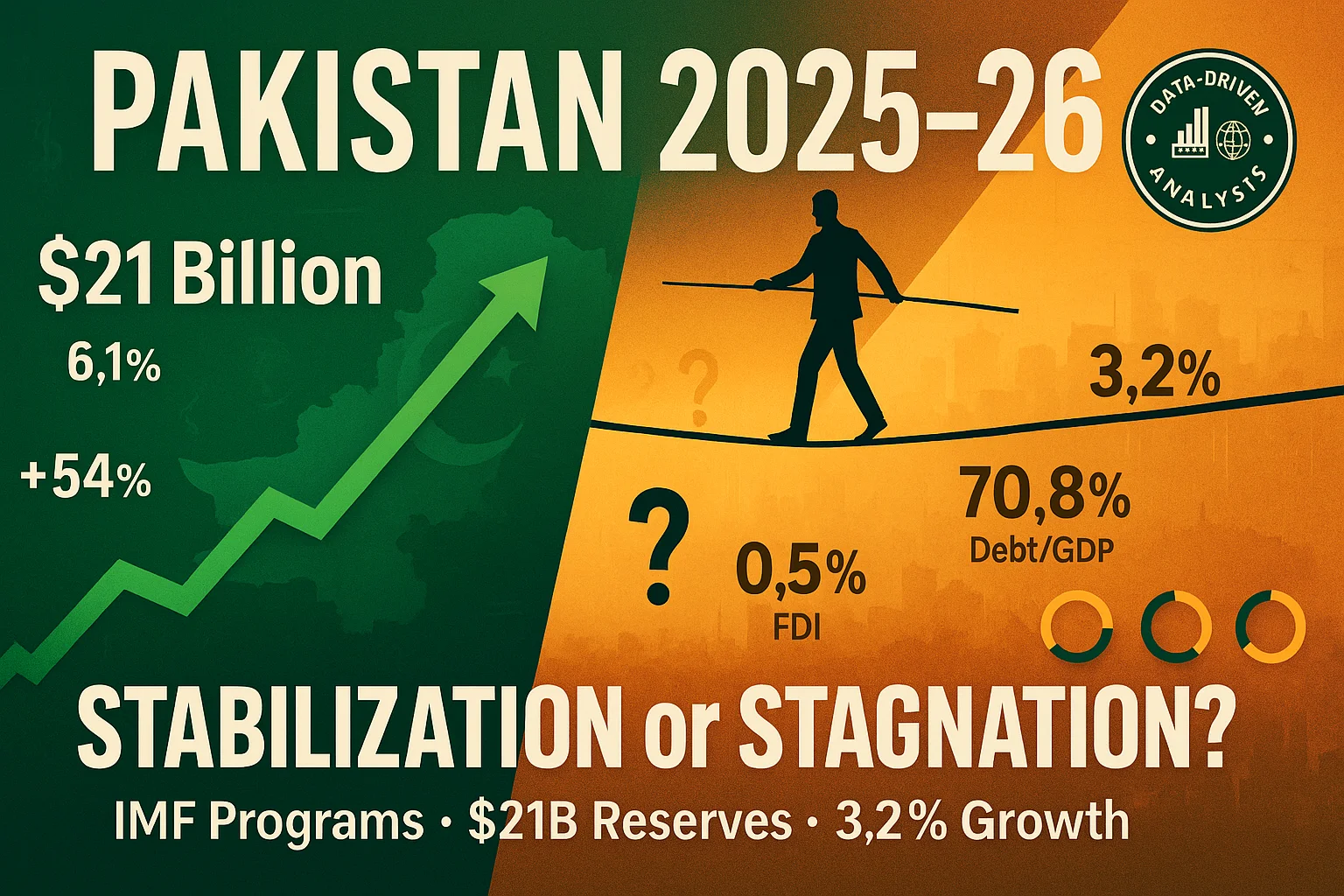
Can Pakistan finally break its bailout addiction, or is 2025 just another chapter in a recurring crisis?
Pakistan’s economy shows stabilization with $21B reserves and 6% inflation, but 3.2% growth barely exceeds population. Analyzing IMF programs, debt dynamics, and 2026 prospects for investors and policymakers.
The International Monetary Fund’s latest disbursement of $1.2 billion to Pakistan in December 2025 represents far more than a routine financial transaction. It’s a barometer of a nation caught between tentative stabilization and the persistent gravitational pull of economic inertia. Pakistan achieved a primary surplus of 1.3 percent of GDP in fiscal year 2025, in line with IMF targets, marking genuine fiscal progress. Yet beneath this achievement lies an uncomfortable truth: growth projections inch from 2.6% in FY25 to just 3.2% by FY26—barely matching population growth for a country of 240.5 million people.
This isn’t recovery. It’s containment.
For investors, policymakers, and Pakistan’s burgeoning middle class, 2025 presents a watershed moment. The immediate crisis of 2023—when foreign reserves plummeted to dangerously low levels and default fears paralyzed markets—has receded. But the challenge now is profoundly different: translating stabilization into sustained, inclusive growth that creates jobs and opportunities at scale.
The Stabilization Mirage: Real Progress or Borrowed Time?
Pakistan’s economic metrics tell a story of contradictions. On one hand, foreign exchange reserves surged to $21.1 billion as of December 2025, the highest level since March 2022. The rupee has shown unexpected resilience, with a 15.4 percent real effective appreciation in FY25 signaling currency stability after years of depreciation. The Pakistan Stock Exchange’s KSE-100 index has been nothing short of spectacular, climbing 54.70% year-over-year to reach 170,830 points, making it one of Asia’s strongest-performing equity markets.
These aren’t trivial achievements. Remittances hit a record $31.2 billion during the first ten months of fiscal year 2025, rising 30.9% year-over-year, with Saudi Arabia emerging as the top source. Inflation eased to 6.1% in November 2025 from a one-year high of 6.2% in October, a dramatic decline from the 23.4% average of the previous year.
“Pakistan’s economic outlook for 2025-2026 shows stabilization after crisis, with foreign reserves reaching $21 billion and inflation declining to 6.1%. However, GDP growth of 3.2% barely exceeds population growth, while 70.8% debt-to-GDP ratio and weak 0.5% FDI signal persistent challenges. The country must implement structural reforms to transition from containment to genuine inclusive growth.”
Yet dig deeper, and fragility persists. Foreign direct investment remains subdued at just 0.5-0.6% of GDP—levels that reflect continuing investor skepticism about Pakistan’s business environment. Unemployment is projected to fall only modestly from 8.3% to 7.5%, revealing weak job creation capacity. The country’s public debt reached Rs80.52 trillion (70.8% of GDP) by end-June 2025, up from Rs71.24 trillion the previous year—an increase of Rs9.3 trillion in a single year.
Consider what this means: Pakistan is running faster just to stay in place. Per capita income of $1,677 combined with 3.2% growth against 2% population growth translates to barely 1% improvement in living standards annually. For a nation where around 45% of the population lives below the poverty line according to a June 2025 World Bank report, this trajectory offers little hope.
The Debt Trap: Pakistan’s Fiscal Straitjacket
Here’s the brutal arithmetic constraining Pakistan’s future: nearly half of projected FY26 outlays—Rs7.5 trillion out of Rs17.4 trillion—is earmarked for debt servicing, equaling 77% of net federal revenues. This leaves Pakistan in what economists call “fiscal capture”—a situation where debt service crowds out virtually all productive spending.
Compare this globally. India, with debt around 82% of GDP, devotes 25-30% of central revenues to interest; Brazil spends roughly 20-25% with 88% debt-to-GDP. Pakistan’s debt servicing burden rivals Argentina’s, a country synonymous with fiscal distress. The difference? Pakistan borrows in currencies it cannot print, at interest rates it cannot control, making it acutely vulnerable to global financial shocks.
The IMF projects some relief, with public debt expected to decline from 70.8% to 60.8% of GDP by FY28 under continued fiscal consolidation. But this depends on maintaining primary surpluses of 2-2.5% of GDP annually—an extraordinary political challenge requiring sustained austerity in a democracy where 45% of citizens live in poverty.
What makes Pakistan’s debt particularly concerning isn’t just its size but its cost. Pakistan recorded a quarterly decline of Rs1.37 trillion in public debt in September 2025, the first since December 2019, achieved through early repayments of expensive debt. Yet the underlying structure remains precarious: domestic debt accounts for nearly half of GDP, keeping interest costs elevated, while external debt fell to 26% of GDP in FY25 from 31% two years earlier—progress, but from dangerously high levels.
The IMF Paradox: Lifeline or Dependency Trap?
Pakistan is operating under two simultaneous IMF programs: a 37-month Extended Fund Facility focused on economic stabilization and a Resilience and Sustainability Facility addressing climate vulnerabilities. Together, these have disbursed around $3.3 billion, with the latest reviews unlocking another $1.2 billion.
This marks Pakistan’s 25th IMF program since joining in 1950—a statistic that speaks volumes about the country’s inability to break its boom-bust cycle. Each program stabilizes the economy temporarily, but structural reforms remain incomplete. Tax collection as a percentage of GDP languishes around 10-11%, one of the lowest globally. Energy sector circular debt continues to accumulate despite repeated restructuring attempts. State-owned enterprises hemorrhage billions in losses annually.
The IMF’s 2025 Governance and Corruption Diagnostic Assessment found Pakistan’s economy loses an estimated 5-6.5% of GDP to corruption through “elite capture,” where influential groups shape policy for their benefit. This isn’t just morally troubling—it’s economically catastrophic. When market distortions and policy capture persist, private investment remains suppressed, foreign investors stay away, and productive capacity stagnates.
Yet paradoxically, the IMF program is working—at least on paper. The fiscal discipline it enforces has stabilized the currency, rebuilt reserves, and restored some international credibility. The question isn’t whether the IMF program is effective; it’s whether Pakistan can internalize these disciplines once external oversight ends.
2026 Prospects: Three Scenarios
Base Case: Muddle-Through Stabilization (60% probability)
Under current policies, Pakistan limps forward with 3-3.5% growth, just ahead of population expansion. The IMF program continues through 2027, providing external anchor and financing. The budget deficit narrows from -6.8% to -4.0% of GDP, with a primary surplus rising to 2.5%. Inflation stabilizes in the 5-7% range. Foreign reserves gradually build toward $25-28 billion by end-2026, providing 3.5-4 months of import cover.
This scenario delivers stability but not transformation. Living standards improve marginally. Job creation remains weak. Brain drain continues as educated Pakistanis seek opportunities abroad. The country avoids crisis but doesn’t achieve escape velocity. Think of it as economic purgatory—not hell, but certainly not heaven.
Upside Case: Reform Breakthrough (25% probability)
Imagine Pakistan actually implements long-delayed structural reforms. Tax-to-GDP ratio increases 2-3 percentage points through base broadening and digitalization. Major state-owned enterprises undergo genuine privatization, not cosmetic restructuring. Energy sector reforms sustainably reduce circular debt. The Special Investment Facilitation Council delivers $5-7 billion in Gulf investments, particularly in agriculture, IT, and mining.
In this scenario, growth accelerates to 4.5-5% by late 2026. Foreign direct investment doubles to 1-1.2% of GDP. The stock market rally continues, with the KSE-100 reaching 200,000 points. Pakistan begins attracting portfolio flows as international investors recognize improved fundamentals. Manufacturing competitiveness improves as energy costs decline.
What makes this plausible? Pakistan has demonstrated capacity for reform under pressure. The recent debt prepayment and fiscal consolidation show technical competence exists. The question is political will. Coalition governments prioritizing short-term survival over long-term transformation make sustained reform unlikely, but not impossible.
Downside Case: External Shock Relapse (15% probability)
Global commodity price spikes, particularly oil, blow out the current account. Regional geopolitical tensions escalate, disrupting trade and investor confidence. Political instability undermines policy continuity. Climate shocks—floods or droughts—require expensive emergency spending, blowing fiscal targets.
In this scenario, the current account deficit widens beyond 1% of GDP. Reserves deplete rapidly. The rupee comes under severe pressure. Inflation rebounds to double digits. The stock market corrects 30-40%. Pakistan returns to IMF mid-program for emergency adjustment, triggering another painful stabilization cycle.
This isn’t alarmist speculation—it’s Pakistan’s historical pattern. The country has faced similar setbacks repeatedly. What’s changed is improved reserve buffers and a more disciplined fiscal stance provide better shock absorption than in past cycles. But vulnerabilities remain acute.
The 2026 Inflection Point: What Must Happen
For Pakistan to transition from stabilization to genuine growth in 2026, five critical factors must align:
Revenue mobilization breakthroughs. Pakistan cannot sustain itself on 10-11% tax-to-GDP. Broadening the tax base, improving compliance, and rationalizing exemptions must deliver at least 1-1.5 percentage points of GDP in additional revenues. This isn’t technically difficult—digitalization and data integration can dramatically improve collection. It’s politically difficult because it requires taxing privileged sectors that have historically evaded their obligations.
Energy sector resolution. Circular debt and high electricity costs strangle industrial competitiveness. Pakistan’s electricity tariffs are among the highest in South Asia, making manufacturing globally uncompetitive. Addressing this requires politically painful decisions: rationalizing capacity payments to independent power producers, reducing transmission losses, improving recovery rates, and possibly renegotiating contracts. Without this, Pakistan cannot compete in global manufacturing.
Investment climate transformation. Why does Pakistan attract only 0.5% of GDP in FDI while Bangladesh draws 1.5% and Vietnam 6%? The answer: bureaucratic red tape, policy unpredictability, weak contract enforcement, and infrastructure deficits. Creating genuine one-stop investment facilitation, reducing regulatory approvals from months to weeks, and providing policy certainty would unlock billions in investment.
Export competitiveness revival. Pakistan’s exports have stagnated around $30-32 billion annually for years while regional peers have surged. Vietnam’s exports exceeded $370 billion in 2024; Bangladesh, despite political turmoil, maintains $45-50 billion. Pakistan needs export-led growth, requiring currency competitiveness, trade facilitation, value chain integration, and quality upgrading. The textile sector alone could double exports with better policy support.
Human capital investment. With 64% of the population under age 30, Pakistan possesses a demographic dividend that could propel growth—or become a demographic disaster if unmanaged. This requires massive investment in education, vocational training, and healthcare. Currently, education spending hovers around 2% of GDP, among the world’s lowest. Doubling this, with reforms ensuring quality, would transform long-term potential.
The Corruption Challenge: Elite Capture and Growth
The IMF’s corruption diagnostic reveals something Pakistan has long known but rarely confronted systematically: 5-6.5% of GDP is lost annually to corruption through elite capture. This isn’t petty bribery—it’s systemic policy distortion where powerful groups extract rents through protective regulations, subsidized inputs, tax exemptions, and procurement manipulation.
Consider the energy sector. Independent power producers negotiated extraordinarily favorable contracts in the 1990s and 2000s, guaranteeing dollar returns regardless of demand. These “capacity payments” now drain billions annually, creating circular debt that cascades through the economy. Why do these contracts persist? Because the beneficiaries have political influence to block reform.
Or examine tax exemptions. Pakistan grants hundreds of billions in tax expenditures annually—concessions to specific sectors, mostly benefiting large, connected businesses. A 2024 analysis found rationalizing just 30% of these exemptions could raise 1.5% of GDP in additional revenue. Yet reform stalls because beneficiaries lobby intensively against rationalization.
Breaking elite capture requires more than anti-corruption campaigns; it demands institutional reform: transparent procurement systems, merit-based bureaucracy, independent regulators, and genuine competition policy. The IMF diagnostic is helpful precisely because it shifts the conversation from moralistic hand-wringing to concrete institutional diagnostics.
Climate and Resilience: The Overlooked Variable
Here’s what makes Pakistan’s outlook uniquely precarious: climate vulnerability. The 2025 monsoon floods affected almost 7 million people and caused an estimated 0.6% of GDP in damage. This follows the catastrophic 2022 floods that inundated one-third of the country, causing $30 billion in damages.
Pakistan ranks among the world’s most climate-vulnerable nations despite contributing negligible global emissions. Rising temperatures threaten agricultural productivity in a country where agriculture employs 40% of the workforce. Glacier melt in the north creates water scarcity risks for irrigation-dependent farming. Extreme weather events—floods, droughts, heatwaves—are increasing in frequency and intensity.
The IMF’s Resilience and Sustainability Facility, providing $200 million in the latest disbursement, addresses this directly. But Pakistan needs far more comprehensive climate adaptation: improved water storage and irrigation systems, disaster-resilient infrastructure, agricultural diversification, and early warning systems. The World Bank estimates Pakistan requires $8-10 billion annually in climate adaptation investments through 2030.
Climate isn’t just an environmental issue—it’s a macroeconomic variable that can blow apart fiscal plans, devastate agricultural output, and trigger massive humanitarian emergencies requiring expensive relief. Any serious 2026 outlook must account for climate risk.
The Regional Context: Where Pakistan Stands
Pakistan doesn’t compete in isolation. Its South Asian neighbors offer instructive contrasts. India, despite comparable governance challenges, maintains 6-7% growth through a larger domestic market, more diversified economy, and deeper capital markets. Bangladesh, having graduated from least-developed status, sustains 5-6% growth driven by garment exports and steady policy continuity.
Even Sri Lanka, having endured debt default and political crisis in 2022, is stabilizing faster than expected. Its reform program, while painful, has restored some fiscal credibility and attracted investment interest.
Pakistan’s advantages are real: a large, young population; strategic location between South Asia, Central Asia, and the Middle East; reasonable infrastructure; and a substantial diaspora providing remittances and potential investment. Its disadvantages are equally real: political instability, security challenges, weak institutions, and policy inconsistency.
The critical question: can Pakistan leverage its advantages while addressing its weaknesses? Historical evidence suggests caution. Pakistan has squandered similar opportunities repeatedly. But circumstances have changed. The regional security environment has stabilized somewhat. China’s Belt and Road infrastructure provides connectivity options. Gulf states, particularly Saudi Arabia and UAE, show investment interest. Global firms seeking China+1 diversification could include Pakistan.
The window exists. Whether Pakistan can seize it depends on choices made in 2025-26.
What This Means for Stakeholders
For investors: Pakistan offers asymmetric opportunities with commensurate risks. The stock market’s 50%+ returns in 2025 reflect compressed valuations catching up to improved fundamentals. Banking, cement, energy, and consumer sectors show promise. But political and policy risks remain elevated. Diversification is essential. Consider Pakistan as a 5-10% portfolio allocation, not a concentrated bet.
For businesses: Pakistan’s 240 million person market and low per-capita income suggest massive consumption growth potential as incomes rise. But doing business requires patient capital, local partnerships, and willingness to navigate bureaucracy. Sectors with demonstrated success—textiles, IT services, food processing—offer proven paths. Emerging sectors like renewable energy, e-commerce, and fintech show potential but require regulatory navigation.
For policymakers: The 2025-26 period represents a narrow window for transformative reform. Stabilization creates space for politically difficult decisions—but that space won’t last forever. Prioritize revenue mobilization, energy sector restructuring, investment climate improvement, and export competitiveness. Most critically, build institutional capacity that outlasts any single government. Pakistan’s problem isn’t lack of plans—it’s lack of implementation and sustainability.
For citizens: Understand that stabilization isn’t prosperity. Demand more than fiscal metrics; demand job creation, service delivery, education access, and corruption accountability. Pakistan’s youth represent its greatest asset—but only if provided opportunities to contribute productively. Brain drain isn’t inevitable; it’s a policy choice reflecting failure to create domestic opportunity.
The Verdict: Cautious Optimism Grounded in Reality
So where does this leave Pakistan in 2025, looking toward 2026? In a place simultaneously better and more fragile than simple metrics suggest.
The stabilization is real. Pakistan has stepped back from the 2023 precipice. Reserves are rebuilding, inflation has declined, fiscal discipline has improved, and market confidence has partially returned. These aren’t trivial achievements—they required painful adjustment and represent genuine progress.
But stabilization isn’t transformation. Growth barely outpacing population expansion doesn’t create jobs at scale. Debt servicing consuming half the budget leaves no fiscal space for development. Foreign investment at 0.5% of GDP signals ongoing skepticism. Poverty affecting 45% of citizens demands far more aggressive inclusive growth.
The choice Pakistan faces isn’t between crisis and prosperity—it’s between muddling through and breakthrough. Muddling through means 3-3.5% growth indefinitely, stable but stagnant, avoiding disaster but not achieving potential. Breakthrough means accelerating to 5-6% sustained growth through genuine reform, creating millions of jobs, dramatically reducing poverty, and fulfilling Pakistan’s considerable potential.
Which path materializes depends on choices made in 2025-26. The external environment is reasonably favorable—global growth continues, commodity prices are manageable, Gulf investment interest exists, and IMF support provides buffer. The domestic environment is more uncertain—political stability is fragile, coalition dynamics complicate reform, and vested interests resist change.
History suggests skepticism. Pakistan has disappointed repeatedly, choosing expedience over reform, short-term survival over long-term strategy. But history also shows capacity for surprise. Pakistan has demonstrated resilience through extraordinary challenges. The question isn’t capability—it’s will.
For 2026, expect continued stabilization with modest growth acceleration if reforms progress. The base case of 3.2-3.5% growth, 5-6% inflation, $25-28 billion reserves, and gradual debt-to-GDP improvement is achievable and likely. Whether Pakistan breaks through to 5%+ sustained growth depends on policy courage—expanding the tax base, restructuring energy, improving business climate, and prioritizing exports.
The immediate crisis has passed. The chronic challenges remain. Pakistan’s economic outlook for 2025-26 is neither euphoric nor catastrophic—it’s cautiously optimistic, grounded in real progress but acutely aware of formidable obstacles ahead.
The country stands at a crossroads. One path leads to continued muddling—stable but mediocre, avoiding crisis but not achieving potential. The other leads to genuine transformation—politically difficult but economically transformative. Which path Pakistan takes will define not just 2026, but the trajectory of the next decade.
The data is mixed. The potential is real. The choice is Pakistan’s.
Sources Referenced:
- International Monetary Fund (IMF) reports and projections
- State Bank of Pakistan data
- World Bank Pakistan assessments
- Trading Economics statistical data
- Ministry of Finance debt sustainability analysis
- Pakistan Stock Exchange performance metrics
- Multiple authoritative economic research institutions
Discover more from The Economy
Subscribe to get the latest posts sent to your email.


Banks
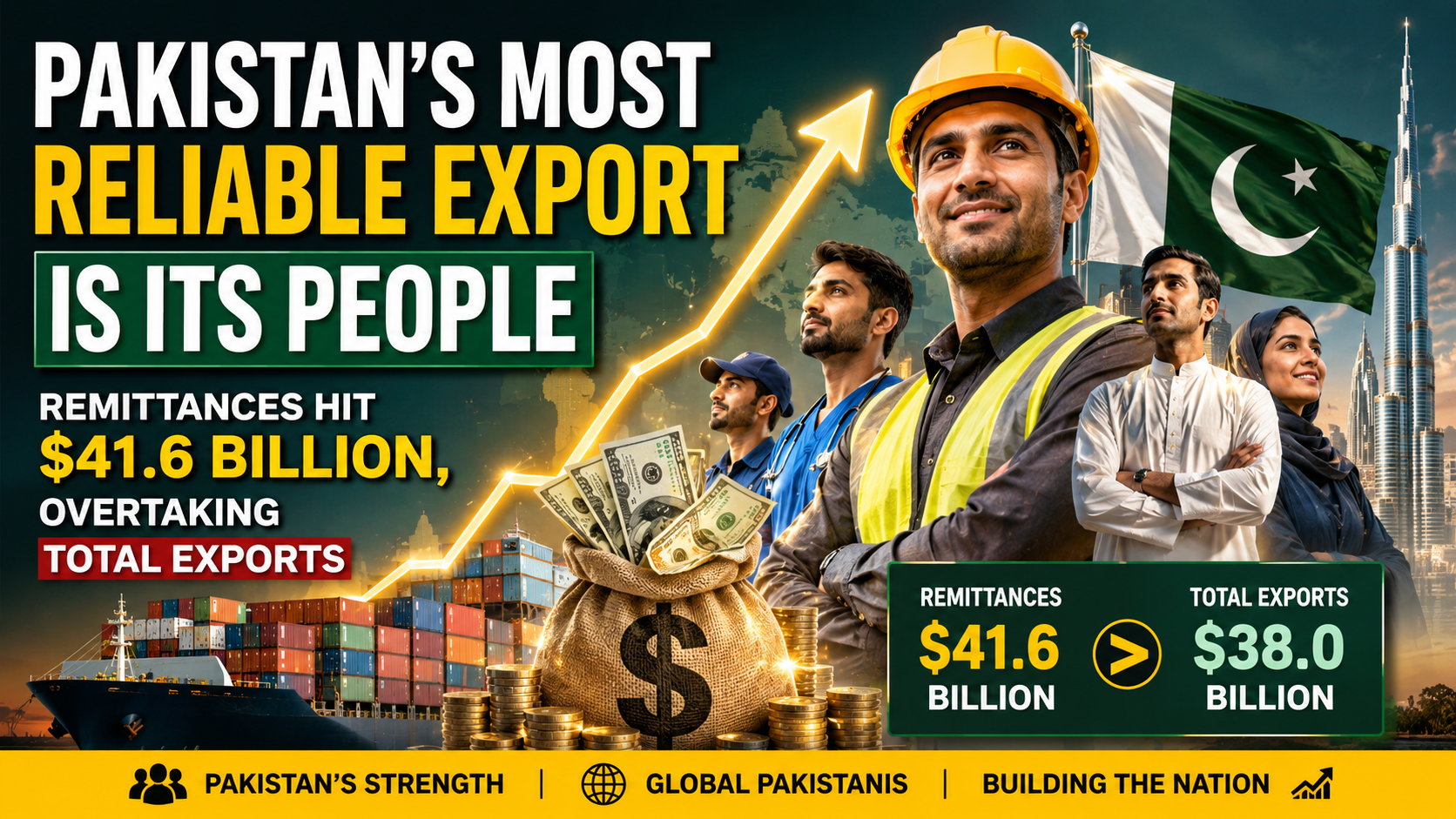
Pakistan’s Most Reliable Export Is Its People: Remittances Hit $41.6 Billion, Overtaking Total Exports
Introduction
For the first time in the country’s history, money sent home by Pakistan’s overseas workers has exceeded the value of everything Pakistan actually sells abroad. Remittances hit a record $41.6 billion in the fiscal year ending June 30, 2026, according to State Bank of Pakistan data — surpassing total merchandise exports for the same period and cementing a structural shift that economists are increasingly uneasy about (VOI World/State Bank of Pakistan).
The Numbers Behind the Milestone
Remittance inflows rose 8.6% year-on-year in FY26, up from $38.3 billion in FY25 (VOI World). Some reporting puts the full 11-month figure even higher at $38 billion before the final month was tallied, with May 2026 alone contributing $4.25 billion — an amount roughly equal to what the entire country spends on imports in a single month (Express Tribune). A separate Express Tribune report puts the full FY26 total even higher, at $41.58 billion, an increase of nearly $3.29 billion over the prior year, delivered “without structured educational, training or welfare support” for the overseas workforce generating it (Express Tribune — Remittances Without Structured Support).
Saudi Arabia remained the single largest source of remittances in June 2026 at $829.6 million, followed by the UAE ($792.3 million), the United Kingdom ($514.9 million) and the United States ($296.8 million), with Italy and Oman each contributing more than $100 million (VOI World). That geographic concentration matters: a substantial share of Pakistan’s remittance base originates from the Gulf, leaving the country’s external account exposed to labor market reforms, economic cycles and geopolitical developments concentrated in a single, currently volatile region (Business Recorder Editorial).
Exports Have Been Stuck for Years
The remittance surge stands in sharp contrast to Pakistan’s export performance, which has shown little sustained dynamism despite years of concessional financing, preferential tariff regimes and subsidized energy for exporters (Business Recorder Editorial). The textile sector — long considered the backbone of Pakistan’s export economy — has been stuck in a $15–18 billion annual range for years, even as a handful of forward-thinking textile groups have managed to grow exports and diversify product lines under the exact same operating conditions others cite as prohibitive (Express Tribune). Separately reported nine-month data for the fiscal year showed exports contracting 5.8% to $23.3 billion even as imports rose nearly 8% to $46.8 billion, widening the trade gap further (Minute Mirror).
Over the three fiscal years from 2023 to 2025, Pakistan received $95.8 billion in remittances compared with $91 billion in merchandise exports — a gap that reflects, according to Business Recorder analysis, a deliberate policy orientation that has effectively institutionalized remittances as the default tool for stabilizing the current account rather than addressing the underlying export weakness (Business Recorder Opinion).
The Dutch Disease Warning
Independent economists have begun explicitly framing this pattern as a precursor to Dutch disease — the phenomenon where a large, easy source of foreign currency inflow reduces the pressure and incentive to build a competitive tradeable export sector (Business Recorder Opinion). The policy dimension is not incidental: under IMF program conditions, a long-standing subsidy that had encouraged banks to actively mobilize remittance transfers was withdrawn in the 2026 Budget, contributing to a temporary slowdown in inflows during the early months of the fiscal year before the government released Rs30 billion from its contingency fund to help revive momentum (Business Recorder Opinion).
A Business Recorder editorial published in July 2026 was blunt about the implication: Pakistan’s overseas workers have effectively become the country’s “most reliable export,” with its own people functioning as its largest export commodity — a framing the editorial explicitly calls an unsustainable foundation for long-term development strategy (Business Recorder Editorial).
The Silver Linings
The remittance boom has provided genuine macroeconomic stabilization. Total liquid foreign reserves crossed $23.98 billion as of early July 2026, including $18.47 billion held by the State Bank of Pakistan itself, with the rupee holding relatively steady around Rs278 per dollar in the interbank market (Express Tribune — Remittances Without Structured Support). Inflation has also been easing, and large-scale manufacturing showed signs of recovery with 5.9% growth in earlier-reported data, while agricultural lending rose 14.4% during July–February, extending credit access to farmers (Minute Mirror). Separately, Pakistan has reportedly repaid roughly Rs4,722 billion in debt ahead of schedule and posted a historic milestone in IT sector exports, suggesting pockets of genuine structural improvement exist alongside the broader export stagnation (Radio Pakistan).
Why This Matters Beyond Pakistan
Pakistan’s experience is a useful case study for other remittance-dependent emerging economies navigating IMF program conditions. The core tension — using a reliable, low-effort capital inflow to paper over a harder structural problem in the tradeable goods sector — is not unique to Pakistan, but few economies illustrate the scale of the imbalance as starkly as a country where remittances now formally exceed total exports.
Key Takeaways
- Pakistan’s FY26 remittances hit a record $41.6 billion, surpassing total merchandise exports for the first time in the country’s history.
- Saudi Arabia and the UAE remain the largest single sources, concentrating external account risk in the Gulf region.
- Textile exports have been stuck between $15–18 billion annually for years despite sustained government support.
- Economists are increasingly framing the remittance-export imbalance as a Dutch disease risk rather than a stabilization success story.
- Reserves have strengthened to nearly $24 billion and the rupee has stabilized, but the underlying export competitiveness problem remains unresolved.
Sources: VOI World, Express Tribune — Remittances Dwarf Exports, Express Tribune — Remittances Without Structured Support, Business Recorder Opinion, Business Recorder Editorial, Minute Mirror, Radio Pakistan
Discover more from The Economy
Subscribe to get the latest posts sent to your email.
Markets & Finance
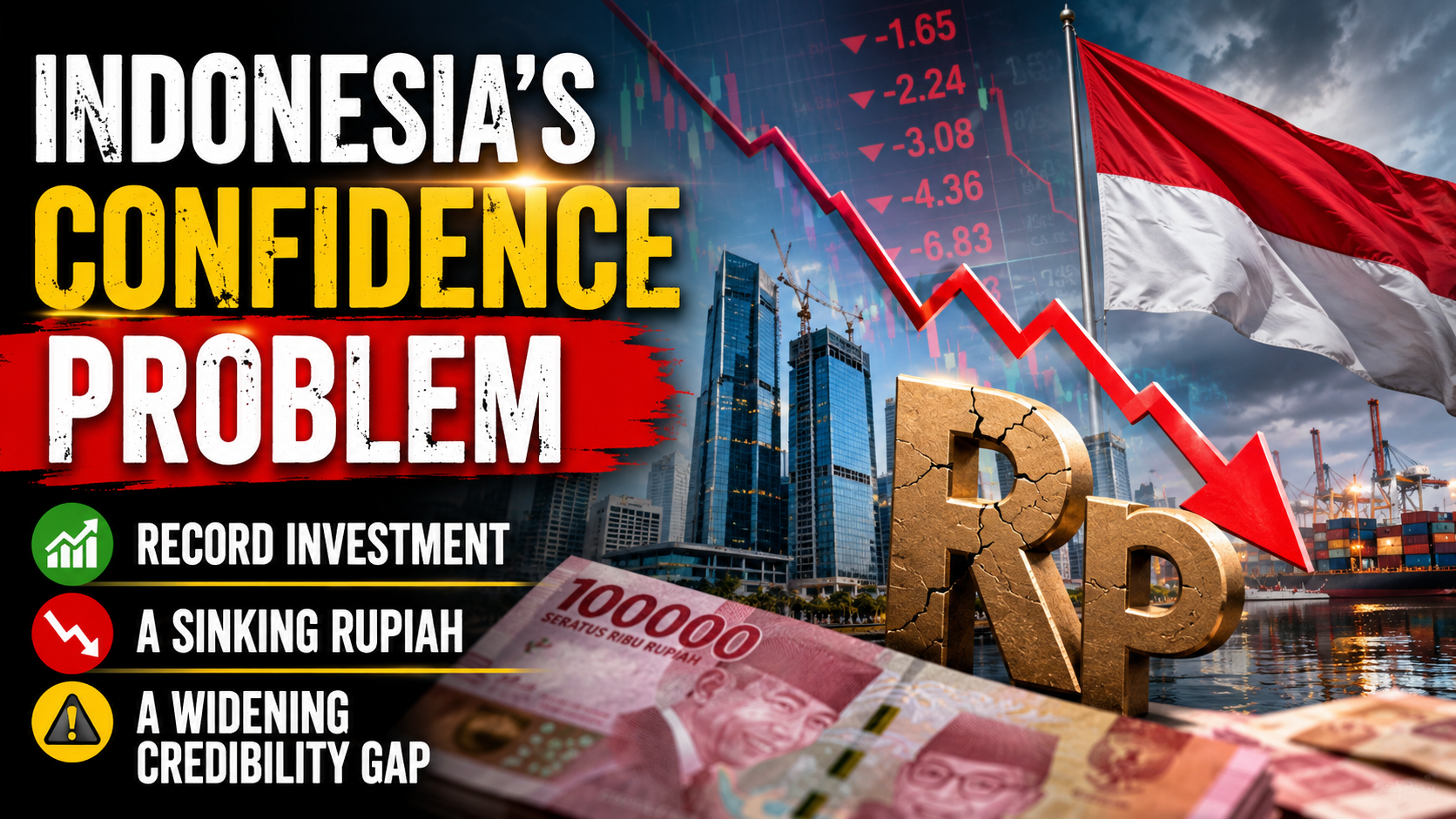
Indonesia’s Confidence Problem: Record Investment, a Sinking Rupiah, and a Widening Credibility Gap
Introduction
Indonesia’s economic story in mid-2026 is one of genuine contradiction. On one hand, the government posted a record Rp1,010.6 trillion ($56.1 billion) in realized investment for the first half of the year, up 7.2% from a year earlier and on pace to hit its full-year target (Antara News). On the other, the rupiah has been sliding toward Rp18,000 per US dollar, the state budget deficit has widened, and a growing chorus of domestic commentators is warning that Indonesia risks permanently losing what one Jakarta Post analysis called “the vital game of investor confidence” (The Jakarta Post).
The Investment Numbers Look Genuinely Strong
Indonesia’s Investment and Downstreaming Minister Rosan Roeslani reported that first-half 2026 investment realization reached 49.5% of the government’s full-year target of Rp2,041.3 trillion, creating 1.44 million jobs — a 15% increase in job creation compared to the first half of 2025 (Antara News). Domestic and foreign investment remained almost perfectly balanced, with foreign direct investment reaching Rp507.6 trillion (50.2% of the total) against Rp502.9 trillion in domestic investment (Antara News). Notably, investment outside the country’s most populous island, Java, exceeded inflows into Java itself for the first time in this dataset — Rp507.8 trillion versus Rp502.8 trillion — supporting the government’s long-standing goal of more balanced regional development (Antara News).
Singapore remained by far Indonesia’s largest source of foreign capital at $8.8 billion, followed by Hong Kong ($7.6 billion), China ($3.9 billion), Japan ($1.9 billion) and the United States ($1.7 billion) — together accounting for roughly 77.8% of all foreign direct investment into the country (Antara News). Second-quarter investment specifically rose 7.1% year-on-year to Rp511.8 trillion, with Minister Roeslani noting that investor commitment to Indonesia has held up despite significant “geopolitical and geoeconomic challenges” globally (The Jakarta Post).
But the Pace Is Slowing, and the Currency Is Under Pressure
Despite the record absolute figures, the Jakarta Post notes that investment growth in 2026 has been running at a distinctly slower pace than the country achieved in recent prior years, even as it remains on track to hit the annual target (The Jakarta Post). Meanwhile Bank Indonesia has had to actively respond to renewed rupiah weakness, attributing the currency’s slide toward Rp18,000 per dollar to hawkish signals from Federal Reserve officials and broader movements in the US dollar index (Samuel Sekuritas Daily Economic Insights). The state budget deficit reached Rp196.5 trillion in the first half of 2026, equivalent to 0.76% of GDP (Samuel Sekuritas Daily Economic Insights).
There has been some relief more recently: a 27.4% surge in second-quarter foreign direct investment helped strengthen the rupiah, with USD/IDR trading around 17,990 in mid-July as softer US inflation data reduced the odds of a near-term Fed hike (TMGM). Even so, the US dollar has retained broad support from escalating Middle East geopolitical tensions, keeping the rupiah’s recovery fragile rather than decisive (TMGM).
Why Growth Forecasts Keep Getting Trimmed
International lenders have grown more cautious about Indonesia’s growth trajectory for 2026. The OECD has held its outlook at 4.7% year-on-year — a clear deterioration from 2025’s realized 5.1% growth — with most major lending institutions clustering around the 5.0% threshold, implying a loss of momentum after Indonesia posted 5.61% growth in the first quarter of 2026 alone (Indonesia Investments). The deceleration is attributed to a softening labor market, weakening consumer confidence, and contracting retail sales in the second quarter (Indonesia Investments). High global oil prices are compounding the pressure on the government’s fiscal balance, since Indonesia continues to subsidize a significant portion of domestically sold fuel — a policy that transmits global energy volatility directly into the state budget rather than shielding consumers from it entirely (Indonesia Investments).
The Deeper Warning: A Confidence Problem, Not Just a Cyclical One
The most pointed recent critique comes from domestic commentary rather than foreign analysts. A Jakarta Post opinion piece published July 20, 2026 argues Indonesia must halt what it describes as erratic policymaking and institutional erosion before the country permanently damages its standing in the “vital game of investor confidence,” framing the rupiah’s weakness and shifting global market conditions as symptoms of a deeper credibility issue rather than purely external shocks (The Jakarta Post). That framing matters for how the strong headline investment numbers should be read: capital is still arriving, but the terms on which it arrives, and the confidence with which it stays, are visibly more fragile than the raw totals suggest.
Strategic Bright Spots
Not every recent development points toward strain. India secured access to Indonesian critical minerals through several major agreements signed during Prime Minister Narendra Modi’s visit to Jakarta, part of a broader push by Indonesia to leverage its resource base for deeper strategic partnerships (Samuel Sekuritas Daily Economic Insights). Indonesia is also pursuing energy independence through B50 biodiesel and compressed natural gas development, aimed explicitly at reducing reliance on imported LPG — a structural move that, if successful, would reduce exactly the kind of imported-energy vulnerability now straining the budget (Samuel Sekuritas Daily Economic Insights).
Key Takeaways
- Indonesia posted a record Rp1,010.6 trillion ($56.1 billion) in H1 2026 investment, up 7.2% year-on-year, with foreign and domestic capital nearly evenly split.
- The rupiah has weakened toward Rp18,000 per dollar on hawkish Fed signals, though a Q2 FDI surge has since provided partial relief.
- International lenders have trimmed Indonesia’s 2026 growth outlook to around 4.7–5.0%, down from 5.1% realized growth in 2025.
- The H1 2026 budget deficit reached 0.76% of GDP, pressured by continued fuel subsidies amid high global oil prices.
- Domestic commentary increasingly frames Indonesia’s challenge as a credibility and policymaking issue, not merely a cyclical external shock.
Sources: Antara News, The Jakarta Post — Investment Growth, The Jakarta Post — Confidence Game, Samuel Sekuritas Daily Economic Insights, Indonesia Investments, TMGM
Discover more from The Economy
Subscribe to get the latest posts sent to your email.
Introduction
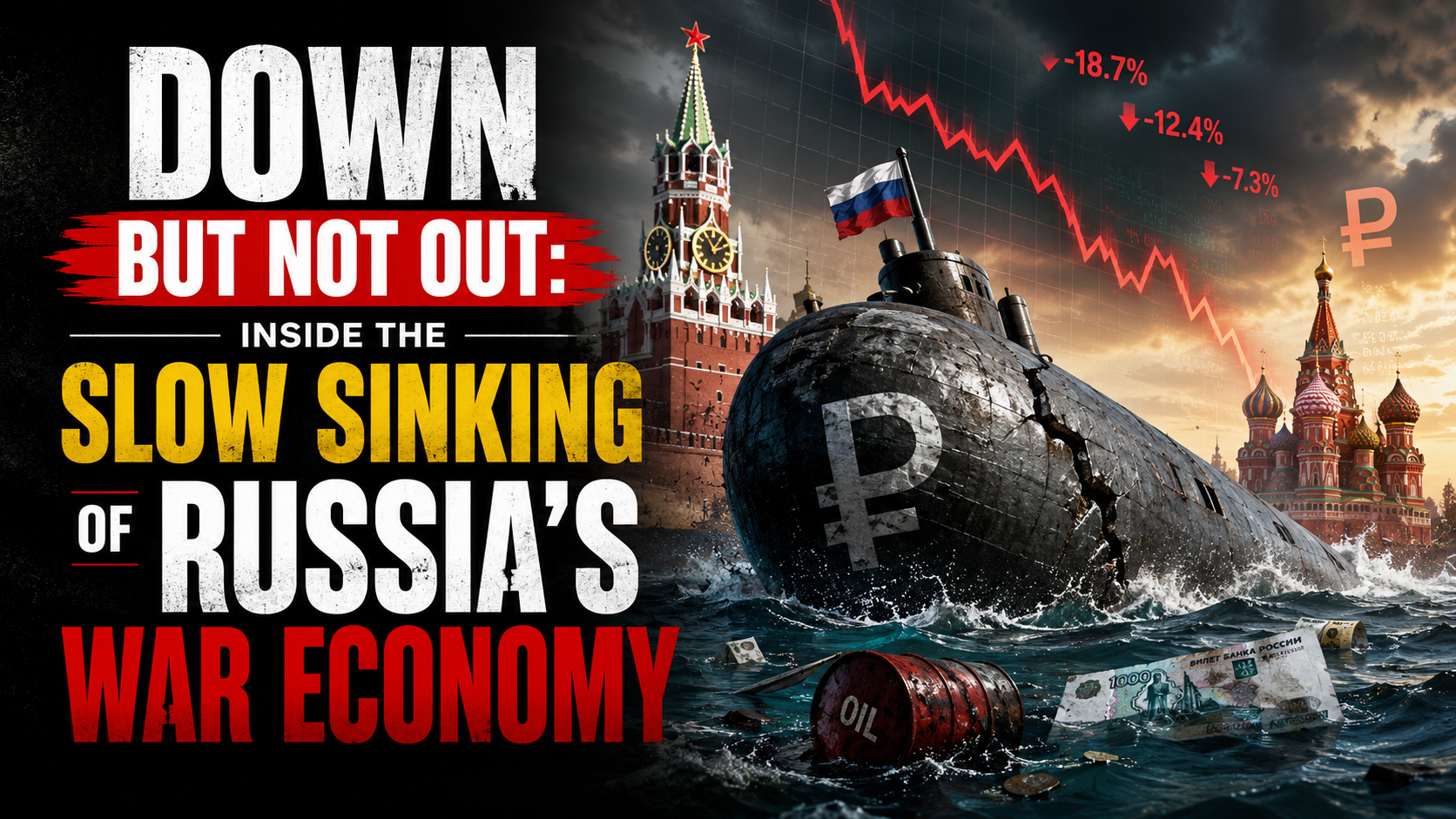
The European Council formally extended its economic sanctions against Russia for another full year on 25 June 2026, keeping restrictive measures in place until 31 July 2027 (Council of the EU). More than four years into the war, the headline story of Russia’s economy has shifted from whether sanctions would work to a more nuanced question: how much longer can the Kremlin keep financing the war before the accumulated strain becomes impossible to hide behind favorable official statistics.
The Sanctions Architecture, Renewed Again
The EU’s economic measures against Russia, first introduced in 2014 and dramatically expanded after the February 2022 full-scale invasion, now span trade, finance, energy and dual-use technology restrictions, alongside asset freezes and travel bans on a broad range of individuals and entities (Council of the EU). Since February 2022, the EU has adopted 20 separate sanctions packages, and the European Council has explicitly stated it remains determined to keep weakening Russia’s war economy by further reducing its energy revenues, curbing shadow-fleet oil shipping operations and constraining its banking system (Council of the EU). Separately, on 3 July 2026 the EU sanctioned six individuals connected to the poisoning and death of opposition figure Alexei Navalny, underscoring that the sanctions regime continues to expand on human-rights grounds as well as economic ones (Council of the EU Sanctions Timeline).
The Headline Numbers Beijing-Style Optimism Can No Longer Explain Away
Russia’s GDP is now put at roughly $2.51 trillion, the world’s eleventh-largest economy — comparable in size to South Korea despite Russia’s vastly larger landmass and resource base — with 2026 growth projected at just 1.0% and inflation running at 5.2% (Statistics of the World). More pessimistic estimates put full-year 2026 growth even lower, at around 0.4%, which would be worse than 2025’s already-weak 1% expansion and would mark a sharp deceleration from the 4.1% growth Russia posted in 2023 as it forged new trading relationships to route around initial sanctions (Forbes).
Oil and gas revenues — historically around half of Russia’s state income — have fallen to roughly a quarter, a deliberate outcome of Western sanctions strategy that targets how much Russia earns from exports rather than blocking those exports outright (Stockholm School of Economics/SITE). Russia’s oil and gas budget revenues reportedly halved in January 2026 alone, with crude prices falling below $73 a barrel before the Middle East conflict briefly reversed the trend, sending Brent surging more than 55% to near $120 a barrel at its peak (Forbes).
The Middle East War: A Temporary Lifeline With Long-Term Costs
The spike in oil prices tied to the Iran conflict, combined with a period of eased US sanctions enforcement on Russian oil under President Trump, offered Moscow unexpected fiscal breathing room in mid-2026 (Forbes). But that same conflict has undermined Russia’s longer-term energy diversification ambitions in the region: two Russian-backed power plant projects in Iran have been put on hold, along with oil and gas exploration work and plans to build new transit routes linking Russia to India via Iran (Forbes).
The Gap Between Official Statistics and Underlying Reality
Perhaps the most important analytical point from recent research is not about any single data point but about the reliability of Russian statistics themselves. Torbjörn Becker of the Stockholm Institute of Transition Economics has argued the real test of sanctions is not whether they end the war overnight, but how much they erode the Kremlin’s capacity to finance it — and by that measure, the evidence points to deeper strain than headline GDP figures suggest (Stockholm School of Economics/SITE). Becker notes that Russia’s economy grew only modestly in 2022 despite oil prices rising sharply that year — a gap between expected and actual performance that implies a considerably larger hidden economic hit than the official contraction figures showed (Stockholm School of Economics/SITE). Compounding the problem, Russian authorities have stopped publishing several key statistics since 2022, making independent assessment of inflation, consumption and real economic conditions increasingly difficult — leading Becker to conclude that “statistics have become part of the narrative” rather than a neutral measure of economic reality (Stockholm School of Economics/SITE).
The Military-Civilian Economic Split
A recurring theme across recent analysis is the growing bifurcation between Russia’s overheating military-industrial sector and a stagnating civilian economy. This imbalance has pushed interest rates higher and forced the liquidation of a striking 71% of Russia’s gold reserves to help fund continued war spending (Forbes). Russia’s total fossil fuel export revenue is estimated at roughly €734 million per day, underscoring just how central hydrocarbon income remains to the entire war financing model even as that revenue stream shrinks (Forbes).
The Counter-Narrative: Wages Still Rising
It would be inaccurate to describe Russia’s economy as in freefall. CSIS research notes that Russian salaries rose 17.8% in nominal terms and 8.7% in real terms in 2024 compared to 2023, with disposable incomes up 6.1% in 2023 and 7.3% in 2024 — growth rates not seen in Russia in almost two decades (CSIS). Government budget projections still expect real salaries to rise, albeit at a decelerating pace: 7% in 2025, 5.7% in 2026 and 4.1% in 2027 — a marked slowdown from the 2024 peak but still roughly double the pre-invasion decade average (CSIS). This wage growth, driven substantially by wartime labor shortages and military-adjacent spending, is precisely the kind of headline-stabilizing data point that has allowed Putin to argue publicly that sanctions have failed to cripple his economy (Fortune) — even as think tanks describe the broader trajectory as pushing Russia toward what one report calls an “economic, political, and military abyss” (Fortune).
What Comes Next
Renewed legislative pressure in Washington — including the Sanctioning Russia Act introduced with strong bipartisan support — signals appetite in the US for tightening the screws further, even as the loss of a key congressional champion for that effort has complicated the political path forward (TIME). Whether the EU’s renewed sanctions regime, continued oil price pressure, and constrained reserves ultimately force a shift in Kremlin calculus toward negotiation remains the central open question for 2027.
Key Takeaways
- The EU has extended Russia sanctions for a further year, through 31 July 2027, continuing a regime built from 20 separate packages since 2022.
- Russia’s 2026 GDP growth is forecast between 0.4% and 1.0%, a sharp deceleration from 2023’s 4.1% post-shock rebound.
- Oil and gas revenue’s share of Russian state income has fallen from roughly half to about a quarter as Western sanctions target export earnings specifically.
- Russia has liquidated a large share of its gold reserves to sustain war financing amid a widening split between an overheating military sector and a stagnating civilian economy.
- Official Russian statistics likely understate the true economic strain, according to independent economists who cite a widening gap between reported and expected performance.
Sources: Council of the EU, Council of the EU Sanctions Timeline, Stockholm School of Economics/SITE, Forbes, Statistics of the World, CSIS, Fortune, TIME
Discover more from The Economy
Subscribe to get the latest posts sent to your email.

Global Central Banks 2026: Fed, BoE and BoJ Decisions Could Reshape Markets

Gulf Capital Retreat From Pakistan 2026: UAE Loan Freeze & What It Means

Pakistan’s Most Reliable Export Is Its People: Remittances Hit $41.6 Billion, Overtaking Total Exports

Indonesia’s Confidence Problem: Record Investment, a Sinking Rupiah, and a Widening Credibility Gap

Down But Not Out: Inside the Slow Sinking of Russia’s War Economy

China’s Growth Slips to a Four-Year Low: Why Beijing Still Won’t Pull the Stimulus Trigger

The Johor-Singapore Corridor: How Malaysia Became Southeast Asia’s AI Infrastructure Powerhouse

Canada’s Economy ‘On Pause’: Inside the CUSMA Deadline That Passed Without a Deal

Dubai’s Millionaire Magnet: How the UAE Turned Middle East Turmoil Into a Capital Safe-Haven Boom

Britain’s Sixth Prime Minister in a Decade: What Starmer’s Exit Means for Gilts, Sterling and Your Portfolio

Anthropic Offers Up to $600,000 Salary for Critical IPO Role as AI Giant Prepares for Wall Street Debut

EU Readies Crisis Team for Potential China Rare Earths Stand-Off as Supply Chain Risks Mount

Singapore Weighs Hedge Fund Tax Cuts to Counter Hong Kong’s Growing Financial Challenge

Facebook and Instagram Experience Global Outage

Carry Trade Unwind 2026: How the Yen’s Snapback Triggered a Global Margin Call

AI Bubble Warning 2026: Why BIS, IMF and Bank of England Fear a Market Crash

BRICS De‑Dollarization Strategy Takes Shape with $15 Billion Local‑Currency Push

Male Labor Force Participation Rate 2026: Why Men Are Leaving & Economic Impact

The AI Super Bubble Is Ready to Burst

Russia Bans Diesel Exports 2026: Global Fuel Market Impact Explained

Strait of Hormuz Blockade 2026: Oil Prices Surge 9% as US-Iran Conflict Reignites

Private Credit Warning: Most BDCs Turn Unprofitable in 2026, Reuters Finds

IMF Cuts Pakistan Growth Forecast, Raises Inflation to 8.4%

Bitcoin $150k Milestone Achieved as US Sovereign Crypto Pivot Looms
Gulf Capital Retreat From Pakistan 2026: UAE Loan Freeze & What It Means

India Economic Rise 2026: How the Subcontinent Toppled Japan

Strait of Hormuz 2026: Why Markets Still Don’t Trust It’s Open

Argentina Economy 2026: Milei’s Fiscal Surplus, Inflation Drop to 29%, and What Comes Next
-

 Markets & Finance7 months ago
Top 15 Stocks for Investment in 2026 in PSX: Your Complete Guide to Pakistan’s Best Investment Opportunities
-

 Analysis5 months ago
Johor’s Investment Boom: The Hidden Costs Behind Malaysia’s Most Ambitious Economic Surge
-

 Analysis5 months ago
Top 10 Stocks for Investment in PSX for Quick Returns in 2026
-

 Analysis6 months ago
Brazil’s Rare Earth Race: US, EU, and China Compete for Critical Minerals as Tensions Rise
-

 Banks6 months ago
Best Investments in Pakistan 2026: Top 10 Low-Price Shares and Long-Term Picks for the PSX
-

 Investment7 months ago
Top 10 Mutual Fund Managers in Pakistan for Investment in 2026: A Comprehensive Guide for Optimal Returns
-

 Global Economy7 months ago
15 Most Lucrative Sectors for Investment in Pakistan: A 2025 Data-Driven Analysis
-

 Global Economy7 months ago
Pakistan’s Export Goldmine: 10 Game-Changing Markets Where Pakistani Businesses Are Winning Big in 2025
Pingback: Pakistan's Startup Revival: How Hybrid Financing Drove a $74 Million Surge in 2025 - The Economy
Pingback: K-Electric Tariff Cut Sparks $2B Arbitration Crisis - The Economy