
Industory
Tesla Cybercab and Robotaxi Economics in a Post-Midterm Environment


Tesla is banking on its next phase being the Cybercab, a purpose-built robotaxi without a steering wheel or pedals, and a robotaxi network it says will reach more cities by the end of 2026. In early November, Elon Musk said that production of the Cybertruck at Gigafactory Texas would be wound down around mid-2027 to make way for expansion of the Cybercab. The economics still aren’t there. Tesla hasn’t given any figures on the volume of Cybercab production, the margin per vehicle or a fact-checked retail price, while the company’s own timetable for unsupervised driving has slipped before.
Key Takeaways
- Musk said on November 6, 2026 that Cybertruck production at Gigafactory Texas will wind down around mid-2027 to free space for Cybercab expansion, according to Complex.
- Texas DMV figures cited in the same coverage put about 570 Cybercabs among more than 1,200 Tesla robotaxis operating in the state, though those counts should be checked against the DMV’s own filings.
- Tesla expanded its robotaxi network to San Antonio in November, which 24/7 Wall St described as its eighth live robotaxi city, per 24/7 Wall St.
- A U.S. regulator, the National Highway Traffic Safety Administration, opened a formal audit into Tesla’s Cybercab self-certification, according to reporting on the company’s Q3 call.
- Musk has said material Cybercab revenue is unlikely before 2027, which makes the 2026 numbers a test of execution rather than earnings.
What Tesla Has Actually Said
Tesla’s Q3 2026 shareholder update reported nearly two million cumulative unsupervised robotaxi miles, and the company changed its metric from cumulative paid miles to unsupervised miles before reporting. That change matters. Unsupervised miles are a measure of technical capability, not of revenue.
Autonomy chief Ashok Elluswamy told investors that expansion is technology-driven, meaning service hours and geographic reach grow as software handles more conditions. Tesla said Cybercab expansion would begin in Dallas in November 2026 and spread to other cities by year-end. Those are company statements, and they have not been independently verified.
Tesla has also said that Cybercab production began at Giga Texas, with output expected to ramp slowly. Musk described early output as a slow S-curve, and several analyses flagged a gap between the production milestone and the unsupervised-driving milestone that would make the vehicle commercially useful.
The Price Question
Reports in mid-November described a Cybercab offer at $29,990 with a $299 monthly autonomy subscription, with deliveries slated for December. That figure appeared in a social-media-driven report and has not been confirmed in a Tesla release or a regulatory filing in the sources we reviewed. Editors should treat it as unverified until Tesla publishes a price sheet.
The price matters for the economics. A vehicle sold to a consumer creates a one-time margin. A vehicle run by Tesla as part of its own fleet earns revenue per mile. Tesla has said, in the coverage reviewed, that every Cybercab built at Giga Texas currently goes into its own robotaxi fleet. If that remains true, the company’s economics depend on utilization, insurance costs, cleaning and charging, and remote oversight, not on vehicle sales.
A Simple Unit-Economics Framework
Robotaxi economics come down to four variables. Consider each one before accepting a headline projection.
Vehicle cost. The cost to build a Cybercab, including batteries, sensors, and compute, determines how long a fleet vehicle must run to recover its price. Tesla has not disclosed this figure.
Utilization. A robotaxi earns revenue only while carrying passengers. Hours of service, geographic coverage, and demand density all affect utilization. Austin service runs from 6 a.m. to midnight, according to Tesla’s Q3 disclosures, which means overnight hours are unproductive.
Operating cost per mile. This includes charging, cleaning, remote assistance, insurance, maintenance, and depot labor. Robotaxi operators disclose these costs rarely, so forecasts rely heavily on assumptions.
Regulatory cost. A federal audit, state permits, and local rules add compliance costs and can limit where the vehicle operates. The NHTSA audit into Cybercab self-certification is the clearest current example.
A simple sensitivity check helps. If a Cybercab costs a given amount, earns a given revenue per paid mile, and runs a given number of miles per year, the payback period changes sharply with each variable. Doubling the vehicle cost, or halving utilization, can turn a profitable case into a loss. Without disclosed inputs, readers should treat any single payback estimate as illustrative.
The Cybertruck Wind-Down
Musk’s November statement that the Cybertruck would end production at Gigafactory Texas around mid-2027 is an unusual signal. The Cybertruck has faced 11 recalls reported to NHTSA since deliveries began in November 2023, according to Complex’s coverage. Musk said the order backlog exceeds what Tesla can build before the line is converted, and that the company will add an extra shift to fill outstanding orders.
Some buyers may not receive vehicles on their original timeline, and Musk said Tesla would return deposits to many customers. For investors, the move shows that Tesla is prioritizing Cybercab capacity over a product that has struggled with quality and sales. It also shows that factory space, not just demand, is the binding constraint.
Regulation and Safety
The most important near-term risk may be regulatory. A formal NHTSA audit into a self-certified vehicle with no steering wheel or pedals raises questions about how the vehicle meets federal safety standards. Any delay could slow the Dallas launch and later expansion.
The regulatory environment is also shifting. Several states and cities have debated autonomous vehicle rules, and insurance and liability frameworks are still developing. Readers should watch for federal guidance, state permits, and any statement by NHTSA on the audit’s scope.
The Post-Midterm Context
The midterm results shifted the policy environment for autonomous vehicles in ways that remain unclear. Divided or constrained federal government reduces the likelihood of sweeping new federal AV legislation in the near term. That leaves most rules to regulators and states.
Financial conditions also matter. Tesla’s stock reflects expectations for robotaxi revenue more than current vehicle sales, so a risk-off market can hit the shares even when operating news is positive. Treasury yields and the cost of capital affect how expensive it is to finance a large fleet, which matters for a company that must buy or build vehicles before it earns revenue from them.
What to Watch
- Dallas launch timing and service hours. Watch whether Cybercab service in Dallas starts in November or December, and whether it operates outside daytime hours.
- NHTSA audit outcome. Any finding or restriction would affect expansion plans.
- Tesla’s disclosed unit metrics. Look for cost per vehicle, paid miles, and fleet size in future filings, not just unsupervised miles.
- Cybertruck deposit handling. How Tesla returns deposits will reveal how it balances customer obligations against factory conversion.
- Competitor pricing. Waymo and other robotaxi operators set benchmarks for fares, coverage, and safety that Tesla will be measured against.
Frequently Asked Questions
How many Cybercabs are on the road? Texas DMV figures cited in November coverage put roughly 570 Cybercabs among more than 1,200 Tesla robotaxis in Texas. Tesla has not published an independent fleet count, so treat the figure as approximate.
Is the Cybercab for sale to consumers? Reports in mid-November described a consumer offer, but Tesla had not published a confirmed price sheet in the sources reviewed. Check Tesla’s official website before relying on any price.
Why is Tesla ending Cybertruck production? Musk said the Gigafactory Texas line will be converted to Cybercab production around mid-2027, and that the Cybertruck backlog is larger than what Tesla can build before the conversion.
When will the Cybercab generate material revenue? Musk has said material revenue is unlikely before 2027. Tesla has not provided a formal revenue forecast for the vehicle.
What regulatory risk does the Cybercab face? NHTSA opened a formal audit into Tesla’s self-certification of the Cybercab. Outcomes could affect where and how quickly the vehicle can operate.
Are robotaxi economics better than ride-hailing? Potentially, if utilization and operating costs are favorable, because a robotaxi removes the driver’s wage. However, insurance, charging, cleaning, remote support, and capital costs can offset those savings. No operator has published audited results that settle the comparison.
Conclusion: A Hardware Bet With Unproven Economics
The Cybercab is a serious product bet and Tesla has made real progress on production and city expansion. But the economics rest on disclosed inputs the company has not yet published: unit cost, paid utilization and operating cost per mile. Readers should know the difference between production milestones and revenue milestones and track the NHTSA audit. The post-midterm landscape brings regulatory uncertainty and keeps cost of capital in focus.
Discover more from The Economy
Subscribe to get the latest posts sent to your email.


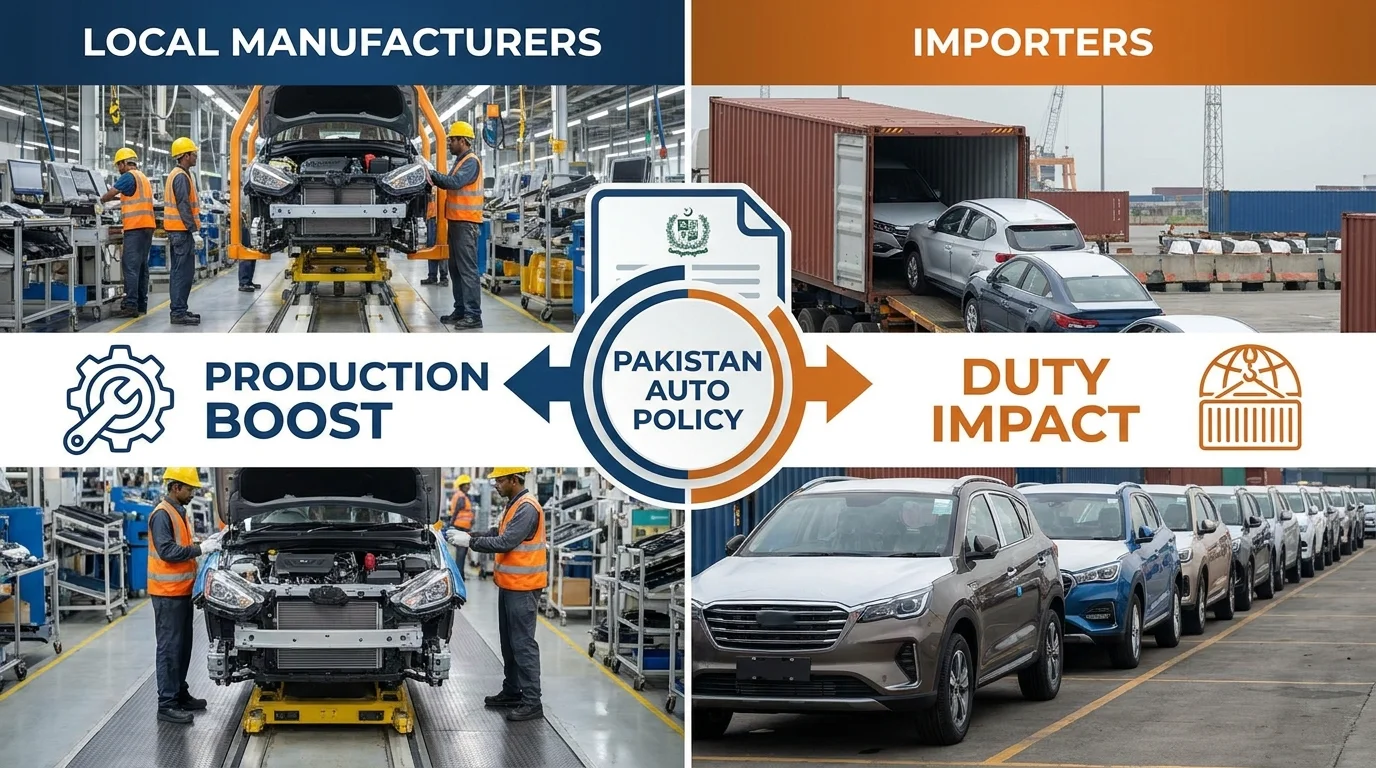
The proposed Pakistan Auto Policy 2026–31 marks a critical turning point for the country’s automotive sector, challenging a long-standing regime of tariff and tax protection for domestic assemblers. By systematically phasing down customs duties and introducing targeted concessions for local electric vehicle (EV) manufacturing, the framework seeks to balance market competition with industrial growth. As traditional assemblers face intensifying pressures to cut costs and innovate, this article examines the structural shifts, strategic trade-offs, and policy milestones that will shape the future of Pakistan’s automotive landscape.
Key Takeaways
- The IMF pushed for lower net weighted average tariffs in the auto sector, aiming for single-digit levels and an end to protection for existing assemblers, according to Express Tribune’s April 2026 reporting.
- Cabinet-approved versions of the policy described customs duties of 20% to 50% in 2026-27 falling to 15% by 2030 for the higher slabs, with the 20% slab moving to 10% and the 15% slab to 5%, per Express Tribune.
- The draft proposes a 1% sales tax on parts used to build EVs locally, which favors localized EV production.
- Hybrid concessions have ended under the new framework, and hybrid sales tax was reported to have risen from 8.5% to 25% from July 1, 2026.
- Assemblers have argued that abrupt protection cuts threaten their investments, and the transition timing is the central dispute.
The Core Trade-Off
The policy balances two goals that pull in different directions. The first is to protect and build local manufacturing, which requires some degree of protection while factories scale and supplier networks develop. The second is to lower vehicle prices and open the market to competition, which requires reducing that protection.
Policymakers have tried to reconcile these goals through phased duty cuts, incentives for local EV production, and a five-year timeline. Whether that reconciliation works depends on the speed of the cuts and how assemblers respond.
Who the Policy Affects
Four groups face the most direct effects.
Existing assemblers produce vehicles in Pakistan under protection and local-content arrangements. They face the largest shift, as tariffs fall and competition from imports and new entrants increases.
New EV and hybrid manufacturers may benefit from tax concessions on EVs and EV parts, but they face uncertainty about the final tax structure and the treatment of hybrids.
Importers of fully built vehicles gain access to lower duties over time. Their margins may improve, though they face competition from local assemblers that also adjust prices.
Parts suppliers face shifting demand. Those that serve assemblers may see volume changes, while those that supply EV components may see new opportunities.
Consumers are also affected, though indirectly. Lower duties and more competition could reduce prices, but only if the savings pass through to buyers.
The Protection Question
Protection has shaped the Pakistani auto industry. Tariffs and tax treatment have helped domestic assemblers compete with imports, but they have also kept prices higher and limited incentives to improve cost and quality. The IMF has pressed for a sector opening, arguing that lower protection would improve efficiency.
The sources reviewed describe the IMF’s position in several rounds of talks. In April 2026, the Express Tribune reported that the IMF would vet the auto policy before cabinet approval, with a goal of lowering tariffs to 6% by 2030 and ending protection for assemblers. In June, reporting described the IMF refusing to accept a 1% sales tax on new energy vehicles, creating inter-ministerial disagreement. The final approach appears to have softened some of those positions, though the IMF has not fully signed off.
For local manufacturers, the message is clear: the protection they have relied on is being phased out, and they must adapt.
Effects on Established Assemblers
Established assemblers face several pressures.
Price competition. Lower duties on imported completely built units allow importers to undercut local prices on comparable models. Assemblers must respond by cutting costs, improving product mix, or accepting lower margins.
Volume risk. If imports take share, factories running below capacity may struggle to cover fixed costs. Assemblers with narrow product lines face the greatest risk.
Investment decisions. Assemblers need to decide whether to invest in new models, EV lines, or export capacity. Those decisions depend on how stable the policy remains and whether the duty schedule holds.
Supplier relationships. Local-content requirements currently tie many assemblers to domestic suppliers. Changes in duty treatment on imported components could shift sourcing choices.
Assemblers that can reach scale, improve quality, and build EV or hybrid capability have a better chance of surviving the transition. Those that depend on protection alone face a difficult adjustment.
Effects on Importers
Importers gain from lower duties, but the benefit is gradual. The phase-down runs over several years, and importers must plan around the schedule. They also face demand uncertainty, since buyers may wait for prices to fall further.
Importers of EVs may benefit more directly, since the draft policy proposes concessions and exemptions for EVs in a defined price band. Those advantages are narrowed by the price cap, however, and they apply only once the policy is notified.
Importers should also watch compliance rules. Safety, emissions, and consumer-protection requirements can add costs for importers that must meet new standards.
The Local Content Question
The policy’s treatment of local content is central to its impact on manufacturers. Local content rules aim to build supplier capacity and reduce import dependence. But they can raise costs if local parts are more expensive or less reliable than imports.
The proposed 1% sales tax on parts used to produce EVs locally is designed to encourage domestic EV production. It is a targeted incentive for local manufacturing of electric vehicles, and it shows the policy favoring localization in the EV segment.
Local suppliers will need to scale up to benefit. Assemblers may find that imported parts remain cheaper for some components, which could limit local content gains unless suppliers improve quality and cost.
The Hybrid Question
Hybrid vehicles have become a contested category. Under the old policy, concessions for hybrids were available, and that concession ended with the expiration of the previous auto policy on June 30, 2026. Sales tax on hybrids and plug-in hybrids was reported to rise from 8.5% to 25% from July 1, according to ProPakistani. The draft policy would set PHEVs at 9% and REEVs at 6%, but the final treatment of hybrids depends on the notified rules.
The hybrid question matters for manufacturers because several Japanese assemblers have introduced their own hybrids to defend market share, according to Express Tribune’s coverage. Hybrid pricing will shape competition in the mid-market.
Effects on Parts Suppliers
Parts suppliers serve both assemblers and aftermarket buyers. The policy affects them in two ways.
First, changes in vehicle volumes flow directly to component demand. If assembly volumes fall in the short term, suppliers face lower orders. If EV assembly grows, demand for battery components, electronics, and drivetrain parts could rise.
Second, duty changes on imported components affect supplier competitiveness. Lower duties on imported parts may make some local suppliers less competitive, while reduced sales tax on EV parts may help suppliers that serve EV programs.
Suppliers that can document quality, meet export certification, and offer competitive prices stand to benefit most.
Effects on Consumers
Consumers should benefit from more competition, but the outcome depends on several factors. If assemblers cut prices to match imports, buyers gain directly. If assemblers keep prices high and rely on profit margins, the benefit is smaller.
The policy also aims to make vehicles more affordable for middle and lower-middle income buyers. The main channels are lower taxes on EVs, larger EV loans, and reduced import duties over time. Whether those channels deliver lower prices for conventional cars is less certain.
Timing Risks
The transition timeline is the policy’s biggest risk. A five-year phase-down gives assemblers time to adjust but also leaves room for policy reversal. If future governments reinstate protection, investors who committed to a reduced-protection model could suffer losses.
Conversely, if the phase-down happens too quickly, assemblers may face sudden margin pressure, which could lead to plant closures and job losses. The sources reviewed show that timing has been a central point of contention between the government and the IMF, and between ministries.
What Good Implementation Would Look Like
A well-implemented policy would have several features.
- Predictable duty schedules published in advance, so assemblers and importers can plan.
- Clear local-content rules that reward quality and cost improvement rather than simply mandating domestic parts.
- Support for export readiness, so assemblers can use scale to compete abroad.
- Consumer-facing transparency on how tax changes affect prices.
- Regular reviews that adjust the policy if assemblers or consumers face unintended harm.
What to Watch
- Final cabinet and parliamentary approval, which will confirm the duty and tax schedule.
- IMF sign-off, which the policy depends on for several concessions.
- Assembler investment announcements, including EV lines and new model launches.
- Import volumes and prices, which show how quickly competition is increasing.
- Hybrid market share, which will show how buyers respond to the tax changes.
- Supplier financial health, which indicates whether the local base is holding up.
Frequently Asked Questions
Will local car assemblers be hurt by the policy? Some will face more competition and must adjust. Assemblers with scale, quality, and EV capability are better placed. Those that depend mainly on protection face the greatest risk.
Will importers benefit? Yes, over time, as customs duties fall. The benefit is gradual and depends on the notified schedule and the final policy terms.
What does the policy mean for EV manufacturers? Concessions on EVs and local EV parts are designed to encourage local production. Final treatment depends on notification and the price band.
Are hybrids still favored? Hybrid concessions have ended under the new framework, and hybrid sales tax was reported to rise in July 2026. The draft applies lower rates to REEVs and PHEVs than to hybrids, but final rules matter.
Why did the IMF push for lower protection? The IMF wants a more efficient and open auto sector with lower tariffs. It aims to reduce protection that keeps prices high and limits competition.
Will car prices fall? Possibly, for some models, as duties fall and competition increases. The effect depends on how assemblers and importers respond, and on exchange rates.
Conclusion: A Managed Opening
At its core, the Auto Policy 2026–31 is a test of political will and industrial adaptability. It attempts a delicate balancing act: weaning established assemblers off decades of tariff protection while planting the seeds for an electric vehicle ecosystem. For local manufacturers, the era of guaranteed margins is closing, replaced by an urgent mandate to innovate, localize, and scale. For importers and consumers, the promise of wider choice and lower prices hangs in the balance, contingent on strict adherence to the tariff schedule and stable macroeconomic conditions. As the policy moves from draft to notification—and undergoes final IMF scrutiny—the real measure of its success won’t be found in its tax slabs, but in whether Pakistani buyers finally get better, safer, and more affordable vehicles.
Discover more from The Economy
Subscribe to get the latest posts sent to your email.

Nvidia’s stock has fallen sharply in November 2026, driven by governance reports involving CEO Jensen Huang, concern about slower U.S. data center construction, and doubts about whether hyperscaler AI spending can keep rising. The company reports fiscal third-quarter results on November 17, and options markets were pricing an unusually large move of about 10.6% in either direction. Investors now need to separate the business, which remains strong on reported guidance, from the sentiment and governance risks that drove the selloff.
Key Takeaways
- Nvidia shares fell about 9.3% on November 5, 2026, their largest one-day drop in a year, according to Trefis.
- On November 9, shares fell 4.3%, wiping out roughly $190 billion in market value, after reports of an investigation into whether an alleged Chinese intelligence operation targeted Huang, per MarketPulse.
- Nvidia’s board announced an independent investigation on November 8 while expressing confidence in Huang, according to InvestingLive.
- Nvidia’s revenue guidance for the quarter was about $108 billion, plus or minus 2%.
- Options markets priced a move of about ±10.6% around earnings, above the stock’s 10-year average earnings-day move of ±7.8%.
What Happened in November
The selloff came in stages. Nvidia fell 4.22% on October 30, then about 7% over the five sessions ending November 4, according to Crypto Briefing. The 9.3% drop on November 5 was the largest in a year.
Three drivers overlapped:
- AI spending doubts. Investors questioned whether hyperscaler capex, which has been Nvidia’s main demand driver, can keep growing as cash flow tightens. (See our article on AI infrastructure sustainability for detail.)
- Data center constraints. Local moratoriums and ballot measures against data centers threaten to slow construction, and construction timing drives chip orders. (See our article on data center backlash.)
- Governance headlines. Reports about the investigation and about the board’s deliberations over Huang’s leadership added a company-specific risk premium.
Reports have said that Nvidia’s board was preparing to consider changes in leadership, according to a Wall Street Journal report summarized by InvestingLive. That report is unconfirmed by the company as of this writing, and editors should verify the latest board statements before publication.
The Business Picture Has Not Broken
Nvidia’s operating results remain strong by most measures. Analysts expect revenue and earnings per share to rise roughly 90% year over year for the quarter, and guidance points to continued growth. The stock’s forward price-to-earnings ratio has also been described as near a five-year low, which some investors see as a sign that expectations have reset.
Still, guidance quality matters more than the headline. Investors will focus on three items.
Data center revenue and hyperscaler orders. Growth in sales to large cloud customers is the clearest signal of whether AI infrastructure spending is sustaining.
Gross margin. Analysts have flagged rising memory prices as a pressure on gross margin, which some estimates place in the 71% to 72% range. A margin decline would matter as much as a revenue miss.
China exposure. Nvidia’s guidance has excluded most China data center sales, according to coverage from TIKR. Any update on export restrictions or China demand could move the stock.
What to Watch on November 17
Earnings are scheduled for about 4:20 p.m. Eastern Time, with a conference call at 5 p.m. Eastern. Focus on the following:
- Actual revenue versus the roughly $108 billion guide, and the size of the next-quarter guide
- Commentary on customer demand, particularly from hyperscalers and enterprises
- Data center timing and power constraints, which determine when orders convert to revenue
- Any update on the governance investigation, including statements about leadership
- Capital allocation, including buybacks and any change in investment plans
Expect volatility. The options-implied move of about 10.6% means a double-digit change is plausible in either direction.
Valuation: Why Some Analysts See Value
Valuation is the main debate. Bulls argue that the stock trades near its cheapest forward earnings multiple in five years while earnings have roughly doubled. Bears argue that the multiple is cheap only if earnings keep growing, which depends on AI spending that is now under scrutiny.
Two points keep this debate balanced. First, a lower multiple can reflect legitimate concerns rather than a bargain. Second, a strong quarterly report does not resolve longer-term questions about demand durability and competition. Nvidia has faced competitors such as AMD and Broadcom, and some investors rotated toward those names during the selloff.
Risks to Keep in View
- Concentration. Nvidia is one of the largest companies in the market, so its moves affect index funds and retirement accounts.
- Governance uncertainty. An unresolved investigation or leadership change could cause further volatility regardless of operating results.
- Customer concentration. A large share of revenue comes from a small number of hyperscalers, whose spending plans can shift.
- Policy risk. Export controls, data center moratoriums, and AI regulation could slow demand.
Frequently Asked Questions
Why did Nvidia stock fall in November 2026? Several factors combined: a sharp drop on November 5 tied to AI spending doubts, reports about an investigation involving CEO Jensen Huang, and concern that data center construction could slow due to local opposition.
When does Nvidia report earnings? Nvidia is scheduled to release fiscal third-quarter 2027 results on November 17, 2026, at about 4:20 p.m. Eastern Time, with a call at 5 p.m. Eastern.
What is Nvidia’s revenue guidance? Coverage cites guidance of about $108 billion, plus or minus 2%, for the quarter. Check the company’s official release for the exact figure.
Is Jensen Huang leaving Nvidia? Nvidia’s board announced an independent investigation and expressed confidence in Huang on November 8. A Wall Street Journal report said the board was preparing to consider leadership changes. No change had been confirmed by the company as of this writing.
Is Nvidia stock cheap now? Analysts disagree. Some point to a forward multiple near a five-year low. Others argue the multiple reflects risks to growth. This article does not offer investment advice.
What should I watch besides the headline earnings number? Gross margin, data center revenue, guidance for the next quarter, and any update on the governance investigation.
Conclusion: The Report Will Not End the Debate
Nvidia’s November 17 report is important, but no single quarter will settle whether the AI investment cycle is durable. Investors should look for evidence of continued demand, margin stability, and clarity on governance. Expect volatility around the report, and avoid making large decisions based on a single day’s price action.
Discover more from The Economy
Subscribe to get the latest posts sent to your email.
AMD Chief Executive Officer Lisa Su has explicitly repositioned the company as a “data center first” enterprise after the data-center segment nearly doubled year-over-year and reached approximately two-thirds of total revenue. Speaking after the third-quarter 2026 results, she stated that server revenue is expected to double in 2027 and that data-center AI revenue will grow even faster than the already-elevated expectations set only 90 days earlier. Yahoo Finance
Third-quarter revenue reached $13.4 billion, up 45 percent year-over-year, with data-center sales of roughly $8.5 billion. Gaming revenue fell about 40 percent, underscoring the internal shift in priorities. Large multi-year GPU agreements, some accompanied by warrants that give major customers potential equity upside, further illustrate the strategic bet on AI infrastructure. Observer
Table of Contents
- What Did Lisa Su Mean by “Data Center First”?
- How Strong Has Recent Data-Center Performance Been?
- What Is the Detailed 2027 Financial and Product Outlook?
- How Do the Customer Warrants and Multi-Year Deals Work?
- What Supply, Cost and Capacity Constraints Remain?
- How Does AMD’s Position Compare with Nvidia’s?
- What Are the Principal Risks to the 2027 Targets?
- What Does the Shift Mean for Consumer GPUs and Other Segments?
- Key Takeaways
- Frequently Asked Questions
What Did Lisa Su Mean by “Data Center First”?
In a Yahoo Finance interview days after the earnings release, Su stated: “We are a data center first company; that is our profile.” She added that customers need substantially more computing power to run AI applications and that AMD’s ambition is to be the best partner to the largest users of compute in the world. The remark reflects both the current revenue mix and the allocation of engineering, supply-chain and capital resources going forward. PCMag
How Strong Has Recent Data-Center Performance Been?
Data-center revenue rose nearly 100 percent year-over-year in the third quarter and accounted for approximately 64 percent of AMD’s total sales. Management guided for a further sequential increase of roughly 50 percent in the fourth quarter. Growth is being driven by Instinct GPU accelerators and EPYC server CPUs. The sharp decline in gaming revenue highlights the deliberate reallocation of priorities and wafer capacity. VideoCardz summary of Yahoo Finance interview
What Is the Detailed 2027 Financial and Product Outlook?
Su told investors that overall server revenue is expected to double year-over-year in 2027. Data-center AI revenue is projected to grow faster than the forecast given one quarter earlier. By 2027 the data-center business is expected to represent more than 80 percent of company-wide revenue. The company is already seeing demand run ahead of available supply for its latest accelerators and rack-scale systems. Yahoo Finance
How Do the Customer Warrants and Multi-Year Deals Work?
AMD has signed multi-year supply agreements that include warrants allowing certain customers to purchase AMD shares if volume and stock-price conditions are met. The arrangement with Meta, for example, covers up to six gigawatts of GPUs and includes warrants for up to 160 million shares. Similar structures have been discussed with other large buyers. The warrants give hyperscalers a direct economic interest in AMD’s success as their deployments scale, aligning incentives beyond a pure supplier-customer relationship. Observer
What Supply, Cost and Capacity Constraints Remain?
Advanced packaging, high-bandwidth memory, substrates and overall wafer capacity remain tight. Su has acknowledged that customer demand currently exceeds AMD’s ability to supply and that the company is working aggressively to expand output through 2027. These constraints, rather than lack of design wins, are the principal limit on near-term revenue growth.
How Does AMD’s Position Compare with Nvidia’s?
Nvidia continues to hold the majority of spending on the highest-end AI training GPUs and benefits from a mature software ecosystem. AMD is growing faster off a smaller base, gaining credible design wins in both training and inference, and using commercial structures such as warrants to deepen customer relationships. The “data center first” framing signals an intent to compete more directly for large-scale deployments rather than remain a secondary supplier.
What Are the Principal Risks to the 2027 Targets?
- Inability to expand supply (packaging, memory, wafers) quickly enough
- A slowdown or deferral in hyperscaler and sovereign AI capital expenditure
- Intensifying competition or pricing pressure from Nvidia
- Execution risk on new rack-scale systems and software improvements
- Export-control or geopolitical restrictions that affect certain customers
What Does the Shift Mean for Consumer GPUs and Other Segments?
With data-center products receiving priority for advanced process nodes, packaging and memory, availability and pricing of consumer graphics cards are likely to remain constrained. Gaming and client revenues are not being abandoned, but they are no longer the primary drivers of investment or growth targets.
Revenue Mix and Outlook Snapshot
| Segment | Q3 2026 Approximate Share | 2027 Direction | Primary Driver |
|---|---|---|---|
| Data Center | ~64 % | >80 % of total revenue | AI GPUs + EPYC CPUs |
| Client | Modest | Stable to moderate | Ryzen processors |
| Gaming | Declining | Secondary priority | Consoles & discrete GPUs |
Key Takeaways
- Lisa Su has explicitly labeled AMD a “data center first” company.
- Data-center revenue nearly doubled year-over-year and already represents roughly two-thirds of sales.
- 2027 guidance calls for server revenue to double and AI revenue to grow even faster than previously expected.
- Data center is projected to exceed 80 percent of total company revenue in 2027.
- Multi-year deals with customer warrants align hyperscaler incentives with AMD’s growth.
- Supply constraints remain the main near-term bottleneck.
- Consumer GPU availability is likely to stay tight as data-center priority rises.
Frequently Asked Questions
Is AMD exiting the gaming or client PC markets?
No. Those businesses continue, but data center is now the clear strategic, financial and resource-allocation priority.
How fast is the AI-specific portion of data-center revenue growing?
Faster than management projected 90 days earlier; Su highlighted clear acceleration.
Will the customer warrants dilute existing shareholders?
Dilution occurs only if the large purchase-volume and stock-price conditions are met—i.e., only if substantial growth materializes.
What is the single biggest risk to the 2027 outlook?
The ability to expand supply of advanced packaging, high-bandwidth memory and wafers quickly enough to meet demand.
How does AMD’s 2027 guidance compare with Nvidia’s trajectory?
Both companies are capacity-constrained. AMD is growing from a smaller base and is explicitly targeting share gains in large-scale AI deployments.
Does “data center first” mean consumer graphics cards will become more expensive or scarce?
Prioritization of data-center products for leading-edge capacity makes continued tightness in consumer GPU supply a reasonable expectation.
When did Su make the “data center first” statement?
In a Yahoo Finance interview in early November 2026, immediately after the Q3 earnings release.
Conclusion
Lisa Su’s declaration that AMD is now a “data center first” company crystallizes a transformation already visible in the financial results. For technology investors and industry observers the quantitative 2027 targets—server revenue doubling and data center exceeding 80 percent of sales—together with the innovative customer-warrant structures, provide clear milestones against which progress can be measured. Supply expansion remains the critical execution variable. If AMD can convert its current design wins and capacity additions into sustained shipments through 2027, the strategic pivot will have succeeded in establishing the company as a credible large-scale competitor in AI infrastructure. The next several quarters of delivery against both customer commitments and internal supply plans will be decisive.
Discover more from The Economy
Subscribe to get the latest posts sent to your email.

Tesla Cybercab and Robotaxi Economics in a Post-Midterm Environment

Impact of Pakistan’s Auto Policy on Local Manufacturers and Importers

Anthropic’s Financials and the AI Investment Thesis

Open Banking Trends 2026: What Consumers Should Know

Nvidia After the Selloff: What to Watch Before Earnings

Black Friday 2026 Early Deals: A Data-Driven Shopping Guide

Fed Policy Path 2027: Rate Expectations After the Hold

Asia’s Economic Resilience in 2026: The Strategic Blueprint for Sustaining the Global Growth Engine

Credit Scoring Changes 2026: What Mortgage Buyers Need to Know

10-Year Treasury Yield Outlook for 2027 After the Democratic Sweep

Is the AI Infrastructure Boom Sustainable? A Reality Check

Disability Insurance Demand in 2026: Who’s Buying and Why

What the 2026 Midterms Mean for Treasury Yields and Bond Markets

Payroll Outlook After the Midterms: 2027 Tax Changes, Compliance Risks and AI Trends

Dow Jones Today: Dow Slips 237 Points After the Worst Day Since April 2025

US–Iran Conflict in October 2026: Hormuz, Oil Prices and Diplomacy

Pakistan IMF Programme 2026: Why Bailouts Keep Returning

Singapore Stock Market Outlook 2027: The STI’s Bank-and-Yield Test

SSI November 2026 Payment: Why Benefits Arrive October 30

IMF Global Outlook 2027: The Recovery Is Real, but the Divide Is Growing

2027 Federal Tax Brackets: New IRS Rates and Standard Deductions Explained

World Bank Debt Report 2026: The $9.4 Trillion Burden Behind the Recovery

Stock Market Crash 2026? What the November Rout Actually Tells Us

KSE-100 Index 2026: Is Pakistan’s Stock-Market Recovery Sustainable?

Germany–France ‘Made in Europe’ Deal Could Reshape China’s EV Ambitions

Zhuhai Airshow 2026: How China’s Stealth Jets, Drones and Missiles Are Redrawing Global Air Power

Global Markets Today: The AI Sell-Off Has Become a Test of Liquidity

Singapore’s Bank Sell-Off Is Really a Test of What Stability Is Worth
-

 Markets & Finance10 months ago
Top 15 Stocks for Investment in 2026 in PSX: Your Complete Guide to Pakistan’s Best Investment Opportunities
-

 Analysis9 months ago
Johor’s Investment Boom: The Hidden Costs Behind Malaysia’s Most Ambitious Economic Surge
-

 Analysis9 months ago
Top 10 Stocks for Investment in PSX for Quick Returns in 2026
-

 Banks10 months ago
Best Investments in Pakistan 2026: Top 10 Low-Price Shares and Long-Term Picks for the PSX
-

 Analysis9 months ago
Brazil’s Rare Earth Race: US, EU, and China Compete for Critical Minerals as Tensions Rise
-

 Investment10 months ago
Top 10 Mutual Fund Managers in Pakistan for Investment in 2026: A Comprehensive Guide for Optimal Returns
-

 Global Economy11 months ago
15 Most Lucrative Sectors for Investment in Pakistan: A 2025 Data-Driven Analysis
-

 Global Economy11 months ago
Pakistan’s Export Goldmine: 10 Game-Changing Markets Where Pakistani Businesses Are Winning Big in 2025